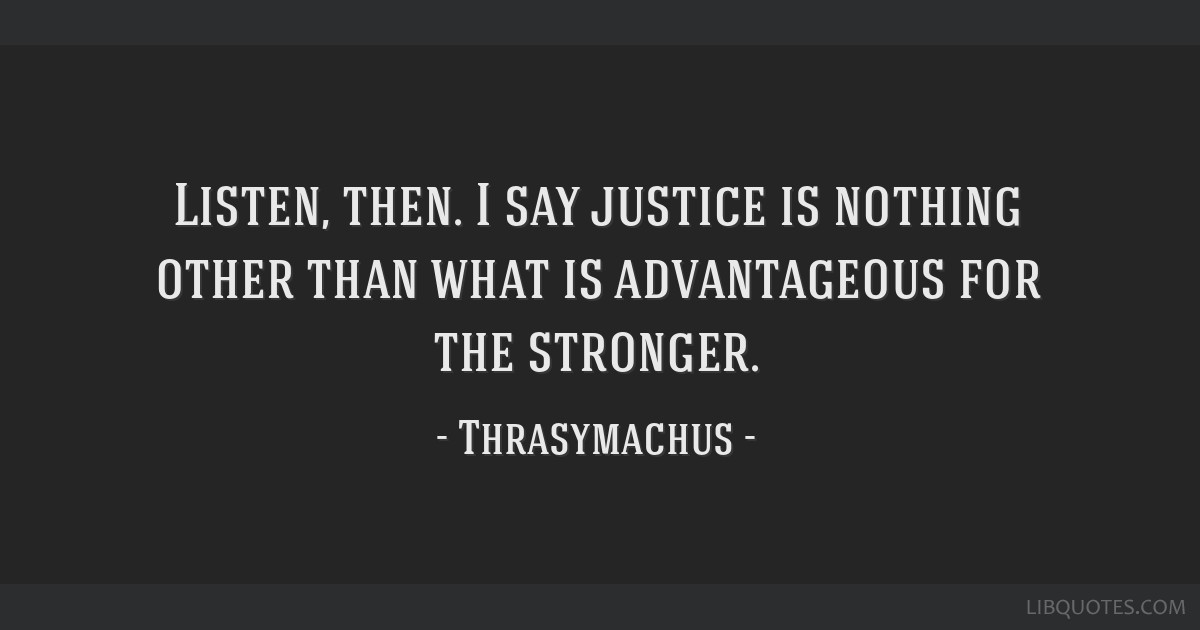
The end justifies the means

emeraldglass

emeraldglass

6'1" Gymmaxed Moroccan
Staff
Joined
Sep 20, 2022
Posts
11,638
Reputation
22,903
Now there's an old moral teaching about a man passing by a river and suddenly seeing a baby floating past, about to drown in the water. He runs into the river to save the baby. But then he sees another and another, and another, an endless number of babies floating down the river, all about to drown. Now another man appears on the shore, and the man in the river cries out to him for help. The man on the shore pauses for a moment and then starts to walk away. The man in the river shouts, 'Where are you going? You have to help me save these babies.' The man replies, 'That's what I'm doing. I'm going to find out where the babies are being placed in the river and stop it.'

So, who was right? The man in the river will certainly be able to save a few babies but will just as certainly fail to save many. The man on the shore will certainly be able to save many babies but will just as certainly fail to save a few. However, he will bring the problem to a conclusive end. The man in the river represents the moral idealist or ideological approach, while the man on the shore represents the realpolitik approach of achieving moral ends through objective and unemotional strategy. But of course, the man on the shore is also guilty of literally walking away from drowning babies whom he could save at that moment if he tried. There's no getting around that fact, but in my opinion, his approach is still superior. I think that we can frame this approach as the moral decision-making equivalent of the decision-making approach of delayed gratification.

It's similar to how you choose to sacrifice some form of immediate gratification today for greater gratification in the future. For example, it's more pleasant to just sit on your couch rather than go to the gym, and going to the gym, of course, won't provide you immediate results. Anyway, but if you go to the gym instead of sitting on your couch, eventually, the outcome is going to be far better for you than the immediate enjoyment of lazy indulgence. This is delayed gratification.

I share this with you because at some point in your life, you may have to do things that are distasteful to you in the immediate term, things that even contradict your values, perhaps, but they will be necessary if you want to achieve positive and long-term moral outcomes. Now, use this information as you see fit.
 
Last edited:

  • +1
  • Woah
  • Love it
Reactions: RAITEIII, try2beme, Infinite and 9 others
Couldn’t say it better.

IMG 6206
 
  • +1
  • JFL
Reactions: try2beme and Roquefort
1701772548174
 
  • +1
Reactions: Roquefort and horizontallytall
his means were right.

His actions are forgiven for that.
From his perspective, perhaps, but what positive outcome did he gain from it? One could argue that it actually accelerated his downfall.
 
  • Hmm...
Reactions: PseudoMaxxer
I agree with Thrasymachus on one thing.

I could wish, men of Athens, to have belonged to that long-past time when the young were content to remain silent unless events compelled them to speak, and while the older men were correctly supervising affairs of State. But since Fate has so far advanced us in time that we must obey others as rulers but must suffer the consequences ourselves; and when the worst results are not the work of Heaven or Fate but of our administrators, then it is necessary to speak.
 
  • Hmm...
  • WTF
Reactions: Fiqh and Deleted member 21345
Good one I read all of it but I still didn't understand the message
 
  • JFL
  • +1
Reactions: Primalsplit, Whitepill_Saint and emeraldglass
The ends justifying the means might be true, but for everytime a immoral action is committed in service of some greater moral good a piece of the person committing the immoral actions is damaged. In theory committing a whole bunch of immoral actions towards an end moral goal might be goood and favourable, but in practice the character of the man committing the immoral actions gets damaged to the point where the man never reaches his ultimate moral goal, and only ends up corrupting himself with nothing but means without any end.

Doing heroin is probably not bad if you do it once, it's a fun experience and doesn't pose huge amounts of risks when you use it a single time. However people who use heroin rarely use it one time. Why? Because by using heroin they become more susceptible to using it again, and a piece of their character is changed. I would compare this to the person doing immoral actions in service of some greater moral good, eventually he will get lost.
 
Last edited:
  • +1
Reactions: Infinite, Deleted member 19911 and horizontallytall
Do what is immediately satisfying and you’ll end up doing the same thing for years learnt this the hard way tbh
 
  • +1
Reactions: emeraldglass
Good one I read all of it but I still didn't understand the message
The message is simple: as a man navigating life, you will inevitably meet situations that need difficult or strategic judgments. In my opinion, accomplishing your goals or making the best decisions may necessitate abandoning certain ideals and values in certain circumstances. Although some emotional thought is still required, it is best to prioritize rational reasoning over pure feeling.

This story illustrates a dilemma between immediate action and strategic, long-term solutions in addressing moral issues. The man in the river represents a moral idealist, saving babies one by one, while the man on the shore embodies a realpolitik approach, aiming to stop the root cause.
 
  • +1
  • Love it
Reactions: Deleted member 27152 and wsada
water is wet
 
The ends justifying the means might be true, but for everytime a immoral action is committed in service of some greater moral good a piece of the person committing the immoral actions is damaged. In theory committing a whole bunch of immoral actions towards an end moral goal might be goood and favourable, but in practice the character of the man committing the immoral actions gets damaged to the point where the man never reaches his ultimate moral goal, and only ends up corrupting himself with nothing but means without any end.

Doing heroin is probably not bad if you do it once, it's a fun experience and doesn't pose huge amounts of risks when you use it a single time. However people who use heroin rarely use it one time. Why? Because by using heroin they become more susceptible to using it again, and a piece of their character is changed. I would compare this to the person doing immoral actions in service of some greater moral good, eventually he will get lost.
I agree that using the end justifies the means in every decision is unnecessary and impractical, therefore, I would not propose it for every foreseeable scenario. Instead, a healthier method involves promoting rational thinking while simultaneously considering emotions. In fact, my statement has an accompanying lesson. It emphasizes the need of thinking strategically and thinking about long-term implications rather than putting instant pleasure ahead of duty.
 
water is wet
No, water is not inherently wet. Wetness is a property that describes the state of a material when it comes into contact with a liquid. Water itself is the liquid that can make other substances wet, but by itself, it doesn't exhibit the property of wetness.
 
I agree that using the end justifies the means in every decision is unnecessary and impractical, therefore, I would not propose it for every foreseeable scenario. Instead, a healthier method involves promoting rational thinking while simultaneously considering emotions. In fact, my statement has an accompanying lesson. It emphasizes the need of thinking strategically and thinking about long-term implications rather than putting instant pleasure ahead of duty.

Rational thinking while simultaneously considering emotion is obvious, and not relevant to whether the ends justify the means. Same with long term thinking instead of instant pleasure.

My grapple is that a person that puts the ends over the means will corrupt himself, even if he just does it once. If a person lies to gain a promotion do you really think he won't do it again?
 
Rational thinking while simultaneously considering emotion is obvious, and not relevant to whether the ends justify the means. Same with long term thinking instead of instant pleasure.
It is actually quite relevant since, while making judgments, adopting the mentality that the goal justifies the means helps to avoid any potential emotions that may otherwise impair your judgment.
My grapple is that a person that puts the ends over the means will corrupt himself, even if he just does it once. If a person lies to gain a promotion do you really think he won't do it again?
Maybe I should have clarified that when I mentioned "the ends justify the means," I meant to highlight how it may be applied to make quick judgments in situations that are beneficial and necessary, not to support its usage in situations when morality is called into question.
 
It is actually quite relevant since, while making judgments, adopting the mentality that the goal justifies the means helps to avoid any potential emotions that may otherwise impair your judgment.

Maybe I should have clarified that when I mentioned "the ends justify the means," I meant to highlight how it may be applied to make quick judgments in situations that are beneficial and necessary, not to support its usage in situations when morality is called into question.

If that is your point and is has nothing to do with morality then its as obvious as saying don't fall in a volcano
 
If that is your point and is has nothing to do with morality then its as obvious as saying don't fall in a volcano
Does it? Explain.
 
Does it? Explain.

If you talk about doing what's best for you long term instead of giving into short-term pleasure, that seems obvious. Thinking rationally instead of emotionally is also obvious. That is if that is what you meant.
 
  • +1
Reactions: emeraldglass
No, water is not inherently wet. Wetness is a property that describes the state of a material when it comes into contact with a liquid. Water itself is the liquid that can make other substances wet, but by itself, it doesn't exhibit the property of wetness.
water is wet
 
tag me in these threads you're a real wordsmith yakhi 🤙🤙🤙🚬🚬🚬
 
  • +1
Reactions: emeraldglass
Bullshit essay for the most basic learnings of life
 
To me this story highlights another fact: You need both idealists and realists, and together they make an excellent team.

One saves the babies and the other goes on to fix the problem for good. Result: No baby dies if they make a good job.
 
  • +1
  • Love it
Reactions: Traxanas, RAITEIII, Deleted member 19442 and 2 others
Now there's an old moral teaching about a man passing by a river and suddenly seeing a baby floating past, about to drown in the water. He runs into the river to save the baby. But then he sees another and another, and another, an endless number of babies floating down the river, all about to drown. Now another man appears on the shore, and the man in the river cries out to him for help. The man on the shore pauses for a moment and then starts to walk away. The man in the river shouts, 'Where are you going? You have to help me save these babies.' The man replies, 'That's what I'm doing. I'm going to find out where the babies are being placed in the river and stop it.'

So, who was right? The man in the river will certainly be able to save a few babies but will just as certainly fail to save many. The man on the shore will certainly be able to save many babies but will just as certainly fail to save a few. However, he will bring the problem to a conclusive end. The man in the river represents the moral idealist or ideological approach, while the man on the shore represents the realpolitik approach of achieving moral ends through objective and unemotional strategy. But of course, the man on the shore is also guilty of literally walking away from drowning babies whom he could save at that moment if he tried. There's no getting around that fact, but in my opinion, his approach is still superior. I think that we can frame this approach as the moral decision-making equivalent of the decision-making approach of delayed gratification.

It's similar to how you choose to sacrifice some form of immediate gratification today for greater gratification in the future. For example, it's more pleasant to just sit on your couch rather than go to the gym, and going to the gym, of course, won't provide you immediate results. Anyway, but if you go to the gym instead of sitting on your couch, eventually, the outcome is going to be far better for you than the immediate enjoyment of lazy indulgence. This is delayed gratification.

I share this with you because at some point in your life, you may have to do things that are distasteful to you in the immediate term, things that even contradict your values, perhaps, but they will be necessary if you want to achieve positive and long-term moral outcomes. Now, use this information as you see fit.

Your reasoning is actually based on utilitarianism. You want to minimize evil and maximize good. In your case, the man who stops people from drowning babies achieves the most good and the least evil compared to the person who rescues the babies immediately.

If you want to make "ends justify the means" an absolute rule, then you need to consider the cases below

1. Would you save 1 man, if it requires you to sacrifice/kill 1000 people ?

You would clearly say no, since the end doesn't seem to justify the means here.

Even if the numbers were inverted ( kill 1 to save 5 ), your moral reasoning can be used to justify organ harvesting, which is an abhorrent practice.

2. There is also another serious problem with using utilitarianism. How do you weigh the greater good and give priority to people once you begin treating them as tools ?

Would you give the moral approval to the state if it wants to kill your elderly parents to save a young nuclear scientist who can do greater good for your country ? Nope, you would not.

3. In fact, utilitarianism can be incompatible with "ends justify the means"

Suppose 1,000,000 people are stranded in an island with food resources that can keep 100,000 alive max. If you were to maximize the greater good for the greatest number of people, you would give food to everyone but end up with everyone dead in the long run. Here, you would either need to abandon utilitarianism or "ends justify the means"
 
Last edited:
  • Hmm...
  • +1
Reactions: Deleted member 19442 and emeraldglass
Your reasoning is actually based on utilitarianism. You want to minimize evil and maximize good. In your case, the man who stops people from drowning babies achieves the most good and the least evil compared to the person who rescues the babies immediately.

If you want to make "ends justify the means" an absolute rule, then you need to consider the cases below

1. Would you save 1 man, if it requires you to sacrifice/kill 1000 people ?

You would clearly say no, since the end doesn't seem to justify the means here.

Even if the numbers were inverted ( kill 1 to save 5 ), your moral reasoning can be used to justify organ harvesting, which is an abhorrent practice.

2. There is also another serious problem with using utilitarianism. How do you weigh the greater good and give priority to people once you begin treating them as tools ?

Would you give the moral approval to the state if it wants to kill your elderly parents to save a young nuclear scientist who can do greater good for your country ? Nope, you would not.

3. In fact, utilitarianism can be incompatible with "ends justify the means"

Suppose 1,000,000 people are stranded in an island with food resources that can keep 100,000 alive max. If you were to maximize the greater good for the greatest number of people, you would give food to everyone but end up with everyone dead in the long run. Here, you would either need to abandon utilitarianism or "ends justify the means"
The nuanced perspective I offered in the OP is oversimplified by you. The difference might be due to a different interpretation of the perspective.

The man on the beach, symbolizing the realpolitik approach, does not necessarily advocate for the ruthless sacrifice of individual life. Instead, he emphasizes the need of addressing the underlying problem in order to avoid repeated catastrophes. The man on the beach is not apathetic rather he is strategically focused.


Furthermore, the utilitarian examples provided, such as sacrificing one for the greater good, do not perfectly align with the realpolitik approach I described. The realpolitik viewpoint, as described in my text, proposes a more comprehensive strategy which seeks to balance quick action with a long-term, systematic solution while not expressly encouraging excessive sacrifices.

I think the difference is rooted in how the realpolitik method is interpreted, which, when viewed as a balanced and compassionate strategy, corresponds with the emphasis on resolving the core cause for a more sustainable moral conclusion.
 
Furthermore, the utilitarian examples provided, such as sacrificing one for the greater good, do not perfectly align with the realpolitik approach I described. The realpolitik viewpoint, as described in my text, proposes a more comprehensive strategy which seeks to balance quick action with a long-term, systematic solution while not expressly encouraging excessive sacrifices.

I think the difference is rooted in how the realpolitik method is interpreted, which, when viewed as a balanced and compassionate strategy, corresponds with the emphasis on resolving the core cause for a more sustainable moral conclusion.


Realpolitik is about putting morality aside and using the best strategy to achieve your goals, whatever they be good or evil.

This theory is usually invoked when we discuss international relations between countries. But even on that level, it's hardly the only theory in political science.

It rests on 2 assumptions

1. International countries don't have any sovereign or judge that can enforce justice or police countries when there is a conflict of interest between them. Anarchy is always in the background

2. Each country is taking care of its interests and goals in light of 1

The most well known proponent of this theory is none other than Machiavelli.

Is this "Realpolitik" approach applicable on a personal or organizational level in a community or country ? No

Even if you end up as a CEO of a company with your disregard for ethics, it will come to hurt your company in the long run. Your customers will lose trust in you and you will lose the best workers to other organizations.

Even if you are a military leader, your troops will respect you and be ready to die at your command if you don't use them as mere tools.

You might retort that one should always display a good image and do the neccesary work for it. But if that's the case, then there is no good in being a hypocrite. You will either be exposed or be forced to make up for it.

All this said, realpolitik is incompatible with Islam, and pretty much every other religion out there. Your religion has principles which can never be compromised, whatever the goals. Eg, you can't burn people alive as a punishment. You are the representative of God on earth, you are bound by his rules and goals, which place morality at the forefront.
 
Last edited:
the end justifies the memes..........
 
  • JFL
Reactions: emeraldglass

Similar threads

KronionTheGreat
Replies
12
Views
63
Jayan_3
J
Dejean
Replies
4
Views
36
looksmaxer3431413
looksmaxer3431413
hopelessmanlet32
Replies
3
Views
41
L(oser)ooksmaxxer
L(oser)ooksmaxxer
Mr. Squarepants
Replies
2
Views
45
T-bone123
T-bone123
unknownincel
Replies
4
Views
25
halabi
halabi

Users who are viewing this thread

Back
Top
Sponsored
Stake.us
America's #1 Social Casino
Slots, Poker & More
Join Now →