BluntestPuppy17
ChadTheoryYT
- Joined
- Feb 18, 2026
- Posts
- 6
- Reputation
- 10
The Science Behind Eye Contact: How to MAXIMIZE Your Appeal
Even normies understand the immense power of eye contact. If you ask anyone for tips on how to improve your public speaking and presence in a room, chances are they will tell you about how important eye contact is. Very few people, however, are actually able to explain the science behind why direct eye contact actually makes you more attractive to others. In this thread, I will explain the psychology and physiology behind eye contact and how you can use it to maximize your appeal in social interactions.
Disclaimer: If you're only here to learn how to be more attractive and don't care about the nerdy science stuff, skip to part three.
Even normies understand the immense power of eye contact. If you ask anyone for tips on how to improve your public speaking and presence in a room, chances are they will tell you about how important eye contact is. Very few people, however, are actually able to explain the science behind why direct eye contact actually makes you more attractive to others. In this thread, I will explain the psychology and physiology behind eye contact and how you can use it to maximize your appeal in social interactions.
Disclaimer: If you're only here to learn how to be more attractive and don't care about the nerdy science stuff, skip to part three.
PART ONE: PHYSIOLOGY
Research on the effects of eye contact is somewhat limited, but the few studies conducted on this topic reveal some extremely valuable information.
I. Arousal
There is a significant amount of evidence that suggests that direct eye contact stimulates physiological arousal in others.
There are three main models that explain how eye contact is potentially processed in the brain. First, according to the affective arousal model, eye contact can stimulate the amygdala, an area of the brain responsible for emotional arousal. Second, according to the communicative intention detector model, eye contact serves as a indicator that you want to engage in social communication. Lastly, the fast-track modulator is a newer model that suggests that different regions of the brain, such as the amygdala, orbitofrontal cortex, and fusiform gyrus form a sort of "social brain network" responsible for social cognition.

The three models of eye contact processing
So how does the process of arousal relate to attraction? According to evolutionary psychology, the human stress response may play a significant role in the formation of monogamous romantic relationships. Stress, in this context, can be either positive or negative, simply describing how your body reacts to arousing stimuli. Arousal stimulates the sympathetic nervous system, which is responsible for things like increasing your heart rate and sweating. This is why, when you are talking to someone you are attracted to, your palms get sweaty and you feel that "butterflies in your stomach" feeling as a result of your body's fight or flight response.

The physiology of romantic pair bond initiation and maintenance model
The sympathetic nervous system and the autonomic nervous system as a whole play a role in the formation of romantic relationships through emotional regulation. In addition to the autonomic nervous system, hypothalamic–pituitary–adrenal (HPA) axis is also a fundamental part of the human stress response system. The HPA is activated during social interaction and is especially active in individuals who experience high levels of passionate love. All of this suggests that stress and arousal play an important role in the formation of relationships.
II. The Neural Reward System
Research suggests that direct eye contact can stimulate the brain's neural reward (mesolimbic) pathway, comprised of the ventral tegmental area, nucleus accumbens, amygdala, and hippocampus. A study using fMRI scans found that the ventral striatum had increased activity as a result of seeing someone's direct gaze. The study also had another interesting finding: "...This activation was also dependent on facial attractiveness. For stimuli with direct gaze, ventral striatum activation increased as a function of facial attractiveness" (Hietanen). The blackpill is proven, yet again, by science. Brutal.

The mesolimbic pathway
III. Neurotransmitters
The autonomic nervous system and the process of arousal are mediated by oxytocin, a neuropeptide that many of you may already know as the "social bonding" hormone. When you engage in direct eye contact, your brain releases oxytocin, as well as other neurotransmitters such as dopamine, which is especially important for the neural reward system. These chemicals help to form strong interpersonal relationships by facilitating early attraction.
Research on the effects of eye contact is somewhat limited, but the few studies conducted on this topic reveal some extremely valuable information.
I. Arousal
There is a significant amount of evidence that suggests that direct eye contact stimulates physiological arousal in others.
There are three main models that explain how eye contact is potentially processed in the brain. First, according to the affective arousal model, eye contact can stimulate the amygdala, an area of the brain responsible for emotional arousal. Second, according to the communicative intention detector model, eye contact serves as a indicator that you want to engage in social communication. Lastly, the fast-track modulator is a newer model that suggests that different regions of the brain, such as the amygdala, orbitofrontal cortex, and fusiform gyrus form a sort of "social brain network" responsible for social cognition.
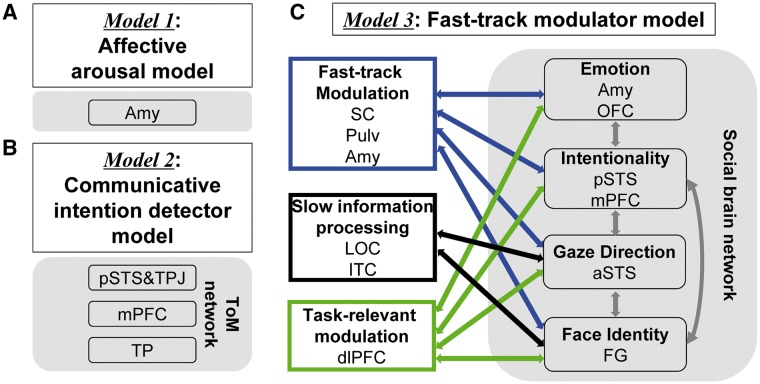
The three models of eye contact processing
So how does the process of arousal relate to attraction? According to evolutionary psychology, the human stress response may play a significant role in the formation of monogamous romantic relationships. Stress, in this context, can be either positive or negative, simply describing how your body reacts to arousing stimuli. Arousal stimulates the sympathetic nervous system, which is responsible for things like increasing your heart rate and sweating. This is why, when you are talking to someone you are attracted to, your palms get sweaty and you feel that "butterflies in your stomach" feeling as a result of your body's fight or flight response.
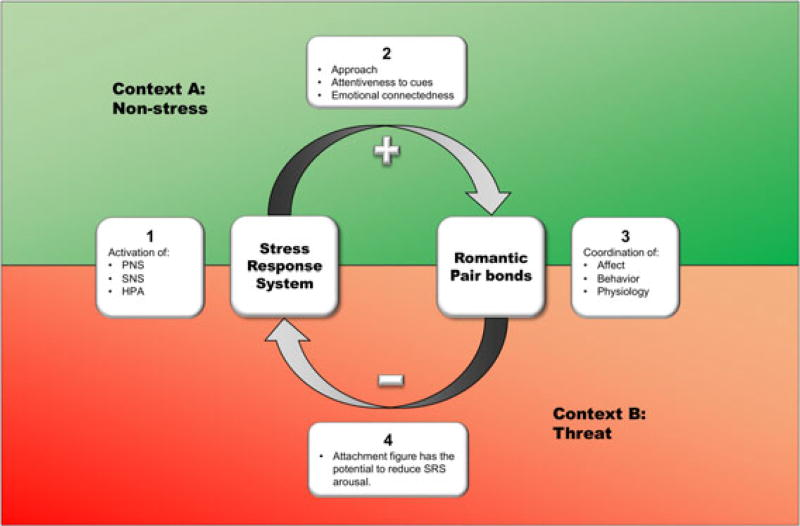
The physiology of romantic pair bond initiation and maintenance model
The sympathetic nervous system and the autonomic nervous system as a whole play a role in the formation of romantic relationships through emotional regulation. In addition to the autonomic nervous system, hypothalamic–pituitary–adrenal (HPA) axis is also a fundamental part of the human stress response system. The HPA is activated during social interaction and is especially active in individuals who experience high levels of passionate love. All of this suggests that stress and arousal play an important role in the formation of relationships.
II. The Neural Reward System
Research suggests that direct eye contact can stimulate the brain's neural reward (mesolimbic) pathway, comprised of the ventral tegmental area, nucleus accumbens, amygdala, and hippocampus. A study using fMRI scans found that the ventral striatum had increased activity as a result of seeing someone's direct gaze. The study also had another interesting finding: "...This activation was also dependent on facial attractiveness. For stimuli with direct gaze, ventral striatum activation increased as a function of facial attractiveness" (Hietanen). The blackpill is proven, yet again, by science. Brutal.
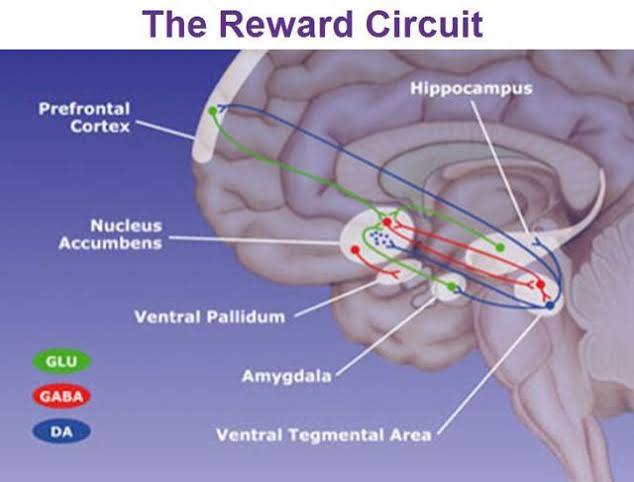
The mesolimbic pathway
III. Neurotransmitters
The autonomic nervous system and the process of arousal are mediated by oxytocin, a neuropeptide that many of you may already know as the "social bonding" hormone. When you engage in direct eye contact, your brain releases oxytocin, as well as other neurotransmitters such as dopamine, which is especially important for the neural reward system. These chemicals help to form strong interpersonal relationships by facilitating early attraction.
PART TWO: SOCIAL PSYCHOLOGY
This section is going to be a little shorter because it is really just common sense. Eye contact makes you appear more confident. It also stimulates arousal, as I explained in part one, though this arousal is not always positive. The effect of eye contact is dependent on your social situation.
Consider this scenario:
You just finished a long shift at the office and are on your way home. You sit down on the bus, across from a suspicious looking stranger. The whole time you are riding the bus, he is staring at you intensely, refusing to take his eyes off of you. Your heart is racing and you begin to sweat a little. Does this mean that you are becoming attracted towards him? Most likely, the answer is no. Eye contact is a powerful tool with potential for misuse. Like everything, it requires a balance.
Eye contact also has the interesting effect of promoting prosocial behavior and encouraging individuals to adhere to social norms. The reason for this is that eye contact influences self-control. Social interactions are likely to go smoother when you engage in direct eye contact.
This section is going to be a little shorter because it is really just common sense. Eye contact makes you appear more confident. It also stimulates arousal, as I explained in part one, though this arousal is not always positive. The effect of eye contact is dependent on your social situation.
Consider this scenario:
You just finished a long shift at the office and are on your way home. You sit down on the bus, across from a suspicious looking stranger. The whole time you are riding the bus, he is staring at you intensely, refusing to take his eyes off of you. Your heart is racing and you begin to sweat a little. Does this mean that you are becoming attracted towards him? Most likely, the answer is no. Eye contact is a powerful tool with potential for misuse. Like everything, it requires a balance.
Eye contact also has the interesting effect of promoting prosocial behavior and encouraging individuals to adhere to social norms. The reason for this is that eye contact influences self-control. Social interactions are likely to go smoother when you engage in direct eye contact.
PART THREE: PRACTICAL APPLICATIONS
In this section, I will teach you how to effectively use eye contact in social situations without looking like an idiot.
I. Oxytocinmaxxing
This could potentially be the highest-value section of this thread. I found an article that could potentially revolutionize social interactions. If you struggle with maintaining eye contact, listen up. According to this study conducted in 2015, taking intranasal oxytocin can improve eye contact for individuals both with and without autism. In this double-blind study, participants who received a dose of 24 IU of oxytocin had significantly higher levels of fixation on the eye area of a researcher compared to the placebo group. This suggests that taking intranasal oxytocin can substantially improve your eye contact and social interactions in general, regardless of whether or not you have autism.
II. The 3-5 Rule
The following information is mostly water but could still be pretty useful for normies. As I explained in part two, eye contact can have some negative effects depending on your social situation, hence why it is important to use eye contact thoughtfully and intentionally.
Good Eye Contact ≠ Staring Intensely at Someone
If you want to attract a woman, don't just stare at her. That is a pretty solid way to ruin any chance you have at a romantic relationship and be labeled a creep. Instead, hold your gaze for about 3-5 seconds and look away. Shifting your gaze periodically will make her feel more relaxed and comfortable.
III. The 50/70 Rule
When holding a conversation, you obviously want to look like you care about what the other person is saying. While you are speaking, you should only hold eye contact for about 50% of the time. When you are listening to someone else speak, increase this to 70% to show that you are an active listener.
That's pretty much all there is to it. Don't overthink eye contact, or else you might look awkward. Just remember these simple rules and act natural.
TL;DR: Looking into people's eyes makes you more attractive.
In this section, I will teach you how to effectively use eye contact in social situations without looking like an idiot.
I. Oxytocinmaxxing
This could potentially be the highest-value section of this thread. I found an article that could potentially revolutionize social interactions. If you struggle with maintaining eye contact, listen up. According to this study conducted in 2015, taking intranasal oxytocin can improve eye contact for individuals both with and without autism. In this double-blind study, participants who received a dose of 24 IU of oxytocin had significantly higher levels of fixation on the eye area of a researcher compared to the placebo group. This suggests that taking intranasal oxytocin can substantially improve your eye contact and social interactions in general, regardless of whether or not you have autism.
II. The 3-5 Rule
The following information is mostly water but could still be pretty useful for normies. As I explained in part two, eye contact can have some negative effects depending on your social situation, hence why it is important to use eye contact thoughtfully and intentionally.
Good Eye Contact ≠ Staring Intensely at Someone
If you want to attract a woman, don't just stare at her. That is a pretty solid way to ruin any chance you have at a romantic relationship and be labeled a creep. Instead, hold your gaze for about 3-5 seconds and look away. Shifting your gaze periodically will make her feel more relaxed and comfortable.
III. The 50/70 Rule
When holding a conversation, you obviously want to look like you care about what the other person is saying. While you are speaking, you should only hold eye contact for about 50% of the time. When you are listening to someone else speak, increase this to 70% to show that you are an active listener.
That's pretty much all there is to it. Don't overthink eye contact, or else you might look awkward. Just remember these simple rules and act natural.
TL;DR: Looking into people's eyes makes you more attractive.
SOURCES:
 pmc.ncbi.nlm.nih.gov
pmc.ncbi.nlm.nih.gov
pmc.ncbi.nlm.nih.gov
pmc.ncbi.nlm.nih.gov
pmc.ncbi.nlm.nih.gov
pmc.ncbi.nlm.nih.gov
pmc.ncbi.nlm.nih.gov
pmc.ncbi.nlm.nih.gov
pmc.ncbi.nlm.nih.gov
 www.mandel.com
Affective Eye Contact: An Integrative Review - PMC
In recent years, many studies have shown that perceiving other individuals’ direct gaze has robust effects on various attentional and cognitive processes. However, considerably less attention has been devoted to investigating the affective effects ...
pmc.ncbi.nlm.nih.gov
Beholden: The Emotional Effects of Having Eye Contact While Breaking Social Norms - PMC
This study looks into the role that eye contact plays in helping people to control themselves in social settings and to avoid breaking social norms. Based on previous research, it is likely that eye contact increases prosocial behavior via ...
pmc.ncbi.nlm.nih.gov
Neural mechanisms of eye contact when listening to another person talking - PMC
Eye contact occurs frequently and voluntarily during face-to-face verbal communication. However, the neural mechanisms underlying eye contact when it is accompanied by spoken language remain unexplored to date. Here we used a novel approach, ...
pmc.ncbi.nlm.nih.gov
I love you from the bottom of my hypothalamus: The role of stress physiology in romantic pair bond formation and maintenance - PMC
Monogamous pair bonds helped solve ancestral problems pertinent to our survival as a species. In order for these pair bonds to succeed, biological systems were co-opted to support and reinforce attachment bonds through feelings of pleasure and ...
pmc.ncbi.nlm.nih.gov
Oxytocin increases eye contact during a real-time, naturalistic social interaction in males with and without autism - PMC
Autism spectrum conditions (autism) affect ~1% of the population and are characterized by deficits in social communication. Oxytocin has been widely reported to affect social-communicative function and its neural underpinnings. Here we report the ...
pmc.ncbi.nlm.nih.gov
3 Ways to Use Eye Contact to Your Advantage
3 Ways to Use Eye Contact to Your Advantage | Mandel Communications
www.mandel.com