The State of the Forum — 2026 | Data Analysis

Also, to combat this phenomenon of ''fewer active users'' making ''too few cool threads'' compared to before, I made a suggestion some time ago in this regard, where Master should create a special section, separate from Off-Topic (a kind of Off-Topic but high effort), where only users who meet certain requirements should have access to create threads (requirements that generally relate to the number of posts on the forum, and maybe other criteria, to dilute the base of users who can create threads there), and the daily number of threads that a user can make in that particular section compared to the normal Off-Topic should also be limited, to increase the quality of the threads there

Would just lead to much more post farming, making other node's even worse.
 
  • +1
Reactions: Danish_Retard, Gargantuan, thecel and 3 others
the forum will survive, believe me
 
  • +1
Reactions: Gargantuan
The good ole days, I remember 2022 u could actually remember forum faces but now there’s so many greys and randoms it’s not the same. Feels like a tiktok comment section now
 
  • +1
  • So Sad
Reactions: Chadeep, AryanSchizo, Navity and 2 others
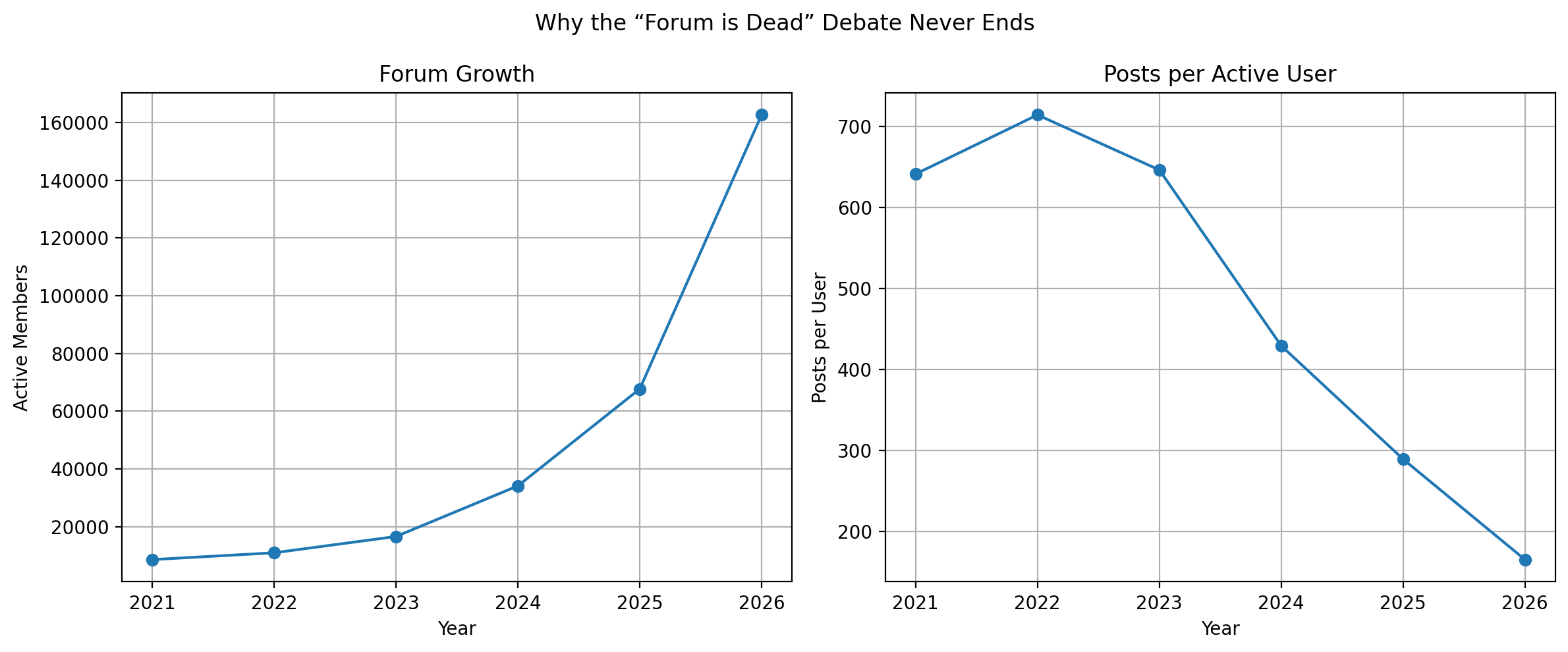
Figure 7 — Why the “forum is dead” debate never ends
1779384089894

Left: forum growth (active members, 2021–2026).
Right: posts per active user (2021–2026).
Genuine proof we just got a flood of low quality users. Wish this place stayed niche for like 5 more years but oh well was fun while it lasted
 
  • +1
Reactions: Danish_Retard, Chadeep, Navity and 3 others

Introduction​

Having been a member of the forum for over 6 years now, I’ve seen many users and eras come and go.
During this time, the forum has transformed from an obscure niche community into a massive, mainstream community. Naturally, that has led to endless discussions throughout, where users will argue that:

“The forum used to be better in year X”
“The forum used to be shit, it’s better now”
“The forum peaked in year Y”


Recent discussion surrounding the forum’s historical trajectory, particularly threads by @Daddy's Home on changing forum quality and @Jason Voorhees on forum history/lore inspired a broader look into the forum’s development through actual longitudinal data.

So, instead of arguing from nostalgia or recency bias, I decided to look at the actual data, the numbers behind it all.
In this thread, I aim to provide a data-driven look at growth, activity, culture, and the forum's long-term health.

The goal is not to pick sides or argue that the forum used to be better. In many ways, the forum is objectively thriving.

What I am more interested in are two questions:
  • How does a forum change as it scales?
  • What actually makes a forum survive in the long term?


Part 1 — The scale explosion

Question answered:
How much has the forum actually grown?

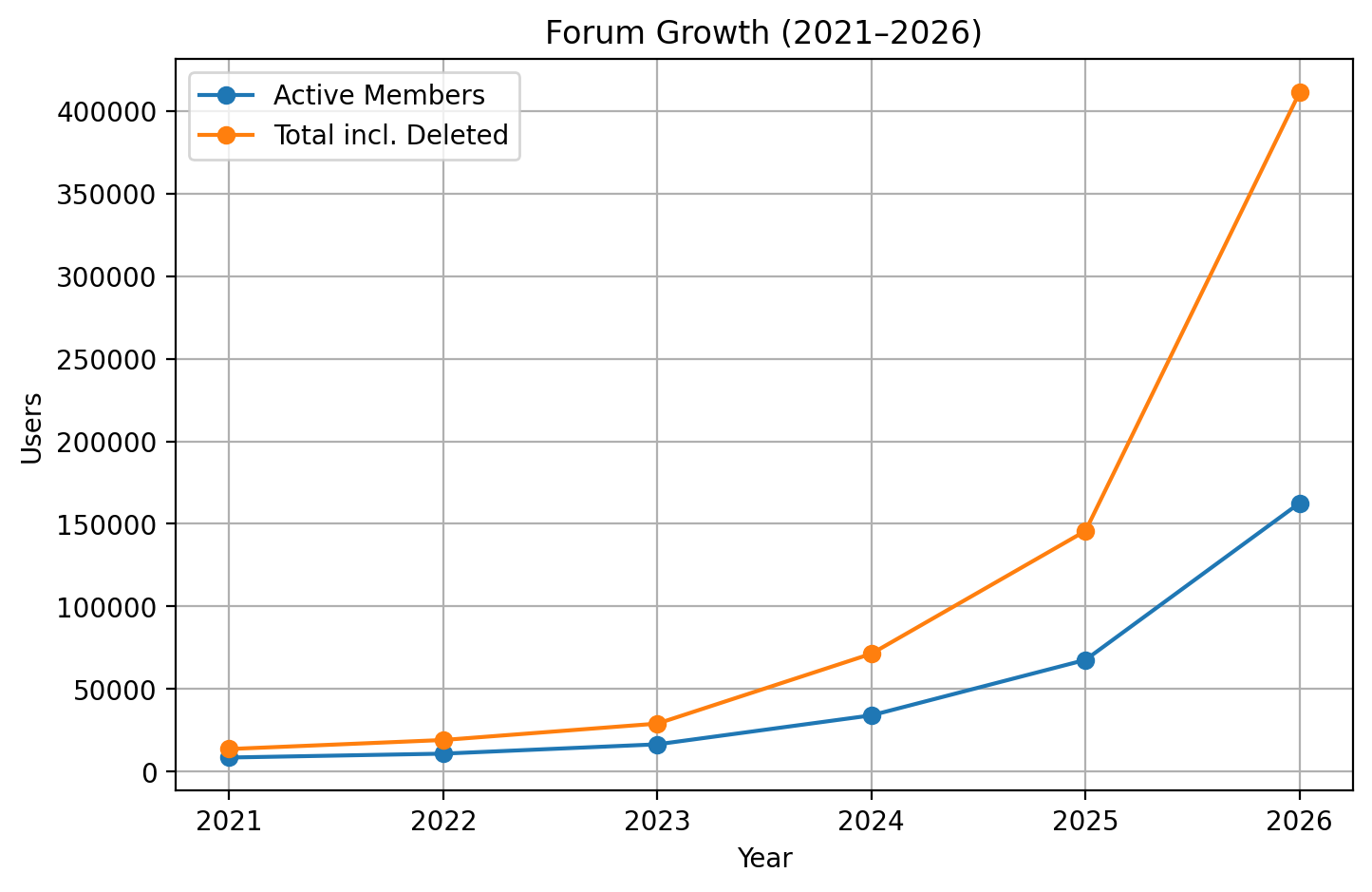
Figure 1 — Forum growth (2021–2026)
View attachment 5096928
Forum userbase growth from 2021 to 2026, including both active accounts and total accounts (including deleted users).


Interpretation​

Over the past five years, the forum has grown from roughly 8.5k members in 2021 to ~170k members today.

Still, this only paints half the picture regarding the historical footprint of this forum.
When accounting for deleted accounts (a feature introduced in February of 2021), the total user base rises from roughly 13k accounts in 2021 (April/May snapshot) to ~438k accounts in the present day.

Before 2023, growth remained relatively modest, but from roughly 2023 onward, the curve began bending upward sharply.
Unsurprisingly, and as many of you will know, this coincided with the forum being exposed to a much broader audience.
Key events here include:


Part 2 — The hidden cost of scale

Question answered:
Does bigger automatically mean stronger?

Figure 2 — Posts per active user (2021–2026)
View attachment 5096932
Average number of posts per active user over time.


Interpretation​

At first glance, as evident in Figure 1, forum growth looks overwhelmingly positive: the forum transitioned from a period of modest early growth into a phase of accelerated, near-exponential scaling, particularly from 2023 onward, after the now infamous TikTok invasion.

However, scale comes with tradeoffs. This is particularly evident in posts per active user.
Back in 2021, the average user created roughly ~640 posts.
Now, in 2026, this figure had declined to roughly ~165 posts.

However, this should not automatically be interpreted as a decline. After all, smaller niche communities are naturally denser than larger, mainstream communities, which the forum has turned into.
As the forum scaled from late 2023 onward, the dynamic naturally shifted: more passive users, more lurkers, less overlap between familiar faces, and shorter engagement cycles overall.

Figure 3 — Threads per active user (2021–2026)
View attachment 5096936
Average number of threads created per active user over time.


Interpretation​

In addition to posts per active user declining substantially, thread creation per user has also dropped significantly.
Peaking in 2022, with roughly ~44 threads per user, this figure has declined to roughly ~12 as of the present day, 2026.

Nowadays, the average user contributes significantly less than before, both in participation and initiative, suggesting lower contribution density.
Altogether, proportionally fewer users are starting discussions, despite more threads getting churned out than ever before.

The forum did not necessarily become weaker. Instead, it simply transitioned into a broader organism.
However, broader communities also tend to feel thinner, which is why you’ll constantly see users claiming that “the forum is dead” (more on this later).


Part 3 — Are discussions still deep?

Question answered:
Has discussion quality collapsed?

Figure 4 — Posts per thread (2021–2026)
View attachment 5096940
Average number of posts generated per thread over time.


Interpretation​

Even though both posts per user and threads per user have declined significantly, interestingly enough, this is not necessarily the case for discussion quality.

Evidently, the change here is not as dramatic.
In 2021, the average thread generated roughly ~16.7 posts per thread.
In 2026, this figure has dropped to roughly ~13.6 posts per thread.

Compared to the considerable decline in both posts and threads per user, as shown earlier, this decrease is relatively conservative.
Altogether, this suggests that threads are still generating discussion, which is clear for everyone to see who uses the forum actively.

While the forum may feel different, discussions themselves appear more resilient than the broader discourse sometimes suggests.


Part 4 — Who actually carries a forum?

Question answered:
Does growth also create long-term contributors?

Before studying the data, it is worth defining what actually sustains a long-term community, like this forum.
Every long-lasting forum gradually develops a relatively small clique of core users who disproportionately shape its culture over time.

On .org, these are usually the users who:
  • are considered forum chads
  • OGs who have sustained consistent activity over the years
  • have provided valuable insights/information/guides
  • postmaxxers (or shitposters) who brute-forced exposure through sheer output
For simplicity, I will refer to these users as long-term contributors

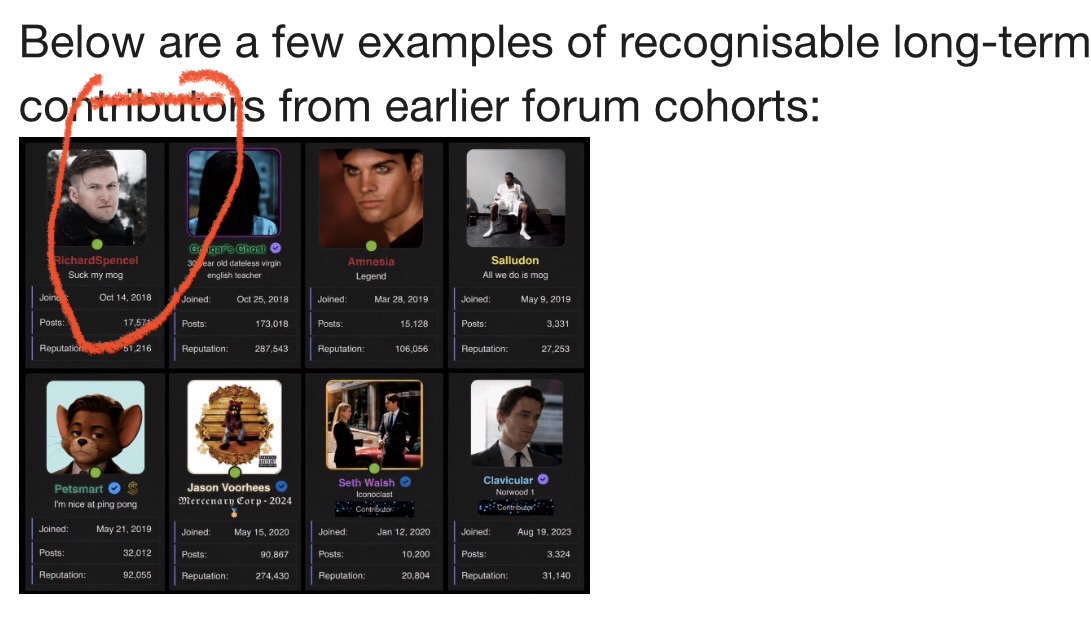
Below are a few examples of recognisable long-term contributors from earlier forum cohorts:
View attachment 5136323

While contributors can be evaluated along various axes, we need a practical proxy for measurement.
And ultimately, the most important metric here is sustained output, since without output, there can be no visibility or long-term presence.

For this reason, post count thresholds will be used as a measurable indicator of long-term contribution, divided into three separate categories:
1k+ posts → committed contributor
5k+ posts → highly invested contributor
10k+ posts → core contributor

Figure 5A — Long-term contributor formation by join cohort
View attachment 5096943
Users reaching 1k+, 5k+, and 10k+ posts by join year.


Interpretation​

Initially, it would be common to assume that more growth automatically translates into more long-term contributors. However, the data paints a more nuanced picture.

At first glance, the number of users reaching 1k+ posts continues to rise sharply, meaning that the forum is still churning out committed users.
However, when looking at 5k+ and 10k+ contributors, a different pattern starts to emerge, with both cohorts plateauing.
So even though the forum is still attracting users who become engaged, proportionally fewer transition into long-term, deeply invested contributors.

This, too, is significant since we already established that every long-lasting community ultimately depends on a group of relatively small and highly invested users who sustain continuity over time.

At this point, another question naturally emerges: once users become committed, how likely are they to deepen into long-term contributors?

Figure 5B — Deep investment conversion by join cohort

View attachment 5096946
Percentage of 1k+ contributors progressing into 5k+ and 10k+ contributors.


Interpretation​

While the forum continues to produce committed users, the likelihood of those users progressing to deep, long-term investment appears to decline across newer cohorts.
This may also help explain why newer eras of the forum can sometimes feel less familiar to older users.
Recognisable long-term contributors still emerge, but proportionally fewer deepen into highly invested contributors over time.

Earlier cohorts converted into 5k+ and 10k+ contributors at substantially higher rates, especially in the 2020 cohort (indeed a great year to join .org :feelsez:).
It is also worth noting that from 2021 onward, accounts now have the option to delete, and deleted accounts, while still counted in these figures, cease posting entirely, which may modestly suppress conversion rates in more recent cohorts.

To conclude, the forum still succeeds at creating active users, but at the same time, core depth is not accelerating at the same pace as growth.
This may ultimately be one of the most important long-term challenges for a rapidly scaling forum.

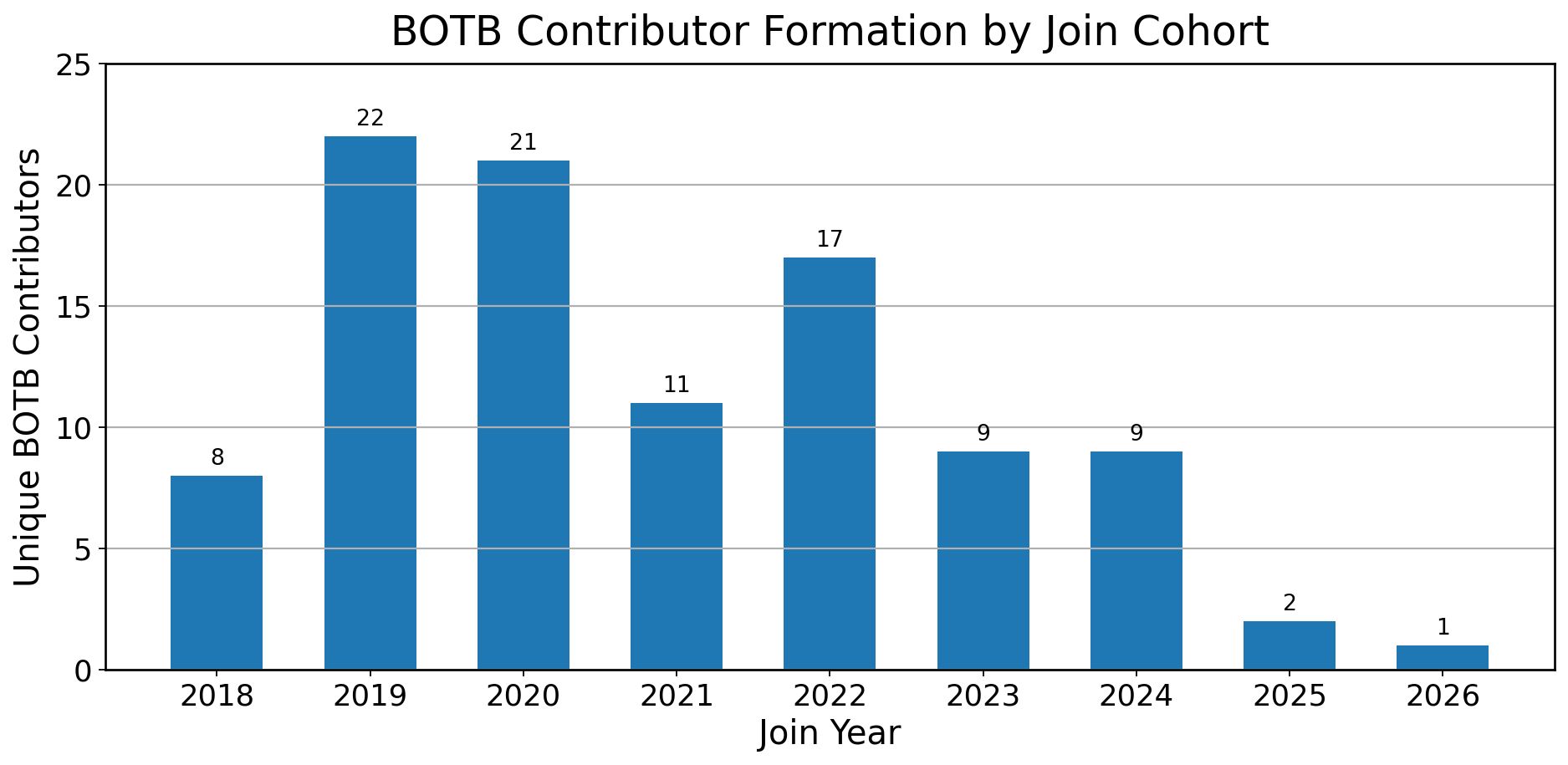
Figure 5C — BOTB contributor formation by join cohort
View attachment 5126735
Number of unique users from each join cohort who made it into the forum's Best of the Best (BOTB) section.


Interpretation​

The distribution of BOTB contributors by join cohort reinforces earlier findings regarding contributor depth, with the 2019–2020 cohorts once again standing out as the dominant cohorts, together accounting for nearly half of all BOTB representation by join year.
Since BOTB functions as a staff-curated archive of high-quality content, independent of raw activity/post count, this serves as an additional qualitative indicator of contributor impact, and one that cannot simply be accumulated through sheer posting volume.

While later cohorts still produced several BOTB contributors, their lower representation is likely structural.
After all, earlier cohorts had the luxury of establishing many areas of discussion that were still relatively underexplored, making foundational breakthroughs and key contributions easier to establish. As the forum evolves, the threshold for genuinely novel, standout content rises accordingly, not necessarily as a sign of decline, but as a natural consequence of a maturing organism building on its own foundations.


Part 5 — Moderation

Question answered:
What does growth cost operationally?

Before moving on, I thought it would be interesting to briefly share a side of the forum most users never really get to see.

Having moderated this forum since late 2020, the change in forum growth isn't just visible in the numbers, it's felt operationally. Growth doesn't only produce more users, posts, and activity. It changes the entire reality required to keep a large system functioning.
Below is one such measure: estimated moderation actions processed per year (simply put, how much work us staff have to put in to keep the forum operational):

Figure 6 — Estimated annual moderation throughput (2022–2026)
View attachment 5096947
Estimated moderation throughput derived from cumulative moderation log intervals.

Interpretation​

Based on yearly moderation log intervals, our estimated workload has increased dramatically:

~39k (2022–23)~77k (2023–24)~127k (2024–25)~333k (2025–26, projected) moderation actions per year.

As the forum scales, so too does the amount of invisible work required to keep it functioning without the forum turning into a complete zoo :feelshah:

More users naturally means:

– more reports
– more approvals/queue processing
– more moderation decisions
– more general operational complexity

Naturally, this means that larger systems also require more maintenance. This is, of course, logical since a small village does not require the same infrastructure as a large city.


Part 6 — So… is the forum dead?

Question answered:
How much truth is there to the claim that “the forum is dead”?

For as long as I can remember, even before I joined this forum, users have repeatedly claimed that “the forum is dead

Funnily enough, this statement appears in literally every era of the forum’s history:

2019: https://looksmax.org/threads/forum-is-dead-today.76001/
2020: https://looksmax.org/threads/why-is-the-forum-dead.214676/
2021: https://looksmax.org/threads/the-forum-is-pretty-dead-right-now.346771/
2022: https://looksmax.org/threads/why-is-this-forum-so-dead.449811/
2023: https://looksmax.org/threads/this-forum-is-dead.774746/
2024: https://looksmax.org/threads/this-forum-is-so-dead-currently.1068627/
2025: https://looksmax.org/threads/why-is-the-forum-so-dead-right-now.1343621/
2026: https://looksmax.org/threads/dead-forum.1949282/

In fact, a simple search for "forum dead", sorted by "search titles only" across the entire thread history, returns 500+ unique threads across 11 pages of users claiming the forum is "dead"
View attachment 5097927

Figure 7 — Why the “forum is dead” debate never ends
View attachment 5096952
Left: forum growth (active members, 2021–2026).
Right: posts per active user (2021–2026).


Interpretation​

These two graphs explain why the debate surrounding the forum never truly disappears.

On the one hand, the graph on the left suggests that the forum is objectively thriving. Membership growth has accelerated dramatically, and overall activity continues to expand.

On the other hand, the graph on the right suggests that the forum experience has changed.
As mentioned earlier, the average user now contributes significantly less than before, which helps explain why the forum can sometimes feel “dead” despite its continued growth in overall size and activity.

Earlier forum years can be characterised as:

– smaller (another reason it felt “dead” in earlier years)
– denser
– having a higher overlap between familiar users
– having a stronger continuity

Current forum years can be characterised as:

– larger
– broader
– faster-moving
– more transient

This is why OGs who lament the good old days of the forum and newcels who think they are just being nostalgia merchants both have a valid perspective.
After all, they are describing different versions of the same organism.


Part 7 — What actually makes a forum survive?

After looking at all of this data, one question naturally emerges:
What actually allows a forum to survive while continuing to scale?

The data points out that:
  • Growth is accelerating
  • Activity remains high
  • New users continue arriving at rapid rates
At the same time, scaling naturally introduces tradeoffs:

– lower contribution density
– weaker continuity
– more transient users
– proportionally fewer deeply invested contributors

None of this necessarily means that the forum became worse.

It means the organism changed shape

And perhaps the most interesting thing the data reveals is this:

The forum has already solved this problem once before

The 2019–2021 cohorts produced the highest rates of deep contributor formation the forum has ever seen.
However, the forum today is a fundamentally different organism. It is larger and broader, and thus, it will not replicate 2020, but nor should it try.

Organisms are not static since they always adapt.
And the next generation of recognisable contributors is already forming somewhere in the current cohorts, just as every recognisable contributor once did.

Because ultimately:

Every recognisable user,

Every OG,

Every staff member,

Was once

Some random greycel no-name

They showed up consistently, contributed. and eventually:

They became part of the organism

The more interesting question moving forward is therefore not:

“Was the old forum better?” or “Is the forum dead?”

But rather:

Does the current organism still create the conditions for the next generation?

Because in the end:

That is what actually allows a forum to survive

View attachment 5096636

@NumbThePain @Randomized @tuberculosisinmybal

Yeah since the forum is scaling at such a large level, i suggest you guys to consider making me mod.
 
  • JFL
Reactions: Navity, Gargantuan and thecel
Seem FUCKING COOL

This sticky is good

I'm going to read it and then I'll give my thoughts .
 
  • JFL
  • +1
Reactions: Gargantuan, thecel and trump
Stats absolutely true, niggas dnring just prove the "users contribute less nowadays" point
 
  • +1
Reactions: Chadeep, Deathninja328, shedontluv-U and 2 others
my nigga really brought out the matplotlib charts
 
  • +1
  • JFL
Reactions: Danish_Retard, Chadeep, shedontluv-U and 1 other person
IMG 5882
IMG 6256
 
  • JFL
Reactions: Navity, shedontluv-U, Gargantuan and 3 others
Took me 15 Minutes to read through lol

Eternal Sticky/BOTB
 
  • Love it
  • +1
Reactions: Gargantuan, Algernon and Lookologist003
Thank you for reading and typing all of this out.

Valid point, and you're right that the metrics I used can't really capture identity dilution. Indeed, that would require a different kind of analysis altogether, which is much harder to measure longitudinally with publicly accessible data.
yeah this part is harder ro measure since it is qualitative, but ig potentially finding somewhat big original terms from 2020 or 2021 with at least 50+ pages of mentions in the search, creating a database of them, then randomly sampling about 5, checking their percentage usage rate in comparison to the standard words (foid v woman,girl,female,etc)
Though I don't think forums necessarily preserve themselves by staying identical, but rather by adapting while retaining some underlying continuity. A forum that never changes usually dies just as quickly as one that loses itself entirely.

So you're definitely getting at something real since survival and identity preservation are not necessarily the same thing.
Though I think it's more so a matter of how much of the culture remains and reproduces itself through newer generations of contributors.
That's partly what the contributor/BOTB sections were trying to get at, not whether the forum stayed the same, but whether it still produces users capable of contributing meaningful 'signal' to it.

Whether that process remains strong enough long term is an interesting question, only time will tell, I guess.
yeah i definitely agree here, looking through the history of this forum i think gradual change has benefitted it

my bigger point was really though, if this forum loses its identity yet continues to grow, then it's lost its purpose

without an identity why use platform #2 then platform #1 is bigger (for example, people who were originals on vimeo moved to youtube, new people go to youtube instead of vimeo causes it's bigger)

i think less identity is fine, as long as it's slightly preserved since it wont just lead to what i said above

also just generally, i feel there is a lot of opposition to new identity for .org, or at least high quality identity, while despite being more engaging and having more users

(new term creation generally feels forced when it can be taken from ig or tiktok, as you said w/ botb, pre-existing, most blackpill ideology is set in stone and people don't read as much, so it's not like anyone can write 5 paragraphs on hypergamy or add in their own beliefs etc)

also, not sure how big of an effect it would have after a while, but it does make sense the data in botb etc will be skewed in comparison to what they really are

since most 2026 users are just starting off,
(usually to get in botb, you need to be able to have good formatting, which most users need a little time to get accustomed to creating good formatted threads, you have to be able to research good or have personal experience, which usually starts a little after being on this forum, also partially you need to get up to a more eyecatching name color to get people to click on the guide)
it will take more time for a 2026 user to meet the requirements, lets say 6 months
so (just guessing, i could be wrong about all this) if i had to guess i'd say a majority (maybe lets say 50%) of people who got their contributor badge in 2026 made an account 2 years ago, then lets say 15% for 1 and 3 years ago, etc, so on that contributor guide it is likely the fall-off near the more recent years isn't entirely as steep
 
  • +1
Reactions: Chadeep, shedontluv-U, Navity and 2 others
Hey @thecel they beat you to it! Nevermind that. These are the stats that I was wondering about for at least a year. Some closure this has offered me. Thanks for breaking it down for us, Gargantuan.
 
  • +1
Reactions: Chadeep, Gargantuan, thecel and 1 other person
Neat stuff
 
  • +1
Reactions: Gargantuan, Algernon and thecel
First of all, thanks for the shout out to and the tag in the thread, I appreciate this :BASEDCIGAR: :peepoLove: :FeelsLoveMan:

Your data basically gives us a logical conclusion if we think about the rationale of things and how people operate

When the forum had fewer users, inactive users didn't change compared to now anyway, meaning they were just as inactive as now, but the active ones were much more active precisely because they had greater engagement visibility giving the fewer users -> fewer threads -> their threads stayed in the public eye for longer without that much effort

(while now they have a higher chance of being ignored / falling into the abyss of off-topic much sooner, which demotivates them to make / post them in the first place)

Also, before the reward for engagement was generally higher, being a smaller community, active users wanted to keep good reputation/be close to other active users, meaning more frequent free bumps, more free reps, so extra motivation to keep posting on and on, because it all felt like a family, where others would glaze you more for any dumb post you made

Instead, today, I can briefly say that the forum has become much more ''competitive'' than ever in the fight for engagement, given that there are so many users and so many threads, it is much harder to attract users' attention to your particular thread, and this often leads to a clear consequence -> users are much less motivated / willing in general to ''try'' to risk posting a ''mid'' thread at first glance (because it may ''fail''), compared to the past, so they often decide to give up on posting it in the first place.. :FeelsPepoSpin:

By this, we can also conclude that the more activity is on the forum and the more users, it is natural that the number of cool / interesting threads will decrease significantly on average compared to the past..

For example, I have a lot of ideas for cool threads that would deserve BOTB, but I often know that their posting has a very, very high chance of not receiving the engagement / reward / level of glaze that it deserves because of how ''fried'' the average user's brain is in terms of stimulation already with daily threads full of click bait and slop / low effort in general, so that when a thread is really good, they will judge it at a much lower value than it has

(as happens, ironically, even with this thread of yours and with the first users who interacted on it, who instead of providing some cooler feedback, even on fewer words, they still consider that shit posting in such threads is still seen as ''aura / the cool thing to do'') :catJAMCRY: 💔 :Pepehand:
Great reply! This also lines up a lot with my own experience being here over the years :feelsokman:

Indeed, the incentive structure itself changed massively, and the consequences are felt big time 100%.
Back when the forum was much smaller, it genuinely felt more like a small family, as you pointed out. It was always the same group of active users seeing each other every day, which created very strong continuity between users.

Funnily enough, all of this made the incentive to rot on here much higher (I spent by far the most time here between 2020 and 2022), because spending time on the forum fed back into a tighter loop that kept reinforcing itself. There was more of a feeling that your presence actually mattered here, because visibility was high, and it was much easier to stand out.

These days, that becomes much harder when there are simply too many users and threads competing for attention at once. And when you think about it, this not only discourages rotting (especially for older users), but also reduces the willingness to genuinely try and stand out (for newer users especially who are trying to fit in), since most users crave reps and recognition to some extent, so it is a double-edged sword in a way :feelsmage:

Good point about competitiveness as well. In the current attention economy, users are less willing to make high-effort content because they fear getting snowed under/being irrelevant, so many instead resort to lower-effort shitposting.

Ironically enough, some of the very first replies in this thread were kind of a live demonstration of that dynamic :feelsez:
 
  • +1
  • Woah
  • Love it
Reactions: Daddy's Home, BigBallsLarry, Yliaster and 1 other person
yeah this part is harder ro measure since it is qualitative, but ig potentially finding somewhat big original terms from 2020 or 2021 with at least 50+ pages of mentions in the search, creating a database of them, then randomly sampling about 5, checking their percentage usage rate in comparison to the standard words (foid v woman,girl,female,etc)

yeah i definitely agree here, looking through the history of this forum i think gradual change has benefitted it

my bigger point was really though, if this forum loses its identity yet continues to grow, then it's lost its purpose

without an identity why use platform #2 then platform #1 is bigger (for example, people who were originals on vimeo moved to youtube, new people go to youtube instead of vimeo causes it's bigger)

i think less identity is fine, as long as it's slightly preserved since it wont just lead to what i said above

also just generally, i feel there is a lot of opposition to new identity for .org, or at least high quality identity, while despite being more engaging and having more users

(new term creation generally feels forced when it can be taken from ig or tiktok, as you said w/ botb, pre-existing, most blackpill ideology is set in stone and people don't read as much, so it's not like anyone can write 5 paragraphs on hypergamy or add in their own beliefs etc)

also, not sure how big of an effect it would have after a while, but it does make sense the data in botb etc will be skewed in comparison to what they really are

since most 2026 users are just starting off,
(usually to get in botb, you need to be able to have good formatting, which most users need a little time to get accustomed to creating good formatted threads, you have to be able to research good or have personal experience, which usually starts a little after being on this forum, also partially you need to get up to a more eyecatching name color to get people to click on the guide)
it will take more time for a 2026 user to meet the requirements, lets say 6 months
so (just guessing, i could be wrong about all this) if i had to guess i'd say a majority (maybe lets say 50%) of people who got their contributor badge in 2026 made an account 2 years ago, then lets say 15% for 1 and 3 years ago, etc, so on that contributor guide it is likely the fall-off near the more recent years isn't entirely as steep
Fair points overall, and I think the nuance you raised about BOTB is actually worth considering.

You're definitely spot on when you point out that the more recent cohorts are somewhat disadvantaged simply because they haven't had as much time yet, especially when it comes to formatting, experience, visibility, etc.

At the same time, I ended up questioning the tenure argument a bit myself while writing the BOTB section, because I noticed several cases where users basically popped up (let's say 2021), dropped one genuinely standout thread that got included in BOTB, and then were never/barely seen again. So it doesn't seem like long-term presence is necessarily a requirement either.
I guess that it's probably a mix of factors rather than one explanation alone.

I do think you raise a good point on identity, though. Growth alone doesn't necessarily mean much if the thing that made people come here in the first place dies out completely. The interesting question is probably how much continuity is enough for a forum to remain recognisably itself while continuing to evolve.
 
  • +1
Reactions: Algernon and shedontluv-U
Putting that high Dolph Lundgren IQ to use I see, good thread

Lots of thots come to mind:

1. I wonder what userbase rate of change will look like over time (will growth continue to be exponential? If so for how long? What happens after peak growth - slow but continuous rise, or plateau, or even decline?)

2. In a similar vein, I wonder what the long term looks like for bp creators. Will they continue to grow, or settle into a solid yet steady niche audience, or be forced to pivot / leave the scene altogether if attention dies down? And how soon / quickly will these potential futures play out? And who will survive longer than others and why?

3. How will the worsening irl bp conditions affect all this? Will things ever get better for the subChad man?

4. Will the forum make it to the 2030s. 40s? 50s? Indefinitley? Will some of us still be logging in daily to postmaxx in the nursing home?

5. How will forum slang evolve over time? How long does it take for a given term to die out and be replaced by another? Which terms have stuck around and maintained or even grown in popularity? How often does new slang enter the paradigm? And come to think of it, can we accurately map and model out pseudo-evolutionary pressures onto these terms?

6. Does the continued rise of ever advancing AI chatbots threaten to overrun the forum with functionally undetectable bots? What contingency plans does forum management have for this? Again, come to think of it, how much of management resources are simply dedicated to keeping the ship afloat day to day vs planning for future scenarios and projected forum changes? At what point does Master take this shit public and become the first trillionaire???

The possibilities and avenues of inquiry are ENDLESS
sci-fi film GIF


We should assemble a team of high iq cels and found an org academia to attempt to answer all these burning questions
 
  • +1
  • Love it
Reactions: Gargantuan, Algernon and shedontluv-U
Did you use matplotlib or chatgpt for the graph
 
  • WTF
  • +1
Reactions: shedontluv-U and discord m0d
Genuine proof we just got a flood of low quality users. Wish this place stayed niche for like 5 more years but oh well was fun while it lasted
Why old users are the best ? I noticed this too
 
  • +1
Reactions: shedontluv-U and Reformed
Figure 5C — BOTB contributor formation by join cohort
1779914532985

Number of unique users from each join cohort who made it into the forum's Best of the Best (BOTB) section.


Interpretation​

The distribution of BOTB contributors by join cohort reinforces earlier findings regarding contributor depth, with the 2019–2020 cohorts once again standing out as the dominant cohorts, together accounting for nearly half of all BOTB representation by join year.
Since BOTB functions as a staff-curated archive of high-quality content, independent of raw activity/post count, this serves as an additional qualitative indicator of contributor impact, and one that cannot simply be accumulated through sheer posting volume.

While later cohorts still produced several BOTB contributors, their lower representation is likely structural.
After all, earlier cohorts had the luxury of establishing many areas of discussion that were still relatively underexplored, making foundational breakthroughs and key contributions easier to establish. As the forum evolves, the threshold for genuinely novel, standout content rises accordingly, not necessarily as a sign of decline, but as a natural consequence of a maturing organism building on its own foundations.
Well, this one is probably cause "mewing and dhtmaxxing" threads got into BOTB back in the day..
 
  • +1
Reactions: shedontluv-U and Gargantuan

Introduction​

Having been a member of the forum for over 6 years now, I’ve seen many users and eras come and go.
During this time, the forum has transformed from an obscure niche community into a massive, mainstream community. Naturally, that has led to endless discussions throughout, where users will argue that:

“The forum used to be better in year X”
“The forum used to be shit, it’s better now”
“The forum peaked in year Y”


Recent discussion surrounding the forum’s historical trajectory, particularly threads by @Daddy's Home on changing forum quality and @Jason Voorhees on forum history/lore inspired a broader look into the forum’s development through actual longitudinal data.

So, instead of arguing from nostalgia or recency bias, I decided to look at the actual data, the numbers behind it all.
In this thread, I aim to provide a data-driven look at growth, activity, culture, and the forum's long-term health.

The goal is not to pick sides or argue that the forum used to be better. In many ways, the forum is objectively thriving.

What I am more interested in are two questions:
  • How does a forum change as it scales?
  • What actually makes a forum survive in the long term?


Part 1 — The scale explosion

Question answered:
How much has the forum actually grown?

Figure 1 — Forum growth (2021–2026)
View attachment 5096928
Forum userbase growth from 2021 to 2026, including both active accounts and total accounts (including deleted users).


Interpretation​

Over the past five years, the forum has grown from roughly 8.5k members in 2021 to ~170k members today.

Still, this only paints half the picture regarding the historical footprint of this forum.
When accounting for deleted accounts (a feature introduced in February of 2021), the total user base rises from roughly 13k accounts in 2021 (April/May snapshot) to ~438k accounts in the present day.

Before 2023, growth remained relatively modest, but from roughly 2023 onward, the curve began bending upward sharply.
Unsurprisingly, and as many of you will know, this coincided with the forum being exposed to a much broader audience.
Key events here include:


Part 2 — The hidden cost of scale

Question answered:
Does bigger automatically mean stronger?

Figure 2 — Posts per active user (2021–2026)
View attachment 5096932
Average number of posts per active user over time.


Interpretation​

At first glance, as evident in Figure 1, forum growth looks overwhelmingly positive: the forum transitioned from a period of modest early growth into a phase of accelerated, near-exponential scaling, particularly from 2023 onward, after the now infamous TikTok invasion.

However, scale comes with tradeoffs. This is particularly evident in posts per active user.
Back in 2021, the average user created roughly ~640 posts.
Now, in 2026, this figure had declined to roughly ~165 posts.

However, this should not automatically be interpreted as a decline. After all, smaller niche communities are naturally denser than larger, mainstream communities, which the forum has turned into.
As the forum scaled from late 2023 onward, the dynamic naturally shifted: more passive users, more lurkers, less overlap between familiar faces, and shorter engagement cycles overall.

Figure 3 — Threads per active user (2021–2026)
View attachment 5096936
Average number of threads created per active user over time.


Interpretation​

In addition to posts per active user declining substantially, thread creation per user has also dropped significantly.
Peaking in 2022, with roughly ~44 threads per user, this figure has declined to roughly ~12 as of the present day, 2026.

Nowadays, the average user contributes significantly less than before, both in participation and initiative, suggesting lower contribution density.
Altogether, proportionally fewer users are starting discussions, despite more threads getting churned out than ever before.

The forum did not necessarily become weaker. Instead, it simply transitioned into a broader organism.
However, broader communities also tend to feel thinner, which is why you’ll constantly see users claiming that “the forum is dead” (more on this later).


Part 3 — Are discussions still deep?

Question answered:
Has discussion quality collapsed?

Figure 4 — Posts per thread (2021–2026)
View attachment 5096940
Average number of posts generated per thread over time.


Interpretation​

Even though both posts per user and threads per user have declined significantly, interestingly enough, this is not necessarily the case for discussion quality.

Evidently, the change here is not as dramatic.
In 2021, the average thread generated roughly ~16.7 posts per thread.
In 2026, this figure has dropped to roughly ~13.6 posts per thread.

Compared to the considerable decline in both posts and threads per user, as shown earlier, this decrease is relatively conservative.
Altogether, this suggests that threads are still generating discussion, which is clear for everyone to see who uses the forum actively.

While the forum may feel different, discussions themselves appear more resilient than the broader discourse sometimes suggests.


Part 4 — Who actually carries a forum?

Question answered:
Does growth also create long-term contributors?

Before studying the data, it is worth defining what actually sustains a long-term community, like this forum.
Every long-lasting forum gradually develops a relatively small clique of core users who disproportionately shape its culture over time.

On .org, these are usually the users who:
  • are considered forum chads
  • OGs who have sustained consistent activity over the years
  • have provided valuable insights/information/guides
  • postmaxxers (or shitposters) who brute-forced exposure through sheer output
For simplicity, I will refer to these users as long-term contributors

Below are a few examples of recognisable long-term contributors from earlier forum cohorts:
View attachment 5136323

While contributors can be evaluated along various axes, we need a practical proxy for measurement.
And ultimately, the most important metric here is sustained output, since without output, there can be no visibility or long-term presence.

For this reason, post count thresholds will be used as a measurable indicator of long-term contribution, divided into three separate categories:
1k+ posts → committed contributor
5k+ posts → highly invested contributor
10k+ posts → core contributor

Figure 5A — Long-term contributor formation by join cohort
View attachment 5096943
Users reaching 1k+, 5k+, and 10k+ posts by join year.


Interpretation​

Initially, it would be common to assume that more growth automatically translates into more long-term contributors. However, the data paints a more nuanced picture.

At first glance, the number of users reaching 1k+ posts continues to rise sharply, meaning that the forum is still churning out committed users.
However, when looking at 5k+ and 10k+ contributors, a different pattern starts to emerge, with both cohorts plateauing.
So even though the forum is still attracting users who become engaged, proportionally fewer transition into long-term, deeply invested contributors.

This, too, is significant since we already established that every long-lasting community ultimately depends on a group of relatively small and highly invested users who sustain continuity over time.

At this point, another question naturally emerges: once users become committed, how likely are they to deepen into long-term contributors?

Figure 5B — Deep investment conversion by join cohort

View attachment 5096946
Percentage of 1k+ contributors progressing into 5k+ and 10k+ contributors.


Interpretation​

While the forum continues to produce committed users, the likelihood of those users progressing to deep, long-term investment appears to decline across newer cohorts.
This may also help explain why newer eras of the forum can sometimes feel less familiar to older users.
Recognisable long-term contributors still emerge, but proportionally fewer deepen into highly invested contributors over time.

Earlier cohorts converted into 5k+ and 10k+ contributors at substantially higher rates, especially in the 2020 cohort (indeed a great year to join .org :feelsez:).
It is also worth noting that from 2021 onward, accounts now have the option to delete, and deleted accounts, while still counted in these figures, cease posting entirely, which may modestly suppress conversion rates in more recent cohorts.

To conclude, the forum still succeeds at creating active users, but at the same time, core depth is not accelerating at the same pace as growth.
This may ultimately be one of the most important long-term challenges for a rapidly scaling forum.

Figure 5C — BOTB contributor formation by join cohort
View attachment 5126735
Number of unique users from each join cohort who made it into the forum's Best of the Best (BOTB) section.


Interpretation​

The distribution of BOTB contributors by join cohort reinforces earlier findings regarding contributor depth, with the 2019–2020 cohorts once again standing out as the dominant cohorts, together accounting for nearly half of all BOTB representation by join year.
Since BOTB functions as a staff-curated archive of high-quality content, independent of raw activity/post count, this serves as an additional qualitative indicator of contributor impact, and one that cannot simply be accumulated through sheer posting volume.

While later cohorts still produced several BOTB contributors, their lower representation is likely structural.
After all, earlier cohorts had the luxury of establishing many areas of discussion that were still relatively underexplored, making foundational breakthroughs and key contributions easier to establish. As the forum evolves, the threshold for genuinely novel, standout content rises accordingly, not necessarily as a sign of decline, but as a natural consequence of a maturing organism building on its own foundations.


Part 5 — Moderation

Question answered:
What does growth cost operationally?

Before moving on, I thought it would be interesting to briefly share a side of the forum most users never really get to see.

Having moderated this forum since late 2020, the change in forum growth isn't just visible in the numbers, it's felt operationally. Growth doesn't only produce more users, posts, and activity. It changes the entire reality required to keep a large system functioning.
Below is one such measure: estimated moderation actions processed per year (simply put, how much work us staff have to put in to keep the forum operational):

Figure 6 — Estimated annual moderation throughput (2022–2026)
View attachment 5096947
Estimated moderation throughput derived from cumulative moderation log intervals.

Interpretation​

Based on yearly moderation log intervals, our estimated workload has increased dramatically:

~39k (2022–23)~77k (2023–24)~127k (2024–25)~333k (2025–26, projected) moderation actions per year.

As the forum scales, so too does the amount of invisible work required to keep it functioning without the forum turning into a complete zoo :feelshah:

More users naturally means:

– more reports
– more approvals/queue processing
– more moderation decisions
– more general operational complexity

Naturally, this means that larger systems also require more maintenance. This is, of course, logical since a small village does not require the same infrastructure as a large city.


Part 6 — So… is the forum dead?

Question answered:
How much truth is there to the claim that “the forum is dead”?

For as long as I can remember, even before I joined this forum, users have repeatedly claimed that “the forum is dead

Funnily enough, this statement appears in literally every era of the forum’s history:

2019: https://looksmax.org/threads/forum-is-dead-today.76001/
2020: https://looksmax.org/threads/why-is-the-forum-dead.214676/
2021: https://looksmax.org/threads/the-forum-is-pretty-dead-right-now.346771/
2022: https://looksmax.org/threads/why-is-this-forum-so-dead.449811/
2023: https://looksmax.org/threads/this-forum-is-dead.774746/
2024: https://looksmax.org/threads/this-forum-is-so-dead-currently.1068627/
2025: https://looksmax.org/threads/why-is-the-forum-so-dead-right-now.1343621/
2026: https://looksmax.org/threads/dead-forum.1949282/

In fact, a simple search for "forum dead", sorted by "search titles only" across the entire thread history, returns 500+ unique threads across 11 pages of users claiming the forum is "dead"
View attachment 5097927

Figure 7 — Why the “forum is dead” debate never ends
View attachment 5096952
Left: forum growth (active members, 2021–2026).
Right: posts per active user (2021–2026).


Interpretation​

These two graphs explain why the debate surrounding the forum never truly disappears.

On the one hand, the graph on the left suggests that the forum is objectively thriving. Membership growth has accelerated dramatically, and overall activity continues to expand.

On the other hand, the graph on the right suggests that the forum experience has changed.
As mentioned earlier, the average user now contributes significantly less than before, which helps explain why the forum can sometimes feel “dead” despite its continued growth in overall size and activity.

Earlier forum years can be characterised as:

– smaller (another reason it felt “dead” in earlier years)
– denser
– having a higher overlap between familiar users
– having a stronger continuity

Current forum years can be characterised as:

– larger
– broader
– faster-moving
– more transient

This is why OGs who lament the good old days of the forum and newcels who think they are just being nostalgia merchants both have a valid perspective.
After all, they are describing different versions of the same organism.


Part 7 — What actually makes a forum survive?

After looking at all of this data, one question naturally emerges:
What actually allows a forum to survive while continuing to scale?

The data points out that:
  • Growth is accelerating
  • Activity remains high
  • New users continue arriving at rapid rates
At the same time, scaling naturally introduces tradeoffs:

– lower contribution density
– weaker continuity
– more transient users
– proportionally fewer deeply invested contributors

None of this necessarily means that the forum became worse.

It means the organism changed shape

And perhaps the most interesting thing the data reveals is this:

The forum has already solved this problem once before

The 2019–2021 cohorts produced the highest rates of deep contributor formation the forum has ever seen.
However, the forum today is a fundamentally different organism. It is larger and broader, and thus, it will not replicate 2020, but nor should it try.

Organisms are not static since they always adapt.
And the next generation of recognisable contributors is already forming somewhere in the current cohorts, just as every recognisable contributor once did.

Because ultimately:

Every recognisable user,

Every OG,

Every staff member,

Was once

Some random greycel no-name

They showed up consistently, contributed. and eventually:

They became part of the organism

The more interesting question moving forward is therefore not:

“Was the old forum better?” or “Is the forum dead?”

But rather:

Does the current organism still create the conditions for the next generation?

Because in the end:

That is what actually allows a forum to survive

View attachment 5096636

@NumbThePain @Randomized @tuberculosisinmybal

1780132673000


'mirin intellectual data analysis skills :Comfy:
 
  • JFL
  • +1
Reactions: Navity and Gargantuan
  • +1
Reactions: Gargantuan

Introduction​

Having been a member of the forum for over 6 years now, I’ve seen many users and eras come and go.
During this time, the forum has transformed from an obscure niche community into a massive, mainstream community. Naturally, that has led to endless discussions throughout, where users will argue that:

“The forum used to be better in year X”
“The forum used to be shit, it’s better now”
“The forum peaked in year Y”


Recent discussion surrounding the forum’s historical trajectory, particularly threads by @Daddy's Home on changing forum quality and @Jason Voorhees on forum history/lore inspired a broader look into the forum’s development through actual longitudinal data.

So, instead of arguing from nostalgia or recency bias, I decided to look at the actual data, the numbers behind it all.
In this thread, I aim to provide a data-driven look at growth, activity, culture, and the forum's long-term health.

The goal is not to pick sides or argue that the forum used to be better. In many ways, the forum is objectively thriving.

What I am more interested in are two questions:
  • How does a forum change as it scales?
  • What actually makes a forum survive in the long term?


Part 1 — The scale explosion

Question answered:
How much has the forum actually grown?

Figure 1 — Forum growth (2021–2026)
View attachment 5096928
Forum userbase growth from 2021 to 2026, including both active accounts and total accounts (including deleted users).


Interpretation​

Over the past five years, the forum has grown from roughly 8.5k members in 2021 to ~170k members today.

Still, this only paints half the picture regarding the historical footprint of this forum.
When accounting for deleted accounts (a feature introduced in February of 2021), the total user base rises from roughly 13k accounts in 2021 (April/May snapshot) to ~438k accounts in the present day.

Before 2023, growth remained relatively modest, but from roughly 2023 onward, the curve began bending upward sharply.
Unsurprisingly, and as many of you will know, this coincided with the forum being exposed to a much broader audience.
Key events here include:


Part 2 — The hidden cost of scale

Question answered:
Does bigger automatically mean stronger?

Figure 2 — Posts per active user (2021–2026)
View attachment 5096932
Average number of posts per active user over time.


Interpretation​

At first glance, as evident in Figure 1, forum growth looks overwhelmingly positive: the forum transitioned from a period of modest early growth into a phase of accelerated, near-exponential scaling, particularly from 2023 onward, after the now infamous TikTok invasion.

However, scale comes with tradeoffs. This is particularly evident in posts per active user.
Back in 2021, the average user created roughly ~640 posts.
Now, in 2026, this figure had declined to roughly ~165 posts.

However, this should not automatically be interpreted as a decline. After all, smaller niche communities are naturally denser than larger, mainstream communities, which the forum has turned into.
As the forum scaled from late 2023 onward, the dynamic naturally shifted: more passive users, more lurkers, less overlap between familiar faces, and shorter engagement cycles overall.

Figure 3 — Threads per active user (2021–2026)
View attachment 5096936
Average number of threads created per active user over time.


Interpretation​

In addition to posts per active user declining substantially, thread creation per user has also dropped significantly.
Peaking in 2022, with roughly ~44 threads per user, this figure has declined to roughly ~12 as of the present day, 2026.

Nowadays, the average user contributes significantly less than before, both in participation and initiative, suggesting lower contribution density.
Altogether, proportionally fewer users are starting discussions, despite more threads getting churned out than ever before.

The forum did not necessarily become weaker. Instead, it simply transitioned into a broader organism.
However, broader communities also tend to feel thinner, which is why you’ll constantly see users claiming that “the forum is dead” (more on this later).


Part 3 — Are discussions still deep?

Question answered:
Has discussion quality collapsed?

Figure 4 — Posts per thread (2021–2026)
View attachment 5096940
Average number of posts generated per thread over time.


Interpretation​

Even though both posts per user and threads per user have declined significantly, interestingly enough, this is not necessarily the case for discussion quality.

Evidently, the change here is not as dramatic.
In 2021, the average thread generated roughly ~16.7 posts per thread.
In 2026, this figure has dropped to roughly ~13.6 posts per thread.

Compared to the considerable decline in both posts and threads per user, as shown earlier, this decrease is relatively conservative.
Altogether, this suggests that threads are still generating discussion, which is clear for everyone to see who uses the forum actively.

While the forum may feel different, discussions themselves appear more resilient than the broader discourse sometimes suggests.


Part 4 — Who actually carries a forum?

Question answered:
Does growth also create long-term contributors?

Before studying the data, it is worth defining what actually sustains a long-term community, like this forum.
Every long-lasting forum gradually develops a relatively small clique of core users who disproportionately shape its culture over time.

On .org, these are usually the users who:
  • are considered forum chads
  • OGs who have sustained consistent activity over the years
  • have provided valuable insights/information/guides
  • postmaxxers (or shitposters) who brute-forced exposure through sheer output
For simplicity, I will refer to these users as long-term contributors

Below are a few examples of recognisable long-term contributors from earlier forum cohorts:
View attachment 5136323

While contributors can be evaluated along various axes, we need a practical proxy for measurement.
And ultimately, the most important metric here is sustained output, since without output, there can be no visibility or long-term presence.

For this reason, post count thresholds will be used as a measurable indicator of long-term contribution, divided into three separate categories:
1k+ posts → committed contributor
5k+ posts → highly invested contributor
10k+ posts → core contributor

Figure 5A — Long-term contributor formation by join cohort
View attachment 5096943
Users reaching 1k+, 5k+, and 10k+ posts by join year.


Interpretation​

Initially, it would be common to assume that more growth automatically translates into more long-term contributors. However, the data paints a more nuanced picture.

At first glance, the number of users reaching 1k+ posts continues to rise sharply, meaning that the forum is still churning out committed users.
However, when looking at 5k+ and 10k+ contributors, a different pattern starts to emerge, with both cohorts plateauing.
So even though the forum is still attracting users who become engaged, proportionally fewer transition into long-term, deeply invested contributors.

This, too, is significant since we already established that every long-lasting community ultimately depends on a group of relatively small and highly invested users who sustain continuity over time.

At this point, another question naturally emerges: once users become committed, how likely are they to deepen into long-term contributors?

Figure 5B — Deep investment conversion by join cohort

View attachment 5096946
Percentage of 1k+ contributors progressing into 5k+ and 10k+ contributors.


Interpretation​

While the forum continues to produce committed users, the likelihood of those users progressing to deep, long-term investment appears to decline across newer cohorts.
This may also help explain why newer eras of the forum can sometimes feel less familiar to older users.
Recognisable long-term contributors still emerge, but proportionally fewer deepen into highly invested contributors over time.

Earlier cohorts converted into 5k+ and 10k+ contributors at substantially higher rates, especially in the 2020 cohort (indeed a great year to join .org :feelsez:).
It is also worth noting that from 2021 onward, accounts now have the option to delete, and deleted accounts, while still counted in these figures, cease posting entirely, which may modestly suppress conversion rates in more recent cohorts.

To conclude, the forum still succeeds at creating active users, but at the same time, core depth is not accelerating at the same pace as growth.
This may ultimately be one of the most important long-term challenges for a rapidly scaling forum.

Figure 5C — BOTB contributor formation by join cohort
View attachment 5126735
Number of unique users from each join cohort who made it into the forum's Best of the Best (BOTB) section.


Interpretation​

The distribution of BOTB contributors by join cohort reinforces earlier findings regarding contributor depth, with the 2019–2020 cohorts once again standing out as the dominant cohorts, together accounting for nearly half of all BOTB representation by join year.
Since BOTB functions as a staff-curated archive of high-quality content, independent of raw activity/post count, this serves as an additional qualitative indicator of contributor impact, and one that cannot simply be accumulated through sheer posting volume.

While later cohorts still produced several BOTB contributors, their lower representation is likely structural.
After all, earlier cohorts had the luxury of establishing many areas of discussion that were still relatively underexplored, making foundational breakthroughs and key contributions easier to establish. As the forum evolves, the threshold for genuinely novel, standout content rises accordingly, not necessarily as a sign of decline, but as a natural consequence of a maturing organism building on its own foundations.


Part 5 — Moderation

Question answered:
What does growth cost operationally?

Before moving on, I thought it would be interesting to briefly share a side of the forum most users never really get to see.

Having moderated this forum since late 2020, the change in forum growth isn't just visible in the numbers, it's felt operationally. Growth doesn't only produce more users, posts, and activity. It changes the entire reality required to keep a large system functioning.
Below is one such measure: estimated moderation actions processed per year (simply put, how much work us staff have to put in to keep the forum operational):

Figure 6 — Estimated annual moderation throughput (2022–2026)
View attachment 5096947
Estimated moderation throughput derived from cumulative moderation log intervals.

Interpretation​

Based on yearly moderation log intervals, our estimated workload has increased dramatically:

~39k (2022–23)~77k (2023–24)~127k (2024–25)~333k (2025–26, projected) moderation actions per year.

As the forum scales, so too does the amount of invisible work required to keep it functioning without the forum turning into a complete zoo :feelshah:

More users naturally means:

– more reports
– more approvals/queue processing
– more moderation decisions
– more general operational complexity

Naturally, this means that larger systems also require more maintenance. This is, of course, logical since a small village does not require the same infrastructure as a large city.


Part 6 — So… is the forum dead?

Question answered:
How much truth is there to the claim that “the forum is dead”?

For as long as I can remember, even before I joined this forum, users have repeatedly claimed that “the forum is dead

Funnily enough, this statement appears in literally every era of the forum’s history:

2019: https://looksmax.org/threads/forum-is-dead-today.76001/
2020: https://looksmax.org/threads/why-is-the-forum-dead.214676/
2021: https://looksmax.org/threads/the-forum-is-pretty-dead-right-now.346771/
2022: https://looksmax.org/threads/why-is-this-forum-so-dead.449811/
2023: https://looksmax.org/threads/this-forum-is-dead.774746/
2024: https://looksmax.org/threads/this-forum-is-so-dead-currently.1068627/
2025: https://looksmax.org/threads/why-is-the-forum-so-dead-right-now.1343621/
2026: https://looksmax.org/threads/dead-forum.1949282/

In fact, a simple search for "forum dead", sorted by "search titles only" across the entire thread history, returns 500+ unique threads across 11 pages of users claiming the forum is "dead"
View attachment 5097927

Figure 7 — Why the “forum is dead” debate never ends
View attachment 5096952
Left: forum growth (active members, 2021–2026).
Right: posts per active user (2021–2026).


Interpretation​

These two graphs explain why the debate surrounding the forum never truly disappears.

On the one hand, the graph on the left suggests that the forum is objectively thriving. Membership growth has accelerated dramatically, and overall activity continues to expand.

On the other hand, the graph on the right suggests that the forum experience has changed.
As mentioned earlier, the average user now contributes significantly less than before, which helps explain why the forum can sometimes feel “dead” despite its continued growth in overall size and activity.

Earlier forum years can be characterised as:

– smaller (another reason it felt “dead” in earlier years)
– denser
– having a higher overlap between familiar users
– having a stronger continuity

Current forum years can be characterised as:

– larger
– broader
– faster-moving
– more transient

This is why OGs who lament the good old days of the forum and newcels who think they are just being nostalgia merchants both have a valid perspective.
After all, they are describing different versions of the same organism.


Part 7 — What actually makes a forum survive?

After looking at all of this data, one question naturally emerges:
What actually allows a forum to survive while continuing to scale?

The data points out that:
  • Growth is accelerating
  • Activity remains high
  • New users continue arriving at rapid rates
At the same time, scaling naturally introduces tradeoffs:

– lower contribution density
– weaker continuity
– more transient users
– proportionally fewer deeply invested contributors

None of this necessarily means that the forum became worse.

It means the organism changed shape

And perhaps the most interesting thing the data reveals is this:

The forum has already solved this problem once before

The 2019–2021 cohorts produced the highest rates of deep contributor formation the forum has ever seen.
However, the forum today is a fundamentally different organism. It is larger and broader, and thus, it will not replicate 2020, but nor should it try.

Organisms are not static since they always adapt.
And the next generation of recognisable contributors is already forming somewhere in the current cohorts, just as every recognisable contributor once did.

Because ultimately:

Every recognisable user,

Every OG,

Every staff member,

Was once

Some random greycel no-name

They showed up consistently, contributed. and eventually:

They became part of the organism

The more interesting question moving forward is therefore not:

“Was the old forum better?” or “Is the forum dead?”

But rather:

Does the current organism still create the conditions for the next generation?

Because in the end:

That is what actually allows a forum to survive

View attachment 5096636

@NumbThePain @Randomized @tuberculosisinmybal

Nice repfarm, repfarm spot claimed. Did read. Mirin. But don't you think kids and tiktokcells kinda ruins the forum? Haters too. I mean ur right but there is some things that slowly killing org.
 
  • +1
  • JFL
Reactions: Navity, shedontluv-U and Gargantuan
dnr
 
  • Ugh..
Reactions: Idontknow-
Did you use matplotlib or chatgpt for the graph
We both did
Damn how many greys were deleted man

Many of those were out there for a rate and then left so not surprising


Thats not surprising
Yeah funny you mention that, because one thing I noticed while collecting the data is just how insanely high the churn rate seems to be.
We get flooded with new accounts non-stop, but a huge percentage of these users disappear after a short period and never stick around.

It's always been a really small core that carries the forum.
To put it into perspective: out of ~440k total accounts ever registered here, only around ~4.5k users ever crossed 1k+ posts, roughly 1%.
Nice repfarm, repfarm spot claimed. Did read. Mirin. But don't you think kids and tiktokcells kinda ruins the forum? Haters too. I mean ur right but there is some things that slowly killing org.
You can argue that, but every forum needs new generations to survive long-term, even if it means getting flooded with tiktokcels and such.

But yes, more users = more slop, more shitposting, more haters, more low-effort content competing for attention, but it is also inevitable.
 
  • +1
Reactions: Centurion Hunter, shedontluv-U and Dysphoria
Part 4 — Who actually carries a forum?
Question answered:
Does growth also create long-term contributors?

Before studying the data, it is worth defining what actually sustains a long-term community, like this forum.
Every long-lasting forum gradually develops a relatively small clique of core users who disproportionately shape its culture over time.

On .org, these are usually the users who:
  • are considered forum chads
  • OGs who have sustained consistent activity over the years
  • have provided valuable insights/information/guides
  • postmaxxers (or shitposters) who brute-forced exposure through sheer output
For simplicity, I will refer to these users as long-term contributors

Below are a few examples of recognisable long-term contributors from earlier forum cohorts:
View attachment 5136323

While contributors can be evaluated along various axes, we need a practical proxy for measurement.
And ultimately, the most important metric here is sustained output, since without output, there can be no visibility or long-term presence.

For this reason, post count thresholds will be used as a measurable indicator of long-term contribution, divided into three separate categories:
1k+ posts → committed contributor
5k+ posts → highly invested contributor
10k+ posts → core contributor

Figure 5A — Long-term contributor formation by join cohort
View attachment 5096943
Users reaching 1k+, 5k+, and 10k+ posts by join year.


Interpretation​

Initially, it would be common to assume that more growth automatically translates into more long-term contributors. However, the data paints a more nuanced picture.

At first glance, the number of users reaching 1k+ posts continues to rise sharply, meaning that the forum is still churning out committed users.
However, when looking at 5k+ and 10k+ contributors, a different pattern starts to emerge, with both cohorts plateauing.
So even though the forum is still attracting users who become engaged, proportionally fewer transition into long-term, deeply invested contributors.

This, too, is significant since we already established that every long-lasting community ultimately depends on a group of relatively small and highly invested users who sustain continuity over time.

At this point, another question naturally emerges: once users become committed, how likely are they to deepen into long-term contributors?

Figure 5B — Deep investment conversion by join cohort

View attachment 5096946
Percentage of 1k+ contributors progressing into 5k+ and 10k+ contributors.


Interpretation​

While the forum continues to produce committed users, the likelihood of those users progressing to deep, long-term investment appears to decline across newer cohorts.
This may also help explain why newer eras of the forum can sometimes feel less familiar to older users.
Recognisable long-term contributors still emerge, but proportionally fewer deepen into highly invested contributors over time.

Earlier cohorts converted into 5k+ and 10k+ contributors at substantially higher rates, especially in the 2020 cohort (indeed a great year to join .org :feelsez:).
It is also worth noting that from 2021 onward, accounts now have the option to delete, and deleted accounts, while still counted in these figures, cease posting entirely, which may modestly suppress conversion rates in more recent cohorts.

To conclude, the forum still succeeds at creating active users, but at the same time, core depth is not accelerating at the same pace as growth.
This may ultimately be one of the most important long-term challenges for a rapidly scaling forum.

Figure 5C — BOTB contributor formation by join cohort
View attachment 5126735
Number of unique users from each join cohort who made it into the forum's Best of the Best (BOTB) section.


Interpretation​

The distribution of BOTB contributors by join cohort reinforces earlier findings regarding contributor depth, with the 2019–2020 cohorts once again standing out as the dominant cohorts, together accounting for nearly half of all BOTB representation by join year.
Since BOTB functions as a staff-curated archive of high-quality content, independent of raw activity/post count, this serves as an additional qualitative indicator of contributor impact, and one that cannot simply be accumulated through sheer posting volume.

While later cohorts still produced several BOTB contributors, their lower representation is likely structural.
After all, earlier cohorts had the luxury of establishing many areas of discussion that were still relatively underexplored, making foundational breakthroughs and key contributions easier to establish. As the forum evolves, the threshold for genuinely novel, standout content rises accordingly, not necessarily as a sign of decline, but as a natural consequence of a maturing organism building on its own foundations.

you forgot @IronMike :feelshaha:
 
red et al
 
  • +1
Reactions: Gargantuan and Dysphoria

Introduction​

Having been a member of the forum for over 6 years now, I’ve seen many users and eras come and go.
During this time, the forum has transformed from an obscure niche community into a massive, mainstream community. Naturally, that has led to endless discussions throughout, where users will argue that:

“The forum used to be better in year X”
“The forum used to be shit, it’s better now”
“The forum peaked in year Y”


Recent discussion surrounding the forum’s historical trajectory, particularly threads by @Daddy's Home on changing forum quality and @Jason Voorhees on forum history/lore inspired a broader look into the forum’s development through actual longitudinal data.

So, instead of arguing from nostalgia or recency bias, I decided to look at the actual data, the numbers behind it all.
In this thread, I aim to provide a data-driven look at growth, activity, culture, and the forum's long-term health.

The goal is not to pick sides or argue that the forum used to be better. In many ways, the forum is objectively thriving.

What I am more interested in are two questions:
  • How does a forum change as it scales?
  • What actually makes a forum survive in the long term?


Part 1 — The scale explosion

Question answered:
How much has the forum actually grown?

Figure 1 — Forum growth (2021–2026)
View attachment 5096928
Forum userbase growth from 2021 to 2026, including both active accounts and total accounts (including deleted users).


Interpretation​

Over the past five years, the forum has grown from roughly 8.5k members in 2021 to ~170k members today.

Still, this only paints half the picture regarding the historical footprint of this forum.
When accounting for deleted accounts (a feature introduced in February of 2021), the total user base rises from roughly 13k accounts in 2021 (April/May snapshot) to ~438k accounts in the present day.

Before 2023, growth remained relatively modest, but from roughly 2023 onward, the curve began bending upward sharply.
Unsurprisingly, and as many of you will know, this coincided with the forum being exposed to a much broader audience.
Key events here include:


Part 2 — The hidden cost of scale

Question answered:
Does bigger automatically mean stronger?

Figure 2 — Posts per active user (2021–2026)
View attachment 5096932
Average number of posts per active user over time.


Interpretation​

At first glance, as evident in Figure 1, forum growth looks overwhelmingly positive: the forum transitioned from a period of modest early growth into a phase of accelerated, near-exponential scaling, particularly from 2023 onward, after the now infamous TikTok invasion.

However, scale comes with tradeoffs. This is particularly evident in posts per active user.
Back in 2021, the average user created roughly ~640 posts.
Now, in 2026, this figure had declined to roughly ~165 posts.

However, this should not automatically be interpreted as a decline. After all, smaller niche communities are naturally denser than larger, mainstream communities, which the forum has turned into.
As the forum scaled from late 2023 onward, the dynamic naturally shifted: more passive users, more lurkers, less overlap between familiar faces, and shorter engagement cycles overall.

Figure 3 — Threads per active user (2021–2026)
View attachment 5096936
Average number of threads created per active user over time.


Interpretation​

In addition to posts per active user declining substantially, thread creation per user has also dropped significantly.
Peaking in 2022, with roughly ~44 threads per user, this figure has declined to roughly ~12 as of the present day, 2026.

Nowadays, the average user contributes significantly less than before, both in participation and initiative, suggesting lower contribution density.
Altogether, proportionally fewer users are starting discussions, despite more threads getting churned out than ever before.

The forum did not necessarily become weaker. Instead, it simply transitioned into a broader organism.
However, broader communities also tend to feel thinner, which is why you’ll constantly see users claiming that “the forum is dead” (more on this later).


Part 3 — Are discussions still deep?

Question answered:
Has discussion quality collapsed?

Figure 4 — Posts per thread (2021–2026)
View attachment 5096940
Average number of posts generated per thread over time.


Interpretation​

Even though both posts per user and threads per user have declined significantly, interestingly enough, this is not necessarily the case for discussion quality.

Evidently, the change here is not as dramatic.
In 2021, the average thread generated roughly ~16.7 posts per thread.
In 2026, this figure has dropped to roughly ~13.6 posts per thread.

Compared to the considerable decline in both posts and threads per user, as shown earlier, this decrease is relatively conservative.
Altogether, this suggests that threads are still generating discussion, which is clear for everyone to see who uses the forum actively.

While the forum may feel different, discussions themselves appear more resilient than the broader discourse sometimes suggests.


Part 4 — Who actually carries a forum?

Question answered:
Does growth also create long-term contributors?

Before studying the data, it is worth defining what actually sustains a long-term community, like this forum.
Every long-lasting forum gradually develops a relatively small clique of core users who disproportionately shape its culture over time.

On .org, these are usually the users who:
  • are considered forum chads
  • OGs who have sustained consistent activity over the years
  • have provided valuable insights/information/guides
  • postmaxxers (or shitposters) who brute-forced exposure through sheer output
For simplicity, I will refer to these users as long-term contributors

Below are a few examples of recognisable long-term contributors from earlier forum cohorts:
View attachment 5136323

While contributors can be evaluated along various axes, we need a practical proxy for measurement.
And ultimately, the most important metric here is sustained output, since without output, there can be no visibility or long-term presence.

For this reason, post count thresholds will be used as a measurable indicator of long-term contribution, divided into three separate categories:
1k+ posts → committed contributor
5k+ posts → highly invested contributor
10k+ posts → core contributor

Figure 5A — Long-term contributor formation by join cohort
View attachment 5096943
Users reaching 1k+, 5k+, and 10k+ posts by join year.


Interpretation​

Initially, it would be common to assume that more growth automatically translates into more long-term contributors. However, the data paints a more nuanced picture.

At first glance, the number of users reaching 1k+ posts continues to rise sharply, meaning that the forum is still churning out committed users.
However, when looking at 5k+ and 10k+ contributors, a different pattern starts to emerge, with both cohorts plateauing.
So even though the forum is still attracting users who become engaged, proportionally fewer transition into long-term, deeply invested contributors.

This, too, is significant since we already established that every long-lasting community ultimately depends on a group of relatively small and highly invested users who sustain continuity over time.

At this point, another question naturally emerges: once users become committed, how likely are they to deepen into long-term contributors?

Figure 5B — Deep investment conversion by join cohort

View attachment 5096946
Percentage of 1k+ contributors progressing into 5k+ and 10k+ contributors.


Interpretation​

While the forum continues to produce committed users, the likelihood of those users progressing to deep, long-term investment appears to decline across newer cohorts.
This may also help explain why newer eras of the forum can sometimes feel less familiar to older users.
Recognisable long-term contributors still emerge, but proportionally fewer deepen into highly invested contributors over time.

Earlier cohorts converted into 5k+ and 10k+ contributors at substantially higher rates, especially in the 2020 cohort (indeed a great year to join .org :feelsez:).
It is also worth noting that from 2021 onward, accounts now have the option to delete, and deleted accounts, while still counted in these figures, cease posting entirely, which may modestly suppress conversion rates in more recent cohorts.

To conclude, the forum still succeeds at creating active users, but at the same time, core depth is not accelerating at the same pace as growth.
This may ultimately be one of the most important long-term challenges for a rapidly scaling forum.

Figure 5C — BOTB contributor formation by join cohort
View attachment 5126735
Number of unique users from each join cohort who made it into the forum's Best of the Best (BOTB) section.


Interpretation​

The distribution of BOTB contributors by join cohort reinforces earlier findings regarding contributor depth, with the 2019–2020 cohorts once again standing out as the dominant cohorts, together accounting for nearly half of all BOTB representation by join year.
Since BOTB functions as a staff-curated archive of high-quality content, independent of raw activity/post count, this serves as an additional qualitative indicator of contributor impact, and one that cannot simply be accumulated through sheer posting volume.

While later cohorts still produced several BOTB contributors, their lower representation is likely structural.
After all, earlier cohorts had the luxury of establishing many areas of discussion that were still relatively underexplored, making foundational breakthroughs and key contributions easier to establish. As the forum evolves, the threshold for genuinely novel, standout content rises accordingly, not necessarily as a sign of decline, but as a natural consequence of a maturing organism building on its own foundations.


Part 5 — Moderation

Question answered:
What does growth cost operationally?

Before moving on, I thought it would be interesting to briefly share a side of the forum most users never really get to see.

Having moderated this forum since late 2020, the change in forum growth isn't just visible in the numbers, it's felt operationally. Growth doesn't only produce more users, posts, and activity. It changes the entire reality required to keep a large system functioning.
Below is one such measure: estimated moderation actions processed per year (simply put, how much work us staff have to put in to keep the forum operational):

Figure 6 — Estimated annual moderation throughput (2022–2026)
View attachment 5096947
Estimated moderation throughput derived from cumulative moderation log intervals.

Interpretation​

Based on yearly moderation log intervals, our estimated workload has increased dramatically:

~39k (2022–23)~77k (2023–24)~127k (2024–25)~333k (2025–26, projected) moderation actions per year.

As the forum scales, so too does the amount of invisible work required to keep it functioning without the forum turning into a complete zoo :feelshah:

More users naturally means:

– more reports
– more approvals/queue processing
– more moderation decisions
– more general operational complexity

Naturally, this means that larger systems also require more maintenance. This is, of course, logical since a small village does not require the same infrastructure as a large city.


Part 6 — So… is the forum dead?

Question answered:
How much truth is there to the claim that “the forum is dead”?

For as long as I can remember, even before I joined this forum, users have repeatedly claimed that “the forum is dead

Funnily enough, this statement appears in literally every era of the forum’s history:

2019: https://looksmax.org/threads/forum-is-dead-today.76001/
2020: https://looksmax.org/threads/why-is-the-forum-dead.214676/
2021: https://looksmax.org/threads/the-forum-is-pretty-dead-right-now.346771/
2022: https://looksmax.org/threads/why-is-this-forum-so-dead.449811/
2023: https://looksmax.org/threads/this-forum-is-dead.774746/
2024: https://looksmax.org/threads/this-forum-is-so-dead-currently.1068627/
2025: https://looksmax.org/threads/why-is-the-forum-so-dead-right-now.1343621/
2026: https://looksmax.org/threads/dead-forum.1949282/

In fact, a simple search for "forum dead", sorted by "search titles only" across the entire thread history, returns 500+ unique threads across 11 pages of users claiming the forum is "dead"
View attachment 5097927

Figure 7 — Why the “forum is dead” debate never ends
View attachment 5096952
Left: forum growth (active members, 2021–2026).
Right: posts per active user (2021–2026).


Interpretation​

These two graphs explain why the debate surrounding the forum never truly disappears.

On the one hand, the graph on the left suggests that the forum is objectively thriving. Membership growth has accelerated dramatically, and overall activity continues to expand.

On the other hand, the graph on the right suggests that the forum experience has changed.
As mentioned earlier, the average user now contributes significantly less than before, which helps explain why the forum can sometimes feel “dead” despite its continued growth in overall size and activity.

Earlier forum years can be characterised as:

– smaller (another reason it felt “dead” in earlier years)
– denser
– having a higher overlap between familiar users
– having a stronger continuity

Current forum years can be characterised as:

– larger
– broader
– faster-moving
– more transient

This is why OGs who lament the good old days of the forum and newcels who think they are just being nostalgia merchants both have a valid perspective.
After all, they are describing different versions of the same organism.


Part 7 — What actually makes a forum survive?

After looking at all of this data, one question naturally emerges:
What actually allows a forum to survive while continuing to scale?

The data points out that:
  • Growth is accelerating
  • Activity remains high
  • New users continue arriving at rapid rates
At the same time, scaling naturally introduces tradeoffs:

– lower contribution density
– weaker continuity
– more transient users
– proportionally fewer deeply invested contributors

None of this necessarily means that the forum became worse.

It means the organism changed shape

And perhaps the most interesting thing the data reveals is this:

The forum has already solved this problem once before

The 2019–2021 cohorts produced the highest rates of deep contributor formation the forum has ever seen.
However, the forum today is a fundamentally different organism. It is larger and broader, and thus, it will not replicate 2020, but nor should it try.

Organisms are not static since they always adapt.
And the next generation of recognisable contributors is already forming somewhere in the current cohorts, just as every recognisable contributor once did.

Because ultimately:

Every recognisable user,

Every OG,

Every staff member,

Was once

Some random greycel no-name

They showed up consistently, contributed. and eventually:

They became part of the organism

The more interesting question moving forward is therefore not:

“Was the old forum better?” or “Is the forum dead?”

But rather:

Does the current organism still create the conditions for the next generation?

Because in the end:

That is what actually allows a forum to survive

View attachment 5096636

@NumbThePain @Randomized @tuberculosisinmybal

Nice, keep me informed
Also when is the next update after this?
 
  • +1
Reactions: Gargantuan
First of all, thanks for the shout out to and the tag in the thread, I appreciate this :BASEDCIGAR: :peepoLove: :FeelsLoveMan:

Your data basically gives us a logical conclusion if we think about the rationale of things and how people operate

When the forum had fewer users, inactive users didn't change compared to now anyway, meaning they were just as inactive as now, but the active ones were much more active precisely because they had greater engagement visibility giving the fewer users -> fewer threads -> their threads stayed in the public eye for longer without that much effort

(while now they have a higher chance of being ignored / falling into the abyss of off-topic much sooner, which demotivates them to make / post them in the first place)

Also, before the reward for engagement was generally higher, being a smaller community, active users wanted to keep good reputation/be close to other active users, meaning more frequent free bumps, more free reps, so extra motivation to keep posting on and on, because it all felt like a family, where others would glaze you more for any dumb post you made

Instead, today, I can briefly say that the forum has become much more ''competitive'' than ever in the fight for engagement, given that there are so many users and so many threads, it is much harder to attract users' attention to your particular thread, and this often leads to a clear consequence -> users are much less motivated / willing in general to ''try'' to risk posting a ''mid'' thread at first glance (because it may ''fail''), compared to the past, so they often decide to give up on posting it in the first place.. :FeelsPepoSpin:

By this, we can also conclude that the more activity is on the forum and the more users, it is natural that the number of cool / interesting threads will decrease significantly on average compared to the past..

For example, I have a lot of ideas for cool threads that would deserve BOTB, but I often know that their posting has a very, very high chance of not receiving the engagement / reward / level of glaze that it deserves because of how ''fried'' the average user's brain is in terms of stimulation already with daily threads full of click bait and slop / low effort in general, so that when a thread is really good, they will judge it at a much lower value than it has

(as happens, ironically, even with this thread of yours and with the first users who interacted on it, who instead of providing some cooler feedback, even on fewer words, they still consider that shit posting in such threads is still seen as ''aura / the cool thing to do'') :catJAMCRY: 💔 :Pepehand:
DNR
 

Introduction​

Having been a member of the forum for over 6 years now, I’ve seen many users and eras come and go.
During this time, the forum has transformed from an obscure niche community into a massive, mainstream community. Naturally, that has led to endless discussions throughout, where users will argue that:

“The forum used to be better in year X”
“The forum used to be shit, it’s better now”
“The forum peaked in year Y”


Recent discussion surrounding the forum’s historical trajectory, particularly threads by @Daddy's Home on changing forum quality and @Jason Voorhees on forum history/lore inspired a broader look into the forum’s development through actual longitudinal data.

So, instead of arguing from nostalgia or recency bias, I decided to look at the actual data, the numbers behind it all.
In this thread, I aim to provide a data-driven look at growth, activity, culture, and the forum's long-term health.

The goal is not to pick sides or argue that the forum used to be better. In many ways, the forum is objectively thriving.

What I am more interested in are two questions:
  • How does a forum change as it scales?
  • What actually makes a forum survive in the long term?


Part 1 — The scale explosion

Question answered:
How much has the forum actually grown?

Figure 1 — Forum growth (2021–2026)
View attachment 5096928
Forum userbase growth from 2021 to 2026, including both active accounts and total accounts (including deleted users).


Interpretation​

Over the past five years, the forum has grown from roughly 8.5k members in 2021 to ~170k members today.

Still, this only paints half the picture regarding the historical footprint of this forum.
When accounting for deleted accounts (a feature introduced in February of 2021), the total user base rises from roughly 13k accounts in 2021 (April/May snapshot) to ~438k accounts in the present day.

Before 2023, growth remained relatively modest, but from roughly 2023 onward, the curve began bending upward sharply.
Unsurprisingly, and as many of you will know, this coincided with the forum being exposed to a much broader audience.
Key events here include:


Part 2 — The hidden cost of scale

Question answered:
Does bigger automatically mean stronger?

Figure 2 — Posts per active user (2021–2026)
View attachment 5096932
Average number of posts per active user over time.


Interpretation​

At first glance, as evident in Figure 1, forum growth looks overwhelmingly positive: the forum transitioned from a period of modest early growth into a phase of accelerated, near-exponential scaling, particularly from 2023 onward, after the now infamous TikTok invasion.

However, scale comes with tradeoffs. This is particularly evident in posts per active user.
Back in 2021, the average user created roughly ~640 posts.
Now, in 2026, this figure had declined to roughly ~165 posts.

However, this should not automatically be interpreted as a decline. After all, smaller niche communities are naturally denser than larger, mainstream communities, which the forum has turned into.
As the forum scaled from late 2023 onward, the dynamic naturally shifted: more passive users, more lurkers, less overlap between familiar faces, and shorter engagement cycles overall.

Figure 3 — Threads per active user (2021–2026)
View attachment 5096936
Average number of threads created per active user over time.


Interpretation​

In addition to posts per active user declining substantially, thread creation per user has also dropped significantly.
Peaking in 2022, with roughly ~44 threads per user, this figure has declined to roughly ~12 as of the present day, 2026.

Nowadays, the average user contributes significantly less than before, both in participation and initiative, suggesting lower contribution density.
Altogether, proportionally fewer users are starting discussions, despite more threads getting churned out than ever before.

The forum did not necessarily become weaker. Instead, it simply transitioned into a broader organism.
However, broader communities also tend to feel thinner, which is why you’ll constantly see users claiming that “the forum is dead” (more on this later).


Part 3 — Are discussions still deep?

Question answered:
Has discussion quality collapsed?

Figure 4 — Posts per thread (2021–2026)
View attachment 5096940
Average number of posts generated per thread over time.


Interpretation​

Even though both posts per user and threads per user have declined significantly, interestingly enough, this is not necessarily the case for discussion quality.

Evidently, the change here is not as dramatic.
In 2021, the average thread generated roughly ~16.7 posts per thread.
In 2026, this figure has dropped to roughly ~13.6 posts per thread.

Compared to the considerable decline in both posts and threads per user, as shown earlier, this decrease is relatively conservative.
Altogether, this suggests that threads are still generating discussion, which is clear for everyone to see who uses the forum actively.

While the forum may feel different, discussions themselves appear more resilient than the broader discourse sometimes suggests.


Part 4 — Who actually carries a forum?

Question answered:
Does growth also create long-term contributors?

Before studying the data, it is worth defining what actually sustains a long-term community, like this forum.
Every long-lasting forum gradually develops a relatively small clique of core users who disproportionately shape its culture over time.

On .org, these are usually the users who:
  • are considered forum chads
  • OGs who have sustained consistent activity over the years
  • have provided valuable insights/information/guides
  • postmaxxers (or shitposters) who brute-forced exposure through sheer output
For simplicity, I will refer to these users as long-term contributors

Below are a few examples of recognisable long-term contributors from earlier forum cohorts:
View attachment 5136323

While contributors can be evaluated along various axes, we need a practical proxy for measurement.
And ultimately, the most important metric here is sustained output, since without output, there can be no visibility or long-term presence.

For this reason, post count thresholds will be used as a measurable indicator of long-term contribution, divided into three separate categories:
1k+ posts → committed contributor
5k+ posts → highly invested contributor
10k+ posts → core contributor

Figure 5A — Long-term contributor formation by join cohort
View attachment 5096943
Users reaching 1k+, 5k+, and 10k+ posts by join year.


Interpretation​

Initially, it would be common to assume that more growth automatically translates into more long-term contributors. However, the data paints a more nuanced picture.

At first glance, the number of users reaching 1k+ posts continues to rise sharply, meaning that the forum is still churning out committed users.
However, when looking at 5k+ and 10k+ contributors, a different pattern starts to emerge, with both cohorts plateauing.
So even though the forum is still attracting users who become engaged, proportionally fewer transition into long-term, deeply invested contributors.

This, too, is significant since we already established that every long-lasting community ultimately depends on a group of relatively small and highly invested users who sustain continuity over time.

At this point, another question naturally emerges: once users become committed, how likely are they to deepen into long-term contributors?

Figure 5B — Deep investment conversion by join cohort

View attachment 5096946
Percentage of 1k+ contributors progressing into 5k+ and 10k+ contributors.


Interpretation​

While the forum continues to produce committed users, the likelihood of those users progressing to deep, long-term investment appears to decline across newer cohorts.
This may also help explain why newer eras of the forum can sometimes feel less familiar to older users.
Recognisable long-term contributors still emerge, but proportionally fewer deepen into highly invested contributors over time.

Earlier cohorts converted into 5k+ and 10k+ contributors at substantially higher rates, especially in the 2020 cohort (indeed a great year to join .org :feelsez:).
It is also worth noting that from 2021 onward, accounts now have the option to delete, and deleted accounts, while still counted in these figures, cease posting entirely, which may modestly suppress conversion rates in more recent cohorts.

To conclude, the forum still succeeds at creating active users, but at the same time, core depth is not accelerating at the same pace as growth.
This may ultimately be one of the most important long-term challenges for a rapidly scaling forum.

Figure 5C — BOTB contributor formation by join cohort
View attachment 5126735
Number of unique users from each join cohort who made it into the forum's Best of the Best (BOTB) section.


Interpretation​

The distribution of BOTB contributors by join cohort reinforces earlier findings regarding contributor depth, with the 2019–2020 cohorts once again standing out as the dominant cohorts, together accounting for nearly half of all BOTB representation by join year.
Since BOTB functions as a staff-curated archive of high-quality content, independent of raw activity/post count, this serves as an additional qualitative indicator of contributor impact, and one that cannot simply be accumulated through sheer posting volume.

While later cohorts still produced several BOTB contributors, their lower representation is likely structural.
After all, earlier cohorts had the luxury of establishing many areas of discussion that were still relatively underexplored, making foundational breakthroughs and key contributions easier to establish. As the forum evolves, the threshold for genuinely novel, standout content rises accordingly, not necessarily as a sign of decline, but as a natural consequence of a maturing organism building on its own foundations.


Part 5 — Moderation

Question answered:
What does growth cost operationally?

Before moving on, I thought it would be interesting to briefly share a side of the forum most users never really get to see.

Having moderated this forum since late 2020, the change in forum growth isn't just visible in the numbers, it's felt operationally. Growth doesn't only produce more users, posts, and activity. It changes the entire reality required to keep a large system functioning.
Below is one such measure: estimated moderation actions processed per year (simply put, how much work us staff have to put in to keep the forum operational):

Figure 6 — Estimated annual moderation throughput (2022–2026)
View attachment 5096947
Estimated moderation throughput derived from cumulative moderation log intervals.

Interpretation​

Based on yearly moderation log intervals, our estimated workload has increased dramatically:

~39k (2022–23)~77k (2023–24)~127k (2024–25)~333k (2025–26, projected) moderation actions per year.

As the forum scales, so too does the amount of invisible work required to keep it functioning without the forum turning into a complete zoo :feelshah:

More users naturally means:

– more reports
– more approvals/queue processing
– more moderation decisions
– more general operational complexity

Naturally, this means that larger systems also require more maintenance. This is, of course, logical since a small village does not require the same infrastructure as a large city.


Part 6 — So… is the forum dead?

Question answered:
How much truth is there to the claim that “the forum is dead”?

For as long as I can remember, even before I joined this forum, users have repeatedly claimed that “the forum is dead

Funnily enough, this statement appears in literally every era of the forum’s history:

2019: https://looksmax.org/threads/forum-is-dead-today.76001/
2020: https://looksmax.org/threads/why-is-the-forum-dead.214676/
2021: https://looksmax.org/threads/the-forum-is-pretty-dead-right-now.346771/
2022: https://looksmax.org/threads/why-is-this-forum-so-dead.449811/
2023: https://looksmax.org/threads/this-forum-is-dead.774746/
2024: https://looksmax.org/threads/this-forum-is-so-dead-currently.1068627/
2025: https://looksmax.org/threads/why-is-the-forum-so-dead-right-now.1343621/
2026: https://looksmax.org/threads/dead-forum.1949282/

In fact, a simple search for "forum dead", sorted by "search titles only" across the entire thread history, returns 500+ unique threads across 11 pages of users claiming the forum is "dead"
View attachment 5097927

Figure 7 — Why the “forum is dead” debate never ends
View attachment 5096952
Left: forum growth (active members, 2021–2026).
Right: posts per active user (2021–2026).


Interpretation​

These two graphs explain why the debate surrounding the forum never truly disappears.

On the one hand, the graph on the left suggests that the forum is objectively thriving. Membership growth has accelerated dramatically, and overall activity continues to expand.

On the other hand, the graph on the right suggests that the forum experience has changed.
As mentioned earlier, the average user now contributes significantly less than before, which helps explain why the forum can sometimes feel “dead” despite its continued growth in overall size and activity.

Earlier forum years can be characterised as:

– smaller (another reason it felt “dead” in earlier years)
– denser
– having a higher overlap between familiar users
– having a stronger continuity

Current forum years can be characterised as:

– larger
– broader
– faster-moving
– more transient

This is why OGs who lament the good old days of the forum and newcels who think they are just being nostalgia merchants both have a valid perspective.
After all, they are describing different versions of the same organism.


Part 7 — What actually makes a forum survive?

After looking at all of this data, one question naturally emerges:
What actually allows a forum to survive while continuing to scale?

The data points out that:
  • Growth is accelerating
  • Activity remains high
  • New users continue arriving at rapid rates
At the same time, scaling naturally introduces tradeoffs:

– lower contribution density
– weaker continuity
– more transient users
– proportionally fewer deeply invested contributors

None of this necessarily means that the forum became worse.

It means the organism changed shape

And perhaps the most interesting thing the data reveals is this:

The forum has already solved this problem once before

The 2019–2021 cohorts produced the highest rates of deep contributor formation the forum has ever seen.
However, the forum today is a fundamentally different organism. It is larger and broader, and thus, it will not replicate 2020, but nor should it try.

Organisms are not static since they always adapt.
And the next generation of recognisable contributors is already forming somewhere in the current cohorts, just as every recognisable contributor once did.

Because ultimately:

Every recognisable user,

Every OG,

Every staff member,

Was once

Some random greycel no-name

They showed up consistently, contributed. and eventually:

They became part of the organism

The more interesting question moving forward is therefore not:

“Was the old forum better?” or “Is the forum dead?”

But rather:

Does the current organism still create the conditions for the next generation?

Because in the end:

That is what actually allows a forum to survive

View attachment 5096636

@NumbThePain @Randomized @tuberculosisinmybal


@ICL
 
  • +1
Reactions: Selbstmord and ICL

Introduction​

Having been a member of the forum for over 6 years now, I’ve seen many users and eras come and go.
During this time, the forum has transformed from an obscure niche community into a massive, mainstream community. Naturally, that has led to endless discussions throughout, where users will argue that:

“The forum used to be better in year X”
“The forum used to be shit, it’s better now”
“The forum peaked in year Y”


Recent discussion surrounding the forum’s historical trajectory, particularly threads by @Daddy's Home on changing forum quality and @Jason Voorhees on forum history/lore inspired a broader look into the forum’s development through actual longitudinal data.

So, instead of arguing from nostalgia or recency bias, I decided to look at the actual data, the numbers behind it all.
In this thread, I aim to provide a data-driven look at growth, activity, culture, and the forum's long-term health.

The goal is not to pick sides or argue that the forum used to be better. In many ways, the forum is objectively thriving.

What I am more interested in are two questions:
  • How does a forum change as it scales?
  • What actually makes a forum survive in the long term?


Part 1 — The scale explosion

Question answered:
How much has the forum actually grown?

Figure 1 — Forum growth (2021–2026)
View attachment 5096928
Forum userbase growth from 2021 to 2026, including both active accounts and total accounts (including deleted users).


Interpretation​

Over the past five years, the forum has grown from roughly 8.5k members in 2021 to ~170k members today.

Still, this only paints half the picture regarding the historical footprint of this forum.
When accounting for deleted accounts (a feature introduced in February of 2021), the total user base rises from roughly 13k accounts in 2021 (April/May snapshot) to ~438k accounts in the present day.

Before 2023, growth remained relatively modest, but from roughly 2023 onward, the curve began bending upward sharply.
Unsurprisingly, and as many of you will know, this coincided with the forum being exposed to a much broader audience.
Key events here include:


Part 2 — The hidden cost of scale

Question answered:
Does bigger automatically mean stronger?

Figure 2 — Posts per active user (2021–2026)
View attachment 5096932
Average number of posts per active user over time.


Interpretation​

At first glance, as evident in Figure 1, forum growth looks overwhelmingly positive: the forum transitioned from a period of modest early growth into a phase of accelerated, near-exponential scaling, particularly from 2023 onward, after the now infamous TikTok invasion.

However, scale comes with tradeoffs. This is particularly evident in posts per active user.
Back in 2021, the average user created roughly ~640 posts.
Now, in 2026, this figure had declined to roughly ~165 posts.

However, this should not automatically be interpreted as a decline. After all, smaller niche communities are naturally denser than larger, mainstream communities, which the forum has turned into.
As the forum scaled from late 2023 onward, the dynamic naturally shifted: more passive users, more lurkers, less overlap between familiar faces, and shorter engagement cycles overall.

Figure 3 — Threads per active user (2021–2026)
View attachment 5096936
Average number of threads created per active user over time.


Interpretation​

In addition to posts per active user declining substantially, thread creation per user has also dropped significantly.
Peaking in 2022, with roughly ~44 threads per user, this figure has declined to roughly ~12 as of the present day, 2026.

Nowadays, the average user contributes significantly less than before, both in participation and initiative, suggesting lower contribution density.
Altogether, proportionally fewer users are starting discussions, despite more threads getting churned out than ever before.

The forum did not necessarily become weaker. Instead, it simply transitioned into a broader organism.
However, broader communities also tend to feel thinner, which is why you’ll constantly see users claiming that “the forum is dead” (more on this later).


Part 3 — Are discussions still deep?

Question answered:
Has discussion quality collapsed?

Figure 4 — Posts per thread (2021–2026)
View attachment 5096940
Average number of posts generated per thread over time.


Interpretation​

Even though both posts per user and threads per user have declined significantly, interestingly enough, this is not necessarily the case for discussion quality.

Evidently, the change here is not as dramatic.
In 2021, the average thread generated roughly ~16.7 posts per thread.
In 2026, this figure has dropped to roughly ~13.6 posts per thread.

Compared to the considerable decline in both posts and threads per user, as shown earlier, this decrease is relatively conservative.
Altogether, this suggests that threads are still generating discussion, which is clear for everyone to see who uses the forum actively.

While the forum may feel different, discussions themselves appear more resilient than the broader discourse sometimes suggests.


Part 4 — Who actually carries a forum?

Question answered:
Does growth also create long-term contributors?

Before studying the data, it is worth defining what actually sustains a long-term community, like this forum.
Every long-lasting forum gradually develops a relatively small clique of core users who disproportionately shape its culture over time.

On .org, these are usually the users who:
  • are considered forum chads
  • OGs who have sustained consistent activity over the years
  • have provided valuable insights/information/guides
  • postmaxxers (or shitposters) who brute-forced exposure through sheer output
For simplicity, I will refer to these users as long-term contributors

Below are a few examples of recognisable long-term contributors from earlier forum cohorts:
View attachment 5136323

While contributors can be evaluated along various axes, we need a practical proxy for measurement.
And ultimately, the most important metric here is sustained output, since without output, there can be no visibility or long-term presence.

For this reason, post count thresholds will be used as a measurable indicator of long-term contribution, divided into three separate categories:
1k+ posts → committed contributor
5k+ posts → highly invested contributor
10k+ posts → core contributor

Figure 5A — Long-term contributor formation by join cohort
View attachment 5096943
Users reaching 1k+, 5k+, and 10k+ posts by join year.


Interpretation​

Initially, it would be common to assume that more growth automatically translates into more long-term contributors. However, the data paints a more nuanced picture.

At first glance, the number of users reaching 1k+ posts continues to rise sharply, meaning that the forum is still churning out committed users.
However, when looking at 5k+ and 10k+ contributors, a different pattern starts to emerge, with both cohorts plateauing.
So even though the forum is still attracting users who become engaged, proportionally fewer transition into long-term, deeply invested contributors.

This, too, is significant since we already established that every long-lasting community ultimately depends on a group of relatively small and highly invested users who sustain continuity over time.

At this point, another question naturally emerges: once users become committed, how likely are they to deepen into long-term contributors?

Figure 5B — Deep investment conversion by join cohort

View attachment 5096946
Percentage of 1k+ contributors progressing into 5k+ and 10k+ contributors.


Interpretation​

While the forum continues to produce committed users, the likelihood of those users progressing to deep, long-term investment appears to decline across newer cohorts.
This may also help explain why newer eras of the forum can sometimes feel less familiar to older users.
Recognisable long-term contributors still emerge, but proportionally fewer deepen into highly invested contributors over time.

Earlier cohorts converted into 5k+ and 10k+ contributors at substantially higher rates, especially in the 2020 cohort (indeed a great year to join .org :feelsez:).
It is also worth noting that from 2021 onward, accounts now have the option to delete, and deleted accounts, while still counted in these figures, cease posting entirely, which may modestly suppress conversion rates in more recent cohorts.

To conclude, the forum still succeeds at creating active users, but at the same time, core depth is not accelerating at the same pace as growth.
This may ultimately be one of the most important long-term challenges for a rapidly scaling forum.

Figure 5C — BOTB contributor formation by join cohort
View attachment 5126735
Number of unique users from each join cohort who made it into the forum's Best of the Best (BOTB) section.


Interpretation​

The distribution of BOTB contributors by join cohort reinforces earlier findings regarding contributor depth, with the 2019–2020 cohorts once again standing out as the dominant cohorts, together accounting for nearly half of all BOTB representation by join year.
Since BOTB functions as a staff-curated archive of high-quality content, independent of raw activity/post count, this serves as an additional qualitative indicator of contributor impact, and one that cannot simply be accumulated through sheer posting volume.

While later cohorts still produced several BOTB contributors, their lower representation is likely structural.
After all, earlier cohorts had the luxury of establishing many areas of discussion that were still relatively underexplored, making foundational breakthroughs and key contributions easier to establish. As the forum evolves, the threshold for genuinely novel, standout content rises accordingly, not necessarily as a sign of decline, but as a natural consequence of a maturing organism building on its own foundations.


Part 5 — Moderation

Question answered:
What does growth cost operationally?

Before moving on, I thought it would be interesting to briefly share a side of the forum most users never really get to see.

Having moderated this forum since late 2020, the change in forum growth isn't just visible in the numbers, it's felt operationally. Growth doesn't only produce more users, posts, and activity. It changes the entire reality required to keep a large system functioning.
Below is one such measure: estimated moderation actions processed per year (simply put, how much work us staff have to put in to keep the forum operational):

Figure 6 — Estimated annual moderation throughput (2022–2026)
View attachment 5096947
Estimated moderation throughput derived from cumulative moderation log intervals.

Interpretation​

Based on yearly moderation log intervals, our estimated workload has increased dramatically:

~39k (2022–23)~77k (2023–24)~127k (2024–25)~333k (2025–26, projected) moderation actions per year.

As the forum scales, so too does the amount of invisible work required to keep it functioning without the forum turning into a complete zoo :feelshah:

More users naturally means:

– more reports
– more approvals/queue processing
– more moderation decisions
– more general operational complexity

Naturally, this means that larger systems also require more maintenance. This is, of course, logical since a small village does not require the same infrastructure as a large city.


Part 6 — So… is the forum dead?

Question answered:
How much truth is there to the claim that “the forum is dead”?

For as long as I can remember, even before I joined this forum, users have repeatedly claimed that “the forum is dead

Funnily enough, this statement appears in literally every era of the forum’s history:

2019: https://looksmax.org/threads/forum-is-dead-today.76001/
2020: https://looksmax.org/threads/why-is-the-forum-dead.214676/
2021: https://looksmax.org/threads/the-forum-is-pretty-dead-right-now.346771/
2022: https://looksmax.org/threads/why-is-this-forum-so-dead.449811/
2023: https://looksmax.org/threads/this-forum-is-dead.774746/
2024: https://looksmax.org/threads/this-forum-is-so-dead-currently.1068627/
2025: https://looksmax.org/threads/why-is-the-forum-so-dead-right-now.1343621/
2026: https://looksmax.org/threads/dead-forum.1949282/

In fact, a simple search for "forum dead", sorted by "search titles only" across the entire thread history, returns 500+ unique threads across 11 pages of users claiming the forum is "dead"
View attachment 5097927

Figure 7 — Why the “forum is dead” debate never ends
View attachment 5096952
Left: forum growth (active members, 2021–2026).
Right: posts per active user (2021–2026).


Interpretation​

These two graphs explain why the debate surrounding the forum never truly disappears.

On the one hand, the graph on the left suggests that the forum is objectively thriving. Membership growth has accelerated dramatically, and overall activity continues to expand.

On the other hand, the graph on the right suggests that the forum experience has changed.
As mentioned earlier, the average user now contributes significantly less than before, which helps explain why the forum can sometimes feel “dead” despite its continued growth in overall size and activity.

Earlier forum years can be characterised as:

– smaller (another reason it felt “dead” in earlier years)
– denser
– having a higher overlap between familiar users
– having a stronger continuity

Current forum years can be characterised as:

– larger
– broader
– faster-moving
– more transient

This is why OGs who lament the good old days of the forum and newcels who think they are just being nostalgia merchants both have a valid perspective.
After all, they are describing different versions of the same organism.


Part 7 — What actually makes a forum survive?

After looking at all of this data, one question naturally emerges:
What actually allows a forum to survive while continuing to scale?

The data points out that:
  • Growth is accelerating
  • Activity remains high
  • New users continue arriving at rapid rates
At the same time, scaling naturally introduces tradeoffs:

– lower contribution density
– weaker continuity
– more transient users
– proportionally fewer deeply invested contributors

None of this necessarily means that the forum became worse.

It means the organism changed shape

And perhaps the most interesting thing the data reveals is this:

The forum has already solved this problem once before

The 2019–2021 cohorts produced the highest rates of deep contributor formation the forum has ever seen.
However, the forum today is a fundamentally different organism. It is larger and broader, and thus, it will not replicate 2020, but nor should it try.

Organisms are not static since they always adapt.
And the next generation of recognisable contributors is already forming somewhere in the current cohorts, just as every recognisable contributor once did.

Because ultimately:

Every recognisable user,

Every OG,

Every staff member,

Was once

Some random greycel no-name

They showed up consistently, contributed. and eventually:

They became part of the organism

The more interesting question moving forward is therefore not:

“Was the old forum better?” or “Is the forum dead?”

But rather:

Does the current organism still create the conditions for the next generation?

Because in the end:

That is what actually allows a forum to survive

View attachment 5096636

@NumbThePain @Randomized @tuberculosisinmybal

Mirin all the effort you put into this thread.
 
  • +1
Reactions: Gargantuan
now i see a lot of greyfags
 
  • +1
Reactions: Gargantuan
Fair points overall, and I think the nuance you raised about BOTB is actually worth considering.

You're definitely spot on when you point out that the more recent cohorts are somewhat disadvantaged simply because they haven't had as much time yet, especially when it comes to formatting, experience, visibility, etc.

At the same time, I ended up questioning the tenure argument a bit myself while writing the BOTB section, because I noticed several cases where users basically popped up (let's say 2021), dropped one genuinely standout thread that got included in BOTB, and then were never/barely seen again. So it doesn't seem like long-term presence is necessarily a requirement either.
I guess that it's probably a mix of factors rather than one explanation alone.

I do think you raise a good point on identity, though. Growth alone doesn't necessarily mean much if the thing that made people come here in the first place dies out completely. The interesting question is probably how much continuity is enough for a forum to remain recognisably itself while continuing to evolve.
Opening
i'm going to try to use your data to extrapolate potential death date of .org, and answer your question, so I will
  • Create two extra graphs to predict future statistics about .org (active users, total users, activity ratio of users)
  • Interpret these to answer your question (is there being enough creating for future .org users to survive as a forum)
i already finished writing the rest of it out so i will add a notice, it is probably about 80% accurate, as each time i multiply and divide the distributions, they get less accurate, (so a 97% accuracy -> 93% etc), and also i am taking educated guesses at the existing function structure for the regressions

Part 1 - Creating the initial predictive function on total users

6320371_1779383919642.png


In order to do this, figure 1 will be the most important, the data we get off it is
x1y1 (total users)
0~12000
1~18000
2~32000
3~70500
4~149000
5~411000

In most population models, we use the logistic equation to describe this, so I created a rough fit of this
A/(1+e^-(x-5))+B
to explain why the -5 is there, I am offsetting it for how many years we have been recording data) we aim for r^2>0.98, a 98% data fit, this way when we eventually combine distributions, error isn't too likely to stack. The +B is mostly because we didn't start at 0, so i just wanted to be able to shift it up and down, and it still makes sense to have an initial spike up because that would be coming from other forums
this gave us a predicted max total users of 1.04 million (deleted users included)

I did the exact same for the active users
x2 (years)y2 (active users)
0~8000
1~12000
2~19200
3~36000
4~65500
5~162000
slightly altered equation A/(1+e^-(x-5.5))+B
unfortunate side effect, i did have to change the 5 to 5.5, I attempted to minimize the difference while making sure the fit wasn't too oddly shaped, so the reliability of this regression does go down, even if more data fit the curve, at least i think so


i entered these into desmos got

active users(A,B)=(299997,2438)
total users(A,B)=(1046670,-3239)

total users had r^2≈98.5%, active had r^2≈97.4%, so about a 98% fit to data

to find the actual max active users though, this is a logistic, which fits the initial rise, but it can never account for a fall in user count, so we have to do more steps

Part 2 - User Count -> Activity Percent

to find the activity ratio was simpler, i took the points on y1 and y2, then did y1/y2 (active/total)

x3y1/y2
-2 (speculative)1
00.667
10.667
20.600
30.511
40.439
50.394
infinity0
(-2,1) assumes that in 2019 on creation 100% of users were active, the first user was active for a point so while speculative, it is true

the last row just means over time, eventually no looksmax.org users will be active, aka it eventually dies (inevitable, whether its in 300 years or 10), it can also be written as a limit statement instead, lim x3->inf, y1/y2->0

Writing a regression, we can say it is exponentially decreasing (the amount of users before not using the forum remains while new users going inactive increasing, it can be said to compound on itself), it has an occasional bump, which we will use a 1/(1+x^2) instead of a gaussian to approximate

writing out the regression a/(1+(x-b)^2)+c^x as our ratio of activity to total, we get a=-0.353, b=-0.171, c=0.823, r^2=0.9974=99.74% data fit, multiplying this by the total user logistic gets a curve that sharply increasing until x=7, then slowly decreasing until 45

this multiplied graph quite nicely fits the active user data, so it seems to be pretty accurate, in desmos i wrapped it in a max(0,the function) so it would get capped and not decrease

it is important to note, yet again, this is assuming no waves, no big new creators like Clav repopulating the forum.

checking the expected peak of the forum, it's at the 7 year mark (7 years after 2021, so 2028), with an active user count of 213,631 users. At 17 years, so 2038, the forum is expected to have returned back down to 36,000, same number as back in 2024, 2023 levels (19200 users) in 2031, 2022 levels (12000 users) in 2043, 2021 levels (8000 users) in 2046, and entirely die to 0 users by 45 years (2066)

Work

If you want to check the math I did it on desmos here https://www.desmos.com/calculator/6bx94wz3tx

the work is kind of matched up weirdly though, since i was using a lot of different variables and function names then listed before, but the view of the Active Users vs Years graph should be the first thing you see

Conclusion on Predicted User Activity

to answer the question "is the forum giving the next generation of the forum enough", yes, at least for the next 2 years,

but in 2028 without a new content creator or change to .org, it will then begin to decline

to not peak and reach even higher points, the forum must find a way to keep activity rates high or at least keep a high replacement rate, who will be active for enough time to truly replace the expected time of the prior people

lastly, as i mentioned before, while i think this is actually pretty accurate, it is not confirmed to be accurate and it heavily relies on the correct regression formula being used, which there are hundreds of possible functions
Putting that high Dolph Lundgren IQ to use I see, good thread

Lots of thots come to mind:

1. I wonder what userbase rate of change will look like over time (will growth continue to be exponential? If so for how long? What happens after peak growth - slow but continuous rise, or plateau, or even decline?)

2. In a similar vein, I wonder what the long term looks like for bp creators. Will they continue to grow, or settle into a solid yet steady niche audience, or be forced to pivot / leave the scene altogether if attention dies down? And how soon / quickly will these potential futures play out? And who will survive longer than others and why?

3. How will the worsening irl bp conditions affect all this? Will things ever get better for the subChad man?

4. Will the forum make it to the 2030s. 40s? 50s? Indefinitley? Will some of us still be logging in daily to postmaxx in the nursing home?

5. How will forum slang evolve over time? How long does it take for a given term to die out and be replaced by another? Which terms have stuck around and maintained or even grown in popularity? How often does new slang enter the paradigm? And come to think of it, can we accurately map and model out pseudo-evolutionary pressures onto these terms?

6. Does the continued rise of ever advancing AI chatbots threaten to overrun the forum with functionally undetectable bots? What contingency plans does forum management have for this? Again, come to think of it, how much of management resources are simply dedicated to keeping the ship afloat day to day vs planning for future scenarios and projected forum changes? At what point does Master take this shit public and become the first trillionaire???

The possibilities and avenues of inquiry are ENDLESS
sci-fi film GIF


We should assemble a team of high iq cels and found an org academia to attempt to answer all these burning questions
tried to answer to the best of my ability #1 and #4 above, might try #5 later
 
  • Love it
Reactions: Gargantuan, Acquiescence and shedontluv-U
it's good unless you want looksmaxxing info
 
  • +1
Reactions: Gargantuan
Putting that high Dolph Lundgren IQ to use I see, good thread

Lots of thots come to mind:

5. How will forum slang evolve over time? How long does it take for a given term to die out and be replaced by another? Which terms have stuck around and maintained or even grown in popularity? How often does new slang enter the paradigm? And come to think of it, can we accurately map and model out pseudo-evolutionary pressures onto these terms?
i am too lazy to work on it rn but if you or anyone else viewing this feels like making it

here would be a potential methodology

gather a large word bank (the larger the better is preferred i think, and try to encompass the overall terminology of .org throughout all the years, even new and old dead ones, i was thinking of getting some from https://incels.wiki/w/Incel_Glossary, but 50% of these feel like they were placed here by users trying to popularize them instead of already being popular)

sample ~5 of these words (the more the better, but it is complicated)

then create .org language for it vs a list of non .org language (for example, foid vs women, girls, "huzz", etc)

search up each of these from (exclude 2026 so far since the year is only halfway done) Jan 1 2025 to Dec 31 2025, Jan 1 2024 to Dec 31 2024, etc all the way back to 2021

not sure if this is true but i think if you search up all the alternative words (women girl) it can show just one specifically, so the total amount here contains the total amount of both individually which saves a lot of time, idk if its true though

to find the number of instances a word occurs, just search it up, take the number of pages, multiply by 50 (i think there are 50 per thread), subtract 50 since you don't know if the last page has all 50, then just add up the number of instances on the last page to get the total number

part of a flaw in this is that this includes replies though so the actual number is skewed (quoting to a post including for example the word "ok", even if you don't say ok it will include it in the search bar when you search ok, this sites search engine can be pretty bad at times and miss a lot of replies) so the data may be slightly off

then put it in a table like
yearword 1 .org unique languageword 1 non-unique language (this is adding up all of the different substitutes, like foid -> women + girls however many mentions)
2025# of times# of times
2024......
2023......
.........
.........

then

yearratio (# of times .org unique language)/(total, # of times .org language + # of times non-unique language)
2025x%
......
......

do this for each word

then, per year take an average among the 5 words

yearaverage percent usage
2025x%
......
......

interpreting this, if it decreases then native forum terminology usage has decreased (100% means that whenever someone can use .org language they will, 0% means there is no usage anymore of any unique .org language, 50% would be right inbetween, people use both equally), similar numbers over time indicates a lack of erosion at forum identity, and an increase means the forum identity has only grown stronger

native forum terminology, while not directly forum identity (botb, fuoty, etc), it addresses changing forum identity pretty well and gives an accurate comparison to how uniform this forum is in comparison to other places online
 
  • +1
Reactions: shedontluv-U, Gargantuan and Acquiescence
Some random greycel no-name

Introduction​

Having been a member of the forum for over 6 years now, I’ve seen many users and eras come and go.
During this time, the forum has transformed from an obscure niche community into a massive, mainstream community. Naturally, that has led to endless discussions throughout, where users will argue that:

“The forum used to be better in year X”
“The forum used to be shit, it’s better now”
“The forum peaked in year Y”


Recent discussion surrounding the forum’s historical trajectory, particularly threads by @Daddy's Home on changing forum quality and @Jason Voorhees on forum history/lore inspired a broader look into the forum’s development through actual longitudinal data.

So, instead of arguing from nostalgia or recency bias, I decided to look at the actual data, the numbers behind it all.
In this thread, I aim to provide a data-driven look at growth, activity, culture, and the forum's long-term health.

The goal is not to pick sides or argue that the forum used to be better. In many ways, the forum is objectively thriving.

What I am more interested in are two questions:
  • How does a forum change as it scales?
  • What actually makes a forum survive in the long term?


Part 1 — The scale explosion

Question answered:
How much has the forum actually grown?

Figure 1 — Forum growth (2021–2026)
View attachment 5096928
Forum userbase growth from 2021 to 2026, including both active accounts and total accounts (including deleted users).


Interpretation​

Over the past five years, the forum has grown from roughly 8.5k members in 2021 to ~170k members today.

Still, this only paints half the picture regarding the historical footprint of this forum.
When accounting for deleted accounts (a feature introduced in February of 2021), the total user base rises from roughly 13k accounts in 2021 (April/May snapshot) to ~438k accounts in the present day.

Before 2023, growth remained relatively modest, but from roughly 2023 onward, the curve began bending upward sharply.
Unsurprisingly, and as many of you will know, this coincided with the forum being exposed to a much broader audience.
Key events here include:


Part 2 — The hidden cost of scale

Question answered:
Does bigger automatically mean stronger?

Figure 2 — Posts per active user (2021–2026)
View attachment 5096932
Average number of posts per active user over time.


Interpretation​

At first glance, as evident in Figure 1, forum growth looks overwhelmingly positive: the forum transitioned from a period of modest early growth into a phase of accelerated, near-exponential scaling, particularly from 2023 onward, after the now infamous TikTok invasion.

However, scale comes with tradeoffs. This is particularly evident in posts per active user.
Back in 2021, the average user created roughly ~640 posts.
Now, in 2026, this figure had declined to roughly ~165 posts.

However, this should not automatically be interpreted as a decline. After all, smaller niche communities are naturally denser than larger, mainstream communities, which the forum has turned into.
As the forum scaled from late 2023 onward, the dynamic naturally shifted: more passive users, more lurkers, less overlap between familiar faces, and shorter engagement cycles overall.

Figure 3 — Threads per active user (2021–2026)
View attachment 5096936
Average number of threads created per active user over time.


Interpretation​

In addition to posts per active user declining substantially, thread creation per user has also dropped significantly.
Peaking in 2022, with roughly ~44 threads per user, this figure has declined to roughly ~12 as of the present day, 2026.

Nowadays, the average user contributes significantly less than before, both in participation and initiative, suggesting lower contribution density.
Altogether, proportionally fewer users are starting discussions, despite more threads getting churned out than ever before.

The forum did not necessarily become weaker. Instead, it simply transitioned into a broader organism.
However, broader communities also tend to feel thinner, which is why you’ll constantly see users claiming that “the forum is dead” (more on this later).


Part 3 — Are discussions still deep?

Question answered:
Has discussion quality collapsed?

Figure 4 — Posts per thread (2021–2026)
View attachment 5096940
Average number of posts generated per thread over time.


Interpretation​

Even though both posts per user and threads per user have declined significantly, interestingly enough, this is not necessarily the case for discussion quality.

Evidently, the change here is not as dramatic.
In 2021, the average thread generated roughly ~16.7 posts per thread.
In 2026, this figure has dropped to roughly ~13.6 posts per thread.

Compared to the considerable decline in both posts and threads per user, as shown earlier, this decrease is relatively conservative.
Altogether, this suggests that threads are still generating discussion, which is clear for everyone to see who uses the forum actively.

While the forum may feel different, discussions themselves appear more resilient than the broader discourse sometimes suggests.


Part 4 — Who actually carries a forum?

Question answered:
Does growth also create long-term contributors?

Before studying the data, it is worth defining what actually sustains a long-term community, like this forum.
Every long-lasting forum gradually develops a relatively small clique of core users who disproportionately shape its culture over time.

On .org, these are usually the users who:
  • are considered forum chads
  • OGs who have sustained consistent activity over the years
  • have provided valuable insights/information/guides
  • postmaxxers (or shitposters) who brute-forced exposure through sheer output
For simplicity, I will refer to these users as long-term contributors

Below are a few examples of recognisable long-term contributors from earlier forum cohorts:
View attachment 5136323

While contributors can be evaluated along various axes, we need a practical proxy for measurement.
And ultimately, the most important metric here is sustained output, since without output, there can be no visibility or long-term presence.

For this reason, post count thresholds will be used as a measurable indicator of long-term contribution, divided into three separate categories:
1k+ posts → committed contributor
5k+ posts → highly invested contributor
10k+ posts → core contributor

Figure 5A — Long-term contributor formation by join cohort
View attachment 5096943
Users reaching 1k+, 5k+, and 10k+ posts by join year.


Interpretation​

Initially, it would be common to assume that more growth automatically translates into more long-term contributors. However, the data paints a more nuanced picture.

At first glance, the number of users reaching 1k+ posts continues to rise sharply, meaning that the forum is still churning out committed users.
However, when looking at 5k+ and 10k+ contributors, a different pattern starts to emerge, with both cohorts plateauing.
So even though the forum is still attracting users who become engaged, proportionally fewer transition into long-term, deeply invested contributors.

This, too, is significant since we already established that every long-lasting community ultimately depends on a group of relatively small and highly invested users who sustain continuity over time.

At this point, another question naturally emerges: once users become committed, how likely are they to deepen into long-term contributors?

Figure 5B — Deep investment conversion by join cohort

View attachment 5096946
Percentage of 1k+ contributors progressing into 5k+ and 10k+ contributors.


Interpretation​

While the forum continues to produce committed users, the likelihood of those users progressing to deep, long-term investment appears to decline across newer cohorts.
This may also help explain why newer eras of the forum can sometimes feel less familiar to older users.
Recognisable long-term contributors still emerge, but proportionally fewer deepen into highly invested contributors over time.

Earlier cohorts converted into 5k+ and 10k+ contributors at substantially higher rates, especially in the 2020 cohort (indeed a great year to join .org :feelsez:).
It is also worth noting that from 2021 onward, accounts now have the option to delete, and deleted accounts, while still counted in these figures, cease posting entirely, which may modestly suppress conversion rates in more recent cohorts.

To conclude, the forum still succeeds at creating active users, but at the same time, core depth is not accelerating at the same pace as growth.
This may ultimately be one of the most important long-term challenges for a rapidly scaling forum.

Figure 5C — BOTB contributor formation by join cohort
View attachment 5126735
Number of unique users from each join cohort who made it into the forum's Best of the Best (BOTB) section.


Interpretation​

The distribution of BOTB contributors by join cohort reinforces earlier findings regarding contributor depth, with the 2019–2020 cohorts once again standing out as the dominant cohorts, together accounting for nearly half of all BOTB representation by join year.
Since BOTB functions as a staff-curated archive of high-quality content, independent of raw activity/post count, this serves as an additional qualitative indicator of contributor impact, and one that cannot simply be accumulated through sheer posting volume.

While later cohorts still produced several BOTB contributors, their lower representation is likely structural.
After all, earlier cohorts had the luxury of establishing many areas of discussion that were still relatively underexplored, making foundational breakthroughs and key contributions easier to establish. As the forum evolves, the threshold for genuinely novel, standout content rises accordingly, not necessarily as a sign of decline, but as a natural consequence of a maturing organism building on its own foundations.


Part 5 — Moderation

Question answered:
What does growth cost operationally?

Before moving on, I thought it would be interesting to briefly share a side of the forum most users never really get to see.

Having moderated this forum since late 2020, the change in forum growth isn't just visible in the numbers, it's felt operationally. Growth doesn't only produce more users, posts, and activity. It changes the entire reality required to keep a large system functioning.
Below is one such measure: estimated moderation actions processed per year (simply put, how much work us staff have to put in to keep the forum operational):

Figure 6 — Estimated annual moderation throughput (2022–2026)
View attachment 5096947
Estimated moderation throughput derived from cumulative moderation log intervals.

Interpretation​

Based on yearly moderation log intervals, our estimated workload has increased dramatically:

~39k (2022–23)~77k (2023–24)~127k (2024–25)~333k (2025–26, projected) moderation actions per year.

As the forum scales, so too does the amount of invisible work required to keep it functioning without the forum turning into a complete zoo :feelshah:

More users naturally means:

– more reports
– more approvals/queue processing
– more moderation decisions
– more general operational complexity

Naturally, this means that larger systems also require more maintenance. This is, of course, logical since a small village does not require the same infrastructure as a large city.


Part 6 — So… is the forum dead?

Question answered:
How much truth is there to the claim that “the forum is dead”?

For as long as I can remember, even before I joined this forum, users have repeatedly claimed that “the forum is dead

Funnily enough, this statement appears in literally every era of the forum’s history:

2019: https://looksmax.org/threads/forum-is-dead-today.76001/
2020: https://looksmax.org/threads/why-is-the-forum-dead.214676/
2021: https://looksmax.org/threads/the-forum-is-pretty-dead-right-now.346771/
2022: https://looksmax.org/threads/why-is-this-forum-so-dead.449811/
2023: https://looksmax.org/threads/this-forum-is-dead.774746/
2024: https://looksmax.org/threads/this-forum-is-so-dead-currently.1068627/
2025: https://looksmax.org/threads/why-is-the-forum-so-dead-right-now.1343621/
2026: https://looksmax.org/threads/dead-forum.1949282/

In fact, a simple search for "forum dead", sorted by "search titles only" across the entire thread history, returns 500+ unique threads across 11 pages of users claiming the forum is "dead"
View attachment 5097927

Figure 7 — Why the “forum is dead” debate never ends
View attachment 5096952
Left: forum growth (active members, 2021–2026).
Right: posts per active user (2021–2026).


Interpretation​

These two graphs explain why the debate surrounding the forum never truly disappears.

On the one hand, the graph on the left suggests that the forum is objectively thriving. Membership growth has accelerated dramatically, and overall activity continues to expand.

On the other hand, the graph on the right suggests that the forum experience has changed.
As mentioned earlier, the average user now contributes significantly less than before, which helps explain why the forum can sometimes feel “dead” despite its continued growth in overall size and activity.

Earlier forum years can be characterised as:

– smaller (another reason it felt “dead” in earlier years)
– denser
– having a higher overlap between familiar users
– having a stronger continuity

Current forum years can be characterised as:

– larger
– broader
– faster-moving
– more transient

This is why OGs who lament the good old days of the forum and newcels who think they are just being nostalgia merchants both have a valid perspective.
After all, they are describing different versions of the same organism.


Part 7 — What actually makes a forum survive?

After looking at all of this data, one question naturally emerges:
What actually allows a forum to survive while continuing to scale?

The data points out that:
  • Growth is accelerating
  • Activity remains high
  • New users continue arriving at rapid rates
At the same time, scaling naturally introduces tradeoffs:

– lower contribution density
– weaker continuity
– more transient users
– proportionally fewer deeply invested contributors

None of this necessarily means that the forum became worse.

It means the organism changed shape

And perhaps the most interesting thing the data reveals is this:

The forum has already solved this problem once before

The 2019–2021 cohorts produced the highest rates of deep contributor formation the forum has ever seen.
However, the forum today is a fundamentally different organism. It is larger and broader, and thus, it will not replicate 2020, but nor should it try.

Organisms are not static since they always adapt.
And the next generation of recognisable contributors is already forming somewhere in the current cohorts, just as every recognisable contributor once did.

Because ultimately:

Every recognisable user,

Every OG,

Every staff member,

Was once

Some random greycel no-name

They showed up consistently, contributed. and eventually:

They became part of the organism

The more interesting question moving forward is therefore not:

“Was the old forum better?” or “Is the forum dead?”

But rather:

Does the current organism still create the conditions for the next generation?

Because in the end:

That is what actually allows a forum to survive

View attachment 5096636

@NumbThePain @Randomized @tuberculosisinmybal

Some random greycel no-name , someone's talking about me here
 
i just think the ‘decline’ is humor changing over time, the reason I joined is because I liked viewing funny users in 2022, the same brand of humor is hard to find now

I accept it somewhat but there was more of a fascination with specific users/familiar faces on the forum akin to 4chan in the past
I divide my time on boards I like equally now, when I joined I used to laugh more though
 
  • +1
Reactions: Algernon and Gargantuan
i just think the ‘decline’ is humor changing over time, the reason I joined is because I liked viewing funny users in 2022, the same brand of humor is hard to find now

I accept it somewhat but there was more of a fascination with specific users/familiar faces on the forum akin to 4chan in the past
I divide my time on boards I like equally now, when I joined I used to laugh more though
Albeit I’m not the best judge on this
But it was just different.
 
  • +1
Reactions: Algernon and Gargantuan
To put it into perspective: out of ~440k total accounts ever registered here, only around ~4.5k users ever crossed 1k+ posts, roughly 1
More brutal number than my dating odds if I tried dating apps
 
  • +1
Reactions: Algernon and Acquiescence
Putting that high Dolph Lundgren IQ to use I see, good thread

Lots of thots come to mind:

1. I wonder what userbase rate of change will look like over time (will growth continue to be exponential? If so for how long? What happens after peak growth - slow but continuous rise, or plateau, or even decline?)

2. In a similar vein, I wonder what the long term looks like for bp creators. Will they continue to grow, or settle into a solid yet steady niche audience, or be forced to pivot / leave the scene altogether if attention dies down? And how soon / quickly will these potential futures play out? And who will survive longer than others and why?

3. How will the worsening irl bp conditions affect all this? Will things ever get better for the subChad man?

4. Will the forum make it to the 2030s. 40s? 50s? Indefinitley? Will some of us still be logging in daily to postmaxx in the nursing home?

5. How will forum slang evolve over time? How long does it take for a given term to die out and be replaced by another? Which terms have stuck around and maintained or even grown in popularity? How often does new slang enter the paradigm? And come to think of it, can we accurately map and model out pseudo-evolutionary pressures onto these terms?

6. Does the continued rise of ever advancing AI chatbots threaten to overrun the forum with functionally undetectable bots? What contingency plans does forum management have for this? Again, come to think of it, how much of management resources are simply dedicated to keeping the ship afloat day to day vs planning for future scenarios and projected forum changes? At what point does Master take this shit public and become the first trillionaire???

The possibilities and avenues of inquiry are ENDLESS
sci-fi film GIF


We should assemble a team of high iq cels and found an org academia to attempt to answer all these burning questions
Opening
i'm going to try to use your data to extrapolate potential death date of .org, and answer your question, so I will
  • Create two extra graphs to predict future statistics about .org (active users, total users, activity ratio of users)
  • Interpret these to answer your question (is there being enough creating for future .org users to survive as a forum)
i already finished writing the rest of it out so i will add a notice, it is probably about 80% accurate, as each time i multiply and divide the distributions, they get less accurate, (so a 97% accuracy -> 93% etc), and also i am taking educated guesses at the existing function structure for the regressions

Part 1 - Creating the initial predictive function on total users

6320371_1779383919642.png


In order to do this, figure 1 will be the most important, the data we get off it is
x1y1 (total users)
0~12000
1~18000
2~32000
3~70500
4~149000
5~411000

In most population models, we use the logistic equation to describe this, so I created a rough fit of this
A/(1+e^-(x-5))+B
to explain why the -5 is there, I am offsetting it for how many years we have been recording data) we aim for r^2>0.98, a 98% data fit, this way when we eventually combine distributions, error isn't too likely to stack. The +B is mostly because we didn't start at 0, so i just wanted to be able to shift it up and down, and it still makes sense to have an initial spike up because that would be coming from other forums
this gave us a predicted max total users of 1.04 million (deleted users included)

I did the exact same for the active users
x2 (years)y2 (active users)
0~8000
1~12000
2~19200
3~36000
4~65500
5~162000
slightly altered equation A/(1+e^-(x-5.5))+B
unfortunate side effect, i did have to change the 5 to 5.5, I attempted to minimize the difference while making sure the fit wasn't too oddly shaped, so the reliability of this regression does go down, even if more data fit the curve, at least i think so


i entered these into desmos got

active users(A,B)=(299997,2438)
total users(A,B)=(1046670,-3239)

total users had r^2≈98.5%, active had r^2≈97.4%, so about a 98% fit to data

to find the actual max active users though, this is a logistic, which fits the initial rise, but it can never account for a fall in user count, so we have to do more steps

Part 2 - User Count -> Activity Percent

to find the activity ratio was simpler, i took the points on y1 and y2, then did y1/y2 (active/total)

x3y1/y2
-2 (speculative)1
00.667
10.667
20.600
30.511
40.439
50.394
infinity0
(-2,1) assumes that in 2019 on creation 100% of users were active, the first user was active for a point so while speculative, it is true

the last row just means over time, eventually no looksmax.org users will be active, aka it eventually dies (inevitable, whether its in 300 years or 10), it can also be written as a limit statement instead, lim x3->inf, y1/y2->0

Writing a regression, we can say it is exponentially decreasing (the amount of users before not using the forum remains while new users going inactive increasing, it can be said to compound on itself), it has an occasional bump, which we will use a 1/(1+x^2) instead of a gaussian to approximate

writing out the regression a/(1+(x-b)^2)+c^x as our ratio of activity to total, we get a=-0.353, b=-0.171, c=0.823, r^2=0.9974=99.74% data fit, multiplying this by the total user logistic gets a curve that sharply increasing until x=7, then slowly decreasing until 45

this multiplied graph quite nicely fits the active user data, so it seems to be pretty accurate, in desmos i wrapped it in a max(0,the function) so it would get capped and not decrease

it is important to note, yet again, this is assuming no waves, no big new creators like Clav repopulating the forum.

checking the expected peak of the forum, it's at the 7 year mark (7 years after 2021, so 2028), with an active user count of 213,631 users. At 17 years, so 2038, the forum is expected to have returned back down to 36,000, same number as back in 2024, 2023 levels (19200 users) in 2031, 2022 levels (12000 users) in 2043, 2021 levels (8000 users) in 2046, and entirely die to 0 users by 45 years (2066)

Work

If you want to check the math I did it on desmos here https://www.desmos.com/calculator/6bx94wz3tx

the work is kind of matched up weirdly though, since i was using a lot of different variables and function names then listed before, but the view of the Active Users vs Years graph should be the first thing you see

Conclusion on Predicted User Activity

to answer the question "is the forum giving the next generation of the forum enough", yes, at least for the next 2 years,

but in 2028 without a new content creator or change to .org, it will then begin to decline

to not peak and reach even higher points, the forum must find a way to keep activity rates high or at least keep a high replacement rate, who will be active for enough time to truly replace the expected time of the prior people

lastly, as i mentioned before, while i think this is actually pretty accurate, it is not confirmed to be accurate and it heavily relies on the correct regression formula being used, which there are hundreds of possible functions

tried to answer to the best of my ability #1 and #4 above, might try #5 later
i am too lazy to work on it rn but if you or anyone else viewing this feels like making it

here would be a potential methodology

gather a large word bank (the larger the better is preferred i think, and try to encompass the overall terminology of .org throughout all the years, even new and old dead ones, i was thinking of getting some from https://incels.wiki/w/Incel_Glossary, but 50% of these feel like they were placed here by users trying to popularize them instead of already being popular)

sample ~5 of these words (the more the better, but it is complicated)

then create .org language for it vs a list of non .org language (for example, foid vs women, girls, "huzz", etc)

search up each of these from (exclude 2026 so far since the year is only halfway done) Jan 1 2025 to Dec 31 2025, Jan 1 2024 to Dec 31 2024, etc all the way back to 2021

not sure if this is true but i think if you search up all the alternative words (women girl) it can show just one specifically, so the total amount here contains the total amount of both individually which saves a lot of time, idk if its true though

to find the number of instances a word occurs, just search it up, take the number of pages, multiply by 50 (i think there are 50 per thread), subtract 50 since you don't know if the last page has all 50, then just add up the number of instances on the last page to get the total number

part of a flaw in this is that this includes replies though so the actual number is skewed (quoting to a post including for example the word "ok", even if you don't say ok it will include it in the search bar when you search ok, this sites search engine can be pretty bad at times and miss a lot of replies) so the data may be slightly off

then put it in a table like
yearword 1 .org unique languageword 1 non-unique language (this is adding up all of the different substitutes, like foid -> women + girls however many mentions)
2025# of times# of times
2024......
2023......
.........
.........

then

yearratio (# of times .org unique language)/(total, # of times .org language + # of times non-unique language)
2025x%
......
......

do this for each word

then, per year take an average among the 5 words

yearaverage percent usage
2025x%
......
......

interpreting this, if it decreases then native forum terminology usage has decreased (100% means that whenever someone can use .org language they will, 0% means there is no usage anymore of any unique .org language, 50% would be right inbetween, people use both equally), similar numbers over time indicates a lack of erosion at forum identity, and an increase means the forum identity has only grown stronger

native forum terminology, while not directly forum identity (botb, fuoty, etc), it addresses changing forum identity pretty well and gives an accurate comparison to how uniform this forum is in comparison to other places online
Honestly, this is exactly the kind of engagement I hoped this thread would generate, users taking the data seriously and extending the framework into new directions, very nice :feelsyay:

Funny enough, one thing I genuinely found interesting here is how this ties back quite closely to the whole “forum as organism” framing I was getting at in the thread.
Obviously, I wouldn't take any exact timeline too literally (since there are many external variables involved, e.g. creator waves, culture shifts, AI, etc.), but if the broader shape of the curve is even directionally correct, then it does suggest that communities may actually follow lifecycle dynamics closer to populations/organisms than infinite exponential growth.

I guess it makes a lot of sense since when systems scale, fragmentation, churn, attention competition, and cultural dilution all naturally set in over time.
Kind of ironic in a way how growth itself may eventually create the conditions that make sustained growth harder.

I also find the language/identity methodology to be a really interesting one. Obviously, terminology alone is not identical to forum identity, but as a proxy for cultural continuity, it probably does get at something real and measurable.

The fact that we're now talking about quantitatively modelling forum identity erosion/preservation and potential forum lifecycle curves unironically feels like we accidentally started .org sociology :bigbrain:
 
  • +1
Reactions: shedontluv-U, Acquiescence and Algernon
Honestly, this is exactly the kind of engagement I hoped this thread would generate, users taking the data seriously and extending the framework into new directions, very nice :feelsyay:
i found the predictive angle of it pretty interesting, the thread data gave me a lot of questions and ideas how to combine them (posts per user, finding threads per user or threads per year)

i decided to js stick with answering the main question of "Does the forum still produce users capable of contributing meaningful 'signal' to it."

i mostly stuck with what i did, tried to make a roughly predictive model to find the peak etc

i was thinking of trying other things (for example, redoing the botb and contributor graphs, cutting the data of the last 2 years, then trying to do the same prediction, the data drop on 2021 and small number of data points though made it really difficult to reliably fit any curve though)
Funny enough, one thing I genuinely found interesting here is how this ties back quite closely to the whole “forum as organism” framing I was getting at in the thread.
Obviously, I wouldn't take any exact timeline too literally (since there are many external variables involved, e.g. creator waves, culture shifts, AI, etc.), but if the broader shape of the curve is even directionally correct, then it does suggest that communities may actually follow lifecycle dynamics closer to populations/organisms than infinite exponential growth.
the curve is likely about half correct, (although, maybe more peaks later or higher peaks on the graph, since as you said i ignored a decent amount of external variables that could cause a sudden or prolonged decrease or increase), but as you said the years are pretty doubtful since i don't have too many exact points and ways to account/predict external variables

the main force pulling the number of active users down though was activity (well now that i type it its obvious)

the ratio of inactive users to active users is growing (although, it seems to be slowing down, which would actually end up indicating .org having a higher peak, and a longer life span then i predicted)
I guess it makes a lot of sense since when systems scale, fragmentation, churn, attention competition, and cultural dilution all naturally set in over time.
Kind of ironic in a way how growth itself may eventually create the conditions that make sustained growth harder.
the curve i made couldn't really account for any of those variables really

i think with the terminology curve i suggested though, i probably could find a way to get the active user count to being predicted by the curve instead, which averaging the two out maybe might make them more accurate
I also find the language/identity methodology to be a really interesting one. Obviously, terminology alone is not identical to forum identity, but as a proxy for cultural continuity, it probably does get at something real and measurable.

The fact that we're now talking about quantitatively modelling forum identity erosion/preservation and potential forum lifecycle curves unironically feels like we accidentally started .org sociology :bigbrain:
i think there are a good amount of interesting ways for this to go

i wonder if it would be possible to use information from the forum surveys to continue building on this
 
  • +1
Reactions: Gargantuan, shedontluv-U and Pony
very insightful, great read
 
  • +1
Reactions: Gargantuan, shedontluv-U and Algernon
Perhaps consider looking into recommender systems if you wish to manipulate or "preserve" the culture here. Could just be the first 5 threads shown that are determined from a recommender algorithm and the rest in the usual forum style.

I quit all social media, pretty much completely, recently began hearing people say mog and shit at the institute, didn't believe my fucking ears man. Crazy shit. Normies are all so confidently wrong about the meaning of the vernacular they abuse. Which also makes me doubt a simple word match would be able to determine anything about whether or not the culture here has declined.

I think another problem is that the forum pretty much presents the problem and solution. I was talking with my cousin for a while where he was slowly showing his cards, and eventually I showed him this forum. Now this 18 yo mofo is discussing the surgeries he wants lol. But I doubt he has ever made an account, or even posted anything, but he sure did get blackpilled. He's bought SARMs and Accutane off me (told him to just take roids, his choice tho), but he was always well socially integrated, and all the resentment here just washed off him. Almost admire it. To just go on with ones life, no great revelation found. It's so logical.


idk where I went wrong man... Never did recover, everything still feels meaningless to me.

First of all, thanks for the shout out to and the tag in the thread, I appreciate this :BASEDCIGAR: :peepoLove: :FeelsLoveMan:

Your data basically gives us a logical conclusion if we think about the rationale of things and how people operate

When the forum had fewer users, inactive users didn't change compared to now anyway, meaning they were just as inactive as now, but the active ones were much more active precisely because they had greater engagement visibility giving the fewer users -> fewer threads -> their threads stayed in the public eye for longer without that much effort

(while now they have a higher chance of being ignored / falling into the abyss of off-topic much sooner, which demotivates them to make / post them in the first place)

Also, before the reward for engagement was generally higher, being a smaller community, active users wanted to keep good reputation/be close to other active users, meaning more frequent free bumps, more free reps, so extra motivation to keep posting on and on, because it all felt like a family, where others would glaze you more for any dumb post you made

Instead, today, I can briefly say that the forum has become much more ''competitive'' than ever in the fight for engagement, given that there are so many users and so many threads, it is much harder to attract users' attention to your particular thread, and this often leads to a clear consequence -> users are much less motivated / willing in general to ''try'' to risk posting a ''mid'' thread at first glance (because it may ''fail''), compared to the past, so they often decide to give up on posting it in the first place.. :FeelsPepoSpin:

By this, we can also conclude that the more activity is on the forum and the more users, it is natural that the number of cool / interesting threads will decrease significantly on average compared to the past..

For example, I have a lot of ideas for cool threads that would deserve BOTB, but I often know that their posting has a very, very high chance of not receiving the engagement / reward / level of glaze that it deserves because of how ''fried'' the average user's brain is in terms of stimulation already with daily threads full of click bait and slop / low effort in general, so that when a thread is really good, they will judge it at a much lower value than it has

(as happens, ironically, even with this thread of yours and with the first users who interacted on it, who instead of providing some cooler feedback, even on fewer words, they still consider that shit posting in such threads is still seen as ''aura / the cool thing to do'') :catJAMCRY: 💔 :Pepehand:
Illustrates my point for implementing a recommender system better than I could describe. Could be as simple as just slightly weighting which threads get shown to those that get more reps. You can go all the way to the deep end too and start giving individual users specific recommendations, tho that might lower the cohesion of the forum. It's inevitable tho, a forum can't keep growing like this while staying coherent.

atp forum is more of an offtopic forum than lm forum
always has been
 
  • +1
Reactions: Gargantuan, Algernon and Daddy's Home

Introduction​

Having been a member of the forum for over 6 years now, I’ve seen many users and eras come and go.
During this time, the forum has transformed from an obscure niche community into a massive, mainstream community. Naturally, that has led to endless discussions throughout, where users will argue that:

“The forum used to be better in year X”
“The forum used to be shit, it’s better now”
“The forum peaked in year Y”


Recent discussion surrounding the forum’s historical trajectory, particularly threads by @Daddy's Home on changing forum quality and @Jason Voorhees on forum history/lore inspired a broader look into the forum’s development through actual longitudinal data.

So, instead of arguing from nostalgia or recency bias, I decided to look at the actual data, the numbers behind it all.
In this thread, I aim to provide a data-driven look at growth, activity, culture, and the forum's long-term health.

The goal is not to pick sides or argue that the forum used to be better. In many ways, the forum is objectively thriving.

What I am more interested in are two questions:
  • How does a forum change as it scales?
  • What actually makes a forum survive in the long term?


Part 1 — The scale explosion

Question answered:
How much has the forum actually grown?

Figure 1 — Forum growth (2021–2026)
View attachment 5096928
Forum userbase growth from 2021 to 2026, including both active accounts and total accounts (including deleted users).


Interpretation​

Over the past five years, the forum has grown from roughly 8.5k members in 2021 to ~170k members today.

Still, this only paints half the picture regarding the historical footprint of this forum.
When accounting for deleted accounts (a feature introduced in February of 2021), the total user base rises from roughly 13k accounts in 2021 (April/May snapshot) to ~438k accounts in the present day.

Before 2023, growth remained relatively modest, but from roughly 2023 onward, the curve began bending upward sharply.
Unsurprisingly, and as many of you will know, this coincided with the forum being exposed to a much broader audience.
Key events here include:


Part 2 — The hidden cost of scale

Question answered:
Does bigger automatically mean stronger?

Figure 2 — Posts per active user (2021–2026)
View attachment 5096932
Average number of posts per active user over time.


Interpretation​

At first glance, as evident in Figure 1, forum growth looks overwhelmingly positive: the forum transitioned from a period of modest early growth into a phase of accelerated, near-exponential scaling, particularly from 2023 onward, after the now infamous TikTok invasion.

However, scale comes with tradeoffs. This is particularly evident in posts per active user.
Back in 2021, the average user created roughly ~640 posts.
Now, in 2026, this figure had declined to roughly ~165 posts.

However, this should not automatically be interpreted as a decline. After all, smaller niche communities are naturally denser than larger, mainstream communities, which the forum has turned into.
As the forum scaled from late 2023 onward, the dynamic naturally shifted: more passive users, more lurkers, less overlap between familiar faces, and shorter engagement cycles overall.

Figure 3 — Threads per active user (2021–2026)
View attachment 5096936
Average number of threads created per active user over time.


Interpretation​

In addition to posts per active user declining substantially, thread creation per user has also dropped significantly.
Peaking in 2022, with roughly ~44 threads per user, this figure has declined to roughly ~12 as of the present day, 2026.

Nowadays, the average user contributes significantly less than before, both in participation and initiative, suggesting lower contribution density.
Altogether, proportionally fewer users are starting discussions, despite more threads getting churned out than ever before.

The forum did not necessarily become weaker. Instead, it simply transitioned into a broader organism.
However, broader communities also tend to feel thinner, which is why you’ll constantly see users claiming that “the forum is dead” (more on this later).


Part 3 — Are discussions still deep?

Question answered:
Has discussion quality collapsed?

Figure 4 — Posts per thread (2021–2026)
View attachment 5096940
Average number of posts generated per thread over time.


Interpretation​

Even though both posts per user and threads per user have declined significantly, interestingly enough, this is not necessarily the case for discussion quality.

Evidently, the change here is not as dramatic.
In 2021, the average thread generated roughly ~16.7 posts per thread.
In 2026, this figure has dropped to roughly ~13.6 posts per thread.

Compared to the considerable decline in both posts and threads per user, as shown earlier, this decrease is relatively conservative.
Altogether, this suggests that threads are still generating discussion, which is clear for everyone to see who uses the forum actively.

While the forum may feel different, discussions themselves appear more resilient than the broader discourse sometimes suggests.


Part 4 — Who actually carries a forum?

Question answered:
Does growth also create long-term contributors?

Before studying the data, it is worth defining what actually sustains a long-term community, like this forum.
Every long-lasting forum gradually develops a relatively small clique of core users who disproportionately shape its culture over time.

On .org, these are usually the users who:
  • are considered forum chads
  • OGs who have sustained consistent activity over the years
  • have provided valuable insights/information/guides
  • postmaxxers (or shitposters) who brute-forced exposure through sheer output
For simplicity, I will refer to these users as long-term contributors

Below are a few examples of recognisable long-term contributors from earlier forum cohorts:
View attachment 5136323

While contributors can be evaluated along various axes, we need a practical proxy for measurement.
And ultimately, the most important metric here is sustained output, since without output, there can be no visibility or long-term presence.

For this reason, post count thresholds will be used as a measurable indicator of long-term contribution, divided into three separate categories:
1k+ posts → committed contributor
5k+ posts → highly invested contributor
10k+ posts → core contributor

Figure 5A — Long-term contributor formation by join cohort
View attachment 5096943
Users reaching 1k+, 5k+, and 10k+ posts by join year.


Interpretation​

Initially, it would be common to assume that more growth automatically translates into more long-term contributors. However, the data paints a more nuanced picture.

At first glance, the number of users reaching 1k+ posts continues to rise sharply, meaning that the forum is still churning out committed users.
However, when looking at 5k+ and 10k+ contributors, a different pattern starts to emerge, with both cohorts plateauing.
So even though the forum is still attracting users who become engaged, proportionally fewer transition into long-term, deeply invested contributors.

This, too, is significant since we already established that every long-lasting community ultimately depends on a group of relatively small and highly invested users who sustain continuity over time.

At this point, another question naturally emerges: once users become committed, how likely are they to deepen into long-term contributors?

Figure 5B — Deep investment conversion by join cohort

View attachment 5096946
Percentage of 1k+ contributors progressing into 5k+ and 10k+ contributors.


Interpretation​

While the forum continues to produce committed users, the likelihood of those users progressing to deep, long-term investment appears to decline across newer cohorts.
This may also help explain why newer eras of the forum can sometimes feel less familiar to older users.
Recognisable long-term contributors still emerge, but proportionally fewer deepen into highly invested contributors over time.

Earlier cohorts converted into 5k+ and 10k+ contributors at substantially higher rates, especially in the 2020 cohort (indeed a great year to join .org :feelsez:).
It is also worth noting that from 2021 onward, accounts now have the option to delete, and deleted accounts, while still counted in these figures, cease posting entirely, which may modestly suppress conversion rates in more recent cohorts.

To conclude, the forum still succeeds at creating active users, but at the same time, core depth is not accelerating at the same pace as growth.
This may ultimately be one of the most important long-term challenges for a rapidly scaling forum.

Figure 5C — BOTB contributor formation by join cohort
View attachment 5126735
Number of unique users from each join cohort who made it into the forum's Best of the Best (BOTB) section.


Interpretation​

The distribution of BOTB contributors by join cohort reinforces earlier findings regarding contributor depth, with the 2019–2020 cohorts once again standing out as the dominant cohorts, together accounting for nearly half of all BOTB representation by join year.
Since BOTB functions as a staff-curated archive of high-quality content, independent of raw activity/post count, this serves as an additional qualitative indicator of contributor impact, and one that cannot simply be accumulated through sheer posting volume.

While later cohorts still produced several BOTB contributors, their lower representation is likely structural.
After all, earlier cohorts had the luxury of establishing many areas of discussion that were still relatively underexplored, making foundational breakthroughs and key contributions easier to establish. As the forum evolves, the threshold for genuinely novel, standout content rises accordingly, not necessarily as a sign of decline, but as a natural consequence of a maturing organism building on its own foundations.


Part 5 — Moderation

Question answered:
What does growth cost operationally?

Before moving on, I thought it would be interesting to briefly share a side of the forum most users never really get to see.

Having moderated this forum since late 2020, the change in forum growth isn't just visible in the numbers, it's felt operationally. Growth doesn't only produce more users, posts, and activity. It changes the entire reality required to keep a large system functioning.
Below is one such measure: estimated moderation actions processed per year (simply put, how much work us staff have to put in to keep the forum operational):

Figure 6 — Estimated annual moderation throughput (2022–2026)
View attachment 5096947
Estimated moderation throughput derived from cumulative moderation log intervals.

Interpretation​

Based on yearly moderation log intervals, our estimated workload has increased dramatically:

~39k (2022–23)~77k (2023–24)~127k (2024–25)~333k (2025–26, projected) moderation actions per year.

As the forum scales, so too does the amount of invisible work required to keep it functioning without the forum turning into a complete zoo :feelshah:

More users naturally means:

– more reports
– more approvals/queue processing
– more moderation decisions
– more general operational complexity

Naturally, this means that larger systems also require more maintenance. This is, of course, logical since a small village does not require the same infrastructure as a large city.


Part 6 — So… is the forum dead?

Question answered:
How much truth is there to the claim that “the forum is dead”?

For as long as I can remember, even before I joined this forum, users have repeatedly claimed that “the forum is dead

Funnily enough, this statement appears in literally every era of the forum’s history:

2019: https://looksmax.org/threads/forum-is-dead-today.76001/
2020: https://looksmax.org/threads/why-is-the-forum-dead.214676/
2021: https://looksmax.org/threads/the-forum-is-pretty-dead-right-now.346771/
2022: https://looksmax.org/threads/why-is-this-forum-so-dead.449811/
2023: https://looksmax.org/threads/this-forum-is-dead.774746/
2024: https://looksmax.org/threads/this-forum-is-so-dead-currently.1068627/
2025: https://looksmax.org/threads/why-is-the-forum-so-dead-right-now.1343621/
2026: https://looksmax.org/threads/dead-forum.1949282/

In fact, a simple search for "forum dead", sorted by "search titles only" across the entire thread history, returns 500+ unique threads across 11 pages of users claiming the forum is "dead"
View attachment 5097927

Figure 7 — Why the “forum is dead” debate never ends
View attachment 5096952
Left: forum growth (active members, 2021–2026).
Right: posts per active user (2021–2026).


Interpretation​

These two graphs explain why the debate surrounding the forum never truly disappears.

On the one hand, the graph on the left suggests that the forum is objectively thriving. Membership growth has accelerated dramatically, and overall activity continues to expand.

On the other hand, the graph on the right suggests that the forum experience has changed.
As mentioned earlier, the average user now contributes significantly less than before, which helps explain why the forum can sometimes feel “dead” despite its continued growth in overall size and activity.

Earlier forum years can be characterised as:

– smaller (another reason it felt “dead” in earlier years)
– denser
– having a higher overlap between familiar users
– having a stronger continuity

Current forum years can be characterised as:

– larger
– broader
– faster-moving
– more transient

This is why OGs who lament the good old days of the forum and newcels who think they are just being nostalgia merchants both have a valid perspective.
After all, they are describing different versions of the same organism.


Part 7 — What actually makes a forum survive?

After looking at all of this data, one question naturally emerges:
What actually allows a forum to survive while continuing to scale?

The data points out that:
  • Growth is accelerating
  • Activity remains high
  • New users continue arriving at rapid rates
At the same time, scaling naturally introduces tradeoffs:

– lower contribution density
– weaker continuity
– more transient users
– proportionally fewer deeply invested contributors

None of this necessarily means that the forum became worse.

It means the organism changed shape

And perhaps the most interesting thing the data reveals is this:

The forum has already solved this problem once before

The 2019–2021 cohorts produced the highest rates of deep contributor formation the forum has ever seen.
However, the forum today is a fundamentally different organism. It is larger and broader, and thus, it will not replicate 2020, but nor should it try.

Organisms are not static since they always adapt.
And the next generation of recognisable contributors is already forming somewhere in the current cohorts, just as every recognisable contributor once did.

Because ultimately:

Every recognisable user,

Every OG,

Every staff member,

Was once

Some random greycel no-name

They showed up consistently, contributed. and eventually:

They became part of the organism

The more interesting question moving forward is therefore not:

“Was the old forum better?” or “Is the forum dead?”

But rather:

Does the current organism still create the conditions for the next generation?

Because in the end:

That is what actually allows a forum to survive

View attachment 5096636

@NumbThePain @Randomized @tuberculosisinmybal

Wow, Part 4 and 7 was so intersting
 
  • +1
Reactions: shedontluv-U and Gargantuan

Similar threads

81xa
Replies
9
Views
65
Romxnus753AC
Romxnus753AC
Hihi21
Replies
26
Views
102
iwannasleeponurlap
iwannasleeponurlap
Petsmart
Replies
21
Views
140
lmtn_boy777
lmtn_boy777
selfhatingcurrycel
Replies
29
Views
159
AscensionMan98
A

Users who are viewing this thread

  • MarkGandy
  • VeryFuglyNiyguhs
Back
Top