resting
its never going to be enough
- Joined
- Mar 24, 2026
- Posts
- 2,117
- Reputation
- 3,581
The Ultimate Eye Area Guide [BOTB]
first attempt at a high effort thread (hopefully BOTB level).
Holy shit, I typed this out in word first. 26,000 words

welcome to the full eye area deep dive by yours truly, resting.
most of the eye area threads on this site are pure dogshit. either it’s some glossary that just lists definitions like a fucking wikipedia page, or it’s the horseshit usual of “positive canthal tilt = hunter eyes” cope with zero actual breakdown of what creates the look. then you’ve got the surgerycels jumping straight to canthoplasty and orbital implants like that’s the starting point and that everyone needs it (they don’t) instead of treating it like the last resort that it is. this post is not that.
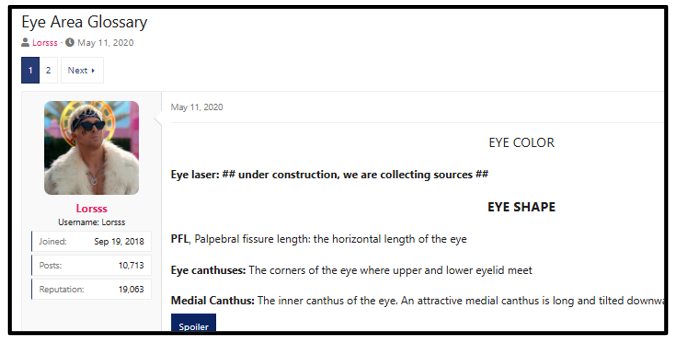
Seriously this thread fucking sucks, sorry @Lorsss
It was written in 2020 to be fair, for its time its alright. We are in 2026 though, so more standards have come.
the eye area is one of the most important parts of the face and most people here still treat it like an afterthought. it controls how dominant, tired, sunken, alert, or recessed your whole face looks in the first second someone sees you. you can have solid bones everywhere else and still get dragged down hard by weak orbital support, negative tilt, high upper eyelid exposure, or a soft brow-ridge relationship. these things stack. a slightly off canthal tilt with bad infraorbital support and open upper lids reads completely different from the same tilt with proper support and controlled exposure. almost nobody on here actually breaks those interactions down properly.
this guide exists because I got tired of the surface-level posting. we’re going to cover the real anatomy, so you know what you’re even looking at. then the key concepts that matter. then a clear hunter vs prey breakdown that isn’t just aesthetic jargon. after that you’ll get a proper way to assess your own eye area instead of just guessing from selfies. only once that’s done do we get into what can improve each part, ranked and separated so you don’t mix cope with real levers.
you will see detailed coverage of:
if all you want is quick definitions, the old glossary threads are already there. if you want the full version with no missing pieces, I got you, keep reading.
Due to the 10,000 word limit i gotta make new threads for these later sections aswell JFL
Section 6 <- Section 6
Section 7, 8, 9 <- Section 7 8 9
Finally its fucking done, I spent all of fucking today and yesterday wasting my life away making this
That's 48 hours of my life I'm never getting back
first attempt at a high effort thread (hopefully BOTB level).
Holy shit, I typed this out in word first. 26,000 words
welcome to the full eye area deep dive by yours truly, resting.
most of the eye area threads on this site are pure dogshit. either it’s some glossary that just lists definitions like a fucking wikipedia page, or it’s the horseshit usual of “positive canthal tilt = hunter eyes” cope with zero actual breakdown of what creates the look. then you’ve got the surgerycels jumping straight to canthoplasty and orbital implants like that’s the starting point and that everyone needs it (they don’t) instead of treating it like the last resort that it is. this post is not that.
Seriously this thread fucking sucks, sorry @Lorsss
It was written in 2020 to be fair, for its time its alright. We are in 2026 though, so more standards have come.
the eye area is one of the most important parts of the face and most people here still treat it like an afterthought. it controls how dominant, tired, sunken, alert, or recessed your whole face looks in the first second someone sees you. you can have solid bones everywhere else and still get dragged down hard by weak orbital support, negative tilt, high upper eyelid exposure, or a soft brow-ridge relationship. these things stack. a slightly off canthal tilt with bad infraorbital support and open upper lids reads completely different from the same tilt with proper support and controlled exposure. almost nobody on here actually breaks those interactions down properly.
this guide exists because I got tired of the surface-level posting. we’re going to cover the real anatomy, so you know what you’re even looking at. then the key concepts that matter. then a clear hunter vs prey breakdown that isn’t just aesthetic jargon. after that you’ll get a proper way to assess your own eye area instead of just guessing from selfies. only once that’s done do we get into what can improve each part, ranked and separated so you don’t mix cope with real levers.
you will see detailed coverage of:
- orbital bones and rim projection
- fat pad position and volume
- canthal tendons and tilt
- upper eyelid exposure versus hooding
- infraorbital support and the tear trough complex
- brow position relative to the orbital rim
- skin quality and soft tissue contribution
- what body fat, posture, and lighting change versus what they don’t
- ranked practical approaches for each sub-area
- clear limits so you know what is structural versus modifiable
if all you want is quick definitions, the old glossary threads are already there. if you want the full version with no missing pieces, I got you, keep reading.
2. Core Anatomy
before you can even understand what the fuck a "positive canthal tilt" or "negative orbital vector" actually means, you need to know what you're looking at underneath the skin. this is the part every other thread skips because glossary-posting is easy and actual anatomy is not. so, we're doing it properly, once, here, so you never have to relearn it.
the orbital bone (orbit):
this is the bony socket your eyeball sits in, and it is not some flat little dish — it's a rim with real depth, real projection, and it's built from three different bones stitching together: the frontal bone up top, the zygomatic bone (cheekbone) on the outer/lower side, and the maxilla on the lower/inner side. how far this rim projects forward relative to your actual eyeball is one of the single biggest variables in the entire eye area conversation, and almost nobody outside of actual craniofacial literature talks about it correctly.

a well-projected rim gives you natural shade over the eye without doing shit. no makeup, no fat loss, no lighting tricks, the bone itself throws shadow and creates definition. a weak or retruded rim does the opposite. your eyeball sits more exposed relative to the bone around it and depending on severity that reads anywhere from "soft prey-ish eyes" to actual scleral show and permanent tired-guy face no matter how much you sleep. this is bone. cope all you want; you're not changing this with skincare or any amount of stupid eye pulling.
source: orbital rim projection and its relationship to periorbital aesthetics is covered in Codner MA et al., "The Anatomy and Evolution of the Eyelid-Midface Junction," Plastic and Reconstructive Surgery — one of the standard references for orbital/midface anatomy in aesthetic surgery literature.
the globe-to-rim relationship:
this is the actual position of your eyeball relative to that orbital rim we just covered, and it's the single most underrated variable in this entire topic. two guys can have the exact same size eyeball and completely different looks purely because of how far forward or back the bone sits relative to it. this relationship is basically 100% skeletal. it's set by how your bones grew, full stop, and outside of surgery there is no "training" or "pulling" your way into changing it. i'm telling you this now so you don't waste six months on some bullshit routine trying to fix something that was decided by your bone structure before you hit puberty.
canthal tendons:
the canthi are just the corners of your eyes, medial (inner corner, closest to your nose) and lateral (outer corner, toward your temple). each corner is held in place by an actual tendon anchored directly into bone: the medial canthal tendon clips onto the frontal process of the maxilla, and the lateral canthal tendon anchors onto the lateral orbital rim at a specific point called whitnall's tubercle.

here's why this matters more than people think: the angle formed between these two anchor points is your canthal tilt. tilt isn't some floating "eye shape" trait, it is a direct physical output of where these two tendons are bolted into your skull. this is also exactly why faking tilt with makeup, tape, or lash extensions only ever works dead-on, straight-into-the-camera. the second you turn your head to a 3/4 angle or profile, the illusion collapses, because the actual tendon anchor points haven't moved an inch. the bone doesn't care about your eyeliner.
fat pads (periorbital fat):
this is where most people on this site get it completely wrong, because they lump "eye fat" into one category when it's several separate compartments doing completely different jobs:

source: the compartmentalized fat pad model (as opposed to one continuous fat layer) comes from Rohrich RJ & Pessa JE, "The Fat Compartments of the Face: Anatomy and Clinical Implications for Cosmetic Surgery," Plastic and Reconstructive Surgery — this is the paper that actually mapped these as distinct compartments instead of one blob, and it's the reason plastic surgeons treat upper lid fat, lower lid fat, and malar fat as separate problems requiring separate approaches.
eyelid structure (upper and lower)
your upper eyelid is a stack: skin on top, then the orbicularis oculi muscle (the muscle that closes your eye), then the orbital septum, then the levator palpebrae superioris — the actual muscle responsible for lifting your eyelid open. how much of this entire stack is visible between your lash line and your crease is your upper eyelid exposure, which we'll define properly in section 3.
whether you even have a visible crease at all comes down to skin quantity, fat pad volume, and how well that levator muscle is doing its job. hooding is what happens when skin and/or fat physically overhang the lash line and cover part of your mobile lid, different problem, different cause, and definitely not something you fix the same way as high exposure.
orbicularis retaining ligament (ORL):
this one basically never gets mentioned outside actual surgical literature but it matters a lot for anyone who's going to read section 6.6 later. the ORL is a ligament that anchors the orbicularis oculi muscle (the ring muscle around your eye) down to the bone along the lower orbital rim. it's the actual structural line that separates your lower eyelid from your cheek.

why you should care: this ligament is a big part of why a tear trough can look like a hard, defined groove rather than a soft gradual transition. when the ligament is tight and the fat/skin above and below it is uneven in volume, you get a sharp visible line right where the ligament attaches. this is a completely separate mechanism from the orbitomalar ligament stuff covered below. different ligament, different depression, and they commonly get confused as "the same tear trough thing" when they're not. this distinction is also the reason non-surgical filler approaches (section 6.10) sometimes work great for one type of trough and do basically nothing for the other, you're not treating the same structure.
source: the ORL's role in lower lid/cheek boundary aesthetics is detailed in Wong CH & Mendelson B, "Facial Soft-Tissue Spaces and Retaining Ligaments of the Midcheek: Defining the Premaxillary Space," Plastic and Reconstructive Surgery.
brow-to-orbit relationship and eyebrow follicle anatomy:
your eyebrow is not floating independently in space — it's soft tissue sitting directly on top of your superior orbital rim. its position is a direct reflection of the bone underneath it. a more projected brow ridge, combined with brow hair sitting in the right position on top of it, creates real shadow and a strong, defined transition into the upper lid. a flat brow bone paired with high-set eyebrows gives you that washed-out, permanently "open," slightly startled upper face — and this happens regardless of how strong your jaw or cheekbones are, because the eye area is being let down independently.

on top of bone position, the actual hair itself matters and this is worth covering now because section 6.4 is going to get into minoxidil for brow density. eyebrow hairs grow out of follicles that sit at a specific angle to the skin, and unlike scalp hair, brow follicles have a much shorter anagen (active growth) phase — this is why eyebrow hairs only grow to a certain length before shedding and why you can't "grow out" a sparse brow into a thick one just by leaving it alone. density is a function of total follicle count (mostly genetic, set early) and how many of those follicles are actively in the growth phase at any given time versus dormant. this second part is the actual lever that topical treatments are working on, which is why minoxidil for brows is a "wake up dormant follicles" strategy rather than a "create new follicles" strategy.
source: eyebrow hair cycle characteristics are described in Higgins CA et al., "Microphthalmia-associated transcription factor and human hair follicle pigmentation" and more directly in dermatology hair-cycle literature covering the shorter anagen phase of eyebrow vs scalp follicles; general reference: Otberg N et al., "Folliculitis decalvans" review section on eyebrow/facial hair cycling, Dermatology.
infraorbital region / tear trough:
this is the depression that can show up between your lower lid and your cheek, and the mechanical cause is specific: the orbital septum attaches directly to bone via something called the orbitomalar ligament, while the cheek fat sitting below that attachment point is separate and sits lower. genetics decide how deep and how low that ligament attachment sits to begin with. fat volume and skin thickness on top of it decide how visible the resulting trough actually looks day to day.

as covered above, this is a distinct mechanism from the ORL, you can have either one, both, or neither, and they respond to different fixes.
source: orbitomalar ligament and tear trough mechanism originally characterized in Kikkawa DO et al., "Relations of the Superficial Musculoaponeurotic System to the Orbit and Characterization of the Orbitomalar Ligament," Ophthalmic Plastic and Reconstructive Surgery.
before you can even understand what the fuck a "positive canthal tilt" or "negative orbital vector" actually means, you need to know what you're looking at underneath the skin. this is the part every other thread skips because glossary-posting is easy and actual anatomy is not. so, we're doing it properly, once, here, so you never have to relearn it.
the orbital bone (orbit):
this is the bony socket your eyeball sits in, and it is not some flat little dish — it's a rim with real depth, real projection, and it's built from three different bones stitching together: the frontal bone up top, the zygomatic bone (cheekbone) on the outer/lower side, and the maxilla on the lower/inner side. how far this rim projects forward relative to your actual eyeball is one of the single biggest variables in the entire eye area conversation, and almost nobody outside of actual craniofacial literature talks about it correctly.
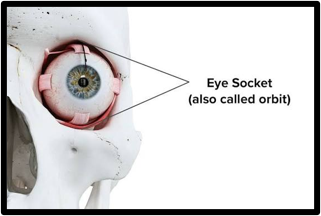
a well-projected rim gives you natural shade over the eye without doing shit. no makeup, no fat loss, no lighting tricks, the bone itself throws shadow and creates definition. a weak or retruded rim does the opposite. your eyeball sits more exposed relative to the bone around it and depending on severity that reads anywhere from "soft prey-ish eyes" to actual scleral show and permanent tired-guy face no matter how much you sleep. this is bone. cope all you want; you're not changing this with skincare or any amount of stupid eye pulling.
source: orbital rim projection and its relationship to periorbital aesthetics is covered in Codner MA et al., "The Anatomy and Evolution of the Eyelid-Midface Junction," Plastic and Reconstructive Surgery — one of the standard references for orbital/midface anatomy in aesthetic surgery literature.
the globe-to-rim relationship:
this is the actual position of your eyeball relative to that orbital rim we just covered, and it's the single most underrated variable in this entire topic. two guys can have the exact same size eyeball and completely different looks purely because of how far forward or back the bone sits relative to it. this relationship is basically 100% skeletal. it's set by how your bones grew, full stop, and outside of surgery there is no "training" or "pulling" your way into changing it. i'm telling you this now so you don't waste six months on some bullshit routine trying to fix something that was decided by your bone structure before you hit puberty.
canthal tendons:
the canthi are just the corners of your eyes, medial (inner corner, closest to your nose) and lateral (outer corner, toward your temple). each corner is held in place by an actual tendon anchored directly into bone: the medial canthal tendon clips onto the frontal process of the maxilla, and the lateral canthal tendon anchors onto the lateral orbital rim at a specific point called whitnall's tubercle.
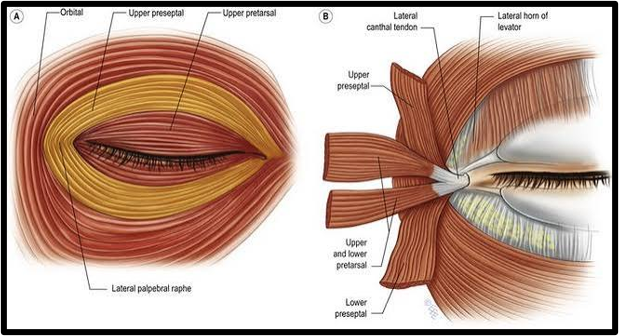
here's why this matters more than people think: the angle formed between these two anchor points is your canthal tilt. tilt isn't some floating "eye shape" trait, it is a direct physical output of where these two tendons are bolted into your skull. this is also exactly why faking tilt with makeup, tape, or lash extensions only ever works dead-on, straight-into-the-camera. the second you turn your head to a 3/4 angle or profile, the illusion collapses, because the actual tendon anchor points haven't moved an inch. the bone doesn't care about your eyeliner.
fat pads (periorbital fat):
this is where most people on this site get it completely wrong, because they lump "eye fat" into one category when it's several separate compartments doing completely different jobs:
- upper eyelid fat pad: sits underneath the brow. when this is excessive, or when the skin/muscle holding it starts sagging, it drops down and creates hooding.
- lower eyelid fat pads: there's three of these (medial, central, lateral), and when they bulge forward due to age, genetics, or septum weakness, that's your classic "eye bags."
- malar/cheek fat: sits just below the orbital rim, and its job is to support the transition from your lower lid smoothly into your cheek. when this deflates, or was never thick to begin with, you get a hollow tear trough even in lean, young, well-rested guys. this trips people up constantly, they think they look tired from lack of sleep when it's actually just missing structural fat volume.
- buccal and general midface fat: not technically eye-area tissue, but it changes how much shadow and support the under-eye gets overall, which is exactly why cutting body fat changes how your eyes look even though your eyes themselves didn't change.
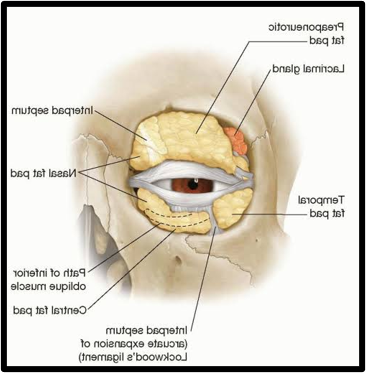
source: the compartmentalized fat pad model (as opposed to one continuous fat layer) comes from Rohrich RJ & Pessa JE, "The Fat Compartments of the Face: Anatomy and Clinical Implications for Cosmetic Surgery," Plastic and Reconstructive Surgery — this is the paper that actually mapped these as distinct compartments instead of one blob, and it's the reason plastic surgeons treat upper lid fat, lower lid fat, and malar fat as separate problems requiring separate approaches.
eyelid structure (upper and lower)
your upper eyelid is a stack: skin on top, then the orbicularis oculi muscle (the muscle that closes your eye), then the orbital septum, then the levator palpebrae superioris — the actual muscle responsible for lifting your eyelid open. how much of this entire stack is visible between your lash line and your crease is your upper eyelid exposure, which we'll define properly in section 3.
whether you even have a visible crease at all comes down to skin quantity, fat pad volume, and how well that levator muscle is doing its job. hooding is what happens when skin and/or fat physically overhang the lash line and cover part of your mobile lid, different problem, different cause, and definitely not something you fix the same way as high exposure.
orbicularis retaining ligament (ORL):
this one basically never gets mentioned outside actual surgical literature but it matters a lot for anyone who's going to read section 6.6 later. the ORL is a ligament that anchors the orbicularis oculi muscle (the ring muscle around your eye) down to the bone along the lower orbital rim. it's the actual structural line that separates your lower eyelid from your cheek.
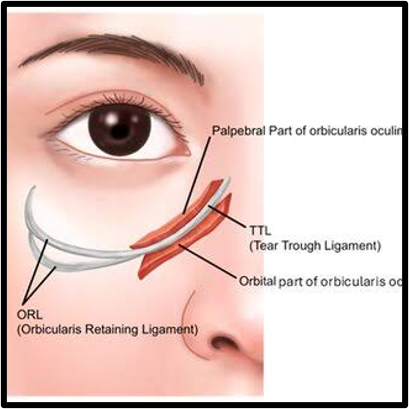
why you should care: this ligament is a big part of why a tear trough can look like a hard, defined groove rather than a soft gradual transition. when the ligament is tight and the fat/skin above and below it is uneven in volume, you get a sharp visible line right where the ligament attaches. this is a completely separate mechanism from the orbitomalar ligament stuff covered below. different ligament, different depression, and they commonly get confused as "the same tear trough thing" when they're not. this distinction is also the reason non-surgical filler approaches (section 6.10) sometimes work great for one type of trough and do basically nothing for the other, you're not treating the same structure.
source: the ORL's role in lower lid/cheek boundary aesthetics is detailed in Wong CH & Mendelson B, "Facial Soft-Tissue Spaces and Retaining Ligaments of the Midcheek: Defining the Premaxillary Space," Plastic and Reconstructive Surgery.
brow-to-orbit relationship and eyebrow follicle anatomy:
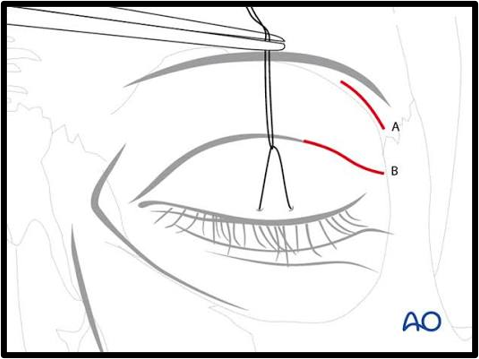
your eyebrow is not floating independently in space — it's soft tissue sitting directly on top of your superior orbital rim. its position is a direct reflection of the bone underneath it. a more projected brow ridge, combined with brow hair sitting in the right position on top of it, creates real shadow and a strong, defined transition into the upper lid. a flat brow bone paired with high-set eyebrows gives you that washed-out, permanently "open," slightly startled upper face — and this happens regardless of how strong your jaw or cheekbones are, because the eye area is being let down independently.
on top of bone position, the actual hair itself matters and this is worth covering now because section 6.4 is going to get into minoxidil for brow density. eyebrow hairs grow out of follicles that sit at a specific angle to the skin, and unlike scalp hair, brow follicles have a much shorter anagen (active growth) phase — this is why eyebrow hairs only grow to a certain length before shedding and why you can't "grow out" a sparse brow into a thick one just by leaving it alone. density is a function of total follicle count (mostly genetic, set early) and how many of those follicles are actively in the growth phase at any given time versus dormant. this second part is the actual lever that topical treatments are working on, which is why minoxidil for brows is a "wake up dormant follicles" strategy rather than a "create new follicles" strategy.
source: eyebrow hair cycle characteristics are described in Higgins CA et al., "Microphthalmia-associated transcription factor and human hair follicle pigmentation" and more directly in dermatology hair-cycle literature covering the shorter anagen phase of eyebrow vs scalp follicles; general reference: Otberg N et al., "Folliculitis decalvans" review section on eyebrow/facial hair cycling, Dermatology.
infraorbital region / tear trough:
this is the depression that can show up between your lower lid and your cheek, and the mechanical cause is specific: the orbital septum attaches directly to bone via something called the orbitomalar ligament, while the cheek fat sitting below that attachment point is separate and sits lower. genetics decide how deep and how low that ligament attachment sits to begin with. fat volume and skin thickness on top of it decide how visible the resulting trough actually looks day to day.
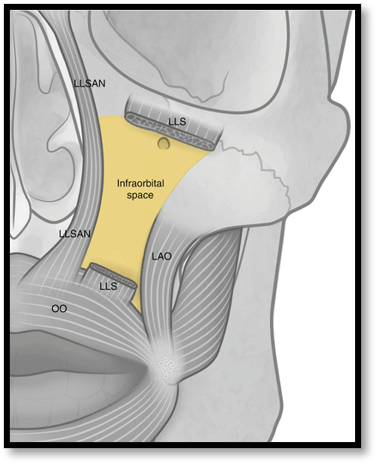
as covered above, this is a distinct mechanism from the ORL, you can have either one, both, or neither, and they respond to different fixes.
source: orbitomalar ligament and tear trough mechanism originally characterized in Kikkawa DO et al., "Relations of the Superficial Musculoaponeurotic System to the Orbit and Characterization of the Orbitomalar Ligament," Ophthalmic Plastic and Reconstructive Surgery.
3. Key Aesthetic Concepts
alright so before we get anywhere near hunter vs prey breakdowns, you need these terms actually locked into your head properly, not just vaguely remembered from some other thread you skimmed at 2am. every single concept below is a relationship between two or more structures we already covered in section 2. none of these are standalone traits you either have or don't have like some genetic lottery ticket. that binary thinking is exactly why 90% of rate threads on this site are worthless. guy posts a selfie, first reply is "bro get a canthoplasty for a positive canthal tilt," and nobody in the whole thread mentions his vector is negative as fuck. and honestly the tilt is the least of his problems. we're not doing that shit here. we're doing this properly.
canthal tilt
the angle of the line running from your medial canthus (inner corner, closest to your nose) to your lateral canthus (outer corner, toward your temple), measured against horizontal. that's it, that's the actual definition.
and tilt isn't some binary switch either, which people constantly treat it as. clinically this gets measured in actual degrees, and most normal populations sit somewhere in the 0-8 degree positive range as a baseline, with real documented ethnic variation on top of that — East Asian populations for instance tend to run a higher average positive tilt at baseline, tied to epicanthal fold prevalence and a different medial canthal tendon insertion angle. so "do I have positive tilt, yes or no" is genuinely often the wrong question to be asking yourself in the mirror. the better question is how many degrees, and is it enough magnitude to actually read as a deliberate, noticeable feature to a stranger looking at you for two seconds, versus a technically-positive-but-basically-invisible half-degree that isn't doing anything for you either way.
one more thing that never gets brought up and genuinely should be: tilt can be asymmetric between your two eyes, and mild asymmetry in the 1-3 degree range is extremely common and not something worth spiraling over. it only becomes an actual problem once you're past that range, and by that point it's usually riding alongside other asymmetries too. E.g. brow height being uneven, lid crease sitting differently on each side, meaning the tilt asymmetry alone usually isn't the main character in that story, it's a symptom of a broader asymmetry that's the real issue.
as covered back in section 2, tilt is a direct mechanical output of where your lateral and medial canthal tendons physically anchor into bone. it is set skeletally, full stop, end of discussion. there is no non-surgical method on this earth that changes the actual angle those tendons create. the fake-tilt makeup techniques you see everywhere, winged liner extended past the actual lateral canthus, lash extensions angled outward and upward, canthal tape pulling the corner, all work on the exact same principle, which is creating a visible line that tricks the eye into extending the apparent lateral corner further up and out than it actually goes. this reads completely fine dead straight into a phone camera because you're exploiting how the eye reads edges and lines. the second you turn even slightly to a 3/4 angle, let alone full profile, it collapses instantly and looks obviously fake, because the actual tendon insertion point — the physical thing casting real shadow and creating real form in three dimensions — never moved an inch. so don't fall for threads claiming otherwise, and don't waste your money on "canthal tilt tape" being sold to you as anything more than a temporary front-facing camera trick, because that's genuinely all it is.

source: canthal tilt as a function of canthal tendon insertion position, and its surgical modification via canthoplasty, is discussed in Fagien S, "Algorithm for Canthoplasty," Plastic and Reconstructive Surgery. ethnic variation in baseline tilt and epicanthal fold prevalence is covered in Kunjur J et al., "Anthropometric Analysis of Eyebrows and Eyelids," British Journal of Oral and Maxillofacial Surgery.
upper eyelid exposure (UEE)
how much skin is actually showing between your lash line and your crease/brow when your eyes are open and sitting at a relaxed baseline, not squinting at your phone, not doing a face for the mirror like a fucking cuck, just normal resting state, the way your eyes actually look when someone talks to you on the street.

here's the part almost every other thread completely skips over and just doesn't tell you, UEE is not one single measurement you can point to, it's the combined output of at minimum four separate variables all stacking on top of each other simultaneously, and figuring out which one is actually driving your specific situation matters a lot, because the fix for one is completely useless against another:
source: upper eyelid exposure as a multifactorial trait combining skin, fat, and levator function is standard across oculoplastic literature, e.g. Cohen AJ & Weinberg DA (eds.), Evaluation and Management of Blepharoptosis. brow position's independent contribution to apparent hooding is discussed in Matros E et al., "Correction of Eyebrow Ptosis," Aesthetic Surgery Journal.
orbital vector
the relationship between the front-most point of your cornea and the front-most point of your lower orbital rim/cheekbone, viewed straight from the side. I'm going to spend real time on this one because it might genuinely be the single most important concept in this entire guide, and it's the one most threads on here butcher the worst.

the actual clinical way this gets assessed is by drawing, or just mentally visualizing, a vertical line straight down from the front surface of the cornea and checking exactly where the front surface of the malar/orbital rim falls relative to that line when viewed in profile, sitting in front of it, sitting right on it, or sitting behind it. and honestly, this is one of the only traits in this whole guide that's basically binary in its real-world consequences. there is no lighting angle, no skincare product on planet earth, no amount of sleep, no hydration protocol, that changes where your bone physically sits relative to your eyeball. I've seen guys with negative vector on here running a genuinely perfect sleep schedule, drinking their 4 liters a day religiously, still posting about their under eye "bags" and they still have the exact same shadow, because the shadow was never being caused by tiredness or dehydration in the first place. it's pure geometry, bone sitting behind eyeball, casting shadow, that's it, that's the whole mechanism.
this is also exactly why "puffy vs hollow" under-eye discourse confuses so many people on here you can have negative vector, meaning hollow and shadowed, AND lower lid fat pad bulging, meaning puffy, at the exact same time, on the exact same face, because these are two completely different structures doing two completely different things. the hollow part is the vector/bone problem. the puffy part sitting right below or right on top of it is the fat pad problem. they need completely different, sometimes actually opposite, treatments — and this is a massive part of why generic "how do I fix my under eye bags" threads go in circles forever, half the replies in there are unknowingly answering a totally different question than the one actually being asked.
and vector isn't even uniform across your whole under-eye either, which almost nobody mentions. it's genuinely common to have a stronger vector medially, near your nose, and a noticeably weaker one laterally, toward your temple, or the reverse, because the maxilla and the zygomatic bone are contributing differently across that entire span rather than as one uniform sheet of bone. this is exactly why some guys have a hollow that's really only visible right in the inner corner near the nose, or only really shows up on the outer third near the temple, instead of the entire under-eye reading as uniformly negative front to back.
this concept comes back hard later in section 7 (what doesn't actually work, so stop wasting money) and section 11 (surgical options) because it's one of the very few traits in this entire guide where surgery, specifically orbital rim implants, or fat grafting to physically build the projection forward, is genuinely the only real functioning lever available, not some dramatic last-resort thing people throw around on here to sound edgy. everything non-surgical covered later in section 6 that touches this specific area, 6.6 specifically, is about managing the appearance around a negative vector, not actually correcting the vector itself, and I need that distinction completely locked in your head before we even get there, because I guarantee people are going to skip straight to 6.6 hoping for a miracle and I want you walking in with realistic expectations already set.


source: orbital vector terminology and its clinical significance in classifying periorbital aesthetics is established in Jelks GW & Jelks EB, "The Influence of Orbital and Eyelid Anatomy on the Palpebral Aperture," Clinics in Plastic Surgery. the distinction between vector-driven hollowing and fat-pad-driven puffiness as independent, frequently co-occurring phenomena is discussed in Lambros V, "Observations on Periorbital and Midface Aging," Plastic and Reconstructive Surgery.
scleral show
visible white of the eye, the sclera, showing above or below the iris when your eyes are relaxed and looking dead straight ahead.
the reason I'm giving scleral show its own dedicated breakdown separate from vector or lid laxity is that it's genuinely the single most visually obvious symptom to a random stranger looking at your face for two seconds in passing. most people walking past you on the street cannot consciously identify "ah, negative orbital vector" if you asked them to name it, but they will absolutely, instantly register "something looks kind of off, or sad, or tired about this guy's eyes," and scleral show is very often the exact specific visual trigger causing that read without them being able to articulate why. so it's a genuinely high-leverage symptom to understand properly, even though, and this is the important part I need you to actually internalize instead of skimming past. it is a symptom, not a root cause, ever. it is downstream of orbital vector, canthal tendon strength, and lower lid tone, sometimes all three stacking on top of each other at once. do not waste your time or money trying to "fix scleral show" directly with some random eye-widening exercise routine or lid-taping gimmick you saw on here or on tiktok, because you're treating a symptom while ignoring whatever's actually causing it underneath. you fix the actual cause, or, if the cause is skeletal, you accept it as a genuine hard limit and move on to working the parts of your face you can actually change.
worth flagging honestly: some degree of inferior scleral show is completely normal, and it's present even in eyes widely considered attractive by basically any standard. the actual difference between "a small sliver of white that reads as alert and wide-eyed in a good way" and "visible white that reads as sunken and sad" comes down to a matter of degree, and what else is stacking around it. vector, tilt, UEE all compounding together. not some strict binary presence-or-absence thing you either have or don't.
source: inferior scleral show as an indicator of negative vector and lower lid malposition is covered in Hamra ST, "Arcus Marginalis Release and Orbital Fat Preservation in Midface Rejuvenation," Plastic and Reconstructive Surgery.

palpebral fissure
the horizontal opening of the eye itself — basically the visible almond shape sitting between your two canthi when your eye is open, measured both by horizontal length, canthus to canthus, and vertical height, the widest point from top lid to bottom lid. this sets your actual baseline eye shape completely independent of everything else on this entire list, and it's worth thinking about as two separate numbers rather than one vague fuzzy "eye shape" impression in your head.

combined with tilt and UEE, fissure shape is a big part of what actually determines whether an eye reads as almond, round, hooded-almond, whatever category people throw around loosely on here — and honestly it's a big chunk of why two guys can have the exact same measured positive tilt and still look completely different from each other, because one of them has a long narrow fissure and the other has a short round one sitting at that identical angle. tilt alone was never going to tell the whole story.
source: palpebral fissure dimensions as a standard anthropometric measurement, Farkas LG, Anthropometry of the Head and Face.
intercanthal distance / interpupillary relationship
how far apart your eyes sit, both at the inner corners, which is your intercanthal distance, and at the pupils themselves, your interpupillary distance. this affects your perceived facial proportion and "set," meaning close-set versus wide-set eyes, but it's a completely independent variable from tilt or vector. they don't correlate with each other at all, they just happen to be sitting on the same face at the same time.


the clinical rule of thumb here, and I want to stress this is a commonly cited proportional guideline and not some hard unbreakable law of facial aesthetics, is that your intercanthal distance should roughly equal the horizontal width of one of your own eyes, and that this same distance should also roughly equal the width of your nasal base, the classic "one eye's width of space" spacing rule you might've heard thrown around. deviating from this in either direction, too close or too wide, is exactly what reads as close-set or wide-set to a viewer, and both extremes tend to read as slightly "off" even to people who couldn't articulate why if you asked them directly, because human face-processing is subconsciously tuned to expect that roughly even spacing as a baseline.
source: intercanthal distance as an independent facial proportion metric, and the "eye-width spacing" proportional guideline, standard reference in Farkas LG, Anthropometry of the Head and Face.
alright so before we get anywhere near hunter vs prey breakdowns, you need these terms actually locked into your head properly, not just vaguely remembered from some other thread you skimmed at 2am. every single concept below is a relationship between two or more structures we already covered in section 2. none of these are standalone traits you either have or don't have like some genetic lottery ticket. that binary thinking is exactly why 90% of rate threads on this site are worthless. guy posts a selfie, first reply is "bro get a canthoplasty for a positive canthal tilt," and nobody in the whole thread mentions his vector is negative as fuck. and honestly the tilt is the least of his problems. we're not doing that shit here. we're doing this properly.
canthal tilt
the angle of the line running from your medial canthus (inner corner, closest to your nose) to your lateral canthus (outer corner, toward your temple), measured against horizontal. that's it, that's the actual definition.
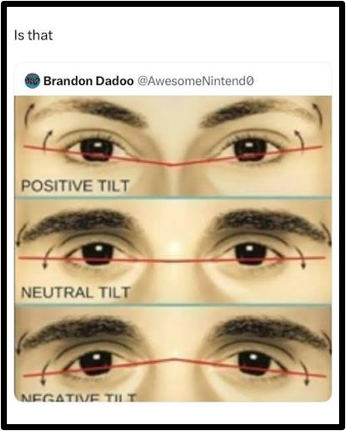
- positive tilt: outer corner sits higher than inner corner. line angles up toward the temple. this is the tilt everyone on here is obsessed with, the "hunter eye" tilt, the thing half the newgens think is the entire eye area conversation on its own (it's not, keep reading).
- negative tilt: outer corner sits lower than inner corner. line angles down. gets lumped in constantly with "puppy dog eyes" or thrown under the broader "prey eyes" umbrella we'll get into properly in section 4.
- neutral: roughly level, no meaningful angle either direction.
and tilt isn't some binary switch either, which people constantly treat it as. clinically this gets measured in actual degrees, and most normal populations sit somewhere in the 0-8 degree positive range as a baseline, with real documented ethnic variation on top of that — East Asian populations for instance tend to run a higher average positive tilt at baseline, tied to epicanthal fold prevalence and a different medial canthal tendon insertion angle. so "do I have positive tilt, yes or no" is genuinely often the wrong question to be asking yourself in the mirror. the better question is how many degrees, and is it enough magnitude to actually read as a deliberate, noticeable feature to a stranger looking at you for two seconds, versus a technically-positive-but-basically-invisible half-degree that isn't doing anything for you either way.
one more thing that never gets brought up and genuinely should be: tilt can be asymmetric between your two eyes, and mild asymmetry in the 1-3 degree range is extremely common and not something worth spiraling over. it only becomes an actual problem once you're past that range, and by that point it's usually riding alongside other asymmetries too. E.g. brow height being uneven, lid crease sitting differently on each side, meaning the tilt asymmetry alone usually isn't the main character in that story, it's a symptom of a broader asymmetry that's the real issue.
as covered back in section 2, tilt is a direct mechanical output of where your lateral and medial canthal tendons physically anchor into bone. it is set skeletally, full stop, end of discussion. there is no non-surgical method on this earth that changes the actual angle those tendons create. the fake-tilt makeup techniques you see everywhere, winged liner extended past the actual lateral canthus, lash extensions angled outward and upward, canthal tape pulling the corner, all work on the exact same principle, which is creating a visible line that tricks the eye into extending the apparent lateral corner further up and out than it actually goes. this reads completely fine dead straight into a phone camera because you're exploiting how the eye reads edges and lines. the second you turn even slightly to a 3/4 angle, let alone full profile, it collapses instantly and looks obviously fake, because the actual tendon insertion point — the physical thing casting real shadow and creating real form in three dimensions — never moved an inch. so don't fall for threads claiming otherwise, and don't waste your money on "canthal tilt tape" being sold to you as anything more than a temporary front-facing camera trick, because that's genuinely all it is.
source: canthal tilt as a function of canthal tendon insertion position, and its surgical modification via canthoplasty, is discussed in Fagien S, "Algorithm for Canthoplasty," Plastic and Reconstructive Surgery. ethnic variation in baseline tilt and epicanthal fold prevalence is covered in Kunjur J et al., "Anthropometric Analysis of Eyebrows and Eyelids," British Journal of Oral and Maxillofacial Surgery.
upper eyelid exposure (UEE)
how much skin is actually showing between your lash line and your crease/brow when your eyes are open and sitting at a relaxed baseline, not squinting at your phone, not doing a face for the mirror like a fucking cuck, just normal resting state, the way your eyes actually look when someone talks to you on the street.
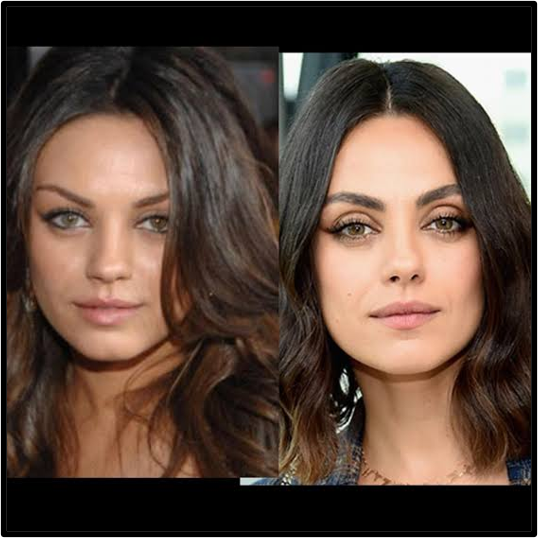
- low UEE: minimal skin visible, lid looks tucked and tight, usually comes paired with a defined but not overhung crease. generally the more favorable end if you're going for a sharp, alert look, which let's be honest is what basically everyone reading this wants.
- high UEE: a lot of skin showing between your lash line and brow. can genuinely look youthful or doe-eyed on certain faces, I'm not going to pretend it's universally bad, but stacked on top of other negative traits like negative tilt, negative vector, the combo it will probably read as tired, sleepy, checked-out, the exact opposite of what you're going for.
- hooding: skin and/or fat overhangs the crease and physically covers part of your lash line. this is the opposite problem from high UEE. too little lid showing rather than too much. and I see people mix these two up constantly in threads on here, calling hooding "high UEE" and vice versa, when they need genuinely different diagnostic approaches and different fixes.
here's the part almost every other thread completely skips over and just doesn't tell you, UEE is not one single measurement you can point to, it's the combined output of at minimum four separate variables all stacking on top of each other simultaneously, and figuring out which one is actually driving your specific situation matters a lot, because the fix for one is completely useless against another:
- skin quantity: literally just how much skin physically exists above your lash line before it hits your crease. purely anatomical, present from a young age in some guys (some people are just born with a lower-set crease, nothing to do with aging), and it gets progressively worse with age in basically everyone via dermatochalasis, which is the clinical term for skin laxity and excess from ongoing collagen loss over the years.
- fat pad volume: we covered this in section 2, the upper lid fat pad sitting tucked under the brow. more volume there physically pushes the crease down and reduces how much lid space is visible, meaning lower apparent UEE, but through a completely different mechanism than the skin issue above. less volume there does the reverse.
- levator muscle function: the actual muscle responsible for lifting your lid open in the first place. weak or poorly attached levator function is what's clinically called ptosis when it's significant enough, and it directly reduces how much of your upper lid retracts up and out of view when your eyes are open, which increases apparent hooding completely independent of how much skin or fat you're carrying up there.
- brow position: a high, arched brow drags the entire eyebrow-to-crease skin envelope upward with it, which can either increase your visible UEE by giving more physical space to work with, or, and this trips people up, it can paradoxically decrease it if that extra vertical distance is just getting filled with loose sagging skin instead of taut skin. meanwhile a low, heavy brow crowds the lid space directly and contributes to hooding completely independent of your actual eyelid anatomy — which is exactly why some guys' hooding is actually a brow positioning problem, not an eyelid problem at all, and zero amount of eyelid-focused anything is going to fix that for them.
source: upper eyelid exposure as a multifactorial trait combining skin, fat, and levator function is standard across oculoplastic literature, e.g. Cohen AJ & Weinberg DA (eds.), Evaluation and Management of Blepharoptosis. brow position's independent contribution to apparent hooding is discussed in Matros E et al., "Correction of Eyebrow Ptosis," Aesthetic Surgery Journal.
orbital vector
the relationship between the front-most point of your cornea and the front-most point of your lower orbital rim/cheekbone, viewed straight from the side. I'm going to spend real time on this one because it might genuinely be the single most important concept in this entire guide, and it's the one most threads on here butcher the worst.
- positive vector: cheekbone projects forward, sitting level with or actually in front of the cornea. this is your "structured under-eye" — no hollow, no bag, a completely clean smooth transition running straight from lid into cheek with zero visible break in the surface.
- neutral vector: cornea and rim roughly line up with each other, no meaningful shadow being cast either way.
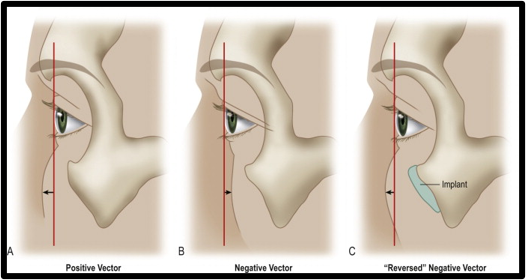
- negative vector: cornea sits forward of the rim. this creates a natural, permanent shadow and hollow under the eye regardless of how much you sleep, how hydrated you are, or what you eat, because the bone itself is physically set back relative to the eyeball sitting out in front of it.
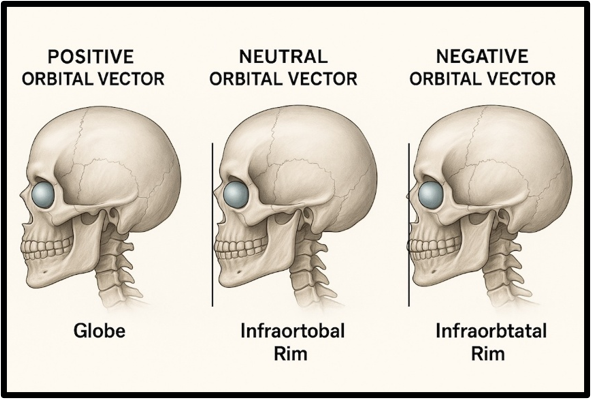
the actual clinical way this gets assessed is by drawing, or just mentally visualizing, a vertical line straight down from the front surface of the cornea and checking exactly where the front surface of the malar/orbital rim falls relative to that line when viewed in profile, sitting in front of it, sitting right on it, or sitting behind it. and honestly, this is one of the only traits in this whole guide that's basically binary in its real-world consequences. there is no lighting angle, no skincare product on planet earth, no amount of sleep, no hydration protocol, that changes where your bone physically sits relative to your eyeball. I've seen guys with negative vector on here running a genuinely perfect sleep schedule, drinking their 4 liters a day religiously, still posting about their under eye "bags" and they still have the exact same shadow, because the shadow was never being caused by tiredness or dehydration in the first place. it's pure geometry, bone sitting behind eyeball, casting shadow, that's it, that's the whole mechanism.
this is also exactly why "puffy vs hollow" under-eye discourse confuses so many people on here you can have negative vector, meaning hollow and shadowed, AND lower lid fat pad bulging, meaning puffy, at the exact same time, on the exact same face, because these are two completely different structures doing two completely different things. the hollow part is the vector/bone problem. the puffy part sitting right below or right on top of it is the fat pad problem. they need completely different, sometimes actually opposite, treatments — and this is a massive part of why generic "how do I fix my under eye bags" threads go in circles forever, half the replies in there are unknowingly answering a totally different question than the one actually being asked.
and vector isn't even uniform across your whole under-eye either, which almost nobody mentions. it's genuinely common to have a stronger vector medially, near your nose, and a noticeably weaker one laterally, toward your temple, or the reverse, because the maxilla and the zygomatic bone are contributing differently across that entire span rather than as one uniform sheet of bone. this is exactly why some guys have a hollow that's really only visible right in the inner corner near the nose, or only really shows up on the outer third near the temple, instead of the entire under-eye reading as uniformly negative front to back.
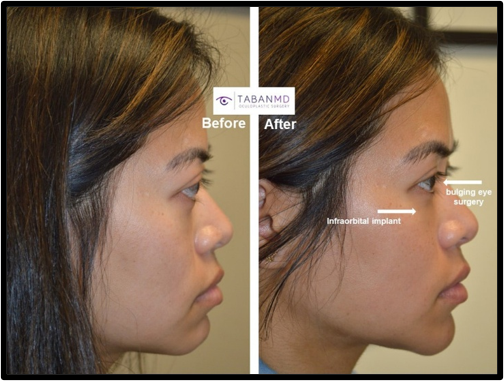
this concept comes back hard later in section 7 (what doesn't actually work, so stop wasting money) and section 11 (surgical options) because it's one of the very few traits in this entire guide where surgery, specifically orbital rim implants, or fat grafting to physically build the projection forward, is genuinely the only real functioning lever available, not some dramatic last-resort thing people throw around on here to sound edgy. everything non-surgical covered later in section 6 that touches this specific area, 6.6 specifically, is about managing the appearance around a negative vector, not actually correcting the vector itself, and I need that distinction completely locked in your head before we even get there, because I guarantee people are going to skip straight to 6.6 hoping for a miracle and I want you walking in with realistic expectations already set.
source: orbital vector terminology and its clinical significance in classifying periorbital aesthetics is established in Jelks GW & Jelks EB, "The Influence of Orbital and Eyelid Anatomy on the Palpebral Aperture," Clinics in Plastic Surgery. the distinction between vector-driven hollowing and fat-pad-driven puffiness as independent, frequently co-occurring phenomena is discussed in Lambros V, "Observations on Periorbital and Midface Aging," Plastic and Reconstructive Surgery.
scleral show
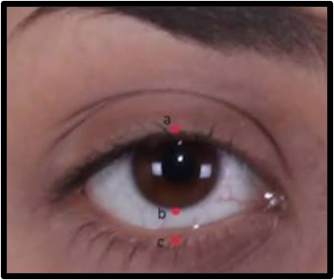
visible white of the eye, the sclera, showing above or below the iris when your eyes are relaxed and looking dead straight ahead.
- inferior scleral show, below the iris, is by far the more common of the two. usually comes from negative vector, weak lower lid support, or genuine lower lid laxity — meaning the lid is physically sitting lower than it should relative to where your iris is, which in more severe clinical cases actually gets its own name, lower lid retraction. this is what's giving guys that permanent "sad eyes" or sunken look even when literally everything else on their face is put together well. you'll see this get mistaken for "just being tired" constantly, when the guy in question could be getting perfect sleep every single night and it wouldn't change a thing.
- superior scleral show, above the iris, is way less common, and usually reads as a startled or permanently surprised expression rather than tired. it's tied more often to high UEE or brow elevation than it is to vector specifically.
the reason I'm giving scleral show its own dedicated breakdown separate from vector or lid laxity is that it's genuinely the single most visually obvious symptom to a random stranger looking at your face for two seconds in passing. most people walking past you on the street cannot consciously identify "ah, negative orbital vector" if you asked them to name it, but they will absolutely, instantly register "something looks kind of off, or sad, or tired about this guy's eyes," and scleral show is very often the exact specific visual trigger causing that read without them being able to articulate why. so it's a genuinely high-leverage symptom to understand properly, even though, and this is the important part I need you to actually internalize instead of skimming past. it is a symptom, not a root cause, ever. it is downstream of orbital vector, canthal tendon strength, and lower lid tone, sometimes all three stacking on top of each other at once. do not waste your time or money trying to "fix scleral show" directly with some random eye-widening exercise routine or lid-taping gimmick you saw on here or on tiktok, because you're treating a symptom while ignoring whatever's actually causing it underneath. you fix the actual cause, or, if the cause is skeletal, you accept it as a genuine hard limit and move on to working the parts of your face you can actually change.
worth flagging honestly: some degree of inferior scleral show is completely normal, and it's present even in eyes widely considered attractive by basically any standard. the actual difference between "a small sliver of white that reads as alert and wide-eyed in a good way" and "visible white that reads as sunken and sad" comes down to a matter of degree, and what else is stacking around it. vector, tilt, UEE all compounding together. not some strict binary presence-or-absence thing you either have or don't.
source: inferior scleral show as an indicator of negative vector and lower lid malposition is covered in Hamra ST, "Arcus Marginalis Release and Orbital Fat Preservation in Midface Rejuvenation," Plastic and Reconstructive Surgery.
palpebral fissure
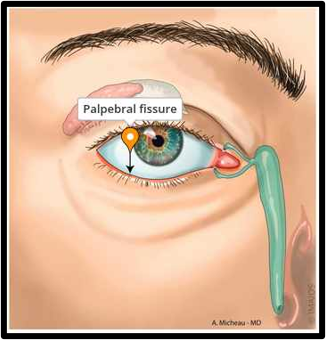
the horizontal opening of the eye itself — basically the visible almond shape sitting between your two canthi when your eye is open, measured both by horizontal length, canthus to canthus, and vertical height, the widest point from top lid to bottom lid. this sets your actual baseline eye shape completely independent of everything else on this entire list, and it's worth thinking about as two separate numbers rather than one vague fuzzy "eye shape" impression in your head.
- a longer, narrower fissure reads as more almond-shaped by default, no other factors needed.
- a shorter, taller fissure reads rounder by default, again completely independent of whatever your tilt or vector happen to be doing.
combined with tilt and UEE, fissure shape is a big part of what actually determines whether an eye reads as almond, round, hooded-almond, whatever category people throw around loosely on here — and honestly it's a big chunk of why two guys can have the exact same measured positive tilt and still look completely different from each other, because one of them has a long narrow fissure and the other has a short round one sitting at that identical angle. tilt alone was never going to tell the whole story.
source: palpebral fissure dimensions as a standard anthropometric measurement, Farkas LG, Anthropometry of the Head and Face.
intercanthal distance / interpupillary relationship
how far apart your eyes sit, both at the inner corners, which is your intercanthal distance, and at the pupils themselves, your interpupillary distance. this affects your perceived facial proportion and "set," meaning close-set versus wide-set eyes, but it's a completely independent variable from tilt or vector. they don't correlate with each other at all, they just happen to be sitting on the same face at the same time.
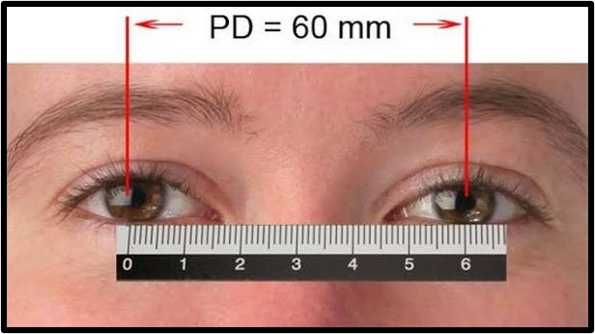
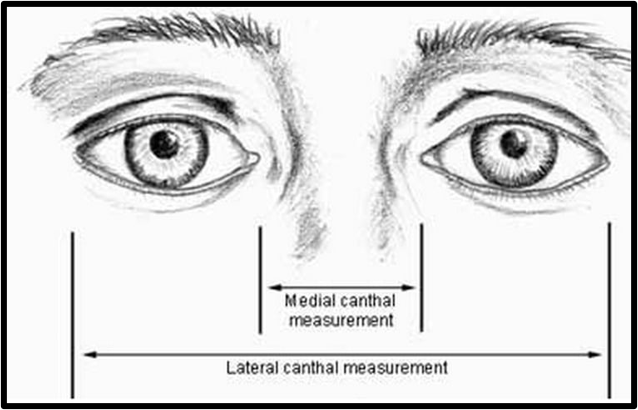
the clinical rule of thumb here, and I want to stress this is a commonly cited proportional guideline and not some hard unbreakable law of facial aesthetics, is that your intercanthal distance should roughly equal the horizontal width of one of your own eyes, and that this same distance should also roughly equal the width of your nasal base, the classic "one eye's width of space" spacing rule you might've heard thrown around. deviating from this in either direction, too close or too wide, is exactly what reads as close-set or wide-set to a viewer, and both extremes tend to read as slightly "off" even to people who couldn't articulate why if you asked them directly, because human face-processing is subconsciously tuned to expect that roughly even spacing as a baseline.
source: intercanthal distance as an independent facial proportion metric, and the "eye-width spacing" proportional guideline, standard reference in Farkas LG, Anthropometry of the Head and Face.
4. Hunter Eyes vs Prey Eyes
before I get into this, let me address the elephant in the room: "hunter eyes" and "prey eyes" are not clinical terms, you will not find them in a single anatomy textbook or surgical paper, and that's fine, because they're just community shorthand for two specific clusters of the traits we already covered in section 3. the problem is basically every thread on this site treats "hunter eyes" as a single trait (usually just canthal tilt) when it's actually a combination of like four or five things stacking together, and if you're only checking one of them you're going to misdiagnose yourself constantly. so let's actually break down the full cluster properly instead of doing the lazy version.
hunter eyes: the full trait cluster
positive canthal tilt — outer corner sitting higher than inner corner, this is the one everyone already knows.
positive-to-neutral orbital vector — cheekbone projecting forward at or ahead of the cornea, so there's no hollow/shadow undercutting the eye and dragging it down visually.
low-to-moderate UEE with a controlled, tucked lid — not a ton of skin showing, lid looks tight, no hooding but also not excessively "open."
minimal-to-no scleral show — especially inferior scleral show, since as we covered, that reads as tired/sad even when it's not the actual issue.
a reasonably projected brow ridge — enough to throw natural shadow over the upper lid without needing to squint or furrow to create it artificially.
a narrower, more almond-shaped palpebral fissure — not a hard requirement, but it shows up disproportionately often in what people call hunter eyes because it reinforces the sharp, narrowed look.

the actual visual effect all of this creates together is a kind of natural, low-effort intensity. the eye looks slightly narrowed and forward-projecting without the person doing anything, no squinting, no deliberate expression. this is exactly why it reads as "predatory" to people, hence the name. it's mimicking the kind of focused, narrowed gaze a predator has when it's actually looking at something it's tracking, versus the wide, exposed, alert-to-danger gaze of something that's scanning for threats. that's the actual evolutionary-psych logic behind the naming convention, whether or not you buy into how much weight that theory deserves.
prey eyes: the full trait cluster

the visual effect here is the literal opposite. the eye reads as wide open, exposed, slightly startled or vulnerable, with nothing narrowing or shadowing it. going with the same evolutionary-psych framing as above, this mimics the wide, exposed gaze of prey animals that need maximum peripheral awareness to detect threats rather than a narrow-focused gaze tracking one specific target. again, take that framing for what it's worth, it's a naming convention that stuck because it's intuitive, not a rigorous scientific classification.
why "just fix your tilt" is genuinely bad advice
here's the thing that I need you to actually sit with instead of skimming past: you can have textbook positive canthal tilt and still read as prey eyes overall if your vector is negative, your UEE is high, and you've got visible inferior scleral show stacked on top. the tilt alone is not carrying the whole look. I see this constantly on here. guy has decent tilt, gets told his eyes are already good, but the actual reason his eye area isn't working is his vector is negative and there's a shadow undercutting the whole thing, or his UEE is so high the tilt barely registers because there's so much skin between the lash line and brow that the eye just reads as tired regardless of the corner angle. tilt is the trait everyone learns about first because it's the easiest to describe in one sentence, not because it's the most important one in isolation. it's one of five-plus stacking traits, not the whole equation.
same logic in reverse. I've seen guys with genuinely neutral or even slightly negative tilt who still read as hunter-eyed overall because their vector is strongly positive, their UEE is low and controlled, brow ridge is doing real work throwing shadow, and there's zero scleral show anywhere. the tilt being slightly negative barely registers against everything else in the cluster pulling the look in the other direction. this is exactly why fixating on tilt alone, positive or negative, and ignoring the rest of the cluster, is how people misdiagnose their own eye area constantly on this site.
most people are not a clean cluster either way
realistically, most faces are not sitting in a pure hunter cluster or a pure prey cluster. most guys have some mix, positive tilt paired with a slightly negative vector, or a great vector paired with higher-than-ideal UEE, whatever combination. this isn't a personal failure or some rare unlucky genetic draw, it's just how these traits actually distribute across a population, because as covered in section 3, tilt and vector aren't correlated with each other at all. they're independent variables that happen to land on the same face, so there's no biological reason they'd naturally sort themselves into two clean opposing packages for most people. the "pure hunter eyes" guys you see get posted around here as reference are genuinely somewhat rare specifically because it requires several independent traits to all land favourably on the same face simultaneously, not because everyone else is doing something wrong.
this matters practically because it means your actual goal, realistically, for most guys reading this, is not "become a pure hunter eyes guy," it's identifying which specific traits in your own cluster are pulling you toward prey and addressing those individually where they're actually addressable. which is exactly the diagnostic process section 5 is about to walk you through, and exactly why section 6 is broken into eleven separate subsections instead of one generic "how to get hunter eyes" section. there is no single lever. there's a checklist, and you're probably only failing two or three items on it, not all of them.

a note on subtlety and threshold effects
one more thing worth flagging before section 5: these clusters aren't operating on some hard threshold where you either clearly have one or clearly have the other. the traits exist on a spectrum, and small movements matter — someone with mild negative vector and otherwise strong traits everywhere else can still look pretty solid overall, while someone with severe negative vector will have that one trait actively dragging down an otherwise decent cluster because, as covered in section 3, vector-driven shadow is one of the most immediately visible cues to a stranger's eye. severity and stacking matter as much as the raw checklist of which traits are positive versus negative. this is going to come up again directly in section 5 when we actually get into how to assess your own eye area instead of just checking boxes.
before I get into this, let me address the elephant in the room: "hunter eyes" and "prey eyes" are not clinical terms, you will not find them in a single anatomy textbook or surgical paper, and that's fine, because they're just community shorthand for two specific clusters of the traits we already covered in section 3. the problem is basically every thread on this site treats "hunter eyes" as a single trait (usually just canthal tilt) when it's actually a combination of like four or five things stacking together, and if you're only checking one of them you're going to misdiagnose yourself constantly. so let's actually break down the full cluster properly instead of doing the lazy version.
hunter eyes: the full trait cluster
positive canthal tilt — outer corner sitting higher than inner corner, this is the one everyone already knows.
positive-to-neutral orbital vector — cheekbone projecting forward at or ahead of the cornea, so there's no hollow/shadow undercutting the eye and dragging it down visually.
low-to-moderate UEE with a controlled, tucked lid — not a ton of skin showing, lid looks tight, no hooding but also not excessively "open."
minimal-to-no scleral show — especially inferior scleral show, since as we covered, that reads as tired/sad even when it's not the actual issue.
a reasonably projected brow ridge — enough to throw natural shadow over the upper lid without needing to squint or furrow to create it artificially.
a narrower, more almond-shaped palpebral fissure — not a hard requirement, but it shows up disproportionately often in what people call hunter eyes because it reinforces the sharp, narrowed look.
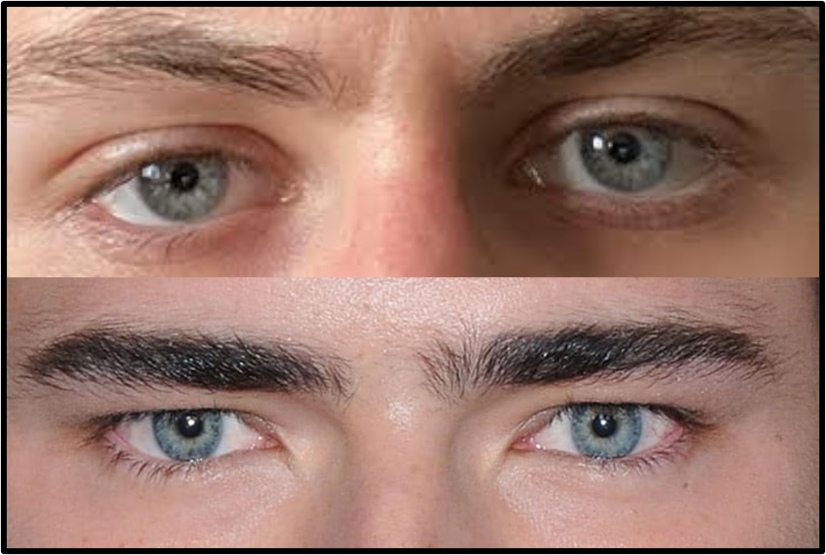
the actual visual effect all of this creates together is a kind of natural, low-effort intensity. the eye looks slightly narrowed and forward-projecting without the person doing anything, no squinting, no deliberate expression. this is exactly why it reads as "predatory" to people, hence the name. it's mimicking the kind of focused, narrowed gaze a predator has when it's actually looking at something it's tracking, versus the wide, exposed, alert-to-danger gaze of something that's scanning for threats. that's the actual evolutionary-psych logic behind the naming convention, whether or not you buy into how much weight that theory deserves.
prey eyes: the full trait cluster
- negative canthal tilt — outer corner sitting lower than inner corner.
- negative orbital vector — cornea projecting forward of the cheekbone, creating that natural hollow/shadow under the eye regardless of sleep or hydration.
- high UEE, sometimes with visible hooding on top of it — a lot of skin showing, or in some cases skin overhang combined with high exposure elsewhere on the same lid, which sounds contradictory but happens when skin laxity and brow position are both working against you at once.
- inferior scleral show — visible white below the iris, the "sad eyes" trigger we covered in section 3.
- flatter, weaker brow ridge projection — not throwing much natural shadow, contributing to the generally "open" and exposed look.
- rounder, wider palpebral fissure — again not a hard requirement but shows up disproportionately in this cluster.
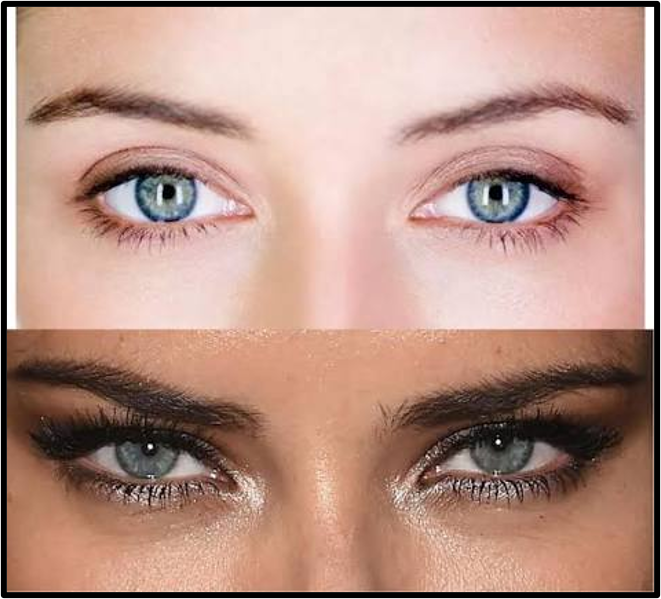
the visual effect here is the literal opposite. the eye reads as wide open, exposed, slightly startled or vulnerable, with nothing narrowing or shadowing it. going with the same evolutionary-psych framing as above, this mimics the wide, exposed gaze of prey animals that need maximum peripheral awareness to detect threats rather than a narrow-focused gaze tracking one specific target. again, take that framing for what it's worth, it's a naming convention that stuck because it's intuitive, not a rigorous scientific classification.
why "just fix your tilt" is genuinely bad advice
here's the thing that I need you to actually sit with instead of skimming past: you can have textbook positive canthal tilt and still read as prey eyes overall if your vector is negative, your UEE is high, and you've got visible inferior scleral show stacked on top. the tilt alone is not carrying the whole look. I see this constantly on here. guy has decent tilt, gets told his eyes are already good, but the actual reason his eye area isn't working is his vector is negative and there's a shadow undercutting the whole thing, or his UEE is so high the tilt barely registers because there's so much skin between the lash line and brow that the eye just reads as tired regardless of the corner angle. tilt is the trait everyone learns about first because it's the easiest to describe in one sentence, not because it's the most important one in isolation. it's one of five-plus stacking traits, not the whole equation.
same logic in reverse. I've seen guys with genuinely neutral or even slightly negative tilt who still read as hunter-eyed overall because their vector is strongly positive, their UEE is low and controlled, brow ridge is doing real work throwing shadow, and there's zero scleral show anywhere. the tilt being slightly negative barely registers against everything else in the cluster pulling the look in the other direction. this is exactly why fixating on tilt alone, positive or negative, and ignoring the rest of the cluster, is how people misdiagnose their own eye area constantly on this site.
most people are not a clean cluster either way
realistically, most faces are not sitting in a pure hunter cluster or a pure prey cluster. most guys have some mix, positive tilt paired with a slightly negative vector, or a great vector paired with higher-than-ideal UEE, whatever combination. this isn't a personal failure or some rare unlucky genetic draw, it's just how these traits actually distribute across a population, because as covered in section 3, tilt and vector aren't correlated with each other at all. they're independent variables that happen to land on the same face, so there's no biological reason they'd naturally sort themselves into two clean opposing packages for most people. the "pure hunter eyes" guys you see get posted around here as reference are genuinely somewhat rare specifically because it requires several independent traits to all land favourably on the same face simultaneously, not because everyone else is doing something wrong.
this matters practically because it means your actual goal, realistically, for most guys reading this, is not "become a pure hunter eyes guy," it's identifying which specific traits in your own cluster are pulling you toward prey and addressing those individually where they're actually addressable. which is exactly the diagnostic process section 5 is about to walk you through, and exactly why section 6 is broken into eleven separate subsections instead of one generic "how to get hunter eyes" section. there is no single lever. there's a checklist, and you're probably only failing two or three items on it, not all of them.
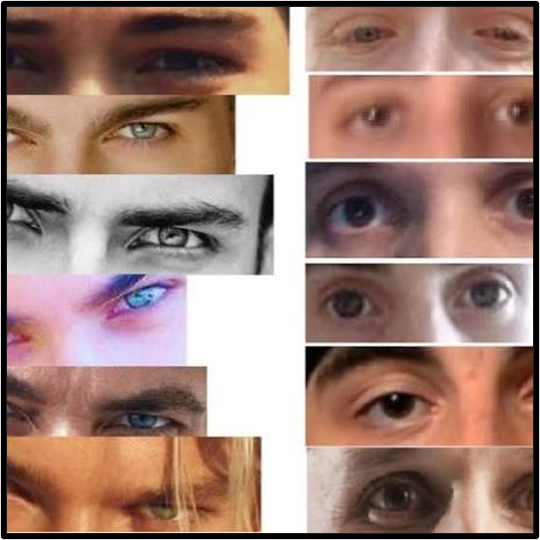
a note on subtlety and threshold effects
one more thing worth flagging before section 5: these clusters aren't operating on some hard threshold where you either clearly have one or clearly have the other. the traits exist on a spectrum, and small movements matter — someone with mild negative vector and otherwise strong traits everywhere else can still look pretty solid overall, while someone with severe negative vector will have that one trait actively dragging down an otherwise decent cluster because, as covered in section 3, vector-driven shadow is one of the most immediately visible cues to a stranger's eye. severity and stacking matter as much as the raw checklist of which traits are positive versus negative. this is going to come up again directly in section 5 when we actually get into how to assess your own eye area instead of just checking boxes.
5. How to Assess Your Own Eye Area
alright, this is the section that actually matters more than half the definitions before it, because if you assess yourself wrong, everything downstream in section 6 is going to be aimed at the wrong problem. I see this constantly on here — guy convinces himself his issue is fat pad puffiness when it's actually vector, spends three months on some skincare routine or ice roller nonsense, changes nothing, gets discouraged, posts about how "nothing works." nothing was going to work because he never actually diagnosed what he was looking at in the first place. so we're doing this properly, step by step.
step 1: get your photo conditions right, or none of this means anything
this is non-negotiable and it's the single most skipped step on this entire site. bad photo conditions will straight up lie to you about your own face, in both directions — make you think you look worse than you do or trick you into thinking a trait is fine when it isn't.
step 2: assess canthal tilt properly
using your straight-on, level photo: draw a mental (or actual, using a photo editing app) line from your medial canthus to your lateral canthus. is the outer corner higher, lower, or level with the inner corner. don't just eyeball a vague impression — actually trace it. as covered in section 3, mild asymmetry between your two eyes is normal, so check both sides independently rather than assuming they match.

what you're looking for: is there a clear, visible angle, or is it borderline enough that it's not really contributing to your overall look either way. remember magnitude matters more than a binary yes/no.
step 3: assess orbital vector using your profile shot
this is the step guys skip constantly because it requires the profile photo they didn't bother taking. using your profile shot, visualize a vertical line dropping straight down from the front-most point of your cornea. where does your cheekbone/orbital rim fall relative to that line, in front of it, on it, or behind it.
if you genuinely can't tell from a photo, a decent secondary check: run a finger along your lower orbital rim in the mirror and feel where it stops relative to where your eyeball sits. this won't be as precise as a proper profile photo assessment, but it can back up what you're seeing.
be honest with yourself here specifically, because this is the trait most likely to get denial treatment — guys really want their under-eye hollow to be a sleep/hydration/fat issue because that feels fixable, versus a bone issue that isn't. if it's been there consistently regardless of sleep, hydration, or leanness, it's probably vector, not lifestyle.

step 4: assess UEE and identify which of the four causes is driving it
look at your straight-on relaxed photo. how much skin is visible between lash line and crease/brow. then work through the four variables from section 3 one at a time instead of just labelling it "high UEE" and moving on:

this is the trait with the most possible causes, so don't rush this part.
step 5: assess scleral show
relaxed, straight-ahead, straight-on photo. is there visible white below your iris, above it, or neither. if below — go back to your vector and lower lid assessment, since as covered in section 3 this is almost always downstream of one of those two rather than being its own independent problem. don't treat this as something to fix on its own.

step 6: assess fissure shape and intercanthal spacing
straight-on photo again. is your eye opening longer and narrower or shorter and rounder. then check spacing. does the distance between your inner corners look roughly equal to the width of one of your own eyes, and roughly equal to the width of your nose base, per the rule of thumb from section 3. wider or narrower than that, note it, but don't stress over it. this is one of the lower-leverage traits in terms of what's correctable anyway, so it's more diagnostic information than an action item.
step 7: put it together into an honest cluster read
now go back to section 4. lay out your results: tilt (positive/negative/neutral, mild or pronounced), vector (positive/neutral/negative, mild or pronounced), UEE (low/high, and which cause), scleral show (present or not, inferior or superior), fissure shape, spacing. don't average these into a vague overall vibe — keep them as separate data points, because section 6 is going to address them separately too.
most guys doing this honestly will find they're not a clean hunter or prey cluster — usually two or three traits pulling one direction and one or two pulling the other, exactly as covered at the end of section 4. that's normal. the point of this whole exercise isn't to give yourself a final verdict of "hunter" or "prey," it's to walk away with a specific list of which individual traits are actually working against you, because that list is what determines which subsections of section 6 are actually relevant to your situation and which ones you can skip entirely.
a note on being honest with yourself here
this section only works if you're not doing the thing where you photograph yourself from a flattering low angle with your chin tilted just enough to fake decent tilt, in soft golden-hour lighting that hides your actual vector and then conclude your eye area is basically fine. I get why the temptation exists, but the entire point of section 6 downstream is matching real interventions to real problems, and that only works off an honest diagnostic. if you're going to lie to the assessment, you might as well skip the whole guide, because you'll just be applying random techniques from section 6 without actually knowing if they address anything you're dealing with.
alright, this is the section that actually matters more than half the definitions before it, because if you assess yourself wrong, everything downstream in section 6 is going to be aimed at the wrong problem. I see this constantly on here — guy convinces himself his issue is fat pad puffiness when it's actually vector, spends three months on some skincare routine or ice roller nonsense, changes nothing, gets discouraged, posts about how "nothing works." nothing was going to work because he never actually diagnosed what he was looking at in the first place. so we're doing this properly, step by step.
step 1: get your photo conditions right, or none of this means anything
this is non-negotiable and it's the single most skipped step on this entire site. bad photo conditions will straight up lie to you about your own face, in both directions — make you think you look worse than you do or trick you into thinking a trait is fine when it isn't.
- lighting: flat, even, front-facing light. no harsh overhead lighting (this exaggerates under-eye hollows and casts shadow that isn't representative of how you look in normal conditions), no single-side lighting (creates artificial asymmetry). natural window light facing you directly is the most reliable and free option.
- head position: this is where most self-assessments fall apart before they even start. as covered in section 3, your Frankfort horizontal plane needs to be level — that imaginary line from the bottom of your eye socket to the top of your ear canal, parallel to the ground. chin up even slightly and you're faking positive tilt and hiding UEE. chin down and you're faking negative tilt and exaggerating hooding. get a friend to check this, or use a level line drawn on a mirror, whatever you have to do. do not skip this.
- expression: fully relaxed, not squinting, not "trying" to look intense, not doing the thing where you subconsciously raise your brows a little for the camera. this is harder than it sounds because most people have an unconscious "photo face" that mildly distorts brow position specifically. take several photos, pick the one where you look most like you do mid-conversation with someone, not the one where you look best.
- distance and angle set: you want three angles minimum — straight-on, 3/4, and full profile. straight-on gets you tilt, UEE, fissure shape, intercanthal spacing. profile is where vector actually gets assessed properly, since vector is fundamentally a side-view measurement, and it's the angle most guys skip entirely because they're only ever checking their front-facing selfie game.
step 2: assess canthal tilt properly
using your straight-on, level photo: draw a mental (or actual, using a photo editing app) line from your medial canthus to your lateral canthus. is the outer corner higher, lower, or level with the inner corner. don't just eyeball a vague impression — actually trace it. as covered in section 3, mild asymmetry between your two eyes is normal, so check both sides independently rather than assuming they match.
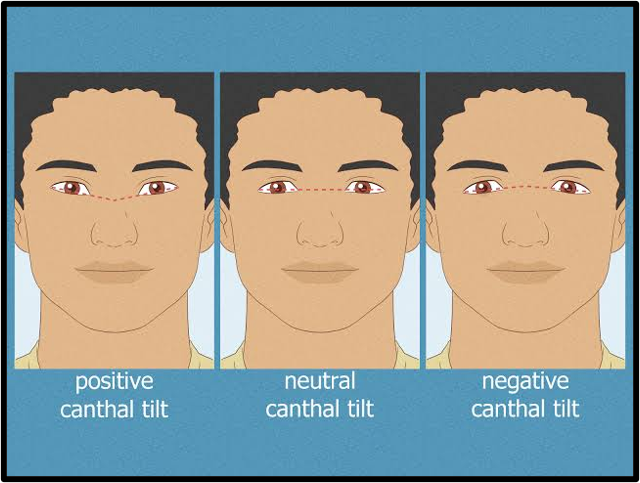
what you're looking for: is there a clear, visible angle, or is it borderline enough that it's not really contributing to your overall look either way. remember magnitude matters more than a binary yes/no.
step 3: assess orbital vector using your profile shot
this is the step guys skip constantly because it requires the profile photo they didn't bother taking. using your profile shot, visualize a vertical line dropping straight down from the front-most point of your cornea. where does your cheekbone/orbital rim fall relative to that line, in front of it, on it, or behind it.
if you genuinely can't tell from a photo, a decent secondary check: run a finger along your lower orbital rim in the mirror and feel where it stops relative to where your eyeball sits. this won't be as precise as a proper profile photo assessment, but it can back up what you're seeing.
be honest with yourself here specifically, because this is the trait most likely to get denial treatment — guys really want their under-eye hollow to be a sleep/hydration/fat issue because that feels fixable, versus a bone issue that isn't. if it's been there consistently regardless of sleep, hydration, or leanness, it's probably vector, not lifestyle.
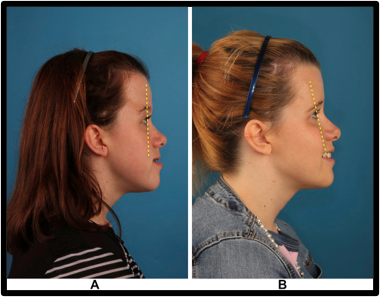
step 4: assess UEE and identify which of the four causes is driving it
look at your straight-on relaxed photo. how much skin is visible between lash line and crease/brow. then work through the four variables from section 3 one at a time instead of just labelling it "high UEE" and moving on:
- is there visible hooding (skin/fat overhanging the lash line) or is it genuinely just open with no overhang — these need different diagnoses.
- raise your brow slightly with your finger, does more lid become visible immediately — if yes, brow position is a meaningful contributor.
- press gently just under your brow bone, does that area feel like it has noticeable fat volume or is it flat — helps distinguish fat pad contribution from pure skin excess.
- has this gotten visibly worse over the last several years specifically, versus being roughly the same since you were younger — recent change points toward skin laxity (dermatochalasis) or levator weakening, long-standing points toward it being your baseline anatomy.
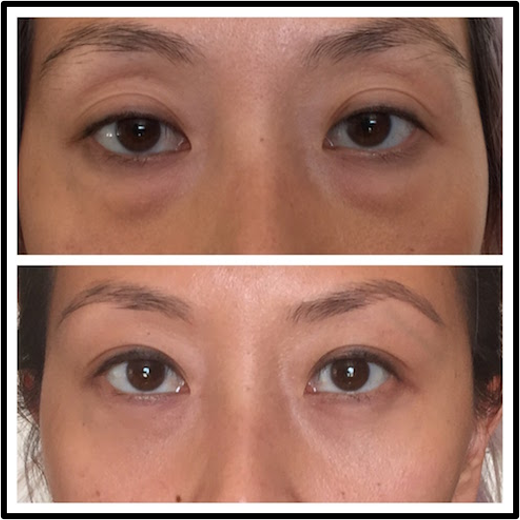
this is the trait with the most possible causes, so don't rush this part.
step 5: assess scleral show
relaxed, straight-ahead, straight-on photo. is there visible white below your iris, above it, or neither. if below — go back to your vector and lower lid assessment, since as covered in section 3 this is almost always downstream of one of those two rather than being its own independent problem. don't treat this as something to fix on its own.
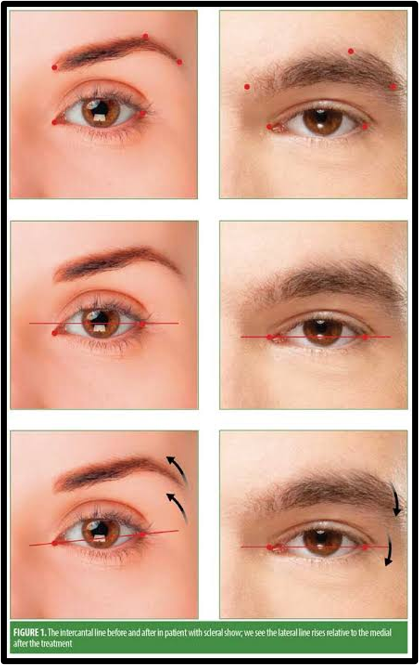
step 6: assess fissure shape and intercanthal spacing
straight-on photo again. is your eye opening longer and narrower or shorter and rounder. then check spacing. does the distance between your inner corners look roughly equal to the width of one of your own eyes, and roughly equal to the width of your nose base, per the rule of thumb from section 3. wider or narrower than that, note it, but don't stress over it. this is one of the lower-leverage traits in terms of what's correctable anyway, so it's more diagnostic information than an action item.
step 7: put it together into an honest cluster read
now go back to section 4. lay out your results: tilt (positive/negative/neutral, mild or pronounced), vector (positive/neutral/negative, mild or pronounced), UEE (low/high, and which cause), scleral show (present or not, inferior or superior), fissure shape, spacing. don't average these into a vague overall vibe — keep them as separate data points, because section 6 is going to address them separately too.
most guys doing this honestly will find they're not a clean hunter or prey cluster — usually two or three traits pulling one direction and one or two pulling the other, exactly as covered at the end of section 4. that's normal. the point of this whole exercise isn't to give yourself a final verdict of "hunter" or "prey," it's to walk away with a specific list of which individual traits are actually working against you, because that list is what determines which subsections of section 6 are actually relevant to your situation and which ones you can skip entirely.
a note on being honest with yourself here
this section only works if you're not doing the thing where you photograph yourself from a flattering low angle with your chin tilted just enough to fake decent tilt, in soft golden-hour lighting that hides your actual vector and then conclude your eye area is basically fine. I get why the temptation exists, but the entire point of section 6 downstream is matching real interventions to real problems, and that only works off an honest diagnostic. if you're going to lie to the assessment, you might as well skip the whole guide, because you'll just be applying random techniques from section 6 without actually knowing if they address anything you're dealing with.
Due to the 10,000 word limit i gotta make new threads for these later sections aswell JFL
Section 6 <- Section 6
Section 7, 8, 9 <- Section 7 8 9
Finally its fucking done, I spent all of fucking today and yesterday wasting my life away making this
That's 48 hours of my life I'm never getting back
References
- Codner MA et al. "The Anatomy and Evolution of the Eyelid-Midface Junction." Plastic and Reconstructive Surgery.
- Rohrich RJ, Pessa JE. "The Fat Compartments of the Face: Anatomy and Clinical Implications for Cosmetic Surgery." Plastic and Reconstructive Surgery.
- Wong CH, Mendelson B. "Facial Soft-Tissue Spaces and Retaining Ligaments of the Midcheek: Defining the Premaxillary Space." Plastic and Reconstructive Surgery.
- Higgins CA et al. "Microphthalmia-associated transcription factor and human hair follicle pigmentation."
- Otberg N et al. "Folliculitis decalvans." Dermatology.
- Kikkawa DO et al. "Relations of the Superficial Musculoaponeurotic System to the Orbit and Characterization of the Orbitomalar Ligament." Ophthalmic Plastic and Reconstructive Surgery.
- Fagien S. "Algorithm for Canthoplasty." Plastic and Reconstructive Surgery.
- Kunjur J et al. "Anthropometric Analysis of Eyebrows and Eyelids." British Journal of Oral and Maxillofacial Surgery.
- Cohen AJ, Weinberg DA (eds.). Evaluation and Management of Blepharoptosis.
- Matros E et al. "Correction of Eyebrow Ptosis." Aesthetic Surgery Journal.
- Jelks GW, Jelks EB. "The Influence of Orbital and Eyelid Anatomy on the Palpebral Aperture." Clinics in Plastic Surgery.
- Lambros V. "Observations on Periorbital and Midface Aging." Plastic and Reconstructive Surgery.
- Hamra ST. "Arcus Marginalis Release and Orbital Fat Preservation in Midface Rejuvenation." Plastic and Reconstructive Surgery.
- Farkas LG. Anthropometry of the Head and Face.
- Kong R et al. "A Comparative Study of the Effects of Retinol and Retinoic Acid on Histological, Molecular, and Clinical Properties of Human Skin." Journal of Cosmetic Dermatology.
- Huang W et al. "Botulinum Toxin in the Treatment of Facial Aesthetics." Aesthetic Surgery Journal.
- Suchonwanit P et al. "Minoxidil and Its Use in Hair Disorders: A Review." Drug Design, Development and Therapy.
- Wester ST, Fowler AM. "Bimatoprost 0.03% for the Treatment of Eyelash Hypotrichosis." Clinical Ophthalmology.
- Herndon LW. "Rethinking Bimatoprost 0.03%." Clinical Ophthalmology.
- Vrcek I et al. "Infraorbital Dark Circles: A Review of the Pathogenesis, Evaluation and Treatment." Journal of Cutaneous and Aesthetic Surgery.
- Lee W et al. "Complications of Hyaluronic Acid Fillers Used for Nose and Nasolabial Fold Augmentation and Their Nonsurgical Correction."
- Sundaram H et al. "Cohesivity of Hyaluronic Acid Fillers: Development and Clinical Implications." Dermatologic Surgery.
- Ha RY et al. "Analysis of Facial Skin Thickness: Defining the Relative Thickness Index." Plastic and Reconstructive Surgery.
- Krutmann J et al. "Photoprotection of the Future: Challenges and Opportunities." Journal of the European Academy of Dermatology and Venereology.
- Carruthers J, Carruthers A. "The Evolution of Botulinum Neurotoxin Type A for Cosmetic Use." Facial Plastic Surgery Clinics of North America.
- Alexiades-Armenakas MR et al. "The Spectrum of Laser Skin Resurfacing: Nonablative, Fractional, and Ablative Laser Resurfacing." Journal of the American Academy of Dermatology.
Last edited: