True Spaniard
It will all work out
- Joined
- Sep 9, 2026
- Posts
- 37
- Reputation
- 60
Thread song :
Disclaimer:
This guide is for educational and informational purposes only. Thread lifting is an invasive medical procedure that involves inserting foreign material into deep facial layers. It carries risks, including nerve damage, permanent asymmetry, and infection. Your face is your responsibility.
Introduction:
Today I am going to be talking about one of the most underrated softmaxxes of all time, PCL threads. I felt in the need to make a guide about these threads because there is a lot of misinformation and misunderstanding around them and their siblings, the PDO and PLLA threads. I will be explaining what are esentially the PCL threads, their different types, a comparison between all 3 threads, ultimately what you can use for and the risks involved in using them.
Lets get started, do not forget to play the song while you read the thread gng, I put it there for a reason.
Disclaimer:
This guide is for educational and informational purposes only. Thread lifting is an invasive medical procedure that involves inserting foreign material into deep facial layers. It carries risks, including nerve damage, permanent asymmetry, and infection. Your face is your responsibility.
Introduction:
Today I am going to be talking about one of the most underrated softmaxxes of all time, PCL threads. I felt in the need to make a guide about these threads because there is a lot of misinformation and misunderstanding around them and their siblings, the PDO and PLLA threads. I will be explaining what are esentially the PCL threads, their different types, a comparison between all 3 threads, ultimately what you can use for and the risks involved in using them.
Lets get started, do not forget to play the song while you read the thread gng, I put it there for a reason.
 Section 1: What are PCL Threads? The Long-Term Collagen Blueprint
Section 1: What are PCL Threads? The Long-Term Collagen BlueprintIn the world of non-surgical aesthetics, thread lifting relies on inserting bio-absorbable surgical sutures into the subcutaneous layer of the skin to physically lift tissue and trigger a healing response.
Polycaprolactone (PCL) is the absolute new-school tier of thread material. It is a biodegradable polymer that has been used in biomedical applications for decades.
When a PCL thread is deployed under your skin, it does two things:
Polycaprolactone (PCL) is the absolute new-school tier of thread material. It is a biodegradable polymer that has been used in biomedical applications for decades.
When a PCL thread is deployed under your skin, it does two things:
- Immediate Mechanical Support: It acts as an internal scaffold, physically shifting and holding sagging fat pads into a more youthful, angular position.
- Delayed Chemical Induction: As the thread slowly breaks down via hydrolysis into water and carbon dioxide, it continuously releases small chemical signals that force your fibroblasts to build a dense, permanent sleeve of Type I and Type III collagen around the thread path. Even after the thread is 100% gone, the newly formed collagen matrix remains, maintaining the structural lift. That is such a cheatcode right there.
Section 2: The Anatomy of the Thread: Types and Functions
You can not just walk into a clinic and ask for PCL threads that would be very retarded jfl. They come in fundamentally different shapes, and each shape has a specific mechanical job. Using the wrong type in the wrong zone will ruin your results, we should not make your face uglier than it already is, so listen up carefully little truecel.
1. Mono Threads (The Rejuvenators)
- The Design: Completely smooth, single-filament, thin wires.
- The Function: Mono threads provide zero immediate lifting power. If a clinic tells you they will lift your sagging jowls with monos, they are straight up scamming you.
- How they work: They are inserted in a dense, grid-like pattern (a mesh). Their sole purpose is to tighten loose skin, improve skin density, and eliminate fine texture issues by generating widespread, low-level collagen production.
2. Screw / Tornado Threads (The Volumizers)
- The Design: One or two smooth PCL threads tightly coiled around the insertion needle like a spring.
- The Function: These are used for localized volume restoration.
- How they work: When the needle is withdrawn, the thread remains in its coiled, spring-like shape. This physically pushes the skin outward slightly, filling in sunken areas or deep creases. They are a high-tier alternative to hyaluronic acid fillers because they use your own collagen to fill a deficit, meaning zero risk of the "filler face" bloating effect.
3. Cog / Barb / Molded Threads (The True Lifters)
- The Design: Heavy-duty threads engineered with microscopic hooks, barbs, or molded notches pointing in opposite directions along the shaft.
- The Function: These are the heavy hitters used for true mechanical lifting and tissue repositioning.
- How they work: The thread is inserted deep into the subcutaneous fat. Once in place, the surgeon pulls the thread taut, causing the barbs to literally hook into the fat tissue. The tissue is pulled upward and anchored into place, completely redefining facial borders.
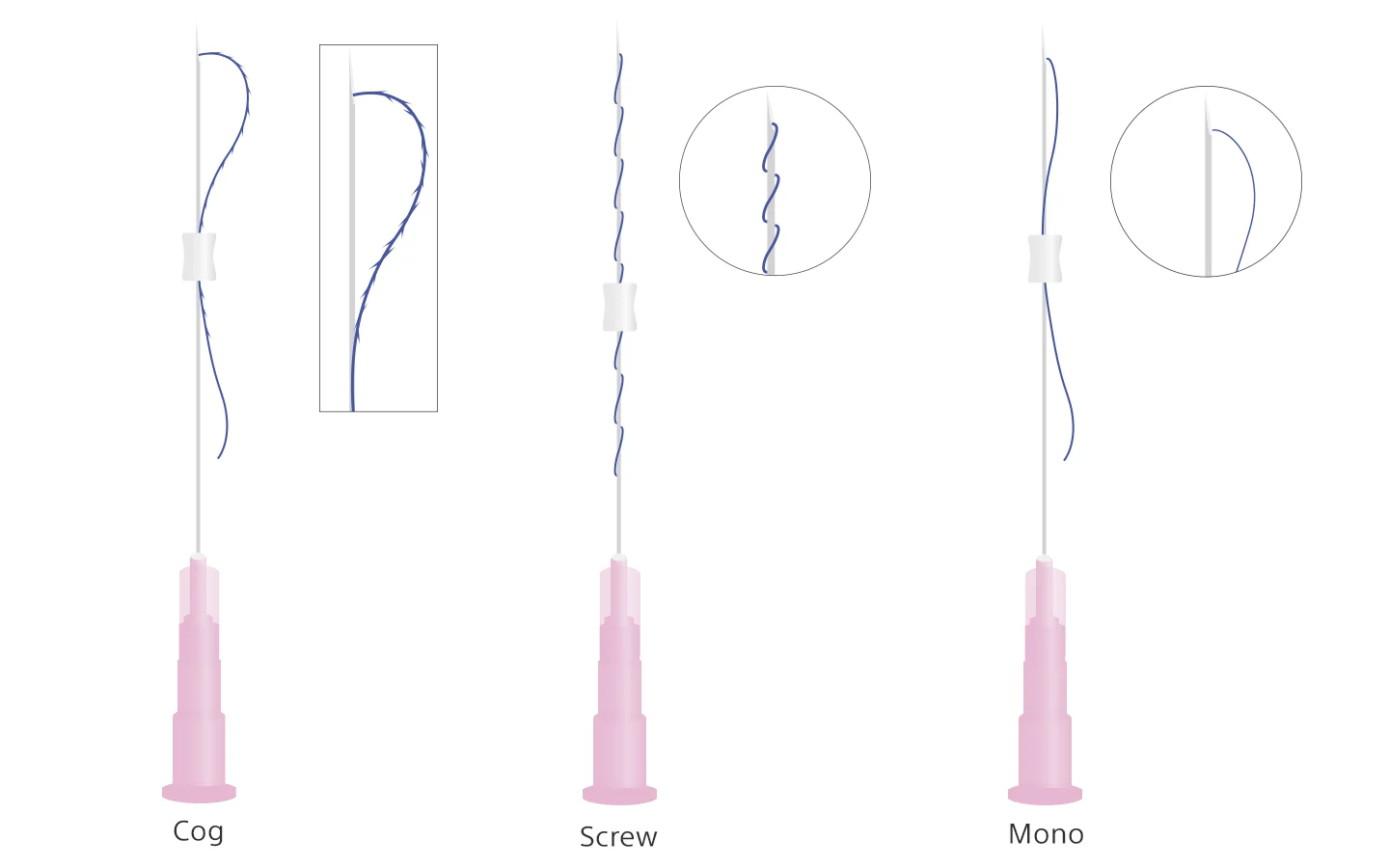
 Section 3: The Thread Showdown: PCL vs. PDO vs. PLLA
Section 3: The Thread Showdown: PCL vs. PDO vs. PLLADo not let a clinic sell you cheap ass threads without knowing what you are buying. Here is how PCL stacks up against the other two major materials on the market: PDO (Polydioxanone) and PLLA (Poly-L-Lactic Acid).
| Feature/Metric | PDO (Polydioxanone) | PLLA (Poly-L-Lactic Acid) | PCL (Polycaprolactone) |
| Material Longevity | Short (6–8 months) | Moderate (12–18 months) | Longest (18–24 months) |
| Material Flexibility | Stiff / Brittle (High risk of snapping) | Semi-stiff | Highly Flexible / Elastic (Moves naturally with facial expressions) |
| Collagen Stimulation | Low to Moderate | High (But highly inflammatory) | Very High (Steady, long-term, non-inflammatory) |
| Degradation Product | Minimal tissue reaction | L-Lactic Acid (Can cause localized nodules if clustered) | Caproic Acid ➔ CO2 + H2O (Extremely safe and bio-compatible) |
| Best Used For | Quick, budget-friendly lifting | General volumization | Premium, long-term structural lifting & sharpening |
Section 4: The Dark Side: Risks, Blind Spots, and Complications
Threads are frequently marketed as "lunchtime procedures" with zero downtime. This is a massive cope. Thread lifting requires aggressive entry into facial planes, and if the injector (yourself or a clinic) lacks deep anatomical knowledge, things can go south fast. With your procrastination to search things up, you will probably chop up yourself jfl.
- Puckering and Dimpling: If a Cog thread is placed too superficially (in the dermis instead of the subcutaneous fat), the barbs will catch the underside of your visible skin. This creates highly noticeable dents, dimples, or a "pulled plastic" look every time you smile.
- Thread Extrusion ("Spitting"): Because PCL is highly flexible, this is less common than with PDO, but it still happens. If the end of the thread isn't anchored deeply or cut cleanly, your body will treat it as a splinter and slowly push it out through the skin, creating an open sore that can easily become infected.
- Asymmetry: Your face is naturally asymmetrical. If the surgeon uses the exact same vector or tension on both sides without adjusting for your unique bone and muscle layout, one side of your face will end up higher, tighter, or pulled differently than the other.
- Nerve Damage & Vascular Injury: The face is a highway of critical structures (like the facial nerve branches and the facial artery). Shoving a sharp cannula into the wrong plane can sever nerves, causing temporary or permanent facial paralysis, or nick blood vessels, causing massive internal hematomas.
- Overall, this risks are pretty rare and only happen if research about the topic and the threads have not been done correctly.
Section 5: Target Zones: Where to Deploy PCL Threads
To get maximum facial harmony, you need to know exactly where to apply each tool. Here are the premier zones where PCL threads can be deployed to elevate your aesthetics:
1. The Mandibular Border & Jowls
- The Goal: Eliminate soft, sagging tissue along the jawline to create a razor-sharp, angular mandidular border.
- The Tool: PCL Cog Threads.
- The Execution: Placed near the angle of the jaw and pulled upward toward the preauricular (ear) area, lifting the sagging jowl fat pad and tightening the skin tightly against the bone.
2. The Midface & Malar Fat Pad
- The Goal: Lift drooping cheeks that make you look tired, flat, or hollow in the midface.
- The Tool: PCL Cog Threads combined with Screw Threads.
- The Execution: Cog threads pull the fallen malar fat pad back up onto the cheekbones, restoring a strong, youthful Ogee curve, while Screw threads can be placed directly into the nasolabial folds to fill the crease from the inside out.
3. The Lateral Brow
- The Goal: Lift a sagging, drooping outer eyebrow tail to create a positive canthal tilt or an aggressive, focused eye aesthetic.
- The Tool: PCL Cog Threads.
- The Execution: Inserted at the temporal hairline and directed down to the lateral edge of the brow. Tensing the thread pulls the tail of the brow upward and outward, opening up a crowded upper eyelid area.
4. The Submental Area
- The Goal: Tighten the loose, soft skin directly under the chin and upper neck to create a sharp front and side profile.
- The Tool: PCL Mono Threads.
- The Execution: A dense mesh of smooth mono threads is laid out under the chin. Over 3–6 months, the massive wave of new collagen contracts the loose skin, pulling it tight against the submental muscles.
5. The Undereye Area
- The Goal: Eliminate undereye area darkness
- The tool: Pcl Screw Threads
- The execution: Insert a blunt-tip cannula in the superficial subcutaneous plane around the infraorbital rim. Rotate the cannula to release the PCL Screw Thread, leaving the coil to stimulate collagen.
Conclusion
PCL threads are overall a very good method to ascend you via softmaxxing, for most of you, i would definitely recommend to assist to a clinic since you will never do enough research and have the preciseness on the mirror to replicate professional-like results, altough if you want to take the risks that is your decision G. Thank you all for reading, we are all gonna make it, stay safe.