pOH..
Oh, living in Egypt, bro
- Joined
- Dec 23, 2025
- Posts
- 216
- Reputation
- 97
Unlocking Your Facial Potential: The Science of Temporalis Training and Holistic Well-being
In the ever-evolving world of aesthetics and self-improvement, the pursuit of a more defined and attractive facial structure has gained significant traction. While many focus solely on masseter muscle development or conventional orthodontics, a deeper dive into craniofacial dynamics reveals the often-overlooked yet pivotal role of the temporalis muscle. This article explores how strategic temporalis training, combined with key biological processes, can unlock your facial potential for a more harmonious and appealing look.
The Temporalis vs. Masseter: A Paradigm Shift in Facial Aesthetics
For years, the masseter muscle has been at the forefront of discussions regarding jawline definition. However, its anatomical limitations suggest it operates primarily within a "closed system," affecting the mandible and zygomatic arch without direct positive leverage on the maxilla (upper jaw). In fact, some theories suggest that an overdeveloped masseter can contribute to an elongated facial appearance and even deepen the "ante-gonial notch," contradicting the goal of a robust jawline.
Enter the temporalis muscle. Recognized by physiotherapists as a crucial postural muscle, the temporalis offers a unique advantage. By leveraging the mandibular arch against the maxillary arch, it creates a compressive force along the "temporal-palate axis." This mechanism is hypothesized to:
Shorten vertical facial length: Promoting a more balanced and aesthetically pleasing face.
Enhance chin projection: Moving the chin forward and creating a straighter jawline.
Widen the face and pronounce the zygos (cheekbones): Contributing to a stronger, more defined mid-face.
Aid in overall mandible growth: Guiding proper development of the lower jaw.
The Biological Blueprint for Bone Growth
Beyond muscle mechanics, understanding the underlying biological signals is crucial. Our bodies are master architects, constantly remodeling bone in response to mechanical stress. This process, known as mechanotransduction, involves specialized cells:
Osteocytes: The "master sensors" deep within the bone, detecting mechanical stress.
Osteoblasts: The "bone-building cells" activated by these signals, responsible for laying down new bone tissue.
Two key biological factors play a significant role in this adaptive process:
Nitric Oxide (NO): Bone's Biochemical Signal: Mechanical strain on bone cells rapidly increases nitric oxide production. NO is not just a byproduct; it actively regulates bone formation, promoting the proliferation and differentiation of osteoblasts. It also triggers crucial pathways like the PI3K/Akt/β-catenin pathway, which is vital for cell proliferation and bone regeneration.
The Vagus Nerve & Stress Reduction: Interestingly, humming has been shown to stimulate the vagus nerve, which in turn lowers stress hormones like cortisol. Lower cortisol levels are associated with less bone breakdown, creating a more favorable environment for bone growth and adaptation. Furthermore, the low-frequency vibrations generated by humming may directly contribute to nitric oxide release in facial bones.
Practical Application: Training Your Temporalis
So, how can you harness this knowledge? The key lies in consciously engaging and training the temporalis muscle:
Targeted Clenching/Short Bites: Unlike masseter-dominant clenching, focus on biting back firmly with your molars. To isolate the temporalis, place your thumb on your masseter (the muscle at the angle of your jaw) and your index finger on your temporalis (on the side of your head above your ear). Practice clenching, making sure you feel the temporalis contract strongly while the masseter remains relatively relaxed.
"Thumb Pulling" (Advanced Technique): This technique, often discussed in looksmaxxing communities, involves applying specific, sustained pressure. It requires careful execution and consistency over a long period. The goal is to gently influence the maxilla, encouraging a slight "counter-clockwise rotation" of the skull, which can lead to enhanced mid-face projection. Always research proper technique and proceed with caution.
Consistency is Key: Craniofacial adaptation is a slow process. Dedicate consistent time (e.g., 30-60 minutes daily, across various techniques) to see results.
Important Considerations and Disclaimer
TMJ Issues: If you suffer from severe Temporomandibular Joint (TMJ) problems, do not attempt these techniques until your condition is resolved. Consult with a medical professional.
Avoid Masseter Over-clenching: Over-training the masseters can have counterproductive effects, potentially elongating the face.
Realistic Expectations: Significant changes take time and consistency. Be patient and understand that individual results will vary.
By integrating targeted temporalis training with an understanding of the biological mechanisms that drive bone remodeling, you can embark on a holistic journey to optimize your facial aesthetics. Remember, dedication, proper technique, and patience are your most valuable tools in unlocking your unique facial potential.
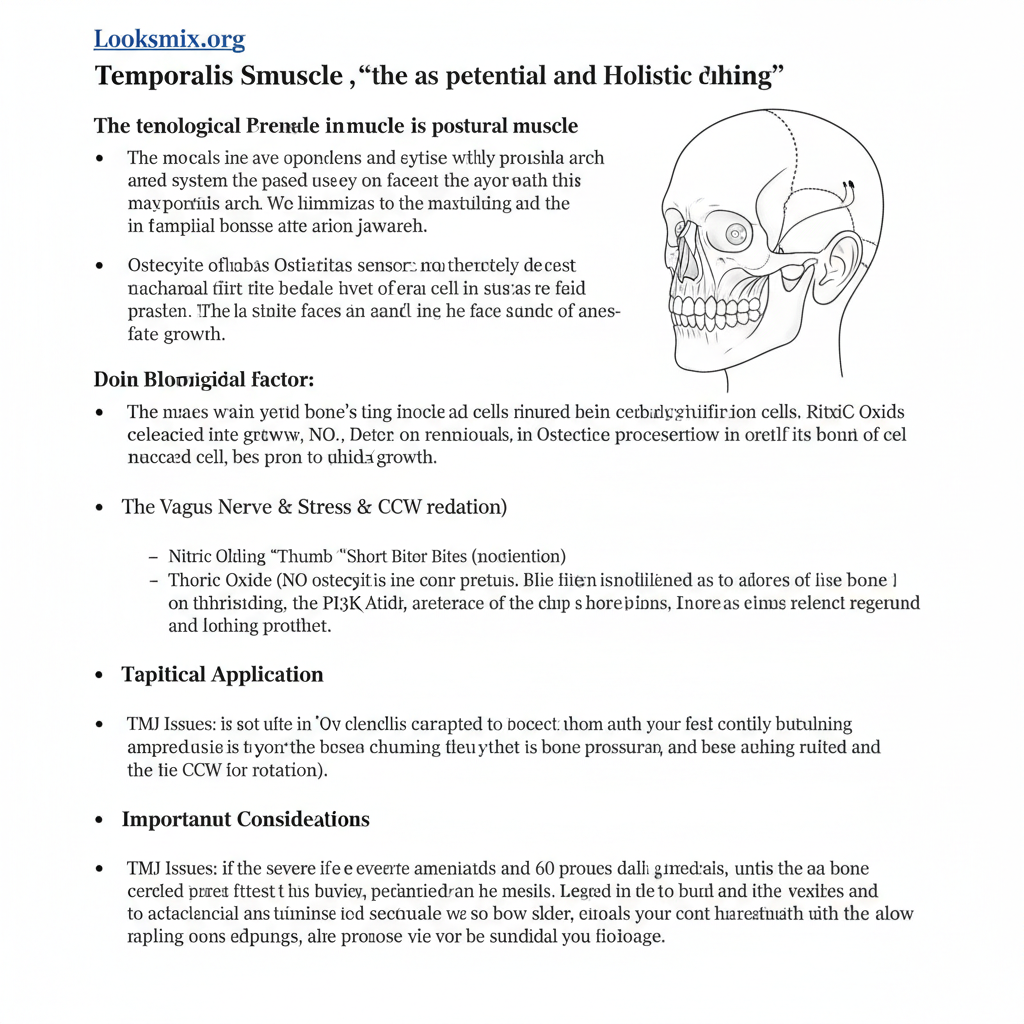
I gathered some information and put it together
It's not a very good thing, but I'm still looking.
In the ever-evolving world of aesthetics and self-improvement, the pursuit of a more defined and attractive facial structure has gained significant traction. While many focus solely on masseter muscle development or conventional orthodontics, a deeper dive into craniofacial dynamics reveals the often-overlooked yet pivotal role of the temporalis muscle. This article explores how strategic temporalis training, combined with key biological processes, can unlock your facial potential for a more harmonious and appealing look.
The Temporalis vs. Masseter: A Paradigm Shift in Facial Aesthetics
For years, the masseter muscle has been at the forefront of discussions regarding jawline definition. However, its anatomical limitations suggest it operates primarily within a "closed system," affecting the mandible and zygomatic arch without direct positive leverage on the maxilla (upper jaw). In fact, some theories suggest that an overdeveloped masseter can contribute to an elongated facial appearance and even deepen the "ante-gonial notch," contradicting the goal of a robust jawline.
Enter the temporalis muscle. Recognized by physiotherapists as a crucial postural muscle, the temporalis offers a unique advantage. By leveraging the mandibular arch against the maxillary arch, it creates a compressive force along the "temporal-palate axis." This mechanism is hypothesized to:
Shorten vertical facial length: Promoting a more balanced and aesthetically pleasing face.
Enhance chin projection: Moving the chin forward and creating a straighter jawline.
Widen the face and pronounce the zygos (cheekbones): Contributing to a stronger, more defined mid-face.
Aid in overall mandible growth: Guiding proper development of the lower jaw.
The Biological Blueprint for Bone Growth
Beyond muscle mechanics, understanding the underlying biological signals is crucial. Our bodies are master architects, constantly remodeling bone in response to mechanical stress. This process, known as mechanotransduction, involves specialized cells:
Osteocytes: The "master sensors" deep within the bone, detecting mechanical stress.
Osteoblasts: The "bone-building cells" activated by these signals, responsible for laying down new bone tissue.
Two key biological factors play a significant role in this adaptive process:
Nitric Oxide (NO): Bone's Biochemical Signal: Mechanical strain on bone cells rapidly increases nitric oxide production. NO is not just a byproduct; it actively regulates bone formation, promoting the proliferation and differentiation of osteoblasts. It also triggers crucial pathways like the PI3K/Akt/β-catenin pathway, which is vital for cell proliferation and bone regeneration.
The Vagus Nerve & Stress Reduction: Interestingly, humming has been shown to stimulate the vagus nerve, which in turn lowers stress hormones like cortisol. Lower cortisol levels are associated with less bone breakdown, creating a more favorable environment for bone growth and adaptation. Furthermore, the low-frequency vibrations generated by humming may directly contribute to nitric oxide release in facial bones.
Practical Application: Training Your Temporalis
So, how can you harness this knowledge? The key lies in consciously engaging and training the temporalis muscle:
Targeted Clenching/Short Bites: Unlike masseter-dominant clenching, focus on biting back firmly with your molars. To isolate the temporalis, place your thumb on your masseter (the muscle at the angle of your jaw) and your index finger on your temporalis (on the side of your head above your ear). Practice clenching, making sure you feel the temporalis contract strongly while the masseter remains relatively relaxed.
"Thumb Pulling" (Advanced Technique): This technique, often discussed in looksmaxxing communities, involves applying specific, sustained pressure. It requires careful execution and consistency over a long period. The goal is to gently influence the maxilla, encouraging a slight "counter-clockwise rotation" of the skull, which can lead to enhanced mid-face projection. Always research proper technique and proceed with caution.
Consistency is Key: Craniofacial adaptation is a slow process. Dedicate consistent time (e.g., 30-60 minutes daily, across various techniques) to see results.
Important Considerations and Disclaimer
TMJ Issues: If you suffer from severe Temporomandibular Joint (TMJ) problems, do not attempt these techniques until your condition is resolved. Consult with a medical professional.
Avoid Masseter Over-clenching: Over-training the masseters can have counterproductive effects, potentially elongating the face.
Realistic Expectations: Significant changes take time and consistency. Be patient and understand that individual results will vary.
By integrating targeted temporalis training with an understanding of the biological mechanisms that drive bone remodeling, you can embark on a holistic journey to optimize your facial aesthetics. Remember, dedication, proper technique, and patience are your most valuable tools in unlocking your unique facial potential.
I gathered some information and put it together
It's not a very good thing, but I'm still looking.