myusufs
25 max
- Joined
- May 5, 2026
- Posts
- 41
- Reputation
- 11
WALKMAXXING
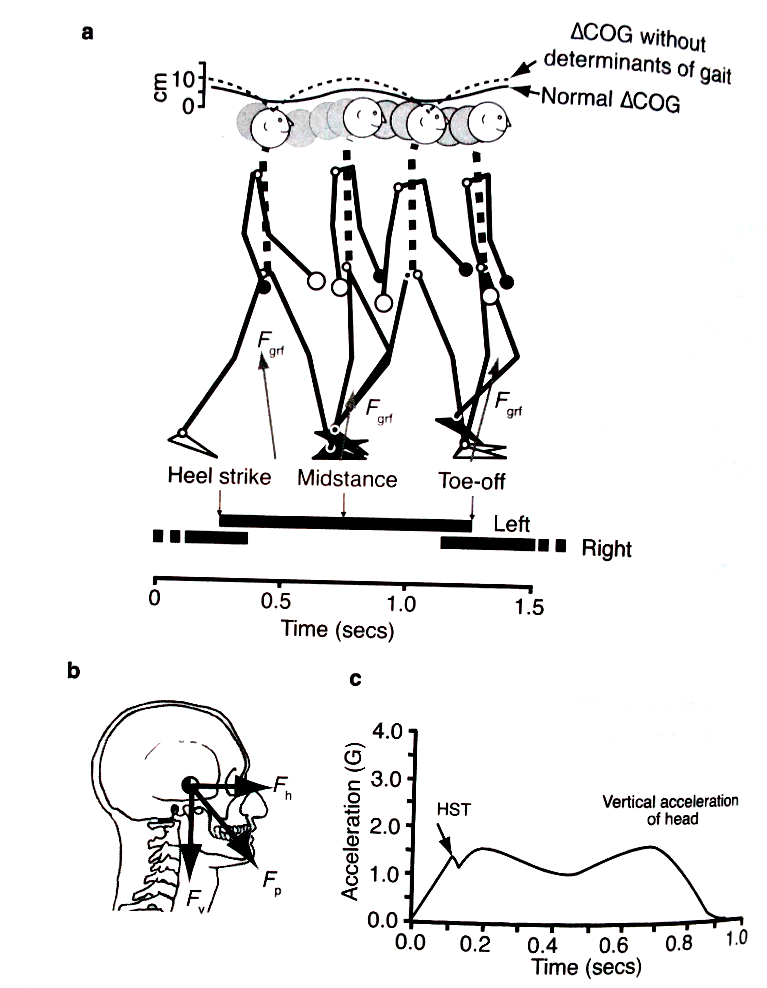
Biomechanically, a walk is defined as an inverted pendular gait in which one vaults over relatively straight and stiffened legs. With each step, between heel strike and mid-stance, the body's center of gravity (COG) is elevated, thereby increasing the body's potential energy. Gravity then converts this energy into motion (kinetic energy) as the body's COG falls downward and forward from mid-stance until toe-off, at which point we begin to push the center of gravity up again and send the leg into a swing. About 70 percent of the potential energy is converted into kinetic energy with each cycle. During a walk, each foot is typically on the ground for about 60 percent of a total stride cycle (which is divided into stance and swing phases), so that at least one foot is always on the ground.
To understand the head's motion during walking, it is useful to keep a few points in mind. First, the head rises and falls along with the body's COG by approximately 4-5 centimeters per stride. If walking were a purely inverted pendular gait (imagine a peg-legged person with no ankles and knees), then these movements would be more substantial, with jolting changes in direction at every heel strike. Instead, the head moves in a gradual sinusoidal wave, thanks to a number of mechanisms such as hip rotation, hip abduction, knee flexion, ankle flexion at heel strike, ankle extension at heel-off, and slight flexion and extension of the trunk (backward at heel strike and forward at toe-off. These "determinants of gait minimize and smooth vertical movements of the body's COG.
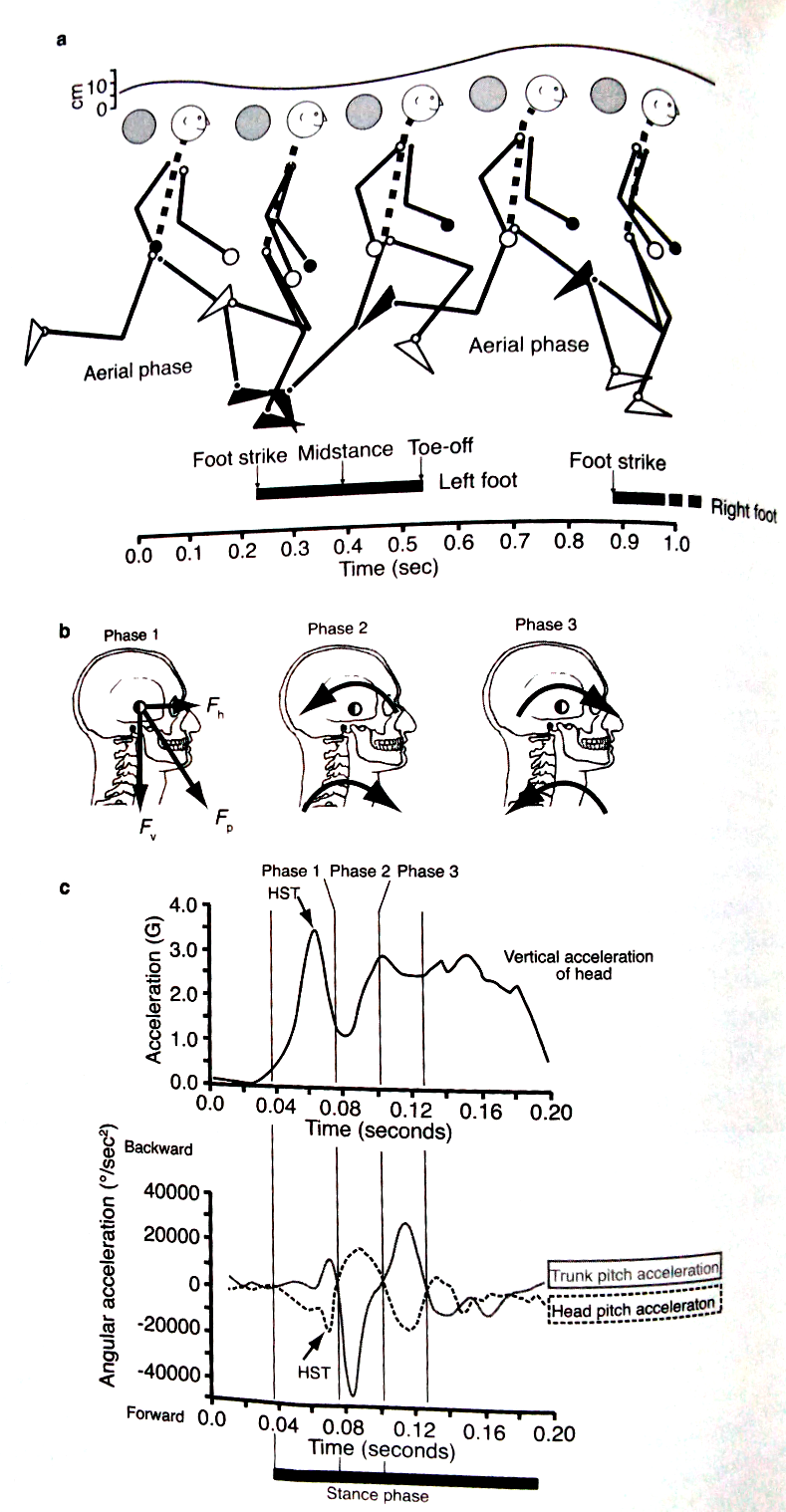
During walking, the head tends to pitch in the sagittal plane, smaller rolling and yawing moments also act on the head. Pitching occurs for two reasons. The first is to stabilize the gaze to counteract the rise and fall of the body: as the body rises during the first half of stance, the head typically pitches forward slightly; and as the body falls during the second half of stance, the head pitches backward. The head also pitches very slightly because of accelerations, some of which come from the ground. Every time the heel strikes the ground with a given force, the ground reacts with an equal and opposite force that sends an impulse, the heel strike transient (HST) up the leg, along the spine, and into the head. The HST is attenuated considerably by elastic tissues in the joints and the spine , but it still tends to jiggle the head because, even though the trunk and neck tend to be rather vertical (usually inclined slightly forward) above the hips during walking, the head's COG is about 2 cm anterior to the AOJ.The combination of vertical and horizontal accelerations from the HST cause the head to pitch forward slightly; the head also tends to pitch forward slightly during the second half of stance phase as the body's COG falls.
A walking human's head remains fairly stable, despite the forces described above, because of a combination of passive and active mechanisms. Passive mechanisms are the intrinsic mechanical characteristics of the musculoskeletal system. These are primarily the natural inertial properties of the head and the stretch-resistant (viscoelastic) properties of the many muscles and ligaments that connect the head, neck, and trunk. Active stabilizing mechanisms mostly involve the reflex activation of muscles that extend or flex the neck. Several experiments have tried to estimate the relative contribution of passive and active types of head stabilization in the sagittal plane. These studies mostly find that although intrinsic mechanisms do play a key role, particularly in high-speed walking , active reflexes are probably the dominant way we keep our heads still.
For the most part, these muscles have very low levels of EMG activity during walking compared to running, and they mostly contract during the second half of stance, as the body's COG is falling. However, at very fast walking speeds (e.g., speeds at which one normally runs), these muscles have higher levels of activity, as the head is subject to much greater rates of pitching.