Haplogroup Q-M242 is one of the two branches of P1-M45 also known as K2b2a (The other is R-M207).
Q-M242 is believed to have arisen around the Altai Mountains area (or South Central Siberia),[3] approximately 17,000[3] to 31,700 years ago.[4] However, the matter remains unclear due to limited sample sizes and changing definitions of Haplogroup Q: early definitions used a combination of the SNPs M242, P36.2, and MEH2 as defining mutations.
In Siberia, the regions between Altai and Lake Baikal, which are famous for many prehistoric cultures and as the most likely birthplace of haplogroup Q, exhibit high frequencies of Q-M242. In a study (Dulik 2012),[50] Q-M242 (mostly Q-M346 including some Q-M3) has been found in 24.3% (46/189: 45 Q-M346, 1 Q-M25) of all Altaian samples. Among them, Chelkans show the highest frequency at 60.0% (15/25: all Q-M346), followed by Tubalars at 41% (11/27: 1 Q-M25, 10 Q-M346) and Altaians-Kizhi at 17% (20/120). In a former study, Q-M242 is found in 4.2% of southern Altaians and 32.0% of northern Altaians with the highest frequency of 63.6% in Kurmach-Baigol (Baygol). The frequency reaches 13.7% (20/146) in the whole samples.[10] In another study,[51] the frequency rises up to 25.8% (23/89: all Q-M346) in Altaians. Based on the results of these studies, the average frequency of Q-M242 in Altaians is about 21%.
Tuva, which is located on the east side of Altai Republic and west of Lake Baikal as well as on the north side of Mongolia, shows higher frequency of Q-M242. It is found in 14%[52]~38.0% (41/108)[51] of Tuvans. Also, Todjins (Tozhu Tuvans) in eastern Tuva show the frequency at ≤22.2% (8/36 P(xR1)[53])~38.5% (10/26, all Q-M346(xM3)).[51] So, the average frequency of Q-M242 among Tuvans-Todjins in Tuva Republic is about 25%. Haplogroup Q-M242 has been found in 5.9% (3/51) of a sample of Tuvans from the village of Kanasi, 9.8% (5/51) of a sample of Tuvans from the village of Hemu, and 62.5% (30/48) of a sample of Tuvans from the village of Baihaba in northern Xinjiang near the international border with Altai Republic.[11]
The highest frequencies of Q-M242 in Eurasia are witnessed in Kets (central Siberia) at 93.8% (45/48) and in Selkups (north Siberia) at 66.4% (87/131).[7] Russian ethnographers believe that their ancient places were farther south, in the area of the Altai and Sayan Mountains[3] (Altai-Sayan region). Their populations are currently small in number, being just under 1,500 and 5,000 respectively. In linguistic anthropology, the Ket language is significant as it is currently the only surviving one in the Yeniseian language family which has been linked by some scholars to the Native AmericanNa-Dené languages[54] and, more controversially, the language of the Huns. (See: L. Lieti, E. Pulleybank,[55]E. Vajda,[56] A. Vovin,[57] etc.) Q-M346 is also found at lower rates in Sojots (7.1%, Q-M346), Khakassians (6.3%, Q-M346), Kalmyks (3.4%, Q-M25, Q-M346)[51] and Khanty,[58] and so on.
In some studies, various subgroups of Q-M242 are observed in Mongolia. Q1a2-M346 (mostly Q-L330) occupies 1.4[28]~3.1%[49] of Mongols (1/2~2/3 among Q samples), followed by Q1a1a1-M120 (0.25[28]~1.25%[49]), Q1a1b-M25 (0.25[28]~0.63%[49]), Q1b-M378. In another study, Q is found in 4% of Mongols.[8] Karafet et al. (2018) found Q-L54(xM3) in 2.7% (2/75) and Q-M25 in another 2.7% (2/75) for a total of 5.3% (4/75) haplogroup Q Y-DNA in a sample of Khalkha Mongols from Ulaanbaatar, Mongolia.[59] Based on these studies, the average frequency of Q-M242 in Mongols is estimated to be about 4~5%.
Our results reveal that the current diversity and distribution of haplogroup H were largely established by the Mid Neolithic (~4000 BC), but with substantial genetic contributions from subsequent pan-European cultures such as the Bell Beakers expanding out of Iberia in the Late Neolithic (~2800 BC). Dated haplogroup H genomes allow us to reconstruct the recent evolutionary history of haplogroup H and reveal a mutation rate 45% higher than current estimates for human mitochondria.
Here, Brotherton and colleagues sequence 39 mitochondrial genomes from ancient human remains. They track population changes across Central Europe and find that the foundations of the European mitochondrial DNA pool were formed during the Neolithic rather than the post-glacial period.
www.nature.com
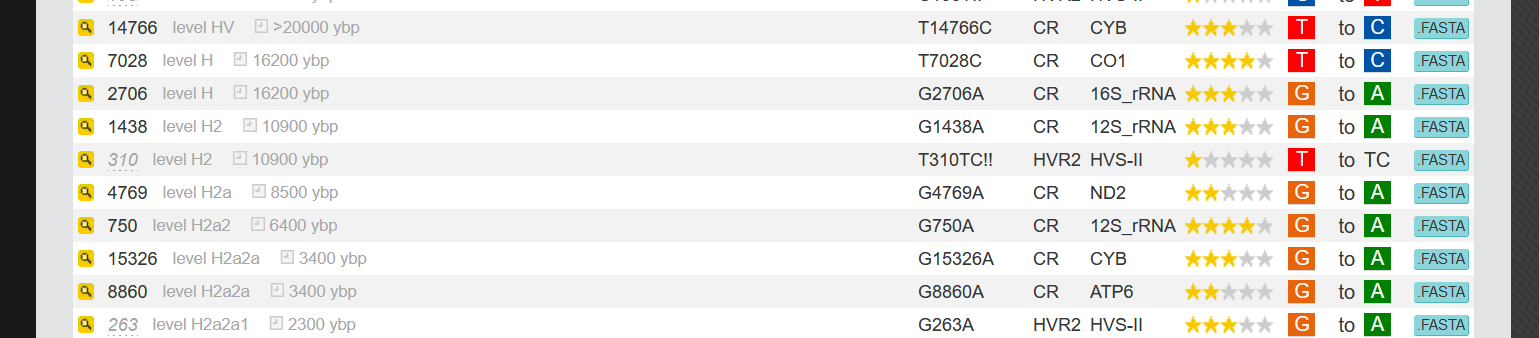
Haplogroup H is a descendant of haplogroup HV. The Cambridge Reference Sequence (CRS), which until recently was the human mitochondrial sequence to which all others were compared, belongs to haplogroup H2a2a1 (human mitochondrial sequences should now be compared with the ancestral Reconstructed Sapiens Reference Sequence (RSRS)).[4] Several independent studies conclude that haplogroup H probably evolved in Western Asia c. 25,000 years ago.
This site uses cookies to help personalise content, tailor your experience and to keep you logged in if you register.
By continuing to use this site, you are consenting to our use of cookies.