





AstroSky
Solstice
- Joined
- Nov 24, 2018
- Posts
- 2,336
- Reputation
- 3,959
LONG WINDED POST
I’ve spent a lot of R&D time working on a liposomal/niosomal hair-loss topical. The formula includes RU58841, dutasteride, minoxidil, latanoprost, CoQ10, and a liposomal delivery system, which is the main feature of the product.
A major issue with many DIY and commercial hair-loss topicals is that they are mostly solvent-based. They often rely on ethanol and propylene glycol to dissolve the active ingredients and push high concentrations onto the scalp. While this can help with delivery, a lot of the product can be wasted through evaporation, crystallization, and residue left behind on the scalp. If you’ve ever noticed white residue or dandruff-like buildup from topicals over time, this is usually part of the reason.
The problem is that these formulas are not always optimized to target the hair follicles directly. Instead, they often flood the scalp with active ingredients and hope enough eventually reaches the follicle and sebaceous gland area. That can be inefficient for both the ingredients and the user.
Minoxidil also has another limitation: some people may not have enough sulfotransferase enzyme activity in the skin for it to work as well topically. This is one reason some people move to oral minoxidil, which can be effective but also comes with more systemic exposure and long-term risk concerns. One common way to improve topical minoxidil response is by using tretinoin, which may increase local sulfation activity and help minoxidil work better. The downside is that this becomes another separate product that has to be bought and applied consistently.
The goal of my formulation is to combine multiple hair-growth pathways into one topical while using a nano liposomal/niosomal delivery system. Liposomal technology is used in some of the most advanced topical formulations because it may help improve delivery, reduce waste, and keep ingredients closer to the target area. The idea is that these tiny oil-based carriers can better disperse into the follicle area and interact with sebum, helping concentrate the actives where they are needed while also creating a longer-lasting depot effect.
Developing this has taken a lot of research because each ingredient has its own strengths, weaknesses, solubility issues, and delivery challenges. Fortunately, there is existing research showing that liposomal or nano-emulsion delivery can improve the performance of several individual topical ingredients. My goal is to bring those advantages together into one more complete formula.
Hair loss is not only about DHT. DHT is a major factor because it contributes to follicle miniaturization over time, but there are other pathways involved as well. Many people focus only on blocking DHT and may only slow further loss without seeing much regrowth. Regrowth usually requires stimulation and a broader approach, including pathways related to follicle signaling, inflammation, PGD2/PGE2 balance, and overall follicle environment.
Of course, there are limits. Some hair loss becomes much harder to reverse if it has been untreated for too long. But for people who are still within a recoverable range, the goal should be to improve consistency, reduce wasted product, and target the follicle more effectively.
Another major issue with hair-loss treatment is adherence. People apply something, do not see results as fast as they hoped, get frustrated, stop using it, and often lose more ground. It can also get expensive quickly. A person might buy minoxidil, RU58841, oral dutasteride, tretinoin cream, and several other products, spending well over $100 per month while still dealing with complicated application routines.
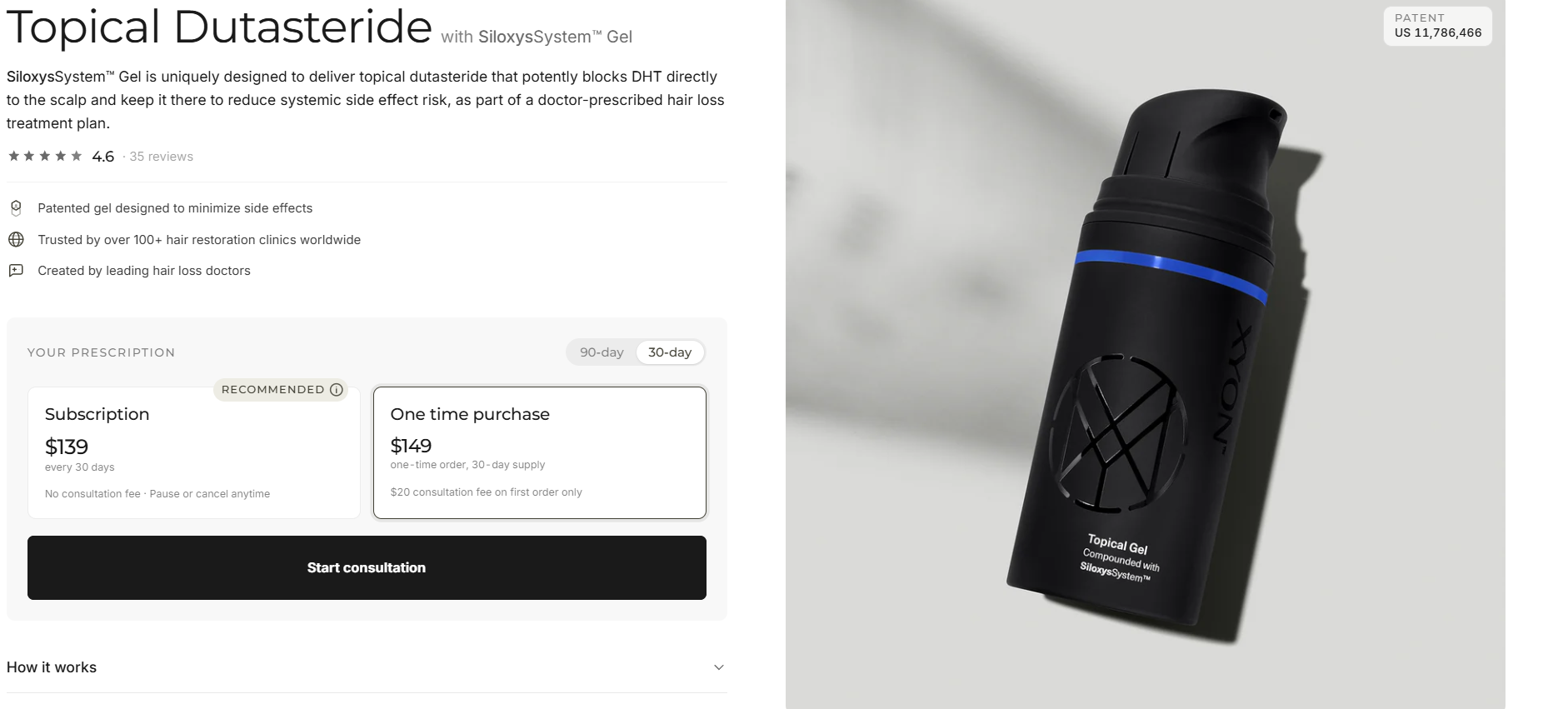
I’ve researched the current options carefully. There are a few compounding pharmacies offering advanced delivery systems, but they are usually very expensive. One of the closest comparisons is liposomal dutasteride from Xyon, which is a high-end approach to delivering dutasteride more directly to the follicle area while aiming to reduce systemic absorption. The issue is cost. Many people are not going to commit to around $139 per month for one treatment.
That is where my formulation is different. I’ve invested in the equipment and development process needed to create a similar advanced delivery concept, but with multiple pathways combined into one product. The goal is a once-daily topical that is more efficient, longer acting, less wasteful, and easier to stay consistent with.
Instead of using several separate products every day, this is designed as a one-month supply applied once daily. Not twice daily, not excessive, and not overly complicated.
There are always new hair-loss treatments being discussed, but many of them are still targeting the same core issues: androgen signaling, follicle stimulation, inflammation, prostaglandin balance, and delivery efficiency. In my view, the biggest opportunity is not just finding new actives, but making existing actives work better through smarter delivery.
That is why liposomal and nano-emulsion technology matters. The goal is to make the formula more targeted, more efficient, and easier to use consistently, while reducing unnecessary systemic exposure compared to oral approaches.
so my only question is
what is it worth to you if you knew you could apply something once per day and get access to 5 different treatments into ONE single dropper style applicator?
sure you can try to diy a personal cheap version using solvents but you should know the stability issue of said route. ru58841 being the most unstable of all and breaks down overtime forcing you to make it fresh every few days for the best potency (i solved this issue)
I’ve spent a lot of R&D time working on a liposomal/niosomal hair-loss topical. The formula includes RU58841, dutasteride, minoxidil, latanoprost, CoQ10, and a liposomal delivery system, which is the main feature of the product.
A major issue with many DIY and commercial hair-loss topicals is that they are mostly solvent-based. They often rely on ethanol and propylene glycol to dissolve the active ingredients and push high concentrations onto the scalp. While this can help with delivery, a lot of the product can be wasted through evaporation, crystallization, and residue left behind on the scalp. If you’ve ever noticed white residue or dandruff-like buildup from topicals over time, this is usually part of the reason.
The problem is that these formulas are not always optimized to target the hair follicles directly. Instead, they often flood the scalp with active ingredients and hope enough eventually reaches the follicle and sebaceous gland area. That can be inefficient for both the ingredients and the user.
Minoxidil also has another limitation: some people may not have enough sulfotransferase enzyme activity in the skin for it to work as well topically. This is one reason some people move to oral minoxidil, which can be effective but also comes with more systemic exposure and long-term risk concerns. One common way to improve topical minoxidil response is by using tretinoin, which may increase local sulfation activity and help minoxidil work better. The downside is that this becomes another separate product that has to be bought and applied consistently.
The goal of my formulation is to combine multiple hair-growth pathways into one topical while using a nano liposomal/niosomal delivery system. Liposomal technology is used in some of the most advanced topical formulations because it may help improve delivery, reduce waste, and keep ingredients closer to the target area. The idea is that these tiny oil-based carriers can better disperse into the follicle area and interact with sebum, helping concentrate the actives where they are needed while also creating a longer-lasting depot effect.
Developing this has taken a lot of research because each ingredient has its own strengths, weaknesses, solubility issues, and delivery challenges. Fortunately, there is existing research showing that liposomal or nano-emulsion delivery can improve the performance of several individual topical ingredients. My goal is to bring those advantages together into one more complete formula.
Hair loss is not only about DHT. DHT is a major factor because it contributes to follicle miniaturization over time, but there are other pathways involved as well. Many people focus only on blocking DHT and may only slow further loss without seeing much regrowth. Regrowth usually requires stimulation and a broader approach, including pathways related to follicle signaling, inflammation, PGD2/PGE2 balance, and overall follicle environment.
Of course, there are limits. Some hair loss becomes much harder to reverse if it has been untreated for too long. But for people who are still within a recoverable range, the goal should be to improve consistency, reduce wasted product, and target the follicle more effectively.
Another major issue with hair-loss treatment is adherence. People apply something, do not see results as fast as they hoped, get frustrated, stop using it, and often lose more ground. It can also get expensive quickly. A person might buy minoxidil, RU58841, oral dutasteride, tretinoin cream, and several other products, spending well over $100 per month while still dealing with complicated application routines.
I’ve researched the current options carefully. There are a few compounding pharmacies offering advanced delivery systems, but they are usually very expensive. One of the closest comparisons is liposomal dutasteride from Xyon, which is a high-end approach to delivering dutasteride more directly to the follicle area while aiming to reduce systemic absorption. The issue is cost. Many people are not going to commit to around $139 per month for one treatment.
That is where my formulation is different. I’ve invested in the equipment and development process needed to create a similar advanced delivery concept, but with multiple pathways combined into one product. The goal is a once-daily topical that is more efficient, longer acting, less wasteful, and easier to stay consistent with.
Instead of using several separate products every day, this is designed as a one-month supply applied once daily. Not twice daily, not excessive, and not overly complicated.
There are always new hair-loss treatments being discussed, but many of them are still targeting the same core issues: androgen signaling, follicle stimulation, inflammation, prostaglandin balance, and delivery efficiency. In my view, the biggest opportunity is not just finding new actives, but making existing actives work better through smarter delivery.
That is why liposomal and nano-emulsion technology matters. The goal is to make the formula more targeted, more efficient, and easier to use consistently, while reducing unnecessary systemic exposure compared to oral approaches.
so my only question is
what is it worth to you if you knew you could apply something once per day and get access to 5 different treatments into ONE single dropper style applicator?
sure you can try to diy a personal cheap version using solvents but you should know the stability issue of said route. ru58841 being the most unstable of all and breaks down overtime forcing you to make it fresh every few days for the best potency (i solved this issue)


