unknownlarp
Larper
- Joined
- May 24, 2026
- Posts
- 282
- Reputation
- 152
Introduction
I've been on here for a while now, and one thing I kept noticing is the complete lack of discussion around Semax and especially when it comes to athletic performance and sport. You've got dozens of threads on peptides, stimulants, and recovery compounds, but almost nothing on Semax and what it could realistically do for your training. I figured it was time to change that.I'm not here to hype anything. I just want to lay out the science as clearly as possible and share why I think Semax is one of the most mechanistically interesting compounds for athletes — particularly those in technical, skill-heavy sports like combat sports and football.
How Does Semax Actually Work?
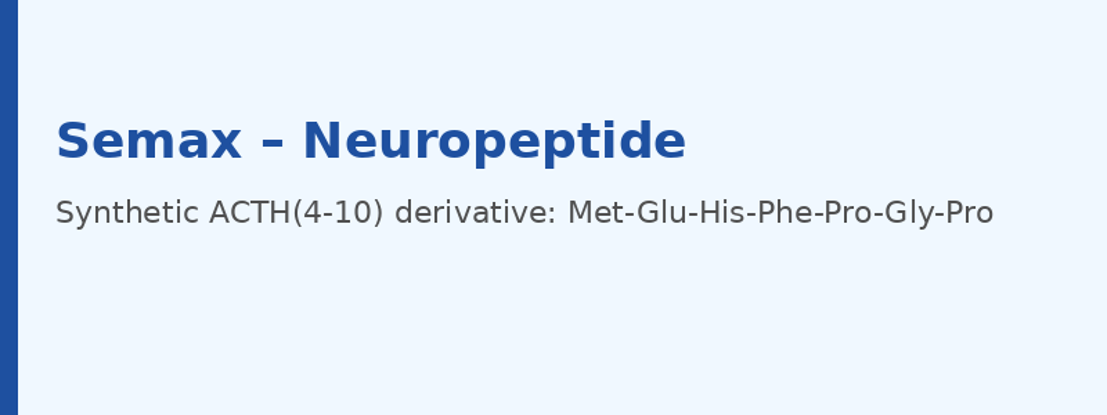
Semax — Synthetic ACTH(4-10) derivative: Met-Glu-His-Phe-Pro-Gly-Pro
Semax is a synthetic neuropeptide derived from the ACTH(4-10) fragment. Here's what matters: unlike regular ACTH, it does NOT stimulate cortisol production. Its effects are entirely neurological.
The Core Mechanisms
BDNF Upregulation — This is the big one. BDNF (Brain-Derived Neurotrophic Factor) is essentially the molecular fuel for synaptic plasticity and long-term potentiation (LTP). More BDNF = your brain builds and consolidates new connections faster. Semax elevates BDNF in the hippocampus and motor cortex.Dopamine Modulation in the PFC — Semax increases dopamine turnover in the prefrontal cortex, which directly impacts working memory, decision-making speed, and executive function.
MC4R Activation — Binds melanocortin-4 receptors → activates cAMP/PKA signaling cascade → downstream modulation of noradrenergic and serotonergic systems.
Neuroinflammation Reduction — Suppresses NF-kB dependent inflammatory pathways, reduces IL-1β, TNF-α, and IL-6 in CNS tissue.
Route of administration: Intranasal. Bioavailability is high (~60-80%) because it bypasses the blood-brain barrier via the olfactory nerve.

BDNF → LTP → Synaptic Plasticity → Motor Learning & Memory Consolidation
Why I Think This Matters for Sport
Here's the thing most performance discussions miss: sport is not just physical. Technical sports — combat sports, football, basketball, tennis — are primarily limited by the nervous system, not the muscles. Decision speed, pattern recognition, motor automation, spatial awareness... these are all CNS outputs. And these are exactly the systems Semax targets.My thesis is simple: Semax doesn't make your muscles stronger. It makes your nervous system learn faster and maintain output longer.
| Performance Domain | Semax Mechanism | Expected benefit |
| Motor Learning | BDNF↑ in Motor Cortex | Faster skill automation |
| Decision Speed | Dopamine ↑ in PFC | Faster read & react |
| Working Memory | Dopamine↑ in PFC | Better spatial awareness |
| Cognitive Endurance | Serotonergic modulation | Less mental fatigue late game |
| CNS Recovery | Anti-inflammatory | Faster neural recovery |
| Concentration | Noradrenergic effects | Sustained focus under pressure |
Combat Sports (BJJ, Muay Thai, MMA)

Martial Arts — Technique Automation via Motor Cortex Plasticity
Combat sports might be the single best use case for Semax. Think about what skill acquisition in BJJ or Muay Thai actually looks like:
You drill a technique consciously and slowly at first
Over hundreds of reps, it transitions from explicit to implicit memory
Eventually it's available under pressure without conscious thought
That transition — from 'thinking about it' to 'just doing it' — is exactly what BDNF and LTP govern. Semax accelerates that pathway. The motor cortex builds and consolidates new patterns faster when BDNF is elevated.
Beyond technique: reaction time in sparring is determined by prefrontal dopamine availability and noradrenergic tone. The faster your PFC processes incoming information, the sooner you can counter. Semax modulates both.
And here's the part nobody talks about: motor consolidation happens primarily during sleep. The brain replays and cements what you drilled during waking hours. Semax, by supporting BDNF signaling, could theoretically potentiate this overnight consolidation — meaning the gains from your afternoon session get locked in more efficiently.
Practical Implication for Combat Athletes
If you're in a heavy technical phase — learning a new guard system, working a new striking combination — this is where Semax theoretically has the highest ROI. Less so during pure conditioning blocks.Football / Soccer

Football — Cognitive Demands: Decision Speed, Spatial Memory, Tactical Automatisms
Football is a fascinating case because it's one of the most cognitively demanding sports in existence, yet it's almost never discussed from a neuroscience angle in performance communities.
Consider what a professional midfielder does every 10-15 seconds: scan 360 degrees, hold the positions of 21 players in working memory, anticipate 2-3 possible passes, make a decision in under 500ms, and execute under physical pressure. That is elite neurological performance.
Where Semax Maps Onto Football
Hippocampal BDNF → Spatial working memory → Track teammates and opponents more accuratelyPFC Dopamine → Decision speed → Pick the right option faster under pressure
Motor Cortex plasticity → Technique automation → First touch, passing, finishing become more reliable under fatigue
Serotonerge modulation → Cognitive fatigue resistance → Maintain output quality in minutes 70-90
Pattern chunking via LTP → Faster tactical learning → New pressing schemes or set pieces get automated quicker
The Minute 70-90 Problem
This is something I find genuinely interesting. Late in matches, passing accuracy drops, decisionmaking slows, and tactical errors increase. Most people chalk this up to muscular fatigue — but a lot of it is central nervous system fatigue. Serotonin accumulates, dopamine depletes, and the brain starts cutting corners. Semax addresses both sides of this equation directly.Evidence Base & Honest Caveats
I want to be straightforward here: there are essentially zero controlled trials on Semax in healthy athletes. The clinical evidence base comes from Russia, primarily in patients with ischemic stroke, optic nerve pathology, and ADHS. The mechanisms are well-characterized — but applying them to athletic performance is an extrapolation.What we do know:
BDNF's role in motor learning and LTP is extremely well established in the literature
Dopaminergic enhancement of decision speed has good proxy evidence (Methylphenidate studies in sport contexts)
Semax's BDNF-upregulating effect is reproducible in animal models
Human cognitive studies (non-athlete) suggest improved attention and processing speed
What we don't know:
Optimal dosing for cognitive enhancement (vs. therapeutic) purposes
Tolerance development with extended use
Inter-individual variability (MC4R polymorphisms, baseline BDNF levels)
Long-term safety data in healthy populations
Final Thoughts
Semax is not a shortcut. It doesn't replace training volume, it doesn't build muscle, and it doesn't improve VO2max. What it potentially does is make your nervous system a more efficient learning machine — and in skill-based sports, that's actually where improvement comes from.I think it's genuinely underrated in this community, and I hope this thread opens up some discussion. If anyone has personal experience running it alongside a structured training block, especially in a technical sport, I'd be really interested to hear what you noticed and how you structured it.
Thank you for reading, dont forget to rep, theres some effort in this thread

@primal_shitmuncher