Seth Walsh

Iconoclast
Contributor
- Joined
- Jan 12, 2020
- Posts
- 11,279
- Reputation
- 23,092
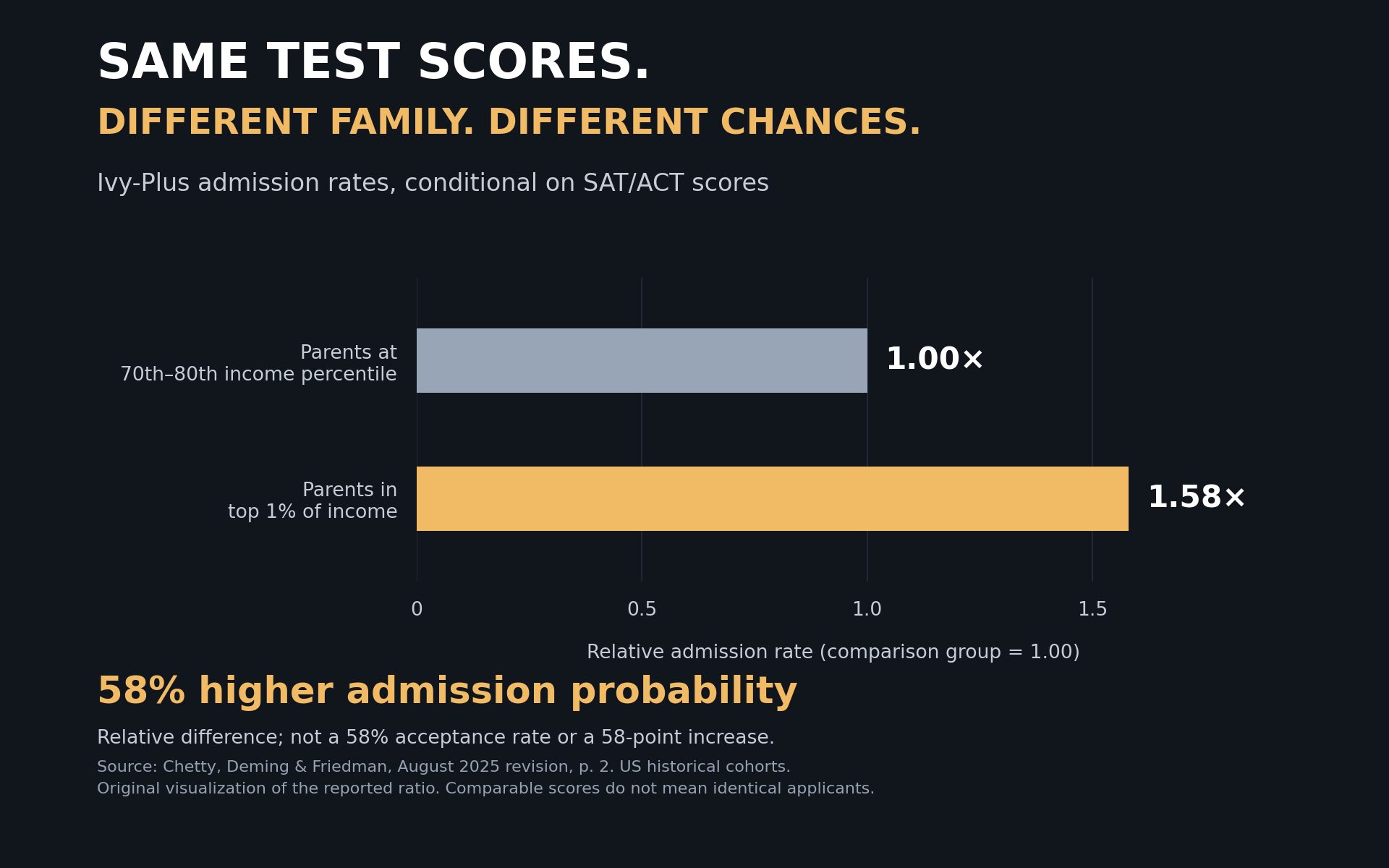
Chetty, Deming and Friedman found that Ivy-Plus applicants from top-1% families were 58% more likely to be admitted than applicants from the 70th–80th parental-income percentiles with comparable SAT/ACT scores.
The advantage came through legacy preferences, athletic recruitment and non-academic ratings. Those three advantages did not predict better post-college outcomes after adjusting for the colleges attended.
Now the nasty part: getting through that gate actually matters. Their waitlist-based analysis estimates that attending Ivy-Plus instead of an average flagship public university made marginal applicants about 50% more likely to reach the top 1% of earnings and 2.5× as likely to work at a prestigious firm.
My reading: family advantage helps buy access to the institution that later certifies your success.
The degree can be earned. The work can be real. The competition can still be tilted.
“He succeeded” does not establish that you were offered the same test.
The advantage came through legacy preferences, athletic recruitment and non-academic ratings. Those three advantages did not predict better post-college outcomes after adjusting for the colleges attended.
Now the nasty part: getting through that gate actually matters. Their waitlist-based analysis estimates that attending Ivy-Plus instead of an average flagship public university made marginal applicants about 50% more likely to reach the top 1% of earnings and 2.5× as likely to work at a prestigious firm.
My reading: family advantage helps buy access to the institution that later certifies your success.
The degree can be earned. The work can be real. The competition can still be tilted.
“He succeeded” does not establish that you were offered the same test.
Chetty, Deming & Friedman — August 2025 revision, pp. 2–3.
US historical cohorts, not a claim about every university today. Comparable test scores ≠ identical applicants. 58% is a relative admissions difference; the later outcome estimates concern marginal applicants. These estimates cannot be multiplied together.
US historical cohorts, not a claim about every university today. Comparable test scores ≠ identical applicants. 58% is a relative admissions difference; the later outcome estimates concern marginal applicants. These estimates cannot be multiplied together.