D
Deleted member 16275
Anmal Lover
- Joined
- Dec 2, 2021
- Posts
- 11,363
- Reputation
- 14,082
4368
Follow along with the video below to see how to install our site as a web app on your home screen.

Note: this_feature_currently_requires_accessing_site_using_safari




Seems there's more than one way, given u made it up, but if we assume 3 is zero, then u can do double the last difference plus 6.3, 14, 42, 104, ?
~110 iq sequence
tagging some forum nerds
@cloUder @OGJBSLAYER @JackTheKnife @the BULL
But where does the initial 3 and 11 come from? This is a very unsatisfying ad hoc "solution"This is what I did:
3 -- +11 --> 14 -- +28 --> 42 -- + 62 --> 104
11
28 = 11*2 +6
62 = 28*2 + 6 then
62*2 +6 = 130 and 104 + 130 = 234
You can probably find other patterns that give the same answer or different answers. I believe the whole point of these questions is to test whether the person has basic arithmetic skills and can see patterns. I guess most low-IQ people freeze with these types of questions so if you put several of them under a time constraint you can estimate their IQ.
Nope, it definitely comes up. You are just Google noobIt doesn't. Maybe cuz you already visited the place


Difference between the numbers 3 and 14 is 11but there's no pattern because random primes are being used each time with addition and subtraction being chosen arbitarirly (plus as someone else mentioned 1 isnt prime)
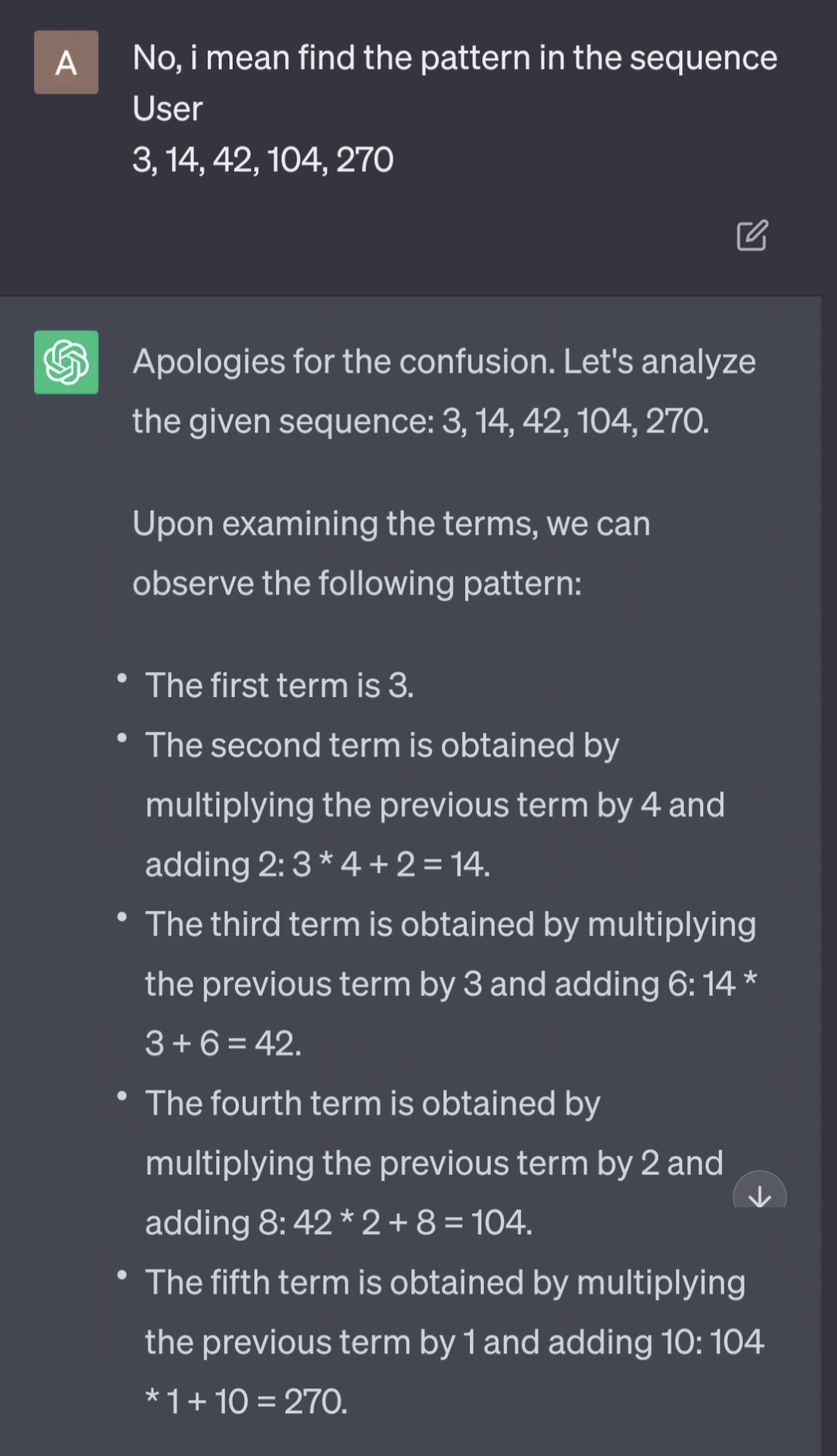
270 is the right answer btw, i wanted to see how you got that
prime examle of why options arent providedDifference between the numbers 3 and 14 is 11
14 and 42 is 28 and 42 and 104 is 62
11= 3^2+2
28= 5^2+3
62=8^2-2
X= Y^2-3 ( order on the rhs is + 2 + 3 -2 and therefore -3 on the last term)
Y= 13 as 2+3= 5 and 5+3=8 ( Fibonacci sequence)
X= 166
Adding 166 to 104 = 270

Na you just don’t understand it lol even if I explain like to a 5 yo you’ll keep saying it’s random schizophrenic bla bla so peaceprime examle of why options arent provided
you have arrived at the correct answer through some random autism that amkes absolutely no sense and does not constitute a pattern

Y the Jfl this is basic AP taught in 8 th gradeThanks for wasting my 5 minutes for this dumbass question
why is the first term 3?Na you just don’t understand it lol even if I explain like to a 5 yo you’ll keep saying it’s random schizophrenic bla bla so peace
Bruh that's not apY the Jfl this is basic AP taught in 8 th grade
your just mad your not high enough iq to solveBruh that's not ap
Ap goes like this : 2,4,6,8,10
When there's a common diffrence and it repeats itself and that's not even a gp
That's just ridiculous dumbass question tbh
Because that’s the number we start from in the sequence to get 11 . It is just AP - there’s no requirement for Fibonacci to start from 1 or 0 . Some patterns even go deep into the sequence as it’s an infinite series.why is the first term 3?
The additive /subtractive terms on the rhs. The first equation it’s +2 the second it’s 3 the third we substract 2 and so the fourth we subtract 3 to maintain symmetrywtf is the sequences 2,3,-2,-3?
Well yeah d remains the same in Ap but what I meant was it is the same logic you find out the difference in the series that keeps increasing ( so more like a series than Ap) and you find a pattern amongst them rather than the main terms . Since there is no obvious pattern among the terms 3 14 42 104 in themselves.Bruh that's not ap
Ap goes like this : 2,4,6,8,10
When there's a common diffrence and it repeats itself and that's not even a gp
That's just ridiculous dumbass question tbh
One guy explained reasoning for 234 it answers only two terms doesn’t explain the term 11 in the rhs in the firstthis is 80 iq question. if you cant instantly see it ur retarded. i was about to solve it for you but its literally so easy its humiliating
234
bro stop talking to me like im 5. i have a more in depth math education than you.Because that’s the number we start from in the sequence to get 11 . It is just AP - there’s no requirement for Fibonacci to start from 1 or 0 . Some patterns even go deep into the sequence as it’s an infinite series.
The additive /subtractive terms on the rhs. The first equation it’s +2 the second it’s 3 the third we substract 2 and so the fourth we subtract 3 to maintain symmetry
i dont remember asking for you to speak, tbhThis is absolutely useless for survival and reproduction
Cagedbro stop talking to me like im 5. i have a more in depth math education than you.
your "pattern" is retarded, stop coping
I don't remember asking you to make this thread, tbh. Why are you being hostile man? I'm just joking, chill. I was being sarcastic.i dont remember asking for you to speak, tbh
define sequence a( n ) as 11 *n + (6* (n-1))One guy explained reasoning for 234 it answers only two terms doesn’t explain the term 11 in the rhs in the first
Just define sequence theory. You’re the midwit you dumb mong when there’s no reasoning behind why you’re defining that particular sequence when you cannot even explain the first term 11. You’re in effect onlu explaining two terms the 28 one and 62 one. Many others in the thread got the same answer as you go look.. all you’re doing is defining a function that makes the first term 11 by using the term n-1. Proper midwit move skim the thread first. And even the sequence you defined doesn’t work clearly as the third term is 45 a number nowhere to be found in the sequence. The answer is 270 as I posted and mogger123 verified but said I arrived at it randomly because he’s too low iq to understand the Fibonacci sequence and symmetry.define sequence a( n ) as 11 *n + (6* (n-1))
the sequence members are as follows: 11, 28, 62, ...
choose arbitrary starting natural number, in this case, 3
for every next member ,add the previous and the appropriate sequence member
3, 3 + (11*1)+0 = 14, 14 +(11*2) +6 *1 = 42, ...
you are all midwits.
the sequence perfectly defines the first term. although i have written it perhaps too hastly the proper definition would be a ( n ) = 11*n + K where K is a natural number defined as 0 when n = 1 and 6 when n > 1. it is mathematically completely correct and describes the given sequence if we do the steps i have provided.Just define sequence theory. You’re the midwit you dumb mong when there’s no reasoning behind why you’re defining that particular sequence when you cannot even explain the first term 11. You’re in effect onlu explaining two terms the 28 one and 62 one. Many others in the thread got the same answer as you go look.. all you’re doing is defining a function that makes the first term 11 by using the term n-1. Proper midwit move skim the thread first. And even the sequence you defined doesn’t work clearly as the third term is 45 a number nowhere to be found in the sequence. The answer is 270 as I posted and mogger123 verified but said I arrived at it randomly because he’s too low iq to understand the Fibonacci sequence and symmetry.
11*3+6=39the sequence perfectly defines the first term. although i have written it perhaps too hastly the proper definition would be a ( n ) = 11*n + K where K is a natural number defined as 0 when n = 1 and 6 when n > 1. it is mathematically completely correct and describes the given sequence if we do the steps i have provided.

you should use the sequence with the rule ive given for the arbitrary one that starts with 3. defined rigorously, the original sequence is actually a recursive one, a( n ) = 11 for n = 1 and a( n ) = 2 * a(n-1) + 6 for n > 1.11*3+6=39
midwit alertdefine sequence a( n ) as 11 *n + (6* (n-1))
the sequence members are as follows: 11, 28, 62, ...
choose arbitrary starting natural number, in this case, 3
for every next member ,add the previous and the appropriate sequence member
3, 3 + (11*1)+0 = 14, 14 +(11*2) +6 *1 = 42, ...
you are all midwits.
Ok but my original criticism remains. You are in effect only explaining two terms with the second defined fn. The first function is far too arbitrary. My pattern explains all three terms .you should use the sequence with the rule ive given for the arbitrary one that starts with 3. defined rigorously, the original sequence is actually a recursive one, a( n ) = 11 for n = 1 and a( n ) = 2 * a(n-1) + 6 for n > 1.

brahmin i talked to you like months ago about using dnp for fat loss. i ended up just using ostarine and cardarine and dropped fat precipitiously.Ok but my original criticism remains. You are in effect only explaining two terms with the second defined fn. The first function is far too arbitrary. My pattern explains all three terms .
cant get the pattern in a non-contrived manner sadly. but miring how the forum pseuds can't help but scurry to your threads like rats.3, 14, 42, 104, ?
~110 iq sequence
tagging some forum nerds
@cloUder @OGJBSLAYER @JackTheKnife @the BULL
check my other threads. i got in a psych ward and was prescribed meds that made me put on weight. my dnp was also seized by police. im off them all now tho and dropping around .75 kg a week nowadays.brahmin i talked to you like months ago about using dnp for fat loss. i ended up just using ostarine and cardarine and dropped fat precipitiously.
why havent your efforts worked out? you seemed very determined at the time.
cant get the pattern in a non-contrived manner sadly. but miring how the forum pseuds can't help but scurry to your threads like rats.
 = a(1) when n = 1, and c = c(n-1) + a(n+4), where a(n+4) is sequence a starting from the 4th member. the given sequence is now formed:
nopeending the thread with a complete, rigorous, mathematically complete solution, taking into account all previous given solutions:
Define sequence a ( n ) as fib ( n ) ^ 2 + b ( n ) where fib ( n ) is nth element of fibonacci sequence and b ( n ) is nth element of the sequence
+2 , +3, -2, +2, +3, -2, ....
thus, the elements of the sequence a ( n ) are as follows:
1^2 + 2 = 3
1^2 + 3 = 4
2^2 - 2 = 2
3^2 + 2 = 11
5^2 + 3 = 28
8^2 -2 = 62
13^2 + 2 = 171
Now, define a sequence c
3, 3+11 = 14, 14 + 28 = 42, 42 + 62 = 104, 104 +171 = 275
it isnt a matter of yes or no, given that you didnt provide options, this answer completely describes the given sequence and is a valid next elementnope
it's much much much simpler than this
yes it isit isnt a matter of yes or no, given that you didnt provide options, this answer completely describes the given sequence and is a valid next element

exactly ,that is how sequences work, it is completely uncertain what the next element can be if you dont know the general member. for example, even if you gave me a sequence 0,0,0 and told me to find next element, if i said its it is -6 would be correct, if the sequence was defined as (3-n)(2-n)(1-n)yes it is
or i could just say it's the seaquence h[n] where h[1]=3, h[2]=14, h[3]=42, h[4]=104 and h[5]=tbhiorvfnfjlknrefvnk
exactly, so the simplest solution is the correct one. i.e not yoursexactly ,that is how sequences work, it is completely uncertain what the next element can be if you dont know the general member. for example, even if you gave me a sequence 0,0,0 and told me to find next element, if i said its it is -6 would be correct, if the sequence was defined as (3-n)(2-n)(1-n)
You defeated mogger123?exactly ,that is how sequences work, it is completely uncertain what the next element can be if you dont know the general member. for example, even if you gave me a sequence 0,0,0 and told me to find next element, if i said its it is -6 would be correct, if the sequence was defined as (3-n)(2-n)(1-n)
for example 1, 4, 9, 16, ?exactly ,that is how sequences work, it is completely uncertain what the next element can be if you dont know the general member. for example, even if you gave me a sequence 0,0,0 and told me to find next element, if i said its it is -6 would be correct, if the sequence was defined as (3-n)(2-n)(1-n)
Yo solve this one for me: Straight, Gay, ?for example 1, 4, 9, 16, ?
the correct answer is 25 even though you could find other contrived "answers"
the answer by definition is correct if it is a next member of a sequence whose preceding members are the ones provided. this is the exact reason why most tests offer solutions, so people dont come with hacky solutionsfor example 1, 4, 9, 16, ?
the correct answer is 25 even though you could find other contrived "answers"
Cope, users provided interesting answers. You're too low IQ to even begin solving any of this. Sit yo ass on the retard bench and watchJust type in random numbers, say there's an IQ requirement for solving it, and watch forum autists flood your post theory

youre on the right track bring in symmetry and you are done.ending the thread with a complete, rigorous, mathematically complete solution, taking into account all previous given solutions:
Define sequence a ( n ) as fib ( n ) ^ 2 + b ( n ) where fib ( n ) is nth element of fibonacci sequence and b ( n ) is nth element of the sequence
+2 , +3, -2, +2, +3, -2, ....
thus, the elements of the sequence a ( n ) are as follows:
1^2 + 2 = 3
1^2 + 3 = 4
2^2 - 2 = 2
3^2 + 2 = 11
5^2 + 3 = 28
8^2 -2 = 62
13^2 + 2 = 171
Now, define a sequence c
3, 3+11 = 14, 14 + 28 = 42, 42 + 62 = 104, 104 +171 = 275
Post degree + GPA?Cope, users provided interesting answers. You're too low IQ to even begin solving any of this. Sit yo ass on the retard bench and watch
@JackTheKnife @QQ442244Difference between the numbers 3 and 14 is 11
14 and 42 is 28 and 42 and 104 is 62
11= 3^2+2
28= 5^2+3
62=8^2-2
X= Y^2-3 ( order on the rhs is + 2 + 3 -2 and therefore -3 on the last term)
Y= 13 as 2+3= 5 and 5+3=8 ( Fibonacci sequence)
X= 166
Adding 166 to 104 = 270