enchanted_elixir

𝕸𝖊𝖗𝖈𝖊𝖓𝖆𝖗𝖞 𝕮𝖔𝖗𝖕 • 𝟐𝟎𝟐𝟐🥉• Inactive
Contributor
- Joined
- Apr 15, 2022
- Posts
- 24,610
- Reputation
- 44,004
Read this carefully. You will read it again at the end, and it will not be the same scene.
It's the third week of the semester. You take the same seat in the same lecture hall every session, because you are a creature of habit and the outlet is there.

Week one: a girl — call her Mara — sits two rows behind you. Twice during the lecture she turns to say something to her friend, and both times her eyes pass over you on the way. You notice because you notice everything. It's probably nothing.
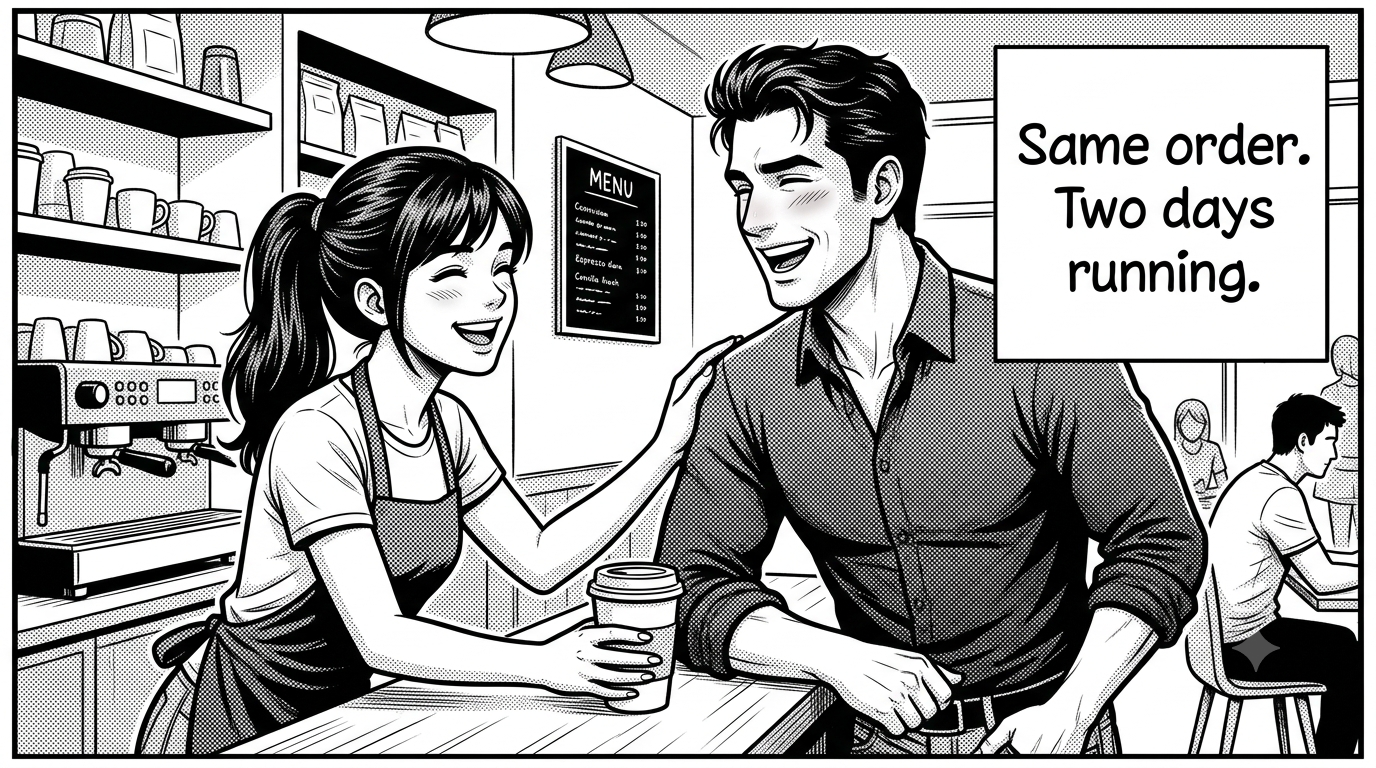
That same week, the girl at the campus café laughs hard at a mediocre joke you make about the card reader, touches your forearm, and remembers your order the next day. Warm. Bright. You leave wondering if she had something for you.
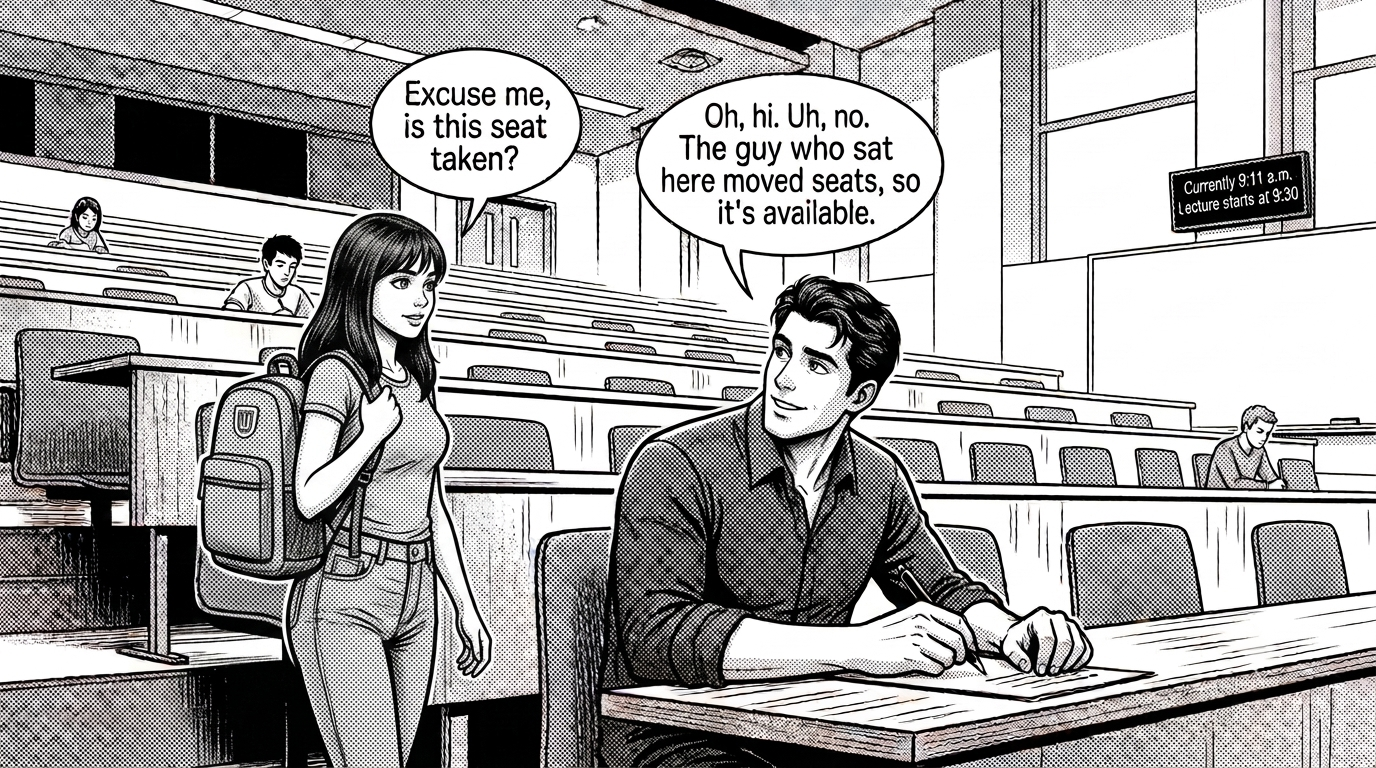
Week two: Mara's seat has migrated. She's in your row now, four seats down. On Thursday she's next to you — "is this seat taken??" There are twenty other empty seats she could have chosen. During the lecture she asks to borrow your charger; her phone is at 98%. She asks what you said your minor was — you mentioned it once, in passing, ten days ago, to someone else while she was nearby. When you answer, she laughs at a joke you didn't fully commit to. Later, walking out, as you and her kick off the first conversation between you two, she fumbles the door push-bar, drops her pen, laughs at herself, and says "I swear I can walk."
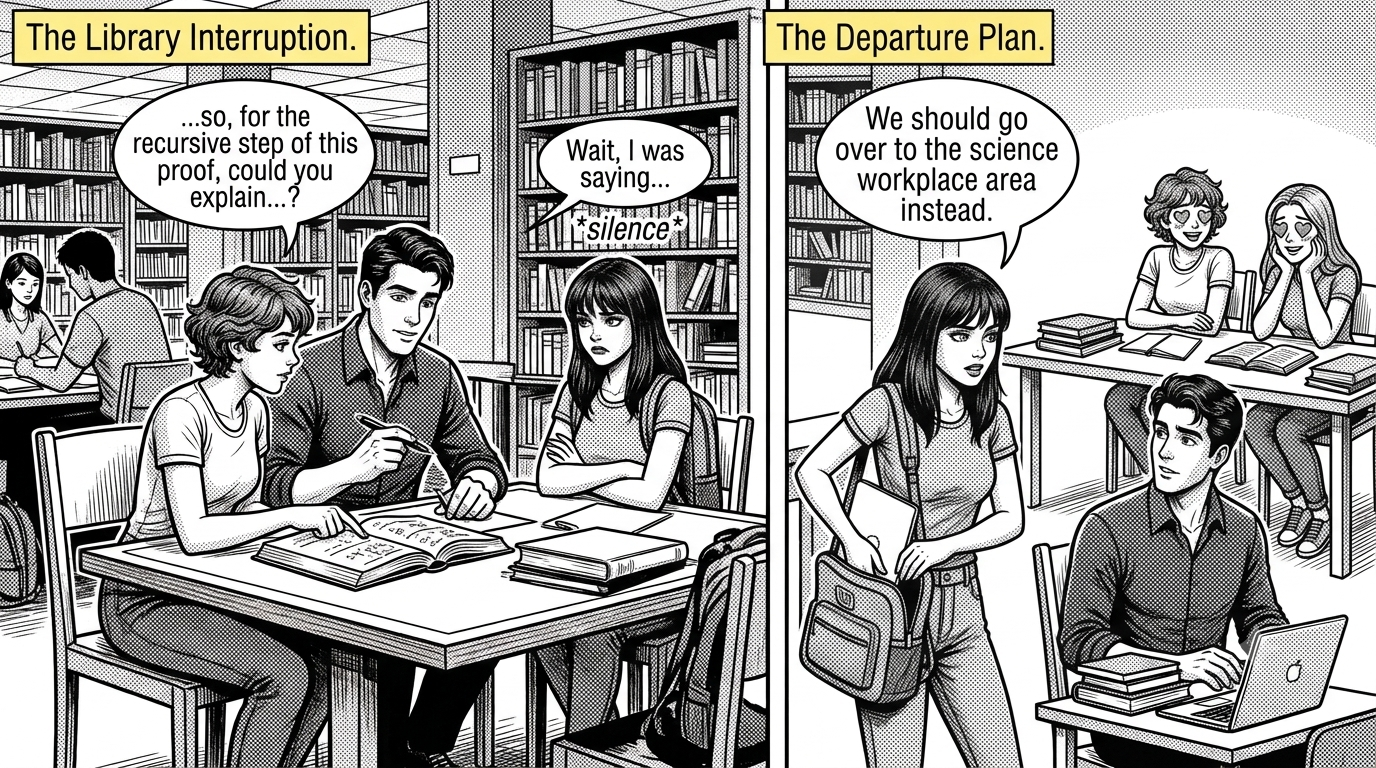
Week three: study group before the midterm. A girl from another section sits down next to you and asks you to explain a proof. Mara, mid-sentence across the table, goes quiet. For the next ten minutes her answers are clipped. When the other girl leaves, Mara slides her laptop over — "wait, explain that to me" — and the temperature returns. She then sees the girl looking over at you two in the distance and overhears her and her friend trying to invite you to their study group, she infers that they like you too (you are not aware of what Mara is seeing or if the girls who came over liked you). She then tells you that she is not comfortable here, makes an excuse to go to the little workplace area in the natural science department, and you two leave. Three hours later, as you two pack up, she mentions, to no one in particular, that "a bunch of people are going to the thing at Vessel on Friday, you should probably come." That night she follows you and replies to your story in under four minutes, with an emoji, about something that did not require a reply.

Meanwhile, the café girl is exactly as warm to the guy in line behind you as she was to you. You watch her touch his forearm too.
Question: is Mara interested?
You want to say "obviously." But you cannot currently say why. Not precisely, not in a way that would survive cross-examination, and not in a way that would transfer to the next girl, in the next context, with a completely different personality. If Mara had social anxiety, or a boyfriend, or a reputation to manage, almost every one of those behaviors would change form, and most guys would read her as cold.
By the end of this guide you will be able to take that scene apart behavior by behavior, classify every signal into its class, weigh each one correctly, discard the counterfeit, and tell me not just that she's interested but roughly how much, how you'd confirm it, and why the café girl means nothing.
Introduction
My Story
I haven't posted a major guide since 2023. In the time since, I've learned at least ten times what I knew then, and I believe there is a non-trivial chance that I begin posting guides more frequently, with much higher quality than before.
I do have a confession to make though: as someone who used to be an LTN turbomanlet, I was obviously ostracized from the dating market throughout middle school and most of high school. Anyone who has attended a public school in the United States, or maybe anywhere in the Anglosphere, knows that women have a tendency to ask other women what they think of the men in their environment, precisely "would you date x?", and whenever I was x, it wouldn't be out of the normal to overhear "ewww... no".
These unrequited self-esteem nukes served as a potent negative reinforcement for any future pursuit of women I would undergo, and I still haven't made a self-initiated and sustained approach to a woman to this day. I've only approached a woman once, and I stopped talking to her after seeing her twice due to being too sensitive to negative feedback, paranoid that some of the minor behaviors I observed may mean that she doesn't like me (she did like me, and I gave up too early). This woman gave me IOIs before I approached her, and our initial conversation went really well and she sucked up to me during the conversation we had.
I also don't approach random women, and if I do, it's only women who give me IOIs, so my rejection rate is literally near-zero so far, although this is a risk-averse strategy and it leaves a lot of potential on the table, I'll admit.
Due to these incentives created by my past, I had to get good at detecting IOIs, because I didn't want to experience the same esteem nukes I experienced back in grade school. This guide is a dump of everything I've learned (and yes, the contents of this guide are quite literally how I either consciously or intuitively process IOIs).
Why a list was never enough
In March of 2025, I posted a megalist of female indicators of interest, things like "She plays with her hair", "She points her feet at you", "She touches her collarbone". Note that it was a list, never a guide. Lists are checklist knowledge, the kind every YouTube body-language channel, every dating book, and every forum guide sells, and checklist knowledge has a fatal flaw: a checklist tells you what attraction looked like once, on someone else.
I actually closed that megalist with the line "...or any other behavior that has common underlying motivations". This masterclass is that one sentence expanded. Chief among my objectives is to give you the common underlying motivations themselves, a model that tells you what attraction must look like on the specific woman in front of you, including behaviors no list (mine included) could ever be long enough to contain.
Checklists are why you over-read the friendly barista and under-read the anxious girl who never approaches but has orbited you for a month (and you probably didn't notice her). Checklists have no way to handle context, personality, or counterfeits. They pattern-match surfaces.
What this guide does
This guide teaches the machine that generates Indicators of Interest (IOIs) from women, and how to detect its outputs. And once you have the machine, here is the good news: it's not that hard. The behaviors that confuse you now share a common underlying structure, and knowing it lets you triangulate which of the things you perceive are signal and which are noise. What currently confuses you becomes the predictable output of a system you can understand in an afternoon, master in a semester, and benefit from for a lifetime. This is what I personally use to detect IOIs.
One rule before anything else. It is the most important sentence in this guide, and everything after it exists to justify it:
If you know statistics: interest is the alternative hypothesis, and disinterest is the null. You do not get to accept the alternative because you want it to be true. The null holds until the data forces you off it. Most of the misery in this domain (the over-reading, the humiliating misfires, the "I thought we had something", the woman who accepts your advances not really because she likes you but because she wants a boyfriend since her friends all have one, or because of parental pressure, or some other externally placed demand that far exceeds her actual desire for you) comes from men who run the test backwards.
Table of Contents
Part I — The Mechanism of Attraction. Where attraction comes from. All behavior is acquisition. Attraction is the brain's valuation of acquiring you. Pursuit is a separate decision, downstream of the valuation, and you only ever see that last stage, which is why detecting interest is an inference problem: a hidden state read from visible outputs.
Part II — Indicators of Interest. What an IOI actually is, and the proof that every one of them reduces to three incentives she acts on (attention, propinquity, and value). Then, the full graded catalog of two hundred and fifty.
Part III — The Training Protocol. The discipline and the habit. How to read a deviation without fooling yourself, how to subtract the counterfeits, how to detect when the source is playing defense on what you get to see, and when to declare the question closed. Then the one loop that turns the model into a skill: observe, predict, get feedback, update. The model without reps is trivia.
Part I — The Mechanism of Attraction
All behavior serves acquisition

All human behavior is executed in service of an objective. All behaviors. Every action you take, from blinking, to selecting a certain meal at a restaurant, to which foods you pick at the grocery store, to your purchases, and even spending time on this website, has an underlying reason, whether you are aware of it or not.
As humans, we are always out to acquire things to fulfill objectives (whether the objective is of the advancement or attainment (+), maintenance (=), or prevention or removal (−) type). All that we do is in service of acquisition. We seek to acquire food, resources, information, comfort, stimulation, friends, mates in service of higher objectives such as status, survival, safety, among others.
Here's the important bit though: behavior is metabolically expensive. The energy you have in the form of ATP, which you manufacture from food and oxygen, is finite and thus must be allocated to what matters, thus the human body (including the brain) will not spend energy on what it does not value and will only spend energy on what it values in a given, dynamic time horizon.
The general computation behind every behavior
In the previous subsection, I stated that all human behavior is in service of acquisition, but what is the underlying causality behind all of the human behavior we observe in our lives? The answer is that there exists a general computation that runs continuously in every human brain. The computation is as follows:
The sequence above is adapted from the Natural Law Institute's cognitive laws (see Sources).
The cognitive process behind attraction

Now, let us get the general computation and apply it to how attraction is generated in a woman. Let us imagine a woman walking into a library of the university she attends. The general computation we described above runs in milliseconds, loops continuously, and happens almost entirely below her awareness. It begins the instant you enter her sensory field.
First, sensation: raw input hits her senses, which include your face, frame, voice, and cologne entering her visual, auditory, and olfactory fields as you walk in. Her brain has only received these inputs but has not made sense of anything yet, so at this point, she does not recognize "there is a face", "there is a man", etc.
Raw input means nothing until it is sorted, so her brain categorizes it, answering "what am I currently sensing?" and returning male, around her age, tall, lean, well-dressed, calm voice.
Isolated categories are still not a scene, so they are organized into one coherent representation: "the guy who sits by the outlet, third row, talking to the teacher's assistant, relaxed posture."
A scene with no meaning is useless, so the representation is immediately auto-associated against her memory, matched to past inferences: well-dressed and calm under attention reads as likely status, glasses as likely smarter than average, your above-average height is associated with dominance, status, competence and masculinity, and her previous crushes.
Now that the scene carries meaning, her brain does what brains are for and predicts: given what this is, what can I expect? This is a value-neutral forecast, her generative model rolling the tape forward on three layers, the sensations she will meet later (I will continue to walk and I will get closer to him as I need to pass him to get to the door), the sequence about to unfold (finishes talking to the teacher's assistant, sits by the outlet, may pack up in an hour since the next wave of classes starts around 11:00), and the reachable states her own actions would open ("if I sit one seat over, we share an armrest for ninety minutes"). None of these futures carries a good-or-bad label yet; this stage only generates the menu of possible futures.
A menu is worthless without prices, so the futures are handed to valuation, which is attraction itself. The objective here is to assign valence to the situation based on the scene, its meaning, and what could happen next to incentive action. Her subconscious rubric prices the scene (including you) according to the goals she cares about (survival, mating, status, etc.) and assigns values each predicted future. For you, she's grading you on your looks, status, competence and also factoring in mate scarcity (the usual 2 female : 1 male gender ratio in colleges and universities increasing acquisition pressure), her neurochemistry, her alternatives, tagging each object in the scene as desirable (ends up acquired by me) or undesirable (public rejection, the girlfriend branch) and of what magnitude. The output is a single number, silent, continuous, and invisible, and the size of that number is the degree of her attraction.
Because a brain will not and will NEVER spend its scarcest resource on what it prices at zero, a high attraction valuation forces the next step, focused attention. This is where her subconscious mind directs her attention to the handsome male she sees, and this is the first process she is post-hoc aware of. Attention is always being paid to something; focus is the scarce version, prioritizing one thing at the expense of everything else, to the degree she cares and not necessarily consciously. You now stick in her awareness without her deciding it, and she knows where you are in the room. A woman demonstrating that your handsomeness is the most important thing to be paying attention to is a huge deal.
Having valued you and is fixated on you, she must decide what to do, which is the state stage: "what should I do about it?" This is where the only real if in the whole chain lives, the pursuit decision, driven by acquisition pressure (value times feasibility) and weighed against cost: does she believe you like her back, can her effort pay off, is there time pressure. It is also where the constraint filter runs, deciding which channels she can actually afford given her costs, risk tolerance, and situation (approaching may be too expensive, sitting nearby affordable). Both are detailed in Part II.
Whatever survives the decision and the filter becomes the last stage, action/behavior, and something always executes; the only question is which kind. It may be pursuit (the deliberate "is anyone sitting here?"), covert planning (working out the plan to a desirable future, like figuring out when you are in the library to position herself in an advantageous place to approach next week), attention allocation (staring, monitoring), hiding intent (the expensive work of not getting caught staring), or propinquity (pretending to need to print a worksheet just to get closer to you in hopes that you will talk to her, which if you are perspicacious, you can tell that is what she's likely doing since she printed a random picture from Google Images and keeps staring at you while she's printing her "assignment").
And then it loops. Her action changes the scene, including you, so the changed scene re-enters her senses as new raw input, and the whole computation runs again on the result.
Only the actions and behaviors performed by a woman are capable of being visible to you, whether you notice is another question entirely. Everything upstream is invisible. Detecting interest is therefore an inference problem: estimating a hidden state of a mind from its visible outputs.
Two scientific findings back the first stage of that sequence harder than you'd expect.
Attention does not merely drift toward what the brain values; it is front-loaded onto it, automatically and before awareness. Attractive faces break through visual suppression and reach consciousness earlier than ordinary ones, and a face rendered completely invisible still drags attention toward it [1].
And once caught, that attention is held: eye-tracking shows the gaze lingers on attractive faces longer than on plain ones, most strongly in men looking at women [2].
Attractiveness is only one input to value, but that is exactly the point, the perceptual system sorts a stimulus by worth and allocates processing to it before you consciously decide anything, which is precisely what the focus stage claims: you attend to what you care about, and what matters more is processed faster and held longer. So when she cannot keep her eyes off you, read it literally. Her visual system is doing what these studies say it does, with you as the stimulus it has already judged worth the look. (See Sources.)
Part II — Indicators of Interest

The definition of indicator of interest
Everything so far has been the cognitive processing machinery and how it's used when it comes to attraction. Now, we are going to discuss what it outputs, an indicator of interest (IOI), which is an action/behavior, and action/behavior is the endpoint of the computation traced earlier.
The definition of an indicator of interest writes itself from two directions: one from inside her head, one from outside it, in your eyes.
The first is what an indicator of interest is, stated from inside her head:
Clean, but useless in the field, because you can't see desires, only behaviors. So you also need the measurable, operational form, the one you'll actually run:
The first tells you what an IOI is; the second tells you how to detect one. Any behavior, in any channel, enacted consciously or not, is the same underlying bet: "this might produce an outcome useful to acquiring him."
Back to the lecture hall. Run Mara's charger question through both definitions. Enacted because of a desire to acquire you? You can infer that, but you cannot perceive that; desires are invisible. A behavior whose probability rises with how valuable acquiring you is? A phone at 98% answers that one for you. A woman who asks for a charger when her phone has battery either has extremely deranged OCD perfectionism or is desperate to have a conversation with you and will find any reason to do so, the latter is much more likely.
The core grammar underlying indicators of interest
The three logically necessary metaclasses of incentives
A list of indicators of interest can grow forever and still leave you unable to extract the trend from it, which is why you need a grammar: a small set of underlying forms to which every indicator of interest is ultimately reducible.
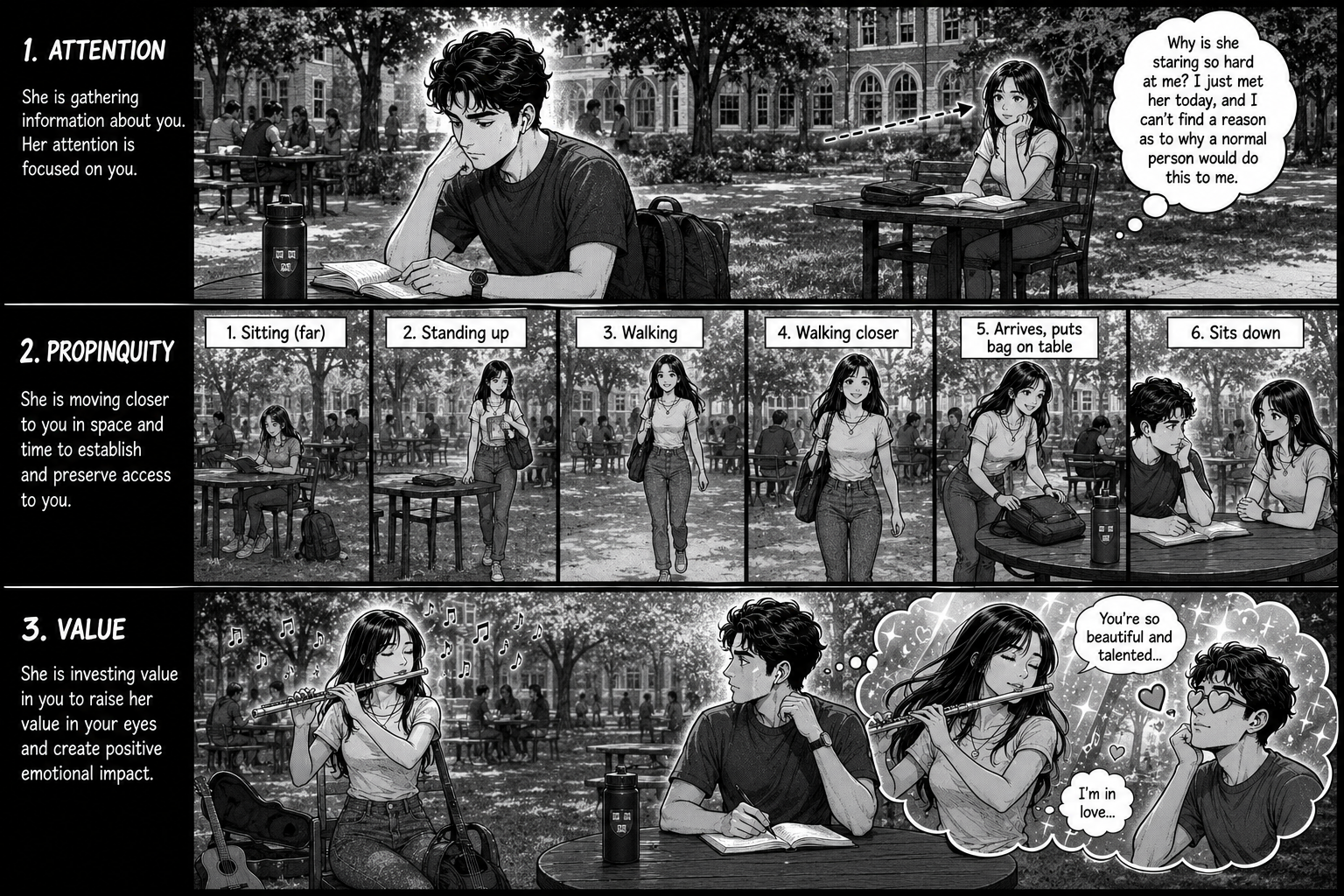
To acquire you as a mate, there is a fixed and finite set of incentives she must be under by necessity. They are the following, each named once, here, with the concrete forms it actually takes in the wild:
Women who are attracted will either act on these incentives, or want to act on these incentives but think its futile. If she does not act on the incentives and/or does not wish she had the means to act on them, she is not attracted.
Above delineates the three logically necessary incentives an agent has to be under in order to acquire a person as a mate. Each incentive can only be met by allocating selective attention to you, increasing propinquity to you, and/or investing resources in increasing her value to you, through the effectors a human actually has (gaze, positioning, speech, appearance effort, digital behavior, among others), in one of exactly two modes: overt (owned, deliberate, pursuit-grade, ex. approaching, inviting, asking) or covert (unowned, deniable, often unconscious, leak-grade, ex. staring, latency patterns, appearance effort). Finite incentives, finite resources to spend on them, and exactly two modes of spending: the result is a closed space within which every indicator of interest must fall.
"There are only so many classes of IOIs a woman can emit" is not an observation I am hoping holds up, it is a necessary consequence, because surface behaviors are unlimited (new apps, new contexts, new pretexts), but the incentives underlying and generating every one of them reduce to those three above, because she NEEDS to act on those incentives to get you, and mate acquisition has nothing else to incentivize. Any behavior you will ever observe either lands in one of these three classes of incentives and two modes, or it is not serving acquisition of you, meaning it is not an indicator of interest at all.
Think about it this way. Let's say that there exists a woman who is attracted to you, yet does not find you worth her selective attention, does not want to be closer to you (in space, time, or relationship), and does not care about her perceived mate value in your eyes.
That woman's "attraction", if she is not under the three logically necessary incentives, is a logical contradiction. How can you be attracted to someone and simultaneously NOT pay selective, focused attention to them, NOT want to be closer to them, and NOT care about your perceived mate value in their eyes?
And here is the same claim confirmed from the other side of the mirror, not as logic but as lived experience: I can guarantee that every time you have been attracted to a woman, you have performed, or wanted to perform, actions derived from all three of those same incentives (approaching her: propinquity; staring: attention; standing taller, deepening your voice, pulling your shoulders back, trying to be funny: value). The necessity runs in both directions, because it was never about her specifically, it is about what attraction is.
A brief, logical summary of what I discussed above:
One property of the three incentives before you use them: they can overlap.
One behavior can spend on several incentives at once (ex. "come study at my place": propinquity (space) + attention (information acquisition), and depending on what's actually on the table when you arrive, escalation, which is a subdomain of propinquity, actually an attempted advancement of it). A behavior that instantiates all three is still one observation, not three independent signals, and only independence across contexts and days multiplies evidence, a rule the closure section in Part III will discuss.
Emotional displays. Her smiling more around you, the visible excitement in your presence, the flatness when you're absent, is an observable register of her valuation of the situation she's in. To describe this economically, her emotions are a reaction-expression of changes in capital. Remember that attraction is a value, and values moving feel like something. Watch a man's face the morning his portfolio is up 600x, then the morning it's down 95%. This is an expression of his valuation of his situation, and the same goes with the woman. Read her emotions the same way as well. Positive affect leaks a high valuation in your presence, sulking, disappointment, and jealousy leaks a negative evaluation of the situation, that being, she doesn't want you to go and she wants you to be exclusively hers.
The cognitive filters determining which indicators of interest get actualized
A woman's cognitive pipeline runs continuously: perception → identification → classification → auto-association → prediction → valuation → focused attention → state → action/behavior. The "whether I should pursue" decision and the constraint filter live in that second-to-last stage (state). Those filtered outputs (action/behavior) are where indicators of interest reside. The constraint filter that a woman's actions and behaviors pass through is specific to this particular woman, in this particular context. Constraints select the channel.
Take two girls with identical attraction to you (same value, same acquisition pressure). One stares, approaches, and touches your arm. The other never looks at you directly, yet she is somehow always in your general area, and her friends keep glancing at you and smirking. Same input, wildly different output. A checklist reads girl one as interested and girl two as furniture, and both readings are wrong in opposite directions.
The difference is the constraint filter, the unique, specific-to-her stack of costs and inhibitions the pursuit decision must pass through before anything becomes visible:
Every constraint closes some channels and leaves others open:
Context, personality and beliefs (among other variables) select the channel and thus change which behaviors are actualized. The same attraction wears a different body in every environment, because the computation (I like him, thus I want him) is invariant and only what she does about it changes.
The opening question promised you this payoff. If Mara had a boyfriend, the seat migration dies and the 2 a.m. story replies survive. If she had social anxiety, "is anyone sitting here?" never happens, and her friends glancing at you and smirking happens instead. If she managed a reputation, the invitation to Vessel still gets said to the air, just quieter. Same Mara, same number, different body. Change the filter and you change the surface, never the machine.
Among one of the many things that enters the filter is acquisition pressure, which is equal to value times feasibility, where feasibility is her expected, perceived reward and progress toward the objective if she acts (ex. blatant pursuit, staring), and pressure is the urgency her incentives place on her to act on her desire of acquiring you as a mate, and its magnitude, which sets how hard it pushes against the filter, moves with a list of dimensions you should know:
When either core term (value or feasibility) goes to zero, pressure goes to zero: pursuit stops and only sparse leakage remains, even if attraction persists. That is the input. The filter is what shapes it into visible behavior.
The taxonomy of indicators of interest
Two warnings before you use the table.
First, strength is not frequency: the most common signals are weak precisely because they are common under disinterest too, and the strongest are rare precisely because they are expensive.
Second, every grade bends to context: Read the grades as priors, never as verdicts.
The full 250-row catalog, split by theme into eleven spoilered tables, lives in a companion thread so this guide stays inside the character limit:
→ The Full 250-Row Megalist of Indicators of Interest (companion thread)
Open the categories relevant to what you're seeing in the wild: gaze and monitoring, information acquisition and probes, digital attention, physical propinquity, scheduling and future propinquity, appeasement and celebrity treatment, value display and provisioning, public association, stake defense, involuntary leaks, and sexual-romantic escalation.
Every entry above is a surface. The logically necessary incentives generated all of them, and it will generate every one this table missed.
Part III — The Training Protocol
How to detect IOIs from what you observe
The residual is the signal: the Consistent Undue Deviation principle
A behavior on its own doesn't say much; the same behavior minus what her situation already explains tells you almost everything. Detection runs on the shift, not the act, so you USUALLY cannot read an IOI off a single observation. You need the thing she deviated from.
Behaviors are outputs of incentives, and her situation always supplies its own set (be polite, keep the job, keep the group comfortable, look normal). Those ambient incentives produce behavior that has nothing to do with wanting you. So the question is never "did she do something?", it is "did she do something her situation's incentives do not already fully explain?":
The words doing all the work here are undue (meaning she's exuding the behavior more frequently or of a larger magnitude than the situation or her character would demand of her), robust (invariant across scenarios), and self-attributable (you are the direct, exclusive cause). The evidence lives in the residual, never in the raw behavior. This single idea deletes the majority of your false positives on the spot, and it's why the café girl (warm with everyone) carries no information, while quiet Mara's four-minute reply time carries plenty.
The reframe always has the same shape: take the raw behavior, subtract what her context and baseline incentives already can explain, and read whatever is left over. Run it across the channels you may actually see:
Here is the method, run on the two women from the opening scene.
Start with the café girl. She was warm, she laughed at your card-reader joke, she remembered your order the next day. Now subtract what her situation already pays for: a barista's job is warmth, and a sunny disposition spends it on everyone. What is the residual, the part her incentives do not explain? Zero. You watched her be exactly that warm to the next guy in line, and touch his forearm too. Nothing survives the subtraction, so she means nothing, and the warmth that felt like a signal was noise the whole time.
Now Mara. On the surface she did less, a borrowed charger, a remembered detail, a seat. But subtract what her situation demanded. Nothing demanded she cross thirty empty seats to sit beside you, nothing demanded she retrieve a minor you mentioned once, ten days ago, to someone else, nothing demanded a reply at four minutes past midnight to a story that asked for none. The residual is almost the entire behavior. Same subtraction, opposite result: the loud one nets zero, the quiet one nets nearly everything.
And here is the part that saves you from the opposite mistake, throwing out every friendly service worker on principle. Warmth being paid for does not mean the café girl couldn't be into you; it means her warmth is uninformative and you have to read the residual instead. So run the counterfactual on her. Suppose that on top of the for-everyone warmth she keeps catching your eye across the room when there is no order to take, covers your sandwich on her own meal voucher (the one she was saving to eat on a long shift), and turns up the next day working an hour you have never once seen her work. None of that is in the job description. All of it survives the subtraction: undue attention (a stare with no professional reason to exist), value she was never required to spend (a real, freely-chosen cost), and propinquity (a shift rearranged to put her in your path). The discriminator was never the warmth. It is whatever is left once you subtract what the environment already buys, and on the real café girl that number was zero, while on Mara it is deafening.
The counterfeits: warmth that means nothing
A detector is only as good as its false-positive rate. Half of this skill is seeing interest; the other half, the half that keeps you from humiliating yourself, is confidently seeing that it isn't there. The biggest failure mode in this audience is not blindness, it's hallucination, and four counterfeits account for nearly all of it, some examples:
1. The Bartender Problem: warmth that is paid for. Bartenders, baristas, personal trainers, waitresses, retail girls, HR, anyone service-facing: their warmth has a monetary and professional acquisition target, their environment incentivizes it. Run the telic reduction ("what is this behavior acquiring?") and the answer is tips, ratings, and workplace peace. Not you. The behavior is real, and the warmth may even be genuine as a trait, but the acquisition target is not you, so it is not an IOI by definition. The café girl touched your forearm; she touched the next customer's too. Incentive-confounded warmth is worth exactly zero evidence (not low, zero). But do not overcorrect into throwing out every barista on sight: as the deviation section showed with the café girl's counterfactual, it is the warmth you discard, not the person. If she does something the job never pays for, keeps finding you when there is no order to take, spends a real cost on you, reworks her schedule around yours, that survives the subtraction and counts. The discriminator is never the warmth, it is what is left once you subtract what the environment already buys.
2. The Validation Farmer. Some people harvest attention itself; the acquisition target is your attraction to her, not you. She signals, you orient, she collects the status hit, and it goes nowhere, forever. The discriminator: validation farming produces attention-class and status-class signals but never costly ones. No real propinquity engineering, no invitations that could actually convert, no stake defense (she doesn't care who else you talk to, she cares who else looks at her). Interest invests; farming only advertises.
3. The Extrovert Baseline. Some girls are warm, touchy, teasing, and attentive with everyone. Against a checklist she lights up every indicator. Against the Undue Deviation principle she disappears: her baseline is the behavior, so the residual is zero. You cannot read her through warmth at all. You can only read her through deviations from her own high baseline (ex. does she text you differently, defend you, engineer time alone with you?). Baseline first, always. This is why the principle is the master concept and not a nice-to-have.
4. Politeness, empathy, and professional courtesy. The girl who laughs at your joke in a seminar because silence would be awkward. The classmate who helps because she's conscientious. The coworker who's friendly because you share eight hours a day. All of these are friction-reducing social defaults with their own acquisition targets (group harmony, self-image, workplace comfort).
Which brings us to the question every guide answers with a list, and I'll answer with a signature:
And the negative class: Indicators of Disinterest. The Golden Rule needs teeth, so learn what disinterest looks like, because it also has a signature: she answers but never asks. Threads die with her every time. Latency is long and irregular, and she's "bad at texting" only with you. Her position is random with respect to you across many opportunities. Zero reaction (not suppressed reaction, nothing) when you're with other girls. Attention drifts mid-conversation. The absence of deviation, sustained across many opportunities where interest would have produced one, is itself strong evidence. A guide that only teaches you to see interest teaches you to see it everywhere. Half this skill is confidently reading no.
Detecting IOIs under adversarialism
Plausible deniability and covertness
One more thing the pursuit computation explains, something you've felt but never articulated: indicators of interest from women are usually ambiguous, and by design. She doesn't just come out and say it, because the incentive structure forbids clear signals. A clear signal is expensive: full rejection risk, full audience risk, status detraction if the rejection is seen, self-esteem damage, among others (all risks she would rather not incur, though of course every girl weighs them differently, and some barely weigh risk at all).
A deniable signal, like asking "is anyone sitting here?", purchases the same information at a fraction of the cost relative to "Hey, I think you're smoking hot and I want to be around you so we can become partners". This is plausible deniability, and it is the reason IOIs look the way they look. The ambiguity of female interest is not noise. It is the optimal solution to her cost function. IOIs are engineered, mostly unconsciously, to advance her objective of being with you while minimizing risk. Some women don't weigh those costs highly, or acquisition pressure exceeds them by so much that it doesn't matter; these are the direct ones, and you don't need a masterclass for them.
Every woman attracted to you (one who values you positively in a sexual-romantic sense) has the same goal: being with you on some level. But every woman differs cognitively, circumstantially, among other things, so the stable goal gets instantiated as a strategy (how she'll pursue it), and the strategy as tactics (the specific behaviors), both chosen fresh in every context. A strategy may not even involve pursuit: for some women the entire strategy is permitted leakage (ex. consistently staring at you longer than at anyone else, letting herself get caught, and maybe smiling when she is).
Which sets up the part most guides never tell you: you are not outside the system you are reading.
You are a variable in her behavior
Everything so far treats you as a telescope, passively collecting light. That is the wrong self-image, twice over. First: you are radar, and radar emits. The highest-grade evidence you will ever collect is not what she does spontaneously, it's what she does in response to what you do. Second, and deeper: you cannot stand outside this system and observe it, because your behavior is a variable in her equation. Go back to the pursuit computation: her feasibility term, the number that decides whether her attraction ever becomes behavior, is largely a function of you (your warmth, your availability, your responses to her probes). "Neutrally observing" is not neutral: to her computation it reads as unavailability, and it drives her feasibility over time toward zero while you stand there collecting nothing. There is no passive option. Passivity is itself an input, and it is the input that closes windows.
So run experiments. The probes are nearly free:
Test the water
Some women are too covert, and sometimes you see her too infrequently, or without sufficient proximity or contact, for passive observation to ever reach closure on whether she likes you. In those cases you do not wait for closure, you manufacture it: interact with her and probe.
The probe library. Every probe is a cheap, deniable bid that forces her computation to output a response you can read: hold eye contact one beat past comfortable (does she hold, break-and-return, or just break?). Leave an open loop ("that's a story for another time") and see if she collects the debt. Mention plans vaguely ("I'm getting coffee after this") and see if she attaches herself. Move seats once and see if the propinquity re-establishes itself within two sessions (the Mara experiment: her migration took two weeks unprompted, so a re-run inside two sessions is her answering you). Let one reply sit for a few hours and see if she re-initiates. None of these cost you anything, and each one is a controlled experiment where her response carries far more evidential weight than any spontaneous signal, because you set the baseline yourself: you know exactly what a null response looks like, because you designed the probe.
Tit-for-tat and the asymmetry ledger. Every interaction is an exchange of investment: initiations, questions asked, message length, effort, planning, risk absorbed. Run a running ledger of who invests more, per interaction and over time. The mechanics: match her investment, then escalate one step, and observe. If she matches or exceeds, acquisition pressure is confirmed and the ratchet continues (this also makes her believe acquiring you is feasible, which in my experience, dramatically changes her behavior). If she lets it fall, you've found the current ceiling; drop back to matching and re-probe later. Chronic asymmetry in your direction (you initiate, you ask, you plan, she merely permits) is one of the most reliable indicators of disinterest in existence, no matter how pleasant each individual interaction feels (the opposite is also true). And the ledger read over weeks is your live gauge of degree: rising investment = rising valuation, flat = parked, falling = falling valuation or perceived acquisition feasibility.
You usually only have so long to act, if you plan on acting
Recall from the acquisition pressures section that: behavior requires value × feasibility to stay above threshold. When she signals and you don't reciprocate, her feasibility estimate (not her attraction) starts dropping. Each unanswered invitation and each unreturned probe revises her belief of her probability of success downward, and dopaminergic reinforcement learning does exactly what it's built for: behaviors that stop predicting reward stop being emitted. The signals fade, then cease. In my experience the heavy signaling is frontloaded into roughly the first 3-6 weeks of exposure; hold out past that without reciprocating and the emission rate visibly decays. Her goal usually never fades (the valuation can sit there for years or even forever), but feasibility collapses, and behavior follows feasibility. Three consequences:
I am the proof, from the other side of the equation. The girl in my introduction, the one approach I ever made: her interest survived, mine did not survive the uncertainty. I read minor things as rejection, my feasibility estimate collapsed, and I stopped emitting and she eventually did too because she thought I did not like her so she stopped giving IOIs.
When to declare closure
You declare closure the way the Golden Rule demands: when the null hypothesis (disinterest) can no longer survive the data, given the strength of each observation and its consistency across time and contexts. Three principles govern the call:
Context sets the exchange rate of every signal. The same behavior is worth different amounts in different situations, because context changes what her incentives already explain (a smile from the barista is priced at zero; the same smile held across a silent library table carries information) and changes what the behavior cost her to emit (sitting next to you in a packed hall costs nothing; against thirty empty seats, it's heavy). Assimilate the context before you price the behavior, every time.
One-shot closure exists, but it is not the default. Some observations are so expensive, so self-attributable, and so stripped of innocent hypotheses that a single one legitimately breaks the null (ex. she crosses the party to re-join you three separate times after her friend group relocates twice, her friend says she likes you). It's not common, although not rare either. When the context is that loud, believe it. Otherwise the default is accumulation, and accumulation has a rule:
Independence, or the correlated-signals trap. "She stared at me AND stood near me AND laughed at my jokes — three signals!" Usually, no. If all three happened in the same interaction, they are one draw from one underlying state (she was in a good mood, or the setting was social, or yes, interested): correlated evidence, not triple evidence. Two strong signals are only an "elevated near-guarantee" when they are independent: different contexts, different days, different channels. Staring on Tuesday in class + fast replies Thursday night + territorial behavior on Saturday at the party: that multiplies. Three signals in one conversation is usually not enough to break the null hypothesis.
Bayesian updating and the master variable. Which resolves into the single most important measurement principle in this guide: consistent deviation across repeated interactions, time, and contexts. One observation is noise. Any single behavior has innocent explanations (moods, coincidence, politeness). But innocent explanations are random: they don't repeat in the same direction, week after week, in class and by text and at the party. Acquisition pressure does. Repeated sampling averages out the noise and leaves the signal. This is also why the Golden Rule is safe to hold: real interest persists and accumulates, so you lose almost nothing by waiting for consistency, and you avoid catastrophic false positives. If it's real, it will still be there next week, and next week you'll have twice the data.
Score the scene by this standard: the null hypothesis (assuming she isn't into you) survives week one (two glance-passes, noise), starts bleeding in week two (independent channels, expensive seats), and dies on a Thursday in week three when another girl sits down next to you. The full accounting is the re-read at the end.
Turning the model into habits
Reading this guide gives you the model. It does not give you calibration, the ability to look at a live scene and output an accurate probability. Calibration has exactly one source: scored predictions in volume. Not experience; experience without scoring just reinforces your existing biases. What the research on expert intuition actually shows is that intuition is nothing mystical: it is compressed statistical learning over thousands of feedback-corrected examples (chess masters, radiologists, firefighters, same mechanism).
All you have to do is to is observe -> make a prediction on the likelihood of attraction given the perceptual scene -> get feedback (behavioral logical deduction based on current observations, further observation) -> update. If you keep doing this, you will get better at detecting who is and is not attracted to you and to what degree in any room, trust me.
The Scene, Re-read
Now go back to the top. Actually scroll up and reread the scene. Then come back.
Here is what you can now see:
Week one. Two glance-passes: attention incentive, but weight near zero (single context, innocent explanations abundant, the kind of behavior nearly as common under disinterest). Correct read at this point: nothing. The null holds. The café girl: bartender problem, incentive-confounded warmth, evidence value exactly zero, and the scene handed you the proof (same warmth, next customer). She never appears in the ledger again.
Week two. Now it compounds, and notice how it compounds: different days, different channels, independent draws. Seat migration terminating adjacent to you: propinquity incentive, and heavy (position is a choice, thirty empty seats is a strong baseline, repeated migration is the deviation). "Is anyone sitting here": plausible deniability doing its job, exactly as the pursuit computation predicts. The 71% charger: information acquisition, since telic reduction says the question isn't acquiring a charger. The minor you mentioned once, ten days ago, to someone else: attention incentive at its highest grade, because disinterested classmates do not index and retrieve your throwaway biography (and note the content of the receipt: what she indexed tells you what she's valuing). Laughing at a joke you didn't commit to: status delta, appeasement. The door fumble, the pen, "I swear I can walk": cognitive load leakage, self-monitoring eating her working memory, the one signal in the scene she'd pay to suppress.
Week three. The other girl sits next to you and Mara's temperature drops on cue: stake defense, the involuntary reaction, rare under disinterest and common under interest, the single heaviest observation in the entire three weeks. The re-insertion ("explain that to me") is the stake being reclaimed. "A bunch of people are going… you should probably come," addressed to the air: future propinquity, an opening engineered with full deniability. The four-minute story reply with decoration, unprompted: digital attention + digital propinquity, a thin pipe but a consistent direction.
The verdict the machine outputs: spending on all three incentives (attention, propinquity, value), plus the one reaction she can't choose (stake defense), accumulated across three weeks, multiple contexts, and independent channels, with a counterfeit correctly subtracted and consistency, the master variable, satisfied. The prior started at 5%. It is not at 5% anymore; it is undeniable, which is precisely the standard the Golden Rule set. And note what the window demands: her invitation is live, her feasibility estimate is high, and you already know what happens to windows that go unanswered. The next move was never going to be hers. It was always yours.
That is the difference between the guy who "had a feeling" and you: he has a mood. You have a model, a ledger, a number, and a next probe.
The machine, in one line: attraction sets the value → pursuit weighs the costs → pressure builds → constraints pick the channel → the channel leaks undue deviations → you weigh them, subtract the counterfeits, demand consistency — and probe, because you are part of her equation.
She is disinterested until it is undeniable. Now you know what undeniable looks like.
Glossary
Every coined term in the guide, in one place. If a section lost you, the odds are one of these words was carrying weight you hadn't loaded yet.
Sources
Most of this guide is derived from first principles and from watching people closely. Where I lean on published research, here is the specific work, what it shows, and why it matters to the model.
Together these cover both ends of the attention claim, faster capture and longer hold, and both land preconsciously, which is why undue attention is the hardest incentive to fake and the first one this guide teaches you to read.
It's the third week of the semester. You take the same seat in the same lecture hall every session, because you are a creature of habit and the outlet is there.
Week one: a girl — call her Mara — sits two rows behind you. Twice during the lecture she turns to say something to her friend, and both times her eyes pass over you on the way. You notice because you notice everything. It's probably nothing.
That same week, the girl at the campus café laughs hard at a mediocre joke you make about the card reader, touches your forearm, and remembers your order the next day. Warm. Bright. You leave wondering if she had something for you.
Week two: Mara's seat has migrated. She's in your row now, four seats down. On Thursday she's next to you — "is this seat taken??" There are twenty other empty seats she could have chosen. During the lecture she asks to borrow your charger; her phone is at 98%. She asks what you said your minor was — you mentioned it once, in passing, ten days ago, to someone else while she was nearby. When you answer, she laughs at a joke you didn't fully commit to. Later, walking out, as you and her kick off the first conversation between you two, she fumbles the door push-bar, drops her pen, laughs at herself, and says "I swear I can walk."
Week three: study group before the midterm. A girl from another section sits down next to you and asks you to explain a proof. Mara, mid-sentence across the table, goes quiet. For the next ten minutes her answers are clipped. When the other girl leaves, Mara slides her laptop over — "wait, explain that to me" — and the temperature returns. She then sees the girl looking over at you two in the distance and overhears her and her friend trying to invite you to their study group, she infers that they like you too (you are not aware of what Mara is seeing or if the girls who came over liked you). She then tells you that she is not comfortable here, makes an excuse to go to the little workplace area in the natural science department, and you two leave. Three hours later, as you two pack up, she mentions, to no one in particular, that "a bunch of people are going to the thing at Vessel on Friday, you should probably come." That night she follows you and replies to your story in under four minutes, with an emoji, about something that did not require a reply.
Meanwhile, the café girl is exactly as warm to the guy in line behind you as she was to you. You watch her touch his forearm too.
Question: is Mara interested?
You want to say "obviously." But you cannot currently say why. Not precisely, not in a way that would survive cross-examination, and not in a way that would transfer to the next girl, in the next context, with a completely different personality. If Mara had social anxiety, or a boyfriend, or a reputation to manage, almost every one of those behaviors would change form, and most guys would read her as cold.
By the end of this guide you will be able to take that scene apart behavior by behavior, classify every signal into its class, weigh each one correctly, discard the counterfeit, and tell me not just that she's interested but roughly how much, how you'd confirm it, and why the café girl means nothing.
Introduction
My Story
I haven't posted a major guide since 2023. In the time since, I've learned at least ten times what I knew then, and I believe there is a non-trivial chance that I begin posting guides more frequently, with much higher quality than before.
I do have a confession to make though: as someone who used to be an LTN turbomanlet, I was obviously ostracized from the dating market throughout middle school and most of high school. Anyone who has attended a public school in the United States, or maybe anywhere in the Anglosphere, knows that women have a tendency to ask other women what they think of the men in their environment, precisely "would you date x?", and whenever I was x, it wouldn't be out of the normal to overhear "ewww... no".
These unrequited self-esteem nukes served as a potent negative reinforcement for any future pursuit of women I would undergo, and I still haven't made a self-initiated and sustained approach to a woman to this day. I've only approached a woman once, and I stopped talking to her after seeing her twice due to being too sensitive to negative feedback, paranoid that some of the minor behaviors I observed may mean that she doesn't like me (she did like me, and I gave up too early). This woman gave me IOIs before I approached her, and our initial conversation went really well and she sucked up to me during the conversation we had.
I also don't approach random women, and if I do, it's only women who give me IOIs, so my rejection rate is literally near-zero so far, although this is a risk-averse strategy and it leaves a lot of potential on the table, I'll admit.
Due to these incentives created by my past, I had to get good at detecting IOIs, because I didn't want to experience the same esteem nukes I experienced back in grade school. This guide is a dump of everything I've learned (and yes, the contents of this guide are quite literally how I either consciously or intuitively process IOIs).
Why a list was never enough
In March of 2025, I posted a megalist of female indicators of interest, things like "She plays with her hair", "She points her feet at you", "She touches her collarbone". Note that it was a list, never a guide. Lists are checklist knowledge, the kind every YouTube body-language channel, every dating book, and every forum guide sells, and checklist knowledge has a fatal flaw: a checklist tells you what attraction looked like once, on someone else.
I actually closed that megalist with the line "...or any other behavior that has common underlying motivations". This masterclass is that one sentence expanded. Chief among my objectives is to give you the common underlying motivations themselves, a model that tells you what attraction must look like on the specific woman in front of you, including behaviors no list (mine included) could ever be long enough to contain.
Checklists are why you over-read the friendly barista and under-read the anxious girl who never approaches but has orbited you for a month (and you probably didn't notice her). Checklists have no way to handle context, personality, or counterfeits. They pattern-match surfaces.
What this guide does
This guide teaches the machine that generates Indicators of Interest (IOIs) from women, and how to detect its outputs. And once you have the machine, here is the good news: it's not that hard. The behaviors that confuse you now share a common underlying structure, and knowing it lets you triangulate which of the things you perceive are signal and which are noise. What currently confuses you becomes the predictable output of a system you can understand in an afternoon, master in a semester, and benefit from for a lifetime. This is what I personally use to detect IOIs.
One rule before anything else. It is the most important sentence in this guide, and everything after it exists to justify it:
She is disinterested until it is undeniable.
Not "until you have a good feeling." Not "until a signal appears." Until the evidence is so consistent, across so many interactions and contexts, that continuing to assume disinterest would be the irrational position.
If you know statistics: interest is the alternative hypothesis, and disinterest is the null. You do not get to accept the alternative because you want it to be true. The null holds until the data forces you off it. Most of the misery in this domain (the over-reading, the humiliating misfires, the "I thought we had something", the woman who accepts your advances not really because she likes you but because she wants a boyfriend since her friends all have one, or because of parental pressure, or some other externally placed demand that far exceeds her actual desire for you) comes from men who run the test backwards.
Table of Contents
Part I — The Mechanism of Attraction. Where attraction comes from. All behavior is acquisition. Attraction is the brain's valuation of acquiring you. Pursuit is a separate decision, downstream of the valuation, and you only ever see that last stage, which is why detecting interest is an inference problem: a hidden state read from visible outputs.
Part II — Indicators of Interest. What an IOI actually is, and the proof that every one of them reduces to three incentives she acts on (attention, propinquity, and value). Then, the full graded catalog of two hundred and fifty.
Part III — The Training Protocol. The discipline and the habit. How to read a deviation without fooling yourself, how to subtract the counterfeits, how to detect when the source is playing defense on what you get to see, and when to declare the question closed. Then the one loop that turns the model into a skill: observe, predict, get feedback, update. The model without reps is trivia.
Part I — The Mechanism of Attraction
All behavior serves acquisition
All human behavior is executed in service of an objective. All behaviors. Every action you take, from blinking, to selecting a certain meal at a restaurant, to which foods you pick at the grocery store, to your purchases, and even spending time on this website, has an underlying reason, whether you are aware of it or not.
As humans, we are always out to acquire things to fulfill objectives (whether the objective is of the advancement or attainment (+), maintenance (=), or prevention or removal (−) type). All that we do is in service of acquisition. We seek to acquire food, resources, information, comfort, stimulation, friends, mates in service of higher objectives such as status, survival, safety, among others.
Here's the important bit though: behavior is metabolically expensive. The energy you have in the form of ATP, which you manufacture from food and oxygen, is finite and thus must be allocated to what matters, thus the human body (including the brain) will not spend energy on what it does not value and will only spend energy on what it values in a given, dynamic time horizon.
The general computation behind every behavior
In the previous subsection, I stated that all human behavior is in service of acquisition, but what is the underlying causality behind all of the human behavior we observe in our lives? The answer is that there exists a general computation that runs continuously in every human brain. The computation is as follows:
Sensation (visual, auditory, olfactory, and if applicable, tactile)
Categorization (identifying and categorizing what is currently being sensed)
Organization (creating a coherent perceptual representation of what has been categorized)
Auto-association (intuitive association of the perceptual representation with relevant information from memory; ex. glasses = likely smarter than average)
Prediction (given the meaning manufactured about what I am sensing in toto, what can I expect to experience in the future?)
Valuation (given the prediction: does that (and can that) move me toward a better state or toward a worse state within a given time horizon, given my current state, and to what magnitude? The spawning of relevance assignment and incentive creation occurs here.)
Focused Attention (given the prediction, allocate focus attention to the most relevant and important (or among the most important) thing to pay attention to within the perceptual scene, bring it to my conscious attention and make it stick in my attention to the degree appropriate to how much I care about it. Attention allocation is a staked demonstration of interest regarding what people care about because people WILL NOT AND DO NOT, EVER allocate their mental energy to things they do not care about.)
State (given everything extracted so far, what should I do about it? This is computed by but not limited to: what she knows, her cognitive capabilities, her circumstances and agency, her valuation of the benefits and risks and her perceived certainty of the realization of those benefits and risks if acted upon, her expected outcomes based on past and imagined experiences, and the subjective weighting of all of these by personality, biological and cognitive state, among other things)
Action/Behavior (execute the action the state calls for: movement, speech, planning approaches, visual attention reallocation, heart rate increase, orienting body and legs directly toward you when in your general area but not near you, pupil dilation, among others. The action subcategories relevant to us here: pursuit, attention allocation, hiding intent...)
...and this keeps looping.
The sequence above is adapted from the Natural Law Institute's cognitive laws (see Sources).
The cognitive process behind attraction
Now, let us get the general computation and apply it to how attraction is generated in a woman. Let us imagine a woman walking into a library of the university she attends. The general computation we described above runs in milliseconds, loops continuously, and happens almost entirely below her awareness. It begins the instant you enter her sensory field.
First, sensation: raw input hits her senses, which include your face, frame, voice, and cologne entering her visual, auditory, and olfactory fields as you walk in. Her brain has only received these inputs but has not made sense of anything yet, so at this point, she does not recognize "there is a face", "there is a man", etc.
Raw input means nothing until it is sorted, so her brain categorizes it, answering "what am I currently sensing?" and returning male, around her age, tall, lean, well-dressed, calm voice.
Isolated categories are still not a scene, so they are organized into one coherent representation: "the guy who sits by the outlet, third row, talking to the teacher's assistant, relaxed posture."
A scene with no meaning is useless, so the representation is immediately auto-associated against her memory, matched to past inferences: well-dressed and calm under attention reads as likely status, glasses as likely smarter than average, your above-average height is associated with dominance, status, competence and masculinity, and her previous crushes.
Now that the scene carries meaning, her brain does what brains are for and predicts: given what this is, what can I expect? This is a value-neutral forecast, her generative model rolling the tape forward on three layers, the sensations she will meet later (I will continue to walk and I will get closer to him as I need to pass him to get to the door), the sequence about to unfold (finishes talking to the teacher's assistant, sits by the outlet, may pack up in an hour since the next wave of classes starts around 11:00), and the reachable states her own actions would open ("if I sit one seat over, we share an armrest for ninety minutes"). None of these futures carries a good-or-bad label yet; this stage only generates the menu of possible futures.
A menu is worthless without prices, so the futures are handed to valuation, which is attraction itself. The objective here is to assign valence to the situation based on the scene, its meaning, and what could happen next to incentive action. Her subconscious rubric prices the scene (including you) according to the goals she cares about (survival, mating, status, etc.) and assigns values each predicted future. For you, she's grading you on your looks, status, competence and also factoring in mate scarcity (the usual 2 female : 1 male gender ratio in colleges and universities increasing acquisition pressure), her neurochemistry, her alternatives, tagging each object in the scene as desirable (ends up acquired by me) or undesirable (public rejection, the girlfriend branch) and of what magnitude. The output is a single number, silent, continuous, and invisible, and the size of that number is the degree of her attraction.
Because a brain will not and will NEVER spend its scarcest resource on what it prices at zero, a high attraction valuation forces the next step, focused attention. This is where her subconscious mind directs her attention to the handsome male she sees, and this is the first process she is post-hoc aware of. Attention is always being paid to something; focus is the scarce version, prioritizing one thing at the expense of everything else, to the degree she cares and not necessarily consciously. You now stick in her awareness without her deciding it, and she knows where you are in the room. A woman demonstrating that your handsomeness is the most important thing to be paying attention to is a huge deal.
Having valued you and is fixated on you, she must decide what to do, which is the state stage: "what should I do about it?" This is where the only real if in the whole chain lives, the pursuit decision, driven by acquisition pressure (value times feasibility) and weighed against cost: does she believe you like her back, can her effort pay off, is there time pressure. It is also where the constraint filter runs, deciding which channels she can actually afford given her costs, risk tolerance, and situation (approaching may be too expensive, sitting nearby affordable). Both are detailed in Part II.
Whatever survives the decision and the filter becomes the last stage, action/behavior, and something always executes; the only question is which kind. It may be pursuit (the deliberate "is anyone sitting here?"), covert planning (working out the plan to a desirable future, like figuring out when you are in the library to position herself in an advantageous place to approach next week), attention allocation (staring, monitoring), hiding intent (the expensive work of not getting caught staring), or propinquity (pretending to need to print a worksheet just to get closer to you in hopes that you will talk to her, which if you are perspicacious, you can tell that is what she's likely doing since she printed a random picture from Google Images and keeps staring at you while she's printing her "assignment").
And then it loops. Her action changes the scene, including you, so the changed scene re-enters her senses as new raw input, and the whole computation runs again on the result.
Only the actions and behaviors performed by a woman are capable of being visible to you, whether you notice is another question entirely. Everything upstream is invisible. Detecting interest is therefore an inference problem: estimating a hidden state of a mind from its visible outputs.
Two scientific findings back the first stage of that sequence harder than you'd expect.
Attention does not merely drift toward what the brain values; it is front-loaded onto it, automatically and before awareness. Attractive faces break through visual suppression and reach consciousness earlier than ordinary ones, and a face rendered completely invisible still drags attention toward it [1].
And once caught, that attention is held: eye-tracking shows the gaze lingers on attractive faces longer than on plain ones, most strongly in men looking at women [2].
Attractiveness is only one input to value, but that is exactly the point, the perceptual system sorts a stimulus by worth and allocates processing to it before you consciously decide anything, which is precisely what the focus stage claims: you attend to what you care about, and what matters more is processed faster and held longer. So when she cannot keep her eyes off you, read it literally. Her visual system is doing what these studies say it does, with you as the stimulus it has already judged worth the look. (See Sources.)
Part II — Indicators of Interest
The definition of indicator of interest
Everything so far has been the cognitive processing machinery and how it's used when it comes to attraction. Now, we are going to discuss what it outputs, an indicator of interest (IOI), which is an action/behavior, and action/behavior is the endpoint of the computation traced earlier.
The definition of an indicator of interest writes itself from two directions: one from inside her head, one from outside it, in your eyes.
The first is what an indicator of interest is, stated from inside her head:
An Indicator of Interest (IOI) is an action/behavior enacted because of a desire to acquire you.
Clean, but useless in the field, because you can't see desires, only behaviors. So you also need the measurable, operational form, the one you'll actually run:
An Indicator of Interest is an action/behavior whose probability of being enacted rises because of, and in proportion to, how valuable acquiring you as a mate is to her.
The first tells you what an IOI is; the second tells you how to detect one. Any behavior, in any channel, enacted consciously or not, is the same underlying bet: "this might produce an outcome useful to acquiring him."
Back to the lecture hall. Run Mara's charger question through both definitions. Enacted because of a desire to acquire you? You can infer that, but you cannot perceive that; desires are invisible. A behavior whose probability rises with how valuable acquiring you is? A phone at 98% answers that one for you. A woman who asks for a charger when her phone has battery either has extremely deranged OCD perfectionism or is desperate to have a conversation with you and will find any reason to do so, the latter is much more likely.
The core grammar underlying indicators of interest
The three logically necessary metaclasses of incentives
A list of indicators of interest can grow forever and still leave you unable to extract the trend from it, which is why you need a grammar: a small set of underlying forms to which every indicator of interest is ultimately reducible.
To acquire you as a mate, there is a fixed and finite set of incentives she must be under by necessity. They are the following, each named once, here, with the concrete forms it actually takes in the wild:
- Attention — she must attend to you: gather information about you (staring, asking strange questions which helps build and maintain a model of the target, as well as getting a kick out of it). Attention is the scarcest resource a brain has, and it flows toward value, which is why every example below is that flow made visible.
- Gaze, the bluntest form: staring, sustained and repeated, glance-and-return, watching you across rooms. The subtler forms matter more: tracking your conversations from across the room, watching who you talk to, viewing your story within minutes.
- Information acquisition, the highest grade, attention spent on learning you: questions she doesn't need answered (the 71% charger), remembering details at a resolution friendship doesn't require, checking whether you're single, asking your friends about you, probing your availability sideways ("so is your girlfriend coming?" when she's never seen a girlfriend).
- Probes, the active form: trial balloons she watches you react to ("imagine if we dated lol", a touch she watches land, a bold statement with her eyes on your face). She is running the same experiments on you that Test the water will hand you later in Part III, and disinterested girls run essentially none of them.
- Conspicuous inattention, the inverted form: effortful not-looking, the head that never once turns toward the only novel thing in the room, suppression that visibly costs her something. Attention spent on not attending is still attention spent.
- Digital: response latency, story views, thread maintenance.
- Propinquity — she must be able to reach you: first make herself known to you and stay in your awareness, then get closer to you in space and time, and establish and preserve access to you now or in the future, which includes engineering the openings that make your move cheap, because women usually do not take the shot themselves, focusing instead on lowering the cost of the shot for you. This serves as a channel she can use to accrue value points (persuading you to mate with her), which she definitely needs if she is to get you as her mate. This is arguably the heaviest incentive, because position is a choice, and repeated positioning near you against thirty empty seats is a choice made repeatedly.
- Physical: seat migration, route changes, entering your spaces, appearing at your gym time, joining your group.
- Scheduling: appearing at your times, joining your groups.
- Digital: initiating contact, appearing in your DMs on pretexts, keeping threads alive past their natural death.
- Future propinquity, the forward-deployed form: invitations engineered with deniability ("a bunch of people are going, you should probably come"), open loops that require follow-up, questions that create the next contact, and grabbing your contact information to preserve the channel when she fears losing access to you (say, you're moving to another university). Every invitation is future propinquity purchased in advance, with plausible deniability as the insurance policy.
- Commitment escalation, future propinquity iterated over time: the ladder from a number, to a date, to meeting her parents, to shared plans. Not a separate class, this same incentive (mostly propinquity, with the occasional value rung like a gift mixed in) drawn down at rising cost, and its slope is the cleanest read on valuation there is. A coffee invitation and a meet-my-parents invitation are both future propinquity; one simply costs a hundred times the other, which is why the price of the rung is its strength. Rungs that keep climbing mean the valuation is rising, a plateau means it is parked, and rungs that stop coming mean the window is closing. The instrument that tracks the slope is the asymmetry ledger, which Test the water will hand you later in Part III.
- Value — she must be valued by you: simultaneously raise her mate value in your eyes (via investing resources) and keep the perceived value she has created, while preventing it from being destroyed, whether from within (self-sabotage) or from without (competitors trying to take you from her). Investment here means what it means everywhere else: she allocates resources (time, energy, money, attention, movement, maintaining receptivity under plausible deniability) over time, under uncertainty, in anticipation of progress toward acquiring exclusive access to you as a mate. The stake is that accumulated spend, and a stake that exists gets defended. Status is this incentive's main currency.
- Appeasement, the bluntest operation, transferring status upward: over-laughing, quick agreement, deference, treating you like a celebrity.
- Celebrity treatment: nervousness, performing, self-monitoring specifically around you.
- Value display: elevated effort in her appearance on days she'll see you (a deviation from her baseline, not from fashion), preening, fragrances, dressing better, trying to be funny, hiding flaws.
- Provisioning: gifts, favors, food made for you, money and effort spent on your welfare (mothering is this class wearing an apron).
- Public association: claiming familiarity ("Yeah, Sarah, I know him, I talk to him often"), defending you to others.
- Stake defense, this incentive's involuntary face, not spent but leaked: territoriality (coldness at competition, re-insertion), negative valence when acquisition is blocked, sulking at rivals, guarding a future claim to exclusive access (ex. suggesting the two of you move somewhere else secretly because she spotted a woman staring at you, and engaging with her would come at the expense of her investment). This is the only face of the value incentive she does not choose to spend, which is why it is among the strongest tells.
- One visible byproduct here is celebrity-treatment nervousness leaking out as fumbles. The tell for the whole incentive is the delta: watch how she treats comparable men, then watch how she treats you.
Women who are attracted will either act on these incentives, or want to act on these incentives but think its futile. If she does not act on the incentives and/or does not wish she had the means to act on them, she is not attracted.
Above delineates the three logically necessary incentives an agent has to be under in order to acquire a person as a mate. Each incentive can only be met by allocating selective attention to you, increasing propinquity to you, and/or investing resources in increasing her value to you, through the effectors a human actually has (gaze, positioning, speech, appearance effort, digital behavior, among others), in one of exactly two modes: overt (owned, deliberate, pursuit-grade, ex. approaching, inviting, asking) or covert (unowned, deniable, often unconscious, leak-grade, ex. staring, latency patterns, appearance effort). Finite incentives, finite resources to spend on them, and exactly two modes of spending: the result is a closed space within which every indicator of interest must fall.
"There are only so many classes of IOIs a woman can emit" is not an observation I am hoping holds up, it is a necessary consequence, because surface behaviors are unlimited (new apps, new contexts, new pretexts), but the incentives underlying and generating every one of them reduce to those three above, because she NEEDS to act on those incentives to get you, and mate acquisition has nothing else to incentivize. Any behavior you will ever observe either lands in one of these three classes of incentives and two modes, or it is not serving acquisition of you, meaning it is not an indicator of interest at all.
Think about it this way. Let's say that there exists a woman who is attracted to you, yet does not find you worth her selective attention, does not want to be closer to you (in space, time, or relationship), and does not care about her perceived mate value in your eyes.
That woman's "attraction", if she is not under the three logically necessary incentives, is a logical contradiction. How can you be attracted to someone and simultaneously NOT pay selective, focused attention to them, NOT want to be closer to them, and NOT care about your perceived mate value in their eyes?
And here is the same claim confirmed from the other side of the mirror, not as logic but as lived experience: I can guarantee that every time you have been attracted to a woman, you have performed, or wanted to perform, actions derived from all three of those same incentives (approaching her: propinquity; staring: attention; standing taller, deepening your voice, pulling your shoulders back, trying to be funny: value). The necessity runs in both directions, because it was never about her specifically, it is about what attraction is.
A brief, logical summary of what I discussed above:
1. By definition, an indicator of interest is an action/behavior caused by the desire to acquire you as a mate.
2. Acquiring a person has a finite set of requirements for the realization of the objective: pay selective attention to the target (which includes learning it), reach the target (which includes engineering openings for the target's own move), and be valued by the target (which includes defending the value already accrued). All of which must be acted upon to acquire you as a mate.
3. A behavior caused by acquisition-desire must serve at least one of those requirements, or the desire is not causing it in any functional sense (and then it is not an indicator of interest, by definition, since it is not incentivizing the behaviors that are logically necessary to acquire you as a mate).
4. Her effectors are finite (gaze, position, speech, appearance, digital), and every emission runs in one of two modes, overt or covert.
5. Therefore every indicator of interest can only take a certain form: shaped by the logically necessary incentives, actualized through the available effectors, and filtered by her constraints (covered later).
One property of the three incentives before you use them: they can overlap.
One behavior can spend on several incentives at once (ex. "come study at my place": propinquity (space) + attention (information acquisition), and depending on what's actually on the table when you arrive, escalation, which is a subdomain of propinquity, actually an attempted advancement of it). A behavior that instantiates all three is still one observation, not three independent signals, and only independence across contexts and days multiplies evidence, a rule the closure section in Part III will discuss.
Emotional displays. Her smiling more around you, the visible excitement in your presence, the flatness when you're absent, is an observable register of her valuation of the situation she's in. To describe this economically, her emotions are a reaction-expression of changes in capital. Remember that attraction is a value, and values moving feel like something. Watch a man's face the morning his portfolio is up 600x, then the morning it's down 95%. This is an expression of his valuation of his situation, and the same goes with the woman. Read her emotions the same way as well. Positive affect leaks a high valuation in your presence, sulking, disappointment, and jealousy leaks a negative evaluation of the situation, that being, she doesn't want you to go and she wants you to be exclusively hers.
The cognitive filters determining which indicators of interest get actualized
A woman's cognitive pipeline runs continuously: perception → identification → classification → auto-association → prediction → valuation → focused attention → state → action/behavior. The "whether I should pursue" decision and the constraint filter live in that second-to-last stage (state). Those filtered outputs (action/behavior) are where indicators of interest reside. The constraint filter that a woman's actions and behaviors pass through is specific to this particular woman, in this particular context. Constraints select the channel.
Take two girls with identical attraction to you (same value, same acquisition pressure). One stares, approaches, and touches your arm. The other never looks at you directly, yet she is somehow always in your general area, and her friends keep glancing at you and smirking. Same input, wildly different output. A checklist reads girl one as interested and girl two as furniture, and both readings are wrong in opposite directions.
The difference is the constraint filter, the unique, specific-to-her stack of costs and inhibitions the pursuit decision must pass through before anything becomes visible:
Code:
   attraction (valuation)
          │
          ▼
   ┌─ CONSTRAINT FILTER ─────────────────────────
   │
   │   · rejection sensitivity
   │   · desire for secrecy / non-embarrassment
   │   · audience / reputation
   │   · perceived capacity to acquire him
   │   · situation in life
   │   · existing relationship
   │   · self-awareness
   │   · prefrontal inhibition capacity
   │   · personality
   │   · perceived cost of each specific signal class
   │   · social norms of the setting
   │   · what her social circle (or lack thereof) affords her
   │   · and more
   │
   └─────────────────────────────────────────────
          │
          ▼
   whichever signal channels are left open, if any are left (action/behavior)
Every constraint closes some channels and leaves others open:
- The socially anxious girl can't approach (channel closed: too expensive for her), but she can be nearby (channel open: deniable).
- The girl with a boyfriend can't be seen investing publicly, so pressure routes into covert channels (ex. secrecy, private messages, "accidental" encounters).
- The high-self-awareness girl consciously suppresses staring, so she leaks through appeasement instead (ex. laughing too hard, agreeing too fast), or she suppresses so hard the suppression itself looks unnatural (overcompensation).
- The girl with low self-esteem will never make any advances but talk to her friends about you and you can catch her friends obviously trying to bring you to her attention while she ignores her friends.
- The bold, desperate or obsessed girl with a crush on you may try to make overt advances (cold approach) or overt invitations to talk to her (making an excuse to talk to you, then inviting you over to study with her for three hours one-on-one or a party; sitting closer to you)
Context, personality and beliefs (among other variables) select the channel and thus change which behaviors are actualized. The same attraction wears a different body in every environment, because the computation (I like him, thus I want him) is invariant and only what she does about it changes.
The opening question promised you this payoff. If Mara had a boyfriend, the seat migration dies and the 2 a.m. story replies survive. If she had social anxiety, "is anyone sitting here?" never happens, and her friends glancing at you and smirking happens instead. If she managed a reputation, the invitation to Vessel still gets said to the air, just quieter. Same Mara, same number, different body. Change the filter and you change the surface, never the machine.
Among one of the many things that enters the filter is acquisition pressure, which is equal to value times feasibility, where feasibility is her expected, perceived reward and progress toward the objective if she acts (ex. blatant pursuit, staring), and pressure is the urgency her incentives place on her to act on her desire of acquiring you as a mate, and its magnitude, which sets how hard it pushes against the filter, moves with a list of dimensions you should know:
- how much she values you (the attraction itself)
- how feasible she believes you are (attainability, availability, her read on your interest)
- her alternatives (pressure concentrates when options are few, dilutes when many)
- scarcity and urgency (semesters end, jobs change, windows close)
- her self-estimate (where she thinks she stands relative to you)
- uncertainty (an unresolved "does he like me?" raises pressure; certainty in either direction releases it)
- current need states (loneliness, a recent breakup, a status wound)
When either core term (value or feasibility) goes to zero, pressure goes to zero: pursuit stops and only sparse leakage remains, even if attraction persists. That is the input. The filter is what shapes it into visible behavior.
The taxonomy of indicators of interest
- Class— which of the three incentives the behavior originates from, written out in full in every row. There are only three, and each is defined the same way, by the purpose the behavior serves:
- Attention — any behavior performed for the purpose of allocating her selective attention to you and building a model of you.
- Propinquity — any behavior performed for the purpose of making herself known to you and reducing the distance to you, in space, time, or channel, now or in the future.
- Value — any behavior performed for the purpose of raising, or defending, her mate value in your eyes.
- Frequency — how often the behavior shows up in the wild: Very common, Common, Uncommon, or Rare.
- Strength — how hard the observation moves you off the null by itself, assuming it is undue, robust, and self-attributable (the three words the Consistent Undue Deviation principle in Part III exists to formalize). Five ordinal grades: Impotent, Mild, Moderate, Strong, Undeniable (one clean instance can break the null on its own).
- What it implements — the computation the behavior actually performs.
Two warnings before you use the table.
First, strength is not frequency: the most common signals are weak precisely because they are common under disinterest too, and the strongest are rare precisely because they are expensive.
Second, every grade bends to context: Read the grades as priors, never as verdicts.
The full 250-row catalog, split by theme into eleven spoilered tables, lives in a companion thread so this guide stays inside the character limit:
→ The Full 250-Row Megalist of Indicators of Interest (companion thread)
Open the categories relevant to what you're seeing in the wild: gaze and monitoring, information acquisition and probes, digital attention, physical propinquity, scheduling and future propinquity, appeasement and celebrity treatment, value display and provisioning, public association, stake defense, involuntary leaks, and sexual-romantic escalation.
Every entry above is a surface. The logically necessary incentives generated all of them, and it will generate every one this table missed.
Part III — The Training Protocol
How to detect IOIs from what you observe
The residual is the signal: the Consistent Undue Deviation principle
A behavior on its own doesn't say much; the same behavior minus what her situation already explains tells you almost everything. Detection runs on the shift, not the act, so you USUALLY cannot read an IOI off a single observation. You need the thing she deviated from.
Behaviors are outputs of incentives, and her situation always supplies its own set (be polite, keep the job, keep the group comfortable, look normal). Those ambient incentives produce behavior that has nothing to do with wanting you. So the question is never "did she do something?", it is "did she do something her situation's incentives do not already fully explain?":
The Consistent Undue Deviation principle. An IOI is never a behavior in and of itself. It is a consistent, robust, self-attributable deviation, a gap between her observed behavior and the baseline incentives her context and personality would predict, in the direction mate acquisition would incentivize.
The words doing all the work here are undue (meaning she's exuding the behavior more frequently or of a larger magnitude than the situation or her character would demand of her), robust (invariant across scenarios), and self-attributable (you are the direct, exclusive cause). The evidence lives in the residual, never in the raw behavior. This single idea deletes the majority of your false positives on the spot, and it's why the café girl (warm with everyone) carries no information, while quiet Mara's four-minute reply time carries plenty.
The reframe always has the same shape: take the raw behavior, subtract what her context and baseline incentives already can explain, and read whatever is left over. Run it across the channels you may actually see:
- Not "she looked at you", but she looked at you more than the setting demands and her personality would predict, and did it repeatedly and consistently.
- Not "she's nearby", but the probability of her being this close, this often, at the right times, is beyond chance given her established routes and preferences.
- Not "she decided to sit there", but of all the seats available, she chose the one most proximal to you; weigh every innocent hypothesis (she's visually impaired, prefers the front, prefers sun exposure) against the acquisition one, and the residual still points to wanting to be near you in hopes that you talk to her and establish contact as the most plausible answer.
- Not "she's nice to you", but she is consistently nicer to you than to comparable others, and the environment does not demand it of her.
Here is the method, run on the two women from the opening scene.
Start with the café girl. She was warm, she laughed at your card-reader joke, she remembered your order the next day. Now subtract what her situation already pays for: a barista's job is warmth, and a sunny disposition spends it on everyone. What is the residual, the part her incentives do not explain? Zero. You watched her be exactly that warm to the next guy in line, and touch his forearm too. Nothing survives the subtraction, so she means nothing, and the warmth that felt like a signal was noise the whole time.
Now Mara. On the surface she did less, a borrowed charger, a remembered detail, a seat. But subtract what her situation demanded. Nothing demanded she cross thirty empty seats to sit beside you, nothing demanded she retrieve a minor you mentioned once, ten days ago, to someone else, nothing demanded a reply at four minutes past midnight to a story that asked for none. The residual is almost the entire behavior. Same subtraction, opposite result: the loud one nets zero, the quiet one nets nearly everything.
And here is the part that saves you from the opposite mistake, throwing out every friendly service worker on principle. Warmth being paid for does not mean the café girl couldn't be into you; it means her warmth is uninformative and you have to read the residual instead. So run the counterfactual on her. Suppose that on top of the for-everyone warmth she keeps catching your eye across the room when there is no order to take, covers your sandwich on her own meal voucher (the one she was saving to eat on a long shift), and turns up the next day working an hour you have never once seen her work. None of that is in the job description. All of it survives the subtraction: undue attention (a stare with no professional reason to exist), value she was never required to spend (a real, freely-chosen cost), and propinquity (a shift rearranged to put her in your path). The discriminator was never the warmth. It is whatever is left once you subtract what the environment already buys, and on the real café girl that number was zero, while on Mara it is deafening.
The counterfeits: warmth that means nothing
A detector is only as good as its false-positive rate. Half of this skill is seeing interest; the other half, the half that keeps you from humiliating yourself, is confidently seeing that it isn't there. The biggest failure mode in this audience is not blindness, it's hallucination, and four counterfeits account for nearly all of it, some examples:
1. The Bartender Problem: warmth that is paid for. Bartenders, baristas, personal trainers, waitresses, retail girls, HR, anyone service-facing: their warmth has a monetary and professional acquisition target, their environment incentivizes it. Run the telic reduction ("what is this behavior acquiring?") and the answer is tips, ratings, and workplace peace. Not you. The behavior is real, and the warmth may even be genuine as a trait, but the acquisition target is not you, so it is not an IOI by definition. The café girl touched your forearm; she touched the next customer's too. Incentive-confounded warmth is worth exactly zero evidence (not low, zero). But do not overcorrect into throwing out every barista on sight: as the deviation section showed with the café girl's counterfactual, it is the warmth you discard, not the person. If she does something the job never pays for, keeps finding you when there is no order to take, spends a real cost on you, reworks her schedule around yours, that survives the subtraction and counts. The discriminator is never the warmth, it is what is left once you subtract what the environment already buys.
2. The Validation Farmer. Some people harvest attention itself; the acquisition target is your attraction to her, not you. She signals, you orient, she collects the status hit, and it goes nowhere, forever. The discriminator: validation farming produces attention-class and status-class signals but never costly ones. No real propinquity engineering, no invitations that could actually convert, no stake defense (she doesn't care who else you talk to, she cares who else looks at her). Interest invests; farming only advertises.
3. The Extrovert Baseline. Some girls are warm, touchy, teasing, and attentive with everyone. Against a checklist she lights up every indicator. Against the Undue Deviation principle she disappears: her baseline is the behavior, so the residual is zero. You cannot read her through warmth at all. You can only read her through deviations from her own high baseline (ex. does she text you differently, defend you, engineer time alone with you?). Baseline first, always. This is why the principle is the master concept and not a nice-to-have.
4. Politeness, empathy, and professional courtesy. The girl who laughs at your joke in a seminar because silence would be awkward. The classmate who helps because she's conscientious. The coworker who's friendly because you share eight hours a day. All of these are friction-reducing social defaults with their own acquisition targets (group harmony, self-image, workplace comfort).
Which brings us to the question every guide answers with a list, and I'll answer with a signature:
Friendliness vs. attraction is not distinguished by behavior. It's distinguished by incentive structure.
Friendliness is cheap, non-exclusive, and audience-invariant: it costs her nothing, she distributes it broadly, and it doesn't change when others are watching.
Attraction is costly, exclusive, and audience-sensitive: it invests real resources (time, planning, risk, focused attention), it concentrates on you, it manages deniability, and it produces defense when acquisition of you as a mate is threatened.
Friendliness never guards. If there is no stake defense anywhere in the pattern, and no invitation that could actually convert, be very slow to conclude attraction, no matter how warm the surface is.
And the negative class: Indicators of Disinterest. The Golden Rule needs teeth, so learn what disinterest looks like, because it also has a signature: she answers but never asks. Threads die with her every time. Latency is long and irregular, and she's "bad at texting" only with you. Her position is random with respect to you across many opportunities. Zero reaction (not suppressed reaction, nothing) when you're with other girls. Attention drifts mid-conversation. The absence of deviation, sustained across many opportunities where interest would have produced one, is itself strong evidence. A guide that only teaches you to see interest teaches you to see it everywhere. Half this skill is confidently reading no.
Detecting IOIs under adversarialism
Plausible deniability and covertness
One more thing the pursuit computation explains, something you've felt but never articulated: indicators of interest from women are usually ambiguous, and by design. She doesn't just come out and say it, because the incentive structure forbids clear signals. A clear signal is expensive: full rejection risk, full audience risk, status detraction if the rejection is seen, self-esteem damage, among others (all risks she would rather not incur, though of course every girl weighs them differently, and some barely weigh risk at all).
A deniable signal, like asking "is anyone sitting here?", purchases the same information at a fraction of the cost relative to "Hey, I think you're smoking hot and I want to be around you so we can become partners". This is plausible deniability, and it is the reason IOIs look the way they look. The ambiguity of female interest is not noise. It is the optimal solution to her cost function. IOIs are engineered, mostly unconsciously, to advance her objective of being with you while minimizing risk. Some women don't weigh those costs highly, or acquisition pressure exceeds them by so much that it doesn't matter; these are the direct ones, and you don't need a masterclass for them.
Every woman attracted to you (one who values you positively in a sexual-romantic sense) has the same goal: being with you on some level. But every woman differs cognitively, circumstantially, among other things, so the stable goal gets instantiated as a strategy (how she'll pursue it), and the strategy as tactics (the specific behaviors), both chosen fresh in every context. A strategy may not even involve pursuit: for some women the entire strategy is permitted leakage (ex. consistently staring at you longer than at anyone else, letting herself get caught, and maybe smiling when she is).
Which sets up the part most guides never tell you: you are not outside the system you are reading.
You are a variable in her behavior
Everything so far treats you as a telescope, passively collecting light. That is the wrong self-image, twice over. First: you are radar, and radar emits. The highest-grade evidence you will ever collect is not what she does spontaneously, it's what she does in response to what you do. Second, and deeper: you cannot stand outside this system and observe it, because your behavior is a variable in her equation. Go back to the pursuit computation: her feasibility term, the number that decides whether her attraction ever becomes behavior, is largely a function of you (your warmth, your availability, your responses to her probes). "Neutrally observing" is not neutral: to her computation it reads as unavailability, and it drives her feasibility over time toward zero while you stand there collecting nothing. There is no passive option. Passivity is itself an input, and it is the input that closes windows.
So run experiments. The probes are nearly free:
Test the water
Some women are too covert, and sometimes you see her too infrequently, or without sufficient proximity or contact, for passive observation to ever reach closure on whether she likes you. In those cases you do not wait for closure, you manufacture it: interact with her and probe.
The probe library. Every probe is a cheap, deniable bid that forces her computation to output a response you can read: hold eye contact one beat past comfortable (does she hold, break-and-return, or just break?). Leave an open loop ("that's a story for another time") and see if she collects the debt. Mention plans vaguely ("I'm getting coffee after this") and see if she attaches herself. Move seats once and see if the propinquity re-establishes itself within two sessions (the Mara experiment: her migration took two weeks unprompted, so a re-run inside two sessions is her answering you). Let one reply sit for a few hours and see if she re-initiates. None of these cost you anything, and each one is a controlled experiment where her response carries far more evidential weight than any spontaneous signal, because you set the baseline yourself: you know exactly what a null response looks like, because you designed the probe.
So there was this one day back in Fall of 2025, where this one woman I suspected had a crush on me was in the library and I didn't know where to sit so I decided to sit with her. I didn't even deliberately do this to test the water but in the following hours, she started talking about how she wanted 4 kids in front of my face with her friend (given how into me she was, she might as well said I want 4 kids with you), and she also decided to get up, walk around the table and stood next to me to ask for simple excel advice I knew she had to know to even survive the class (so she's just manufacturing pretext to get closer to me), and she sat next to me in class the next day (I wasn't even into her back). That's the importance of testing. A woman I suspected having a crush on me showed her full colors after that incident.
Tit-for-tat and the asymmetry ledger. Every interaction is an exchange of investment: initiations, questions asked, message length, effort, planning, risk absorbed. Run a running ledger of who invests more, per interaction and over time. The mechanics: match her investment, then escalate one step, and observe. If she matches or exceeds, acquisition pressure is confirmed and the ratchet continues (this also makes her believe acquiring you is feasible, which in my experience, dramatically changes her behavior). If she lets it fall, you've found the current ceiling; drop back to matching and re-probe later. Chronic asymmetry in your direction (you initiate, you ask, you plan, she merely permits) is one of the most reliable indicators of disinterest in existence, no matter how pleasant each individual interaction feels (the opposite is also true). And the ledger read over weeks is your live gauge of degree: rising investment = rising valuation, flat = parked, falling = falling valuation or perceived acquisition feasibility.
You usually only have so long to act, if you plan on acting
Recall from the acquisition pressures section that: behavior requires value × feasibility to stay above threshold. When she signals and you don't reciprocate, her feasibility estimate (not her attraction) starts dropping. Each unanswered invitation and each unreturned probe revises her belief of her probability of success downward, and dopaminergic reinforcement learning does exactly what it's built for: behaviors that stop predicting reward stop being emitted. The signals fade, then cease. In my experience the heavy signaling is frontloaded into roughly the first 3-6 weeks of exposure; hold out past that without reciprocating and the emission rate visibly decays. Her goal usually never fades (the valuation can sit there for years or even forever), but feasibility collapses, and behavior follows feasibility. Three consequences:
- Every IOI is an invitation, not a declaration. It says: I currently believe reciprocation is possible, and this is your window. And the window is finite and specific: it stays open exactly as long as her feasibility estimate survives your responses. Every probe she sends that you fumble or ignore is a data point in her ledger too. Windows close not because attraction died, but because belief did.
I am the proof, from the other side of the equation. The girl in my introduction, the one approach I ever made: her interest survived, mine did not survive the uncertainty. I read minor things as rejection, my feasibility estimate collapsed, and I stopped emitting and she eventually did too because she thought I did not like her so she stopped giving IOIs.
- Survivorship bias: you can only detect the ones who still believe. The girls signaling around you are the ones who believe that doing something can result in a desired outcome. The girl who concluded months ago that you're unattainable, or taken, or would reject her, emits close to nothing, and is nearly invisible to any passive detector, no matter how attracted she is (only her sparse leaks remain, ex. staring). The instrument that finds her is an active probe, because a probe resets her feasibility estimate. This, more than anything, is why radar beats the telescope: telescopes only see the stars that happen to be shining at them.
- You are being detected too. She is running Bayesian updates on you just as you are on her: watching your responses, revising her feasibility, revising how attractive she thinks you are, reallocating her signals. Detection is not a snapshot of a state. It's two moving computations tracking each other, and yours moves second. Her instruments are the trial balloons you met in the taxonomy; catch one, and you've caught her mid-measurement.
When to declare closure
You declare closure the way the Golden Rule demands: when the null hypothesis (disinterest) can no longer survive the data, given the strength of each observation and its consistency across time and contexts. Three principles govern the call:
Context sets the exchange rate of every signal. The same behavior is worth different amounts in different situations, because context changes what her incentives already explain (a smile from the barista is priced at zero; the same smile held across a silent library table carries information) and changes what the behavior cost her to emit (sitting next to you in a packed hall costs nothing; against thirty empty seats, it's heavy). Assimilate the context before you price the behavior, every time.
One-shot closure exists, but it is not the default. Some observations are so expensive, so self-attributable, and so stripped of innocent hypotheses that a single one legitimately breaks the null (ex. she crosses the party to re-join you three separate times after her friend group relocates twice, her friend says she likes you). It's not common, although not rare either. When the context is that loud, believe it. Otherwise the default is accumulation, and accumulation has a rule:
Independence, or the correlated-signals trap. "She stared at me AND stood near me AND laughed at my jokes — three signals!" Usually, no. If all three happened in the same interaction, they are one draw from one underlying state (she was in a good mood, or the setting was social, or yes, interested): correlated evidence, not triple evidence. Two strong signals are only an "elevated near-guarantee" when they are independent: different contexts, different days, different channels. Staring on Tuesday in class + fast replies Thursday night + territorial behavior on Saturday at the party: that multiplies. Three signals in one conversation is usually not enough to break the null hypothesis.
Bayesian updating and the master variable. Which resolves into the single most important measurement principle in this guide: consistent deviation across repeated interactions, time, and contexts. One observation is noise. Any single behavior has innocent explanations (moods, coincidence, politeness). But innocent explanations are random: they don't repeat in the same direction, week after week, in class and by text and at the party. Acquisition pressure does. Repeated sampling averages out the noise and leaves the signal. This is also why the Golden Rule is safe to hold: real interest persists and accumulates, so you lose almost nothing by waiting for consistency, and you avoid catastrophic false positives. If it's real, it will still be there next week, and next week you'll have twice the data.
Score the scene by this standard: the null hypothesis (assuming she isn't into you) survives week one (two glance-passes, noise), starts bleeding in week two (independent channels, expensive seats), and dies on a Thursday in week three when another girl sits down next to you. The full accounting is the re-read at the end.
Turning the model into habits
Reading this guide gives you the model. It does not give you calibration, the ability to look at a live scene and output an accurate probability. Calibration has exactly one source: scored predictions in volume. Not experience; experience without scoring just reinforces your existing biases. What the research on expert intuition actually shows is that intuition is nothing mystical: it is compressed statistical learning over thousands of feedback-corrected examples (chess masters, radiologists, firefighters, same mechanism).
All you have to do is to is observe -> make a prediction on the likelihood of attraction given the perceptual scene -> get feedback (behavioral logical deduction based on current observations, further observation) -> update. If you keep doing this, you will get better at detecting who is and is not attracted to you and to what degree in any room, trust me.
The Scene, Re-read
Now go back to the top. Actually scroll up and reread the scene. Then come back.
Here is what you can now see:
Week one. Two glance-passes: attention incentive, but weight near zero (single context, innocent explanations abundant, the kind of behavior nearly as common under disinterest). Correct read at this point: nothing. The null holds. The café girl: bartender problem, incentive-confounded warmth, evidence value exactly zero, and the scene handed you the proof (same warmth, next customer). She never appears in the ledger again.
Week two. Now it compounds, and notice how it compounds: different days, different channels, independent draws. Seat migration terminating adjacent to you: propinquity incentive, and heavy (position is a choice, thirty empty seats is a strong baseline, repeated migration is the deviation). "Is anyone sitting here": plausible deniability doing its job, exactly as the pursuit computation predicts. The 71% charger: information acquisition, since telic reduction says the question isn't acquiring a charger. The minor you mentioned once, ten days ago, to someone else: attention incentive at its highest grade, because disinterested classmates do not index and retrieve your throwaway biography (and note the content of the receipt: what she indexed tells you what she's valuing). Laughing at a joke you didn't commit to: status delta, appeasement. The door fumble, the pen, "I swear I can walk": cognitive load leakage, self-monitoring eating her working memory, the one signal in the scene she'd pay to suppress.
Week three. The other girl sits next to you and Mara's temperature drops on cue: stake defense, the involuntary reaction, rare under disinterest and common under interest, the single heaviest observation in the entire three weeks. The re-insertion ("explain that to me") is the stake being reclaimed. "A bunch of people are going… you should probably come," addressed to the air: future propinquity, an opening engineered with full deniability. The four-minute story reply with decoration, unprompted: digital attention + digital propinquity, a thin pipe but a consistent direction.
The verdict the machine outputs: spending on all three incentives (attention, propinquity, value), plus the one reaction she can't choose (stake defense), accumulated across three weeks, multiple contexts, and independent channels, with a counterfeit correctly subtracted and consistency, the master variable, satisfied. The prior started at 5%. It is not at 5% anymore; it is undeniable, which is precisely the standard the Golden Rule set. And note what the window demands: her invitation is live, her feasibility estimate is high, and you already know what happens to windows that go unanswered. The next move was never going to be hers. It was always yours.
That is the difference between the guy who "had a feeling" and you: he has a mood. You have a model, a ledger, a number, and a next probe.
The machine, in one line: attraction sets the value → pursuit weighs the costs → pressure builds → constraints pick the channel → the channel leaks undue deviations → you weigh them, subtract the counterfeits, demand consistency — and probe, because you are part of her equation.
She is disinterested until it is undeniable. Now you know what undeniable looks like.
Glossary
Every coined term in the guide, in one place. If a section lost you, the odds are one of these words was carrying weight you hadn't loaded yet.
- Acquisition. The end every behavior serves: closing the gap between a current state and a desired one. Attraction is acquisition pointed at a mate.
- Acquisition pressure. Value × feasibility. The urgency her incentives place on her to act. If she likes you, when either term hits zero, pursuit stops and only sparse leakage remains. It is the input the constraint filter shapes into visible behavior.
- Acquisition value. The number her brain assigns to acquiring you. Degree of attraction is that number; it is a valuation, not a mood.
- Asymmetry ledger. Your running tally of who invests more, per interaction and over time. Its slope is your live gauge of degree: rising, parked, or falling valuation.
- Attention (incentive). Any behavior performed to allocate her selective attention to you and build a model of you. The unconditional incentive: if interest exists, attention-allocation exists.
- Boundary logic (the closed space). The proof that IOIs reduce to a finite set of classes: finite incentives × finite effectors × exactly two modes. Surface behaviors multiply forever; the incentives that generate them never do.
- Cognitive load leakage. Self-monitoring ("how do I look, is he watching") eating her working memory until it shows: fumbles, dropped things, lost sentences, unnatural gait and movement, but only around you. Nearly impossible to fake.
- Commitment escalation. Future propinquity iterated over time (number → date → parents → shared plans). Not a separate class: the same incentives acted on at rising cost, its slope the cleanest read on valuation.
- Consistent Undue Deviation. The master detection principle. An IOI is never a raw behavior; it is a deviation from the baseline her context and personality predict, undue, robust across scenarios, and self-attributable to you. The evidence lives in the residual.
- Constraint filter. The stack of costs and inhibitions (rejection sensitivity, secrecy, audience, existing relationship, personality) the same attraction must pass through, which is why identical attraction wears a different body in every environment.
- Counterfeit. Warmth that is not an IOI because its acquisition target is not you: the Bartender Problem, the Validation Farmer, the Extrovert Baseline, ordinary politeness.
- Exhaust. Leakage of affect, load, or physiology, not action aimed at you. A thermometer reading of her valuation, not an act in service of it.
- Feasibility. Her perceived odds and expected progress if she acts. The second term in acquisition pressure: high value with near-zero feasibility can still produce almost no pursuit.
- The Golden Rule. She is disinterested until it is undeniable. Disinterest is the null hypothesis; you do not get to accept interest because you want it to be true.
- Incentive (class / meta-class of incentives). One of the three drives she must act on to acquire you as a mate: attention, propinquity, or value. When the guide says class or meta-class, it means a class of incentives; every voluntary IOI acts on one of the three, and there is no fourth.
- Indicators of Disinterest. The sustained absence of deviation where interest would have produced one (answers but never asks, random position, zero reaction to rivals). A necessary condition failing, not merely evidence missing.
- Indicator of Interest. An action or behavior whose probability of being enacted rises because of, and in proportion to, how valuable acquiring you as a mate is to her.
- Overt / covert. The two modes any expression of an incentive can run in. Overt is owned, deliberate, pursuit-grade (approaching, inviting, asking); covert is deniable, often unconscious, leak-grade (staring, latency, appearance effort).
- Plausible deniability. The reason IOIs look the way they look. A deniable signal buys the same information as a clear one at a fraction of the cost; ambiguity is the optimal solution to her cost function.
- Probe. A cheap, deniable experiment you run to force her computation to output a readable response. Also her instrument: a trial balloon she floats to measure you.
- Propinquity (incentive). Making herself known to you, then reducing and preserving the distance to you in space, time, or relationship, now or in the future. The heaviest voluntary incentive, because position is a choice.
- Pursuit vs. leakage. The two ways behavior follows attraction: pursuit is chosen and advances acquisition; leakage escapes without a decision, sometimes against one.
- Stake defense. The value incentive's involuntary, defensive face: what escapes when her accrued investment is threatened (territoriality, cold-drops at rivals, guarding, hiding flaws). The one thing she cannot choose not to express, and therefore among the strongest tells.
- Telic reduction. The field heuristic. Point at any behavior and ask what it is trying to acquire. When the target is you as a mate, the behavior is an IOI.
- Value (incentive). Any behavior performed to raise, or defend, her mate value in your eyes: appeasement, appearance effort, provisioning, public association, and, on its involuntary face, stake defense. Status is its main form.
Sources
Most of this guide is derived from first principles and from watching people closely. Where I lean on published research, here is the specific work, what it shows, and why it matters to the model.
- Hung, S.-M., Nieh, C.-H., & Hsieh, P.-J. (2016). Unconscious processing of facial attractiveness: invisible attractive faces orient visual attention. Scientific Reports, 6, 37117. nature.com/articles/srep37117 — Attractive faces break through visual suppression and reach awareness earlier than ordinary faces, and even a fully invisible attractive face still orients attention toward it. Evidence that attention is front-loaded onto high-value stimuli automatically, before deliberation. Supports the focused attention stage of the cognitive sequence.
- Valuch, C., Pflüger, L. S., Wallner, B., Laeng, B., & Ansorge, U. (2015). Using eye tracking to test for individual differences in attention to attractive faces. Frontiers in Psychology, 6, 42. doi.org/10.3389/fpsyg.2015.00042 — Eye-tracking shows attractive faces hold the gaze significantly longer than unattractive ones, with the effect strongest in men viewing female faces. Attention is not only captured by value, it is sustained on it. Also supports the focused attention stage.
- The Natural Law Institute, The Cognitive Laws of Behavior (Volume Two: The Ternary Logic). naturallawinstitute.com — The general computation behind every behavior (sensation → categorization → organization → auto-association → prediction → valuation → focused attention → state → action) that Part I adapts into the cognitive sequence.
Together these cover both ends of the attention claim, faster capture and longer hold, and both land preconsciously, which is why undue attention is the hardest incentive to fake and the first one this guide teaches you to read.
Last edited: