Seth Walsh

Iconoclast
Contributor
- Joined
- Jan 12, 2020
- Posts
- 11,075
- Reputation
- 22,654
@6ft4 @jester patell @anythingtobenormal @TheAncientMacedonia
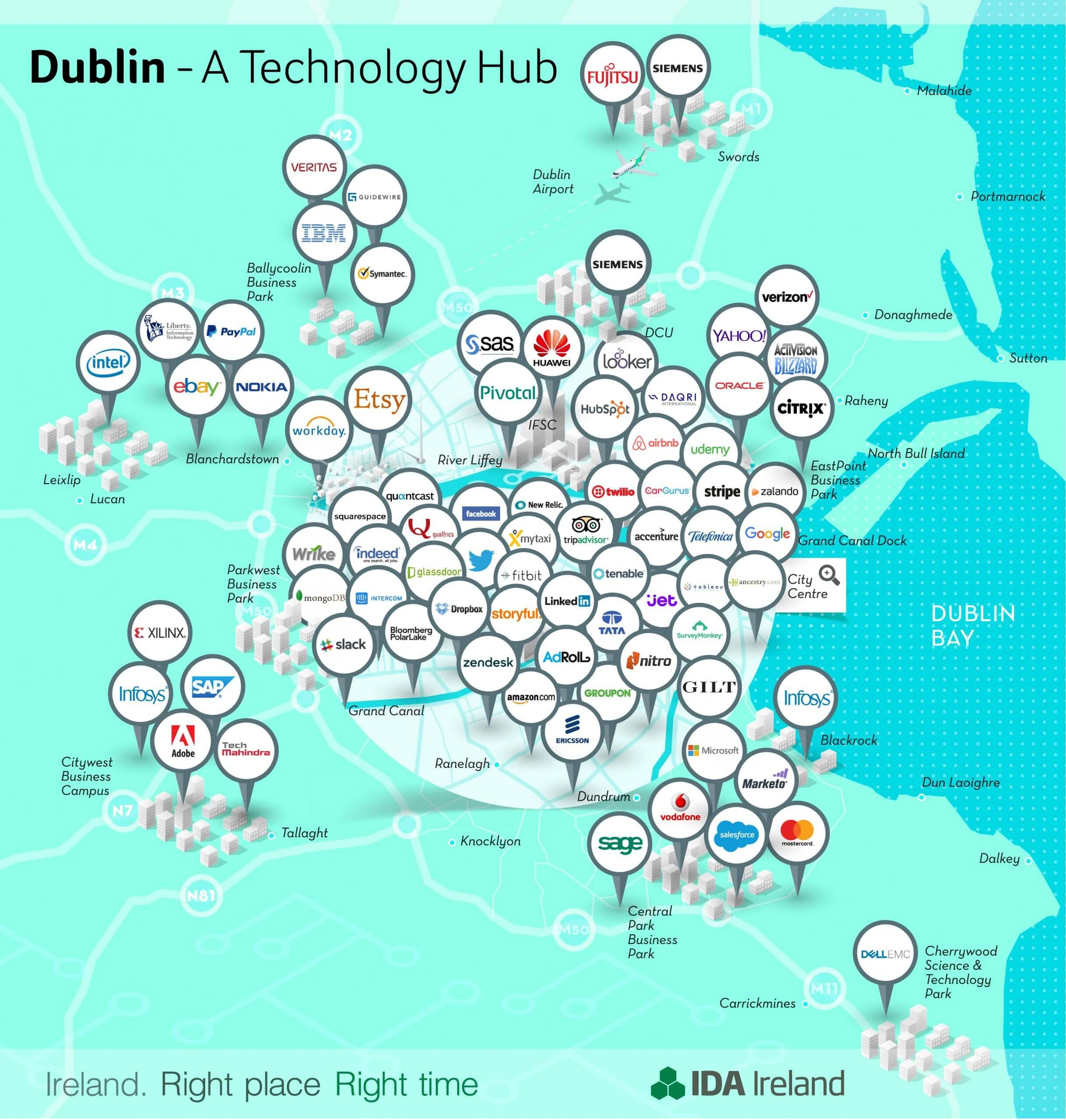


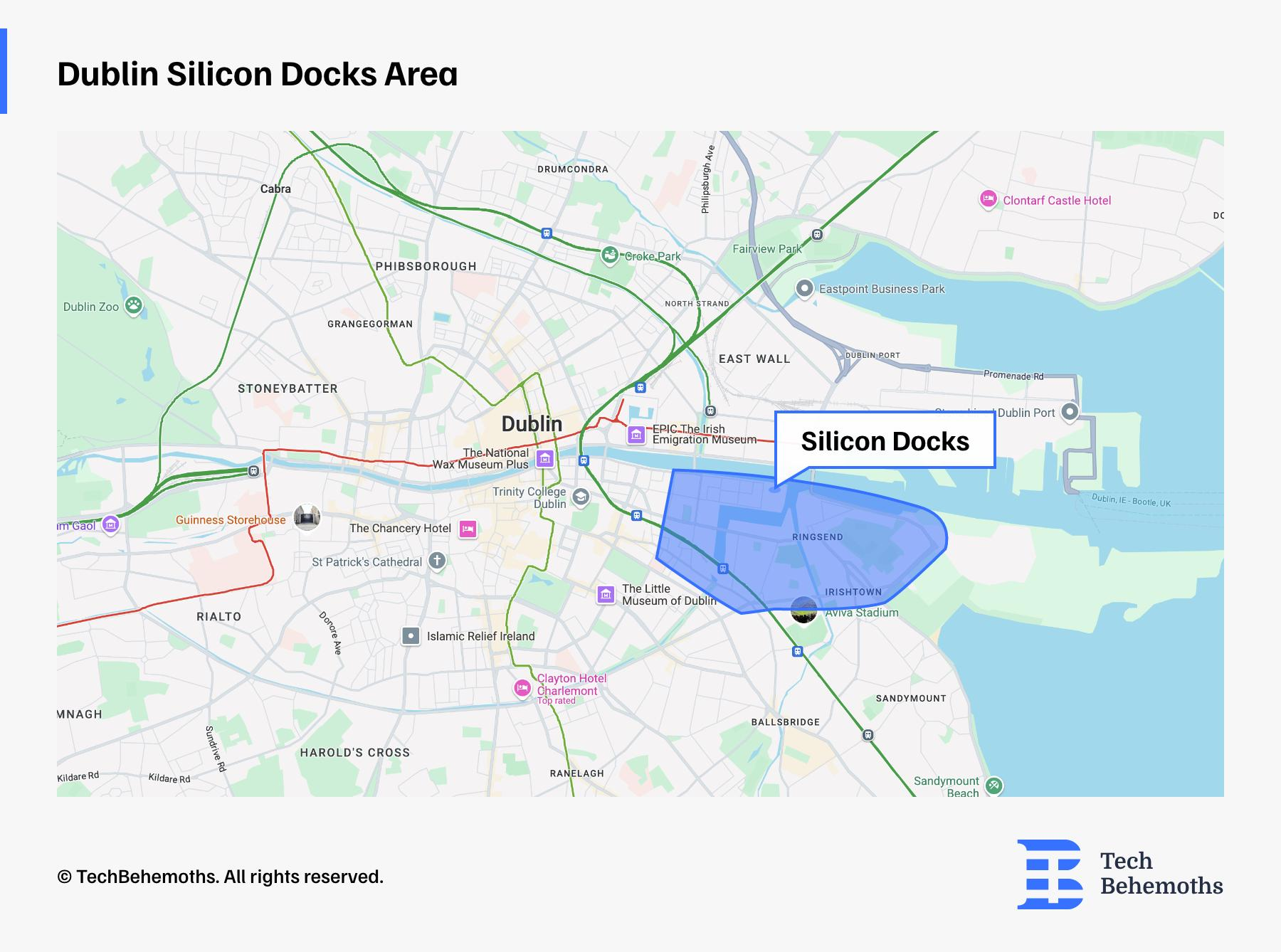
Ireland is not the US with euro signs. Ireland is a small, high-income, high-tax, housing-constrained, reputation-heavy economy where tax-aware ownership beats raw income.
The formula:
scarce skill → high income → low lifestyle drag → pension/PPR/business equity/direct equity → better rooms → reputation → scale
Labour gets you in. Capital moves you up. Reputation keeps you there.
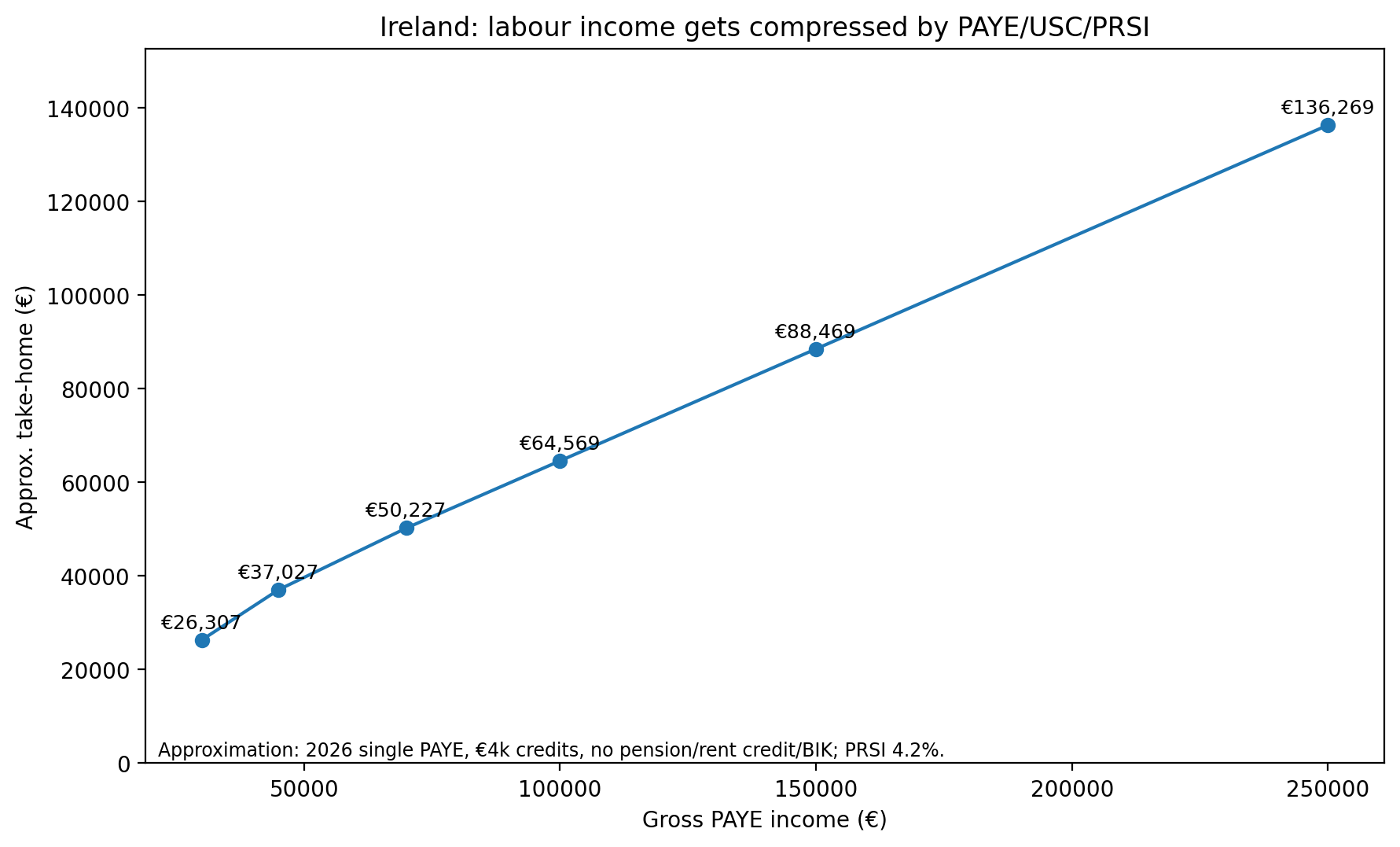
In Ireland, the “class jump” is not just earning more. PAYE income gets compressed quickly by income tax, USC and PRSI. For a single person in 2026, the standard income-tax band is €44,000 at 20%, with income above that taxed at 40%; USC rises to 8% above €70,044; employee PRSI is 4.2%, rising to 4.35% from October 2026. That puts a high-earning employee’s top marginal drag around 52%+ before pension planning.
 www.revenue.ie
Rule: do not build your whole plan around post-tax salary. Build around salary converted into assets through the most favourable Irish channels.
Ireland rewards five things:
The Central Bank says Irish household wealth reached €1.34 trillion in Q3 2025, housing represented 67.7% of total net wealth, and the top 10% held 49.2% of national net wealth. The rich are not mostly “better savers”; they hold appreciating assets.
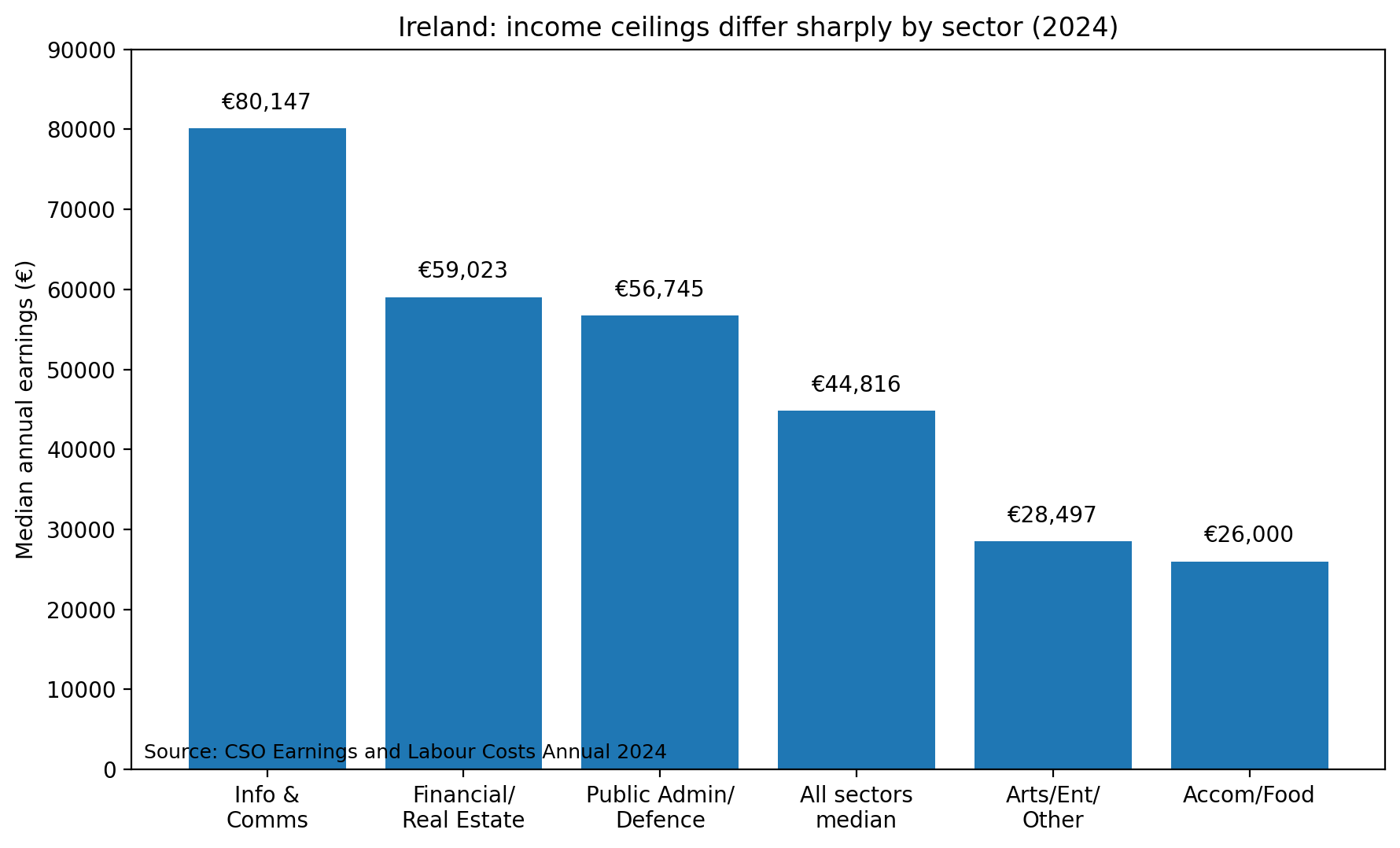
CSO 2024 data shows median annual earnings across all sectors were €44,816. But sector choice dominates. Information and Communication had median annual earnings of €80,147; Financial, Insurance and Real Estate was €59,023; Public Administration and Defence was €56,745; Accommodation and Food was €26,000.
Target sectors with ceiling, portability and credential leverage:
SOLAS identifies future challenges and demand pressure across construction, science and engineering, ICT, health, business and finance, and education; it also notes that Ireland’s high-skilled employment growth has been driven heavily by workers with NFQ level 8 or above qualifications.
 www.solas.ie
Education is not automatically status mobility. It is only good when it buys one of these:
higher earnings, a protected credential, access to better employers, international mobility, or trust.
CSO graduate outcomes show median weekly earnings one year after graduation for 2022 graduates were €625, but field choice mattered: Education graduates earned €815/week, Health and Welfare €775/week, ICT €765/week, while Arts and Humanities earned €470/week.
Decision rule:
Expected annual income gain ÷ total cost of degree/time = credential quality
Good Ireland credentials:
Bad credential pattern:
borrow money + lose years + enter a low-ceiling field + call it ambition.
A €100k PAYE salary is strong, but not enough to become upper class if it turns into rent, car payments, restaurants, holidays and idle cash.
A high earner in Ireland needs a conversion system:
gross income → pension/PPR/business/equity → compounding
Without that, the tax system and housing costs eat the spread.
Use this order unless your situation clearly breaks it:
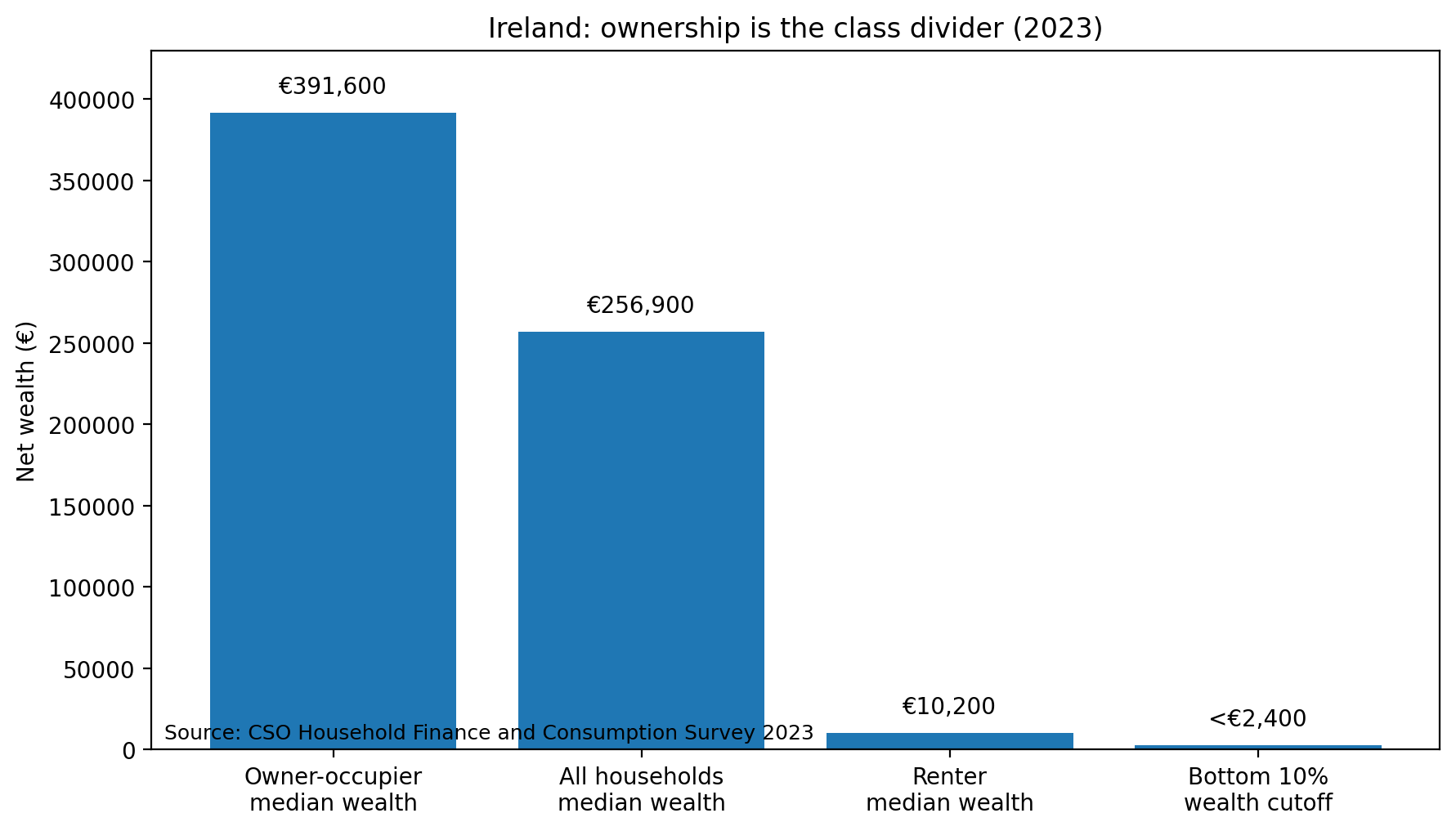
CSO household wealth data shows owner-occupiers had median net wealth of €391,600, renters had €10,200, and the national median household net wealth was €256,900 in 2023.
For Irish high earners, pensions are not boring. They are the first serious wealth wrapper.
Revenue’s age-related tax-relievable pension contribution limits are:
The earnings cap for tax relief is €115,000, and employer contributions do not count against the employee’s age-related contribution limit.
www.revenue.ie
Principle:
If you pay 40% income tax, pension contributions are usually the first legal place to move labour income into capital.
Pension weaknesses:
Still, for PAYE workers, pension is usually the cleanest “labour → capital” bridge.
Principal Private Residence relief is huge. Revenue says a PPR is a house or apartment you own and occupy as your only or main residence. If you dispose of a property that was your main residence for the full period and used as your home, the gain can be CGT-exempt; the final 12 months are also treated as occupation.
www.revenue.ie
This is why Irish wealth is housing-heavy.
But the move is not “buy any house.” The move is:
buy optionality, not identity.
Good PPR:
Bad PPR:
The Central Bank’s mortgage rules allow first-time buyers to borrow up to 4x gross income, second/subsequent buyers 3.5x, with a 10% deposit for PPR buyers and 30% deposit for buy-to-let.
 www.centralbank.ie
So a couple on €100k gross can usually target around:
€400k mortgage + deposit
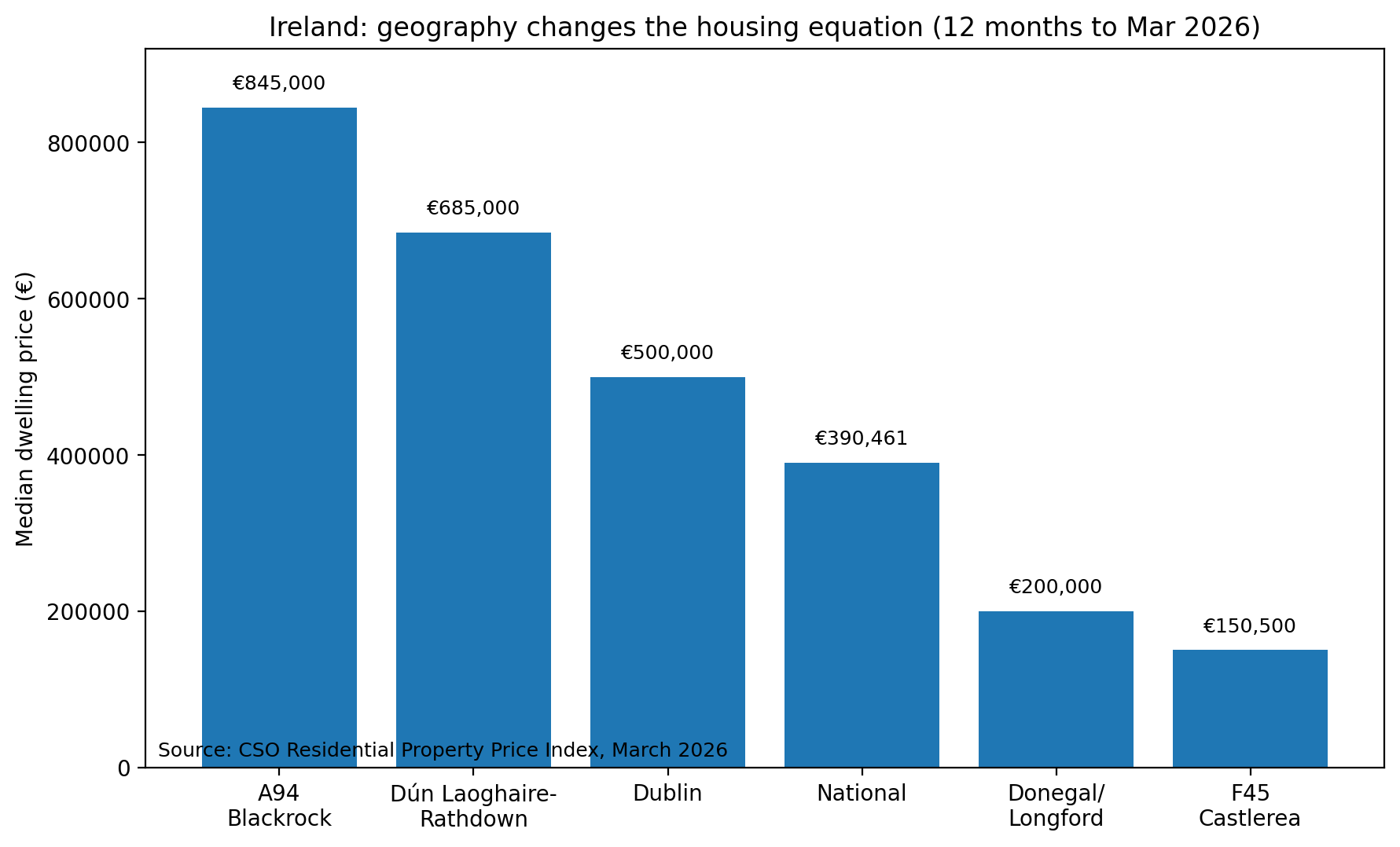
CSO says the national median dwelling price for the 12 months to March 2026 was €390,461; Dublin was €500,000; Dún Laoghaire-Rathdown was €685,000; Donegal and Longford were €200,000.
The brutal truth:
dual income, sector choice and geography decide housing access.
Help to Buy can provide up to €30,000, limited by 10% of the purchase/valuation or income tax and DIRT paid over the previous four years; USC and PRSI do not count. The enhanced scheme is listed through 2029.
www.revenue.ie
The First Home Scheme is shared equity. It can fund up to 30% of the price/build cost, reduced to 20% if Help to Buy is also used, and service charges begin from year six.
Correct use: bridge a rational purchase.
Incorrect use: stretch into a house that eats your life.
Revenue’s Rent-a-Room Relief lets an individual receive up to €14,000 a year from letting a room in their home tax-free; if income exceeds the limit, the total amount is taxable.
For a young owner-occupier, this can be powerful:
PPR relief + mortgage amortisation + optional tax-free room income
That is a real Irish-specific mobility lever.
This is where Ireland differs sharply from the US.
Revenue guidance on equivalent offshore funds says income and gains are generally taxed at 38% from 2026, deemed disposal applies every eight years, and losses generally cannot be used for CGT or other loss relief.
William Fry notes that EU-domiciled ETFs are generally taxed similarly to Irish funds, including the eight-year deemed disposal regime. It also notes that US ETFs are generally outside the offshore-fund regime and are normally subject to income tax/USC/PRSI on distributions and CGT on realised gains, but access, regulation, US estate tax and product availability complicate this.
 www.williamfry.com
Illustration only: €10,000 at 7% for 24 years.
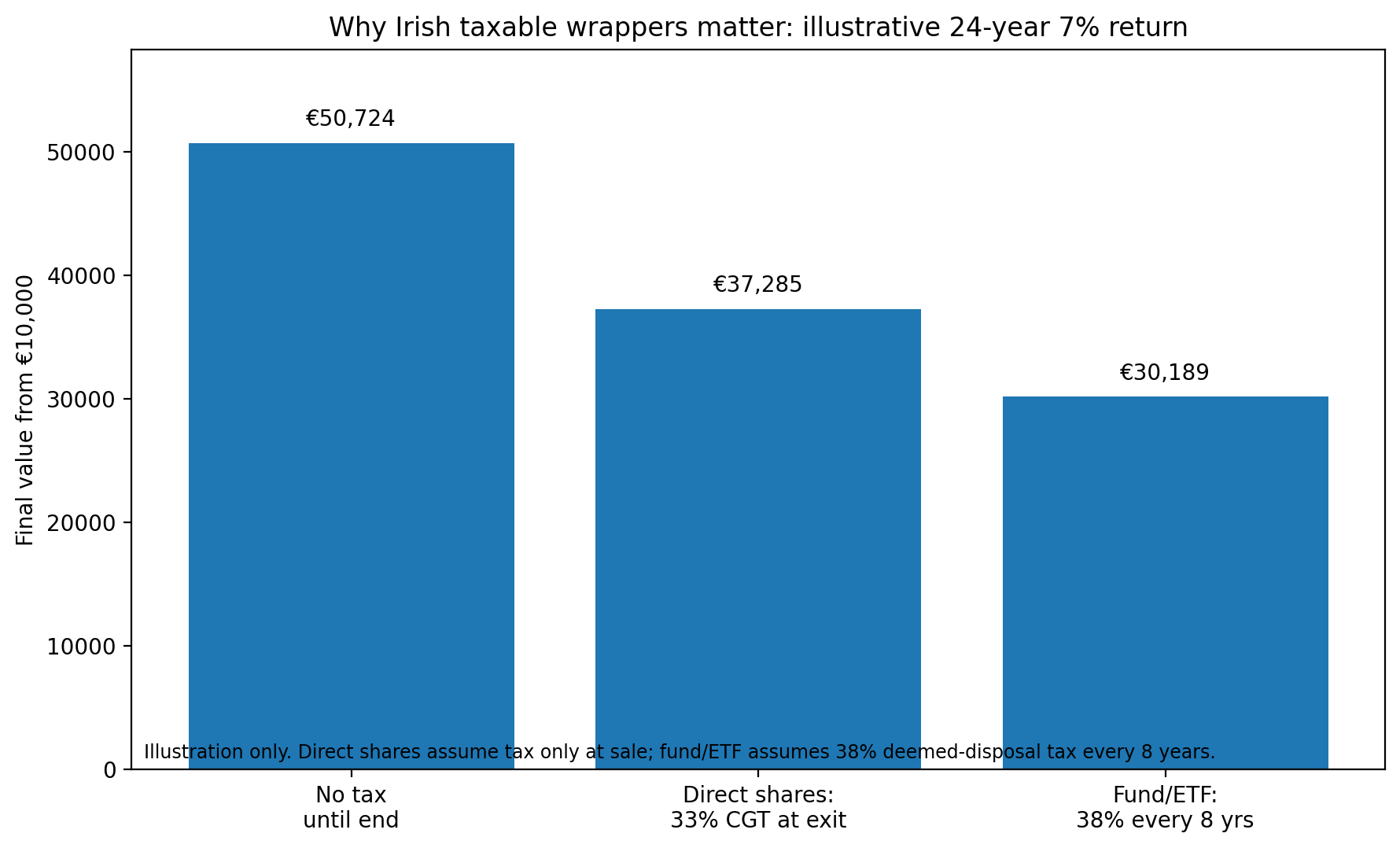
The point is not the exact return. The point is structure.
Ireland’s taxable investing hierarchy is weird.
CGT is generally 33%, and individuals have a €1,270 annual CGT exemption.
JAM and SMT are not “trusts” in the private-family-trust sense. They are listed investment trusts: closed-ended investment companies.
Why Irish investors look at them:
Risks:
KPMG notes that open-ended funds and variable-capital companies are more likely to create a “material interest” offshore fund issue, while closed-ended funds or vehicles with maturity beyond seven years are less likely; but this is fact-specific.

 kpmg.com
Rule:
Investment trusts can be a useful Irish taxable account tool, not a magic cheat code.
Before allocating serious money, confirm the tax classification from the prospectus, structure and a competent Irish tax adviser.
Irish households save a lot. CSO says the household saving rate was 14.8% in Q3 2025, about €1 in €7 of disposable income.
But the Central Bank says Ireland has among the lowest levels of direct retail participation in EU capital markets, with households tending to hold wealth in property, life assurance and pensions; wealthier households dominate capital-market participation.

 www.centralbank.ie
Cash is for optionality and safety.
Cash is not a long-term class ladder.
Employee income is capped by salary bands. Business income is capped by market size, pricing, systems and hiring.
Ireland’s tax system rewards real trading businesses more than passive wrappers. Revenue lists Corporation Tax at 12.5% for trading income and 25% for non-trading income such as investment/rental income.
But do not confuse “company” with “tax-free.” Close companies can face a 20% surcharge on undistributed after-tax estate and investment income if not distributed within 18 months.
www.revenue.ie
Best business paths in Ireland:
The jump is:
self-employed worker → owner-operator → employer → asset owner
Revenue’s Revised Entrepreneur Relief gives a 10% CGT rate on gains from qualifying business assets, reduced from the standard 33%. The lifetime limit is €1,500,000 for gains arising on or after 1 January 2026. It generally requires ownership of qualifying business assets for a continuous three-year period and excludes passive investment assets, development land, and land letting
www.revenue.ie
his is why building a saleable trading company can beat decades of salary optimisation.
Simplified example:
That gap is class mobility.
A PPR is tax-advantaged. A rental property is a business/investment exposed to tax, leverage, regulation, maintenance and vacancy.
BTL can work, but not with lazy maths.
BTL checklist:
Most bad BTL investors buy because “property always goes up.” That is not investing. That is national folklore with leverage.
Dublin has the strongest concentration of high-income roles, multinationals, finance, tech, law, advisory, startups and elite networks. But Dublin housing can destroy the spread.
Ireland geography strategy:
Correct model:
earn in a high-income market, live where the spread survives.
In the US, you can burn rooms and move cities. In Ireland, weak reputation follows faster.
High-status Irish rooms are often understated. Do not peacock. Be competent, useful, discreet and reliable.
Better rooms:
Rule:
In Ireland, social class is partly balance sheet, partly accent/education, partly address, but heavily reputation.
This is uncomfortable but true.
A disciplined dual-income couple can buy, invest and absorb shocks. One chaotic partner can erase ten years of progress.
CSO SILC 2025 data shows households with three or more people at work had median nominal household disposable income of €106,524, while households with nobody at work had €33,105. Owner-occupied households had median nominal disposable income of €71,338, compared with €47,599 for rented/rent-free households.
Screen for:
For children, the assets are:
stable home, language, discipline, school quality, peer group, sport/music/social confidence, parental network, inheritance planning.
In Ireland, PPR location often doubles as education strategy. But do not overpay for status schooling while destroying your balance sheet. A child with calm parents, books, sport, maths, social confidence and a stable home beats a child with private-school cosplay and broke parents.
Current CAT thresholds are:
CAT applies above the threshold at 33%.
www.revenue.ie
The small gift exemption allows gifts of up to €3,000 per disponer per calendar year to be CAT-exempt and not counted for aggregation.
Use this early. Compounding needs time.
For most Irish people, private trusts are not the answer. They add legal cost, tax complexity and reporting. Use:
pensions, wills, life cover, PPR planning, small gifts, business succession, shareholder agreements
before reaching for trust structures.
Investment trusts like JAM/SMT are a completely different category: listed investment companies used for market exposure, not family estate planning.
Write down:
Kill or refinance the highest-APR debt.
Check pension match.
Check tax credits.
Stop idle subscriptions/status spending.
Pick one:
Do:
In Ireland, the ladder is:
skill → salary → spread → pension/PPR → direct equity/business → reputation → scale
If your life is:
PAYE income + rent + cash + consumption
you stay exposed.
If your life becomes:
scarce skill + tax-aware investing + PPR/pension + business equity + better rooms
you have a real shot at moving class.
Capital beats labour.
But in Ireland, tax-aware capital beats naive capital.
Ireland is not the US with euro signs. Ireland is a small, high-income, high-tax, housing-constrained, reputation-heavy economy where tax-aware ownership beats raw income.
The formula:
scarce skill → high income → low lifestyle drag → pension/PPR/business equity/direct equity → better rooms → reputation → scale
Labour gets you in. Capital moves you up. Reputation keeps you there.
1. The Irish class ladder is tax-shaped
In Ireland, the “class jump” is not just earning more. PAYE income gets compressed quickly by income tax, USC and PRSI. For a single person in 2026, the standard income-tax band is €44,000 at 20%, with income above that taxed at 40%; USC rises to 8% above €70,044; employee PRSI is 4.2%, rising to 4.35% from October 2026. That puts a high-earning employee’s top marginal drag around 52%+ before pension planning.
Tax rates, bands and reliefs
This page shows the tables that show the various tax band and rates together with tax reliefs for the current year and previous four years
Rule: do not build your whole plan around post-tax salary. Build around salary converted into assets through the most favourable Irish channels.
2. First scoreboard: where Ireland rewards you
Ireland rewards five things:
| Lever | Irish version |
|---|---|
| Scarce skill | ICT, finance, engineering, pharma/biotech, construction, healthcare, law/accounting, B2B sales |
| Tax shelter | Pension, employer pension, PPR relief, business reliefs |
| Ownership | PPR, pension assets, direct shares, investment trusts, trading company equity |
| Geography | Dublin for labour/network; regional arbitrage for housing/spread |
| Trust | Small-country reputation compounds hard |
The Central Bank says Irish household wealth reached €1.34 trillion in Q3 2025, housing represented 67.7% of total net wealth, and the top 10% held 49.2% of national net wealth. The rich are not mostly “better savers”; they hold appreciating assets.
3. Raise the price of your hour first
CSO 2024 data shows median annual earnings across all sectors were €44,816. But sector choice dominates. Information and Communication had median annual earnings of €80,147; Financial, Insurance and Real Estate was €59,023; Public Administration and Defence was €56,745; Accommodation and Food was €26,000.

Target sectors with ceiling, portability and credential leverage:
| Lane | Why it works in Ireland |
|---|---|
| Software/data/AI/cybersecurity | Multinationals, remote leverage, high salaries, equity/RSUs |
| Finance/accounting/tax/actuarial | Ireland is a funds, insurance and multinational tax hub |
| Pharma/biotech/medtech | Cork, Limerick, Galway, Dublin corridor; regulated high-skill work |
| Engineering/construction management | Housing/infrastructure shortage creates durable demand |
| Healthcare leadership | Ageing population + structural shortages |
| B2B sales/customer success | High upside without needing elite credentials |
| Law/compliance/risk | Regulation creates high-trust, high-fee work |
| Skilled trades with business path | Employee ceiling lower; contractor/employer ceiling much higher |
SOLAS identifies future challenges and demand pressure across construction, science and engineering, ICT, health, business and finance, and education; it also notes that Ireland’s high-skilled employment growth has been driven heavily by workers with NFQ level 8 or above qualifications.
Solas | Learning Works | SOLAS Launches the 21st Edition of the National Skills Bulletin
Further Education and Training programmes which enable learners to succeed in the labour market and thrive in society.
www.solas.ie
4. Do not “get educated.” Buy income power.
Education is not automatically status mobility. It is only good when it buys one of these:
higher earnings, a protected credential, access to better employers, international mobility, or trust.
CSO graduate outcomes show median weekly earnings one year after graduation for 2022 graduates were €625, but field choice mattered: Education graduates earned €815/week, Health and Welfare €775/week, ICT €765/week, while Arts and Humanities earned €470/week.
Decision rule:
Expected annual income gain ÷ total cost of degree/time = credential quality
Good Ireland credentials:
| Route | Good when |
|---|---|
| Accounting qualification | You want corporate finance, tax, audit, CFO track, business credibility |
| Software/data/cyber cert + portfolio | You can prove skill with projects, not just paper |
| Engineering/construction qualification | You want site management, QS, infrastructure, energy, property |
| Medicine/healthcare | You accept long training for protected income |
| Law | You can get into commercial, tax, corporate, funds, property, litigation |
| MBA | Only when it gets access to better employers/network, not vague “leadership” |
| Trade apprenticeship | Best if the endgame is contracting/business ownership |
Bad credential pattern:
borrow money + lose years + enter a low-ceiling field + call it ambition.
5. Ireland’s income trap: high salary without ownership
A €100k PAYE salary is strong, but not enough to become upper class if it turns into rent, car payments, restaurants, holidays and idle cash.
A high earner in Ireland needs a conversion system:
gross income → pension/PPR/business/equity → compounding
Without that, the tax system and housing costs eat the spread.
6. Asset order for Ireland
Use this order unless your situation clearly breaks it:
| Order | Asset/action | Why |
|---|---|---|
| 1 | Emergency cash | Ireland has high housing/job-transition costs |
| 2 | Kill high-interest debt | Guaranteed return; anti-compounding removed |
| 3 | Employer pension match | Free money + tax shelter |
| 4 | AVC/PRSA/pension contributions | Best mainstream wrapper for high-rate taxpayers |
| 5 | PPR deposit/math | PPR relief is one of Ireland’s cleanest tax advantages |
| 6 | Direct shares/investment trusts | More tax-control than UCITS ETFs, but more complexity |
| 7 | Business equity | Real class jump happens here |
| 8 | BTL/property projects | Only if yield survives tax, leverage, regulation and vacancy |
| 9 | Concentrated/speculative bets | Only after base is secure |
CSO household wealth data shows owner-occupiers had median net wealth of €391,600, renters had €10,200, and the national median household net wealth was €256,900 in 2023.
7. Pensions are the cleanest mass-market compounding machine
For Irish high earners, pensions are not boring. They are the first serious wealth wrapper.
Revenue’s age-related tax-relievable pension contribution limits are:
| Age | Max % of net relevant earnings |
|---|---|
| Under 30 | 15% |
| 30–39 | 20% |
| 40–49 | 25% |
| 50–54 | 30% |
| 55–59 | 35% |
| 60+ | 40% |
The earnings cap for tax relief is €115,000, and employer contributions do not count against the employee’s age-related contribution limit.
Tax relief limits on pension contributions
This page outlines the tax relief limits on pension contributions
Principle:
If you pay 40% income tax, pension contributions are usually the first legal place to move labour income into capital.
Pension weaknesses:
| Weakness | Meaning |
|---|---|
| Locked until retirement rules allow access | Bad for short-term liquidity |
| Policy risk | Rules can change |
| Drawdown tax | Not tax-free forever |
| Overconcentration risk | Bad pension fund choices can destroy the wrapper advantage |
Still, for PAYE workers, pension is usually the cleanest “labour → capital” bridge.
8. PPR is Ireland’s most important middle-class tax shelter
Principal Private Residence relief is huge. Revenue says a PPR is a house or apartment you own and occupy as your only or main residence. If you dispose of a property that was your main residence for the full period and used as your home, the gain can be CGT-exempt; the final 12 months are also treated as occupation.
Principal Private Residence (PPR) Relief
This page outlines Principal Private Residence (PPR) Relief
This is why Irish wealth is housing-heavy.
But the move is not “buy any house.” The move is:
buy optionality, not identity.
Good PPR:
| Feature | Why it matters |
|---|---|
| Near strong labour market | Keeps income high |
| Rentable room/space | Optional cashflow |
| Transport links | Resale + career flexibility |
| Expandable/renovatable | Forced appreciation |
| Good schools/amenities | Social-class persistence |
| Sensible mortgage | Prevents house-poverty |
Bad PPR:
| Feature | Problem |
|---|---|
| Max mortgage in weak location | Traps labour mobility |
| Status house too early | Kills investment spread |
| No emergency fund after purchase | Fragile |
| Commute destroys energy | Lower career output |
| “Forever home” thinking at 28 | Overcommits before life is stable |
9. The mortgage constraint is the real Irish class gate
The Central Bank’s mortgage rules allow first-time buyers to borrow up to 4x gross income, second/subsequent buyers 3.5x, with a 10% deposit for PPR buyers and 30% deposit for buy-to-let.
Mortgage Measures | Central Bank of Ireland
The measures set limits on size of mortgages that consumers can borrow through the use of loan-to-value (LTV) and loan-to-income (LTI) limits.
So a couple on €100k gross can usually target around:
€400k mortgage + deposit
CSO says the national median dwelling price for the 12 months to March 2026 was €390,461; Dublin was €500,000; Dún Laoghaire-Rathdown was €685,000; Donegal and Longford were €200,000.
The brutal truth:
dual income, sector choice and geography decide housing access.
10. Use Help to Buy/FHS carefully
Help to Buy can provide up to €30,000, limited by 10% of the purchase/valuation or income tax and DIRT paid over the previous four years; USC and PRSI do not count. The enhanced scheme is listed through 2029.
How much can you claim?
This page describes how much, and how, the refund will be paid
The First Home Scheme is shared equity. It can fund up to 30% of the price/build cost, reduced to 20% if Help to Buy is also used, and service charges begin from year six.

Correct use: bridge a rational purchase.
Incorrect use: stretch into a house that eats your life.
11. Rent-a-room is underrated
Revenue’s Rent-a-Room Relief lets an individual receive up to €14,000 a year from letting a room in their home tax-free; if income exceeds the limit, the total amount is taxable.
For a young owner-occupier, this can be powerful:
PPR relief + mortgage amortisation + optional tax-free room income
That is a real Irish-specific mobility lever.
12. ETFs are not treated like Americans expect
This is where Ireland differs sharply from the US.
Revenue guidance on equivalent offshore funds says income and gains are generally taxed at 38% from 2026, deemed disposal applies every eight years, and losses generally cannot be used for CGT or other loss relief.
William Fry notes that EU-domiciled ETFs are generally taxed similarly to Irish funds, including the eight-year deemed disposal regime. It also notes that US ETFs are generally outside the offshore-fund regime and are normally subject to income tax/USC/PRSI on distributions and CGT on realised gains, but access, regulation, US estate tax and product availability complicate this.
Irish Investors in Exchange Traded Funds - WILLIAM FRY
Irish Investors in Exchange Traded Funds .
www.williamfry.com
Illustration only: €10,000 at 7% for 24 years.
The point is not the exact return. The point is structure.
13. Direct shares vs ETFs vs investment trusts
Ireland’s taxable investing hierarchy is weird.
| Asset | Typical Irish tax issue |
|---|---|
| UCITS ETF / many funds | Exit tax/deemed disposal regime; loss restrictions |
| Direct shares | Dividends taxed as income; gains usually CGT at 33%; annual €1,270 personal CGT exemption |
| UK investment trusts | Often analysed as company shares rather than funds, but classification is fact-specific |
| US ETFs | Often normal income/CGT treatment, but access and US estate-tax risk matter |
| Pensions | Usually best wrapper, but locked |
| PPR | CGT relief if conditions met |
| Trading company equity | Potential entrepreneur relief / business sale upside |
CGT is generally 33%, and individuals have a €1,270 annual CGT exemption.
14. Investment trusts: JAM, SMT, etc.
JAM and SMT are not “trusts” in the private-family-trust sense. They are listed investment trusts: closed-ended investment companies.
Why Irish investors look at them:
| Feature | Why it attracts Irish investors |
|---|---|
| Listed company form | May be taxed more like shares than UCITS ETFs |
| No automatic UCITS ETF deemed-disposal treatment if outside fund regime | Potential tax-control advantage |
| Diversified exposure | Easier than picking 50 stocks |
| CGT timing | You may control realisation timing |
Risks:
| Risk | Meaning |
|---|---|
| Classification risk | Revenue treatment depends on facts, not vibes |
| Active-manager risk | JAM/SMT are not neutral index trackers |
| Premium/discount risk | Investment trusts can trade away from NAV |
| Gearing risk | Borrowing can amplify losses |
| Concentration/style risk | SMT especially can be volatile |
| UK stamp duty/FX | Friction costs matter |
KPMG notes that open-ended funds and variable-capital companies are more likely to create a “material interest” offshore fund issue, while closed-ended funds or vehicles with maturity beyond seven years are less likely; but this is fact-specific.
Taxation insights for Irish investors
Understanding rules for investing in Irish & offshore funds
kpmg.com
Rule:
Investment trusts can be a useful Irish taxable account tool, not a magic cheat code.
Before allocating serious money, confirm the tax classification from the prospectus, structure and a competent Irish tax adviser.
15. Do not over-hoard cash
Irish households save a lot. CSO says the household saving rate was 14.8% in Q3 2025, about €1 in €7 of disposable income.
But the Central Bank says Ireland has among the lowest levels of direct retail participation in EU capital markets, with households tending to hold wealth in property, life assurance and pensions; wealthier households dominate capital-market participation.
Irish households are not realising the full benefit of investment options
The Central Bank of Ireland has today (1 December) published consumer research and analysis of retail investment in Ireland.
Cash is for optionality and safety.
Cash is not a long-term class ladder.
16. Business ownership is the real class jump
Employee income is capped by salary bands. Business income is capped by market size, pricing, systems and hiring.
Ireland’s tax system rewards real trading businesses more than passive wrappers. Revenue lists Corporation Tax at 12.5% for trading income and 25% for non-trading income such as investment/rental income.
But do not confuse “company” with “tax-free.” Close companies can face a 20% surcharge on undistributed after-tax estate and investment income if not distributed within 18 months.
Surcharge on undistributed income
This page outlines the surcharge on undistributed income
Best business paths in Ireland:
| Path | Why it works |
|---|---|
| B2B consulting | Low capital, high trust, fast cashflow |
| Agency → productised service | Scales beyond your hours |
| Software/SaaS | Exportable, high margin |
| Specialist trades contractor | Housing/infrastructure demand |
| Medical/dental/accounting/legal practice | Protected trust + recurring demand |
| Property services | Ireland’s housing system creates constant friction |
| Compliance/regulatory services | Complex rules create fee pools |
| Niche recruiting | High-value talent shortage |
| Training/upskilling | AI and regulation force reskilling |
| B2B sales brokerage | Commission upside without heavy capital |
The jump is:
self-employed worker → owner-operator → employer → asset owner
17. Entrepreneur relief matters
Revenue’s Revised Entrepreneur Relief gives a 10% CGT rate on gains from qualifying business assets, reduced from the standard 33%. The lifetime limit is €1,500,000 for gains arising on or after 1 January 2026. It generally requires ownership of qualifying business assets for a continuous three-year period and excludes passive investment assets, development land, and land letting
Revised Entrepreneur Relief
This page outlines what the Revised Entrepreneur Relief is
his is why building a saleable trading company can beat decades of salary optimisation.
Simplified example:
| Exit gain | Normal CGT at 33% | Entrepreneur relief at 10% |
|---|---|---|
| €500,000 | €165,000 | €50,000 |
| €1,000,000 | €330,000 | €100,000 |
| €1,500,000 | €495,000 | €150,000 |
That gap is class mobility.
18. Buy-to-let is not PPR
A PPR is tax-advantaged. A rental property is a business/investment exposed to tax, leverage, regulation, maintenance and vacancy.
BTL can work, but not with lazy maths.
BTL checklist:
| Question | Required answer |
|---|---|
| Does rent cover mortgage, tax, insurance, repairs and vacancy? | Yes |
| Is the gross yield strong enough after Irish tax? | Yes |
| Is there forced appreciation? | Renovation, planning, conversion, under-market buy |
| Can you survive a bad tenant/non-payment period? | Yes |
| Is leverage fixed/controlled? | Yes |
| Are you buying below replacement value? | Ideally |
Most bad BTL investors buy because “property always goes up.” That is not investing. That is national folklore with leverage.
19. Geography: use Dublin, but do not worship it
Dublin has the strongest concentration of high-income roles, multinationals, finance, tech, law, advisory, startups and elite networks. But Dublin housing can destroy the spread.
Ireland geography strategy:
| Location | Best use |
|---|---|
| Dublin | Career acceleration, network, top salaries |
| Cork | Pharma, tech, finance, engineering |
| Galway | Medtech, software, quality/regulatory |
| Limerick/Shannon | Engineering, aviation, pharma, lower housing cost |
| Waterford | Lower-cost base with improving regional opportunity |
| Kildare/Meath/Wicklow/Louth | Commuter arbitrage |
| Remote regional | Good only if income remains high |
Correct model:
earn in a high-income market, live where the spread survives.
20. Network: Ireland is small, so reputation compounds brutally
In the US, you can burn rooms and move cities. In Ireland, weak reputation follows faster.
High-status Irish rooms are often understated. Do not peacock. Be competent, useful, discreet and reliable.
Better rooms:
| Room | Why it helps |
|---|---|
| Multinational teams | High standards, mobility, referrals |
| Professional bodies | Chartered Accountant, CFA, SCSI, Engineers Ireland, Law Society |
| Founder/operator circles | Deals, talent, capital |
| Property/construction circles | Land, planning, contractors, funding |
| Alumni networks | Quiet access |
| High-skill sport/social clubs | Trust formation |
| Angel/startup ecosystem | Early equity access |
| Industry conferences | Weak alone, strong with follow-up |
Rule:
In Ireland, social class is partly balance sheet, partly accent/education, partly address, but heavily reputation.
21. Partner choice is economic strategy
This is uncomfortable but true.
A disciplined dual-income couple can buy, invest and absorb shocks. One chaotic partner can erase ten years of progress.
CSO SILC 2025 data shows households with three or more people at work had median nominal household disposable income of €106,524, while households with nobody at work had €33,105. Owner-occupied households had median nominal disposable income of €71,338, compared with €47,599 for rented/rent-free households.
Screen for:
| Trait | Why |
|---|---|
| Low debt chaos | Prevents fragility |
| Career seriousness | Raises household borrowing/investing power |
| Similar spending values | Protects spread |
| Emotional stability | Protects execution |
| Family expectations understood | Prevents hidden financial obligations |
| Long-term orientation | Class mobility is slow |
22. Children: class persists through environment
For children, the assets are:
stable home, language, discipline, school quality, peer group, sport/music/social confidence, parental network, inheritance planning.
In Ireland, PPR location often doubles as education strategy. But do not overpay for status schooling while destroying your balance sheet. A child with calm parents, books, sport, maths, social confidence and a stable home beats a child with private-school cosplay and broke parents.
23. Inheritance and family wealth planning
CAT matters because intergenerational wealth is a class escalator.Current CAT thresholds are:
| Group | Typical relationship | Threshold |
|---|---|---|
| A | Child | €400,000 |
| B | Sibling, niece/nephew, grandchild, etc. | €40,000 |
| C | Stranger/cousin/in-law/friend | €20,000 |
CAT applies above the threshold at 33%.
CAT group thresholds
This page explains the thresholds, rates and aggregation rules for calculating Capital Acquisitions Tax
The small gift exemption allows gifts of up to €3,000 per disponer per calendar year to be CAT-exempt and not counted for aggregation.
Use this early. Compounding needs time.
24. Private trusts are not the first ladder rung
For most Irish people, private trusts are not the answer. They add legal cost, tax complexity and reporting. Use:
pensions, wills, life cover, PPR planning, small gifts, business succession, shareholder agreements
before reaching for trust structures.
Investment trusts like JAM/SMT are a completely different category: listed investment companies used for market exposure, not family estate planning.
25. The Irish tax map
| Asset/income type | Broad treatment | Strategic meaning |
|---|---|---|
| PAYE salary | Income tax + USC + PRSI | Needed, but compressed |
| Pension contribution | Income-tax relief within limits | First major wrapper |
| PPR gain | Potential CGT relief | Huge Irish advantage |
| Direct shares | Dividends income-taxed; gains usually CGT | Tax timing/control |
| UCITS ETFs/funds | Exit tax/deemed disposal regime | Simple product, ugly tax drag |
| Investment trusts | Fact-specific; may be share-like | Useful but verify |
| Trading company | 12.5% CT on trading income | Good for scaling business |
| Passive company income | 25% CT + possible surcharge | Not a simple ETF wrapper |
| BTL property | Rental income taxed; CGT on gains | Must be yield-positive |
| Business sale | Possible 10% entrepreneur relief | Major wealth event |
| Gifts/inheritance | CAT thresholds + small gift exemption | Family planning matters |
26. Avoid these Irish class traps
| Trap | Why it kills mobility |
|---|---|
| Maxing mortgage too early | Turns income into survival |
| Cash hoarding forever | Safety becomes stagnation |
| ETF ignorance | Deemed disposal/tax drag surprises |
| Status car/PCP | Converts capital into depreciation |
| Wedding/status spending | One-year optics, decade-long opportunity cost |
| Low-ceiling loyalty | Ireland rewards trusted competence, not blind loyalty |
| Overstaying low-growth public/private roles | Stability can become ceiling |
| BTL with weak yield | Tax + repairs + leverage eat you |
| Employer RSU concentration | Job and portfolio risk become same risk |
| Lifestyle inflation after first big salary | The spread disappears |
| “Dublin or nothing” | High income can be neutralised by housing |
| “Cheap region only” | Low cost is useless if opportunity vanishes |
| Company-as-tax-hack thinking | Close-company/passive-income rules bite |
| Crypto as main plan | Speculation is not class strategy |
27. The correct Ireland execution plan
Days 1–3: balance sheet audit
Write down:
| Item | Target |
|---|---|
| Gross income | Current |
| Net income | Current |
| Rent/mortgage | % of net income |
| Debt APRs | Highest first |
| Pension contributions | Employer + employee |
| Cash | Months of expenses |
| Taxable investments | Amount + structure |
| Skills | Current market price |
| Network | People 2 levels above you |
Days 4–7: stop leakage
Cut one major recurring cost.Kill or refinance the highest-APR debt.
Check pension match.
Check tax credits.
Stop idle subscriptions/status spending.
Days 8–14: choose income lane
Pick one:
| Starting point | Move |
|---|---|
| Low-income graduate | ICT/data/accounting/sales/engineering route |
| Mid-career professional | Specialise into higher-fee niche |
| Public-sector worker | Add private-market skill or consulting path |
| Trade worker | Move toward contractor/business ownership |
| Tech worker | Move toward AI/data/security/product/customer-facing leverage |
| Finance/accounting worker | Move toward advisory, tax, deals, CFO, funds |
| Healthcare worker | Move toward scarce specialty/management/private practice |
Days 15–30: force market feedback
Do:
| Action | Number |
|---|---|
| Higher-paid job applications | 20 |
| Recruiter conversations | 5 |
| Coffee calls with people 2 levels above | 5 |
| Portfolio/project/client proof pieces | 2 |
| Pension/investment setup actions | 1 |
| Spending cuts automated | 1 |
28. Twelve-month target
| Metric | Target |
|---|---|
| Income | +15–30% |
| Pension contribution | maximised to rational level |
| Savings/investment rate | 20–40% of gross if living at home/low rent; 10–25% if renting/buying |
| Debt | no high-interest consumer debt |
| Skill | one monetisable scarce skill |
| Network | 25 useful high-quality relationships |
| Housing | either rational PPR path or deliberate rent/invest plan |
| Business | one side cashflow or equity path |
| Net worth | tracked monthly |
29. Five-year target
| Area | Goal |
|---|---|
| Income | Top-quartile in chosen field |
| Housing | PPR owned or clear high-income alternative |
| Pension | serious compounding base |
| Taxable assets | direct shares/investment trusts/business equity, tax-aware |
| Business | ownership stake, consulting income, or scalable side asset |
| Network | people who hire, invest, refer, advise |
| Reputation | known for competence and reliability |
| Optionality | can move city, change job, start company, or buy asset without panic |
30. Final rule
In Ireland, the ladder is:
skill → salary → spread → pension/PPR → direct equity/business → reputation → scale
If your life is:
PAYE income + rent + cash + consumption
you stay exposed.
If your life becomes:
scarce skill + tax-aware investing + PPR/pension + business equity + better rooms
you have a real shot at moving class.
Capital beats labour.
But in Ireland, tax-aware capital beats naive capital.