[BOTB] Guide: How to increase your social class in Ireland (Autistic step-by-step detail)

Seth Walsh

Seth Walsh

Iconoclast
Contributor
Joined
Jan 12, 2020
Posts
10,766
Reputation
21,932
@6ft4 @jester patell @anythingtobenormal @TheAncientMacedonia
1778870801793
1778870810748
1778870818918
1778870828500


Ireland is not the US with euro signs. Ireland is a small, high-income, high-tax, housing-constrained, reputation-heavy economy where tax-aware ownership beats raw income.

The formula:

scarce skill → high income → low lifestyle drag → pension/PPR/business equity/direct equity → better rooms → reputation → scale

Labour gets you in. Capital moves you up. Reputation keeps you there.

1. The Irish class ladder is tax-shaped​


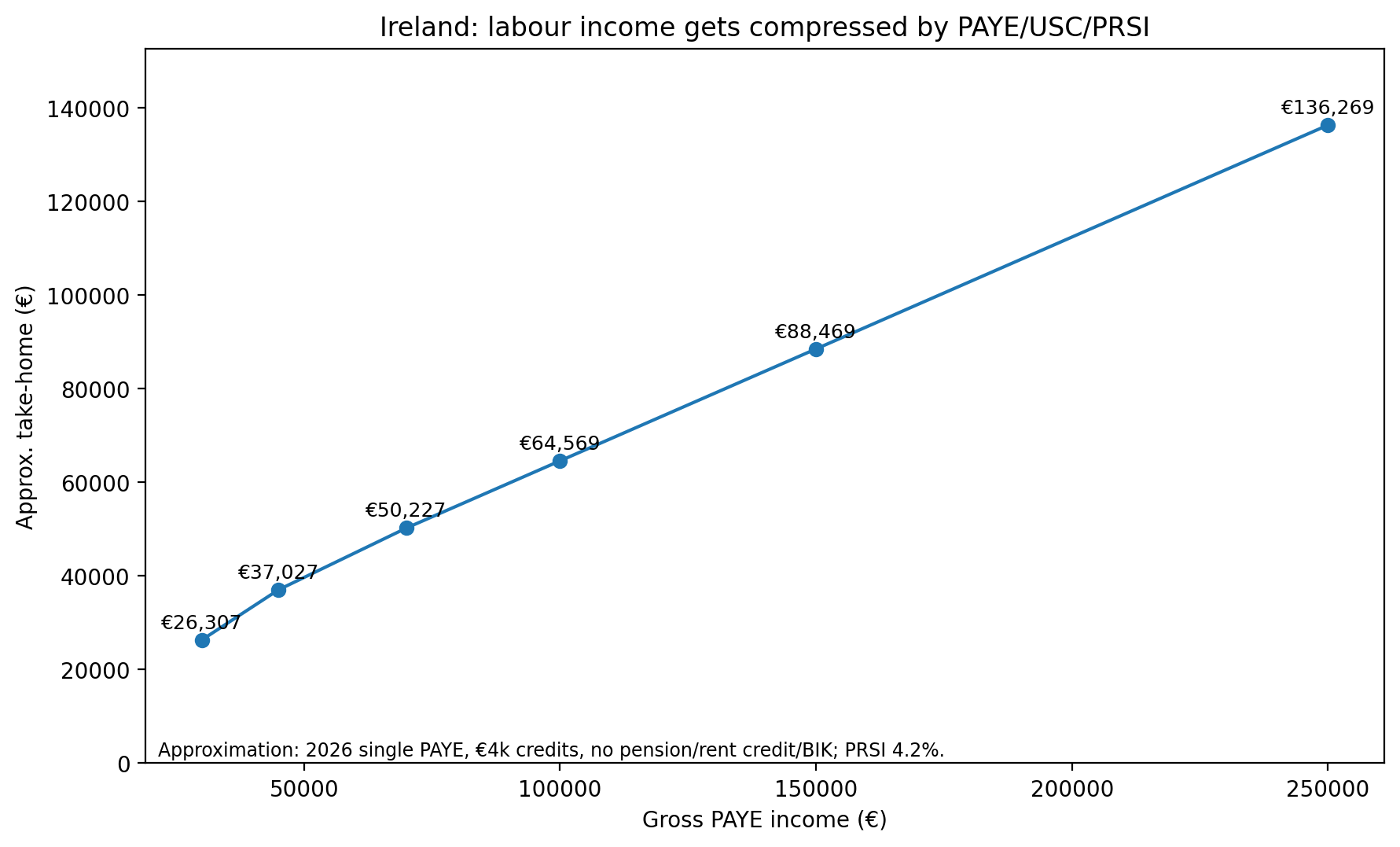
In Ireland, the “class jump” is not just earning more. PAYE income gets compressed quickly by income tax, USC and PRSI. For a single person in 2026, the standard income-tax band is €44,000 at 20%, with income above that taxed at 40%; USC rises to 8% above €70,044; employee PRSI is 4.2%, rising to 4.35% from October 2026. That puts a high-earning employee’s top marginal drag around 52%+ before pension planning.

1778870908952


Rule: do not build your whole plan around post-tax salary. Build around salary converted into assets through the most favourable Irish channels.

2. First scoreboard: where Ireland rewards you​


Ireland rewards five things:


LeverIrish version
Scarce skillICT, finance, engineering, pharma/biotech, construction, healthcare, law/accounting, B2B sales
Tax shelterPension, employer pension, PPR relief, business reliefs
OwnershipPPR, pension assets, direct shares, investment trusts, trading company equity
GeographyDublin for labour/network; regional arbitrage for housing/spread
TrustSmall-country reputation compounds hard

The Central Bank says Irish household wealth reached €1.34 trillion in Q3 2025, housing represented 67.7% of total net wealth, and the top 10% held 49.2% of national net wealth. The rich are not mostly “better savers”; they hold appreciating assets.


3. Raise the price of your hour first​


CSO 2024 data shows median annual earnings across all sectors were €44,816. But sector choice dominates. Information and Communication had median annual earnings of €80,147; Financial, Insurance and Real Estate was €59,023; Public Administration and Defence was €56,745; Accommodation and Food was €26,000.


1778870985815


Target sectors with ceiling, portability and credential leverage:


LaneWhy it works in Ireland
Software/data/AI/cybersecurityMultinationals, remote leverage, high salaries, equity/RSUs
Finance/accounting/tax/actuarialIreland is a funds, insurance and multinational tax hub
Pharma/biotech/medtechCork, Limerick, Galway, Dublin corridor; regulated high-skill work
Engineering/construction managementHousing/infrastructure shortage creates durable demand
Healthcare leadershipAgeing population + structural shortages
B2B sales/customer successHigh upside without needing elite credentials
Law/compliance/riskRegulation creates high-trust, high-fee work
Skilled trades with business pathEmployee ceiling lower; contractor/employer ceiling much higher

SOLAS identifies future challenges and demand pressure across construction, science and engineering, ICT, health, business and finance, and education; it also notes that Ireland’s high-skilled employment growth has been driven heavily by workers with NFQ level 8 or above qualifications.


4. Do not “get educated.” Buy income power.​


Education is not automatically status mobility. It is only good when it buys one of these:


higher earnings, a protected credential, access to better employers, international mobility, or trust.


CSO graduate outcomes show median weekly earnings one year after graduation for 2022 graduates were €625, but field choice mattered: Education graduates earned €815/week, Health and Welfare €775/week, ICT €765/week, while Arts and Humanities earned €470/week.


Decision rule:


Expected annual income gain ÷ total cost of degree/time = credential quality


Good Ireland credentials:


RouteGood when
Accounting qualificationYou want corporate finance, tax, audit, CFO track, business credibility
Software/data/cyber cert + portfolioYou can prove skill with projects, not just paper
Engineering/construction qualificationYou want site management, QS, infrastructure, energy, property
Medicine/healthcareYou accept long training for protected income
LawYou can get into commercial, tax, corporate, funds, property, litigation
MBAOnly when it gets access to better employers/network, not vague “leadership”
Trade apprenticeshipBest if the endgame is contracting/business ownership

Bad credential pattern:
borrow money + lose years + enter a low-ceiling field + call it ambition.


5. Ireland’s income trap: high salary without ownership​


A €100k PAYE salary is strong, but not enough to become upper class if it turns into rent, car payments, restaurants, holidays and idle cash.


A high earner in Ireland needs a conversion system:


gross income → pension/PPR/business/equity → compounding


Without that, the tax system and housing costs eat the spread.


6. Asset order for Ireland​


Use this order unless your situation clearly breaks it:


OrderAsset/actionWhy
1Emergency cashIreland has high housing/job-transition costs
2Kill high-interest debtGuaranteed return; anti-compounding removed
3Employer pension matchFree money + tax shelter
4AVC/PRSA/pension contributionsBest mainstream wrapper for high-rate taxpayers
5PPR deposit/mathPPR relief is one of Ireland’s cleanest tax advantages
6Direct shares/investment trustsMore tax-control than UCITS ETFs, but more complexity
7Business equityReal class jump happens here
8BTL/property projectsOnly if yield survives tax, leverage, regulation and vacancy
9Concentrated/speculative betsOnly after base is secure

CSO household wealth data shows owner-occupiers had median net wealth of €391,600, renters had €10,200, and the national median household net wealth was €256,900 in 2023.
1778871071636


7. Pensions are the cleanest mass-market compounding machine​


For Irish high earners, pensions are not boring. They are the first serious wealth wrapper.


Revenue’s age-related tax-relievable pension contribution limits are:


AgeMax % of net relevant earnings
Under 3015%
30–3920%
40–4925%
50–5430%
55–5935%
60+40%

The earnings cap for tax relief is €115,000, and employer contributions do not count against the employee’s age-related contribution limit.


Principle:


If you pay 40% income tax, pension contributions are usually the first legal place to move labour income into capital.


Pension weaknesses:


WeaknessMeaning
Locked until retirement rules allow accessBad for short-term liquidity
Policy riskRules can change
Drawdown taxNot tax-free forever
Overconcentration riskBad pension fund choices can destroy the wrapper advantage

Still, for PAYE workers, pension is usually the cleanest “labour → capital” bridge.


8. PPR is Ireland’s most important middle-class tax shelter​


Principal Private Residence relief is huge. Revenue says a PPR is a house or apartment you own and occupy as your only or main residence. If you dispose of a property that was your main residence for the full period and used as your home, the gain can be CGT-exempt; the final 12 months are also treated as occupation.


This is why Irish wealth is housing-heavy.


But the move is not “buy any house.” The move is:


buy optionality, not identity.


Good PPR:


FeatureWhy it matters
Near strong labour marketKeeps income high
Rentable room/spaceOptional cashflow
Transport linksResale + career flexibility
Expandable/renovatableForced appreciation
Good schools/amenitiesSocial-class persistence
Sensible mortgagePrevents house-poverty

Bad PPR:


FeatureProblem
Max mortgage in weak locationTraps labour mobility
Status house too earlyKills investment spread
No emergency fund after purchaseFragile
Commute destroys energyLower career output
“Forever home” thinking at 28Overcommits before life is stable


9. The mortgage constraint is the real Irish class gate​


The Central Bank’s mortgage rules allow first-time buyers to borrow up to 4x gross income, second/subsequent buyers 3.5x, with a 10% deposit for PPR buyers and 30% deposit for buy-to-let.


So a couple on €100k gross can usually target around:


€400k mortgage + deposit


CSO says the national median dwelling price for the 12 months to March 2026 was €390,461; Dublin was €500,000; Dún Laoghaire-Rathdown was €685,000; Donegal and Longford were €200,000.

1778871202537


The brutal truth:
dual income, sector choice and geography decide housing access.


10. Use Help to Buy/FHS carefully​


Help to Buy can provide up to €30,000, limited by 10% of the purchase/valuation or income tax and DIRT paid over the previous four years; USC and PRSI do not count. The enhanced scheme is listed through 2029.


The First Home Scheme is shared equity. It can fund up to 30% of the price/build cost, reduced to 20% if Help to Buy is also used, and service charges begin from year six.


Correct use: bridge a rational purchase.
Incorrect use: stretch into a house that eats your life.


11. Rent-a-room is underrated​


Revenue’s Rent-a-Room Relief lets an individual receive up to €14,000 a year from letting a room in their home tax-free; if income exceeds the limit, the total amount is taxable.


For a young owner-occupier, this can be powerful:
PPR relief + mortgage amortisation + optional tax-free room income
That is a real Irish-specific mobility lever.

12. ETFs are not treated like Americans expect​


This is where Ireland differs sharply from the US.


Revenue guidance on equivalent offshore funds says income and gains are generally taxed at 38% from 2026, deemed disposal applies every eight years, and losses generally cannot be used for CGT or other loss relief.

William Fry notes that EU-domiciled ETFs are generally taxed similarly to Irish funds, including the eight-year deemed disposal regime. It also notes that US ETFs are generally outside the offshore-fund regime and are normally subject to income tax/USC/PRSI on distributions and CGT on realised gains, but access, regulation, US estate tax and product availability complicate this.

Illustration only: €10,000 at 7% for 24 years.
1778871351203


The point is not the exact return. The point is structure.

13. Direct shares vs ETFs vs investment trusts​


Ireland’s taxable investing hierarchy is weird.


AssetTypical Irish tax issue
UCITS ETF / many fundsExit tax/deemed disposal regime; loss restrictions
Direct sharesDividends taxed as income; gains usually CGT at 33%; annual €1,270 personal CGT exemption
UK investment trustsOften analysed as company shares rather than funds, but classification is fact-specific
US ETFsOften normal income/CGT treatment, but access and US estate-tax risk matter
PensionsUsually best wrapper, but locked
PPRCGT relief if conditions met
Trading company equityPotential entrepreneur relief / business sale upside

CGT is generally 33%, and individuals have a €1,270 annual CGT exemption.


14. Investment trusts: JAM, SMT, etc.​


JAM and SMT are not “trusts” in the private-family-trust sense. They are listed investment trusts: closed-ended investment companies.


Why Irish investors look at them:


FeatureWhy it attracts Irish investors
Listed company formMay be taxed more like shares than UCITS ETFs
No automatic UCITS ETF deemed-disposal treatment if outside fund regimePotential tax-control advantage
Diversified exposureEasier than picking 50 stocks
CGT timingYou may control realisation timing

Risks:


RiskMeaning
Classification riskRevenue treatment depends on facts, not vibes
Active-manager riskJAM/SMT are not neutral index trackers
Premium/discount riskInvestment trusts can trade away from NAV
Gearing riskBorrowing can amplify losses
Concentration/style riskSMT especially can be volatile
UK stamp duty/FXFriction costs matter

KPMG notes that open-ended funds and variable-capital companies are more likely to create a “material interest” offshore fund issue, while closed-ended funds or vehicles with maturity beyond seven years are less likely; but this is fact-specific.

Rule:
Investment trusts can be a useful Irish taxable account tool, not a magic cheat code.
Before allocating serious money, confirm the tax classification from the prospectus, structure and a competent Irish tax adviser.


15. Do not over-hoard cash​


Irish households save a lot. CSO says the household saving rate was 14.8% in Q3 2025, about €1 in €7 of disposable income.


But the Central Bank says Ireland has among the lowest levels of direct retail participation in EU capital markets, with households tending to hold wealth in property, life assurance and pensions; wealthier households dominate capital-market participation.

Cash is for optionality and safety.
Cash is not a long-term class ladder.

16. Business ownership is the real class jump​


Employee income is capped by salary bands. Business income is capped by market size, pricing, systems and hiring.


Ireland’s tax system rewards real trading businesses more than passive wrappers. Revenue lists Corporation Tax at 12.5% for trading income and 25% for non-trading income such as investment/rental income.

But do not confuse “company” with “tax-free.” Close companies can face a 20% surcharge on undistributed after-tax estate and investment income if not distributed within 18 months.


Best business paths in Ireland:


PathWhy it works
B2B consultingLow capital, high trust, fast cashflow
Agency → productised serviceScales beyond your hours
Software/SaaSExportable, high margin
Specialist trades contractorHousing/infrastructure demand
Medical/dental/accounting/legal practiceProtected trust + recurring demand
Property servicesIreland’s housing system creates constant friction
Compliance/regulatory servicesComplex rules create fee pools
Niche recruitingHigh-value talent shortage
Training/upskillingAI and regulation force reskilling
B2B sales brokerageCommission upside without heavy capital

The jump is:
self-employed worker → owner-operator → employer → asset owner


17. Entrepreneur relief matters​


Revenue’s Revised Entrepreneur Relief gives a 10% CGT rate on gains from qualifying business assets, reduced from the standard 33%. The lifetime limit is €1,500,000 for gains arising on or after 1 January 2026. It generally requires ownership of qualifying business assets for a continuous three-year period and excludes passive investment assets, development land, and land letting

his is why building a saleable trading company can beat decades of salary optimisation.


Simplified example:


Exit gainNormal CGT at 33%Entrepreneur relief at 10%
€500,000€165,000€50,000
€1,000,000€330,000€100,000
€1,500,000€495,000€150,000

That gap is class mobility.

18. Buy-to-let is not PPR​


A PPR is tax-advantaged. A rental property is a business/investment exposed to tax, leverage, regulation, maintenance and vacancy.


BTL can work, but not with lazy maths.


BTL checklist:


QuestionRequired answer
Does rent cover mortgage, tax, insurance, repairs and vacancy?Yes
Is the gross yield strong enough after Irish tax?Yes
Is there forced appreciation?Renovation, planning, conversion, under-market buy
Can you survive a bad tenant/non-payment period?Yes
Is leverage fixed/controlled?Yes
Are you buying below replacement value?Ideally

Most bad BTL investors buy because “property always goes up.” That is not investing. That is national folklore with leverage.


19. Geography: use Dublin, but do not worship it​


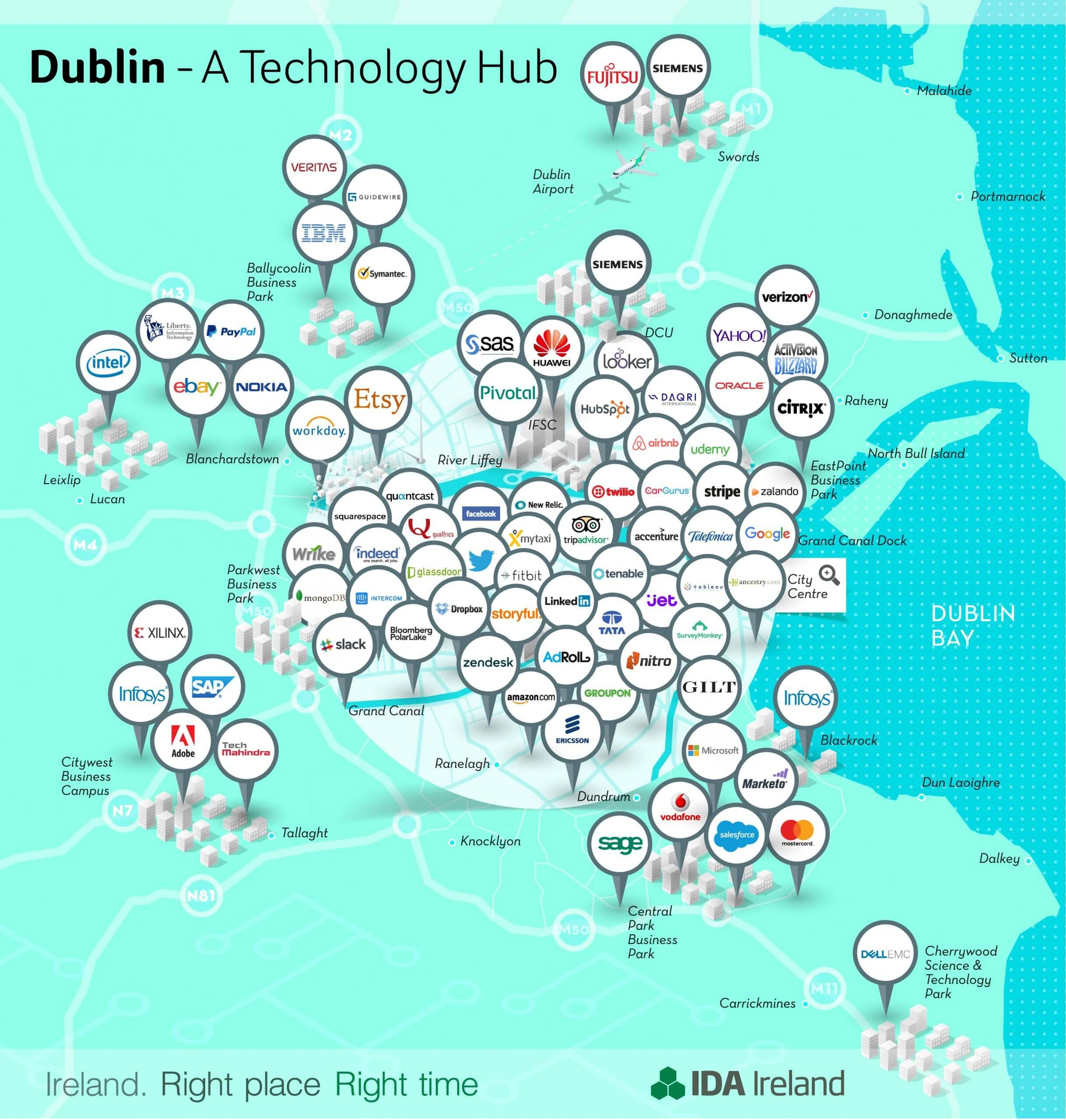
Dublin has the strongest concentration of high-income roles, multinationals, finance, tech, law, advisory, startups and elite networks. But Dublin housing can destroy the spread.


Ireland geography strategy:


LocationBest use
DublinCareer acceleration, network, top salaries
CorkPharma, tech, finance, engineering
GalwayMedtech, software, quality/regulatory
Limerick/ShannonEngineering, aviation, pharma, lower housing cost
WaterfordLower-cost base with improving regional opportunity
Kildare/Meath/Wicklow/LouthCommuter arbitrage
Remote regionalGood only if income remains high

Correct model:

earn in a high-income market, live where the spread survives.


20. Network: Ireland is small, so reputation compounds brutally​


In the US, you can burn rooms and move cities. In Ireland, weak reputation follows faster.


High-status Irish rooms are often understated. Do not peacock. Be competent, useful, discreet and reliable.


Better rooms:


RoomWhy it helps
Multinational teamsHigh standards, mobility, referrals
Professional bodiesChartered Accountant, CFA, SCSI, Engineers Ireland, Law Society
Founder/operator circlesDeals, talent, capital
Property/construction circlesLand, planning, contractors, funding
Alumni networksQuiet access
High-skill sport/social clubsTrust formation
Angel/startup ecosystemEarly equity access
Industry conferencesWeak alone, strong with follow-up

Rule:


In Ireland, social class is partly balance sheet, partly accent/education, partly address, but heavily reputation.


21. Partner choice is economic strategy​


This is uncomfortable but true.


A disciplined dual-income couple can buy, invest and absorb shocks. One chaotic partner can erase ten years of progress.


CSO SILC 2025 data shows households with three or more people at work had median nominal household disposable income of €106,524, while households with nobody at work had €33,105. Owner-occupied households had median nominal disposable income of €71,338, compared with €47,599 for rented/rent-free households.

Screen for:


TraitWhy
Low debt chaosPrevents fragility
Career seriousnessRaises household borrowing/investing power
Similar spending valuesProtects spread
Emotional stabilityProtects execution
Family expectations understoodPrevents hidden financial obligations
Long-term orientationClass mobility is slow


22. Children: class persists through environment​


For children, the assets are:

stable home, language, discipline, school quality, peer group, sport/music/social confidence, parental network, inheritance planning.

In Ireland, PPR location often doubles as education strategy. But do not overpay for status schooling while destroying your balance sheet. A child with calm parents, books, sport, maths, social confidence and a stable home beats a child with private-school cosplay and broke parents.


23. Inheritance and family wealth planning​

CAT matters because intergenerational wealth is a class escalator.

Current CAT thresholds are:

GroupTypical relationshipThreshold
AChild€400,000
BSibling, niece/nephew, grandchild, etc.€40,000
CStranger/cousin/in-law/friend€20,000

CAT applies above the threshold at 33%.

The small gift exemption allows gifts of up to €3,000 per disponer per calendar year to be CAT-exempt and not counted for aggregation.

Use this early. Compounding needs time.


24. Private trusts are not the first ladder rung​


For most Irish people, private trusts are not the answer. They add legal cost, tax complexity and reporting. Use:

pensions, wills, life cover, PPR planning, small gifts, business succession, shareholder agreements

before reaching for trust structures.

Investment trusts like JAM/SMT are a completely different category: listed investment companies used for market exposure, not family estate planning.


25. The Irish tax map​


Asset/income typeBroad treatmentStrategic meaning
PAYE salaryIncome tax + USC + PRSINeeded, but compressed
Pension contributionIncome-tax relief within limitsFirst major wrapper
PPR gainPotential CGT reliefHuge Irish advantage
Direct sharesDividends income-taxed; gains usually CGTTax timing/control
UCITS ETFs/fundsExit tax/deemed disposal regimeSimple product, ugly tax drag
Investment trustsFact-specific; may be share-likeUseful but verify
Trading company12.5% CT on trading incomeGood for scaling business
Passive company income25% CT + possible surchargeNot a simple ETF wrapper
BTL propertyRental income taxed; CGT on gainsMust be yield-positive
Business salePossible 10% entrepreneur reliefMajor wealth event
Gifts/inheritanceCAT thresholds + small gift exemptionFamily planning matters


26. Avoid these Irish class traps​


TrapWhy it kills mobility
Maxing mortgage too earlyTurns income into survival
Cash hoarding foreverSafety becomes stagnation
ETF ignoranceDeemed disposal/tax drag surprises
Status car/PCPConverts capital into depreciation
Wedding/status spendingOne-year optics, decade-long opportunity cost
Low-ceiling loyaltyIreland rewards trusted competence, not blind loyalty
Overstaying low-growth public/private rolesStability can become ceiling
BTL with weak yieldTax + repairs + leverage eat you
Employer RSU concentrationJob and portfolio risk become same risk
Lifestyle inflation after first big salaryThe spread disappears
“Dublin or nothing”High income can be neutralised by housing
“Cheap region only”Low cost is useless if opportunity vanishes
Company-as-tax-hack thinkingClose-company/passive-income rules bite
Crypto as main planSpeculation is not class strategy


27. The correct Ireland execution plan​


Days 1–3: balance sheet audit​


Write down:


ItemTarget
Gross incomeCurrent
Net incomeCurrent
Rent/mortgage% of net income
Debt APRsHighest first
Pension contributionsEmployer + employee
CashMonths of expenses
Taxable investmentsAmount + structure
SkillsCurrent market price
NetworkPeople 2 levels above you


Days 4–7: stop leakage​

Cut one major recurring cost.
Kill or refinance the highest-APR debt.
Check pension match.
Check tax credits.
Stop idle subscriptions/status spending.

Days 8–14: choose income lane​


Pick one:


Starting pointMove
Low-income graduateICT/data/accounting/sales/engineering route
Mid-career professionalSpecialise into higher-fee niche
Public-sector workerAdd private-market skill or consulting path
Trade workerMove toward contractor/business ownership
Tech workerMove toward AI/data/security/product/customer-facing leverage
Finance/accounting workerMove toward advisory, tax, deals, CFO, funds
Healthcare workerMove toward scarce specialty/management/private practice

Days 15–30: force market feedback​


Do:


ActionNumber
Higher-paid job applications20
Recruiter conversations5
Coffee calls with people 2 levels above5
Portfolio/project/client proof pieces2
Pension/investment setup actions1
Spending cuts automated1


28. Twelve-month target​


MetricTarget
Income+15–30%
Pension contributionmaximised to rational level
Savings/investment rate20–40% of gross if living at home/low rent; 10–25% if renting/buying
Debtno high-interest consumer debt
Skillone monetisable scarce skill
Network25 useful high-quality relationships
Housingeither rational PPR path or deliberate rent/invest plan
Businessone side cashflow or equity path
Net worthtracked monthly


29. Five-year target​


AreaGoal
IncomeTop-quartile in chosen field
HousingPPR owned or clear high-income alternative
Pensionserious compounding base
Taxable assetsdirect shares/investment trusts/business equity, tax-aware
Businessownership stake, consulting income, or scalable side asset
Networkpeople who hire, invest, refer, advise
Reputationknown for competence and reliability
Optionalitycan move city, change job, start company, or buy asset without panic


30. Final rule​


In Ireland, the ladder is:

skill → salary → spread → pension/PPR → direct equity/business → reputation → scale

If your life is:

PAYE income + rent + cash + consumption

you stay exposed.


If your life becomes:

scarce skill + tax-aware investing + PPR/pension + business equity + better rooms

you have a real shot at moving class.


Capital beats labour.
But in Ireland,
tax-aware capital beats naive capital.
 
  • +1
  • Love it
  • JFL
Reactions: vision_n, 3pider, yex and 12 others
bro what percentage of this forum is from ireland
 
  • +1
  • JFL
Reactions: yex, anythingtobenormal, rraymond and 3 others
this would be really helpful if i lived in ireland:feelsgood:
 
  • +1
  • JFL
Reactions: Pay, Alexg_lover, yex and 3 others
bro what percentage of this forum is from ireland
Tag them.

If you literally follow everything step by step (if you have the fortune/capacity), it's hard to fuck things up. This was extremely high effort. And a specific, practical guide.
 
  • +1
Reactions: anythingtobenormal, Deleted member 300207 and killuacel
Or step 1: leave
 
  • +1
  • JFL
Reactions: yex, uksucks, idont and 4 others
Also works and very viable. To where? Australia, UAE?

Depends on field really.

Even UK seems better than Ireland, at least you have the £20k tax-free per year ISA to compound wealth and the income taxes are not as extreme. It’s ironic that Ireland is a tax haven country for big tech and yet they fuck their own citizens extremely hard.
 
  • +1
Reactions: yex, uksucks, Seth Walsh and 1 other person
Impressive guide. The best way to increase your social class in Ireland though is to be born to one of the Anglo-Irish aristocrats who didn't get their estate burned down by terrorists in the early 1900s
 
  • +1
Reactions: Pay, yex, guessedcookie58 and 1 other person
Depends on field really.

Even UK seems better than Ireland, at least you have the £20k tax-free per year ISA to compound wealth and the income taxes are not as extreme. It’s ironic that Ireland is a tax haven country for big tech and yet they fuck their own citizens extremely hard.
The Irish freed themselves from Britain to then quickly become slaves to the EU and international capital
 
  • Love it
  • +1
Reactions: yex and Seth Walsh
Really good thread, i hope this gets BOTB :bigbrain:
 
  • Love it
  • +1
Reactions: yex and Seth Walsh
Can you make one for India, would be much appreciated.

Thanks
 
  • +1
  • JFL
  • Ugh..
Reactions: stonecold trucel, yex, anythingtobenormal and 4 others
Ireland is high-income

spiderman-funny.gif


The most I ever made wageslaving there was like 20k in a year, that was the only time I worked fulltime
It's a decent country if you're on welfare because of how high the welfare is compared to other countries but fuck trying to live there as a workcel
My soul feels more cleansed with each passing day where I don't have to encounter cocky irish jesters
 
  • JFL
  • +1
Reactions: ETR, yex, idont and 1 other person
spiderman-funny.gif


The most I ever made wageslaving there was like 20k in a year, that was the only time I worked fulltime
It's a decent country if you're on welfare because of how high the welfare is compared to other countries but fuck trying to live there as a workcel
My soul feels more cleansed with each passing day where I don't have to encounter cocky irish jesters
Did you Australiamaxx?

And yeah out of context "Ireland is high income" is completely laughable. Good catch lmao. Overall, Irish wages are the most compressed, suppressed cost-centre bullshit salaries you'll ever see unless you're working somewhere like SIG, Virtu or one of the big law firms.

Yeah Ireland is NOT high income lmao
 
  • +1
Reactions: yex, idont and Deleted member 2382
Can you make one for India, would be much appreciated.

Thanks
If this thread gets into BOTB and OP gets 200 likes I'll make one for India that's so detailed that you can't fuck it up.

I'll even add how to H1B and immigration-maxx and snare jobs at Databricks, Amazon AWS in Dublin/London etc while staying under the radar.
 
  • +1
Reactions: yex and idont
Did you Australiamaxx?

And yeah out of context "Ireland is high income" is completely laughable. Good catch lmao. Overall, Irish wages are the most compressed, suppressed cost-centre bullshit salaries you'll ever see unless you're working somewhere like SIG, Virtu or one of the big law firms.

Yeah Ireland is NOT high income lmao
Nah I'm still in Europe

I'll even add how to H1B and immigration-maxx and snare jobs at Databricks, Amazon AWS in Dublin/London etc while staying under the radar.
Why on earth would you do this?
 
  • Love it
  • +1
Reactions: yex and Seth Walsh
  • +1
Reactions: yex, Deleted member 2382 and idont
@6ft4 @jester patell @anythingtobenormal @TheAncientMacedonia

View attachment 5065100View attachment 5065101View attachment 5065103View attachment 5065104

Ireland is not the US with euro signs. Ireland is a small, high-income, high-tax, housing-constrained, reputation-heavy economy where tax-aware ownership beats raw income.

The formula:

scarce skill → high income → low lifestyle drag → pension/PPR/business equity/direct equity → better rooms → reputation → scale

Labour gets you in. Capital moves you up. Reputation keeps you there.

1. The Irish class ladder is tax-shaped​


In Ireland, the “class jump” is not just earning more. PAYE income gets compressed quickly by income tax, USC and PRSI. For a single person in 2026, the standard income-tax band is €44,000 at 20%, with income above that taxed at 40%; USC rises to 8% above €70,044; employee PRSI is 4.2%, rising to 4.35% from October 2026. That puts a high-earning employee’s top marginal drag around 52%+ before pension planning.

View attachment 5065113

Rule: do not build your whole plan around post-tax salary. Build around salary converted into assets through the most favourable Irish channels.

2. First scoreboard: where Ireland rewards you​


Ireland rewards five things:


LeverIrish version
Scarce skillICT, finance, engineering, pharma/biotech, construction, healthcare, law/accounting, B2B sales
Tax shelterPension, employer pension, PPR relief, business reliefs
OwnershipPPR, pension assets, direct shares, investment trusts, trading company equity
GeographyDublin for labour/network; regional arbitrage for housing/spread
TrustSmall-country reputation compounds hard

The Central Bank says Irish household wealth reached €1.34 trillion in Q3 2025, housing represented 67.7% of total net wealth, and the top 10% held 49.2% of national net wealth. The rich are not mostly “better savers”; they hold appreciating assets.


3. Raise the price of your hour first​


CSO 2024 data shows median annual earnings across all sectors were €44,816. But sector choice dominates. Information and Communication had median annual earnings of €80,147; Financial, Insurance and Real Estate was €59,023; Public Administration and Defence was €56,745; Accommodation and Food was €26,000.


View attachment 5065121


Target sectors with ceiling, portability and credential leverage:


LaneWhy it works in Ireland
Software/data/AI/cybersecurityMultinationals, remote leverage, high salaries, equity/RSUs
Finance/accounting/tax/actuarialIreland is a funds, insurance and multinational tax hub
Pharma/biotech/medtechCork, Limerick, Galway, Dublin corridor; regulated high-skill work
Engineering/construction managementHousing/infrastructure shortage creates durable demand
Healthcare leadershipAgeing population + structural shortages
B2B sales/customer successHigh upside without needing elite credentials
Law/compliance/riskRegulation creates high-trust, high-fee work
Skilled trades with business pathEmployee ceiling lower; contractor/employer ceiling much higher

SOLAS identifies future challenges and demand pressure across construction, science and engineering, ICT, health, business and finance, and education; it also notes that Ireland’s high-skilled employment growth has been driven heavily by workers with NFQ level 8 or above qualifications.


4. Do not “get educated.” Buy income power.​


Education is not automatically status mobility. It is only good when it buys one of these:


higher earnings, a protected credential, access to better employers, international mobility, or trust.


CSO graduate outcomes show median weekly earnings one year after graduation for 2022 graduates were €625, but field choice mattered: Education graduates earned €815/week, Health and Welfare €775/week, ICT €765/week, while Arts and Humanities earned €470/week.


Decision rule:


Expected annual income gain ÷ total cost of degree/time = credential quality


Good Ireland credentials:


RouteGood when
Accounting qualificationYou want corporate finance, tax, audit, CFO track, business credibility
Software/data/cyber cert + portfolioYou can prove skill with projects, not just paper
Engineering/construction qualificationYou want site management, QS, infrastructure, energy, property
Medicine/healthcareYou accept long training for protected income
LawYou can get into commercial, tax, corporate, funds, property, litigation
MBAOnly when it gets access to better employers/network, not vague “leadership”
Trade apprenticeshipBest if the endgame is contracting/business ownership

Bad credential pattern:
borrow money + lose years + enter a low-ceiling field + call it ambition.


5. Ireland’s income trap: high salary without ownership​


A €100k PAYE salary is strong, but not enough to become upper class if it turns into rent, car payments, restaurants, holidays and idle cash.


A high earner in Ireland needs a conversion system:


gross income → pension/PPR/business/equity → compounding


Without that, the tax system and housing costs eat the spread.


6. Asset order for Ireland​


Use this order unless your situation clearly breaks it:


OrderAsset/actionWhy
1Emergency cashIreland has high housing/job-transition costs
2Kill high-interest debtGuaranteed return; anti-compounding removed
3Employer pension matchFree money + tax shelter
4AVC/PRSA/pension contributionsBest mainstream wrapper for high-rate taxpayers
5PPR deposit/mathPPR relief is one of Ireland’s cleanest tax advantages
6Direct shares/investment trustsMore tax-control than UCITS ETFs, but more complexity
7Business equityReal class jump happens here
8BTL/property projectsOnly if yield survives tax, leverage, regulation and vacancy
9Concentrated/speculative betsOnly after base is secure

CSO household wealth data shows owner-occupiers had median net wealth of €391,600, renters had €10,200, and the national median household net wealth was €256,900 in 2023.
View attachment 5065125

7. Pensions are the cleanest mass-market compounding machine​


For Irish high earners, pensions are not boring. They are the first serious wealth wrapper.


Revenue’s age-related tax-relievable pension contribution limits are:


AgeMax % of net relevant earnings
Under 3015%
30–3920%
40–4925%
50–5430%
55–5935%
60+40%

The earnings cap for tax relief is €115,000, and employer contributions do not count against the employee’s age-related contribution limit.


Principle:


If you pay 40% income tax, pension contributions are usually the first legal place to move labour income into capital.


Pension weaknesses:


WeaknessMeaning
Locked until retirement rules allow accessBad for short-term liquidity
Policy riskRules can change
Drawdown taxNot tax-free forever
Overconcentration riskBad pension fund choices can destroy the wrapper advantage

Still, for PAYE workers, pension is usually the cleanest “labour → capital” bridge.


8. PPR is Ireland’s most important middle-class tax shelter​


Principal Private Residence relief is huge. Revenue says a PPR is a house or apartment you own and occupy as your only or main residence. If you dispose of a property that was your main residence for the full period and used as your home, the gain can be CGT-exempt; the final 12 months are also treated as occupation.


This is why Irish wealth is housing-heavy.


But the move is not “buy any house.” The move is:


buy optionality, not identity.


Good PPR:


FeatureWhy it matters
Near strong labour marketKeeps income high
Rentable room/spaceOptional cashflow
Transport linksResale + career flexibility
Expandable/renovatableForced appreciation
Good schools/amenitiesSocial-class persistence
Sensible mortgagePrevents house-poverty

Bad PPR:


FeatureProblem
Max mortgage in weak locationTraps labour mobility
Status house too earlyKills investment spread
No emergency fund after purchaseFragile
Commute destroys energyLower career output
“Forever home” thinking at 28Overcommits before life is stable


9. The mortgage constraint is the real Irish class gate​


The Central Bank’s mortgage rules allow first-time buyers to borrow up to 4x gross income, second/subsequent buyers 3.5x, with a 10% deposit for PPR buyers and 30% deposit for buy-to-let.


So a couple on €100k gross can usually target around:


€400k mortgage + deposit


CSO says the national median dwelling price for the 12 months to March 2026 was €390,461; Dublin was €500,000; Dún Laoghaire-Rathdown was €685,000; Donegal and Longford were €200,000.

View attachment 5065131

The brutal truth:
dual income, sector choice and geography decide housing access.


10. Use Help to Buy/FHS carefully​


Help to Buy can provide up to €30,000, limited by 10% of the purchase/valuation or income tax and DIRT paid over the previous four years; USC and PRSI do not count. The enhanced scheme is listed through 2029.


The First Home Scheme is shared equity. It can fund up to 30% of the price/build cost, reduced to 20% if Help to Buy is also used, and service charges begin from year six.


Correct use: bridge a rational purchase.
Incorrect use: stretch into a house that eats your life.


11. Rent-a-room is underrated​


Revenue’s Rent-a-Room Relief lets an individual receive up to €14,000 a year from letting a room in their home tax-free; if income exceeds the limit, the total amount is taxable.


For a young owner-occupier, this can be powerful:
PPR relief + mortgage amortisation + optional tax-free room income
That is a real Irish-specific mobility lever.

12. ETFs are not treated like Americans expect​


This is where Ireland differs sharply from the US.


Revenue guidance on equivalent offshore funds says income and gains are generally taxed at 38% from 2026, deemed disposal applies every eight years, and losses generally cannot be used for CGT or other loss relief.

William Fry notes that EU-domiciled ETFs are generally taxed similarly to Irish funds, including the eight-year deemed disposal regime. It also notes that US ETFs are generally outside the offshore-fund regime and are normally subject to income tax/USC/PRSI on distributions and CGT on realised gains, but access, regulation, US estate tax and product availability complicate this.

Illustration only: €10,000 at 7% for 24 years.
View attachment 5065146

The point is not the exact return. The point is structure.

13. Direct shares vs ETFs vs investment trusts​


Ireland’s taxable investing hierarchy is weird.


AssetTypical Irish tax issue
UCITS ETF / many fundsExit tax/deemed disposal regime; loss restrictions
Direct sharesDividends taxed as income; gains usually CGT at 33%; annual €1,270 personal CGT exemption
UK investment trustsOften analysed as company shares rather than funds, but classification is fact-specific
US ETFsOften normal income/CGT treatment, but access and US estate-tax risk matter
PensionsUsually best wrapper, but locked
PPRCGT relief if conditions met
Trading company equityPotential entrepreneur relief / business sale upside

CGT is generally 33%, and individuals have a €1,270 annual CGT exemption.


14. Investment trusts: JAM, SMT, etc.​


JAM and SMT are not “trusts” in the private-family-trust sense. They are listed investment trusts: closed-ended investment companies.


Why Irish investors look at them:


FeatureWhy it attracts Irish investors
Listed company formMay be taxed more like shares than UCITS ETFs
No automatic UCITS ETF deemed-disposal treatment if outside fund regimePotential tax-control advantage
Diversified exposureEasier than picking 50 stocks
CGT timingYou may control realisation timing

Risks:


RiskMeaning
Classification riskRevenue treatment depends on facts, not vibes
Active-manager riskJAM/SMT are not neutral index trackers
Premium/discount riskInvestment trusts can trade away from NAV
Gearing riskBorrowing can amplify losses
Concentration/style riskSMT especially can be volatile
UK stamp duty/FXFriction costs matter

KPMG notes that open-ended funds and variable-capital companies are more likely to create a “material interest” offshore fund issue, while closed-ended funds or vehicles with maturity beyond seven years are less likely; but this is fact-specific.

Rule:
Investment trusts can be a useful Irish taxable account tool, not a magic cheat code.
Before allocating serious money, confirm the tax classification from the prospectus, structure and a competent Irish tax adviser.


15. Do not over-hoard cash​


Irish households save a lot. CSO says the household saving rate was 14.8% in Q3 2025, about €1 in €7 of disposable income.


But the Central Bank says Ireland has among the lowest levels of direct retail participation in EU capital markets, with households tending to hold wealth in property, life assurance and pensions; wealthier households dominate capital-market participation.

Cash is for optionality and safety.
Cash is not a long-term class ladder.

16. Business ownership is the real class jump​


Employee income is capped by salary bands. Business income is capped by market size, pricing, systems and hiring.


Ireland’s tax system rewards real trading businesses more than passive wrappers. Revenue lists Corporation Tax at 12.5% for trading income and 25% for non-trading income such as investment/rental income.

But do not confuse “company” with “tax-free.” Close companies can face a 20% surcharge on undistributed after-tax estate and investment income if not distributed within 18 months.


Best business paths in Ireland:


PathWhy it works
B2B consultingLow capital, high trust, fast cashflow
Agency → productised serviceScales beyond your hours
Software/SaaSExportable, high margin
Specialist trades contractorHousing/infrastructure demand
Medical/dental/accounting/legal practiceProtected trust + recurring demand
Property servicesIreland’s housing system creates constant friction
Compliance/regulatory servicesComplex rules create fee pools
Niche recruitingHigh-value talent shortage
Training/upskillingAI and regulation force reskilling
B2B sales brokerageCommission upside without heavy capital

The jump is:
self-employed worker → owner-operator → employer → asset owner


17. Entrepreneur relief matters​


Revenue’s Revised Entrepreneur Relief gives a 10% CGT rate on gains from qualifying business assets, reduced from the standard 33%. The lifetime limit is €1,500,000 for gains arising on or after 1 January 2026. It generally requires ownership of qualifying business assets for a continuous three-year period and excludes passive investment assets, development land, and land letting

his is why building a saleable trading company can beat decades of salary optimisation.


Simplified example:


Exit gainNormal CGT at 33%Entrepreneur relief at 10%
€500,000€165,000€50,000
€1,000,000€330,000€100,000
€1,500,000€495,000€150,000

That gap is class mobility.

18. Buy-to-let is not PPR​


A PPR is tax-advantaged. A rental property is a business/investment exposed to tax, leverage, regulation, maintenance and vacancy.


BTL can work, but not with lazy maths.


BTL checklist:


QuestionRequired answer
Does rent cover mortgage, tax, insurance, repairs and vacancy?Yes
Is the gross yield strong enough after Irish tax?Yes
Is there forced appreciation?Renovation, planning, conversion, under-market buy
Can you survive a bad tenant/non-payment period?Yes
Is leverage fixed/controlled?Yes
Are you buying below replacement value?Ideally

Most bad BTL investors buy because “property always goes up.” That is not investing. That is national folklore with leverage.


19. Geography: use Dublin, but do not worship it​


Dublin has the strongest concentration of high-income roles, multinationals, finance, tech, law, advisory, startups and elite networks. But Dublin housing can destroy the spread.


Ireland geography strategy:


LocationBest use
DublinCareer acceleration, network, top salaries
CorkPharma, tech, finance, engineering
GalwayMedtech, software, quality/regulatory
Limerick/ShannonEngineering, aviation, pharma, lower housing cost
WaterfordLower-cost base with improving regional opportunity
Kildare/Meath/Wicklow/LouthCommuter arbitrage
Remote regionalGood only if income remains high

Correct model:

earn in a high-income market, live where the spread survives.


20. Network: Ireland is small, so reputation compounds brutally​


In the US, you can burn rooms and move cities. In Ireland, weak reputation follows faster.


High-status Irish rooms are often understated. Do not peacock. Be competent, useful, discreet and reliable.


Better rooms:


RoomWhy it helps
Multinational teamsHigh standards, mobility, referrals
Professional bodiesChartered Accountant, CFA, SCSI, Engineers Ireland, Law Society
Founder/operator circlesDeals, talent, capital
Property/construction circlesLand, planning, contractors, funding
Alumni networksQuiet access
High-skill sport/social clubsTrust formation
Angel/startup ecosystemEarly equity access
Industry conferencesWeak alone, strong with follow-up

Rule:


In Ireland, social class is partly balance sheet, partly accent/education, partly address, but heavily reputation.


21. Partner choice is economic strategy​


This is uncomfortable but true.


A disciplined dual-income couple can buy, invest and absorb shocks. One chaotic partner can erase ten years of progress.


CSO SILC 2025 data shows households with three or more people at work had median nominal household disposable income of €106,524, while households with nobody at work had €33,105. Owner-occupied households had median nominal disposable income of €71,338, compared with €47,599 for rented/rent-free households.

Screen for:


TraitWhy
Low debt chaosPrevents fragility
Career seriousnessRaises household borrowing/investing power
Similar spending valuesProtects spread
Emotional stabilityProtects execution
Family expectations understoodPrevents hidden financial obligations
Long-term orientationClass mobility is slow


22. Children: class persists through environment​


For children, the assets are:

stable home, language, discipline, school quality, peer group, sport/music/social confidence, parental network, inheritance planning.

In Ireland, PPR location often doubles as education strategy. But do not overpay for status schooling while destroying your balance sheet. A child with calm parents, books, sport, maths, social confidence and a stable home beats a child with private-school cosplay and broke parents.


23. Inheritance and family wealth planning​

CAT matters because intergenerational wealth is a class escalator.

Current CAT thresholds are:

GroupTypical relationshipThreshold
AChild€400,000
BSibling, niece/nephew, grandchild, etc.€40,000
CStranger/cousin/in-law/friend€20,000

CAT applies above the threshold at 33%.

The small gift exemption allows gifts of up to €3,000 per disponer per calendar year to be CAT-exempt and not counted for aggregation.

Use this early. Compounding needs time.


24. Private trusts are not the first ladder rung​


For most Irish people, private trusts are not the answer. They add legal cost, tax complexity and reporting. Use:

pensions, wills, life cover, PPR planning, small gifts, business succession, shareholder agreements

before reaching for trust structures.

Investment trusts like JAM/SMT are a completely different category: listed investment companies used for market exposure, not family estate planning.


25. The Irish tax map​


Asset/income typeBroad treatmentStrategic meaning
PAYE salaryIncome tax + USC + PRSINeeded, but compressed
Pension contributionIncome-tax relief within limitsFirst major wrapper
PPR gainPotential CGT reliefHuge Irish advantage
Direct sharesDividends income-taxed; gains usually CGTTax timing/control
UCITS ETFs/fundsExit tax/deemed disposal regimeSimple product, ugly tax drag
Investment trustsFact-specific; may be share-likeUseful but verify
Trading company12.5% CT on trading incomeGood for scaling business
Passive company income25% CT + possible surchargeNot a simple ETF wrapper
BTL propertyRental income taxed; CGT on gainsMust be yield-positive
Business salePossible 10% entrepreneur reliefMajor wealth event
Gifts/inheritanceCAT thresholds + small gift exemptionFamily planning matters


26. Avoid these Irish class traps​


TrapWhy it kills mobility
Maxing mortgage too earlyTurns income into survival
Cash hoarding foreverSafety becomes stagnation
ETF ignoranceDeemed disposal/tax drag surprises
Status car/PCPConverts capital into depreciation
Wedding/status spendingOne-year optics, decade-long opportunity cost
Low-ceiling loyaltyIreland rewards trusted competence, not blind loyalty
Overstaying low-growth public/private rolesStability can become ceiling
BTL with weak yieldTax + repairs + leverage eat you
Employer RSU concentrationJob and portfolio risk become same risk
Lifestyle inflation after first big salaryThe spread disappears
“Dublin or nothing”High income can be neutralised by housing
“Cheap region only”Low cost is useless if opportunity vanishes
Company-as-tax-hack thinkingClose-company/passive-income rules bite
Crypto as main planSpeculation is not class strategy


27. The correct Ireland execution plan​


Days 1–3: balance sheet audit​


Write down:


ItemTarget
Gross incomeCurrent
Net incomeCurrent
Rent/mortgage% of net income
Debt APRsHighest first
Pension contributionsEmployer + employee
CashMonths of expenses
Taxable investmentsAmount + structure
SkillsCurrent market price
NetworkPeople 2 levels above you


Days 4–7: stop leakage​

Cut one major recurring cost.
Kill or refinance the highest-APR debt.
Check pension match.
Check tax credits.
Stop idle subscriptions/status spending.

Days 8–14: choose income lane​


Pick one:


Starting pointMove
Low-income graduateICT/data/accounting/sales/engineering route
Mid-career professionalSpecialise into higher-fee niche
Public-sector workerAdd private-market skill or consulting path
Trade workerMove toward contractor/business ownership
Tech workerMove toward AI/data/security/product/customer-facing leverage
Finance/accounting workerMove toward advisory, tax, deals, CFO, funds
Healthcare workerMove toward scarce specialty/management/private practice

Days 15–30: force market feedback​


Do:


ActionNumber
Higher-paid job applications20
Recruiter conversations5
Coffee calls with people 2 levels above5
Portfolio/project/client proof pieces2
Pension/investment setup actions1
Spending cuts automated1


28. Twelve-month target​


MetricTarget
Income+15–30%
Pension contributionmaximised to rational level
Savings/investment rate20–40% of gross if living at home/low rent; 10–25% if renting/buying
Debtno high-interest consumer debt
Skillone monetisable scarce skill
Network25 useful high-quality relationships
Housingeither rational PPR path or deliberate rent/invest plan
Businessone side cashflow or equity path
Net worthtracked monthly


29. Five-year target​


AreaGoal
IncomeTop-quartile in chosen field
HousingPPR owned or clear high-income alternative
Pensionserious compounding base
Taxable assetsdirect shares/investment trusts/business equity, tax-aware
Businessownership stake, consulting income, or scalable side asset
Networkpeople who hire, invest, refer, advise
Reputationknown for competence and reliability
Optionalitycan move city, change job, start company, or buy asset without panic


30. Final rule​


In Ireland, the ladder is:

skill → salary → spread → pension/PPR → direct equity/business → reputation → scale

If your life is:

PAYE income + rent + cash + consumption

you stay exposed.


If your life becomes:

scarce skill + tax-aware investing + PPR/pension + business equity + better rooms

you have a real shot at moving class.


Capital beats labour.
But in Ireland,
tax-aware capital beats naive capital.
BRO WHAT NO WAY
i did not expect this

@rraymond
 
  • +1
  • Love it
Reactions: yex, rraymond and Seth Walsh
Depends on field really.

Even UK seems better than Ireland, at least you have the £20k tax-free per year ISA to compound wealth and the income taxes are not as extreme. It’s ironic that Ireland is a tax haven country for big tech and yet they fuck their own citizens extremely hard.
Yeah good point. I'm jealous of the ISA tbhngl
 
Impressive guide. The best way to increase your social class in Ireland though is to be born to one of the Anglo-Irish aristocrats who didn't get their estate burned down by terrorists in the early 1900s
No truer words have been said
 
  • +1
Reactions: yex and atlantidmogger
can i use this guide in ukraine?
 
  • +1
  • JFL
Reactions: yex, gymcelld and Seth Walsh
can i use this guide in ukraine?
250 likes on the OP and I make a giga-autistic step by step node-by-node impossible to mess up, Ukraine specific guide.
 
  • Woah
  • +1
Reactions: yex and Sadist
  • JFL
  • +1
Reactions: yex, anythingtobenormal, Sadist and 1 other person
250 likes on the OP and I make a giga-autistic step by step node-by-node impossible to mess up, Ukraine specific guide.
bet let me gather up my army of rep minions and it will be done in no time.
 
  • JFL
  • +1
Reactions: yex and Seth Walsh
bet let me gather up my army of rep minions and it will be done in no time.
I regret what I said now. But I'll hold my word.
 
  • JFL
  • +1
Reactions: yex and Sadist
@6ft4 @jester patell @anythingtobenormal @TheAncientMacedonia

View attachment 5065100View attachment 5065101View attachment 5065103View attachment 5065104

Ireland is not the US with euro signs. Ireland is a small, high-income, high-tax, housing-constrained, reputation-heavy economy where tax-aware ownership beats raw income.

The formula:

scarce skill → high income → low lifestyle drag → pension/PPR/business equity/direct equity → better rooms → reputation → scale

Labour gets you in. Capital moves you up. Reputation keeps you there.

1. The Irish class ladder is tax-shaped​


In Ireland, the “class jump” is not just earning more. PAYE income gets compressed quickly by income tax, USC and PRSI. For a single person in 2026, the standard income-tax band is €44,000 at 20%, with income above that taxed at 40%; USC rises to 8% above €70,044; employee PRSI is 4.2%, rising to 4.35% from October 2026. That puts a high-earning employee’s top marginal drag around 52%+ before pension planning.

View attachment 5065113

Rule: do not build your whole plan around post-tax salary. Build around salary converted into assets through the most favourable Irish channels.

2. First scoreboard: where Ireland rewards you​


Ireland rewards five things:


LeverIrish version
Scarce skillICT, finance, engineering, pharma/biotech, construction, healthcare, law/accounting, B2B sales
Tax shelterPension, employer pension, PPR relief, business reliefs
OwnershipPPR, pension assets, direct shares, investment trusts, trading company equity
GeographyDublin for labour/network; regional arbitrage for housing/spread
TrustSmall-country reputation compounds hard

The Central Bank says Irish household wealth reached €1.34 trillion in Q3 2025, housing represented 67.7% of total net wealth, and the top 10% held 49.2% of national net wealth. The rich are not mostly “better savers”; they hold appreciating assets.


3. Raise the price of your hour first​


CSO 2024 data shows median annual earnings across all sectors were €44,816. But sector choice dominates. Information and Communication had median annual earnings of €80,147; Financial, Insurance and Real Estate was €59,023; Public Administration and Defence was €56,745; Accommodation and Food was €26,000.


View attachment 5065121


Target sectors with ceiling, portability and credential leverage:


LaneWhy it works in Ireland
Software/data/AI/cybersecurityMultinationals, remote leverage, high salaries, equity/RSUs
Finance/accounting/tax/actuarialIreland is a funds, insurance and multinational tax hub
Pharma/biotech/medtechCork, Limerick, Galway, Dublin corridor; regulated high-skill work
Engineering/construction managementHousing/infrastructure shortage creates durable demand
Healthcare leadershipAgeing population + structural shortages
B2B sales/customer successHigh upside without needing elite credentials
Law/compliance/riskRegulation creates high-trust, high-fee work
Skilled trades with business pathEmployee ceiling lower; contractor/employer ceiling much higher

SOLAS identifies future challenges and demand pressure across construction, science and engineering, ICT, health, business and finance, and education; it also notes that Ireland’s high-skilled employment growth has been driven heavily by workers with NFQ level 8 or above qualifications.


4. Do not “get educated.” Buy income power.​


Education is not automatically status mobility. It is only good when it buys one of these:


higher earnings, a protected credential, access to better employers, international mobility, or trust.


CSO graduate outcomes show median weekly earnings one year after graduation for 2022 graduates were €625, but field choice mattered: Education graduates earned €815/week, Health and Welfare €775/week, ICT €765/week, while Arts and Humanities earned €470/week.


Decision rule:


Expected annual income gain ÷ total cost of degree/time = credential quality


Good Ireland credentials:


RouteGood when
Accounting qualificationYou want corporate finance, tax, audit, CFO track, business credibility
Software/data/cyber cert + portfolioYou can prove skill with projects, not just paper
Engineering/construction qualificationYou want site management, QS, infrastructure, energy, property
Medicine/healthcareYou accept long training for protected income
LawYou can get into commercial, tax, corporate, funds, property, litigation
MBAOnly when it gets access to better employers/network, not vague “leadership”
Trade apprenticeshipBest if the endgame is contracting/business ownership

Bad credential pattern:
borrow money + lose years + enter a low-ceiling field + call it ambition.


5. Ireland’s income trap: high salary without ownership​


A €100k PAYE salary is strong, but not enough to become upper class if it turns into rent, car payments, restaurants, holidays and idle cash.


A high earner in Ireland needs a conversion system:


gross income → pension/PPR/business/equity → compounding


Without that, the tax system and housing costs eat the spread.


6. Asset order for Ireland​


Use this order unless your situation clearly breaks it:


OrderAsset/actionWhy
1Emergency cashIreland has high housing/job-transition costs
2Kill high-interest debtGuaranteed return; anti-compounding removed
3Employer pension matchFree money + tax shelter
4AVC/PRSA/pension contributionsBest mainstream wrapper for high-rate taxpayers
5PPR deposit/mathPPR relief is one of Ireland’s cleanest tax advantages
6Direct shares/investment trustsMore tax-control than UCITS ETFs, but more complexity
7Business equityReal class jump happens here
8BTL/property projectsOnly if yield survives tax, leverage, regulation and vacancy
9Concentrated/speculative betsOnly after base is secure

CSO household wealth data shows owner-occupiers had median net wealth of €391,600, renters had €10,200, and the national median household net wealth was €256,900 in 2023.
View attachment 5065125

7. Pensions are the cleanest mass-market compounding machine​


For Irish high earners, pensions are not boring. They are the first serious wealth wrapper.


Revenue’s age-related tax-relievable pension contribution limits are:


AgeMax % of net relevant earnings
Under 3015%
30–3920%
40–4925%
50–5430%
55–5935%
60+40%

The earnings cap for tax relief is €115,000, and employer contributions do not count against the employee’s age-related contribution limit.


Principle:


If you pay 40% income tax, pension contributions are usually the first legal place to move labour income into capital.


Pension weaknesses:


WeaknessMeaning
Locked until retirement rules allow accessBad for short-term liquidity
Policy riskRules can change
Drawdown taxNot tax-free forever
Overconcentration riskBad pension fund choices can destroy the wrapper advantage

Still, for PAYE workers, pension is usually the cleanest “labour → capital” bridge.


8. PPR is Ireland’s most important middle-class tax shelter​


Principal Private Residence relief is huge. Revenue says a PPR is a house or apartment you own and occupy as your only or main residence. If you dispose of a property that was your main residence for the full period and used as your home, the gain can be CGT-exempt; the final 12 months are also treated as occupation.


This is why Irish wealth is housing-heavy.


But the move is not “buy any house.” The move is:


buy optionality, not identity.


Good PPR:


FeatureWhy it matters
Near strong labour marketKeeps income high
Rentable room/spaceOptional cashflow
Transport linksResale + career flexibility
Expandable/renovatableForced appreciation
Good schools/amenitiesSocial-class persistence
Sensible mortgagePrevents house-poverty

Bad PPR:


FeatureProblem
Max mortgage in weak locationTraps labour mobility
Status house too earlyKills investment spread
No emergency fund after purchaseFragile
Commute destroys energyLower career output
“Forever home” thinking at 28Overcommits before life is stable


9. The mortgage constraint is the real Irish class gate​


The Central Bank’s mortgage rules allow first-time buyers to borrow up to 4x gross income, second/subsequent buyers 3.5x, with a 10% deposit for PPR buyers and 30% deposit for buy-to-let.


So a couple on €100k gross can usually target around:


€400k mortgage + deposit


CSO says the national median dwelling price for the 12 months to March 2026 was €390,461; Dublin was €500,000; Dún Laoghaire-Rathdown was €685,000; Donegal and Longford were €200,000.

View attachment 5065131

The brutal truth:
dual income, sector choice and geography decide housing access.


10. Use Help to Buy/FHS carefully​


Help to Buy can provide up to €30,000, limited by 10% of the purchase/valuation or income tax and DIRT paid over the previous four years; USC and PRSI do not count. The enhanced scheme is listed through 2029.


The First Home Scheme is shared equity. It can fund up to 30% of the price/build cost, reduced to 20% if Help to Buy is also used, and service charges begin from year six.


Correct use: bridge a rational purchase.
Incorrect use: stretch into a house that eats your life.


11. Rent-a-room is underrated​


Revenue’s Rent-a-Room Relief lets an individual receive up to €14,000 a year from letting a room in their home tax-free; if income exceeds the limit, the total amount is taxable.


For a young owner-occupier, this can be powerful:
PPR relief + mortgage amortisation + optional tax-free room income
That is a real Irish-specific mobility lever.

12. ETFs are not treated like Americans expect​


This is where Ireland differs sharply from the US.


Revenue guidance on equivalent offshore funds says income and gains are generally taxed at 38% from 2026, deemed disposal applies every eight years, and losses generally cannot be used for CGT or other loss relief.

William Fry notes that EU-domiciled ETFs are generally taxed similarly to Irish funds, including the eight-year deemed disposal regime. It also notes that US ETFs are generally outside the offshore-fund regime and are normally subject to income tax/USC/PRSI on distributions and CGT on realised gains, but access, regulation, US estate tax and product availability complicate this.

Illustration only: €10,000 at 7% for 24 years.
View attachment 5065146

The point is not the exact return. The point is structure.

13. Direct shares vs ETFs vs investment trusts​


Ireland’s taxable investing hierarchy is weird.


AssetTypical Irish tax issue
UCITS ETF / many fundsExit tax/deemed disposal regime; loss restrictions
Direct sharesDividends taxed as income; gains usually CGT at 33%; annual €1,270 personal CGT exemption
UK investment trustsOften analysed as company shares rather than funds, but classification is fact-specific
US ETFsOften normal income/CGT treatment, but access and US estate-tax risk matter
PensionsUsually best wrapper, but locked
PPRCGT relief if conditions met
Trading company equityPotential entrepreneur relief / business sale upside

CGT is generally 33%, and individuals have a €1,270 annual CGT exemption.


14. Investment trusts: JAM, SMT, etc.​


JAM and SMT are not “trusts” in the private-family-trust sense. They are listed investment trusts: closed-ended investment companies.


Why Irish investors look at them:


FeatureWhy it attracts Irish investors
Listed company formMay be taxed more like shares than UCITS ETFs
No automatic UCITS ETF deemed-disposal treatment if outside fund regimePotential tax-control advantage
Diversified exposureEasier than picking 50 stocks
CGT timingYou may control realisation timing

Risks:


RiskMeaning
Classification riskRevenue treatment depends on facts, not vibes
Active-manager riskJAM/SMT are not neutral index trackers
Premium/discount riskInvestment trusts can trade away from NAV
Gearing riskBorrowing can amplify losses
Concentration/style riskSMT especially can be volatile
UK stamp duty/FXFriction costs matter

KPMG notes that open-ended funds and variable-capital companies are more likely to create a “material interest” offshore fund issue, while closed-ended funds or vehicles with maturity beyond seven years are less likely; but this is fact-specific.

Rule:
Investment trusts can be a useful Irish taxable account tool, not a magic cheat code.
Before allocating serious money, confirm the tax classification from the prospectus, structure and a competent Irish tax adviser.


15. Do not over-hoard cash​


Irish households save a lot. CSO says the household saving rate was 14.8% in Q3 2025, about €1 in €7 of disposable income.


But the Central Bank says Ireland has among the lowest levels of direct retail participation in EU capital markets, with households tending to hold wealth in property, life assurance and pensions; wealthier households dominate capital-market participation.

Cash is for optionality and safety.
Cash is not a long-term class ladder.

16. Business ownership is the real class jump​


Employee income is capped by salary bands. Business income is capped by market size, pricing, systems and hiring.


Ireland’s tax system rewards real trading businesses more than passive wrappers. Revenue lists Corporation Tax at 12.5% for trading income and 25% for non-trading income such as investment/rental income.

But do not confuse “company” with “tax-free.” Close companies can face a 20% surcharge on undistributed after-tax estate and investment income if not distributed within 18 months.


Best business paths in Ireland:


PathWhy it works
B2B consultingLow capital, high trust, fast cashflow
Agency → productised serviceScales beyond your hours
Software/SaaSExportable, high margin
Specialist trades contractorHousing/infrastructure demand
Medical/dental/accounting/legal practiceProtected trust + recurring demand
Property servicesIreland’s housing system creates constant friction
Compliance/regulatory servicesComplex rules create fee pools
Niche recruitingHigh-value talent shortage
Training/upskillingAI and regulation force reskilling
B2B sales brokerageCommission upside without heavy capital

The jump is:
self-employed worker → owner-operator → employer → asset owner


17. Entrepreneur relief matters​


Revenue’s Revised Entrepreneur Relief gives a 10% CGT rate on gains from qualifying business assets, reduced from the standard 33%. The lifetime limit is €1,500,000 for gains arising on or after 1 January 2026. It generally requires ownership of qualifying business assets for a continuous three-year period and excludes passive investment assets, development land, and land letting

his is why building a saleable trading company can beat decades of salary optimisation.


Simplified example:


Exit gainNormal CGT at 33%Entrepreneur relief at 10%
€500,000€165,000€50,000
€1,000,000€330,000€100,000
€1,500,000€495,000€150,000

That gap is class mobility.

18. Buy-to-let is not PPR​


A PPR is tax-advantaged. A rental property is a business/investment exposed to tax, leverage, regulation, maintenance and vacancy.


BTL can work, but not with lazy maths.


BTL checklist:


QuestionRequired answer
Does rent cover mortgage, tax, insurance, repairs and vacancy?Yes
Is the gross yield strong enough after Irish tax?Yes
Is there forced appreciation?Renovation, planning, conversion, under-market buy
Can you survive a bad tenant/non-payment period?Yes
Is leverage fixed/controlled?Yes
Are you buying below replacement value?Ideally

Most bad BTL investors buy because “property always goes up.” That is not investing. That is national folklore with leverage.


19. Geography: use Dublin, but do not worship it​


Dublin has the strongest concentration of high-income roles, multinationals, finance, tech, law, advisory, startups and elite networks. But Dublin housing can destroy the spread.


Ireland geography strategy:


LocationBest use
DublinCareer acceleration, network, top salaries
CorkPharma, tech, finance, engineering
GalwayMedtech, software, quality/regulatory
Limerick/ShannonEngineering, aviation, pharma, lower housing cost
WaterfordLower-cost base with improving regional opportunity
Kildare/Meath/Wicklow/LouthCommuter arbitrage
Remote regionalGood only if income remains high

Correct model:

earn in a high-income market, live where the spread survives.


20. Network: Ireland is small, so reputation compounds brutally​


In the US, you can burn rooms and move cities. In Ireland, weak reputation follows faster.


High-status Irish rooms are often understated. Do not peacock. Be competent, useful, discreet and reliable.


Better rooms:


RoomWhy it helps
Multinational teamsHigh standards, mobility, referrals
Professional bodiesChartered Accountant, CFA, SCSI, Engineers Ireland, Law Society
Founder/operator circlesDeals, talent, capital
Property/construction circlesLand, planning, contractors, funding
Alumni networksQuiet access
High-skill sport/social clubsTrust formation
Angel/startup ecosystemEarly equity access
Industry conferencesWeak alone, strong with follow-up

Rule:


In Ireland, social class is partly balance sheet, partly accent/education, partly address, but heavily reputation.


21. Partner choice is economic strategy​


This is uncomfortable but true.


A disciplined dual-income couple can buy, invest and absorb shocks. One chaotic partner can erase ten years of progress.


CSO SILC 2025 data shows households with three or more people at work had median nominal household disposable income of €106,524, while households with nobody at work had €33,105. Owner-occupied households had median nominal disposable income of €71,338, compared with €47,599 for rented/rent-free households.

Screen for:


TraitWhy
Low debt chaosPrevents fragility
Career seriousnessRaises household borrowing/investing power
Similar spending valuesProtects spread
Emotional stabilityProtects execution
Family expectations understoodPrevents hidden financial obligations
Long-term orientationClass mobility is slow


22. Children: class persists through environment​


For children, the assets are:

stable home, language, discipline, school quality, peer group, sport/music/social confidence, parental network, inheritance planning.

In Ireland, PPR location often doubles as education strategy. But do not overpay for status schooling while destroying your balance sheet. A child with calm parents, books, sport, maths, social confidence and a stable home beats a child with private-school cosplay and broke parents.


23. Inheritance and family wealth planning​

CAT matters because intergenerational wealth is a class escalator.

Current CAT thresholds are:

GroupTypical relationshipThreshold
AChild€400,000
BSibling, niece/nephew, grandchild, etc.€40,000
CStranger/cousin/in-law/friend€20,000

CAT applies above the threshold at 33%.

The small gift exemption allows gifts of up to €3,000 per disponer per calendar year to be CAT-exempt and not counted for aggregation.

Use this early. Compounding needs time.


24. Private trusts are not the first ladder rung​


For most Irish people, private trusts are not the answer. They add legal cost, tax complexity and reporting. Use:

pensions, wills, life cover, PPR planning, small gifts, business succession, shareholder agreements

before reaching for trust structures.

Investment trusts like JAM/SMT are a completely different category: listed investment companies used for market exposure, not family estate planning.


25. The Irish tax map​


Asset/income typeBroad treatmentStrategic meaning
PAYE salaryIncome tax + USC + PRSINeeded, but compressed
Pension contributionIncome-tax relief within limitsFirst major wrapper
PPR gainPotential CGT reliefHuge Irish advantage
Direct sharesDividends income-taxed; gains usually CGTTax timing/control
UCITS ETFs/fundsExit tax/deemed disposal regimeSimple product, ugly tax drag
Investment trustsFact-specific; may be share-likeUseful but verify
Trading company12.5% CT on trading incomeGood for scaling business
Passive company income25% CT + possible surchargeNot a simple ETF wrapper
BTL propertyRental income taxed; CGT on gainsMust be yield-positive
Business salePossible 10% entrepreneur reliefMajor wealth event
Gifts/inheritanceCAT thresholds + small gift exemptionFamily planning matters


26. Avoid these Irish class traps​


TrapWhy it kills mobility
Maxing mortgage too earlyTurns income into survival
Cash hoarding foreverSafety becomes stagnation
ETF ignoranceDeemed disposal/tax drag surprises
Status car/PCPConverts capital into depreciation
Wedding/status spendingOne-year optics, decade-long opportunity cost
Low-ceiling loyaltyIreland rewards trusted competence, not blind loyalty
Overstaying low-growth public/private rolesStability can become ceiling
BTL with weak yieldTax + repairs + leverage eat you
Employer RSU concentrationJob and portfolio risk become same risk
Lifestyle inflation after first big salaryThe spread disappears
“Dublin or nothing”High income can be neutralised by housing
“Cheap region only”Low cost is useless if opportunity vanishes
Company-as-tax-hack thinkingClose-company/passive-income rules bite
Crypto as main planSpeculation is not class strategy


27. The correct Ireland execution plan​


Days 1–3: balance sheet audit​


Write down:


ItemTarget
Gross incomeCurrent
Net incomeCurrent
Rent/mortgage% of net income
Debt APRsHighest first
Pension contributionsEmployer + employee
CashMonths of expenses
Taxable investmentsAmount + structure
SkillsCurrent market price
NetworkPeople 2 levels above you


Days 4–7: stop leakage​

Cut one major recurring cost.
Kill or refinance the highest-APR debt.
Check pension match.
Check tax credits.
Stop idle subscriptions/status spending.

Days 8–14: choose income lane​


Pick one:


Starting pointMove
Low-income graduateICT/data/accounting/sales/engineering route
Mid-career professionalSpecialise into higher-fee niche
Public-sector workerAdd private-market skill or consulting path
Trade workerMove toward contractor/business ownership
Tech workerMove toward AI/data/security/product/customer-facing leverage
Finance/accounting workerMove toward advisory, tax, deals, CFO, funds
Healthcare workerMove toward scarce specialty/management/private practice

Days 15–30: force market feedback​


Do:


ActionNumber
Higher-paid job applications20
Recruiter conversations5
Coffee calls with people 2 levels above5
Portfolio/project/client proof pieces2
Pension/investment setup actions1
Spending cuts automated1


28. Twelve-month target​


MetricTarget
Income+15–30%
Pension contributionmaximised to rational level
Savings/investment rate20–40% of gross if living at home/low rent; 10–25% if renting/buying
Debtno high-interest consumer debt
Skillone monetisable scarce skill
Network25 useful high-quality relationships
Housingeither rational PPR path or deliberate rent/invest plan
Businessone side cashflow or equity path
Net worthtracked monthly


29. Five-year target​


AreaGoal
IncomeTop-quartile in chosen field
HousingPPR owned or clear high-income alternative
Pensionserious compounding base
Taxable assetsdirect shares/investment trusts/business equity, tax-aware
Businessownership stake, consulting income, or scalable side asset
Networkpeople who hire, invest, refer, advise
Reputationknown for competence and reliability
Optionalitycan move city, change job, start company, or buy asset without panic


30. Final rule​


In Ireland, the ladder is:

skill → salary → spread → pension/PPR → direct equity/business → reputation → scale

If your life is:

PAYE income + rent + cash + consumption

you stay exposed.


If your life becomes:

scarce skill + tax-aware investing + PPR/pension + business equity + better rooms

you have a real shot at moving class.


Capital beats labour.
But in Ireland,
tax-aware capital beats naive capital.
SON :lul::lul::lul::lul::lul::lul::lul::lul:
bro what percentage of this forum is from ireland
Hi
BRO WHAT NO WAY
i did not expect this

@rraymond
Our shithole gets recognised.
 
  • +1
  • Love it
Reactions: yex, idont and Seth Walsh
BUMP - this deserved BOTB
 
  • +1
Reactions: yex
Mirin effort. 🇮🇪
 
  • +1
  • Love it
Reactions: yex, anythingtobenormal and Seth Walsh
Still bullish on this thread. Deserves BOTB
 
  • +1
Reactions: yex
Don't listen to RTE. Michael Martin, Simon Harris.

Just stick to this thread. Literally step by step.
 
  • +1
Reactions: yex
Pensions are a scam
 
  • +1
Reactions: yex
How? They're not.
Can't receive it until already oldish age

Limited choice in what it's in. If it's defined benefits that's safer but defined contributions it will probably be in a blend of equities and bonds (trash), relatively low performance you're only getting a few % real return over money supply expansion vs picking a few good stocks yourself. Even buffet said you only need a few good companies.

Also in USA they literally stole the pensions of pilots (united airlines), not as safe as people think and most aren't in public sector

And yeah no proof but I don't think they even have the money for DB pensions, they just get it from money printing and run deficits
 
  • +1
Reactions: yex and Seth Walsh
Can't receive it until already oldish age

Limited choice in what it's in. If it's defined benefits that's safer but defined contributions it will probably be in a blend of equities and bonds (trash), relatively low performance you're only getting a few % real return over money supply expansion vs picking a few good stocks yourself. Even buffet said you only need a few good companies.

Also in USA they literally stole the pensions of pilots (united airlines), not as safe as people think and most aren't in public sector

And yeah no proof but I don't think they even have the money for DB pensions, they just get it from money printing and run deficits
You can choose which fund to put your pension in. Can go pretty high risk 100% equities (i.e., NDX/QQQ clones), then make your pot less concentrated by switching to global diversified equities or 60/40 equities/bonds over time.

What matters is the consistent contribution, employer match, uninterrupted compounding, and tax sheltering over time. You're buying solid equities that grow in valuation over time.

It's the long game. I would worry more about the tail-event of currency debasement than an institution that can be bailed out by Europe "stealing my pension".

I understand in the USA maybe there were some corrupt cases of employer controlled pensions being stolen in the past. But that wasn't counterparty risk with the investment vehicle managers themselves, it was to do with corrupt employers using employee pensions as balance sheet triage.
 
  • +1
Reactions: uksucks and yex
@6ft4 @jester patell @anythingtobenormal @TheAncientMacedonia
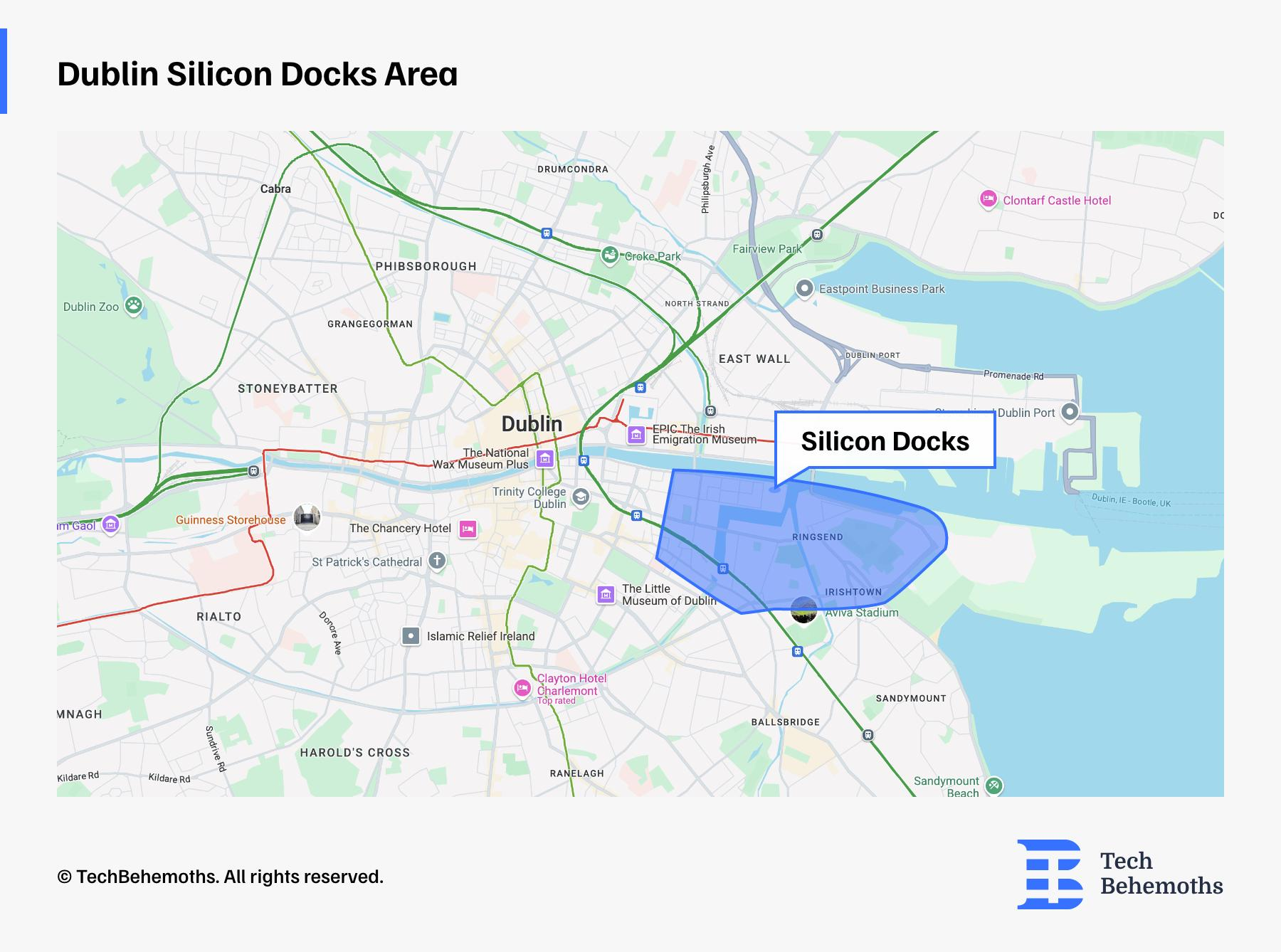
View attachment 5065100View attachment 5065101View attachment 5065103View attachment 5065104

Ireland is not the US with euro signs. Ireland is a small, high-income, high-tax, housing-constrained, reputation-heavy economy where tax-aware ownership beats raw income.

The formula:

scarce skill → high income → low lifestyle drag → pension/PPR/business equity/direct equity → better rooms → reputation → scale

Labour gets you in. Capital moves you up. Reputation keeps you there.

1. The Irish class ladder is tax-shaped​


In Ireland, the “class jump” is not just earning more. PAYE income gets compressed quickly by income tax, USC and PRSI. For a single person in 2026, the standard income-tax band is €44,000 at 20%, with income above that taxed at 40%; USC rises to 8% above €70,044; employee PRSI is 4.2%, rising to 4.35% from October 2026. That puts a high-earning employee’s top marginal drag around 52%+ before pension planning.

View attachment 5065113

Rule: do not build your whole plan around post-tax salary. Build around salary converted into assets through the most favourable Irish channels.

2. First scoreboard: where Ireland rewards you​


Ireland rewards five things:


LeverIrish version
Scarce skillICT, finance, engineering, pharma/biotech, construction, healthcare, law/accounting, B2B sales
Tax shelterPension, employer pension, PPR relief, business reliefs
OwnershipPPR, pension assets, direct shares, investment trusts, trading company equity
GeographyDublin for labour/network; regional arbitrage for housing/spread
TrustSmall-country reputation compounds hard

The Central Bank says Irish household wealth reached €1.34 trillion in Q3 2025, housing represented 67.7% of total net wealth, and the top 10% held 49.2% of national net wealth. The rich are not mostly “better savers”; they hold appreciating assets.


3. Raise the price of your hour first​


CSO 2024 data shows median annual earnings across all sectors were €44,816. But sector choice dominates. Information and Communication had median annual earnings of €80,147; Financial, Insurance and Real Estate was €59,023; Public Administration and Defence was €56,745; Accommodation and Food was €26,000.
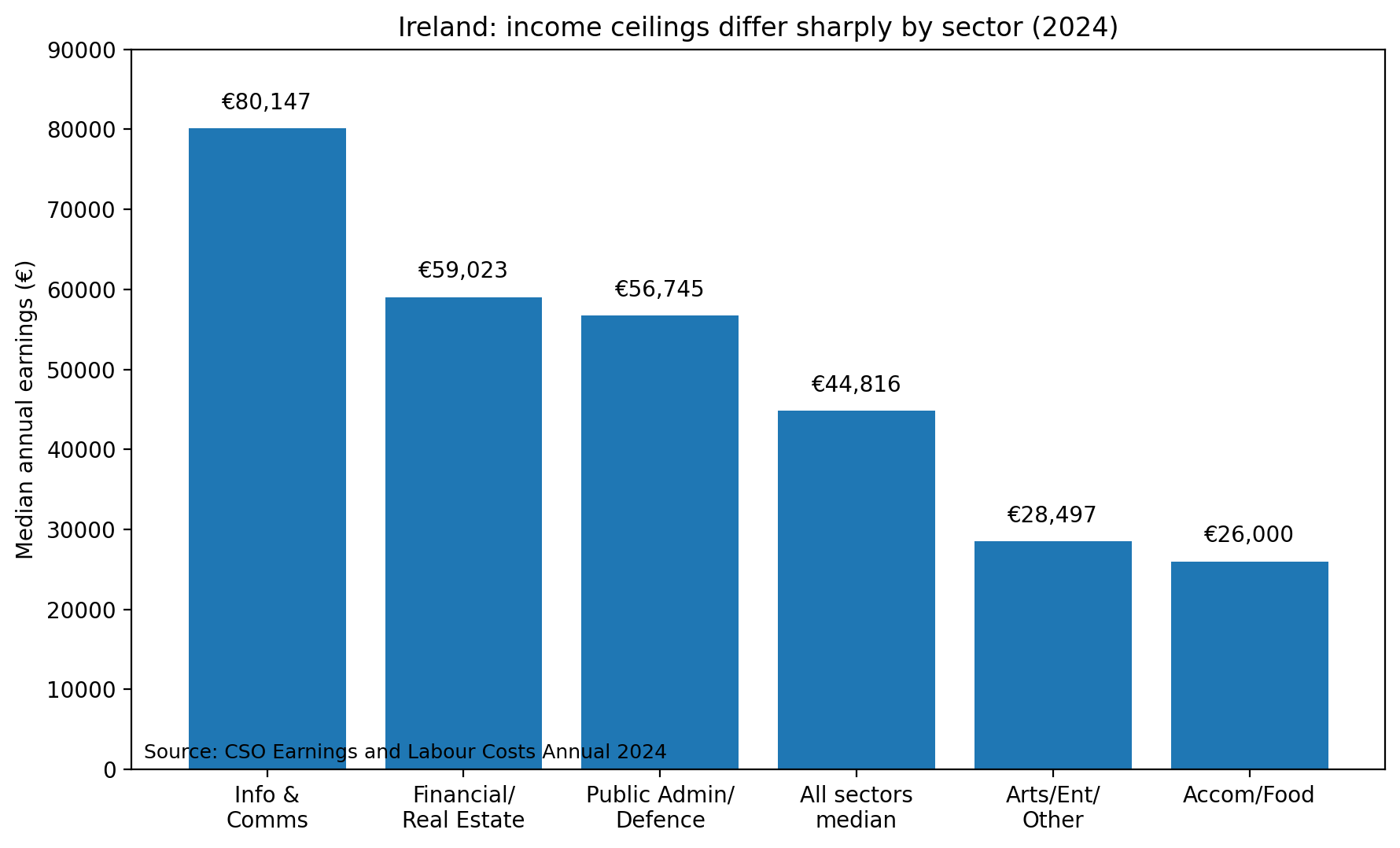

View attachment 5065121


Target sectors with ceiling, portability and credential leverage:


LaneWhy it works in Ireland
Software/data/AI/cybersecurityMultinationals, remote leverage, high salaries, equity/RSUs
Finance/accounting/tax/actuarialIreland is a funds, insurance and multinational tax hub
Pharma/biotech/medtechCork, Limerick, Galway, Dublin corridor; regulated high-skill work
Engineering/construction managementHousing/infrastructure shortage creates durable demand
Healthcare leadershipAgeing population + structural shortages
B2B sales/customer successHigh upside without needing elite credentials
Law/compliance/riskRegulation creates high-trust, high-fee work
Skilled trades with business pathEmployee ceiling lower; contractor/employer ceiling much higher

SOLAS identifies future challenges and demand pressure across construction, science and engineering, ICT, health, business and finance, and education; it also notes that Ireland’s high-skilled employment growth has been driven heavily by workers with NFQ level 8 or above qualifications.


4. Do not “get educated.” Buy income power.​


Education is not automatically status mobility. It is only good when it buys one of these:


higher earnings, a protected credential, access to better employers, international mobility, or trust.


CSO graduate outcomes show median weekly earnings one year after graduation for 2022 graduates were €625, but field choice mattered: Education graduates earned €815/week, Health and Welfare €775/week, ICT €765/week, while Arts and Humanities earned €470/week.


Decision rule:


Expected annual income gain ÷ total cost of degree/time = credential quality


Good Ireland credentials:


RouteGood when
Accounting qualificationYou want corporate finance, tax, audit, CFO track, business credibility
Software/data/cyber cert + portfolioYou can prove skill with projects, not just paper
Engineering/construction qualificationYou want site management, QS, infrastructure, energy, property
Medicine/healthcareYou accept long training for protected income
LawYou can get into commercial, tax, corporate, funds, property, litigation
MBAOnly when it gets access to better employers/network, not vague “leadership”
Trade apprenticeshipBest if the endgame is contracting/business ownership

Bad credential pattern:
borrow money + lose years + enter a low-ceiling field + call it ambition.


5. Ireland’s income trap: high salary without ownership​


A €100k PAYE salary is strong, but not enough to become upper class if it turns into rent, car payments, restaurants, holidays and idle cash.


A high earner in Ireland needs a conversion system:


gross income → pension/PPR/business/equity → compounding


Without that, the tax system and housing costs eat the spread.


6. Asset order for Ireland​


Use this order unless your situation clearly breaks it:


OrderAsset/actionWhy
1Emergency cashIreland has high housing/job-transition costs
2Kill high-interest debtGuaranteed return; anti-compounding removed
3Employer pension matchFree money + tax shelter
4AVC/PRSA/pension contributionsBest mainstream wrapper for high-rate taxpayers
5PPR deposit/mathPPR relief is one of Ireland’s cleanest tax advantages
6Direct shares/investment trustsMore tax-control than UCITS ETFs, but more complexity
7Business equityReal class jump happens here
8BTL/property projectsOnly if yield survives tax, leverage, regulation and vacancy
9Concentrated/speculative betsOnly after base is secure

CSO household wealth data shows owner-occupiers had median net wealth of €391,600, renters had €10,200, and the national median household net wealth was €256,900 in 2023.
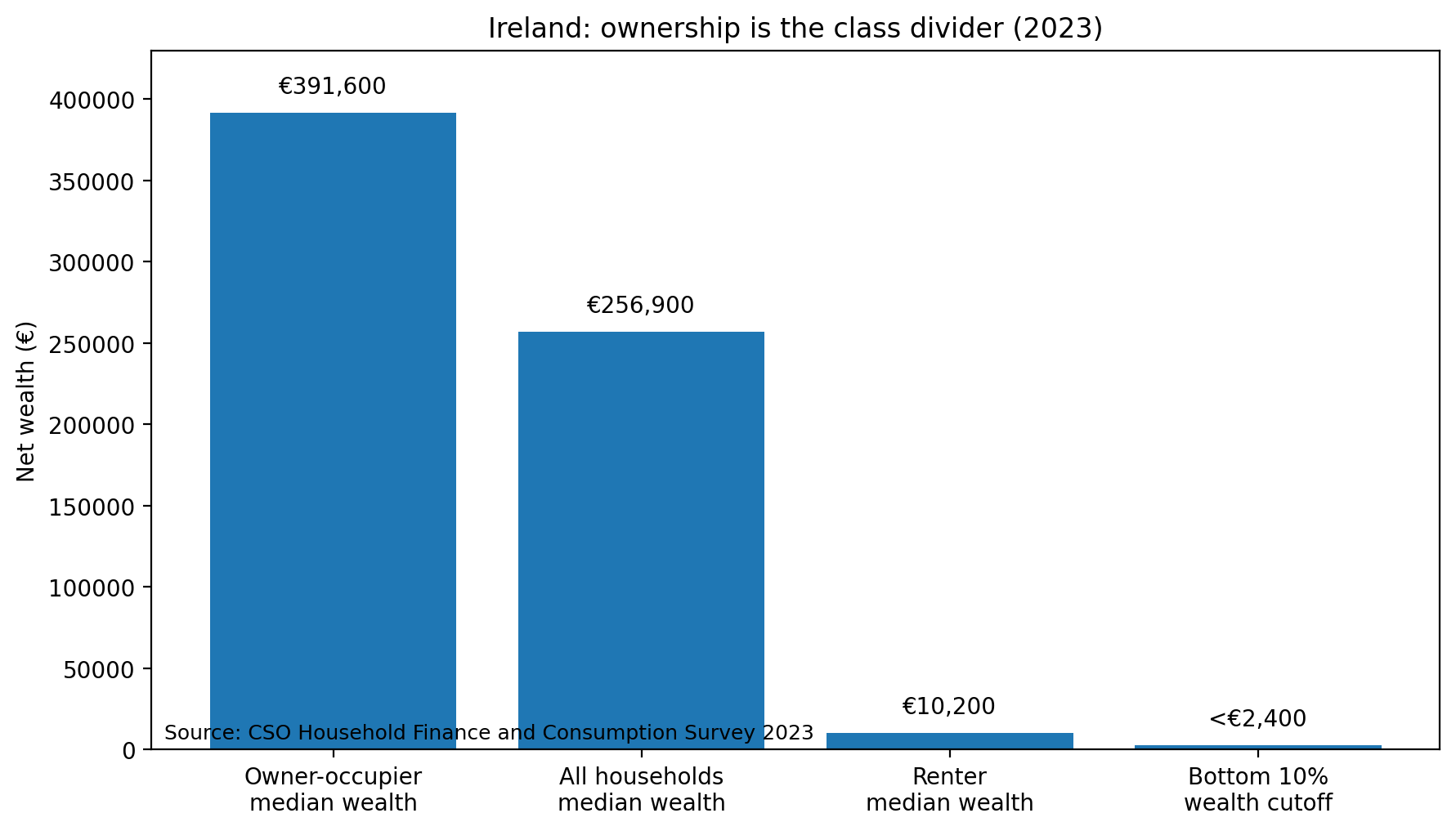
View attachment 5065125

7. Pensions are the cleanest mass-market compounding machine​


For Irish high earners, pensions are not boring. They are the first serious wealth wrapper.


Revenue’s age-related tax-relievable pension contribution limits are:


AgeMax % of net relevant earnings
Under 3015%
30–3920%
40–4925%
50–5430%
55–5935%
60+40%

The earnings cap for tax relief is €115,000, and employer contributions do not count against the employee’s age-related contribution limit.


Principle:


If you pay 40% income tax, pension contributions are usually the first legal place to move labour income into capital.


Pension weaknesses:


WeaknessMeaning
Locked until retirement rules allow accessBad for short-term liquidity
Policy riskRules can change
Drawdown taxNot tax-free forever
Overconcentration riskBad pension fund choices can destroy the wrapper advantage

Still, for PAYE workers, pension is usually the cleanest “labour → capital” bridge.


8. PPR is Ireland’s most important middle-class tax shelter​


Principal Private Residence relief is huge. Revenue says a PPR is a house or apartment you own and occupy as your only or main residence. If you dispose of a property that was your main residence for the full period and used as your home, the gain can be CGT-exempt; the final 12 months are also treated as occupation.


This is why Irish wealth is housing-heavy.


But the move is not “buy any house.” The move is:


buy optionality, not identity.


Good PPR:


FeatureWhy it matters
Near strong labour marketKeeps income high
Rentable room/spaceOptional cashflow
Transport linksResale + career flexibility
Expandable/renovatableForced appreciation
Good schools/amenitiesSocial-class persistence
Sensible mortgagePrevents house-poverty

Bad PPR:


FeatureProblem
Max mortgage in weak locationTraps labour mobility
Status house too earlyKills investment spread
No emergency fund after purchaseFragile
Commute destroys energyLower career output
“Forever home” thinking at 28Overcommits before life is stable


9. The mortgage constraint is the real Irish class gate​


The Central Bank’s mortgage rules allow first-time buyers to borrow up to 4x gross income, second/subsequent buyers 3.5x, with a 10% deposit for PPR buyers and 30% deposit for buy-to-let.


So a couple on €100k gross can usually target around:


€400k mortgage + deposit


CSO says the national median dwelling price for the 12 months to March 2026 was €390,461; Dublin was €500,000; Dún Laoghaire-Rathdown was €685,000; Donegal and Longford were €200,000.
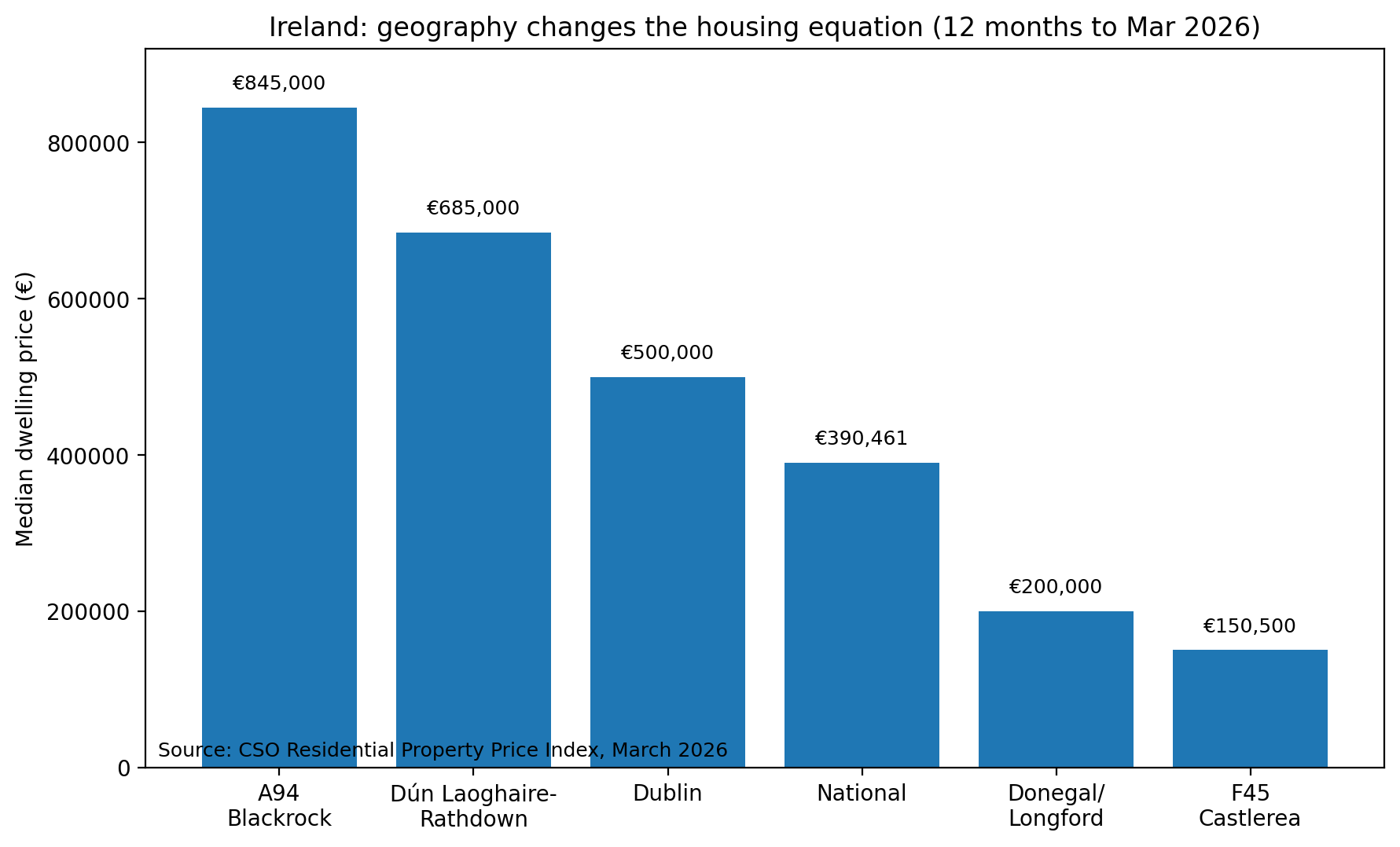
View attachment 5065131

The brutal truth:
dual income, sector choice and geography decide housing access.


10. Use Help to Buy/FHS carefully​


Help to Buy can provide up to €30,000, limited by 10% of the purchase/valuation or income tax and DIRT paid over the previous four years; USC and PRSI do not count. The enhanced scheme is listed through 2029.


The First Home Scheme is shared equity. It can fund up to 30% of the price/build cost, reduced to 20% if Help to Buy is also used, and service charges begin from year six.


Correct use: bridge a rational purchase.
Incorrect use: stretch into a house that eats your life.


11. Rent-a-room is underrated​


Revenue’s Rent-a-Room Relief lets an individual receive up to €14,000 a year from letting a room in their home tax-free; if income exceeds the limit, the total amount is taxable.


For a young owner-occupier, this can be powerful:
PPR relief + mortgage amortisation + optional tax-free room income
That is a real Irish-specific mobility lever.

12. ETFs are not treated like Americans expect​


This is where Ireland differs sharply from the US.


Revenue guidance on equivalent offshore funds says income and gains are generally taxed at 38% from 2026, deemed disposal applies every eight years, and losses generally cannot be used for CGT or other loss relief.

William Fry notes that EU-domiciled ETFs are generally taxed similarly to Irish funds, including the eight-year deemed disposal regime. It also notes that US ETFs are generally outside the offshore-fund regime and are normally subject to income tax/USC/PRSI on distributions and CGT on realised gains, but access, regulation, US estate tax and product availability complicate this.

Illustration only: €10,000 at 7% for 24 years.
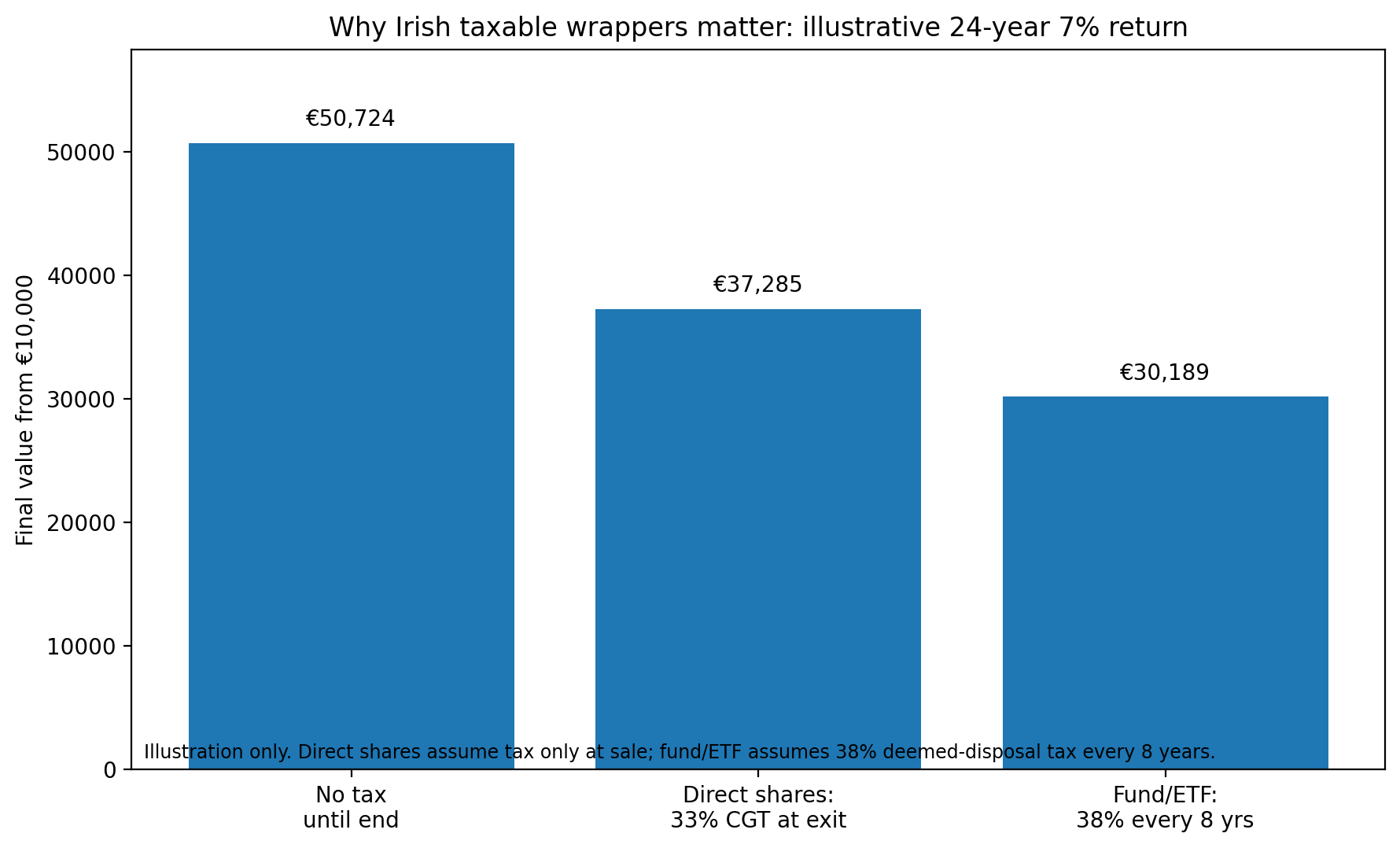
View attachment 5065146

The point is not the exact return. The point is structure.

13. Direct shares vs ETFs vs investment trusts​


Ireland’s taxable investing hierarchy is weird.


AssetTypical Irish tax issue
UCITS ETF / many fundsExit tax/deemed disposal regime; loss restrictions
Direct sharesDividends taxed as income; gains usually CGT at 33%; annual €1,270 personal CGT exemption
UK investment trustsOften analysed as company shares rather than funds, but classification is fact-specific
US ETFsOften normal income/CGT treatment, but access and US estate-tax risk matter
PensionsUsually best wrapper, but locked
PPRCGT relief if conditions met
Trading company equityPotential entrepreneur relief / business sale upside

CGT is generally 33%, and individuals have a €1,270 annual CGT exemption.


14. Investment trusts: JAM, SMT, etc.​


JAM and SMT are not “trusts” in the private-family-trust sense. They are listed investment trusts: closed-ended investment companies.


Why Irish investors look at them:


FeatureWhy it attracts Irish investors
Listed company formMay be taxed more like shares than UCITS ETFs
No automatic UCITS ETF deemed-disposal treatment if outside fund regimePotential tax-control advantage
Diversified exposureEasier than picking 50 stocks
CGT timingYou may control realisation timing

Risks:


RiskMeaning
Classification riskRevenue treatment depends on facts, not vibes
Active-manager riskJAM/SMT are not neutral index trackers
Premium/discount riskInvestment trusts can trade away from NAV
Gearing riskBorrowing can amplify losses
Concentration/style riskSMT especially can be volatile
UK stamp duty/FXFriction costs matter

KPMG notes that open-ended funds and variable-capital companies are more likely to create a “material interest” offshore fund issue, while closed-ended funds or vehicles with maturity beyond seven years are less likely; but this is fact-specific.

Rule:
Investment trusts can be a useful Irish taxable account tool, not a magic cheat code.
Before allocating serious money, confirm the tax classification from the prospectus, structure and a competent Irish tax adviser.


15. Do not over-hoard cash​


Irish households save a lot. CSO says the household saving rate was 14.8% in Q3 2025, about €1 in €7 of disposable income.


But the Central Bank says Ireland has among the lowest levels of direct retail participation in EU capital markets, with households tending to hold wealth in property, life assurance and pensions; wealthier households dominate capital-market participation.

Cash is for optionality and safety.
Cash is not a long-term class ladder.

16. Business ownership is the real class jump​


Employee income is capped by salary bands. Business income is capped by market size, pricing, systems and hiring.


Ireland’s tax system rewards real trading businesses more than passive wrappers. Revenue lists Corporation Tax at 12.5% for trading income and 25% for non-trading income such as investment/rental income.

But do not confuse “company” with “tax-free.” Close companies can face a 20% surcharge on undistributed after-tax estate and investment income if not distributed within 18 months.


Best business paths in Ireland:


PathWhy it works
B2B consultingLow capital, high trust, fast cashflow
Agency → productised serviceScales beyond your hours
Software/SaaSExportable, high margin
Specialist trades contractorHousing/infrastructure demand
Medical/dental/accounting/legal practiceProtected trust + recurring demand
Property servicesIreland’s housing system creates constant friction
Compliance/regulatory servicesComplex rules create fee pools
Niche recruitingHigh-value talent shortage
Training/upskillingAI and regulation force reskilling
B2B sales brokerageCommission upside without heavy capital

The jump is:
self-employed worker → owner-operator → employer → asset owner


17. Entrepreneur relief matters​


Revenue’s Revised Entrepreneur Relief gives a 10% CGT rate on gains from qualifying business assets, reduced from the standard 33%. The lifetime limit is €1,500,000 for gains arising on or after 1 January 2026. It generally requires ownership of qualifying business assets for a continuous three-year period and excludes passive investment assets, development land, and land letting

his is why building a saleable trading company can beat decades of salary optimisation.


Simplified example:


Exit gainNormal CGT at 33%Entrepreneur relief at 10%
€500,000€165,000€50,000
€1,000,000€330,000€100,000
€1,500,000€495,000€150,000

That gap is class mobility.

18. Buy-to-let is not PPR​


A PPR is tax-advantaged. A rental property is a business/investment exposed to tax, leverage, regulation, maintenance and vacancy.


BTL can work, but not with lazy maths.


BTL checklist:


QuestionRequired answer
Does rent cover mortgage, tax, insurance, repairs and vacancy?Yes
Is the gross yield strong enough after Irish tax?Yes
Is there forced appreciation?Renovation, planning, conversion, under-market buy
Can you survive a bad tenant/non-payment period?Yes
Is leverage fixed/controlled?Yes
Are you buying below replacement value?Ideally

Most bad BTL investors buy because “property always goes up.” That is not investing. That is national folklore with leverage.


19. Geography: use Dublin, but do not worship it​


Dublin has the strongest concentration of high-income roles, multinationals, finance, tech, law, advisory, startups and elite networks. But Dublin housing can destroy the spread.


Ireland geography strategy:


LocationBest use
DublinCareer acceleration, network, top salaries
CorkPharma, tech, finance, engineering
GalwayMedtech, software, quality/regulatory
Limerick/ShannonEngineering, aviation, pharma, lower housing cost
WaterfordLower-cost base with improving regional opportunity
Kildare/Meath/Wicklow/LouthCommuter arbitrage
Remote regionalGood only if income remains high

Correct model:

earn in a high-income market, live where the spread survives.


20. Network: Ireland is small, so reputation compounds brutally​


In the US, you can burn rooms and move cities. In Ireland, weak reputation follows faster.


High-status Irish rooms are often understated. Do not peacock. Be competent, useful, discreet and reliable.


Better rooms:


RoomWhy it helps
Multinational teamsHigh standards, mobility, referrals
Professional bodiesChartered Accountant, CFA, SCSI, Engineers Ireland, Law Society
Founder/operator circlesDeals, talent, capital
Property/construction circlesLand, planning, contractors, funding
Alumni networksQuiet access
High-skill sport/social clubsTrust formation
Angel/startup ecosystemEarly equity access
Industry conferencesWeak alone, strong with follow-up

Rule:


In Ireland, social class is partly balance sheet, partly accent/education, partly address, but heavily reputation.


21. Partner choice is economic strategy​


This is uncomfortable but true.


A disciplined dual-income couple can buy, invest and absorb shocks. One chaotic partner can erase ten years of progress.


CSO SILC 2025 data shows households with three or more people at work had median nominal household disposable income of €106,524, while households with nobody at work had €33,105. Owner-occupied households had median nominal disposable income of €71,338, compared with €47,599 for rented/rent-free households.

Screen for:


TraitWhy
Low debt chaosPrevents fragility
Career seriousnessRaises household borrowing/investing power
Similar spending valuesProtects spread
Emotional stabilityProtects execution
Family expectations understoodPrevents hidden financial obligations
Long-term orientationClass mobility is slow


22. Children: class persists through environment​


For children, the assets are:

stable home, language, discipline, school quality, peer group, sport/music/social confidence, parental network, inheritance planning.

In Ireland, PPR location often doubles as education strategy. But do not overpay for status schooling while destroying your balance sheet. A child with calm parents, books, sport, maths, social confidence and a stable home beats a child with private-school cosplay and broke parents.


23. Inheritance and family wealth planning​

CAT matters because intergenerational wealth is a class escalator.

Current CAT thresholds are:

GroupTypical relationshipThreshold
AChild€400,000
BSibling, niece/nephew, grandchild, etc.€40,000
CStranger/cousin/in-law/friend€20,000

CAT applies above the threshold at 33%.

The small gift exemption allows gifts of up to €3,000 per disponer per calendar year to be CAT-exempt and not counted for aggregation.

Use this early. Compounding needs time.


24. Private trusts are not the first ladder rung​


For most Irish people, private trusts are not the answer. They add legal cost, tax complexity and reporting. Use:

pensions, wills, life cover, PPR planning, small gifts, business succession, shareholder agreements

before reaching for trust structures.

Investment trusts like JAM/SMT are a completely different category: listed investment companies used for market exposure, not family estate planning.


25. The Irish tax map​


Asset/income typeBroad treatmentStrategic meaning
PAYE salaryIncome tax + USC + PRSINeeded, but compressed
Pension contributionIncome-tax relief within limitsFirst major wrapper
PPR gainPotential CGT reliefHuge Irish advantage
Direct sharesDividends income-taxed; gains usually CGTTax timing/control
UCITS ETFs/fundsExit tax/deemed disposal regimeSimple product, ugly tax drag
Investment trustsFact-specific; may be share-likeUseful but verify
Trading company12.5% CT on trading incomeGood for scaling business
Passive company income25% CT + possible surchargeNot a simple ETF wrapper
BTL propertyRental income taxed; CGT on gainsMust be yield-positive
Business salePossible 10% entrepreneur reliefMajor wealth event
Gifts/inheritanceCAT thresholds + small gift exemptionFamily planning matters


26. Avoid these Irish class traps​


TrapWhy it kills mobility
Maxing mortgage too earlyTurns income into survival
Cash hoarding foreverSafety becomes stagnation
ETF ignoranceDeemed disposal/tax drag surprises
Status car/PCPConverts capital into depreciation
Wedding/status spendingOne-year optics, decade-long opportunity cost
Low-ceiling loyaltyIreland rewards trusted competence, not blind loyalty
Overstaying low-growth public/private rolesStability can become ceiling
BTL with weak yieldTax + repairs + leverage eat you
Employer RSU concentrationJob and portfolio risk become same risk
Lifestyle inflation after first big salaryThe spread disappears
“Dublin or nothing”High income can be neutralised by housing
“Cheap region only”Low cost is useless if opportunity vanishes
Company-as-tax-hack thinkingClose-company/passive-income rules bite
Crypto as main planSpeculation is not class strategy


27. The correct Ireland execution plan​


Days 1–3: balance sheet audit​


Write down:


ItemTarget
Gross incomeCurrent
Net incomeCurrent
Rent/mortgage% of net income
Debt APRsHighest first
Pension contributionsEmployer + employee
CashMonths of expenses
Taxable investmentsAmount + structure
SkillsCurrent market price
NetworkPeople 2 levels above you


Days 4–7: stop leakage​

Cut one major recurring cost.
Kill or refinance the highest-APR debt.
Check pension match.
Check tax credits.
Stop idle subscriptions/status spending.

Days 8–14: choose income lane​


Pick one:


Starting pointMove
Low-income graduateICT/data/accounting/sales/engineering route
Mid-career professionalSpecialise into higher-fee niche
Public-sector workerAdd private-market skill or consulting path
Trade workerMove toward contractor/business ownership
Tech workerMove toward AI/data/security/product/customer-facing leverage
Finance/accounting workerMove toward advisory, tax, deals, CFO, funds
Healthcare workerMove toward scarce specialty/management/private practice

Days 15–30: force market feedback​


Do:


ActionNumber
Higher-paid job applications20
Recruiter conversations5
Coffee calls with people 2 levels above5
Portfolio/project/client proof pieces2
Pension/investment setup actions1
Spending cuts automated1


28. Twelve-month target​


MetricTarget
Income+15–30%
Pension contributionmaximised to rational level
Savings/investment rate20–40% of gross if living at home/low rent; 10–25% if renting/buying
Debtno high-interest consumer debt
Skillone monetisable scarce skill
Network25 useful high-quality relationships
Housingeither rational PPR path or deliberate rent/invest plan
Businessone side cashflow or equity path
Net worthtracked monthly


29. Five-year target​


AreaGoal
IncomeTop-quartile in chosen field
HousingPPR owned or clear high-income alternative
Pensionserious compounding base
Taxable assetsdirect shares/investment trusts/business equity, tax-aware
Businessownership stake, consulting income, or scalable side asset
Networkpeople who hire, invest, refer, advise
Reputationknown for competence and reliability
Optionalitycan move city, change job, start company, or buy asset without panic


30. Final rule​


In Ireland, the ladder is:

skill → salary → spread → pension/PPR → direct equity/business → reputation → scale

If your life is:

PAYE income + rent + cash + consumption

you stay exposed.


If your life becomes:

scarce skill + tax-aware investing + PPR/pension + business equity + better rooms

you have a real shot at moving class.


Capital beats labour.
But in Ireland,
tax-aware capital beats naive capital.

Bump mirin thread
 
  • Love it
Reactions: Seth Walsh
Bump mirin thread
Much love man, thank you.

This is a thread I'll personally be going back to ngl. It's rare I bookmark anything, but I did with this haha
 
  • +1
Reactions: yex
Great, I've always wanted to do that
 
  • Woah
Reactions: Seth Walsh
Great, I've always wanted to do that
Refer to the steps as if it's a textbook.

This is Ireland specific. Doesn't translate at all elsewhere. I'm pretty sure I made a US version too but it was way less effort.
 
BUMP

This is pure gold.
 
@6ft4 @jester patell @anythingtobenormal @TheAncientMacedonia

View attachment 5065100View attachment 5065101View attachment 5065103View attachment 5065104

Ireland is not the US with euro signs. Ireland is a small, high-income, high-tax, housing-constrained, reputation-heavy economy where tax-aware ownership beats raw income.

The formula:

scarce skill → high income → low lifestyle drag → pension/PPR/business equity/direct equity → better rooms → reputation → scale

Labour gets you in. Capital moves you up. Reputation keeps you there.

1. The Irish class ladder is tax-shaped​


In Ireland, the “class jump” is not just earning more. PAYE income gets compressed quickly by income tax, USC and PRSI. For a single person in 2026, the standard income-tax band is €44,000 at 20%, with income above that taxed at 40%; USC rises to 8% above €70,044; employee PRSI is 4.2%, rising to 4.35% from October 2026. That puts a high-earning employee’s top marginal drag around 52%+ before pension planning.

View attachment 5065113

Rule: do not build your whole plan around post-tax salary. Build around salary converted into assets through the most favourable Irish channels.

2. First scoreboard: where Ireland rewards you​


Ireland rewards five things:


LeverIrish version
Scarce skillICT, finance, engineering, pharma/biotech, construction, healthcare, law/accounting, B2B sales
Tax shelterPension, employer pension, PPR relief, business reliefs
OwnershipPPR, pension assets, direct shares, investment trusts, trading company equity
GeographyDublin for labour/network; regional arbitrage for housing/spread
TrustSmall-country reputation compounds hard

The Central Bank says Irish household wealth reached €1.34 trillion in Q3 2025, housing represented 67.7% of total net wealth, and the top 10% held 49.2% of national net wealth. The rich are not mostly “better savers”; they hold appreciating assets.


3. Raise the price of your hour first​


CSO 2024 data shows median annual earnings across all sectors were €44,816. But sector choice dominates. Information and Communication had median annual earnings of €80,147; Financial, Insurance and Real Estate was €59,023; Public Administration and Defence was €56,745; Accommodation and Food was €26,000.


View attachment 5065121


Target sectors with ceiling, portability and credential leverage:


LaneWhy it works in Ireland
Software/data/AI/cybersecurityMultinationals, remote leverage, high salaries, equity/RSUs
Finance/accounting/tax/actuarialIreland is a funds, insurance and multinational tax hub
Pharma/biotech/medtechCork, Limerick, Galway, Dublin corridor; regulated high-skill work
Engineering/construction managementHousing/infrastructure shortage creates durable demand
Healthcare leadershipAgeing population + structural shortages
B2B sales/customer successHigh upside without needing elite credentials
Law/compliance/riskRegulation creates high-trust, high-fee work
Skilled trades with business pathEmployee ceiling lower; contractor/employer ceiling much higher

SOLAS identifies future challenges and demand pressure across construction, science and engineering, ICT, health, business and finance, and education; it also notes that Ireland’s high-skilled employment growth has been driven heavily by workers with NFQ level 8 or above qualifications.


4. Do not “get educated.” Buy income power.​


Education is not automatically status mobility. It is only good when it buys one of these:


higher earnings, a protected credential, access to better employers, international mobility, or trust.


CSO graduate outcomes show median weekly earnings one year after graduation for 2022 graduates were €625, but field choice mattered: Education graduates earned €815/week, Health and Welfare €775/week, ICT €765/week, while Arts and Humanities earned €470/week.


Decision rule:


Expected annual income gain ÷ total cost of degree/time = credential quality


Good Ireland credentials:


RouteGood when
Accounting qualificationYou want corporate finance, tax, audit, CFO track, business credibility
Software/data/cyber cert + portfolioYou can prove skill with projects, not just paper
Engineering/construction qualificationYou want site management, QS, infrastructure, energy, property
Medicine/healthcareYou accept long training for protected income
LawYou can get into commercial, tax, corporate, funds, property, litigation
MBAOnly when it gets access to better employers/network, not vague “leadership”
Trade apprenticeshipBest if the endgame is contracting/business ownership

Bad credential pattern:
borrow money + lose years + enter a low-ceiling field + call it ambition.


5. Ireland’s income trap: high salary without ownership​


A €100k PAYE salary is strong, but not enough to become upper class if it turns into rent, car payments, restaurants, holidays and idle cash.


A high earner in Ireland needs a conversion system:


gross income → pension/PPR/business/equity → compounding


Without that, the tax system and housing costs eat the spread.


6. Asset order for Ireland​


Use this order unless your situation clearly breaks it:


OrderAsset/actionWhy
1Emergency cashIreland has high housing/job-transition costs
2Kill high-interest debtGuaranteed return; anti-compounding removed
3Employer pension matchFree money + tax shelter
4AVC/PRSA/pension contributionsBest mainstream wrapper for high-rate taxpayers
5PPR deposit/mathPPR relief is one of Ireland’s cleanest tax advantages
6Direct shares/investment trustsMore tax-control than UCITS ETFs, but more complexity
7Business equityReal class jump happens here
8BTL/property projectsOnly if yield survives tax, leverage, regulation and vacancy
9Concentrated/speculative betsOnly after base is secure

CSO household wealth data shows owner-occupiers had median net wealth of €391,600, renters had €10,200, and the national median household net wealth was €256,900 in 2023.
View attachment 5065125

7. Pensions are the cleanest mass-market compounding machine​


For Irish high earners, pensions are not boring. They are the first serious wealth wrapper.


Revenue’s age-related tax-relievable pension contribution limits are:


AgeMax % of net relevant earnings
Under 3015%
30–3920%
40–4925%
50–5430%
55–5935%
60+40%

The earnings cap for tax relief is €115,000, and employer contributions do not count against the employee’s age-related contribution limit.


Principle:


If you pay 40% income tax, pension contributions are usually the first legal place to move labour income into capital.


Pension weaknesses:


WeaknessMeaning
Locked until retirement rules allow accessBad for short-term liquidity
Policy riskRules can change
Drawdown taxNot tax-free forever
Overconcentration riskBad pension fund choices can destroy the wrapper advantage

Still, for PAYE workers, pension is usually the cleanest “labour → capital” bridge.


8. PPR is Ireland’s most important middle-class tax shelter​


Principal Private Residence relief is huge. Revenue says a PPR is a house or apartment you own and occupy as your only or main residence. If you dispose of a property that was your main residence for the full period and used as your home, the gain can be CGT-exempt; the final 12 months are also treated as occupation.


This is why Irish wealth is housing-heavy.


But the move is not “buy any house.” The move is:


buy optionality, not identity.


Good PPR:


FeatureWhy it matters
Near strong labour marketKeeps income high
Rentable room/spaceOptional cashflow
Transport linksResale + career flexibility
Expandable/renovatableForced appreciation
Good schools/amenitiesSocial-class persistence
Sensible mortgagePrevents house-poverty

Bad PPR:


FeatureProblem
Max mortgage in weak locationTraps labour mobility
Status house too earlyKills investment spread
No emergency fund after purchaseFragile
Commute destroys energyLower career output
“Forever home” thinking at 28Overcommits before life is stable


9. The mortgage constraint is the real Irish class gate​


The Central Bank’s mortgage rules allow first-time buyers to borrow up to 4x gross income, second/subsequent buyers 3.5x, with a 10% deposit for PPR buyers and 30% deposit for buy-to-let.


So a couple on €100k gross can usually target around:


€400k mortgage + deposit


CSO says the national median dwelling price for the 12 months to March 2026 was €390,461; Dublin was €500,000; Dún Laoghaire-Rathdown was €685,000; Donegal and Longford were €200,000.

View attachment 5065131

The brutal truth:
dual income, sector choice and geography decide housing access.


10. Use Help to Buy/FHS carefully​


Help to Buy can provide up to €30,000, limited by 10% of the purchase/valuation or income tax and DIRT paid over the previous four years; USC and PRSI do not count. The enhanced scheme is listed through 2029.


The First Home Scheme is shared equity. It can fund up to 30% of the price/build cost, reduced to 20% if Help to Buy is also used, and service charges begin from year six.


Correct use: bridge a rational purchase.
Incorrect use: stretch into a house that eats your life.


11. Rent-a-room is underrated​


Revenue’s Rent-a-Room Relief lets an individual receive up to €14,000 a year from letting a room in their home tax-free; if income exceeds the limit, the total amount is taxable.


For a young owner-occupier, this can be powerful:
PPR relief + mortgage amortisation + optional tax-free room income
That is a real Irish-specific mobility lever.

12. ETFs are not treated like Americans expect​


This is where Ireland differs sharply from the US.


Revenue guidance on equivalent offshore funds says income and gains are generally taxed at 38% from 2026, deemed disposal applies every eight years, and losses generally cannot be used for CGT or other loss relief.

William Fry notes that EU-domiciled ETFs are generally taxed similarly to Irish funds, including the eight-year deemed disposal regime. It also notes that US ETFs are generally outside the offshore-fund regime and are normally subject to income tax/USC/PRSI on distributions and CGT on realised gains, but access, regulation, US estate tax and product availability complicate this.

Illustration only: €10,000 at 7% for 24 years.
View attachment 5065146

The point is not the exact return. The point is structure.

13. Direct shares vs ETFs vs investment trusts​


Ireland’s taxable investing hierarchy is weird.


AssetTypical Irish tax issue
UCITS ETF / many fundsExit tax/deemed disposal regime; loss restrictions
Direct sharesDividends taxed as income; gains usually CGT at 33%; annual €1,270 personal CGT exemption
UK investment trustsOften analysed as company shares rather than funds, but classification is fact-specific
US ETFsOften normal income/CGT treatment, but access and US estate-tax risk matter
PensionsUsually best wrapper, but locked
PPRCGT relief if conditions met
Trading company equityPotential entrepreneur relief / business sale upside

CGT is generally 33%, and individuals have a €1,270 annual CGT exemption.


14. Investment trusts: JAM, SMT, etc.​


JAM and SMT are not “trusts” in the private-family-trust sense. They are listed investment trusts: closed-ended investment companies.


Why Irish investors look at them:


FeatureWhy it attracts Irish investors
Listed company formMay be taxed more like shares than UCITS ETFs
No automatic UCITS ETF deemed-disposal treatment if outside fund regimePotential tax-control advantage
Diversified exposureEasier than picking 50 stocks
CGT timingYou may control realisation timing

Risks:


RiskMeaning
Classification riskRevenue treatment depends on facts, not vibes
Active-manager riskJAM/SMT are not neutral index trackers
Premium/discount riskInvestment trusts can trade away from NAV
Gearing riskBorrowing can amplify losses
Concentration/style riskSMT especially can be volatile
UK stamp duty/FXFriction costs matter

KPMG notes that open-ended funds and variable-capital companies are more likely to create a “material interest” offshore fund issue, while closed-ended funds or vehicles with maturity beyond seven years are less likely; but this is fact-specific.

Rule:
Investment trusts can be a useful Irish taxable account tool, not a magic cheat code.
Before allocating serious money, confirm the tax classification from the prospectus, structure and a competent Irish tax adviser.


15. Do not over-hoard cash​


Irish households save a lot. CSO says the household saving rate was 14.8% in Q3 2025, about €1 in €7 of disposable income.


But the Central Bank says Ireland has among the lowest levels of direct retail participation in EU capital markets, with households tending to hold wealth in property, life assurance and pensions; wealthier households dominate capital-market participation.

Cash is for optionality and safety.
Cash is not a long-term class ladder.

16. Business ownership is the real class jump​


Employee income is capped by salary bands. Business income is capped by market size, pricing, systems and hiring.


Ireland’s tax system rewards real trading businesses more than passive wrappers. Revenue lists Corporation Tax at 12.5% for trading income and 25% for non-trading income such as investment/rental income.

But do not confuse “company” with “tax-free.” Close companies can face a 20% surcharge on undistributed after-tax estate and investment income if not distributed within 18 months.


Best business paths in Ireland:


PathWhy it works
B2B consultingLow capital, high trust, fast cashflow
Agency → productised serviceScales beyond your hours
Software/SaaSExportable, high margin
Specialist trades contractorHousing/infrastructure demand
Medical/dental/accounting/legal practiceProtected trust + recurring demand
Property servicesIreland’s housing system creates constant friction
Compliance/regulatory servicesComplex rules create fee pools
Niche recruitingHigh-value talent shortage
Training/upskillingAI and regulation force reskilling
B2B sales brokerageCommission upside without heavy capital

The jump is:
self-employed worker → owner-operator → employer → asset owner


17. Entrepreneur relief matters​


Revenue’s Revised Entrepreneur Relief gives a 10% CGT rate on gains from qualifying business assets, reduced from the standard 33%. The lifetime limit is €1,500,000 for gains arising on or after 1 January 2026. It generally requires ownership of qualifying business assets for a continuous three-year period and excludes passive investment assets, development land, and land letting

his is why building a saleable trading company can beat decades of salary optimisation.


Simplified example:


Exit gainNormal CGT at 33%Entrepreneur relief at 10%
€500,000€165,000€50,000
€1,000,000€330,000€100,000
€1,500,000€495,000€150,000

That gap is class mobility.

18. Buy-to-let is not PPR​


A PPR is tax-advantaged. A rental property is a business/investment exposed to tax, leverage, regulation, maintenance and vacancy.


BTL can work, but not with lazy maths.


BTL checklist:


QuestionRequired answer
Does rent cover mortgage, tax, insurance, repairs and vacancy?Yes
Is the gross yield strong enough after Irish tax?Yes
Is there forced appreciation?Renovation, planning, conversion, under-market buy
Can you survive a bad tenant/non-payment period?Yes
Is leverage fixed/controlled?Yes
Are you buying below replacement value?Ideally

Most bad BTL investors buy because “property always goes up.” That is not investing. That is national folklore with leverage.


19. Geography: use Dublin, but do not worship it​


Dublin has the strongest concentration of high-income roles, multinationals, finance, tech, law, advisory, startups and elite networks. But Dublin housing can destroy the spread.


Ireland geography strategy:


LocationBest use
DublinCareer acceleration, network, top salaries
CorkPharma, tech, finance, engineering
GalwayMedtech, software, quality/regulatory
Limerick/ShannonEngineering, aviation, pharma, lower housing cost
WaterfordLower-cost base with improving regional opportunity
Kildare/Meath/Wicklow/LouthCommuter arbitrage
Remote regionalGood only if income remains high

Correct model:

earn in a high-income market, live where the spread survives.


20. Network: Ireland is small, so reputation compounds brutally​


In the US, you can burn rooms and move cities. In Ireland, weak reputation follows faster.


High-status Irish rooms are often understated. Do not peacock. Be competent, useful, discreet and reliable.


Better rooms:


RoomWhy it helps
Multinational teamsHigh standards, mobility, referrals
Professional bodiesChartered Accountant, CFA, SCSI, Engineers Ireland, Law Society
Founder/operator circlesDeals, talent, capital
Property/construction circlesLand, planning, contractors, funding
Alumni networksQuiet access
High-skill sport/social clubsTrust formation
Angel/startup ecosystemEarly equity access
Industry conferencesWeak alone, strong with follow-up

Rule:


In Ireland, social class is partly balance sheet, partly accent/education, partly address, but heavily reputation.


21. Partner choice is economic strategy​


This is uncomfortable but true.


A disciplined dual-income couple can buy, invest and absorb shocks. One chaotic partner can erase ten years of progress.


CSO SILC 2025 data shows households with three or more people at work had median nominal household disposable income of €106,524, while households with nobody at work had €33,105. Owner-occupied households had median nominal disposable income of €71,338, compared with €47,599 for rented/rent-free households.

Screen for:


TraitWhy
Low debt chaosPrevents fragility
Career seriousnessRaises household borrowing/investing power
Similar spending valuesProtects spread
Emotional stabilityProtects execution
Family expectations understoodPrevents hidden financial obligations
Long-term orientationClass mobility is slow


22. Children: class persists through environment​


For children, the assets are:

stable home, language, discipline, school quality, peer group, sport/music/social confidence, parental network, inheritance planning.

In Ireland, PPR location often doubles as education strategy. But do not overpay for status schooling while destroying your balance sheet. A child with calm parents, books, sport, maths, social confidence and a stable home beats a child with private-school cosplay and broke parents.


23. Inheritance and family wealth planning​

CAT matters because intergenerational wealth is a class escalator.

Current CAT thresholds are:

GroupTypical relationshipThreshold
AChild€400,000
BSibling, niece/nephew, grandchild, etc.€40,000
CStranger/cousin/in-law/friend€20,000

CAT applies above the threshold at 33%.

The small gift exemption allows gifts of up to €3,000 per disponer per calendar year to be CAT-exempt and not counted for aggregation.

Use this early. Compounding needs time.


24. Private trusts are not the first ladder rung​


For most Irish people, private trusts are not the answer. They add legal cost, tax complexity and reporting. Use:

pensions, wills, life cover, PPR planning, small gifts, business succession, shareholder agreements

before reaching for trust structures.

Investment trusts like JAM/SMT are a completely different category: listed investment companies used for market exposure, not family estate planning.


25. The Irish tax map​


Asset/income typeBroad treatmentStrategic meaning
PAYE salaryIncome tax + USC + PRSINeeded, but compressed
Pension contributionIncome-tax relief within limitsFirst major wrapper
PPR gainPotential CGT reliefHuge Irish advantage
Direct sharesDividends income-taxed; gains usually CGTTax timing/control
UCITS ETFs/fundsExit tax/deemed disposal regimeSimple product, ugly tax drag
Investment trustsFact-specific; may be share-likeUseful but verify
Trading company12.5% CT on trading incomeGood for scaling business
Passive company income25% CT + possible surchargeNot a simple ETF wrapper
BTL propertyRental income taxed; CGT on gainsMust be yield-positive
Business salePossible 10% entrepreneur reliefMajor wealth event
Gifts/inheritanceCAT thresholds + small gift exemptionFamily planning matters


26. Avoid these Irish class traps​


TrapWhy it kills mobility
Maxing mortgage too earlyTurns income into survival
Cash hoarding foreverSafety becomes stagnation
ETF ignoranceDeemed disposal/tax drag surprises
Status car/PCPConverts capital into depreciation
Wedding/status spendingOne-year optics, decade-long opportunity cost
Low-ceiling loyaltyIreland rewards trusted competence, not blind loyalty
Overstaying low-growth public/private rolesStability can become ceiling
BTL with weak yieldTax + repairs + leverage eat you
Employer RSU concentrationJob and portfolio risk become same risk
Lifestyle inflation after first big salaryThe spread disappears
“Dublin or nothing”High income can be neutralised by housing
“Cheap region only”Low cost is useless if opportunity vanishes
Company-as-tax-hack thinkingClose-company/passive-income rules bite
Crypto as main planSpeculation is not class strategy


27. The correct Ireland execution plan​


Days 1–3: balance sheet audit​


Write down:


ItemTarget
Gross incomeCurrent
Net incomeCurrent
Rent/mortgage% of net income
Debt APRsHighest first
Pension contributionsEmployer + employee
CashMonths of expenses
Taxable investmentsAmount + structure
SkillsCurrent market price
NetworkPeople 2 levels above you


Days 4–7: stop leakage​

Cut one major recurring cost.
Kill or refinance the highest-APR debt.
Check pension match.
Check tax credits.
Stop idle subscriptions/status spending.

Days 8–14: choose income lane​


Pick one:


Starting pointMove
Low-income graduateICT/data/accounting/sales/engineering route
Mid-career professionalSpecialise into higher-fee niche
Public-sector workerAdd private-market skill or consulting path
Trade workerMove toward contractor/business ownership
Tech workerMove toward AI/data/security/product/customer-facing leverage
Finance/accounting workerMove toward advisory, tax, deals, CFO, funds
Healthcare workerMove toward scarce specialty/management/private practice

Days 15–30: force market feedback​


Do:


ActionNumber
Higher-paid job applications20
Recruiter conversations5
Coffee calls with people 2 levels above5
Portfolio/project/client proof pieces2
Pension/investment setup actions1
Spending cuts automated1


28. Twelve-month target​


MetricTarget
Income+15–30%
Pension contributionmaximised to rational level
Savings/investment rate20–40% of gross if living at home/low rent; 10–25% if renting/buying
Debtno high-interest consumer debt
Skillone monetisable scarce skill
Network25 useful high-quality relationships
Housingeither rational PPR path or deliberate rent/invest plan
Businessone side cashflow or equity path
Net worthtracked monthly


29. Five-year target​


AreaGoal
IncomeTop-quartile in chosen field
HousingPPR owned or clear high-income alternative
Pensionserious compounding base
Taxable assetsdirect shares/investment trusts/business equity, tax-aware
Businessownership stake, consulting income, or scalable side asset
Networkpeople who hire, invest, refer, advise
Reputationknown for competence and reliability
Optionalitycan move city, change job, start company, or buy asset without panic


30. Final rule​


In Ireland, the ladder is:

skill → salary → spread → pension/PPR → direct equity/business → reputation → scale

If your life is:

PAYE income + rent + cash + consumption

you stay exposed.


If your life becomes:

scarce skill + tax-aware investing + PPR/pension + business equity + better rooms

you have a real shot at moving class.


Capital beats labour.
But in Ireland,
tax-aware capital beats naive capital.
This is the best thread ever.
 
BUMP this absolute grail thread!
 
Bump this grail thread
 
@6ft4 @jester patell @anythingtobenormal @TheAncientMacedonia

View attachment 5065100View attachment 5065101View attachment 5065103View attachment 5065104

Ireland is not the US with euro signs. Ireland is a small, high-income, high-tax, housing-constrained, reputation-heavy economy where tax-aware ownership beats raw income.

The formula:

scarce skill → high income → low lifestyle drag → pension/PPR/business equity/direct equity → better rooms → reputation → scale

Labour gets you in. Capital moves you up. Reputation keeps you there.

1. The Irish class ladder is tax-shaped​


In Ireland, the “class jump” is not just earning more. PAYE income gets compressed quickly by income tax, USC and PRSI. For a single person in 2026, the standard income-tax band is €44,000 at 20%, with income above that taxed at 40%; USC rises to 8% above €70,044; employee PRSI is 4.2%, rising to 4.35% from October 2026. That puts a high-earning employee’s top marginal drag around 52%+ before pension planning.

View attachment 5065113

Rule: do not build your whole plan around post-tax salary. Build around salary converted into assets through the most favourable Irish channels.

2. First scoreboard: where Ireland rewards you​


Ireland rewards five things:


LeverIrish version
Scarce skillICT, finance, engineering, pharma/biotech, construction, healthcare, law/accounting, B2B sales
Tax shelterPension, employer pension, PPR relief, business reliefs
OwnershipPPR, pension assets, direct shares, investment trusts, trading company equity
GeographyDublin for labour/network; regional arbitrage for housing/spread
TrustSmall-country reputation compounds hard

The Central Bank says Irish household wealth reached €1.34 trillion in Q3 2025, housing represented 67.7% of total net wealth, and the top 10% held 49.2% of national net wealth. The rich are not mostly “better savers”; they hold appreciating assets.


3. Raise the price of your hour first​


CSO 2024 data shows median annual earnings across all sectors were €44,816. But sector choice dominates. Information and Communication had median annual earnings of €80,147; Financial, Insurance and Real Estate was €59,023; Public Administration and Defence was €56,745; Accommodation and Food was €26,000.


View attachment 5065121


Target sectors with ceiling, portability and credential leverage:


LaneWhy it works in Ireland
Software/data/AI/cybersecurityMultinationals, remote leverage, high salaries, equity/RSUs
Finance/accounting/tax/actuarialIreland is a funds, insurance and multinational tax hub
Pharma/biotech/medtechCork, Limerick, Galway, Dublin corridor; regulated high-skill work
Engineering/construction managementHousing/infrastructure shortage creates durable demand
Healthcare leadershipAgeing population + structural shortages
B2B sales/customer successHigh upside without needing elite credentials
Law/compliance/riskRegulation creates high-trust, high-fee work
Skilled trades with business pathEmployee ceiling lower; contractor/employer ceiling much higher

SOLAS identifies future challenges and demand pressure across construction, science and engineering, ICT, health, business and finance, and education; it also notes that Ireland’s high-skilled employment growth has been driven heavily by workers with NFQ level 8 or above qualifications.


4. Do not “get educated.” Buy income power.​


Education is not automatically status mobility. It is only good when it buys one of these:


higher earnings, a protected credential, access to better employers, international mobility, or trust.


CSO graduate outcomes show median weekly earnings one year after graduation for 2022 graduates were €625, but field choice mattered: Education graduates earned €815/week, Health and Welfare €775/week, ICT €765/week, while Arts and Humanities earned €470/week.


Decision rule:


Expected annual income gain ÷ total cost of degree/time = credential quality


Good Ireland credentials:


RouteGood when
Accounting qualificationYou want corporate finance, tax, audit, CFO track, business credibility
Software/data/cyber cert + portfolioYou can prove skill with projects, not just paper
Engineering/construction qualificationYou want site management, QS, infrastructure, energy, property
Medicine/healthcareYou accept long training for protected income
LawYou can get into commercial, tax, corporate, funds, property, litigation
MBAOnly when it gets access to better employers/network, not vague “leadership”
Trade apprenticeshipBest if the endgame is contracting/business ownership

Bad credential pattern:
borrow money + lose years + enter a low-ceiling field + call it ambition.


5. Ireland’s income trap: high salary without ownership​


A €100k PAYE salary is strong, but not enough to become upper class if it turns into rent, car payments, restaurants, holidays and idle cash.


A high earner in Ireland needs a conversion system:


gross income → pension/PPR/business/equity → compounding


Without that, the tax system and housing costs eat the spread.


6. Asset order for Ireland​


Use this order unless your situation clearly breaks it:


OrderAsset/actionWhy
1Emergency cashIreland has high housing/job-transition costs
2Kill high-interest debtGuaranteed return; anti-compounding removed
3Employer pension matchFree money + tax shelter
4AVC/PRSA/pension contributionsBest mainstream wrapper for high-rate taxpayers
5PPR deposit/mathPPR relief is one of Ireland’s cleanest tax advantages
6Direct shares/investment trustsMore tax-control than UCITS ETFs, but more complexity
7Business equityReal class jump happens here
8BTL/property projectsOnly if yield survives tax, leverage, regulation and vacancy
9Concentrated/speculative betsOnly after base is secure

CSO household wealth data shows owner-occupiers had median net wealth of €391,600, renters had €10,200, and the national median household net wealth was €256,900 in 2023.
View attachment 5065125

7. Pensions are the cleanest mass-market compounding machine​


For Irish high earners, pensions are not boring. They are the first serious wealth wrapper.


Revenue’s age-related tax-relievable pension contribution limits are:


AgeMax % of net relevant earnings
Under 3015%
30–3920%
40–4925%
50–5430%
55–5935%
60+40%

The earnings cap for tax relief is €115,000, and employer contributions do not count against the employee’s age-related contribution limit.


Principle:


If you pay 40% income tax, pension contributions are usually the first legal place to move labour income into capital.


Pension weaknesses:


WeaknessMeaning
Locked until retirement rules allow accessBad for short-term liquidity
Policy riskRules can change
Drawdown taxNot tax-free forever
Overconcentration riskBad pension fund choices can destroy the wrapper advantage

Still, for PAYE workers, pension is usually the cleanest “labour → capital” bridge.


8. PPR is Ireland’s most important middle-class tax shelter​


Principal Private Residence relief is huge. Revenue says a PPR is a house or apartment you own and occupy as your only or main residence. If you dispose of a property that was your main residence for the full period and used as your home, the gain can be CGT-exempt; the final 12 months are also treated as occupation.


This is why Irish wealth is housing-heavy.


But the move is not “buy any house.” The move is:


buy optionality, not identity.


Good PPR:


FeatureWhy it matters
Near strong labour marketKeeps income high
Rentable room/spaceOptional cashflow
Transport linksResale + career flexibility
Expandable/renovatableForced appreciation
Good schools/amenitiesSocial-class persistence
Sensible mortgagePrevents house-poverty

Bad PPR:


FeatureProblem
Max mortgage in weak locationTraps labour mobility
Status house too earlyKills investment spread
No emergency fund after purchaseFragile
Commute destroys energyLower career output
“Forever home” thinking at 28Overcommits before life is stable


9. The mortgage constraint is the real Irish class gate​


The Central Bank’s mortgage rules allow first-time buyers to borrow up to 4x gross income, second/subsequent buyers 3.5x, with a 10% deposit for PPR buyers and 30% deposit for buy-to-let.


So a couple on €100k gross can usually target around:


€400k mortgage + deposit


CSO says the national median dwelling price for the 12 months to March 2026 was €390,461; Dublin was €500,000; Dún Laoghaire-Rathdown was €685,000; Donegal and Longford were €200,000.

View attachment 5065131

The brutal truth:
dual income, sector choice and geography decide housing access.


10. Use Help to Buy/FHS carefully​


Help to Buy can provide up to €30,000, limited by 10% of the purchase/valuation or income tax and DIRT paid over the previous four years; USC and PRSI do not count. The enhanced scheme is listed through 2029.


The First Home Scheme is shared equity. It can fund up to 30% of the price/build cost, reduced to 20% if Help to Buy is also used, and service charges begin from year six.


Correct use: bridge a rational purchase.
Incorrect use: stretch into a house that eats your life.


11. Rent-a-room is underrated​


Revenue’s Rent-a-Room Relief lets an individual receive up to €14,000 a year from letting a room in their home tax-free; if income exceeds the limit, the total amount is taxable.


For a young owner-occupier, this can be powerful:
PPR relief + mortgage amortisation + optional tax-free room income
That is a real Irish-specific mobility lever.

12. ETFs are not treated like Americans expect​


This is where Ireland differs sharply from the US.


Revenue guidance on equivalent offshore funds says income and gains are generally taxed at 38% from 2026, deemed disposal applies every eight years, and losses generally cannot be used for CGT or other loss relief.

William Fry notes that EU-domiciled ETFs are generally taxed similarly to Irish funds, including the eight-year deemed disposal regime. It also notes that US ETFs are generally outside the offshore-fund regime and are normally subject to income tax/USC/PRSI on distributions and CGT on realised gains, but access, regulation, US estate tax and product availability complicate this.

Illustration only: €10,000 at 7% for 24 years.
View attachment 5065146

The point is not the exact return. The point is structure.

13. Direct shares vs ETFs vs investment trusts​


Ireland’s taxable investing hierarchy is weird.


AssetTypical Irish tax issue
UCITS ETF / many fundsExit tax/deemed disposal regime; loss restrictions
Direct sharesDividends taxed as income; gains usually CGT at 33%; annual €1,270 personal CGT exemption
UK investment trustsOften analysed as company shares rather than funds, but classification is fact-specific
US ETFsOften normal income/CGT treatment, but access and US estate-tax risk matter
PensionsUsually best wrapper, but locked
PPRCGT relief if conditions met
Trading company equityPotential entrepreneur relief / business sale upside

CGT is generally 33%, and individuals have a €1,270 annual CGT exemption.


14. Investment trusts: JAM, SMT, etc.​


JAM and SMT are not “trusts” in the private-family-trust sense. They are listed investment trusts: closed-ended investment companies.


Why Irish investors look at them:


FeatureWhy it attracts Irish investors
Listed company formMay be taxed more like shares than UCITS ETFs
No automatic UCITS ETF deemed-disposal treatment if outside fund regimePotential tax-control advantage
Diversified exposureEasier than picking 50 stocks
CGT timingYou may control realisation timing

Risks:


RiskMeaning
Classification riskRevenue treatment depends on facts, not vibes
Active-manager riskJAM/SMT are not neutral index trackers
Premium/discount riskInvestment trusts can trade away from NAV
Gearing riskBorrowing can amplify losses
Concentration/style riskSMT especially can be volatile
UK stamp duty/FXFriction costs matter

KPMG notes that open-ended funds and variable-capital companies are more likely to create a “material interest” offshore fund issue, while closed-ended funds or vehicles with maturity beyond seven years are less likely; but this is fact-specific.

Rule:
Investment trusts can be a useful Irish taxable account tool, not a magic cheat code.
Before allocating serious money, confirm the tax classification from the prospectus, structure and a competent Irish tax adviser.


15. Do not over-hoard cash​


Irish households save a lot. CSO says the household saving rate was 14.8% in Q3 2025, about €1 in €7 of disposable income.


But the Central Bank says Ireland has among the lowest levels of direct retail participation in EU capital markets, with households tending to hold wealth in property, life assurance and pensions; wealthier households dominate capital-market participation.

Cash is for optionality and safety.
Cash is not a long-term class ladder.

16. Business ownership is the real class jump​


Employee income is capped by salary bands. Business income is capped by market size, pricing, systems and hiring.


Ireland’s tax system rewards real trading businesses more than passive wrappers. Revenue lists Corporation Tax at 12.5% for trading income and 25% for non-trading income such as investment/rental income.

But do not confuse “company” with “tax-free.” Close companies can face a 20% surcharge on undistributed after-tax estate and investment income if not distributed within 18 months.


Best business paths in Ireland:


PathWhy it works
B2B consultingLow capital, high trust, fast cashflow
Agency → productised serviceScales beyond your hours
Software/SaaSExportable, high margin
Specialist trades contractorHousing/infrastructure demand
Medical/dental/accounting/legal practiceProtected trust + recurring demand
Property servicesIreland’s housing system creates constant friction
Compliance/regulatory servicesComplex rules create fee pools
Niche recruitingHigh-value talent shortage
Training/upskillingAI and regulation force reskilling
B2B sales brokerageCommission upside without heavy capital

The jump is:
self-employed worker → owner-operator → employer → asset owner


17. Entrepreneur relief matters​


Revenue’s Revised Entrepreneur Relief gives a 10% CGT rate on gains from qualifying business assets, reduced from the standard 33%. The lifetime limit is €1,500,000 for gains arising on or after 1 January 2026. It generally requires ownership of qualifying business assets for a continuous three-year period and excludes passive investment assets, development land, and land letting

his is why building a saleable trading company can beat decades of salary optimisation.


Simplified example:


Exit gainNormal CGT at 33%Entrepreneur relief at 10%
€500,000€165,000€50,000
€1,000,000€330,000€100,000
€1,500,000€495,000€150,000

That gap is class mobility.

18. Buy-to-let is not PPR​


A PPR is tax-advantaged. A rental property is a business/investment exposed to tax, leverage, regulation, maintenance and vacancy.


BTL can work, but not with lazy maths.


BTL checklist:


QuestionRequired answer
Does rent cover mortgage, tax, insurance, repairs and vacancy?Yes
Is the gross yield strong enough after Irish tax?Yes
Is there forced appreciation?Renovation, planning, conversion, under-market buy
Can you survive a bad tenant/non-payment period?Yes
Is leverage fixed/controlled?Yes
Are you buying below replacement value?Ideally

Most bad BTL investors buy because “property always goes up.” That is not investing. That is national folklore with leverage.


19. Geography: use Dublin, but do not worship it​


Dublin has the strongest concentration of high-income roles, multinationals, finance, tech, law, advisory, startups and elite networks. But Dublin housing can destroy the spread.


Ireland geography strategy:


LocationBest use
DublinCareer acceleration, network, top salaries
CorkPharma, tech, finance, engineering
GalwayMedtech, software, quality/regulatory
Limerick/ShannonEngineering, aviation, pharma, lower housing cost
WaterfordLower-cost base with improving regional opportunity
Kildare/Meath/Wicklow/LouthCommuter arbitrage
Remote regionalGood only if income remains high

Correct model:

earn in a high-income market, live where the spread survives.


20. Network: Ireland is small, so reputation compounds brutally​


In the US, you can burn rooms and move cities. In Ireland, weak reputation follows faster.


High-status Irish rooms are often understated. Do not peacock. Be competent, useful, discreet and reliable.


Better rooms:


RoomWhy it helps
Multinational teamsHigh standards, mobility, referrals
Professional bodiesChartered Accountant, CFA, SCSI, Engineers Ireland, Law Society
Founder/operator circlesDeals, talent, capital
Property/construction circlesLand, planning, contractors, funding
Alumni networksQuiet access
High-skill sport/social clubsTrust formation
Angel/startup ecosystemEarly equity access
Industry conferencesWeak alone, strong with follow-up

Rule:


In Ireland, social class is partly balance sheet, partly accent/education, partly address, but heavily reputation.


21. Partner choice is economic strategy​


This is uncomfortable but true.


A disciplined dual-income couple can buy, invest and absorb shocks. One chaotic partner can erase ten years of progress.


CSO SILC 2025 data shows households with three or more people at work had median nominal household disposable income of €106,524, while households with nobody at work had €33,105. Owner-occupied households had median nominal disposable income of €71,338, compared with €47,599 for rented/rent-free households.

Screen for:


TraitWhy
Low debt chaosPrevents fragility
Career seriousnessRaises household borrowing/investing power
Similar spending valuesProtects spread
Emotional stabilityProtects execution
Family expectations understoodPrevents hidden financial obligations
Long-term orientationClass mobility is slow


22. Children: class persists through environment​


For children, the assets are:

stable home, language, discipline, school quality, peer group, sport/music/social confidence, parental network, inheritance planning.

In Ireland, PPR location often doubles as education strategy. But do not overpay for status schooling while destroying your balance sheet. A child with calm parents, books, sport, maths, social confidence and a stable home beats a child with private-school cosplay and broke parents.


23. Inheritance and family wealth planning​

CAT matters because intergenerational wealth is a class escalator.

Current CAT thresholds are:

GroupTypical relationshipThreshold
AChild€400,000
BSibling, niece/nephew, grandchild, etc.€40,000
CStranger/cousin/in-law/friend€20,000

CAT applies above the threshold at 33%.

The small gift exemption allows gifts of up to €3,000 per disponer per calendar year to be CAT-exempt and not counted for aggregation.

Use this early. Compounding needs time.


24. Private trusts are not the first ladder rung​


For most Irish people, private trusts are not the answer. They add legal cost, tax complexity and reporting. Use:

pensions, wills, life cover, PPR planning, small gifts, business succession, shareholder agreements

before reaching for trust structures.

Investment trusts like JAM/SMT are a completely different category: listed investment companies used for market exposure, not family estate planning.


25. The Irish tax map​


Asset/income typeBroad treatmentStrategic meaning
PAYE salaryIncome tax + USC + PRSINeeded, but compressed
Pension contributionIncome-tax relief within limitsFirst major wrapper
PPR gainPotential CGT reliefHuge Irish advantage
Direct sharesDividends income-taxed; gains usually CGTTax timing/control
UCITS ETFs/fundsExit tax/deemed disposal regimeSimple product, ugly tax drag
Investment trustsFact-specific; may be share-likeUseful but verify
Trading company12.5% CT on trading incomeGood for scaling business
Passive company income25% CT + possible surchargeNot a simple ETF wrapper
BTL propertyRental income taxed; CGT on gainsMust be yield-positive
Business salePossible 10% entrepreneur reliefMajor wealth event
Gifts/inheritanceCAT thresholds + small gift exemptionFamily planning matters


26. Avoid these Irish class traps​


TrapWhy it kills mobility
Maxing mortgage too earlyTurns income into survival
Cash hoarding foreverSafety becomes stagnation
ETF ignoranceDeemed disposal/tax drag surprises
Status car/PCPConverts capital into depreciation
Wedding/status spendingOne-year optics, decade-long opportunity cost
Low-ceiling loyaltyIreland rewards trusted competence, not blind loyalty
Overstaying low-growth public/private rolesStability can become ceiling
BTL with weak yieldTax + repairs + leverage eat you
Employer RSU concentrationJob and portfolio risk become same risk
Lifestyle inflation after first big salaryThe spread disappears
“Dublin or nothing”High income can be neutralised by housing
“Cheap region only”Low cost is useless if opportunity vanishes
Company-as-tax-hack thinkingClose-company/passive-income rules bite
Crypto as main planSpeculation is not class strategy


27. The correct Ireland execution plan​


Days 1–3: balance sheet audit​


Write down:


ItemTarget
Gross incomeCurrent
Net incomeCurrent
Rent/mortgage% of net income
Debt APRsHighest first
Pension contributionsEmployer + employee
CashMonths of expenses
Taxable investmentsAmount + structure
SkillsCurrent market price
NetworkPeople 2 levels above you


Days 4–7: stop leakage​

Cut one major recurring cost.
Kill or refinance the highest-APR debt.
Check pension match.
Check tax credits.
Stop idle subscriptions/status spending.

Days 8–14: choose income lane​


Pick one:


Starting pointMove
Low-income graduateICT/data/accounting/sales/engineering route
Mid-career professionalSpecialise into higher-fee niche
Public-sector workerAdd private-market skill or consulting path
Trade workerMove toward contractor/business ownership
Tech workerMove toward AI/data/security/product/customer-facing leverage
Finance/accounting workerMove toward advisory, tax, deals, CFO, funds
Healthcare workerMove toward scarce specialty/management/private practice

Days 15–30: force market feedback​


Do:


ActionNumber
Higher-paid job applications20
Recruiter conversations5
Coffee calls with people 2 levels above5
Portfolio/project/client proof pieces2
Pension/investment setup actions1
Spending cuts automated1


28. Twelve-month target​


MetricTarget
Income+15–30%
Pension contributionmaximised to rational level
Savings/investment rate20–40% of gross if living at home/low rent; 10–25% if renting/buying
Debtno high-interest consumer debt
Skillone monetisable scarce skill
Network25 useful high-quality relationships
Housingeither rational PPR path or deliberate rent/invest plan
Businessone side cashflow or equity path
Net worthtracked monthly


29. Five-year target​


AreaGoal
IncomeTop-quartile in chosen field
HousingPPR owned or clear high-income alternative
Pensionserious compounding base
Taxable assetsdirect shares/investment trusts/business equity, tax-aware
Businessownership stake, consulting income, or scalable side asset
Networkpeople who hire, invest, refer, advise
Reputationknown for competence and reliability
Optionalitycan move city, change job, start company, or buy asset without panic


30. Final rule​


In Ireland, the ladder is:

skill → salary → spread → pension/PPR → direct equity/business → reputation → scale

If your life is:

PAYE income + rent + cash + consumption

you stay exposed.


If your life becomes:

scarce skill + tax-aware investing + PPR/pension + business equity + better rooms

you have a real shot at moving class.


Capital beats labour.
But in Ireland,
tax-aware capital beats naive capital.
BUMP
 
@6ft4 @jester patell @anythingtobenormal @TheAncientMacedonia

View attachment 5065100View attachment 5065101View attachment 5065103View attachment 5065104

Ireland is not the US with euro signs. Ireland is a small, high-income, high-tax, housing-constrained, reputation-heavy economy where tax-aware ownership beats raw income.

The formula:

scarce skill → high income → low lifestyle drag → pension/PPR/business equity/direct equity → better rooms → reputation → scale

Labour gets you in. Capital moves you up. Reputation keeps you there.

1. The Irish class ladder is tax-shaped​


In Ireland, the “class jump” is not just earning more. PAYE income gets compressed quickly by income tax, USC and PRSI. For a single person in 2026, the standard income-tax band is €44,000 at 20%, with income above that taxed at 40%; USC rises to 8% above €70,044; employee PRSI is 4.2%, rising to 4.35% from October 2026. That puts a high-earning employee’s top marginal drag around 52%+ before pension planning.

View attachment 5065113

Rule: do not build your whole plan around post-tax salary. Build around salary converted into assets through the most favourable Irish channels.

2. First scoreboard: where Ireland rewards you​


Ireland rewards five things:


LeverIrish version
Scarce skillICT, finance, engineering, pharma/biotech, construction, healthcare, law/accounting, B2B sales
Tax shelterPension, employer pension, PPR relief, business reliefs
OwnershipPPR, pension assets, direct shares, investment trusts, trading company equity
GeographyDublin for labour/network; regional arbitrage for housing/spread
TrustSmall-country reputation compounds hard

The Central Bank says Irish household wealth reached €1.34 trillion in Q3 2025, housing represented 67.7% of total net wealth, and the top 10% held 49.2% of national net wealth. The rich are not mostly “better savers”; they hold appreciating assets.


3. Raise the price of your hour first​


CSO 2024 data shows median annual earnings across all sectors were €44,816. But sector choice dominates. Information and Communication had median annual earnings of €80,147; Financial, Insurance and Real Estate was €59,023; Public Administration and Defence was €56,745; Accommodation and Food was €26,000.


View attachment 5065121


Target sectors with ceiling, portability and credential leverage:


LaneWhy it works in Ireland
Software/data/AI/cybersecurityMultinationals, remote leverage, high salaries, equity/RSUs
Finance/accounting/tax/actuarialIreland is a funds, insurance and multinational tax hub
Pharma/biotech/medtechCork, Limerick, Galway, Dublin corridor; regulated high-skill work
Engineering/construction managementHousing/infrastructure shortage creates durable demand
Healthcare leadershipAgeing population + structural shortages
B2B sales/customer successHigh upside without needing elite credentials
Law/compliance/riskRegulation creates high-trust, high-fee work
Skilled trades with business pathEmployee ceiling lower; contractor/employer ceiling much higher

SOLAS identifies future challenges and demand pressure across construction, science and engineering, ICT, health, business and finance, and education; it also notes that Ireland’s high-skilled employment growth has been driven heavily by workers with NFQ level 8 or above qualifications.


4. Do not “get educated.” Buy income power.​


Education is not automatically status mobility. It is only good when it buys one of these:


higher earnings, a protected credential, access to better employers, international mobility, or trust.


CSO graduate outcomes show median weekly earnings one year after graduation for 2022 graduates were €625, but field choice mattered: Education graduates earned €815/week, Health and Welfare €775/week, ICT €765/week, while Arts and Humanities earned €470/week.


Decision rule:


Expected annual income gain ÷ total cost of degree/time = credential quality


Good Ireland credentials:


RouteGood when
Accounting qualificationYou want corporate finance, tax, audit, CFO track, business credibility
Software/data/cyber cert + portfolioYou can prove skill with projects, not just paper
Engineering/construction qualificationYou want site management, QS, infrastructure, energy, property
Medicine/healthcareYou accept long training for protected income
LawYou can get into commercial, tax, corporate, funds, property, litigation
MBAOnly when it gets access to better employers/network, not vague “leadership”
Trade apprenticeshipBest if the endgame is contracting/business ownership

Bad credential pattern:
borrow money + lose years + enter a low-ceiling field + call it ambition.


5. Ireland’s income trap: high salary without ownership​


A €100k PAYE salary is strong, but not enough to become upper class if it turns into rent, car payments, restaurants, holidays and idle cash.


A high earner in Ireland needs a conversion system:


gross income → pension/PPR/business/equity → compounding


Without that, the tax system and housing costs eat the spread.


6. Asset order for Ireland​


Use this order unless your situation clearly breaks it:


OrderAsset/actionWhy
1Emergency cashIreland has high housing/job-transition costs
2Kill high-interest debtGuaranteed return; anti-compounding removed
3Employer pension matchFree money + tax shelter
4AVC/PRSA/pension contributionsBest mainstream wrapper for high-rate taxpayers
5PPR deposit/mathPPR relief is one of Ireland’s cleanest tax advantages
6Direct shares/investment trustsMore tax-control than UCITS ETFs, but more complexity
7Business equityReal class jump happens here
8BTL/property projectsOnly if yield survives tax, leverage, regulation and vacancy
9Concentrated/speculative betsOnly after base is secure

CSO household wealth data shows owner-occupiers had median net wealth of €391,600, renters had €10,200, and the national median household net wealth was €256,900 in 2023.
View attachment 5065125

7. Pensions are the cleanest mass-market compounding machine​


For Irish high earners, pensions are not boring. They are the first serious wealth wrapper.


Revenue’s age-related tax-relievable pension contribution limits are:


AgeMax % of net relevant earnings
Under 3015%
30–3920%
40–4925%
50–5430%
55–5935%
60+40%

The earnings cap for tax relief is €115,000, and employer contributions do not count against the employee’s age-related contribution limit.


Principle:


If you pay 40% income tax, pension contributions are usually the first legal place to move labour income into capital.


Pension weaknesses:


WeaknessMeaning
Locked until retirement rules allow accessBad for short-term liquidity
Policy riskRules can change
Drawdown taxNot tax-free forever
Overconcentration riskBad pension fund choices can destroy the wrapper advantage

Still, for PAYE workers, pension is usually the cleanest “labour → capital” bridge.


8. PPR is Ireland’s most important middle-class tax shelter​


Principal Private Residence relief is huge. Revenue says a PPR is a house or apartment you own and occupy as your only or main residence. If you dispose of a property that was your main residence for the full period and used as your home, the gain can be CGT-exempt; the final 12 months are also treated as occupation.


This is why Irish wealth is housing-heavy.


But the move is not “buy any house.” The move is:


buy optionality, not identity.


Good PPR:


FeatureWhy it matters
Near strong labour marketKeeps income high
Rentable room/spaceOptional cashflow
Transport linksResale + career flexibility
Expandable/renovatableForced appreciation
Good schools/amenitiesSocial-class persistence
Sensible mortgagePrevents house-poverty

Bad PPR:


FeatureProblem
Max mortgage in weak locationTraps labour mobility
Status house too earlyKills investment spread
No emergency fund after purchaseFragile
Commute destroys energyLower career output
“Forever home” thinking at 28Overcommits before life is stable


9. The mortgage constraint is the real Irish class gate​


The Central Bank’s mortgage rules allow first-time buyers to borrow up to 4x gross income, second/subsequent buyers 3.5x, with a 10% deposit for PPR buyers and 30% deposit for buy-to-let.


So a couple on €100k gross can usually target around:


€400k mortgage + deposit


CSO says the national median dwelling price for the 12 months to March 2026 was €390,461; Dublin was €500,000; Dún Laoghaire-Rathdown was €685,000; Donegal and Longford were €200,000.

View attachment 5065131

The brutal truth:
dual income, sector choice and geography decide housing access.


10. Use Help to Buy/FHS carefully​


Help to Buy can provide up to €30,000, limited by 10% of the purchase/valuation or income tax and DIRT paid over the previous four years; USC and PRSI do not count. The enhanced scheme is listed through 2029.


The First Home Scheme is shared equity. It can fund up to 30% of the price/build cost, reduced to 20% if Help to Buy is also used, and service charges begin from year six.


Correct use: bridge a rational purchase.
Incorrect use: stretch into a house that eats your life.


11. Rent-a-room is underrated​


Revenue’s Rent-a-Room Relief lets an individual receive up to €14,000 a year from letting a room in their home tax-free; if income exceeds the limit, the total amount is taxable.


For a young owner-occupier, this can be powerful:
PPR relief + mortgage amortisation + optional tax-free room income
That is a real Irish-specific mobility lever.

12. ETFs are not treated like Americans expect​


This is where Ireland differs sharply from the US.


Revenue guidance on equivalent offshore funds says income and gains are generally taxed at 38% from 2026, deemed disposal applies every eight years, and losses generally cannot be used for CGT or other loss relief.

William Fry notes that EU-domiciled ETFs are generally taxed similarly to Irish funds, including the eight-year deemed disposal regime. It also notes that US ETFs are generally outside the offshore-fund regime and are normally subject to income tax/USC/PRSI on distributions and CGT on realised gains, but access, regulation, US estate tax and product availability complicate this.

Illustration only: €10,000 at 7% for 24 years.
View attachment 5065146

The point is not the exact return. The point is structure.

13. Direct shares vs ETFs vs investment trusts​


Ireland’s taxable investing hierarchy is weird.


AssetTypical Irish tax issue
UCITS ETF / many fundsExit tax/deemed disposal regime; loss restrictions
Direct sharesDividends taxed as income; gains usually CGT at 33%; annual €1,270 personal CGT exemption
UK investment trustsOften analysed as company shares rather than funds, but classification is fact-specific
US ETFsOften normal income/CGT treatment, but access and US estate-tax risk matter
PensionsUsually best wrapper, but locked
PPRCGT relief if conditions met
Trading company equityPotential entrepreneur relief / business sale upside

CGT is generally 33%, and individuals have a €1,270 annual CGT exemption.


14. Investment trusts: JAM, SMT, etc.​


JAM and SMT are not “trusts” in the private-family-trust sense. They are listed investment trusts: closed-ended investment companies.


Why Irish investors look at them:


FeatureWhy it attracts Irish investors
Listed company formMay be taxed more like shares than UCITS ETFs
No automatic UCITS ETF deemed-disposal treatment if outside fund regimePotential tax-control advantage
Diversified exposureEasier than picking 50 stocks
CGT timingYou may control realisation timing

Risks:


RiskMeaning
Classification riskRevenue treatment depends on facts, not vibes
Active-manager riskJAM/SMT are not neutral index trackers
Premium/discount riskInvestment trusts can trade away from NAV
Gearing riskBorrowing can amplify losses
Concentration/style riskSMT especially can be volatile
UK stamp duty/FXFriction costs matter

KPMG notes that open-ended funds and variable-capital companies are more likely to create a “material interest” offshore fund issue, while closed-ended funds or vehicles with maturity beyond seven years are less likely; but this is fact-specific.

Rule:
Investment trusts can be a useful Irish taxable account tool, not a magic cheat code.
Before allocating serious money, confirm the tax classification from the prospectus, structure and a competent Irish tax adviser.


15. Do not over-hoard cash​


Irish households save a lot. CSO says the household saving rate was 14.8% in Q3 2025, about €1 in €7 of disposable income.


But the Central Bank says Ireland has among the lowest levels of direct retail participation in EU capital markets, with households tending to hold wealth in property, life assurance and pensions; wealthier households dominate capital-market participation.

Cash is for optionality and safety.
Cash is not a long-term class ladder.

16. Business ownership is the real class jump​


Employee income is capped by salary bands. Business income is capped by market size, pricing, systems and hiring.


Ireland’s tax system rewards real trading businesses more than passive wrappers. Revenue lists Corporation Tax at 12.5% for trading income and 25% for non-trading income such as investment/rental income.

But do not confuse “company” with “tax-free.” Close companies can face a 20% surcharge on undistributed after-tax estate and investment income if not distributed within 18 months.


Best business paths in Ireland:


PathWhy it works
B2B consultingLow capital, high trust, fast cashflow
Agency → productised serviceScales beyond your hours
Software/SaaSExportable, high margin
Specialist trades contractorHousing/infrastructure demand
Medical/dental/accounting/legal practiceProtected trust + recurring demand
Property servicesIreland’s housing system creates constant friction
Compliance/regulatory servicesComplex rules create fee pools
Niche recruitingHigh-value talent shortage
Training/upskillingAI and regulation force reskilling
B2B sales brokerageCommission upside without heavy capital

The jump is:
self-employed worker → owner-operator → employer → asset owner


17. Entrepreneur relief matters​


Revenue’s Revised Entrepreneur Relief gives a 10% CGT rate on gains from qualifying business assets, reduced from the standard 33%. The lifetime limit is €1,500,000 for gains arising on or after 1 January 2026. It generally requires ownership of qualifying business assets for a continuous three-year period and excludes passive investment assets, development land, and land letting

his is why building a saleable trading company can beat decades of salary optimisation.


Simplified example:


Exit gainNormal CGT at 33%Entrepreneur relief at 10%
€500,000€165,000€50,000
€1,000,000€330,000€100,000
€1,500,000€495,000€150,000

That gap is class mobility.

18. Buy-to-let is not PPR​


A PPR is tax-advantaged. A rental property is a business/investment exposed to tax, leverage, regulation, maintenance and vacancy.


BTL can work, but not with lazy maths.


BTL checklist:


QuestionRequired answer
Does rent cover mortgage, tax, insurance, repairs and vacancy?Yes
Is the gross yield strong enough after Irish tax?Yes
Is there forced appreciation?Renovation, planning, conversion, under-market buy
Can you survive a bad tenant/non-payment period?Yes
Is leverage fixed/controlled?Yes
Are you buying below replacement value?Ideally

Most bad BTL investors buy because “property always goes up.” That is not investing. That is national folklore with leverage.


19. Geography: use Dublin, but do not worship it​


Dublin has the strongest concentration of high-income roles, multinationals, finance, tech, law, advisory, startups and elite networks. But Dublin housing can destroy the spread.


Ireland geography strategy:


LocationBest use
DublinCareer acceleration, network, top salaries
CorkPharma, tech, finance, engineering
GalwayMedtech, software, quality/regulatory
Limerick/ShannonEngineering, aviation, pharma, lower housing cost
WaterfordLower-cost base with improving regional opportunity
Kildare/Meath/Wicklow/LouthCommuter arbitrage
Remote regionalGood only if income remains high

Correct model:

earn in a high-income market, live where the spread survives.


20. Network: Ireland is small, so reputation compounds brutally​


In the US, you can burn rooms and move cities. In Ireland, weak reputation follows faster.


High-status Irish rooms are often understated. Do not peacock. Be competent, useful, discreet and reliable.


Better rooms:


RoomWhy it helps
Multinational teamsHigh standards, mobility, referrals
Professional bodiesChartered Accountant, CFA, SCSI, Engineers Ireland, Law Society
Founder/operator circlesDeals, talent, capital
Property/construction circlesLand, planning, contractors, funding
Alumni networksQuiet access
High-skill sport/social clubsTrust formation
Angel/startup ecosystemEarly equity access
Industry conferencesWeak alone, strong with follow-up

Rule:


In Ireland, social class is partly balance sheet, partly accent/education, partly address, but heavily reputation.


21. Partner choice is economic strategy​


This is uncomfortable but true.


A disciplined dual-income couple can buy, invest and absorb shocks. One chaotic partner can erase ten years of progress.


CSO SILC 2025 data shows households with three or more people at work had median nominal household disposable income of €106,524, while households with nobody at work had €33,105. Owner-occupied households had median nominal disposable income of €71,338, compared with €47,599 for rented/rent-free households.

Screen for:


TraitWhy
Low debt chaosPrevents fragility
Career seriousnessRaises household borrowing/investing power
Similar spending valuesProtects spread
Emotional stabilityProtects execution
Family expectations understoodPrevents hidden financial obligations
Long-term orientationClass mobility is slow


22. Children: class persists through environment​


For children, the assets are:

stable home, language, discipline, school quality, peer group, sport/music/social confidence, parental network, inheritance planning.

In Ireland, PPR location often doubles as education strategy. But do not overpay for status schooling while destroying your balance sheet. A child with calm parents, books, sport, maths, social confidence and a stable home beats a child with private-school cosplay and broke parents.


23. Inheritance and family wealth planning​

CAT matters because intergenerational wealth is a class escalator.

Current CAT thresholds are:

GroupTypical relationshipThreshold
AChild€400,000
BSibling, niece/nephew, grandchild, etc.€40,000
CStranger/cousin/in-law/friend€20,000

CAT applies above the threshold at 33%.

The small gift exemption allows gifts of up to €3,000 per disponer per calendar year to be CAT-exempt and not counted for aggregation.

Use this early. Compounding needs time.


24. Private trusts are not the first ladder rung​


For most Irish people, private trusts are not the answer. They add legal cost, tax complexity and reporting. Use:

pensions, wills, life cover, PPR planning, small gifts, business succession, shareholder agreements

before reaching for trust structures.

Investment trusts like JAM/SMT are a completely different category: listed investment companies used for market exposure, not family estate planning.


25. The Irish tax map​


Asset/income typeBroad treatmentStrategic meaning
PAYE salaryIncome tax + USC + PRSINeeded, but compressed
Pension contributionIncome-tax relief within limitsFirst major wrapper
PPR gainPotential CGT reliefHuge Irish advantage
Direct sharesDividends income-taxed; gains usually CGTTax timing/control
UCITS ETFs/fundsExit tax/deemed disposal regimeSimple product, ugly tax drag
Investment trustsFact-specific; may be share-likeUseful but verify
Trading company12.5% CT on trading incomeGood for scaling business
Passive company income25% CT + possible surchargeNot a simple ETF wrapper
BTL propertyRental income taxed; CGT on gainsMust be yield-positive
Business salePossible 10% entrepreneur reliefMajor wealth event
Gifts/inheritanceCAT thresholds + small gift exemptionFamily planning matters


26. Avoid these Irish class traps​


TrapWhy it kills mobility
Maxing mortgage too earlyTurns income into survival
Cash hoarding foreverSafety becomes stagnation
ETF ignoranceDeemed disposal/tax drag surprises
Status car/PCPConverts capital into depreciation
Wedding/status spendingOne-year optics, decade-long opportunity cost
Low-ceiling loyaltyIreland rewards trusted competence, not blind loyalty
Overstaying low-growth public/private rolesStability can become ceiling
BTL with weak yieldTax + repairs + leverage eat you
Employer RSU concentrationJob and portfolio risk become same risk
Lifestyle inflation after first big salaryThe spread disappears
“Dublin or nothing”High income can be neutralised by housing
“Cheap region only”Low cost is useless if opportunity vanishes
Company-as-tax-hack thinkingClose-company/passive-income rules bite
Crypto as main planSpeculation is not class strategy


27. The correct Ireland execution plan​


Days 1–3: balance sheet audit​


Write down:


ItemTarget
Gross incomeCurrent
Net incomeCurrent
Rent/mortgage% of net income
Debt APRsHighest first
Pension contributionsEmployer + employee
CashMonths of expenses
Taxable investmentsAmount + structure
SkillsCurrent market price
NetworkPeople 2 levels above you


Days 4–7: stop leakage​

Cut one major recurring cost.
Kill or refinance the highest-APR debt.
Check pension match.
Check tax credits.
Stop idle subscriptions/status spending.

Days 8–14: choose income lane​


Pick one:


Starting pointMove
Low-income graduateICT/data/accounting/sales/engineering route
Mid-career professionalSpecialise into higher-fee niche
Public-sector workerAdd private-market skill or consulting path
Trade workerMove toward contractor/business ownership
Tech workerMove toward AI/data/security/product/customer-facing leverage
Finance/accounting workerMove toward advisory, tax, deals, CFO, funds
Healthcare workerMove toward scarce specialty/management/private practice

Days 15–30: force market feedback​


Do:


ActionNumber
Higher-paid job applications20
Recruiter conversations5
Coffee calls with people 2 levels above5
Portfolio/project/client proof pieces2
Pension/investment setup actions1
Spending cuts automated1


28. Twelve-month target​


MetricTarget
Income+15–30%
Pension contributionmaximised to rational level
Savings/investment rate20–40% of gross if living at home/low rent; 10–25% if renting/buying
Debtno high-interest consumer debt
Skillone monetisable scarce skill
Network25 useful high-quality relationships
Housingeither rational PPR path or deliberate rent/invest plan
Businessone side cashflow or equity path
Net worthtracked monthly


29. Five-year target​


AreaGoal
IncomeTop-quartile in chosen field
HousingPPR owned or clear high-income alternative
Pensionserious compounding base
Taxable assetsdirect shares/investment trusts/business equity, tax-aware
Businessownership stake, consulting income, or scalable side asset
Networkpeople who hire, invest, refer, advise
Reputationknown for competence and reliability
Optionalitycan move city, change job, start company, or buy asset without panic


30. Final rule​


In Ireland, the ladder is:

skill → salary → spread → pension/PPR → direct equity/business → reputation → scale

If your life is:

PAYE income + rent + cash + consumption

you stay exposed.


If your life becomes:

scarce skill + tax-aware investing + PPR/pension + business equity + better rooms

you have a real shot at moving class.


Capital beats labour.
But in Ireland,
tax-aware capital beats naive capital.

The blunt correction​


Inheritance is not “necessary” to build capital.


But early capital is necessary.


In Ireland, early capital usually comes from one of these:


  1. living at home while earning properly
  2. parental gift
  3. inheritance
  4. partner/dual income
  5. high-income career
  6. emigrating temporarily
  7. business income
  8. buying a modest first property before lifestyle expands

Without one of those, you are mostly playing the game on hard mode.


BPFI’s 2024 survey said 38% of Irish adults had received a substantial gift or inheritance, and about one third of those used it to buy or build a home. That works out at nearly 13% of Irish adults using gifts/inheritance for housing. That is not a fringe detail. It is part of the capital formation system.


Rewritten version​


The blunt Ireland capital guide for a young person​


Ireland is a high-income, high-tax, housing-constrained, family-capital-sensitive economy.


Do not copy American personal finance advice. Do not copy UK ISA advice. Do not think a good salary alone makes you rich.


In Ireland, salary is mainly useful because it lets you do five things:


  1. qualify for a mortgage
  2. fund a pension
  3. survive rent
  4. build deposit/cash reserves
  5. buy or build equity

The ladder is:


starting capital → scarce skill → high income → low burn rate → pension/PPR/business/direct equity → reputation → scale


The missing phrase is starting capital.


0. Know your starting lane​


Before planning, classify yourself honestly.


Lane A: No family capital.
You need higher income, lower rent, geographic arbitrage, emigration, or business upside. Normal saving alone will be slow.


Lane B: Live-at-home subsidy.
This is not embarrassing. It is one of the strongest wealth-building advantages available to young Irish workers. Use it aggressively. Save/invest the gap. Do not convert it into holidays, a car, or “finally enjoying yourself.”


Lane C: Parental gift/inheritance.
This is capital. Treat it like capital. Do not waste it on a wedding, car, or lifestyle upgrade.


Lane D: Dual-income household.
A serious partner changes mortgage capacity, rent burden, savings rate, and risk tolerance. A chaotic partner destroys the plan.


Lane E: Emigration/remote-income lane.
If Ireland gives you high costs and limited upside, leaving temporarily can be rational. The point is not patriotism. The point is capital formation.


1. Raise the price of your hour​


Your first investment is not an ETF. It is your earning power.


Sector choice matters more than budgeting apps. CSO data for 2024 showed median annual earnings of €44,816 overall, but €80,147 in Information & Communication, €59,023 in Financial/Insurance/Real Estate, and €26,000 in Accommodation & Food Services.


Target fields where income can rise:


  • software, data, cybersecurity, AI
  • accounting, finance, tax, actuarial
  • pharma, medtech, engineering
  • commercial law, compliance, risk
  • quantity surveying, construction management
  • B2B sales
  • skilled trade → contractor → employer
  • healthcare specialty/management/private practice

Bad plan:


low-income degree → expensive rent → car finance → no pension → no deposit → resentment


Good plan:


scarce skill → higher income → cheap living base → deposit/pension/business equity


2. Keep fixed costs brutally low​


Your enemy is not coffee. It is recurring fixed cost.


The big four:


  1. rent
  2. car
  3. debt
  4. lifestyle inflation after first decent salary

If you can live at home safely and work in a high-income field, do it. Two to four years of low rent in your 20s can beat a decade of “independence” funded by rent leakage.


If you cannot live at home, optimise location around income spread:


income after tax − housing cost − transport cost − time cost = actual opportunity


A cheap region with no career upside is not cheap. Dublin with rent destroying your savings rate is also not smart.


3. Build basic defence first​


Order:


  1. one month cash buffer
  2. kill credit-card/consumer debt
  3. three to six months emergency fund
  4. employer pension match
  5. house deposit/pension split

Do not invest while carrying stupid debt. Paying off high-interest consumer debt is a guaranteed return.


4. Use pension relief early, but do not become cash-poor​


Ireland taxes PAYE income heavily. For 2026, a single person has €44,000 taxed at 20%, with the balance at 40%; USC also rises by bands and reaches 8% on the balance above the top USC threshold.


That means pension relief matters.


Revenue’s pension contribution relief limits are age-based: under 30 gets relief up to 15% of earnings, 30–39 up to 20%, 40–49 up to 25%, 50–54 up to 30%, 55–59 up to 35%, and 60+ up to 40%, with an earnings cap of €115,000. Employer contributions do not count against the employee threshold.


Rule:


Always take employer match.


After that, decide based on timeline.


If buying a home within 24–36 months, do not lock every spare euro into pension. Keep deposit liquidity.


If already housed or not buying soon, pension becomes one of the cleanest PAYE-to-capital machines available.


5. Housing is the Irish gate​


This is the biggest difference between Ireland and generic finance advice.


Owner-occupiers had median net wealth of €391,600 in 2023 versus €10,200 for renters. That does not mean every house is a good investment. It means Irish household wealth is structurally tied to housing.


Central Bank mortgage rules generally cap first-time buyers at 4x gross income and require a 10% deposit; buy-to-let requires 30% deposit. So a couple earning €100,000 can usually borrow around €400,000 before deposit.


But national median dwelling price was €390,461 in the 12 months to March 2026, Dublin was €500,000, and Dún Laoghaire-Rathdown was €685,000.


Blunt truth:


Housing access is decided by income, deposit, partner, family help, and geography.


Not vibes.


6. Buy a PPR only if it preserves optionality​


A Principal Private Residence is powerful because gains on your main residence can qualify for CGT relief, with the final 12 months of ownership treated as occupation.


Good first home:


  • close enough to strong jobs
  • rentable room
  • manageable mortgage
  • transport links
  • no status premium
  • no insane commute
  • possible extension/renovation
  • does not wipe emergency fund

Bad first home:


  • “forever home” at 28
  • max mortgage
  • weak location
  • no cash left after purchase
  • commute kills career output
  • bought to impress people

Correct mindset:


First home is a capital base, not identity.


7. Use Help to Buy and First Home Scheme carefully​


Help to Buy can provide up to €30,000, limited by 10% of the purchase/valuation or the amount of Income Tax and DIRT paid over the previous four years; USC and PRSI do not count.


The First Home Scheme is shared equity. It can fund up to 30% of the property purchase/build cost, reduced to 20% if Help to Buy is used. Service charges apply from year six, and the state’s equity share rises in euro terms if the home value rises.


Use schemes to bridge a rational purchase.


Do not use schemes to justify overpaying.


8. Rent-a-room is a serious Irish lever​


If you own and can tolerate it, Rent-a-Room Relief allows up to €14,000 income tax-free if you let a room in your home and stay within the rules.


This is why the best starter PPR is often not the prettiest one.


A modest home with a spare room can beat a nicer home that leaves you cash-starved.


9. Treat inheritance/gifts as Step 0, not fantasy​


Current CAT thresholds are:


  • Group A: €400,000
  • Group B: €40,000
  • Group C: €20,000

CAT applies at 33% above the threshold.


The small gift exemption allows €3,000 per disponer per calendar year, exempt from CAT and not counted for aggregation. It applies to gifts, not inheritances.


Blunt rules:


  • Ask what family support exists before you build a fantasy plan.
  • Do not be ashamed if help exists.
  • Do not pretend you are self-made if help exists.
  • Do not count on inheritance until it is legally real.
  • Do not spend inheritance before tax, legal, and family issues are settled.
  • If parents can gift annually, start early.
  • If no family capital exists, stop comparing yourself to people who have it.

Inheritance is not character. It is balance-sheet acceleration.


10. Inheritance event protocol​


When money lands:


First 30 days: do nothing dramatic.
No car. No watch. No crypto revenge trade. No “I deserve this” holiday.


Then:


  1. calculate CAT/legal/tax position
  2. clear high-interest debt
  3. create emergency fund
  4. preserve deposit liquidity if buying
  5. use part for pension only if housing liquidity is solved
  6. buy PPR only if mortgage and location make sense
  7. invest gradually, not emotionally
  8. consider training/business if it permanently raises income

Best uses of inheritance:


  • deposit for rational PPR
  • buying time to retrain into higher-income field
  • pension top-up if housing solved
  • business with proven demand
  • emergency/security reserve
  • direct equity portfolio after base is stable

Worst uses:


  • car
  • wedding
  • luxury rent
  • speculative trading
  • lending to friends
  • pretending it is bigger than it is

11. Taxable investing comes after the base​


Ireland makes taxable investing awkward.


Direct shares generally fall under CGT, with a 33% rate for most gains and a €1,270 annual personal exemption.


Many offshore/equivalent fund structures are taxed differently: Revenue guidance says income and gains from equivalent offshore funds are taxed at 38% from 2026, with deemed disposal every eight years, and losses on disposal do not get normal CGT or other loss relief.


Practical order:


  1. pension first
  2. PPR if numbers work
  3. emergency cash
  4. direct shares/investment trusts only if you understand tax
  5. ETFs/funds only with eyes open
  6. speculation last

Do not build your whole plan around taxable ETFs without understanding deemed disposal.


12. Business equity is the real jump​


Salary gets compressed. Business equity can scale.


Ireland taxes corporation trading income at 12.5%, while non-trading income such as rental/investment income is generally 25%.


Revised Entrepreneur Relief gives a 10% CGT rate on qualifying business asset gains, with the lifetime limit increasing to €1.5 million for gains arising on or after 1 January 2026. It has conditions, including ownership/use rules and exclusions.


Best young-person business paths:


  • B2B service agency
  • niche consulting
  • trade contractor business
  • software/productised service
  • compliance/regulatory service
  • recruiting in scarce-skill markets
  • property services
  • accounting/tax/legal/medical practice route

The ladder:


employee → freelancer → owner-operator → employer → asset owner


Most people stop at employee because it feels safe. It is safe, but capped.


13. Emigration is a legitimate strategy​


Leaving Ireland is not failure.


It can be the correct capital move if:


  • your field pays materially more elsewhere
  • housing/rent destroys your Irish savings rate
  • you can return with capital
  • you can build international experience
  • you avoid tax-residency mistakes

The move is not “escape Ireland forever.”


The move is:


earn where income is high, live where spread survives, invest where rules make sense.


14. Partner choice is financial architecture​


This does not mean marry for money.


It means household economics matter.


A disciplined dual-income couple can buy earlier, absorb shocks, and invest more. One financially chaotic partner can destroy ten years of work.


Screen for:


  • debt behaviour
  • spending habits
  • career seriousness
  • attitude to family obligations
  • emotional stability
  • housing expectations
  • willingness to delay status consumption

Romance does not cancel arithmetic.


15. The actual Ireland order of operations​


Use this order.


  1. Identify starting capital: family help, living-at-home option, expected inheritance, site, partner, emigration option.
  2. Choose high-income lane: do not drift into low-ceiling work.
  3. Cut fixed costs: rent, car, debt, lifestyle inflation.
  4. Emergency buffer: one month first, then three to six months.
  5. Kill high-interest debt.
  6. Take employer pension match.
  7. Build PPR deposit if buying within 2–3 years.
  8. Use Help to Buy/FHS only if the purchase is rational.
  9. Buy PPR only if it preserves income and optionality.
  10. Use rent-a-room if suitable.
  11. Increase pension contributions once liquidity is safe.
  12. Build taxable investments carefully.
  13. Build business/side equity.
  14. Use inheritance/gifts as capital, not consumption.
  15. Speculate only after the base is secure.

Final rewrite of the formula​


Bad Ireland path:


PAYE income → rent → car → lifestyle → cash savings → ETF confusion → no deposit → resentment


Good Ireland path:


starting capital/living-at-home advantage → scarce skill → high income → low burn rate → employer pension → deposit/PPR → rent-a-room/pension/business → direct equity → reputation → scale


Bluntest version:


In Ireland, labour gets you borrowing power. Family capital gets you speed. Pension and PPR get you tax shelter. Business equity gets you class mobility. Consumption keeps you stuck.
 
@anondude
 
  • +1
Reactions: anondude
JUMPING this thread for Eire-cels.

This is one of my best works. Extremely high effort and accurate for the practical population.
 

Similar threads

Seth Walsh
Replies
13
Views
118
Macan
Macan
KIYAD
Replies
3
Views
98
theübermenschboy
theübermenschboy
.org Consumer
Replies
9
Views
51
.org Consumer
.org Consumer
Desirable
Replies
2
Views
77
armenianpsycho77
armenianpsycho77

Users who are viewing this thread

Back
Top