


nigHT.143
accutane softmaxxer
- Joined
- Mar 27, 2026
- Posts
- 1,471
- Reputation
- 1,878
Love.
Love is a surreal feeling that a lot of people will never experience. I was curious as to see whether ASMR could be an inferior, but still functional, method of simulating love. As prefaced earlier, ASMR will certainly be less effective since it does not include physical touch. Though, I have compiled some research from various studies which show interesting results.
As a decent chunk of people here will never experience love to its fullest (or at all), I felt that it was appropriate to share my findings.
Does ASMR even do anything?
Firstly, I had to find out if listening to ASMR even had any effect on the mind. To be specific, I selected media which included a fake romantic conversation between the creator and the listener. This may be formally known as narrative-driven vocal roleplay or simulated interpersonal audio.
We can firstly observe a study on how, "Social vocalizations can release oxytocin in humans".
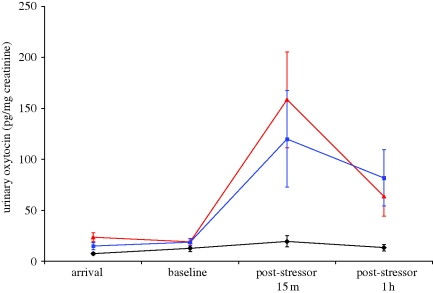
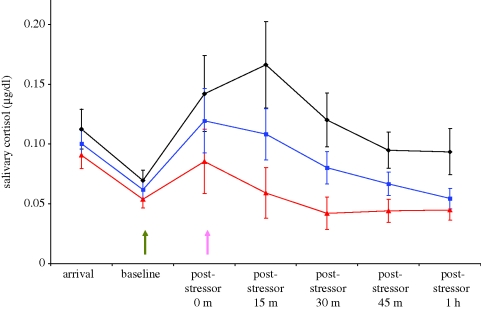
Diamonds and black line, no contact; triangles and red line, direct contact; squares and blue line, speech-only
From this study, we can conclude that the human nervous system treats specific vocal sounds as an exact biological substitute for physical proximity. A comforting voice alone can trigger the same sudden drop in salivary cortisol [stress] and spike in oxytocin as a physical hug, albeit not as effectively.
There was a follow-up study that was slightly irrelevant to our investigation, however it still included some valuable information. The study showed that instant messages [texting] fail to trigger any oxytocin release, leaving cortisol levels as high as individuals who received zero comfort. On the other hand, we can see that verbal contact did have a significant effect.
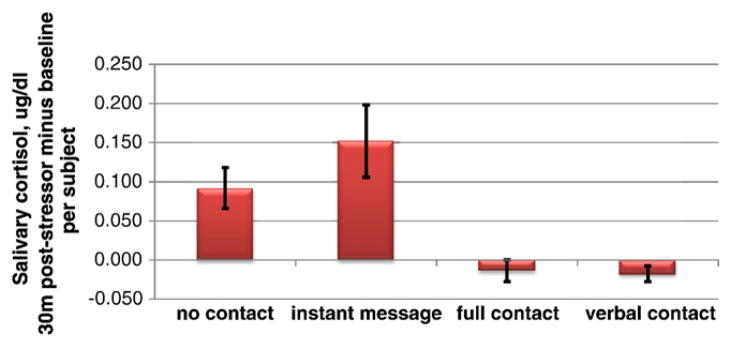
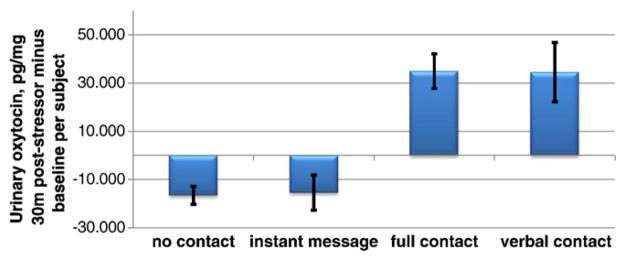
However, it is important to state that verbal contact alone was not exactly as effective as full contact, which included physical proximity. They do, however, average out, so we can deduce that they have similar effects.
The aforementioned ASMR media contains slow-paced soft speech, so I wanted to see if the slow pacing helped with oxytocin release. Research found that listening to slow-tempo audio can lead to an increase in salivary oxytocin. Since soft speech is a commonly known signal of relaxation, I did not research it.
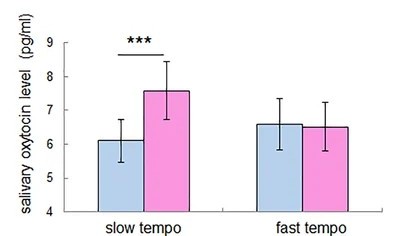
Blue: baseline; pink: 20 minutes after onset of music
It is also important to note that binaural audio is more effective at creating a convincing conversation than typical speakers. This is because earbuds/earphones/headphones can better create a sense of physical proximity for the brain, though I'm sure speakers can work fine too.
Can it recreate the sense of love? [1]
Now that we have established that ASMR does release oxytocin, we have to see if it can serve as an actual substitute for romantic love.
Since the study that I looked at observed "newly infatuated lovers", the ASMR content itself must recreate an accurate depiction of an early-stage relationship. This is basically a non-issue since most, if not all, creators, like Alekirser, use scripts that mimic the exact behavioural indicators of real romantic attachment, which successfully tricks the brain into releasing the same chemicals. Plus, the videos created usually recreate a scenario involving newly infatuated lovers.
The study in psychoneuroendocrinology (wow) examined plasma oxytocin in 163 young adults: 120 new lovers (60 couples) three months after the initiation of their romantic relationship and 43 non-attached singles. To summarise, the non-single adults had a much higher oxytocin baseline compared to single adults, and the higher levels were sustained for at least 6 months.
This is water to most.
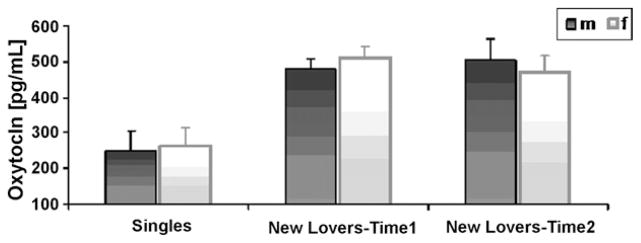
Time1 and Time2 were 6 months apart
Take into account that some couples broke up, so I presume that their readings weren't taken
The increased oxytocin directly "correlated with the couples' interactive reciprocity, including social focus, positive affect, affectionate touch, and synchronized dyadic states, and with anxieties and worries regarding the partner and the relationship, findings which parallel those described for parent-infant bonding.".
Here, we can find some interesting findings. While the study did take in physical touch, a massive portion of it is still measured through behavioral and vocal indicators, which included highly focused attention [one-on-one] and mutual emotional responsiveness.
Luckily, ASMR creators like Alekirser tend to hyper-concentrate these exact non-physical elements of a relationship. Since physical touch is not possible through media, the video instead offers intense emotional focus. This level of focus is not realistic due to its extreme and unsustainable nature, but that it not a problem for us.
From this, we can deduce that the brain processes the audio as a genuine attachment signal, triggering the same romantic chemical baseline without an actual physical partner.
Can it recreate the sense of love? [2]
I've created another section to break up the text.
The last study researched human bonding. The study itself is lengthy, very dense, and did not include any diagrams, so most of what I write will be a summary. We are trying to use vocal synchrony as the main driver for emotional bonding.
When two people start to bond more and more, they unconsciously sync up their body chemistry and behaviour. This phenomenon can often be seen in the form of people's heartbeats matching up by simply being in the same room.
The study also mentioned how things such as physical cues, eye contact, and facial expressions help build deeper emotional bonds. In our case, we do not have this, so your emotional connection can feel shallower and more artificial which does feel a little strange. No worries, it's better than nothing.
As aforementioned, our nervous systems track specific voices. When we hear an affectionate voice, our brain will register this emotional tone and create a sense of safety. When you listen to the same style of soft-speech ASMR in the same safe setting again and again, your brain starts to adapt. Eventually, just the sound of the voice is enough to completely make the listener forget that the video is a piece of fiction (ouch).
With enough time and training, your nervous system will synchronise with the soothing, affectionate voice. This means that your body is able to unlock the oxytocin system [release oxytocin] by simply processing specific sounds.
Can it be better than love?
While a bit of a stretch, there are actually many aspects of a relationship that have drawbacks. With ASMR, these drawbacks are non-existent.
Falling in love with someone, competing with others, and actually being good-looking enough to earn their love is a stressful and, for some, impossible. Even when in a relationship, there exists an underlying sense of anxiety and worry that comes with being vulnerable, facing potential separation, and potentially having your partner cheat.
ASMR, while missing physical contact, does not have these issues. By the nature of the videos, the risks of a relationship are no longer apparent. Instead, one can fully reap its benefits.
Overall:
On paper, this form of ASMR is very efficient and risk-free. We can also see that it is functional in rewarding the brain while not having any of the drawbacks.
Lastly, one must realise that this is a fragile illusion. When you're laying in bed and the audio ends, the artificial feeling of warmth slowly fades away, leaving an uncanny sense of affection. For those who do not feel affection, this may serve as a permanent substitute, but do know that it can not yet serve as a true substitute. Do not develop a parasocial relationship with the creators! There already exists a cultural stigma of simulated love and you do not want to make it worse, although as society becomes less and less shameful, most stigmas are slowly fading too.
Sample of studies which I have cited from:

 pubmed.ncbi.nlm.nih.gov
pubmed.ncbi.nlm.nih.gov
pubmed.ncbi.nlm.nih.gov
pubmed.ncbi.nlm.nih.gov
pubmed.ncbi.nlm.nih.gov
pubmed.ncbi.nlm.nih.gov
pubmed.ncbi.nlm.nih.gov
Love is a surreal feeling that a lot of people will never experience. I was curious as to see whether ASMR could be an inferior, but still functional, method of simulating love. As prefaced earlier, ASMR will certainly be less effective since it does not include physical touch. Though, I have compiled some research from various studies which show interesting results.
As a decent chunk of people here will never experience love to its fullest (or at all), I felt that it was appropriate to share my findings.
Does ASMR even do anything?
Firstly, I had to find out if listening to ASMR even had any effect on the mind. To be specific, I selected media which included a fake romantic conversation between the creator and the listener. This may be formally known as narrative-driven vocal roleplay or simulated interpersonal audio.
We can firstly observe a study on how, "Social vocalizations can release oxytocin in humans".
Diamonds and black line, no contact; triangles and red line, direct contact; squares and blue line, speech-only
From this study, we can conclude that the human nervous system treats specific vocal sounds as an exact biological substitute for physical proximity. A comforting voice alone can trigger the same sudden drop in salivary cortisol [stress] and spike in oxytocin as a physical hug, albeit not as effectively.
There was a follow-up study that was slightly irrelevant to our investigation, however it still included some valuable information. The study showed that instant messages [texting] fail to trigger any oxytocin release, leaving cortisol levels as high as individuals who received zero comfort. On the other hand, we can see that verbal contact did have a significant effect.
However, it is important to state that verbal contact alone was not exactly as effective as full contact, which included physical proximity. They do, however, average out, so we can deduce that they have similar effects.
The aforementioned ASMR media contains slow-paced soft speech, so I wanted to see if the slow pacing helped with oxytocin release. Research found that listening to slow-tempo audio can lead to an increase in salivary oxytocin. Since soft speech is a commonly known signal of relaxation, I did not research it.
Blue: baseline; pink: 20 minutes after onset of music
It is also important to note that binaural audio is more effective at creating a convincing conversation than typical speakers. This is because earbuds/earphones/headphones can better create a sense of physical proximity for the brain, though I'm sure speakers can work fine too.
Can it recreate the sense of love? [1]
Now that we have established that ASMR does release oxytocin, we have to see if it can serve as an actual substitute for romantic love.
Since the study that I looked at observed "newly infatuated lovers", the ASMR content itself must recreate an accurate depiction of an early-stage relationship. This is basically a non-issue since most, if not all, creators, like Alekirser, use scripts that mimic the exact behavioural indicators of real romantic attachment, which successfully tricks the brain into releasing the same chemicals. Plus, the videos created usually recreate a scenario involving newly infatuated lovers.
The study in psychoneuroendocrinology (wow) examined plasma oxytocin in 163 young adults: 120 new lovers (60 couples) three months after the initiation of their romantic relationship and 43 non-attached singles. To summarise, the non-single adults had a much higher oxytocin baseline compared to single adults, and the higher levels were sustained for at least 6 months.
This is water to most.
Time1 and Time2 were 6 months apart
Take into account that some couples broke up, so I presume that their readings weren't taken
The increased oxytocin directly "correlated with the couples' interactive reciprocity, including social focus, positive affect, affectionate touch, and synchronized dyadic states, and with anxieties and worries regarding the partner and the relationship, findings which parallel those described for parent-infant bonding.".
Here, we can find some interesting findings. While the study did take in physical touch, a massive portion of it is still measured through behavioral and vocal indicators, which included highly focused attention [one-on-one] and mutual emotional responsiveness.
Luckily, ASMR creators like Alekirser tend to hyper-concentrate these exact non-physical elements of a relationship. Since physical touch is not possible through media, the video instead offers intense emotional focus. This level of focus is not realistic due to its extreme and unsustainable nature, but that it not a problem for us.
From this, we can deduce that the brain processes the audio as a genuine attachment signal, triggering the same romantic chemical baseline without an actual physical partner.
Can it recreate the sense of love? [2]
I've created another section to break up the text.
The last study researched human bonding. The study itself is lengthy, very dense, and did not include any diagrams, so most of what I write will be a summary. We are trying to use vocal synchrony as the main driver for emotional bonding.
When two people start to bond more and more, they unconsciously sync up their body chemistry and behaviour. This phenomenon can often be seen in the form of people's heartbeats matching up by simply being in the same room.
The study also mentioned how things such as physical cues, eye contact, and facial expressions help build deeper emotional bonds. In our case, we do not have this, so your emotional connection can feel shallower and more artificial which does feel a little strange. No worries, it's better than nothing.
As aforementioned, our nervous systems track specific voices. When we hear an affectionate voice, our brain will register this emotional tone and create a sense of safety. When you listen to the same style of soft-speech ASMR in the same safe setting again and again, your brain starts to adapt. Eventually, just the sound of the voice is enough to completely make the listener forget that the video is a piece of fiction (ouch).
With enough time and training, your nervous system will synchronise with the soothing, affectionate voice. This means that your body is able to unlock the oxytocin system [release oxytocin] by simply processing specific sounds.
Can it be better than love?
While a bit of a stretch, there are actually many aspects of a relationship that have drawbacks. With ASMR, these drawbacks are non-existent.
Falling in love with someone, competing with others, and actually being good-looking enough to earn their love is a stressful and, for some, impossible. Even when in a relationship, there exists an underlying sense of anxiety and worry that comes with being vulnerable, facing potential separation, and potentially having your partner cheat.
ASMR, while missing physical contact, does not have these issues. By the nature of the videos, the risks of a relationship are no longer apparent. Instead, one can fully reap its benefits.
Overall:
On paper, this form of ASMR is very efficient and risk-free. We can also see that it is functional in rewarding the brain while not having any of the drawbacks.
Lastly, one must realise that this is a fragile illusion. When you're laying in bed and the audio ends, the artificial feeling of warmth slowly fades away, leaving an uncanny sense of affection. For those who do not feel affection, this may serve as a permanent substitute, but do know that it can not yet serve as a true substitute. Do not develop a parasocial relationship with the creators! There already exists a cultural stigma of simulated love and you do not want to make it worse, although as society becomes less and less shameful, most stigmas are slowly fading too.
Sample of studies which I have cited from:
Social vocalizations can release oxytocin in humans - PubMed
Vocalizations are important components of social behaviour in many vertebrate species, including our own. Less well-understood are the hormonal mechanisms involved in response to vocal cues, and how these systems may influence the course of behavioural evolution. The neurohormone oxytocin (OT)...
pubmed.ncbi.nlm.nih.gov
Instant messages vs. speech: hormones and why we still need to hear each other - PubMed
Human speech evidently conveys an adaptive advantage, given its apparently rapid dissemination through the ancient world and global use today. As such, speech must be capable of altering human biology in a positive way, possibly through those neuroendocrine mechanisms responsible for...
pubmed.ncbi.nlm.nih.gov
Increase in salivary oxytocin and decrease in salivary cortisol after listening to relaxing slow-tempo and exciting fast-tempo music - PubMed
Relaxation and excitation are components of the effects of music listening. The tempo of music is often considered a critical factor when determining these effects: listening to slow-tempo and fast-tempo music elicits relaxation and excitation, respectively. However, the chemical bases that...
pubmed.ncbi.nlm.nih.gov
Oxytocin and social affiliation in humans - PubMed
A conceptual model detailing the process of bio-behavioral synchrony between the online physiological and behavioral responses of attachment partners during social contact is presented as a theoretical and empirical framework for the study of affiliative bonds. Guided by an ethological...
pubmed.ncbi.nlm.nih.gov
Attachments
Last edited:


