


chudpiller
var for the huzz
- Joined
- Dec 21, 2025
- Posts
- 3,741
- Reputation
- 5,872
All the stuff I will talk about in this thread comes from the following study:
 www.sciencedirect.com
Study summary, importance of Mrs2 transporter:
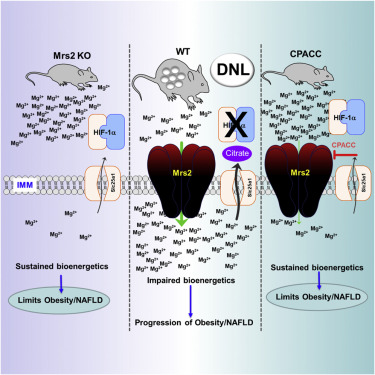
Basically, in your mitochondria, there are certain magnesium ion transporters called Mrs2. When magnesium ions enter your mitochondria, they generally reduce the rate at which cellular respiration occurs, thereby slowing your metabolism. Therefore, by restricting magnesium entry into the mitochondria, one could theoretically significantly increase their metabolic rate.
In the study, scientists first genetically modified mice to have nonfunctional Mrs2 transporters. They fed some mice a high-fat Western diet, while other mice were fed a normal mouse kibble diet. This resulted in the following results.
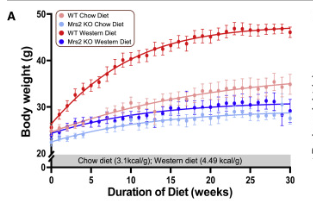
"WT" refers to wild type, meaning those groups still had the Mrs2 transporter.
As you can see, the group with the Mrs2 transporter knockout experienced less weight gain, even while eating the high-fat Western diet, while the groups with the Mrs2 transporter got mega fat.
Therefore, it can be concluded that Mrs2 heavily decreases basal metabolic rate because it transports Mg2+ into the mitochondria.
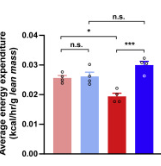
Additionally, this figure demonstrates that the Mrs2 knockout & Western diet mice had a metabolic rate approximately 160% of their wild-type counterparts while eating the same diet.
How this relates to us as genetically normal humans:
The scientists also gave wild-type (normal) mice a compound called Chloropentamminecobalt chloride (CPAAC), which inhibits the Mrs2 transporter without needing genetic modification. As you can see, the groups that received the CPAAC experienced much less weight gain than the groups that just received the vehicle (carrier oil for the CPAAC).
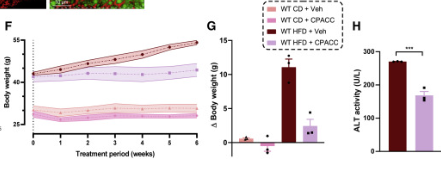
Additionally, rather interesting was the fact that the group of mice that received the CPAAC also had lower ALT activity, which indicates a healthier liver, and possibly that CPAAC can be hepatoprotective.
Potential Caveats to using CPAAC
According to the study, CPAAC is very mildly cytotoxic (damages cells). It is also a potential carcinogen according to the WHO. Finally, the scientists administered the drug intraperitoneally, meaning directly into the abdominal cavity, so injecting elsewhere as a human might cause issues.
In conclusion, administering CPAAC could be beneficial in humans, possibly serving as a slightly healthier compound than DNP, if more complicated to administer. THIS IS NOT HEALTH ADVICE; THIS HAS NOT BEEN STUDIED IN HUMANS.
TLDR: Chloropentamminecobalt chloride (CPAAC) appears promising at increasing metabolic efficiency and preventing weight gain when being a fatass.
Limiting Mrs2-dependent mitochondrial Mg2+ uptake induces metabolic programming in prolonged dietary stress
The most abundant cellular divalent cations, Mg2+ (mM) and Ca2+ (nM-μM), antagonistically regulate divergent metabolic pathways with several orders of…
Study summary, importance of Mrs2 transporter:
Basically, in your mitochondria, there are certain magnesium ion transporters called Mrs2. When magnesium ions enter your mitochondria, they generally reduce the rate at which cellular respiration occurs, thereby slowing your metabolism. Therefore, by restricting magnesium entry into the mitochondria, one could theoretically significantly increase their metabolic rate.
In the study, scientists first genetically modified mice to have nonfunctional Mrs2 transporters. They fed some mice a high-fat Western diet, while other mice were fed a normal mouse kibble diet. This resulted in the following results.
"WT" refers to wild type, meaning those groups still had the Mrs2 transporter.
As you can see, the group with the Mrs2 transporter knockout experienced less weight gain, even while eating the high-fat Western diet, while the groups with the Mrs2 transporter got mega fat.
Therefore, it can be concluded that Mrs2 heavily decreases basal metabolic rate because it transports Mg2+ into the mitochondria.
Additionally, this figure demonstrates that the Mrs2 knockout & Western diet mice had a metabolic rate approximately 160% of their wild-type counterparts while eating the same diet.
How this relates to us as genetically normal humans:
The scientists also gave wild-type (normal) mice a compound called Chloropentamminecobalt chloride (CPAAC), which inhibits the Mrs2 transporter without needing genetic modification. As you can see, the groups that received the CPAAC experienced much less weight gain than the groups that just received the vehicle (carrier oil for the CPAAC).
Additionally, rather interesting was the fact that the group of mice that received the CPAAC also had lower ALT activity, which indicates a healthier liver, and possibly that CPAAC can be hepatoprotective.
Potential Caveats to using CPAAC
According to the study, CPAAC is very mildly cytotoxic (damages cells). It is also a potential carcinogen according to the WHO. Finally, the scientists administered the drug intraperitoneally, meaning directly into the abdominal cavity, so injecting elsewhere as a human might cause issues.
In conclusion, administering CPAAC could be beneficial in humans, possibly serving as a slightly healthier compound than DNP, if more complicated to administer. THIS IS NOT HEALTH ADVICE; THIS HAS NOT BEEN STUDIED IN HUMANS.
TLDR: Chloropentamminecobalt chloride (CPAAC) appears promising at increasing metabolic efficiency and preventing weight gain when being a fatass.
Last edited:


