Demirs
Iron
- Joined
- Apr 29, 2026
- Posts
- 156
- Reputation
- 147
The Short Answer
The bottom line is straightforward: there is no good evidence that masturbation causes acne or meaningfully worsens it. In the literature I retrieved for this report, I did not find randomized trials,cohort studies, case-control studies, or cross-sectional studies that directly tested masturbationfrequency against acne incidence or acne severity. What I did find were mechanistic studies ofhormones after sexual arousal or orgasm, plus dermatology and endocrinology literature on whatactually drives acne. Put together, that evidence points away from masturbation as an acne trigger.
Acne is driven by a combination of androgen-sensitive sebaceous gland activity, excess or alteredsebum, follicular plugging, inflammation, and shifts in the pilosebaceous microbiome.Dihydrotestosterone (DHT) is especially relevant because sebaceous glands locally convert testosteroneto DHT, and DHT binds androgen receptors more strongly than testosterone. Importantly, acne canoccur even when circulating hormone levels are “normal,” because local skin androgen metabolism andsebaceous-gland sensitivity matter a lot.
Sexual arousal and orgasm do change some hormones and neurochemicals, but the changes areusually brief and small, not the sort of sustained androgen exposure that dermatology literature linksto sebaceous stimulation and acne. The most consistent finding is a prolactin rise after orgasm thatcan last about an hour. Testosterone results are mixed: one small study found no acute testosterone change with orgasm in men, another found a modest short-lived rise during erotic stimulation, and a2021 crossover pilot suggested masturbation may blunt the normal daytime decline in freetestosterone without altering testosterone:cortisol or free-testosterone :cortisol ratios. Cortisol is usually unchanged or inconsistently changed in modern studies.
That makes the most defensible conclusion an inference: typical masturbation-related endocrineshifts are unlikely to reach the magnitude or duration known to matter for sebaceous glands.Acne biology is tied more to puberty, chronic hyperandrogenism, local conversion of testosterone to DHT, sebaceous-gland sensitivity, and inflammatory signaling than to minute-scale post-orgasmhormone fluctuations.
For patients and forum readers, the practical message is: stopping masturbation is not an evidencebased acne treatment. If someone notices breakouts “after” masturbation, the better explanations areusually coincidence, puberty, touching the face, sweat/friction, occlusive products, staying up very late,stress, or unrelated acne triggers and treatments. Reputable health guidance also states that sex ormasturbation do not make acne better or worse.
What Actually Causes Acne?
Acne vulgaris is a chronic inflammatory disorder of the pilosebaceous unit. The key steps are wellestablished: sebaceous glands produce more or altered sebum, the follicle becomes plugged,Cutibacterium acnes and the surrounding follicular microbiome shift in ways that can promoteinflammation, and innate plus adaptive immune pathways amplify the lesion. Recent reviews and guidelines still frame acne as a multifactorial disease with hormonal, microbial, and inflammatorydrivers rather than a single-trigger condition.
Androgens are central because sebaceous glands are androgen-responsive organs. The skin itself cangenerate and modify steroids: sebaceous glands convert adrenal precursors toward testosterone, and type 1 5-alpha-reductase within sebaceous glands converts testosterone into DHT, the more potentandrogen for receptor binding. DHT and testosterone both act on sebocytes, but DHT has the strongerreceptor affinity. That is why endocrine reviews focus less on a single serum testosterone value andmore on local androgen handling and sebaceous sensitivity.
A subtle but important point is that acne often appears in people whose circulating androgens are stillwithin the reference range. Reviews note that many acne patients, especially outside overt endocrinedisease, have normal serum androgens but heightened sebaceous responsiveness or altered localmetabolism. One classical endocrine review even reported that roughly 75% of the normal male levelof sebaceous function is achieved at androgen levels considered normal for women, underscoringhow sensitive sebaceous tissue can be to androgenic signaling.
Inflammation matters early, not just late. Acne-associated C. acnes strains can trigger inflammatorypathways including TH17-associated cytokine responses and inflammasome activation. Sebum itself isnot merely “oil”; it shapes the follicular environment, feeds bacterial metabolism, and contributes toinflammatory lipid signaling. That means any theory about masturbation causing acne has to explainnot just a hormone blip, but how that blip would persist long enough to change sebum production,follicular keratinization, microbial ecology, and inflammatory tone. The current evidence does notsupport that chain.
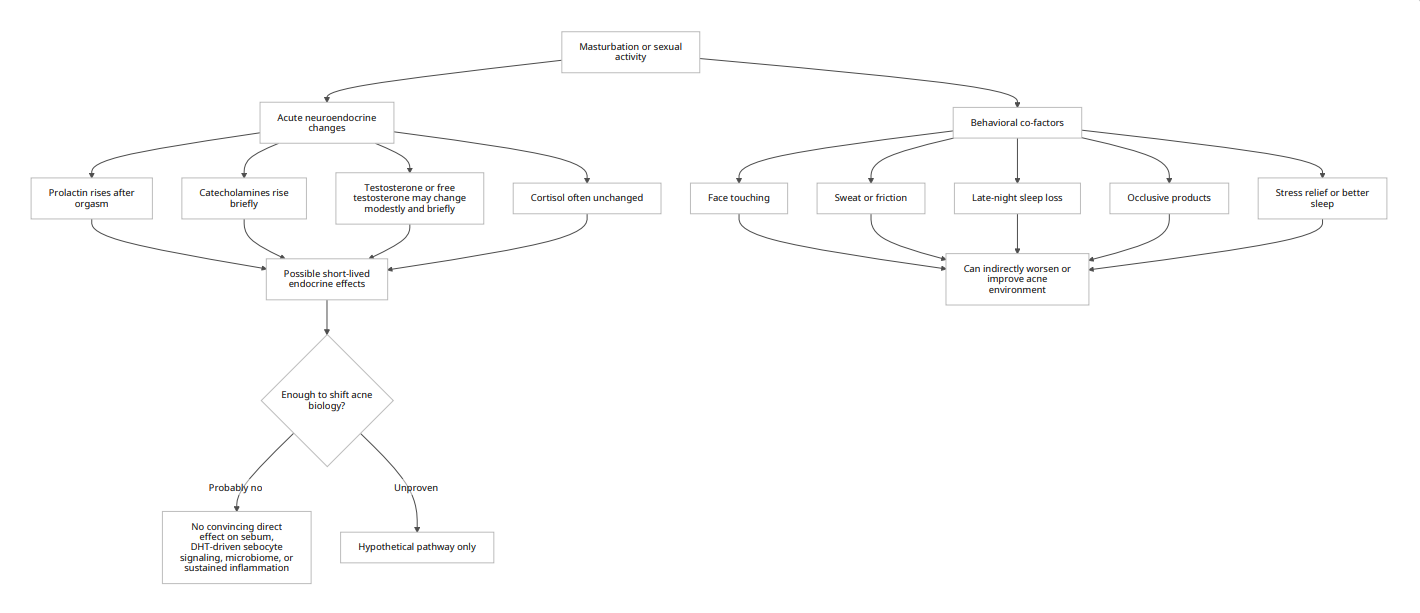
The proposed pathways above are synthesized from acne pathophysiology reviews and sexualendocrine studies. The strongest acne-linked processes are sustained androgenic effects on sebaceousglands, follicular obstruction, microbiome shifts, and inflammation, while orgasm-related endocrinechanges are mostly acute and short-lived.
Does Masturbation Affect Your Hormones?
The most reproducible endocrine signal after orgasm is prolactin. Studies in women, men, and coupleshave found a marked post-orgasm prolactin increase, and that increase can remain elevated for about60 minutes. A later paper reported that the post-orgasmic prolactin increase after intercourse was 400% greater than after masturbation, which says more about sexual satiety and context than aboutacne. Either way, the prolactin effect is acute, not a chronic endocrine state.
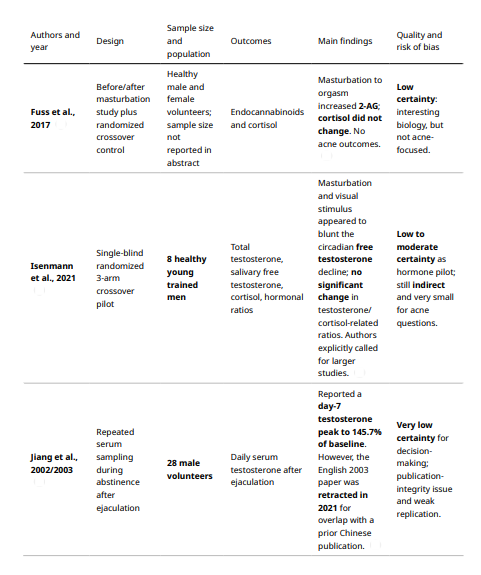
Testosterone is much less dramatic than internet myths suggest. In one well-known study of healthymen, masturbation-induced orgasm increased prolactin and catecholamines but did not acutely change testosterone; after a separate three-week abstinence period, baseline testosterone was higher,but the orgasm response itself was unchanged. Another experiment found that during erotic-filmsexual arousal, testosterone increased from 22.2 ± 5.6 to 25.2 ± 6.3 nmol/L in the first 10 minutes, amodest rise of about 14%, and the study did not find a clear effect on mean testosterone across theentire session. A 2021 randomized crossover pilot in eight healthy young trained men found thatmasturbation and even visual erotic stimulus alone appeared to counter the normal daytime fall in free testosterone, but there were no significant changes in total testosterone:cortisol, free-testosterone:total-testosterone, or free-testosterone:cortisol ratios.
DHT is where the acne question becomes interesting, because DHT is more directly relevant tosebaceous glands than testosterone. But here the data are thin. A 1976 study in young healthy malesreported that multiple steroids, including testosterone, DHT, and cortisol, increased aftermasturbation compared with an anticipatory control condition, with LH unchanged. However, thatpaper is old, uses older endocrine methods, and its abstract does not report a sample size. Later workhas tended to focus on prolactin, testosterone, free testosterone, and cortisol rather than directlymeasuring post-orgasm DHT. So for acne, the most honest statement is that post-masturbation DHT kinetics in humans are poorly characterized.
Cortisol does not behave like a clear acne-triggering spike in modern orgasm studies. A human study ofmasturbation to orgasm found that cortisol was not altered, and a review of sexual arousal studiesconcluded cortisol tends either to decrease or not change in response to sexual arousal or orgasm.That does not rule out behavioral stress effects altogether, but it weakly argues against the simple storythat masturbation raises stress hormones enough to worsen acne.
One abstinence study is constantly cited online: Jiang and colleagues reported that serum testosteronereached 145.7% of baseline on day 7 of abstinence. Two big caveats matter. First, the English language 2003 paper was retracted in 2021 because it substantially overlapped a previously publishedChinese article; that is a publication-integrity problem, even if not proof the data were fabricated.Second, the finding has not become well replicated in robust contemporary trials. So this study shouldbe treated very cautiously, not as settled proof that abstinence or ejaculation meaningfully shifts acnebiology.
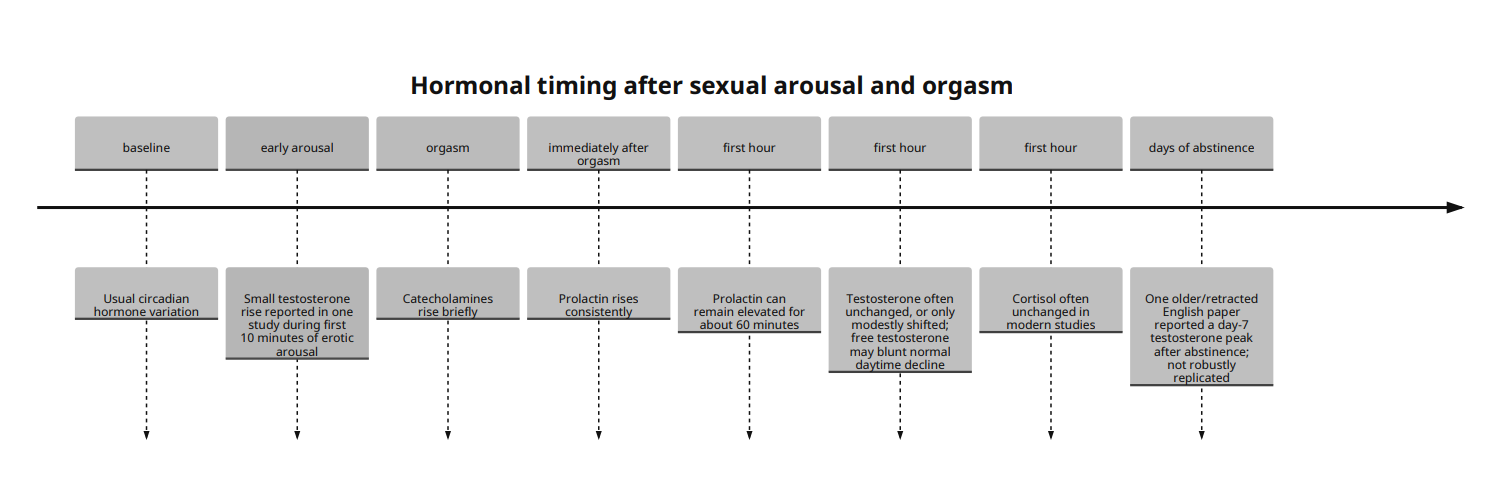
This timeline reflects the retrieved lab literature: acute endocrine shifts measured in minutes to roughlyan hour, not the prolonged androgen exposure typical of puberty, chronic hyperandrogenism, or Exogenous testosterone therapy. That difference in timescale is one of the main reasons themasturbation-acne theory looks biologically weak.
What Do the Studies Actually Show?
Human and Animal Evidence
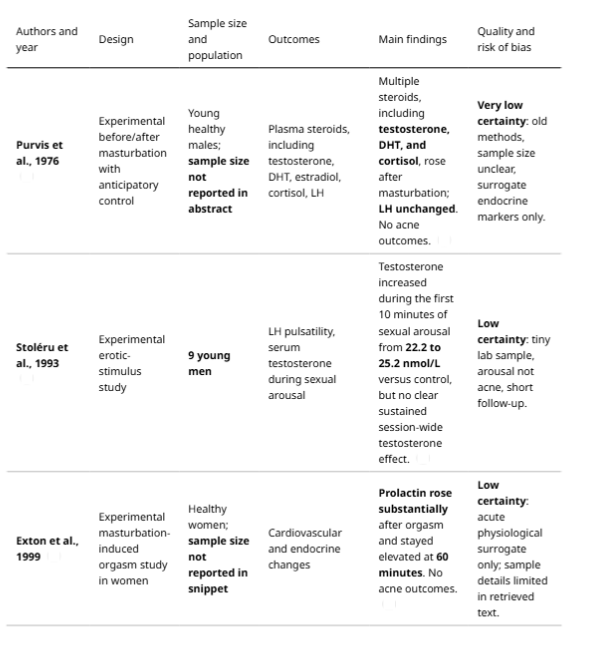
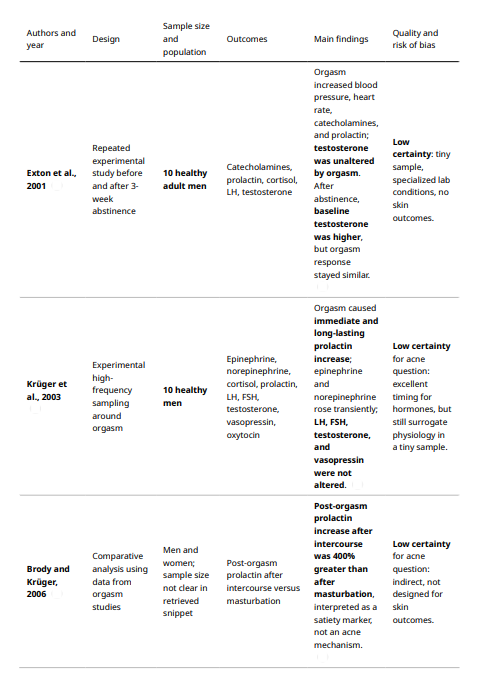
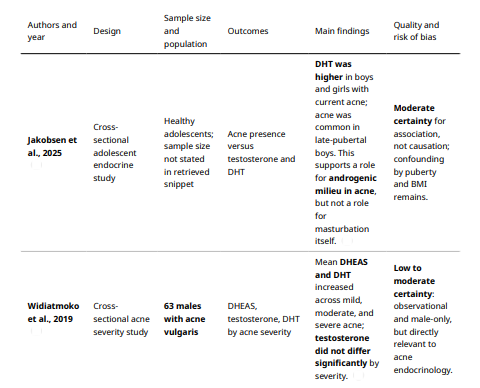
Here is the most useful way to read the literature: no direct acne studies, several short-termhormone studies, and some supporting acne-endocrine studies showing what kinds of hormonal environments actually track with acne. That is enough to estimate plausibility, even if it does not providea perfect trial answer.
A small amount of animal data is relevant mainly because it shows how sebaceous glands actually respond to hormones. Rat studies and classic pilosebaceous-unit reviews show sebaceous glands arestimulated by androgens, and pituitary factors can modify that response; castration suppresses sebumproduction, while testosterone replacement restores it. The important thing, though, is that these are sustained hormonal manipulations, not minute-scale orgasm pulses. That makes them useful foracne biology, but weak support for the claim that ordinary masturbation causes pimples.
How Much Would Hormones Need to Change?
The most acne-relevant endocrine literature points to persistent pubertal androgen exposure, tissuelocal DHT generation, sebaceous sensitivity, and in some cases chronic hyperandrogenism. Crosssectional acne studies report higher DHT or DHEAS in people with acne, and late puberty itself is theclassic setting where acne emerges. By contrast, masturbation studies mostly show physiologychanging over minutes to an hour, often with no clear testosterone effect and almost no modern DHT measurements
So while it is technically possible that a short-lived endocrine change could influence skin biology insome tiny way, the current evidence does not show a shift that is large, durable, or acne-specificenough to compete with the real drivers of acne. That is an inference, but it is a well-supported one.
Why Do People Think It Causes Acne?
The biggest confounder is puberty. Acne and masturbation both commonly start in adolescence, when androgens, sebaceous output, body hair, sexual interest, and social anxiety are all changing at once.That temporal overlap makes it easy to misattribute acne to masturbation when both phenomena arereally downstream of puberty.
Baseline hormone levels matter too. Acne relates to sex, pubertal stage, BMI, family history, skin type, and sometimes to endocrine disorders such as hyperandrogenism or PCOS. A systematic review of acneepidemiology found strong associations for family history, age, BMI, and skin type, and modern acneguidance still treats endocrine context as important, especially when acne is persistent, treatmentresistant, or accompanied by other hyperandrogenic features.
Medications and products are another major source of confusion. Acne or acneiform eruptions can beworsened by corticosteroids, lithium, some antiepileptics, some antidepressants/antipsychotics, testosterone or other hormonal agents, and various occlusive or comedogenic topical products.NICE also advises avoiding oil-based and comedogenic skin-care products and discourages pickingbecause it can increase scarring risk.
Behavior around masturbation can matter more than masturbation itself. If someone tends to stay uplate, sweat, rest their face on unwashed bedding, touch or pick at the skin, or use fragranced/occlusiveproducts, those behaviors can plausibly aggravate acne-prone skin even though orgasm does not. Sleepand stress are especially messy confounders: acne severity has been linked with stress in medicalstudent and population studies, while some sexual-activity studies suggest orgasm may improve sleeponset or sleep quality for some people. So the direction of the indirect effect could go either waydepending on the person’s habits.
Diet is another common over-attribution problem. NICE judged the evidence too limited to recommenda specific diet as acne treatment, even though some studies suggest low-glycemic approaches mayhelp. Other reviews note associations with high sugar and dairy intake, but these effects are still notspecific enough to explain an immediate “I masturbated and broke out” narrative.
What Actually Helps Acne?
If the question is, “Should I stop masturbating to clear my acne?” the evidence-based answer is no. There is no convincing evidence that abstaining from masturbation improves acne, and reputable publichealth advice explicitly says sex or masturbation do not make acne better or worse.
A more useful acne plan looks like this:
Use evidence-based acne treatment, not sexual abstinence. Current acne guidelines stronglysupport therapies such as benzoyl peroxide, topical retinoids, topical antibiotics incombination regimens, oral doxycycline for appropriate cases, and isotretinoin for severe,scarring, or refractory acne.
Cleanse acne-prone areas with a non-alkaline syndet cleanser twice daily, avoid oil-based/comedogenic skin-care products or makeup, and avoid picking.
If breakouts seem to happen “after masturbation,” test the behavioral factors first: wash sweatoff, do not touch the face, change pillowcases and towels regularly, avoid occlusive products,and notice whether the real issue is late nights, stress, or stopping your acne meds. This is an inference from guideline skin-care advice plus the stress and sleep literature, not a directmasturbation trial.
If acne is severe, scarring, or unusually persistent, think about real endocrine causes ratherthan myths. In women, especially, acne plus irregular periods, hirsutism, or otherhyperandrogenic signs deserves medical evaluation. In any patient, medication review matters.
What We Still Do Not Know
The main limitation is obvious: there are almost no direct studies of masturbation and acne as aclinical question. The retrieved evidence is mostly indirect, built from acute lab studies measuringhormones after sexual arousal or orgasm, plus separate acne-endocrine studies. That means the final conclusion is strong in direction but only moderate in directness.
The sexual-endocrine studies themselves are usually small, highly controlled, and often male-dominant.Several are decades old, and some key papers report only abstracts or have limited detail in accessiblesummaries. The 2021 pilot that looked most carefully at free testosterone explicitly said larger samplesare needed.
The internet’s favorite abstinence study is also a problem. The 2003 English-language Jiang paper was retracted, which does not automatically invalidate the underlying physiology but definitely lowersconfidence and makes it poor material for sweeping lifestyle claims.
There are also important biological gaps. Modern studies rarely measure post-orgasm DHT, rarelymeasure local skin androgen activity, and almost never connect those measurements to actual sebum output, lesion counts, or standardized acne scores. Given what we know about localsebaceous hormone metabolism, that is exactly the kind of study that would be needed to settle thequestion more directly.
SOURCES:
NOTE:
I used ChatGPT to correct grammar mistakes and assist with the research.
The bottom line is straightforward: there is no good evidence that masturbation causes acne or meaningfully worsens it. In the literature I retrieved for this report, I did not find randomized trials,cohort studies, case-control studies, or cross-sectional studies that directly tested masturbationfrequency against acne incidence or acne severity. What I did find were mechanistic studies ofhormones after sexual arousal or orgasm, plus dermatology and endocrinology literature on whatactually drives acne. Put together, that evidence points away from masturbation as an acne trigger.
Acne is driven by a combination of androgen-sensitive sebaceous gland activity, excess or alteredsebum, follicular plugging, inflammation, and shifts in the pilosebaceous microbiome.Dihydrotestosterone (DHT) is especially relevant because sebaceous glands locally convert testosteroneto DHT, and DHT binds androgen receptors more strongly than testosterone. Importantly, acne canoccur even when circulating hormone levels are “normal,” because local skin androgen metabolism andsebaceous-gland sensitivity matter a lot.
Sexual arousal and orgasm do change some hormones and neurochemicals, but the changes areusually brief and small, not the sort of sustained androgen exposure that dermatology literature linksto sebaceous stimulation and acne. The most consistent finding is a prolactin rise after orgasm thatcan last about an hour. Testosterone results are mixed: one small study found no acute testosterone change with orgasm in men, another found a modest short-lived rise during erotic stimulation, and a2021 crossover pilot suggested masturbation may blunt the normal daytime decline in freetestosterone without altering testosterone:cortisol or free-testosterone :cortisol ratios. Cortisol is usually unchanged or inconsistently changed in modern studies.
That makes the most defensible conclusion an inference: typical masturbation-related endocrineshifts are unlikely to reach the magnitude or duration known to matter for sebaceous glands.Acne biology is tied more to puberty, chronic hyperandrogenism, local conversion of testosterone to DHT, sebaceous-gland sensitivity, and inflammatory signaling than to minute-scale post-orgasmhormone fluctuations.
For patients and forum readers, the practical message is: stopping masturbation is not an evidencebased acne treatment. If someone notices breakouts “after” masturbation, the better explanations areusually coincidence, puberty, touching the face, sweat/friction, occlusive products, staying up very late,stress, or unrelated acne triggers and treatments. Reputable health guidance also states that sex ormasturbation do not make acne better or worse.
What Actually Causes Acne?
Acne vulgaris is a chronic inflammatory disorder of the pilosebaceous unit. The key steps are wellestablished: sebaceous glands produce more or altered sebum, the follicle becomes plugged,Cutibacterium acnes and the surrounding follicular microbiome shift in ways that can promoteinflammation, and innate plus adaptive immune pathways amplify the lesion. Recent reviews and guidelines still frame acne as a multifactorial disease with hormonal, microbial, and inflammatorydrivers rather than a single-trigger condition.
Androgens are central because sebaceous glands are androgen-responsive organs. The skin itself cangenerate and modify steroids: sebaceous glands convert adrenal precursors toward testosterone, and type 1 5-alpha-reductase within sebaceous glands converts testosterone into DHT, the more potentandrogen for receptor binding. DHT and testosterone both act on sebocytes, but DHT has the strongerreceptor affinity. That is why endocrine reviews focus less on a single serum testosterone value andmore on local androgen handling and sebaceous sensitivity.
A subtle but important point is that acne often appears in people whose circulating androgens are stillwithin the reference range. Reviews note that many acne patients, especially outside overt endocrinedisease, have normal serum androgens but heightened sebaceous responsiveness or altered localmetabolism. One classical endocrine review even reported that roughly 75% of the normal male levelof sebaceous function is achieved at androgen levels considered normal for women, underscoringhow sensitive sebaceous tissue can be to androgenic signaling.
Inflammation matters early, not just late. Acne-associated C. acnes strains can trigger inflammatorypathways including TH17-associated cytokine responses and inflammasome activation. Sebum itself isnot merely “oil”; it shapes the follicular environment, feeds bacterial metabolism, and contributes toinflammatory lipid signaling. That means any theory about masturbation causing acne has to explainnot just a hormone blip, but how that blip would persist long enough to change sebum production,follicular keratinization, microbial ecology, and inflammatory tone. The current evidence does notsupport that chain.
The proposed pathways above are synthesized from acne pathophysiology reviews and sexualendocrine studies. The strongest acne-linked processes are sustained androgenic effects on sebaceousglands, follicular obstruction, microbiome shifts, and inflammation, while orgasm-related endocrinechanges are mostly acute and short-lived.
Does Masturbation Affect Your Hormones?
The most reproducible endocrine signal after orgasm is prolactin. Studies in women, men, and coupleshave found a marked post-orgasm prolactin increase, and that increase can remain elevated for about60 minutes. A later paper reported that the post-orgasmic prolactin increase after intercourse was 400% greater than after masturbation, which says more about sexual satiety and context than aboutacne. Either way, the prolactin effect is acute, not a chronic endocrine state.
Testosterone is much less dramatic than internet myths suggest. In one well-known study of healthymen, masturbation-induced orgasm increased prolactin and catecholamines but did not acutely change testosterone; after a separate three-week abstinence period, baseline testosterone was higher,but the orgasm response itself was unchanged. Another experiment found that during erotic-filmsexual arousal, testosterone increased from 22.2 ± 5.6 to 25.2 ± 6.3 nmol/L in the first 10 minutes, amodest rise of about 14%, and the study did not find a clear effect on mean testosterone across theentire session. A 2021 randomized crossover pilot in eight healthy young trained men found thatmasturbation and even visual erotic stimulus alone appeared to counter the normal daytime fall in free testosterone, but there were no significant changes in total testosterone:cortisol, free-testosterone:total-testosterone, or free-testosterone:cortisol ratios.
DHT is where the acne question becomes interesting, because DHT is more directly relevant tosebaceous glands than testosterone. But here the data are thin. A 1976 study in young healthy malesreported that multiple steroids, including testosterone, DHT, and cortisol, increased aftermasturbation compared with an anticipatory control condition, with LH unchanged. However, thatpaper is old, uses older endocrine methods, and its abstract does not report a sample size. Later workhas tended to focus on prolactin, testosterone, free testosterone, and cortisol rather than directlymeasuring post-orgasm DHT. So for acne, the most honest statement is that post-masturbation DHT kinetics in humans are poorly characterized.
Cortisol does not behave like a clear acne-triggering spike in modern orgasm studies. A human study ofmasturbation to orgasm found that cortisol was not altered, and a review of sexual arousal studiesconcluded cortisol tends either to decrease or not change in response to sexual arousal or orgasm.That does not rule out behavioral stress effects altogether, but it weakly argues against the simple storythat masturbation raises stress hormones enough to worsen acne.
One abstinence study is constantly cited online: Jiang and colleagues reported that serum testosteronereached 145.7% of baseline on day 7 of abstinence. Two big caveats matter. First, the English language 2003 paper was retracted in 2021 because it substantially overlapped a previously publishedChinese article; that is a publication-integrity problem, even if not proof the data were fabricated.Second, the finding has not become well replicated in robust contemporary trials. So this study shouldbe treated very cautiously, not as settled proof that abstinence or ejaculation meaningfully shifts acnebiology.
This timeline reflects the retrieved lab literature: acute endocrine shifts measured in minutes to roughlyan hour, not the prolonged androgen exposure typical of puberty, chronic hyperandrogenism, or Exogenous testosterone therapy. That difference in timescale is one of the main reasons themasturbation-acne theory looks biologically weak.
What Do the Studies Actually Show?
Human and Animal Evidence
Here is the most useful way to read the literature: no direct acne studies, several short-termhormone studies, and some supporting acne-endocrine studies showing what kinds of hormonal environments actually track with acne. That is enough to estimate plausibility, even if it does not providea perfect trial answer.
A small amount of animal data is relevant mainly because it shows how sebaceous glands actually respond to hormones. Rat studies and classic pilosebaceous-unit reviews show sebaceous glands arestimulated by androgens, and pituitary factors can modify that response; castration suppresses sebumproduction, while testosterone replacement restores it. The important thing, though, is that these are sustained hormonal manipulations, not minute-scale orgasm pulses. That makes them useful foracne biology, but weak support for the claim that ordinary masturbation causes pimples.
How Much Would Hormones Need to Change?
The most acne-relevant endocrine literature points to persistent pubertal androgen exposure, tissuelocal DHT generation, sebaceous sensitivity, and in some cases chronic hyperandrogenism. Crosssectional acne studies report higher DHT or DHEAS in people with acne, and late puberty itself is theclassic setting where acne emerges. By contrast, masturbation studies mostly show physiologychanging over minutes to an hour, often with no clear testosterone effect and almost no modern DHT measurements
So while it is technically possible that a short-lived endocrine change could influence skin biology insome tiny way, the current evidence does not show a shift that is large, durable, or acne-specificenough to compete with the real drivers of acne. That is an inference, but it is a well-supported one.
Why Do People Think It Causes Acne?
The biggest confounder is puberty. Acne and masturbation both commonly start in adolescence, when androgens, sebaceous output, body hair, sexual interest, and social anxiety are all changing at once.That temporal overlap makes it easy to misattribute acne to masturbation when both phenomena arereally downstream of puberty.
Baseline hormone levels matter too. Acne relates to sex, pubertal stage, BMI, family history, skin type, and sometimes to endocrine disorders such as hyperandrogenism or PCOS. A systematic review of acneepidemiology found strong associations for family history, age, BMI, and skin type, and modern acneguidance still treats endocrine context as important, especially when acne is persistent, treatmentresistant, or accompanied by other hyperandrogenic features.
Medications and products are another major source of confusion. Acne or acneiform eruptions can beworsened by corticosteroids, lithium, some antiepileptics, some antidepressants/antipsychotics, testosterone or other hormonal agents, and various occlusive or comedogenic topical products.NICE also advises avoiding oil-based and comedogenic skin-care products and discourages pickingbecause it can increase scarring risk.
Behavior around masturbation can matter more than masturbation itself. If someone tends to stay uplate, sweat, rest their face on unwashed bedding, touch or pick at the skin, or use fragranced/occlusiveproducts, those behaviors can plausibly aggravate acne-prone skin even though orgasm does not. Sleepand stress are especially messy confounders: acne severity has been linked with stress in medicalstudent and population studies, while some sexual-activity studies suggest orgasm may improve sleeponset or sleep quality for some people. So the direction of the indirect effect could go either waydepending on the person’s habits.
Diet is another common over-attribution problem. NICE judged the evidence too limited to recommenda specific diet as acne treatment, even though some studies suggest low-glycemic approaches mayhelp. Other reviews note associations with high sugar and dairy intake, but these effects are still notspecific enough to explain an immediate “I masturbated and broke out” narrative.
What Actually Helps Acne?
If the question is, “Should I stop masturbating to clear my acne?” the evidence-based answer is no. There is no convincing evidence that abstaining from masturbation improves acne, and reputable publichealth advice explicitly says sex or masturbation do not make acne better or worse.
A more useful acne plan looks like this:
Use evidence-based acne treatment, not sexual abstinence. Current acne guidelines stronglysupport therapies such as benzoyl peroxide, topical retinoids, topical antibiotics incombination regimens, oral doxycycline for appropriate cases, and isotretinoin for severe,scarring, or refractory acne.
Cleanse acne-prone areas with a non-alkaline syndet cleanser twice daily, avoid oil-based/comedogenic skin-care products or makeup, and avoid picking.
If breakouts seem to happen “after masturbation,” test the behavioral factors first: wash sweatoff, do not touch the face, change pillowcases and towels regularly, avoid occlusive products,and notice whether the real issue is late nights, stress, or stopping your acne meds. This is an inference from guideline skin-care advice plus the stress and sleep literature, not a directmasturbation trial.
If acne is severe, scarring, or unusually persistent, think about real endocrine causes ratherthan myths. In women, especially, acne plus irregular periods, hirsutism, or otherhyperandrogenic signs deserves medical evaluation. In any patient, medication review matters.
What We Still Do Not Know
The main limitation is obvious: there are almost no direct studies of masturbation and acne as aclinical question. The retrieved evidence is mostly indirect, built from acute lab studies measuringhormones after sexual arousal or orgasm, plus separate acne-endocrine studies. That means the final conclusion is strong in direction but only moderate in directness.
The sexual-endocrine studies themselves are usually small, highly controlled, and often male-dominant.Several are decades old, and some key papers report only abstracts or have limited detail in accessiblesummaries. The 2021 pilot that looked most carefully at free testosterone explicitly said larger samplesare needed.
The internet’s favorite abstinence study is also a problem. The 2003 English-language Jiang paper was retracted, which does not automatically invalidate the underlying physiology but definitely lowersconfidence and makes it poor material for sweeping lifestyle claims.
There are also important biological gaps. Modern studies rarely measure post-orgasm DHT, rarelymeasure local skin androgen activity, and almost never connect those measurements to actual sebum output, lesion counts, or standardized acne scores. Given what we know about localsebaceous hormone metabolism, that is exactly the kind of study that would be needed to settle thequestion more directly.
SOURCES:
- Abstinence from Masturbation and Hypersexuality — PMC
https://pmc.ncbi.nlm.nih.gov/articles/PMC7145784/ - Acne Vulgaris — StatPearls, NCBI Bookshelf
https://www.ncbi.nlm.nih.gov/books/NBK459173/ - Endocrine Response to Masturbation-Induced Orgasm in Healthy Men Following a 3-Week Sexual Abstinence
https://www.researchgate.net/public...lthy_men_following_a_3-week_sexual_abstinence - Acne: Causes — NHS
https://www.nhs.uk/conditions/acne/causes/ - Guidelines of Care for the Management of Acne Vulgaris — Journal of the American Academy of Dermatology
https://www.jaad.org/article/S0190-9622(23)03389-3/fulltext - Acne Vulgaris: The Role of Hormones — PubMed
https://pubmed.ncbi.nlm.nih.gov/20107754/ - Cardiovascular and Endocrine Alterations After Masturbation-Induced Orgasm — PubMed
https://pubmed.ncbi.nlm.nih.gov/10367606/ - Endocrine Effects of Masturbation in Men — PubMed
https://pubmed.ncbi.nlm.nih.gov/135817/ - Masturbation to Orgasm Stimulates the Release of the Endocannabinoid 2-Arachidonoylglycerol in Humans — PubMed
https://pubmed.ncbi.nlm.nih.gov/29110806/ - A Research on the Relationship Between Ejaculation and Serum Testosterone Level in Men — PubMed
https://pubmed.ncbi.nlm.nih.gov/12659241/ - LH Pulsatile Secretion and Testosterone Blood Levels During Sexual Arousal in Human Males — PubMed
https://pubmed.ncbi.nlm.nih.gov/8516424/ - Specificity of the Neuroendocrine Response to Orgasm During Sexual Arousal in Men — Journal of Endocrinology
https://joe.bioscientifica.com/downloadpdf/journals/joe/177/1/57.pdf - The Post-Orgasmic Prolactin Increase Following Intercourse Is Greater Than Following Masturbation — PubMed
https://pubmed.ncbi.nlm.nih.gov/16095799/ - Hormonal Response After Masturbation in Young Healthy Men: A Randomized Controlled Cross-Over Pilot Study — PMC
https://pmc.ncbi.nlm.nih.gov/articles/PMC8697462/ - Adolescent Acne: Association With Sex, Puberty, Testosterone and DHT — PubMed
https://pubmed.ncbi.nlm.nih.gov/40132142/ - Comparison of Serum DHEAS, Testosterone and DHT Levels According to Acne Severity
https://turkjdermatol.com/pdf/33791...5adda/articles/TJD.TJD_12_19/TDD-13-60-En.pdf - The Influence of Pituitary Hormones on the Response of the Sebaceous Gland to Testosterone — PubMed
https://pubmed.ncbi.nlm.nih.gov/5824084/ - Physiology, Sebaceous Glands — StatPearls, NCBI Bookshelf
https://www.ncbi.nlm.nih.gov/books/NBK499819/ - Systematic Review of the Epidemiology of Acne Vulgaris — PMC
https://pmc.ncbi.nlm.nih.gov/articles/PMC7113252/ - Acneiform Eruptions — StatPearls, NCBI Bookshelf
https://www.ncbi.nlm.nih.gov/books/NBK459207/ - The Association Between Stress and Acne — PMC
https://pmc.ncbi.nlm.nih.gov/articles/PMC5722010/ - Acne Vulgaris: Management — NCBI Bookshelf
https://www.ncbi.nlm.nih.gov/books/NBK573056/ - Guidelines of Care for the Management of Acne Vulgaris — PubMed
https://pubmed.ncbi.nlm.nih.gov/38300170/ - Retraction Note: A Research on the Relationship Between Ejaculation and Serum Testosterone Level in Men — Springer Nature
https://link.springer.com/article/10.1631/jzus.2003.r236
NOTE:
I used ChatGPT to correct grammar mistakes and assist with the research.
Last edited: