FGFR3 Inhibitors For Dummies

rsj

rsj

Zephir
Joined
Jun 17, 2026
Posts
1,893
Reputation
1,550
wnXpbCI.png

FGFR3 Inhibitors For Dummies
special thanks to Punjabi Waffen for inspiration and research

What is FGFR3? FGFR3 (Fibroblast growth factor receptor 3) is the body’s built-in brake pedal for bone growth. It slows the cartilage cells inside your growth plates, so inhibiting it takes some pressure off the brake and lets long bones grow faster.

What are some FGFR3 inhibitors? Erdafitinib, Infigratinib, Vosoritide and TYRA-300 (not all will be mentioned due to lack of evidence for height).

FGFR3 inhibitors information:

Erdafitinib:


Erdafitinib is an oral pan-FGFR inhibitor that blocks FGFR1-4, including FGFR3. It is mainly a cancer drug, so unlike more selective options it also hits pathways outside FGFR3.

Evidence: it has strong human evidence as a targeted treatment for FGFR-altered urothelial cancer, but the relevant height angle comes from FGFR3’s role as a brake on growth-plate activity, not from a dedicated height trial.

Infigratinib:
Infigratinib is a oral pan FGFR1-3 inhibitor, one of the main signals that tells your growth plates to slow down. The dose used in the growth study was 0.25 mg for every kilogram of bodyweight per day, which is far lower than the doses once used for cancer.

Evidence: In children with achondroplasia, the highest study dose increased yearly growth by around 2.5 cm after 18 months. It also improved height relative to other children with achondroplasia and slightly improved body proportions.

Vosoritide:
Vosoritide is a daily injection that helps cancel out FGFR3’s “slow bone growth” signal. Instead of blocking FGFR3 directly, it boosts a natural growth-plate signal that tells the bone-growth system to keep working.

Evidence: It is the proven and FDA-approved option for children with achondroplasia whose growth plates are still open. In the main trial, it added about 1.6 cm per year of extra growth compared with placebo.

TYRA-300:
TYRA-300 is a once-daily pill designed to block FGFR3 specifically. Unlike older FGFR drugs, it is meant to leave FGFR1, FGFR2, and FGFR4 alone, which could mean fewer random side effects outside the growth plates.

Evidence: It has made long bones grow more and improved body proportions in achondroplasia mouse studies. A human Phase 2 achondroplasia study is now testing several daily weight-based doses, but there are not yet human height results to show.

Side effects:

ErdafitinibThe big ones are high phosphate, eye/retinal toxicity (like potentially becoming blind), nail damage, dry skin or mouth, diarrhea, mouth sores, fatigue, and hand-foot syndrome. It is the “powerful but messy” FGFR inhibitor because it is not FGFR3-selective and highly potent.
InfigratinibAt the growth dose, it looked very well tolerated. Reported issues were mainly mild stomach upset, gas, nausea, lower appetite, and lower vitamin D; one person had mildly high phosphate in their blood and needed to pause and lower the dose. No major eye problems, faster growth-plate aging, or worse bone density were seen in that study.
VosoritideThe most common ones are redness, swelling, or pain where you inject it, vomiting, low blood pressure shortly after the shot, sweating more, and joint or limb pain. The major downside is that it has to be injected every day.
TYRA-300Nobody knows the full side-effect profile at growth doses yet because the pediatric growth trial is still ongoing. The whole selling point is that FGFR3-only targeting should avoid the high phosphate, eye, skin, and liver problems seen when other FGFR receptors get blocked, but that is still theory until the trial data come out.

Dosing:
ErdafitinibNot 100% settled on. FDA figure is 8 to 9mg once daily is for the cancer dose. People on this forum report using 2 to 4mg daily as a dose for heightmaxxing.
Infigratinib0.25 mg/kg daily
Vosoritide15 mcg/kg daily injection
TYRA-3000.125 to 0.50 mg/kg daily being studied

for the weight based dosing, just convert your weight to kilograms from pounds (if you use pounds to weight instead of kilograms) then multiply your weight in kg by the specific milligram (mg) or microgram (mcg) amount to see how much you need to take daily.

Picking a FGFR3 inhibitor (click on image):
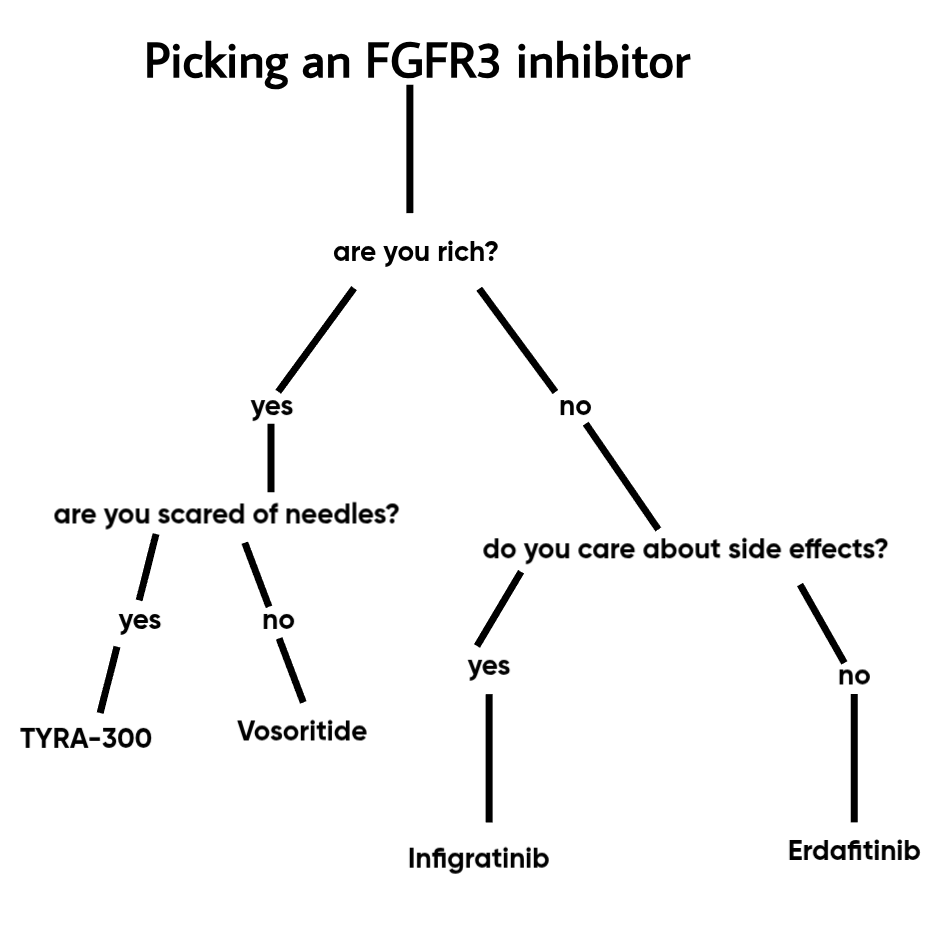
Screenshot From 2026 07 18 12 51 12

Sourcing:
For sourcing Erdafitinib, Infigratinib and Vosoritide you can get them all from the same places. If you have a Whatsapp or Telegram vendor with one of these they probably have all three. If you wanna get it from a website with a ton of pharma (like indiamart for example) just make an inquiry as they may not have a listing for it, but you can definitely find it if you ask. For something like TYRA-300 you either need to get a vendor on a chat-app that will make the capsules or tablets for you and ship it to you. You could also order the raw powder from many chemical websites and make the capsules or press the tablets yourself with a machine.

Research:


Attachments

  • 1784388442508.png
    1784388442508.png
    1.8 MB · Views: 0
  • +1
Reactions: negative, bestfraud67, ropesfy and 18 others
  • +1
Reactions: Paul.jnxy, fraudster#1, mendeds and 1 other person
i went over all the negatives and positives of using it. im not saying its the best one here or boasting.
Ik dw. I just dont like the people that glaze it a lot
 
  • +1
Reactions: Paul.jnxy
wnXpbCI.png

FGFR3 Inhibitors For Dummies
special thanks to Punjabi Waffen for inspiration and research

What is FGFR3? FGFR3 (Fibroblast growth factor receptor 3) is the body’s built-in brake pedal for bone growth. It slows the cartilage cells inside your growth plates, so inhibiting it takes some pressure off the brake and lets long bones grow faster.

What are some FGFR3 inhibitors? Erdafitinib, Infigratinib, Vosoritide and TYRA-300 (not all will be mentioned due to lack of evidence for height).

FGFR3 inhibitors information:

Erdafitinib:


Erdafitinib is an oral pan-FGFR inhibitor that blocks FGFR1-4, including FGFR3. It is mainly a cancer drug, so unlike more selective options it also hits pathways outside FGFR3.

Evidence: it has strong human evidence as a targeted treatment for FGFR-altered urothelial cancer, but the relevant height angle comes from FGFR3’s role as a brake on growth-plate activity, not from a dedicated height trial.

Infigratinib:
Infigratinib is a oral pan FGFR1-3 inhibitor, one of the main signals that tells your growth plates to slow down. The dose used in the growth study was 0.25 mg for every kilogram of bodyweight per day, which is far lower than the doses once used for cancer.

Evidence: In children with achondroplasia, the highest study dose increased yearly growth by around 2.5 cm after 18 months. It also improved height relative to other children with achondroplasia and slightly improved body proportions.

Vosoritide:
Vosoritide is a daily injection that helps cancel out FGFR3’s “slow bone growth” signal. Instead of blocking FGFR3 directly, it boosts a natural growth-plate signal that tells the bone-growth system to keep working.

Evidence: It is the proven and FDA-approved option for children with achondroplasia whose growth plates are still open. In the main trial, it added about 1.6 cm per year of extra growth compared with placebo.

TYRA-300:
TYRA-300 is a once-daily pill designed to block FGFR3 specifically. Unlike older FGFR drugs, it is meant to leave FGFR1, FGFR2, and FGFR4 alone, which could mean fewer random side effects outside the growth plates.

Evidence: It has made long bones grow more and improved body proportions in achondroplasia mouse studies. A human Phase 2 achondroplasia study is now testing several daily weight-based doses, but there are not yet human height results to show.

Side effects:

ErdafitinibThe big ones are high phosphate, eye/retinal toxicity (like potentially becoming blind), nail damage, dry skin or mouth, diarrhea, mouth sores, fatigue, and hand-foot syndrome. It is the “powerful but messy” FGFR inhibitor because it is not FGFR3-selective and highly potent.
InfigratinibAt the growth dose, it looked very well tolerated. Reported issues were mainly mild stomach upset, gas, nausea, lower appetite, and lower vitamin D; one person had mildly high phosphate in their blood and needed to pause and lower the dose. No major eye problems, faster growth-plate aging, or worse bone density were seen in that study.
VosoritideThe most common ones are redness, swelling, or pain where you inject it, vomiting, low blood pressure shortly after the shot, sweating more, and joint or limb pain. The major downside is that it has to be injected every day.
TYRA-300Nobody knows the full side-effect profile at growth doses yet because the pediatric growth trial is still ongoing. The whole selling point is that FGFR3-only targeting should avoid the high phosphate, eye, skin, and liver problems seen when other FGFR receptors get blocked, but that is still theory until the trial data come out.

Dosing:
ErdafitinibNot 100% settled on. FDA figure is 8 to 9mg once daily is for the cancer dose. People on this forum report using 2 to 4mg daily as a dose for heightmaxxing.
Infigratinib0.25 mg/kg daily
Vosoritide15 mcg/kg daily injection
TYRA-3000.125 to 0.50 mg/kg daily being studied

for the weight based dosing, just convert your weight to kilograms from pounds (if you use pounds to weight instead of kilograms) then multiply your weight in kg by the specific milligram (mg) or microgram (mcg) amount to see how much you need to take daily.

Picking a FGFR3 inhibitor (click on image):

Sourcing:
For sourcing Erdafitinib, Infigratinib and Vosoritide you can get them all from the same places. If you have a Whatsapp or Telegram vendor with one of these they probably have all three. If you wanna get it from a website with a ton of pharma (like indiamart for example) just make an inquiry as they may not have a listing for it, but you can definitely find it if you ask. For something like TYRA-300 you either need to get a vendor on a chat-app that will make the capsules or tablets for you and ship it to you. You could also order the raw powder from many chemical websites and make the capsules or press the tablets yourself with a machine.

Research:


cool thread
 
  • +1
Reactions: emire and Paul.jnxy
wnXpbCI.png

FGFR3 Inhibitors For Dummies
special thanks to Punjabi Waffen for inspiration and research

What is FGFR3? FGFR3 (Fibroblast growth factor receptor 3) is the body’s built-in brake pedal for bone growth. It slows the cartilage cells inside your growth plates, so inhibiting it takes some pressure off the brake and lets long bones grow faster.

What are some FGFR3 inhibitors? Erdafitinib, Infigratinib, Vosoritide and TYRA-300 (not all will be mentioned due to lack of evidence for height).

FGFR3 inhibitors information:

Erdafitinib:


Erdafitinib is an oral pan-FGFR inhibitor that blocks FGFR1-4, including FGFR3. It is mainly a cancer drug, so unlike more selective options it also hits pathways outside FGFR3.

Evidence: it has strong human evidence as a targeted treatment for FGFR-altered urothelial cancer, but the relevant height angle comes from FGFR3’s role as a brake on growth-plate activity, not from a dedicated height trial.

Infigratinib:
Infigratinib is a oral pan FGFR1-3 inhibitor, one of the main signals that tells your growth plates to slow down. The dose used in the growth study was 0.25 mg for every kilogram of bodyweight per day, which is far lower than the doses once used for cancer.

Evidence: In children with achondroplasia, the highest study dose increased yearly growth by around 2.5 cm after 18 months. It also improved height relative to other children with achondroplasia and slightly improved body proportions.

Vosoritide:
Vosoritide is a daily injection that helps cancel out FGFR3’s “slow bone growth” signal. Instead of blocking FGFR3 directly, it boosts a natural growth-plate signal that tells the bone-growth system to keep working.

Evidence: It is the proven and FDA-approved option for children with achondroplasia whose growth plates are still open. In the main trial, it added about 1.6 cm per year of extra growth compared with placebo.

TYRA-300:
TYRA-300 is a once-daily pill designed to block FGFR3 specifically. Unlike older FGFR drugs, it is meant to leave FGFR1, FGFR2, and FGFR4 alone, which could mean fewer random side effects outside the growth plates.

Evidence: It has made long bones grow more and improved body proportions in achondroplasia mouse studies. A human Phase 2 achondroplasia study is now testing several daily weight-based doses, but there are not yet human height results to show.

Side effects:

ErdafitinibThe big ones are high phosphate, eye/retinal toxicity (like potentially becoming blind), nail damage, dry skin or mouth, diarrhea, mouth sores, fatigue, and hand-foot syndrome. It is the “powerful but messy” FGFR inhibitor because it is not FGFR3-selective and highly potent.
InfigratinibAt the growth dose, it looked very well tolerated. Reported issues were mainly mild stomach upset, gas, nausea, lower appetite, and lower vitamin D; one person had mildly high phosphate in their blood and needed to pause and lower the dose. No major eye problems, faster growth-plate aging, or worse bone density were seen in that study.
VosoritideThe most common ones are redness, swelling, or pain where you inject it, vomiting, low blood pressure shortly after the shot, sweating more, and joint or limb pain. The major downside is that it has to be injected every day.
TYRA-300Nobody knows the full side-effect profile at growth doses yet because the pediatric growth trial is still ongoing. The whole selling point is that FGFR3-only targeting should avoid the high phosphate, eye, skin, and liver problems seen when other FGFR receptors get blocked, but that is still theory until the trial data come out.

Dosing:
ErdafitinibNot 100% settled on. FDA figure is 8 to 9mg once daily is for the cancer dose. People on this forum report using 2 to 4mg daily as a dose for heightmaxxing.
Infigratinib0.25 mg/kg daily
Vosoritide15 mcg/kg daily injection
TYRA-3000.125 to 0.50 mg/kg daily being studied

for the weight based dosing, just convert your weight to kilograms from pounds (if you use pounds to weight instead of kilograms) then multiply your weight in kg by the specific milligram (mg) or microgram (mcg) amount to see how much you need to take daily.

Picking a FGFR3 inhibitor (click on image):

Sourcing:
For sourcing Erdafitinib, Infigratinib and Vosoritide you can get them all from the same places. If you have a Whatsapp or Telegram vendor with one of these they probably have all three. If you wanna get it from a website with a ton of pharma (like indiamart for example) just make an inquiry as they may not have a listing for it, but you can definitely find it if you ask. For something like TYRA-300 you either need to get a vendor on a chat-app that will make the capsules or tablets for you and ship it to you. You could also order the raw powder from many chemical websites and make the capsules or press the tablets yourself with a machine.

Research:


But wouldn't this be pointless unless you are nearing the end of puberty / end of closure? If You only rely on cell division / death and have no E2 while trying to heightmaxx, Wont your bones become brittle as fuck and potentially break
 
But wouldn't this be pointless unless you are nearing the end of puberty / end of closure? If You only rely on cell division / death and have no E2 while trying to heightmaxx, Wont your bones become brittle as fuck and potentially break
depends on how far the fgfr3 inhibation goes and how strong your bones are. i don't think its pointless doing even doing mid puberty as a height boost to potentially go past your genetics or even gain an inch or two early.
 
depends on how far the fgfr3 inhibation goes and how strong your bones are. i don't think its pointless doing even doing mid puberty as a height boost to potentially go past your genetics or even gain an inch or two early.
I mean puberty takes years no? if you are going to do this. would you be pinning the hg for years?
 
I mean puberty takes years no? if you are going to do this. would you be pinning the hg for years?
? what are you saying exactly
 
? what are you saying exactly
We're saying if someone is about mid way through puberty and they still got open plates. FGFR is the "brake" in your bio mechanism that dictates when the time to close your plates are correct? I assume this only matters to people who are older and nearing the end.

Or does it still close if you accelerate your growth from the hg + ai? And you need to stop it anyway if you want to go past your genetics?


im still new to this shit but thats my idea
 
We're saying if someone is about mid way through puberty and they still got open plates. FGFR is the "brake" in your bio mechanism that dictates when the time to close your plates are correct? I assume this only matters to people who are older and nearing the end.

Or does it still close if you accelerate your growth from the hg + ai? And you need to stop it anyway if you want to go past your genetics?


im still new to this shit but thats my idea
FGFR3 slows growth-plate activity and bone maturation, so inhibiting it could make you grow faster than usual while your plates are still open. It doesn’t directly control plate closure like estrogen does, but it may give you more growth during the time you have left. Whether that translates to more final height than your genetics in healthy people is still unknown. It also appears it can speed up linear/height growth while you’re taking it.
 
FGFR3 slows growth-plate activity and bone maturation, so inhibiting it could make you grow faster than usual while your plates are still open. It doesn’t directly control plate closure like estrogen does, but it may give you more growth during the time you have left. Whether that translates to more final height than your genetics in healthy people is still unknown. It also appears it can speed up linear/height growth while you’re taking it.
One more question, if we inhibit the E2 during the cycle. isnt that dangerous for bones because they grow but do not mineralize
 
One more question, if we inhibit the E2 during the cycle. isnt that dangerous for bones because they grow but do not mineralize
yeah it can be. but your join date is 2021 so im curious have your plates stayed open this whole time?
 
yeah it can be. but your join date is 2021 so im curious have your plates stayed open this whole time?
Yes but nearing the end i am beginning to fuse
 
This nigger put voso as fgfr inhibitor
 
  • JFL
  • +1
Reactions: Goy.boy.Hero, Paul.jnxy and Gudlifer
This nigger put voso as fgfr inhibitor
vosoritide is considered a functional FGFR3 inhibitor, though it works indirectly rather than by directly blocking the receptor itself. nigger boy!
 
  • JFL
  • +1
Reactions: negative, ropesfy and Goy.boy.Hero
What is FGFR3? FGFR3 (Fibroblast growth factor receptor 3) is the body’s built-in brake pedal for bone growth. It slows the cartilage cells inside your growth plates, so inhibiting it takes some pressure off the brake and lets long bones grow faster.
Tbh heightmaxxing is rarely worth it for most people, you either end up mentally retarded by nuking e2 or end of feeling like you're terminally ill.
 
  • +1
  • Hmm...
Reactions: Goy.boy.Hero and Paul.jnxy
vosoritide is considered a functional FGFR3 inhibitor, though it works indirectly rather than by directly blocking the receptor itself. nigger boy!
Exactly it works indirectly
Thus it is not a FGFR inhibitor
 
  • +1
Reactions: Goy.boy.Hero, Paul.jnxy and Gudlifer
Tbh heightmaxxing is rarely worth it for most people, you either end up mentally retarded by nuking e2 or end of feeling like you're terminally ill.
if you use something like anastrozole especially 0.5g your not going to fully nuke it or feel like shit. and yeah heightmaxxing is hard and annoying asf, its like god never intended for you to escape your personally made height-hell decided as soon as the sperm hit the egg, which is pretty brutal.
 
  • +1
Reactions: Goy.boy.Hero and Lord Vader
Exactly it works indirectly
Thus it is not a FGFR inhibitor
:lul: JFL. it inhibits FGFR3 specifically (its not a pan fgfr inhibitor), inhibition medically is when receptor's activity or downstream signaling is suppressed which is what happens with voso to the fgfr3 lol. it doesn't have to work directly with it to still inhibit it.
 
:lul: JFL. it inhibits FGFR3 specifically (its not a pan fgfr inhibitor)
It doesnt lmao
It binds to a receptor which raises cgmp which then activates g2 which then inhibits fgfr3s downstream pathways
The FGFR3 is not inhibited at all
inhibition medically is when receptor's activity or downstream signaling is suppressed which is what happens with voso to the fgfr3 lol.
no its not? Where did you get this from
Receptor inhibition is binding to the extra- or intracellular receptor domain
The effect that FGFR3s downstream signaling is suppressed cannot be called FGFR3 Inhibition, at best you can call Voso an 'inhibitor' of MAPK/ERK phosophorylation
it doesn't have to work directly with it to still inhibit it.
It does
If not, it doesnt inhibit the receptor but only other parts of the pathway
 
  • +1
Reactions: Paul.jnxy and Gudlifer
It doesnt lmao
It binds to a receptor which raises cgmp which then activates g2 which then inhibits fgfr3s downstream pathways
The FGFR3 is not inhibited at all

no its not? Where did you get this from
Receptor inhibition is binding to the extra- or intracellular receptor domain
The effect that FGFR3s downstream signaling is suppressed cannot be called FGFR3 Inhibition, at best you can call Voso an 'inhibitor' of MAPK/ERK phosophorylation

It does
If not, it doesnt inhibit the receptor but only other parts of the pathway
you could use the strict definition in pharmacology and all the technical aspect. but at the end of the day fgfr3 still gets inhibited and you see all of the benefits of it like you would with other fgfr3 inhibitors. there's a reason it's favored so much clinically for height right now. i don't care about the semantics and neither did anyone in this thread.
 
  • +1
Reactions: Goy.boy.Hero
wnXpbCI.png

FGFR3 Inhibitors For Dummies
special thanks to Punjabi Waffen for inspiration and research

What is FGFR3? FGFR3 (Fibroblast growth factor receptor 3) is the body’s built-in brake pedal for bone growth. It slows the cartilage cells inside your growth plates, so inhibiting it takes some pressure off the brake and lets long bones grow faster.

What are some FGFR3 inhibitors? Erdafitinib, Infigratinib, Vosoritide and TYRA-300 (not all will be mentioned due to lack of evidence for height).

FGFR3 inhibitors information:

Erdafitinib:


Erdafitinib is an oral pan-FGFR inhibitor that blocks FGFR1-4, including FGFR3. It is mainly a cancer drug, so unlike more selective options it also hits pathways outside FGFR3.

Evidence: it has strong human evidence as a targeted treatment for FGFR-altered urothelial cancer, but the relevant height angle comes from FGFR3’s role as a brake on growth-plate activity, not from a dedicated height trial.

Infigratinib:
Infigratinib is a oral pan FGFR1-3 inhibitor, one of the main signals that tells your growth plates to slow down. The dose used in the growth study was 0.25 mg for every kilogram of bodyweight per day, which is far lower than the doses once used for cancer.

Evidence: In children with achondroplasia, the highest study dose increased yearly growth by around 2.5 cm after 18 months. It also improved height relative to other children with achondroplasia and slightly improved body proportions.

Vosoritide:
Vosoritide is a daily injection that helps cancel out FGFR3’s “slow bone growth” signal. Instead of blocking FGFR3 directly, it boosts a natural growth-plate signal that tells the bone-growth system to keep working.

Evidence: It is the proven and FDA-approved option for children with achondroplasia whose growth plates are still open. In the main trial, it added about 1.6 cm per year of extra growth compared with placebo.

TYRA-300:
TYRA-300 is a once-daily pill designed to block FGFR3 specifically. Unlike older FGFR drugs, it is meant to leave FGFR1, FGFR2, and FGFR4 alone, which could mean fewer random side effects outside the growth plates.

Evidence: It has made long bones grow more and improved body proportions in achondroplasia mouse studies. A human Phase 2 achondroplasia study is now testing several daily weight-based doses, but there are not yet human height results to show.

Side effects:

ErdafitinibThe big ones are high phosphate, eye/retinal toxicity (like potentially becoming blind), nail damage, dry skin or mouth, diarrhea, mouth sores, fatigue, and hand-foot syndrome. It is the “powerful but messy” FGFR inhibitor because it is not FGFR3-selective and highly potent.
InfigratinibAt the growth dose, it looked very well tolerated. Reported issues were mainly mild stomach upset, gas, nausea, lower appetite, and lower vitamin D; one person had mildly high phosphate in their blood and needed to pause and lower the dose. No major eye problems, faster growth-plate aging, or worse bone density were seen in that study.
VosoritideThe most common ones are redness, swelling, or pain where you inject it, vomiting, low blood pressure shortly after the shot, sweating more, and joint or limb pain. The major downside is that it has to be injected every day.
TYRA-300Nobody knows the full side-effect profile at growth doses yet because the pediatric growth trial is still ongoing. The whole selling point is that FGFR3-only targeting should avoid the high phosphate, eye, skin, and liver problems seen when other FGFR receptors get blocked, but that is still theory until the trial data come out.

Dosing:
ErdafitinibNot 100% settled on. FDA figure is 8 to 9mg once daily is for the cancer dose. People on this forum report using 2 to 4mg daily as a dose for heightmaxxing.
Infigratinib0.25 mg/kg daily
Vosoritide15 mcg/kg daily injection
TYRA-3000.125 to 0.50 mg/kg daily being studied

for the weight based dosing, just convert your weight to kilograms from pounds (if you use pounds to weight instead of kilograms) then multiply your weight in kg by the specific milligram (mg) or microgram (mcg) amount to see how much you need to take daily.

Picking a FGFR3 inhibitor (click on image):

Sourcing:
For sourcing Erdafitinib, Infigratinib and Vosoritide you can get them all from the same places. If you have a Whatsapp or Telegram vendor with one of these they probably have all three. If you wanna get it from a website with a ton of pharma (like indiamart for example) just make an inquiry as they may not have a listing for it, but you can definitely find it if you ask. For something like TYRA-300 you either need to get a vendor on a chat-app that will make the capsules or tablets for you and ship it to you. You could also order the raw powder from many chemical websites and make the capsules or press the tablets yourself with a machine.

Research:


Omg erda!!
 
  • JFL
Reactions: Goy.boy.Hero
you could use the strict definition in pharmacology and all the technical aspect.
Voso fulfills neither competitive nor non-competitive inhibition and also not inverse agonism, theres no way to call it an inhibitor
Go read Katzungs Antagonist definition lol
but at the end of the day fgfr3 still gets inhibited
The point is that it DOES NOT get inhibited
youre talking about the whole pathway
do you know what the R stands for?
FGFR3 is only a receptor
It does not get inhibited by Vosoritide
and you see all of the benefits of it like you would with other fgfr3 inhibitors.
same outcome does not mean same cause
Fallacy farming right here
there's a reason it's favored so much clinically for height right now.
How is it favored
it just passed trials, just like FGFR3 Inhibitors did
its not even the same category
i don't care about the semantics and neither did anyone in this thread.
I did
It shows the lack of quality of your OP and knowledge
And your enormous ego, cant even admit you were wrong
First its "No im right its an fgfr3 inhibitor" now its "well noone cares about the details anyways":lul::lul:
JFL at you
 
  • +1
Reactions: Paul.jnxy and Gudlifer
Voso fulfills neither competitive nor non-competitive inhibition and also not inverse agonism, theres no way to call it an inhibitor
Go read Katzungs Antagonist definition lol

The point is that it DOES NOT get inhibited
youre talking about the whole pathway
do you know what the R stands for?
FGFR3 is only a receptor
It does not get inhibited by Vosoritide

same outcome does not mean same cause
Fallacy farming right here

How is it favored
it just passed trials, just like FGFR3 Inhibitors did
its not even the same category

I did
It shows the lack of quality of your OP and knowledge
And your enormous ego, cant even admit you were wrong
First its "No im right its an fgfr3 inhibitor" now its "well noone cares about the details anyways":lul::lul:
JFL at you
dude if your denying what google is saying the definition of medical inhibition sure. the end goal of fgfr3 not going off is still reached which is what everyone imagines when you say FGFR3 inhibition. if you wanna say its not direct sure, but the end goal still happens. removing it would've made the thread much more shallow and shit.
 
dude if your denying what google is saying the definition of medical inhibition sure. the end goal of fgfr3 not going off is still reached which is what everyone imagines when you say FGFR3 inhibition. if you wanna say its not direct sure, but the end goal still happens. removing it would've made the thread much more shallow and shit.
My point gets even sharper when you include the concept of functional agonism, which you seem to be missing.
 
Voso fulfills neither competitive nor non-competitive inhibition and also not inverse agonism, theres no way to call it an inhibitor
Go read Katzungs Antagonist definition lol

The point is that it DOES NOT get inhibited
youre talking about the whole pathway
do you know what the R stands for?
FGFR3 is only a receptor
It does not get inhibited by Vosoritide

same outcome does not mean same cause
Fallacy farming right here

How is it favored
it just passed trials, just like FGFR3 Inhibitors did
its not even the same category

I did
It shows the lack of quality of your OP and knowledge
And your enormous ego, cant even admit you were wrong
First its "No im right its an fgfr3 inhibitor" now its "well noone cares about the details anyways":lul::lul:
JFL at you
Multiple sources across the literature consistently phrase vosoritide's action as producing "inhibition of downstream signalling pathways of the overactive FGFR3 gene", and one recent meta-analysis states plainly that "vosoritide activates the NPR-B receptor to inhibit the overactive FGFR3 signaling pathway". It's the consistent phrasing used across pharmacology reviews and meta-analyses in 2021 through 2026. When the mechanism is functional antagonism, describing the net effect as "FGFR3 gets inhibited" is defensible precisely because functional antagonism is a legitimate way pharmacologists describe an opposing-receptor system neutralizing another receptor's pathological output. My instinct that the end result matters and is what the term is communicating lines up with how these clinical and pharmacology papers actually write about it.
 
dude if your denying what google is saying the definition of medical inhibition sure.
saar google
Katzungs antagonist definition
"If drug-receptor binding results in activation of the receptor, the drug is termed an agonist; if inhibition results, the drug is considered an antagonist."
There is no inhibition resulting with Vosoritide, there isnt even any receptor binding
Clearly NOT an inhibitor
the end goal of fgfr3 not going off is still reached
No its not
FGFR3 still activates as usual
which is what everyone imagines when you say FGFR3 inhibition.
Yeah and it does not happen
if you wanna say its not direct sure, but the end goal still happens. removing it would've made the thread much more shallow and shit.
Its not just "not direct"
The whole thing is not happening at all
 
  • +1
Reactions: Paul.jnxy and Gudlifer
My point gets even sharper when you include the concept of functional agonism, which you seem to be missing.
Clearly chat gpt answer
This applies to ligands that bind to receptors
Voso doesnt bind to fgfr3 in the first place
 
  • +1
Reactions: Paul.jnxy and Gudlifer
saar google
Katzungs antagonist definition
"If drug-receptor binding results in activation of the receptor, the drug is termed an agonist; if inhibition results, the drug is considered an antagonist."
There is no inhibition resulting with Vosoritide, there isnt even any receptor binding
Clearly NOT an inhibitor

No its not
FGFR3 still activates as usual

Yeah and it does not happen

Its not just "not direct"
The whole thing is not happening at all
Still ignoring the concept of functional agonism which is consistant across multiple papers. Also, Google just gives you the standard definition of what your asking for.
 
  • JFL
  • +1
Reactions: Paul.jnxy and Niebvll
Clearly chat gpt answer
This applies to ligands that bind to receptors
Voso doesnt bind to fgfr3 in the first place
Using proper capitalization and punctuation does not mean the post is from AI.
 
  • +1
Reactions: Paul.jnxy
Multiple sources across the literature consistently phrase vosoritide's action as producing "inhibition of downstream signalling pathways of the overactive FGFR3 gene", and one recent meta-analysis states plainly that "vosoritide activates the NPR-B receptor to inhibit the overactive FGFR3 signaling pathway".
Exactly the pathway not the receptor
It's the consistent phrasing used across pharmacology reviews and meta-analyses in 2021 through 2026. When the mechanism is functional antagonism, describing the net effect as "FGFR3 gets inhibited" is defensible precisely because functional antagonism is a legitimate way pharmacologists describe an opposing-receptor system neutralizing another receptor's pathological output. My instinct that the end result matters and is what the term is communicating lines up with how these clinical and pharmacology papers actually write about it.
DNR gpt slop
Also "Multiple sources" *proceeds to name 0*
Absolute cope just to not admit youre wrong
It is in no definition an FGFR3 inhibitor period
 
  • +1
Reactions: Gudlifer
Still ignoring the concept of functional agonism which is consistant across multiple papers. Also, Google just gives you the standard definition of what your asking for.
LOL YOU ARE SO IGNORANT:lul::lul:
Top 5 least iq users
 
  • +1
Reactions: Gudlifer
@Gudlifer @Paul.jnxy look at this nigger:forcedsmile::forcedsmile:
 
  • +1
Reactions: Paul.jnxy and Gudlifer
Using proper capitalization and punctuation does not mean the post is from AI.
Giving a completely unrelated answer does make it seem like it is
If you would even slightly understand how voso and ligands work, youd know functional agonism doesnt matter here
 
  • +1
Reactions: Paul.jnxy and Gudlifer
Exactly the pathway not the receptor

DNR gpt slop
Also "Multiple sources" *proceeds to name 0*
Absolute cope just to not admit youre wrong
It is in no definition an FGFR3 inhibitor period
Functional/physiological antagonism, per IUPHAR's own nomenclature, explicitly allows a separate receptor to counteract another pathway's pathological signaling without any direct binding, so the fact that vosoritide never touches FGFR3 doesn't disqualify it from inhibiting the FGFR3 pathway, it's the exact mechanism the term describes.
 
  • Ugh..
Reactions: Niebvll
  • JFL
  • Nerd
Reactions: negative, Paul.jnxy and Gudlifer
Functional/physiological antagonism, per IUPHAR's own nomenclature, explicitly allows a separate receptor to counteract another pathway's pathological signaling without any direct binding, so the fact that vosoritide never touches FGFR3 doesn't disqualify it from inhibiting the FGFR3 pathway, it's the exact mechanism the term describes.
Exactly the pathway not the receptor itself:lul:
Just disproving yourself here
 
  • +1
Reactions: Paul.jnxy and Gudlifer
Giving a completely unrelated answer does make it seem like it is
If you would even slightly understand how voso and ligands work, youd know functional agonism doesnt matter here
I understand it on a much more advanced perspective than yours.
 
  • JFL
Reactions: Paul.jnxy
get those niggers out of here i wanna argue with you not your friends
You already lost the second I first replied
Gonna put you on ignore now, your ratio says it all and I dont want mine to become like yours
Too high iq to keep explaining simple differences to you
 
  • +1
Reactions: Paul.jnxy and Gudlifer
You already lost the second I first replied
Gonna put you on ignore now, your ratio says it all and I dont want mine to become like yours
Too high iq to keep explaining simple differences to you
Good job losing!
 
You already lost the second I first replied
Gonna put you on ignore now, your ratio says it all and I dont want mine to become like yours
Too high iq to keep explaining simple differences to you
Every peer-reviewed source on this drug, including the 2026 meta-analysis, literally writes 'vosoritide inhibits the overactive FGFR3 signaling pathway,' so I'm using the exact terminology the entire published pharmacology literature uses, meanwhile you're rejecting a term you don't like while offering zero citation that contradicts it, your losing to the actual literature.
pubmed.ncbi.nlm.nih
pubmed.ncbi.nlm.nih
pmc.ncbi.nlm.nih
pmc.ncbi.nlm.nih
nature
 
Every peer-reviewed source on this drug, including the 2026 meta-analysis, literally writes 'vosoritide inhibits the overactive FGFR3 signaling pathway so I'm using the exact terminology the entire published pharmacology literature uses,

meanwhile you're rejecting a term you don't like
I rejected calling it an Fgfr3 inhibitor because it isnt
how can you not grasp that fgfr3 is the receptor only while the pathway is the whole pathway
while offering zero citation that contradicts it, your losing to the actual literature.
I literally cited Katzung lol whats your problem retard
 
  • +1
Reactions: Paul.jnxy
I rejected calling it an Fgfr3 inhibitor because it isnt
how can you not grasp that fgfr3 is the receptor only while the pathway is the whole pathway

I literally cited Katzung lol whats your problem retard
dnr + bump
 
  • Ugh..
  • +1
Reactions: Paul.jnxy and Niebvll
Functional/physiological antagonism, per IUPHAR's own nomenclature, explicitly allows a separate receptor to counteract another pathway's pathological signaling without any direct binding, so the fact that vosoritide never touches FGFR3 doesn't disqualify it from inhibiting the FGFR3 pathway, it's the exact mechanism the term describes.
Dude what are you even arguing about. FGFR3 = Fibroblast Growth Factor RECEPTOR 3. how can Voso be an inhibitor when it does not bind the RECEPTOR lmao
 

Similar threads

eliashnmsnv
Replies
0
Views
26
eliashnmsnv
eliashnmsnv
eliashnmsnv
Replies
0
Views
29
eliashnmsnv
eliashnmsnv
eliashnmsnv
Replies
1
Views
36
WonkyChin186
WonkyChin186
MMMax
Replies
3
Views
74
mike1223277189
mike1223277189
FoidBrutalizer
Replies
2
Views
125
Nerogen
Nerogen

Users who are viewing this thread

Back
Top