rsj
Gold
- Joined
- Jun 17, 2026
- Posts
- 904
- Reputation
- 492

FGFR3 Inhibitors For Dummies
special thanks to Punjabi Waffen for inspiration and research
What is FGFR3? FGFR3 (Fibroblast growth factor receptor 3) is the body’s built-in brake pedal for bone growth. It slows the cartilage cells inside your growth plates, so inhibiting it takes some pressure off the brake and lets long bones grow faster.
What are some FGFR3 inhibitors? Erdafitinib, Infigratinib, Vosoritide and TYRA-300 (not all will be mentioned due to lack of evidence for height).
FGFR3 inhibitors information:
Erdafitinib:
Erdafitinib is an oral pan-FGFR inhibitor that blocks FGFR1-4, including FGFR3. It is mainly a cancer drug, so unlike more selective options it also hits pathways outside FGFR3.
Evidence: it has strong human evidence as a targeted treatment for FGFR-altered urothelial cancer, but the relevant height angle comes from FGFR3’s role as a brake on growth-plate activity, not from a dedicated height trial.
Infigratinib:
Infigratinib is a oral pan FGFR1-3 inhibitor, one of the main signals that tells your growth plates to slow down. The dose used in the growth study was 0.25 mg for every kilogram of bodyweight per day, which is far lower than the doses once used for cancer.
Evidence: In children with achondroplasia, the highest study dose increased yearly growth by around 2.5 cm after 18 months. It also improved height relative to other children with achondroplasia and slightly improved body proportions.
Vosoritide:
Vosoritide is a daily injection that helps cancel out FGFR3’s “slow bone growth” signal. Instead of blocking FGFR3 directly, it boosts a natural growth-plate signal that tells the bone-growth system to keep working.
Evidence: It is the proven and FDA-approved option for children with achondroplasia whose growth plates are still open. In the main trial, it added about 1.6 cm per year of extra growth compared with placebo.
TYRA-300:
TYRA-300 is a once-daily pill designed to block FGFR3 specifically. Unlike older FGFR drugs, it is meant to leave FGFR1, FGFR2, and FGFR4 alone, which could mean fewer random side effects outside the growth plates.
Evidence: It has made long bones grow more and improved body proportions in achondroplasia mouse studies. A human Phase 2 achondroplasia study is now testing several daily weight-based doses, but there are not yet human height results to show.
Side effects:
| Erdafitinib | The big ones are high phosphate, eye/retinal toxicity (like potentially becoming blind), nail damage, dry skin or mouth, diarrhea, mouth sores, fatigue, and hand-foot syndrome. It is the “powerful but messy” FGFR inhibitor because it is not FGFR3-selective and highly potent. |
| Infigratinib | At the growth dose, it looked very well tolerated. Reported issues were mainly mild stomach upset, gas, nausea, lower appetite, and lower vitamin D; one person had mildly high phosphate in their blood and needed to pause and lower the dose. No major eye problems, faster growth-plate aging, or worse bone density were seen in that study. |
| Vosoritide | The most common ones are redness, swelling, or pain where you inject it, vomiting, low blood pressure shortly after the shot, sweating more, and joint or limb pain. The major downside is that it has to be injected every day. |
| TYRA-300 | Nobody knows the full side-effect profile at growth doses yet because the pediatric growth trial is still ongoing. The whole selling point is that FGFR3-only targeting should avoid the high phosphate, eye, skin, and liver problems seen when other FGFR receptors get blocked, but that is still theory until the trial data come out. |
Dosing:
| Erdafitinib | Not 100% settled on. FDA figure is 8 to 9mg once daily is for the cancer dose. People on this forum report using 2 to 4mg daily as a dose for heightmaxxing. |
| Infigratinib | 0.25 mg/kg daily |
| Vosoritide | 15 mcg/kg daily injection |
| TYRA-300 | 0.125 to 0.50 mg/kg daily being studied |
for the weight based dosing, just convert your weight to kilograms from pounds (if you use pounds to weight instead of kilograms) then multiply your weight in kg by the specific milligram (mg) or microgram (mcg) amount to see how much you need to take daily.
Picking a FGFR3 inhibitor (click on image):
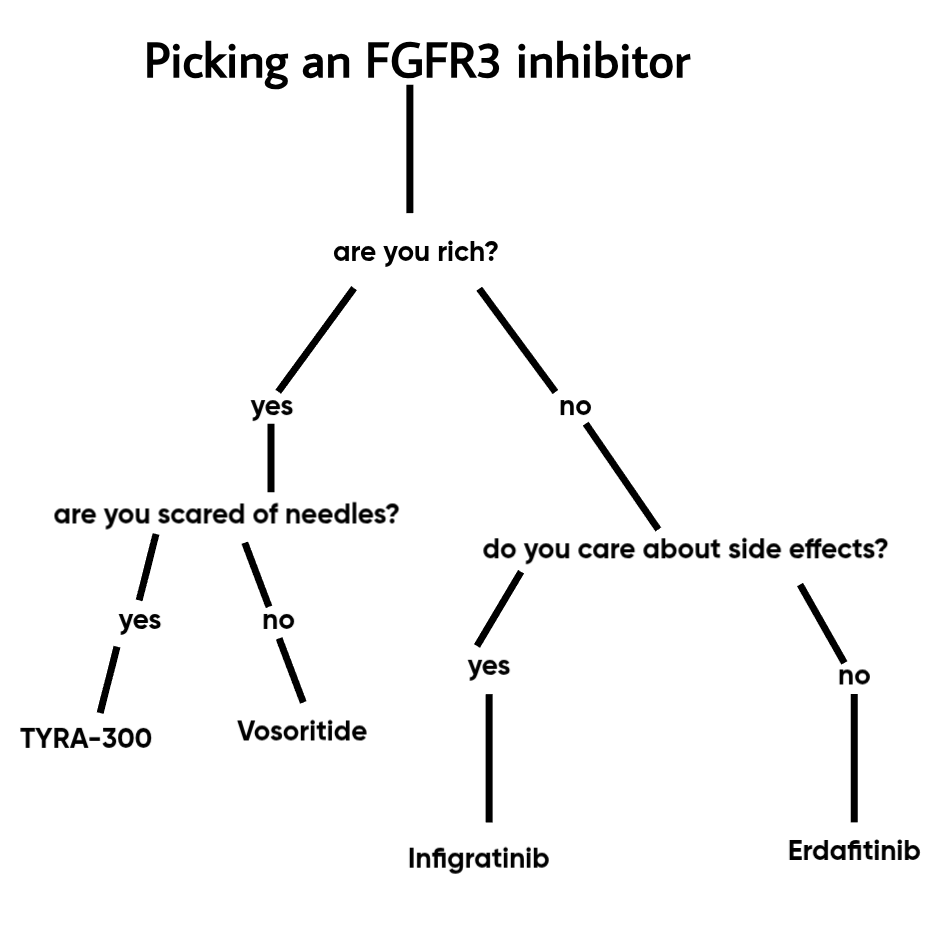
For sourcing Erdafitinib, Infigratinib and Vosoritide you can get them all from the same places. If you have a Whatsapp or Telegram vendor with one of these they probably have all three. If you wanna get it from a website with a ton of pharma (like indiamart for example) just make an inquiry as they may not have a listing for it, but you can definitely find it if you ask. For something like TYRA-300 you either need to get a vendor on a chat-app that will make the capsules or tablets for you and ship it to you. You could also order the raw powder from many chemical websites and make the capsules or press the tablets yourself with a machine.
Research:
Vosoritide (Voxzogo) for Achondroplasia: A Review of Clinical and Real-World Evidence - PMC
Achondroplasia is the most common genetic skeletal dysplasia, caused by activating mutations in the FGFR3 gene that impair endochondral ossification and result in disproportionate short stature. Vosoritide (VOXZOGO®), a C-type natriuretic peptide ...
 pmc.ncbi.nlm.nih.gov
BridgeBio Reports Positive Phase 3 Topline Results for Oral Infigratinib with the First Statistically Significant Improvements in Body Proportionality in Achondroplasia
- PROPEL 3 successfully met the primary endpoint of change from baseline in AHV at Week 52 (p<0.0001) - Change from baseline in AHV was superior to placebo at Week 52 with a mean treatment difference against placebo of +2.10 cm/year; the LS mean was +1.74 cm/year - In a pre-specified exploratory...
TYRA-300, an FGFR3-selective inhibitor, promotes bone growth in two FGFR3-driven models of chondrodysplasia - PMC
Achondroplasia (ACH) and hypochondroplasia (HCH), the two most common types of dwarfism, are each caused by FGFR3 gain-of-function mutations that result in increased FGFR3 signaling, which disrupts chondrogenesis and osteogenesis, resulting in ...
pmc.ncbi.nlm.nih.gov
ClinicalTrials.gov
 clinicaltrials.gov