St.TikTokcel
159cm ofiara klinefeltera/Male feminist, Anti JBW
- Joined
- Apr 6, 2022
- Posts
- 33,028
- Reputation
- 61,112
god is real
god isreal
coincidence?

Follow along with the video below to see how to install our site as a web app on your home screen.

Note: this_feature_currently_requires_accessing_site_using_safari



god is real
god isreal
coincidence?



science cant justify itself or generate knowledge beyond contingent probabilistic associationsYour opinion is wrong, Kuhn's work is more of a direct admission of the fact that we should treat science as a method instead of the method. We cannot wholly know the truth but we can get have a better measure of our ignorance. To treat science as falsification is to deny science altogether.
let me ask you this: what are the rules/methods for scientists during the extraordinary research stage of a paradigm shift?Your opinion is wrong, Kuhn's work is more of a direct admission of the fact that we should treat science as a method instead of the method
falsification never claims to discover truth, merely eliminating incorrect ideas. theories that are easy to falsify empirically and have been tested many many times are preferred because they are usefulWe cannot wholly know the truth but we can get have a better measure of our ignorance. To treat science as falsification is to deny science altogether.
Deus exscience cant justify itself or generate knowledge beyond contingent probabilistic associations
it cant even establish certain causation between physical phenomena without assuming a bunch of things that arent experimentally verifiable or falsifiable
without regularity, external world, metaphysical transcendentals like logic and numbers which cannot be experimentally observed, etc. you cant even use it
it is insufficient basis for a coherent worldview
problem is majority of reddit i love science faggots dont understand this and literally think you can be a dogmatic materialist and not collapse into nihilism because muh science will figure everything out and well all eventually put ont he fedora and be euphoric in our own enlightenment and live in star trek world and wear pastel jumpsuits and fuck aliens
without god science is impossible
retardscience cant justify itself or generate knowledge beyond contingent probabilistic associations
it cant even establish certain causation between physical phenomena without assuming a bunch of things that arent experimentally verifiable or falsifiable
without regularity, external world, metaphysical transcendentals like logic and numbers which cannot be experimentally observed, etc. you cant even use it
it is insufficient basis for a coherent worldview
problem is majority of reddit i love science faggots dont understand this and literally think you can be a dogmatic materialist and not collapse into nihilism because muh science will figure everything out and well all eventually put ont he fedora and be euphoric in our own enlightenment and live in star trek world and wear pastel jumpsuits and fuck aliens
without god science is impossible
yeah but there is one thoDeus ex

your last line a) does not make any sense and b) is completely unrelated and doesn't follow on from anything else you wrotethis is beyond you greycel
you must lern
Except science doesn't work by the way of falsification. A theory even if falsified would be accepted by the scientific community and will b used using band-aid methods until a new theory replace it's place. Just look at string theory or renormalization.let me ask you this: what are the rules/methods for scientists during the extraordinary research stage of a paradigm shift?
falsification never claims to discover truth, merely eliminating incorrect ideas. theories that are easy to falsify empirically and have been tested many many times are preferred because they are useful

I agree God is real. If u see the world nowadays everything is straying away from God, and yet people are becoming less happy. That itself alone should be an indicator that there was a reason God planned things. Now there are bunch of fags and weirdos roaming around
I never said it did, but I do think it's the best method that isn't just giving up and accepting anything goesExcept science doesn't work by the way of falsification. A theory even if falsified would be accepted by the scientific community and will b used using band-aid methods until a new theory replace it's place. Just look at string theory or renormalization.

lmao, noAnyone who suggests Deductive Reasoning for God is not valid is low iq by definition.
And it’s rational to believe in a Supremely Perfect Necessary Being. The greatest thinkers arrived to this conclusion via deductive reasoning a-prior (logic alone) or a posteriori (from observation around us) in fact.

In what ways are cause and effect debunked?Most philosophers believed in God because it was instilled in them by society during early childhood and then they employed mental gymnastics to defend the position when they were older. That is how beliefs typically work
Regarding the cosmological argument, cause and effect were debunked a while ago so it is easy enough to dismiss entirely

It’s not as simple as that. Also some theoretical physicists believe that the universe somehow behave in an oscillating fashion. Expanding and then condense or collapse.The big bang theory is two particles colliding and creating the whole universe (without explaining how those two particles were even created), it's also just a theory too. Just as valid as some supernatural being magically creating the universe.

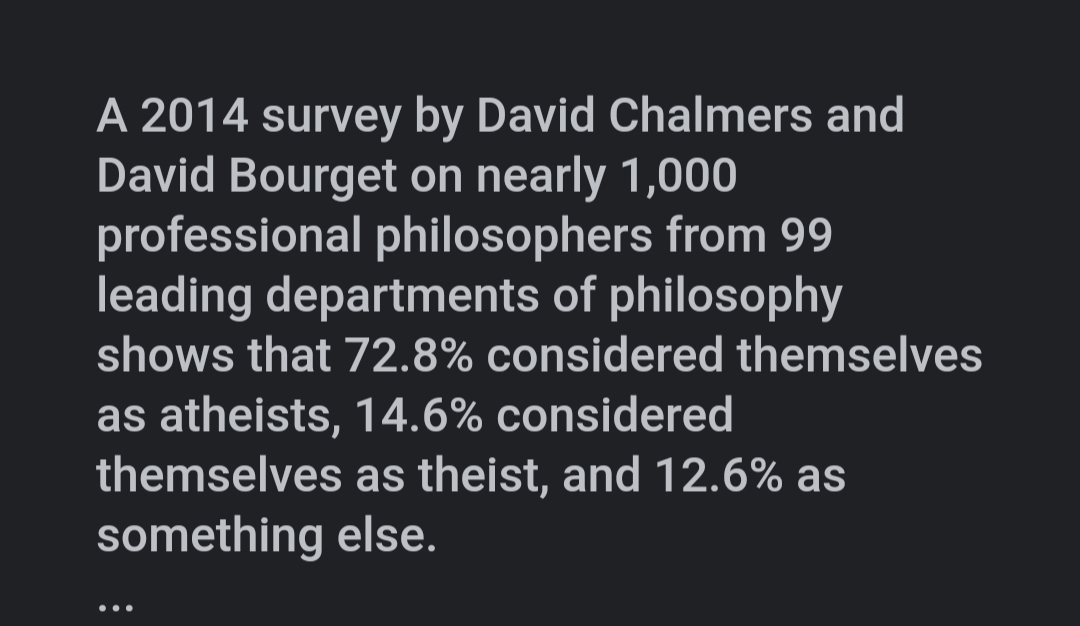
This is not a popularity contest. The truth of a proposition needs to be demonstrated, how many people believe it and entertain it is irrelevant. Either way your statement isn't entirely correct, most philosophers were theists 600 years ago when we had little to no scientific knowledge of the world. The majority of current philosophers do not subscribe to theism.i see people calling god a fairy tale and an irrational idea but the irony is that most of the famous philosphers were theists/deists...
why did they believed in a god?ill try to answer in this thread
"We need to define god"? So you're defining things into existence now? God's definition should be self evident under the assumption that he does exist and interacts with the universe, instead what you're doing is going with your own interpretation of his nature and seeing how you can make it fit with reality. That is a fallacious method, first you look at evidence, then you come to conclusions. What precedent and prior observation are you going off of when "defining god"? I'd like to know how you determined that God is defined as whatever you say it is.Deductive Proof of god:
first we need to define god
GOD=from which everything originated ie The first cause/the uncaused cause
"By using simple logic we can be sure that God exists"by using simple logic we can be sure god exists
premise no 1: i have a cause
premise no2:my cause also has a cause and that cause has a cause too and so on
premis no 3: since this caual chain can go on for infinity hence there must exist a first cause from which everything originated
Does this menthod works?
democrites used the same kind of reasoning to predict that Atomos/Atom exist thousands of years ago
he asked a simple question to himself :what will happen if i cut a melon in two pieces and take one of the two pieces and cut it again and repeat the process?he concluded that since this process cant go on for infinity hence there must exist a particle which cant be further divided..he called this the Atomos/atom ie the elemantry particle
Zeno used his paradoxes having same reasoning to hint that plank length exist
so why did most of the famous philosopher believed in god?because its simple logic
denying god is denying simple logic (atleast if u define god the way i did)
I already know about that. A religious person could argue that god designed the universe to expand and collapse and was behind the initial root cause/creation of the universe still.It’s not as simple as that. Also some theoretical physicists believe that the universe somehow behave in an oscillating fashion. Expanding and then condense or collapse.
Certainly not as valid as something supernatural

What?lmao, no
Theists have always held God to be uncaused.What caused God? Or is he just absolved of your reasoning
Theists have always held God to be uncaused.
It’s literally impossible to cause a perfect being whatever could cause a perfect being would have to have more Perfect Will than the Perfect Will of a perfect being. So it would have to be more perfect than perfect but that’s impossible. A contradiction. Therefore nothing could cause a perfect being. God is a perfect being. Therefore nothing could cause God.
Why is God "perfect"? How can "perfect" be a thing? What causes his perfection? What is that based on? If he is maximally everything then is he also maximally stupid? If he is perfect then why would he create us when that denotes a lack of something which is in direct contradiction with perfection? A god that is perfect is self sustainable and doesn't need anything, much less a bunch of sentient primates acknowledging his existence and praising him. Any change towards a new state implies that the prior state wasn't perfect.Theists have always held God to be uncaused.
It’s literally impossible to cause a perfect being whatever could cause a perfect being would have to have more Perfect Will than the Perfect Will of a perfect being. So it would have to be more perfect than perfect but that’s impossible. A contradiction. Therefore nothing could cause a perfect being. God is a perfect being. Therefore nothing could cause God.
Why is God "perfect"? How can "perfect" be a thing? What causes his perfection? What is that based on? If he is maximally everything then is he also maximally stupid? If he is perfect then why would he create us when that denotes a lack of something which is in direct contradiction with perfection? A god that is perfect is self sustainable and doesn't need anything, much less a bunch of sentient primates acknowledging his existence and praising him. Any change towards a new state implies that the prior state wasn't perfect.
I agree it doesn’t tell us it’s God… quite I don’t believe most of the logical arguments for God get you to God so defined (a perfect being)… the only argument that gets you directly to a perfect being is the ontological argument.Yeah but when the premises of the OPs post is all about cause, you would except a better answer than the uncaused cause
You can see God is perfect on inspection into his absolute perfection and seeing that’s a purely positive thing.Why is God "perfect"? How can "perfect" be a thing? What causes his perfection? What is that based on? If he is maximally everything then is he also maximally stupid? If he is perfect then why would he create us when that denotes a lack of something which is in direct contradiction with perfection? A god that is perfect is self sustainable and doesn't need anything, much less a bunch of sentient primates acknowledging his existence and praising him. Any change towards a new state implies that the prior state wasn't perfect.
I agree it doesn’t tell us it’s God… quite I don’t believe most of the logical arguments for God get you to God so defined (a perfect being)… the only argument that gets you directly to a perfect being is the ontological argument.
Which goes from looking into the concept of God as the greatest conceivable being, or a greatest possible being and deducing a being that’s defined like that would have to exist.
If god existed I think perverted is a more accurate description than perfectYou can see God is perfect on inspection into his absolute perfection and seeing that’s a purely positive thing.
It’s impossible to cause his perfection. Perfection entails ultimacy which in turn entails uncausability.
Think about it what would be more ultimate a thing which by what it is could possibly have had a cause or a thing which could have possibly has a cause?
No he wouldn’t also be maximally stupid that doesn’t follow. God has all and only purely positives properties. Purely positive properties could not entails a Negative or purely negative properties.
1. No Purely positive property entails a negative property
2. The Property of entailing a negative property is negative
3. Therefore, any property that entails a negative property cannot be purely positive
4. Therefore, no property can be purely positive and entail a negative property at the same time.
A God that is perfect would be motivated to bring about good things. The universe containing freely creatures is a good. Therefore a God would be motivated to create a universe containing freely creatures but that doesn’t he needs to create afterall God is self-sufficient he’s in need of no thing.
One way of going about trying to show it could not be the universe is to go about and argue that the universe just is the collection of contingents things… a contingent being a thing that could fail to exists it could be absent from reality and show that therefore the whole universe too would be contingent.You still have to make a lot of assumptions to reach that perfect being hypothesis.
Why couldn’t we just attribute our existence to the universe, which is far from understood I grant.
I’d rather live in uncertainty than a God who felt it necessary to tell some dessert dwelling goat herders in the Middle East, that you shouldn’t boil infants in their mothers breast milk
Circular reasoning.You can see God is perfect on inspection into his absolute perfection and seeing that’s a purely positive thing.
What is the standard for ultimate perfection? We have our own subjective standards for what "perfect" means in certain contexts based on our own constructs, but how is ultimate objective perfection achieved and how and why is it uncaused? What is the mechanism upon which it works and who or what is the arbitrator of his perfection? As far as I know no god has ever come forward to speak in behalf of his attributes, so are you defining that he is perfect based on the cognitive functions of the human brain? And you accept an ultimately perfect being that is uncaused but you don't accept an uncaused universe? Why?It’s impossible to cause his perfection. Perfection entails ultimacy which in turn entails uncausability.
"God has only positive properties" Why? Positive to whom? Again, who or what is the arbitrator and how did you find out what his properties are?No he wouldn’t also be maximally stupid that doesn’t follow. God has all and only purely positives properties. Purely positive properties could not entails a Negative or purely negative properties.
Everyone on either side must make assumptions I agree.One way of going about trying to show it could not be the universe is to go about and argue that the universe just is the collection of contingents things… a contingent being a thing that could fail to exists it could be absent from reality and show that therefore the whole universe too would be contingent.
If every part of a thing can fail to exists than the whole thing can fail to exist but if the whole thing can fail to exist than it satisfies being contingent.
To illustrate consider a completely whole puzzle… every puzzle piece of that puzzle can fail to exists if so the whole puzzle can fail to exist.
This is not a fallacy it seems evident.. why should we privilege the universe?
It would be akin to arguing every part of a white board is white therefore the whole white board is also white.
Contingency is like color. The theist would argue
People are straying away from biology which is making them less happyI agree God is real. If u see the world nowadays everything is straying away from God, and yet people are becoming less happy. That itself alone should be an indicator that there was a reason God planned things. Now there are bunch of fags and weirdos roaming around
Not circular.. it’s foundationism we need foundation from which all our belief springs forth otherwise turtling all the way down. Aristotle’s talked about this .Circular reasoning.
Well let’s start by unpacking what perfection is… Perfection by definition is the state or quality of being free from any flaws or defects. Ultimate perfection would be an absolute, flawless state with no faults or errors. Again Perfection is a primitive concept.What is the standard for ultimate perfection?
Goodness dude I just demonstrated by discursive logical reasoning why it would have to be… It’s like u have ur fingers in ears and shouting la la lahow is ultimate objective perfection achieved and how and why is it uncaused?
My argument from contingency is perfectly compatible with things being eternal.. even if you had a eternal sun that was shining from eternity the rays of that sun would be contingent on the sun from eternity.. I’ve got no problem with the universe being eternal my argument still goes through.And you accept an ultimately perfect being that is uncaused but you don't accept an uncaused universe? Why?
Facepalm… Perfection entails necessity. Whatever is necessary is necessarily necessary.gain, who or what is the arbitrator and how did you find out what his properties are?
The point was to show that instant you accept this idea of purely positive properties. On pain of being contradiction/irrationality you cannot but accept that it cannot entail a negative property (which being also maximally stupid is)Not sure what your point is with that armchair tautology syllogism...
Everyone makes assumption… the mathematicians makes assumption his axioms from which proves theorems are true..Everyone on either side must make assumptions I agree.
But the part most atheists are not partial to is the abundance of “Gods” and their ideas for humanity.
The universe is something we can observe and try to understand. We are far from the truth but it’s the best way to figure it out instead of just giving something outside nature the credit
No sir, that is precisely and exactly circular reasoning, I asked how you know god is perfect and you said "we know God is perfect in inspect into his perfection" which is no different than "we know God is because God is perfect". You don't get to say this isn't circular reasoning because you used the word "foundationalism", you need a precedent and prior observation to justify your claim, so either you fix your reasoning and give me a real argument as to why god is "perfect" and why you can know that or we're just running in circles.Not circular.. it’s foundationism we need foundation from which all our belief springs forth otherwise turtling all the way down. Aristotle’s talked about this .
"Free of errors and flaws". Now please define flaws and errors and to whom would those things be flawed. Abstract ideas contingent on a mind to be considered such and such cannot have objectivety attached to them and as a result a subjective arbitrator is the only one who can use that label. Even if we assume God is "perfect", flawless and free of errors, it would follow that the things that derive from him are also that way. Would you say this is flawless and free of errors?:Well let’s start by unpacking what perfection is… Perfection by definition is the state or quality of being free from any flaws or defects. Ultimate perfection would be an absolute, flawless state with no faults or errors. Again Perfection is a primitive concept.




u need to read my statement correctly..i didnt said most of the philosophers were theist i said most of the "famous/influential" were theistThis is not a popularity contest. The truth of a proposition needs to be demonstrated, how many people believe it and entertain it is irrelevant. Either way your statement isn't entirely correct, most philosophers were theists 600 years ago when we had little to no scientific knowledge of the world. The majority of current philosophers do not subscribe to theism.
View attachment 2052869
while doing philosophy first u need to define things and the defination i used is not something new many philosophers in history has defined god as such for example aristotle/voltaire/aquains etc"We need to define god"? So you're defining things into existence now? God's definition should be self evident under the assumption that he does exist and interacts with the universe, instead what you're doing is going with your own interpretation of his nature and seeing how you can make it fit with reality. That is a fallacious method, first you look at evidence, then you come to conclusions. What precedent and prior observation are you going off of when "defining god"? I'd like to know how you determined that God is defined as whatever you say it is.
i didnt first proved the first cause and then said its god i first defined god as the first cause(can be anything alien/unicorn etc) and then proved it exists ie the first cause..there is a difference"By using simple logic we can be sure that God exists"
I very much disagree. An argument can be both logically valid and factually false. This is taught in introductory college logic classes. You cannot rationalize and argue the existence of something. Our ability to reason and figure things out in our heads is severely limited by various things such as our symbolic language, the limitation of our abstractions to correspond to external reality, and the acceptance of certain assumptions underlying whatever logical argument we are applying. Arguments based on pure reason in the absence of empirical proof are therefore extremely prone to errors, unrecognized biases, and hidden flaws in logic. Arguments based on pure reason must be dismissed as nothing more than thought experiments and naval observation. Reason applied to actual evidence has a much better track record, and even then conclusions can be tentative.
Anyways, your whole argument seems to be built around the idea that things have a cause, but you didn't provide a tiny shred of evidence or a reason to think that "God" is the cause of the universe. How did you determine that God, a very specific explanation, is that first cause? How did you rule out other hypotheses? Multiverse, the universe creating pixies, aliens? When you allow magic as an explanation, anything goes... your point proves absolutely nothing and god is absolutely not perfectly evident, that's why we are discussing it to this day because God is in fact not self demonstrable and evident, instead what we have is people doing mental gymnastics and engaging in word games to try and smuggle a god into existence.
Can u give me permission to edit this thread?Very nice, a fellow Islamic philosopher.


Sadly, I can't. I only moderate Ratings.Can u give me permission to edit this thread?
It doesn't matter, the point still remains that the truth of a proposition isn't supported by the merit of whoever defends it but by demonstrations of objective reality. Either you demonstrate it or you have nothing, appealing to authorities doesn't prove anything.u need to read my statement correctly..i didnt said most of the philosophers were theist i said most of the "famous/influential" were theist
i was talking about quality not quantity
You need a precedent as a reference to justify the definition, you can't just define it for the sake of defining and going from there because you defined that's how it works based on absolutely nothing.while doing philosophy first u need to define things and the defination i used is not something new many philosophers in history has defined god as such for example aristotle/voltaire/aquainus etc
u can dictinary the defination of god in deism
Yeah, it's called presuppositionalism and it's a dishonest tactic. You can't use arguments that are purposely set out with the intention of getting to "God" and leading the rest of your script down that pathway irrespective of whether your premises justify that conclusion. Theists should be embarrassed of their inability to provide a scrap of real evidence for their god and stop playing around with "philosophical arguments" that attempt to dishonestly define a god into existence.i didnt first proved the first cause and then said its god i first defined god as the first cause(can be anything alien/unicorn etc) and then proved it exists ie the first cause..there is a difference
Okay here’s one way: We know God is perfect by looking at imperfect things and then concluding God would be the total opposite of that. Thus entailing by the opposite of an imperfect thing is perfect thingNo sir, that is precisely and exactly circular reasoning, I asked how you know god is perfect and you said "we know God is perfect in inspect into his perfection" which is no different than "we know God is because God is perfect". You don't get to say this isn't circular reasoning because you used the word "foundationalism", you need a precedent and prior observation to justify your claim, so either you fix your reasoning and give me a real argument as to why god is "perfect" and why you can know that or we're just running in circles.
Not it does not follow that those things are also perfect. It just doesn’t. There is a hidden assumption in hereEven if we assume God is "perfect", flawless and free of errors, it would follow that the things that derive from him are also that way. Would you say this is flawless and free of errors?:
And this conclusion is based on what? Another empty unfounded assertion. You're still running in circles, except the time you changed the circle around which you're running. Infinite is opposite from finite because it's logical. God being the opposite of imperfect is not a logical conclusion because god has no clear definition and if you just say god is the opposite of imperfection because god is perfect you're back at the origin of the problem. Your logic is fallacious and flawed from top to bottom, this is what happens when "god" is NOT self-evident and people desperately try to fit him into reality because they want him to exist.Okay here’s one way: We know God is perfect by looking at imperfect things and then concluding God would be the total opposite of that.
Not it does not follow that those things are also perfect. It just doesn’t. There is a hidden assumption in here
‘A perfect being cannot create anything less than perfect’ Suppose that’s true, then it would follow that whatever flows from this thing is not anything less than perfect (it is perfect)…. ONLY THEN WILL THAT FOLLOW.
We don’t need that assumption.
Lmao… this dude’s pride is unbelievable…infinite is the opposite finite because it’s logical by contraposition… similarly the opposite of imperfect cannot but be perfect by contraposition. This is logic.Infinite is opposite from finite because it's logical. God being the opposite of imperfect is not a logical conclusion because god has no clear definition and if you just say god is the opposite of imperfection because god is perfect you're back at the origin of the problem.
Why not because you said so? It’s precisely because only God could be the kind of perfect, there is no superseding perfection or matching perfection without contradiction..You cannot assume a flawless being would ever bring forth anything less than something that meets that standard when he's using his own nature, which includes perfection and thus the inability to be imperfect, to bring that forth.
How is it better than Kuhn's perspectivism? Faslifying doesn't even reflect how science is done much less reflecting scientific realityI never said it did, but I do think it's the best method that isn't just giving up and accepting anything goes
Because Kuhn is approaching the issue as a historian and describing what he has seen happen in science, not what ought to be happening in science. He is avoiding the question, so to me it is a cop out.How is it better than Kuhn's perspectivism? Faslifying doesn't even reflect how science is done much less reflecting scientific reality
Lmao… this dude’s pride is unbelievable…infinite is the opposite finite because it’s logical by contraposition… similarly the opposite of imperfect cannot but be perfect by contraposition. This is logic.
Why not because you said so? It’s precisely because only God could be the kind of perfect, there is no superseding perfection or matching perfection without contradiction..
Give me an argument for the assumption that it is necessary God couldn’t create anything less than perfect… Derive a contradiction without begging the question against me that A Perfect Being could not create anything less than perfect

Me: I’m using the imperfect as a measure to see into the perfect afterall,Your whole argument is centered around "because I said so" and you're accusing me of that, you still haven't provided a single argument or reason as to why or how "god" is perfect that isn't a logical fallacy or a presupposed bald assertion.
This is VERY THING in dispute…because if he's ultimate perfection it follows that whatever he does is also perfect