☩ GOD IS REAL ☩ | [Atheists GTFIH] | IQMaxxing

GOD IS REAL
INTRO

From what I have gathered, a majority of you guys reject belief in God, whether you are an atheist, agnostic, etc. I completely understand this position because I was in the exact same place six years ago. It is true that you cannot prove God is real; however, you can't disprove Him either. On the contrary, we can follow strong logical arguments that were created by some of the greatest minds in history.

The content of this post is a twenty-page letter that I wrote to someone very dear to me. This originally took me weeks to write, so I hope that all my effort is not in vain. If this post benefits just one person, that makes it all worth it. This is being treated as a part two that is focusing on the spirituality aspect mentioned in my recent post: https://looksmax.org/threads/the-actual-dangers-of-looksmaxxing-high-iq-gtfih.2113266/

St. Thomas Aquinas

St. Thomas Aquinas offered five classic ways that still hold up remarkably well even 500 years later.

  • The Argument from Motion / Change (Aquinas’ First Way): Nothing can move or change itself: whatever is in motion has to be moved by something else. Motion means reducing potentiality to actuality; only something already “actual” can do this. For example, an actuality would be “hot”. It is a potentiality to become hot. The actuality would be being “hot”. If something is put into motion, you would need a prior cause. (There cannot be an infinite chain of movers.) Therefore, there must be a First Mover that is pure actuality, that is God.

  • The Argument from Efficient Causation (Second Way): Every effect has a cause. Nothing can cause itself (that would require it to exist before it exists – an absurdity.) An infinite regress of causes is impossible. If there is no first cause, there is no intermediate or final effect. Therefore, there must be a First Efficient Cause that is uncaused. This is the one who is (Exodus 3:14 “I AM WHO I AM”).

  • The Argument from Contingency (Third Way): We observe many things that are contingent, beings, events, or things whose existence is not necessary, they depend on something else for their existence and could potentially not exist. (Born, grow, decay, die, break, etc.) If everything were contingent, then there would have been a time where nothing existed. To believe something can come from nothing is an absurdity. However, we can recognize existences that eventually will cease to exist, like me and you, for example.

  • Therefore, it is logically impossible to deduce that everything is contingent. There must be at least one being whose nature is to exist, that has to exist. This necessary being does not derive its necessity from anything else. Otherwise, we would need another cause, which would lead to an infinite regress. It must be necessary in its very nature. This is God.

  • The Argument from Degree (Fourth Way): We observe things of different degrees of quality: things are more or less good, true, beautiful, etc. These qualities are judged to a maximum or perfect standard. There must be a perfect source of all perfections, something that is perfect in every way. God is that maximum.

  • We observe degrees of qualities; things are more or less good, true, beautiful, noble. These gradations imply a maximum standard. There must be a perfect source of all perfections (goodness, truth, beauty) that we participate in. God is that maximum.

  • The Argument from Design / Governance (Fifth Way): The universe is not chaos. Plants, animals, laws of physics, etc., are all ordered to an end. These things lack intelligence and cannot guide themselves toward an end unless it is guided by something intelligent. For example, an arrow needs an archer. Therefore, there must be an intelligent being that directs all nature to its ends. This being is once again God.

Transcendental Argument for God

“A truly transcendental argument takes any fact of experience which it wishes to investigate, and tries to determine what the presuppositions of such fact must be, in order to make it what it is.” –Cornelius Van Til, A Survey of Christian Epistemology

We are going to be investigating human experience, knowledge, logic, morality, science, and intelligible prediction, which all are possible and actual. These experiences all presuppose specific conditions: universal, immaterial laws of logic, natural order, objective morality, the unity-and-diversity of being, and the reliability of inductive reasoning. Only the Christian worldview is true. Without the Christian worldview, there is a lack of preconditions of knowledge and meaningful experience, and more. Therefore, the triune God exists as the necessary precondition for epistemology and metaphysics.

Only the Triune God accounts for Logic and Reason, the One-and-Many Problem, Morality, and Science and Uniformity of Nature. I will go through and explain each of the following.

Laws of logic are universal, immaterial, and invariant in their very nature. They are all propositions that serve as primary bearers of truth. These are not simply linguistic or physical. You can state a law of logic in numerous languages; there is still the same law of logic that exists independently of language or brain chemistry. The issue here is that materialism will reduce them to brain chemistry, and atheism is unable to justify its application to reality without circularity or arbitrariness. The only way to ground these propositions is through a God that precedes these things.

Reality displays unity and diversity, and this is something that we can see. Pure monism reduces these distinctions into one essence; pure pluralism states that ultimate reality is not grounded in a single unified system and is grounded in diversity. This would ultimately mean that knowledge is impossible because knowledge requires relating things together. This ultimately yields chaos. The Trinity alone resolves this issue: one divine essence and three distinct Persons (hypostases) in eternal relational communion. Unity and diversity are equally ultimate and eternal in God, grounding a precedent and a coherent world without reductionism.

It is illogical for objective morality to rely on evolution, social convention, or preference. These foundations would reduce objective morality to relativism or a “might makes right.” Relativism reduces objective morality to subjectivism, and objective morality cannot work under a “might makes right” because it would assume that strength ought to define what is objectively moral. The only adequate foundation is the triune God who grounds objective morality within His holy nature, which is defined as perfect and eternal love that exists within the relationship of the Father, Son, and Holy Spirit.

Induction assumes that the future will resemble the past. This is a principle known as the uniformity of nature. Atheistic naturalism does not offer a guarantee against radical contingency. The triune God created and continues a natural order that the world participates in as long as the earth exists. “As long as the earth endures, seedtime and harvest, cold and heat, summer and winter, day and night, shall not cease.” –Genesis 8:22 RSVCE

All religions and philosophies that deny the triune God fail to justify their own preconditions. Atheistic materialism reduces logic and morality to physics and opinion, which ultimately renders itself self-refuting. Other religions cannot adequately solve the one-and-many question and ultimately collapse into pluralism or monism.

The Transcendental Argument for God does not simply suggest God’s existence; it proves that without Him, nothing, not even the argument against Him, makes sense.

The Patristic Argument for the Existence of God

1. Everything that changes needs a Maker who doesn’t change (The “Uncreated Creator” Argument)

By: St. John of Damascus (c. 675-749 A.D.)


Everything we see around us is contingent — it comes into being, changes or eventually ends.. Stars burn out, living things die, man-made things break, etc. These realities cannot be self-explanatory; they require an external cause. If every cause itself needs a prior cause, we would face an infinite regress with no ultimate explanation. Therefore, there must be a creator who is eternal and is uncreated. This is God — the eternal source of all existence.

2. The perfect order and balance in the universe can’t be luck or chance (The “Harmony and Design” Argument)

The world is full of opposite forces that should clash yet somehow work together — fire and water, for example. Seasons arrive on schedule year after year. Even more impressive are living systems in nature. For example, a forest: trees release oxygen that animals need to breathe, while animals give off carbon dioxide that trees use to grow. Insects pollinate flowers, predators control animal populations, and bacteria breaks down dead matter to return nutrients to the soil. All these parts fit together in a balanced, ongoing cycle. If everything happened by random change, it’s hard to explain why we see this kind of stable order and teamwork instead of total chaos or everything being the same.

3. Deep down, we already know God exists (The “Implanted Knowledge” Argument)

Throughout history, almost every culture has believed in some higher power, even without hearing about the Bible. This feeling is built into human nature, similar to knowing right from wrong. Creation (sunsets, stars, a newborn baby) often stirs a sense that life isn’t meaningless. Only strong distractions or habits can push this awareness away. This inner sense suggests we’re wired to recognize something greater than ourselves.

4. Variety and Beauty in Creation Can’t Come from Blind Cause

If the world was created by random atoms or blind forces, everything would likely be uniform and mush. However, we see purposeful diversity: sun and moon, land and sea, unique plants and animals, all beautiful in their own way. This variety of beauty reflects an intelligent creator.

The Human Person

Beyond the physical world, look inward. We experience an objective moral law—
Deep down we know some things are truly right and wrong, not just cultural preferences (e.g., the slaughter of children is evil everywhere). Conscience calls us to goodness beyond self-interest. Where does this binding moral obligation come from if the universe is just blind matter? A moral Lawgiver best explains it.

We also have desires that nothing in this world fully satisfies: endless hunger for truth, beauty, perfect love, and lasting happiness. These point beyond the material to a transcendent fulfillment—God. Our very capacity for reason and science assumes an orderly, intelligible universe, which a rational Creator explains better than chance.

Without an intelligent creator there would be no objective morality. The only morality that would be present would be subjective. However, we know that there is an objective morality because there is something deep within us that tells us whether something is right or wrong i.e. your conscience. Objectively speaking we all agree that murder is wrong. It is wrong because it is the unlawful taking of another person’s life. We must ask ourselves, “Why does that matter?” It matters because there is an intelligent creator who designed us in his image and likeness, who provided us with a soul, a purpose, the ability to reason, etc. Without this world view, murder would not matter, we would simply be “bags of meat/clumps of cells” who have no transcendent value. who are in motion. If we have no purpose and we are here purely by chance then it wouldn’t matter if one person killed another. Without an intelligent creator we must ask, “Who cares if one clump of cells happens to bump into another clump of cells and kill it?” It wouldn’t matter because there is no purpose to our lives, there is no reason for us to live, there is no intelligent creator.

A lot of atheists argue that the value of life comes from thought, love, experience, etc. At the end of the day, however, none of this matters without a God. The absence of God means an absence of objective morality, an absence of love, etc. All of these things are reduced to purposeless electrochemical events in a purposeless universe, which would render them lacking in objective or ultimate significance. If we are here by chance, why treat love more than a useful illusion or murder as more than rearranging particles?

The Restlessness of the Human Heart

One of the Doctors of the Church and Church Father, St. Augustine’s most famous quote is, “You have made us for yourself, O Lord, and our heart is restless until it rests in you.”

Look inward and dig deep down. Do you ever sense a kind of emptiness that no relationship, achievement, experience, entertainment, or success has ever fully satisfied? You may find temporal things that bring real joy, and that’s good, but that eventually fades, leaving the same emptiness behind. Many people who step away from faith notice this same pattern: temporal fillers that never reach the depth that is craved.

The Catholic tradition doesn’t see this as a flaw or psychological accident, but as powerful evidence that we were made for something, someone, infinite. Our hearts are wired for perfect Truth, perfect Beauty, perfect Love, and perfect Happiness. Nothing in the created world will be able to ultimately fill that void because we were created by and for God. St. Augustine’s prayer, “Our hearts are restless until they rest in You.” doesn’t prove God exists on its own, but it fits perfectly with everything else we’ve seen: a universe that points to an intelligent Creator, and a human heart that hungers for the infinite. Faith in Christ doesn’t erase life’s struggles, but it offers the relationship that can finally satisfy the deepest part of who we are.

A Black Pill Argument Against God

One of the most common refutations against God's existence I see on here is, "Why would God create subhumans?"

My response:

Every person has infinite dignity because they were created in the image and likeness of God. This dignity is not based on a looks scale. It’s inherent from the moment of conception. We must keep in mind that the world is not in its final, perfected state, and because of original sin, there is a brokenness of creation, which causes a spectrum of outcomes: some people are born with ideal genetics, and some people have severe deformities.

St. Thomas Aquinas teaches that the universe is more perfect with this range of perfections and imperfections. A world with stable natural laws allows for defects. Look at the looks hierarchy. We recognize that some people are chads and some people are gigadeformed subhumans. These are clear degrees of beauty that are not random chaos. This is a perfect example of Aquinas’ Fourth Way, which states that gradations only exist because they participate in a perfect, maximum Beauty. If everyone were equally attractive, this would actually argue against God. The brutal reality is that the looks scale itself is evidence of a Creator. God does not override the natural laws of the world with constant miracles because that would collapse creation into chaos. Subhumans are extreme cases of a fallen material world.

Everyone has a cross to bear and not everyone gets the same cross to bear. Some people hit the genetic lottery and have a different cross to bear than people who are born with poor genetics. We must keep in mind that even if someone is subhuman, they may be able to develop different virtues that may be harder for a Chad to develop. Some of these virtues include: radical humility, detachment from vanity, etc.

It is true that life is brutally unfair on the looks scale in this fallen world, and Catholic theology agrees; however, it adds that this earthly life is not the whole story. Your looks are temporal; what lasts is how you play the cards you are dealt. For example, the subhuman who improves what he can and unites his suffering towards Christ can rank higher in eternity than a Chad who is arrogant and uses his gifts on pride and vice. This is not to say that a Chad cannot have the same virtues as said subhuman.

There is no problem with improving what you can, however, it is important not to idolize looks because they are not your ultimate worth and are not the telos to life. Furthermore, even if you are subhuman, you are not worthless because you have an immortal soul and have an infinite ontological dignity and were created in the image and likeness of God.

In the same way that God allows suffering in the fallen world, he permits extreme genetic deformities. Christ’s passion shows that he did not abstain from deformity and pain; he entered it himself and lived out the fallen world and suffered himself.

@ALBOSS @Jason Voorhees @GUMMIKZKDI @Acquiescence @avgsub5human @Paul.jnxy

very interesting very cool
 
We literally do have free will... The whole argument was that we have free will. Do you have the reading comprehension of a 4 year old?
Where is your debunk about my argument?
 
  • +1
Reactions: prettyboylite
The Unmoved Mover argument, first introduced by Aristotle is an ontological argument. Such are futile, logics are lesser than The Almighty, you can't prove God using purely logical arguments.
@ashdod_mogger knows
It's all faith
 
  • +1
Reactions: ashdod_mogger
Cool af gradient
 
  • +1
Reactions: connive
The premise of the argument is the idea that everything and every state of existence has a cause
1.

This premise isnt even true if we look at modern physics , which cointains events that seem to happen without a cause.

Quantum events are often described as random . If these a truly uncaused events then the premise that everything must have is cause is basicly wrong
2.

.Still lets assume that for the sake of the argument that quantum events are not really random and that sciene has not discovered their causes yet.
In that case every event and every state of the universe would be caused by previous states

This would imply a deterministic universe

If the universe is deterministi then human thoughts and choices r also determined

What we call our will is ultimately a physical state of the brain and the brain is made of atoms that follow the laws of physics

If every movement of every atom is caused by prior conditions then every thought, desire, and decision is also caused by prior conditions

Under such a view free will becomes impossible because nobody could have acted differently from how they actually acted

This creates a serious problem for many Christian arguments

If people cannot freely choose their actions then moral responsibility becomes difficult to justify

Reward and punishment would lose their foundation and the common explanation that suffering exists because God gave humans free will would also collapse.

Likewise the idea that earthly life is some kind of test for Heaven or Hell becomes questionable if every action is already determined before a person is born

3.

even if we say that compatibilism could be true and that free will can coexist with a determistic universe

that still wouldnt prove the christian god

At most it would point to some kind of first cause

But why should this first cause be allgoo all knowing or identical to the God of Christianity?

The argument itself does not establish any of those qualities.

The first cause could be a completely different kind of being a different god, multiple gods or even some unknown form of existence that created the universe either intentionally or unintentionally

The existence of a first cause does not automatically tell us anything about its nature, its morality or its intentions

Therefore, even if the argument succeeded in proving a first cause it would still be a very large step from that conclusion to the specific claims of Christianity
1. Quantum Events

Ignorance ≠ Absence of Cause

2. Determinism

Even if we were in a deterministic universe at the physical level (quantum mechanics undermines this), it would not destroy free will or Christian theology.

Quantum mechanics undermines a deterministic universe because things happen randomly and at random times. If everything has a cause, that would not make the universe deterministic because there are different outcomes that are possible. You can flip a coin, the cause is the force of your thumb, gravity, the direction it flips, etc. It doesn't flip without cause. Yet even if you could calculate every aspect of the flip, the force, the angle, etc., you still can't predict with absolute certainty whether it's going to land on heads or tails. Therefore, even with a cause for everything, the world is not deterministic.

3. Aquinas

The Argument from Efficient Causation by ITSELF only gets you to a First Uncaused Cause. Aquinas wrote five ways, not one. When you combine all the ways, you get: An uncaused cause, pure actuality (God),
 
  • JFL
Reactions: Mainlander
The Unmoved Mover argument, first introduced by Aristotle is an ontological argument. Such are futile, logics are lesser than The Almighty, you can't prove God using purely logical arguments.
@ashdod_mogger knows
It's all faith
Did you miss this part?
GOD IS REAL
INTRO

It is true that you cannot prove God is real; however, you can't disprove Him either. On the contrary, we can follow strong logical arguments that were created by some of the greatest minds in history.

 
  • +1
Reactions: tomacōck
Did you miss this part?
What's the point of trying to follow an argument if it's false?
I come to believe that only teleological or miraculous argumentation is viable
 
  • JFL
Reactions: connive
Really good threads bro did read
 
  • Love it
Reactions: connive
What's the point of trying to follow an argument if it's false?
I come to believe that only teleological or miraculous argumentation is viable
The inability to prove something to the carnal mind does not make it false. It's a strong argument that moves someone towards the belief in God.
 
GOD IS REAL
INTRO

From what I have gathered, a majority of you guys reject belief in God, whether you are an atheist, agnostic, etc. I completely understand this position because I was in the exact same place six years ago. It is true that you cannot prove God is real; however, you can't disprove Him either. On the contrary, we can follow strong logical arguments that were created by some of the greatest minds in history.

The content of this post is a twenty-page letter that I wrote to someone very dear to me. This originally took me weeks to write, so I hope that all my effort is not in vain. If this post benefits just one person, that makes it all worth it. This is being treated as a part two that is focusing on the spirituality aspect mentioned in my recent post: https://looksmax.org/threads/the-actual-dangers-of-looksmaxxing-high-iq-gtfih.2113266/

St. Thomas Aquinas

St. Thomas Aquinas offered five classic ways that still hold up remarkably well even 500 years later.

  • The Argument from Motion / Change (Aquinas’ First Way): Nothing can move or change itself: whatever is in motion has to be moved by something else. Motion means reducing potentiality to actuality; only something already “actual” can do this. For example, an actuality would be “hot”. It is a potentiality to become hot. The actuality would be being “hot”. If something is put into motion, you would need a prior cause. (There cannot be an infinite chain of movers.) Therefore, there must be a First Mover that is pure actuality, that is God.

  • The Argument from Efficient Causation (Second Way): Every effect has a cause. Nothing can cause itself (that would require it to exist before it exists – an absurdity.) An infinite regress of causes is impossible. If there is no first cause, there is no intermediate or final effect. Therefore, there must be a First Efficient Cause that is uncaused. This is the one who is (Exodus 3:14 “I AM WHO I AM”).

  • The Argument from Contingency (Third Way): We observe many things that are contingent, beings, events, or things whose existence is not necessary, they depend on something else for their existence and could potentially not exist. (Born, grow, decay, die, break, etc.) If everything were contingent, then there would have been a time where nothing existed. To believe something can come from nothing is an absurdity. However, we can recognize existences that eventually will cease to exist, like me and you, for example.

  • Therefore, it is logically impossible to deduce that everything is contingent. There must be at least one being whose nature is to exist, that has to exist. This necessary being does not derive its necessity from anything else. Otherwise, we would need another cause, which would lead to an infinite regress. It must be necessary in its very nature. This is God.

  • The Argument from Degree (Fourth Way): We observe things of different degrees of quality: things are more or less good, true, beautiful, etc. These qualities are judged to a maximum or perfect standard. There must be a perfect source of all perfections, something that is perfect in every way. God is that maximum.

  • We observe degrees of qualities; things are more or less good, true, beautiful, noble. These gradations imply a maximum standard. There must be a perfect source of all perfections (goodness, truth, beauty) that we participate in. God is that maximum.

  • The Argument from Design / Governance (Fifth Way): The universe is not chaos. Plants, animals, laws of physics, etc., are all ordered to an end. These things lack intelligence and cannot guide themselves toward an end unless it is guided by something intelligent. For example, an arrow needs an archer. Therefore, there must be an intelligent being that directs all nature to its ends. This being is once again God.

Transcendental Argument for God

“A truly transcendental argument takes any fact of experience which it wishes to investigate, and tries to determine what the presuppositions of such fact must be, in order to make it what it is.” –Cornelius Van Til, A Survey of Christian Epistemology

We are going to be investigating human experience, knowledge, logic, morality, science, and intelligible prediction, which all are possible and actual. These experiences all presuppose specific conditions: universal, immaterial laws of logic, natural order, objective morality, the unity-and-diversity of being, and the reliability of inductive reasoning. Only the Christian worldview is true. Without the Christian worldview, there is a lack of preconditions of knowledge and meaningful experience, and more. Therefore, the triune God exists as the necessary precondition for epistemology and metaphysics.

Only the Triune God accounts for Logic and Reason, the One-and-Many Problem, Morality, and Science and Uniformity of Nature. I will go through and explain each of the following.

Laws of logic are universal, immaterial, and invariant in their very nature. They are all propositions that serve as primary bearers of truth. These are not simply linguistic or physical. You can state a law of logic in numerous languages; there is still the same law of logic that exists independently of language or brain chemistry. The issue here is that materialism will reduce them to brain chemistry, and atheism is unable to justify its application to reality without circularity or arbitrariness. The only way to ground these propositions is through a God that precedes these things.

Reality displays unity and diversity, and this is something that we can see. Pure monism reduces these distinctions into one essence; pure pluralism states that ultimate reality is not grounded in a single unified system and is grounded in diversity. This would ultimately mean that knowledge is impossible because knowledge requires relating things together. This ultimately yields chaos. The Trinity alone resolves this issue: one divine essence and three distinct Persons (hypostases) in eternal relational communion. Unity and diversity are equally ultimate and eternal in God, grounding a precedent and a coherent world without reductionism.

It is illogical for objective morality to rely on evolution, social convention, or preference. These foundations would reduce objective morality to relativism or a “might makes right.” Relativism reduces objective morality to subjectivism, and objective morality cannot work under a “might makes right” because it would assume that strength ought to define what is objectively moral. The only adequate foundation is the triune God who grounds objective morality within His holy nature, which is defined as perfect and eternal love that exists within the relationship of the Father, Son, and Holy Spirit.

Induction assumes that the future will resemble the past. This is a principle known as the uniformity of nature. Atheistic naturalism does not offer a guarantee against radical contingency. The triune God created and continues a natural order that the world participates in as long as the earth exists. “As long as the earth endures, seedtime and harvest, cold and heat, summer and winter, day and night, shall not cease.” –Genesis 8:22 RSVCE

All religions and philosophies that deny the triune God fail to justify their own preconditions. Atheistic materialism reduces logic and morality to physics and opinion, which ultimately renders itself self-refuting. Other religions cannot adequately solve the one-and-many question and ultimately collapse into pluralism or monism.

The Transcendental Argument for God does not simply suggest God’s existence; it proves that without Him, nothing, not even the argument against Him, makes sense.

The Patristic Argument for the Existence of God

1. Everything that changes needs a Maker who doesn’t change (The “Uncreated Creator” Argument)

By: St. John of Damascus (c. 675-749 A.D.)


Everything we see around us is contingent — it comes into being, changes or eventually ends.. Stars burn out, living things die, man-made things break, etc. These realities cannot be self-explanatory; they require an external cause. If every cause itself needs a prior cause, we would face an infinite regress with no ultimate explanation. Therefore, there must be a creator who is eternal and is uncreated. This is God — the eternal source of all existence.

2. The perfect order and balance in the universe can’t be luck or chance (The “Harmony and Design” Argument)

The world is full of opposite forces that should clash yet somehow work together — fire and water, for example. Seasons arrive on schedule year after year. Even more impressive are living systems in nature. For example, a forest: trees release oxygen that animals need to breathe, while animals give off carbon dioxide that trees use to grow. Insects pollinate flowers, predators control animal populations, and bacteria breaks down dead matter to return nutrients to the soil. All these parts fit together in a balanced, ongoing cycle. If everything happened by random change, it’s hard to explain why we see this kind of stable order and teamwork instead of total chaos or everything being the same.

3. Deep down, we already know God exists (The “Implanted Knowledge” Argument)

Throughout history, almost every culture has believed in some higher power, even without hearing about the Bible. This feeling is built into human nature, similar to knowing right from wrong. Creation (sunsets, stars, a newborn baby) often stirs a sense that life isn’t meaningless. Only strong distractions or habits can push this awareness away. This inner sense suggests we’re wired to recognize something greater than ourselves.

4. Variety and Beauty in Creation Can’t Come from Blind Cause

If the world was created by random atoms or blind forces, everything would likely be uniform and mush. However, we see purposeful diversity: sun and moon, land and sea, unique plants and animals, all beautiful in their own way. This variety of beauty reflects an intelligent creator.

The Human Person

Beyond the physical world, look inward. We experience an objective moral law—
Deep down we know some things are truly right and wrong, not just cultural preferences (e.g., the slaughter of children is evil everywhere). Conscience calls us to goodness beyond self-interest. Where does this binding moral obligation come from if the universe is just blind matter? A moral Lawgiver best explains it.

We also have desires that nothing in this world fully satisfies: endless hunger for truth, beauty, perfect love, and lasting happiness. These point beyond the material to a transcendent fulfillment—God. Our very capacity for reason and science assumes an orderly, intelligible universe, which a rational Creator explains better than chance.

Without an intelligent creator there would be no objective morality. The only morality that would be present would be subjective. However, we know that there is an objective morality because there is something deep within us that tells us whether something is right or wrong i.e. your conscience. Objectively speaking we all agree that murder is wrong. It is wrong because it is the unlawful taking of another person’s life. We must ask ourselves, “Why does that matter?” It matters because there is an intelligent creator who designed us in his image and likeness, who provided us with a soul, a purpose, the ability to reason, etc. Without this world view, murder would not matter, we would simply be “bags of meat/clumps of cells” who have no transcendent value. who are in motion. If we have no purpose and we are here purely by chance then it wouldn’t matter if one person killed another. Without an intelligent creator we must ask, “Who cares if one clump of cells happens to bump into another clump of cells and kill it?” It wouldn’t matter because there is no purpose to our lives, there is no reason for us to live, there is no intelligent creator.

A lot of atheists argue that the value of life comes from thought, love, experience, etc. At the end of the day, however, none of this matters without a God. The absence of God means an absence of objective morality, an absence of love, etc. All of these things are reduced to purposeless electrochemical events in a purposeless universe, which would render them lacking in objective or ultimate significance. If we are here by chance, why treat love more than a useful illusion or murder as more than rearranging particles?

The Restlessness of the Human Heart

One of the Doctors of the Church and Church Father, St. Augustine’s most famous quote is, “You have made us for yourself, O Lord, and our heart is restless until it rests in you.”

Look inward and dig deep down. Do you ever sense a kind of emptiness that no relationship, achievement, experience, entertainment, or success has ever fully satisfied? You may find temporal things that bring real joy, and that’s good, but that eventually fades, leaving the same emptiness behind. Many people who step away from faith notice this same pattern: temporal fillers that never reach the depth that is craved.

The Catholic tradition doesn’t see this as a flaw or psychological accident, but as powerful evidence that we were made for something, someone, infinite. Our hearts are wired for perfect Truth, perfect Beauty, perfect Love, and perfect Happiness. Nothing in the created world will be able to ultimately fill that void because we were created by and for God. St. Augustine’s prayer, “Our hearts are restless until they rest in You.” doesn’t prove God exists on its own, but it fits perfectly with everything else we’ve seen: a universe that points to an intelligent Creator, and a human heart that hungers for the infinite. Faith in Christ doesn’t erase life’s struggles, but it offers the relationship that can finally satisfy the deepest part of who we are.

A Black Pill Argument Against God

One of the most common refutations against God's existence I see on here is, "Why would God create subhumans?"

My response:

Every person has infinite dignity because they were created in the image and likeness of God. This dignity is not based on a looks scale. It’s inherent from the moment of conception. We must keep in mind that the world is not in its final, perfected state, and because of original sin, there is a brokenness of creation, which causes a spectrum of outcomes: some people are born with ideal genetics, and some people have severe deformities.

St. Thomas Aquinas teaches that the universe is more perfect with this range of perfections and imperfections. A world with stable natural laws allows for defects. Look at the looks hierarchy. We recognize that some people are chads and some people are gigadeformed subhumans. These are clear degrees of beauty that are not random chaos. This is a perfect example of Aquinas’ Fourth Way, which states that gradations only exist because they participate in a perfect, maximum Beauty. If everyone were equally attractive, this would actually argue against God. The brutal reality is that the looks scale itself is evidence of a Creator. God does not override the natural laws of the world with constant miracles because that would collapse creation into chaos. Subhumans are extreme cases of a fallen material world.

Everyone has a cross to bear and not everyone gets the same cross to bear. Some people hit the genetic lottery and have a different cross to bear than people who are born with poor genetics. We must keep in mind that even if someone is subhuman, they may be able to develop different virtues that may be harder for a Chad to develop. Some of these virtues include: radical humility, detachment from vanity, etc.

It is true that life is brutally unfair on the looks scale in this fallen world, and Catholic theology agrees; however, it adds that this earthly life is not the whole story. Your looks are temporal; what lasts is how you play the cards you are dealt. For example, the subhuman who improves what he can and unites his suffering towards Christ can rank higher in eternity than a Chad who is arrogant and uses his gifts on pride and vice. This is not to say that a Chad cannot have the same virtues as said subhuman.

There is no problem with improving what you can, however, it is important not to idolize looks because they are not your ultimate worth and are not the telos to life. Furthermore, even if you are subhuman, you are not worthless because you have an immortal soul and have an infinite ontological dignity and were created in the image and likeness of God.

In the same way that God allows suffering in the fallen world, he permits extreme genetic deformities. Christ’s passion shows that he did not abstain from deformity and pain; he entered it himself and lived out the fallen world and suffered himself.

@ALBOSS @Jason Voorhees @GUMMIKZKDI @Acquiescence @avgsub5human @Paul.jnxy

spreading the gospel on a looksmaxxing forum type shit
 
  • Love it
Reactions: connive
GOD IS REAL
INTRO

From what I have gathered, a majority of you guys reject belief in God, whether you are an atheist, agnostic, etc. I completely understand this position because I was in the exact same place six years ago. It is true that you cannot prove God is real; however, you can't disprove Him either. On the contrary, we can follow strong logical arguments that were created by some of the greatest minds in history.

The content of this post is a twenty-page letter that I wrote to someone very dear to me. This originally took me weeks to write, so I hope that all my effort is not in vain. If this post benefits just one person, that makes it all worth it. This is being treated as a part two that is focusing on the spirituality aspect mentioned in my recent post: https://looksmax.org/threads/the-actual-dangers-of-looksmaxxing-high-iq-gtfih.2113266/

St. Thomas Aquinas

St. Thomas Aquinas offered five classic ways that still hold up remarkably well even 500 years later.

  • The Argument from Motion / Change (Aquinas’ First Way): Nothing can move or change itself: whatever is in motion has to be moved by something else. Motion means reducing potentiality to actuality; only something already “actual” can do this. For example, an actuality would be “hot”. It is a potentiality to become hot. The actuality would be being “hot”. If something is put into motion, you would need a prior cause. (There cannot be an infinite chain of movers.) Therefore, there must be a First Mover that is pure actuality, that is God.

  • The Argument from Efficient Causation (Second Way): Every effect has a cause. Nothing can cause itself (that would require it to exist before it exists – an absurdity.) An infinite regress of causes is impossible. If there is no first cause, there is no intermediate or final effect. Therefore, there must be a First Efficient Cause that is uncaused. This is the one who is (Exodus 3:14 “I AM WHO I AM”).

  • The Argument from Contingency (Third Way): We observe many things that are contingent, beings, events, or things whose existence is not necessary, they depend on something else for their existence and could potentially not exist. (Born, grow, decay, die, break, etc.) If everything were contingent, then there would have been a time where nothing existed. To believe something can come from nothing is an absurdity. However, we can recognize existences that eventually will cease to exist, like me and you, for example.

  • Therefore, it is logically impossible to deduce that everything is contingent. There must be at least one being whose nature is to exist, that has to exist. This necessary being does not derive its necessity from anything else. Otherwise, we would need another cause, which would lead to an infinite regress. It must be necessary in its very nature. This is God.

  • The Argument from Degree (Fourth Way): We observe things of different degrees of quality: things are more or less good, true, beautiful, etc. These qualities are judged to a maximum or perfect standard. There must be a perfect source of all perfections, something that is perfect in every way. God is that maximum.

  • We observe degrees of qualities; things are more or less good, true, beautiful, noble. These gradations imply a maximum standard. There must be a perfect source of all perfections (goodness, truth, beauty) that we participate in. God is that maximum.

  • The Argument from Design / Governance (Fifth Way): The universe is not chaos. Plants, animals, laws of physics, etc., are all ordered to an end. These things lack intelligence and cannot guide themselves toward an end unless it is guided by something intelligent. For example, an arrow needs an archer. Therefore, there must be an intelligent being that directs all nature to its ends. This being is once again God.

Transcendental Argument for God

“A truly transcendental argument takes any fact of experience which it wishes to investigate, and tries to determine what the presuppositions of such fact must be, in order to make it what it is.” –Cornelius Van Til, A Survey of Christian Epistemology

We are going to be investigating human experience, knowledge, logic, morality, science, and intelligible prediction, which all are possible and actual. These experiences all presuppose specific conditions: universal, immaterial laws of logic, natural order, objective morality, the unity-and-diversity of being, and the reliability of inductive reasoning. Only the Christian worldview is true. Without the Christian worldview, there is a lack of preconditions of knowledge and meaningful experience, and more. Therefore, the triune God exists as the necessary precondition for epistemology and metaphysics.

Only the Triune God accounts for Logic and Reason, the One-and-Many Problem, Morality, and Science and Uniformity of Nature. I will go through and explain each of the following.

Laws of logic are universal, immaterial, and invariant in their very nature. They are all propositions that serve as primary bearers of truth. These are not simply linguistic or physical. You can state a law of logic in numerous languages; there is still the same law of logic that exists independently of language or brain chemistry. The issue here is that materialism will reduce them to brain chemistry, and atheism is unable to justify its application to reality without circularity or arbitrariness. The only way to ground these propositions is through a God that precedes these things.

Reality displays unity and diversity, and this is something that we can see. Pure monism reduces these distinctions into one essence; pure pluralism states that ultimate reality is not grounded in a single unified system and is grounded in diversity. This would ultimately mean that knowledge is impossible because knowledge requires relating things together. This ultimately yields chaos. The Trinity alone resolves this issue: one divine essence and three distinct Persons (hypostases) in eternal relational communion. Unity and diversity are equally ultimate and eternal in God, grounding a precedent and a coherent world without reductionism.

It is illogical for objective morality to rely on evolution, social convention, or preference. These foundations would reduce objective morality to relativism or a “might makes right.” Relativism reduces objective morality to subjectivism, and objective morality cannot work under a “might makes right” because it would assume that strength ought to define what is objectively moral. The only adequate foundation is the triune God who grounds objective morality within His holy nature, which is defined as perfect and eternal love that exists within the relationship of the Father, Son, and Holy Spirit.

Induction assumes that the future will resemble the past. This is a principle known as the uniformity of nature. Atheistic naturalism does not offer a guarantee against radical contingency. The triune God created and continues a natural order that the world participates in as long as the earth exists. “As long as the earth endures, seedtime and harvest, cold and heat, summer and winter, day and night, shall not cease.” –Genesis 8:22 RSVCE

All religions and philosophies that deny the triune God fail to justify their own preconditions. Atheistic materialism reduces logic and morality to physics and opinion, which ultimately renders itself self-refuting. Other religions cannot adequately solve the one-and-many question and ultimately collapse into pluralism or monism.

The Transcendental Argument for God does not simply suggest God’s existence; it proves that without Him, nothing, not even the argument against Him, makes sense.

The Patristic Argument for the Existence of God

1. Everything that changes needs a Maker who doesn’t change (The “Uncreated Creator” Argument)

By: St. John of Damascus (c. 675-749 A.D.)


Everything we see around us is contingent — it comes into being, changes or eventually ends.. Stars burn out, living things die, man-made things break, etc. These realities cannot be self-explanatory; they require an external cause. If every cause itself needs a prior cause, we would face an infinite regress with no ultimate explanation. Therefore, there must be a creator who is eternal and is uncreated. This is God — the eternal source of all existence.

2. The perfect order and balance in the universe can’t be luck or chance (The “Harmony and Design” Argument)

The world is full of opposite forces that should clash yet somehow work together — fire and water, for example. Seasons arrive on schedule year after year. Even more impressive are living systems in nature. For example, a forest: trees release oxygen that animals need to breathe, while animals give off carbon dioxide that trees use to grow. Insects pollinate flowers, predators control animal populations, and bacteria breaks down dead matter to return nutrients to the soil. All these parts fit together in a balanced, ongoing cycle. If everything happened by random change, it’s hard to explain why we see this kind of stable order and teamwork instead of total chaos or everything being the same.

3. Deep down, we already know God exists (The “Implanted Knowledge” Argument)

Throughout history, almost every culture has believed in some higher power, even without hearing about the Bible. This feeling is built into human nature, similar to knowing right from wrong. Creation (sunsets, stars, a newborn baby) often stirs a sense that life isn’t meaningless. Only strong distractions or habits can push this awareness away. This inner sense suggests we’re wired to recognize something greater than ourselves.

4. Variety and Beauty in Creation Can’t Come from Blind Cause

If the world was created by random atoms or blind forces, everything would likely be uniform and mush. However, we see purposeful diversity: sun and moon, land and sea, unique plants and animals, all beautiful in their own way. This variety of beauty reflects an intelligent creator.

The Human Person

Beyond the physical world, look inward. We experience an objective moral law—
Deep down we know some things are truly right and wrong, not just cultural preferences (e.g., the slaughter of children is evil everywhere). Conscience calls us to goodness beyond self-interest. Where does this binding moral obligation come from if the universe is just blind matter? A moral Lawgiver best explains it.

We also have desires that nothing in this world fully satisfies: endless hunger for truth, beauty, perfect love, and lasting happiness. These point beyond the material to a transcendent fulfillment—God. Our very capacity for reason and science assumes an orderly, intelligible universe, which a rational Creator explains better than chance.

Without an intelligent creator there would be no objective morality. The only morality that would be present would be subjective. However, we know that there is an objective morality because there is something deep within us that tells us whether something is right or wrong i.e. your conscience. Objectively speaking we all agree that murder is wrong. It is wrong because it is the unlawful taking of another person’s life. We must ask ourselves, “Why does that matter?” It matters because there is an intelligent creator who designed us in his image and likeness, who provided us with a soul, a purpose, the ability to reason, etc. Without this world view, murder would not matter, we would simply be “bags of meat/clumps of cells” who have no transcendent value. who are in motion. If we have no purpose and we are here purely by chance then it wouldn’t matter if one person killed another. Without an intelligent creator we must ask, “Who cares if one clump of cells happens to bump into another clump of cells and kill it?” It wouldn’t matter because there is no purpose to our lives, there is no reason for us to live, there is no intelligent creator.

A lot of atheists argue that the value of life comes from thought, love, experience, etc. At the end of the day, however, none of this matters without a God. The absence of God means an absence of objective morality, an absence of love, etc. All of these things are reduced to purposeless electrochemical events in a purposeless universe, which would render them lacking in objective or ultimate significance. If we are here by chance, why treat love more than a useful illusion or murder as more than rearranging particles?

The Restlessness of the Human Heart

One of the Doctors of the Church and Church Father, St. Augustine’s most famous quote is, “You have made us for yourself, O Lord, and our heart is restless until it rests in you.”

Look inward and dig deep down. Do you ever sense a kind of emptiness that no relationship, achievement, experience, entertainment, or success has ever fully satisfied? You may find temporal things that bring real joy, and that’s good, but that eventually fades, leaving the same emptiness behind. Many people who step away from faith notice this same pattern: temporal fillers that never reach the depth that is craved.

The Catholic tradition doesn’t see this as a flaw or psychological accident, but as powerful evidence that we were made for something, someone, infinite. Our hearts are wired for perfect Truth, perfect Beauty, perfect Love, and perfect Happiness. Nothing in the created world will be able to ultimately fill that void because we were created by and for God. St. Augustine’s prayer, “Our hearts are restless until they rest in You.” doesn’t prove God exists on its own, but it fits perfectly with everything else we’ve seen: a universe that points to an intelligent Creator, and a human heart that hungers for the infinite. Faith in Christ doesn’t erase life’s struggles, but it offers the relationship that can finally satisfy the deepest part of who we are.

A Black Pill Argument Against God

One of the most common refutations against God's existence I see on here is, "Why would God create subhumans?"

My response:

Every person has infinite dignity because they were created in the image and likeness of God. This dignity is not based on a looks scale. It’s inherent from the moment of conception. We must keep in mind that the world is not in its final, perfected state, and because of original sin, there is a brokenness of creation, which causes a spectrum of outcomes: some people are born with ideal genetics, and some people have severe deformities.

St. Thomas Aquinas teaches that the universe is more perfect with this range of perfections and imperfections. A world with stable natural laws allows for defects. Look at the looks hierarchy. We recognize that some people are chads and some people are gigadeformed subhumans. These are clear degrees of beauty that are not random chaos. This is a perfect example of Aquinas’ Fourth Way, which states that gradations only exist because they participate in a perfect, maximum Beauty. If everyone were equally attractive, this would actually argue against God. The brutal reality is that the looks scale itself is evidence of a Creator. God does not override the natural laws of the world with constant miracles because that would collapse creation into chaos. Subhumans are extreme cases of a fallen material world.

Everyone has a cross to bear and not everyone gets the same cross to bear. Some people hit the genetic lottery and have a different cross to bear than people who are born with poor genetics. We must keep in mind that even if someone is subhuman, they may be able to develop different virtues that may be harder for a Chad to develop. Some of these virtues include: radical humility, detachment from vanity, etc.

It is true that life is brutally unfair on the looks scale in this fallen world, and Catholic theology agrees; however, it adds that this earthly life is not the whole story. Your looks are temporal; what lasts is how you play the cards you are dealt. For example, the subhuman who improves what he can and unites his suffering towards Christ can rank higher in eternity than a Chad who is arrogant and uses his gifts on pride and vice. This is not to say that a Chad cannot have the same virtues as said subhuman.

There is no problem with improving what you can, however, it is important not to idolize looks because they are not your ultimate worth and are not the telos to life. Furthermore, even if you are subhuman, you are not worthless because you have an immortal soul and have an infinite ontological dignity and were created in the image and likeness of God.

In the same way that God allows suffering in the fallen world, he permits extreme genetic deformities. Christ’s passion shows that he did not abstain from deformity and pain; he entered it himself and lived out the fallen world and suffered himself.

@ALBOSS @Jason Voorhees @GUMMIKZKDI @Acquiescence @avgsub5human @Paul.jnxy

yeye wtv schizo boy, get back to dreaming
 
As I read your post I think a lot of the arguments you make kind of aren't really even arguments, it's more just like "can't you feel it?". I think some people just have that perspective where they realize how truly crazy it is to be alive, and the bafflement at why things are exactly the way they are, and the amazement at how perfectly designed and mind bending the experience of just existing is. This is something completely untouchable and unexplainable, something that is truly, honestly divine.

People who think like this, who have been touched by this divinity, I think are believers in god whether they know it or not. It just becomes a question of how you conceptualize the word. Some chose an almost anthropomorphic view like in christianity (God made us in his image) and some chose the new age way where the divine is the universe itself, and we are just parts of god experiencing itself. Some chose not to conceptualize it at all. And a million other ways of course, but it's all from the same realization of how strange it is to be anything at all.

Either way, thanks for sharing. It was especially interesting to learn about St. Thomas Aquinas and his arguments for god.
 
Last edited:
  • Love it
  • +1
Reactions: Sett and connive
if god exists he is evil
 
  • +1
Reactions: Orka and Deleted member 166413
DNR, high effort thread, still disagree tho
 
Max Stirner spoke of this
highkey don’t know who that is, I just remembered reading the first 7 chapters of the book of genesis and remembered something about how he created man in specifically HIS image while it also states that there were people like him present, that he could also have made man in
 
  • +1
Reactions: hax
God is indeed real
 
As I read your post I think a lot of the arguments you make kind of aren't really even arguments, it's more just like "can't you feel it?". I think some people just have that perspective where they realize how truly crazy it is to be alive, and the bafflement at why things are exactly the way they are, and the amazement at how perfectly designed and mind bending the experience of just existing is. This is something completely untouchable and unexplainable, something that is truly, honestly divine.

People who think like this, who have been touched by this divinity, I think are believers in god whether they know it or not. It just becomes a question of how you conceptualize the word. Some chose an almost anthropomorphic view like in christianity (God made us in his image) and some chose the new age way where the divine is the universe itself, and we are just parts of god experiencing itself. Some chose not to conceptualize it at all. And a million other ways of course, but it's all from the same realization of how strange it is to be anything at all.

Either way, thanks for sharing. It was especially interesting to learn about St. Thomas Aquinas and his arguments for god.
I would disagree with the “Don’t you feel it.” part. I think it’s sound logical arguments for the existence of God, especially the TAG argument. Thanks for your input. ❤️
 
  • Love it
Reactions: o_Owtf
W effort but you literally contradicted yourself from title to intro so
B76c849f c7ea 4931 920b 1bc0ce55c83e 1 all 15365
 
Based
The highest IQ holder ever recorded is Christian
 
Literally didn’t. Inability to prove God exists ≠ God does not exist. The title is my conclusion. The contents of the post are the reasons.
well you cant quite fucking prove your statement yk
 
:ROFLMAO::ROFLMAO:I can’t believe an org user just confirmed the existence of god

Something humanity’s greatest minds have been trying to do for thousands of years

Tyler The Creator Sike GIF


I will still read this since It’s best to understand different view points :NERD:
 
graham oppy nodiffs you quit talking + dnr
 
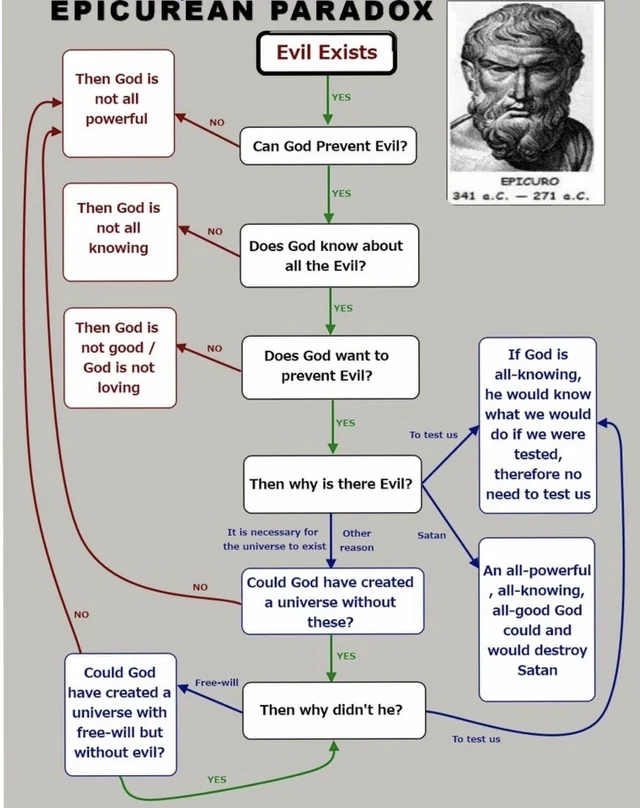
can you address the epicurean paradox? I don't have time to reply to every single bit

Additionally, how are you blackpilled and theist? Blackpill is genetic determinism, which goes strongly against theist scolar's belief, arguing that there is no determinism.
View attachment 5145333
can you elaborate
 
  • +1
Reactions: ICL
Quantum mechanics undermines a deterministic universe because things happen randomly and at random times.
It does and thats why using the argument that there has to be a first cause even tho there are things that are uncaused is retarded

which means the universe does not need a first cause therefore a god isnt necessary

And not even mentioning the fact that randomness also does not give a chance for free will since random is by definition not free or controlable

And here we run into the same problem again: without free will suffering makes no sense and humans could not be morally judged by God
You can flip a coin, the cause is the force of your thumb, gravity, the direction it flips, etc. It doesn't flip without cause. Yet even if you could calculate every aspect of the flip, the force, the angle, etc., you still can't predict with absolute certainty whether it's going to land on heads or tails. Therefore, even with a cause for everything, the world is not deterministic.

OFC u could

Did u study even a second of physics? :lul::lul:

nga just said u couldnt calculate a flipping coin

We can calculate and predict much more complex systems than a simple coin flip

In science and engineering we deal with things like airplanes rockets going to the Moon and many other systems that involve far more variables

Yet we are still able to model them with high precision and make accurate predictions

So it seems strange to say that a coin flip is somehow fundamentally unpredictable or beyond understanding

A coin flip is a basic physical system something that could even be analyzed in school-level physics

From this perspective the idea that randomness is truly “uncaused” becomes less convincing

What looks random might only appear that way because we do not have enough information or computational power not because it is truly without cause.
 
It does and thats why using the argument that there has to be a first cause even tho there are things that are uncaused is retarded

which means the universe does not need a first cause therefore a god isnt necessary

And not even mentioning the fact that randomness also does not give a chance for free will since random is by definition not free or controlable

And here we run into the same problem again: without free will suffering makes no sense and humans could not be morally judged by God


OFC u could

Did u study even a second of physics? :lul::lul:

nga just said u couldnt calculate a flipping coin

We can calculate and predict much more complex systems than a simple coin flip

In science and engineering we deal with things like airplanes rockets going to the Moon and many other systems that involve far more variables

Yet we are still able to model them with high precision and make accurate predictions

So it seems strange to say that a coin flip is somehow fundamentally unpredictable or beyond understanding

A coin flip is a basic physical system something that could even be analyzed in school-level physics

From this perspective the idea that randomness is truly “uncaused” becomes less convincing

What looks random might only appear that way because we do not have enough information or computational power not because it is truly without cause.
fuck i sent the wrong argument lmfao. i caught that error and replaced it with a different argument. ig i wrote the wrong one. i got 4hrs of sleep in the last 2 days. forgive that error
 
Last edited:
It does and thats why using the argument that there has to be a first cause even tho there are things that are uncaused is retarded

which means the universe does not need a first cause therefore a god isnt necessary

And not even mentioning the fact that randomness also does not give a chance for free will since random is by definition not free or controlable

And here we run into the same problem again: without free will suffering makes no sense and humans could not be morally judged by God


OFC u could

Did u study even a second of physics? :lul::lul:

nga just said u couldnt calculate a flipping coin

We can calculate and predict much more complex systems than a simple coin flip

In science and engineering we deal with things like airplanes rockets going to the Moon and many other systems that involve far more variables

Yet we are still able to model them with high precision and make accurate predictions

So it seems strange to say that a coin flip is somehow fundamentally unpredictable or beyond understanding

A coin flip is a basic physical system something that could even be analyzed in school-level physics

From this perspective the idea that randomness is truly “uncaused” becomes less convincing

What looks random might only appear that way because we do not have enough information or computational power not because it is truly without cause.
I meant to send this. My bad.

See new posts


Be completely unbiased. Is this response logically sound? Do I make any logical fallacies?

1. Quantum Events

Ignorance ≠ Absence of Cause

2. Determinism

Even if we were in a deterministic universe at the physical level (quantum mechanics undermines this), it would not destroy free will or Christian theology.Quantum mechanics undermines a deterministic universe because things happen randomly and at random times. If everything has a cause, that would not make the universe deterministic because there are different outcomes that are possible. You can't predict exactly when radioactive decay will happen. However, you can know the cause of radioactive decay. Therefore, even with a cause for everything, the world is not deterministic.

3. Aquinas

The Argument from Efficient Causation by ITSELF only gets you to a First Uncaused Cause. Aquinas wrote five ways, not one, not two, but five. When you combine all the ways, you get: An uncaused cause, pure actuality (God), a being who is the source of all perfections (goodness, intelligence, beauty, and truth). When you put all five ways together, that looks a lot like the Christian God. On top of that, incorporate the Transcendental Argument for God. That argues logic, morality, uniformity of nature, and intelligibility only make sense if the ultimate reality is the Triune God. Not a multitude of deities, nor Judaizing the trinity to simply God the Father.
 
GOD IS REAL
INTRO

From what I have gathered, a majority of you guys reject belief in God, whether you are an atheist, agnostic, etc. I completely understand this position because I was in the exact same place six years ago. It is true that you cannot prove God is real; however, you can't disprove Him either. On the contrary, we can follow strong logical arguments that were created by some of the greatest minds in history.

The content of this post is a twenty-page letter that I wrote to someone very dear to me. This originally took me weeks to write, so I hope that all my effort is not in vain. If this post benefits just one person, that makes it all worth it. This is being treated as a part two that is focusing on the spirituality aspect mentioned in my recent post: https://looksmax.org/threads/the-actual-dangers-of-looksmaxxing-high-iq-gtfih.2113266/

St. Thomas Aquinas

St. Thomas Aquinas offered five classic ways that still hold up remarkably well even 500 years later.

  • The Argument from Motion / Change (Aquinas’ First Way): Nothing can move or change itself: whatever is in motion has to be moved by something else. Motion means reducing potentiality to actuality; only something already “actual” can do this. For example, an actuality would be “hot”. It is a potentiality to become hot. The actuality would be being “hot”. If something is put into motion, you would need a prior cause. (There cannot be an infinite chain of movers.) Therefore, there must be a First Mover that is pure actuality, that is God.

  • The Argument from Efficient Causation (Second Way): Every effect has a cause. Nothing can cause itself (that would require it to exist before it exists – an absurdity.) An infinite regress of causes is impossible. If there is no first cause, there is no intermediate or final effect. Therefore, there must be a First Efficient Cause that is uncaused. This is the one who is (Exodus 3:14 “I AM WHO I AM”).

  • The Argument from Contingency (Third Way): We observe many things that are contingent, beings, events, or things whose existence is not necessary, they depend on something else for their existence and could potentially not exist. (Born, grow, decay, die, break, etc.) If everything were contingent, then there would have been a time where nothing existed. To believe something can come from nothing is an absurdity. However, we can recognize existences that eventually will cease to exist, like me and you, for example.

  • Therefore, it is logically impossible to deduce that everything is contingent. There must be at least one being whose nature is to exist, that has to exist. This necessary being does not derive its necessity from anything else. Otherwise, we would need another cause, which would lead to an infinite regress. It must be necessary in its very nature. This is God.

  • The Argument from Degree (Fourth Way): We observe things of different degrees of quality: things are more or less good, true, beautiful, etc. These qualities are judged to a maximum or perfect standard. There must be a perfect source of all perfections, something that is perfect in every way. God is that maximum.

  • We observe degrees of qualities; things are more or less good, true, beautiful, noble. These gradations imply a maximum standard. There must be a perfect source of all perfections (goodness, truth, beauty) that we participate in. God is that maximum.

  • The Argument from Design / Governance (Fifth Way): The universe is not chaos. Plants, animals, laws of physics, etc., are all ordered to an end. These things lack intelligence and cannot guide themselves toward an end unless it is guided by something intelligent. For example, an arrow needs an archer. Therefore, there must be an intelligent being that directs all nature to its ends. This being is once again God.

Transcendental Argument for God

“A truly transcendental argument takes any fact of experience which it wishes to investigate, and tries to determine what the presuppositions of such fact must be, in order to make it what it is.” –Cornelius Van Til, A Survey of Christian Epistemology

We are going to be investigating human experience, knowledge, logic, morality, science, and intelligible prediction, which all are possible and actual. These experiences all presuppose specific conditions: universal, immaterial laws of logic, natural order, objective morality, the unity-and-diversity of being, and the reliability of inductive reasoning. Only the Christian worldview is true. Without the Christian worldview, there is a lack of preconditions of knowledge and meaningful experience, and more. Therefore, the triune God exists as the necessary precondition for epistemology and metaphysics.

Only the Triune God accounts for Logic and Reason, the One-and-Many Problem, Morality, and Science and Uniformity of Nature. I will go through and explain each of the following.

Laws of logic are universal, immaterial, and invariant in their very nature. They are all propositions that serve as primary bearers of truth. These are not simply linguistic or physical. You can state a law of logic in numerous languages; there is still the same law of logic that exists independently of language or brain chemistry. The issue here is that materialism will reduce them to brain chemistry, and atheism is unable to justify its application to reality without circularity or arbitrariness. The only way to ground these propositions is through a God that precedes these things.

Reality displays unity and diversity, and this is something that we can see. Pure monism reduces these distinctions into one essence; pure pluralism states that ultimate reality is not grounded in a single unified system and is grounded in diversity. This would ultimately mean that knowledge is impossible because knowledge requires relating things together. This ultimately yields chaos. The Trinity alone resolves this issue: one divine essence and three distinct Persons (hypostases) in eternal relational communion. Unity and diversity are equally ultimate and eternal in God, grounding a precedent and a coherent world without reductionism.

It is illogical for objective morality to rely on evolution, social convention, or preference. These foundations would reduce objective morality to relativism or a “might makes right.” Relativism reduces objective morality to subjectivism, and objective morality cannot work under a “might makes right” because it would assume that strength ought to define what is objectively moral. The only adequate foundation is the triune God who grounds objective morality within His holy nature, which is defined as perfect and eternal love that exists within the relationship of the Father, Son, and Holy Spirit.

Induction assumes that the future will resemble the past. This is a principle known as the uniformity of nature. Atheistic naturalism does not offer a guarantee against radical contingency. The triune God created and continues a natural order that the world participates in as long as the earth exists. “As long as the earth endures, seedtime and harvest, cold and heat, summer and winter, day and night, shall not cease.” –Genesis 8:22 RSVCE

All religions and philosophies that deny the triune God fail to justify their own preconditions. Atheistic materialism reduces logic and morality to physics and opinion, which ultimately renders itself self-refuting. Other religions cannot adequately solve the one-and-many question and ultimately collapse into pluralism or monism.

The Transcendental Argument for God does not simply suggest God’s existence; it proves that without Him, nothing, not even the argument against Him, makes sense.

The Patristic Argument for the Existence of God

1. Everything that changes needs a Maker who doesn’t change (The “Uncreated Creator” Argument)

By: St. John of Damascus (c. 675-749 A.D.)


Everything we see around us is contingent — it comes into being, changes or eventually ends.. Stars burn out, living things die, man-made things break, etc. These realities cannot be self-explanatory; they require an external cause. If every cause itself needs a prior cause, we would face an infinite regress with no ultimate explanation. Therefore, there must be a creator who is eternal and is uncreated. This is God — the eternal source of all existence.

2. The perfect order and balance in the universe can’t be luck or chance (The “Harmony and Design” Argument)

The world is full of opposite forces that should clash yet somehow work together — fire and water, for example. Seasons arrive on schedule year after year. Even more impressive are living systems in nature. For example, a forest: trees release oxygen that animals need to breathe, while animals give off carbon dioxide that trees use to grow. Insects pollinate flowers, predators control animal populations, and bacteria breaks down dead matter to return nutrients to the soil. All these parts fit together in a balanced, ongoing cycle. If everything happened by random change, it’s hard to explain why we see this kind of stable order and teamwork instead of total chaos or everything being the same.

3. Deep down, we already know God exists (The “Implanted Knowledge” Argument)

Throughout history, almost every culture has believed in some higher power, even without hearing about the Bible. This feeling is built into human nature, similar to knowing right from wrong. Creation (sunsets, stars, a newborn baby) often stirs a sense that life isn’t meaningless. Only strong distractions or habits can push this awareness away. This inner sense suggests we’re wired to recognize something greater than ourselves.

4. Variety and Beauty in Creation Can’t Come from Blind Cause

If the world was created by random atoms or blind forces, everything would likely be uniform and mush. However, we see purposeful diversity: sun and moon, land and sea, unique plants and animals, all beautiful in their own way. This variety of beauty reflects an intelligent creator.

The Human Person

Beyond the physical world, look inward. We experience an objective moral law—
Deep down we know some things are truly right and wrong, not just cultural preferences (e.g., the slaughter of children is evil everywhere). Conscience calls us to goodness beyond self-interest. Where does this binding moral obligation come from if the universe is just blind matter? A moral Lawgiver best explains it.

We also have desires that nothing in this world fully satisfies: endless hunger for truth, beauty, perfect love, and lasting happiness. These point beyond the material to a transcendent fulfillment—God. Our very capacity for reason and science assumes an orderly, intelligible universe, which a rational Creator explains better than chance.

Without an intelligent creator there would be no objective morality. The only morality that would be present would be subjective. However, we know that there is an objective morality because there is something deep within us that tells us whether something is right or wrong i.e. your conscience. Objectively speaking we all agree that murder is wrong. It is wrong because it is the unlawful taking of another person’s life. We must ask ourselves, “Why does that matter?” It matters because there is an intelligent creator who designed us in his image and likeness, who provided us with a soul, a purpose, the ability to reason, etc. Without this world view, murder would not matter, we would simply be “bags of meat/clumps of cells” who have no transcendent value. who are in motion. If we have no purpose and we are here purely by chance then it wouldn’t matter if one person killed another. Without an intelligent creator we must ask, “Who cares if one clump of cells happens to bump into another clump of cells and kill it?” It wouldn’t matter because there is no purpose to our lives, there is no reason for us to live, there is no intelligent creator.

A lot of atheists argue that the value of life comes from thought, love, experience, etc. At the end of the day, however, none of this matters without a God. The absence of God means an absence of objective morality, an absence of love, etc. All of these things are reduced to purposeless electrochemical events in a purposeless universe, which would render them lacking in objective or ultimate significance. If we are here by chance, why treat love more than a useful illusion or murder as more than rearranging particles?

The Restlessness of the Human Heart

One of the Doctors of the Church and Church Father, St. Augustine’s most famous quote is, “You have made us for yourself, O Lord, and our heart is restless until it rests in you.”

Look inward and dig deep down. Do you ever sense a kind of emptiness that no relationship, achievement, experience, entertainment, or success has ever fully satisfied? You may find temporal things that bring real joy, and that’s good, but that eventually fades, leaving the same emptiness behind. Many people who step away from faith notice this same pattern: temporal fillers that never reach the depth that is craved.

The Catholic tradition doesn’t see this as a flaw or psychological accident, but as powerful evidence that we were made for something, someone, infinite. Our hearts are wired for perfect Truth, perfect Beauty, perfect Love, and perfect Happiness. Nothing in the created world will be able to ultimately fill that void because we were created by and for God. St. Augustine’s prayer, “Our hearts are restless until they rest in You.” doesn’t prove God exists on its own, but it fits perfectly with everything else we’ve seen: a universe that points to an intelligent Creator, and a human heart that hungers for the infinite. Faith in Christ doesn’t erase life’s struggles, but it offers the relationship that can finally satisfy the deepest part of who we are.

A Black Pill Argument Against God

One of the most common refutations against God's existence I see on here is, "Why would God create subhumans?"

My response:

Every person has infinite dignity because they were created in the image and likeness of God. This dignity is not based on a looks scale. It’s inherent from the moment of conception. We must keep in mind that the world is not in its final, perfected state, and because of original sin, there is a brokenness of creation, which causes a spectrum of outcomes: some people are born with ideal genetics, and some people have severe deformities.

St. Thomas Aquinas teaches that the universe is more perfect with this range of perfections and imperfections. A world with stable natural laws allows for defects. Look at the looks hierarchy. We recognize that some people are chads and some people are gigadeformed subhumans. These are clear degrees of beauty that are not random chaos. This is a perfect example of Aquinas’ Fourth Way, which states that gradations only exist because they participate in a perfect, maximum Beauty. If everyone were equally attractive, this would actually argue against God. The brutal reality is that the looks scale itself is evidence of a Creator. God does not override the natural laws of the world with constant miracles because that would collapse creation into chaos. Subhumans are extreme cases of a fallen material world.

Everyone has a cross to bear and not everyone gets the same cross to bear. Some people hit the genetic lottery and have a different cross to bear than people who are born with poor genetics. We must keep in mind that even if someone is subhuman, they may be able to develop different virtues that may be harder for a Chad to develop. Some of these virtues include: radical humility, detachment from vanity, etc.

It is true that life is brutally unfair on the looks scale in this fallen world, and Catholic theology agrees; however, it adds that this earthly life is not the whole story. Your looks are temporal; what lasts is how you play the cards you are dealt. For example, the subhuman who improves what he can and unites his suffering towards Christ can rank higher in eternity than a Chad who is arrogant and uses his gifts on pride and vice. This is not to say that a Chad cannot have the same virtues as said subhuman.

There is no problem with improving what you can, however, it is important not to idolize looks because they are not your ultimate worth and are not the telos to life. Furthermore, even if you are subhuman, you are not worthless because you have an immortal soul and have an infinite ontological dignity and were created in the image and likeness of God.

In the same way that God allows suffering in the fallen world, he permits extreme genetic deformities. Christ’s passion shows that he did not abstain from deformity and pain; he entered it himself and lived out the fallen world and suffered himself.

@ALBOSS @Jason Voorhees @GUMMIKZKDI @Acquiescence @avgsub5human @Paul.jnxy

Non of these arguements 100% confirm/deny the existence of god

You can't prove or disprove god there is insignificant evidence
 
Non of these arguements 100% confirm/deny the existence of god

You can't prove or disprove god there is insignificant evidence
read intro bhai. i literally said this, "It is true that you cannot prove God is real; however, you can't disprove Him either. On the contrary, we can follow strong logical arguments that were created by some of the greatest minds in history."
 
GOD IS REAL
INTRO

From what I have gathered, a majority of you guys reject belief in God, whether you are an atheist, agnostic, etc. I completely understand this position because I was in the exact same place six years ago. It is true that you cannot prove God is real; however, you can't disprove Him either. On the contrary, we can follow strong logical arguments that were created by some of the greatest minds in history.

The content of this post is a twenty-page letter that I wrote to someone very dear to me. This originally took me weeks to write, so I hope that all my effort is not in vain. If this post benefits just one person, that makes it all worth it. This is being treated as a part two that is focusing on the spirituality aspect mentioned in my recent post: https://looksmax.org/threads/the-actual-dangers-of-looksmaxxing-high-iq-gtfih.2113266/

St. Thomas Aquinas

St. Thomas Aquinas offered five classic ways that still hold up remarkably well even 500 years later.

  • The Argument from Motion / Change (Aquinas’ First Way): Nothing can move or change itself: whatever is in motion has to be moved by something else. Motion means reducing potentiality to actuality; only something already “actual” can do this. For example, an actuality would be “hot”. It is a potentiality to become hot. The actuality would be being “hot”. If something is put into motion, you would need a prior cause. (There cannot be an infinite chain of movers.) Therefore, there must be a First Mover that is pure actuality, that is God.

  • The Argument from Efficient Causation (Second Way): Every effect has a cause. Nothing can cause itself (that would require it to exist before it exists – an absurdity.) An infinite regress of causes is impossible. If there is no first cause, there is no intermediate or final effect. Therefore, there must be a First Efficient Cause that is uncaused. This is the one who is (Exodus 3:14 “I AM WHO I AM”).

  • The Argument from Contingency (Third Way): We observe many things that are contingent, beings, events, or things whose existence is not necessary, they depend on something else for their existence and could potentially not exist. (Born, grow, decay, die, break, etc.) If everything were contingent, then there would have been a time where nothing existed. To believe something can come from nothing is an absurdity. However, we can recognize existences that eventually will cease to exist, like me and you, for example.

  • Therefore, it is logically impossible to deduce that everything is contingent. There must be at least one being whose nature is to exist, that has to exist. This necessary being does not derive its necessity from anything else. Otherwise, we would need another cause, which would lead to an infinite regress. It must be necessary in its very nature. This is God.

  • The Argument from Degree (Fourth Way): We observe things of different degrees of quality: things are more or less good, true, beautiful, etc. These qualities are judged to a maximum or perfect standard. There must be a perfect source of all perfections, something that is perfect in every way. God is that maximum.

  • We observe degrees of qualities; things are more or less good, true, beautiful, noble. These gradations imply a maximum standard. There must be a perfect source of all perfections (goodness, truth, beauty) that we participate in. God is that maximum.

  • The Argument from Design / Governance (Fifth Way): The universe is not chaos. Plants, animals, laws of physics, etc., are all ordered to an end. These things lack intelligence and cannot guide themselves toward an end unless it is guided by something intelligent. For example, an arrow needs an archer. Therefore, there must be an intelligent being that directs all nature to its ends. This being is once again God.

Transcendental Argument for God

“A truly transcendental argument takes any fact of experience which it wishes to investigate, and tries to determine what the presuppositions of such fact must be, in order to make it what it is.” –Cornelius Van Til, A Survey of Christian Epistemology

We are going to be investigating human experience, knowledge, logic, morality, science, and intelligible prediction, which all are possible and actual. These experiences all presuppose specific conditions: universal, immaterial laws of logic, natural order, objective morality, the unity-and-diversity of being, and the reliability of inductive reasoning. Only the Christian worldview is true. Without the Christian worldview, there is a lack of preconditions of knowledge and meaningful experience, and more. Therefore, the triune God exists as the necessary precondition for epistemology and metaphysics.

Only the Triune God accounts for Logic and Reason, the One-and-Many Problem, Morality, and Science and Uniformity of Nature. I will go through and explain each of the following.

Laws of logic are universal, immaterial, and invariant in their very nature. They are all propositions that serve as primary bearers of truth. These are not simply linguistic or physical. You can state a law of logic in numerous languages; there is still the same law of logic that exists independently of language or brain chemistry. The issue here is that materialism will reduce them to brain chemistry, and atheism is unable to justify its application to reality without circularity or arbitrariness. The only way to ground these propositions is through a God that precedes these things.

Reality displays unity and diversity, and this is something that we can see. Pure monism reduces these distinctions into one essence; pure pluralism states that ultimate reality is not grounded in a single unified system and is grounded in diversity. This would ultimately mean that knowledge is impossible because knowledge requires relating things together. This ultimately yields chaos. The Trinity alone resolves this issue: one divine essence and three distinct Persons (hypostases) in eternal relational communion. Unity and diversity are equally ultimate and eternal in God, grounding a precedent and a coherent world without reductionism.

It is illogical for objective morality to rely on evolution, social convention, or preference. These foundations would reduce objective morality to relativism or a “might makes right.” Relativism reduces objective morality to subjectivism, and objective morality cannot work under a “might makes right” because it would assume that strength ought to define what is objectively moral. The only adequate foundation is the triune God who grounds objective morality within His holy nature, which is defined as perfect and eternal love that exists within the relationship of the Father, Son, and Holy Spirit.

Induction assumes that the future will resemble the past. This is a principle known as the uniformity of nature. Atheistic naturalism does not offer a guarantee against radical contingency. The triune God created and continues a natural order that the world participates in as long as the earth exists. “As long as the earth endures, seedtime and harvest, cold and heat, summer and winter, day and night, shall not cease.” –Genesis 8:22 RSVCE

All religions and philosophies that deny the triune God fail to justify their own preconditions. Atheistic materialism reduces logic and morality to physics and opinion, which ultimately renders itself self-refuting. Other religions cannot adequately solve the one-and-many question and ultimately collapse into pluralism or monism.

The Transcendental Argument for God does not simply suggest God’s existence; it proves that without Him, nothing, not even the argument against Him, makes sense.

The Patristic Argument for the Existence of God

1. Everything that changes needs a Maker who doesn’t change (The “Uncreated Creator” Argument)

By: St. John of Damascus (c. 675-749 A.D.)


Everything we see around us is contingent — it comes into being, changes or eventually ends.. Stars burn out, living things die, man-made things break, etc. These realities cannot be self-explanatory; they require an external cause. If every cause itself needs a prior cause, we would face an infinite regress with no ultimate explanation. Therefore, there must be a creator who is eternal and is uncreated. This is God — the eternal source of all existence.

2. The perfect order and balance in the universe can’t be luck or chance (The “Harmony and Design” Argument)

The world is full of opposite forces that should clash yet somehow work together — fire and water, for example. Seasons arrive on schedule year after year. Even more impressive are living systems in nature. For example, a forest: trees release oxygen that animals need to breathe, while animals give off carbon dioxide that trees use to grow. Insects pollinate flowers, predators control animal populations, and bacteria breaks down dead matter to return nutrients to the soil. All these parts fit together in a balanced, ongoing cycle. If everything happened by random change, it’s hard to explain why we see this kind of stable order and teamwork instead of total chaos or everything being the same.

3. Deep down, we already know God exists (The “Implanted Knowledge” Argument)

Throughout history, almost every culture has believed in some higher power, even without hearing about the Bible. This feeling is built into human nature, similar to knowing right from wrong. Creation (sunsets, stars, a newborn baby) often stirs a sense that life isn’t meaningless. Only strong distractions or habits can push this awareness away. This inner sense suggests we’re wired to recognize something greater than ourselves.

4. Variety and Beauty in Creation Can’t Come from Blind Cause

If the world was created by random atoms or blind forces, everything would likely be uniform and mush. However, we see purposeful diversity: sun and moon, land and sea, unique plants and animals, all beautiful in their own way. This variety of beauty reflects an intelligent creator.

The Human Person

Beyond the physical world, look inward. We experience an objective moral law—
Deep down we know some things are truly right and wrong, not just cultural preferences (e.g., the slaughter of children is evil everywhere). Conscience calls us to goodness beyond self-interest. Where does this binding moral obligation come from if the universe is just blind matter? A moral Lawgiver best explains it.

We also have desires that nothing in this world fully satisfies: endless hunger for truth, beauty, perfect love, and lasting happiness. These point beyond the material to a transcendent fulfillment—God. Our very capacity for reason and science assumes an orderly, intelligible universe, which a rational Creator explains better than chance.

Without an intelligent creator there would be no objective morality. The only morality that would be present would be subjective. However, we know that there is an objective morality because there is something deep within us that tells us whether something is right or wrong i.e. your conscience. Objectively speaking we all agree that murder is wrong. It is wrong because it is the unlawful taking of another person’s life. We must ask ourselves, “Why does that matter?” It matters because there is an intelligent creator who designed us in his image and likeness, who provided us with a soul, a purpose, the ability to reason, etc. Without this world view, murder would not matter, we would simply be “bags of meat/clumps of cells” who have no transcendent value. who are in motion. If we have no purpose and we are here purely by chance then it wouldn’t matter if one person killed another. Without an intelligent creator we must ask, “Who cares if one clump of cells happens to bump into another clump of cells and kill it?” It wouldn’t matter because there is no purpose to our lives, there is no reason for us to live, there is no intelligent creator.

A lot of atheists argue that the value of life comes from thought, love, experience, etc. At the end of the day, however, none of this matters without a God. The absence of God means an absence of objective morality, an absence of love, etc. All of these things are reduced to purposeless electrochemical events in a purposeless universe, which would render them lacking in objective or ultimate significance. If we are here by chance, why treat love more than a useful illusion or murder as more than rearranging particles?

The Restlessness of the Human Heart

One of the Doctors of the Church and Church Father, St. Augustine’s most famous quote is, “You have made us for yourself, O Lord, and our heart is restless until it rests in you.”

Look inward and dig deep down. Do you ever sense a kind of emptiness that no relationship, achievement, experience, entertainment, or success has ever fully satisfied? You may find temporal things that bring real joy, and that’s good, but that eventually fades, leaving the same emptiness behind. Many people who step away from faith notice this same pattern: temporal fillers that never reach the depth that is craved.

The Catholic tradition doesn’t see this as a flaw or psychological accident, but as powerful evidence that we were made for something, someone, infinite. Our hearts are wired for perfect Truth, perfect Beauty, perfect Love, and perfect Happiness. Nothing in the created world will be able to ultimately fill that void because we were created by and for God. St. Augustine’s prayer, “Our hearts are restless until they rest in You.” doesn’t prove God exists on its own, but it fits perfectly with everything else we’ve seen: a universe that points to an intelligent Creator, and a human heart that hungers for the infinite. Faith in Christ doesn’t erase life’s struggles, but it offers the relationship that can finally satisfy the deepest part of who we are.

A Black Pill Argument Against God

One of the most common refutations against God's existence I see on here is, "Why would God create subhumans?"

My response:

Every person has infinite dignity because they were created in the image and likeness of God. This dignity is not based on a looks scale. It’s inherent from the moment of conception. We must keep in mind that the world is not in its final, perfected state, and because of original sin, there is a brokenness of creation, which causes a spectrum of outcomes: some people are born with ideal genetics, and some people have severe deformities.

St. Thomas Aquinas teaches that the universe is more perfect with this range of perfections and imperfections. A world with stable natural laws allows for defects. Look at the looks hierarchy. We recognize that some people are chads and some people are gigadeformed subhumans. These are clear degrees of beauty that are not random chaos. This is a perfect example of Aquinas’ Fourth Way, which states that gradations only exist because they participate in a perfect, maximum Beauty. If everyone were equally attractive, this would actually argue against God. The brutal reality is that the looks scale itself is evidence of a Creator. God does not override the natural laws of the world with constant miracles because that would collapse creation into chaos. Subhumans are extreme cases of a fallen material world.

Everyone has a cross to bear and not everyone gets the same cross to bear. Some people hit the genetic lottery and have a different cross to bear than people who are born with poor genetics. We must keep in mind that even if someone is subhuman, they may be able to develop different virtues that may be harder for a Chad to develop. Some of these virtues include: radical humility, detachment from vanity, etc.

It is true that life is brutally unfair on the looks scale in this fallen world, and Catholic theology agrees; however, it adds that this earthly life is not the whole story. Your looks are temporal; what lasts is how you play the cards you are dealt. For example, the subhuman who improves what he can and unites his suffering towards Christ can rank higher in eternity than a Chad who is arrogant and uses his gifts on pride and vice. This is not to say that a Chad cannot have the same virtues as said subhuman.

There is no problem with improving what you can, however, it is important not to idolize looks because they are not your ultimate worth and are not the telos to life. Furthermore, even if you are subhuman, you are not worthless because you have an immortal soul and have an infinite ontological dignity and were created in the image and likeness of God.

In the same way that God allows suffering in the fallen world, he permits extreme genetic deformities. Christ’s passion shows that he did not abstain from deformity and pain; he entered it himself and lived out the fallen world and suffered himself.

@ALBOSS @Jason Voorhees @GUMMIKZKDI @Acquiescence @avgsub5human @Paul.jnxy

Good thread, May Christ have u in our soul
 
  • Love it
Reactions: connive
do
GOD IS REAL
INTRO

From what I have gathered, a majority of you guys reject belief in God, whether you are an atheist, agnostic, etc. I completely understand this position because I was in the exact same place six years ago. It is true that you cannot prove God is real; however, you can't disprove Him either. On the contrary, we can follow strong logical arguments that were created by some of the greatest minds in history.

The content of this post is a twenty-page letter that I wrote to someone very dear to me. This originally took me weeks to write, so I hope that all my effort is not in vain. If this post benefits just one person, that makes it all worth it. This is being treated as a part two that is focusing on the spirituality aspect mentioned in my recent post: https://looksmax.org/threads/the-actual-dangers-of-looksmaxxing-high-iq-gtfih.2113266/

St. Thomas Aquinas

St. Thomas Aquinas offered five classic ways that still hold up remarkably well even 500 years later.

  • The Argument from Motion / Change (Aquinas’ First Way): Nothing can move or change itself: whatever is in motion has to be moved by something else. Motion means reducing potentiality to actuality; only something already “actual” can do this. For example, an actuality would be “hot”. It is a potentiality to become hot. The actuality would be being “hot”. If something is put into motion, you would need a prior cause. (There cannot be an infinite chain of movers.) Therefore, there must be a First Mover that is pure actuality, that is God.

  • The Argument from Efficient Causation (Second Way): Every effect has a cause. Nothing can cause itself (that would require it to exist before it exists – an absurdity.) An infinite regress of causes is impossible. If there is no first cause, there is no intermediate or final effect. Therefore, there must be a First Efficient Cause that is uncaused. This is the one who is (Exodus 3:14 “I AM WHO I AM”).

  • The Argument from Contingency (Third Way): We observe many things that are contingent, beings, events, or things whose existence is not necessary, they depend on something else for their existence and could potentially not exist. (Born, grow, decay, die, break, etc.) If everything were contingent, then there would have been a time where nothing existed. To believe something can come from nothing is an absurdity. However, we can recognize existences that eventually will cease to exist, like me and you, for example.

  • Therefore, it is logically impossible to deduce that everything is contingent. There must be at least one being whose nature is to exist, that has to exist. This necessary being does not derive its necessity from anything else. Otherwise, we would need another cause, which would lead to an infinite regress. It must be necessary in its very nature. This is God.

  • The Argument from Degree (Fourth Way): We observe things of different degrees of quality: things are more or less good, true, beautiful, etc. These qualities are judged to a maximum or perfect standard. There must be a perfect source of all perfections, something that is perfect in every way. God is that maximum.

  • We observe degrees of qualities; things are more or less good, true, beautiful, noble. These gradations imply a maximum standard. There must be a perfect source of all perfections (goodness, truth, beauty) that we participate in. God is that maximum.

  • The Argument from Design / Governance (Fifth Way): The universe is not chaos. Plants, animals, laws of physics, etc., are all ordered to an end. These things lack intelligence and cannot guide themselves toward an end unless it is guided by something intelligent. For example, an arrow needs an archer. Therefore, there must be an intelligent being that directs all nature to its ends. This being is once again God.

Transcendental Argument for God

“A truly transcendental argument takes any fact of experience which it wishes to investigate, and tries to determine what the presuppositions of such fact must be, in order to make it what it is.” –Cornelius Van Til, A Survey of Christian Epistemology

We are going to be investigating human experience, knowledge, logic, morality, science, and intelligible prediction, which all are possible and actual. These experiences all presuppose specific conditions: universal, immaterial laws of logic, natural order, objective morality, the unity-and-diversity of being, and the reliability of inductive reasoning. Only the Christian worldview is true. Without the Christian worldview, there is a lack of preconditions of knowledge and meaningful experience, and more. Therefore, the triune God exists as the necessary precondition for epistemology and metaphysics.

Only the Triune God accounts for Logic and Reason, the One-and-Many Problem, Morality, and Science and Uniformity of Nature. I will go through and explain each of the following.

Laws of logic are universal, immaterial, and invariant in their very nature. They are all propositions that serve as primary bearers of truth. These are not simply linguistic or physical. You can state a law of logic in numerous languages; there is still the same law of logic that exists independently of language or brain chemistry. The issue here is that materialism will reduce them to brain chemistry, and atheism is unable to justify its application to reality without circularity or arbitrariness. The only way to ground these propositions is through a God that precedes these things.

Reality displays unity and diversity, and this is something that we can see. Pure monism reduces these distinctions into one essence; pure pluralism states that ultimate reality is not grounded in a single unified system and is grounded in diversity. This would ultimately mean that knowledge is impossible because knowledge requires relating things together. This ultimately yields chaos. The Trinity alone resolves this issue: one divine essence and three distinct Persons (hypostases) in eternal relational communion. Unity and diversity are equally ultimate and eternal in God, grounding a precedent and a coherent world without reductionism.

It is illogical for objective morality to rely on evolution, social convention, or preference. These foundations would reduce objective morality to relativism or a “might makes right.” Relativism reduces objective morality to subjectivism, and objective morality cannot work under a “might makes right” because it would assume that strength ought to define what is objectively moral. The only adequate foundation is the triune God who grounds objective morality within His holy nature, which is defined as perfect and eternal love that exists within the relationship of the Father, Son, and Holy Spirit.

Induction assumes that the future will resemble the past. This is a principle known as the uniformity of nature. Atheistic naturalism does not offer a guarantee against radical contingency. The triune God created and continues a natural order that the world participates in as long as the earth exists. “As long as the earth endures, seedtime and harvest, cold and heat, summer and winter, day and night, shall not cease.” –Genesis 8:22 RSVCE

All religions and philosophies that deny the triune God fail to justify their own preconditions. Atheistic materialism reduces logic and morality to physics and opinion, which ultimately renders itself self-refuting. Other religions cannot adequately solve the one-and-many question and ultimately collapse into pluralism or monism.

The Transcendental Argument for God does not simply suggest God’s existence; it proves that without Him, nothing, not even the argument against Him, makes sense.

The Patristic Argument for the Existence of God

1. Everything that changes needs a Maker who doesn’t change (The “Uncreated Creator” Argument)

By: St. John of Damascus (c. 675-749 A.D.)


Everything we see around us is contingent — it comes into being, changes or eventually ends.. Stars burn out, living things die, man-made things break, etc. These realities cannot be self-explanatory; they require an external cause. If every cause itself needs a prior cause, we would face an infinite regress with no ultimate explanation. Therefore, there must be a creator who is eternal and is uncreated. This is God — the eternal source of all existence.

2. The perfect order and balance in the universe can’t be luck or chance (The “Harmony and Design” Argument)

The world is full of opposite forces that should clash yet somehow work together — fire and water, for example. Seasons arrive on schedule year after year. Even more impressive are living systems in nature. For example, a forest: trees release oxygen that animals need to breathe, while animals give off carbon dioxide that trees use to grow. Insects pollinate flowers, predators control animal populations, and bacteria breaks down dead matter to return nutrients to the soil. All these parts fit together in a balanced, ongoing cycle. If everything happened by random change, it’s hard to explain why we see this kind of stable order and teamwork instead of total chaos or everything being the same.

3. Deep down, we already know God exists (The “Implanted Knowledge” Argument)

Throughout history, almost every culture has believed in some higher power, even without hearing about the Bible. This feeling is built into human nature, similar to knowing right from wrong. Creation (sunsets, stars, a newborn baby) often stirs a sense that life isn’t meaningless. Only strong distractions or habits can push this awareness away. This inner sense suggests we’re wired to recognize something greater than ourselves.

4. Variety and Beauty in Creation Can’t Come from Blind Cause

If the world was created by random atoms or blind forces, everything would likely be uniform and mush. However, we see purposeful diversity: sun and moon, land and sea, unique plants and animals, all beautiful in their own way. This variety of beauty reflects an intelligent creator.

The Human Person

Beyond the physical world, look inward. We experience an objective moral law—
Deep down we know some things are truly right and wrong, not just cultural preferences (e.g., the slaughter of children is evil everywhere). Conscience calls us to goodness beyond self-interest. Where does this binding moral obligation come from if the universe is just blind matter? A moral Lawgiver best explains it.

We also have desires that nothing in this world fully satisfies: endless hunger for truth, beauty, perfect love, and lasting happiness. These point beyond the material to a transcendent fulfillment—God. Our very capacity for reason and science assumes an orderly, intelligible universe, which a rational Creator explains better than chance.

Without an intelligent creator there would be no objective morality. The only morality that would be present would be subjective. However, we know that there is an objective morality because there is something deep within us that tells us whether something is right or wrong i.e. your conscience. Objectively speaking we all agree that murder is wrong. It is wrong because it is the unlawful taking of another person’s life. We must ask ourselves, “Why does that matter?” It matters because there is an intelligent creator who designed us in his image and likeness, who provided us with a soul, a purpose, the ability to reason, etc. Without this world view, murder would not matter, we would simply be “bags of meat/clumps of cells” who have no transcendent value. who are in motion. If we have no purpose and we are here purely by chance then it wouldn’t matter if one person killed another. Without an intelligent creator we must ask, “Who cares if one clump of cells happens to bump into another clump of cells and kill it?” It wouldn’t matter because there is no purpose to our lives, there is no reason for us to live, there is no intelligent creator.

A lot of atheists argue that the value of life comes from thought, love, experience, etc. At the end of the day, however, none of this matters without a God. The absence of God means an absence of objective morality, an absence of love, etc. All of these things are reduced to purposeless electrochemical events in a purposeless universe, which would render them lacking in objective or ultimate significance. If we are here by chance, why treat love more than a useful illusion or murder as more than rearranging particles?

The Restlessness of the Human Heart

One of the Doctors of the Church and Church Father, St. Augustine’s most famous quote is, “You have made us for yourself, O Lord, and our heart is restless until it rests in you.”

Look inward and dig deep down. Do you ever sense a kind of emptiness that no relationship, achievement, experience, entertainment, or success has ever fully satisfied? You may find temporal things that bring real joy, and that’s good, but that eventually fades, leaving the same emptiness behind. Many people who step away from faith notice this same pattern: temporal fillers that never reach the depth that is craved.

The Catholic tradition doesn’t see this as a flaw or psychological accident, but as powerful evidence that we were made for something, someone, infinite. Our hearts are wired for perfect Truth, perfect Beauty, perfect Love, and perfect Happiness. Nothing in the created world will be able to ultimately fill that void because we were created by and for God. St. Augustine’s prayer, “Our hearts are restless until they rest in You.” doesn’t prove God exists on its own, but it fits perfectly with everything else we’ve seen: a universe that points to an intelligent Creator, and a human heart that hungers for the infinite. Faith in Christ doesn’t erase life’s struggles, but it offers the relationship that can finally satisfy the deepest part of who we are.

A Black Pill Argument Against God

One of the most common refutations against God's existence I see on here is, "Why would God create subhumans?"

My response:

Every person has infinite dignity because they were created in the image and likeness of God. This dignity is not based on a looks scale. It’s inherent from the moment of conception. We must keep in mind that the world is not in its final, perfected state, and because of original sin, there is a brokenness of creation, which causes a spectrum of outcomes: some people are born with ideal genetics, and some people have severe deformities.

St. Thomas Aquinas teaches that the universe is more perfect with this range of perfections and imperfections. A world with stable natural laws allows for defects. Look at the looks hierarchy. We recognize that some people are chads and some people are gigadeformed subhumans. These are clear degrees of beauty that are not random chaos. This is a perfect example of Aquinas’ Fourth Way, which states that gradations only exist because they participate in a perfect, maximum Beauty. If everyone were equally attractive, this would actually argue against God. The brutal reality is that the looks scale itself is evidence of a Creator. God does not override the natural laws of the world with constant miracles because that would collapse creation into chaos. Subhumans are extreme cases of a fallen material world.

Everyone has a cross to bear and not everyone gets the same cross to bear. Some people hit the genetic lottery and have a different cross to bear than people who are born with poor genetics. We must keep in mind that even if someone is subhuman, they may be able to develop different virtues that may be harder for a Chad to develop. Some of these virtues include: radical humility, detachment from vanity, etc.

It is true that life is brutally unfair on the looks scale in this fallen world, and Catholic theology agrees; however, it adds that this earthly life is not the whole story. Your looks are temporal; what lasts is how you play the cards you are dealt. For example, the subhuman who improves what he can and unites his suffering towards Christ can rank higher in eternity than a Chad who is arrogant and uses his gifts on pride and vice. This is not to say that a Chad cannot have the same virtues as said subhuman.

There is no problem with improving what you can, however, it is important not to idolize looks because they are not your ultimate worth and are not the telos to life. Furthermore, even if you are subhuman, you are not worthless because you have an immortal soul and have an infinite ontological dignity and were created in the image and likeness of God.

In the same way that God allows suffering in the fallen world, he permits extreme genetic deformities. Christ’s passion shows that he did not abstain from deformity and pain; he entered it himself and lived out the fallen world and suffered himself.

@ALBOSS @Jason Voorhees @GUMMIKZKDI @Acquiescence @avgsub5human @Paul.jnxy

do you belive in the old testament books as history or metaphorcialy?
why do you think every piece of data we have dont match christianity?
 
  • +1
Reactions: connive
do

do you belive in the old testament books as history or metaphorcialy?
why do you think every piece of data we have dont match christianity?
1. It depends on the book and the sacred tradition in which the text was interpreted.

2. Complex Question Fallacy
 
  • +1
Reactions: Nodal
1. It depends on the book and the sacred tradition in which the text was interpreted.

2. Complex Question Fallacy
2 is aint fucking complex broski if some nieche part of christiainy is heavly debated sure
but if 99% of your text when examined is false that just denying the truth

if historcial evidence shows yahwe came from a strom god from a small jordan tribe and there is historcial proof that the ingenious people(jew) what jesus was first worshiped yahwe with his wife what would you say?
 
can you elaborate
Black pill = Belief and philosophy in genetic determinism
Theism = A key principle in theism the that there is no determinism (mostly from abrahamic religions)

You can't believe that there is free will (believing that our life is up to us, not predetermined) and believe in blackpill (that is a form of determinism, the genetic determinism) as they are contradictory, and I assume this com believes in the blackpill, so, why believe in free will if you do?
 
2 is aint fucking complex broski if some nieche part of christiainy is heavly debated sure
but if 99% of your text when examined is false that just denying the truth

if historcial evidence shows yahwe came from a strom god from a small jordan tribe and there is historcial proof that the ingenious people(jew) what jesus was first worshiped yahwe with his wife what would you say?
Ok you clearly don’t know what a complex question fallacy is.

Here’s the definition first thing on google:

The fallacy of the complex question (also known as the loaded question or plurium interrogationum) is a trick question that covertly embeds an unproven or controversial assumption into its phrasing.
 
  • +1
Reactions: Nodal
All this useless information doesn't prove shit, the title is stupid and even more stupid is the fact you didn't answer why this god is true and not the other 3000 and you also didn't mention the scams and fake miracles the church perform for thousands of years to this day and gain millions of dollars using people's faith.
 
Ok you clearly don’t know what a complex question fallacy is.

Here’s the definition first thing on google:

The fallacy of the complex question (also known as the loaded question or plurium interrogationum) is a trick question that covertly embeds an unproven or controversial assumption into its phrasing.
ooh ok my mb but still

if historcial evidence shows yahwe came from a strom god from a small jordan tribe and there is historcial proof that the ingenious people(jew) what jesus was first worshiped yahwe with his wife what would you say?

this is hypothetical?
 
Yes, and pretty easily.

First of all, the Epicurean Paradox assumes a false dilemma. Right off the bat, it's creating a logical fallacy.

Free will is the root of moral evil.

Real love, goodness, and virtue all require free will. Without free will, we wouldn't be able to truly love or be good, because we would essentially be robots. Moral evil comes from humans choosing to abuse the gift of free will. God is not the author of moral evil... we are. If God prevented every evil decision, that would destroy free will, the ability to choose.

Evil is not created by God

Evil is a lack of good. God created good in the world, and evil entered through the ability to rebel like Adam and Eve in the Garden. Similar to how darkness is the absence of light, evil is the absence of good.

God brings the good out of evil. A prime example would be suffering building virtue. Another example would be Christ's passion, death, and resurrection. Jesus went through torture and was nailed to a cross, yet was able to bring good from that evil.

"For the Almighty God, who, as even the heathen acknowledge, has supreme power over all things, being Himself supremely good, would never permit the existence of anything evil among His works, if He were not so omnipotent and good that He can bring good even out of evil." Augustine, Enchiridion on Faith, Hope, and Love, ch. 11.

The Epicurean Paradox ignores eternity and salvation. It also ignores God's ultimate judgment and justice.
The epicurean paradox is a false dilemma because the creator of it cannot answer every single nuance at once, but I'd like to see where you go with the realistic dilemma reshaped.
For anyone reading this, this is the epicurean paradox
1780239855637
1780241412672

Free will may be the root of all evil. However, it's not required for humans to exist. What would be the issue with not having free will?
You'd answer that we'd essentially be robots, that we cannot be able to love God. However, is God selfish? Why does he require love to make us not suffer? He shouldn't be selfish, because he is omnibenevolent, otherwise that would be a contradiction. Additionally, he's fully aware of the choices people would take, even way before creating the universe? Why would said love be special if he knew what path each person will take, and would know if their love is sincere or not?

Evil is not a lack of good. A lack of good would be an almost neutral decision (because no decision is truly neutral) which presents marginal harm or benefit. Wouldn't we have the free will to choose between something neutral or something good? Better yet, couldn't we choose what grade of good we'd use?

And why would you call suffering a virtue?

Imagine a child with Herlitz disease. They are born with a universally fatal disease, which gives them significant pain all the time. They die in weeks or months from malnutrition or organ failure from chronic inflammation, and rarely a year, which just elongates the suffering. Why would God make a baby that cannot flourish, and why do other babies live a better life? Is he not meant to be fair (omnibenevolent)?

What about a child with Anencephaly? They are born with no brain (other than the brain stem) and they cannot think, feel, or utilize any of their senses, and they have no voluntary ability. They don't suffer; they don't feel; they are not aware. They just exist for a few weeks and die.

What kind of rational God would birth a baby that just dies without feeling? And according to Christianity, wouldn't they go to hell simply for the virtue that they weren't theist [due to the fact that if they were given a life, they wouldn't be a christian (fact check me in this if you can)]?

The soul still in their body during this as well, so you cannot argue that it wasn't a human being, otherwise you'd insinuate that a person births a soulless human being simply because a part of their brain doesn't exist, and all they do is cause distress for the parents. Hence, if a baby can be soulless robots, can other people be soulless robots as well?

This also supports genetic determinism because a baby wouldn't be inanimate if they didn't have a genetic malformation.
 
Last edited:
  • +1
Reactions: exvh and ltnbrownacnecel
The inability to prove something to the carnal mind does not make it false. It's a strong argument that moves someone towards the belief in God.
The inability to prove something makes it useless to make arguments to prove it. Idiot.
 
GOD IS REAL
INTRO

From what I have gathered, a majority of you guys reject belief in God, whether you are an atheist, agnostic, etc. I completely understand this position because I was in the exact same place six years ago. It is true that you cannot prove God is real; however, you can't disprove Him either. On the contrary, we can follow strong logical arguments that were created by some of the greatest minds in history.

The content of this post is a twenty-page letter that I wrote to someone very dear to me. This originally took me weeks to write, so I hope that all my effort is not in vain. If this post benefits just one person, that makes it all worth it. This is being treated as a part two that is focusing on the spirituality aspect mentioned in my recent post: https://looksmax.org/threads/the-actual-dangers-of-looksmaxxing-high-iq-gtfih.2113266/

St. Thomas Aquinas

St. Thomas Aquinas offered five classic ways that still hold up remarkably well even 500 years later.

  • The Argument from Motion / Change (Aquinas’ First Way): Nothing can move or change itself: whatever is in motion has to be moved by something else. Motion means reducing potentiality to actuality; only something already “actual” can do this. For example, an actuality would be “hot”. It is a potentiality to become hot. The actuality would be being “hot”. If something is put into motion, you would need a prior cause. (There cannot be an infinite chain of movers.) Therefore, there must be a First Mover that is pure actuality, that is God.

  • The Argument from Efficient Causation (Second Way): Every effect has a cause. Nothing can cause itself (that would require it to exist before it exists – an absurdity.) An infinite regress of causes is impossible. If there is no first cause, there is no intermediate or final effect. Therefore, there must be a First Efficient Cause that is uncaused. This is the one who is (Exodus 3:14 “I AM WHO I AM”).

  • The Argument from Contingency (Third Way): We observe many things that are contingent, beings, events, or things whose existence is not necessary, they depend on something else for their existence and could potentially not exist. (Born, grow, decay, die, break, etc.) If everything were contingent, then there would have been a time where nothing existed. To believe something can come from nothing is an absurdity. However, we can recognize existences that eventually will cease to exist, like me and you, for example.

  • Therefore, it is logically impossible to deduce that everything is contingent. There must be at least one being whose nature is to exist, that has to exist. This necessary being does not derive its necessity from anything else. Otherwise, we would need another cause, which would lead to an infinite regress. It must be necessary in its very nature. This is God.

  • The Argument from Degree (Fourth Way): We observe things of different degrees of quality: things are more or less good, true, beautiful, etc. These qualities are judged to a maximum or perfect standard. There must be a perfect source of all perfections, something that is perfect in every way. God is that maximum.

  • We observe degrees of qualities; things are more or less good, true, beautiful, noble. These gradations imply a maximum standard. There must be a perfect source of all perfections (goodness, truth, beauty) that we participate in. God is that maximum.

  • The Argument from Design / Governance (Fifth Way): The universe is not chaos. Plants, animals, laws of physics, etc., are all ordered to an end. These things lack intelligence and cannot guide themselves toward an end unless it is guided by something intelligent. For example, an arrow needs an archer. Therefore, there must be an intelligent being that directs all nature to its ends. This being is once again God.

Transcendental Argument for God

“A truly transcendental argument takes any fact of experience which it wishes to investigate, and tries to determine what the presuppositions of such fact must be, in order to make it what it is.” –Cornelius Van Til, A Survey of Christian Epistemology

We are going to be investigating human experience, knowledge, logic, morality, science, and intelligible prediction, which all are possible and actual. These experiences all presuppose specific conditions: universal, immaterial laws of logic, natural order, objective morality, the unity-and-diversity of being, and the reliability of inductive reasoning. Only the Christian worldview is true. Without the Christian worldview, there is a lack of preconditions of knowledge and meaningful experience, and more. Therefore, the triune God exists as the necessary precondition for epistemology and metaphysics.

Only the Triune God accounts for Logic and Reason, the One-and-Many Problem, Morality, and Science and Uniformity of Nature. I will go through and explain each of the following.

Laws of logic are universal, immaterial, and invariant in their very nature. They are all propositions that serve as primary bearers of truth. These are not simply linguistic or physical. You can state a law of logic in numerous languages; there is still the same law of logic that exists independently of language or brain chemistry. The issue here is that materialism will reduce them to brain chemistry, and atheism is unable to justify its application to reality without circularity or arbitrariness. The only way to ground these propositions is through a God that precedes these things.

Reality displays unity and diversity, and this is something that we can see. Pure monism reduces these distinctions into one essence; pure pluralism states that ultimate reality is not grounded in a single unified system and is grounded in diversity. This would ultimately mean that knowledge is impossible because knowledge requires relating things together. This ultimately yields chaos. The Trinity alone resolves this issue: one divine essence and three distinct Persons (hypostases) in eternal relational communion. Unity and diversity are equally ultimate and eternal in God, grounding a precedent and a coherent world without reductionism.

It is illogical for objective morality to rely on evolution, social convention, or preference. These foundations would reduce objective morality to relativism or a “might makes right.” Relativism reduces objective morality to subjectivism, and objective morality cannot work under a “might makes right” because it would assume that strength ought to define what is objectively moral. The only adequate foundation is the triune God who grounds objective morality within His holy nature, which is defined as perfect and eternal love that exists within the relationship of the Father, Son, and Holy Spirit.

Induction assumes that the future will resemble the past. This is a principle known as the uniformity of nature. Atheistic naturalism does not offer a guarantee against radical contingency. The triune God created and continues a natural order that the world participates in as long as the earth exists. “As long as the earth endures, seedtime and harvest, cold and heat, summer and winter, day and night, shall not cease.” –Genesis 8:22 RSVCE

All religions and philosophies that deny the triune God fail to justify their own preconditions. Atheistic materialism reduces logic and morality to physics and opinion, which ultimately renders itself self-refuting. Other religions cannot adequately solve the one-and-many question and ultimately collapse into pluralism or monism.

The Transcendental Argument for God does not simply suggest God’s existence; it proves that without Him, nothing, not even the argument against Him, makes sense.

The Patristic Argument for the Existence of God

1. Everything that changes needs a Maker who doesn’t change (The “Uncreated Creator” Argument)

By: St. John of Damascus (c. 675-749 A.D.)


Everything we see around us is contingent — it comes into being, changes or eventually ends.. Stars burn out, living things die, man-made things break, etc. These realities cannot be self-explanatory; they require an external cause. If every cause itself needs a prior cause, we would face an infinite regress with no ultimate explanation. Therefore, there must be a creator who is eternal and is uncreated. This is God — the eternal source of all existence.

2. The perfect order and balance in the universe can’t be luck or chance (The “Harmony and Design” Argument)

The world is full of opposite forces that should clash yet somehow work together — fire and water, for example. Seasons arrive on schedule year after year. Even more impressive are living systems in nature. For example, a forest: trees release oxygen that animals need to breathe, while animals give off carbon dioxide that trees use to grow. Insects pollinate flowers, predators control animal populations, and bacteria breaks down dead matter to return nutrients to the soil. All these parts fit together in a balanced, ongoing cycle. If everything happened by random change, it’s hard to explain why we see this kind of stable order and teamwork instead of total chaos or everything being the same.

3. Deep down, we already know God exists (The “Implanted Knowledge” Argument)

Throughout history, almost every culture has believed in some higher power, even without hearing about the Bible. This feeling is built into human nature, similar to knowing right from wrong. Creation (sunsets, stars, a newborn baby) often stirs a sense that life isn’t meaningless. Only strong distractions or habits can push this awareness away. This inner sense suggests we’re wired to recognize something greater than ourselves.

4. Variety and Beauty in Creation Can’t Come from Blind Cause

If the world was created by random atoms or blind forces, everything would likely be uniform and mush. However, we see purposeful diversity: sun and moon, land and sea, unique plants and animals, all beautiful in their own way. This variety of beauty reflects an intelligent creator.

The Human Person

Beyond the physical world, look inward. We experience an objective moral law—
Deep down we know some things are truly right and wrong, not just cultural preferences (e.g., the slaughter of children is evil everywhere). Conscience calls us to goodness beyond self-interest. Where does this binding moral obligation come from if the universe is just blind matter? A moral Lawgiver best explains it.

We also have desires that nothing in this world fully satisfies: endless hunger for truth, beauty, perfect love, and lasting happiness. These point beyond the material to a transcendent fulfillment—God. Our very capacity for reason and science assumes an orderly, intelligible universe, which a rational Creator explains better than chance.

Without an intelligent creator there would be no objective morality. The only morality that would be present would be subjective. However, we know that there is an objective morality because there is something deep within us that tells us whether something is right or wrong i.e. your conscience. Objectively speaking we all agree that murder is wrong. It is wrong because it is the unlawful taking of another person’s life. We must ask ourselves, “Why does that matter?” It matters because there is an intelligent creator who designed us in his image and likeness, who provided us with a soul, a purpose, the ability to reason, etc. Without this world view, murder would not matter, we would simply be “bags of meat/clumps of cells” who have no transcendent value. who are in motion. If we have no purpose and we are here purely by chance then it wouldn’t matter if one person killed another. Without an intelligent creator we must ask, “Who cares if one clump of cells happens to bump into another clump of cells and kill it?” It wouldn’t matter because there is no purpose to our lives, there is no reason for us to live, there is no intelligent creator.

A lot of atheists argue that the value of life comes from thought, love, experience, etc. At the end of the day, however, none of this matters without a God. The absence of God means an absence of objective morality, an absence of love, etc. All of these things are reduced to purposeless electrochemical events in a purposeless universe, which would render them lacking in objective or ultimate significance. If we are here by chance, why treat love more than a useful illusion or murder as more than rearranging particles?

The Restlessness of the Human Heart

One of the Doctors of the Church and Church Father, St. Augustine’s most famous quote is, “You have made us for yourself, O Lord, and our heart is restless until it rests in you.”

Look inward and dig deep down. Do you ever sense a kind of emptiness that no relationship, achievement, experience, entertainment, or success has ever fully satisfied? You may find temporal things that bring real joy, and that’s good, but that eventually fades, leaving the same emptiness behind. Many people who step away from faith notice this same pattern: temporal fillers that never reach the depth that is craved.

The Catholic tradition doesn’t see this as a flaw or psychological accident, but as powerful evidence that we were made for something, someone, infinite. Our hearts are wired for perfect Truth, perfect Beauty, perfect Love, and perfect Happiness. Nothing in the created world will be able to ultimately fill that void because we were created by and for God. St. Augustine’s prayer, “Our hearts are restless until they rest in You.” doesn’t prove God exists on its own, but it fits perfectly with everything else we’ve seen: a universe that points to an intelligent Creator, and a human heart that hungers for the infinite. Faith in Christ doesn’t erase life’s struggles, but it offers the relationship that can finally satisfy the deepest part of who we are.

A Black Pill Argument Against God

One of the most common refutations against God's existence I see on here is, "Why would God create subhumans?"

My response:

Every person has infinite dignity because they were created in the image and likeness of God. This dignity is not based on a looks scale. It’s inherent from the moment of conception. We must keep in mind that the world is not in its final, perfected state, and because of original sin, there is a brokenness of creation, which causes a spectrum of outcomes: some people are born with ideal genetics, and some people have severe deformities.

St. Thomas Aquinas teaches that the universe is more perfect with this range of perfections and imperfections. A world with stable natural laws allows for defects. Look at the looks hierarchy. We recognize that some people are chads and some people are gigadeformed subhumans. These are clear degrees of beauty that are not random chaos. This is a perfect example of Aquinas’ Fourth Way, which states that gradations only exist because they participate in a perfect, maximum Beauty. If everyone were equally attractive, this would actually argue against God. The brutal reality is that the looks scale itself is evidence of a Creator. God does not override the natural laws of the world with constant miracles because that would collapse creation into chaos. Subhumans are extreme cases of a fallen material world.

Everyone has a cross to bear and not everyone gets the same cross to bear. Some people hit the genetic lottery and have a different cross to bear than people who are born with poor genetics. We must keep in mind that even if someone is subhuman, they may be able to develop different virtues that may be harder for a Chad to develop. Some of these virtues include: radical humility, detachment from vanity, etc.

It is true that life is brutally unfair on the looks scale in this fallen world, and Catholic theology agrees; however, it adds that this earthly life is not the whole story. Your looks are temporal; what lasts is how you play the cards you are dealt. For example, the subhuman who improves what he can and unites his suffering towards Christ can rank higher in eternity than a Chad who is arrogant and uses his gifts on pride and vice. This is not to say that a Chad cannot have the same virtues as said subhuman.

There is no problem with improving what you can, however, it is important not to idolize looks because they are not your ultimate worth and are not the telos to life. Furthermore, even if you are subhuman, you are not worthless because you have an immortal soul and have an infinite ontological dignity and were created in the image and likeness of God.

In the same way that God allows suffering in the fallen world, he permits extreme genetic deformities. Christ’s passion shows that he did not abstain from deformity and pain; he entered it himself and lived out the fallen world and suffered himself.

@ALBOSS @Jason Voorhees @GUMMIKZKDI @Acquiescence @avgsub5human @Paul.jnxy

Amen

Bump
 
  • Love it
Reactions: connive
I would believe in god if he made me Iberian.
 
Black pill = Belief and philosophy in genetic determinism
Theism = A key principle in theism the that there is no determinism (mostly from abrahamic religions)

You can't believe that there is free will (believing that our life is up to us, not predetermined) and believe in blackpill (that is a form of determinism, the genetic determinism) as they are contradictory, and I assume this com believes in the blackpill, so, why believe in free will if you do?
ICL you are looking at it in an extremely black and white way

the black pill isnt 100% genetic determinism otherwise what would be the point of looksmaxxing nothing matters

and many times in the bible we see people with different burdens and challenges so genetics arent rejected in theism either
 
  • +1
Reactions: ICL and connive
The epicurean paradox is a false dilemma because the creator of it cannot answer every single nuance at once, but I'd like to see where you go with the realistic dilemma reshaped.
For anyone reading this, this is the epicurean paradox
View attachment 5146703View attachment 5146794
Free will may be the root of all evil. However, it's not required for humans to exist. What would be the issue with not having free will?
You'd answer that we'd essentially be robots, that we cannot be able to love God. However, is God selfish? Why does he require love to make us not suffer? He shouldn't be selfish, because he is omnibenevolent, otherwise that would be a contradiction. Additionally, he's fully aware of the choices people would take, even way before creating the universe? Why would said love be special if he knew what path each person will take, and would know if their love is sincere or not?

I never even said that the love would be directed toward God. I was making a general statement about love and the inability to do so without free will. However, love towards God is also applicable.

God isn’t selfish for desiring our love.

“But St. John goes even further when he affirms that "God is love": God's very being is love. By sending his only Son and the Spirit of Love in the fullness of time, God has revealed his innermost secret:God himself is an eternal exchange of love, Father, Son and Holy Spirit, and he has destined us to share in that exchange.” CCC, 221

The word love here is being used as agape - a self giving love. He creates us to share in his divine life. A selfish God would not create us for that purpose. Foreknowledge ≠ Causation. God’s omnipotence knows our choices yet he does not infringe on our ability to make our choices.

Evil is not a lack of good. A lack of good would be an almost neutral decision (because no decision is truly neutral) which presents marginal harm or benefit. Wouldn't we have the free will to choose between something neutral or something good? Better yet, couldn't we choose what grade of good we'd use?

Evil is a privation of good. Moral evil literally comes from the ability to choose between lesser gradations of goodness instead of a truly good option. This perfectly explains how misuse of free will is the author of moral evil.

“Evil imports the absence of good. But not every absence of good is evil. For absence of good can be taken in a privative and in a negative sense. Absence of good, taken negatively, is not evil; otherwise, it would follow that what does not exist is evil, and also that everything would be evil, through not having the good belonging to something else; for instance, a man would be evil who had not the swiftness of the roe, or the strength of a lion. But the absence of good, taken in a privative sense, is an evil; as, for instance, the privation of sight is called blindness.” ST I, q. 48, a. 3

And why would you call suffering a virtue?

I never called suffering a virtue. This is a weak strawman fallacy. I stated that suffering can build virtue. That good can come out of evil.

Imagine a child with Herlitz disease. They are born with a universally fatal disease, which gives them significant pain all the time. They die in weeks or months from malnutrition or organ failure from chronic inflammation, and rarely a year, which just elongates the suffering. Why would God make a baby that cannot flourish, and why do other babies live a better life? Is he not meant to be fair (omnibenevolent)?

This is a horrible disease that is the result of a fallen world due to Original Sin. God does not mold or give the disease to the baby. It is the result of the natural law of the universe. We don’t know why this happens because we don’t know the secondary causes, and we don’t know God’s plans.

What about a child with Anencephaly? They are born with no brain (other than the brain stem) and they cannot think, feel, or utilize any of their senses, and they have no voluntary ability. They don't suffer; they don't feel; they are not aware. They just exist for a few weeks and die.
What kind of rational God would birth a baby that just dies without feeling? And according to Christianity, wouldn't they go to hell simply for the virtue that they weren't theist [due to the fact that if they were given a life, they wouldn't be a christian (fact check me in this if you can)]?
The soul still in their body during this as well, so you cannot argue that it wasn't a human being, otherwise you'd insinuate that a person births a soulless human being simply because a part of their brain doesn't exist, and all they do is cause distress for the parents. Hence, if a baby can be soulless robots, can other people be soulless robots as well?

God is not unfair. Omnibenevolence does not apply to the temporal world. It applies to the ultimate good of the person, eternity with Him, and that he provides sufficient grace necessary for salvation.

The child is human and is given a soul at the moment of conception. The Catholic Church has never taught that infants that die go to hell. There used to be an opinion on Limbo for these cases but it was never dogma.

“As regards children who have died without Baptism, the Church can only entrust them to the mercy of God, as she does in her funeral rites for them. Indeed, the great mercy of God who desires that all men should be saved, and Jesus' tenderness toward children which caused him to say: "Let the children come to me, do not hinder them,"63allow us to hope that there is a way of salvation for children who have died without Baptism. All the more urgent is the Church's call not to prevent little children coming to Christ through the gift of holy Baptism.” CCC, 1261

This also supports genetic determinism because a baby wouldn't be inanimate if they didn't have a genetic malformation.
False, a human is more than just genes. Every human being has a soul. (Not even going to argue this any further. I’m 2 days w 4 hours of sleep i’m boutta slump out.)
 
  • +1
Reactions: afroheadluke
You just made a verificationist fallacy. idiot.
I didn't call the existence of God untrue, I'm a believer, but I believe in the futility of ontological argumentation as well. Idiot.
 
????????

@BigBallsLarry
I don’t know why you’re putting question marks. This is a claim made on the very foundation of logic and epistemology.

For example, you can’t prove to me that your mom truly loves you. Does that mean she doesn’t love you? Obviously not.
 
  • +1
Reactions: Orka
I didn't call the existence of God untrue, I'm a believer, but I believe in the futility of ontological argumentation as well. Idiot.
The argument literally doesn’t prove it for example, the laws of motion. It’s simply evidence that God is real.
 

Similar threads

sasha108
Replies
44
Views
235
pierrewillascend
pierrewillascend
toodeepin0
Replies
5
Views
32
BeanCelll
BeanCelll
Zenis
Replies
3
Views
43
alurmo
alurmo
AnastPal67
Replies
8
Views
72
AnastPal67
AnastPal67
sync!
Replies
405
Views
2K
hatredsark
hatredsark

Users who are viewing this thread

  • bayzis
Back
Top
Sponsored
Stake.us
America's #1 Social Casino
Slots, Poker & More
Join Now →