



How much does genetics determine your life — research and calculations

kewerest

kewerest

𝐌𝐢𝐬𝐨𝐠𝐲𝐧𝐢𝐬𝐭
Joined
Apr 22, 2026
Posts
4,882
Reputation
18,361
1791539645991


I asked myself: how much does genetics determine life if you average it across all studies? While searching, I came across a meta-analysis of virtually all work on this subject. It says heritability is 49%. But I still decided to roughly estimate the average from other studies to check whether the result converges.​

Meta-analysis of all twin studies​

https://www.nature.com/articles/ng.3285#Bib1
Meta-analysis of 2,748 publications, 14,558,903 twin pairs. All twin studies over 50 years.
​
"Heritability estimates cluster strongly within functional domains, and across all traits the reported heritability is 49%"​

Everything measurable in a human is on average 49% heritable.
And another important point:​
"For a majority (69%) of traits, the observed twin correlations are consistent with a simple and parsimonious model where twin resemblance is solely due to additive genetic variation"​
Only unique environment works - what happened only to you.​

Height and weight​

2023 study, 214 twin pairs aged 3–18:
https://pubmed.ncbi.nlm.nih.gov/36635383/
​
"Anthropometric measures showed high heritability (80% or more for most traits), while the remaining variation was explained by environmental factors not shared by twins"​
Another study, 2012, 12,000 twin pairs:
https://pubmed.ncbi.nlm.nih.gov/22347368/
​
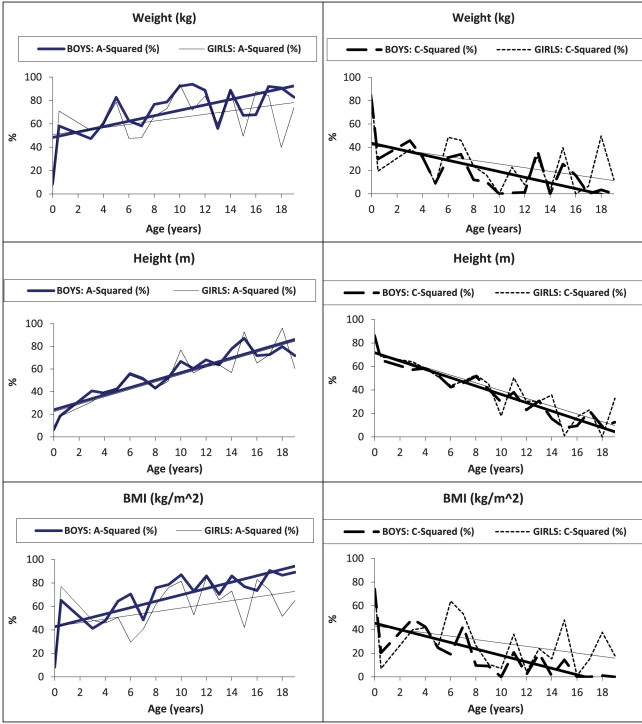
"Heritability of body mass, height, and BMI was low at birth (from 6.4 to 8.7% for boys and from 4.8 to 7.9% for girls), but increased with age, explaining almost half or more of the variance in body mass and BMI after 5 months in both sexes"​

1791379389347


Another one, 2024, twin study:
https://pubmed.ncbi.nlm.nih.gov/39072540/
​
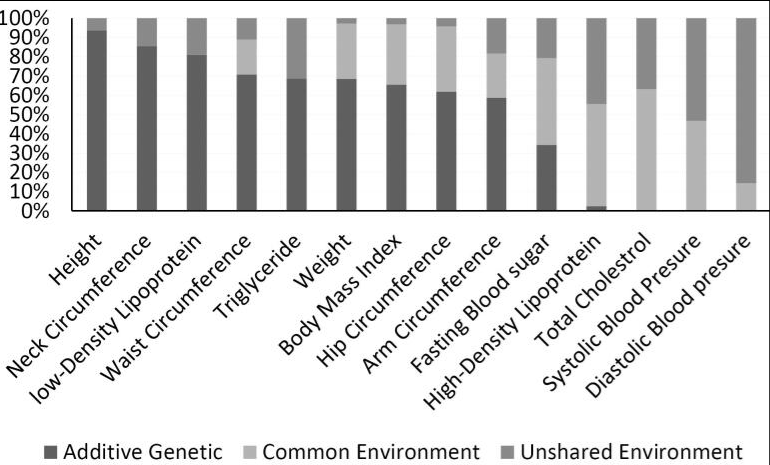
"In adolescence, height (94%), neck circumference (85%), LDL cholesterol (81%), waist circumference (70%), triglycerides (69%), weight (68%), and BMI (65%) - all were highly or moderately heritable"​

1791379435809


Meta-analysis 2024, 560,000 pairs of relatives:
https://pubmed.ncbi.nlm.nih.gov/39564936/
​
"Estimated heritability of height based on twin design increased from birth to 17 years. For children under 5, estimated heritability was 0.57. Heritability estimated from the parent-offspring design was 0.46 at birth and 0.76 at 17 years"​
The body is almost entirely genetics.​

Face​

1998 study, 79 twin pairs:
https://pubmed.ncbi.nlm.nih.gov/9770105/#1
​
"Modeling showed that all facial proportions are controlled by additive genes and specific environment. The genetic component was 71% for upper/lower facial height, 66% for anterior/posterior height, 62% for total facial height"​
2022 study, 98 twin pairs, age up to 17:
https://pubmed.ncbi.nlm.nih.gov/35014186/#1
​
"At age 12, strong additive genetic influence was observed for facial convexity (70%), upper lip profile (66%), and nose protrusion (65%). At age 17, only upper lip thickness (55%) and nose protrusion (84%) were under strong additive genetic control"​
2013 study, 21 twin pairs:
https://pubmed.ncbi.nlm.nih.gov/24501696/#1
​
"Three principal components showed evidence of moderate or high heritability and were associated with variation in the width of orbital and nasal structures, height and projection of the upper lip, and vertical and anterior projection of the nasal root"​
Meta-analysis 2019, 18,032 people in total:
https://pubmed.ncbi.nlm.nih.gov/31763980/#1
Locus - the place where a gene is located.
​
"24 genetic loci reaching genome-wide significance were identified. A subsequent multi-ethnic study confirmed 10 loci, including six previously undescribed"​
2025 study, 11,662 people:
https://pubmed.ncbi.nlm.nih.gov/40670343/#1
​
"253 markers in 188 loci associated with facial variations were identified. These markers explain up to 7.9% of variation for a specific trait. SNP heritability (markers) averaged 0.23, with a maximum of 0.36 for the nose and forehead"​
Not surprising, but the face is also almost entirely genetics.​

Personality​

2025 study, 1,914 twins:
https://pubmed.ncbi.nlm.nih.gov/40088417/
​
"Agency (the capacity to act independently) is moderately heritable (44.4%), strongly correlates with extraversion (r = 0.51)... about 40% of the variance in agency is shared with the Big Five"​
Another study, 2018, 2,796 twins aged 19–46:
https://pubmed.ncbi.nlm.nih.gov/30392478/
​
"Heritability estimates for the three risk factors were 48% (95% CI 41–54%), 35% (CI 28–42%), and 37% (CI 31–44%), respectively"​
Character is half-set.​

IQ​

2015 review of twin studies:
https://pubmed.ncbi.nlm.nih.gov/25224258/
​
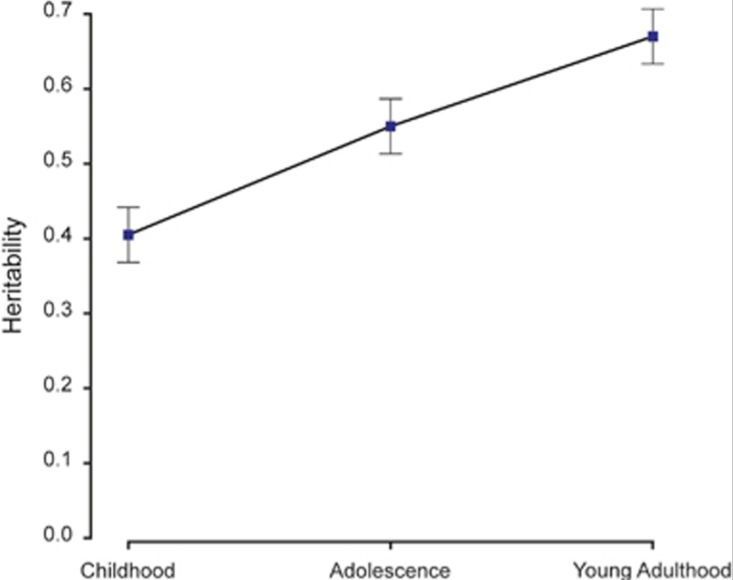
"Heritability estimates of IQ increase from 20% in infancy to 80% in adulthood"​

1791379481778


A meta-analysis of 11,000 twin pairs shows that the heritability of intelligence increases significantly from childhood (age 9) to adolescence (age 12) and to young adulthood (age 17)
2003 study, twins:
https://pubmed.ncbi.nlm.nih.gov/14629696/
​
"Models suggest that in poor families 60% of IQ variance is explained by shared environment, while the contribution of genes is close to zero; in rich families the result is almost the opposite"​
This means that in a poor environment IQ almost does not depend on genes, while in a rich one it is the opposite. The heritability of IQ depends on the environment.​

Self-control​

2019 meta-analysis, 30,000 twin pairs:
https://pubmed.ncbi.nlm.nih.gov/30822436/
​
"Results showed an overall correlation between monozygotic twins of 0.58 and an overall correlation between dizygotic twins of 0.28, leading to a heritability estimate of 60%"​
60% of self-control is genetics.​

Optimism​

2009 study, 3,053 twins over 50:
https://pubmed.ncbi.nlm.nih.gov/19618259/
​
"Additive genetic factors explained 36%, 34%, and 46% of the variation in optimism, mental health, and self-rated health, respectively, with the remainder due to non-shared environmental factors"​
The baseline level of optimism is genetics.​

Mental disorders​

2013 review of twin studies:
https://pubmed.ncbi.nlm.nih.gov/20459884/
​
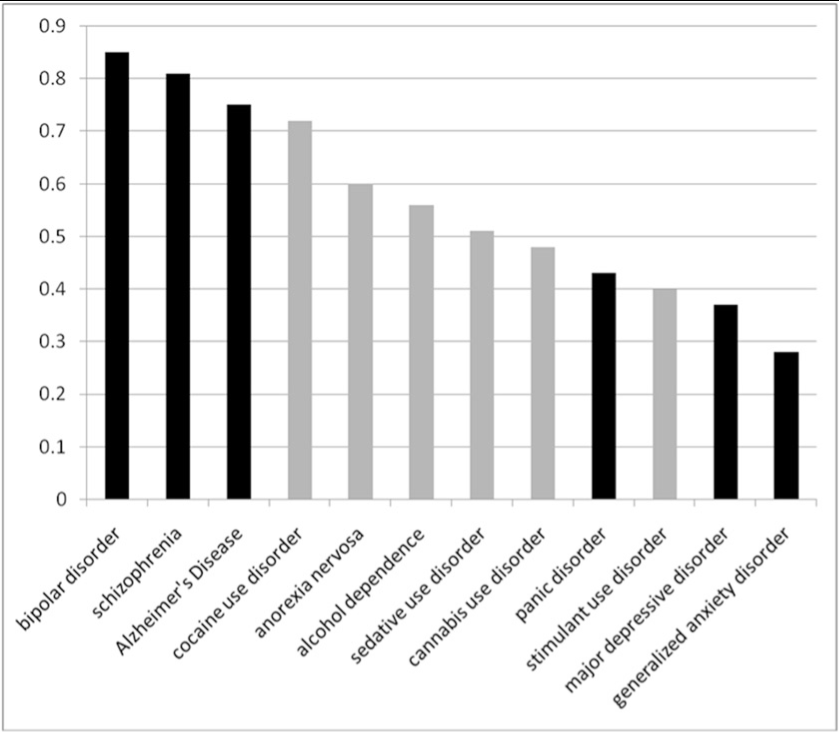
"Pooled heritability estimates were as follows: bipolar disorder (85%), schizophrenia (81%), Alzheimer's disease (75%), cocaine use disorder (72%), anorexia nervosa (60%), alcohol dependence (56%), sedative use disorder (51%), cannabis use disorder (48%), panic disorder (43%), stimulant use disorder (40%), major depressive disorder (37%), and generalized anxiety disorder (28%)."​
1791379556159


Predisposition to mental disorders is largely genetic.
​

Alcoholism and drug addiction​

2012 meta-analysis of twin and adoption studies:
https://pubmed.ncbi.nlm.nih.gov/22367454/
​
"Alcoholism and drug addiction are common mental disorders with a heritability of about 50%"​
Predisposition to alcoholism and drug addiction is half genetics.​

Religiosity​

2019 study, 273 twin pairs, mean age 33:
https://pubmed.ncbi.nlm.nih.gov/15745438/
​
"In adulthood, genetic factors explained 44% of the variance in current religiosity"​
Even faith is partly genetic.​

Education and income​

2017 study, 1,100 twin pairs:
https://pubmed.ncbi.nlm.nih.gov/28606205/
​
"Corresponding heritability estimates were 0.54 for education, 0.37 for occupational status, and 0.18 for income"​
"In low-income families, 60% of IQ variance is explained by shared environment, while the contribution of genes is close to zero; in affluent families the result is almost the opposite"​
In a poor environment genes almost do not decide - the environment does. In a rich one it is different.​

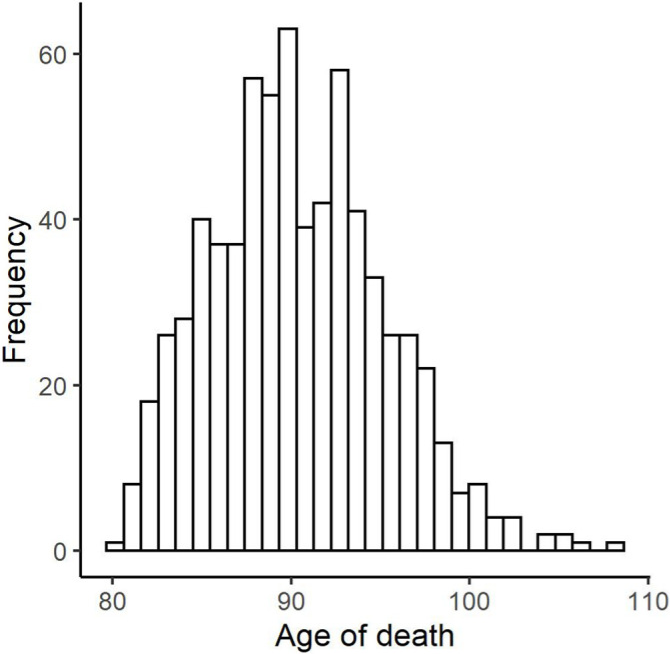
Mortality after 80​

2021 study, 699 twin pairs:
https://pubmed.ncbi.nlm.nih.gov/34630233/
​
"Our results confirmed low heritability at 12%... Longer survival was associated with female sex, absence of the APOE e4 allele (Alzheimer's gene), and not smoking... Social engagement, better self-rated health, and life satisfaction were also significantly associated with longer survival"​
1791379632366


Heritability of longevity is 12%. The rest is environment and lifestyle.
​

Environmental factors that change heritability​

2014 study, 18,932 twins:
https://pubmed.ncbi.nlm.nih.gov/24878694/
​
"Heritability was lower for formal daycare and under lower socioeconomic status... The decrease in heritability was explained by greater environmental influence, not by a decrease in genetic variation"​
2025 study, 9,080 children:
https://pubmed.ncbi.nlm.nih.gov/41282851/
​
"However, in children from low socioeconomic status families, differences in cortical structure were less genetically linked and more strongly linked to the environment, sometimes exceeding the genetic contribution. These results suggest that under socioeconomic disadvantage, children's brain structure reflects lived experience more strongly than previously thought"​
In a poor environment genes decide little, in a rich one - a lot.​

Calculation across all items​

Average values:
Height: 80 and 94 - (80 + 94) : 2 = 87%
BMI: 65%
Face: 71, 66, 62, 70, 66, 65, 55, 84 - (71 + 66 + 62 + 70 + 66 + 65 + 55 + 84) : 8 = 67.4%
Personality: 44.4 and 40 (48 + 35 + 37 = 120 : 3 = 40) - (44.4 + 40) : 2 = 42.2%
IQ: 80%
Self-control: 60%
Optimism: 36%
Mental disorders: 85, 81, 75, 72, 60, 56, 51, 48, 43, 40, 37, 28
85 + 81 + 75 + 72 + 60 + 56 + 51 + 48 + 43 + 40 + 37 + 28 = 676
676 : 12 = 56.3%
Alcoholism and drug addiction: 50%
Religiosity: 44%
Education: 54%
Income: 18%
Occupational status: 37%
Longevity (after 80): 12%

87 + 65 + 67,4 + 42,2 + 80 + 60 + 36 + 56,3 + 50 + 44 + 54 + 18 + 37 + 12 = 708,9
Number of items = 14
708.9 : 14 = 50.6%
50.6% genetics. 49.3% - environment.
​

Calculation only by biological indicators​

Height: 87%
BMI: 65%
Face: 67.4%
IQ: 80%
Self-control: 60%
Optimism: 36%
Mental disorders: 56.3%
Alcoholism: 50%
Longevity: 12%
87 + 65 + 67.4 + 80 + 60 + 36 + 56.3 + 50 + 12 = 513.7
513.7 : 9 = 57.1%
57.1% genetics. 42.9% - environment
​

Calculation by the most important indicators​

Height: 87%
BMI: 65%
Face: 67.4%
IQ: 80%
87 + 65 + 67.4 + 80 = 299.4
299.4 : 4 = 74.85%
​

If remove BMI:
Height: 87
Face: 67.4
IQ: 80
87 + 67.4 + 80 = 234.4
234.4 : 3 = 78.13%
​

Conclusion​

I did quite a lot of calculations. I replaced studies a million times because they gave me almost nothing. But every time I put it all together, the result ended up in roughly the same range: 50.4–51.4%.

I understand these are averages and that in different cases everything is different. Somewhere genetics decides almost everything, somewhere almost nothing. But if you take everything together, it turns out that genetics determines slightly more than half of life across all indicators.


In the end, I got four numbers: 50.6% - across all items, 57.1% - purely biological, 74.85% - by the most important ones, and 78.13% - by the most-most important ones, which have a huge influence on your entire life.

A huge meta-analysis says that on average genetics influences life by no more than 49%. If you're reading this, then most likely genetics has influenced most of your life. And far from for the better.

This is a translation of my thread from my language into English. Errors are possible.
@sasha108 @fantom0726 @trav191 @NotFun @tomacōck
DNR = FAGGOT
Image
 
  • +1
  • Love it
Reactions: iqlet_278573, Optimizer, krispi1 and 43 others
mirin
 
  • +1
Reactions: socio, americanpakitruvcel, Antide314 and 13 others
Dnr
 
  • +1
  • WTF
Reactions: akumaytt, russian grey, code80 and 5 others
View attachment 5738412

I asked myself: how much does genetics determine life if you average it across all studies? While searching, I came across a meta-analysis of virtually all work on this subject. It says heritability is 49%. But I still decided to roughly estimate the average from other studies to check whether the result converges.​

Meta-analysis of all twin studies​

https://www.nature.com/articles/ng.3285#Bib1
Meta-analysis of 2,748 publications, 14,558,903 twin pairs. All twin studies over 50 years.


Everything measurable in a human is on average 49% heritable.
And another important point:

Only unique environment works - what happened only to you.​

Height and weight​

2023 study, 214 twin pairs aged 3–18:
https://pubmed.ncbi.nlm.nih.gov/36635383/

Another study, 2012, 12,000 twin pairs:
https://pubmed.ncbi.nlm.nih.gov/22347368/


View attachment 5733346

Another one, 2024, twin study:
https://pubmed.ncbi.nlm.nih.gov/39072540/


View attachment 5733348


Meta-analysis 2024, 560,000 pairs of relatives:
https://pubmed.ncbi.nlm.nih.gov/39564936/

The body is almost entirely genetics.
​

Face​

1998 study, 79 twin pairs:
https://pubmed.ncbi.nlm.nih.gov/9770105/#1

2022 study, 98 twin pairs, age up to 17:
https://pubmed.ncbi.nlm.nih.gov/35014186/#1

2013 study, 21 twin pairs:
https://pubmed.ncbi.nlm.nih.gov/24501696/#1

Meta-analysis 2019, 18,032 people in total:
https://pubmed.ncbi.nlm.nih.gov/31763980/#1
Locus - the place where a gene is located.

2025 study, 11,662 people:
https://pubmed.ncbi.nlm.nih.gov/40670343/#1

Not surprising, but the face is also almost entirely genetics.
​

Personality​

2025 study, 1,914 twins:
https://pubmed.ncbi.nlm.nih.gov/40088417/

Another study, 2018, 2,796 twins aged 19–46:
https://pubmed.ncbi.nlm.nih.gov/30392478/

Character is half-set.
​

IQ​

2015 review of twin studies:
https://pubmed.ncbi.nlm.nih.gov/25224258/


View attachment 5733350

A meta-analysis of 11,000 twin pairs shows that the heritability of intelligence increases significantly from childhood (age 9) to adolescence (age 12) and to young adulthood (age 17)
2003 study, twins:
https://pubmed.ncbi.nlm.nih.gov/14629696/

This means that in a poor environment IQ almost does not depend on genes, while in a rich one it is the opposite. The heritability of IQ depends on the environment.
​

Self-control​

2019 meta-analysis, 30,000 twin pairs:
https://pubmed.ncbi.nlm.nih.gov/30822436/

60% of self-control is genetics.
​

Optimism​

2009 study, 3,053 twins over 50:
https://pubmed.ncbi.nlm.nih.gov/19618259/

The baseline level of optimism is genetics.
​

Mental disorders​

2013 review of twin studies:
https://pubmed.ncbi.nlm.nih.gov/20459884/

View attachment 5733354

Predisposition to mental disorders is largely genetic.
​

Alcoholism and drug addiction​

2012 meta-analysis of twin and adoption studies:
https://pubmed.ncbi.nlm.nih.gov/22367454/

Predisposition to alcoholism and drug addiction is half genetics.
​

Religiosity​

2019 study, 273 twin pairs, mean age 33:
https://pubmed.ncbi.nlm.nih.gov/15745438/

Even faith is partly genetic.
​

Education and income​

2017 study, 1,100 twin pairs:
https://pubmed.ncbi.nlm.nih.gov/28606205/

2003 study:
https://pubmed.ncbi.nlm.nih.gov/14629696/

In a poor environment genes almost do not decide - the environment does. In a rich one it is different.
​

Mortality after 80​

2021 study, 699 twin pairs:
https://pubmed.ncbi.nlm.nih.gov/34630233/

View attachment 5733355

Heritability of longevity is 12%. The rest is environment and lifestyle.
​

Environmental factors that change heritability​

2014 study, 18,932 twins:
https://pubmed.ncbi.nlm.nih.gov/24878694/

2025 study, 9,080 children:
https://pubmed.ncbi.nlm.nih.gov/41282851/

In a poor environment genes decide little, in a rich one - a lot.
​

Calculation across all items​

Average values:
Height: 80 and 94 - (80 + 94) : 2 = 87%
BMI: 65%
Face: 71, 66, 62, 70, 66, 65, 55, 84 - (71 + 66 + 62 + 70 + 66 + 65 + 55 + 84) : 8 = 67.4%
Personality: 44.4 and 40 (48 + 35 + 37 = 120 : 3 = 40) - (44.4 + 40) : 2 = 42.2%
IQ: 80%
Self-control: 60%
Optimism: 36%
Mental disorders: 85, 81, 75, 72, 60, 56, 51, 48, 43, 40, 37, 28
85 + 81 + 75 + 72 + 60 + 56 + 51 + 48 + 43 + 40 + 37 + 28 = 676
676 : 12 = 56.3%
Alcoholism and drug addiction: 50%
Religiosity: 44%
Education: 54%
Income: 18%
Occupational status: 37%
Longevity (after 80): 12%

87 + 65 + 67,4 + 42,2 + 80 + 60 + 36 + 56,3 + 50 + 44 + 54 + 18 + 37 + 12 = 708,9
Number of items = 14
708.9 : 14 = 50.6%
50.6% genetics. 49.3% - environment.
​

Calculation only by biological indicators​

Height: 87%
BMI: 65%
Face: 67.4%
IQ: 80%
Self-control: 60%
Optimism: 36%
Mental disorders: 56.3%
Alcoholism: 50%
Longevity: 12%
87 + 65 + 67.4 + 80 + 60 + 36 + 56.3 + 50 + 12 = 513.7
513.7 : 9 = 57.1%
57.1% genetics. 42.9% - environment
​

Calculation by the most important indicators​

Height: 87%
BMI: 65%
Face: 67.4%
IQ: 80%
87 + 65 + 67.4 + 80 = 299.4
299.4 : 4 = 74.85%
​

If remove BMI:
Height: 87
Face: 67.4
IQ: 80
87 + 67.4 + 80 = 234.4
234.4 : 3 = 78.13%
​

Conclusion​

I did quite a lot of calculations. I replaced studies a million times because they gave me almost nothing. But every time I put it all together, the result ended up in roughly the same range: 50.4–51.4%.

I understand these are averages and that in different cases everything is different. Somewhere genetics decides almost everything, somewhere almost nothing. But if you take everything together, it turns out that genetics determines slightly more than half of life across all indicators.


In the end, I got four numbers: 50.6% - across all items, 57.1% - purely biological, 74.85% - by the most important ones, and 78.13% - by the most-most important ones, which have a huge influence on your entire life.

A huge meta-analysis says that on average genetics influences life by no more than 49%. If you're reading this, then most likely genetics has influenced most of your life. And far from for the better.

This is a translation of my thread from my language into English. Errors are possible.
@sasha108 @fantom0726 @trav191 @NotFun @tomacōck
DNR = FAGGOT

dnr but mirin' for the effort :ogre:

P. S. I will read later
 
  • +1
Reactions: akumaytt, russian grey, code80 and 6 others
View attachment 5738412

I asked myself: how much does genetics determine life if you average it across all studies? While searching, I came across a meta-analysis of virtually all work on this subject. It says heritability is 49%. But I still decided to roughly estimate the average from other studies to check whether the result converges.​

Meta-analysis of all twin studies​

https://www.nature.com/articles/ng.3285#Bib1
Meta-analysis of 2,748 publications, 14,558,903 twin pairs. All twin studies over 50 years.


Everything measurable in a human is on average 49% heritable.
And another important point:

Only unique environment works - what happened only to you.​

Height and weight​

2023 study, 214 twin pairs aged 3–18:
https://pubmed.ncbi.nlm.nih.gov/36635383/

Another study, 2012, 12,000 twin pairs:
https://pubmed.ncbi.nlm.nih.gov/22347368/


View attachment 5733346

Another one, 2024, twin study:
https://pubmed.ncbi.nlm.nih.gov/39072540/


View attachment 5733348


Meta-analysis 2024, 560,000 pairs of relatives:
https://pubmed.ncbi.nlm.nih.gov/39564936/

The body is almost entirely genetics.
​

Face​

1998 study, 79 twin pairs:
https://pubmed.ncbi.nlm.nih.gov/9770105/#1

2022 study, 98 twin pairs, age up to 17:
https://pubmed.ncbi.nlm.nih.gov/35014186/#1

2013 study, 21 twin pairs:
https://pubmed.ncbi.nlm.nih.gov/24501696/#1

Meta-analysis 2019, 18,032 people in total:
https://pubmed.ncbi.nlm.nih.gov/31763980/#1
Locus - the place where a gene is located.

2025 study, 11,662 people:
https://pubmed.ncbi.nlm.nih.gov/40670343/#1

Not surprising, but the face is also almost entirely genetics.
​

Personality​

2025 study, 1,914 twins:
https://pubmed.ncbi.nlm.nih.gov/40088417/

Another study, 2018, 2,796 twins aged 19–46:
https://pubmed.ncbi.nlm.nih.gov/30392478/

Character is half-set.
​

IQ​

2015 review of twin studies:
https://pubmed.ncbi.nlm.nih.gov/25224258/


View attachment 5733350

A meta-analysis of 11,000 twin pairs shows that the heritability of intelligence increases significantly from childhood (age 9) to adolescence (age 12) and to young adulthood (age 17)
2003 study, twins:
https://pubmed.ncbi.nlm.nih.gov/14629696/

This means that in a poor environment IQ almost does not depend on genes, while in a rich one it is the opposite. The heritability of IQ depends on the environment.
​

Self-control​

2019 meta-analysis, 30,000 twin pairs:
https://pubmed.ncbi.nlm.nih.gov/30822436/

60% of self-control is genetics.
​

Optimism​

2009 study, 3,053 twins over 50:
https://pubmed.ncbi.nlm.nih.gov/19618259/

The baseline level of optimism is genetics.
​

Mental disorders​

2013 review of twin studies:
https://pubmed.ncbi.nlm.nih.gov/20459884/

View attachment 5733354

Predisposition to mental disorders is largely genetic.
​

Alcoholism and drug addiction​

2012 meta-analysis of twin and adoption studies:
https://pubmed.ncbi.nlm.nih.gov/22367454/

Predisposition to alcoholism and drug addiction is half genetics.
​

Religiosity​

2019 study, 273 twin pairs, mean age 33:
https://pubmed.ncbi.nlm.nih.gov/15745438/

Even faith is partly genetic.
​

Education and income​

2017 study, 1,100 twin pairs:
https://pubmed.ncbi.nlm.nih.gov/28606205/

2003 study:
https://pubmed.ncbi.nlm.nih.gov/14629696/

In a poor environment genes almost do not decide - the environment does. In a rich one it is different.
​

Mortality after 80​

2021 study, 699 twin pairs:
https://pubmed.ncbi.nlm.nih.gov/34630233/

View attachment 5733355

Heritability of longevity is 12%. The rest is environment and lifestyle.
​

Environmental factors that change heritability​

2014 study, 18,932 twins:
https://pubmed.ncbi.nlm.nih.gov/24878694/

2025 study, 9,080 children:
https://pubmed.ncbi.nlm.nih.gov/41282851/

In a poor environment genes decide little, in a rich one - a lot.
​

Calculation across all items​

Average values:
Height: 80 and 94 - (80 + 94) : 2 = 87%
BMI: 65%
Face: 71, 66, 62, 70, 66, 65, 55, 84 - (71 + 66 + 62 + 70 + 66 + 65 + 55 + 84) : 8 = 67.4%
Personality: 44.4 and 40 (48 + 35 + 37 = 120 : 3 = 40) - (44.4 + 40) : 2 = 42.2%
IQ: 80%
Self-control: 60%
Optimism: 36%
Mental disorders: 85, 81, 75, 72, 60, 56, 51, 48, 43, 40, 37, 28
85 + 81 + 75 + 72 + 60 + 56 + 51 + 48 + 43 + 40 + 37 + 28 = 676
676 : 12 = 56.3%
Alcoholism and drug addiction: 50%
Religiosity: 44%
Education: 54%
Income: 18%
Occupational status: 37%
Longevity (after 80): 12%

87 + 65 + 67,4 + 42,2 + 80 + 60 + 36 + 56,3 + 50 + 44 + 54 + 18 + 37 + 12 = 708,9
Number of items = 14
708.9 : 14 = 50.6%
50.6% genetics. 49.3% - environment.
​

Calculation only by biological indicators​

Height: 87%
BMI: 65%
Face: 67.4%
IQ: 80%
Self-control: 60%
Optimism: 36%
Mental disorders: 56.3%
Alcoholism: 50%
Longevity: 12%
87 + 65 + 67.4 + 80 + 60 + 36 + 56.3 + 50 + 12 = 513.7
513.7 : 9 = 57.1%
57.1% genetics. 42.9% - environment
​

Calculation by the most important indicators​

Height: 87%
BMI: 65%
Face: 67.4%
IQ: 80%
87 + 65 + 67.4 + 80 = 299.4
299.4 : 4 = 74.85%
​

If remove BMI:
Height: 87
Face: 67.4
IQ: 80
87 + 67.4 + 80 = 234.4
234.4 : 3 = 78.13%
​

Conclusion​

I did quite a lot of calculations. I replaced studies a million times because they gave me almost nothing. But every time I put it all together, the result ended up in roughly the same range: 50.4–51.4%.

I understand these are averages and that in different cases everything is different. Somewhere genetics decides almost everything, somewhere almost nothing. But if you take everything together, it turns out that genetics determines slightly more than half of life across all indicators.


In the end, I got four numbers: 50.6% - across all items, 57.1% - purely biological, 74.85% - by the most important ones, and 78.13% - by the most-most important ones, which have a huge influence on your entire life.

A huge meta-analysis says that on average genetics influences life by no more than 49%. If you're reading this, then most likely genetics has influenced most of your life. And far from for the better.

This is a translation of my thread from my language into English. Errors are possible.
@sasha108 @fantom0726 @trav191 @NotFun @tomacōck
DNR = FAGGOT
Its over :feelswah:
 
  • +1
  • So Sad
Reactions: doubleR, jr49506, Dydargas_ and 3 others
At the end of the thread, all final values are highlighted
Отправишь мне может русскую версию?
 
  • +1
Reactions: doubleR, russian grey, Emancipator and 4 others
Good thread bro
 
  • +1
Reactions: doubleR, Dydargas_, Ldar09867 and 2 others
Отправишь мне может русскую версию?
Я её сейчас выложу в наш сабфорум
 
  • +1
  • Love it
Reactions: doubleR, m1zzeronok, russian grey and 7 others
Bump
 
  • +1
Reactions: doubleR, m1zzeronok, russian grey and 8 others
Bump
 
  • +1
Reactions: doubleR, m1zzeronok, russian grey and 6 others
w for the high effort
 
  • +1
  • Love it
Reactions: doubleR, jr49506, Emancipator and 4 others
bump
 
  • +1
Reactions: doubleR, m1zzeronok, russian grey and 5 others
.
 
  • +1
Reactions: doubleR, russian grey, jr49506 and 4 others
View attachment 5738412

I asked myself: how much does genetics determine life if you average it across all studies? While searching, I came across a meta-analysis of virtually all work on this subject. It says heritability is 49%. But I still decided to roughly estimate the average from other studies to check whether the result converges.​

Meta-analysis of all twin studies​

https://www.nature.com/articles/ng.3285#Bib1
Meta-analysis of 2,748 publications, 14,558,903 twin pairs. All twin studies over 50 years.


Everything measurable in a human is on average 49% heritable.
And another important point:

Only unique environment works - what happened only to you.​

Height and weight​

2023 study, 214 twin pairs aged 3–18:
https://pubmed.ncbi.nlm.nih.gov/36635383/

Another study, 2012, 12,000 twin pairs:
https://pubmed.ncbi.nlm.nih.gov/22347368/


View attachment 5733346

Another one, 2024, twin study:
https://pubmed.ncbi.nlm.nih.gov/39072540/


View attachment 5733348


Meta-analysis 2024, 560,000 pairs of relatives:
https://pubmed.ncbi.nlm.nih.gov/39564936/

The body is almost entirely genetics.
​

Face​

1998 study, 79 twin pairs:
https://pubmed.ncbi.nlm.nih.gov/9770105/#1

2022 study, 98 twin pairs, age up to 17:
https://pubmed.ncbi.nlm.nih.gov/35014186/#1

2013 study, 21 twin pairs:
https://pubmed.ncbi.nlm.nih.gov/24501696/#1

Meta-analysis 2019, 18,032 people in total:
https://pubmed.ncbi.nlm.nih.gov/31763980/#1
Locus - the place where a gene is located.

2025 study, 11,662 people:
https://pubmed.ncbi.nlm.nih.gov/40670343/#1

Not surprising, but the face is also almost entirely genetics.
​

Personality​

2025 study, 1,914 twins:
https://pubmed.ncbi.nlm.nih.gov/40088417/

Another study, 2018, 2,796 twins aged 19–46:
https://pubmed.ncbi.nlm.nih.gov/30392478/

Character is half-set.
​

IQ​

2015 review of twin studies:
https://pubmed.ncbi.nlm.nih.gov/25224258/


View attachment 5733350

A meta-analysis of 11,000 twin pairs shows that the heritability of intelligence increases significantly from childhood (age 9) to adolescence (age 12) and to young adulthood (age 17)
2003 study, twins:
https://pubmed.ncbi.nlm.nih.gov/14629696/

This means that in a poor environment IQ almost does not depend on genes, while in a rich one it is the opposite. The heritability of IQ depends on the environment.
​

Self-control​

2019 meta-analysis, 30,000 twin pairs:
https://pubmed.ncbi.nlm.nih.gov/30822436/

60% of self-control is genetics.
​

Optimism​

2009 study, 3,053 twins over 50:
https://pubmed.ncbi.nlm.nih.gov/19618259/

The baseline level of optimism is genetics.
​

Mental disorders​

2013 review of twin studies:
https://pubmed.ncbi.nlm.nih.gov/20459884/

View attachment 5733354

Predisposition to mental disorders is largely genetic.
​

Alcoholism and drug addiction​

2012 meta-analysis of twin and adoption studies:
https://pubmed.ncbi.nlm.nih.gov/22367454/

Predisposition to alcoholism and drug addiction is half genetics.
​

Religiosity​

2019 study, 273 twin pairs, mean age 33:
https://pubmed.ncbi.nlm.nih.gov/15745438/

Even faith is partly genetic.
​

Education and income​

2017 study, 1,100 twin pairs:
https://pubmed.ncbi.nlm.nih.gov/28606205/

2003 study:
https://pubmed.ncbi.nlm.nih.gov/14629696/

In a poor environment genes almost do not decide - the environment does. In a rich one it is different.
​

Mortality after 80​

2021 study, 699 twin pairs:
https://pubmed.ncbi.nlm.nih.gov/34630233/

View attachment 5733355

Heritability of longevity is 12%. The rest is environment and lifestyle.
​

Environmental factors that change heritability​

2014 study, 18,932 twins:
https://pubmed.ncbi.nlm.nih.gov/24878694/

2025 study, 9,080 children:
https://pubmed.ncbi.nlm.nih.gov/41282851/

In a poor environment genes decide little, in a rich one - a lot.
​

Calculation across all items​

Average values:
Height: 80 and 94 - (80 + 94) : 2 = 87%
BMI: 65%
Face: 71, 66, 62, 70, 66, 65, 55, 84 - (71 + 66 + 62 + 70 + 66 + 65 + 55 + 84) : 8 = 67.4%
Personality: 44.4 and 40 (48 + 35 + 37 = 120 : 3 = 40) - (44.4 + 40) : 2 = 42.2%
IQ: 80%
Self-control: 60%
Optimism: 36%
Mental disorders: 85, 81, 75, 72, 60, 56, 51, 48, 43, 40, 37, 28
85 + 81 + 75 + 72 + 60 + 56 + 51 + 48 + 43 + 40 + 37 + 28 = 676
676 : 12 = 56.3%
Alcoholism and drug addiction: 50%
Religiosity: 44%
Education: 54%
Income: 18%
Occupational status: 37%
Longevity (after 80): 12%

87 + 65 + 67,4 + 42,2 + 80 + 60 + 36 + 56,3 + 50 + 44 + 54 + 18 + 37 + 12 = 708,9
Number of items = 14
708.9 : 14 = 50.6%
50.6% genetics. 49.3% - environment.
​

Calculation only by biological indicators​

Height: 87%
BMI: 65%
Face: 67.4%
IQ: 80%
Self-control: 60%
Optimism: 36%
Mental disorders: 56.3%
Alcoholism: 50%
Longevity: 12%
87 + 65 + 67.4 + 80 + 60 + 36 + 56.3 + 50 + 12 = 513.7
513.7 : 9 = 57.1%
57.1% genetics. 42.9% - environment
​

Calculation by the most important indicators​

Height: 87%
BMI: 65%
Face: 67.4%
IQ: 80%
87 + 65 + 67.4 + 80 = 299.4
299.4 : 4 = 74.85%
​

If remove BMI:
Height: 87
Face: 67.4
IQ: 80
87 + 67.4 + 80 = 234.4
234.4 : 3 = 78.13%
​

Conclusion​

I did quite a lot of calculations. I replaced studies a million times because they gave me almost nothing. But every time I put it all together, the result ended up in roughly the same range: 50.4–51.4%.

I understand these are averages and that in different cases everything is different. Somewhere genetics decides almost everything, somewhere almost nothing. But if you take everything together, it turns out that genetics determines slightly more than half of life across all indicators.


In the end, I got four numbers: 50.6% - across all items, 57.1% - purely biological, 74.85% - by the most important ones, and 78.13% - by the most-most important ones, which have a huge influence on your entire life.

A huge meta-analysis says that on average genetics influences life by no more than 49%. If you're reading this, then most likely genetics has influenced most of your life. And far from for the better.

This is a translation of my thread from my language into English. Errors are possible.
@sasha108 @fantom0726 @trav191 @NotFun @tomacōck
DNR = FAGGOT
Yooo High iq post
 
  • +1
Reactions: doubleR, jr49506, Emancipator and 3 others
highest iq in the universe

0e2dff7b06b8e58c72040bb66d236465
 
  • +1
  • Love it
Reactions: doubleR, russian grey, jr49506 and 6 others
View attachment 5738412

I asked myself: how much does genetics determine life if you average it across all studies? While searching, I came across a meta-analysis of virtually all work on this subject. It says heritability is 49%. But I still decided to roughly estimate the average from other studies to check whether the result converges.​

Meta-analysis of all twin studies​

https://www.nature.com/articles/ng.3285#Bib1
Meta-analysis of 2,748 publications, 14,558,903 twin pairs. All twin studies over 50 years.


Everything measurable in a human is on average 49% heritable.
And another important point:

Only unique environment works - what happened only to you.​

Height and weight​

2023 study, 214 twin pairs aged 3–18:
https://pubmed.ncbi.nlm.nih.gov/36635383/

Another study, 2012, 12,000 twin pairs:
https://pubmed.ncbi.nlm.nih.gov/22347368/


View attachment 5733346

Another one, 2024, twin study:
https://pubmed.ncbi.nlm.nih.gov/39072540/


View attachment 5733348


Meta-analysis 2024, 560,000 pairs of relatives:
https://pubmed.ncbi.nlm.nih.gov/39564936/

The body is almost entirely genetics.
​

Face​

1998 study, 79 twin pairs:
https://pubmed.ncbi.nlm.nih.gov/9770105/#1

2022 study, 98 twin pairs, age up to 17:
https://pubmed.ncbi.nlm.nih.gov/35014186/#1

2013 study, 21 twin pairs:
https://pubmed.ncbi.nlm.nih.gov/24501696/#1

Meta-analysis 2019, 18,032 people in total:
https://pubmed.ncbi.nlm.nih.gov/31763980/#1
Locus - the place where a gene is located.

2025 study, 11,662 people:
https://pubmed.ncbi.nlm.nih.gov/40670343/#1

Not surprising, but the face is also almost entirely genetics.
​

Personality​

2025 study, 1,914 twins:
https://pubmed.ncbi.nlm.nih.gov/40088417/

Another study, 2018, 2,796 twins aged 19–46:
https://pubmed.ncbi.nlm.nih.gov/30392478/

Character is half-set.
​

IQ​

2015 review of twin studies:
https://pubmed.ncbi.nlm.nih.gov/25224258/


View attachment 5733350

A meta-analysis of 11,000 twin pairs shows that the heritability of intelligence increases significantly from childhood (age 9) to adolescence (age 12) and to young adulthood (age 17)
2003 study, twins:
https://pubmed.ncbi.nlm.nih.gov/14629696/

This means that in a poor environment IQ almost does not depend on genes, while in a rich one it is the opposite. The heritability of IQ depends on the environment.
​

Self-control​

2019 meta-analysis, 30,000 twin pairs:
https://pubmed.ncbi.nlm.nih.gov/30822436/

60% of self-control is genetics.
​

Optimism​

2009 study, 3,053 twins over 50:
https://pubmed.ncbi.nlm.nih.gov/19618259/

The baseline level of optimism is genetics.
​

Mental disorders​

2013 review of twin studies:
https://pubmed.ncbi.nlm.nih.gov/20459884/

View attachment 5733354

Predisposition to mental disorders is largely genetic.
​

Alcoholism and drug addiction​

2012 meta-analysis of twin and adoption studies:
https://pubmed.ncbi.nlm.nih.gov/22367454/

Predisposition to alcoholism and drug addiction is half genetics.
​

Religiosity​

2019 study, 273 twin pairs, mean age 33:
https://pubmed.ncbi.nlm.nih.gov/15745438/

Even faith is partly genetic.
​

Education and income​

2017 study, 1,100 twin pairs:
https://pubmed.ncbi.nlm.nih.gov/28606205/

2003 study:
https://pubmed.ncbi.nlm.nih.gov/14629696/

In a poor environment genes almost do not decide - the environment does. In a rich one it is different.
​

Mortality after 80​

2021 study, 699 twin pairs:
https://pubmed.ncbi.nlm.nih.gov/34630233/

View attachment 5733355

Heritability of longevity is 12%. The rest is environment and lifestyle.
​

Environmental factors that change heritability​

2014 study, 18,932 twins:
https://pubmed.ncbi.nlm.nih.gov/24878694/

2025 study, 9,080 children:
https://pubmed.ncbi.nlm.nih.gov/41282851/

In a poor environment genes decide little, in a rich one - a lot.
​

Calculation across all items​

Average values:
Height: 80 and 94 - (80 + 94) : 2 = 87%
BMI: 65%
Face: 71, 66, 62, 70, 66, 65, 55, 84 - (71 + 66 + 62 + 70 + 66 + 65 + 55 + 84) : 8 = 67.4%
Personality: 44.4 and 40 (48 + 35 + 37 = 120 : 3 = 40) - (44.4 + 40) : 2 = 42.2%
IQ: 80%
Self-control: 60%
Optimism: 36%
Mental disorders: 85, 81, 75, 72, 60, 56, 51, 48, 43, 40, 37, 28
85 + 81 + 75 + 72 + 60 + 56 + 51 + 48 + 43 + 40 + 37 + 28 = 676
676 : 12 = 56.3%
Alcoholism and drug addiction: 50%
Religiosity: 44%
Education: 54%
Income: 18%
Occupational status: 37%
Longevity (after 80): 12%

87 + 65 + 67,4 + 42,2 + 80 + 60 + 36 + 56,3 + 50 + 44 + 54 + 18 + 37 + 12 = 708,9
Number of items = 14
708.9 : 14 = 50.6%
50.6% genetics. 49.3% - environment.
​

Calculation only by biological indicators​

Height: 87%
BMI: 65%
Face: 67.4%
IQ: 80%
Self-control: 60%
Optimism: 36%
Mental disorders: 56.3%
Alcoholism: 50%
Longevity: 12%
87 + 65 + 67.4 + 80 + 60 + 36 + 56.3 + 50 + 12 = 513.7
513.7 : 9 = 57.1%
57.1% genetics. 42.9% - environment
​

Calculation by the most important indicators​

Height: 87%
BMI: 65%
Face: 67.4%
IQ: 80%
87 + 65 + 67.4 + 80 = 299.4
299.4 : 4 = 74.85%
​

If remove BMI:
Height: 87
Face: 67.4
IQ: 80
87 + 67.4 + 80 = 234.4
234.4 : 3 = 78.13%
​

Conclusion​

I did quite a lot of calculations. I replaced studies a million times because they gave me almost nothing. But every time I put it all together, the result ended up in roughly the same range: 50.4–51.4%.

I understand these are averages and that in different cases everything is different. Somewhere genetics decides almost everything, somewhere almost nothing. But if you take everything together, it turns out that genetics determines slightly more than half of life across all indicators.


In the end, I got four numbers: 50.6% - across all items, 57.1% - purely biological, 74.85% - by the most important ones, and 78.13% - by the most-most important ones, which have a huge influence on your entire life.

A huge meta-analysis says that on average genetics influences life by no more than 49%. If you're reading this, then most likely genetics has influenced most of your life. And far from for the better.

This is a translation of my thread from my language into English. Errors are possible.
@sasha108 @fantom0726 @trav191 @NotFun @tomacōck
DNR = FAGGOT
Good thread

crazy that even faith is genetic
 
  • +1
Reactions: doubleR, jr49506, Dydargas_ and 3 others
б
View attachment 5738412

I asked myself: how much does genetics determine life if you average it across all studies? While searching, I came across a meta-analysis of virtually all work on this subject. It says heritability is 49%. But I still decided to roughly estimate the average from other studies to check whether the result converges.​

Meta-analysis of all twin studies​

https://www.nature.com/articles/ng.3285#Bib1
Meta-analysis of 2,748 publications, 14,558,903 twin pairs. All twin studies over 50 years.


Everything measurable in a human is on average 49% heritable.
And another important point:

Only unique environment works - what happened only to you.​

Height and weight​

2023 study, 214 twin pairs aged 3–18:
https://pubmed.ncbi.nlm.nih.gov/36635383/

Another study, 2012, 12,000 twin pairs:
https://pubmed.ncbi.nlm.nih.gov/22347368/


View attachment 5733346

Another one, 2024, twin study:
https://pubmed.ncbi.nlm.nih.gov/39072540/


View attachment 5733348


Meta-analysis 2024, 560,000 pairs of relatives:
https://pubmed.ncbi.nlm.nih.gov/39564936/

The body is almost entirely genetics.
​

Face​

1998 study, 79 twin pairs:
https://pubmed.ncbi.nlm.nih.gov/9770105/#1

2022 study, 98 twin pairs, age up to 17:
https://pubmed.ncbi.nlm.nih.gov/35014186/#1

2013 study, 21 twin pairs:
https://pubmed.ncbi.nlm.nih.gov/24501696/#1

Meta-analysis 2019, 18,032 people in total:
https://pubmed.ncbi.nlm.nih.gov/31763980/#1
Locus - the place where a gene is located.

2025 study, 11,662 people:
https://pubmed.ncbi.nlm.nih.gov/40670343/#1

Not surprising, but the face is also almost entirely genetics.
​

Personality​

2025 study, 1,914 twins:
https://pubmed.ncbi.nlm.nih.gov/40088417/

Another study, 2018, 2,796 twins aged 19–46:
https://pubmed.ncbi.nlm.nih.gov/30392478/

Character is half-set.
​

IQ​

2015 review of twin studies:
https://pubmed.ncbi.nlm.nih.gov/25224258/


View attachment 5733350

A meta-analysis of 11,000 twin pairs shows that the heritability of intelligence increases significantly from childhood (age 9) to adolescence (age 12) and to young adulthood (age 17)
2003 study, twins:
https://pubmed.ncbi.nlm.nih.gov/14629696/

This means that in a poor environment IQ almost does not depend on genes, while in a rich one it is the opposite. The heritability of IQ depends on the environment.
​

Self-control​

2019 meta-analysis, 30,000 twin pairs:
https://pubmed.ncbi.nlm.nih.gov/30822436/

60% of self-control is genetics.
​

Optimism​

2009 study, 3,053 twins over 50:
https://pubmed.ncbi.nlm.nih.gov/19618259/

The baseline level of optimism is genetics.
​

Mental disorders​

2013 review of twin studies:
https://pubmed.ncbi.nlm.nih.gov/20459884/

View attachment 5733354

Predisposition to mental disorders is largely genetic.
​

Alcoholism and drug addiction​

2012 meta-analysis of twin and adoption studies:
https://pubmed.ncbi.nlm.nih.gov/22367454/

Predisposition to alcoholism and drug addiction is half genetics.
​

Religiosity​

2019 study, 273 twin pairs, mean age 33:
https://pubmed.ncbi.nlm.nih.gov/15745438/

Even faith is partly genetic.
​

Education and income​

2017 study, 1,100 twin pairs:
https://pubmed.ncbi.nlm.nih.gov/28606205/

2003 study:
https://pubmed.ncbi.nlm.nih.gov/14629696/

In a poor environment genes almost do not decide - the environment does. In a rich one it is different.
​

Mortality after 80​

2021 study, 699 twin pairs:
https://pubmed.ncbi.nlm.nih.gov/34630233/

View attachment 5733355

Heritability of longevity is 12%. The rest is environment and lifestyle.
​

Environmental factors that change heritability​

2014 study, 18,932 twins:
https://pubmed.ncbi.nlm.nih.gov/24878694/

2025 study, 9,080 children:
https://pubmed.ncbi.nlm.nih.gov/41282851/

In a poor environment genes decide little, in a rich one - a lot.
​

Calculation across all items​

Average values:
Height: 80 and 94 - (80 + 94) : 2 = 87%
BMI: 65%
Face: 71, 66, 62, 70, 66, 65, 55, 84 - (71 + 66 + 62 + 70 + 66 + 65 + 55 + 84) : 8 = 67.4%
Personality: 44.4 and 40 (48 + 35 + 37 = 120 : 3 = 40) - (44.4 + 40) : 2 = 42.2%
IQ: 80%
Self-control: 60%
Optimism: 36%
Mental disorders: 85, 81, 75, 72, 60, 56, 51, 48, 43, 40, 37, 28
85 + 81 + 75 + 72 + 60 + 56 + 51 + 48 + 43 + 40 + 37 + 28 = 676
676 : 12 = 56.3%
Alcoholism and drug addiction: 50%
Religiosity: 44%
Education: 54%
Income: 18%
Occupational status: 37%
Longevity (after 80): 12%

87 + 65 + 67,4 + 42,2 + 80 + 60 + 36 + 56,3 + 50 + 44 + 54 + 18 + 37 + 12 = 708,9
Number of items = 14
708.9 : 14 = 50.6%
50.6% genetics. 49.3% - environment.
​

Calculation only by biological indicators​

Height: 87%
BMI: 65%
Face: 67.4%
IQ: 80%
Self-control: 60%
Optimism: 36%
Mental disorders: 56.3%
Alcoholism: 50%
Longevity: 12%
87 + 65 + 67.4 + 80 + 60 + 36 + 56.3 + 50 + 12 = 513.7
513.7 : 9 = 57.1%
57.1% genetics. 42.9% - environment
​

Calculation by the most important indicators​

Height: 87%
BMI: 65%
Face: 67.4%
IQ: 80%
87 + 65 + 67.4 + 80 = 299.4
299.4 : 4 = 74.85%
​

If remove BMI:
Height: 87
Face: 67.4
IQ: 80
87 + 67.4 + 80 = 234.4
234.4 : 3 = 78.13%
​

Conclusion​

I did quite a lot of calculations. I replaced studies a million times because they gave me almost nothing. But every time I put it all together, the result ended up in roughly the same range: 50.4–51.4%.

I understand these are averages and that in different cases everything is different. Somewhere genetics decides almost everything, somewhere almost nothing. But if you take everything together, it turns out that genetics determines slightly more than half of life across all indicators.


In the end, I got four numbers: 50.6% - across all items, 57.1% - purely biological, 74.85% - by the most important ones, and 78.13% - by the most-most important ones, which have a huge influence on your entire life.

A huge meta-analysis says that on average genetics influences life by no more than 49%. If you're reading this, then most likely genetics has influenced most of your life. And far from for the better.

This is a translation of my thread from my language into English. Errors are possible.
@sasha108 @fantom0726 @trav191 @NotFun @tomacōck
DNR = FAGGOT
бамп
 
  • +1
Reactions: russian grey, needsinjury, Dydargas_ and 2 others
TLDR: It was over by the time of conception
 
  • +1
Reactions: jr49506, Dydargas_ and kewerest
View attachment 5738412

I asked myself: how much does genetics determine life if you average it across all studies? While searching, I came across a meta-analysis of virtually all work on this subject. It says heritability is 49%. But I still decided to roughly estimate the average from other studies to check whether the result converges.​

Meta-analysis of all twin studies​

https://www.nature.com/articles/ng.3285#Bib1
Meta-analysis of 2,748 publications, 14,558,903 twin pairs. All twin studies over 50 years.


Everything measurable in a human is on average 49% heritable.
And another important point:

Only unique environment works - what happened only to you.​

Height and weight​

2023 study, 214 twin pairs aged 3–18:
https://pubmed.ncbi.nlm.nih.gov/36635383/

Another study, 2012, 12,000 twin pairs:
https://pubmed.ncbi.nlm.nih.gov/22347368/


View attachment 5733346

Another one, 2024, twin study:
https://pubmed.ncbi.nlm.nih.gov/39072540/


View attachment 5733348


Meta-analysis 2024, 560,000 pairs of relatives:
https://pubmed.ncbi.nlm.nih.gov/39564936/

The body is almost entirely genetics.
​

Face​

1998 study, 79 twin pairs:
https://pubmed.ncbi.nlm.nih.gov/9770105/#1

2022 study, 98 twin pairs, age up to 17:
https://pubmed.ncbi.nlm.nih.gov/35014186/#1

2013 study, 21 twin pairs:
https://pubmed.ncbi.nlm.nih.gov/24501696/#1

Meta-analysis 2019, 18,032 people in total:
https://pubmed.ncbi.nlm.nih.gov/31763980/#1
Locus - the place where a gene is located.

2025 study, 11,662 people:
https://pubmed.ncbi.nlm.nih.gov/40670343/#1

Not surprising, but the face is also almost entirely genetics.
​

Personality​

2025 study, 1,914 twins:
https://pubmed.ncbi.nlm.nih.gov/40088417/

Another study, 2018, 2,796 twins aged 19–46:
https://pubmed.ncbi.nlm.nih.gov/30392478/

Character is half-set.
​

IQ​

2015 review of twin studies:
https://pubmed.ncbi.nlm.nih.gov/25224258/


View attachment 5733350

A meta-analysis of 11,000 twin pairs shows that the heritability of intelligence increases significantly from childhood (age 9) to adolescence (age 12) and to young adulthood (age 17)
2003 study, twins:
https://pubmed.ncbi.nlm.nih.gov/14629696/

This means that in a poor environment IQ almost does not depend on genes, while in a rich one it is the opposite. The heritability of IQ depends on the environment.
​

Self-control​

2019 meta-analysis, 30,000 twin pairs:
https://pubmed.ncbi.nlm.nih.gov/30822436/

60% of self-control is genetics.
​

Optimism​

2009 study, 3,053 twins over 50:
https://pubmed.ncbi.nlm.nih.gov/19618259/

The baseline level of optimism is genetics.
​

Mental disorders​

2013 review of twin studies:
https://pubmed.ncbi.nlm.nih.gov/20459884/

View attachment 5733354

Predisposition to mental disorders is largely genetic.
​

Alcoholism and drug addiction​

2012 meta-analysis of twin and adoption studies:
https://pubmed.ncbi.nlm.nih.gov/22367454/

Predisposition to alcoholism and drug addiction is half genetics.
​

Religiosity​

2019 study, 273 twin pairs, mean age 33:
https://pubmed.ncbi.nlm.nih.gov/15745438/

Even faith is partly genetic.
​

Education and income​

2017 study, 1,100 twin pairs:
https://pubmed.ncbi.nlm.nih.gov/28606205/

2003 study:
https://pubmed.ncbi.nlm.nih.gov/14629696/

In a poor environment genes almost do not decide - the environment does. In a rich one it is different.
​

Mortality after 80​

2021 study, 699 twin pairs:
https://pubmed.ncbi.nlm.nih.gov/34630233/

View attachment 5733355

Heritability of longevity is 12%. The rest is environment and lifestyle.
​

Environmental factors that change heritability​

2014 study, 18,932 twins:
https://pubmed.ncbi.nlm.nih.gov/24878694/

2025 study, 9,080 children:
https://pubmed.ncbi.nlm.nih.gov/41282851/

In a poor environment genes decide little, in a rich one - a lot.
​

Calculation across all items​

Average values:
Height: 80 and 94 - (80 + 94) : 2 = 87%
BMI: 65%
Face: 71, 66, 62, 70, 66, 65, 55, 84 - (71 + 66 + 62 + 70 + 66 + 65 + 55 + 84) : 8 = 67.4%
Personality: 44.4 and 40 (48 + 35 + 37 = 120 : 3 = 40) - (44.4 + 40) : 2 = 42.2%
IQ: 80%
Self-control: 60%
Optimism: 36%
Mental disorders: 85, 81, 75, 72, 60, 56, 51, 48, 43, 40, 37, 28
85 + 81 + 75 + 72 + 60 + 56 + 51 + 48 + 43 + 40 + 37 + 28 = 676
676 : 12 = 56.3%
Alcoholism and drug addiction: 50%
Religiosity: 44%
Education: 54%
Income: 18%
Occupational status: 37%
Longevity (after 80): 12%

87 + 65 + 67,4 + 42,2 + 80 + 60 + 36 + 56,3 + 50 + 44 + 54 + 18 + 37 + 12 = 708,9
Number of items = 14
708.9 : 14 = 50.6%
50.6% genetics. 49.3% - environment.
​

Calculation only by biological indicators​

Height: 87%
BMI: 65%
Face: 67.4%
IQ: 80%
Self-control: 60%
Optimism: 36%
Mental disorders: 56.3%
Alcoholism: 50%
Longevity: 12%
87 + 65 + 67.4 + 80 + 60 + 36 + 56.3 + 50 + 12 = 513.7
513.7 : 9 = 57.1%
57.1% genetics. 42.9% - environment
​

Calculation by the most important indicators​

Height: 87%
BMI: 65%
Face: 67.4%
IQ: 80%
87 + 65 + 67.4 + 80 = 299.4
299.4 : 4 = 74.85%
​

If remove BMI:
Height: 87
Face: 67.4
IQ: 80
87 + 67.4 + 80 = 234.4
234.4 : 3 = 78.13%
​

Conclusion​

I did quite a lot of calculations. I replaced studies a million times because they gave me almost nothing. But every time I put it all together, the result ended up in roughly the same range: 50.4–51.4%.

I understand these are averages and that in different cases everything is different. Somewhere genetics decides almost everything, somewhere almost nothing. But if you take everything together, it turns out that genetics determines slightly more than half of life across all indicators.


In the end, I got four numbers: 50.6% - across all items, 57.1% - purely biological, 74.85% - by the most important ones, and 78.13% - by the most-most important ones, which have a huge influence on your entire life.

A huge meta-analysis says that on average genetics influences life by no more than 49%. If you're reading this, then most likely genetics has influenced most of your life. And far from for the better.

This is a translation of my thread from my language into English. Errors are possible.
@sasha108 @fantom0726 @trav191 @NotFun @tomacōck
DNR = FAGGOT
so im already 80 percent in disadvantage :feelswhy:
 
  • +1
  • So Sad
Reactions: Dydargas_ and kewerest
bump
 
  • +1
Reactions: Antide314, hopesty, m1zzeronok and 5 others
great thread man, very brutal
 
  • +1
  • Love it
Reactions: m1zzeronok, Dydargas_ and kewerest
Very interesting and fun thread to read deserves BOTB
 
  • +1
  • Love it
Reactions: m1zzeronok, jr49506, Dydargas_ and 2 others
mirin as always
Zyzz GIF
 
  • +1
Reactions: hopesty, m1zzeronok, russian grey and 4 others
deserves BOTB, mirin
 
  • +1
Reactions: m1zzeronok, russian grey, needsinjury and 2 others
View attachment 5738412

I asked myself: how much does genetics determine life if you average it across all studies? While searching, I came across a meta-analysis of virtually all work on this subject. It says heritability is 49%. But I still decided to roughly estimate the average from other studies to check whether the result converges.​

Meta-analysis of all twin studies​

https://www.nature.com/articles/ng.3285#Bib1
Meta-analysis of 2,748 publications, 14,558,903 twin pairs. All twin studies over 50 years.


Everything measurable in a human is on average 49% heritable.
And another important point:

Only unique environment works - what happened only to you.​

Height and weight​

2023 study, 214 twin pairs aged 3–18:
https://pubmed.ncbi.nlm.nih.gov/36635383/

Another study, 2012, 12,000 twin pairs:
https://pubmed.ncbi.nlm.nih.gov/22347368/


View attachment 5733346

Another one, 2024, twin study:
https://pubmed.ncbi.nlm.nih.gov/39072540/


View attachment 5733348


Meta-analysis 2024, 560,000 pairs of relatives:
https://pubmed.ncbi.nlm.nih.gov/39564936/

The body is almost entirely genetics.
​

Face​

1998 study, 79 twin pairs:
https://pubmed.ncbi.nlm.nih.gov/9770105/#1

2022 study, 98 twin pairs, age up to 17:
https://pubmed.ncbi.nlm.nih.gov/35014186/#1

2013 study, 21 twin pairs:
https://pubmed.ncbi.nlm.nih.gov/24501696/#1

Meta-analysis 2019, 18,032 people in total:
https://pubmed.ncbi.nlm.nih.gov/31763980/#1
Locus - the place where a gene is located.

2025 study, 11,662 people:
https://pubmed.ncbi.nlm.nih.gov/40670343/#1

Not surprising, but the face is also almost entirely genetics.
​

Personality​

2025 study, 1,914 twins:
https://pubmed.ncbi.nlm.nih.gov/40088417/

Another study, 2018, 2,796 twins aged 19–46:
https://pubmed.ncbi.nlm.nih.gov/30392478/

Character is half-set.
​

IQ​

2015 review of twin studies:
https://pubmed.ncbi.nlm.nih.gov/25224258/


View attachment 5733350

A meta-analysis of 11,000 twin pairs shows that the heritability of intelligence increases significantly from childhood (age 9) to adolescence (age 12) and to young adulthood (age 17)
2003 study, twins:
https://pubmed.ncbi.nlm.nih.gov/14629696/

This means that in a poor environment IQ almost does not depend on genes, while in a rich one it is the opposite. The heritability of IQ depends on the environment.
​

Self-control​

2019 meta-analysis, 30,000 twin pairs:
https://pubmed.ncbi.nlm.nih.gov/30822436/

60% of self-control is genetics.
​

Optimism​

2009 study, 3,053 twins over 50:
https://pubmed.ncbi.nlm.nih.gov/19618259/

The baseline level of optimism is genetics.
​

Mental disorders​

2013 review of twin studies:
https://pubmed.ncbi.nlm.nih.gov/20459884/

View attachment 5733354

Predisposition to mental disorders is largely genetic.
​

Alcoholism and drug addiction​

2012 meta-analysis of twin and adoption studies:
https://pubmed.ncbi.nlm.nih.gov/22367454/

Predisposition to alcoholism and drug addiction is half genetics.
​

Religiosity​

2019 study, 273 twin pairs, mean age 33:
https://pubmed.ncbi.nlm.nih.gov/15745438/

Even faith is partly genetic.
​

Education and income​

2017 study, 1,100 twin pairs:
https://pubmed.ncbi.nlm.nih.gov/28606205/

2003 study:
https://pubmed.ncbi.nlm.nih.gov/14629696/

In a poor environment genes almost do not decide - the environment does. In a rich one it is different.
​

Mortality after 80​

2021 study, 699 twin pairs:
https://pubmed.ncbi.nlm.nih.gov/34630233/

View attachment 5733355

Heritability of longevity is 12%. The rest is environment and lifestyle.
​

Environmental factors that change heritability​

2014 study, 18,932 twins:
https://pubmed.ncbi.nlm.nih.gov/24878694/

2025 study, 9,080 children:
https://pubmed.ncbi.nlm.nih.gov/41282851/

In a poor environment genes decide little, in a rich one - a lot.
​

Calculation across all items​

Average values:
Height: 80 and 94 - (80 + 94) : 2 = 87%
BMI: 65%
Face: 71, 66, 62, 70, 66, 65, 55, 84 - (71 + 66 + 62 + 70 + 66 + 65 + 55 + 84) : 8 = 67.4%
Personality: 44.4 and 40 (48 + 35 + 37 = 120 : 3 = 40) - (44.4 + 40) : 2 = 42.2%
IQ: 80%
Self-control: 60%
Optimism: 36%
Mental disorders: 85, 81, 75, 72, 60, 56, 51, 48, 43, 40, 37, 28
85 + 81 + 75 + 72 + 60 + 56 + 51 + 48 + 43 + 40 + 37 + 28 = 676
676 : 12 = 56.3%
Alcoholism and drug addiction: 50%
Religiosity: 44%
Education: 54%
Income: 18%
Occupational status: 37%
Longevity (after 80): 12%

87 + 65 + 67,4 + 42,2 + 80 + 60 + 36 + 56,3 + 50 + 44 + 54 + 18 + 37 + 12 = 708,9
Number of items = 14
708.9 : 14 = 50.6%
50.6% genetics. 49.3% - environment.
​

Calculation only by biological indicators​

Height: 87%
BMI: 65%
Face: 67.4%
IQ: 80%
Self-control: 60%
Optimism: 36%
Mental disorders: 56.3%
Alcoholism: 50%
Longevity: 12%
87 + 65 + 67.4 + 80 + 60 + 36 + 56.3 + 50 + 12 = 513.7
513.7 : 9 = 57.1%
57.1% genetics. 42.9% - environment
​

Calculation by the most important indicators​

Height: 87%
BMI: 65%
Face: 67.4%
IQ: 80%
87 + 65 + 67.4 + 80 = 299.4
299.4 : 4 = 74.85%
​

If remove BMI:
Height: 87
Face: 67.4
IQ: 80
87 + 67.4 + 80 = 234.4
234.4 : 3 = 78.13%
​

Conclusion​

I did quite a lot of calculations. I replaced studies a million times because they gave me almost nothing. But every time I put it all together, the result ended up in roughly the same range: 50.4–51.4%.

I understand these are averages and that in different cases everything is different. Somewhere genetics decides almost everything, somewhere almost nothing. But if you take everything together, it turns out that genetics determines slightly more than half of life across all indicators.


In the end, I got four numbers: 50.6% - across all items, 57.1% - purely biological, 74.85% - by the most important ones, and 78.13% - by the most-most important ones, which have a huge influence on your entire life.

A huge meta-analysis says that on average genetics influences life by no more than 49%. If you're reading this, then most likely genetics has influenced most of your life. And far from for the better.

This is a translation of my thread from my language into English. Errors are possible.
@sasha108 @fantom0726 @trav191 @NotFun @tomacōck
DNR = FAGGOT
mirin
 
  • +1
Reactions: hopesty, m1zzeronok, russian grey and 3 others
mirin
 
  • +1
Reactions: m1zzeronok, jr49506, Emancipator and 3 others
what does iq part mean explain pls
 
  • +1
Reactions: m1zzeronok, jr49506, Dydargas_ and 1 other person
what does iq part mean explain pls
The heritability of intelligence increases with age. In infants, genes explain about 20% of the differences, while in adults - already 80%. The older you get, the more your iq is determined by genetics
 
  • +1
Reactions: krispi1, hopesty, m1zzeronok and 6 others
View attachment 5738412

I asked myself: how much does genetics determine life if you average it across all studies? While searching, I came across a meta-analysis of virtually all work on this subject. It says heritability is 49%. But I still decided to roughly estimate the average from other studies to check whether the result converges.​

Meta-analysis of all twin studies​

https://www.nature.com/articles/ng.3285#Bib1
Meta-analysis of 2,748 publications, 14,558,903 twin pairs. All twin studies over 50 years.


Everything measurable in a human is on average 49% heritable.
And another important point:

Only unique environment works - what happened only to you.​

Height and weight​

2023 study, 214 twin pairs aged 3–18:
https://pubmed.ncbi.nlm.nih.gov/36635383/

Another study, 2012, 12,000 twin pairs:
https://pubmed.ncbi.nlm.nih.gov/22347368/


View attachment 5733346

Another one, 2024, twin study:
https://pubmed.ncbi.nlm.nih.gov/39072540/


View attachment 5733348


Meta-analysis 2024, 560,000 pairs of relatives:
https://pubmed.ncbi.nlm.nih.gov/39564936/

The body is almost entirely genetics.
​

Face​

1998 study, 79 twin pairs:
https://pubmed.ncbi.nlm.nih.gov/9770105/#1

2022 study, 98 twin pairs, age up to 17:
https://pubmed.ncbi.nlm.nih.gov/35014186/#1

2013 study, 21 twin pairs:
https://pubmed.ncbi.nlm.nih.gov/24501696/#1

Meta-analysis 2019, 18,032 people in total:
https://pubmed.ncbi.nlm.nih.gov/31763980/#1
Locus - the place where a gene is located.

2025 study, 11,662 people:
https://pubmed.ncbi.nlm.nih.gov/40670343/#1

Not surprising, but the face is also almost entirely genetics.
​

Personality​

2025 study, 1,914 twins:
https://pubmed.ncbi.nlm.nih.gov/40088417/

Another study, 2018, 2,796 twins aged 19–46:
https://pubmed.ncbi.nlm.nih.gov/30392478/

Character is half-set.
​

IQ​

2015 review of twin studies:
https://pubmed.ncbi.nlm.nih.gov/25224258/


View attachment 5733350

A meta-analysis of 11,000 twin pairs shows that the heritability of intelligence increases significantly from childhood (age 9) to adolescence (age 12) and to young adulthood (age 17)
2003 study, twins:
https://pubmed.ncbi.nlm.nih.gov/14629696/

This means that in a poor environment IQ almost does not depend on genes, while in a rich one it is the opposite. The heritability of IQ depends on the environment.
​

Self-control​

2019 meta-analysis, 30,000 twin pairs:
https://pubmed.ncbi.nlm.nih.gov/30822436/

60% of self-control is genetics.
​

Optimism​

2009 study, 3,053 twins over 50:
https://pubmed.ncbi.nlm.nih.gov/19618259/

The baseline level of optimism is genetics.
​

Mental disorders​

2013 review of twin studies:
https://pubmed.ncbi.nlm.nih.gov/20459884/

View attachment 5733354

Predisposition to mental disorders is largely genetic.
​

Alcoholism and drug addiction​

2012 meta-analysis of twin and adoption studies:
https://pubmed.ncbi.nlm.nih.gov/22367454/

Predisposition to alcoholism and drug addiction is half genetics.
​

Religiosity​

2019 study, 273 twin pairs, mean age 33:
https://pubmed.ncbi.nlm.nih.gov/15745438/

Even faith is partly genetic.
​

Education and income​

2017 study, 1,100 twin pairs:
https://pubmed.ncbi.nlm.nih.gov/28606205/

2003 study:
https://pubmed.ncbi.nlm.nih.gov/14629696/

In a poor environment genes almost do not decide - the environment does. In a rich one it is different.
​

Mortality after 80​

2021 study, 699 twin pairs:
https://pubmed.ncbi.nlm.nih.gov/34630233/

View attachment 5733355

Heritability of longevity is 12%. The rest is environment and lifestyle.
​

Environmental factors that change heritability​

2014 study, 18,932 twins:
https://pubmed.ncbi.nlm.nih.gov/24878694/

2025 study, 9,080 children:
https://pubmed.ncbi.nlm.nih.gov/41282851/

In a poor environment genes decide little, in a rich one - a lot.
​

Calculation across all items​

Average values:
Height: 80 and 94 - (80 + 94) : 2 = 87%
BMI: 65%
Face: 71, 66, 62, 70, 66, 65, 55, 84 - (71 + 66 + 62 + 70 + 66 + 65 + 55 + 84) : 8 = 67.4%
Personality: 44.4 and 40 (48 + 35 + 37 = 120 : 3 = 40) - (44.4 + 40) : 2 = 42.2%
IQ: 80%
Self-control: 60%
Optimism: 36%
Mental disorders: 85, 81, 75, 72, 60, 56, 51, 48, 43, 40, 37, 28
85 + 81 + 75 + 72 + 60 + 56 + 51 + 48 + 43 + 40 + 37 + 28 = 676
676 : 12 = 56.3%
Alcoholism and drug addiction: 50%
Religiosity: 44%
Education: 54%
Income: 18%
Occupational status: 37%
Longevity (after 80): 12%

87 + 65 + 67,4 + 42,2 + 80 + 60 + 36 + 56,3 + 50 + 44 + 54 + 18 + 37 + 12 = 708,9
Number of items = 14
708.9 : 14 = 50.6%
50.6% genetics. 49.3% - environment.
​

Calculation only by biological indicators​

Height: 87%
BMI: 65%
Face: 67.4%
IQ: 80%
Self-control: 60%
Optimism: 36%
Mental disorders: 56.3%
Alcoholism: 50%
Longevity: 12%
87 + 65 + 67.4 + 80 + 60 + 36 + 56.3 + 50 + 12 = 513.7
513.7 : 9 = 57.1%
57.1% genetics. 42.9% - environment
​

Calculation by the most important indicators​

Height: 87%
BMI: 65%
Face: 67.4%
IQ: 80%
87 + 65 + 67.4 + 80 = 299.4
299.4 : 4 = 74.85%
​

If remove BMI:
Height: 87
Face: 67.4
IQ: 80
87 + 67.4 + 80 = 234.4
234.4 : 3 = 78.13%
​

Conclusion​

I did quite a lot of calculations. I replaced studies a million times because they gave me almost nothing. But every time I put it all together, the result ended up in roughly the same range: 50.4–51.4%.

I understand these are averages and that in different cases everything is different. Somewhere genetics decides almost everything, somewhere almost nothing. But if you take everything together, it turns out that genetics determines slightly more than half of life across all indicators.


In the end, I got four numbers: 50.6% - across all items, 57.1% - purely biological, 74.85% - by the most important ones, and 78.13% - by the most-most important ones, which have a huge influence on your entire life.

A huge meta-analysis says that on average genetics influences life by no more than 49%. If you're reading this, then most likely genetics has influenced most of your life. And far from for the better.

This is a translation of my thread from my language into English. Errors are possible.
@sasha108 @fantom0726 @trav191 @NotFun @tomacōck
DNR = FAGGOT
Mirin tbh
 
  • +1
Reactions: hopesty, m1zzeronok, russian grey and 4 others
mirin + bump:love:
 
  • +1
Reactions: Antide314, hopesty, m1zzeronok and 5 others
The heritability of intelligence increases with age. In infants, genes explain about 20% of the differences, while in adults - already 80%. The older you get, the more your iq is determined by genetics
ok thx. What about the environment. does it basically mean that with shitty living conditions you can be high iq by genes but you won’t get to the full potential. and when rich you have good food etc. and that’s why iq is just genetic then because your healthy already.
 
  • +1
Reactions: m1zzeronok, jr49506, kewerest and 1 other person
View attachment 5738412

I asked myself: how much does genetics determine life if you average it across all studies? While searching, I came across a meta-analysis of virtually all work on this subject. It says heritability is 49%. But I still decided to roughly estimate the average from other studies to check whether the result converges.​

Meta-analysis of all twin studies​

https://www.nature.com/articles/ng.3285#Bib1
Meta-analysis of 2,748 publications, 14,558,903 twin pairs. All twin studies over 50 years.


Everything measurable in a human is on average 49% heritable.
And another important point:

Only unique environment works - what happened only to you.​

Height and weight​

2023 study, 214 twin pairs aged 3–18:
https://pubmed.ncbi.nlm.nih.gov/36635383/

Another study, 2012, 12,000 twin pairs:
https://pubmed.ncbi.nlm.nih.gov/22347368/


View attachment 5733346

Another one, 2024, twin study:
https://pubmed.ncbi.nlm.nih.gov/39072540/


View attachment 5733348


Meta-analysis 2024, 560,000 pairs of relatives:
https://pubmed.ncbi.nlm.nih.gov/39564936/

The body is almost entirely genetics.
​

Face​

1998 study, 79 twin pairs:
https://pubmed.ncbi.nlm.nih.gov/9770105/#1

2022 study, 98 twin pairs, age up to 17:
https://pubmed.ncbi.nlm.nih.gov/35014186/#1

2013 study, 21 twin pairs:
https://pubmed.ncbi.nlm.nih.gov/24501696/#1

Meta-analysis 2019, 18,032 people in total:
https://pubmed.ncbi.nlm.nih.gov/31763980/#1
Locus - the place where a gene is located.

2025 study, 11,662 people:
https://pubmed.ncbi.nlm.nih.gov/40670343/#1

Not surprising, but the face is also almost entirely genetics.
​

Personality​

2025 study, 1,914 twins:
https://pubmed.ncbi.nlm.nih.gov/40088417/

Another study, 2018, 2,796 twins aged 19–46:
https://pubmed.ncbi.nlm.nih.gov/30392478/

Character is half-set.
​

IQ​

2015 review of twin studies:
https://pubmed.ncbi.nlm.nih.gov/25224258/


View attachment 5733350

A meta-analysis of 11,000 twin pairs shows that the heritability of intelligence increases significantly from childhood (age 9) to adolescence (age 12) and to young adulthood (age 17)
2003 study, twins:
https://pubmed.ncbi.nlm.nih.gov/14629696/

This means that in a poor environment IQ almost does not depend on genes, while in a rich one it is the opposite. The heritability of IQ depends on the environment.
​

Self-control​

2019 meta-analysis, 30,000 twin pairs:
https://pubmed.ncbi.nlm.nih.gov/30822436/

60% of self-control is genetics.
​

Optimism​

2009 study, 3,053 twins over 50:
https://pubmed.ncbi.nlm.nih.gov/19618259/

The baseline level of optimism is genetics.
​

Mental disorders​

2013 review of twin studies:
https://pubmed.ncbi.nlm.nih.gov/20459884/

View attachment 5733354

Predisposition to mental disorders is largely genetic.
​

Alcoholism and drug addiction​

2012 meta-analysis of twin and adoption studies:
https://pubmed.ncbi.nlm.nih.gov/22367454/

Predisposition to alcoholism and drug addiction is half genetics.
​

Religiosity​

2019 study, 273 twin pairs, mean age 33:
https://pubmed.ncbi.nlm.nih.gov/15745438/

Even faith is partly genetic.
​

Education and income​

2017 study, 1,100 twin pairs:
https://pubmed.ncbi.nlm.nih.gov/28606205/

2003 study:
https://pubmed.ncbi.nlm.nih.gov/14629696/

In a poor environment genes almost do not decide - the environment does. In a rich one it is different.
​

Mortality after 80​

2021 study, 699 twin pairs:
https://pubmed.ncbi.nlm.nih.gov/34630233/

View attachment 5733355

Heritability of longevity is 12%. The rest is environment and lifestyle.
​

Environmental factors that change heritability​

2014 study, 18,932 twins:
https://pubmed.ncbi.nlm.nih.gov/24878694/

2025 study, 9,080 children:
https://pubmed.ncbi.nlm.nih.gov/41282851/

In a poor environment genes decide little, in a rich one - a lot.
​

Calculation across all items​

Average values:
Height: 80 and 94 - (80 + 94) : 2 = 87%
BMI: 65%
Face: 71, 66, 62, 70, 66, 65, 55, 84 - (71 + 66 + 62 + 70 + 66 + 65 + 55 + 84) : 8 = 67.4%
Personality: 44.4 and 40 (48 + 35 + 37 = 120 : 3 = 40) - (44.4 + 40) : 2 = 42.2%
IQ: 80%
Self-control: 60%
Optimism: 36%
Mental disorders: 85, 81, 75, 72, 60, 56, 51, 48, 43, 40, 37, 28
85 + 81 + 75 + 72 + 60 + 56 + 51 + 48 + 43 + 40 + 37 + 28 = 676
676 : 12 = 56.3%
Alcoholism and drug addiction: 50%
Religiosity: 44%
Education: 54%
Income: 18%
Occupational status: 37%
Longevity (after 80): 12%

87 + 65 + 67,4 + 42,2 + 80 + 60 + 36 + 56,3 + 50 + 44 + 54 + 18 + 37 + 12 = 708,9
Number of items = 14
708.9 : 14 = 50.6%
50.6% genetics. 49.3% - environment.
​

Calculation only by biological indicators​

Height: 87%
BMI: 65%
Face: 67.4%
IQ: 80%
Self-control: 60%
Optimism: 36%
Mental disorders: 56.3%
Alcoholism: 50%
Longevity: 12%
87 + 65 + 67.4 + 80 + 60 + 36 + 56.3 + 50 + 12 = 513.7
513.7 : 9 = 57.1%
57.1% genetics. 42.9% - environment
​

Calculation by the most important indicators​

Height: 87%
BMI: 65%
Face: 67.4%
IQ: 80%
87 + 65 + 67.4 + 80 = 299.4
299.4 : 4 = 74.85%
​

If remove BMI:
Height: 87
Face: 67.4
IQ: 80
87 + 67.4 + 80 = 234.4
234.4 : 3 = 78.13%
​

Conclusion​

I did quite a lot of calculations. I replaced studies a million times because they gave me almost nothing. But every time I put it all together, the result ended up in roughly the same range: 50.4–51.4%.

I understand these are averages and that in different cases everything is different. Somewhere genetics decides almost everything, somewhere almost nothing. But if you take everything together, it turns out that genetics determines slightly more than half of life across all indicators.


In the end, I got four numbers: 50.6% - across all items, 57.1% - purely biological, 74.85% - by the most important ones, and 78.13% - by the most-most important ones, which have a huge influence on your entire life.

A huge meta-analysis says that on average genetics influences life by no more than 49%. If you're reading this, then most likely genetics has influenced most of your life. And far from for the better.

This is a translation of my thread from my language into English. Errors are possible.
@sasha108 @fantom0726 @trav191 @NotFun @tomacōck
DNR = FAGGOT
mirin ❤️❤️❤️
 
  • +1
Reactions: hopesty, m1zzeronok, russian grey and 3 others
ok thx. What about the environment. does it basically mean that with shitty living conditions you can be high iq by genes but you won’t get to the full potential. and when rich you have good food etc. and that’s why iq is just genetic then because your healthy already.
Yes, you understood it correctly. Just to clarify: in a rich environment, iq doesn t become purely genetic. It's just that genes start to play a bigger role than environment. But environment still matters - its contribution just becomes smaller.
 
  • +1
Reactions: krispi1, Antide314, hopesty and 5 others
View attachment 5738412

I asked myself: how much does genetics determine life if you average it across all studies? While searching, I came across a meta-analysis of virtually all work on this subject. It says heritability is 49%. But I still decided to roughly estimate the average from other studies to check whether the result converges.​

Meta-analysis of all twin studies​

https://www.nature.com/articles/ng.3285#Bib1
Meta-analysis of 2,748 publications, 14,558,903 twin pairs. All twin studies over 50 years.


Everything measurable in a human is on average 49% heritable.
And another important point:

Only unique environment works - what happened only to you.​

Height and weight​

2023 study, 214 twin pairs aged 3–18:
https://pubmed.ncbi.nlm.nih.gov/36635383/

Another study, 2012, 12,000 twin pairs:
https://pubmed.ncbi.nlm.nih.gov/22347368/


View attachment 5733346

Another one, 2024, twin study:
https://pubmed.ncbi.nlm.nih.gov/39072540/


View attachment 5733348


Meta-analysis 2024, 560,000 pairs of relatives:
https://pubmed.ncbi.nlm.nih.gov/39564936/

The body is almost entirely genetics.
​

Face​

1998 study, 79 twin pairs:
https://pubmed.ncbi.nlm.nih.gov/9770105/#1

2022 study, 98 twin pairs, age up to 17:
https://pubmed.ncbi.nlm.nih.gov/35014186/#1

2013 study, 21 twin pairs:
https://pubmed.ncbi.nlm.nih.gov/24501696/#1

Meta-analysis 2019, 18,032 people in total:
https://pubmed.ncbi.nlm.nih.gov/31763980/#1
Locus - the place where a gene is located.

2025 study, 11,662 people:
https://pubmed.ncbi.nlm.nih.gov/40670343/#1

Not surprising, but the face is also almost entirely genetics.
​

Personality​

2025 study, 1,914 twins:
https://pubmed.ncbi.nlm.nih.gov/40088417/

Another study, 2018, 2,796 twins aged 19–46:
https://pubmed.ncbi.nlm.nih.gov/30392478/

Character is half-set.
​

IQ​

2015 review of twin studies:
https://pubmed.ncbi.nlm.nih.gov/25224258/


View attachment 5733350

A meta-analysis of 11,000 twin pairs shows that the heritability of intelligence increases significantly from childhood (age 9) to adolescence (age 12) and to young adulthood (age 17)
2003 study, twins:
https://pubmed.ncbi.nlm.nih.gov/14629696/

This means that in a poor environment IQ almost does not depend on genes, while in a rich one it is the opposite. The heritability of IQ depends on the environment.
​

Self-control​

2019 meta-analysis, 30,000 twin pairs:
https://pubmed.ncbi.nlm.nih.gov/30822436/

60% of self-control is genetics.
​

Optimism​

2009 study, 3,053 twins over 50:
https://pubmed.ncbi.nlm.nih.gov/19618259/

The baseline level of optimism is genetics.
​

Mental disorders​

2013 review of twin studies:
https://pubmed.ncbi.nlm.nih.gov/20459884/

View attachment 5733354

Predisposition to mental disorders is largely genetic.
​

Alcoholism and drug addiction​

2012 meta-analysis of twin and adoption studies:
https://pubmed.ncbi.nlm.nih.gov/22367454/

Predisposition to alcoholism and drug addiction is half genetics.
​

Religiosity​

2019 study, 273 twin pairs, mean age 33:
https://pubmed.ncbi.nlm.nih.gov/15745438/

Even faith is partly genetic.
​

Education and income​

2017 study, 1,100 twin pairs:
https://pubmed.ncbi.nlm.nih.gov/28606205/

2003 study:
https://pubmed.ncbi.nlm.nih.gov/14629696/

In a poor environment genes almost do not decide - the environment does. In a rich one it is different.
​

Mortality after 80​

2021 study, 699 twin pairs:
https://pubmed.ncbi.nlm.nih.gov/34630233/

View attachment 5733355

Heritability of longevity is 12%. The rest is environment and lifestyle.
​

Environmental factors that change heritability​

2014 study, 18,932 twins:
https://pubmed.ncbi.nlm.nih.gov/24878694/

2025 study, 9,080 children:
https://pubmed.ncbi.nlm.nih.gov/41282851/

In a poor environment genes decide little, in a rich one - a lot.
​

Calculation across all items​

Average values:
Height: 80 and 94 - (80 + 94) : 2 = 87%
BMI: 65%
Face: 71, 66, 62, 70, 66, 65, 55, 84 - (71 + 66 + 62 + 70 + 66 + 65 + 55 + 84) : 8 = 67.4%
Personality: 44.4 and 40 (48 + 35 + 37 = 120 : 3 = 40) - (44.4 + 40) : 2 = 42.2%
IQ: 80%
Self-control: 60%
Optimism: 36%
Mental disorders: 85, 81, 75, 72, 60, 56, 51, 48, 43, 40, 37, 28
85 + 81 + 75 + 72 + 60 + 56 + 51 + 48 + 43 + 40 + 37 + 28 = 676
676 : 12 = 56.3%
Alcoholism and drug addiction: 50%
Religiosity: 44%
Education: 54%
Income: 18%
Occupational status: 37%
Longevity (after 80): 12%

87 + 65 + 67,4 + 42,2 + 80 + 60 + 36 + 56,3 + 50 + 44 + 54 + 18 + 37 + 12 = 708,9
Number of items = 14
708.9 : 14 = 50.6%
50.6% genetics. 49.3% - environment.
​

Calculation only by biological indicators​

Height: 87%
BMI: 65%
Face: 67.4%
IQ: 80%
Self-control: 60%
Optimism: 36%
Mental disorders: 56.3%
Alcoholism: 50%
Longevity: 12%
87 + 65 + 67.4 + 80 + 60 + 36 + 56.3 + 50 + 12 = 513.7
513.7 : 9 = 57.1%
57.1% genetics. 42.9% - environment
​

Calculation by the most important indicators​

Height: 87%
BMI: 65%
Face: 67.4%
IQ: 80%
87 + 65 + 67.4 + 80 = 299.4
299.4 : 4 = 74.85%
​

If remove BMI:
Height: 87
Face: 67.4
IQ: 80
87 + 67.4 + 80 = 234.4
234.4 : 3 = 78.13%
​

Conclusion​

I did quite a lot of calculations. I replaced studies a million times because they gave me almost nothing. But every time I put it all together, the result ended up in roughly the same range: 50.4–51.4%.

I understand these are averages and that in different cases everything is different. Somewhere genetics decides almost everything, somewhere almost nothing. But if you take everything together, it turns out that genetics determines slightly more than half of life across all indicators.


In the end, I got four numbers: 50.6% - across all items, 57.1% - purely biological, 74.85% - by the most important ones, and 78.13% - by the most-most important ones, which have a huge influence on your entire life.

A huge meta-analysis says that on average genetics influences life by no more than 49%. If you're reading this, then most likely genetics has influenced most of your life. And far from for the better.

This is a translation of my thread from my language into English. Errors are possible.
@sasha108 @fantom0726 @trav191 @NotFun @tomacōck
DNR = FAGGOT
wowww

Nice

Posted at a fresh 6:00 am
 
  • +1
Reactions: Dydargas_, m1zzeronok, code80 and 1 other person
:eek:
 
  • +1
  • Woah
Reactions: Antide314, Dydargas_, m1zzeronok and 3 others
Bump:AYAYABASS::AYAYABASS::AYAYABASS::AYAYABASS:
 
  • +1
Reactions: kewerest, Dydargas_ and m1zzeronok
View attachment 5738412

I asked myself: how much does genetics determine life if you average it across all studies? While searching, I came across a meta-analysis of virtually all work on this subject. It says heritability is 49%. But I still decided to roughly estimate the average from other studies to check whether the result converges.​

Meta-analysis of all twin studies​

https://www.nature.com/articles/ng.3285#Bib1
Meta-analysis of 2,748 publications, 14,558,903 twin pairs. All twin studies over 50 years.


Everything measurable in a human is on average 49% heritable.
And another important point:

Only unique environment works - what happened only to you.​

Height and weight​

2023 study, 214 twin pairs aged 3–18:
https://pubmed.ncbi.nlm.nih.gov/36635383/

Another study, 2012, 12,000 twin pairs:
https://pubmed.ncbi.nlm.nih.gov/22347368/


View attachment 5733346

Another one, 2024, twin study:
https://pubmed.ncbi.nlm.nih.gov/39072540/


View attachment 5733348


Meta-analysis 2024, 560,000 pairs of relatives:
https://pubmed.ncbi.nlm.nih.gov/39564936/

The body is almost entirely genetics.
​

Face​

1998 study, 79 twin pairs:
https://pubmed.ncbi.nlm.nih.gov/9770105/#1

2022 study, 98 twin pairs, age up to 17:
https://pubmed.ncbi.nlm.nih.gov/35014186/#1

2013 study, 21 twin pairs:
https://pubmed.ncbi.nlm.nih.gov/24501696/#1

Meta-analysis 2019, 18,032 people in total:
https://pubmed.ncbi.nlm.nih.gov/31763980/#1
Locus - the place where a gene is located.

2025 study, 11,662 people:
https://pubmed.ncbi.nlm.nih.gov/40670343/#1

Not surprising, but the face is also almost entirely genetics.
​

Personality​

2025 study, 1,914 twins:
https://pubmed.ncbi.nlm.nih.gov/40088417/

Another study, 2018, 2,796 twins aged 19–46:
https://pubmed.ncbi.nlm.nih.gov/30392478/

Character is half-set.
​

IQ​

2015 review of twin studies:
https://pubmed.ncbi.nlm.nih.gov/25224258/


View attachment 5733350

A meta-analysis of 11,000 twin pairs shows that the heritability of intelligence increases significantly from childhood (age 9) to adolescence (age 12) and to young adulthood (age 17)
2003 study, twins:
https://pubmed.ncbi.nlm.nih.gov/14629696/

This means that in a poor environment IQ almost does not depend on genes, while in a rich one it is the opposite. The heritability of IQ depends on the environment.
​

Self-control​

2019 meta-analysis, 30,000 twin pairs:
https://pubmed.ncbi.nlm.nih.gov/30822436/

60% of self-control is genetics.
​

Optimism​

2009 study, 3,053 twins over 50:
https://pubmed.ncbi.nlm.nih.gov/19618259/

The baseline level of optimism is genetics.
​

Mental disorders​

2013 review of twin studies:
https://pubmed.ncbi.nlm.nih.gov/20459884/

View attachment 5733354

Predisposition to mental disorders is largely genetic.
​

Alcoholism and drug addiction​

2012 meta-analysis of twin and adoption studies:
https://pubmed.ncbi.nlm.nih.gov/22367454/

Predisposition to alcoholism and drug addiction is half genetics.
​

Religiosity​

2019 study, 273 twin pairs, mean age 33:
https://pubmed.ncbi.nlm.nih.gov/15745438/

Even faith is partly genetic.
​

Education and income​

2017 study, 1,100 twin pairs:
https://pubmed.ncbi.nlm.nih.gov/28606205/

2003 study:
https://pubmed.ncbi.nlm.nih.gov/14629696/

In a poor environment genes almost do not decide - the environment does. In a rich one it is different.
​

Mortality after 80​

2021 study, 699 twin pairs:
https://pubmed.ncbi.nlm.nih.gov/34630233/

View attachment 5733355

Heritability of longevity is 12%. The rest is environment and lifestyle.
​

Environmental factors that change heritability​

2014 study, 18,932 twins:
https://pubmed.ncbi.nlm.nih.gov/24878694/

2025 study, 9,080 children:
https://pubmed.ncbi.nlm.nih.gov/41282851/

In a poor environment genes decide little, in a rich one - a lot.
​

Calculation across all items​

Average values:
Height: 80 and 94 - (80 + 94) : 2 = 87%
BMI: 65%
Face: 71, 66, 62, 70, 66, 65, 55, 84 - (71 + 66 + 62 + 70 + 66 + 65 + 55 + 84) : 8 = 67.4%
Personality: 44.4 and 40 (48 + 35 + 37 = 120 : 3 = 40) - (44.4 + 40) : 2 = 42.2%
IQ: 80%
Self-control: 60%
Optimism: 36%
Mental disorders: 85, 81, 75, 72, 60, 56, 51, 48, 43, 40, 37, 28
85 + 81 + 75 + 72 + 60 + 56 + 51 + 48 + 43 + 40 + 37 + 28 = 676
676 : 12 = 56.3%
Alcoholism and drug addiction: 50%
Religiosity: 44%
Education: 54%
Income: 18%
Occupational status: 37%
Longevity (after 80): 12%

87 + 65 + 67,4 + 42,2 + 80 + 60 + 36 + 56,3 + 50 + 44 + 54 + 18 + 37 + 12 = 708,9
Number of items = 14
708.9 : 14 = 50.6%
50.6% genetics. 49.3% - environment.
​

Calculation only by biological indicators​

Height: 87%
BMI: 65%
Face: 67.4%
IQ: 80%
Self-control: 60%
Optimism: 36%
Mental disorders: 56.3%
Alcoholism: 50%
Longevity: 12%
87 + 65 + 67.4 + 80 + 60 + 36 + 56.3 + 50 + 12 = 513.7
513.7 : 9 = 57.1%
57.1% genetics. 42.9% - environment
​

Calculation by the most important indicators​

Height: 87%
BMI: 65%
Face: 67.4%
IQ: 80%
87 + 65 + 67.4 + 80 = 299.4
299.4 : 4 = 74.85%
​

If remove BMI:
Height: 87
Face: 67.4
IQ: 80
87 + 67.4 + 80 = 234.4
234.4 : 3 = 78.13%
​

Conclusion​

I did quite a lot of calculations. I replaced studies a million times because they gave me almost nothing. But every time I put it all together, the result ended up in roughly the same range: 50.4–51.4%.

I understand these are averages and that in different cases everything is different. Somewhere genetics decides almost everything, somewhere almost nothing. But if you take everything together, it turns out that genetics determines slightly more than half of life across all indicators.


In the end, I got four numbers: 50.6% - across all items, 57.1% - purely biological, 74.85% - by the most important ones, and 78.13% - by the most-most important ones, which have a huge influence on your entire life.

A huge meta-analysis says that on average genetics influences life by no more than 49%. If you're reading this, then most likely genetics has influenced most of your life. And far from for the better.

This is a translation of my thread from my language into English. Errors are possible.
@sasha108 @fantom0726 @trav191 @NotFun @tomacōck
DNR = FAGGOT
holy effort +rep
 
  • +1
Reactions: kewerest and Dydargas_
bump
 
  • +1
Reactions: Antide314, kewerest, Dydargas_ and 1 other person
IMG 5940
 
  • +1
  • Love it
Reactions: kewerest, Dydargas_ and code80
  • +1
  • Love it
Reactions: kewerest and Dydargas_
b
 
  • +1
Reactions: Dydargas_, hopesty and kewerest
View attachment 5738412

I asked myself: how much does genetics determine life if you average it across all studies? While searching, I came across a meta-analysis of virtually all work on this subject. It says heritability is 49%. But I still decided to roughly estimate the average from other studies to check whether the result converges.​

Meta-analysis of all twin studies​

https://www.nature.com/articles/ng.3285#Bib1
Meta-analysis of 2,748 publications, 14,558,903 twin pairs. All twin studies over 50 years.


Everything measurable in a human is on average 49% heritable.
And another important point:

Only unique environment works - what happened only to you.​

Height and weight​

2023 study, 214 twin pairs aged 3–18:
https://pubmed.ncbi.nlm.nih.gov/36635383/

Another study, 2012, 12,000 twin pairs:
https://pubmed.ncbi.nlm.nih.gov/22347368/


View attachment 5733346

Another one, 2024, twin study:
https://pubmed.ncbi.nlm.nih.gov/39072540/


View attachment 5733348


Meta-analysis 2024, 560,000 pairs of relatives:
https://pubmed.ncbi.nlm.nih.gov/39564936/

The body is almost entirely genetics.
​

Face​

1998 study, 79 twin pairs:
https://pubmed.ncbi.nlm.nih.gov/9770105/#1

2022 study, 98 twin pairs, age up to 17:
https://pubmed.ncbi.nlm.nih.gov/35014186/#1

2013 study, 21 twin pairs:
https://pubmed.ncbi.nlm.nih.gov/24501696/#1

Meta-analysis 2019, 18,032 people in total:
https://pubmed.ncbi.nlm.nih.gov/31763980/#1
Locus - the place where a gene is located.

2025 study, 11,662 people:
https://pubmed.ncbi.nlm.nih.gov/40670343/#1

Not surprising, but the face is also almost entirely genetics.
​

Personality​

2025 study, 1,914 twins:
https://pubmed.ncbi.nlm.nih.gov/40088417/

Another study, 2018, 2,796 twins aged 19–46:
https://pubmed.ncbi.nlm.nih.gov/30392478/

Character is half-set.
​

IQ​

2015 review of twin studies:
https://pubmed.ncbi.nlm.nih.gov/25224258/


View attachment 5733350

A meta-analysis of 11,000 twin pairs shows that the heritability of intelligence increases significantly from childhood (age 9) to adolescence (age 12) and to young adulthood (age 17)
2003 study, twins:
https://pubmed.ncbi.nlm.nih.gov/14629696/

This means that in a poor environment IQ almost does not depend on genes, while in a rich one it is the opposite. The heritability of IQ depends on the environment.
​

Self-control​

2019 meta-analysis, 30,000 twin pairs:
https://pubmed.ncbi.nlm.nih.gov/30822436/

60% of self-control is genetics.
​

Optimism​

2009 study, 3,053 twins over 50:
https://pubmed.ncbi.nlm.nih.gov/19618259/

The baseline level of optimism is genetics.
​

Mental disorders​

2013 review of twin studies:
https://pubmed.ncbi.nlm.nih.gov/20459884/

View attachment 5733354

Predisposition to mental disorders is largely genetic.
​

Alcoholism and drug addiction​

2012 meta-analysis of twin and adoption studies:
https://pubmed.ncbi.nlm.nih.gov/22367454/

Predisposition to alcoholism and drug addiction is half genetics.
​

Religiosity​

2019 study, 273 twin pairs, mean age 33:
https://pubmed.ncbi.nlm.nih.gov/15745438/

Even faith is partly genetic.
​

Education and income​

2017 study, 1,100 twin pairs:
https://pubmed.ncbi.nlm.nih.gov/28606205/

2003 study:
https://pubmed.ncbi.nlm.nih.gov/14629696/

In a poor environment genes almost do not decide - the environment does. In a rich one it is different.
​

Mortality after 80​

2021 study, 699 twin pairs:
https://pubmed.ncbi.nlm.nih.gov/34630233/

View attachment 5733355

Heritability of longevity is 12%. The rest is environment and lifestyle.
​

Environmental factors that change heritability​

2014 study, 18,932 twins:
https://pubmed.ncbi.nlm.nih.gov/24878694/

2025 study, 9,080 children:
https://pubmed.ncbi.nlm.nih.gov/41282851/

In a poor environment genes decide little, in a rich one - a lot.
​

Calculation across all items​

Average values:
Height: 80 and 94 - (80 + 94) : 2 = 87%
BMI: 65%
Face: 71, 66, 62, 70, 66, 65, 55, 84 - (71 + 66 + 62 + 70 + 66 + 65 + 55 + 84) : 8 = 67.4%
Personality: 44.4 and 40 (48 + 35 + 37 = 120 : 3 = 40) - (44.4 + 40) : 2 = 42.2%
IQ: 80%
Self-control: 60%
Optimism: 36%
Mental disorders: 85, 81, 75, 72, 60, 56, 51, 48, 43, 40, 37, 28
85 + 81 + 75 + 72 + 60 + 56 + 51 + 48 + 43 + 40 + 37 + 28 = 676
676 : 12 = 56.3%
Alcoholism and drug addiction: 50%
Religiosity: 44%
Education: 54%
Income: 18%
Occupational status: 37%
Longevity (after 80): 12%

87 + 65 + 67,4 + 42,2 + 80 + 60 + 36 + 56,3 + 50 + 44 + 54 + 18 + 37 + 12 = 708,9
Number of items = 14
708.9 : 14 = 50.6%
50.6% genetics. 49.3% - environment.
​

Calculation only by biological indicators​

Height: 87%
BMI: 65%
Face: 67.4%
IQ: 80%
Self-control: 60%
Optimism: 36%
Mental disorders: 56.3%
Alcoholism: 50%
Longevity: 12%
87 + 65 + 67.4 + 80 + 60 + 36 + 56.3 + 50 + 12 = 513.7
513.7 : 9 = 57.1%
57.1% genetics. 42.9% - environment
​

Calculation by the most important indicators​

Height: 87%
BMI: 65%
Face: 67.4%
IQ: 80%
87 + 65 + 67.4 + 80 = 299.4
299.4 : 4 = 74.85%
​

If remove BMI:
Height: 87
Face: 67.4
IQ: 80
87 + 67.4 + 80 = 234.4
234.4 : 3 = 78.13%
​

Conclusion​

I did quite a lot of calculations. I replaced studies a million times because they gave me almost nothing. But every time I put it all together, the result ended up in roughly the same range: 50.4–51.4%.

I understand these are averages and that in different cases everything is different. Somewhere genetics decides almost everything, somewhere almost nothing. But if you take everything together, it turns out that genetics determines slightly more than half of life across all indicators.


In the end, I got four numbers: 50.6% - across all items, 57.1% - purely biological, 74.85% - by the most important ones, and 78.13% - by the most-most important ones, which have a huge influence on your entire life.

A huge meta-analysis says that on average genetics influences life by no more than 49%. If you're reading this, then most likely genetics has influenced most of your life. And far from for the better.

This is a translation of my thread from my language into English. Errors are possible.
@sasha108 @fantom0726 @trav191 @NotFun @tomacōck
DNR = FAGGOT

Mirin
 
  • +1
Reactions: Dydargas_, Antide314, akumaytt and 2 others
fuckinnggg bump botb
 
  • +1
Reactions: akumaytt and kewerest
View attachment 5738412

I asked myself: how much does genetics determine life if you average it across all studies? While searching, I came across a meta-analysis of virtually all work on this subject. It says heritability is 49%. But I still decided to roughly estimate the average from other studies to check whether the result converges.​

Meta-analysis of all twin studies​

https://www.nature.com/articles/ng.3285#Bib1
Meta-analysis of 2,748 publications, 14,558,903 twin pairs. All twin studies over 50 years.


Everything measurable in a human is on average 49% heritable.
And another important point:

Only unique environment works - what happened only to you.​

Height and weight​

2023 study, 214 twin pairs aged 3–18:
https://pubmed.ncbi.nlm.nih.gov/36635383/

Another study, 2012, 12,000 twin pairs:
https://pubmed.ncbi.nlm.nih.gov/22347368/


View attachment 5733346

Another one, 2024, twin study:
https://pubmed.ncbi.nlm.nih.gov/39072540/


View attachment 5733348


Meta-analysis 2024, 560,000 pairs of relatives:
https://pubmed.ncbi.nlm.nih.gov/39564936/

The body is almost entirely genetics.
​

Face​

1998 study, 79 twin pairs:
https://pubmed.ncbi.nlm.nih.gov/9770105/#1

2022 study, 98 twin pairs, age up to 17:
https://pubmed.ncbi.nlm.nih.gov/35014186/#1

2013 study, 21 twin pairs:
https://pubmed.ncbi.nlm.nih.gov/24501696/#1

Meta-analysis 2019, 18,032 people in total:
https://pubmed.ncbi.nlm.nih.gov/31763980/#1
Locus - the place where a gene is located.

2025 study, 11,662 people:
https://pubmed.ncbi.nlm.nih.gov/40670343/#1

Not surprising, but the face is also almost entirely genetics.
​

Personality​

2025 study, 1,914 twins:
https://pubmed.ncbi.nlm.nih.gov/40088417/

Another study, 2018, 2,796 twins aged 19–46:
https://pubmed.ncbi.nlm.nih.gov/30392478/

Character is half-set.
​

IQ​

2015 review of twin studies:
https://pubmed.ncbi.nlm.nih.gov/25224258/


View attachment 5733350

A meta-analysis of 11,000 twin pairs shows that the heritability of intelligence increases significantly from childhood (age 9) to adolescence (age 12) and to young adulthood (age 17)
2003 study, twins:
https://pubmed.ncbi.nlm.nih.gov/14629696/

This means that in a poor environment IQ almost does not depend on genes, while in a rich one it is the opposite. The heritability of IQ depends on the environment.
​

Self-control​

2019 meta-analysis, 30,000 twin pairs:
https://pubmed.ncbi.nlm.nih.gov/30822436/

60% of self-control is genetics.
​

Optimism​

2009 study, 3,053 twins over 50:
https://pubmed.ncbi.nlm.nih.gov/19618259/

The baseline level of optimism is genetics.
​

Mental disorders​

2013 review of twin studies:
https://pubmed.ncbi.nlm.nih.gov/20459884/

View attachment 5733354

Predisposition to mental disorders is largely genetic.
​

Alcoholism and drug addiction​

2012 meta-analysis of twin and adoption studies:
https://pubmed.ncbi.nlm.nih.gov/22367454/

Predisposition to alcoholism and drug addiction is half genetics.
​

Religiosity​

2019 study, 273 twin pairs, mean age 33:
https://pubmed.ncbi.nlm.nih.gov/15745438/

Even faith is partly genetic.
​

Education and income​

2017 study, 1,100 twin pairs:
https://pubmed.ncbi.nlm.nih.gov/28606205/

2003 study:
https://pubmed.ncbi.nlm.nih.gov/14629696/

In a poor environment genes almost do not decide - the environment does. In a rich one it is different.
​

Mortality after 80​

2021 study, 699 twin pairs:
https://pubmed.ncbi.nlm.nih.gov/34630233/

View attachment 5733355

Heritability of longevity is 12%. The rest is environment and lifestyle.
​

Environmental factors that change heritability​

2014 study, 18,932 twins:
https://pubmed.ncbi.nlm.nih.gov/24878694/

2025 study, 9,080 children:
https://pubmed.ncbi.nlm.nih.gov/41282851/

In a poor environment genes decide little, in a rich one - a lot.
​

Calculation across all items​

Average values:
Height: 80 and 94 - (80 + 94) : 2 = 87%
BMI: 65%
Face: 71, 66, 62, 70, 66, 65, 55, 84 - (71 + 66 + 62 + 70 + 66 + 65 + 55 + 84) : 8 = 67.4%
Personality: 44.4 and 40 (48 + 35 + 37 = 120 : 3 = 40) - (44.4 + 40) : 2 = 42.2%
IQ: 80%
Self-control: 60%
Optimism: 36%
Mental disorders: 85, 81, 75, 72, 60, 56, 51, 48, 43, 40, 37, 28
85 + 81 + 75 + 72 + 60 + 56 + 51 + 48 + 43 + 40 + 37 + 28 = 676
676 : 12 = 56.3%
Alcoholism and drug addiction: 50%
Religiosity: 44%
Education: 54%
Income: 18%
Occupational status: 37%
Longevity (after 80): 12%

87 + 65 + 67,4 + 42,2 + 80 + 60 + 36 + 56,3 + 50 + 44 + 54 + 18 + 37 + 12 = 708,9
Number of items = 14
708.9 : 14 = 50.6%
50.6% genetics. 49.3% - environment.
​

Calculation only by biological indicators​

Height: 87%
BMI: 65%
Face: 67.4%
IQ: 80%
Self-control: 60%
Optimism: 36%
Mental disorders: 56.3%
Alcoholism: 50%
Longevity: 12%
87 + 65 + 67.4 + 80 + 60 + 36 + 56.3 + 50 + 12 = 513.7
513.7 : 9 = 57.1%
57.1% genetics. 42.9% - environment
​

Calculation by the most important indicators​

Height: 87%
BMI: 65%
Face: 67.4%
IQ: 80%
87 + 65 + 67.4 + 80 = 299.4
299.4 : 4 = 74.85%
​

If remove BMI:
Height: 87
Face: 67.4
IQ: 80
87 + 67.4 + 80 = 234.4
234.4 : 3 = 78.13%
​

Conclusion​

I did quite a lot of calculations. I replaced studies a million times because they gave me almost nothing. But every time I put it all together, the result ended up in roughly the same range: 50.4–51.4%.

I understand these are averages and that in different cases everything is different. Somewhere genetics decides almost everything, somewhere almost nothing. But if you take everything together, it turns out that genetics determines slightly more than half of life across all indicators.


In the end, I got four numbers: 50.6% - across all items, 57.1% - purely biological, 74.85% - by the most important ones, and 78.13% - by the most-most important ones, which have a huge influence on your entire life.

A huge meta-analysis says that on average genetics influences life by no more than 49%. If you're reading this, then most likely genetics has influenced most of your life. And far from for the better.

This is a translation of my thread from my language into English. Errors are possible.
@sasha108 @fantom0726 @trav191 @NotFun @tomacōck
DNR = FAGGOT
bump
 
  • +1
Reactions: akumaytt and kewerest
Mirin
 
  • +1
Reactions: Dydargas_, czechsub3, Antide314 and 1 other person
View attachment 5738412

I asked myself: how much does genetics determine life if you average it across all studies? While searching, I came across a meta-analysis of virtually all work on this subject. It says heritability is 49%. But I still decided to roughly estimate the average from other studies to check whether the result converges.​

Meta-analysis of all twin studies​

https://www.nature.com/articles/ng.3285#Bib1
Meta-analysis of 2,748 publications, 14,558,903 twin pairs. All twin studies over 50 years.


Everything measurable in a human is on average 49% heritable.
And another important point:

Only unique environment works - what happened only to you.​

Height and weight​

2023 study, 214 twin pairs aged 3–18:
https://pubmed.ncbi.nlm.nih.gov/36635383/

Another study, 2012, 12,000 twin pairs:
https://pubmed.ncbi.nlm.nih.gov/22347368/


View attachment 5733346

Another one, 2024, twin study:
https://pubmed.ncbi.nlm.nih.gov/39072540/


View attachment 5733348


Meta-analysis 2024, 560,000 pairs of relatives:
https://pubmed.ncbi.nlm.nih.gov/39564936/

The body is almost entirely genetics.
​

Face​

1998 study, 79 twin pairs:
https://pubmed.ncbi.nlm.nih.gov/9770105/#1

2022 study, 98 twin pairs, age up to 17:
https://pubmed.ncbi.nlm.nih.gov/35014186/#1

2013 study, 21 twin pairs:
https://pubmed.ncbi.nlm.nih.gov/24501696/#1

Meta-analysis 2019, 18,032 people in total:
https://pubmed.ncbi.nlm.nih.gov/31763980/#1
Locus - the place where a gene is located.

2025 study, 11,662 people:
https://pubmed.ncbi.nlm.nih.gov/40670343/#1

Not surprising, but the face is also almost entirely genetics.
​

Personality​

2025 study, 1,914 twins:
https://pubmed.ncbi.nlm.nih.gov/40088417/

Another study, 2018, 2,796 twins aged 19–46:
https://pubmed.ncbi.nlm.nih.gov/30392478/

Character is half-set.
​

IQ​

2015 review of twin studies:
https://pubmed.ncbi.nlm.nih.gov/25224258/


View attachment 5733350

A meta-analysis of 11,000 twin pairs shows that the heritability of intelligence increases significantly from childhood (age 9) to adolescence (age 12) and to young adulthood (age 17)
2003 study, twins:
https://pubmed.ncbi.nlm.nih.gov/14629696/

This means that in a poor environment IQ almost does not depend on genes, while in a rich one it is the opposite. The heritability of IQ depends on the environment.
​

Self-control​

2019 meta-analysis, 30,000 twin pairs:
https://pubmed.ncbi.nlm.nih.gov/30822436/

60% of self-control is genetics.
​

Optimism​

2009 study, 3,053 twins over 50:
https://pubmed.ncbi.nlm.nih.gov/19618259/

The baseline level of optimism is genetics.
​

Mental disorders​

2013 review of twin studies:
https://pubmed.ncbi.nlm.nih.gov/20459884/

View attachment 5733354

Predisposition to mental disorders is largely genetic.
​

Alcoholism and drug addiction​

2012 meta-analysis of twin and adoption studies:
https://pubmed.ncbi.nlm.nih.gov/22367454/

Predisposition to alcoholism and drug addiction is half genetics.
​

Religiosity​

2019 study, 273 twin pairs, mean age 33:
https://pubmed.ncbi.nlm.nih.gov/15745438/

Even faith is partly genetic.
​

Education and income​

2017 study, 1,100 twin pairs:
https://pubmed.ncbi.nlm.nih.gov/28606205/

2003 study:
https://pubmed.ncbi.nlm.nih.gov/14629696/

In a poor environment genes almost do not decide - the environment does. In a rich one it is different.
​

Mortality after 80​

2021 study, 699 twin pairs:
https://pubmed.ncbi.nlm.nih.gov/34630233/

View attachment 5733355

Heritability of longevity is 12%. The rest is environment and lifestyle.
​

Environmental factors that change heritability​

2014 study, 18,932 twins:
https://pubmed.ncbi.nlm.nih.gov/24878694/

2025 study, 9,080 children:
https://pubmed.ncbi.nlm.nih.gov/41282851/

In a poor environment genes decide little, in a rich one - a lot.
​

Calculation across all items​

Average values:
Height: 80 and 94 - (80 + 94) : 2 = 87%
BMI: 65%
Face: 71, 66, 62, 70, 66, 65, 55, 84 - (71 + 66 + 62 + 70 + 66 + 65 + 55 + 84) : 8 = 67.4%
Personality: 44.4 and 40 (48 + 35 + 37 = 120 : 3 = 40) - (44.4 + 40) : 2 = 42.2%
IQ: 80%
Self-control: 60%
Optimism: 36%
Mental disorders: 85, 81, 75, 72, 60, 56, 51, 48, 43, 40, 37, 28
85 + 81 + 75 + 72 + 60 + 56 + 51 + 48 + 43 + 40 + 37 + 28 = 676
676 : 12 = 56.3%
Alcoholism and drug addiction: 50%
Religiosity: 44%
Education: 54%
Income: 18%
Occupational status: 37%
Longevity (after 80): 12%

87 + 65 + 67,4 + 42,2 + 80 + 60 + 36 + 56,3 + 50 + 44 + 54 + 18 + 37 + 12 = 708,9
Number of items = 14
708.9 : 14 = 50.6%
50.6% genetics. 49.3% - environment.
​

Calculation only by biological indicators​

Height: 87%
BMI: 65%
Face: 67.4%
IQ: 80%
Self-control: 60%
Optimism: 36%
Mental disorders: 56.3%
Alcoholism: 50%
Longevity: 12%
87 + 65 + 67.4 + 80 + 60 + 36 + 56.3 + 50 + 12 = 513.7
513.7 : 9 = 57.1%
57.1% genetics. 42.9% - environment
​

Calculation by the most important indicators​

Height: 87%
BMI: 65%
Face: 67.4%
IQ: 80%
87 + 65 + 67.4 + 80 = 299.4
299.4 : 4 = 74.85%
​

If remove BMI:
Height: 87
Face: 67.4
IQ: 80
87 + 67.4 + 80 = 234.4
234.4 : 3 = 78.13%
​

Conclusion​

I did quite a lot of calculations. I replaced studies a million times because they gave me almost nothing. But every time I put it all together, the result ended up in roughly the same range: 50.4–51.4%.

I understand these are averages and that in different cases everything is different. Somewhere genetics decides almost everything, somewhere almost nothing. But if you take everything together, it turns out that genetics determines slightly more than half of life across all indicators.


In the end, I got four numbers: 50.6% - across all items, 57.1% - purely biological, 74.85% - by the most important ones, and 78.13% - by the most-most important ones, which have a huge influence on your entire life.

A huge meta-analysis says that on average genetics influences life by no more than 49%. If you're reading this, then most likely genetics has influenced most of your life. And far from for the better.

This is a translation of my thread from my language into English. Errors are possible.
@sasha108 @fantom0726 @trav191 @NotFun @tomacōck
DNR = FAGGOT
dnr + water
 
bump:popcorn:
 
  • Love it
  • +1
Reactions: Dydargas_ and kewerest
View attachment 5738412

I asked myself: how much does genetics determine life if you average it across all studies? While searching, I came across a meta-analysis of virtually all work on this subject. It says heritability is 49%. But I still decided to roughly estimate the average from other studies to check whether the result converges.​

Meta-analysis of all twin studies​

https://www.nature.com/articles/ng.3285#Bib1
Meta-analysis of 2,748 publications, 14,558,903 twin pairs. All twin studies over 50 years.


Everything measurable in a human is on average 49% heritable.
And another important point:

Only unique environment works - what happened only to you.​

Height and weight​

2023 study, 214 twin pairs aged 3–18:
https://pubmed.ncbi.nlm.nih.gov/36635383/

Another study, 2012, 12,000 twin pairs:
https://pubmed.ncbi.nlm.nih.gov/22347368/


View attachment 5733346

Another one, 2024, twin study:
https://pubmed.ncbi.nlm.nih.gov/39072540/


View attachment 5733348


Meta-analysis 2024, 560,000 pairs of relatives:
https://pubmed.ncbi.nlm.nih.gov/39564936/

The body is almost entirely genetics.
​

Face​

1998 study, 79 twin pairs:
https://pubmed.ncbi.nlm.nih.gov/9770105/#1

2022 study, 98 twin pairs, age up to 17:
https://pubmed.ncbi.nlm.nih.gov/35014186/#1

2013 study, 21 twin pairs:
https://pubmed.ncbi.nlm.nih.gov/24501696/#1

Meta-analysis 2019, 18,032 people in total:
https://pubmed.ncbi.nlm.nih.gov/31763980/#1
Locus - the place where a gene is located.

2025 study, 11,662 people:
https://pubmed.ncbi.nlm.nih.gov/40670343/#1

Not surprising, but the face is also almost entirely genetics.
​

Personality​

2025 study, 1,914 twins:
https://pubmed.ncbi.nlm.nih.gov/40088417/

Another study, 2018, 2,796 twins aged 19–46:
https://pubmed.ncbi.nlm.nih.gov/30392478/

Character is half-set.
​

IQ​

2015 review of twin studies:
https://pubmed.ncbi.nlm.nih.gov/25224258/


View attachment 5733350

A meta-analysis of 11,000 twin pairs shows that the heritability of intelligence increases significantly from childhood (age 9) to adolescence (age 12) and to young adulthood (age 17)
2003 study, twins:
https://pubmed.ncbi.nlm.nih.gov/14629696/

This means that in a poor environment IQ almost does not depend on genes, while in a rich one it is the opposite. The heritability of IQ depends on the environment.
​

Self-control​

2019 meta-analysis, 30,000 twin pairs:
https://pubmed.ncbi.nlm.nih.gov/30822436/

60% of self-control is genetics.
​

Optimism​

2009 study, 3,053 twins over 50:
https://pubmed.ncbi.nlm.nih.gov/19618259/

The baseline level of optimism is genetics.
​

Mental disorders​

2013 review of twin studies:
https://pubmed.ncbi.nlm.nih.gov/20459884/

View attachment 5733354

Predisposition to mental disorders is largely genetic.
​

Alcoholism and drug addiction​

2012 meta-analysis of twin and adoption studies:
https://pubmed.ncbi.nlm.nih.gov/22367454/

Predisposition to alcoholism and drug addiction is half genetics.
​

Religiosity​

2019 study, 273 twin pairs, mean age 33:
https://pubmed.ncbi.nlm.nih.gov/15745438/

Even faith is partly genetic.
​

Education and income​

2017 study, 1,100 twin pairs:
https://pubmed.ncbi.nlm.nih.gov/28606205/

2003 study:
https://pubmed.ncbi.nlm.nih.gov/14629696/

In a poor environment genes almost do not decide - the environment does. In a rich one it is different.
​

Mortality after 80​

2021 study, 699 twin pairs:
https://pubmed.ncbi.nlm.nih.gov/34630233/

View attachment 5733355

Heritability of longevity is 12%. The rest is environment and lifestyle.
​

Environmental factors that change heritability​

2014 study, 18,932 twins:
https://pubmed.ncbi.nlm.nih.gov/24878694/

2025 study, 9,080 children:
https://pubmed.ncbi.nlm.nih.gov/41282851/

In a poor environment genes decide little, in a rich one - a lot.
​

Calculation across all items​

Average values:
Height: 80 and 94 - (80 + 94) : 2 = 87%
BMI: 65%
Face: 71, 66, 62, 70, 66, 65, 55, 84 - (71 + 66 + 62 + 70 + 66 + 65 + 55 + 84) : 8 = 67.4%
Personality: 44.4 and 40 (48 + 35 + 37 = 120 : 3 = 40) - (44.4 + 40) : 2 = 42.2%
IQ: 80%
Self-control: 60%
Optimism: 36%
Mental disorders: 85, 81, 75, 72, 60, 56, 51, 48, 43, 40, 37, 28
85 + 81 + 75 + 72 + 60 + 56 + 51 + 48 + 43 + 40 + 37 + 28 = 676
676 : 12 = 56.3%
Alcoholism and drug addiction: 50%
Religiosity: 44%
Education: 54%
Income: 18%
Occupational status: 37%
Longevity (after 80): 12%

87 + 65 + 67,4 + 42,2 + 80 + 60 + 36 + 56,3 + 50 + 44 + 54 + 18 + 37 + 12 = 708,9
Number of items = 14
708.9 : 14 = 50.6%
50.6% genetics. 49.3% - environment.
​

Calculation only by biological indicators​

Height: 87%
BMI: 65%
Face: 67.4%
IQ: 80%
Self-control: 60%
Optimism: 36%
Mental disorders: 56.3%
Alcoholism: 50%
Longevity: 12%
87 + 65 + 67.4 + 80 + 60 + 36 + 56.3 + 50 + 12 = 513.7
513.7 : 9 = 57.1%
57.1% genetics. 42.9% - environment
​

Calculation by the most important indicators​

Height: 87%
BMI: 65%
Face: 67.4%
IQ: 80%
87 + 65 + 67.4 + 80 = 299.4
299.4 : 4 = 74.85%
​

If remove BMI:
Height: 87
Face: 67.4
IQ: 80
87 + 67.4 + 80 = 234.4
234.4 : 3 = 78.13%
​

Conclusion​

I did quite a lot of calculations. I replaced studies a million times because they gave me almost nothing. But every time I put it all together, the result ended up in roughly the same range: 50.4–51.4%.

I understand these are averages and that in different cases everything is different. Somewhere genetics decides almost everything, somewhere almost nothing. But if you take everything together, it turns out that genetics determines slightly more than half of life across all indicators.


In the end, I got four numbers: 50.6% - across all items, 57.1% - purely biological, 74.85% - by the most important ones, and 78.13% - by the most-most important ones, which have a huge influence on your entire life.

A huge meta-analysis says that on average genetics influences life by no more than 49%. If you're reading this, then most likely genetics has influenced most of your life. And far from for the better.

This is a translation of my thread from my language into English. Errors are possible.
@sasha108 @fantom0726 @trav191 @NotFun @tomacōck
DNR = FAGGOT
Bump nigger
 
  • +1
Reactions: kewerest

Similar threads

Demon7
Replies
1
Views
34
killuacel
killuacel
Chad's Coccoon
Discussion How to Research
Replies
6
Views
41
Chad's Coccoon
Chad's Coccoon
Messabouts
Replies
10
Views
70
Messabouts
Messabouts
Death_Stalker
Replies
10
Views
23
Death_Stalker
Death_Stalker
roidar
Replies
0
Views
29
roidar
roidar

Users who are viewing this thread

Back
Top