buccalfatremoval
sluthater
- Joined
- Jun 30, 2024
- Posts
- 17,119
- Reputation
- 42,448
DnrThis content is for educational and informational purposes only and is not medical advice. I am not a doctor, and nothing here should be used to diagnose, treat, prevent, or cure any medical condition. Always consult a qualified healthcare professional before making decisions related to medications, supplements, hormones, training, or your health. I do not recommend trying any of these things on your own.
Why I recommend nuking your E2 levels to an absurdly low range of 5-12 pg/mL (not undetectable, I’ll explain later)
View attachment 5126100
Why is nuking E2 ideal?
In adolescent males, estrogen primarily through activation of ERα (Estrogen Receptor Alpha) — is the primary driver of epiphyseal plate closure. During puberty, rising e2 levels promote chondrocyte hypertrophy, matrix mineralization, and eventual ossification of the growth plate cartilage. This process progressively reduces the proliferative capacity of the plates and leads to their fusion, thereby terminating longitudinal bone growth.
By lowering circulating estradiol to the 5–12 pg/mL we will delay epiphyseal fusion while maintaining an extended window for growth.
While there is a genetic limit to keeping your plates open, this Approach will make sure we reach the upper range of our genetic ceiling.
Of course inhibiting ERα and lowering e2 by itself will probably not make you taller by itself but you can run other compounds with this Protocol. In this guide we will be purely focusing on delaying Bone maturation and protecting the brain while nuking e2.
The target of 5–12 pg/mL (rather than undetectable/near-zero) represents a deliberate therapeutic window:
Complete elimination of E2 is generally avoided because it can lead to excessive joint dryness, reduced bone quality (osteoporosis in extreme cases), and potential central nervous system effects (mood, cognition).
- Low enough to meaningfully reduce ERα-mediated maturation signals. (especially with a SERD or a SERM)
- High enough to avoid complete loss of estrogen-dependent processes (e.g., some ERβ-mediated chondrocyte survival/proliferation, bone mineralization, and lipid metabolism).
ERα vs ERβ in the Growth Plates
In the epiphyseal growth plates of adolescent males, the two main estrogen receptors — ERα and ERβ — exert opposing or balancing effects on chondrocyte behavior and skeletal maturation.
ERα (Estrogen Receptor Alpha)
- Primary driver of growth plate senescence and closure.
- Activation promotes chondrocyte hypertrophy, matrix mineralization, and ossification.
- Strongly accelerates the transition from proliferative to hypertrophic zone, leading to faster bone age advancement and epiphyseal fusion.
- Considered the main receptor responsible for estrogen-mediated growth plate closure during puberty.
ERβ (Estrogen Receptor Beta)
- Primarily supports chondrocyte proliferation and survival.
- Activation helps maintain the proliferative zone, enhances chondrocyte differentiation in a controlled manner, and can oppose excessive hypertrophic signals.
- Tends to slow or balance the rate of maturation without fully driving closure.
- May preserve growth plate height and function longer when ERα activity is suppressed.
TL;DR for all of you DNR NIggers :
View attachment 5126094
- ERα activation = bad (promotes closure and faster maturation)
- ERβ activation = good (supports proliferation and helps delay closure) inside the growth plate.
Now I will present you the most optimal E2 nuking protocol for the average aromatizing person. This protocol applies for people that are not on aromatizing androgens such as exogenous testosterone, fluoxymesterone and Dianabol for example. You would need to up the dose proportionally for your own dosing of your androgens. I will not be including anti-estrogenic androgens such as Masteron in this protocol. Perhaps another day.
Core Protocol
Name Recommended Dose Function Letrozole 1-2 mg eod (non-steroidal AI: Very potent suppression of estrogen synthesis. Provides strong systemic E2 reduction. Exemestane 12,5 - 25 mg eod (steroidal, suicidal AI): Irreversibly binds aromatase, preventing rebound and giving more stable control. Complements Letrozole well. Tamoxifen 10-15 mg ed (SERM): Adds direct ERα modulation/blockade at the growth plate level. Has some partial agonist activity, but still contributes to slowing maturation. (Fuck all of you copers saying Tamoxifen causes apoptosis, those two studies are flawed and do not translate the same in humans. Il explain in replis probs i fone of you nigger bring it u) Diarylpropionitrile 2-4 mg ed (strong ERβ agonist): This is the key differentiator. It selectively activates ERβ to support chondrocyte proliferation and survival while ERα is heavily suppressed. This gives you the best possible separation between “bad” (closure) and “good” (proliferation) estrogen signaling.
I will link all the studies and sources in a spoiler for all of you labrats.
Now lets debunk the fear mongering of not nuking E2 because of its side effects.
The most common cope for most people will be that E2 is essential for your brain and will halt development or damage your brain permanently. Lets debunk this.
View attachment 5126090
Debunking the Claim That “Low E2 Halts Brain Development”
One of the most common arguments raised by copers is that suppressing estrogen with aromatase inhibitors during puberty will severely impair brain development, cognition, and neurological maturation. They typically claim that estrogen is essential for synaptic plasticity, neurogenesis, and overall brain maturation, and that lowering it to low levels will cause permanent deficits.
Why This Concern Is Biologically Minimal in Practice
While estrogen does play a role in brain function (via both ERα and ERβ as explained above), the brain is not nearly as dependent on high circulating E2 levels as the growth plate is. Many neurodevelopmental processes continue effectively at nuked estrogen concentrations, especially in males, where testosterone and locally produced neurosteroids provide significant redundancy. Complete absence of estrogen signaling can cause issues, but moderate suppression (e.g., 8–14 pg/mL) does not produce the catastrophic “halted brain development” claimed by critics. The effects are usually subtle, often reversible, and heavily mitigated by individual genetics and compensatory mechanisms.
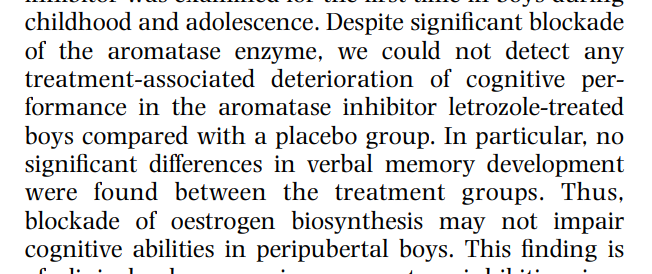
Our key supporting study we have here is Hero et al. 2010
In a randomized, double-blind, placebo-controlled study, peripubertal boys with idiopathic short stature were treated with Letrozole (an aromatase inhibitor) for 2 years, resulting in very low estradiol levels. Cognitive testing showed no significant differences in verbal IQ, performance IQ, or overall cognitive function compared to the placebo group. The study concluded that short-to-medium term aromatase inhibition did not impair cognitive development in adolescent boys.
Hero et al. 2010 - Full Study (or search “Hero Letrozole cognitive function boys”)
What we can still do to avoid these effects entirely
Haven't found a lot of people or barely anybody talking about this especially on this forum. What we can use is a is a small molecule called 10β,17β-dihydroxyestra-1,4-dien-3-one or more rather known as DHED. It is a brain-selective bioprecursor prodrug of 17β-estradiol (E2). Unlike direct estrogen administration, DHED itself has negligible affinity for estrogen receptors and remains biologically inert in peripheral tissues. It is selectively converted to active 17β-estradiol only within the central nervous system by a brain-enriched enzyme (short-chain dehydrogenase/reductase, SDR). This creates localized estrogen signaling in the brain while maintaining very low circulating (systemic) E2 levels.
View attachment 5126004
So what does this result in now?
After systemic administration (typically oral), DHED crosses the blood-brain barrier efficiently. In neural tissue, SDR catalyzes its conversion to 17β-estradiol. This locally produced E2 then activates both ERα and ERβ in brain regions such as the hippocampus, hypothalamus, and prefrontal cortex. The result is neuroprotection, support for synaptic plasticity, and maintenance of cognitive function without significantly elevating peripheral E2, thereby preserving the low systemic estrogen environment required for delayed growth plate closure. Keep in mind this is very experimental with no real trials in human but to be honest barely anything on this forum has backed clinical data on humans.
View attachment 5126022
Recommended Type and Dose
Use pure research-grade DHED (the 10β,17β isomer). The Recommended starting dose: 1–2 mg per day oral, titrated up to 3 mg/day if needed based on subjective mood/cognition. Take once daily in the morning. This range is derived from rodent-to-human dose conversions in published preclinical work and provides meaningful brain E2 exposure with minimal peripheral spillover.
TL;DR for DNR warioirs: DHED enables aggressive systemic E2 suppression (for optimal growth plate delay) while delivering targeted estrogen support to the brain, mitigating potential low-E2 neurological side effects. Take once orally 1-2 mg ed.
Anyways thanks for reading Niggers. Here are my sources:
1. Letrozole slowing bone age and giving good height gains
- Ma et al. 2022 – GH + Letrozole in pubertal boys with short stature: Significant improvement in predicted and actual adult height, slowed bone age advancement.Link: https://pmc.ncbi.nlm.nih.gov/articles/PMC9238122/
- Dunkel et al. 2003 – Letrozole + Testosterone in boys with delayed puberty: Delayed bone maturation and increased predicted adult height.Link: https://www.sciencedirect.com/science/article/abs/pii/S0960076003003443
- Recent 2025 studies also support Letrozole (and AIs in general) for slowing bone age and improving height outcomes in boys with advanced bone age.
2. Tamoxifen slowing bone maturation / height gains
- Kreher et al. 2005 (Pediatrics) – The main human study: Tamoxifen significantly slowed skeletal maturation and increased predicted adult height in short pubertal boys.Link: https://publications.aap.org/pediat...-Use-of-Tamoxifen-to-Improve-Height-Potential
- PubMed version: https://pubmed.ncbi.nlm.nih.gov/16322179/
3. DPN (Diarylpropionitrile) as ERβ agonist
- DPN is a well-established highly selective ERβ agonist (70–170x selectivity). It has been used extensively in research to study ERβ effects in bone/cartilage cells. Direct growth plate studies are limited, but it is accepted as a potent ERβ activator.Key paper on DPN as ERβ agonist: https://pubs.acs.org/doi/10.1021/jm201436k
4. DHED as brain-selective estrogen deliverer
- Prokai et al. 2015 – The foundational paper: DHED selectively delivers 17β-estradiol to the brain.Link: https://www.science.org/doi/10.1126/scitranslmed.aab1290 (or PMC: https://pmc.ncbi.nlm.nih.gov/articles/PMC4591937/)
View attachment 5126129
Wow look the first SMART grey on this forum.