aids
Recovering from: BFR, Grafts, Lipo, Pexy
- Joined
- Jul 5, 2024
- Posts
- 9,447
- Reputation
- 18,953
Quick thread for @killuacel.
If you're like I was, after clearing up my active acne, it can be hard to determine how to address your remaining skin concerns, specifically, any residual discolouration.
Post-inflammatory erythema (PIE) and hyperpigmentation can look almost identical, especially when you have significant skin damage or your skin tone makes hyperpigmentation and PIE less apparent, hence slightly harder to differentiate.
So, how do we determine the difference, and how do we solve for both?
I will make this thread concise and to the point because nobody here needs to know about the various MoAs in-depth for this stuff.
A loose definition of PIE is:
"Post-inflammatory erythema (PIE) refers to the flat, red, pink, or purple marks left on the skin after inflammatory conditions like acne, eczema, or physical injury have healed. Unlike hyperpigmentation, which involves excess melanin and appears brown or dark, PIE is caused by dilated blood vessels and damage to capillaries near the skin’s surface, making it most common in fair to medium skin tones."
As aforementioned, PIE is caused by the dilation of blood vessels. Therefore, if we want to determine whether or not our facial discolouration can be attributed to PIE or hyperpigmentation, we need to determine if said marks on our face respond to forced vasoconstriction (by either physical or pharmaceutical means).
So, there's two things you can do, with the second being a 'band-aid' fix, at least to some extent.
Now that you've learnt another way that pressing solid objects against your face can be beneficial, let's delve into how to fix either hyperpigmentation or PIE.
Personally, I never had significant hyperpigmentation, I would argue that your best bet if you have quite severe hyperpigmentation would be an ablative laser like a Fraxis or Fraxel CO2 laser. These lasers effectively punch holes in your epidermis/wipe your epidermis clean off and allow for new skin cells to generate in their place.
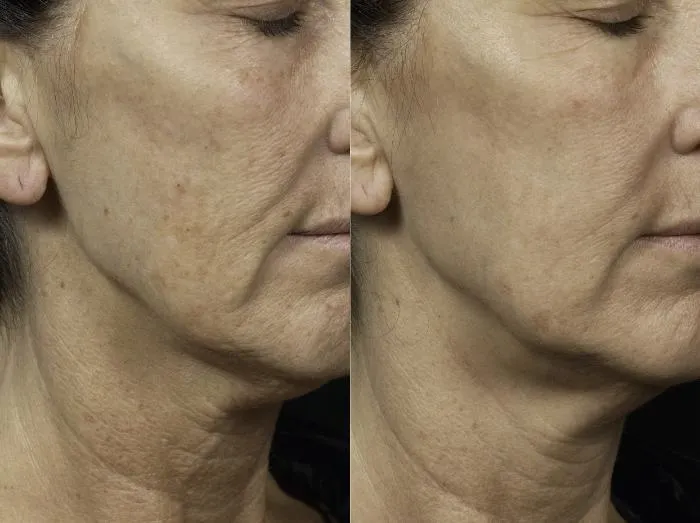
Here's just one result I stole off Google quickly. Look at how much more even her skin is, and the reduction in the prominence of this lady's nasolabial folds.
If you don't have very bad hyperpigmentation, or can't afford Fraxis/Fraxel and/or it's not viable for you, then just use a hydroquinone cream once daily, in addition to a retinoid and microneedling.
If you have PIE, then your best bet is going to be general skin treatments like microneedling. Retinoids and ablative lasers can also help to some extent, but your absolute best bet is a 1064nm Nd:YAG laser (more colloquially known as a Genesis laser).
@Shobek @killuacel - Hope this thread helped you.
If you're like I was, after clearing up my active acne, it can be hard to determine how to address your remaining skin concerns, specifically, any residual discolouration.
Post-inflammatory erythema (PIE) and hyperpigmentation can look almost identical, especially when you have significant skin damage or your skin tone makes hyperpigmentation and PIE less apparent, hence slightly harder to differentiate.
So, how do we determine the difference, and how do we solve for both?
I will make this thread concise and to the point because nobody here needs to know about the various MoAs in-depth for this stuff.
A loose definition of PIE is:
"Post-inflammatory erythema (PIE) refers to the flat, red, pink, or purple marks left on the skin after inflammatory conditions like acne, eczema, or physical injury have healed. Unlike hyperpigmentation, which involves excess melanin and appears brown or dark, PIE is caused by dilated blood vessels and damage to capillaries near the skin’s surface, making it most common in fair to medium skin tones."
As aforementioned, PIE is caused by the dilation of blood vessels. Therefore, if we want to determine whether or not our facial discolouration can be attributed to PIE or hyperpigmentation, we need to determine if said marks on our face respond to forced vasoconstriction (by either physical or pharmaceutical means).
So, there's two things you can do, with the second being a 'band-aid' fix, at least to some extent.
- The first is to press a glass or something transparent against your face to see if there is any reduction of redness. If you press a glass against your face, you are physically forcing the blood vessels closer to the surface of your skin to constrict.
- If the perceived discolouration persists despite you pressing the glass against your face, then you likely have hyperpigmentation, not PIE.
- If some discolouration persists, you may have both hyperpigmentation and PIE.
- If absolutely no/very little discolouration remains, then you likely have PIE.
- Another thing that I personally used to do and has been mentioned on this forum a few times in various posts, is apply Oxymetazoline directly to my skin. Oxymetazoline is a vasoconstrictor commonly found in decongestant nasal sprays. The reason this is a 'band-aid' fix is the effect of Oxymetazoline is only temporary, therefore you can expect any redness on your face that might temporarily disappear to return once the Oxymetazoline wears off.
- Some people (even myself in previous posts) note that Oxymetazoline permanently reduced/fixed their PIE. I admit that such is a naive perspective because Oxymetazoline cannot cause permanent vasoconstriction of damaged blood vessels, rather it may help to inhibit the acute vasodilation of blood vessels that may have occurred from sun exposure, alcohol consumption, etc.
- In reality, it's far more likely that I mis-attributed the effect of my other skin treatments to the Oxymetazoline in reducing/fixing my PIE.
Now that you've learnt another way that pressing solid objects against your face can be beneficial, let's delve into how to fix either hyperpigmentation or PIE.
Personally, I never had significant hyperpigmentation, I would argue that your best bet if you have quite severe hyperpigmentation would be an ablative laser like a Fraxis or Fraxel CO2 laser. These lasers effectively punch holes in your epidermis/wipe your epidermis clean off and allow for new skin cells to generate in their place.
- Fraxis is relatively affordable, but I would put it similar to a well-done session of 2.5mm microneedling in terms of its efficacy in my own experience. I've done Fraxis twice and I think it's a good step-up from microneedlingbut it's not a holy grail. With Fraxis, you can expect to be red for 4-7 days (generally, I'm pretty much good by day 5).
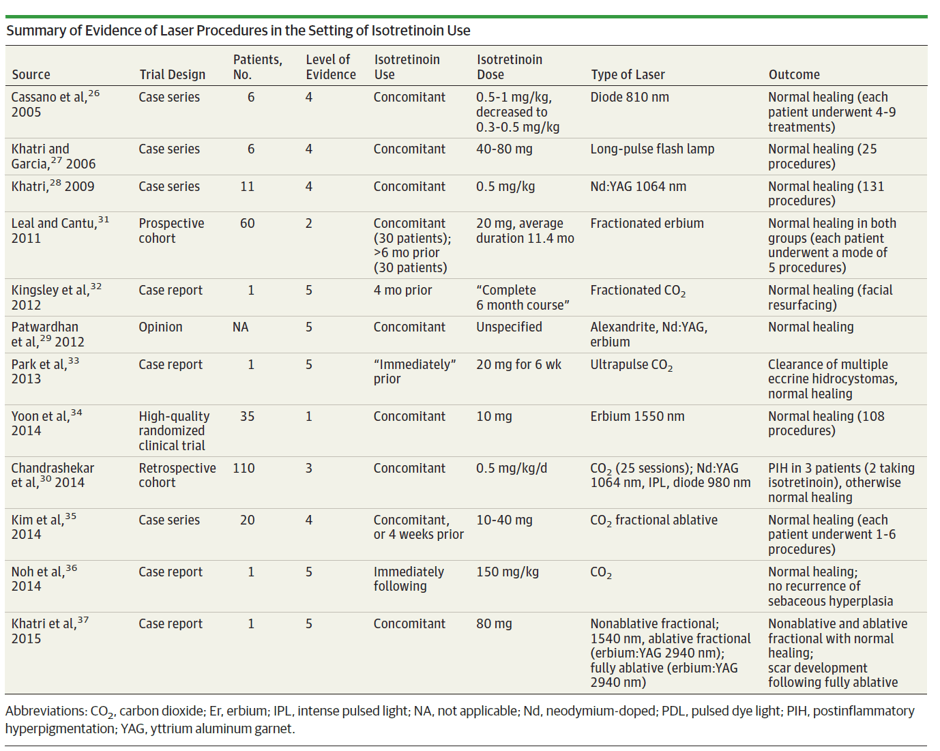
- Note that both times I did Fraxis, I was using isotretinoin. If I were you, I'd reduce my retinoid usage leading up to it, but I wouldn't worry about the arbitrary rules e.g., 'you can't do CO2 laser if you've used retinoids in the past six months', etc.
- Fraxel, on the other hand, is an absolute Godsend. I've never had Fraxel since the downtime is said to be ~2 weeks (difficult to work around), but the results speak for themselves:
Here's just one result I stole off Google quickly. Look at how much more even her skin is, and the reduction in the prominence of this lady's nasolabial folds.
If you don't have very bad hyperpigmentation, or can't afford Fraxis/Fraxel and/or it's not viable for you, then just use a hydroquinone cream once daily, in addition to a retinoid and microneedling.
If you have PIE, then your best bet is going to be general skin treatments like microneedling. Retinoids and ablative lasers can also help to some extent, but your absolute best bet is a 1064nm Nd:YAG laser (more colloquially known as a Genesis laser).
- An advantage of the Genesis laser is there is absolutely zero downtime because the laser is non-ablative. Essentially, the wavelength of the Genesis laser (1064 nanometres, as aforementioned) leads to the absorption of said laser by haemoglobin in the blood. This causes red blood cells to heat up, causing damaged blood vessels (the dilated blood vessels that are the cause of your PIE) to collapse and be reabsorbed by the body.
- If you can't afford Genesis laser, or it's not viable for you, then stick with microneedling at frequent intervals (every 4-6 weeks, at a depth of 1.75mm or greater) in conjunction with your retinoid use. PIE can be addressed a number of ways, Genesis is just the best.
@Shobek @killuacel - Hope this thread helped you.