How to quickly differentiate between PIE and hyperpigmentation to determine necessary treatment

aids

aids

Recovering from: BFR, Grafts, Lipo, Pexy
Joined
Jul 5, 2024
Posts
9,448
Reputation
18,953
Quick thread for @killuacel.

If you're like I was, after clearing up my active acne, it can be hard to determine how to address your remaining skin concerns, specifically, any residual discolouration.

Post-inflammatory erythema (PIE) and hyperpigmentation can look almost identical, especially when you have significant skin damage or your skin tone makes hyperpigmentation and PIE less apparent, hence slightly harder to differentiate.

So, how do we determine the difference, and how do we solve for both?
I will make this thread concise and to the point because nobody here needs to know about the various MoAs in-depth for this stuff.


A loose definition of PIE is:

"Post-inflammatory erythema (PIE) refers to the flat, red, pink, or purple marks left on the skin after inflammatory conditions like acne, eczema, or physical injury have healed. Unlike hyperpigmentation, which involves excess melanin and appears brown or dark, PIE is caused by dilated blood vessels and damage to capillaries near the skin’s surface, making it most common in fair to medium skin tones."

As aforementioned, PIE is caused by the dilation of blood vessels. Therefore, if we want to determine whether or not our facial discolouration can be attributed to PIE or hyperpigmentation, we need to determine if said marks on our face respond to forced vasoconstriction (by either physical or pharmaceutical means).

So, there's two things you can do, with the second being a 'band-aid' fix, at least to some extent.
  1. The first is to press a glass or something transparent against your face to see if there is any reduction of redness. If you press a glass against your face, you are physically forcing the blood vessels closer to the surface of your skin to constrict.
    • If the perceived discolouration persists despite you pressing the glass against your face, then you likely have hyperpigmentation, not PIE.
    • If some discolouration persists, you may have both hyperpigmentation and PIE.
    • If absolutely no/very little discolouration remains, then you likely have PIE.
  2. Another thing that I personally used to do and has been mentioned on this forum a few times in various posts, is apply Oxymetazoline directly to my skin. Oxymetazoline is a vasoconstrictor commonly found in decongestant nasal sprays. The reason this is a 'band-aid' fix is the effect of Oxymetazoline is only temporary, therefore you can expect any redness on your face that might temporarily disappear to return once the Oxymetazoline wears off.
    • Some people (even myself in previous posts) note that Oxymetazoline permanently reduced/fixed their PIE. I admit that such is a naive perspective because Oxymetazoline cannot cause permanent vasoconstriction of damaged blood vessels, rather it may help to inhibit the acute vasodilation of blood vessels that may have occurred from sun exposure, alcohol consumption, etc.
    • In reality, it's far more likely that I mis-attributed the effect of my other skin treatments to the Oxymetazoline in reducing/fixing my PIE.


Now that you've learnt another way that pressing solid objects against your face can be beneficial, let's delve into how to fix either hyperpigmentation or PIE.

Personally, I never had significant hyperpigmentation, I would argue that your best bet if you have quite severe hyperpigmentation would be an ablative laser like a Fraxis or Fraxel CO2 laser. These lasers effectively punch holes in your epidermis/wipe your epidermis clean off and allow for new skin cells to generate in their place.
  • Fraxis is relatively affordable, but I would put it similar to a well-done session of 2.5mm microneedling in terms of its efficacy in my own experience. I've done Fraxis twice and I think it's a good step-up from microneedlingbut it's not a holy grail. With Fraxis, you can expect to be red for 4-7 days (generally, I'm pretty much good by day 5).
    • Note that both times I did Fraxis, I was using isotretinoin. If I were you, I'd reduce my retinoid usage leading up to it, but I wouldn't worry about the arbitrary rules e.g., 'you can't do CO2 laser if you've used retinoids in the past six months', etc.
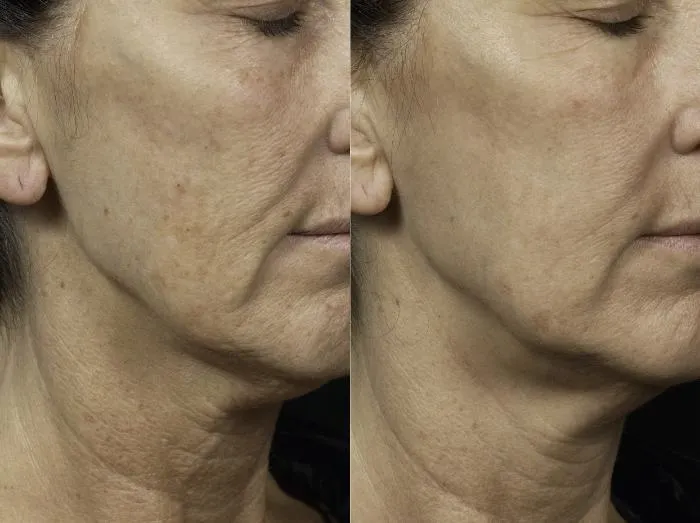
  • Fraxel, on the other hand, is an absolute Godsend. I've never had Fraxel since the downtime is said to be ~2 weeks (difficult to work around), but the results speak for themselves:
1780683814684

Here's just one result I stole off Google quickly. Look at how much more even her skin is, and the reduction in the prominence of this lady's nasolabial folds.

If you don't have very bad hyperpigmentation, or can't afford Fraxis/Fraxel and/or it's not viable for you, then just use a hydroquinone cream once daily, in addition to a retinoid and microneedling.

If you have PIE, then your best bet is going to be general skin treatments like microneedling. Retinoids and ablative lasers can also help to some extent, but your absolute best bet is a 1064nm Nd:YAG laser (more colloquially known as a Genesis laser).
  • An advantage of the Genesis laser is there is absolutely zero downtime because the laser is non-ablative. Essentially, the wavelength of the Genesis laser (1064 nanometres, as aforementioned) leads to the absorption of said laser by haemoglobin in the blood. This causes red blood cells to heat up, causing damaged blood vessels (the dilated blood vessels that are the cause of your PIE) to collapse and be reabsorbed by the body.
    • If you can't afford Genesis laser, or it's not viable for you, then stick with microneedling at frequent intervals (every 4-6 weeks, at a depth of 1.75mm or greater) in conjunction with your retinoid use. PIE can be addressed a number of ways, Genesis is just the best.
That's all.

@Shobek @killuacel - Hope this thread helped you.

 
  • +1
Reactions: Hansel, Org3cel, Firstname.Lastname and 3 others
Dnr but thanks :love:


I'm currently on tret, will it solve both?
 
  • +1
  • JFL
Reactions: anthesis, Kojo, Paul.jnxy and 1 other person
  • +1
Reactions: Deleted member 159945
Exactly man
 
  • +1
Reactions: aids
So not completely but will minimize it?
Maybe completely but it will definitely take longer either way.
It's not like anything here is going to be universally applicable i.e., not EVERYONE will see perfect results from just x, y and/or z.
 
  • +1
Reactions: Kojo and Deleted member 159945
Maybe completely but it will definitely take longer either way.
It's not like anything here is going to be universally applicable i.e., not EVERYONE will see perfect results from just x, y and/or z.
Ok thanks
 
  • +1
Reactions: aids
  • Note that both times I did Fraxis, I was using isotretinoin. If I were you, I'd reduce my retinoid usage leading up to it, but I wouldn't worry about the arbitrary rules e.g., 'you can't do CO2 laser if you've used retinoids in the past six months', etc.
To add on to this for the reader:

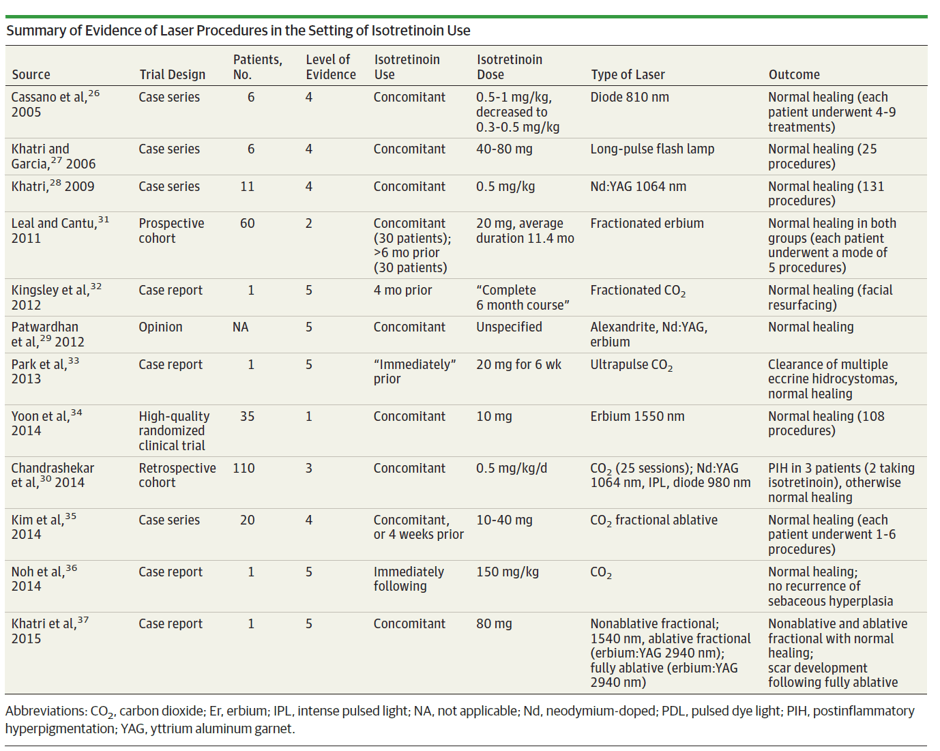
This is largely based on outdated literature that many clinics still repeat because they're either not up to date or understandably don't want the liability. So like many things, keep it to yourself. Obviously having a nuked skin barrier, being on some mega-retarded isotretinoin dosage or undergoing an actual old-school fully ablative laser is still contraindicated. But most acne scar lasers nowadays are fractional, and the current evidence generally supports isotretinoin use during these procedures. As shown below.

1780690915743

( https://acne-scar-treatment.com/isotretinoin-accutane-acne-scar-revision/ )

In fact, Dr. Nadir (CA), Dr. Emil Henningsen (EU), and numerous other respected acne scar specialists actually advocate staying on isotretinoin during treatment because they consider oil control to be a crucial part of achieving good outcomes.

If you want to dive deeper into acne (scar) treatment go and absorb every molecule of the link above.

Also, be careful with advice from generic clinics. Brutal how 99% on /r/acnescars spend thousands on treatments that were never really indicated for their scar type. True acne scar specialists are surprisingly rare and expensive. Most good results come from a combination of treatments, not a single laser or microneedling session.

If you have significant tethered scarring, subcision and often filler will likely need to be part of the treatment plan. The problem is that very few practitioners actually know how to perform proper subcision.

Do your research, figure out what scar types you're actually dealing with, and find a clinic that has the right equipment for those specific scars.

In the meantime, SPF, retinoids, and indefinite monthly DIY microneedling (at the appropriate depths) are your biggest ROI.

Even better: don't let it get that far in the first place and get on isotret in time. Funny how this is almost always the solution (you are on a 5ARi right anon?)

Edit: ty for the tag & appreciate the knowledge as always. True philanthropist.
 
Last edited:
  • +1
Reactions: Deleted member 258622, Firstname.Lastname, Kojo and 2 others
To add on to this for the reader:

This is largely based on outdated literature that many clinics still repeat because they're either not up to date or understandably don't want the liability. So like many things, keep it to yourself. Obviously having a nuked skin barrier, being on some mega-retarded isotretinoin dosage or undergoing an actual old-school fully ablative laser is still contraindicated. But most acne scar lasers nowadays are fractional, and the current evidence generally supports isotretinoin use during these procedures. As shown below.

View attachment 5176325
( https://acne-scar-treatment.com/isotretinoin-accutane-acne-scar-revision/ )

In fact, Dr. Nadir (CA), Dr. Emil Henningsen (EU), and numerous other respected acne scar specialists actually advocate staying on isotretinoin during treatment because they consider oil control to be a crucial part of achieving good outcomes.

If you want to dive deeper into acne (scar) treatment go and absorb every molecule of the link above.

Also, be careful with advice from generic clinics. Brutal how 99% on /r/acnescars spend thousands on treatments that were never really indicated for their scar type. True acne scar specialists are surprisingly rare and expensive. Most good results come from a combination of treatments, not a single laser or microneedling session.

If you have significant tethered scarring, subcision and often filler will likely need to be part of the treatment plan. The problem is that very few practitioners actually know how to perform proper subcision.

Do your research, figure out what scar types you're actually dealing with, and find a clinic that has the right equipment for those specific scars.

In the meantime, SPF, retinoids, and indefinite monthly DIY microneedling (at the appropriate depths) are your biggest ROI.

Even better: don't let it get that far in the first place and get on isotret in time. Funny how this is almost always the solution (you are on a 5ARi right anon?)

Edit: ty for the tag & appreciate the knowledge as always. True philanthropist.
Bumping this insane info.
 
  • +1
Reactions: Shobek
Bumping this insane info.
Quick thread for @killuacel.

If you're like I was, after clearing up my active acne, it can be hard to determine how to address your remaining skin concerns, specifically, any residual discolouration.

Post-inflammatory erythema (PIE) and hyperpigmentation can look almost identical, especially when you have significant skin damage or your skin tone makes hyperpigmentation and PIE less apparent, hence slightly harder to differentiate.

So, how do we determine the difference, and how do we solve for both?
I will make this thread concise and to the point because nobody here needs to know about the various MoAs in-depth for this stuff.


A loose definition of PIE is:

"Post-inflammatory erythema (PIE) refers to the flat, red, pink, or purple marks left on the skin after inflammatory conditions like acne, eczema, or physical injury have healed. Unlike hyperpigmentation, which involves excess melanin and appears brown or dark, PIE is caused by dilated blood vessels and damage to capillaries near the skin’s surface, making it most common in fair to medium skin tones."

As aforementioned, PIE is caused by the dilation of blood vessels. Therefore, if we want to determine whether or not our facial discolouration can be attributed to PIE or hyperpigmentation, we need to determine if said marks on our face respond to forced vasoconstriction (by either physical or pharmaceutical means).

So, there's two things you can do, with the second being a 'band-aid' fix, at least to some extent.
  1. The first is to press a glass or something transparent against your face to see if there is any reduction of redness. If you press a glass against your face, you are physically forcing the blood vessels closer to the surface of your skin to constrict.
    • If the perceived discolouration persists despite you pressing the glass against your face, then you likely have hyperpigmentation, not PIE.
    • If some discolouration persists, you may have both hyperpigmentation and PIE.
    • If absolutely no/very little discolouration remains, then you likely have PIE.
  2. Another thing that I personally used to do and has been mentioned on this forum a few times in various posts, is apply Oxymetazoline directly to my skin. Oxymetazoline is a vasoconstrictor commonly found in decongestant nasal sprays. The reason this is a 'band-aid' fix is the effect of Oxymetazoline is only temporary, therefore you can expect any redness on your face that might temporarily disappear to return once the Oxymetazoline wears off.
    • Some people (even myself in previous posts) note that Oxymetazoline permanently reduced/fixed their PIE. I admit that such is a naive perspective because Oxymetazoline cannot cause permanent vasoconstriction of damaged blood vessels, rather it may help to inhibit the acute vasodilation of blood vessels that may have occurred from sun exposure, alcohol consumption, etc.
    • In reality, it's far more likely that I mis-attributed the effect of my other skin treatments to the Oxymetazoline in reducing/fixing my PIE.


Now that you've learnt another way that pressing solid objects against your face can be beneficial, let's delve into how to fix either hyperpigmentation or PIE.

Personally, I never had significant hyperpigmentation, I would argue that your best bet if you have quite severe hyperpigmentation would be an ablative laser like a Fraxis or Fraxel CO2 laser. These lasers effectively punch holes in your epidermis/wipe your epidermis clean off and allow for new skin cells to generate in their place.
  • Fraxis is relatively affordable, but I would put it similar to a well-done session of 2.5mm microneedling in terms of its efficacy in my own experience. I've done Fraxis twice and I think it's a good step-up from microneedlingbut it's not a holy grail. With Fraxis, you can expect to be red for 4-7 days (generally, I'm pretty much good by day 5).
    • Note that both times I did Fraxis, I was using isotretinoin. If I were you, I'd reduce my retinoid usage leading up to it, but I wouldn't worry about the arbitrary rules e.g., 'you can't do CO2 laser if you've used retinoids in the past six months', etc.
  • Fraxel, on the other hand, is an absolute Godsend. I've never had Fraxel since the downtime is said to be ~2 weeks (difficult to work around), but the results speak for themselves:
View attachment 5175638
Here's just one result I stole off Google quickly. Look at how much more even her skin is, and the reduction in the prominence of this lady's nasolabial folds.

If you don't have very bad hyperpigmentation, or can't afford Fraxis/Fraxel and/or it's not viable for you, then just use a hydroquinone cream once daily, in addition to a retinoid and microneedling.

If you have PIE, then your best bet is going to be general skin treatments like microneedling. Retinoids and ablative lasers can also help to some extent, but your absolute best bet is a 1064nm Nd:YAG laser (more colloquially known as a Genesis laser).
  • An advantage of the Genesis laser is there is absolutely zero downtime because the laser is non-ablative. Essentially, the wavelength of the Genesis laser (1064 nanometres, as aforementioned) leads to the absorption of said laser by haemoglobin in the blood. This causes red blood cells to heat up, causing damaged blood vessels (the dilated blood vessels that are the cause of your PIE) to collapse and be reabsorbed by the body.
    • If you can't afford Genesis laser, or it's not viable for you, then stick with microneedling at frequent intervals (every 4-6 weeks, at a depth of 1.75mm or greater) in conjunction with your retinoid use. PIE can be addressed a number of ways, Genesis is just the best.
That's all.

@Shobek @killuacel - Hope this thread helped you.

microneedling at home?
 
Dnr but thanks :love:


I'm currently on tret, will it solve both?
PIH yes, OP is sort of underrating topical treatments.

PIE is a bit of a tricky one though as it's simply just inflammation + damaged blood vessels which doesn't necessarily get fixed by topicals (azelaic would help though)

Of course actual procedures mog any topical but PIH is easily fixable with topicals and is less harsh on your wallet.

Tazarotene Or Tretinoin but preferably Taz as it's much faster - Retinoids essentially do what the laser does at a less potent rate. It sheds the skin layers and forces you to create new skin cells, skin cell turnover. But this takes like 6 months to fully reverse PIH on its own.

This is where you add tyrosinase inhibitors like Hydroquinone, it acts really fast and you'll see your full results within 2 months of using it. Note that your PIH isn't permanently gone yet because Hydroquinone acts more like a mask, but tazarotene does the actual perma shedding.

So once your pih is gone with hydroquinone in 2 months, you MUST cycle off into maintenance with azelaic acid as it is a selective tyrosinase inhibitor unlike hydro which will make your skin even more uneven and give you rebound after prolonged usage.

This way, you basically lost PIH in 2 months and will just maintain your results with azelaic acid for another 2ish months. It's a very good and cheap stack if you can't do laser therapy.
 
  • +1
Reactions: Deleted member 159945
To add on to this for the reader:

This is largely based on outdated literature that many clinics still repeat because they're either not up to date or understandably don't want the liability. So like many things, keep it to yourself. Obviously having a nuked skin barrier, being on some mega-retarded isotretinoin dosage or undergoing an actual old-school fully ablative laser is still contraindicated. But most acne scar lasers nowadays are fractional, and the current evidence generally supports isotretinoin use during these procedures. As shown below.

View attachment 5176325
( https://acne-scar-treatment.com/isotretinoin-accutane-acne-scar-revision/ )

In fact, Dr. Nadir (CA), Dr. Emil Henningsen (EU), and numerous other respected acne scar specialists actually advocate staying on isotretinoin during treatment because they consider oil control to be a crucial part of achieving good outcomes.

If you want to dive deeper into acne (scar) treatment go and absorb every molecule of the link above.

Also, be careful with advice from generic clinics. Brutal how 99% on /r/acnescars spend thousands on treatments that were never really indicated for their scar type. True acne scar specialists are surprisingly rare and expensive. Most good results come from a combination of treatments, not a single laser or microneedling session.

If you have significant tethered scarring, subcision and often filler will likely need to be part of the treatment plan. The problem is that very few practitioners actually know how to perform proper subcision.

Do your research, figure out what scar types you're actually dealing with, and find a clinic that has the right equipment for those specific scars.

In the meantime, SPF, retinoids, and indefinite monthly DIY microneedling (at the appropriate depths) are your biggest ROI.

Even better: don't let it get that far in the first place and get on isotret in time. Funny how this is almost always the solution (you are on a 5ARi right anon?)

Edit: ty for the tag & appreciate the knowledge as always. True philanthropist.
Skimmed through what you said, conclusively agree with the roi of topical treatments. Much higher roi than laser, most of the time it's retarded specialists that are cheap, or you'll have to pay an arm and a leg for a good procedure.

When you can buy silly creams off of indiamart for 10usd, and get it fixed in 3-8 weeks lmao
 
PIH yes, OP is sort of underrating topical treatments.

PIE is a bit of a tricky one though as it's simply just inflammation + damaged blood vessels which doesn't necessarily get fixed by topicals (azelaic would help though)

Of course actual procedures mog any topical but PIH is easily fixable with topicals and is less harsh on your wallet.

Tazarotene Or Tretinoin but preferably Taz as it's much faster - Retinoids essentially do what the laser does at a less potent rate. It sheds the skin layers and forces you to create new skin cells, skin cell turnover. But this takes like 6 months to fully reverse PIH on its own.

This is where you add tyrosinase inhibitors like Hydroquinone, it acts really fast and you'll see your full results within 2 months of using it. Note that your PIH isn't permanently gone yet because Hydroquinone acts more like a mask, but tazarotene does the actual perma shedding.

So once your pih is gone with hydroquinone in 2 months, you MUST cycle off into maintenance with azelaic acid as it is a selective tyrosinase inhibitor unlike hydro which will make your skin even more uneven and give you rebound after prolonged usage.

This way, you basically lost PIH in 2 months and will just maintain your results with azelaic acid for another 2ish months. It's a very good and cheap stack if you can't do laser therapy.
Got it, thank you for the help!
 
  • +1
Reactions: Kojo
Quick thread for @killuacel.

If you're like I was, after clearing up my active acne, it can be hard to determine how to address your remaining skin concerns, specifically, any residual discolouration.

Post-inflammatory erythema (PIE) and hyperpigmentation can look almost identical, especially when you have significant skin damage or your skin tone makes hyperpigmentation and PIE less apparent, hence slightly harder to differentiate.

So, how do we determine the difference, and how do we solve for both?
I will make this thread concise and to the point because nobody here needs to know about the various MoAs in-depth for this stuff.


A loose definition of PIE is:

"Post-inflammatory erythema (PIE) refers to the flat, red, pink, or purple marks left on the skin after inflammatory conditions like acne, eczema, or physical injury have healed. Unlike hyperpigmentation, which involves excess melanin and appears brown or dark, PIE is caused by dilated blood vessels and damage to capillaries near the skin’s surface, making it most common in fair to medium skin tones."

As aforementioned, PIE is caused by the dilation of blood vessels. Therefore, if we want to determine whether or not our facial discolouration can be attributed to PIE or hyperpigmentation, we need to determine if said marks on our face respond to forced vasoconstriction (by either physical or pharmaceutical means).

So, there's two things you can do, with the second being a 'band-aid' fix, at least to some extent.
  1. The first is to press a glass or something transparent against your face to see if there is any reduction of redness. If you press a glass against your face, you are physically forcing the blood vessels closer to the surface of your skin to constrict.
    • If the perceived discolouration persists despite you pressing the glass against your face, then you likely have hyperpigmentation, not PIE.
    • If some discolouration persists, you may have both hyperpigmentation and PIE.
    • If absolutely no/very little discolouration remains, then you likely have PIE.
  2. Another thing that I personally used to do and has been mentioned on this forum a few times in various posts, is apply Oxymetazoline directly to my skin. Oxymetazoline is a vasoconstrictor commonly found in decongestant nasal sprays. The reason this is a 'band-aid' fix is the effect of Oxymetazoline is only temporary, therefore you can expect any redness on your face that might temporarily disappear to return once the Oxymetazoline wears off.
    • Some people (even myself in previous posts) note that Oxymetazoline permanently reduced/fixed their PIE. I admit that such is a naive perspective because Oxymetazoline cannot cause permanent vasoconstriction of damaged blood vessels, rather it may help to inhibit the acute vasodilation of blood vessels that may have occurred from sun exposure, alcohol consumption, etc.
    • In reality, it's far more likely that I mis-attributed the effect of my other skin treatments to the Oxymetazoline in reducing/fixing my PIE.


Now that you've learnt another way that pressing solid objects against your face can be beneficial, let's delve into how to fix either hyperpigmentation or PIE.

Personally, I never had significant hyperpigmentation, I would argue that your best bet if you have quite severe hyperpigmentation would be an ablative laser like a Fraxis or Fraxel CO2 laser. These lasers effectively punch holes in your epidermis/wipe your epidermis clean off and allow for new skin cells to generate in their place.
  • Fraxis is relatively affordable, but I would put it similar to a well-done session of 2.5mm microneedling in terms of its efficacy in my own experience. I've done Fraxis twice and I think it's a good step-up from microneedlingbut it's not a holy grail. With Fraxis, you can expect to be red for 4-7 days (generally, I'm pretty much good by day 5).
    • Note that both times I did Fraxis, I was using isotretinoin. If I were you, I'd reduce my retinoid usage leading up to it, but I wouldn't worry about the arbitrary rules e.g., 'you can't do CO2 laser if you've used retinoids in the past six months', etc.
  • Fraxel, on the other hand, is an absolute Godsend. I've never had Fraxel since the downtime is said to be ~2 weeks (difficult to work around), but the results speak for themselves:
View attachment 5175638
Here's just one result I stole off Google quickly. Look at how much more even her skin is, and the reduction in the prominence of this lady's nasolabial folds.

If you don't have very bad hyperpigmentation, or can't afford Fraxis/Fraxel and/or it's not viable for you, then just use a hydroquinone cream once daily, in addition to a retinoid and microneedling.

If you have PIE, then your best bet is going to be general skin treatments like microneedling. Retinoids and ablative lasers can also help to some extent, but your absolute best bet is a 1064nm Nd:YAG laser (more colloquially known as a Genesis laser).
  • An advantage of the Genesis laser is there is absolutely zero downtime because the laser is non-ablative. Essentially, the wavelength of the Genesis laser (1064 nanometres, as aforementioned) leads to the absorption of said laser by haemoglobin in the blood. This causes red blood cells to heat up, causing damaged blood vessels (the dilated blood vessels that are the cause of your PIE) to collapse and be reabsorbed by the body.
    • If you can't afford Genesis laser, or it's not viable for you, then stick with microneedling at frequent intervals (every 4-6 weeks, at a depth of 1.75mm or greater) in conjunction with your retinoid use. PIE can be addressed a number of ways, Genesis is just the best.
That's all.

@Shobek @killuacel - Hope this thread helped you.
Hahaha hyperpigmentation ahh blud:lul::feelsuhh:
 
I've done metric fuck tons of laser including full ablation co2. No one has ever once said this, I think you've made it up honestly. They do say you can't do co2 if you've taken isotretinoin, but that is a specific retinoid not a whole class of them.

Also it's a totally dated take. It comes out of early case reports post the release of Accutane where multiple patients contracted keloids after various surgical procedures. So they then came up with this meme. There's never been any actual study data supporting this. It's 100% from anecdotal case reports that supported the keloid claim. We also stopped getting these reports after the 90's. It just keeps getting said out of provider caution, even though theirs no basis for it.
I don't understand your point. I am saying that retinoid use pre and post-laser is hardly relevant despite being said otherwise by clinicians.
I have no incentive to make such a thing up. The reason for the apostrophes was to indicate it's not a direct quote.
You realise that we share the same perspective i.e., retinoid use is hardly relevant, as per my mention that these are "arbitrary rules".

Any reason to use this shit instead of an actual vascular laser like vbeam or advatx if the intended purpose is targeting blood cells?
I looked at these two lasers.
The Vbeam Pro, Vbeam Prima have an identical wavelength to the Genesis Laser (1064nm) but are ablative. I also read that the Vbeam "required a bruise to develop on the area for the most effective outcome". In any case, they're slightly harsher/more dramatic but achieve an otherwise comparable effect to Genesis.

The AdvaTX I infer addresses skin concerns more broadly with it hitting the superficial and deeper layers of the skin concurrently. But it is likely less effective for holistic improvement, rather more effective for specific concerns isolated to a few small areas.
I'd guess it's more effective for more severe but smaller (in volume) skin issues.
Genesis will address redness holistically throughout the entirety of the superficial layers of the face, noting PIE is generally isolated to the superficial layers of the skin.
 
  • +1
Reactions: Firstname.Lastname
It creates unnecessary confusion, since the application of the clarification isn't to the relevant issue. What happens when someone reads this, then the provider tells them the Accutane larp? Accutane is a specific while technically yes your statement applies to it, as it's a subordinate to the class. 99.9% of people who read this won't find it useful irl, since your rebutting a claim no one has made instead of the specific one routinely made.

For example why did you write specifying retinoid instead of vitamin A? Vitamin A is clearly as correct as saying retinoid but totally obfuscates what's actually occurring in the real world. We can get more off topic and say things like wearing a rain coats in the last 6 months also has no effect. Yes I also agree. How is this information useful/helpful? it's not it creates confusion.


Vbeam uses 595 nm weave length not 1064. This is definitely not an ablative laser. As for Vbeam Perfecta I hadn't heard of this newer model and apparently it add 1064 but but that an addition to the capability of it obviously. Also not an ablative laser.

As for bruising, i had it done a few times. It was extremely effective for redness anyways, there was 0 bruising just some redness. It does hurt a bit thou. IG you can pump the energy up and create more impact but that's true with all lasers. I've never heard of a provider doing this but maybe for something like port wine stanes or some shit.


While yes in general it is used more broad, it still has 589 wave length which almost identical to vbeams.

Both of these target superficial layers of the skin, which is where your saying PIE is located. Obvi 1064 targets a deeper layer.
Based on this discussion I would think the Vbeam Perfecta would therefor be the most optimal tool for PIE. Given that it has the superficial targeting in the 595 nm wave length AND built in 1064 nm Nd:YAG wavelength.

I've been around lasers long enough to know obvi the manufactures software settings(what it actually lets a provider do) and the provider skill level/risk tolerance matter a fuck ton. But on paper hard not to take the dual option.
Thanks for your insight.
 
  • +1
Reactions: Firstname.Lastname
Quick thread for @killuacel.

If you're like I was, after clearing up my active acne, it can be hard to determine how to address your remaining skin concerns, specifically, any residual discolouration.

Post-inflammatory erythema (PIE) and hyperpigmentation can look almost identical, especially when you have significant skin damage or your skin tone makes hyperpigmentation and PIE less apparent, hence slightly harder to differentiate.

So, how do we determine the difference, and how do we solve for both?
I will make this thread concise and to the point because nobody here needs to know about the various MoAs in-depth for this stuff.


A loose definition of PIE is:

"Post-inflammatory erythema (PIE) refers to the flat, red, pink, or purple marks left on the skin after inflammatory conditions like acne, eczema, or physical injury have healed. Unlike hyperpigmentation, which involves excess melanin and appears brown or dark, PIE is caused by dilated blood vessels and damage to capillaries near the skin’s surface, making it most common in fair to medium skin tones."

As aforementioned, PIE is caused by the dilation of blood vessels. Therefore, if we want to determine whether or not our facial discolouration can be attributed to PIE or hyperpigmentation, we need to determine if said marks on our face respond to forced vasoconstriction (by either physical or pharmaceutical means).

So, there's two things you can do, with the second being a 'band-aid' fix, at least to some extent.
  1. The first is to press a glass or something transparent against your face to see if there is any reduction of redness. If you press a glass against your face, you are physically forcing the blood vessels closer to the surface of your skin to constrict.
    • If the perceived discolouration persists despite you pressing the glass against your face, then you likely have hyperpigmentation, not PIE.
    • If some discolouration persists, you may have both hyperpigmentation and PIE.
    • If absolutely no/very little discolouration remains, then you likely have PIE.
  2. Another thing that I personally used to do and has been mentioned on this forum a few times in various posts, is apply Oxymetazoline directly to my skin. Oxymetazoline is a vasoconstrictor commonly found in decongestant nasal sprays. The reason this is a 'band-aid' fix is the effect of Oxymetazoline is only temporary, therefore you can expect any redness on your face that might temporarily disappear to return once the Oxymetazoline wears off.
    • Some people (even myself in previous posts) note that Oxymetazoline permanently reduced/fixed their PIE. I admit that such is a naive perspective because Oxymetazoline cannot cause permanent vasoconstriction of damaged blood vessels, rather it may help to inhibit the acute vasodilation of blood vessels that may have occurred from sun exposure, alcohol consumption, etc.
    • In reality, it's far more likely that I mis-attributed the effect of my other skin treatments to the Oxymetazoline in reducing/fixing my PIE.


Now that you've learnt another way that pressing solid objects against your face can be beneficial, let's delve into how to fix either hyperpigmentation or PIE.

Personally, I never had significant hyperpigmentation, I would argue that your best bet if you have quite severe hyperpigmentation would be an ablative laser like a Fraxis or Fraxel CO2 laser. These lasers effectively punch holes in your epidermis/wipe your epidermis clean off and allow for new skin cells to generate in their place.
  • Fraxis is relatively affordable, but I would put it similar to a well-done session of 2.5mm microneedling in terms of its efficacy in my own experience. I've done Fraxis twice and I think it's a good step-up from microneedlingbut it's not a holy grail. With Fraxis, you can expect to be red for 4-7 days (generally, I'm pretty much good by day 5).
    • Note that both times I did Fraxis, I was using isotretinoin. If I were you, I'd reduce my retinoid usage leading up to it, but I wouldn't worry about the arbitrary rules e.g., 'you can't do CO2 laser if you've used retinoids in the past six months', etc.
  • Fraxel, on the other hand, is an absolute Godsend. I've never had Fraxel since the downtime is said to be ~2 weeks (difficult to work around), but the results speak for themselves:
View attachment 5175638
Here's just one result I stole off Google quickly. Look at how much more even her skin is, and the reduction in the prominence of this lady's nasolabial folds.

If you don't have very bad hyperpigmentation, or can't afford Fraxis/Fraxel and/or it's not viable for you, then just use a hydroquinone cream once daily, in addition to a retinoid and microneedling.

If you have PIE, then your best bet is going to be general skin treatments like microneedling. Retinoids and ablative lasers can also help to some extent, but your absolute best bet is a 1064nm Nd:YAG laser (more colloquially known as a Genesis laser).
  • An advantage of the Genesis laser is there is absolutely zero downtime because the laser is non-ablative. Essentially, the wavelength of the Genesis laser (1064 nanometres, as aforementioned) leads to the absorption of said laser by haemoglobin in the blood. This causes red blood cells to heat up, causing damaged blood vessels (the dilated blood vessels that are the cause of your PIE) to collapse and be reabsorbed by the body.
    • If you can't afford Genesis laser, or it's not viable for you, then stick with microneedling at frequent intervals (every 4-6 weeks, at a depth of 1.75mm or greater) in conjunction with your retinoid use. PIE can be addressed a number of ways, Genesis is just the best.
That's all.

@Shobek @killuacel - Hope this thread helped you.
dm
 
Quick thread for @killuacel.

If you're like I was, after clearing up my active acne, it can be hard to determine how to address your remaining skin concerns, specifically, any residual discolouration.

Post-inflammatory erythema (PIE) and hyperpigmentation can look almost identical, especially when you have significant skin damage or your skin tone makes hyperpigmentation and PIE less apparent, hence slightly harder to differentiate.

So, how do we determine the difference, and how do we solve for both?
I will make this thread concise and to the point because nobody here needs to know about the various MoAs in-depth for this stuff.


A loose definition of PIE is:

"Post-inflammatory erythema (PIE) refers to the flat, red, pink, or purple marks left on the skin after inflammatory conditions like acne, eczema, or physical injury have healed. Unlike hyperpigmentation, which involves excess melanin and appears brown or dark, PIE is caused by dilated blood vessels and damage to capillaries near the skin’s surface, making it most common in fair to medium skin tones."

As aforementioned, PIE is caused by the dilation of blood vessels. Therefore, if we want to determine whether or not our facial discolouration can be attributed to PIE or hyperpigmentation, we need to determine if said marks on our face respond to forced vasoconstriction (by either physical or pharmaceutical means).

So, there's two things you can do, with the second being a 'band-aid' fix, at least to some extent.
  1. The first is to press a glass or something transparent against your face to see if there is any reduction of redness. If you press a glass against your face, you are physically forcing the blood vessels closer to the surface of your skin to constrict.
    • If the perceived discolouration persists despite you pressing the glass against your face, then you likely have hyperpigmentation, not PIE.
    • If some discolouration persists, you may have both hyperpigmentation and PIE.
    • If absolutely no/very little discolouration remains, then you likely have PIE.
  2. Another thing that I personally used to do and has been mentioned on this forum a few times in various posts, is apply Oxymetazoline directly to my skin. Oxymetazoline is a vasoconstrictor commonly found in decongestant nasal sprays. The reason this is a 'band-aid' fix is the effect of Oxymetazoline is only temporary, therefore you can expect any redness on your face that might temporarily disappear to return once the Oxymetazoline wears off.
    • Some people (even myself in previous posts) note that Oxymetazoline permanently reduced/fixed their PIE. I admit that such is a naive perspective because Oxymetazoline cannot cause permanent vasoconstriction of damaged blood vessels, rather it may help to inhibit the acute vasodilation of blood vessels that may have occurred from sun exposure, alcohol consumption, etc.
    • In reality, it's far more likely that I mis-attributed the effect of my other skin treatments to the Oxymetazoline in reducing/fixing my PIE.


Now that you've learnt another way that pressing solid objects against your face can be beneficial, let's delve into how to fix either hyperpigmentation or PIE.

Personally, I never had significant hyperpigmentation, I would argue that your best bet if you have quite severe hyperpigmentation would be an ablative laser like a Fraxis or Fraxel CO2 laser. These lasers effectively punch holes in your epidermis/wipe your epidermis clean off and allow for new skin cells to generate in their place.
  • Fraxis is relatively affordable, but I would put it similar to a well-done session of 2.5mm microneedling in terms of its efficacy in my own experience. I've done Fraxis twice and I think it's a good step-up from microneedlingbut it's not a holy grail. With Fraxis, you can expect to be red for 4-7 days (generally, I'm pretty much good by day 5).
    • Note that both times I did Fraxis, I was using isotretinoin. If I were you, I'd reduce my retinoid usage leading up to it, but I wouldn't worry about the arbitrary rules e.g., 'you can't do CO2 laser if you've used retinoids in the past six months', etc.
  • Fraxel, on the other hand, is an absolute Godsend. I've never had Fraxel since the downtime is said to be ~2 weeks (difficult to work around), but the results speak for themselves:
View attachment 5175638
Here's just one result I stole off Google quickly. Look at how much more even her skin is, and the reduction in the prominence of this lady's nasolabial folds.

If you don't have very bad hyperpigmentation, or can't afford Fraxis/Fraxel and/or it's not viable for you, then just use a hydroquinone cream once daily, in addition to a retinoid and microneedling.

If you have PIE, then your best bet is going to be general skin treatments like microneedling. Retinoids and ablative lasers can also help to some extent, but your absolute best bet is a 1064nm Nd:YAG laser (more colloquially known as a Genesis laser).
  • An advantage of the Genesis laser is there is absolutely zero downtime because the laser is non-ablative. Essentially, the wavelength of the Genesis laser (1064 nanometres, as aforementioned) leads to the absorption of said laser by haemoglobin in the blood. This causes red blood cells to heat up, causing damaged blood vessels (the dilated blood vessels that are the cause of your PIE) to collapse and be reabsorbed by the body.
    • If you can't afford Genesis laser, or it's not viable for you, then stick with microneedling at frequent intervals (every 4-6 weeks, at a depth of 1.75mm or greater) in conjunction with your retinoid use. PIE can be addressed a number of ways, Genesis is just the best.
That's all.

@Shobek @killuacel - Hope this thread helped you.
I've heard that pairing azelaic acid with tretinoin does wonders.


also, W thread ❤️
 

Similar threads

moet
Replies
13
Views
126
mrfriday
mrfriday
Namejs
Replies
2
Views
106
IDontBlameAnybody
IDontBlameAnybody
faded_pigeon47
Replies
13
Views
87
fkingrey
fkingrey
TimmyAshan1
Replies
18
Views
160
bluebandz
bluebandz

Users who are viewing this thread

  • Back
    Top
    Sponsored
    Stake.us
    America's #1 Social Casino
    Slots, Poker & More
    Join Now →