M
mogger123
jfl
- Joined
- Dec 10, 2022
- Posts
- 3,099
- Reputation
- 3,564
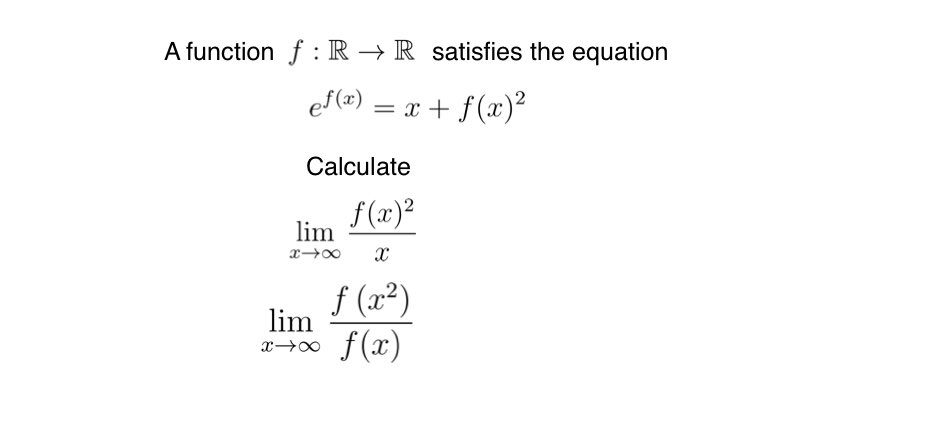
Saw this on twitter and can't see an easy way to solve it
If anyone solves it and explains their solution they will earn my respect
Follow along with the video below to see how to install our site as a web app on your home screen.

Note: this_feature_currently_requires_accessing_site_using_safari


Do you have a uni exam?View attachment 2064250
Saw this on twitter and can't see an easy way to solve it
If anyone solves it and explains their solution they will earn my respect
graduated ages agoDo you have a uni exam?

So solve it motherfuckerFor someone with basic verbal ability, it is easy to solve using simple knowledge.
Is that second one supposed to be f(x)^2/f(x)View attachment 2064250
Saw this on twitter and can't see an easy way to solve it
If anyone solves it and explains their solution they will earn my respect
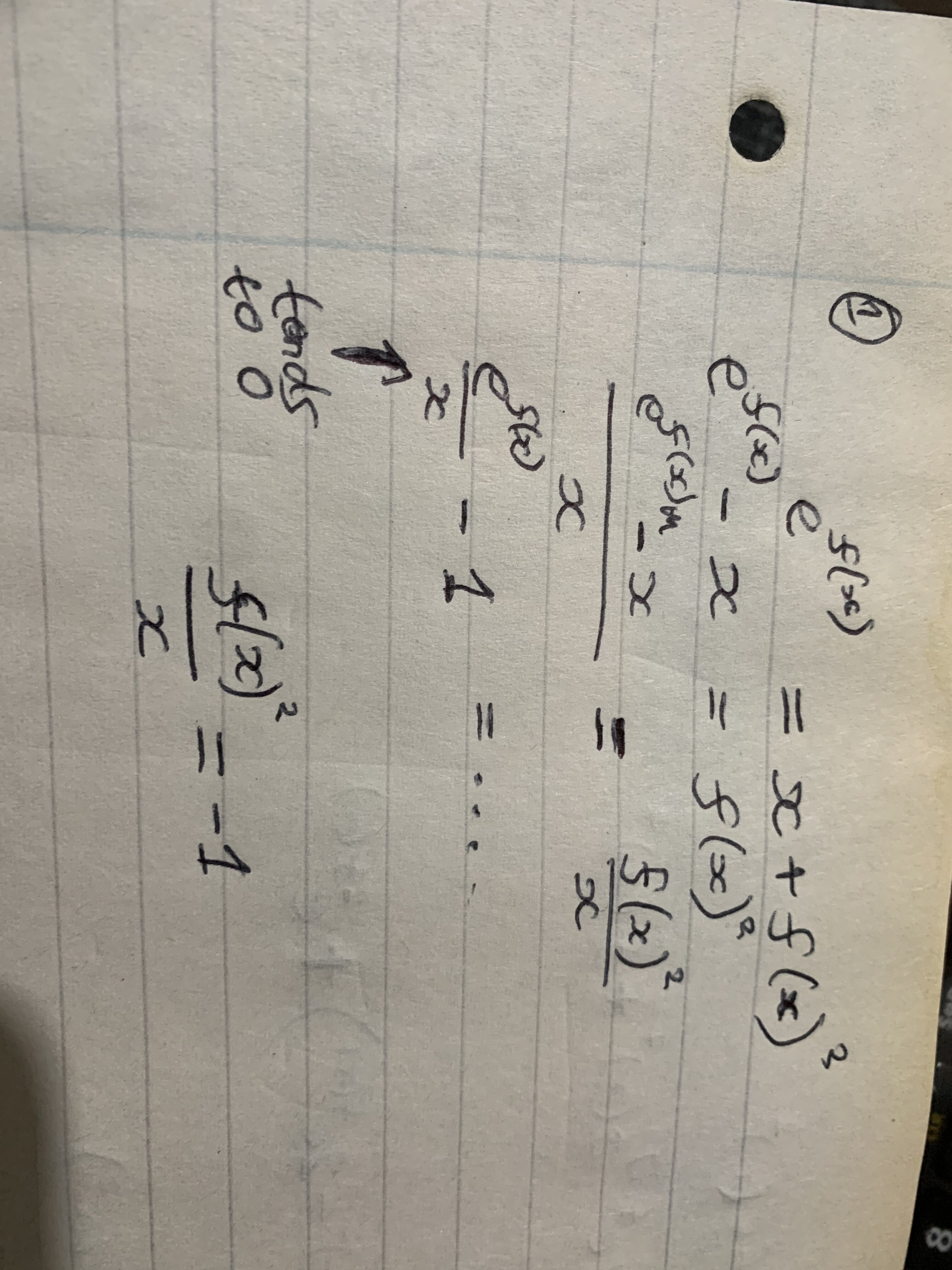

I call y = f(x)View attachment 2064250
Saw this on twitter and can't see an easy way to solve it
If anyone solves it and explains their solution they will earn my respect
Tf niggaI call y = f(x)
Rewrite the first equation to e^y - y^2 = x => if y ->oo, then x has to go to infinity as well because x is roughly e^y for large y. In fact lim_(y -> oo) x ( y ) = e^y
So the the first question is lim_(y->oo) y^2 /e^y -> 0
Second question: lim_(x->oo) log(x^2)/log(x) =lim_(x->oo) 2*log(x)/log(x) = 2
The limit is when x tends to infinity not the function of x.I call y = f(x)
Rewrite the first equation to e^y - y^2 = x => if y ->oo, then x has to go to infinity as well because x is roughly e^y for large y. In fact lim_(y -> oo) x ( y ) = e^y
So the the first question is lim_(y->oo) y^2 /e^y -> 0
Second question: lim_(x->oo) log(x^2)/log(x) =lim_(x->oo) 2*log(x)/log(x) = 2
x tends to infinity exactly when y tends to infinity as well.The limit is when x tends to infinity not the function of x.
You can’t approximate a function like that, what if it was tan(x) it would go to infinity at pi/2 & 3pi/2 & 5pi/2 & 7pi/2 …. u get the point
I thought the 1st question is y^2/x? why did you not use y^2/(e^y-y^2) ?x tends to infinity exactly when y tends to infinity as well.
e^y - y^2 = x
This function looks like x = e^y for large y, so it's just an exponential in that regime, so you can "invert" it. The initial function happens to be bijective as well. If it wasnt injective then the the reformulations that I wrote are not allowed (because you cant invert the function), you would need to be a bit more careful, but the end result would still be correct.
I don’t get it what did I do wrong the maths checks out, how we have different answers?I call y = f(x)
Rewrite the first equation to e^y - y^2 = x => if y ->oo, then x has to go to infinity as well because x is roughly e^y for large y. In fact lim_(y -> oo) x ( y ) = e^y
So the the first question is lim_(y->oo) y^2 /e^y -> 0
Second question: lim_(x->oo) log(x^2)/log(x) =lim_(x->oo) 2*log(x)/log(x) = 2
Actually nvm we have the same method for the second one. I didn’t expand the log in my working, it should have been 2*[f(x)/f(x)] which would equal 2.I call y = f(x)
Rewrite the first equation to e^y - y^2 = x => if y ->oo, then x has to go to infinity as well because x is roughly e^y for large y. In fact lim_(y -> oo) x ( y ) = e^y
So the the first question is lim_(y->oo) y^2 /e^y -> 0
Second question: lim_(x->oo) log(x^2)/log(x) =lim_(x->oo) 2*log(x)/log(x) = 2

wait nvm its squaredView attachment 2064528
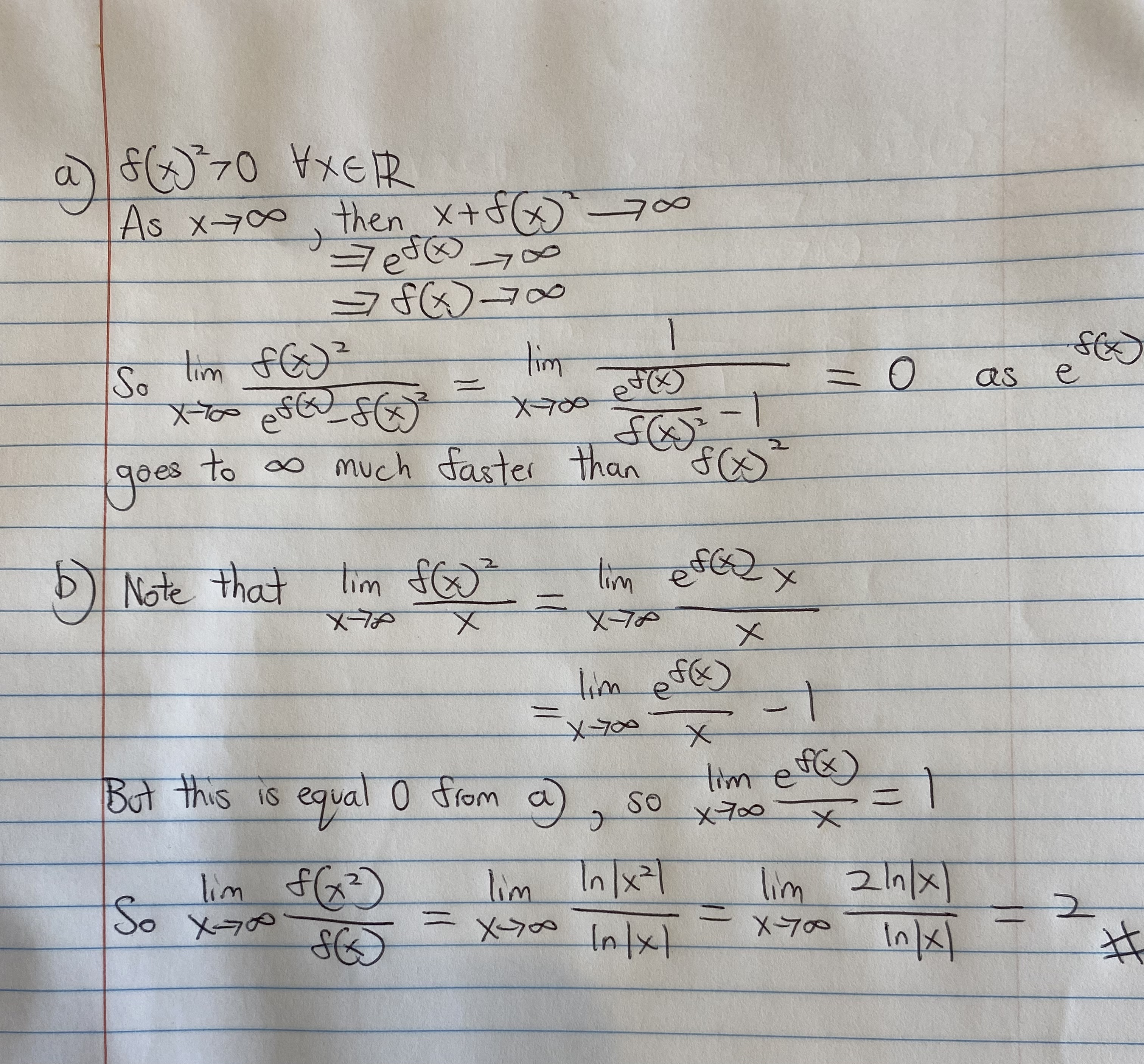
Not sure what retards are saying here but I wrote everything out with justification so u don’t have to look at retarded text formatting
It can't be any function. The function is completely determined by the equation.none of you have considered that f(x) could be any function so e^f(x) could grow at a smaller rate than just x on it's own
idk how to fix this problem without solving for f(x) directly, which doesn;t seem possible
maybe the answer wants separate cases or there is a way to prove this cant be the case
I’m quite sure my answer is correct. The only thing I skimmed over is why e^f(x) goes to infinity faster than f(x)^2 for the first limit.wait nvm its squared
but then how can you determine it's behaviour when the equation is unsolvableIt can't be any function. The function is completely determined by the equation.
If you're so concerned about that. You can prove injectivity and surjectivity => Bijectivity and therefore invertibility
Why do you need separate cases?
can you explain the last lineView attachment 2064528
Not sure what retards are saying here but I wrote everything out with justification so u don’t have to look at retarded text formatting
Answer is 0 and 2 respectively
Why is not 1? Why did my method not workView attachment 2064528
Not sure what retards are saying here but I wrote everything out with justification so u don’t have to look at retarded text formatting
Answer is 0 and 2 respectively
Ova 4 our lowIQnone of you have considered that f(x) could be any function so e^f(x) could grow at a smaller rate than just x on it's own
idk how to fix this problem without solving for f(x) directly, which doesn;t seem possible
maybe the answer wants separate cases or there is a way to prove this cant be the case
Sure! As I wrote in the 2nd to last line, the limit as x goes to infinity of e^f(x)/x = 1 by rewriting the terms from part (a)can you explain the last line
You assumed incorrectly that e^f(x)/x tends to 0 as x tends to infinity.Why is not 1? Why did my method not work

ThisView attachment 2064528
Not sure what retards are saying here but I wrote everything out with justification so u don’t have to look at retarded text formatting
Answer is 0 and 2 respectively
niceSure! As I wrote in the 2nd to last line, the limit as x goes to infinity of e^f(x)/x = 1 by rewriting the terms from part (a)
So e^f(x) and x are equal as x goes to infinity.
Which means f(x)= ln(x) as x goes to infinity.
So f(x^2) = ln(x^2)
And by using logarithm rules, ln(x^2) = 2ln(x)
FYI @Mouthbreath had the correct answer too, he just expressed it in a weird way with the invertibility + typing math symbols out in text + skimmed over alot in his explanationnice
well done, you win!

Couldn't you have used L'hospital instead of saying that one function grows much faster than the other?View attachment 2064528
Not sure what retards are saying here but I wrote everything out with justification so u don’t have to look at retarded text formatting
Answer is 0 and 2 respectively
Yeah in fact, that's the reason. e^f(x) / f(x)^2 is in indeterminate form so it applies.Couldn't you have used L'hospital instead of saying that one function grows much faster than the other?
Are u a maths student?Yeah in fact, that's the reason. e^f(x) / f(x)^2 is in indeterminate form so it applies.
The only thing is I'm assuming f(x) is differentiable on the open interval, which I'm just gonna assume as a technicality
I studied physics.Are u a maths student?
Especially @Mouthbreath ? I study Elctrical Eng. so I was surprised you mentioned bijection etc. cos we use those to describe signals, I thought u were just some schizos.
it’s been a while since I did pure maths + I know it’s cringe cos a lot of people throw it around on this forum underservedly but u guy actually do seem highiQ.
What r ur career plans?
I studied pure math. Actually has quite little to do with numbers and calculation per se, its more about logic and proofs.Are u a maths student?
Especially @Mouthbreath ? I study Elctrical Eng. so I was surprised you mentioned bijection etc. cos we use those to describe signals, I thought u were just some schizos.
it’s been a while since I did pure maths + I know it’s cringe cos a lot of people throw it around on this forum underservedly but u guy actually do seem highiQ.
What r ur career plans?

Bro I built a robot last year + I’m 24 virgin in less than a month. Sexhaving is for monkeys.I studied pure math. Actually has quite little to do with numbers and calculation per se, its more about logic and proofs.
Also probably got brain damage from it which is why I'm 26 yo KHHV and can't talk to women JFL
Private equityBro I built a robot last year + I’m 24 virgin in less than a month. Sexhaving is for monkeys.
Mirin pure maths + physics majors tho, there isn’t a lot of degrees i have respect for given what I do but I could never do pure maths or physics, mogs me hard.
What career have u perused?
Stats? Age, race, height, psl?Private equity
Tbh I might retire soon and just LDAR on .org and incels.is full time, I don't spend money at all except for food and internet so no point moneymaxxing
26, hapa, 192cm, PSL probably lower but SMV higher because I look like some kpop twinkStats? Age, race, height, psl?
Lift fraud to 195 + gymmax you will have god tier smv. It’s Newtons law, you see a truck coming towards you what are you gonna do? Move tf out of the way.26, hapa, 192cm, PSL probably lower but SMV higher because I look like some kpop twink

e^(f(x)) / x can be tending to infinity if f(x) is a function growing faster than f(x) = log(x).Cos sqrt[e^(fx) - x] is not an element of real if x goes to infinity
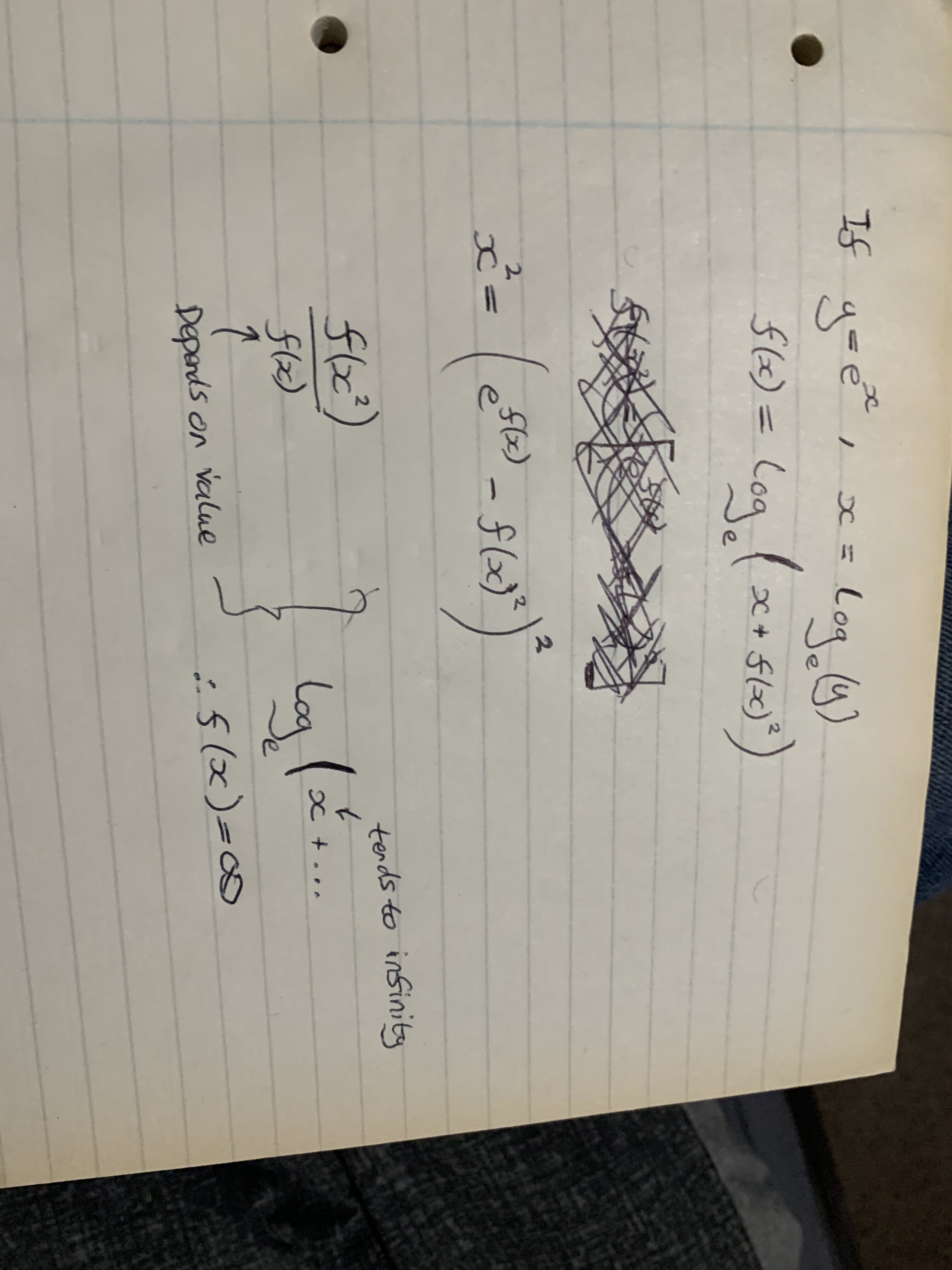
The 1st one you just rearrange + converge View attachment 2064441
I thought the second one is the same but I didn’t realise it’s f(x^2) not f(x)^2