Sayori


ascend or die
- Joined
- Jul 31, 2024
- Posts
- 6,460
- Reputation
- 21,784
SAYORI’S WHITENING GUIDE - [ Full guide from overall skin lightening to treating melasma] no need to think just read
Table of contents
Table of contents
| Must know vocab before starting thread |
| General deep dive about products for whitening |
| Whitening routine |
edit Note:
If its to complex, just skip to the conclusions and notes I left, you can also just skip to the routine
Must know vocab before starting thread
MASI:
It stands for melasma area severity index; it's used to indicate how bad melasma is and its used to check if a treatment is working. The higher the number for this index the worse and the smaller the number the better.
Mean:
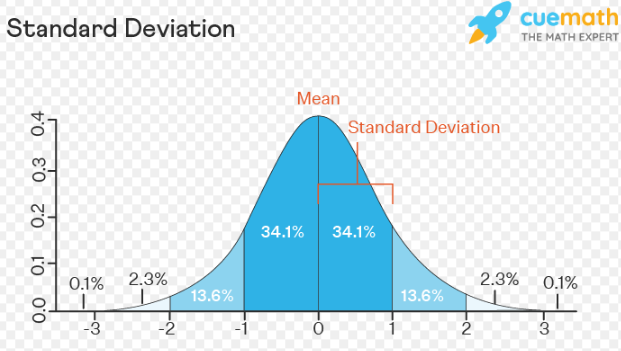
In statistics, the mean is a measure of central tendency that summarizes a dataset with a single number reflecting its center or typical value.
SD:
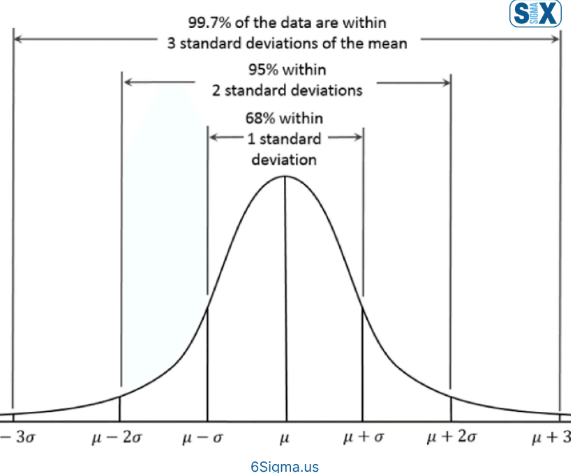
This stands for standard deviation in statistics, standard deviation in statistics is a measure of how much the values in a dataset deviate from the mean, indicating the spread of variability of the data set. The data I will be presenting you with only shows you one standard deviation which means 68% percent of all data fits within the number if you were to take the mean and +/- from it once.
T test and CL:
“A t-test is a statistical test used to compare the means of two groups, while a confidence interval (CI) is a range of values that is likely to include the true population mean with a certain degree of confidence. The 95% CI is a specific type of confidence interval that provides a 95% probability that the true population mean lies within the specified range. This means that if you were to conduct the experiment multiple times and calculate the CI each time, approximately 95% of the intervals would contain the true population mean. The CI is calculated using the sample mean, standard deviation, and degrees of freedom to estimate the variability of the population mean.”
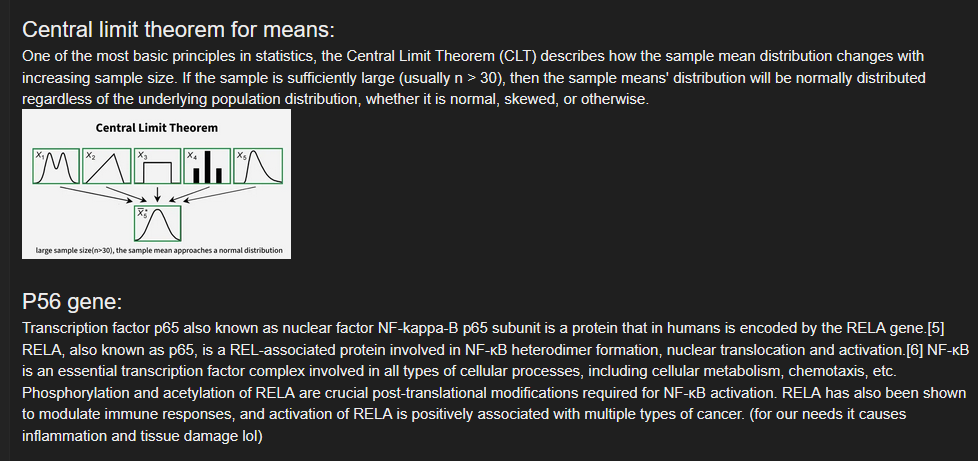
Central limit theorem for means:
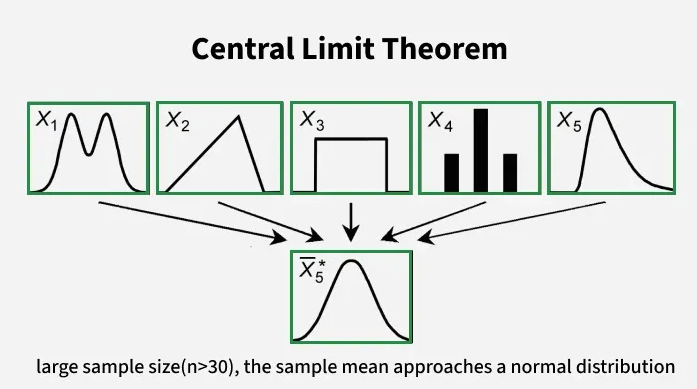
One of the most basic principles in statistics, the Central Limit Theorem (CLT) describes how the sample mean distribution changes with increasing sample size. If the sample is sufficiently large (usually n > 30), then the sample means' distribution will be normally distributed regardless of the underlying population distribution, whether it is normal, skewed, or otherwise.
P56 gene:
Transcription factor p65 also known as nuclear factor NF-kappa-B p65 subunit is a protein that in humans is encoded by the RELA gene.[5] RELA, also known as p65, is a REL-associated protein involved in NF-κB heterodimer formation, nuclear translocation and activation.[6] NF-κB is an essential transcription factor complex involved in all types of cellular processes, including cellular metabolism, chemotaxis, etc. Phosphorylation and acetylation of RELA are crucial post-translational modifications required for NF-κB activation. RELA has also been shown to modulate immune responses, and activation of RELA is positively associated with multiple types of cancer. (for our needs it causes inflammation and tissue damage lol)
General deep dive about products for whitening
Azelaic acid 20 % vs Hydroquinone 4% In people with melasma:
Method:
29 women with melasma were recruited and treated, 15 were with hydroquinone 4% for 2 months and 14 were treated with azelaic acid 4% for 2 months, the cream was applied twice daily and a broad spectrum sunscreen was used concomitantly by both groups.
Hydroquinone 4%:
Before treatment:
MASI Index Mean, SD, T level, and CL 95%:
- Mean=7.2
- SD=3.2
- No significant difference between both groups(T level, and CL 95%= 2.9 to 2.2)
One month after treatment:
MASI Index Mean, SD, T level, and CL 95%:
- Mean=6.7
- SD=3.4
- No significant difference between both groups(T level, and CL 95%= 2.3 to 3)
Two months after treatment:
MASI Index Mean, SD, T level, and CL 95%:
- Mean=6.2
- SD=2.8
- Azelaic acid significant statistical differenceT level, and CL 95%= .03 to 4.9)
Azelaic acid 20%:
Before treatment:
MASI Index Mean, SD, T level, and CL 95%:
- Mean=7.6
- SD=3.5
- No significant difference between both groups(T level, and CL 95%= 2.9 to 2.2)
One month after treatment:
MASI Index Mean, SD, T level, and CL 95%:
- Mean=6.3
- SD=3.4
- No significant difference between both groups(T level, and CL 95%= 2.3 to 3)
Two months after treatment:
MASI Index Mean, SD, T level, and CL 95%:
- Mean=3.8
- SD=2.8
- Azelaic acid significant statistical differenceT level, and CL 95%= .03 to 4.9)
The study suggest that 20% azelaic acid cream applied twice daily may be more effective than hydroquinone 4%
Note:
The study sample size is below 30 and “central limit theorem for means” tells us that if a sample is below 30 we can't trust it. However, if the population= Normal distribution there is no need for a minimum of a sample size of 30. So our statistics qualify for “the central limit theorem for means”.
Note:
Keep in mind this is for individuals with melasma. If this were to be put against normal skin the hydroquinone would win at lightening as it is a non selective tyrosinase inhibitor as compared to azelaic acid which only targets over active cells.
Study used for this:
Hydroquinone combined with aloe vera in order to reduce side effects:
So combining hydroquinone with aloe vera in rats aided in reducing side effects of hydroquinone. So it can hypothetically do the same to us humans. In the words of the researchers “The application of aloe vera gel to the already treated skin had observable effects as Aloe vera gel application showed potentials to ameliorate hydroquinone deleterious effects by persevering the stratum corneum which were generally disrupted in other groups that were administered hydroquinone [to the skin]” this just means that it makes potential side effects of hydroquinone better. Further more “ the expression of p56 in these groups was relatively reduced [Figure 3]. Thus, aloe-vera gel as used had protective effects and by extension might be protecting the skin from the potential consequences associated with the effects of hydroquinone.” This is just telling us that inflammation is being reduced as P56 causes that.
In conclusion:
Without over complicating the data shows that aloe vera on your skin can reduce a lot of the hydroquinone side effects on rats. Which will be important if you choose to run this compound. I don't want to over complicate this section since its pretty water aloe vera is good for you.
The study:
https://pmc.ncbi.nlm.nih.gov/articles/PMC7147621/
What to cycle Hydroquinone and what to maintenance results with:
TCC better than Hyrdoquino 4% & general info:
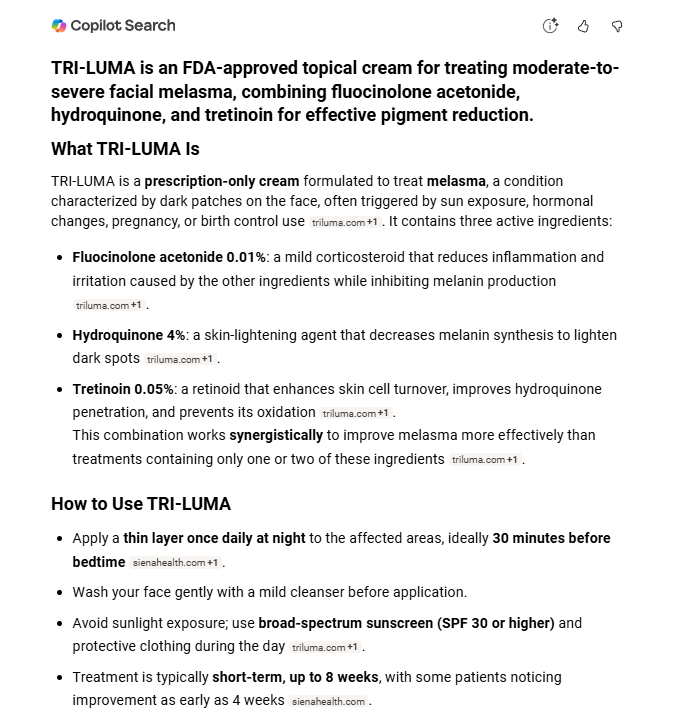
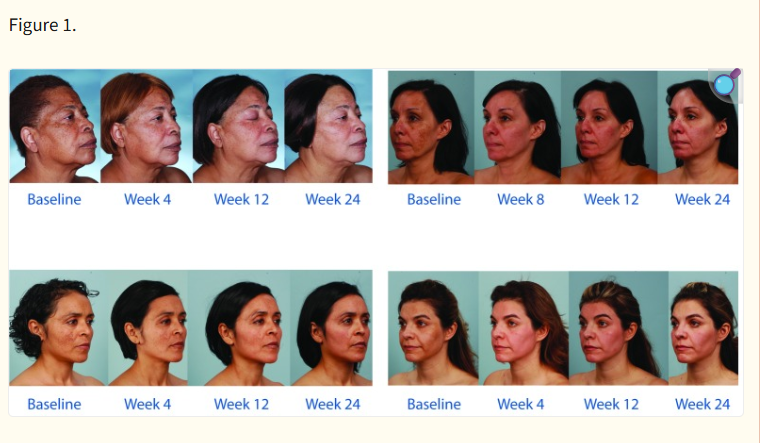
The study talks about combining “ fluocinolone acetonide 0.01%, hydroquinone 4%, and tretinoin 0.05%’ ; it also mentions that they are “ frequently employed” for whitening purposes. In the literature it also talks about “ limited-duration hydroquinone courses, and transition to non-hydroquinone maintenance to minimize adverse effects that can exacerbate pigmentation, such as irritant dermatitis.” This is just telling you to cycle this shii nga. This is from the study directly “77% of TCC-treated participants reached complete or near complete clearing, in contrast only 47% of dual-combination group achieved the very endpoints. Ferreira Cestari et al. also displayed its superiority to 4% hydroquinone in the view of efficacy41. Clearance of melasma, meaning lesions nearly equivalent to perilesional skin, was observed in 35% of subjects using TCC versus 5% using HQ alone.” What this tells us is that the combination “ fluocinolone acetonide 0.01%, hydroquinone 4%, and tretinoin 0.05%’ mogged the fuck out of dual combination and just hyrdoquinone 4%. Which means we should be combining it for my effectiveness.
The combination of these products are better as shown here “the higher efficacy of this product based on the synergistic effects of its ingredients. Specifically, the topical steroid is thought to ameliorate irritation caused by the other two ingredients and inhibit melanin synthesis, while the retinoid is believed to interrupt the oxidation of hydroquinone and facilitate its trans-epidermal penetration42. “ as you can see its saying they work with each other to counter each other's negatives and make each other more effectively absorbed.
Don't cycle longer then 3 months is the norm but here “Given that hydroquinone in concentrations above 4% and in treatment courses longer than 3 months may be associated with new onset ochronosis43, the combination formula limiting the concentration of hydroquinone as 4% thanks to combined effects with other constituents may account for the lower risk of ochronosis4 “ We can cycle for longer or just cycle the same time with less possible side effects while it being more effective yay.
Oral tranexamic acid (TXA)
Oral tranexamic acid stops melanocyte communication "TXA affects the communication between keratinocytes and melanocytes.", Its effects on your vascular tissue and uv “TXA hinders the plasmin activity induced by UV light exposure, leading to a reduction in mast cell activity and the inhibition of fibroblast growth factor50. This, in turn, results in a decrease in the number of mast cells in the dermis and a reduction in the formation of new blood vessels13,50 “ this just means you will get less ugly redness that people get from sun exposure helps people that suffer from PIE. IT also regulates the degradation of melanosomes “TXA can activate the autophagy system by increasing the expression of autophagy-related proteins51. Earlier research indicates that the autophagy system plays a crucial role in determining skin color by regulating the degradation of melanosomes in keratinocytes, which is enhanced by activators of autophagy52 “ This will keep your skin lighter and for longer. The results are the same between dosages but if you want faster results take higher doses “although faster results were achieved with higher doses.".
Conclusion:
TCC is way more effective than solo hydroquinone 4% or just a dual combination. The effects all work to help each other. Oral TXA is effective to take if you want your skin to reduce in redness and want easier maintenance of your whitening. It also mentioned that you shouldn't run these products for longer than 3 months at a time.
Glutathione needed for the natural whitening look:
This will be finished in part 2
I will not be putting in more effort on this topic if its not liked
The study:
https://pmc.ncbi.nlm.nih.gov/articles/PMC3848650/
Conclusion:
TCC which is ““ fluocinolone acetonide 0.01%, hydroquinone 4%, and tretinoin 0.05%’ is more effective at skin whitening and has less side effects as they work together, one works to absorb better and another mechanism to reduce side effects. The research also tells us the cycling for more than 3 months is bad.
Whitening routine
- TCC ( fluocinolone acetonide 0.01%, hydroquinone 4%, and tretinoin 0.05% ) applied twice daily for 3 months
- Oral tranexamic acid in order to reduce redness and maintain the whitening effects
- After 3 months switch to TCC monthly and azelaic acid 20 percent two times daily repeat for a month
- Remove TCC and run azelaic acid 20% twice and Oral tranexamic acid any dose you like for 3 more months
- Lastly repeat this cycle over and over and don't forget sunscreen ever 2 hours non negotiable
Tags:
@illusion @Hernan @goku21 @Randomized @Jason Voorhees
Last edited: