





d99lotus
Platinum
- Joined
- Mar 23, 2026
- Posts
- 1,173
- Reputation
- 725
(This to my knowledge has been covered a couple times to some degree, this is just a much more detailed and accurate version with actual sources and clearer explanations so just skip to How to trigger Myofibrosis if you're too lazy)
I am not gonna be beating around the bush here, this is all straight to the point because i know you niggers have the attention span of a goldfish. Shouldn't be too hard to understand either since ive explained the important stuff.
In specific injury contexts, TGF-β performs distinct functions (you can generally skim through this, just read cell proliferation and skin fibroblasts properly):
Wound Healing: It acts as a chemoattractant for immune cells, promotes angiogenesis by stimulating endothelial cell migration, and drives fibroblast trans-differentiation into myofibroblasts for wound contraction. The balance of TGF-β isoforms (particularly TGF-β1 vs. TGF-β3) determines whether healing results in scar formation or regeneration.
Cell proliferation is the process by which cells grow and divide to produce new daughter cells, resulting in an increase in cell number. It is a fundamental biological mechanism essential for growth, development, tissue repair, and maintenance of healthy organs throughout an organism's lifespan.
(We want to focus mainly on cell proliferation and skin fibroblasts here)
Skin fibroblasts are the primary mesenchymal cells residing in the dermis (the skin's middle layer) responsible for maintaining structural integrity, elasticity, and wound healing. They function by synthesizing and organizing the extracellular matrix (ECM), which includes critical proteins like collagen (types I and III), elastin, and fibronectin
Cell proliferation causes mass gain in tissue-level repair during wound healing. In multicellular organisms, wound healing involves a sequence of phases including hemostasis, inflammation, tissue growth, and remodeling.During the tissue growth phase, cell proliferation acts as a mass source that increases tissue density to replace destroyed or damaged tissue.
Canonical Pathway: Activates Smad transcription factors (Smad2/3/4) via TGF-β type I and II receptor serine/threonine kinases, leading to regulated gene transcription.
Non-Canonical Pathways: Engages cascades such as PI3K/AKT, MAPK (including ERK1/2, JNK, and p38), and Rho GTPases to coordinate diverse cellular responses.
Both these pathways are critical for Mass gain, mainly the canonical pathway. Some of you now may say, well cant the canonical pathway cause cell arrest? That is true unless there is repeated chronic damage over a long period of time where the arrest mechanism is bypassed and ignored. This is caused by 3 scenarios.
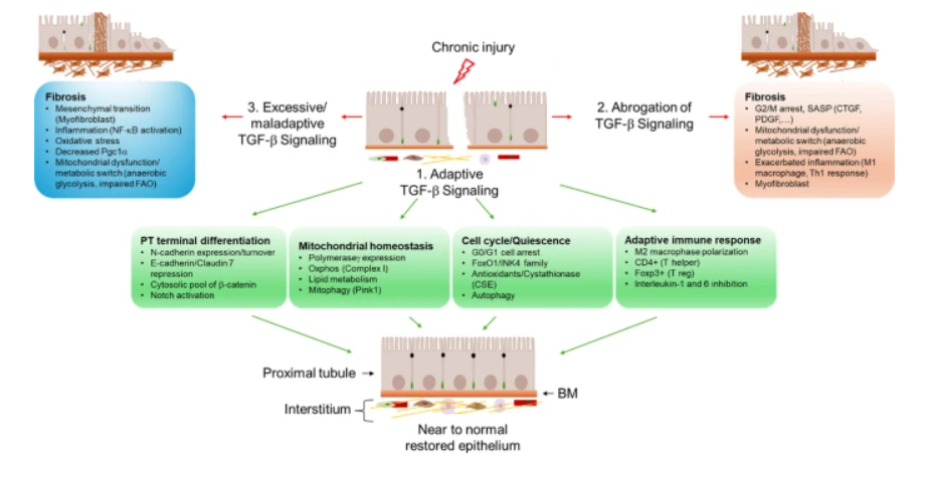
Keep in mind after remodeling which occurs if you stop bonesmashing (which we will get into in a bit), Some size is lost while some semi permanent or permanent size is left as a net mass gain.
So now we know the science behind it, we can move on to the progression and what is actually required and how it should be done.
In normal healing, myofibroblasts appear around day 4–7, peak at 2–3 weeks, and then disappear via apoptosis.
If damage is repeated and constant during this window, the remodeling phase is effectively blocked. The tissue remains trapped in a chronic state of inflammation and proliferation, preventing the normal resolution of scarring.
What this means is you have a good 2 week window before remodeling is complete and your gains are reduced to the net mass gain which wont be anything noticeable if you havent been doing it for a good amount of time.
Tldr: You want to start off with very high intensity and a good amount of quantity for a week so id say 50 reps in ur required areas each day, After a week you can drop it to just high intensity 50 reps and continue. Id say work with your fists rather than a hammer since its much harder to cause serious damage to yourself with your own fists and this will make sure you’re not gonna fuck yourself up. Its also recommended to brace the head unless you want CTE
Huge thanks to @prcxe thread on this since it gave me a good start although his is a more general overview of it.
Few of the sources ive used(They have mostly all the information mentioned here so this shouldnt be a problem since these are the main ones):
https://en.wikipedia.org/wiki/Wound_healing
https://link.springer.com/article/10.1007/s00424-026-03168-x#Sec7
https://pmc.ncbi.nlm.nih.gov/articles/PMC4226391/
https://dupuytrens.org/wp-content/uploads/2023/05/2012_VanDeWater.pdf
I am not gonna be beating around the bush here, this is all straight to the point because i know you niggers have the attention span of a goldfish. Shouldn't be too hard to understand either since ive explained the important stuff.
TGF-β
Transforming Growth Factor-beta (TGF-β) signaling is a critical mediator in the response to external damage, orchestrating wound healing through complex cellular and molecular events. Upon injury, TGF-β is released from platelets and activated in the extracellular matrix to regulate inflammation, cell proliferation, migration, and extracellular matrix (ECM) deposition.
In specific injury contexts, TGF-β performs distinct functions (you can generally skim through this, just read cell proliferation and skin fibroblasts properly):
Wound Healing: It acts as a chemoattractant for immune cells, promotes angiogenesis by stimulating endothelial cell migration, and drives fibroblast trans-differentiation into myofibroblasts for wound contraction. The balance of TGF-β isoforms (particularly TGF-β1 vs. TGF-β3) determines whether healing results in scar formation or regeneration.
Cell proliferation is the process by which cells grow and divide to produce new daughter cells, resulting in an increase in cell number. It is a fundamental biological mechanism essential for growth, development, tissue repair, and maintenance of healthy organs throughout an organism's lifespan.
(We want to focus mainly on cell proliferation and skin fibroblasts here)
Skin fibroblasts are the primary mesenchymal cells residing in the dermis (the skin's middle layer) responsible for maintaining structural integrity, elasticity, and wound healing. They function by synthesizing and organizing the extracellular matrix (ECM), which includes critical proteins like collagen (types I and III), elastin, and fibronectin
Cell proliferation causes mass gain in tissue-level repair during wound healing. In multicellular organisms, wound healing involves a sequence of phases including hemostasis, inflammation, tissue growth, and remodeling.During the tissue growth phase, cell proliferation acts as a mass source that increases tissue density to replace destroyed or damaged tissue.
SIGNALLING PATHWAYS
The signaling pathway operates through two main mechanisms: Canonical Pathway: Activates Smad transcription factors (Smad2/3/4) via TGF-β type I and II receptor serine/threonine kinases, leading to regulated gene transcription.
Non-Canonical Pathways: Engages cascades such as PI3K/AKT, MAPK (including ERK1/2, JNK, and p38), and Rho GTPases to coordinate diverse cellular responses.
Both these pathways are critical for Mass gain, mainly the canonical pathway. Some of you now may say, well cant the canonical pathway cause cell arrest? That is true unless there is repeated chronic damage over a long period of time where the arrest mechanism is bypassed and ignored. This is caused by 3 scenarios.
- Signal Switching: Chronic inflammation and oxidative stress activate non-canonical pathways (like ERK, JNK, and PI3K/AKT) which can phosphorylate and inhibit Smad proteins or degrade CDK inhibitors, effectively silencing the arrest signal.
- Cell Type Specificity: While epithelial cells normally arrest, fibroblasts and myofibroblasts in a chronic wound environment interpret the persistent TGF-β signal differently. Instead of arresting, the Smad3 pathway in these cells preferentially drives the transcription of collagen and fibronectin genes, promoting mass accumulation rather than cell cycle exit.
- Mutations and Resistance: In long-term damage, cells may acquire mutations (e.g., in p53 or Smad4) or epigenetic changes that render them resistant to the cytostatic effects of TGF-β, allowing them to proliferate and deposit matrix uncontrollably.
Keep in mind after remodeling which occurs if you stop bonesmashing (which we will get into in a bit), Some size is lost while some semi permanent or permanent size is left as a net mass gain.
So now we know the science behind it, we can move on to the progression and what is actually required and how it should be done.
How to trigger Myofibrosis
Inflammation alone via chemical signaling is insufficient for causing any permanent myofibroblast differentiation. The force must be sufficient to create mechanical tension and stiffness in the tissue. - Stiffness Requirement: Myofibroblasts typically differentiate only when the extracellular matrix (ECM) stiffness exceeds approximately 5–10 kPa (kilopascals). Normal, healthy skin is softer (~2–5 kPa), while fibrotic skin is significantly stiffer (>20 kPa).
- Force Resistance: The cells must pull against a matrix that resists their contraction. If the tissue is too soft (compliant), the cell’s pulling force simply deforms the matrix without generating enough tension to activate the latent TGF-β stored within it
How to reach the stiffness requirement
- Cumulative Stiffening: Each cycle of injury and repair deposits collagen, gradually increasing tissue stiffness.
- Crossing the Threshold: Once repeated damage makes the tissue stiff enough (crossing the ~5 kPa threshold), even normal cellular pulling forces become sufficient to activate the TGF-β loop.
- Self-Perpetuation: At this point, the process becomes self-sustaining. The myofibroblasts pull, stiffen the tissue further, activate more TGF-β, and recruit more myofibroblasts, leading to the mass and size changes (scarring) previously discussed.
Critical Timeline for Fibrosis
3+ Weeks: Pathological myofibrosis typically sets in when skin is re-injured before the remodeling phase is complete (usually within 3 to 4 weeks of the initial injury). In normal healing, myofibroblasts appear around day 4–7, peak at 2–3 weeks, and then disappear via apoptosis.
If damage is repeated and constant during this window, the remodeling phase is effectively blocked. The tissue remains trapped in a chronic state of inflammation and proliferation, preventing the normal resolution of scarring.
What this means is you have a good 2 week window before remodeling is complete and your gains are reduced to the net mass gain which wont be anything noticeable if you havent been doing it for a good amount of time.
Tldr: You want to start off with very high intensity and a good amount of quantity for a week so id say 50 reps in ur required areas each day, After a week you can drop it to just high intensity 50 reps and continue. Id say work with your fists rather than a hammer since its much harder to cause serious damage to yourself with your own fists and this will make sure you’re not gonna fuck yourself up. Its also recommended to brace the head unless you want CTE
Huge thanks to @prcxe thread on this since it gave me a good start although his is a more general overview of it.
Few of the sources ive used(They have mostly all the information mentioned here so this shouldnt be a problem since these are the main ones):
https://en.wikipedia.org/wiki/Wound_healing
https://link.springer.com/article/10.1007/s00424-026-03168-x#Sec7
https://pmc.ncbi.nlm.nih.gov/articles/PMC4226391/
https://dupuytrens.org/wp-content/uploads/2023/05/2012_VanDeWater.pdf


