opsecfoidslayer
Iron
- Joined
- Jun 19, 2026
- Posts
- 139
- Reputation
- 85
Every low-tier user on this forum thinks they can achieve "hunter eyes" by doing squintmaxx drills or getting a cheap lateral canthoplasty.
The cold truth is that eye area aesthetics are strictly dictated by your sub-orbital bone support. If your maxilla or infraorbital rims are recessed, a soft-tissue surgery will look uncanny or fail completely. This guide breaks down the true biomechanics of the periorbital region.
1. The Foundation: Positive vs. Negative Orbital Vectors
Before looking at surgeries, look at a side-profile photo of your face. Draw a vertical line from the most prominent part of your cornea down to your lower cheekbone.
2. Why Isolated Canthoplasty Fails for Negative Vectors
A lateral canthoplasty cuts the tendon at the outer corner of the eye and anchors it higher on the bone to create a positive tilt.
3. The Gold Standard Tier: Custom Infraorbital-Malar Implants
If you have severe sub-orbital recession, you must fix the bone deficiency first using custom implants made of PEEK (Polyetheretherketone) or Porous Polyethylene (Medpor).
4. Combining Hardmax and Soft Tissue Stacks
For an elite, aggressive result, top-tier oculoplastic surgeons combine hard bone modification with advanced soft tissue tailoring:
5. World-Class Oculoplastic Surgeons to Research
Do not go to a standard body plastic surgeon for this. You need specialized craniofacial or oculoplastic masters:
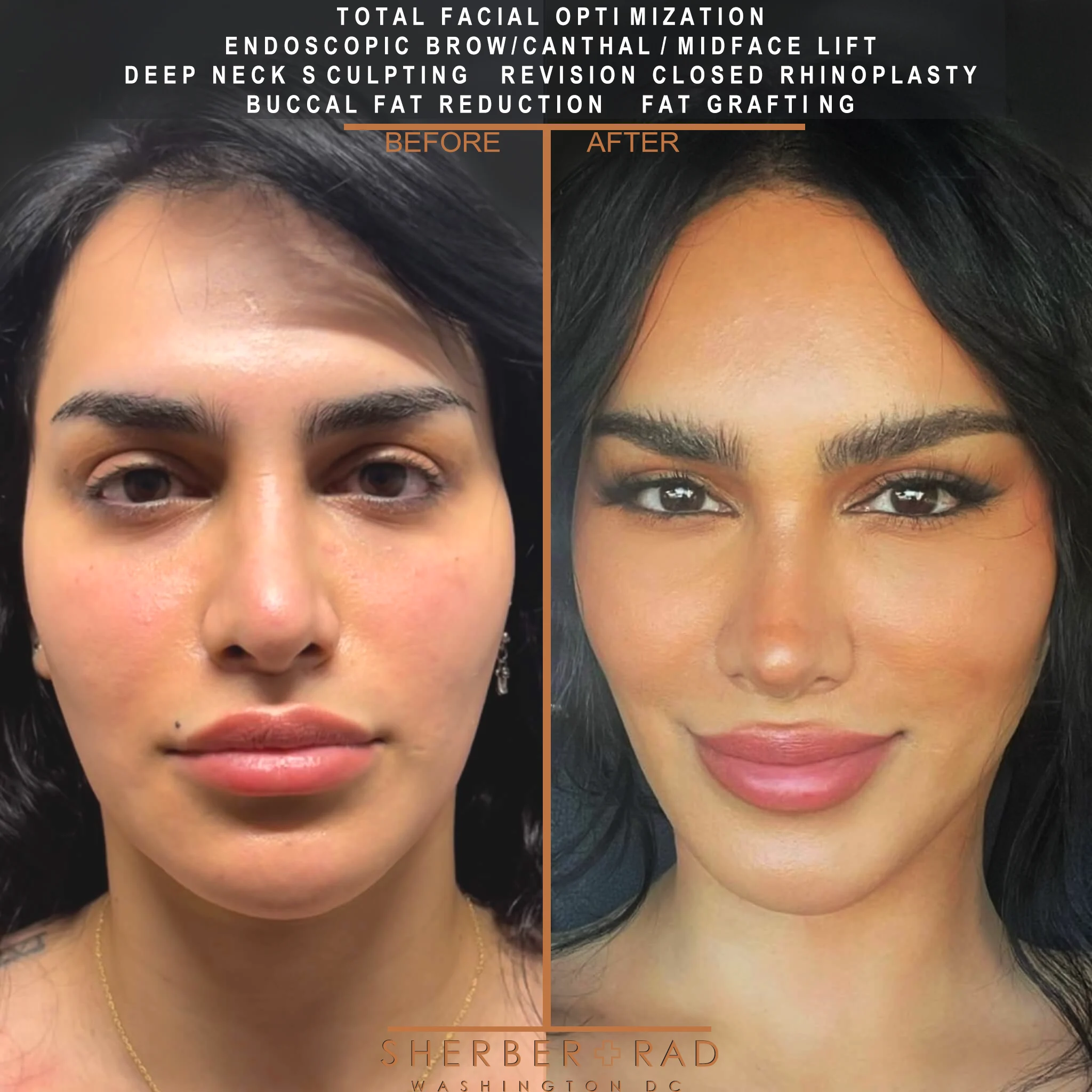
Before and after :
:
The cold truth is that eye area aesthetics are strictly dictated by your sub-orbital bone support. If your maxilla or infraorbital rims are recessed, a soft-tissue surgery will look uncanny or fail completely. This guide breaks down the true biomechanics of the periorbital region.
1. The Foundation: Positive vs. Negative Orbital Vectors
Before looking at surgeries, look at a side-profile photo of your face. Draw a vertical line from the most prominent part of your cornea down to your lower cheekbone.
- Positive Vector: Your lower orbital rim/cheekbone sticks out further than your eyeball. This provides a natural shelf that lifts the lower eyelid, preventing scleral show.
- Negative Vector: Your eyeball sticks out further than your bone. Your lower eyelid has no structural support, causing it to sag, reveal white space under the pupil (scleral show), and create a negative canthal tilt.
2. Why Isolated Canthoplasty Fails for Negative Vectors
A lateral canthoplasty cuts the tendon at the outer corner of the eye and anchors it higher on the bone to create a positive tilt.
- The Catch: If you have a negative bone vector, stretching the eyelid over a recessed socket creates a tight, unnatural, "pulled" look.
- The Risk: Over time, the tension pulls against gravity, leading to ectropion (the lid pulling away from the eyeball) or stretching the tendon right back down to its original saggy position.
3. The Gold Standard Tier: Custom Infraorbital-Malar Implants
If you have severe sub-orbital recession, you must fix the bone deficiency first using custom implants made of PEEK (Polyetheretherketone) or Porous Polyethylene (Medpor).
- The Mechanics: A surgeon uses a 3D CT scan to print implants that sit perfectly over your lower eye sockets and wrap around your cheekbones.
- The Aesthetic Result: This physically pushes the lower border of your eye socket forward, changing your profile from a negative vector to a positive vector. It naturally fills out hollow under-eye circles and physically lifts the lower eyelid margin to delete scleral show.
4. Combining Hardmax and Soft Tissue Stacks
For an elite, aggressive result, top-tier oculoplastic surgeons combine hard bone modification with advanced soft tissue tailoring:
- Custom PEEK Infraorbital Implants: To build the skeletal foundation and create forward projection.
- Epi-Canthoplasty / Canthopexy: To gently tighten and anchor the outer corners at a crisp 2-to-3-degree positive angle without structural tension.
- Infraorbital Spacer Grafts (Hard Palate Grafts): If your lower eyelid is severely short, a small piece of tissue harvested from the roof of your mouth is grafted inside the lower lid to physically widen it and block all visible sclera.
5. World-Class Oculoplastic Surgeons to Research
Do not go to a standard body plastic surgeon for this. You need specialized craniofacial or oculoplastic masters:
- Dr. Barry Eppley (USA): Internationally famous for designing massive, custom wrap-around infraorbital-malar PEEK implants.
- Dr. Taban (USA): A legendary oculoplastic specialist known for complex lower eyelid retractions and almond eye surgeries.
Before and after
: