Quatza33
5,9 framcel Arise femto
- Joined
- Jun 12, 2025
- Posts
- 820
- Reputation
- 1,099
Thesis:
Most jaw threads start with the mandible aka: Gonial angle. Ramus height. Bigonial width. Chin projection.
But the visible line you call your jawline is not simply the border of the mandible.
It is the external contour created by bone, muscle, fat, skin, the floor of the mouth, and the neck interacting in three dimensions.
The lower border of the mandible provides the skeletal foundation.
important variables include:
Mandibular body length (Affects the distance from the chin toward the angle of the jaw.)
Chin projection (Changes how abruptly the lower face transitions into the neck from profile.)
Ramus height (Contributes to posterior facial height and the location of the mandibular angle.)
Bigonial width (Influences lower-face width from the front.)
Gonial morphology (Affects the shape of the transition between the mandibular body and ramus.)
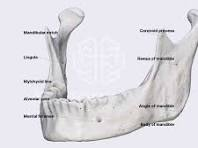
But none of these variables directly determines how clearly the mandibular border will be visible through the tissue covering it.
chin -> submental region -> upper neck (A clean transition produces separation between the lower face and neck.)
A poor transition makes them blend together.
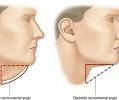
In aesthetic surgery, this region is often described using the cervicomental angle, the angle formed by the underside of the chin and the anterior neck.
(I swear if some fuckwit starts saying this is just the hyoid position I will lose my marbles )
)
Imagine a perfectly defined mandibular border underneath several millimeters of additional soft tissue, not visible right?
Submental fullness can come from multiple anatomical layers:
You therefore cannot infer someone's mandibular quality simply from how sharp the jawline looks.
The masseter sits over the lateral ramus and mandibular angle.
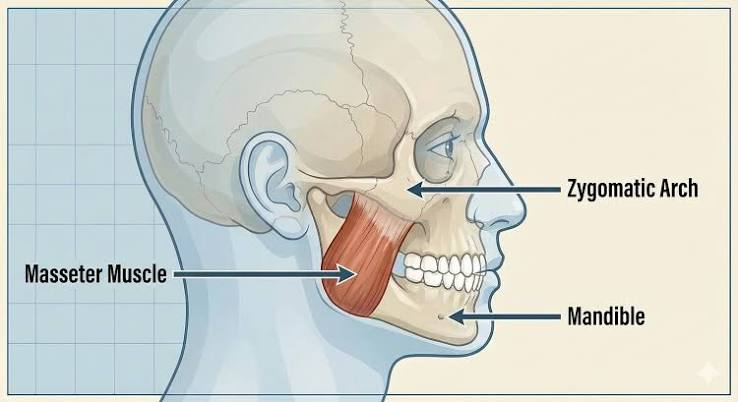
Hypertrophy can increase lower-face width. That can improve appearance in someone whose lower face is too narrow, but width and definition are separate variables.
A larger masseter does not automatically create a cleaner mandibular border.
In some faces:
more masseter = stronger lower-face shape
In others:
more masseter = bulkier lower face without better neck separation
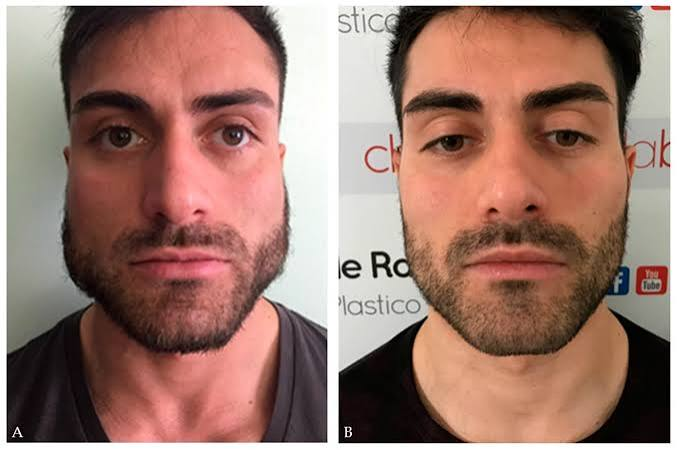
This is why you shouldn't tell everyone to train their masseters. People literally get cosmetic surgery to fix overtrained masseters. Here is an example (irrevelant to my main point though):
You first need to identify what your actual limiting variable is
The hyoid sits below the mandible and acts as an attachment point for muscles involved in swallowing, tongue movement, and floor-of-mouth function.
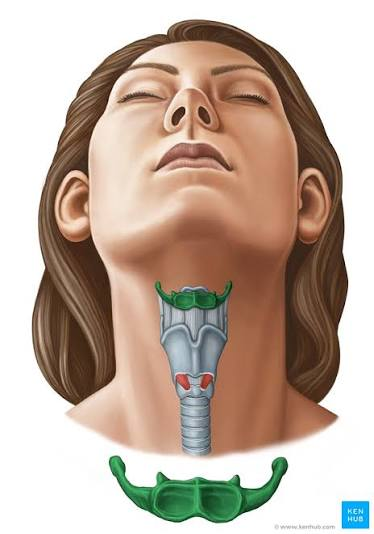
Its relationship with surrounding structures contributes to the shape of the submental region. But the visible contour is not controlled by the hyoid alone.
You also have:
You can demonstrate this yourself.
Take three standardized profile photographs:
Because head position changes:
Lower bf% usually reduces superficial facial and neck fat, obviously not denying that. But the result differs between individuals because fat distribution is not identical. One person may lose facial fat quickly. Another may remain relatively full under the chin even while lean.
The correct conclusion is:
Leanness affects visibility of structure, It does not create structure that is absent.
If your jaw sucks then follow my protocol:
Conclusion:
Ask yourself: "Which anatomical variable is actually preventing my jaw from looking good?" and the answer usually isn't just your jawbone.
Good mandibular alone means jack shit, contour matters.
Most jaw threads start with the mandible aka: Gonial angle. Ramus height. Bigonial width. Chin projection.
But the visible line you call your jawline is not simply the border of the mandible.
It is the external contour created by bone, muscle, fat, skin, the floor of the mouth, and the neck interacting in three dimensions.
1. THE MANDIBLE IS ONLY THE FRAME
The lower border of the mandible provides the skeletal foundation.
important variables include:
Mandibular body length (Affects the distance from the chin toward the angle of the jaw.)
Chin projection (Changes how abruptly the lower face transitions into the neck from profile.)
Ramus height (Contributes to posterior facial height and the location of the mandibular angle.)
Bigonial width (Influences lower-face width from the front.)
Gonial morphology (Affects the shape of the transition between the mandibular body and ramus.)
But none of these variables directly determines how clearly the mandibular border will be visible through the tissue covering it.
2. THE REAL AESTHETIC VARIABLE IS THE FACE-NECK TRANSITION
chin -> submental region -> upper neck (A clean transition produces separation between the lower face and neck.)
A poor transition makes them blend together.
In aesthetic surgery, this region is often described using the cervicomental angle, the angle formed by the underside of the chin and the anterior neck.
(I swear if some fuckwit starts saying this is just the hyoid position I will lose my marbles
)
3. WHY SUBMENTAL TISSUE CAN HIDE GOOD BONE (kinda water part read if you want)
Imagine a perfectly defined mandibular border underneath several millimeters of additional soft tissue, not visible right?
Submental fullness can come from multiple anatomical layers:
- superficial fat
- deeper fat
- skin laxity
- muscle anatomy
- salivary gland position
- floor-of-mouth structures
You therefore cannot infer someone's mandibular quality simply from how sharp the jawline looks.
4. THE MASSETER CHANGES WIDTH, NOT NECESSARILY DEFINITION
The masseter sits over the lateral ramus and mandibular angle.
Hypertrophy can increase lower-face width. That can improve appearance in someone whose lower face is too narrow, but width and definition are separate variables.
A larger masseter does not automatically create a cleaner mandibular border.
In some faces:
more masseter = stronger lower-face shape
In others:
more masseter = bulkier lower face without better neck separation
This is why you shouldn't tell everyone to train their masseters. People literally get cosmetic surgery to fix overtrained masseters. Here is an example (irrevelant to my main point though):
You first need to identify what your actual limiting variable is
5. THE HYOID REGION MATTERS, BUT INTERNET EXPLANATIONS USUALLY OVERSIMPLIFY IT
The hyoid sits below the mandible and acts as an attachment point for muscles involved in swallowing, tongue movement, and floor-of-mouth function.
Its relationship with surrounding structures contributes to the shape of the submental region. But the visible contour is not controlled by the hyoid alone.
You also have:
- suprahyoid muscles
- infrahyoid muscles
- tongue and floor-of-mouth tissues
- fat
- skin
- glands
- mandibular and chin geometry
6. HEAD POSITION CAN CHANGE YOUR "JAWLINE" IN SECONDS
You can demonstrate this yourself.
Take three standardized profile photographs:
- head extended slightly upward
- neutral head position
- chin pushed downward or forward
Because head position changes:
- neck length
- skin tension
- submental compression
- mandibular orientation relative to the camera
- shadows beneath the jaw
- apparent chin projection
7. BODY FAT MATTERS, BUT "GET LEAN" IS STILL TOO SIMPLE (water, no need to read)
Lower bf% usually reduces superficial facial and neck fat, obviously not denying that. But the result differs between individuals because fat distribution is not identical. One person may lose facial fat quickly. Another may remain relatively full under the chin even while lean.
The correct conclusion is:
Leanness affects visibility of structure, It does not create structure that is absent.
8. YOU SHOULD DIAGNOSE THE BOTTLENECK BEFORE TRYING TO CHANGE IT (IMPORTANT)
If your jaw sucks then follow my protocol:
Case A: strong bone, poor visibility
Possible issues:- high submental fullness
- unfavorable head posture
- soft-tissue distribution
- weak chin-neck separation
Case B: narrow lower face
Check masseter size, training it in this case can be beneficial.Case C: recessed chin
Improving chin projection could affect the profile more than increasing jaw width. get a genioplasty.Case D: decent profile, weak frontal jaw
Width may be the bigger variable.Case E: good anatomy, bad photographs
By that I mean that you look alot worse on photos than you should. Therefore you may have no meaningful anatomical problem at all, maybe its just the camera.Conclusion:
Ask yourself: "Which anatomical variable is actually preventing my jaw from looking good?" and the answer usually isn't just your jawbone.
Good mandibular alone means jack shit, contour matters.