asgard
Iron
- Joined
- Feb 8, 2026
- Posts
- 106
- Reputation
- 38
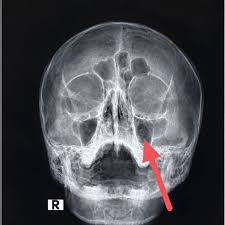
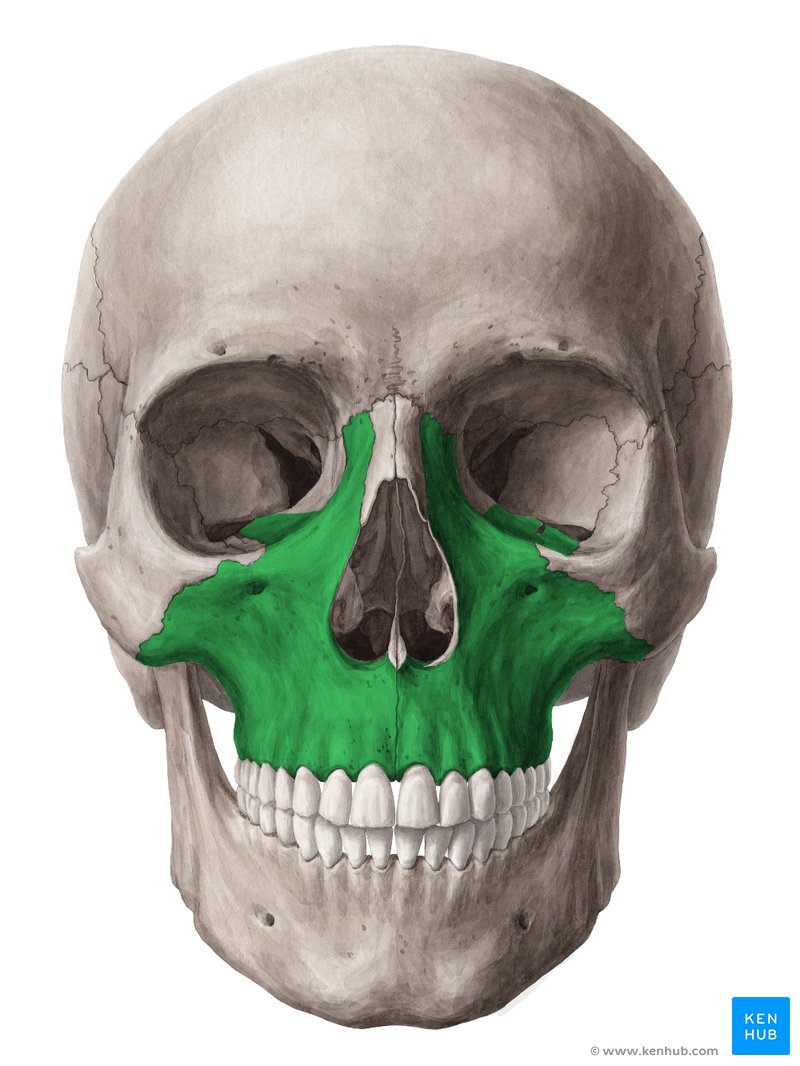
What is the maxilla?
The maxilla (upper jaw) is the structural keystone of the viscerocranium, it forms the floor of the orbits, the lateral walls and floor of the nasal cavity, the roof of the oral cavity (hard palate) and serves as the insertion point for a complex array of mimetic and masticatory muscles. It has three planes which it grows upon, forward (anterior-posterior projection), downward, and transversally.
Why is the maxilla important for facial aesthetics?
The maxilla's aesthetic importance lies in its dual role as both a surface feature and a structural scaffold. intrinsically, its sagittal position defines the nasal base and anterior cheek projection, the anterior-nasal-spine is a maxillary bone. its vertical descent sets the lower facial third height and tooth-to-lip relationship. its transverse width determines the skeletal foundation of the smile, the support of the upper lip (indirectly and slightly), and the outwardness of the cheekbones.
Extrinsically, the maxilla dictates the position of nearly every bone it articulates with. The zygomatic bones articulate at the zygomaticomaxillary (ZM) suture, making maxillary position an important determinant of midfacial projection, the orbital floor is the maxilla's superior surface, any deficiency there manifests as infraorbital hollowing. And critically the maxilla sets the occlusal plane upon which the mandible hinges; maxillary vertical excess or sagittal retrusion influences the mandible into a downward-backward rotation.
Maxillary retrusion backwards may cause aesthetic issues such as: infraorbital hollowing, less forward projection of the cheekbones, a crooked nose, and overall a retrusive midface. And depending on severity and associated craniofacial anatomy, maxillary deficiency may contribute to airway narrowing, malocclusion, impaired mastication, and obstructive sleep apnea.
How does the maxilla grow?
In an infant, the maxilla is an active growth site comprising of many open sutures that respond to genetic, hormonal, and biomechanical influences. Unlike long bones, the maxilla does not grow through a growth plate. Instead its development occurs through three simultaneous processes: displacement, remodeling, and sutural growth.
Displacement refers to the movement of the maxilla as a whole unit through space. As surrounding craniofacial structures grow, particularly the cranial base and adjacent facial bones, the maxilla is progressively displaced downward and forward from its original position.
Remodeling refers to localized changes in bone shape thru the coordinated activity of bone cells (osteoblasts and osteoclasts). Osteoblasts deposit new bone while osteoclasts resorb existing bone. This process alters the contours of the maxilla and allows it to adapt to growth while maintaining structural integrity.
Sutural growth occurs at the fibrous joints connecting the maxilla to neighboring bones. bone deposition at these sutures contributes to the enlargement of the maxillary complex and facilitates its downward and forward displacement during development.
Sutures that the maxillary complex includes/is connected to:
| Name | Location | Aesthetic effect |
| Frontomaxillary suture | Upper bridge of the nose region, near the medial orbital rim | contributes to vertical and anterior positioning of the maxilla's upper aspect |
| Nasomaxillary suture | upper nose walls | affects nasal base support and midface projection around the nose |
| Zygomaticomaxillary suture | Lateral midface | major contributor to midface width and anterior cheek projection |
| Zygomaticotemporal/Zygomaticofrontal region (indirect influence, not strictly a maxillary suture) | Between zygoma and temporal/frontal bones | indirectly transmits forces shaping cheekbone position relative to maxilla |
| Pterygomaxillary region | A buttress like articulation in the deep posterior upper jaw (behind molars) | extremely important for posterior maxillary growth restriction |
| Midpalatal suture | roof of mouth | primary site for transverse maxillary growth |
| Incisive/Premaxillary suture | anterior palate, behind incisors | Separates and coordinates fusion between anterior and posterior maxillary segments. Fuses extremely early |
| Palatomaxillary sutures | posterior hard palate | contributes to posterior palate height and width stability |
One thing I'd like to clear up is that these are not independent growth regions but rather they function as a mechanically linked growth complex coordinated by cranial base growth, functional matrices, and surrounding bone remodeling. The collection of these sutures is called the circummaxillary suture system.
Hormones involved in development:
The most dominant: GH -> IGF-1 axis. This is the main endocrine driver of facial growth during childhood (and adolescence)
Secondary hormones:
- T3/T4
- Oestrogen
- Testosterone
- PTH
Local growth factors involved at the tissue level:
- IGF-1 (also local)
- TGF-β
- BMPs (Bone morphogenetic proteins)
- FGFs (Fibroblast growth factors)
To make things clear: hormones and local growth factors control rate, timing, and biological capacity for growth rather than the exact maxillary projection and bone shape in isolation.
What actually set the blueprint for maxillary projection and bone shape, are well known: Genetics.
Specifically, the following genes:
| Gene (family) name | Specific Involvement |
| HOX genes | Segment identity along body axis |
| DLX genes (DLX1/2/5/6) | Jaw and facial patterning |
| MSX1/MSX2 | Craniofacial bone development |
| PAX genes (PAX9, PAX7) | midface/dental development |
| SHH (Sonic Hedgehog) | Midline + facial prominence |
| FGF signalling (FGFR2, FGFR3) | Cranial growth regulation |
| TCOF1 | Neural crest cell development |
| RUNX2 | Master switch for osteoblast differentiation |
But how is cranial base growth related to maxillary growth?
The maxilla is spatially positioned relative to the cranial base via synchondroses (cartilaginous growth plates in the skull base), especially in the spheno-occipital region. As the cranial base grows, the maxilla is displaced forward and downward. This is one of the major determinants of midface projection. The angle of the cranial base (the cranial base angle between the anterior and posterior cranial base) is associated with whether the midfacial pattern is more forward or more vertical. A more flexed cranial base is generally associated with a more compact, forward midface pattern, while a more extended cranial base is associated with increased vertical facial proportions.
So while hormones amplify growth velocity and bone formation, they do not determine directional geometry.
What is the role of chewing forces?
Rather than a primary driver of facial structure as they are overstated online, chewing forces generate compressive forces on teeth and alveolar bone, tensile forces through periodontal ligaments and muscle forces from the masseter, temporalis and pterygoids, these forces are transmitted into the mandible (lower jaw), maxilla (upper jaw), and alveolar bone (tooth-bearing bone). So what chewing forces can do is shape alveolar bone, influence mandibular growth, and contribute to sutural stress environment indirectly but this is secondary rather than primary. So chewing is useful for developing a robust jaw but it is not significantly useful for upper jaw development.
Mechanotransduction
In bone, osteocytes (terminally differentiated osteoblasts embedded within the bone matrix) detect fluid shear stress in lacuna-canalicular system and strain deformation of mineralized matrix, triggering biochemical signaling to the Wnt/β-catenin pathway (most important for formation), Wnt/β-catenin increases bone formation, local modeling where strain exists, and osteoblast differentiation. Another pathway that is activated is the YAP/TAZ pathway which influences gene expression linked to growth and differentiation . But a major clarification which needs to be made is that mechanotransduction is local adaptation rather than a global craniofacial repositioning system, and when it comes to the upper jaw it depends heavily on the biological plasticity window, age, and the amount of force, and mechanotransduction will definitely not override genetic patterning.
Growth timeline
First, embryonic development (weeks 4-10), the maxilla originates from neural crest cells which migrate into the first pharyngeal arch, the formation of the maxillary processes and early patterning under SHH, FGF, and BMP signaling happens here, along with the establishment of the midface layout. In the fetal period (week 9 to onward) rapid ossification begins, initial maxillary architecture forms and early alveolar development begins around tooth germ regions, growth here is highly genetically programmed and minimally influenced by mechanical loading. Then during infancy happens rapid overall craniofacial expansion with strong influence of cranial base growth, airway expansion and feeding mechanics (suckling -> early functional matrix effects), here sutures are highly patent and biologically responsive. during early childhood (2-6 years), continued but slower craniofacial growth happens, functional matrix influences becomes more noticeable and dental eruption begins shaping alveolar bone. In puberty, happens the final major acceleration window driven by GH/IGF-1 axis and sex steroids which produce increased facial growth velocity, the final expression of the genetic craniofacial pattern.
Most sutures interdigitate by ages 10-15. After the age of 10, the growth remaining in the maxilla is real but small and it's largely genetically programmed displacement that you cannot redirect, and it is mostly remodeling and rotation rather than pure growth.
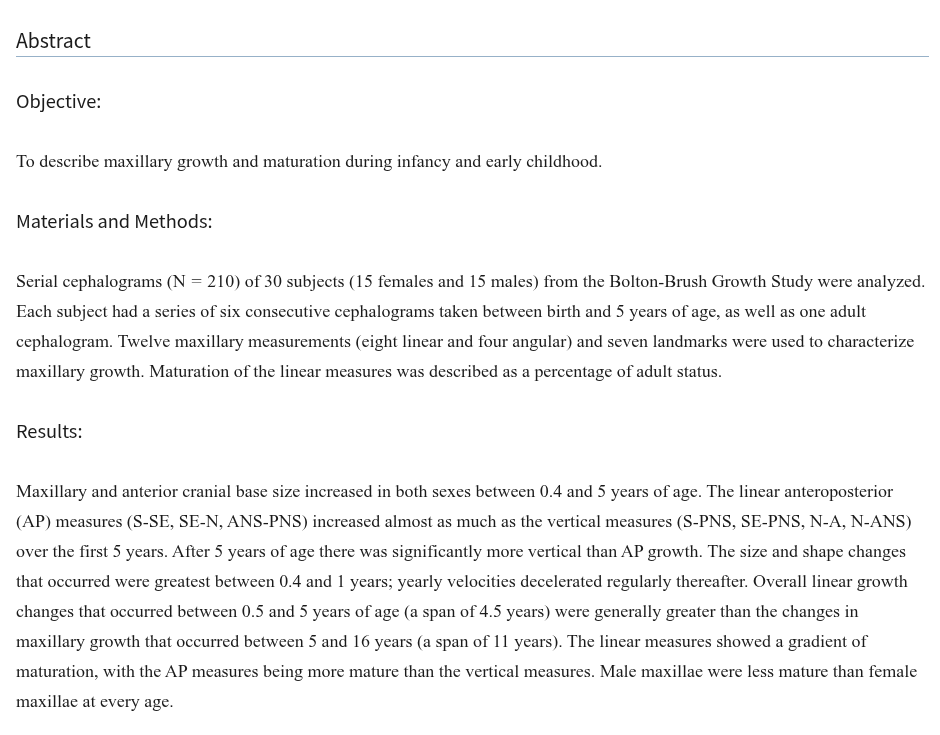
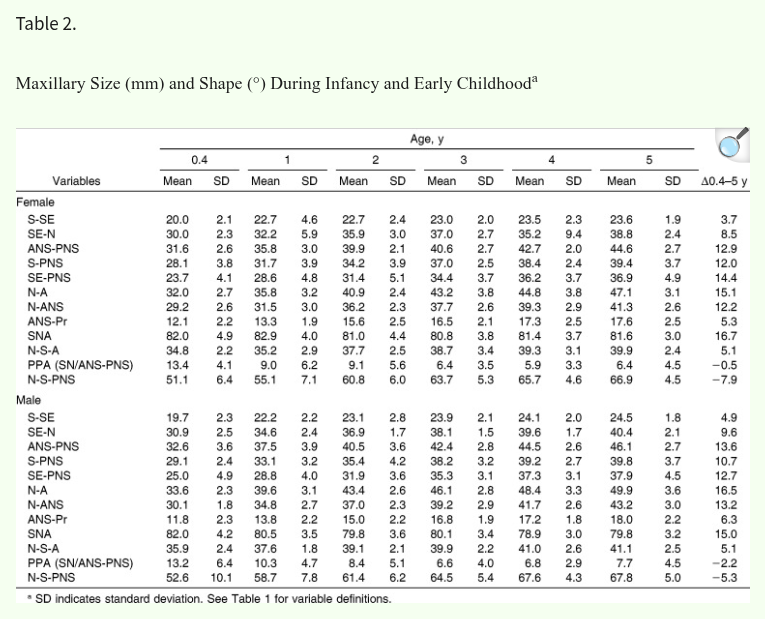
Growth rate graph:
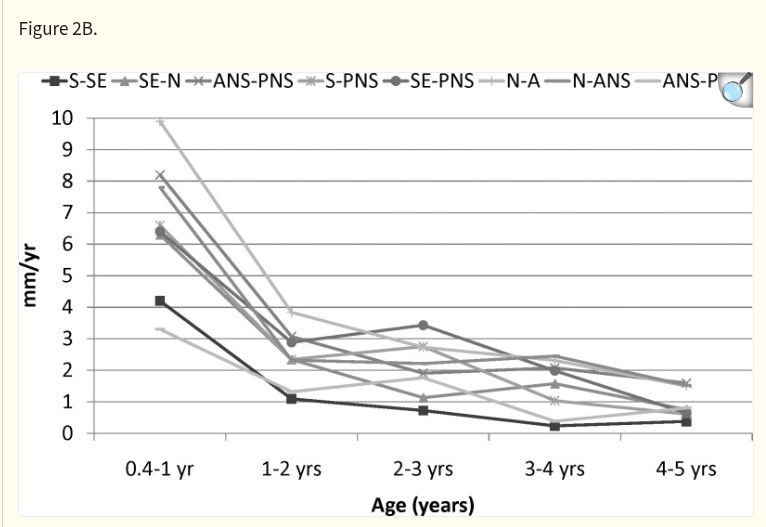
- pictures from https://pmc.ncbi.nlm.nih.gov/articles/PMC8754034
As we can see, while some growth remains in adolescence, the rate of growth declines significantly as we reach age 5.