Demirs
Iron
- Joined
- Apr 29, 2026
- Posts
- 120
- Reputation
- 92
Executive summary
The strongest version of the scientific case against pornography is not that every exposure is toxic, or that every user becomes “addicted.” The evidence is more precise than that. It suggests that pornography becomes especially concerning when use is early, frequent, escalating, secretive, violent in content, or experienced as difficult to control. In those contexts, the literature points to a pattern of harms spanning reward learning, cue reactivity, compulsive use, distress, sexual dissatisfaction, relationship strain, and shifts in sexual attitudes and scripts. The pattern is not perfectly uniform, but it is substantial enough to justify clinical and public-health concern.A balanced reading of the field also requires a second point: frequency alone is often a weak predictor. Distress and impairment are better markers. Some people report “porn addiction” largely in the context of moral conflict, guilt, or religious incongruence rather than very high consumption. Conversely, some heavy users report few obvious symptoms. That is why the best current clinical frameworks focus less on raw use and more on loss of control, distress, compulsivity, escalation, and functional impairment.
From a diagnostic standpoint, the World Health Organization now includes compulsive sexual behaviour disorder in ICD-11, and WHO notes that what had been framed as “excessive sexual drive” was reclassified as CSBD. At the same time, the DSM-5-TR does not recognize “porn addiction” as a formal disorder; the American Psychiatric Association notes that gambling disorder is the only behavioral addiction formally identified there. That tension matters. It means the field has moved past simple denial of the problem, but it has not settled every classification question.
The practical conclusion is straightforward. The literature does not support sensational claims that pornography is uniformly harmful to everyone. But it does support a sober, evidence-based warning that pornography can be harmful in predictable ways, especially for adolescents, vulnerable users, people with loneliness or psychological distress, and users caught in escalating or compulsive patterns. The burden of evidence is now strong enough to support screening, psychoeducation, porn-literacy interventions, and treatment for problematic use.
Background and definitions
Scientifically, it is important to distinguish pornography use from problematic pornography use. Many people encounter pornographic material without meeting any clinical threshold for disorder. What concerns clinicians and researchers is the subgroup whose use becomes repetitive, difficult to control, distressing, secretive, impairing, or tied to escalating needs and negative consequences. WHO’s ICD-11 places compulsive sexual behaviour disorder among the impulse-control disorders, and WHO explicitly describes the change from “excessive sexual drive” to “compulsive sexual behaviour disorder.”Official U.S. psychiatric guidance also reflects this nuance. The DSM-5-TR does not identify “porn addiction” as a formal diagnosis, and the American Psychiatric Association states that gambling disorder is the only behavioral addiction formally recognized there. At the same time, APA materials aimed at patients acknowledge that problematic online pornography use can become compulsive and may affect relationships and mental well-being. In other words, the absence of a DSM label is not evidence of harmlessness; it is evidence of an unsettled nosology.
That unsettled terminology is one reason the literature can look confusing. Different papers study different constructs: simple viewing frequency, self-perceived addiction, problematic use, CSBD symptoms, or help-seeking samples. Those are not interchangeable. The result is that “how harmful is pornography?” often becomes really several questions at once: harmful to whom, in what form, at what developmental stage, with what content, and with what psychosocial context.
One more definitional caution matters. Distress around pornography can arise from at least two partly overlapping routes. The first is a dysregulated, cue-driven, compulsive pattern that resembles other addictive or compulsive processes. The second is moral incongruence: using pornography while believing it is fundamentally wrong. Official APA coverage of this line of work notes that moral or religious beliefs may lead some people to conclude they are addicted even when their use is low or average. That does not mean the problem is “all guilt”; it means that guilt can magnify symptom reporting and suffering, and research must separate those layers carefully.
Neurobiology and learning mechanisms
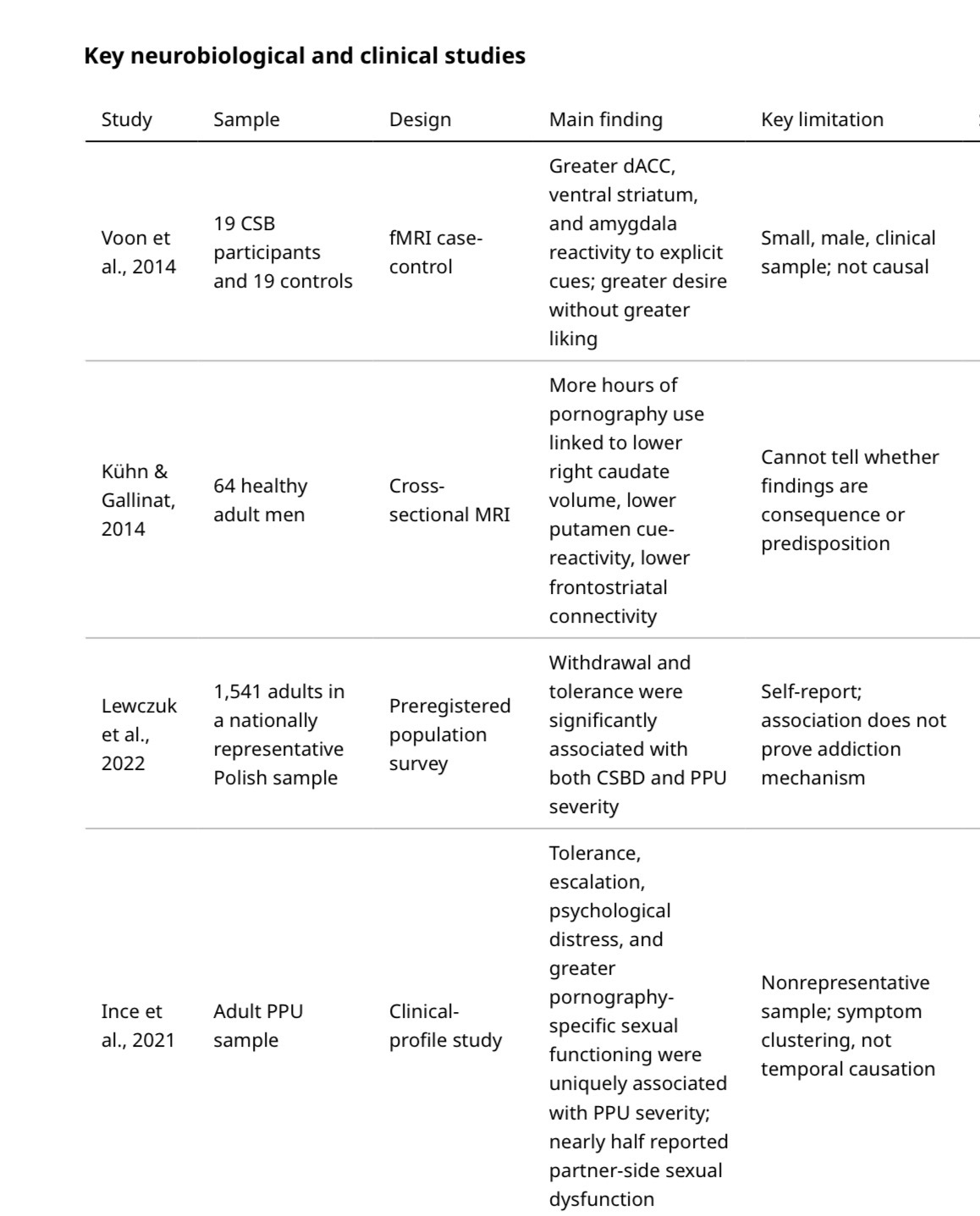
The neurobiological case against pornography is strongest when it is framed as a problem of reward learning, cue sensitization, habit formation, and impaired control, not as a simplistic “dopamine = bad” slogan. Contemporary addiction models such as I-PACE argue that addictive behaviors emerge through interactions among predispositions, affective responses, cue reactivity, craving, and executive-control weaknesses, with frontostriatal imbalance becoming increasingly relevant as habits consolidate. Problematic pornography use is often discussed within that same framework.Primary neuroimaging work supports this picture. In a case-control fMRI study of 19 people with compulsive sexual behaviour and 19 healthy volunteers, Voon and colleagues found greater sexual desire but not greater liking in the CSB group, along with greater activation of the dorsal anterior cingulate, ventral striatum, and amygdala to sexually explicit cues. That “wanting more than liking” pattern is one of the classic signatures discussed in incentive-sensitization models of addiction.
A separate neuroimaging literature has emphasized anticipation rather than reward consummation. Gola and Draps summarized evidence that men with CSB differ from controls primarily in ventral striatal responses to cues predicting erotic pictures, not to the erotic pictures themselves. That finding matters because it fits a conditioning model in which cues become progressively more salient, more motivationally charged, and potentially harder to resist than the reward itself.
Structural and resting-state findings point in the same broad direction, though they do not prove causality. Kühn and Gallinat studied 64 healthy adult men and reported that more hours of pornography use per week were associated with lower right caudate volume, lower left putamen activation during cue reactivity, and lower functional connectivity between the right caudate and left dorsolateral prefrontal cortex. The authors explicitly noted two possibilities: these patterns might reflect neural plasticity from repeated reward-system stimulation, or they might be pre-existing vulnerabilities that make pornography more rewarding. The study is therefore important, but not decisive.
Behavioral markers linked to addiction-like formulations have also appeared in population data. In a preregistered nationally representative Polish sample of 1,541 adults, withdrawal and tolerance symptoms were significantly associated with both CSBD severity and problematic pornography use severity. In a clinical-profile study, current use level, tolerance, escalation, pornography-specific sexual functioning, and psychological distress were uniquely associated with PPU severity, while nearly half of participants reported sexual dysfunction with intimate partners. These papers do not establish that pornography is identical to a substance addiction, but they do show that tolerance-like and withdrawal-like phenomena are not fringe anecdotes.
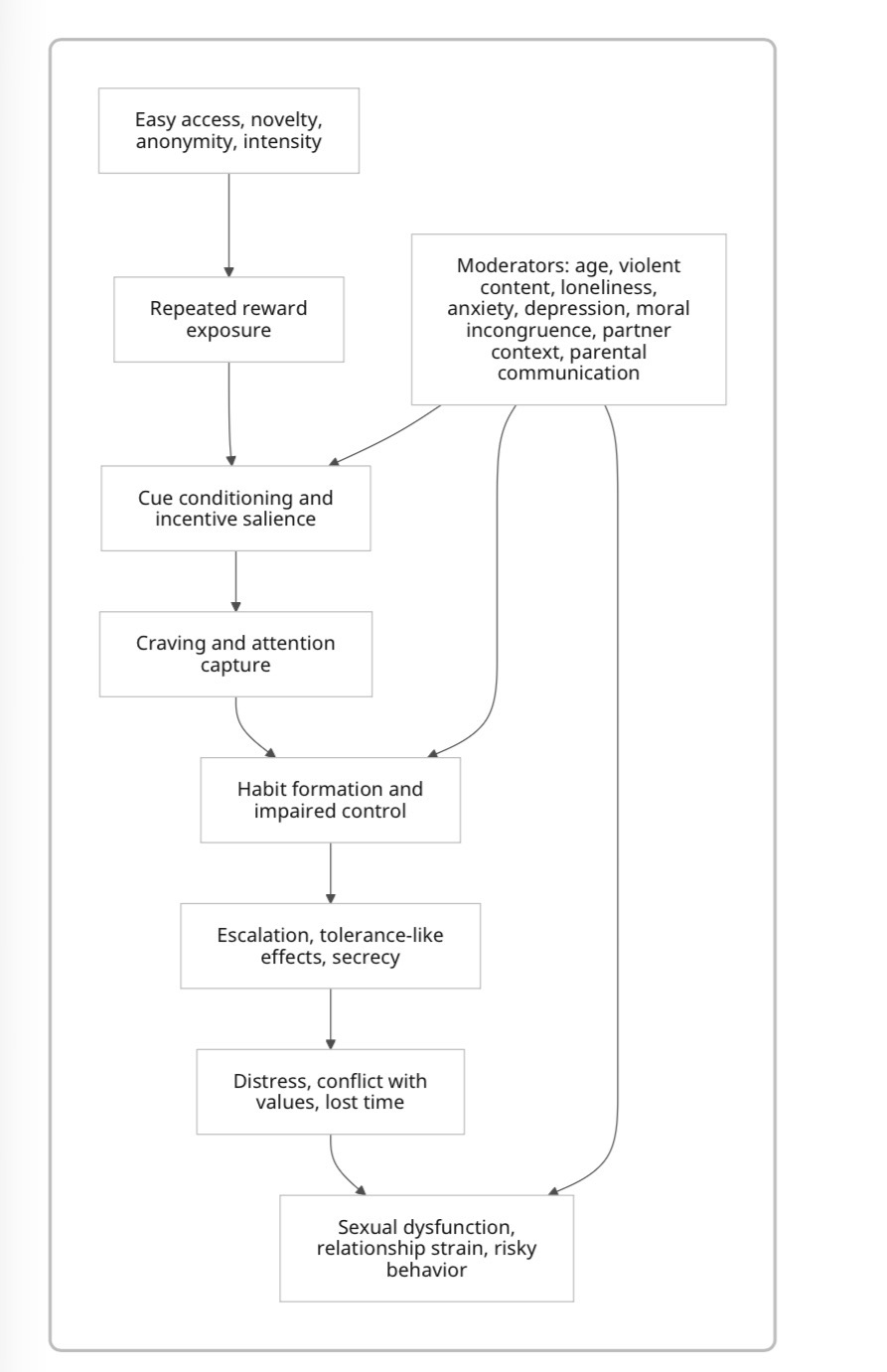
The most careful conclusion is that pornography does not “hijack the brain” in a mystical sense. Rather, in vulnerable users it appears capable of recruiting the same basic learning machinery seen in other compulsive or addictive patterns: novelty-driven reward, cue conditioning, craving, habit consolidation, and weaker top-down control. That is a serious concern because online pornography is unusually optimized for repetition: endless novelty, immediate accessibility, privacy, and low friction.
The following diagram summarizes the proposed causal pathway most often discussed in the literature. It should be read as a synthesis of converging evidence rather than a proven linear chain in every user.
Psychological, sexual, and relational effects
On mental health, the literature is clearest for problematic pornography use, not for pornography exposure in the abstract. Large representative analyses report that PPU is positively associated with anxiety, depression, and loneliness, while self-perceived problematic use predicts significant distress even after accounting for some background variables. In a 2024 paper using cross-sectional and longitudinal samples, PPU was linked to higher initial levels of suicidal thoughts and self-perceived likelihood of suicidal behavior, whereas simple frequency of pornography use itself was not consistently related to those outcomes. That distinction is clinically important: dysregulation appears more toxic than use frequency alone.Still, the evidence is not one-sided. In a six-wave study of Croatian adolescents, involving 775 girls and 514 boys, growth in pornography use did not correspond to changes in self-esteem, depression, or anxiety over time for either sex; only a baseline negative association appeared for girls. That is one of the strongest reminders that pornography is not a universal, one-directional cause of emotional decline. The more defensible interpretation is that harms cluster in subgroups and contexts, not in every exposed adolescent.
Sexual functioning is similarly mixed, but the harm signal is still notable. A 2019 integrative review of observational studies concluded that the strongest evidence concerns decreased sexual satisfaction, while evidence that pornography directly causes erectile dysfunction or delayed ejaculation remains limited and methodologically weaker. A study of younger heterosexual men similarly found little evidence that pornography use was a major risk factor for desire, erectile, or orgasmic problems. Yet more recent work suggests that specific content patterns matter: rough-sex pornography and problematic use have been associated with lower sexual function and lower satisfaction in some samples. The best synthesis is that routine frequency alone is an unreliable proxy, but problematic use, escalation, and some styles of content exposure are more strongly linked to dysfunction.
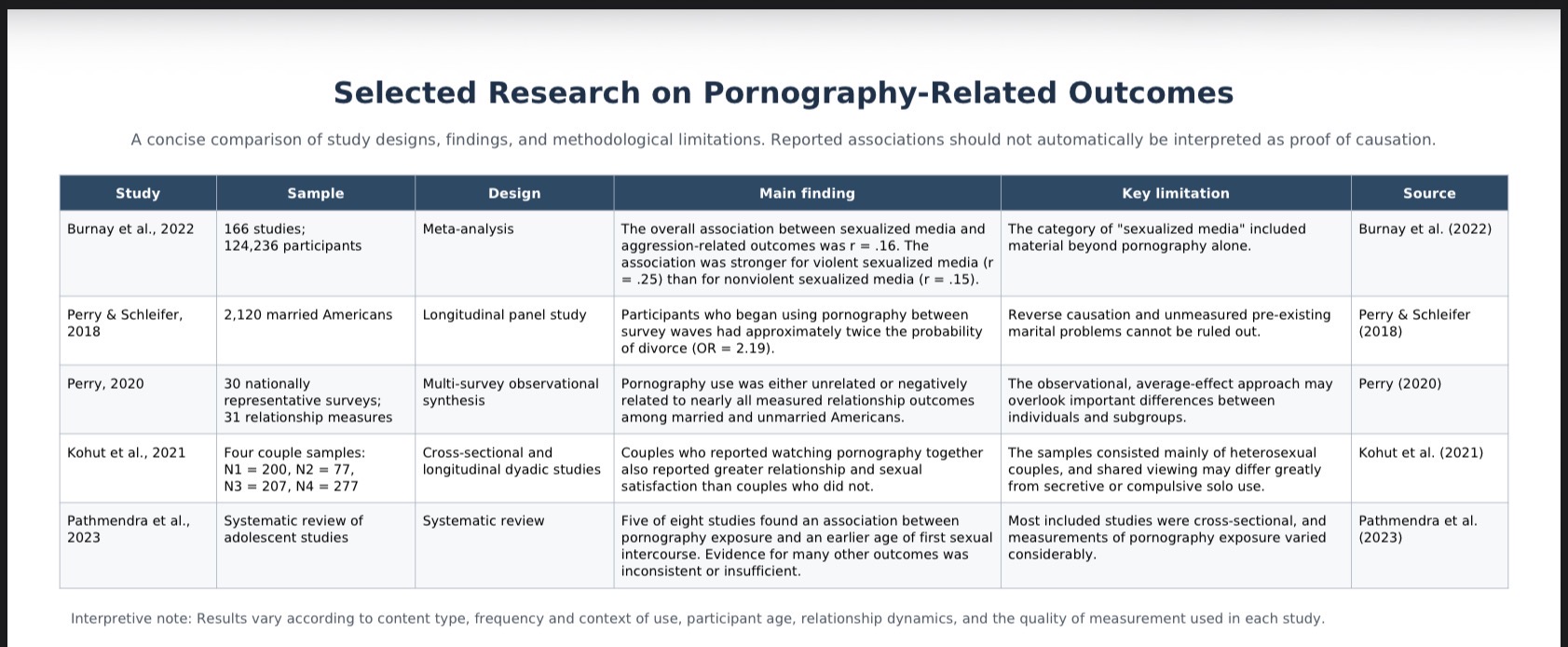
Relationship findings are more consistently negative than the sexual-function literature. In a nationally representative panel, the probability of divorce roughly doubled for married Americans who began pornography use between waves, with an odds ratio of 2.19. In another analysis of 30 nationally representative surveys including 31 measures of relationship quality, pornography use was either unassociated or negatively associated with nearly all relationship outcomes for both married and unmarried Americans. These are not perfect causal demonstrations, but they are difficult to dismiss as isolated studies.
At the same time, the dyadic context matters. Kohut and colleagues found across two cross-sectional and two longitudinal couple samples that partners who watched pornography together reported higher relationship and sexual satisfaction than partners who did not. That does not erase the broader negative literature; it complicates it. Joint, mutually agreed use within transparent relationships is not the same phenomenon as secret, solo, escalating, or compulsive use. In other words, the relational harm often seems to be carried by secrecy, discrepancy, compulsivity, and conflict—not merely by the presence of erotic media in a relationship.
Social attitudes, sexual scripts, and behavioral outcomes
The social-harm literature is strongest when it examines attitudes, scripts, and aggression-related outcomes, especially where violence is present in the material. Burnay and colleagues meta-analyzed 166 independent studies with 124,236 participants and found overall small-to-moderate associations between sexualized media and aggression-related thoughts, feelings, attitudes, and behaviors. The effect size was stronger for violent sexualized media than for nonviolent sexualized media, but nonviolent sexualized media still showed a significant association.An earlier meta-analysis specifically found that pornography consumption was positively associated with men’s attitudes supporting violence against women, with stronger associations for sexually violent pornography than for nonviolent pornography. A separate meta-analysis of media consumption and rape myth acceptance found a small but statistically significant relationship, with violent pornography and general pornography among the media types most clearly driving the effect. These are not merely moral claims; they describe measurable attitude shifts with plausible downstream consequences.
Sexual-script theory helps explain why. In a U.S. sample of 487 college men, Sun and colleagues concluded that pornography provides a powerful heuristic model for expectations and behavior during sexual encounters. Higher pornography use was negatively associated with enjoying sexually intimate behavior with a partner. That finding aligns with a broader concern in the literature: pornography often teaches performance, novelty, and stylized dominance more effectively than it teaches reciprocity, slowness, or mutual attunement.
Risk-behavior studies add further concern. Wright and colleagues reported in two studies that pornography consumption was directly associated with a higher likelihood of condomless sex, partly through perceived peer norms. In adolescents, a 2023 systematic review found that five of eight studies examining earlier sexual debut reported a significant association with pornography exposure, including one longitudinal study, although the broader evidence for other outcomes remained conflicting or insufficient. The signal here is real, but it is not clean enough to justify mechanistic certainty.
This is also where developmental vulnerability becomes especially important. Reviews of adolescents increasingly conclude that pornography is linked to more permissive sexual attitudes, gender-stereotypical beliefs, risky sexual behavior, sexting, and sexual aggression indicators, even though effect sizes and directions vary. The harmful potential is amplified by the fact that pornographic sexual scripts often omit risk responsibilities such as condom use, negotiation, and consent communication.
Psychological, sexual, and relational effects
On mental health, the literature is clearest for problematic pornography use, not for pornography exposure in the abstract. Large representative analyses report that PPU is positively associated with anxiety, depression, and loneliness, while self-perceived problematic use predicts significant distress even after accounting for some background variables. In a 2024 paper using cross-sectional and longitudinal samples, PPU was linked to higher initial levels of suicidal thoughts and self-perceived likelihood of suicidal behavior, whereas simple frequency of pornography use itself was not consistently related to those outcomes. That distinction is clinically important: dysregulation appears more toxic than use frequency alone.Still, the evidence is not one-sided. In a six-wave study of Croatian adolescents, involving 775 girls and 514 boys, growth in pornography use did not correspond to changes in self-esteem, depression, or anxiety over time for either sex; only a baseline negative association appeared for girls. That is one of the strongest reminders that pornography is not a universal, one-directional cause of emotional decline. The more defensible interpretation is that harms cluster in subgroups and contexts, not in every exposed adolescent.
Sexual functioning is similarly mixed, but the harm signal is still notable. A 2019 integrative review of observational studies concluded that the strongest evidence concerns decreased sexual satisfaction, while evidence that pornography directly causes erectile dysfunction or delayed ejaculation remains limited and methodologically weaker. A study of younger heterosexual men similarly found little evidence that pornography use was a major risk factor for desire, erectile, or orgasmic problems. Yet more recent work suggests that specific content patterns matter: rough-sex pornography and problematic use have been associated with lower sexual function and lower satisfaction in some samples. The best synthesis is that routine frequency alone is an unreliable proxy, but problematic use, escalation, and some styles of content exposure are more strongly linked to dysfunction.
Relationship findings are more consistently negative than the sexual-function literature. In a nationally representative panel, the probability of divorce roughly doubled for married Americans who began pornography use between waves, with an odds ratio of 2.19. In another analysis of 30 nationally representative surveys including 31 measures of relationship quality, pornography use was either unassociated or negatively associated with nearly all relationship outcomes for both married and unmarried Americans. These are not perfect causal demonstrations, but they are difficult to dismiss as isolated studies.
At the same time, the dyadic context matters. Kohut and colleagues found across two cross-sectional and two longitudinal couple samples that partners who watched pornography together reported higher relationship and sexual satisfaction than partners who did not. That does not erase the broader negative literature; it complicates it. Joint, mutually agreed use within transparent relationships is not the same phenomenon as secret, solo, escalating, or compulsive use. In other words, the relational harm often seems to be carried by secrecy, discrepancy, compulsivity, and conflict—not merely by the presence of erotic media in a relationship.
Social attitudes, sexual scripts, and behavioral outcomes
The social-harm literature is strongest when it examines attitudes, scripts, and aggression-related outcomes, especially where violence is present in the material. Burnay and colleagues meta-analyzed 166 independent studies with 124,236 participants and found overall small-to-moderate associations between sexualized media and aggression-related thoughts, feelings, attitudes, and behaviors. The effect size was stronger for violent sexualized media than for nonviolent sexualized media, but nonviolent sexualized media still showed a significant association.An earlier meta-analysis specifically found that pornography consumption was positively associated with men’s attitudes supporting violence against women, with stronger associations for sexually violent pornography than for nonviolent pornography. A separate meta-analysis of media consumption and rape myth acceptance found a small but statistically significant relationship, with violent pornography and general pornography among the media types most clearly driving the effect. These are not merely moral claims; they describe measurable attitude shifts with plausible downstream consequences.
Sexual-script theory helps explain why. In a U.S. sample of 487 college men, Sun and colleagues concluded that pornography provides a powerful heuristic model for expectations and behavior during sexual encounters. Higher pornography use was negatively associated with enjoying sexually intimate behavior with a partner. That finding aligns with a broader concern in the literature: pornography often teaches performance, novelty, and stylized dominance more effectively than it teaches reciprocity, slowness, or mutual attunement.
Risk-behavior studies add further concern. Wright and colleagues reported in two studies that pornography consumption was directly associated with a higher likelihood of condomless sex, partly through perceived peer norms. In adolescents, a 2023 systematic review found that five of eight studies examining earlier sexual debut reported a significant association with pornography exposure, including one longitudinal study, although the broader evidence for other outcomes remained conflicting or insufficient. The signal here is real, but it is not clean enough to justify mechanistic certainty.
This is also where developmental vulnerability becomes especially important. Reviews of adolescents increasingly conclude that pornography is linked to more permissive sexual attitudes, gender-stereotypical beliefs, risky sexual behavior, sexting, and sexual aggression indicators, even though effect sizes and directions vary. The harmful potential is amplified by the fact that pornographic sexual scripts often omit risk responsibilities such as condom use, negotiation, and consent communication. To sum up don’t watch porn. @Jenson he made all of it btw.