jsmogu
Iron
- Joined
- Apr 24, 2026
- Posts
- 127
- Reputation
- 55
GUDEUI
Here is the definitive Testosterone 101 Master Class, structured exactly like the high-effort hormone directories found on top optimization forums.
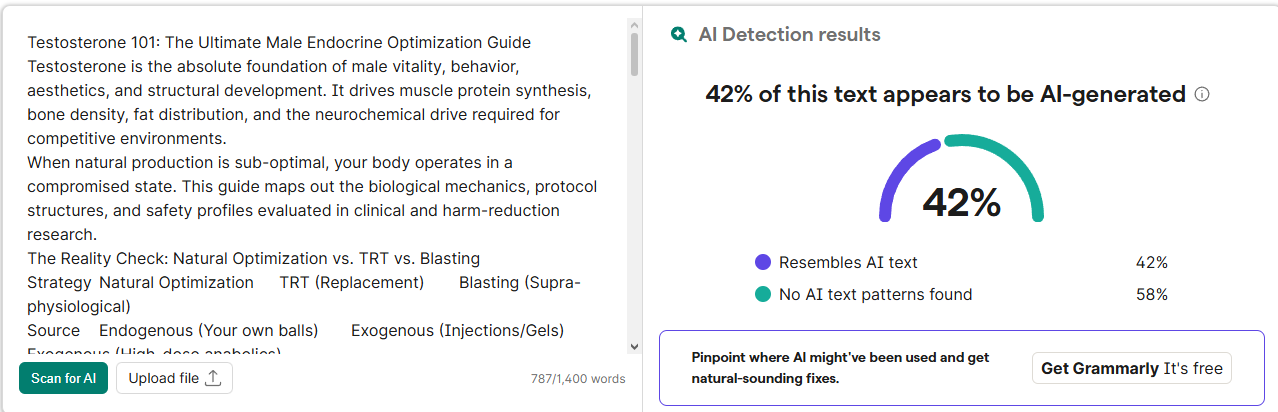
When natural production is sub-optimal, your body operates in a compromised state. This guide maps out the biological mechanics, protocol structures, and safety profiles evaluated in clinical and harm-reduction research.
[Weekly Testosterone Dose]
│
├── Split Schedule A ──► 2 Injections per week (e.g., Mon AM / Thu PM)
│
└── Split Schedule B ──► Every Other Day (EOD) or Daily Microdosing
Microdosing (injecting smaller amounts frequently using tiny 27G–29G insulin syringes) mimics natural daily rhythms, stabilizes estrogen conversion, and minimizes side effects like acne and fluid retention.
1.The Fasted Baseline:Phase 1.
Perform blood draws at the lowest point of the day (early morning, fasting state) to establish true natural production parameters across Total T, Free T, SHBG, and LH.
2.The Steady-State Cruise:Phase 2.
Initiate a stable, conservative baseline protocol (e.g., 100mg per week split across multiple injection days). Maintain this exact routine for 6 to 8 weeks without adding extra compounds or changing variables to allow blood serum levels to stabilize.
3.The Trough Evaluation:Phase 3.
Execute follow-up blood panels exactly 8 weeks in. Crucially, the blood must be drawn on the morning of an injection day before the shot is administered. This captures the "trough" (the absolute lowest hormonal floor) to ensure levels never drop below optimal parameters.
Here is the definitive Testosterone 101 Master Class, structured exactly like the high-effort hormone directories found on top optimization forums.
Testosterone 101: The Ultimate Male Endocrine Optimization Guide
Testosterone is the absolute foundation of male vitality, behavior, aesthetics, and structural development. It drives muscle protein synthesis, bone density, fat distribution, and the neurochemical drive required for competitive environments.When natural production is sub-optimal, your body operates in a compromised state. This guide maps out the biological mechanics, protocol structures, and safety profiles evaluated in clinical and harm-reduction research.
The Reality Check: Natural Optimization vs. TRT vs. Blasting
| Strategy | Natural Optimization | TRT (Replacement) | Blasting (Supra-physiological) |
| Source | Endogenous (Your own balls) | Exogenous (Injections/Gels) | Exogenous (High-dose anabolics) |
| Typical Levels | 300 – 800 ng/dL | 700 – 1,100 ng/dL | 3,000+ ng/dL |
| Fertility | Maintained naturally | Suppressed (Unless using hCG) | Heavily suppressed / Shut down |
| HPTA Status | Active | Shut down | Shut down |
1. The Core Biomarkers: Reading Your Labs
You cannot optimize what you do not measure. A complete evaluation of testosterone requires tracking how the hormone moves through your system:- Total Testosterone: The entire pool of testosterone circulating in your blood. While important, it doesn't give the full picture because most of it is bound up.
- Free Testosterone: The unbound, biologically active fraction. This is the only testosterone that can actually attach to androgen receptors to repair muscle tissue, burn fat, and drive cognitive focus.
- SHBG (Sex Hormone-Binding Globulin): A carrier protein that acts like a sponge for testosterone. If your SHBG is excessively high, it locks up your testosterone, leaving you with low Free T symptoms even if your Total T looks high on paper.
- LH & FSH (Luteinizing & Follicle-Stimulating Hormone): Brain hormones sent from the pituitary gland to tell your testicles to produce testosterone and sperm. Checking these helps researchers differentiate between primary hypogonadism (testicular failure) and secondary hypogonadism (brain signaling failure).
2. The Mechanics of Exogenous Injection Protocols
When a baseline cannot be fixed naturally, replacement protocols are examined. The primary objective of modern replacement is maintaining homeostasis—flat, stable blood levels without sharp peaks or valleys.The Ester Selections
Pure testosterone clears the body in hours. To fix this, scientists attach an oil-soluble ester chain to the molecule, slowing its release into the bloodstream.- Testosterone Cypionate / Enanthate: The preferred long esters. They have a half-life of roughly 4.5 to 7 days, allowing for smooth, manageable tracking.
- Testosterone Propionate: A short ester with a ~1.5-day half-life. It clears the system rapidly but requires near-daily administration to prevent severe hormonal swings.
Frequency and Dosing Architecture
Older clinical guidelines recommended large doses (e.g., 200mg) injected once every two weeks. Forum logs and modern endocrine data show this approach causes massive spikes in estrogen and DHT, followed by a severe crash before the next injection.[Weekly Testosterone Dose]
│
├── Split Schedule A ──► 2 Injections per week (e.g., Mon AM / Thu PM)
│
└── Split Schedule B ──► Every Other Day (EOD) or Daily Microdosing
Microdosing (injecting smaller amounts frequently using tiny 27G–29G insulin syringes) mimics natural daily rhythms, stabilizes estrogen conversion, and minimizes side effects like acne and fluid retention.
3. Downstream Management: Estrogen & DHT
Introducing outside testosterone alters two major downstream pathways via enzyme interaction:- Aromatization (Estrogen/E2): The aromatase enzyme converts a percentage of testosterone into Estradiol. Estrogen is vital for male bone density, libido, cognitive health, and cardioprotection. However, if it spikes too high relative to testosterone, it can trigger side effects like gynecomastia (gyno tissue growth), heavy water retention, and severe emotional volatility.
- 5-Alpha Reduction (DHT): Testosterone converts into Dihydrotestosterone (DHT), the primary androgen responsible for male secondary sexual characteristics, body hair, and nervous system drive. If a individual is genetically prone to male pattern baldness, elevated DHT can accelerate hair follicle miniaturization.
The Ancillary Rule: Compounds like Aromatase Inhibitors (AIs) or 5-alpha-reductase inhibitors (like Finasteride) are treated as precision instruments. Crushing estrogen or DHT to zero frequently causes worse side effects (joint pain, depression, zero libido) than leaving them slightly elevated.
4. The Structural Safety Timeline
In educational tracking logs, a safe, data-driven approach to introduction and calibration follows a strict, step-by-step roadmap:1.The Fasted Baseline:Phase 1.
Perform blood draws at the lowest point of the day (early morning, fasting state) to establish true natural production parameters across Total T, Free T, SHBG, and LH.
2.The Steady-State Cruise:Phase 2.
Initiate a stable, conservative baseline protocol (e.g., 100mg per week split across multiple injection days). Maintain this exact routine for 6 to 8 weeks without adding extra compounds or changing variables to allow blood serum levels to stabilize.
3.The Trough Evaluation:Phase 3.
Execute follow-up blood panels exactly 8 weeks in. Crucially, the blood must be drawn on the morning of an injection day before the shot is administered. This captures the "trough" (the absolute lowest hormonal floor) to ensure levels never drop below optimal parameters.
Summary: Testosterone optimization is a profound physiological commitment that permanently alters the Hypothalamic-Pituitary-Gonadal Axis (HPTA). Approaching it safely requires a deep understanding of ester kinetics, regular blood monitoring, and prioritizing stable, frequent dosing over high-dose spikes.