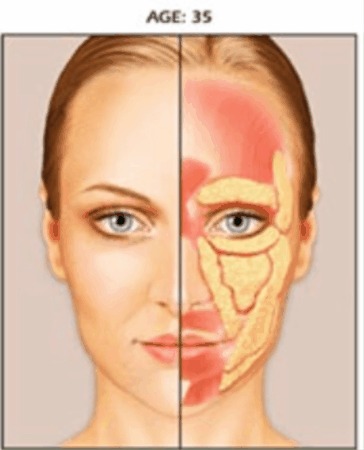
Guide to understand fat pads and its effect on ethnicity + correcting older mistakes

Askinov

Askinov

𝙱𝚅𝙻𝙻 | 𝓦.𝓓 - 𝓢𝓾𝓫 𝓻𝓸𝓼𝓪 ® |
Joined
Oct 31, 2025
Posts
5,289
Reputation
12,591


Table of contents
1. Introduction to facial fat-pads
2. Facial Fat Pad Anatomy
3.Know how your ethnicity affects it

The introduction part only explains and gives knowledge about why fat pad matters . This thread wont talk about any extra stuff and only talk about the thing that it promises in title


1. Introduction to facial fat-pads
Gif


DISCLAIMER : If you have an iq over a room temperature ( in celsius scale ) you will know that the bones are not only the major part that affects your face. your facial muscles , tissue , fat pads , skin are also the real stuff that can make or break your face . if you know this then proceed further
Q1 : What is facial fat pads ?
~> So don't think about it too much its just fat pads it is anatomically distinct adipose tissue located on different layers of face
which are responsible for
1. facial volume
~> Reason why people do facial fat transfer
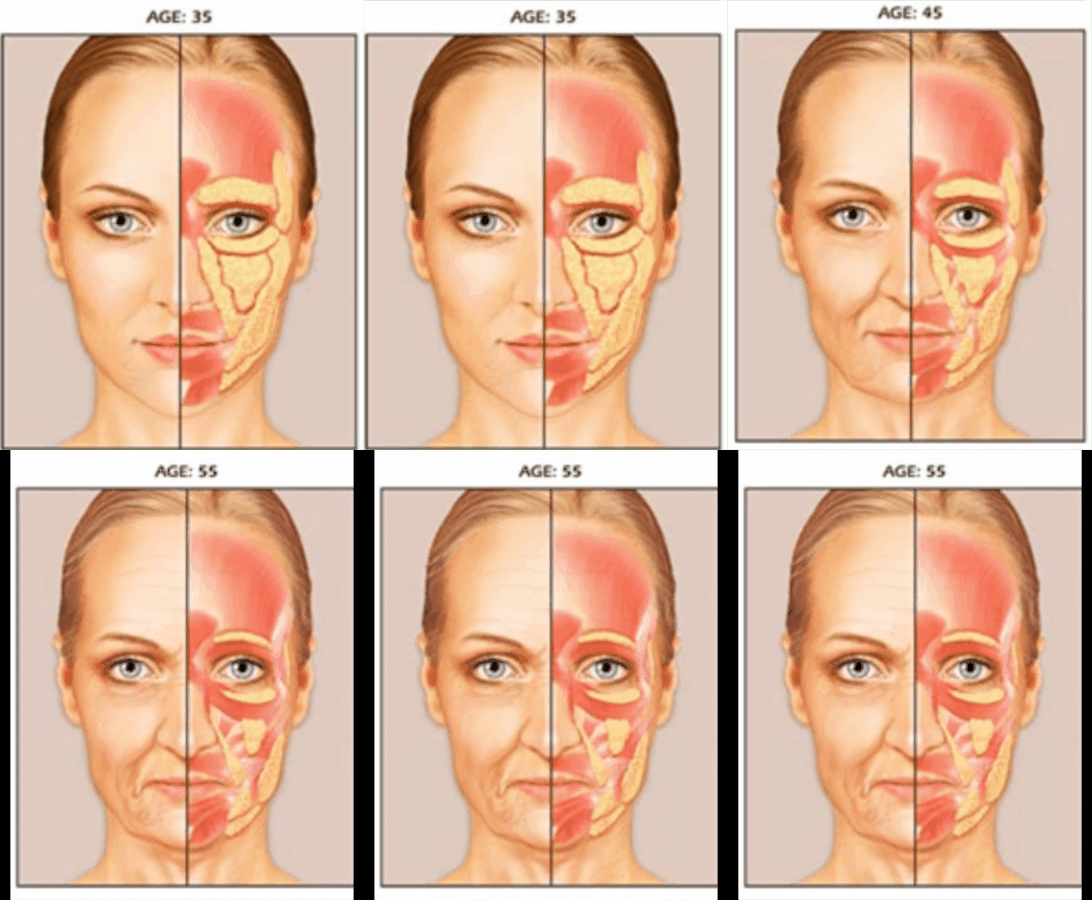
2. facial aging
~> Do i even need to explain it gives support and volume to skin so the skin won't sag down
3.Youthful appearance
~> Facial aging bhaijhan aged face = lack of youthful appearance simple
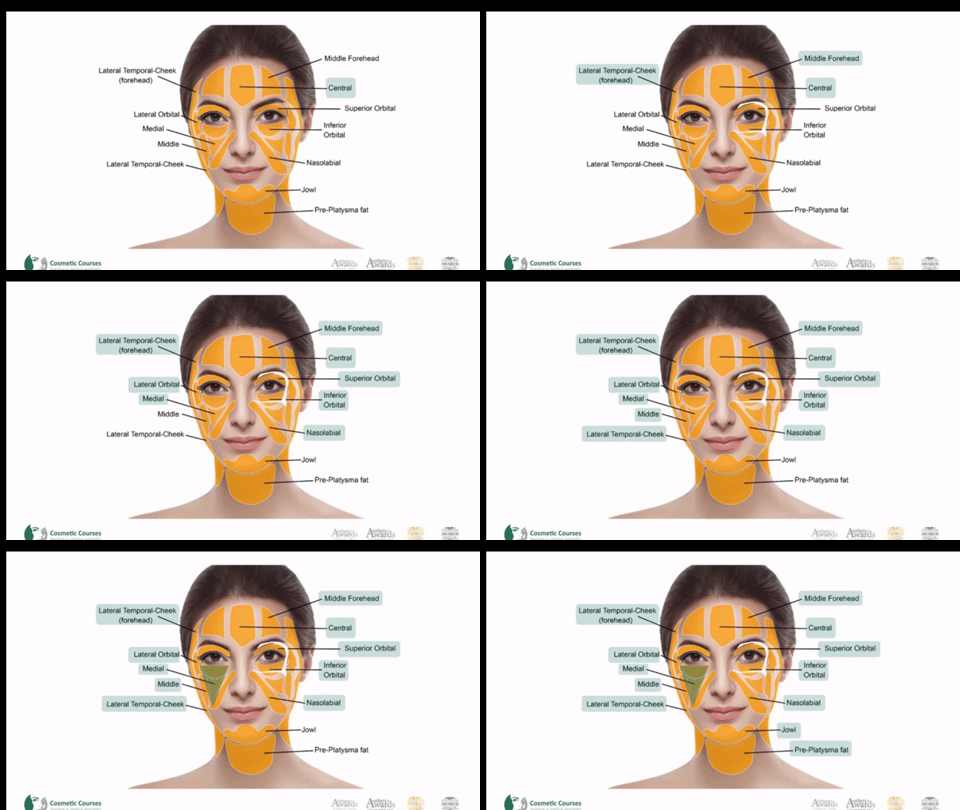
Giphy 1


This gif must be enough to explain why facial fat pad matters !
Q2 : So what facial fat pad does in health aspect ?
1. Help gliding of muscle during movement
2 . Shock absorption
3. Nerve safety
4.Thermal insulation
So these lies on 2 layers or are of two type ( superficial fat pads , deep fat pads )
i will explain these in short in here so i can explain aging and fatloss in fat pads . from my trailer i have this
Superficial : The facial fat pads are separated by fibrous septa, thin walls of connective tissue. This separation is important for each fat pad’s function and appearance.
as the name sounds its not deep in the body its superficial its near the skin
Deep fat pads: contain subcutaneous white adipose tissue (sWAT) separated by the superficial musculoaponeurotic system (SMAS) in the midface and the superficial temporal fascia in the temple. Boundaries of these deep fat pads are created by facial muscles and retaining ligaments

LayerLocationPrimary Role
SuperficialJust under the skin, above the facial musclesProvides soft tissue shape, moves with facial expressions
DeepBeneath the muscles, resting directly against the facial bonesActs as the structural foundation and support for the face
Q3 : So askin if the facial fat is so important how can we preserve it then ? and is every fat pad important ?
To answer this question we need to know . how does it even reduces at the 1st place ? and no every fat pad is not important and some can break your looks which i will again be talking in 2nd chapter
Reason 1. Going to really low bf % so going to 10 to 12 % is ideal for looksmaxing but going below that causes you to lose some important facial fat pads too
Reason 2. Aging so at the 1st part you know that with age your body loses stem cell which is important to replicate and maintain tissue or fat tissue with age you lose this and this will cause to lose your fat pads and in the second will be losing collagen as your body loses collagen as you age the fibrous walls (septa) that enclose fat cells and keep them tightly tightly compartmentalized breaks down and the fat pad sags down
Reason 3 . Lack of nutrition
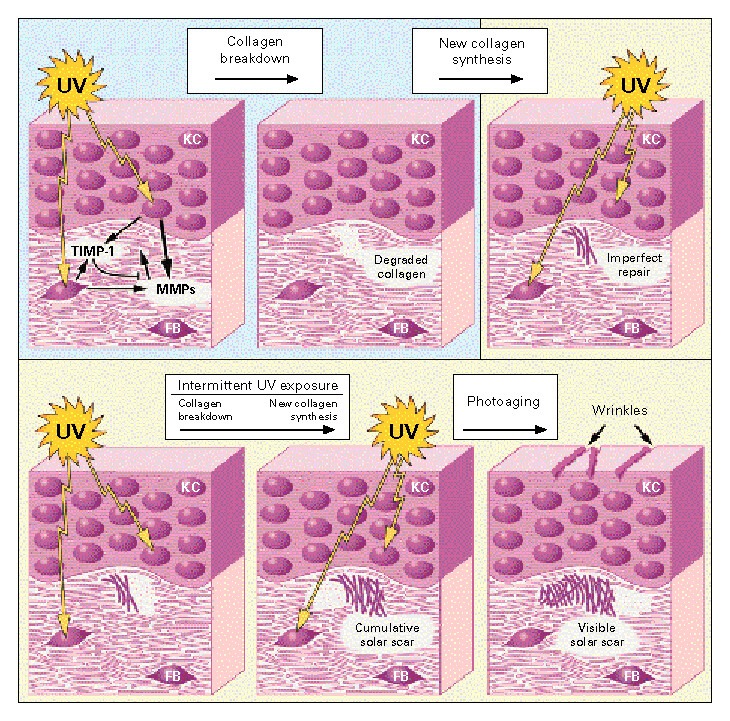
Reason4 . Sun
UV rays → ROS → MMP & ECM upregulate → degrade collagen → degradation of fibrous wall septa in holding fat pad = loss of fat pad/sag down
Nejm199711133372003 f5


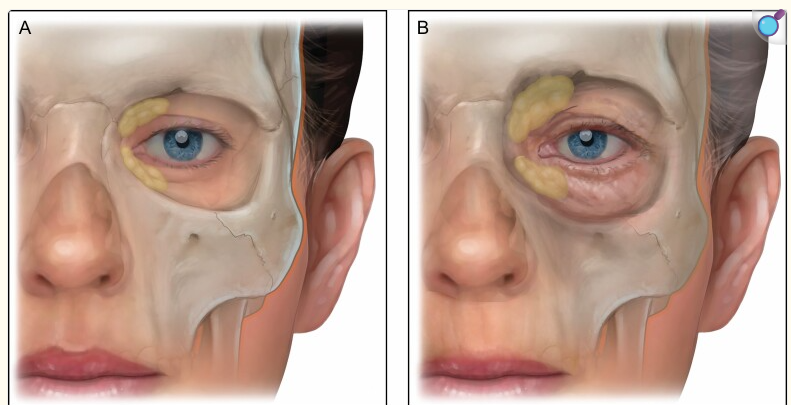
Reason 5 . bone recession with age as we age we lose collagen that builds up the bone causing recession of bone’s and these bones holds the fat pads in place and after we lose them the stuff that holds the fat pad is now gone causing it sag and lose over time
1786787612302.png

y sure there are many collagen threads in the forum
2. Diet and not being in nutrient deficient falls under improving collagen
3.sunscreen
4 .decreasing ros and oxidative damage to dna via taking nac
https://pmc.ncbi.nlm.nih.gov/articles/PMC5944265/
Dosing based on this article Nac article 600 to 1200 mg nac per day
5 Although volufiline is cope mostly you can check this out
Use volufiline 1 to 2 times a day every day use a pea sized amount / tiny amount you will see result in 2 to 3 weeks if it worked

Volufiline article

6. Improving stem cells via stem cell therapy . This stuff for now is experimental and further research is going on and it is effective only for treating cancer

These both paper are almost same view and conclude if you like from one of them
https://pmc.ncbi.nlm.nih.gov/articles/PMC11104807/#Sec11 discusses about vitamin and stem cell regulation path ways
Tldr ; decrease ros sunlight exposure and improve diet
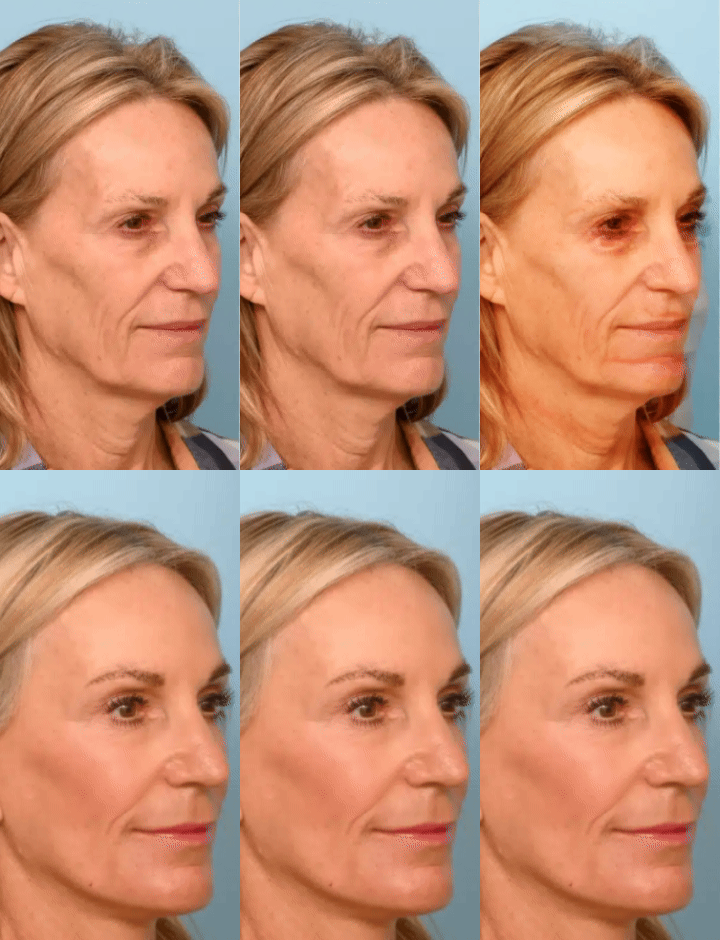
7. Fat transfer to the face . fat grafting is done for to give volume in face it is done by a surgeon taking fat from a part of your own body like thigh abdomen or flanks they like purify the fat by leaving out like some dead cells oils and fluid then the fat is injected layer by layer
The main issue with this is that the 20 to 50% fat are reabsorbed so you will lose some in over time
Example of fat transfer to whole face
0814


2.Facial Fat Pad Anatomy

So now listen !
There are two fat pad layer
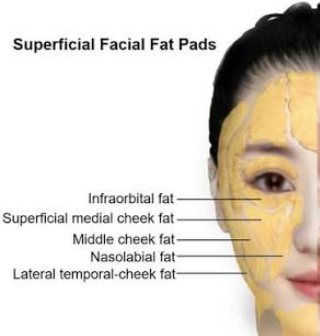
1. Superficial Facial Fat pad
2. Deep Facial Fat Pad
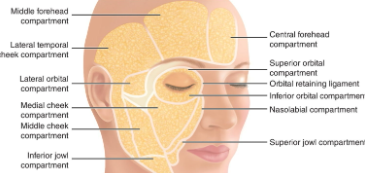
3.Retroseptal (superior orbital fat pad)( different zone but on the ethnicity table at last i added in superficial fat pad ) so manage it ~ aka i already wrote it so i got lazy to change it

0817


1. Superficial Facial Fat Pad is a layer of fat tissue located beneath the dermis directly above the face’s layer known as the Superficial Musculoaponeurotic System (SMAS).
The work of superficial fat is to give volume to face and make it look youthful ( main fat
Pad layer which is important in facial aging

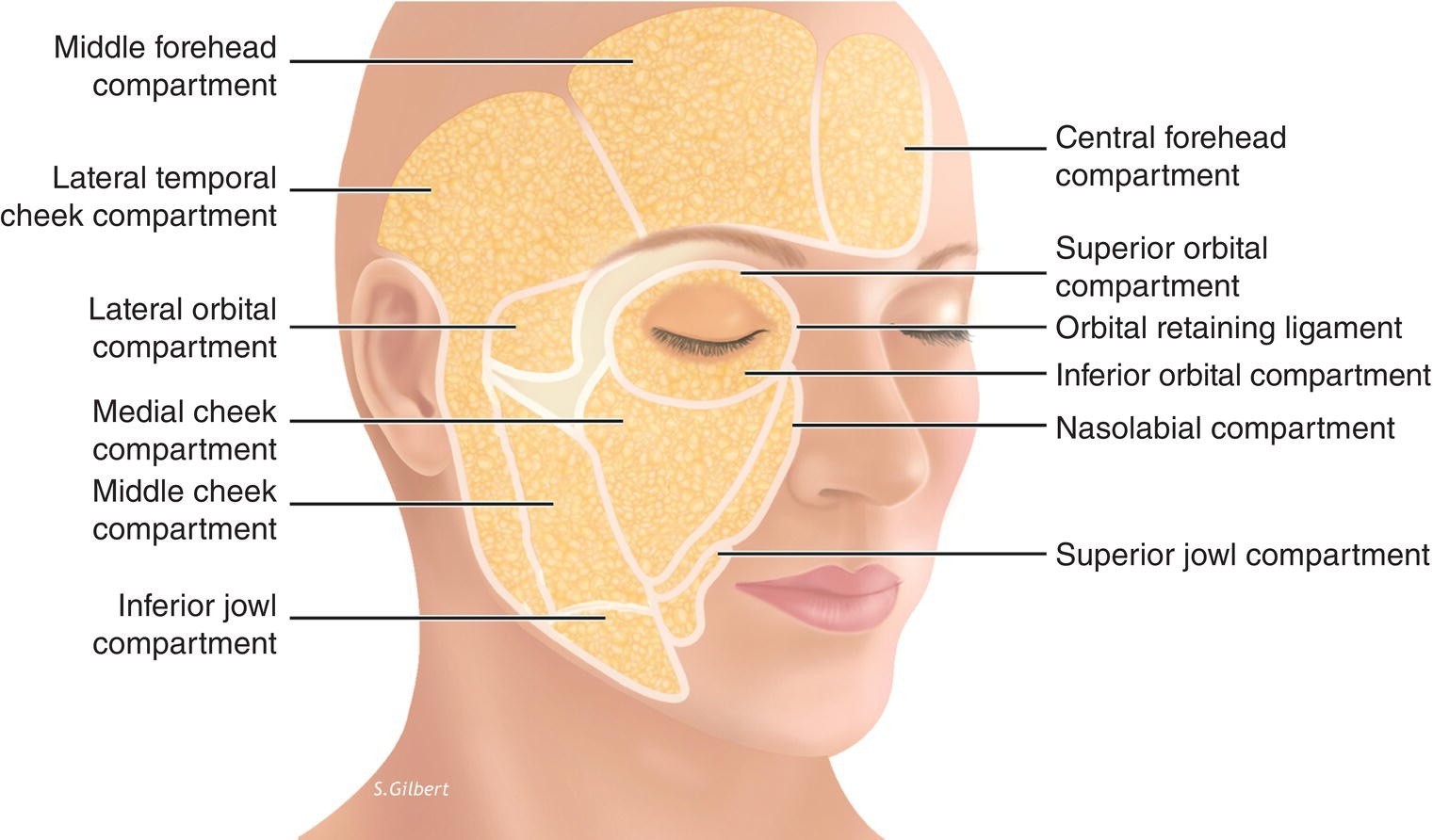
1.1 Compartments Under Superficial Fat Pads And Their Action

1.1.1 Midface Compartment
1.1.1.1 Nasolabial Fat Compartment
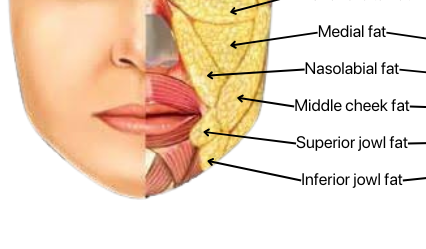
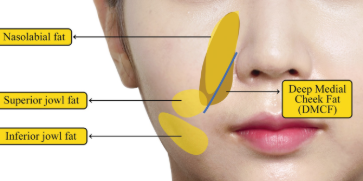
Extends from lateral nasal ala to down to the oral commissure. Is a superficial layer anchored by fibrous septa and ligaments . This fat is important for looks to manage smile lines give volume and structure and manages nasolabial folds which comes as we age
1786339869004

Compartment where sufficient fat is required = fat graft to this area if there is lack of fat
1.1.1.2 Medial Cheek Fat Compartment
Sits directly on the maxilla beneath the facial muscle having two boundary medial → pyriform ligament near the base of the nose , Superficial boundary → Orbicularis retaining ligament under
This fat compartment plays a role in looks by giving the looks of og curve . important for facial aging this sags down with age making it look worse as we age , as for og curve this also depends on your zygomatic bone projection but this can give contour to og curve
Compartment where sufficient fat is required = fat graft to this area if there is lack of fat
1786866159728

1.1.1.3 Middle Cheek Fat Compartment
Lies at dermis layer sits superficial to SMAS ( superficial musculoaponeurotic system ) connects closely with neighboring Superficial fat pads like nasolabial fat pad and medial cheek fat
Also same goes for aging it sags down as you age making it look worse in the midface region
This is the fat pad which you don’t wanna have in excess looks unhealthy and make your midface bulge out
laterally . aka you look fat
Compartment where fat is not much required = fat dissolvers and Surgical fat removal / liposuction
1786979566561

1.1.1.4 Infra Orbital Fat Compartment
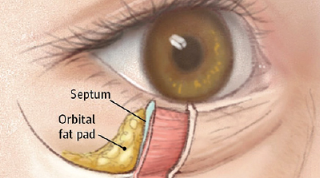
Located under the eye above the mid - cheek it helps to transition between lower eyelid and cheek . It’s actual anatomy is that it is positioned beneath orbicularis oculi in mid face and interacts with tear through and lip-cheek junction
A main fat compartment that is responsible for darkening or lightening of under eyes. Lack of fat = hollowness and dark Under eye . Though this also matters infra orbitals which is require to hold the fat and give projection
Still a major area where fat is required
1786979580733


1.1.1.5 Lateral Temporal-Cheek Compartment
Sits just under the 2nd layer of skin above the parotid Gland extends from the fronto temporal crest down the Outer frame of the face of mandible Sags as we age is important for midface contour facial Gives support on the face and give volume to the face Lateral
A place where sufficient fat is required so fat transfer
1786979592232


1.1.2 .Lower Face Fat Compartment
1.1.2.1 Superior Jowl Fat Compartment
Subcutaneous fat located above the mandibular border in the lower face . works along side the inferior jowl compartment to make up the soft tissue of jowl area . Found in superficial layer above the SMAs muscle layer directly over the lower jaw area . Sags down as you age and not a important fat pad
Lipo suction / fat dissolver can be done in this compartment
Gives puffy and down turned look for face
1786979605245

1.1.2.2 Inferior Jowl Fat Compartment
Fat pad located over jaw bone . Positioned inferior and posterior to superior jowl . Sags down as we age as every
fat pad in midface region and lower jaw region does . Also is positioned beneath the skin and superficial fascia.
Fat pad reason for jowling cause the jaw line to hide and Making lower third look bad and sagged down
Not a fat pad to have around Fat dissolvers and liposuction is Cool in here
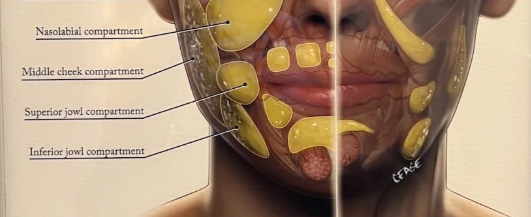
1786979615718


1.1.3 .Upper Face Fat Compartments
1.1.3.1 Central Forehead Fat Compartment
Sits between skin and frontalis muscle / SMAS layer bounded by Middle / lateral compartment on sides extending to nasal root Touches the middle temporal cheek fat compartments laterally And the nasal and dorsum/glabellar area inferiorly .
Contours the face and forehead region . facial concavity occurs in forehead when this fat is depleted and aging also depletes it
So a portion where sufficient fat is required as its support forehead Area and gives volume to it
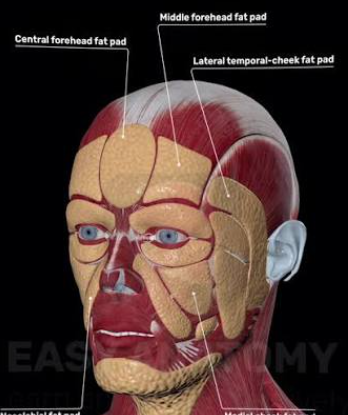
1786979628934


1.1.3.2 Middle Forehead Fat Compartments
Located laterally to central fat pad which is bounded Inferiorly by orbicularis oculi retaining ligaments two section Of this divided into left section and right section covering the Central fat pad . It is important for facial contouring as like Central fat pad also giving volume to fore head and Supporting it
Fore head concavity is associated with depleted middle Fat pad compartment
A place where sufficient fat is required
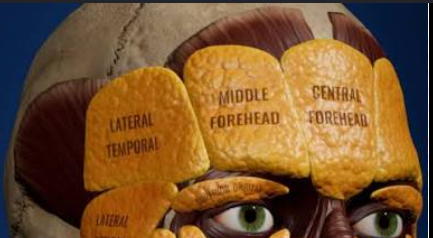
1786979642169


1.1.3.3 Lateral Temporal-Parietal Compartments
Its the same lateral temporal cheek compartment which i Talked above which just exist up to fore head section

1.1.4.2 Lateral Orbital Fat Compartment
A fat compartment located on outer corner of the side of eye socket near the temple which helps to shape the face around eye gives volume and projection to under eyes
Bounded by specific facial ligaments and septa including temporal septum helps to give contour to eyes and lack of it is Is responsible for a hollow and dark under eyes
Also an important place where fat is required
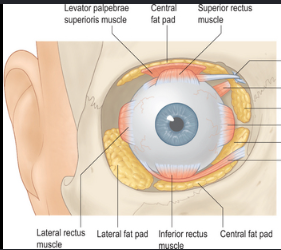
1786979694578


1.1.4.3 Inferior Orbital Fat Compartment
Already talked on section 1.1.1.4


2. Deep facial fat pad lies beneath the SMAS layer and facial muscle resting against periosteum works to serve as a static structural foundation that produces height and out ward projection and volume
2.1 Compartments Under Deep Facial Fat Pads And Their Action

2.1.1 Midface And Periorbital Deep Compartments
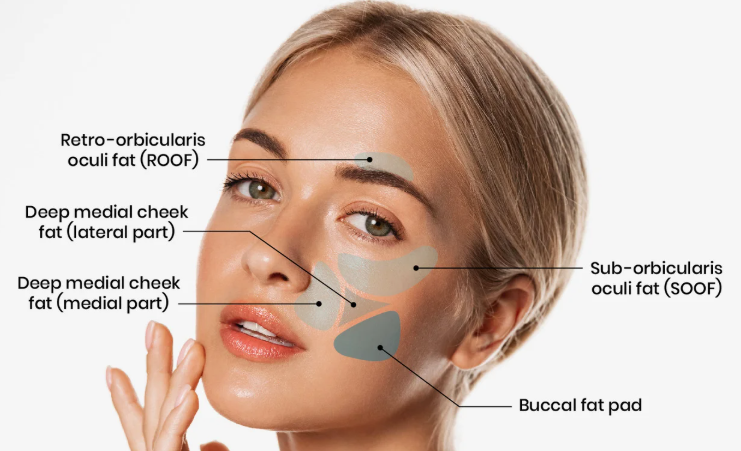
2.1.1.1 Deep Medial Cheek Fat Compartment
It is a distinct adipose compartment located on the maxilla deep within the facial muscle Sits near the side of the nose and stretches outward toward the buccal fat pad and major cheek muscles has two sections a medial part close to the nose and a lateral part next to the buccal fat
This supports the central face and age related volume loss causes midface flattening and deepens the nasolabial fold
So an important fat pad to have around
1786338961829


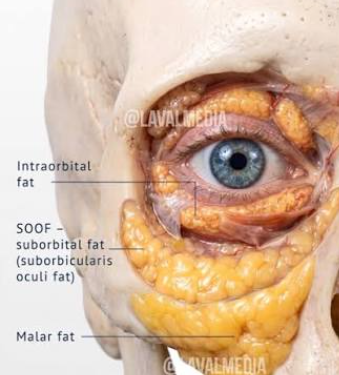
2.1.1.2 Sub-Orbicularis Oculi Fat Compartment
Distinct layer of fat located beneath the orbicularis oculi muscle and over the cheekbone in the lower eyelid and midface area .Divided into medial and lateral sections along the lower eye socket
Medial SOOF: Positioned under the inner half of the lower eyelid atrophy here creates dark circles and hollow tear troughs.
Lateral SOOF: Lies over the outer cheekbone , supporting in the high-cheekbone contour.
It provides structural volume to under eye and upper cheek
Loss of fat causes eye hollowing
Sags down and looks worse as you age
Area where fat is required
1787026673399


2.1.2. Upper Face Deep Compartments
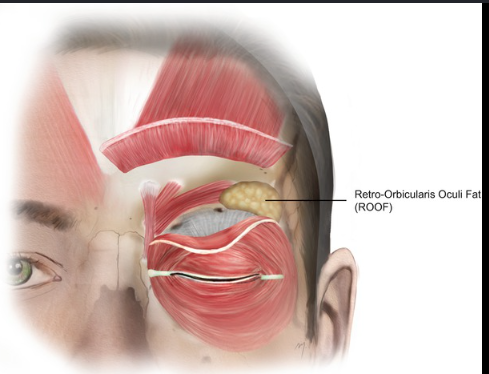
2.1.2.1 Retro-Orbicularis Oculi Fat Compartment
Lies deep to the orbicularis oculi muscle . Is superficial to orbital septum and superior orbital rim
Provides support to brow and is a reason for upper eyelid hooding
Lack of fat here causes sunken upper eyelid
Distributed near the inner corner of eye and thicker toward outer brow
Area where sufficient fat is required
1787027263893


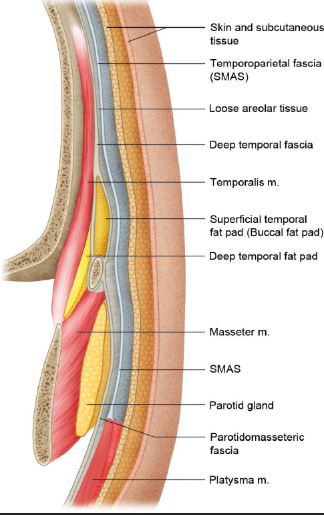
2.1.2.2 Deep Temporal Fat Pad
Its just nothing its a deep layer of temporal fat which sits beneath the deep temporal fascia over the temple bone, cushioning the temporalis muscle
and lack of it also gives the sunken look
you also wanna have fat in here as it contours upper face
1787030300236.png


2.1.2.3 Buccal Fat Compartment
Sits deep in the cheek between facial muscles, underneath the cheekbones and outside the buccinator muscle. Consists of a main body and three lobes (anterior, intermediate, and posterior) extending toward the temple
it is the real reason why some ppl can have baby face appearance
a fat you wanna lose
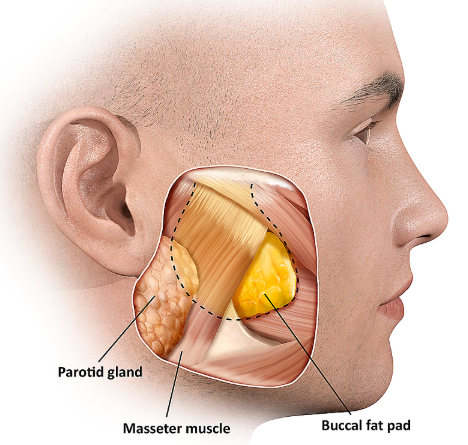
1786338882851


2.1.2.4 Submental Fat Compartment
A submental fat pad is the layer of adipose tissue located beneath the chin and above the platysma muscle, commonly known as a double chin
Bounded by the digastric or platysma-retaining septae and Separated from the chin compartment by the submental ligaments
also known as platysma fat useless fat it hides the chin and removal of this fat is necessary
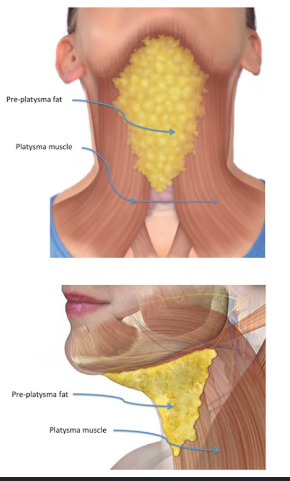
1787031666501.png


Periorbital Fat Compartments - Different anatomical zone not under superficial but Deep (Retroseptal) Compartments
1.1.4.1 Superior Orbital Fat Compartment (medial and preaponeurotic)

There are two pockets of deep fat located in upper eye behind the orbital septum and in front of levator muscle
They include the medial fat pad and the central Preaponeurotic fat pad
Is important fat pad and is important for to get hooded eye / hunter eyes and give volume to eyes and shape upper eye area
A place where enough fat is required
This also sags down with age and gives the looks of even more hooded eyes
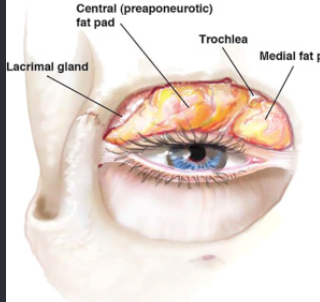
1789924288567


3.Know how your ethnicity affects it

Just dance ! its gonna be okay
How to analyse your phenotype / ethnicity .
Knowing your actual phenotype (not just your race) is the difference between guessing and actuallying knowing which fat pads are your weak points vs. strengths. Different anthropological types have systemically soft-tissue distribution, cheekbone projection, midface volume, orbital fat, and how the face ages / loses fat
Step by step method to analyse your phenotype (for newbies):

  1. Goto http://humanphenotypes.net/
  • Get a general scope of the information here
  • Keep in mind that it is an old-school anthropology typology site based off of pre-colonial ~ 1500 distributions
  • Has ~ 38 basic types (nordid alpinid mediterranid dinarid armenoid sinid tungid, etc.)
  1. Use https://phenotypes.pages.dev/ with your photos
  • Might not be as accurate as if you were to measure yourself (which is why 1. Is better)
  • The pros are that it runs locally in your browser, and its really easy for newbies
  • Just look at the top 3-5 results
Manual things that you can do:
  1. Cephalic index / head shape (long vs broad)
  2. Face shape (leptoprosopic / mesoprosopic / euryprosopic)
  3. Nose (root height, bridge, tip, nostrils, projection)
  4. Eyes (orbital depth, lid type, intercanthal distance)
  5. Cheekbones (width, height, projection)
  6. Midface (long / short, flat / projected)
  7. Jaw / Chin (width, goniol angle, projection)
  8. Soft Tissue / Fat Tendency (does your face stay fuller at a lower BF% or does it hollow out fast)
  9. Pigmentation, Hair Texture, Body Hair
Almost no one is a pure textbook type, most people are combinations or intermediate, the goal is not a singular label but understanding the dominant soft-tissue / skeletal pattern that affects your facial fat pads (malar fat, buccal fat, deep medial cheek fat, orbital fat, temporal fat, etc.)
Why this matters
Different phenotypes

  • Carry more or less volume in specific fat compartments
  • Lose fat preferentially in certain areas when BF% drops or with age
  • Have different “baseline” looks at the same body-fat percentage
  • Age differently (some types go hollow and skeleton-looking early; others stay fuller longer but risk looking heavy / puffy)

NOTE : Before making this part this part really contains lack of comparative data and most of the things written is based on analysis of how thick the skin is in the given ethnicity and fat tissue changes according to carniofacial bone development and just general face analysis

https://pmc.ncbi.nlm.nih.gov/articles/PMC4756870/ #abstract1 main research which showcases how different ethnicity ages (-- ethnic group also tends to have thicker stratum corneum and fibroblasts content making them having thick skin overall and higher melanin content is also some what related to thick skin explained in this study )

+ moderate ai uses has been done on this part as there is a lack of data making it harder to find papers regarding it and ai came in handy if you have a problem with this you can tell in the comments

1. Caucasian

Superficial Facial Fat Pad Compartment

Compartment Characteristics
Medial Cheek Fat CompartmentModerate volume, earliest superficial compartments to show visible atrophy, mostly by the late 30s-40s.
Middle Cheek Fat CompartmentModerate volume, providing lateral cheek convexity; thins with age overall its normal at this race
Nasolabial Fat CompartmentProminent fat is present and well defined fold formation is common as ligamentous support decreases with age which occurs for every compartment
Infra Orbital Fat Compartment Thin , overlying skin makes tear trough hollowing early as Caucasian has thin stratum corneum described in above article
Lateral Temporal Fat CompartmentModerate volume; temporal hollowing is a frequent and happens early
Superior Jowl Fat CompartmentAnterior jowl formation along the mandibular ligament ( happens at normal level for caucasian )
Inferior Jowl Fat CompartmentDescends with age ( normal ) and blends with submental fat, contributing to blunt jawline or covering it
Central Forehead Fat CompartmentModerate volume over a thin fat layer, horizontal rhytids form early due to frontalis activity
Middle Forehead Fat CompartmentModerate volume , contributes to forehead convexity and contour , flattens as you age
Superior Orbital Fat Compartment (Retretroseptal )Moderate fat volume , makes skin sag down with age , contributing to brow ptosis ( happens at normal level)
Lateral Orbital Fat CompartmentModerate volume; reason for lateral hooding ( happens at normal level)

Deep Facial Fat Pad Compartment

CompartmentReported Characteristics
Deep Medial Cheek Fat CompartmentCentral to age-related midface flattening fat volume is at moderate level for caucasian's so for projection zygos are also required .
Sub-Orbicularis Oculi Fat CompartmentModerate depth ,supports the lid-cheek junction, and its loss contributes to lid-cheek step deformity.

Retro-Orbicularis Oculi Fat CompartmentModerate volume, supports deep brow fullness
Deep Temporal Fat PadRelatively preserved with age
Buccal Fat CompartmentModerate volume not too much buccal fat pad and removal is common in this ethnicity
Submental Fat CompartmentVaries

2. East Asian

Superficial Facial Fat Pad Compartment

CompartmentReported Characteristics
Medial Cheek Fat Compartment Reported as more voluminous, contributing to a fuller, rounder middle face contour compared to other races ,descent tends to present later in this ethnicity
Middle Cheek Fat CompartmentPreserved volume for supporting a fuller zygomatic to buccal fat area transition.
Nasolabial Fat CompartmentOften less deeply carved at a given age due to greater superficial fat cushioning.
Infra Orbital Fat CompartmentThicker overlying soft tissue which can mask early tear-trough hollowing

lack of research to measure out volume
Lateral Temporal Fat CompartmentComparatively preserved volume , a fuller zygomatic temporal transition is common.
Superior Jowl Fat Compartment (retroseptal )Often later onset given a greater compartment volume
Inferior Jowl Fat CompartmentLater onset of atrophy relative to thinner skinned groups
Central Forehead Fat Compartment Flat with less central projection means less volume there
Middle Forehead Fat CompartmentFlatter contour which means less fat volume
Superior Orbital Fat Compartment fuller brow fat pads
Lateral Orbital Fat CompartmentFuller lateral brow/ eyelid complex contributing to a lower resting brow position.

Deep Facial Fat Pad Compartment

CompartmentReported Characteristics
Deep Medial Cheek Fat CompartmentWell preserved into later decades relative to other groups,
Sub-Orbicularis Oculi Fat CompartmentComparatively fuller to other groups
Retro-Orbicularis Oculi Fat CompartmentComparatively fuller, contributing to a fuller brow
Deep Temporal Fat PadGenerally preserved, as in other populations.
Buccal Fat CompartmentOften more prominent; buccal fat removal is highly recommended to this group
Submental Fat CompartmentA fuller submental region which is also caused by them having a recessed chin most likely

3. South Asian

Superficial Facial Fat Pad Compartment

CompartmentReported Characteristics
Medial Cheek Fat CompartmentGenerally moderate-to-full
Middle Cheek Fat CompartmentModerate volume , but too much individual variation
Nasolabial Fat CompartmentOften prominent relative to surrounding compartments,
Infra Orbital Fat CompartmentSkin thickness and pigmentation widely varies they mostly have periorbital hyperpigmentation which is a existing concern alongside compartment-related hollowing

my theory is its mainly caused by thyroid issues

fat transfer to this area is necessary if you are from this ethnicity
Lateral Temporal Fat CompartmentModerate volume; individual variation is substantial.
Superior Jowl Fat Compartment (retroseptal )Limited specific comparative data
Inferior Jowl Fat CompartmentLimited specific comparative data available.
Central Forehead Fat CompartmentModerate projection; dynamic rhytids over this region are commonly formed
Middle Forehead Fat CompartmentModerate volume but limited specific comparative data.
Superior Orbital Fat CompartmentModerate brow fat volume
Lateral Orbital Fat CompartmentModerate volume; limited specific comparative data.

Deep Facial Fat Pad Compartment

CompartmentReported Characteristics
Deep Medial Cheek Fat CompartmentLimited specific data
Sub-Orbicularis Oculi Fat CompartmentLimited specific data
Retro-Orbicularis Oculi Fat CompartmentLimited specific data
Deep Temporal Fat PadGenerally preserved, consistent with cross-population findings.
Buccal Fat CompartmentModerate fat volume
Submental Fat CompartmentVariable

4. Africa / Afro-Caribbean

Superficial Facial Fat Pad Compartment

CompartmentReported Characteristics
Medial Cheek Fat Compartment Described as fuller, with ligamentous support that can delay visible atrophy and sagging down relative to thinner skinned groups.
Middle Cheek Fat CompartmentGenerally full, contributing to sustained cheek convexity with age.
Nasolabial Fat CompartmentFold formation still occurs but has later onset dude to thick skin and moderate fat volume
Infra Orbital Fat CompartmentThicker skin and stronger orbicularis retaining ligament and moderate volume
Lateral Temporal Fat CompartmentWell preserved but hollowing will be there as you age
Superior Jowl Fat Compartment ( retroseptal )Stronger mandibular ligament support which helps in delaying jowl formation, though it can be pronounced once it occurs.
Inferior Jowl Fat CompartmentDelayed atrophy relative to thinner skinned groups, though can be pronounced once ligamentous support goes

moderate to full volume
Central Forehead Fat CompartmentModerate to full volume
Middle Forehead Fat CompartmentModerate to full volume
Superior Orbital Fat CompartmentModerate volume
Lateral Orbital Fat CompartmentModerate volume

Deep Facial Fat Pad Compartment

CompartmentReported Characteristics
Deep Medial Cheek Fat CompartmentModerate volume : Fat Loss still drives midface flattening when it occurs but occurs later on average than in thinner-skinned group
Sub-Orbicularis Oculi Fat CompartmentLimited specific comparative data
Retro-Orbicularis Oculi Fat Compartment Limited specific comparative data
Deep Temporal Fat PadPreserved
Buccal Fat CompartmentOften full so fat removal is recommended here
Submental Fat CompartmentVariable

5. Middle Eastern

Superficial Facial Fat Pad Compartment

CompartmentReported Characteristics
Medial Cheek Fat CompartmentModerate-to-full; malar prominence is often a baseline feature independent of fat volume, which can influence perceived cheek fullness.
Middle Cheek Fat CompartmentModerate volume
Nasolabial Fat CompartmentFrequently reported as a prominent
Infra Orbital Fat CompartmentTear-trough hollowing and infraorbital dark circles are commonly reported concerns, often compounded by periorbital pigmentation.

Which means lack of fat in this area in this race
Lateral Temporal Fat CompartmentModerate volume
Superior Jowl Fat CompartmentJowl formation patterns are described as similar to Caucasian series.
Inferior Jowl Fat CompartmentLimited specific comparative data
Central Forehead Fat CompartmentModerate volume
Middle Forehead Fat CompartmentModerate volume with limited specific comparative data.
Superior Orbital Fat Compartment ( retroseptal )Moderate volume, heavier brow/lid complexes aredescribed as a baseline feature
Lateral Orbital Fat CompartmentModerate volume, heavier lateral lid/brow complex

Deep Facial Fat Pad Compartment

CompartmentReported Characteristics
Deep Medial Cheek Fat Compartmentcomparative volumetric data is limited
Sub-Orbicularis Oculi Fat CompartmentLimited specific data available
Retro-Orbicularis Oculi Fat CompartmentLimited specific data available
Deep Temporal Fat PadPreserved, consistent with cross-population findings.
Buccal Fat CompartmentModerate; not specifically distinguished in the literature
Submental Fat CompartmentVariable, individually determined

6. Latino / Mestizo

Superficial Facial Fat Pad Compartment

CompartmentReported Characteristics
Medial Cheek Fat CompartmentModerate to full with prominent malar projection
Middle Cheek Fat CompartmentVariable volume
Nasolabial Fat CompartmentFold prominence varies widely; often intermediate between thinner and thicker skinned population patterns
Infra Orbital Fat CompartmentVariable
Lateral Temporal Fat CompartmentVariable volume
Superior Jowl Fat CompartmentJowl formation patterns varies
Inferior Jowl Fat CompartmentLimited specific comparative data
Central Forehead Fat CompartmentModerate volume; individual variation is significant
Middle Forehead Fat CompartmentModerate volume; individual variation is significant
Superior Orbital Fat Compartment (retroseptal )Moderate volume, variably distributed
Lateral Orbital Fat CompartmentModerate volume, variably distributed

Deep Facial Fat Pad Compartment

CompartmentReported Characteristics
Deep Medial Cheek Fat CompartmentCentral to midface support , malar bone prominence in some individuals can partly offset the visual impact of deep fat loss.

this also has moderate volume
Sub-Orbicularis Oculi Fat CompartmentLimited specific comparative data
Retro-Orbicularis Oculi Fat CompartmentLimited specific comparative data.
Deep Temporal Fat PadPreserved, consistent with general findings
Buccal Fat CompartmentVariable
Submental Fat CompartmentVariable, individually determined

7. Indigenous American

Superficial Facial Fat Pad Compartment

CompartmentReported Characteristics
Medial Cheek Fat CompartmentModerate volume with prominent zygomatic bone
Middle Cheek Fat CompartmentModerate volume but limited specific comparative data.
Nasolabial Fat CompartmentVariable
Infra Orbital Fat CompartmentVariable
Lateral Temporal Fat CompartmentLimited specific comparative data available
Superior Jowl Fat CompartmentLimited specific comparative data available
Inferior Jowl Fat CompartmentLimited specific comparative data available
Central Forehead Fat CompartmentLimited specific comparative data available
Middle Forehead Fat CompartmentLimited specific comparative data available
Superior Orbital Fat Compartment (retroseptal)Limited specific comparative data available
Lateral Orbital Fat CompartmentLimited specific comparative data available

Deep Facial Fat Pad Compartment

CompartmentReported Characteristics
Deep Medial Cheek Fat CompartmentPresumed to follow general anatomic patterns
Sub-Orbicularis Oculi Fat CompartmentLimited specific comparative data
Retro-Orbicularis Oculi Fat CompartmentLimited specific comparative data
Deep Temporal Fat PadPresumed preserved, consistent with cross-population findings.
Buccal Fat CompartmentLimited specific comparative data
Submental Fat CompartmentVariable, individually determined

8. Polynesian / Pacific Islander

Superficial Facial Fat Pad Compartment

CompartmentReported Characteristics
Medial Cheek Fat CompartmentOften described as fuller overall, consistent with generally greater facial soft-tissue volume reported in this group
Middle Cheek Fat Compartment Full, contributing to sustained cheek convexity
Nasolabial Fat Compartment limited specific comparative data
Infra Orbital Fat Compartment limited specific comparative data
Lateral Temporal Fat CompartmentWell preserved given generally fuller overall facial volume
Superior Jowl Fat CompartmentLimited specific comparative data
Inferior Jowl Fat CompartmentLimited specific comparative data
Central Forehead Fat CompartmentLimited specific comparative data.
Middle Forehead Fat CompartmentLimited specific comparative data
Superior Orbital Fat Compartment ( retroseptal)Limited specific comparative data.
Lateral Orbital Fat CompartmentLimited specific comparative data

Deep Facial Fat Pad Compartment

CompartmentReported Characteristics
Deep Medial Cheek Fat CompartmentPresumed to follow general anatomic patterns.
Sub-Orbicularis Oculi Fat CompartmentLimited specific comparative data
Retro-Orbicularis Oculi Fat CompartmentLimited specific comparative data
Deep Temporal Fat Padpreserved, consistent with cross-population finding
Buccal Fat CompartmentLimited specific comparative data
Submental Fat CompartmentVariable


Attachments

  • 1789923422893.jpeg
    1789923422893.jpeg
    29.3 KB · Views: 0
  • 0817.gif
    0817.gif
    692 KB · Views: 0
  • +1
  • Love it
Reactions: Mast, Vrilltrum, blinkers and 20 others
might finish up what iam about too
 
  • +1
Reactions: chrisangeler, ICR, thundence and 7 others
Inb4 botb
 
  • +1
Reactions: ICR, thundence, Mai Sakurajima. and 5 others
@Sayori @Sycophant @histy @Hernan @literallytaxidriver
 
  • +1
Reactions: Mast, ICR, Hernan and 6 others
will read later or wont
 
  • +1
Reactions: ICR, ESR, Mai Sakurajima. and 3 others
@buccalfatremoval this was on my docs for a while ig this time its correct
@HST @Tesarossa @zennn @Vrilltrum
 
  • +1
  • Woah
Reactions: Vrilltrum, zennn, ICR and 5 others
i dont wanna put it in looksmaxxing because stuff there gets no traction looking ass
 
  • +1
  • JFL
Reactions: zennn, ICR, ESR and 6 others
Mirin, a lot of work. I can't read ts from my phone tho
 
  • +1
Reactions: ICR, thundence, literallytaxidriver and 5 others
  • +1
  • JFL
Reactions: ICR, literallytaxidriver, ESR and 4 others
W thread. LM so dead niggas uploading guides in here
 
  • +1
  • So Sad
Reactions: ICR, ESR, Mai Sakurajima. and 3 others
  • +1
Reactions: ICR, Mai Sakurajima., sasha108 and 2 others
mirin. High IQ brah.
 
  • +1
Reactions: ICR, ESR, Mai Sakurajima. and 5 others
mirin effort holyyy
 
  • +1
Reactions: ICR, ESR, Mai Sakurajima. and 3 others
@jnxy @Mast @chang cypionate
 
  • +1
Reactions: Mast, ICR, jnxy and 2 others
How I Met Your Mother Reaction GIF by Laff
 
  • +1
  • JFL
Reactions: _Jason_, ICR, Mai Sakurajima. and 2 others
@hate @ESR @illusion
 
  • +1
Reactions: ICR, ESR and Mai Sakurajima.


Table of contents
1. Introduction to facial fat-pads
2. Facial Fat Pad Anatomy
3.Know how your ethnicity affects it

The introduction part only explains and gives knowledge about why fat pad matters . This thread wont talk about any extra stuff and only talk about the thing that it promises in title


1. Introduction to facial fat-pads
Gif


DISCLAIMER : If you have an iq over a room temperature ( in celsius scale ) you will know that the bones are not only the major part that affects your face. your facial muscles , tissue , fat pads , skin are also the real stuff that can make or break your face . if you know this then proceed further
Q1 : What is facial fat pads ?
~> So don't think about it too much its just fat pads it is anatomically distinct adipose tissue located on different layers of face
which are responsible for
1. facial volume
~> Reason why people do facial fat transfer
2. facial aging
~> Do i even need to explain it gives support and volume to skin so the skin won't sag down
3.Youthful appearance
~> Facial aging bhaijhan aged face = lack of youthful appearance simple

Giphy 1


This gif must be enough to explain why facial fat pad matters !
Q2 : So what facial fat pad does in health aspect ?
1. Help gliding of muscle during movement
2 . Shock absorption
3. Nerve safety
4.Thermal insulation
So these lies on 2 layers or are of two type ( superficial fat pads , deep fat pads )
i will explain these in short in here so i can explain aging and fatloss in fat pads . from my trailer i have this
Superficial : The facial fat pads are separated by fibrous septa, thin walls of connective tissue. This separation is important for each fat pad’s function and appearance.
as the name sounds its not deep in the body its superficial its near the skin
Deep fat pads: contain subcutaneous white adipose tissue (sWAT) separated by the superficial musculoaponeurotic system (SMAS) in the midface and the superficial temporal fascia in the temple. Boundaries of these deep fat pads are created by facial muscles and retaining ligaments

LayerLocationPrimary Role
SuperficialJust under the skin, above the facial musclesProvides soft tissue shape, moves with facial expressions
DeepBeneath the muscles, resting directly against the facial bonesActs as the structural foundation and support for the face
Q3 : So askin if the facial fat is so important how can we preserve it then ? and is every fat pad important ?
To answer this question we need to know . how does it even reduces at the 1st place ? and no every fat pad is not important and some can break your looks which i will again be talking in 2nd chapter
Reason 1. Going to really low bf % so going to 10 to 12 % is ideal for looksmaxing but going below that causes you to lose some important facial fat pads too
Reason 2. Aging so at the 1st part you know that with age your body loses stem cell which is important to replicate and maintain tissue or fat tissue with age you lose this and this will cause to lose your fat pads and in the second will be losing collagen as your body loses collagen as you age the fibrous walls (septa) that enclose fat cells and keep them tightly tightly compartmentalized breaks down and the fat pad sags down
Reason 3 . Lack of nutrition
Reason4 . Sun
UV rays → ROS → MMP & ECM upregulate → degrade collagen → degradation of fibrous wall septa in holding fat pad = loss of fat pad/sag down
View attachment 5669323

Reason 5 . bone recession with age as we age we lose collagen that builds up the bone causing recession of bone’s and these bones holds the fat pads in place and after we lose them the stuff that holds the fat pad is now gone causing it sag and lose over time

View attachment 5669324
y sure there are many collagen threads in the forum
2. Diet and not being in nutrient deficient falls under improving collagen
3.sunscreen
4 .decreasing ros and oxidative damage to dna via taking nac
https://pmc.ncbi.nlm.nih.gov/articles/PMC5944265/
Dosing based on this article Nac article 600 to 1200 mg nac per day
5 Although volufiline is cope mostly you can check this out
Use volufiline 1 to 2 times a day every day use a pea sized amount / tiny amount you will see result in 2 to 3 weeks if it worked

Volufiline article

6. Improving stem cells via stem cell therapy . This stuff for now is experimental and further research is going on and it is effective only for treating cancer

These both paper are almost same view and conclude if you like from one of them
https://pmc.ncbi.nlm.nih.gov/articles/PMC11104807/#Sec11 discusses about vitamin and stem cell regulation path ways
Tldr ; decrease ros sunlight exposure and improve diet
7. Fat transfer to the face . fat grafting is done for to give volume in face it is done by a surgeon taking fat from a part of your own body like thigh abdomen or flanks they like purify the fat by leaving out like some dead cells oils and fluid then the fat is injected layer by layer
The main issue with this is that the 20 to 50% fat are reabsorbed so you will lose some in over time
Example of fat transfer to whole face


View attachment 5669330


2.Facial Fat Pad Anatomy

So now listen !
There are two fat pad layer
1. Superficial Facial Fat pad
2. Deep Facial Fat Pad
3.Retroseptal (superior orbital fat pad)( different zone but on the ethnicity table at last i added in superficial fat pad ) so manage it ~ aka i already wrote it so i got lazy to change it

View attachment 5669335

1. Superficial Facial Fat Pad is a layer of fat tissue located beneath the dermis directly above the face’s layer known as the Superficial Musculoaponeurotic System (SMAS).
The work of superficial fat is to give volume to face and make it look youthful ( main fat
Pad layer which is important in facial aging

1.1 Compartments Under Superficial Fat Pads And Their Action


1.1.1 Midface Compartment
1.1.1.1 Nasolabial Fat Compartment

Extends from lateral nasal ala to down to the oral commissure. Is a superficial layer anchored by fibrous septa and ligaments . This fat is important for looks to manage smile lines give volume and structure and manages nasolabial folds which comes as we age
View attachment 5669337
Compartment where sufficient fat is required = fat graft to this area if there is lack of fat

1.1.1.2 Medial Cheek Fat Compartment
Sits directly on the maxilla beneath the facial muscle having two boundary medial → pyriform ligament near the base of the nose , Superficial boundary → Orbicularis retaining ligament under
This fat compartment plays a role in looks by giving the looks of og curve . important for facial aging this sags down with age making it look worse as we age , as for og curve this also depends on your zygomatic bone projection but this can give contour to og curve
Compartment where sufficient fat is required = fat graft to this area if there is lack of fat
View attachment 5669342
1.1.1.3 Middle Cheek Fat Compartment

Lies at dermis layer sits superficial to SMAS ( superficial musculoaponeurotic system ) connects closely with neighboring Superficial fat pads like nasolabial fat pad and medial cheek fat
Also same goes for aging it sags down as you age making it look worse in the midface region
This is the fat pad which you don’t wanna have in excess looks unhealthy and make your midface bulge out
laterally . aka you look fat
Compartment where fat is not much required = fat dissolvers and Surgical fat removal / liposuction
View attachment 5669345
1.1.1.4 Infra Orbital Fat Compartment
Located under the eye above the mid - cheek it helps to transition between lower eyelid and cheek . It’s actual anatomy is that it is positioned beneath orbicularis oculi in mid face and interacts with tear through and lip-cheek junction
A main fat compartment that is responsible for darkening or lightening of under eyes. Lack of fat = hollowness and dark Under eye . Though this also matters infra orbitals which is require to hold the fat and give projection
Still a major area where fat is required
View attachment 5669347

1.1.1.5 Lateral Temporal-Cheek Compartment
Sits just under the 2nd layer of skin above the parotid Gland extends from the fronto temporal crest down the Outer frame of the face of mandible Sags as we age is important for midface contour facial Gives support on the face and give volume to the face Lateral

A place where sufficient fat is required so fat transfer

View attachment 5669384

1.1.2 .Lower Face Fat Compartment
1.1.2.1 Superior Jowl Fat Compartment

Subcutaneous fat located above the mandibular border in the lower face . works along side the inferior jowl compartment to make up the soft tissue of jowl area . Found in superficial layer above the SMAs muscle layer directly over the lower jaw area . Sags down as you age and not a important fat pad
Lipo suction / fat dissolver can be done in this compartment
Gives puffy and down turned look for face
View attachment 5669352

1.1.2.2 Inferior Jowl Fat Compartment
Fat pad located over jaw bone . Positioned inferior and posterior to superior jowl . Sags down as we age as every
fat pad in midface region and lower jaw region does . Also is positioned beneath the skin and superficial fascia.
Fat pad reason for jowling cause the jaw line to hide and Making lower third look bad and sagged down
Not a fat pad to have around Fat dissolvers and liposuction is Cool in here
View attachment 5669354

1.1.3 .Upper Face Fat Compartments
1.1.3.1 Central Forehead Fat Compartment
Sits between skin and frontalis muscle / SMAS layer bounded by Middle / lateral compartment on sides extending to nasal root Touches the middle temporal cheek fat compartments laterally And the nasal and dorsum/glabellar area inferiorly .
Contours the face and forehead region . facial concavity occurs in forehead when this fat is depleted and aging also depletes it
So a portion where sufficient fat is required as its support forehead Area and gives volume to it
View attachment 5669356

1.1.3.2 Middle Forehead Fat Compartments
Located laterally to central fat pad which is bounded Inferiorly by orbicularis oculi retaining ligaments two section Of this divided into left section and right section covering the Central fat pad . It is important for facial contouring as like Central fat pad also giving volume to fore head and Supporting it
Fore head concavity is associated with depleted middle Fat pad compartment
A place where sufficient fat is required

View attachment 5669360

1.1.3.3 Lateral Temporal-Parietal Compartments
Its the same lateral temporal cheek compartment which i Talked above which just exist up to fore head section


1.1.4.2 Lateral Orbital Fat Compartment
A fat compartment located on outer corner of the side of eye socket near the temple which helps to shape the face around eye gives volume and projection to under eyes
Bounded by specific facial ligaments and septa including temporal septum helps to give contour to eyes and lack of it is Is responsible for a hollow and dark under eyes
Also an important place where fat is required

View attachment 5669380

1.1.4.3 Inferior Orbital Fat Compartment
Already talked on section 1.1.1.4


2. Deep facial fat pad lies beneath the SMAS layer and facial muscle resting against periosteum works to serve as a static structural foundation that produces height and out ward projection and volume
2.1 Compartments Under Deep Facial Fat Pads And Their Action

2.1.1 Midface And Periorbital Deep Compartments
2.1.1.1 Deep Medial Cheek Fat Compartment

It is a distinct adipose compartment located on the maxilla deep within the facial muscle Sits near the side of the nose and stretches outward toward the buccal fat pad and major cheek muscles has two sections a medial part close to the nose and a lateral part next to the buccal fat
This supports the central face and age related volume loss causes midface flattening and deepens the nasolabial fold
So an important fat pad to have around
View attachment 5669391

2.1.1.2 Sub-Orbicularis Oculi Fat Compartment
Distinct layer of fat located beneath the orbicularis oculi muscle and over the cheekbone in the lower eyelid and midface area .Divided into medial and lateral sections along the lower eye socket
Medial SOOF: Positioned under the inner half of the lower eyelid atrophy here creates dark circles and hollow tear troughs.
Lateral SOOF: Lies over the outer cheekbone , supporting in the high-cheekbone contour.
It provides structural volume to under eye and upper cheek
Loss of fat causes eye hollowing
Sags down and looks worse as you age
Area where fat is required

View attachment 5669393

2.1.2. Upper Face Deep Compartments
2.1.2.1 Retro-Orbicularis Oculi Fat Compartment
Lies deep to the orbicularis oculi muscle . Is superficial to orbital septum and superior orbital rim
Provides support to brow and is a reason for upper eyelid hooding
Lack of fat here causes sunken upper eyelid
Distributed near the inner corner of eye and thicker toward outer brow
Area where sufficient fat is required
View attachment 5669395

2.1.2.2 Deep Temporal Fat Pad
Its just nothing its a deep layer of temporal fat which sits beneath the deep temporal fascia over the temple bone, cushioning the temporalis muscle
and lack of it also gives the sunken look
you also wanna have fat in here as it contours upper face

View attachment 5669397

2.1.2.3 Buccal Fat Compartment
Sits deep in the cheek between facial muscles, underneath the cheekbones and outside the buccinator muscle. Consists of a main body and three lobes (anterior, intermediate, and posterior) extending toward the temple
it is the real reason why some ppl can have baby face appearance
a fat you wanna lose

View attachment 5669400

2.1.2.4 Submental Fat Compartment
A submental fat pad is the layer of adipose tissue located beneath the chin and above the platysma muscle, commonly known as a double chin
Bounded by the digastric or platysma-retaining septae and Separated from the chin compartment by the submental ligaments
also known as platysma fat useless fat it hides the chin and removal of this fat is necessary

View attachment 5669402


Periorbital Fat Compartments - Different anatomical zone not under superficial but Deep (Retroseptal) Compartments

1.1.4.1 Superior Orbital Fat Compartment (medial and preaponeurotic)

There are two pockets of deep fat located in upper eye behind the orbital septum and in front of levator muscle
They include the medial fat pad and the central Preaponeurotic fat pad
Is important fat pad and is important for to get hooded eye / hunter eyes and give volume to eyes and shape upper eye area
A place where enough fat is required
This also sags down with age and gives the looks of even more hooded eyes

View attachment 5669404


3.Know how your ethnicity affects it

Just dance ! its gonna be okay
How to analyse your phenotype / ethnicity .
Knowing your actual phenotype (not just your race) is the difference between guessing and actuallying knowing which fat pads are your weak points vs. strengths. Different anthropological types have systemically soft-tissue distribution, cheekbone projection, midface volume, orbital fat, and how the face ages / loses fat
Step by step method to analyse your phenotype (for newbies):

  1. Goto http://humanphenotypes.net/
  • Get a general scope of the information here
  • Keep in mind that it is an old-school anthropology typology site based off of pre-colonial ~ 1500 distributions
  • Has ~ 38 basic types (nordid alpinid mediterranid dinarid armenoid sinid tungid, etc.)
  1. Use https://phenotypes.pages.dev/ with your photos
  • Might not be as accurate as if you were to measure yourself (which is why 1. Is better)
  • The pros are that it runs locally in your browser, and its really easy for newbies
  • Just look at the top 3-5 results
Manual things that you can do:
  1. Cephalic index / head shape (long vs broad)
  2. Face shape (leptoprosopic / mesoprosopic / euryprosopic)
  3. Nose (root height, bridge, tip, nostrils, projection)
  4. Eyes (orbital depth, lid type, intercanthal distance)
  5. Cheekbones (width, height, projection)
  6. Midface (long / short, flat / projected)
  7. Jaw / Chin (width, goniol angle, projection)
  8. Soft Tissue / Fat Tendency (does your face stay fuller at a lower BF% or does it hollow out fast)
  9. Pigmentation, Hair Texture, Body Hair
Almost no one is a pure textbook type, most people are combinations or intermediate, the goal is not a singular label but understanding the dominant soft-tissue / skeletal pattern that affects your facial fat pads (malar fat, buccal fat, deep medial cheek fat, orbital fat, temporal fat, etc.)
Why this matters
Different phenotypes

  • Carry more or less volume in specific fat compartments
  • Lose fat preferentially in certain areas when BF% drops or with age
  • Have different “baseline” looks at the same body-fat percentage
  • Age differently (some types go hollow and skeleton-looking early; others stay fuller longer but risk looking heavy / puffy)

NOTE : Before making this part this part really contains lack of comparative data and most of the things written is based on analysis of how thick the skin is in the given ethnicity and fat tissue changes according to carniofacial bone development and just general face analysis

https://pmc.ncbi.nlm.nih.gov/articles/PMC4756870/ #abstract1 main research which showcases how different ethnicity ages (-- ethnic group also tends to have thicker stratum corneum and fibroblasts content making them having thick skin overall and higher melanin content is also some what related to thick skin explained in this study )

+ moderate ai uses has been done on this part as there is a lack of data making it harder to find papers regarding it and ai came in handy if you have a problem with this you can tell in the comments

1. Caucasian

Superficial Facial Fat Pad Compartment

Compartment Characteristics
Medial Cheek Fat CompartmentModerate volume, earliest superficial compartments to show visible atrophy, mostly by the late 30s-40s.
Middle Cheek Fat CompartmentModerate volume, providing lateral cheek convexity; thins with age overall its normal at this race
Nasolabial Fat CompartmentProminent fat is present and well defined fold formation is common as ligamentous support decreases with age which occurs for every compartment
Infra Orbital Fat Compartment Thin , overlying skin makes tear trough hollowing early as Caucasian has thin stratum corneum described in above article
Lateral Temporal Fat CompartmentModerate volume; temporal hollowing is a frequent and happens early
Superior Jowl Fat CompartmentAnterior jowl formation along the mandibular ligament ( happens at normal level for caucasian )
Inferior Jowl Fat CompartmentDescends with age ( normal ) and blends with submental fat, contributing to blunt jawline or covering it
Central Forehead Fat CompartmentModerate volume over a thin fat layer, horizontal rhytids form early due to frontalis activity
Middle Forehead Fat CompartmentModerate volume , contributes to forehead convexity and contour , flattens as you age
Superior Orbital Fat Compartment (Retretroseptal )Moderate fat volume , makes skin sag down with age , contributing to brow ptosis ( happens at normal level)
Lateral Orbital Fat CompartmentModerate volume; reason for lateral hooding ( happens at normal level)

Deep Facial Fat Pad Compartment

CompartmentReported Characteristics
Deep Medial Cheek Fat CompartmentCentral to age-related midface flattening fat volume is at moderate level for caucasian's so for projection zygos are also required .
Sub-Orbicularis Oculi Fat CompartmentModerate depth ,supports the lid-cheek junction, and its loss contributes to lid-cheek step deformity.

Retro-Orbicularis Oculi Fat CompartmentModerate volume, supports deep brow fullness
Deep Temporal Fat PadRelatively preserved with age
Buccal Fat CompartmentModerate volume not too much buccal fat pad and removal is common in this ethnicity
Submental Fat CompartmentVaries

2. East Asian

Superficial Facial Fat Pad Compartment

CompartmentReported Characteristics
Medial Cheek Fat Compartment Reported as more voluminous, contributing to a fuller, rounder middle face contour compared to other races ,descent tends to present later in this ethnicity
Middle Cheek Fat CompartmentPreserved volume for supporting a fuller zygomatic to buccal fat area transition.
Nasolabial Fat CompartmentOften less deeply carved at a given age due to greater superficial fat cushioning.
Infra Orbital Fat CompartmentThicker overlying soft tissue which can mask early tear-trough hollowing

lack of research to measure out volume
Lateral Temporal Fat CompartmentComparatively preserved volume , a fuller zygomatic temporal transition is common.
Superior Jowl Fat Compartment (retroseptal )Often later onset given a greater compartment volume
Inferior Jowl Fat CompartmentLater onset of atrophy relative to thinner skinned groups
Central Forehead Fat Compartment Flat with less central projection means less volume there
Middle Forehead Fat CompartmentFlatter contour which means less fat volume
Superior Orbital Fat Compartment fuller brow fat pads
Lateral Orbital Fat CompartmentFuller lateral brow/ eyelid complex contributing to a lower resting brow position.

Deep Facial Fat Pad Compartment

CompartmentReported Characteristics
Deep Medial Cheek Fat CompartmentWell preserved into later decades relative to other groups,
Sub-Orbicularis Oculi Fat CompartmentComparatively fuller to other groups
Retro-Orbicularis Oculi Fat CompartmentComparatively fuller, contributing to a fuller brow
Deep Temporal Fat PadGenerally preserved, as in other populations.
Buccal Fat CompartmentOften more prominent; buccal fat removal is highly recommended to this group
Submental Fat CompartmentA fuller submental region which is also caused by them having a recessed chin most likely

3. South Asian

Superficial Facial Fat Pad Compartment

CompartmentReported Characteristics
Medial Cheek Fat CompartmentGenerally moderate-to-full
Middle Cheek Fat CompartmentModerate volume , but too much individual variation
Nasolabial Fat CompartmentOften prominent relative to surrounding compartments,
Infra Orbital Fat CompartmentSkin thickness and pigmentation widely varies they mostly have periorbital hyperpigmentation which is a existing concern alongside compartment-related hollowing

my theory is its mainly caused by thyroid issues

fat transfer to this area is necessary if you are from this ethnicity
Lateral Temporal Fat CompartmentModerate volume; individual variation is substantial.
Superior Jowl Fat Compartment (retroseptal )Limited specific comparative data
Inferior Jowl Fat CompartmentLimited specific comparative data available.
Central Forehead Fat CompartmentModerate projection; dynamic rhytids over this region are commonly formed
Middle Forehead Fat CompartmentModerate volume but limited specific comparative data.
Superior Orbital Fat CompartmentModerate brow fat volume
Lateral Orbital Fat CompartmentModerate volume; limited specific comparative data.

Deep Facial Fat Pad Compartment

CompartmentReported Characteristics
Deep Medial Cheek Fat CompartmentLimited specific data
Sub-Orbicularis Oculi Fat CompartmentLimited specific data
Retro-Orbicularis Oculi Fat CompartmentLimited specific data
Deep Temporal Fat PadGenerally preserved, consistent with cross-population findings.
Buccal Fat CompartmentModerate fat volume
Submental Fat CompartmentVariable

4. Africa / Afro-Caribbean

Superficial Facial Fat Pad Compartment

CompartmentReported Characteristics
Medial Cheek Fat Compartment Described as fuller, with ligamentous support that can delay visible atrophy and sagging down relative to thinner skinned groups.
Middle Cheek Fat CompartmentGenerally full, contributing to sustained cheek convexity with age.
Nasolabial Fat CompartmentFold formation still occurs but has later onset dude to thick skin and moderate fat volume
Infra Orbital Fat CompartmentThicker skin and stronger orbicularis retaining ligament and moderate volume
Lateral Temporal Fat CompartmentWell preserved but hollowing will be there as you age
Superior Jowl Fat Compartment ( retroseptal )Stronger mandibular ligament support which helps in delaying jowl formation, though it can be pronounced once it occurs.
Inferior Jowl Fat CompartmentDelayed atrophy relative to thinner skinned groups, though can be pronounced once ligamentous support goes

moderate to full volume
Central Forehead Fat CompartmentModerate to full volume
Middle Forehead Fat CompartmentModerate to full volume
Superior Orbital Fat CompartmentModerate volume
Lateral Orbital Fat CompartmentModerate volume

Deep Facial Fat Pad Compartment

CompartmentReported Characteristics
Deep Medial Cheek Fat CompartmentModerate volume : Fat Loss still drives midface flattening when it occurs but occurs later on average than in thinner-skinned group
Sub-Orbicularis Oculi Fat CompartmentLimited specific comparative data
Retro-Orbicularis Oculi Fat Compartment Limited specific comparative data
Deep Temporal Fat PadPreserved
Buccal Fat CompartmentOften full so fat removal is recommended here
Submental Fat CompartmentVariable

5. Middle Eastern

Superficial Facial Fat Pad Compartment

CompartmentReported Characteristics
Medial Cheek Fat CompartmentModerate-to-full; malar prominence is often a baseline feature independent of fat volume, which can influence perceived cheek fullness.
Middle Cheek Fat CompartmentModerate volume
Nasolabial Fat CompartmentFrequently reported as a prominent
Infra Orbital Fat CompartmentTear-trough hollowing and infraorbital dark circles are commonly reported concerns, often compounded by periorbital pigmentation.

Which means lack of fat in this area in this race
Lateral Temporal Fat CompartmentModerate volume
Superior Jowl Fat CompartmentJowl formation patterns are described as similar to Caucasian series.
Inferior Jowl Fat CompartmentLimited specific comparative data
Central Forehead Fat CompartmentModerate volume
Middle Forehead Fat CompartmentModerate volume with limited specific comparative data.
Superior Orbital Fat Compartment ( retroseptal )Moderate volume, heavier brow/lid complexes aredescribed as a baseline feature
Lateral Orbital Fat CompartmentModerate volume, heavier lateral lid/brow complex

Deep Facial Fat Pad Compartment

CompartmentReported Characteristics
Deep Medial Cheek Fat Compartmentcomparative volumetric data is limited
Sub-Orbicularis Oculi Fat CompartmentLimited specific data available
Retro-Orbicularis Oculi Fat CompartmentLimited specific data available
Deep Temporal Fat PadPreserved, consistent with cross-population findings.
Buccal Fat CompartmentModerate; not specifically distinguished in the literature
Submental Fat CompartmentVariable, individually determined

6. Latino / Mestizo

Superficial Facial Fat Pad Compartment

CompartmentReported Characteristics
Medial Cheek Fat CompartmentModerate to full with prominent malar projection
Middle Cheek Fat CompartmentVariable volume
Nasolabial Fat CompartmentFold prominence varies widely; often intermediate between thinner and thicker skinned population patterns
Infra Orbital Fat CompartmentVariable
Lateral Temporal Fat CompartmentVariable volume
Superior Jowl Fat CompartmentJowl formation patterns varies
Inferior Jowl Fat CompartmentLimited specific comparative data
Central Forehead Fat CompartmentModerate volume; individual variation is significant
Middle Forehead Fat CompartmentModerate volume; individual variation is significant
Superior Orbital Fat Compartment (retroseptal )Moderate volume, variably distributed
Lateral Orbital Fat CompartmentModerate volume, variably distributed

Deep Facial Fat Pad Compartment

CompartmentReported Characteristics
Deep Medial Cheek Fat CompartmentCentral to midface support , malar bone prominence in some individuals can partly offset the visual impact of deep fat loss.

this also has moderate volume
Sub-Orbicularis Oculi Fat CompartmentLimited specific comparative data
Retro-Orbicularis Oculi Fat CompartmentLimited specific comparative data.
Deep Temporal Fat PadPreserved, consistent with general findings
Buccal Fat CompartmentVariable
Submental Fat CompartmentVariable, individually determined

7. Indigenous American

Superficial Facial Fat Pad Compartment

CompartmentReported Characteristics
Medial Cheek Fat CompartmentModerate volume with prominent zygomatic bone
Middle Cheek Fat CompartmentModerate volume but limited specific comparative data.
Nasolabial Fat CompartmentVariable
Infra Orbital Fat CompartmentVariable
Lateral Temporal Fat CompartmentLimited specific comparative data available
Superior Jowl Fat CompartmentLimited specific comparative data available
Inferior Jowl Fat CompartmentLimited specific comparative data available
Central Forehead Fat CompartmentLimited specific comparative data available
Middle Forehead Fat CompartmentLimited specific comparative data available
Superior Orbital Fat Compartment (retroseptal)Limited specific comparative data available
Lateral Orbital Fat CompartmentLimited specific comparative data available

Deep Facial Fat Pad Compartment

CompartmentReported Characteristics
Deep Medial Cheek Fat CompartmentPresumed to follow general anatomic patterns
Sub-Orbicularis Oculi Fat CompartmentLimited specific comparative data
Retro-Orbicularis Oculi Fat CompartmentLimited specific comparative data
Deep Temporal Fat PadPresumed preserved, consistent with cross-population findings.
Buccal Fat CompartmentLimited specific comparative data
Submental Fat CompartmentVariable, individually determined

8. Polynesian / Pacific Islander

Superficial Facial Fat Pad Compartment

CompartmentReported Characteristics
Medial Cheek Fat CompartmentOften described as fuller overall, consistent with generally greater facial soft-tissue volume reported in this group
Middle Cheek Fat Compartment Full, contributing to sustained cheek convexity
Nasolabial Fat Compartment limited specific comparative data
Infra Orbital Fat Compartment limited specific comparative data
Lateral Temporal Fat CompartmentWell preserved given generally fuller overall facial volume
Superior Jowl Fat CompartmentLimited specific comparative data
Inferior Jowl Fat CompartmentLimited specific comparative data
Central Forehead Fat CompartmentLimited specific comparative data.
Middle Forehead Fat CompartmentLimited specific comparative data
Superior Orbital Fat Compartment ( retroseptal)Limited specific comparative data.
Lateral Orbital Fat CompartmentLimited specific comparative data

Deep Facial Fat Pad Compartment

CompartmentReported Characteristics
Deep Medial Cheek Fat CompartmentPresumed to follow general anatomic patterns.
Sub-Orbicularis Oculi Fat CompartmentLimited specific comparative data
Retro-Orbicularis Oculi Fat CompartmentLimited specific comparative data
Deep Temporal Fat Padpreserved, consistent with cross-population finding
Buccal Fat CompartmentLimited specific comparative data
Submental Fat CompartmentVariable


will read later but wtf is it doing on offtopic 😅
 
  • +1
Reactions: ICR, ESR, Gravitas and 2 others
  • +1
  • JFL
Reactions: ICR, Tesarossa, Mai Sakurajima. and 1 other person
@Mr. Squarepants @i lowkey don't know who tag

@Atra

@Shirobon
 
  • +1
Reactions: ICR, Tesarossa and Mai Sakurajima.
Insanely high effort thread, respect, B U M P
 
  • +1
Reactions: ICR, Askinov and Tesarossa
  • +1
Reactions: chrisangeler, ICR and Askinov
  • +1
Reactions: chrisangeler, ICR, Askinov and 1 other person
dnr good thread doe
 
  • +1
Reactions: ICR and Askinov
  • +1
Reactions: ICR, ESR and Gravitas
@choppedpajeet @Volpa @enchanted_elixir @ReadBooksEveryday
 
  • +1
Reactions: ICR and ESR
Wow bump the high iq effort
And that’s why I always say that getting a Buccalfatremoval at a young age isn’t a gd idea :feelsyay:
 
  • +1
Reactions: ICR, Gravitas and Askinov
verygood thread:love:
 
  • +1
Reactions: ICR and Askinov
W
 
  • +1
Reactions: ICR and Askinov


Table of contents
1. Introduction to facial fat-pads
2. Facial Fat Pad Anatomy
3.Know how your ethnicity affects it

The introduction part only explains and gives knowledge about why fat pad matters . This thread wont talk about any extra stuff and only talk about the thing that it promises in title


1. Introduction to facial fat-pads
Gif


DISCLAIMER : If you have an iq over a room temperature ( in celsius scale ) you will know that the bones are not only the major part that affects your face. your facial muscles , tissue , fat pads , skin are also the real stuff that can make or break your face . if you know this then proceed further
Q1 : What is facial fat pads ?
~> So don't think about it too much its just fat pads it is anatomically distinct adipose tissue located on different layers of face
which are responsible for
1. facial volume
~> Reason why people do facial fat transfer
2. facial aging
~> Do i even need to explain it gives support and volume to skin so the skin won't sag down
3.Youthful appearance
~> Facial aging bhaijhan aged face = lack of youthful appearance simple

Giphy 1


This gif must be enough to explain why facial fat pad matters !
Q2 : So what facial fat pad does in health aspect ?
1. Help gliding of muscle during movement
2 . Shock absorption
3. Nerve safety
4.Thermal insulation
So these lies on 2 layers or are of two type ( superficial fat pads , deep fat pads )
i will explain these in short in here so i can explain aging and fatloss in fat pads . from my trailer i have this
Superficial : The facial fat pads are separated by fibrous septa, thin walls of connective tissue. This separation is important for each fat pad’s function and appearance.
as the name sounds its not deep in the body its superficial its near the skin
Deep fat pads: contain subcutaneous white adipose tissue (sWAT) separated by the superficial musculoaponeurotic system (SMAS) in the midface and the superficial temporal fascia in the temple. Boundaries of these deep fat pads are created by facial muscles and retaining ligaments

LayerLocationPrimary Role
SuperficialJust under the skin, above the facial musclesProvides soft tissue shape, moves with facial expressions
DeepBeneath the muscles, resting directly against the facial bonesActs as the structural foundation and support for the face
Q3 : So askin if the facial fat is so important how can we preserve it then ? and is every fat pad important ?
To answer this question we need to know . how does it even reduces at the 1st place ? and no every fat pad is not important and some can break your looks which i will again be talking in 2nd chapter
Reason 1. Going to really low bf % so going to 10 to 12 % is ideal for looksmaxing but going below that causes you to lose some important facial fat pads too
Reason 2. Aging so at the 1st part you know that with age your body loses stem cell which is important to replicate and maintain tissue or fat tissue with age you lose this and this will cause to lose your fat pads and in the second will be losing collagen as your body loses collagen as you age the fibrous walls (septa) that enclose fat cells and keep them tightly tightly compartmentalized breaks down and the fat pad sags down
Reason 3 . Lack of nutrition
Reason4 . Sun
UV rays → ROS → MMP & ECM upregulate → degrade collagen → degradation of fibrous wall septa in holding fat pad = loss of fat pad/sag down
View attachment 5669323

Reason 5 . bone recession with age as we age we lose collagen that builds up the bone causing recession of bone’s and these bones holds the fat pads in place and after we lose them the stuff that holds the fat pad is now gone causing it sag and lose over time

View attachment 5669324
y sure there are many collagen threads in the forum
2. Diet and not being in nutrient deficient falls under improving collagen
3.sunscreen
4 .decreasing ros and oxidative damage to dna via taking nac
https://pmc.ncbi.nlm.nih.gov/articles/PMC5944265/
Dosing based on this article Nac article 600 to 1200 mg nac per day
5 Although volufiline is cope mostly you can check this out
Use volufiline 1 to 2 times a day every day use a pea sized amount / tiny amount you will see result in 2 to 3 weeks if it worked

Volufiline article

6. Improving stem cells via stem cell therapy . This stuff for now is experimental and further research is going on and it is effective only for treating cancer

These both paper are almost same view and conclude if you like from one of them
https://pmc.ncbi.nlm.nih.gov/articles/PMC11104807/#Sec11 discusses about vitamin and stem cell regulation path ways
Tldr ; decrease ros sunlight exposure and improve diet
7. Fat transfer to the face . fat grafting is done for to give volume in face it is done by a surgeon taking fat from a part of your own body like thigh abdomen or flanks they like purify the fat by leaving out like some dead cells oils and fluid then the fat is injected layer by layer
The main issue with this is that the 20 to 50% fat are reabsorbed so you will lose some in over time
Example of fat transfer to whole face


View attachment 5669330


2.Facial Fat Pad Anatomy

So now listen !
There are two fat pad layer
1. Superficial Facial Fat pad
2. Deep Facial Fat Pad
3.Retroseptal (superior orbital fat pad)( different zone but on the ethnicity table at last i added in superficial fat pad ) so manage it ~ aka i already wrote it so i got lazy to change it

View attachment 5669335

1. Superficial Facial Fat Pad is a layer of fat tissue located beneath the dermis directly above the face’s layer known as the Superficial Musculoaponeurotic System (SMAS).
The work of superficial fat is to give volume to face and make it look youthful ( main fat
Pad layer which is important in facial aging

1.1 Compartments Under Superficial Fat Pads And Their Action


1.1.1 Midface Compartment
1.1.1.1 Nasolabial Fat Compartment

Extends from lateral nasal ala to down to the oral commissure. Is a superficial layer anchored by fibrous septa and ligaments . This fat is important for looks to manage smile lines give volume and structure and manages nasolabial folds which comes as we age
View attachment 5669337
Compartment where sufficient fat is required = fat graft to this area if there is lack of fat

1.1.1.2 Medial Cheek Fat Compartment
Sits directly on the maxilla beneath the facial muscle having two boundary medial → pyriform ligament near the base of the nose , Superficial boundary → Orbicularis retaining ligament under
This fat compartment plays a role in looks by giving the looks of og curve . important for facial aging this sags down with age making it look worse as we age , as for og curve this also depends on your zygomatic bone projection but this can give contour to og curve
Compartment where sufficient fat is required = fat graft to this area if there is lack of fat
View attachment 5669342
1.1.1.3 Middle Cheek Fat Compartment

Lies at dermis layer sits superficial to SMAS ( superficial musculoaponeurotic system ) connects closely with neighboring Superficial fat pads like nasolabial fat pad and medial cheek fat
Also same goes for aging it sags down as you age making it look worse in the midface region
This is the fat pad which you don’t wanna have in excess looks unhealthy and make your midface bulge out
laterally . aka you look fat
Compartment where fat is not much required = fat dissolvers and Surgical fat removal / liposuction
View attachment 5669345
1.1.1.4 Infra Orbital Fat Compartment
Located under the eye above the mid - cheek it helps to transition between lower eyelid and cheek . It’s actual anatomy is that it is positioned beneath orbicularis oculi in mid face and interacts with tear through and lip-cheek junction
A main fat compartment that is responsible for darkening or lightening of under eyes. Lack of fat = hollowness and dark Under eye . Though this also matters infra orbitals which is require to hold the fat and give projection
Still a major area where fat is required
View attachment 5669347

1.1.1.5 Lateral Temporal-Cheek Compartment
Sits just under the 2nd layer of skin above the parotid Gland extends from the fronto temporal crest down the Outer frame of the face of mandible Sags as we age is important for midface contour facial Gives support on the face and give volume to the face Lateral

A place where sufficient fat is required so fat transfer

View attachment 5669384

1.1.2 .Lower Face Fat Compartment
1.1.2.1 Superior Jowl Fat Compartment

Subcutaneous fat located above the mandibular border in the lower face . works along side the inferior jowl compartment to make up the soft tissue of jowl area . Found in superficial layer above the SMAs muscle layer directly over the lower jaw area . Sags down as you age and not a important fat pad
Lipo suction / fat dissolver can be done in this compartment
Gives puffy and down turned look for face
View attachment 5669352

1.1.2.2 Inferior Jowl Fat Compartment
Fat pad located over jaw bone . Positioned inferior and posterior to superior jowl . Sags down as we age as every
fat pad in midface region and lower jaw region does . Also is positioned beneath the skin and superficial fascia.
Fat pad reason for jowling cause the jaw line to hide and Making lower third look bad and sagged down
Not a fat pad to have around Fat dissolvers and liposuction is Cool in here
View attachment 5669354

1.1.3 .Upper Face Fat Compartments
1.1.3.1 Central Forehead Fat Compartment
Sits between skin and frontalis muscle / SMAS layer bounded by Middle / lateral compartment on sides extending to nasal root Touches the middle temporal cheek fat compartments laterally And the nasal and dorsum/glabellar area inferiorly .
Contours the face and forehead region . facial concavity occurs in forehead when this fat is depleted and aging also depletes it
So a portion where sufficient fat is required as its support forehead Area and gives volume to it
View attachment 5669356

1.1.3.2 Middle Forehead Fat Compartments
Located laterally to central fat pad which is bounded Inferiorly by orbicularis oculi retaining ligaments two section Of this divided into left section and right section covering the Central fat pad . It is important for facial contouring as like Central fat pad also giving volume to fore head and Supporting it
Fore head concavity is associated with depleted middle Fat pad compartment
A place where sufficient fat is required

View attachment 5669360

1.1.3.3 Lateral Temporal-Parietal Compartments
Its the same lateral temporal cheek compartment which i Talked above which just exist up to fore head section


1.1.4.2 Lateral Orbital Fat Compartment
A fat compartment located on outer corner of the side of eye socket near the temple which helps to shape the face around eye gives volume and projection to under eyes
Bounded by specific facial ligaments and septa including temporal septum helps to give contour to eyes and lack of it is Is responsible for a hollow and dark under eyes
Also an important place where fat is required

View attachment 5669380

1.1.4.3 Inferior Orbital Fat Compartment
Already talked on section 1.1.1.4


2. Deep facial fat pad lies beneath the SMAS layer and facial muscle resting against periosteum works to serve as a static structural foundation that produces height and out ward projection and volume
2.1 Compartments Under Deep Facial Fat Pads And Their Action

2.1.1 Midface And Periorbital Deep Compartments
2.1.1.1 Deep Medial Cheek Fat Compartment

It is a distinct adipose compartment located on the maxilla deep within the facial muscle Sits near the side of the nose and stretches outward toward the buccal fat pad and major cheek muscles has two sections a medial part close to the nose and a lateral part next to the buccal fat
This supports the central face and age related volume loss causes midface flattening and deepens the nasolabial fold
So an important fat pad to have around
View attachment 5669391

2.1.1.2 Sub-Orbicularis Oculi Fat Compartment
Distinct layer of fat located beneath the orbicularis oculi muscle and over the cheekbone in the lower eyelid and midface area .Divided into medial and lateral sections along the lower eye socket
Medial SOOF: Positioned under the inner half of the lower eyelid atrophy here creates dark circles and hollow tear troughs.
Lateral SOOF: Lies over the outer cheekbone , supporting in the high-cheekbone contour.
It provides structural volume to under eye and upper cheek
Loss of fat causes eye hollowing
Sags down and looks worse as you age
Area where fat is required

View attachment 5669393

2.1.2. Upper Face Deep Compartments
2.1.2.1 Retro-Orbicularis Oculi Fat Compartment
Lies deep to the orbicularis oculi muscle . Is superficial to orbital septum and superior orbital rim
Provides support to brow and is a reason for upper eyelid hooding
Lack of fat here causes sunken upper eyelid
Distributed near the inner corner of eye and thicker toward outer brow
Area where sufficient fat is required
View attachment 5669395

2.1.2.2 Deep Temporal Fat Pad
Its just nothing its a deep layer of temporal fat which sits beneath the deep temporal fascia over the temple bone, cushioning the temporalis muscle
and lack of it also gives the sunken look
you also wanna have fat in here as it contours upper face

View attachment 5669397

2.1.2.3 Buccal Fat Compartment
Sits deep in the cheek between facial muscles, underneath the cheekbones and outside the buccinator muscle. Consists of a main body and three lobes (anterior, intermediate, and posterior) extending toward the temple
it is the real reason why some ppl can have baby face appearance
a fat you wanna lose

View attachment 5669400

2.1.2.4 Submental Fat Compartment
A submental fat pad is the layer of adipose tissue located beneath the chin and above the platysma muscle, commonly known as a double chin
Bounded by the digastric or platysma-retaining septae and Separated from the chin compartment by the submental ligaments
also known as platysma fat useless fat it hides the chin and removal of this fat is necessary

View attachment 5669402


Periorbital Fat Compartments - Different anatomical zone not under superficial but Deep (Retroseptal) Compartments

1.1.4.1 Superior Orbital Fat Compartment (medial and preaponeurotic)

There are two pockets of deep fat located in upper eye behind the orbital septum and in front of levator muscle
They include the medial fat pad and the central Preaponeurotic fat pad
Is important fat pad and is important for to get hooded eye / hunter eyes and give volume to eyes and shape upper eye area
A place where enough fat is required
This also sags down with age and gives the looks of even more hooded eyes

View attachment 5669404


3.Know how your ethnicity affects it

Just dance ! its gonna be okay
How to analyse your phenotype / ethnicity .
Knowing your actual phenotype (not just your race) is the difference between guessing and actuallying knowing which fat pads are your weak points vs. strengths. Different anthropological types have systemically soft-tissue distribution, cheekbone projection, midface volume, orbital fat, and how the face ages / loses fat
Step by step method to analyse your phenotype (for newbies):

  1. Goto http://humanphenotypes.net/
  • Get a general scope of the information here
  • Keep in mind that it is an old-school anthropology typology site based off of pre-colonial ~ 1500 distributions
  • Has ~ 38 basic types (nordid alpinid mediterranid dinarid armenoid sinid tungid, etc.)
  1. Use https://phenotypes.pages.dev/ with your photos
  • Might not be as accurate as if you were to measure yourself (which is why 1. Is better)
  • The pros are that it runs locally in your browser, and its really easy for newbies
  • Just look at the top 3-5 results
Manual things that you can do:
  1. Cephalic index / head shape (long vs broad)
  2. Face shape (leptoprosopic / mesoprosopic / euryprosopic)
  3. Nose (root height, bridge, tip, nostrils, projection)
  4. Eyes (orbital depth, lid type, intercanthal distance)
  5. Cheekbones (width, height, projection)
  6. Midface (long / short, flat / projected)
  7. Jaw / Chin (width, goniol angle, projection)
  8. Soft Tissue / Fat Tendency (does your face stay fuller at a lower BF% or does it hollow out fast)
  9. Pigmentation, Hair Texture, Body Hair
Almost no one is a pure textbook type, most people are combinations or intermediate, the goal is not a singular label but understanding the dominant soft-tissue / skeletal pattern that affects your facial fat pads (malar fat, buccal fat, deep medial cheek fat, orbital fat, temporal fat, etc.)
Why this matters
Different phenotypes

  • Carry more or less volume in specific fat compartments
  • Lose fat preferentially in certain areas when BF% drops or with age
  • Have different “baseline” looks at the same body-fat percentage
  • Age differently (some types go hollow and skeleton-looking early; others stay fuller longer but risk looking heavy / puffy)

NOTE : Before making this part this part really contains lack of comparative data and most of the things written is based on analysis of how thick the skin is in the given ethnicity and fat tissue changes according to carniofacial bone development and just general face analysis

https://pmc.ncbi.nlm.nih.gov/articles/PMC4756870/ #abstract1 main research which showcases how different ethnicity ages (-- ethnic group also tends to have thicker stratum corneum and fibroblasts content making them having thick skin overall and higher melanin content is also some what related to thick skin explained in this study )

+ moderate ai uses has been done on this part as there is a lack of data making it harder to find papers regarding it and ai came in handy if you have a problem with this you can tell in the comments

1. Caucasian

Superficial Facial Fat Pad Compartment

Compartment Characteristics
Medial Cheek Fat CompartmentModerate volume, earliest superficial compartments to show visible atrophy, mostly by the late 30s-40s.
Middle Cheek Fat CompartmentModerate volume, providing lateral cheek convexity; thins with age overall its normal at this race
Nasolabial Fat CompartmentProminent fat is present and well defined fold formation is common as ligamentous support decreases with age which occurs for every compartment
Infra Orbital Fat Compartment Thin , overlying skin makes tear trough hollowing early as Caucasian has thin stratum corneum described in above article
Lateral Temporal Fat CompartmentModerate volume; temporal hollowing is a frequent and happens early
Superior Jowl Fat CompartmentAnterior jowl formation along the mandibular ligament ( happens at normal level for caucasian )
Inferior Jowl Fat CompartmentDescends with age ( normal ) and blends with submental fat, contributing to blunt jawline or covering it
Central Forehead Fat CompartmentModerate volume over a thin fat layer, horizontal rhytids form early due to frontalis activity
Middle Forehead Fat CompartmentModerate volume , contributes to forehead convexity and contour , flattens as you age
Superior Orbital Fat Compartment (Retretroseptal )Moderate fat volume , makes skin sag down with age , contributing to brow ptosis ( happens at normal level)
Lateral Orbital Fat CompartmentModerate volume; reason for lateral hooding ( happens at normal level)

Deep Facial Fat Pad Compartment

CompartmentReported Characteristics
Deep Medial Cheek Fat CompartmentCentral to age-related midface flattening fat volume is at moderate level for caucasian's so for projection zygos are also required .
Sub-Orbicularis Oculi Fat CompartmentModerate depth ,supports the lid-cheek junction, and its loss contributes to lid-cheek step deformity.

Retro-Orbicularis Oculi Fat CompartmentModerate volume, supports deep brow fullness
Deep Temporal Fat PadRelatively preserved with age
Buccal Fat CompartmentModerate volume not too much buccal fat pad and removal is common in this ethnicity
Submental Fat CompartmentVaries

2. East Asian

Superficial Facial Fat Pad Compartment

CompartmentReported Characteristics
Medial Cheek Fat Compartment Reported as more voluminous, contributing to a fuller, rounder middle face contour compared to other races ,descent tends to present later in this ethnicity
Middle Cheek Fat CompartmentPreserved volume for supporting a fuller zygomatic to buccal fat area transition.
Nasolabial Fat CompartmentOften less deeply carved at a given age due to greater superficial fat cushioning.
Infra Orbital Fat CompartmentThicker overlying soft tissue which can mask early tear-trough hollowing

lack of research to measure out volume
Lateral Temporal Fat CompartmentComparatively preserved volume , a fuller zygomatic temporal transition is common.
Superior Jowl Fat Compartment (retroseptal )Often later onset given a greater compartment volume
Inferior Jowl Fat CompartmentLater onset of atrophy relative to thinner skinned groups
Central Forehead Fat Compartment Flat with less central projection means less volume there
Middle Forehead Fat CompartmentFlatter contour which means less fat volume
Superior Orbital Fat Compartment fuller brow fat pads
Lateral Orbital Fat CompartmentFuller lateral brow/ eyelid complex contributing to a lower resting brow position.

Deep Facial Fat Pad Compartment

CompartmentReported Characteristics
Deep Medial Cheek Fat CompartmentWell preserved into later decades relative to other groups,
Sub-Orbicularis Oculi Fat CompartmentComparatively fuller to other groups
Retro-Orbicularis Oculi Fat CompartmentComparatively fuller, contributing to a fuller brow
Deep Temporal Fat PadGenerally preserved, as in other populations.
Buccal Fat CompartmentOften more prominent; buccal fat removal is highly recommended to this group
Submental Fat CompartmentA fuller submental region which is also caused by them having a recessed chin most likely

3. South Asian

Superficial Facial Fat Pad Compartment

CompartmentReported Characteristics
Medial Cheek Fat CompartmentGenerally moderate-to-full
Middle Cheek Fat CompartmentModerate volume , but too much individual variation
Nasolabial Fat CompartmentOften prominent relative to surrounding compartments,
Infra Orbital Fat CompartmentSkin thickness and pigmentation widely varies they mostly have periorbital hyperpigmentation which is a existing concern alongside compartment-related hollowing

my theory is its mainly caused by thyroid issues

fat transfer to this area is necessary if you are from this ethnicity
Lateral Temporal Fat CompartmentModerate volume; individual variation is substantial.
Superior Jowl Fat Compartment (retroseptal )Limited specific comparative data
Inferior Jowl Fat CompartmentLimited specific comparative data available.
Central Forehead Fat CompartmentModerate projection; dynamic rhytids over this region are commonly formed
Middle Forehead Fat CompartmentModerate volume but limited specific comparative data.
Superior Orbital Fat CompartmentModerate brow fat volume
Lateral Orbital Fat CompartmentModerate volume; limited specific comparative data.

Deep Facial Fat Pad Compartment

CompartmentReported Characteristics
Deep Medial Cheek Fat CompartmentLimited specific data
Sub-Orbicularis Oculi Fat CompartmentLimited specific data
Retro-Orbicularis Oculi Fat CompartmentLimited specific data
Deep Temporal Fat PadGenerally preserved, consistent with cross-population findings.
Buccal Fat CompartmentModerate fat volume
Submental Fat CompartmentVariable

4. Africa / Afro-Caribbean

Superficial Facial Fat Pad Compartment

CompartmentReported Characteristics
Medial Cheek Fat Compartment Described as fuller, with ligamentous support that can delay visible atrophy and sagging down relative to thinner skinned groups.
Middle Cheek Fat CompartmentGenerally full, contributing to sustained cheek convexity with age.
Nasolabial Fat CompartmentFold formation still occurs but has later onset dude to thick skin and moderate fat volume
Infra Orbital Fat CompartmentThicker skin and stronger orbicularis retaining ligament and moderate volume
Lateral Temporal Fat CompartmentWell preserved but hollowing will be there as you age
Superior Jowl Fat Compartment ( retroseptal )Stronger mandibular ligament support which helps in delaying jowl formation, though it can be pronounced once it occurs.
Inferior Jowl Fat CompartmentDelayed atrophy relative to thinner skinned groups, though can be pronounced once ligamentous support goes

moderate to full volume
Central Forehead Fat CompartmentModerate to full volume
Middle Forehead Fat CompartmentModerate to full volume
Superior Orbital Fat CompartmentModerate volume
Lateral Orbital Fat CompartmentModerate volume

Deep Facial Fat Pad Compartment

CompartmentReported Characteristics
Deep Medial Cheek Fat CompartmentModerate volume : Fat Loss still drives midface flattening when it occurs but occurs later on average than in thinner-skinned group
Sub-Orbicularis Oculi Fat CompartmentLimited specific comparative data
Retro-Orbicularis Oculi Fat Compartment Limited specific comparative data
Deep Temporal Fat PadPreserved
Buccal Fat CompartmentOften full so fat removal is recommended here
Submental Fat CompartmentVariable

5. Middle Eastern

Superficial Facial Fat Pad Compartment

CompartmentReported Characteristics
Medial Cheek Fat CompartmentModerate-to-full; malar prominence is often a baseline feature independent of fat volume, which can influence perceived cheek fullness.
Middle Cheek Fat CompartmentModerate volume
Nasolabial Fat CompartmentFrequently reported as a prominent
Infra Orbital Fat CompartmentTear-trough hollowing and infraorbital dark circles are commonly reported concerns, often compounded by periorbital pigmentation.

Which means lack of fat in this area in this race
Lateral Temporal Fat CompartmentModerate volume
Superior Jowl Fat CompartmentJowl formation patterns are described as similar to Caucasian series.
Inferior Jowl Fat CompartmentLimited specific comparative data
Central Forehead Fat CompartmentModerate volume
Middle Forehead Fat CompartmentModerate volume with limited specific comparative data.
Superior Orbital Fat Compartment ( retroseptal )Moderate volume, heavier brow/lid complexes aredescribed as a baseline feature
Lateral Orbital Fat CompartmentModerate volume, heavier lateral lid/brow complex

Deep Facial Fat Pad Compartment

CompartmentReported Characteristics
Deep Medial Cheek Fat Compartmentcomparative volumetric data is limited
Sub-Orbicularis Oculi Fat CompartmentLimited specific data available
Retro-Orbicularis Oculi Fat CompartmentLimited specific data available
Deep Temporal Fat PadPreserved, consistent with cross-population findings.
Buccal Fat CompartmentModerate; not specifically distinguished in the literature
Submental Fat CompartmentVariable, individually determined

6. Latino / Mestizo

Superficial Facial Fat Pad Compartment

CompartmentReported Characteristics
Medial Cheek Fat CompartmentModerate to full with prominent malar projection
Middle Cheek Fat CompartmentVariable volume
Nasolabial Fat CompartmentFold prominence varies widely; often intermediate between thinner and thicker skinned population patterns
Infra Orbital Fat CompartmentVariable
Lateral Temporal Fat CompartmentVariable volume
Superior Jowl Fat CompartmentJowl formation patterns varies
Inferior Jowl Fat CompartmentLimited specific comparative data
Central Forehead Fat CompartmentModerate volume; individual variation is significant
Middle Forehead Fat CompartmentModerate volume; individual variation is significant
Superior Orbital Fat Compartment (retroseptal )Moderate volume, variably distributed
Lateral Orbital Fat CompartmentModerate volume, variably distributed

Deep Facial Fat Pad Compartment

CompartmentReported Characteristics
Deep Medial Cheek Fat CompartmentCentral to midface support , malar bone prominence in some individuals can partly offset the visual impact of deep fat loss.

this also has moderate volume
Sub-Orbicularis Oculi Fat CompartmentLimited specific comparative data
Retro-Orbicularis Oculi Fat CompartmentLimited specific comparative data.
Deep Temporal Fat PadPreserved, consistent with general findings
Buccal Fat CompartmentVariable
Submental Fat CompartmentVariable, individually determined

7. Indigenous American

Superficial Facial Fat Pad Compartment

CompartmentReported Characteristics
Medial Cheek Fat CompartmentModerate volume with prominent zygomatic bone
Middle Cheek Fat CompartmentModerate volume but limited specific comparative data.
Nasolabial Fat CompartmentVariable
Infra Orbital Fat CompartmentVariable
Lateral Temporal Fat CompartmentLimited specific comparative data available
Superior Jowl Fat CompartmentLimited specific comparative data available
Inferior Jowl Fat CompartmentLimited specific comparative data available
Central Forehead Fat CompartmentLimited specific comparative data available
Middle Forehead Fat CompartmentLimited specific comparative data available
Superior Orbital Fat Compartment (retroseptal)Limited specific comparative data available
Lateral Orbital Fat CompartmentLimited specific comparative data available

Deep Facial Fat Pad Compartment

CompartmentReported Characteristics
Deep Medial Cheek Fat CompartmentPresumed to follow general anatomic patterns
Sub-Orbicularis Oculi Fat CompartmentLimited specific comparative data
Retro-Orbicularis Oculi Fat CompartmentLimited specific comparative data
Deep Temporal Fat PadPresumed preserved, consistent with cross-population findings.
Buccal Fat CompartmentLimited specific comparative data
Submental Fat CompartmentVariable, individually determined

8. Polynesian / Pacific Islander

Superficial Facial Fat Pad Compartment

CompartmentReported Characteristics
Medial Cheek Fat CompartmentOften described as fuller overall, consistent with generally greater facial soft-tissue volume reported in this group
Middle Cheek Fat Compartment Full, contributing to sustained cheek convexity
Nasolabial Fat Compartment limited specific comparative data
Infra Orbital Fat Compartment limited specific comparative data
Lateral Temporal Fat CompartmentWell preserved given generally fuller overall facial volume
Superior Jowl Fat CompartmentLimited specific comparative data
Inferior Jowl Fat CompartmentLimited specific comparative data
Central Forehead Fat CompartmentLimited specific comparative data.
Middle Forehead Fat CompartmentLimited specific comparative data
Superior Orbital Fat Compartment ( retroseptal)Limited specific comparative data.
Lateral Orbital Fat CompartmentLimited specific comparative data

Deep Facial Fat Pad Compartment

CompartmentReported Characteristics
Deep Medial Cheek Fat CompartmentPresumed to follow general anatomic patterns.
Sub-Orbicularis Oculi Fat CompartmentLimited specific comparative data
Retro-Orbicularis Oculi Fat CompartmentLimited specific comparative data
Deep Temporal Fat Padpreserved, consistent with cross-population finding
Buccal Fat CompartmentLimited specific comparative data
Submental Fat CompartmentVariable


i have no words unc
beautiful guide
deserves a follow
 
  • +1
  • Woah
Reactions: Mai Sakurajima., thundence, ICR and 2 others


Table of contents
1. Introduction to facial fat-pads
2. Facial Fat Pad Anatomy
3.Know how your ethnicity affects it

The introduction part only explains and gives knowledge about why fat pad matters . This thread wont talk about any extra stuff and only talk about the thing that it promises in title


1. Introduction to facial fat-pads
Gif


DISCLAIMER : If you have an iq over a room temperature ( in celsius scale ) you will know that the bones are not only the major part that affects your face. your facial muscles , tissue , fat pads , skin are also the real stuff that can make or break your face . if you know this then proceed further
Q1 : What is facial fat pads ?
~> So don't think about it too much its just fat pads it is anatomically distinct adipose tissue located on different layers of face
which are responsible for
1. facial volume
~> Reason why people do facial fat transfer
2. facial aging
~> Do i even need to explain it gives support and volume to skin so the skin won't sag down
3.Youthful appearance
~> Facial aging bhaijhan aged face = lack of youthful appearance simple

Giphy 1


This gif must be enough to explain why facial fat pad matters !
Q2 : So what facial fat pad does in health aspect ?
1. Help gliding of muscle during movement
2 . Shock absorption
3. Nerve safety
4.Thermal insulation
So these lies on 2 layers or are of two type ( superficial fat pads , deep fat pads )
i will explain these in short in here so i can explain aging and fatloss in fat pads . from my trailer i have this
Superficial : The facial fat pads are separated by fibrous septa, thin walls of connective tissue. This separation is important for each fat pad’s function and appearance.
as the name sounds its not deep in the body its superficial its near the skin
Deep fat pads: contain subcutaneous white adipose tissue (sWAT) separated by the superficial musculoaponeurotic system (SMAS) in the midface and the superficial temporal fascia in the temple. Boundaries of these deep fat pads are created by facial muscles and retaining ligaments

LayerLocationPrimary Role
SuperficialJust under the skin, above the facial musclesProvides soft tissue shape, moves with facial expressions
DeepBeneath the muscles, resting directly against the facial bonesActs as the structural foundation and support for the face
Q3 : So askin if the facial fat is so important how can we preserve it then ? and is every fat pad important ?
To answer this question we need to know . how does it even reduces at the 1st place ? and no every fat pad is not important and some can break your looks which i will again be talking in 2nd chapter
Reason 1. Going to really low bf % so going to 10 to 12 % is ideal for looksmaxing but going below that causes you to lose some important facial fat pads too
Reason 2. Aging so at the 1st part you know that with age your body loses stem cell which is important to replicate and maintain tissue or fat tissue with age you lose this and this will cause to lose your fat pads and in the second will be losing collagen as your body loses collagen as you age the fibrous walls (septa) that enclose fat cells and keep them tightly tightly compartmentalized breaks down and the fat pad sags down
Reason 3 . Lack of nutrition
Reason4 . Sun
UV rays → ROS → MMP & ECM upregulate → degrade collagen → degradation of fibrous wall septa in holding fat pad = loss of fat pad/sag down
View attachment 5669323

Reason 5 . bone recession with age as we age we lose collagen that builds up the bone causing recession of bone’s and these bones holds the fat pads in place and after we lose them the stuff that holds the fat pad is now gone causing it sag and lose over time

View attachment 5669324
y sure there are many collagen threads in the forum
2. Diet and not being in nutrient deficient falls under improving collagen
3.sunscreen
4 .decreasing ros and oxidative damage to dna via taking nac
https://pmc.ncbi.nlm.nih.gov/articles/PMC5944265/
Dosing based on this article Nac article 600 to 1200 mg nac per day
5 Although volufiline is cope mostly you can check this out
Use volufiline 1 to 2 times a day every day use a pea sized amount / tiny amount you will see result in 2 to 3 weeks if it worked

Volufiline article

6. Improving stem cells via stem cell therapy . This stuff for now is experimental and further research is going on and it is effective only for treating cancer

These both paper are almost same view and conclude if you like from one of them
https://pmc.ncbi.nlm.nih.gov/articles/PMC11104807/#Sec11 discusses about vitamin and stem cell regulation path ways
Tldr ; decrease ros sunlight exposure and improve diet
7. Fat transfer to the face . fat grafting is done for to give volume in face it is done by a surgeon taking fat from a part of your own body like thigh abdomen or flanks they like purify the fat by leaving out like some dead cells oils and fluid then the fat is injected layer by layer
The main issue with this is that the 20 to 50% fat are reabsorbed so you will lose some in over time
Example of fat transfer to whole face


View attachment 5669330


2.Facial Fat Pad Anatomy

So now listen !
There are two fat pad layer
1. Superficial Facial Fat pad
2. Deep Facial Fat Pad
3.Retroseptal (superior orbital fat pad)( different zone but on the ethnicity table at last i added in superficial fat pad ) so manage it ~ aka i already wrote it so i got lazy to change it

View attachment 5669335

1. Superficial Facial Fat Pad is a layer of fat tissue located beneath the dermis directly above the face’s layer known as the Superficial Musculoaponeurotic System (SMAS).
The work of superficial fat is to give volume to face and make it look youthful ( main fat
Pad layer which is important in facial aging

1.1 Compartments Under Superficial Fat Pads And Their Action


1.1.1 Midface Compartment
1.1.1.1 Nasolabial Fat Compartment

Extends from lateral nasal ala to down to the oral commissure. Is a superficial layer anchored by fibrous septa and ligaments . This fat is important for looks to manage smile lines give volume and structure and manages nasolabial folds which comes as we age
View attachment 5669337
Compartment where sufficient fat is required = fat graft to this area if there is lack of fat

1.1.1.2 Medial Cheek Fat Compartment
Sits directly on the maxilla beneath the facial muscle having two boundary medial → pyriform ligament near the base of the nose , Superficial boundary → Orbicularis retaining ligament under
This fat compartment plays a role in looks by giving the looks of og curve . important for facial aging this sags down with age making it look worse as we age , as for og curve this also depends on your zygomatic bone projection but this can give contour to og curve
Compartment where sufficient fat is required = fat graft to this area if there is lack of fat
View attachment 5669342
1.1.1.3 Middle Cheek Fat Compartment

Lies at dermis layer sits superficial to SMAS ( superficial musculoaponeurotic system ) connects closely with neighboring Superficial fat pads like nasolabial fat pad and medial cheek fat
Also same goes for aging it sags down as you age making it look worse in the midface region
This is the fat pad which you don’t wanna have in excess looks unhealthy and make your midface bulge out
laterally . aka you look fat
Compartment where fat is not much required = fat dissolvers and Surgical fat removal / liposuction
View attachment 5669345
1.1.1.4 Infra Orbital Fat Compartment
Located under the eye above the mid - cheek it helps to transition between lower eyelid and cheek . It’s actual anatomy is that it is positioned beneath orbicularis oculi in mid face and interacts with tear through and lip-cheek junction
A main fat compartment that is responsible for darkening or lightening of under eyes. Lack of fat = hollowness and dark Under eye . Though this also matters infra orbitals which is require to hold the fat and give projection
Still a major area where fat is required
View attachment 5669347

1.1.1.5 Lateral Temporal-Cheek Compartment
Sits just under the 2nd layer of skin above the parotid Gland extends from the fronto temporal crest down the Outer frame of the face of mandible Sags as we age is important for midface contour facial Gives support on the face and give volume to the face Lateral

A place where sufficient fat is required so fat transfer

View attachment 5669384

1.1.2 .Lower Face Fat Compartment
1.1.2.1 Superior Jowl Fat Compartment

Subcutaneous fat located above the mandibular border in the lower face . works along side the inferior jowl compartment to make up the soft tissue of jowl area . Found in superficial layer above the SMAs muscle layer directly over the lower jaw area . Sags down as you age and not a important fat pad
Lipo suction / fat dissolver can be done in this compartment
Gives puffy and down turned look for face
View attachment 5669352

1.1.2.2 Inferior Jowl Fat Compartment
Fat pad located over jaw bone . Positioned inferior and posterior to superior jowl . Sags down as we age as every
fat pad in midface region and lower jaw region does . Also is positioned beneath the skin and superficial fascia.
Fat pad reason for jowling cause the jaw line to hide and Making lower third look bad and sagged down
Not a fat pad to have around Fat dissolvers and liposuction is Cool in here
View attachment 5669354

1.1.3 .Upper Face Fat Compartments
1.1.3.1 Central Forehead Fat Compartment
Sits between skin and frontalis muscle / SMAS layer bounded by Middle / lateral compartment on sides extending to nasal root Touches the middle temporal cheek fat compartments laterally And the nasal and dorsum/glabellar area inferiorly .
Contours the face and forehead region . facial concavity occurs in forehead when this fat is depleted and aging also depletes it
So a portion where sufficient fat is required as its support forehead Area and gives volume to it
View attachment 5669356

1.1.3.2 Middle Forehead Fat Compartments
Located laterally to central fat pad which is bounded Inferiorly by orbicularis oculi retaining ligaments two section Of this divided into left section and right section covering the Central fat pad . It is important for facial contouring as like Central fat pad also giving volume to fore head and Supporting it
Fore head concavity is associated with depleted middle Fat pad compartment
A place where sufficient fat is required

View attachment 5669360

1.1.3.3 Lateral Temporal-Parietal Compartments
Its the same lateral temporal cheek compartment which i Talked above which just exist up to fore head section


1.1.4.2 Lateral Orbital Fat Compartment
A fat compartment located on outer corner of the side of eye socket near the temple which helps to shape the face around eye gives volume and projection to under eyes
Bounded by specific facial ligaments and septa including temporal septum helps to give contour to eyes and lack of it is Is responsible for a hollow and dark under eyes
Also an important place where fat is required

View attachment 5669380

1.1.4.3 Inferior Orbital Fat Compartment
Already talked on section 1.1.1.4


2. Deep facial fat pad lies beneath the SMAS layer and facial muscle resting against periosteum works to serve as a static structural foundation that produces height and out ward projection and volume
2.1 Compartments Under Deep Facial Fat Pads And Their Action

2.1.1 Midface And Periorbital Deep Compartments
2.1.1.1 Deep Medial Cheek Fat Compartment

It is a distinct adipose compartment located on the maxilla deep within the facial muscle Sits near the side of the nose and stretches outward toward the buccal fat pad and major cheek muscles has two sections a medial part close to the nose and a lateral part next to the buccal fat
This supports the central face and age related volume loss causes midface flattening and deepens the nasolabial fold
So an important fat pad to have around
View attachment 5669391

2.1.1.2 Sub-Orbicularis Oculi Fat Compartment
Distinct layer of fat located beneath the orbicularis oculi muscle and over the cheekbone in the lower eyelid and midface area .Divided into medial and lateral sections along the lower eye socket
Medial SOOF: Positioned under the inner half of the lower eyelid atrophy here creates dark circles and hollow tear troughs.
Lateral SOOF: Lies over the outer cheekbone , supporting in the high-cheekbone contour.
It provides structural volume to under eye and upper cheek
Loss of fat causes eye hollowing
Sags down and looks worse as you age
Area where fat is required

View attachment 5669393

2.1.2. Upper Face Deep Compartments
2.1.2.1 Retro-Orbicularis Oculi Fat Compartment
Lies deep to the orbicularis oculi muscle . Is superficial to orbital septum and superior orbital rim
Provides support to brow and is a reason for upper eyelid hooding
Lack of fat here causes sunken upper eyelid
Distributed near the inner corner of eye and thicker toward outer brow
Area where sufficient fat is required
View attachment 5669395

2.1.2.2 Deep Temporal Fat Pad
Its just nothing its a deep layer of temporal fat which sits beneath the deep temporal fascia over the temple bone, cushioning the temporalis muscle
and lack of it also gives the sunken look
you also wanna have fat in here as it contours upper face

View attachment 5669397

2.1.2.3 Buccal Fat Compartment
Sits deep in the cheek between facial muscles, underneath the cheekbones and outside the buccinator muscle. Consists of a main body and three lobes (anterior, intermediate, and posterior) extending toward the temple
it is the real reason why some ppl can have baby face appearance
a fat you wanna lose

View attachment 5669400

2.1.2.4 Submental Fat Compartment
A submental fat pad is the layer of adipose tissue located beneath the chin and above the platysma muscle, commonly known as a double chin
Bounded by the digastric or platysma-retaining septae and Separated from the chin compartment by the submental ligaments
also known as platysma fat useless fat it hides the chin and removal of this fat is necessary

View attachment 5669402


Periorbital Fat Compartments - Different anatomical zone not under superficial but Deep (Retroseptal) Compartments

1.1.4.1 Superior Orbital Fat Compartment (medial and preaponeurotic)

There are two pockets of deep fat located in upper eye behind the orbital septum and in front of levator muscle
They include the medial fat pad and the central Preaponeurotic fat pad
Is important fat pad and is important for to get hooded eye / hunter eyes and give volume to eyes and shape upper eye area
A place where enough fat is required
This also sags down with age and gives the looks of even more hooded eyes

View attachment 5669404


3.Know how your ethnicity affects it

Just dance ! its gonna be okay
How to analyse your phenotype / ethnicity .
Knowing your actual phenotype (not just your race) is the difference between guessing and actuallying knowing which fat pads are your weak points vs. strengths. Different anthropological types have systemically soft-tissue distribution, cheekbone projection, midface volume, orbital fat, and how the face ages / loses fat
Step by step method to analyse your phenotype (for newbies):

  1. Goto http://humanphenotypes.net/
  • Get a general scope of the information here
  • Keep in mind that it is an old-school anthropology typology site based off of pre-colonial ~ 1500 distributions
  • Has ~ 38 basic types (nordid alpinid mediterranid dinarid armenoid sinid tungid, etc.)
  1. Use https://phenotypes.pages.dev/ with your photos
  • Might not be as accurate as if you were to measure yourself (which is why 1. Is better)
  • The pros are that it runs locally in your browser, and its really easy for newbies
  • Just look at the top 3-5 results
Manual things that you can do:
  1. Cephalic index / head shape (long vs broad)
  2. Face shape (leptoprosopic / mesoprosopic / euryprosopic)
  3. Nose (root height, bridge, tip, nostrils, projection)
  4. Eyes (orbital depth, lid type, intercanthal distance)
  5. Cheekbones (width, height, projection)
  6. Midface (long / short, flat / projected)
  7. Jaw / Chin (width, goniol angle, projection)
  8. Soft Tissue / Fat Tendency (does your face stay fuller at a lower BF% or does it hollow out fast)
  9. Pigmentation, Hair Texture, Body Hair
Almost no one is a pure textbook type, most people are combinations or intermediate, the goal is not a singular label but understanding the dominant soft-tissue / skeletal pattern that affects your facial fat pads (malar fat, buccal fat, deep medial cheek fat, orbital fat, temporal fat, etc.)
Why this matters
Different phenotypes

  • Carry more or less volume in specific fat compartments
  • Lose fat preferentially in certain areas when BF% drops or with age
  • Have different “baseline” looks at the same body-fat percentage
  • Age differently (some types go hollow and skeleton-looking early; others stay fuller longer but risk looking heavy / puffy)

NOTE : Before making this part this part really contains lack of comparative data and most of the things written is based on analysis of how thick the skin is in the given ethnicity and fat tissue changes according to carniofacial bone development and just general face analysis

https://pmc.ncbi.nlm.nih.gov/articles/PMC4756870/ #abstract1 main research which showcases how different ethnicity ages (-- ethnic group also tends to have thicker stratum corneum and fibroblasts content making them having thick skin overall and higher melanin content is also some what related to thick skin explained in this study )

+ moderate ai uses has been done on this part as there is a lack of data making it harder to find papers regarding it and ai came in handy if you have a problem with this you can tell in the comments

1. Caucasian

Superficial Facial Fat Pad Compartment

Compartment Characteristics
Medial Cheek Fat CompartmentModerate volume, earliest superficial compartments to show visible atrophy, mostly by the late 30s-40s.
Middle Cheek Fat CompartmentModerate volume, providing lateral cheek convexity; thins with age overall its normal at this race
Nasolabial Fat CompartmentProminent fat is present and well defined fold formation is common as ligamentous support decreases with age which occurs for every compartment
Infra Orbital Fat Compartment Thin , overlying skin makes tear trough hollowing early as Caucasian has thin stratum corneum described in above article
Lateral Temporal Fat CompartmentModerate volume; temporal hollowing is a frequent and happens early
Superior Jowl Fat CompartmentAnterior jowl formation along the mandibular ligament ( happens at normal level for caucasian )
Inferior Jowl Fat CompartmentDescends with age ( normal ) and blends with submental fat, contributing to blunt jawline or covering it
Central Forehead Fat CompartmentModerate volume over a thin fat layer, horizontal rhytids form early due to frontalis activity
Middle Forehead Fat CompartmentModerate volume , contributes to forehead convexity and contour , flattens as you age
Superior Orbital Fat Compartment (Retretroseptal )Moderate fat volume , makes skin sag down with age , contributing to brow ptosis ( happens at normal level)
Lateral Orbital Fat CompartmentModerate volume; reason for lateral hooding ( happens at normal level)

Deep Facial Fat Pad Compartment

CompartmentReported Characteristics
Deep Medial Cheek Fat CompartmentCentral to age-related midface flattening fat volume is at moderate level for caucasian's so for projection zygos are also required .
Sub-Orbicularis Oculi Fat CompartmentModerate depth ,supports the lid-cheek junction, and its loss contributes to lid-cheek step deformity.

Retro-Orbicularis Oculi Fat CompartmentModerate volume, supports deep brow fullness
Deep Temporal Fat PadRelatively preserved with age
Buccal Fat CompartmentModerate volume not too much buccal fat pad and removal is common in this ethnicity
Submental Fat CompartmentVaries

2. East Asian

Superficial Facial Fat Pad Compartment

CompartmentReported Characteristics
Medial Cheek Fat Compartment Reported as more voluminous, contributing to a fuller, rounder middle face contour compared to other races ,descent tends to present later in this ethnicity
Middle Cheek Fat CompartmentPreserved volume for supporting a fuller zygomatic to buccal fat area transition.
Nasolabial Fat CompartmentOften less deeply carved at a given age due to greater superficial fat cushioning.
Infra Orbital Fat CompartmentThicker overlying soft tissue which can mask early tear-trough hollowing

lack of research to measure out volume
Lateral Temporal Fat CompartmentComparatively preserved volume , a fuller zygomatic temporal transition is common.
Superior Jowl Fat Compartment (retroseptal )Often later onset given a greater compartment volume
Inferior Jowl Fat CompartmentLater onset of atrophy relative to thinner skinned groups
Central Forehead Fat Compartment Flat with less central projection means less volume there
Middle Forehead Fat CompartmentFlatter contour which means less fat volume
Superior Orbital Fat Compartment fuller brow fat pads
Lateral Orbital Fat CompartmentFuller lateral brow/ eyelid complex contributing to a lower resting brow position.

Deep Facial Fat Pad Compartment

CompartmentReported Characteristics
Deep Medial Cheek Fat CompartmentWell preserved into later decades relative to other groups,
Sub-Orbicularis Oculi Fat CompartmentComparatively fuller to other groups
Retro-Orbicularis Oculi Fat CompartmentComparatively fuller, contributing to a fuller brow
Deep Temporal Fat PadGenerally preserved, as in other populations.
Buccal Fat CompartmentOften more prominent; buccal fat removal is highly recommended to this group
Submental Fat CompartmentA fuller submental region which is also caused by them having a recessed chin most likely

3. South Asian

Superficial Facial Fat Pad Compartment

CompartmentReported Characteristics
Medial Cheek Fat CompartmentGenerally moderate-to-full
Middle Cheek Fat CompartmentModerate volume , but too much individual variation
Nasolabial Fat CompartmentOften prominent relative to surrounding compartments,
Infra Orbital Fat CompartmentSkin thickness and pigmentation widely varies they mostly have periorbital hyperpigmentation which is a existing concern alongside compartment-related hollowing

my theory is its mainly caused by thyroid issues

fat transfer to this area is necessary if you are from this ethnicity
Lateral Temporal Fat CompartmentModerate volume; individual variation is substantial.
Superior Jowl Fat Compartment (retroseptal )Limited specific comparative data
Inferior Jowl Fat CompartmentLimited specific comparative data available.
Central Forehead Fat CompartmentModerate projection; dynamic rhytids over this region are commonly formed
Middle Forehead Fat CompartmentModerate volume but limited specific comparative data.
Superior Orbital Fat CompartmentModerate brow fat volume
Lateral Orbital Fat CompartmentModerate volume; limited specific comparative data.

Deep Facial Fat Pad Compartment

CompartmentReported Characteristics
Deep Medial Cheek Fat CompartmentLimited specific data
Sub-Orbicularis Oculi Fat CompartmentLimited specific data
Retro-Orbicularis Oculi Fat CompartmentLimited specific data
Deep Temporal Fat PadGenerally preserved, consistent with cross-population findings.
Buccal Fat CompartmentModerate fat volume
Submental Fat CompartmentVariable

4. Africa / Afro-Caribbean

Superficial Facial Fat Pad Compartment

CompartmentReported Characteristics
Medial Cheek Fat Compartment Described as fuller, with ligamentous support that can delay visible atrophy and sagging down relative to thinner skinned groups.
Middle Cheek Fat CompartmentGenerally full, contributing to sustained cheek convexity with age.
Nasolabial Fat CompartmentFold formation still occurs but has later onset dude to thick skin and moderate fat volume
Infra Orbital Fat CompartmentThicker skin and stronger orbicularis retaining ligament and moderate volume
Lateral Temporal Fat CompartmentWell preserved but hollowing will be there as you age
Superior Jowl Fat Compartment ( retroseptal )Stronger mandibular ligament support which helps in delaying jowl formation, though it can be pronounced once it occurs.
Inferior Jowl Fat CompartmentDelayed atrophy relative to thinner skinned groups, though can be pronounced once ligamentous support goes

moderate to full volume
Central Forehead Fat CompartmentModerate to full volume
Middle Forehead Fat CompartmentModerate to full volume
Superior Orbital Fat CompartmentModerate volume
Lateral Orbital Fat CompartmentModerate volume

Deep Facial Fat Pad Compartment

CompartmentReported Characteristics
Deep Medial Cheek Fat CompartmentModerate volume : Fat Loss still drives midface flattening when it occurs but occurs later on average than in thinner-skinned group
Sub-Orbicularis Oculi Fat CompartmentLimited specific comparative data
Retro-Orbicularis Oculi Fat Compartment Limited specific comparative data
Deep Temporal Fat PadPreserved
Buccal Fat CompartmentOften full so fat removal is recommended here
Submental Fat CompartmentVariable

5. Middle Eastern

Superficial Facial Fat Pad Compartment

CompartmentReported Characteristics
Medial Cheek Fat CompartmentModerate-to-full; malar prominence is often a baseline feature independent of fat volume, which can influence perceived cheek fullness.
Middle Cheek Fat CompartmentModerate volume
Nasolabial Fat CompartmentFrequently reported as a prominent
Infra Orbital Fat CompartmentTear-trough hollowing and infraorbital dark circles are commonly reported concerns, often compounded by periorbital pigmentation.

Which means lack of fat in this area in this race
Lateral Temporal Fat CompartmentModerate volume
Superior Jowl Fat CompartmentJowl formation patterns are described as similar to Caucasian series.
Inferior Jowl Fat CompartmentLimited specific comparative data
Central Forehead Fat CompartmentModerate volume
Middle Forehead Fat CompartmentModerate volume with limited specific comparative data.
Superior Orbital Fat Compartment ( retroseptal )Moderate volume, heavier brow/lid complexes aredescribed as a baseline feature
Lateral Orbital Fat CompartmentModerate volume, heavier lateral lid/brow complex

Deep Facial Fat Pad Compartment

CompartmentReported Characteristics
Deep Medial Cheek Fat Compartmentcomparative volumetric data is limited
Sub-Orbicularis Oculi Fat CompartmentLimited specific data available
Retro-Orbicularis Oculi Fat CompartmentLimited specific data available
Deep Temporal Fat PadPreserved, consistent with cross-population findings.
Buccal Fat CompartmentModerate; not specifically distinguished in the literature
Submental Fat CompartmentVariable, individually determined

6. Latino / Mestizo

Superficial Facial Fat Pad Compartment

CompartmentReported Characteristics
Medial Cheek Fat CompartmentModerate to full with prominent malar projection
Middle Cheek Fat CompartmentVariable volume
Nasolabial Fat CompartmentFold prominence varies widely; often intermediate between thinner and thicker skinned population patterns
Infra Orbital Fat CompartmentVariable
Lateral Temporal Fat CompartmentVariable volume
Superior Jowl Fat CompartmentJowl formation patterns varies
Inferior Jowl Fat CompartmentLimited specific comparative data
Central Forehead Fat CompartmentModerate volume; individual variation is significant
Middle Forehead Fat CompartmentModerate volume; individual variation is significant
Superior Orbital Fat Compartment (retroseptal )Moderate volume, variably distributed
Lateral Orbital Fat CompartmentModerate volume, variably distributed

Deep Facial Fat Pad Compartment

CompartmentReported Characteristics
Deep Medial Cheek Fat CompartmentCentral to midface support , malar bone prominence in some individuals can partly offset the visual impact of deep fat loss.

this also has moderate volume
Sub-Orbicularis Oculi Fat CompartmentLimited specific comparative data
Retro-Orbicularis Oculi Fat CompartmentLimited specific comparative data.
Deep Temporal Fat PadPreserved, consistent with general findings
Buccal Fat CompartmentVariable
Submental Fat CompartmentVariable, individually determined

7. Indigenous American

Superficial Facial Fat Pad Compartment

CompartmentReported Characteristics
Medial Cheek Fat CompartmentModerate volume with prominent zygomatic bone
Middle Cheek Fat CompartmentModerate volume but limited specific comparative data.
Nasolabial Fat CompartmentVariable
Infra Orbital Fat CompartmentVariable
Lateral Temporal Fat CompartmentLimited specific comparative data available
Superior Jowl Fat CompartmentLimited specific comparative data available
Inferior Jowl Fat CompartmentLimited specific comparative data available
Central Forehead Fat CompartmentLimited specific comparative data available
Middle Forehead Fat CompartmentLimited specific comparative data available
Superior Orbital Fat Compartment (retroseptal)Limited specific comparative data available
Lateral Orbital Fat CompartmentLimited specific comparative data available

Deep Facial Fat Pad Compartment

CompartmentReported Characteristics
Deep Medial Cheek Fat CompartmentPresumed to follow general anatomic patterns
Sub-Orbicularis Oculi Fat CompartmentLimited specific comparative data
Retro-Orbicularis Oculi Fat CompartmentLimited specific comparative data
Deep Temporal Fat PadPresumed preserved, consistent with cross-population findings.
Buccal Fat CompartmentLimited specific comparative data
Submental Fat CompartmentVariable, individually determined

8. Polynesian / Pacific Islander

Superficial Facial Fat Pad Compartment

CompartmentReported Characteristics
Medial Cheek Fat CompartmentOften described as fuller overall, consistent with generally greater facial soft-tissue volume reported in this group
Middle Cheek Fat Compartment Full, contributing to sustained cheek convexity
Nasolabial Fat Compartment limited specific comparative data
Infra Orbital Fat Compartment limited specific comparative data
Lateral Temporal Fat CompartmentWell preserved given generally fuller overall facial volume
Superior Jowl Fat CompartmentLimited specific comparative data
Inferior Jowl Fat CompartmentLimited specific comparative data
Central Forehead Fat CompartmentLimited specific comparative data.
Middle Forehead Fat CompartmentLimited specific comparative data
Superior Orbital Fat Compartment ( retroseptal)Limited specific comparative data.
Lateral Orbital Fat CompartmentLimited specific comparative data

Deep Facial Fat Pad Compartment

CompartmentReported Characteristics
Deep Medial Cheek Fat CompartmentPresumed to follow general anatomic patterns.
Sub-Orbicularis Oculi Fat CompartmentLimited specific comparative data
Retro-Orbicularis Oculi Fat CompartmentLimited specific comparative data
Deep Temporal Fat Padpreserved, consistent with cross-population finding
Buccal Fat CompartmentLimited specific comparative data
Submental Fat CompartmentVariable


Why do u need 2 contributor badge nigga :what:
 
  • +1
Reactions: thundence, Askinov and ℤ𝕪𝕘𝕠
  • Love it
Reactions: ICR
Good shit, gonna be my first read after unban :lul:
 
  • +1
Reactions: Askinov and ICR
  • +1
Reactions: Askinov
@Sayori @Sycophant @histy @Hernan @literallytaxidriver
Very great read chang. Kinda cool how I saw your progress writing it.
 
  • Love it
Reactions: ICR and Askinov
Very great read chang. Kinda cool how I saw your progress writing it.
thanks mate this is the guide we need for making that software tbh so i decided to make it
 
  • +1
Reactions: ICR and Hernan


Table of contents
1. Introduction to facial fat-pads
2. Facial Fat Pad Anatomy
3.Know how your ethnicity affects it

The introduction part only explains and gives knowledge about why fat pad matters . This thread wont talk about any extra stuff and only talk about the thing that it promises in title


1. Introduction to facial fat-pads
Gif


DISCLAIMER : If you have an iq over a room temperature ( in celsius scale ) you will know that the bones are not only the major part that affects your face. your facial muscles , tissue , fat pads , skin are also the real stuff that can make or break your face . if you know this then proceed further
Q1 : What is facial fat pads ?
~> So don't think about it too much its just fat pads it is anatomically distinct adipose tissue located on different layers of face
which are responsible for
1. facial volume
~> Reason why people do facial fat transfer
2. facial aging
~> Do i even need to explain it gives support and volume to skin so the skin won't sag down
3.Youthful appearance
~> Facial aging bhaijhan aged face = lack of youthful appearance simple

Giphy 1


This gif must be enough to explain why facial fat pad matters !
Q2 : So what facial fat pad does in health aspect ?
1. Help gliding of muscle during movement
2 . Shock absorption
3. Nerve safety
4.Thermal insulation
So these lies on 2 layers or are of two type ( superficial fat pads , deep fat pads )
i will explain these in short in here so i can explain aging and fatloss in fat pads . from my trailer i have this
Superficial : The facial fat pads are separated by fibrous septa, thin walls of connective tissue. This separation is important for each fat pad’s function and appearance.
as the name sounds its not deep in the body its superficial its near the skin
Deep fat pads: contain subcutaneous white adipose tissue (sWAT) separated by the superficial musculoaponeurotic system (SMAS) in the midface and the superficial temporal fascia in the temple. Boundaries of these deep fat pads are created by facial muscles and retaining ligaments

LayerLocationPrimary Role
SuperficialJust under the skin, above the facial musclesProvides soft tissue shape, moves with facial expressions
DeepBeneath the muscles, resting directly against the facial bonesActs as the structural foundation and support for the face
Q3 : So askin if the facial fat is so important how can we preserve it then ? and is every fat pad important ?
To answer this question we need to know . how does it even reduces at the 1st place ? and no every fat pad is not important and some can break your looks which i will again be talking in 2nd chapter
Reason 1. Going to really low bf % so going to 10 to 12 % is ideal for looksmaxing but going below that causes you to lose some important facial fat pads too
Reason 2. Aging so at the 1st part you know that with age your body loses stem cell which is important to replicate and maintain tissue or fat tissue with age you lose this and this will cause to lose your fat pads and in the second will be losing collagen as your body loses collagen as you age the fibrous walls (septa) that enclose fat cells and keep them tightly tightly compartmentalized breaks down and the fat pad sags down
Reason 3 . Lack of nutrition
Reason4 . Sun
UV rays → ROS → MMP & ECM upregulate → degrade collagen → degradation of fibrous wall septa in holding fat pad = loss of fat pad/sag down
View attachment 5669323

Reason 5 . bone recession with age as we age we lose collagen that builds up the bone causing recession of bone’s and these bones holds the fat pads in place and after we lose them the stuff that holds the fat pad is now gone causing it sag and lose over time

View attachment 5669324
y sure there are many collagen threads in the forum
2. Diet and not being in nutrient deficient falls under improving collagen
3.sunscreen
4 .decreasing ros and oxidative damage to dna via taking nac
https://pmc.ncbi.nlm.nih.gov/articles/PMC5944265/
Dosing based on this article Nac article 600 to 1200 mg nac per day
5 Although volufiline is cope mostly you can check this out
Use volufiline 1 to 2 times a day every day use a pea sized amount / tiny amount you will see result in 2 to 3 weeks if it worked

Volufiline article

6. Improving stem cells via stem cell therapy . This stuff for now is experimental and further research is going on and it is effective only for treating cancer

These both paper are almost same view and conclude if you like from one of them
https://pmc.ncbi.nlm.nih.gov/articles/PMC11104807/#Sec11 discusses about vitamin and stem cell regulation path ways
Tldr ; decrease ros sunlight exposure and improve diet
7. Fat transfer to the face . fat grafting is done for to give volume in face it is done by a surgeon taking fat from a part of your own body like thigh abdomen or flanks they like purify the fat by leaving out like some dead cells oils and fluid then the fat is injected layer by layer
The main issue with this is that the 20 to 50% fat are reabsorbed so you will lose some in over time
Example of fat transfer to whole face


View attachment 5669330


2.Facial Fat Pad Anatomy

So now listen !
There are two fat pad layer
1. Superficial Facial Fat pad
2. Deep Facial Fat Pad
3.Retroseptal (superior orbital fat pad)( different zone but on the ethnicity table at last i added in superficial fat pad ) so manage it ~ aka i already wrote it so i got lazy to change it

View attachment 5669335

1. Superficial Facial Fat Pad is a layer of fat tissue located beneath the dermis directly above the face’s layer known as the Superficial Musculoaponeurotic System (SMAS).
The work of superficial fat is to give volume to face and make it look youthful ( main fat
Pad layer which is important in facial aging

1.1 Compartments Under Superficial Fat Pads And Their Action


1.1.1 Midface Compartment
1.1.1.1 Nasolabial Fat Compartment

Extends from lateral nasal ala to down to the oral commissure. Is a superficial layer anchored by fibrous septa and ligaments . This fat is important for looks to manage smile lines give volume and structure and manages nasolabial folds which comes as we age
View attachment 5669337
Compartment where sufficient fat is required = fat graft to this area if there is lack of fat

1.1.1.2 Medial Cheek Fat Compartment
Sits directly on the maxilla beneath the facial muscle having two boundary medial → pyriform ligament near the base of the nose , Superficial boundary → Orbicularis retaining ligament under
This fat compartment plays a role in looks by giving the looks of og curve . important for facial aging this sags down with age making it look worse as we age , as for og curve this also depends on your zygomatic bone projection but this can give contour to og curve
Compartment where sufficient fat is required = fat graft to this area if there is lack of fat
View attachment 5669342
1.1.1.3 Middle Cheek Fat Compartment

Lies at dermis layer sits superficial to SMAS ( superficial musculoaponeurotic system ) connects closely with neighboring Superficial fat pads like nasolabial fat pad and medial cheek fat
Also same goes for aging it sags down as you age making it look worse in the midface region
This is the fat pad which you don’t wanna have in excess looks unhealthy and make your midface bulge out
laterally . aka you look fat
Compartment where fat is not much required = fat dissolvers and Surgical fat removal / liposuction
View attachment 5669345
1.1.1.4 Infra Orbital Fat Compartment
Located under the eye above the mid - cheek it helps to transition between lower eyelid and cheek . It’s actual anatomy is that it is positioned beneath orbicularis oculi in mid face and interacts with tear through and lip-cheek junction
A main fat compartment that is responsible for darkening or lightening of under eyes. Lack of fat = hollowness and dark Under eye . Though this also matters infra orbitals which is require to hold the fat and give projection
Still a major area where fat is required
View attachment 5669347

1.1.1.5 Lateral Temporal-Cheek Compartment
Sits just under the 2nd layer of skin above the parotid Gland extends from the fronto temporal crest down the Outer frame of the face of mandible Sags as we age is important for midface contour facial Gives support on the face and give volume to the face Lateral

A place where sufficient fat is required so fat transfer

View attachment 5669384

1.1.2 .Lower Face Fat Compartment
1.1.2.1 Superior Jowl Fat Compartment

Subcutaneous fat located above the mandibular border in the lower face . works along side the inferior jowl compartment to make up the soft tissue of jowl area . Found in superficial layer above the SMAs muscle layer directly over the lower jaw area . Sags down as you age and not a important fat pad
Lipo suction / fat dissolver can be done in this compartment
Gives puffy and down turned look for face
View attachment 5669352

1.1.2.2 Inferior Jowl Fat Compartment
Fat pad located over jaw bone . Positioned inferior and posterior to superior jowl . Sags down as we age as every
fat pad in midface region and lower jaw region does . Also is positioned beneath the skin and superficial fascia.
Fat pad reason for jowling cause the jaw line to hide and Making lower third look bad and sagged down
Not a fat pad to have around Fat dissolvers and liposuction is Cool in here
View attachment 5669354

1.1.3 .Upper Face Fat Compartments
1.1.3.1 Central Forehead Fat Compartment
Sits between skin and frontalis muscle / SMAS layer bounded by Middle / lateral compartment on sides extending to nasal root Touches the middle temporal cheek fat compartments laterally And the nasal and dorsum/glabellar area inferiorly .
Contours the face and forehead region . facial concavity occurs in forehead when this fat is depleted and aging also depletes it
So a portion where sufficient fat is required as its support forehead Area and gives volume to it
View attachment 5669356

1.1.3.2 Middle Forehead Fat Compartments
Located laterally to central fat pad which is bounded Inferiorly by orbicularis oculi retaining ligaments two section Of this divided into left section and right section covering the Central fat pad . It is important for facial contouring as like Central fat pad also giving volume to fore head and Supporting it
Fore head concavity is associated with depleted middle Fat pad compartment
A place where sufficient fat is required

View attachment 5669360

1.1.3.3 Lateral Temporal-Parietal Compartments
Its the same lateral temporal cheek compartment which i Talked above which just exist up to fore head section


1.1.4.2 Lateral Orbital Fat Compartment
A fat compartment located on outer corner of the side of eye socket near the temple which helps to shape the face around eye gives volume and projection to under eyes
Bounded by specific facial ligaments and septa including temporal septum helps to give contour to eyes and lack of it is Is responsible for a hollow and dark under eyes
Also an important place where fat is required

View attachment 5669380

1.1.4.3 Inferior Orbital Fat Compartment
Already talked on section 1.1.1.4


2. Deep facial fat pad lies beneath the SMAS layer and facial muscle resting against periosteum works to serve as a static structural foundation that produces height and out ward projection and volume
2.1 Compartments Under Deep Facial Fat Pads And Their Action

2.1.1 Midface And Periorbital Deep Compartments
2.1.1.1 Deep Medial Cheek Fat Compartment

It is a distinct adipose compartment located on the maxilla deep within the facial muscle Sits near the side of the nose and stretches outward toward the buccal fat pad and major cheek muscles has two sections a medial part close to the nose and a lateral part next to the buccal fat
This supports the central face and age related volume loss causes midface flattening and deepens the nasolabial fold
So an important fat pad to have around
View attachment 5669391

2.1.1.2 Sub-Orbicularis Oculi Fat Compartment
Distinct layer of fat located beneath the orbicularis oculi muscle and over the cheekbone in the lower eyelid and midface area .Divided into medial and lateral sections along the lower eye socket
Medial SOOF: Positioned under the inner half of the lower eyelid atrophy here creates dark circles and hollow tear troughs.
Lateral SOOF: Lies over the outer cheekbone , supporting in the high-cheekbone contour.
It provides structural volume to under eye and upper cheek
Loss of fat causes eye hollowing
Sags down and looks worse as you age
Area where fat is required

View attachment 5669393

2.1.2. Upper Face Deep Compartments
2.1.2.1 Retro-Orbicularis Oculi Fat Compartment
Lies deep to the orbicularis oculi muscle . Is superficial to orbital septum and superior orbital rim
Provides support to brow and is a reason for upper eyelid hooding
Lack of fat here causes sunken upper eyelid
Distributed near the inner corner of eye and thicker toward outer brow
Area where sufficient fat is required
View attachment 5669395

2.1.2.2 Deep Temporal Fat Pad
Its just nothing its a deep layer of temporal fat which sits beneath the deep temporal fascia over the temple bone, cushioning the temporalis muscle
and lack of it also gives the sunken look
you also wanna have fat in here as it contours upper face

View attachment 5669397

2.1.2.3 Buccal Fat Compartment
Sits deep in the cheek between facial muscles, underneath the cheekbones and outside the buccinator muscle. Consists of a main body and three lobes (anterior, intermediate, and posterior) extending toward the temple
it is the real reason why some ppl can have baby face appearance
a fat you wanna lose

View attachment 5669400

2.1.2.4 Submental Fat Compartment
A submental fat pad is the layer of adipose tissue located beneath the chin and above the platysma muscle, commonly known as a double chin
Bounded by the digastric or platysma-retaining septae and Separated from the chin compartment by the submental ligaments
also known as platysma fat useless fat it hides the chin and removal of this fat is necessary

View attachment 5669402


Periorbital Fat Compartments - Different anatomical zone not under superficial but Deep (Retroseptal) Compartments

1.1.4.1 Superior Orbital Fat Compartment (medial and preaponeurotic)

There are two pockets of deep fat located in upper eye behind the orbital septum and in front of levator muscle
They include the medial fat pad and the central Preaponeurotic fat pad
Is important fat pad and is important for to get hooded eye / hunter eyes and give volume to eyes and shape upper eye area
A place where enough fat is required
This also sags down with age and gives the looks of even more hooded eyes

View attachment 5669404


3.Know how your ethnicity affects it

Just dance ! its gonna be okay
How to analyse your phenotype / ethnicity .
Knowing your actual phenotype (not just your race) is the difference between guessing and actuallying knowing which fat pads are your weak points vs. strengths. Different anthropological types have systemically soft-tissue distribution, cheekbone projection, midface volume, orbital fat, and how the face ages / loses fat
Step by step method to analyse your phenotype (for newbies):

  1. Goto http://humanphenotypes.net/
  • Get a general scope of the information here
  • Keep in mind that it is an old-school anthropology typology site based off of pre-colonial ~ 1500 distributions
  • Has ~ 38 basic types (nordid alpinid mediterranid dinarid armenoid sinid tungid, etc.)
  1. Use https://phenotypes.pages.dev/ with your photos
  • Might not be as accurate as if you were to measure yourself (which is why 1. Is better)
  • The pros are that it runs locally in your browser, and its really easy for newbies
  • Just look at the top 3-5 results
Manual things that you can do:
  1. Cephalic index / head shape (long vs broad)
  2. Face shape (leptoprosopic / mesoprosopic / euryprosopic)
  3. Nose (root height, bridge, tip, nostrils, projection)
  4. Eyes (orbital depth, lid type, intercanthal distance)
  5. Cheekbones (width, height, projection)
  6. Midface (long / short, flat / projected)
  7. Jaw / Chin (width, goniol angle, projection)
  8. Soft Tissue / Fat Tendency (does your face stay fuller at a lower BF% or does it hollow out fast)
  9. Pigmentation, Hair Texture, Body Hair
Almost no one is a pure textbook type, most people are combinations or intermediate, the goal is not a singular label but understanding the dominant soft-tissue / skeletal pattern that affects your facial fat pads (malar fat, buccal fat, deep medial cheek fat, orbital fat, temporal fat, etc.)
Why this matters
Different phenotypes

  • Carry more or less volume in specific fat compartments
  • Lose fat preferentially in certain areas when BF% drops or with age
  • Have different “baseline” looks at the same body-fat percentage
  • Age differently (some types go hollow and skeleton-looking early; others stay fuller longer but risk looking heavy / puffy)

NOTE : Before making this part this part really contains lack of comparative data and most of the things written is based on analysis of how thick the skin is in the given ethnicity and fat tissue changes according to carniofacial bone development and just general face analysis

https://pmc.ncbi.nlm.nih.gov/articles/PMC4756870/ #abstract1 main research which showcases how different ethnicity ages (-- ethnic group also tends to have thicker stratum corneum and fibroblasts content making them having thick skin overall and higher melanin content is also some what related to thick skin explained in this study )

+ moderate ai uses has been done on this part as there is a lack of data making it harder to find papers regarding it and ai came in handy if you have a problem with this you can tell in the comments

1. Caucasian

Superficial Facial Fat Pad Compartment

Compartment Characteristics
Medial Cheek Fat CompartmentModerate volume, earliest superficial compartments to show visible atrophy, mostly by the late 30s-40s.
Middle Cheek Fat CompartmentModerate volume, providing lateral cheek convexity; thins with age overall its normal at this race
Nasolabial Fat CompartmentProminent fat is present and well defined fold formation is common as ligamentous support decreases with age which occurs for every compartment
Infra Orbital Fat Compartment Thin , overlying skin makes tear trough hollowing early as Caucasian has thin stratum corneum described in above article
Lateral Temporal Fat CompartmentModerate volume; temporal hollowing is a frequent and happens early
Superior Jowl Fat CompartmentAnterior jowl formation along the mandibular ligament ( happens at normal level for caucasian )
Inferior Jowl Fat CompartmentDescends with age ( normal ) and blends with submental fat, contributing to blunt jawline or covering it
Central Forehead Fat CompartmentModerate volume over a thin fat layer, horizontal rhytids form early due to frontalis activity
Middle Forehead Fat CompartmentModerate volume , contributes to forehead convexity and contour , flattens as you age
Superior Orbital Fat Compartment (Retretroseptal )Moderate fat volume , makes skin sag down with age , contributing to brow ptosis ( happens at normal level)
Lateral Orbital Fat CompartmentModerate volume; reason for lateral hooding ( happens at normal level)

Deep Facial Fat Pad Compartment

CompartmentReported Characteristics
Deep Medial Cheek Fat CompartmentCentral to age-related midface flattening fat volume is at moderate level for caucasian's so for projection zygos are also required .
Sub-Orbicularis Oculi Fat CompartmentModerate depth ,supports the lid-cheek junction, and its loss contributes to lid-cheek step deformity.

Retro-Orbicularis Oculi Fat CompartmentModerate volume, supports deep brow fullness
Deep Temporal Fat PadRelatively preserved with age
Buccal Fat CompartmentModerate volume not too much buccal fat pad and removal is common in this ethnicity
Submental Fat CompartmentVaries

2. East Asian

Superficial Facial Fat Pad Compartment

CompartmentReported Characteristics
Medial Cheek Fat Compartment Reported as more voluminous, contributing to a fuller, rounder middle face contour compared to other races ,descent tends to present later in this ethnicity
Middle Cheek Fat CompartmentPreserved volume for supporting a fuller zygomatic to buccal fat area transition.
Nasolabial Fat CompartmentOften less deeply carved at a given age due to greater superficial fat cushioning.
Infra Orbital Fat CompartmentThicker overlying soft tissue which can mask early tear-trough hollowing

lack of research to measure out volume
Lateral Temporal Fat CompartmentComparatively preserved volume , a fuller zygomatic temporal transition is common.
Superior Jowl Fat Compartment (retroseptal )Often later onset given a greater compartment volume
Inferior Jowl Fat CompartmentLater onset of atrophy relative to thinner skinned groups
Central Forehead Fat Compartment Flat with less central projection means less volume there
Middle Forehead Fat CompartmentFlatter contour which means less fat volume
Superior Orbital Fat Compartment fuller brow fat pads
Lateral Orbital Fat CompartmentFuller lateral brow/ eyelid complex contributing to a lower resting brow position.

Deep Facial Fat Pad Compartment

CompartmentReported Characteristics
Deep Medial Cheek Fat CompartmentWell preserved into later decades relative to other groups,
Sub-Orbicularis Oculi Fat CompartmentComparatively fuller to other groups
Retro-Orbicularis Oculi Fat CompartmentComparatively fuller, contributing to a fuller brow
Deep Temporal Fat PadGenerally preserved, as in other populations.
Buccal Fat CompartmentOften more prominent; buccal fat removal is highly recommended to this group
Submental Fat CompartmentA fuller submental region which is also caused by them having a recessed chin most likely

3. South Asian

Superficial Facial Fat Pad Compartment

CompartmentReported Characteristics
Medial Cheek Fat CompartmentGenerally moderate-to-full
Middle Cheek Fat CompartmentModerate volume , but too much individual variation
Nasolabial Fat CompartmentOften prominent relative to surrounding compartments,
Infra Orbital Fat CompartmentSkin thickness and pigmentation widely varies they mostly have periorbital hyperpigmentation which is a existing concern alongside compartment-related hollowing

my theory is its mainly caused by thyroid issues

fat transfer to this area is necessary if you are from this ethnicity
Lateral Temporal Fat CompartmentModerate volume; individual variation is substantial.
Superior Jowl Fat Compartment (retroseptal )Limited specific comparative data
Inferior Jowl Fat CompartmentLimited specific comparative data available.
Central Forehead Fat CompartmentModerate projection; dynamic rhytids over this region are commonly formed
Middle Forehead Fat CompartmentModerate volume but limited specific comparative data.
Superior Orbital Fat CompartmentModerate brow fat volume
Lateral Orbital Fat CompartmentModerate volume; limited specific comparative data.

Deep Facial Fat Pad Compartment

CompartmentReported Characteristics
Deep Medial Cheek Fat CompartmentLimited specific data
Sub-Orbicularis Oculi Fat CompartmentLimited specific data
Retro-Orbicularis Oculi Fat CompartmentLimited specific data
Deep Temporal Fat PadGenerally preserved, consistent with cross-population findings.
Buccal Fat CompartmentModerate fat volume
Submental Fat CompartmentVariable

4. Africa / Afro-Caribbean

Superficial Facial Fat Pad Compartment

CompartmentReported Characteristics
Medial Cheek Fat Compartment Described as fuller, with ligamentous support that can delay visible atrophy and sagging down relative to thinner skinned groups.
Middle Cheek Fat CompartmentGenerally full, contributing to sustained cheek convexity with age.
Nasolabial Fat CompartmentFold formation still occurs but has later onset dude to thick skin and moderate fat volume
Infra Orbital Fat CompartmentThicker skin and stronger orbicularis retaining ligament and moderate volume
Lateral Temporal Fat CompartmentWell preserved but hollowing will be there as you age
Superior Jowl Fat Compartment ( retroseptal )Stronger mandibular ligament support which helps in delaying jowl formation, though it can be pronounced once it occurs.
Inferior Jowl Fat CompartmentDelayed atrophy relative to thinner skinned groups, though can be pronounced once ligamentous support goes

moderate to full volume
Central Forehead Fat CompartmentModerate to full volume
Middle Forehead Fat CompartmentModerate to full volume
Superior Orbital Fat CompartmentModerate volume
Lateral Orbital Fat CompartmentModerate volume

Deep Facial Fat Pad Compartment

CompartmentReported Characteristics
Deep Medial Cheek Fat CompartmentModerate volume : Fat Loss still drives midface flattening when it occurs but occurs later on average than in thinner-skinned group
Sub-Orbicularis Oculi Fat CompartmentLimited specific comparative data
Retro-Orbicularis Oculi Fat Compartment Limited specific comparative data
Deep Temporal Fat PadPreserved
Buccal Fat CompartmentOften full so fat removal is recommended here
Submental Fat CompartmentVariable

5. Middle Eastern

Superficial Facial Fat Pad Compartment

CompartmentReported Characteristics
Medial Cheek Fat CompartmentModerate-to-full; malar prominence is often a baseline feature independent of fat volume, which can influence perceived cheek fullness.
Middle Cheek Fat CompartmentModerate volume
Nasolabial Fat CompartmentFrequently reported as a prominent
Infra Orbital Fat CompartmentTear-trough hollowing and infraorbital dark circles are commonly reported concerns, often compounded by periorbital pigmentation.

Which means lack of fat in this area in this race
Lateral Temporal Fat CompartmentModerate volume
Superior Jowl Fat CompartmentJowl formation patterns are described as similar to Caucasian series.
Inferior Jowl Fat CompartmentLimited specific comparative data
Central Forehead Fat CompartmentModerate volume
Middle Forehead Fat CompartmentModerate volume with limited specific comparative data.
Superior Orbital Fat Compartment ( retroseptal )Moderate volume, heavier brow/lid complexes aredescribed as a baseline feature
Lateral Orbital Fat CompartmentModerate volume, heavier lateral lid/brow complex

Deep Facial Fat Pad Compartment

CompartmentReported Characteristics
Deep Medial Cheek Fat Compartmentcomparative volumetric data is limited
Sub-Orbicularis Oculi Fat CompartmentLimited specific data available
Retro-Orbicularis Oculi Fat CompartmentLimited specific data available
Deep Temporal Fat PadPreserved, consistent with cross-population findings.
Buccal Fat CompartmentModerate; not specifically distinguished in the literature
Submental Fat CompartmentVariable, individually determined

6. Latino / Mestizo

Superficial Facial Fat Pad Compartment

CompartmentReported Characteristics
Medial Cheek Fat CompartmentModerate to full with prominent malar projection
Middle Cheek Fat CompartmentVariable volume
Nasolabial Fat CompartmentFold prominence varies widely; often intermediate between thinner and thicker skinned population patterns
Infra Orbital Fat CompartmentVariable
Lateral Temporal Fat CompartmentVariable volume
Superior Jowl Fat CompartmentJowl formation patterns varies
Inferior Jowl Fat CompartmentLimited specific comparative data
Central Forehead Fat CompartmentModerate volume; individual variation is significant
Middle Forehead Fat CompartmentModerate volume; individual variation is significant
Superior Orbital Fat Compartment (retroseptal )Moderate volume, variably distributed
Lateral Orbital Fat CompartmentModerate volume, variably distributed

Deep Facial Fat Pad Compartment

CompartmentReported Characteristics
Deep Medial Cheek Fat CompartmentCentral to midface support , malar bone prominence in some individuals can partly offset the visual impact of deep fat loss.

this also has moderate volume
Sub-Orbicularis Oculi Fat CompartmentLimited specific comparative data
Retro-Orbicularis Oculi Fat CompartmentLimited specific comparative data.
Deep Temporal Fat PadPreserved, consistent with general findings
Buccal Fat CompartmentVariable
Submental Fat CompartmentVariable, individually determined

7. Indigenous American

Superficial Facial Fat Pad Compartment

CompartmentReported Characteristics
Medial Cheek Fat CompartmentModerate volume with prominent zygomatic bone
Middle Cheek Fat CompartmentModerate volume but limited specific comparative data.
Nasolabial Fat CompartmentVariable
Infra Orbital Fat CompartmentVariable
Lateral Temporal Fat CompartmentLimited specific comparative data available
Superior Jowl Fat CompartmentLimited specific comparative data available
Inferior Jowl Fat CompartmentLimited specific comparative data available
Central Forehead Fat CompartmentLimited specific comparative data available
Middle Forehead Fat CompartmentLimited specific comparative data available
Superior Orbital Fat Compartment (retroseptal)Limited specific comparative data available
Lateral Orbital Fat CompartmentLimited specific comparative data available

Deep Facial Fat Pad Compartment

CompartmentReported Characteristics
Deep Medial Cheek Fat CompartmentPresumed to follow general anatomic patterns
Sub-Orbicularis Oculi Fat CompartmentLimited specific comparative data
Retro-Orbicularis Oculi Fat CompartmentLimited specific comparative data
Deep Temporal Fat PadPresumed preserved, consistent with cross-population findings.
Buccal Fat CompartmentLimited specific comparative data
Submental Fat CompartmentVariable, individually determined

8. Polynesian / Pacific Islander

Superficial Facial Fat Pad Compartment

CompartmentReported Characteristics
Medial Cheek Fat CompartmentOften described as fuller overall, consistent with generally greater facial soft-tissue volume reported in this group
Middle Cheek Fat Compartment Full, contributing to sustained cheek convexity
Nasolabial Fat Compartment limited specific comparative data
Infra Orbital Fat Compartment limited specific comparative data
Lateral Temporal Fat CompartmentWell preserved given generally fuller overall facial volume
Superior Jowl Fat CompartmentLimited specific comparative data
Inferior Jowl Fat CompartmentLimited specific comparative data
Central Forehead Fat CompartmentLimited specific comparative data.
Middle Forehead Fat CompartmentLimited specific comparative data
Superior Orbital Fat Compartment ( retroseptal)Limited specific comparative data.
Lateral Orbital Fat CompartmentLimited specific comparative data

Deep Facial Fat Pad Compartment

CompartmentReported Characteristics
Deep Medial Cheek Fat CompartmentPresumed to follow general anatomic patterns.
Sub-Orbicularis Oculi Fat CompartmentLimited specific comparative data
Retro-Orbicularis Oculi Fat CompartmentLimited specific comparative data
Deep Temporal Fat Padpreserved, consistent with cross-population finding
Buccal Fat CompartmentLimited specific comparative data
Submental Fat CompartmentVariable


@alurmo


Table of contents
1. Introduction to facial fat-pads
2. Facial Fat Pad Anatomy
3.Know how your ethnicity affects it

The introduction part only explains and gives knowledge about why fat pad matters . This thread wont talk about any extra stuff and only talk about the thing that it promises in title


1. Introduction to facial fat-pads
Gif


DISCLAIMER : If you have an iq over a room temperature ( in celsius scale ) you will know that the bones are not only the major part that affects your face. your facial muscles , tissue , fat pads , skin are also the real stuff that can make or break your face . if you know this then proceed further
Q1 : What is facial fat pads ?
~> So don't think about it too much its just fat pads it is anatomically distinct adipose tissue located on different layers of face
which are responsible for
1. facial volume
~> Reason why people do facial fat transfer
2. facial aging
~> Do i even need to explain it gives support and volume to skin so the skin won't sag down
3.Youthful appearance
~> Facial aging bhaijhan aged face = lack of youthful appearance simple

Giphy 1


This gif must be enough to explain why facial fat pad matters !
Q2 : So what facial fat pad does in health aspect ?
1. Help gliding of muscle during movement
2 . Shock absorption
3. Nerve safety
4.Thermal insulation
So these lies on 2 layers or are of two type ( superficial fat pads , deep fat pads )
i will explain these in short in here so i can explain aging and fatloss in fat pads . from my trailer i have this
Superficial : The facial fat pads are separated by fibrous septa, thin walls of connective tissue. This separation is important for each fat pad’s function and appearance.
as the name sounds its not deep in the body its superficial its near the skin
Deep fat pads: contain subcutaneous white adipose tissue (sWAT) separated by the superficial musculoaponeurotic system (SMAS) in the midface and the superficial temporal fascia in the temple. Boundaries of these deep fat pads are created by facial muscles and retaining ligaments

LayerLocationPrimary Role
SuperficialJust under the skin, above the facial musclesProvides soft tissue shape, moves with facial expressions
DeepBeneath the muscles, resting directly against the facial bonesActs as the structural foundation and support for the face
Q3 : So askin if the facial fat is so important how can we preserve it then ? and is every fat pad important ?
To answer this question we need to know . how does it even reduces at the 1st place ? and no every fat pad is not important and some can break your looks which i will again be talking in 2nd chapter
Reason 1. Going to really low bf % so going to 10 to 12 % is ideal for looksmaxing but going below that causes you to lose some important facial fat pads too
Reason 2. Aging so at the 1st part you know that with age your body loses stem cell which is important to replicate and maintain tissue or fat tissue with age you lose this and this will cause to lose your fat pads and in the second will be losing collagen as your body loses collagen as you age the fibrous walls (septa) that enclose fat cells and keep them tightly tightly compartmentalized breaks down and the fat pad sags down
Reason 3 . Lack of nutrition
Reason4 . Sun
UV rays → ROS → MMP & ECM upregulate → degrade collagen → degradation of fibrous wall septa in holding fat pad = loss of fat pad/sag down
View attachment 5669323

Reason 5 . bone recession with age as we age we lose collagen that builds up the bone causing recession of bone’s and these bones holds the fat pads in place and after we lose them the stuff that holds the fat pad is now gone causing it sag and lose over time

View attachment 5669324
y sure there are many collagen threads in the forum
2. Diet and not being in nutrient deficient falls under improving collagen
3.sunscreen
4 .decreasing ros and oxidative damage to dna via taking nac
https://pmc.ncbi.nlm.nih.gov/articles/PMC5944265/
Dosing based on this article Nac article 600 to 1200 mg nac per day
5 Although volufiline is cope mostly you can check this out
Use volufiline 1 to 2 times a day every day use a pea sized amount / tiny amount you will see result in 2 to 3 weeks if it worked

Volufiline article

6. Improving stem cells via stem cell therapy . This stuff for now is experimental and further research is going on and it is effective only for treating cancer

These both paper are almost same view and conclude if you like from one of them
https://pmc.ncbi.nlm.nih.gov/articles/PMC11104807/#Sec11 discusses about vitamin and stem cell regulation path ways
Tldr ; decrease ros sunlight exposure and improve diet
7. Fat transfer to the face . fat grafting is done for to give volume in face it is done by a surgeon taking fat from a part of your own body like thigh abdomen or flanks they like purify the fat by leaving out like some dead cells oils and fluid then the fat is injected layer by layer
The main issue with this is that the 20 to 50% fat are reabsorbed so you will lose some in over time
Example of fat transfer to whole face


View attachment 5669330


2.Facial Fat Pad Anatomy

So now listen !
There are two fat pad layer
1. Superficial Facial Fat pad
2. Deep Facial Fat Pad
3.Retroseptal (superior orbital fat pad)( different zone but on the ethnicity table at last i added in superficial fat pad ) so manage it ~ aka i already wrote it so i got lazy to change it

View attachment 5669335

1. Superficial Facial Fat Pad is a layer of fat tissue located beneath the dermis directly above the face’s layer known as the Superficial Musculoaponeurotic System (SMAS).
The work of superficial fat is to give volume to face and make it look youthful ( main fat
Pad layer which is important in facial aging

1.1 Compartments Under Superficial Fat Pads And Their Action


1.1.1 Midface Compartment
1.1.1.1 Nasolabial Fat Compartment

Extends from lateral nasal ala to down to the oral commissure. Is a superficial layer anchored by fibrous septa and ligaments . This fat is important for looks to manage smile lines give volume and structure and manages nasolabial folds which comes as we age
View attachment 5669337
Compartment where sufficient fat is required = fat graft to this area if there is lack of fat

1.1.1.2 Medial Cheek Fat Compartment
Sits directly on the maxilla beneath the facial muscle having two boundary medial → pyriform ligament near the base of the nose , Superficial boundary → Orbicularis retaining ligament under
This fat compartment plays a role in looks by giving the looks of og curve . important for facial aging this sags down with age making it look worse as we age , as for og curve this also depends on your zygomatic bone projection but this can give contour to og curve
Compartment where sufficient fat is required = fat graft to this area if there is lack of fat
View attachment 5669342
1.1.1.3 Middle Cheek Fat Compartment

Lies at dermis layer sits superficial to SMAS ( superficial musculoaponeurotic system ) connects closely with neighboring Superficial fat pads like nasolabial fat pad and medial cheek fat
Also same goes for aging it sags down as you age making it look worse in the midface region
This is the fat pad which you don’t wanna have in excess looks unhealthy and make your midface bulge out
laterally . aka you look fat
Compartment where fat is not much required = fat dissolvers and Surgical fat removal / liposuction
View attachment 5669345
1.1.1.4 Infra Orbital Fat Compartment
Located under the eye above the mid - cheek it helps to transition between lower eyelid and cheek . It’s actual anatomy is that it is positioned beneath orbicularis oculi in mid face and interacts with tear through and lip-cheek junction
A main fat compartment that is responsible for darkening or lightening of under eyes. Lack of fat = hollowness and dark Under eye . Though this also matters infra orbitals which is require to hold the fat and give projection
Still a major area where fat is required
View attachment 5669347

1.1.1.5 Lateral Temporal-Cheek Compartment
Sits just under the 2nd layer of skin above the parotid Gland extends from the fronto temporal crest down the Outer frame of the face of mandible Sags as we age is important for midface contour facial Gives support on the face and give volume to the face Lateral

A place where sufficient fat is required so fat transfer

View attachment 5669384

1.1.2 .Lower Face Fat Compartment
1.1.2.1 Superior Jowl Fat Compartment

Subcutaneous fat located above the mandibular border in the lower face . works along side the inferior jowl compartment to make up the soft tissue of jowl area . Found in superficial layer above the SMAs muscle layer directly over the lower jaw area . Sags down as you age and not a important fat pad
Lipo suction / fat dissolver can be done in this compartment
Gives puffy and down turned look for face
View attachment 5669352

1.1.2.2 Inferior Jowl Fat Compartment
Fat pad located over jaw bone . Positioned inferior and posterior to superior jowl . Sags down as we age as every
fat pad in midface region and lower jaw region does . Also is positioned beneath the skin and superficial fascia.
Fat pad reason for jowling cause the jaw line to hide and Making lower third look bad and sagged down
Not a fat pad to have around Fat dissolvers and liposuction is Cool in here
View attachment 5669354

1.1.3 .Upper Face Fat Compartments
1.1.3.1 Central Forehead Fat Compartment
Sits between skin and frontalis muscle / SMAS layer bounded by Middle / lateral compartment on sides extending to nasal root Touches the middle temporal cheek fat compartments laterally And the nasal and dorsum/glabellar area inferiorly .
Contours the face and forehead region . facial concavity occurs in forehead when this fat is depleted and aging also depletes it
So a portion where sufficient fat is required as its support forehead Area and gives volume to it
View attachment 5669356

1.1.3.2 Middle Forehead Fat Compartments
Located laterally to central fat pad which is bounded Inferiorly by orbicularis oculi retaining ligaments two section Of this divided into left section and right section covering the Central fat pad . It is important for facial contouring as like Central fat pad also giving volume to fore head and Supporting it
Fore head concavity is associated with depleted middle Fat pad compartment
A place where sufficient fat is required

View attachment 5669360

1.1.3.3 Lateral Temporal-Parietal Compartments
Its the same lateral temporal cheek compartment which i Talked above which just exist up to fore head section


1.1.4.2 Lateral Orbital Fat Compartment
A fat compartment located on outer corner of the side of eye socket near the temple which helps to shape the face around eye gives volume and projection to under eyes
Bounded by specific facial ligaments and septa including temporal septum helps to give contour to eyes and lack of it is Is responsible for a hollow and dark under eyes
Also an important place where fat is required

View attachment 5669380

1.1.4.3 Inferior Orbital Fat Compartment
Already talked on section 1.1.1.4


2. Deep facial fat pad lies beneath the SMAS layer and facial muscle resting against periosteum works to serve as a static structural foundation that produces height and out ward projection and volume
2.1 Compartments Under Deep Facial Fat Pads And Their Action

2.1.1 Midface And Periorbital Deep Compartments
2.1.1.1 Deep Medial Cheek Fat Compartment

It is a distinct adipose compartment located on the maxilla deep within the facial muscle Sits near the side of the nose and stretches outward toward the buccal fat pad and major cheek muscles has two sections a medial part close to the nose and a lateral part next to the buccal fat
This supports the central face and age related volume loss causes midface flattening and deepens the nasolabial fold
So an important fat pad to have around
View attachment 5669391

2.1.1.2 Sub-Orbicularis Oculi Fat Compartment
Distinct layer of fat located beneath the orbicularis oculi muscle and over the cheekbone in the lower eyelid and midface area .Divided into medial and lateral sections along the lower eye socket
Medial SOOF: Positioned under the inner half of the lower eyelid atrophy here creates dark circles and hollow tear troughs.
Lateral SOOF: Lies over the outer cheekbone , supporting in the high-cheekbone contour.
It provides structural volume to under eye and upper cheek
Loss of fat causes eye hollowing
Sags down and looks worse as you age
Area where fat is required

View attachment 5669393

2.1.2. Upper Face Deep Compartments
2.1.2.1 Retro-Orbicularis Oculi Fat Compartment
Lies deep to the orbicularis oculi muscle . Is superficial to orbital septum and superior orbital rim
Provides support to brow and is a reason for upper eyelid hooding
Lack of fat here causes sunken upper eyelid
Distributed near the inner corner of eye and thicker toward outer brow
Area where sufficient fat is required
View attachment 5669395

2.1.2.2 Deep Temporal Fat Pad
Its just nothing its a deep layer of temporal fat which sits beneath the deep temporal fascia over the temple bone, cushioning the temporalis muscle
and lack of it also gives the sunken look
you also wanna have fat in here as it contours upper face

View attachment 5669397

2.1.2.3 Buccal Fat Compartment
Sits deep in the cheek between facial muscles, underneath the cheekbones and outside the buccinator muscle. Consists of a main body and three lobes (anterior, intermediate, and posterior) extending toward the temple
it is the real reason why some ppl can have baby face appearance
a fat you wanna lose

View attachment 5669400

2.1.2.4 Submental Fat Compartment
A submental fat pad is the layer of adipose tissue located beneath the chin and above the platysma muscle, commonly known as a double chin
Bounded by the digastric or platysma-retaining septae and Separated from the chin compartment by the submental ligaments
also known as platysma fat useless fat it hides the chin and removal of this fat is necessary

View attachment 5669402


Periorbital Fat Compartments - Different anatomical zone not under superficial but Deep (Retroseptal) Compartments

1.1.4.1 Superior Orbital Fat Compartment (medial and preaponeurotic)

There are two pockets of deep fat located in upper eye behind the orbital septum and in front of levator muscle
They include the medial fat pad and the central Preaponeurotic fat pad
Is important fat pad and is important for to get hooded eye / hunter eyes and give volume to eyes and shape upper eye area
A place where enough fat is required
This also sags down with age and gives the looks of even more hooded eyes

View attachment 5669404


3.Know how your ethnicity affects it

Just dance ! its gonna be okay
How to analyse your phenotype / ethnicity .
Knowing your actual phenotype (not just your race) is the difference between guessing and actuallying knowing which fat pads are your weak points vs. strengths. Different anthropological types have systemically soft-tissue distribution, cheekbone projection, midface volume, orbital fat, and how the face ages / loses fat
Step by step method to analyse your phenotype (for newbies):

  1. Goto http://humanphenotypes.net/
  • Get a general scope of the information here
  • Keep in mind that it is an old-school anthropology typology site based off of pre-colonial ~ 1500 distributions
  • Has ~ 38 basic types (nordid alpinid mediterranid dinarid armenoid sinid tungid, etc.)
  1. Use https://phenotypes.pages.dev/ with your photos
  • Might not be as accurate as if you were to measure yourself (which is why 1. Is better)
  • The pros are that it runs locally in your browser, and its really easy for newbies
  • Just look at the top 3-5 results
Manual things that you can do:
  1. Cephalic index / head shape (long vs broad)
  2. Face shape (leptoprosopic / mesoprosopic / euryprosopic)
  3. Nose (root height, bridge, tip, nostrils, projection)
  4. Eyes (orbital depth, lid type, intercanthal distance)
  5. Cheekbones (width, height, projection)
  6. Midface (long / short, flat / projected)
  7. Jaw / Chin (width, goniol angle, projection)
  8. Soft Tissue / Fat Tendency (does your face stay fuller at a lower BF% or does it hollow out fast)
  9. Pigmentation, Hair Texture, Body Hair
Almost no one is a pure textbook type, most people are combinations or intermediate, the goal is not a singular label but understanding the dominant soft-tissue / skeletal pattern that affects your facial fat pads (malar fat, buccal fat, deep medial cheek fat, orbital fat, temporal fat, etc.)
Why this matters
Different phenotypes

  • Carry more or less volume in specific fat compartments
  • Lose fat preferentially in certain areas when BF% drops or with age
  • Have different “baseline” looks at the same body-fat percentage
  • Age differently (some types go hollow and skeleton-looking early; others stay fuller longer but risk looking heavy / puffy)

NOTE : Before making this part this part really contains lack of comparative data and most of the things written is based on analysis of how thick the skin is in the given ethnicity and fat tissue changes according to carniofacial bone development and just general face analysis

https://pmc.ncbi.nlm.nih.gov/articles/PMC4756870/ #abstract1 main research which showcases how different ethnicity ages (-- ethnic group also tends to have thicker stratum corneum and fibroblasts content making them having thick skin overall and higher melanin content is also some what related to thick skin explained in this study )

+ moderate ai uses has been done on this part as there is a lack of data making it harder to find papers regarding it and ai came in handy if you have a problem with this you can tell in the comments

1. Caucasian

Superficial Facial Fat Pad Compartment

Compartment Characteristics
Medial Cheek Fat CompartmentModerate volume, earliest superficial compartments to show visible atrophy, mostly by the late 30s-40s.
Middle Cheek Fat CompartmentModerate volume, providing lateral cheek convexity; thins with age overall its normal at this race
Nasolabial Fat CompartmentProminent fat is present and well defined fold formation is common as ligamentous support decreases with age which occurs for every compartment
Infra Orbital Fat Compartment Thin , overlying skin makes tear trough hollowing early as Caucasian has thin stratum corneum described in above article
Lateral Temporal Fat CompartmentModerate volume; temporal hollowing is a frequent and happens early
Superior Jowl Fat CompartmentAnterior jowl formation along the mandibular ligament ( happens at normal level for caucasian )
Inferior Jowl Fat CompartmentDescends with age ( normal ) and blends with submental fat, contributing to blunt jawline or covering it
Central Forehead Fat CompartmentModerate volume over a thin fat layer, horizontal rhytids form early due to frontalis activity
Middle Forehead Fat CompartmentModerate volume , contributes to forehead convexity and contour , flattens as you age
Superior Orbital Fat Compartment (Retretroseptal )Moderate fat volume , makes skin sag down with age , contributing to brow ptosis ( happens at normal level)
Lateral Orbital Fat CompartmentModerate volume; reason for lateral hooding ( happens at normal level)

Deep Facial Fat Pad Compartment

CompartmentReported Characteristics
Deep Medial Cheek Fat CompartmentCentral to age-related midface flattening fat volume is at moderate level for caucasian's so for projection zygos are also required .
Sub-Orbicularis Oculi Fat CompartmentModerate depth ,supports the lid-cheek junction, and its loss contributes to lid-cheek step deformity.

Retro-Orbicularis Oculi Fat CompartmentModerate volume, supports deep brow fullness
Deep Temporal Fat PadRelatively preserved with age
Buccal Fat CompartmentModerate volume not too much buccal fat pad and removal is common in this ethnicity
Submental Fat CompartmentVaries

2. East Asian

Superficial Facial Fat Pad Compartment

CompartmentReported Characteristics
Medial Cheek Fat Compartment Reported as more voluminous, contributing to a fuller, rounder middle face contour compared to other races ,descent tends to present later in this ethnicity
Middle Cheek Fat CompartmentPreserved volume for supporting a fuller zygomatic to buccal fat area transition.
Nasolabial Fat CompartmentOften less deeply carved at a given age due to greater superficial fat cushioning.
Infra Orbital Fat CompartmentThicker overlying soft tissue which can mask early tear-trough hollowing

lack of research to measure out volume
Lateral Temporal Fat CompartmentComparatively preserved volume , a fuller zygomatic temporal transition is common.
Superior Jowl Fat Compartment (retroseptal )Often later onset given a greater compartment volume
Inferior Jowl Fat CompartmentLater onset of atrophy relative to thinner skinned groups
Central Forehead Fat Compartment Flat with less central projection means less volume there
Middle Forehead Fat CompartmentFlatter contour which means less fat volume
Superior Orbital Fat Compartment fuller brow fat pads
Lateral Orbital Fat CompartmentFuller lateral brow/ eyelid complex contributing to a lower resting brow position.

Deep Facial Fat Pad Compartment

CompartmentReported Characteristics
Deep Medial Cheek Fat CompartmentWell preserved into later decades relative to other groups,
Sub-Orbicularis Oculi Fat CompartmentComparatively fuller to other groups
Retro-Orbicularis Oculi Fat CompartmentComparatively fuller, contributing to a fuller brow
Deep Temporal Fat PadGenerally preserved, as in other populations.
Buccal Fat CompartmentOften more prominent; buccal fat removal is highly recommended to this group
Submental Fat CompartmentA fuller submental region which is also caused by them having a recessed chin most likely

3. South Asian

Superficial Facial Fat Pad Compartment

CompartmentReported Characteristics
Medial Cheek Fat CompartmentGenerally moderate-to-full
Middle Cheek Fat CompartmentModerate volume , but too much individual variation
Nasolabial Fat CompartmentOften prominent relative to surrounding compartments,
Infra Orbital Fat CompartmentSkin thickness and pigmentation widely varies they mostly have periorbital hyperpigmentation which is a existing concern alongside compartment-related hollowing

my theory is its mainly caused by thyroid issues

fat transfer to this area is necessary if you are from this ethnicity
Lateral Temporal Fat CompartmentModerate volume; individual variation is substantial.
Superior Jowl Fat Compartment (retroseptal )Limited specific comparative data
Inferior Jowl Fat CompartmentLimited specific comparative data available.
Central Forehead Fat CompartmentModerate projection; dynamic rhytids over this region are commonly formed
Middle Forehead Fat CompartmentModerate volume but limited specific comparative data.
Superior Orbital Fat CompartmentModerate brow fat volume
Lateral Orbital Fat CompartmentModerate volume; limited specific comparative data.

Deep Facial Fat Pad Compartment

CompartmentReported Characteristics
Deep Medial Cheek Fat CompartmentLimited specific data
Sub-Orbicularis Oculi Fat CompartmentLimited specific data
Retro-Orbicularis Oculi Fat CompartmentLimited specific data
Deep Temporal Fat PadGenerally preserved, consistent with cross-population findings.
Buccal Fat CompartmentModerate fat volume
Submental Fat CompartmentVariable

4. Africa / Afro-Caribbean

Superficial Facial Fat Pad Compartment

CompartmentReported Characteristics
Medial Cheek Fat Compartment Described as fuller, with ligamentous support that can delay visible atrophy and sagging down relative to thinner skinned groups.
Middle Cheek Fat CompartmentGenerally full, contributing to sustained cheek convexity with age.
Nasolabial Fat CompartmentFold formation still occurs but has later onset dude to thick skin and moderate fat volume
Infra Orbital Fat CompartmentThicker skin and stronger orbicularis retaining ligament and moderate volume
Lateral Temporal Fat CompartmentWell preserved but hollowing will be there as you age
Superior Jowl Fat Compartment ( retroseptal )Stronger mandibular ligament support which helps in delaying jowl formation, though it can be pronounced once it occurs.
Inferior Jowl Fat CompartmentDelayed atrophy relative to thinner skinned groups, though can be pronounced once ligamentous support goes

moderate to full volume
Central Forehead Fat CompartmentModerate to full volume
Middle Forehead Fat CompartmentModerate to full volume
Superior Orbital Fat CompartmentModerate volume
Lateral Orbital Fat CompartmentModerate volume

Deep Facial Fat Pad Compartment

CompartmentReported Characteristics
Deep Medial Cheek Fat CompartmentModerate volume : Fat Loss still drives midface flattening when it occurs but occurs later on average than in thinner-skinned group
Sub-Orbicularis Oculi Fat CompartmentLimited specific comparative data
Retro-Orbicularis Oculi Fat Compartment Limited specific comparative data
Deep Temporal Fat PadPreserved
Buccal Fat CompartmentOften full so fat removal is recommended here
Submental Fat CompartmentVariable

5. Middle Eastern

Superficial Facial Fat Pad Compartment

CompartmentReported Characteristics
Medial Cheek Fat CompartmentModerate-to-full; malar prominence is often a baseline feature independent of fat volume, which can influence perceived cheek fullness.
Middle Cheek Fat CompartmentModerate volume
Nasolabial Fat CompartmentFrequently reported as a prominent
Infra Orbital Fat CompartmentTear-trough hollowing and infraorbital dark circles are commonly reported concerns, often compounded by periorbital pigmentation.

Which means lack of fat in this area in this race
Lateral Temporal Fat CompartmentModerate volume
Superior Jowl Fat CompartmentJowl formation patterns are described as similar to Caucasian series.
Inferior Jowl Fat CompartmentLimited specific comparative data
Central Forehead Fat CompartmentModerate volume
Middle Forehead Fat CompartmentModerate volume with limited specific comparative data.
Superior Orbital Fat Compartment ( retroseptal )Moderate volume, heavier brow/lid complexes aredescribed as a baseline feature
Lateral Orbital Fat CompartmentModerate volume, heavier lateral lid/brow complex

Deep Facial Fat Pad Compartment

CompartmentReported Characteristics
Deep Medial Cheek Fat Compartmentcomparative volumetric data is limited
Sub-Orbicularis Oculi Fat CompartmentLimited specific data available
Retro-Orbicularis Oculi Fat CompartmentLimited specific data available
Deep Temporal Fat PadPreserved, consistent with cross-population findings.
Buccal Fat CompartmentModerate; not specifically distinguished in the literature
Submental Fat CompartmentVariable, individually determined

6. Latino / Mestizo

Superficial Facial Fat Pad Compartment

CompartmentReported Characteristics
Medial Cheek Fat CompartmentModerate to full with prominent malar projection
Middle Cheek Fat CompartmentVariable volume
Nasolabial Fat CompartmentFold prominence varies widely; often intermediate between thinner and thicker skinned population patterns
Infra Orbital Fat CompartmentVariable
Lateral Temporal Fat CompartmentVariable volume
Superior Jowl Fat CompartmentJowl formation patterns varies
Inferior Jowl Fat CompartmentLimited specific comparative data
Central Forehead Fat CompartmentModerate volume; individual variation is significant
Middle Forehead Fat CompartmentModerate volume; individual variation is significant
Superior Orbital Fat Compartment (retroseptal )Moderate volume, variably distributed
Lateral Orbital Fat CompartmentModerate volume, variably distributed

Deep Facial Fat Pad Compartment

CompartmentReported Characteristics
Deep Medial Cheek Fat CompartmentCentral to midface support , malar bone prominence in some individuals can partly offset the visual impact of deep fat loss.

this also has moderate volume
Sub-Orbicularis Oculi Fat CompartmentLimited specific comparative data
Retro-Orbicularis Oculi Fat CompartmentLimited specific comparative data.
Deep Temporal Fat PadPreserved, consistent with general findings
Buccal Fat CompartmentVariable
Submental Fat CompartmentVariable, individually determined

7. Indigenous American

Superficial Facial Fat Pad Compartment

CompartmentReported Characteristics
Medial Cheek Fat CompartmentModerate volume with prominent zygomatic bone
Middle Cheek Fat CompartmentModerate volume but limited specific comparative data.
Nasolabial Fat CompartmentVariable
Infra Orbital Fat CompartmentVariable
Lateral Temporal Fat CompartmentLimited specific comparative data available
Superior Jowl Fat CompartmentLimited specific comparative data available
Inferior Jowl Fat CompartmentLimited specific comparative data available
Central Forehead Fat CompartmentLimited specific comparative data available
Middle Forehead Fat CompartmentLimited specific comparative data available
Superior Orbital Fat Compartment (retroseptal)Limited specific comparative data available
Lateral Orbital Fat CompartmentLimited specific comparative data available

Deep Facial Fat Pad Compartment

CompartmentReported Characteristics
Deep Medial Cheek Fat CompartmentPresumed to follow general anatomic patterns
Sub-Orbicularis Oculi Fat CompartmentLimited specific comparative data
Retro-Orbicularis Oculi Fat CompartmentLimited specific comparative data
Deep Temporal Fat PadPresumed preserved, consistent with cross-population findings.
Buccal Fat CompartmentLimited specific comparative data
Submental Fat CompartmentVariable, individually determined

8. Polynesian / Pacific Islander

Superficial Facial Fat Pad Compartment

CompartmentReported Characteristics
Medial Cheek Fat CompartmentOften described as fuller overall, consistent with generally greater facial soft-tissue volume reported in this group
Middle Cheek Fat Compartment Full, contributing to sustained cheek convexity
Nasolabial Fat Compartment limited specific comparative data
Infra Orbital Fat Compartment limited specific comparative data
Lateral Temporal Fat CompartmentWell preserved given generally fuller overall facial volume
Superior Jowl Fat CompartmentLimited specific comparative data
Inferior Jowl Fat CompartmentLimited specific comparative data
Central Forehead Fat CompartmentLimited specific comparative data.
Middle Forehead Fat CompartmentLimited specific comparative data
Superior Orbital Fat Compartment ( retroseptal)Limited specific comparative data.
Lateral Orbital Fat CompartmentLimited specific comparative data

Deep Facial Fat Pad Compartment

CompartmentReported Characteristics
Deep Medial Cheek Fat CompartmentPresumed to follow general anatomic patterns.
Sub-Orbicularis Oculi Fat CompartmentLimited specific comparative data
Retro-Orbicularis Oculi Fat CompartmentLimited specific comparative data
Deep Temporal Fat Padpreserved, consistent with cross-population finding
Buccal Fat CompartmentLimited specific comparative data
Submental Fat CompartmentVariable


Holy shit bro

Bump
 
  • +1
Reactions: ICR and Askinov
@pony @Gengar’s Ghost pin this
 
  • +1
Reactions: ICR

Similar threads

jbgenjoyer12
Replies
3
Views
16
jbgenjoyer12
jbgenjoyer12
ArchangeI
Replies
22
Views
181
bhsoda_destroyer
bhsoda_destroyer
ℤ𝕪𝕘𝕠
Replies
11
Views
62
SilvioMoltisantiDan
SilvioMoltisantiDan
jf8
Replies
21
Views
115
JewishNationalist
JewishNationalist
BraveCake
Replies
6
Views
77
coastal
coastal

Users who are viewing this thread

  • Back
    Top