This thread is one of the greatest threads i made on the Org.
It has every single anatomical feature and every single landmark I could find. It includes every single nosemaxxing method, identifying silly copes, and the price of each procedure in different countries. I included citations for every claim I make so you can fact-check yourself.
There is a TL;DR for lazy guys, highlighted text for skimmers, and extreme detail for people who love to read things like this. I even included code for a program that can measure your nose.
I made the formatting quite simple because the Org character limit would not let me post more than 300k characters and I wrote 660k. JFL so i will post this in parts, There is so much I could tell you about this thread that I could make another thread about it. It took me 1 month of working to get this shit done. So please bump or rep this.
It has every single anatomical feature and every single landmark I could find. It includes every single nosemaxxing method, identifying silly copes, and the price of each procedure in different countries. I included citations for every claim I make so you can fact-check yourself.
There is a TL;DR for lazy guys, highlighted text for skimmers, and extreme detail for people who love to read things like this. I even included code for a program that can measure your nose.
I made the formatting quite simple because the Org character limit would not let me post more than 300k characters and I wrote 660k. JFL so i will post this in parts, There is so much I could tell you about this thread that I could make another thread about it. It took me 1 month of working to get this shit done. So please bump or rep this.
━━━━━━━━━━━━━━━━━━━━━━━━━━━━━━━━━━━━━━━━━━━━
▸ THE MALE NOSE
▸ ANATOMY, IDEALS & FIXES
Understand your anatomy, the ideals, and how to max it
━━━━━━━━━━━━━━━━━━━━━━━━━━━━━━━━━━━━━━━━━━━━
NOSE IS LIKE SUPER IMPORTANT
── ME ──
━━━━━━━━━━━━━━━━━━━━━━━━━━━━━━━━━━━━━━━━━━━━
▸ QUICK SUMMARY
▸ THE MALE NOSE
▸ ANATOMY, IDEALS & FIXES
Understand your anatomy, the ideals, and how to max it
━━━━━━━━━━━━━━━━━━━━━━━━━━━━━━━━━━━━━━━━━━━━
NOSE IS LIKE SUPER IMPORTANT
── ME ──
━━━━━━━━━━━━━━━━━━━━━━━━━━━━━━━━━━━━━━━━━━━━
▸ QUICK SUMMARY
Coverage: ANATOMY IDEALS FIXES
Sections: 11 anatomy sections + metrics + ethnic norms + surgical/non-surgical fixes
things i will be covering: 45+ measurements, 30+ anatomical things , 40+ methods for fixing every flaw
probably even more i lost count
▸ TABLE OF CONTENTS
Introduction
Anatomy of the Nose and Landmarks
Nasal Metrics, Ethnic Variability, Norms & Ideals
How to Max and Fix Your Nose (Surgical)
Non-Surgical Options & Decision Trees
Choosing a Surgeon & Closing Thoughts
Measure Your Own Nose (DIY Coding)
Research Gaps & Limitations (24 Known Gaps)
━━━━━━━━━━━━━━━━━━━━━━━━━━━━━━━━━━━━━━━━━━━━
CHAPTER 1
▸ INTRODUCTION
━━━━━━━━━━━━━━━━━━━━━━━━━━━━━━━━━━━━━━━━━━━━
You may be desperate, taking pictures from 100 angles to convince your nose is "FINE", trying borderline BS and anything that you come across on your FYP on TikTok.
You are ready to give up, leave all the BS behind, and LDAR. Is there no hope left?
Fuck no. The nose is one of the most studied facial features and researched on. You would be stupid if you gave up on it.
But the nose is one of the most complex and confusing things with a lot of BS information around and myths. So worry not; I will be helping you guys out to know your nose, the ideal, and how to max it.
i have highlited the main points for skimmers
i have made a tldr at the end for lazycels or
you could just look at the flaw fixing part only
For people who want to know as much as possible, let's dive in.
So here we are going to cover:
Anatomy and landmarks
Ideals and norms
How to max and fix your nose
━━━━━━━━━━━━━━━━━━━━━━━━━━━━━━━━━━━━━━━━━━━━
CHAPTER 2
━━━━━━━━━━━━━━━━━━━━━━━━━━━━━━━━━━━━━━━━━━━━
▸ ANATOMY OF THE NOSE AND LANDMARKS
━━━━━━━━━━━━━━━━━━━━━━━━━━━━━━━━━━━━━━━━━━━━
▸ ANATOMY, LANDMARKS & AESTHETICS
━━━━━━━━━━━━━━━━━━━━━━━━━━━━━━━━━━━━━━━━━━━━
▸ SECTION 1: FACIAL PROPORTIONS
❖ 1.1 Facial Thirds [1](Horizontal)
We all know about facial thirds; they are the tip of the iceberg. Felt right starting with them.
Your nose is one of the most important factors here. A longer nose means a longer middle third; so does it apply with a short middle third.
They are measured from hairline to glabella (your browridge), glabella to subnasale (lowest point of the nose), and finally subnasale to the menton (lowest point in the chin).
This is one of the most basic yet one of the most important proportions.
❖ 1.2 Facial Fifths [1](Vertical)
These are less well-known but could be extremely misleading for ethnics especially because of the 3rd fifth rule which says your nose should fit in this space. But it has been debunked repeatedly this is something you have to looks out for
Eurocentric studies but Does it mean all these proportions mean nothing? Fuck no. Just because you are ethnic doesn't give you pass cards; I see a lot of people do this.
Your nose has to still be relatively close to these proportions while still being close to the average face of your ethnicity.
Key rule: alar base width ≈ intercanthal distance [1] ≈ one-fifth of facial width. Notice I put approximately.
❖ 1.3 Frankfort Horizontal Plane [2] (FHP)
This is one of the best tools you greys should be learning about because someone tilts their head in before and after, and your tiny tiny brain is like: "Look, look, RESULTS!"
This is a gold standard for even clinical measurements to make sure angles had nothing to do with the perceived results. [121]
Definition: A horizontal line from the top of the external auditory canal (porion) to the lowest point on the infraorbital rim (orbitale).
Basically a line drawn from your ears to nose like this one.
❖ 1.4 Chin Position Assessment
you can clearly see the effect of the chin on the nose
Now it is getting known, but chin position is absolutely important. A genio could simply fix your nose looking too big. Even the browridge has such effects.
but i way smaller and lesser effect
Rule of thumb: Always evaluate chin projection before planning nasal surgery. A genioplasty or chin implant may be needed alongside RHINOPLASTY for facial balance.
━━━━━━━━━━━━━━━━━━━━━━━━━━━━━━━━━━━━━━━━━━━━
▸ SECTION 2: EXTERNAL AESTHETIC LANDMARKS (DETAILED)
before we start like a lot these are found in this picture you can use this as a general summary
▸ SECTION 2: EXTERNAL AESTHETIC LANDMARKS (DETAILED)
before we start like a lot these are found in this picture you can use this as a general summary

❖ 2.1 Radix (Root of the Nose)
The most underrated feature. It is basically the point of the nose in front of the eyes. This can affect what your browridge looks like.
Your nose looks like it could even make you look like a pig if it is so deep and you have an upturned nose.
It is one of the most important nose landmarks that you will repeatedly hear again and again.
Note: Radix is the general position area, not a specific point.
❖ 2.2 Nasion
It is basically the same as radix and you might get them confused, but the main difference is the nasion IS a specific structure, not a general landmark like radix.
It is used for so many ratios and metrics. One example you may know is that it is used for measuring the projection of the chin.
It is also one of the most important anatomical landmarks you NEED to know.
❖ 2.3 Rhinion
The anterior tip at the end of the suture of the nasal bones.
It is basically the point in which your bone ends in the nose.
Try pushing on your radix slightly; you will feel bone. Then slowly go down. At some point, you realize there is no bone. The point before that happens is the rhinion.
❖ 2.4 Nasal Dorsum (Bridge)
This is the nose bridge which most of you know; heck, your grandma knows it. It is the bone structure inside your nose.
It creates the dorsal hump, that straight Greek nose, or the ski slope nose every foid wishes they had.
❖ 2.5 Supratip
This is the point above the nose tip. It is THE LOWEST POINT of the nose bridge. But you may say: "How about rhinion? It is the last point of the bone, right?" Yes, but the difference is the rhinion is the bony-cartilaginous junction of the nasal bridge, while the supratip is the cartilaginous area immediately superior to the nasal tip. [187]
Breakdown ruining rhino is the most prevailing thing about this and probably the only time you hear about this in real life.
❖ 2.6 Pronasale

Most anteriorly projecting point of the nose. just the sharp pointy part of the nose
It is soft tissue. Just touch your nose right now; the most outward point is all soft tissue.
One of, if not the most important feature of the nose; so many proportions and ratios are affected by it.
Affects projection, rotation, width, definition, and shape of the nose.
❖ 2.7 Nasal Tip (Tip-Defining Points)
The two brightest light-reflection points on the tip (frontal view). Basically what makes your nose bulbous. Think of Michael Jackson after his hairmaxxes; what defining thing you remember about his face? His nose, right? That point which makes it memorable. That unusually small space between the nostrils is what this is.
When big, the tip appears bulbous or boxy.
When small, the tip appears pinched.
Note: this isn't all the points; it is just the two points in the frontal views. Sometimes referred to as pronasale.
❖ 2.8 Infratip Lobule

Location: Between the tip-defining points (above) and the columella (below). Basically what transitions from the top of the middle of the nose to the bottom.
Adds fullness and roundness to the underside of the tip.
Excessive fullness makes the tip look heavy, bulbous, or amorphous.
❖ 2.9 Columella

you can see it in the picture above like the one i just mentioned
The narrow central strip separating the two nostrils. The very bottom point that separates your nostrils.
Medial crura of LLC + caudal septum.
it is site of the transcolumellar incision in open rhinoplasty.
❖ 2.10 Columellar-Lobular Junction ("Double Break")
The transition point where columella meets the tip lobule.
The "double break": these are 2 points that are kinda like a transition : first at the junction, second at the tip.
it Indicates a well-defined, sculpted tip rather than a formless blob of a nose.
❖ 2.11 Alar Lobule (Ala)
bone/nosebridge is the main part that holds up the upper nose and the middle is held by the upper lateral cartilages (ULC), the lower portion depends on the lower lateral cartilages(LLC).
NO cartilage, only fibroadipose tissue. dont get confused here tho when i say LLC is the support, like the group support you but you arent made of the ground it the same idea so dont get confused about it.
Defines the lateral contour of the nostrils and nasal base.
Because it lacks cartilage, it's prone to collapse during deep breathing (alar collapse).
it be caused because of yet another sloppy shit nose job.[400]
Alar flare and alar base width are separate but related measurements.
❖ 2.12 Alar Rim
(sorry for repeating this pic again and again its just the best pic)
is the curved thingy on the nostrils that masks the beginning of the airway. it contains non of its own cartilage, made from fibroadipose tissue and skin. This lack of strong support makes the rim extremely endanger for alar collapse.
To prevent or correct this issue during surgery alar rim graft is realy important. it is slipping thin, precisely shaped slivers of cartilage into a pocket created along the rim margin. These act as internal support for the soft tissue, making sure the nostril opening holds its shape, resists airway pressure from deep inhilation, and settles into a stable, symmetric position during the healing process.
position of the alar rim is seen side by side with the columella through the alar-columellar relationship. When viewed from the side, a well balanced profile shows a mid exposure of the inner columella beneath the alar rim, ideally measuring between two to four millimeters. Mismatches in this alignment usually manifest as an elevated alar rim which exposes too much of the nostrils, or a retracted rim which pulls downward and hides the natural internal contours.
❖ 2.13 Alar-Columellar Relationship
This checks the relationship of alar rim level to columellar position seen from the side. In simple terms, it shows how far down your columella extends past the edge of the nostril when viewed sideways.
The classification by Gunter and team( the person who set this up) splits into six forms depending on if the issue lies with an elevated alar rim, a drooping columella, or sometimes each at once. [58]
Beneath the edge of the nostril, a slight extension works best. This bit called the columella should drop just a touch, roughly two to four millimeters. Enough space exists when it shows sligthly below the nose's outer curve. Too high looks tight and kinda werid. Too low you can just imagine this it will feel out of porportions. this is the ideal point.
this is important because after surgery this is a well know thing that could happen it start to droop if you had a shit nose job
If your surgeon skips checking this connection before surgery, that should be a lil sus.
❖ 2.14 Alar Base
down around the lowest part of the nose; that spot where your nose curves into the cheek. Think about the place just beside the flare of your nostril. The ala connects there. It's where soft tissue meets facial contour. Closer to the mouth corner than the tip. A subtle junction. Skin folds slightly when you move. That dip matters. Attachment sits shallow and firm. pretty close to bone below.
all the alar rim alar this alar that are contained in here. it basicly this part of your nose that got reduced
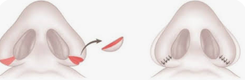
remember when i talked about alar base width? It should be around the gap between your eyes' inner edges. That spacing has a name: intercanthal distance. We covered it earlier when going over facial fifths.
If your base is is very wide, to fix it narrowing the base is needed. That cut at the edge reshapes the opening. A tiny slice of skin disappears there near the bottom. The fix pulls things inward gently.it is trimed just enough so it fits better. Called a Weir excision [444], this step adjusts width. Less space shows once the piece comes out. Narrowing happens right where it meets the cheek.
it aint that complicated but be wary it a definitive possibly .Steer clear of showing up with demands to resemble Voldemort[insert laughing emoji it aint loading for sum reason]. Instead, always consider the doctors recommendation and dont push overboard with your requests
❖ 2.15 Soft Tissue Triangle
this is the space where the alar rim meets the outer part of the LLC. its close to the nose tip.
one of the main importance of this is simply put, there are only two thin layers of skin; no cartilage below at all. As a result, even slight changes show clearly. A small notch stands out sharply, Scars is obvious right away, Shape shifts, There's zero cover under.
Most operations live or die by one small tool. Every skilled surgeon treats it like fragile glass. Get it wrong and fixing it will be dreadful of a job. Some mistakes? oh i never wish on my enemies They just cannot be undone.
best of luck if your doc says 'ooopppps' during this time
 [now the emoji button works] .
❖ 2.16 Nares (Nostrils)
you all know this even the crack head besides the road knows this.

Most niggas see different shapes first thing. Teardrop tops the list for what people call perfect. Round ones show up often too. Slits appear now and again. Each nostril's longest line runs close to a half-diagonal against the center strip.
Most people notice unevenness right away when it comes to looks but the catch is they notice it on their own nose unless yours is being pointed out by people you should just dnr it. Truth is, every face shows slight differences between the two sides. One nostril often sits higher than the other. Small things like this show up more than you might think. Nobody gets a perfectly balanced face by default. [145]
❖ 2.17 Nasal Sill
as you can see in the picture it is the base that holds the nose
Surgeons find it key since sill cuts appear in alar base reductions, adjusting how wide the nose looks. When narrowing the space between nostrils, this area becomes part of the process. Working here allows subtle shifts in position. The move helps reshape without obvious changes elsewhere. This structure matters simply because it moves with intent.
Only rarely does someone consider the bridge of their nose until a doctor brings it up. That works just as well.
❖ 2.18 Alar Crease (Alar Facial Junction)
first things first this isnt for ppl wondering this isnt my nose i got a high T SUPER COOL NOSE not shi like this, but as you can see its simple it just the crease formed by the nostrils . It forms right where facial curves shift sligthly. This crease runs just beside the flare of the nostril. A soft ridge often marks the edge. You notice it when light catches the contour. Slight shadows gather along its path.
during surgery this is useful they use it to cover up cuts since i would looks like the normal shit
When a surgeon has to cut close to the alar base, that spot works best. Nature placed a natural fold there, so scars settle into it like dust in a crease.
So that covers the outer markers. Every notable spot along the nose, starting at the radix and moving down to the alar crease, is now clear. Nothing left out.
The Keystone Area & Bony Nasal Vault Thickness Transition: The transition from the thick upper nasal bone near the radix to a thin, breakable shell at the caudal edge is the exact site of structural profile humps. When a surgeon performs an osteotomy (breaking the bones to narrow a wide bridge or remove a dorsal hump), the thickness profile dictates whether the bone will fracture cleanly or shatter unevenly, directly causing post-op irregularities or asymmetry on the bridge.
The Perichondrium-Periosteum Reflection Zone: This is the facial layer where the deep tissue linings fuse tightly to the bone of the maxilla at the pyriform aperture. If a surgeon tears or destabilizes this reflection zone during a procedural dissection, the structural support anchoring the base of the nose to the face can degrade, leading to post-op widening of the alar base, asymmetry, or loss of definition at the alar-facial junction.
The Perichondrium-Periosteum Reflection Zone: This is the facial layer where the deep tissue linings fuse tightly to the bone of the maxilla at the pyriform aperture. If a surgeon tears or destabilizes this reflection zone during a procedural dissection, the structural support anchoring the base of the nose to the face can degrade, leading to post-op widening of the alar base, asymmetry, or loss of definition at the alar-facial junction.
WHY THE FUCK AM I DOING THIS MUCH JUST TO GET DNRD

who ever reading i respect you bud

━━━━━━━━━━━━━━━━━━━━━━━━━━━━━━━━━━━━━━━━━━━━
▸ SECTION 3: NASAL AESTHETIC SUBUNITS
▸ SECTION 3: NASAL AESTHETIC SUBUNITS
Back in 1985, a couple of doctors, Burget and Menick, realized sum about the nose. it aint one solid shape, it turned out. Instead, nine separate zones emerge when you watch how light moves across it. Shadows define borders. Shape shifts mark boundaries. Each section follows natural dips and curves seen under illumination.[shaka boom]
it is geeky as fuck yet True enough so more suffering for me for something everyone will dnr
❖ 3.1 The Nine Subunits
so let start coverin this shit
Down the center of your nose runs the dorsum, connecting the radix to the supratip as one continuous path. that straight line or your the gandy like nose or the vito like nose yeah thats what i am talking about . Seen head-on or in profile, it stands out. The first thing noticed is it's this central ridge. Your eyes dircetly lands there before moving elsewhere. Shape, height, alignment; all play roles without drawing attention to themselves. It defines balance more than any other part. overrated as fuck tho ppl glze the fuck out of it it aint that important
Running down either side of the nose, you'll find the side of the nose/dorsum framed within by the dorsum. Out beyond lies the cheek or basicly infra orbital area below is found the alar crease.
MASSIVE
 (you understand?), and vise versa
Down at the bottom, the tip (also called the lobule) sits as a single defined piece. Above it lies the supratip region, while beneath stretches the infratip area. Flanking both edges are the alae, shaping its sides. This part is pretty damn important. Faces harmony and proportions could get fucked up very much by this thing
Flaring gently at either side, the things called alae shift with breath or laughter. Shaped by movement, they respond when air rushes in or lips stretch back like i said in breath or laughter. One on the left, another on the right they mirror without matching exactly which i also said if you read the whole thread
small amount of skin links the base of the nose to its tip, visible if a person lifts their chin which nobody cares about pretty sure both you and me dont give a flying fuck about this). This part, the columella, stretches upward from the bony ridge beneath the nose, connecting directly to the area just below the outermost curve. It sits snugly in the middle, framed by each opening of the nose. When the head tips back, this narrow band becomes clear to notice.
Lastly, there are the soft tissue triangles: two small areas sitting between the alar rim and the lateral crus close to the nose tip. Spot them before? You saw them already. Fragile things, really. Only skin layered twice, nothing beneath but air.
if all this confuses you it means the things on top of the the gaps of your nose that are tucked in
That makes nine parts altogether: just one, then two, another one, again two, once more one, finally two. These pieces stick around, always showing up whenever anyone talks about how a nose looks or breaks down its shape.
❖ 3.2 The 50% Rule
This is one of the most important aspects when it comes to nose surgery . you may not think much about it, it is basic if you arent are a surgeon it wont help you tho.
but it wont harm you trying to learn itwhen half or more of a sub units is damaged you completely replace it you dont bs around you dont try to patch or sum stupid. If too much is wrong inside one section, put in a fresh unit. Patchwork fails here, Only full replacement works. all of should be changed
Here is why. Replacing an entire section lets healing happen across a single stretch. Scars settle exactly where parts join; they will looks natural which is what everybody should want.
Yet fixing only part of one section leaves a mark right across an area that should look smooth and boom you have got your self a shitty nose job
❖ 3.3 Nasal Thirds (Aesthetic)
no i didnt get that wrong buddy its nasal not facial thirds like your face these all indeed get division since you dont hear about dont go and bs around about this this is a key point for harmony and proportions , then you may say if its so important why haven't heard about it and to that i say shut the actual fuck up nigga
but since i am soooper dooooper nice i wont say that its because in such incel spaces ppl are retarded they are only follow those rigid measurements even if sum one has a clear flaw they dnr even if its obvious so next time do better
Starting at the radix, the upper part stretches toward the rhinion, entirely made of nasal bones. This section has skin that's neither too thin nor tightly pulled, just somewhat loose. Because of that looseness, small flaws tend to disappear under its surface. A slight ridge left behind by the doctor? Likely invisible thanks to how the tissue covers it up.
Right between the eyes, past the bony bridge, begins a stretch called the middle third. From rhinion down toward the supratip lies soft structure; upper lateral cartilages meet septum. Trouble hides in this spot. The covering layer of skin is thinner than anywhere else on the nose. Flaws appear without warning: edges of implants peek through, uneven shapes catch light, small lumps stand out sharp. Mistakes made during surgery show fully here. Nothing stays hidden where the tissue is this delicate.
Down below, the lower part stretches from above the tip right to the bottom edge. This place holds the tip itself, the outer wings, the strip between nostrils; basically all the structures low on the nose. The skin in this zone tends to be the heaviest, packed with oil glands that make it dense and greasy(Important) Because of this thickness, sharpening the tip during procedures becomes tough, especially when someone has heavier dermal layers, Even if the underlying cartilage gets shaped precisely, the surface layer stays stubborn, muffling definition.
Most niggas say their nose hasn't changed even after getting rhino; well its unlucky niggas with thick nose skin , it also hinders healing, Some wait more. Healing just moves slow for dense skins.
━━━━━━━━━━━━━━━━━━━━━━━━━━━━━━━━━━━━━━━━━━━━
▸ SECTION 4: STRUCTURAL ELEMENTS THAT INFLUENCE APPEARANCE
▸ SECTION 4: STRUCTURAL ELEMENTS THAT INFLUENCE APPEARANCE
we have talked about the subunit the external features their function and surgical failure and much more
now it time for a whole new chapter its the structure
no amount of clear skin no amount of good eye color no amount of anything lets you by pass the bone structure and its the same here . Even with every other feature aligned, it is gonna be standing out and be the most visible part
❖ 4.1 Lower Lateral Cartilages Shape the Nose Tip
this is very important it basically lower parts of your nose and there could be a lot of flaws there may be your columella is too droopy maybe your 2 tip are very wide leading to a bulbous looks 90% of the a big nose is caused here tho thick brige could lead to it too
fuck i am taking too much time ama speed run this rn
So twin cartilages curved like a half-circle, Each splits into three parts, Inside the columella holds the medial crus. The middle section, called the dome, shapes what gives the nose its tip detail, the lateral crus builds the outer nostril wall.
these are like posts holding up a small tent at the front of your nose, They set how far forward that part extends, its tilt, whether it angles upward or dips down, Shape, how wide the end appears.
During nose surgery, those cartilages are stitched into new shapes. Some parts get carefully shortened for better definition, the others receive added pieces to boost strength or volume, their place moves slightly to adjust how the tip(the nose tip not dick) moves and sits.
Weakness or injury to these cartilages brings on tip ptosis, meaning the nose tip sag and droops, Alar collapse, narrowing the nostrils. Definition lost. The result? Features start looking older; or worse, like flawed surgery.
❖ 4.2 Upper Lateral Cartilages and the Middle Vault
One sits next to the other near the middle, each shaped like a triangle. Flexible things makes up both, holding up the section that dips gently inward. Their position splits the core into even parts, bendable by nature, they influence the outline of this spot.
above, the form bends midway, forming soft arcs meant to trace from brow to tip of nose, should everything align, the arc stays smooth Otherwise, it breaks apart. Twisted lines pull at odd angles. Tightness(ong i am not doing this on purpose) appears. The outline seems off. Unevenness draws attention, even when silent.
Inside your nose, the area where the top sideways cartilage joins the wall down the middle is called the inner nasal valve. [23] The best angle at that junction sits somewhere between ten and fifteen degrees. That particular zone ends up being the narrowest passage within. Resistance to airflow builds strongest at this point simply because it pinches tighter than elsewhere.
Imagine a routine operation taking a turn - the inverted-V issue shows up. Remove the nasal bump but forget to brace the side cartilage pieces, see how it unfolds. Those parts buckle inward, coming closer over time. Underneath the skin, their edges begin to appear. From the front, the shape cuts down sharply like a pointed V along the ridge. A clean line appears its distinct, not meant to stand out.
Spreader grafts keep the upper lateral cartilages separated from the septum. Tiny slivers of cartilage do this job - like little props inside the nose. During surgery, they go right into place to stop inward buckling. So what happens? The inner nasal valve stays stronger, works better. With the strips set just so, air flows more freely. Right off, support gets better even though healing drags on.
❖ 4.3 Nasal Bones Form the Bony Bridge
these tiny bone pieces form a smooth pair, shaped like ovals pressed side by side. Broadest at the meeting spot above the nose, they hold steady width just there. each one narrows bit by bit while reaching sideways, after sometime thinner they get, going toward the ends. At the midline, plump and full, they thin out without breaks as they go.
Up top, width usually traces back to the bony section of the nose. That framework shapes how broad it appears left to right, also front to back. Tweaking this zone tends to involve reshaping those particular bones. After all, the profile view gets its outline mostly from there. Got width issues by the eyes? Probably tied to this area. Shifts right here change how the entire nose opening looks. The way the bone sits shapes a lot of the front view of your face. This part decides how far you can go when trying to make things narrower. From here, changes ripple into how the face looks head-on and from the side. Light finds this area first when someone stands naturally.
Cuts come first, these are called osteotomies. think bout a blueprint for breaking bone at set points, the structure splits open. From there, fragments come near each other, moving into new positions. The change pulls everything closer together. When pieces is off track, adjusting them restores harmony. The form grows thinner slowly.
you dont like it? deal with it. Still, surgeons agree it’s one of the most reliable moves in rhinoplasty.
❖ 4.4 Nasal Septum
this bit sits right above the gap between ur nostrils. three things make it. up front theres the quadrangular cartilage. behind it close to the top edge is a thin slice of the ethmoid bone. lower back the vomer bone (yes a bone has a stupid name like that). these 3 hold up the middle of ur nose simple as
think of this piece as the main pole holding up the entire nose. it shapes the spot right under the front of the septum then keeps going down into the thin wall that splits ur nostrils. strength runs top to bottom no breaks. every important zone meets here.
bent cartilage inside fucks the whole nose up. u get a crooked tip or a peak leaning to one side, one half bulges while the other caves in. when the look goes the breathing goes with it most of the time. from certain angles uneven shit pops out fast. outside usually snitches on whats hidden inside.
surgeons keep coming back to the septum cuz when they need cartilage to fix the dorsum or rebuild support they pull it straight from here. its right there, its bendy but firm, and since its YOUR own tissue ur body wont reject it. taking it does 2 things at once fixes the look AND fixes the breathing
this is why septoplasty and RHINOPLASTY get done together most of the time
❖ 4.5 Nasal Ligaments
most niggas forget these entirely
the Pitanguy ligament is this thin strip running halfway down the nose between the septum edge and the outer skin up top. it makes the small fold above the tip (i will not jester after now
ik its random but i need to finish this asap). if a surgeon cuts it during surgery the tip widens out simple as that. once its disconnected the core just drifts with no supportinside theres this thin piece of tissue connecting the 2 cartilage tips at the front. it holds those points in place which decides how wide the bottom of ur nose looks. cut it carelessly and the whole framework starts coming apart slowly.
near the top of ur nose theres another slim strip running across where one upper cartilage meets the other. u move ur face all day but the structure stays solid because of this tie. the centerline holds its form bcuz of it
u snap one cable on a suspension bridge and the whole tension across the span shifts. ligaments work the same way invisible web doing all the heavy lifting while u dont notice. one slips and now everything moves wrong. misalignment shows up from places u wouldnt even predict
━━━━━━━━━━━━━━━━━━━━━━━━━━━━━━━━━━━━━━━━━━━━
▸ SECTION 5: SKIN AND SOFT TISSUE ENVELOPE
nobody talks bout this when discussing noses. everyone obsesses over the hard parts. but the outside is what u actually see. skin health matters and like i already said thick skin is gonna ruin you
u could have perfect cartilage right under the surface and heavy greasy skin will RUIN it. flip side, small flaws hide under thick skin like nothing happened. with thin skin its different. every tiny bump every uneven spot pushes thru clear as day
❖ 5.1 SSTE Layers
under the top layer 4 more stretch down. across the bridge texture changes step by step. one spot acts d/f than the next depending on where it sits
fat collects in uneven pockets. depends on the spot and the person. why does every nose look different? blame the padding sitting over the frame. bone and cartilage could match almost exactly between 2 ppl and the noses still look nothing alike. the volume hidden underneath decides what u see.
below that is a layer of fiber and muscle. picture a net tucked under the surface with tiny muscles connected to it. these fibers move every time ur nostrils flare
then the 4th layer - a soft pad of connective fibers. fat pockets sit below this. slip ur finger gently and the layers come apart easy. under all that ull hit something harder - cartilage, then bone
right on top of the cartilage sits the perichondrium - thin, soft, basicly a ghost. covering the bone? think of them as 2 outer shells similar job, different material. they hold tight, dont slip, feed whats underneath them. small stuff but matters more than it looks
❖ 5.2 How SSTE Shapes Results
one thing decides if ur nose job works. SKIN. it swings the result more than anything else (Important)
thick skin smooths out lumps automaticly - sounds like a win at first. but heres the catch: refining the tip becomes hell. surgeons cant do small adjustments, they have to use AGGRESSIVE cartilage grafts so the changes actually show under all that skin. swelling stays for fucking ever. 12 months goes by and ur still healing. some niggas dont see final shape til 24 months. 2 whole years just to know what ur nose actually looks like
thin skin shows every tiny detail right away. a skilled surgeon can carve clean sharp lines and they look beautiful. BUT - one slip and its visible from across the room. asymmetries, tiny bumps, mismatches - all of it on full display. cant hide shit with thin skin. they cover flaws using thin cartilage layers or soft tissue grafts. every move has to be exact. zero room for error
medium skin = the lottery winner. thick enough to hide small flaws, thin enough to show definition. standard techniques actually work here. things heal normal, the result looks right, no drama
same surgery same surgeon same technique - 2 different ppl get 2 different results. why? skin. not the blade, not the plan - the skin. healing depends on whats under the surface more than what the surgeon does on top. no tool predicts how ur skin will react
❖ 5.3 Skin Zones
ur nose skin isnt the same thickness everywhere - it changes by location. where u might think its consistent its actually not
over the upper bridge its slightly thicksneaky:- the emoji aint random for slow niggas also doin this not to make the text borin do deal with it fuckface)
. that part hides small imperfections without drawing attention. it just sits there doing its job
midway down where the nose meets the forehead area, the skin thins out. on that spot every irregularity becomes obvious - bumps, weird light, lopsided contours. nothing escapes notice over there. tiny details burst forward even when they shouldnt
at the very tip and along both alar edges oil glands pack tight. its thicker here so working through it is harder. this spot stays swollen LONG after the rest healed. circular tip stays puffy past 12 months easy
a real surgeon will tell u what u want doesnt match how ur skin behaves, its biology, them instagram pics ignore physical reality - ur skin doesnt. their caution isnt fear, its what shows up under proper lighting (deal with it)
━━━━━━━━━━━━━━━━━━━━━━━━━━━━━━━━━━━━━━━━━━━━
▸ SECTION 6: LIGHT REFLEXES AND SHADOW LINES
once this clicks u stop seeing noses as shapes and start seeing them as stories. ur own face in the mirror starts looking different even tho nothing moved
most niggas miss this entirely. a nose isnt just bone and cartilage. its about how light moves across the curves and that matters WAY more than the actual dimensions. what does ur eye even catch? shadows. highlights. ur brain feels somethings off. tiny shift and suddenly the edges look sharp. balance matters less than contrast. the actual shape hides behind those light shifts. vision picks up smooth gradients way before sharp edges. a nose shows up not just from whats there but from whats missing
funny how the SAME nose looks completely different under bad lighting. mirror at home? harsh ceiling light? one pic good, the next bad.
a thin line of brightness usually runs down ur nose - starts near the eyes, slides to the tip. when its sharp and narrow it makes the contour look clean and even. if it wavers or spreads wide the silhouette looks off, heavy, tilted. shape underneath might be solid but ur eyes get tricked by where light moves
where the front view meets the bridge u get tiny highlights right above the nostrils. close together = defined tip, looks symmetrical. too far apart = the shape loses its edge, feels uneven. one higher than the other = ur eye gets pulled sideways
down at the base of ur nose light fades on each side. that dim line marks the border between nostril and face. sharp = clean edge, no blur. soft = the nose melts into surrounding skin which is bad if you a dumb ahh if like didnt understand
the supra tip shadow creates the supratip break which is what gives the tip its definition
below the tip just above the rim sits the columellar shadow which shapes the infratip lobule. that subtle dip raises the tip and gives it a floating look, without it the tip just dies into the columella with no separation
this is why CONSISTENT lighting is non-negotiable. without it ur comparisons are useless. one photo in morning light vs one under harsh noon light - shadows move, colors change, fake differences appear out of nowhere. light changes appearance more than ppl think. tilt the lighting and your a fucking dumb ass, keep your damn lighting conistent
━━━━━━━━━━━━━━━━━━━━━━━━━━━━━━━━━━━━━━━━━━━━
▸ SECTION 7: TIP SHAPE TYPES
now that shapes and light are out the way time to figure out if ur tip looks good or needs fixing. this area shows obvious patterns. u gotta know which one urs
bulbous tip is the one everyone notices first. straight on, the width at the bottom stands out. the anchor points underneath are spread wide. lower cartilage size plays a big role. heavy skin makes it look even wider(poor thickskincels). u probly know this one everyone describes exactly this shape
boxy tip = flat front instead of curved. like pressure turned a curve into a level edge, follows from broad rectangular LLC domes
bifid tip - a split runs straight down the front making it look like 2 separate pieces. the LLC domes dont meet, theres a visible gap between them. thats what creates the look
pinched tip - too narrow, looks clamped. usually after surgery where they removed too much LLC. sometimes its just weak framework from birth tho. its very visible and usually traces back to bad surgical decisions
amorphous tip - no defined outline, heavy tissue muddles it. weak framework below cant push thru. the tip just blurs into the rest of the nose with no border
under-projected tip - flat front bcuz the tip doesnt extend forward enough. lower cartilage too weak to hold it out. instead of sticking out the tip bends down. weak push = small final result
over-projected tip - sticks out too far, makes the nose look thin and pulled. usually bcuz the lower cartilage is too stiff and pushes everything forward. sometimes the inner septum grew too long and shoves the whole thing out
ptotic tip - droops when u smile. usually not age its the depressor septi nasi, that thin muscle below the nostrils acts up ur tip drops
real talk - figuring out ur tip shape matters before anything else. bulbous gets treated NOTHING like ptotic. mix them up and ur surgeon ruins ur nose
look head-on first, then from the side. be honest. most ppl land between types - wide base with flat tip or slight droop with soft edges. nobody is just one
━━━━━━━━━━━━━━━━━━━━━━━━━━━━━━━━━━━━━━━━━━━━
▸ SECTION 8: COMMON AESTHETIC DEFORMITIES
deformities come in many forms some u were born with, others u got from surgery (botched ones). the nose can move slowly over years, or change FAST after one bad procedure. crooked ridges, twisted tips, breathing fucked once support breaks. one side might pull sideways for no clear reason. early on swelling masks the real damage. months later scar tissue knots up weird, old surgical changes shift weight to spots they shouldnt be. some niggas notice breathing trouble years after. cartilage shows under thin skin, tiny dents widen over time. not every skin heals the same. STARE at before-and-afters. clues hide in plain sight. shadows that dont make sense up close = problems. when somthing unsettles u about a photo, trust that instinct. some "fixes" make it WORSE
dorsal hump - the bump on the bridge everyone sees from the side. its a soft curve forward between the eyes. genetic for most ppl but trauma can cause it too. profile views expose it instantly. this is the #1 thing ppl get rhinoplasty for
saddle nose - opposite of a hump. instead of a rise theres a DENT running down the bridge. trauma can cause it, over-aggressive surgery weakens support til the bridge caves, infection eats tissue, or cocaine slowly destroys it from inside (yes really, common cause)
pollybeak - small bump RIGHT above the tip post-op while the tip itself droops. looks like a parrots beak hence the name. usually scar tissue builds up in the supratip area. sometimes its bcuz the framework underneath is too weak to hold the tip up. result: tip droops, area above puffs out
open roof deformity - happens when a hump gets removed but the surgeon doesnt close the gap. its like snapping the center pole of a tent and leaving the fabric hanging. the nasal bones stay separated across the top of the bridge. ridge looks split. wide flat gap where it shouldnt be
inverted-V - that downward V between the eyes. covered this earlier already. shows up after surgery when the upper lateral cartilages pinch inward. their edges peek thru the skin at the front. u see it and immediately go "yeah that ones a nose job"
crooked nose - tilts left or right, not aligned with the centerline of the face. inner septum drifts, bone structure differs side to side. soft tissue grows lopsided. real talk getting it FULLY straight takes obsessive surgical work. perfection almost never happens. tissue has memory not literally ofc nigga but it wants to go back to the bend it lived in for 20+ years
irregularities along the tip - small bumps showing up post-op. happens where thin skin sits over hard cartilage edges, after surgical changes underneath, those points poke thru more, solid parts pressing against weak skin = visible bumps near the edges
alar retraction - the nostril rim tugs upward and shows more nostril than it should. usually post-op damage when too much lower lateral cartilage got removed. nose collapses, rim goes up. classic botched job sign
hanging columella - the columella dips below the nostril rim by more than 4mm. shows extra tissue between the nostrils when viewed from the side. stiff central cartilage tugging downward, or overgrowth at the base of the septum.
retracted columella - opposite. columella sits TOO HIGH, hidden, less than 2mm shows from profile. happens when the lower septum is too short or the medial crura are weak
heres the truth - none of this is meant to scare u. point is when ur sitting across from a surgeon and they say "mild tip ptosis" "dorsal hump" "slight alar retraction" u know what they mean immediately. then u look in the mirror and see it on ur own face plain as day
the more the you know the more the outcomes get better every single time

━━━━━━━━━━━━━━━━━━━━━━━━━━━━━━━━━━━━━━━━━━━━
▸ SECTION 9: PHOTOGRAPHIC DOCUMENTATION STANDARDS
ppl skip this section thinking its boring. WRONG. seeing ur own nose correctly decides everything else. progress is hard to track. comparisons help if ur photos are bad? not at all, only consistent photos let u actually see change
get a pic, ur nose looks HUGE, move slightly, take another, different angle, now it looks fine, your didnt fix your nose
you lil silly dumb ah
surgeons examine the nose from 6 angles:
- frontal (head on)
- right profile
- left profile
- 3/4 right
- 3/4 left
- basal (looking up from below)
frontal view - unevenness shows here more than anywhere. lens points straight ahead, balance, tilt, any bend all visible from this angle. from brow to tip every small flaw is on display. if somethings off this is the view this view is most useful and important
right profile - the bridge curve, tip projection, where the brow meets the nose, tip rotation, gap between nose and upper lip, chin position - all visible at once. is there a hump? does the tip droop? this view tells u everything
left profile - mirror of the right but never EXACTLY the same. faces arent symmetrical. shadow on one side = highlight on the other. something missed on one side might show on the other
3/4 views - between fully frontal and fully profile. matches how ppl actually see u in real life. shapes flow when viewed at this angle. tiny shifts across the nose pop here.
basal view (worm's eye) - looking up from below. shows nostril shape, columella position, tip width, distance between outer nostrils, harmony inside the lobule. most ppl never look at this view. but it exposes shit no other angle can but when will anyone see it so only use full for knowing
if there was change
every photo needs the head locked in the FRANKFORT HORIZONTAL PLANE - same reference from section 1.3. the line from the ear canal to the lower eye rim stays level. nothing else
heres why. tilt the head slightly down = nose looks stretched and projects further, tilt up slightly = nose shrinks, if the head wobbles across photos ur comparisons mean NOTHING, setup controls what u see, identical tilts every time or the whole exercise is pointless
lighting = soft, even, from the front. overhead bulbs that are too bright drag shadows across the face and sharpen edges that arent really that sharp. side lighting splits the cheeks.
lens matters a lot. 105mm macro = standard. phones use wide-angle lenses which DISTORT close up subjects. ur face features warp slightly. center features like the nose get pushed forward and look bigger than they actually are. ever notice ur nose looks huge in selfies but normal in a mirror? thats why. phones are big liet
those bitches
DONT smile. dont frown. dont squint. dont do that little eye narrowing thing u do unconciously, when ur depressor septi nasi fires from smiling ur tip slides downward (told u earlier this exact muscle). relax fully and the shape lines up properly
keep lighting identical every single time. stay level no leaning. use the BACK lens of ur phone not the front. shoot all 6 views one after another, miss none. this isnt about looking pretty its about precision dont forget that DUMB ASS
(any dumbass, insults or anything mentioned here is out of love gng thx for reading)
lighting changes destroys comparisons. angle drift dooms comparisons. zoom variance damns comparisons. fix these or ur photos are useless.
━━━━━━━━━━━━━━━━━━━━━━━━━━━━━━━━━━━━━━━━━━
▸ SECTION 10: SURGICAL REFERENCE TABLE
surgical anatomy that actually matters - compressed reference. dnr if ur lazy
StructureSurgical RelevanceKey Procedures
nasal bones decide how wide/tall the bridge looks. when adjustments are needed surgeons cut the bone - inside, outside, or across - to resize or align. structure changes whithout removing material
upper lateral cartilages (ULC) hold the middle of the nose steady and keep the airway open. spreader grafts go between them to widen the space. sutures spread them out. small flaps from nearby tissue work too
the tip is shaped by the lower lateral cartilages (LLC). dome stitches give support. trimming the upper edge refines it. strut grafts add strength underneath. tip grafts change projection
deep inside the nose sits the septum. holds everything together AND gives material for repairs. when its crooked surgeons straighten it (septoplasty). tissue from here often rebuilds other areas
caudal septum reshaping adjusts the front part - this area supports the tip. changing its angle changes how the tip sits. small carves = guided new shape
internal nasal valve causes about half of total nasal airway resistance. surgeons fix this whith spreader grafts, butterfly grafts, or rebuilding the valve directly [313]
external nasal valve - airflow moves thru this section near the nostril. needs stability. small internal strip-shaped grafts get added near weak areas to keep breathing passages open during pressure changes
8 Nasal Turbinates - Airflow regulation - Turbinate reduction (submucosal resection, outfracture, RF ablation)
9 Ostiomeatal Complex - Sinus drainage - FESS (functional endoscopic sinus surgery)
10 Paranasal Sinuses - Air-filled cavities; drainage - Balloon sinuplasty, endoscopic sinus surgery
11 Kiesselbach's Plexus - Anterior nosebleed source - Cauterization, silver nitrate, packing
depressor septi nasi - when u smile this muscle tugs the nose down. surgeons sometimes cut/release it during rhinoplasty
13 Nasalis Muscle - Compresses/dilates nostrils - Botox for transverse nasal wrinkles
14 arteries feed the nose well from 2 sources at once. surgical paths slip between layers where blood doesnt sit. flap design = thinking ahead bout connection. avascular planes guide cuts more than force
beyond the eye socket runs a nerve highway. surgery needs these quiet so numbing steps in. one path under the orbit, one near the bony notch, another along the bridge. each spot stops feeling exactly where needed
16 Olfactory Nerve (CN I) - Sense of smell - avoid injury during septoplasty/roof work
healing matters inside the nose. when tissue recovers right the tiny cilia do their job. keep linings intact or u get complications later. open wounds stick to spots they shouldnt. smooth surfaces prevent adhesions
the major tip support structures - 3 of them hold tip shape thru surgery. if u dont protect them or rebuild them carefully the tip collapses
minor tip supports - 8 little helpers holding things steady. expect some to disappear during surgery. rebuild as needed
keystone area - where bone meets cartilage. when reducing a dorsal hump care HERE is critical. this spot must stay intact or the whole structure becomes unstable
scroll area - tip support stays strong here. overlap between ULC and LLC keeps things stable below. continuity by design
nostril sill - base of the nose opening meets the upper lip. gives structure under the nostril edge. tissue removal here shapes the nostril rim
23 Nasion - Cephalometric reference - measurement reference point for all angles
Rhinion - where bone meets cartilage. surgeons adjust their method at this boundary. subtle but clear in practice
25 Alar Crease - Incision camouflage site - alar base incisions hidden in the natural crease
26 Nasal Cycle - Physiological alternation - patient education; not a surgical target
nasal valve area - air narrows hardest here. controls how easily each breath moves. surgeons reshape this when fixing breathing
tldr
▸ SECTION 5: SKIN AND SOFT TISSUE ENVELOPE
nobody talks bout this when discussing noses. everyone obsesses over the hard parts. but the outside is what u actually see. skin health matters and like i already said thick skin is gonna ruin you
u could have perfect cartilage right under the surface and heavy greasy skin will RUIN it. flip side, small flaws hide under thick skin like nothing happened. with thin skin its different. every tiny bump every uneven spot pushes thru clear as day
❖ 5.1 SSTE Layers
under the top layer 4 more stretch down. across the bridge texture changes step by step. one spot acts d/f than the next depending on where it sits
fat collects in uneven pockets. depends on the spot and the person. why does every nose look different? blame the padding sitting over the frame. bone and cartilage could match almost exactly between 2 ppl and the noses still look nothing alike. the volume hidden underneath decides what u see.
below that is a layer of fiber and muscle. picture a net tucked under the surface with tiny muscles connected to it. these fibers move every time ur nostrils flare
then the 4th layer - a soft pad of connective fibers. fat pockets sit below this. slip ur finger gently and the layers come apart easy. under all that ull hit something harder - cartilage, then bone
right on top of the cartilage sits the perichondrium - thin, soft, basicly a ghost. covering the bone? think of them as 2 outer shells similar job, different material. they hold tight, dont slip, feed whats underneath them. small stuff but matters more than it looks
❖ 5.2 How SSTE Shapes Results
one thing decides if ur nose job works. SKIN. it swings the result more than anything else (Important)
thick skin smooths out lumps automaticly - sounds like a win at first. but heres the catch: refining the tip becomes hell. surgeons cant do small adjustments, they have to use AGGRESSIVE cartilage grafts so the changes actually show under all that skin. swelling stays for fucking ever. 12 months goes by and ur still healing. some niggas dont see final shape til 24 months. 2 whole years just to know what ur nose actually looks like
thin skin shows every tiny detail right away. a skilled surgeon can carve clean sharp lines and they look beautiful. BUT - one slip and its visible from across the room. asymmetries, tiny bumps, mismatches - all of it on full display. cant hide shit with thin skin. they cover flaws using thin cartilage layers or soft tissue grafts. every move has to be exact. zero room for error
medium skin = the lottery winner. thick enough to hide small flaws, thin enough to show definition. standard techniques actually work here. things heal normal, the result looks right, no drama
same surgery same surgeon same technique - 2 different ppl get 2 different results. why? skin. not the blade, not the plan - the skin. healing depends on whats under the surface more than what the surgeon does on top. no tool predicts how ur skin will react
❖ 5.3 Skin Zones
ur nose skin isnt the same thickness everywhere - it changes by location. where u might think its consistent its actually not
over the upper bridge its slightly thick
sneaky:- the emoji aint random for slow niggas also doin this not to make the text borin do deal with it fuckface). that part hides small imperfections without drawing attention. it just sits there doing its job
midway down where the nose meets the forehead area, the skin thins out. on that spot every irregularity becomes obvious - bumps, weird light, lopsided contours. nothing escapes notice over there. tiny details burst forward even when they shouldnt
at the very tip and along both alar edges oil glands pack tight. its thicker here so working through it is harder. this spot stays swollen LONG after the rest healed. circular tip stays puffy past 12 months easy
a real surgeon will tell u what u want doesnt match how ur skin behaves, its biology, them instagram pics ignore physical reality - ur skin doesnt. their caution isnt fear, its what shows up under proper lighting (deal with it)
━━━━━━━━━━━━━━━━━━━━━━━━━━━━━━━━━━━━━━━━━━━━
▸ SECTION 6: LIGHT REFLEXES AND SHADOW LINES
once this clicks u stop seeing noses as shapes and start seeing them as stories. ur own face in the mirror starts looking different even tho nothing moved
most niggas miss this entirely. a nose isnt just bone and cartilage. its about how light moves across the curves and that matters WAY more than the actual dimensions. what does ur eye even catch? shadows. highlights. ur brain feels somethings off. tiny shift and suddenly the edges look sharp. balance matters less than contrast. the actual shape hides behind those light shifts. vision picks up smooth gradients way before sharp edges. a nose shows up not just from whats there but from whats missing
funny how the SAME nose looks completely different under bad lighting. mirror at home? harsh ceiling light? one pic good, the next bad.
a thin line of brightness usually runs down ur nose - starts near the eyes, slides to the tip. when its sharp and narrow it makes the contour look clean and even. if it wavers or spreads wide the silhouette looks off, heavy, tilted. shape underneath might be solid but ur eyes get tricked by where light moves
where the front view meets the bridge u get tiny highlights right above the nostrils. close together = defined tip, looks symmetrical. too far apart = the shape loses its edge, feels uneven. one higher than the other = ur eye gets pulled sideways
down at the base of ur nose light fades on each side. that dim line marks the border between nostril and face. sharp = clean edge, no blur. soft = the nose melts into surrounding skin which is bad if you a dumb ahh if like didnt understand
the supra tip shadow creates the supratip break which is what gives the tip its definition
below the tip just above the rim sits the columellar shadow which shapes the infratip lobule. that subtle dip raises the tip and gives it a floating look, without it the tip just dies into the columella with no separation
this is why CONSISTENT lighting is non-negotiable. without it ur comparisons are useless. one photo in morning light vs one under harsh noon light - shadows move, colors change, fake differences appear out of nowhere. light changes appearance more than ppl think. tilt the lighting and your a fucking dumb ass, keep your damn lighting conistent
━━━━━━━━━━━━━━━━━━━━━━━━━━━━━━━━━━━━━━━━━━━━
▸ SECTION 7: TIP SHAPE TYPES
now that shapes and light are out the way time to figure out if ur tip looks good or needs fixing. this area shows obvious patterns. u gotta know which one urs
bulbous tip is the one everyone notices first. straight on, the width at the bottom stands out. the anchor points underneath are spread wide. lower cartilage size plays a big role. heavy skin makes it look even wider(poor thickskincels
). u probly know this one everyone describes exactly this shapeboxy tip = flat front instead of curved. like pressure turned a curve into a level edge, follows from broad rectangular LLC domes
bifid tip - a split runs straight down the front making it look like 2 separate pieces. the LLC domes dont meet, theres a visible gap between them. thats what creates the look
pinched tip - too narrow, looks clamped. usually after surgery where they removed too much LLC. sometimes its just weak framework from birth tho. its very visible and usually traces back to bad surgical decisions
amorphous tip - no defined outline, heavy tissue muddles it. weak framework below cant push thru. the tip just blurs into the rest of the nose with no border
under-projected tip - flat front bcuz the tip doesnt extend forward enough. lower cartilage too weak to hold it out. instead of sticking out the tip bends down. weak push = small final result
over-projected tip - sticks out too far, makes the nose look thin and pulled. usually bcuz the lower cartilage is too stiff and pushes everything forward. sometimes the inner septum grew too long and shoves the whole thing out
ptotic tip - droops when u smile. usually not age its the depressor septi nasi, that thin muscle below the nostrils acts up ur tip drops
real talk - figuring out ur tip shape matters before anything else. bulbous gets treated NOTHING like ptotic. mix them up and ur surgeon ruins ur nose
look head-on first, then from the side. be honest. most ppl land between types - wide base with flat tip or slight droop with soft edges. nobody is just one
━━━━━━━━━━━━━━━━━━━━━━━━━━━━━━━━━━━━━━━━━━━━
▸ SECTION 8: COMMON AESTHETIC DEFORMITIES
deformities come in many forms some u were born with, others u got from surgery (botched ones). the nose can move slowly over years, or change FAST after one bad procedure. crooked ridges, twisted tips, breathing fucked once support breaks. one side might pull sideways for no clear reason. early on swelling masks the real damage. months later scar tissue knots up weird, old surgical changes shift weight to spots they shouldnt be. some niggas notice breathing trouble years after. cartilage shows under thin skin, tiny dents widen over time. not every skin heals the same. STARE at before-and-afters. clues hide in plain sight. shadows that dont make sense up close = problems. when somthing unsettles u about a photo, trust that instinct. some "fixes" make it WORSE
dorsal hump - the bump on the bridge everyone sees from the side. its a soft curve forward between the eyes. genetic for most ppl but trauma can cause it too. profile views expose it instantly. this is the #1 thing ppl get rhinoplasty for
saddle nose - opposite of a hump. instead of a rise theres a DENT running down the bridge. trauma can cause it, over-aggressive surgery weakens support til the bridge caves, infection eats tissue, or cocaine slowly destroys it from inside (yes really, common cause)
pollybeak - small bump RIGHT above the tip post-op while the tip itself droops. looks like a parrots beak hence the name. usually scar tissue builds up in the supratip area. sometimes its bcuz the framework underneath is too weak to hold the tip up. result: tip droops, area above puffs out
open roof deformity - happens when a hump gets removed but the surgeon doesnt close the gap. its like snapping the center pole of a tent and leaving the fabric hanging. the nasal bones stay separated across the top of the bridge. ridge looks split. wide flat gap where it shouldnt be
inverted-V - that downward V between the eyes. covered this earlier already. shows up after surgery when the upper lateral cartilages pinch inward. their edges peek thru the skin at the front. u see it and immediately go "yeah that ones a nose job"
crooked nose - tilts left or right, not aligned with the centerline of the face. inner septum drifts, bone structure differs side to side. soft tissue grows lopsided. real talk getting it FULLY straight takes obsessive surgical work. perfection almost never happens. tissue has memory not literally ofc nigga but it wants to go back to the bend it lived in for 20+ years
irregularities along the tip - small bumps showing up post-op. happens where thin skin sits over hard cartilage edges, after surgical changes underneath, those points poke thru more, solid parts pressing against weak skin = visible bumps near the edges
alar retraction - the nostril rim tugs upward and shows more nostril than it should. usually post-op damage when too much lower lateral cartilage got removed. nose collapses, rim goes up. classic botched job sign
hanging columella - the columella dips below the nostril rim by more than 4mm. shows extra tissue between the nostrils when viewed from the side. stiff central cartilage tugging downward, or overgrowth at the base of the septum.
retracted columella - opposite. columella sits TOO HIGH, hidden, less than 2mm shows from profile. happens when the lower septum is too short or the medial crura are weak
heres the truth - none of this is meant to scare u. point is when ur sitting across from a surgeon and they say "mild tip ptosis" "dorsal hump" "slight alar retraction" u know what they mean immediately. then u look in the mirror and see it on ur own face plain as day
the more the you know the more the outcomes get better every single time
━━━━━━━━━━━━━━━━━━━━━━━━━━━━━━━━━━━━━━━━━━━━
▸ SECTION 9: PHOTOGRAPHIC DOCUMENTATION STANDARDS
ppl skip this section thinking its boring. WRONG. seeing ur own nose correctly decides everything else. progress is hard to track. comparisons help if ur photos are bad? not at all, only consistent photos let u actually see change
get a pic, ur nose looks HUGE, move slightly, take another, different angle, now it looks fine, your didnt fix your nose
you lil silly dumb ah
surgeons examine the nose from 6 angles:
- frontal (head on)
- right profile
- left profile
- 3/4 right
- 3/4 left
- basal (looking up from below)
frontal view - unevenness shows here more than anywhere. lens points straight ahead, balance, tilt, any bend all visible from this angle. from brow to tip every small flaw is on display. if somethings off this is the view this view is most useful and important
right profile - the bridge curve, tip projection, where the brow meets the nose, tip rotation, gap between nose and upper lip, chin position - all visible at once. is there a hump? does the tip droop? this view tells u everything
left profile - mirror of the right but never EXACTLY the same. faces arent symmetrical. shadow on one side = highlight on the other. something missed on one side might show on the other
3/4 views - between fully frontal and fully profile. matches how ppl actually see u in real life. shapes flow when viewed at this angle. tiny shifts across the nose pop here.
basal view (worm's eye) - looking up from below. shows nostril shape, columella position, tip width, distance between outer nostrils, harmony inside the lobule. most ppl never look at this view. but it exposes shit no other angle can but when will anyone see it so only use full for knowing
if there was change
every photo needs the head locked in the FRANKFORT HORIZONTAL PLANE - same reference from section 1.3. the line from the ear canal to the lower eye rim stays level. nothing else
heres why. tilt the head slightly down = nose looks stretched and projects further, tilt up slightly = nose shrinks, if the head wobbles across photos ur comparisons mean NOTHING, setup controls what u see, identical tilts every time or the whole exercise is pointless
lighting = soft, even, from the front. overhead bulbs that are too bright drag shadows across the face and sharpen edges that arent really that sharp. side lighting splits the cheeks.
lens matters a lot. 105mm macro = standard. phones use wide-angle lenses which DISTORT close up subjects. ur face features warp slightly. center features like the nose get pushed forward and look bigger than they actually are. ever notice ur nose looks huge in selfies but normal in a mirror? thats why. phones are big liet
those bitches
DONT smile. dont frown. dont squint. dont do that little eye narrowing thing u do unconciously, when ur depressor septi nasi fires from smiling ur tip slides downward (told u earlier this exact muscle). relax fully and the shape lines up properly
keep lighting identical every single time. stay level no leaning. use the BACK lens of ur phone not the front. shoot all 6 views one after another, miss none. this isnt about looking pretty its about precision dont forget that DUMB ASS
(any dumbass, insults or anything mentioned here is out of love gng thx for reading
)lighting changes destroys comparisons. angle drift dooms comparisons. zoom variance damns comparisons. fix these or ur photos are useless.
━━━━━━━━━━━━━━━━━━━━━━━━━━━━━━━━━━━━━━━━━━
▸ SECTION 10: SURGICAL REFERENCE TABLE
surgical anatomy that actually matters - compressed reference. dnr if ur lazy
StructureSurgical RelevanceKey Procedures
nasal bones decide how wide/tall the bridge looks. when adjustments are needed surgeons cut the bone - inside, outside, or across - to resize or align. structure changes whithout removing material
upper lateral cartilages (ULC) hold the middle of the nose steady and keep the airway open. spreader grafts go between them to widen the space. sutures spread them out. small flaps from nearby tissue work too
the tip is shaped by the lower lateral cartilages (LLC). dome stitches give support. trimming the upper edge refines it. strut grafts add strength underneath. tip grafts change projection
deep inside the nose sits the septum. holds everything together AND gives material for repairs. when its crooked surgeons straighten it (septoplasty). tissue from here often rebuilds other areas
caudal septum reshaping adjusts the front part - this area supports the tip. changing its angle changes how the tip sits. small carves = guided new shape
internal nasal valve causes about half of total nasal airway resistance. surgeons fix this whith spreader grafts, butterfly grafts, or rebuilding the valve directly [313]
external nasal valve - airflow moves thru this section near the nostril. needs stability. small internal strip-shaped grafts get added near weak areas to keep breathing passages open during pressure changes
8 Nasal Turbinates - Airflow regulation - Turbinate reduction (submucosal resection, outfracture, RF ablation)
9 Ostiomeatal Complex - Sinus drainage - FESS (functional endoscopic sinus surgery)
10 Paranasal Sinuses - Air-filled cavities; drainage - Balloon sinuplasty, endoscopic sinus surgery
11 Kiesselbach's Plexus - Anterior nosebleed source - Cauterization, silver nitrate, packing
depressor septi nasi - when u smile this muscle tugs the nose down. surgeons sometimes cut/release it during rhinoplasty
13 Nasalis Muscle - Compresses/dilates nostrils - Botox for transverse nasal wrinkles
14 arteries feed the nose well from 2 sources at once. surgical paths slip between layers where blood doesnt sit. flap design = thinking ahead bout connection. avascular planes guide cuts more than force
beyond the eye socket runs a nerve highway. surgery needs these quiet so numbing steps in. one path under the orbit, one near the bony notch, another along the bridge. each spot stops feeling exactly where needed
16 Olfactory Nerve (CN I) - Sense of smell - avoid injury during septoplasty/roof work
healing matters inside the nose. when tissue recovers right the tiny cilia do their job. keep linings intact or u get complications later. open wounds stick to spots they shouldnt. smooth surfaces prevent adhesions
the major tip support structures - 3 of them hold tip shape thru surgery. if u dont protect them or rebuild them carefully the tip collapses
minor tip supports - 8 little helpers holding things steady. expect some to disappear during surgery. rebuild as needed
keystone area - where bone meets cartilage. when reducing a dorsal hump care HERE is critical. this spot must stay intact or the whole structure becomes unstable
scroll area - tip support stays strong here. overlap between ULC and LLC keeps things stable below. continuity by design
nostril sill - base of the nose opening meets the upper lip. gives structure under the nostril edge. tissue removal here shapes the nostril rim
23 Nasion - Cephalometric reference - measurement reference point for all angles
Rhinion - where bone meets cartilage. surgeons adjust their method at this boundary. subtle but clear in practice
25 Alar Crease - Incision camouflage site - alar base incisions hidden in the natural crease
26 Nasal Cycle - Physiological alternation - patient education; not a surgical target
nasal valve area - air narrows hardest here. controls how easily each breath moves. surgeons reshape this when fixing breathing
tldr
TLDR: The Male Nose (Anatomy, Ideals & Fixes)
A 1-month research thread covering everything about the male nose: 45+ measurements, 30+ anatomical features, 40+ fix methods, with citations.
What it covers:
Browser released
make it a lil longer dont miss a single thing
The user wants a longer TLDR that doesn't miss a single thing from the original post. Let me go through the content carefully and create a comprehensive summary. I should not use any em dashes (m dashes). I'll use other punctuation like colons, semicolons, parentheses, or regular dashes/hyphens.Let me go through each section thoroughly:1. Introduction2. Anatomy of the Nose and Landmarks - Section 1: Facial Proportions (thirds, fifths, Frankfort Horizontal Plane, chin position) - Section 2: External Aesthetic Landmarks (radix, nasion, rhinion, dorsum, supratip, pronasale, tip, infratip lobule, columella, columellar-lobular junction, alar lobule, alar rim, alar-columellar relationship, alar base, soft tissue triangle, nares, nasal sill, alar crease) + spoiler (keystone area, perichondrium-periosteum reflection zone) - Section 3: Nasal Aesthetic Subunits (9 subunits, 50% rule, nasal thirds) - Section 4: Structural Elements (LLC, ULC, nasal bones, septum, ligaments) - Section 5: Skin and Soft Tissue Envelope (SSTE layers, how it shapes results, skin zones) - Section 6: Light Reflexes and Shadow Lines - Section 7: Tip Shape Types - Section 8: Common Aesthetic Deformities - Section 9: Photographic Documentation Standards - Section 10: Surgical Reference TableLet me write a comprehensive but still TLDR-style summary. I need to avoid em dashes. Let me use colons, semicolons, commas, parentheses, and regular hyphens.
TLDR: THE MALE NOSE (Anatomy, Ideals & Fixes)
A 1-month research thread on the male nose. Coverage: anatomy, ideals, and fixes. Includes 45+ measurements, 30+ anatomical features, 40+ fix methods, with citations for every claim so you can fact-check. Formatted for skimmers (highlighted text), lazy readers (this TLDR), and detail lovers. Posted in parts due to a 300k character limit (the author wrote 660k).
CHAPTER 1: INTRODUCTION
The nose is one of the most studied and researched facial features. Giving up on it is stupid. But it is also one of the most complex features with lots of BS and myths around it. This thread covers anatomy and landmarks, ideals and norms, and how to max and fix your nose.
CHAPTER 2: ANATOMY OF THE NOSE AND LANDMARKS
Section 1: Facial Proportions
In 1985, Burget and Menick discovered the nose is not one solid shape but 9 separate zones defined by how light moves across it (shadows define borders).
No amount of clear skin, eye color, or anything else lets you bypass bone structure. Even with every other feature aligned, structure stands out as the most visible part.
Nobody talks about this. Everyone obsesses over the hard parts, but the outside is what you actually see. Skin health matters; thick skin will ruin you.
Once this clicks, you stop seeing noses as shapes and start seeing them as stories. A nose is not just bone and cartilage; it is about how light moves across the curves, and that matters WAY more than actual dimensions. What your eye catches: shadows, highlights. Your brain feels something is off. Balance matters less than contrast. The actual shape hides behind light shifts.
Figure out if your tip looks good or needs fixing. Most people land between types.
Section 8: Common Aesthetic Deformities
Some you are born with, others from botched surgery. The nose can move slowly over years or change fast after one bad procedure. Early swelling masks real damage; months later scar tissue knots up weird. Stare at before-and-afters. Shadows that do not make sense = problems. Trust your instinct. Some "fixes" make it WORSE.
Section 9: Photographic Documentation Standards
Seeing your nose correctly decides everything. Only consistent photos let you see change. Bad photos = useless comparisons.
BOTTOM LINE: The nose is the most studied and most fixable facial feature. Learn your anatomy, know your tip type, photograph properly (6 views, Frankfort plane, even lighting, 105mm lens, no selfies), evaluate chin projection first, understand that skin thickness decides your result more than the surgeon does, and choose your surgeon carefully. A separate DIY code lets you measure your own nose. Part 2 incoming
A 1-month research thread covering everything about the male nose: 45+ measurements, 30+ anatomical features, 40+ fix methods, with citations.
What it covers:
- Anatomy & landmarks: radix, nasion, rhinion, dorsum, supratip, pronasale, tip, columella, alae, nostrils, plus structural parts (nasal bones, upper/lower lateral cartilages, septum, ligaments) and the skin/soft tissue envelope
- Ideals & proportions: facial thirds/fifths, Frankfort Horizontal Plane, the 9 nasal aesthetic subunits and the 50% replacement rule, nasal thirds (upper/middle/lower)
- Light & shape: light reflexes and shadow lines matter more than raw dimensions; 7 tip shape types (bulbous, boxy, bifid, pinched, amorphous, under/over-projected, ptotic); common deformities (dorsal hump, saddle nose, pollybeak, open roof, inverted-V, alar retraction, hanging/retracted columella)
- Fixes: surgical (osteotomies, spreader grafts, tip sutures, septoplasty, alar base reduction) and non-surgical options, with country-by-country pricing
- Practical rules: always evaluate chin projection before nasal surgery; skin thickness decides your result more than the surgeon does; thick skin hides flaws but blocks definition, thin skin shows everything; use 6 standardized photos in the Frankfort plane with even lighting and a 105mm lens, never phone selfies
Browser released
make it a lil longer dont miss a single thing
The user wants a longer TLDR that doesn't miss a single thing from the original post. Let me go through the content carefully and create a comprehensive summary. I should not use any em dashes (m dashes). I'll use other punctuation like colons, semicolons, parentheses, or regular dashes/hyphens.Let me go through each section thoroughly:1. Introduction2. Anatomy of the Nose and Landmarks - Section 1: Facial Proportions (thirds, fifths, Frankfort Horizontal Plane, chin position) - Section 2: External Aesthetic Landmarks (radix, nasion, rhinion, dorsum, supratip, pronasale, tip, infratip lobule, columella, columellar-lobular junction, alar lobule, alar rim, alar-columellar relationship, alar base, soft tissue triangle, nares, nasal sill, alar crease) + spoiler (keystone area, perichondrium-periosteum reflection zone) - Section 3: Nasal Aesthetic Subunits (9 subunits, 50% rule, nasal thirds) - Section 4: Structural Elements (LLC, ULC, nasal bones, septum, ligaments) - Section 5: Skin and Soft Tissue Envelope (SSTE layers, how it shapes results, skin zones) - Section 6: Light Reflexes and Shadow Lines - Section 7: Tip Shape Types - Section 8: Common Aesthetic Deformities - Section 9: Photographic Documentation Standards - Section 10: Surgical Reference TableLet me write a comprehensive but still TLDR-style summary. I need to avoid em dashes. Let me use colons, semicolons, commas, parentheses, and regular hyphens.
TLDR: THE MALE NOSE (Anatomy, Ideals & Fixes)
A 1-month research thread on the male nose. Coverage: anatomy, ideals, and fixes. Includes 45+ measurements, 30+ anatomical features, 40+ fix methods, with citations for every claim so you can fact-check. Formatted for skimmers (highlighted text), lazy readers (this TLDR), and detail lovers. Posted in parts due to a 300k character limit (the author wrote 660k).
CHAPTER 1: INTRODUCTION
The nose is one of the most studied and researched facial features. Giving up on it is stupid. But it is also one of the most complex features with lots of BS and myths around it. This thread covers anatomy and landmarks, ideals and norms, and how to max and fix your nose.
CHAPTER 2: ANATOMY OF THE NOSE AND LANDMARKS
Section 1: Facial Proportions
- 1.1 Facial Thirds (horizontal): Hairline to glabella, glabella to subnasale, subnasale to menton. A longer nose means a longer middle third, and vice versa. One of the most basic yet important proportions. Facial dimorphism depends on balance among the thirds.
- 1.2 Facial Fifths (vertical): Less well-known but can be misleading for ethnics because of the 3rd fifth rule (nose should fit in that space), which has been debunked repeatedly. However, being ethnic is not a pass card; your nose should still be relatively close to these proportions while matching your ethnicity's average. Key rule: alar base width is approximately equal to intercanthal distance, which is approximately one-fifth of facial width.
- 1.3 Frankfort Horizontal Plane (FHP): A gold standard for clinical measurements. Definition: a horizontal line from the top of the external auditory canal (porion) to the lowest point on the infraorbital rim (orbitale). Essential for making sure head tilt does not create fake before/after results. Learn this so you do not get fooled by tilted photos.
- 1.4 Chin Position Assessment: Absolutely important. A genioplasty or chin implant could fix a nose that looks too big. The browridge has a similar but smaller effect. Rule of thumb: always evaluate chin projection before planning nasal surgery. A genio may be needed alongside rhinoplasty for facial balance.
- 2.1 Radix (Root of the Nose): The most underrated feature. The general position area of the nose in front of the eyes, not a specific point. Affects what your browridge looks like. A deep radix with an upturned nose can make you look like a pig. One of the most important landmarks.
- 2.2 Nasion: Similar to radix but it IS a specific structure, not a general landmark. Used for many ratios and metrics, including measuring chin projection. One of the most important anatomical landmarks you need to know.
- 2.3 Rhinion: The anterior tip at the end of the suture of the nasal bones. The point where bone ends in the nose. To feel it: push on your radix (you feel bone), then go down; the point before bone disappears is the rhinion.
- 2.4 Nasal Dorsum (Bridge): The nose bridge. The bone structure inside the nose. Creates the dorsal hump, the straight Greek nose, or the ski slope nose.
- 2.5 Supratip: The point above the nose tip. THE LOWEST POINT of the nose bridge. Difference from rhinion: rhinion is the bony-cartilaginous junction of the bridge, while supratip is the cartilaginous area immediately superior to the nasal tip. Breakdown ruining rhino is the most prevailing thing about this.
- 2.6 Pronasale: The most anteriorly projecting point of the nose. The sharp pointy part. It is soft tissue. One of the most important features; affects projection, rotation, width, definition, and shape.
- 2.7 Nasal Tip (Tip-Defining Points): The two brightest light-reflection points on the tip in frontal view. What makes your nose bulbous. When big, tip appears bulbous or boxy. When small, tip appears pinched. Sometimes referred to as pronasale.
- 2.8 Infratip Lobule: Between the tip-defining points (above) and the columella (below). Transitions from top of the middle of the nose to the bottom. Adds fullness and roundness to the underside of the tip. Excessive fullness makes the tip look heavy, bulbous, or amorphous.
- 2.9 Columella: The narrow central strip separating the two nostrils. The very bottom point that separates your nostrils. Made of medial crura of LLC plus caudal septum. Site of the transcolumellar incision in open rhinoplasty.
- 2.10 Columellar-Lobular Junction ("Double Break"): The transition point where columella meets the tip lobule. The "double break" is 2 transition points: first at the junction, second at the tip. Indicates a well-defined, sculpted tip rather than a formless blob.
- 2.11 Alar Lobule (Ala): NO cartilage, only fibroadipose tissue. Defines the lateral contour of the nostrils and nasal base. Because it lacks cartilage, it is prone to collapse during deep breathing (alar collapse), which can be caused by a sloppy nose job. Alar flare and alar base width are separate but related measurements.
- 2.12 Alar Rim: The curved part on the nostrils that masks the beginning of the airway. Contains no cartilage of its own; made of fibroadipose tissue and skin. This lack of support makes it endangered for alar collapse. To prevent/correct: alar rim graft (slipping thin slivers of cartilage into a pocket along the rim margin to act as internal support). A well-balanced profile shows mid exposure of the inner columella beneath the alar rim, ideally 2 to 4mm. Mismatches: elevated alar rim (shows too much nostril) or retracted rim (pulls downward, hides internal contours).
- 2.13 Alar-Columellar Relationship: Checks how far the columella extends past the nostril edge when viewed from the side. Gunter's classification splits into 6 forms depending on elevated alar rim, drooping columella, or both. Ideal: columella drops just slightly, roughly 2 to 4mm below the nostril edge. Too high looks tight and weird; too low feels out of proportion. Important because after surgery this can droop if the nose job was bad. If your surgeon skips checking this, that is sus.
- 2.14 Alar Base: The lowest part of the nose where it curves into the cheek, beside the nostril flare. Alar base width should be around the intercanthal distance (gap between inner edges of eyes). If too wide, narrowing is done via Weir excision (a tiny slice of skin removed near the bottom to pull things inward). Be wary: this is a definitive procedure. Do not push overboard and end up looking like Voldemort. Follow the doctor's recommendation.
- 2.15 Soft Tissue Triangle: The space where the alar rim meets the outer part of the LLC, close to the nose tip. Only two thin layers of skin, no cartilage below. Even slight changes show clearly; scars are obvious immediately; shape shifts with zero cover. Every skilled surgeon treats it like fragile glass. Mistakes here cannot be undone.
- 2.16 Nares (Nostrils): Everyone knows these. Shapes: teardrop (most called perfect), round, slits. Each nostril's longest line runs close to a half-diagonal against the center strip. Every face shows slight differences between the two sides; one nostril often sits higher. Nobody gets a perfectly balanced face by default.
- 2.17 Nasal Sill: The base that holds the nose. Surgeons find it key because sill cuts appear in alar base reductions, adjusting how wide the nose looks. Working here allows subtle shifts in position without obvious changes elsewhere.
- 2.18 Alar Crease (Alar Facial Junction): The crease formed by the nostrils, where facial curves shift slightly. During surgery, surgeons use it to cover up cuts since scars settle into it naturally. Best spot for hiding alar base incisions.
- Keystone Area & Bony Nasal Vault Thickness Transition: The transition from thick upper nasal bone near the radix to a thin, breakable shell at the caudal edge is the site of structural profile humps. During osteotomy, the thickness profile dictates whether bone fractures cleanly or shatters, causing post-op irregularities or asymmetry.
- Perichondrium-Periosteum Reflection Zone: Where deep tissue linings fuse to the maxilla at the pyriform aperture. If a surgeon tears this during dissection, structural support degrades, leading to post-op widening of the alar base, asymmetry, or loss of definition at the alar-facial junction.
In 1985, Burget and Menick discovered the nose is not one solid shape but 9 separate zones defined by how light moves across it (shadows define borders).
- 3.1 The Nine Subunits:
- Dorsum (1): central ridge from radix to supratip. The first thing noticed. Defines balance more than any other part. Overrated but people glaze it.
- Side walls/dorsum (2): running down either side. Shape the visual breadth of the nose head-on. A very wide bridge makes even a small nose seem massive, and vice versa.
- Tip/Lobule (1): single defined piece at the bottom. Above it is supratip, beneath is infratip, flanked by alae. Very important for harmony and proportions.
- Alae (2): flare at either side, shift with breath or laughter. Mirror without matching exactly.
- Columella (1): narrow band connecting base to tip, visible when head tips back.
- Soft tissue triangles (2): between alar rim and lateral crus near the tip. Only skin layered twice, nothing beneath but air. Fragile.
- 3.2 The 50% Rule: One of the most important aspects of nose surgery. When half or more of a subunit is damaged, you completely replace it. You do not patch or BS. Replacing an entire section lets healing happen across a single stretch; scars settle where parts join and look natural. Fixing only part leaves a mark across an area that should look smooth, giving you a shitty nose job.
- 3.3 Nasal Thirds (Aesthetic): Not facial thirds, nasal thirds. Key for harmony and proportions.
- Upper third (radix to rhinion): entirely nasal bones. Skin is somewhat loose, so small flaws tend to disappear.
- Middle third (rhinion to supratip): upper lateral cartilages meet septum. Skin is thinner than anywhere else on the nose. Flaws appear without warning: implant edges peek through, uneven shapes catch light, lumps stand out sharp. Mistakes show fully here.
- Lower third (above tip to bottom edge): holds the tip, alae, columella. Skin is the heaviest, packed with oil glands, dense and greasy. Sharpening the tip becomes tough with heavy dermal layers; even precise cartilage shaping gets muffled. People with thick nose skin say their nose has not changed even after rhino; thick skin hinders healing, some wait 24 months for final shape.
No amount of clear skin, eye color, or anything else lets you bypass bone structure. Even with every other feature aligned, structure stands out as the most visible part.
- 4.1 Lower Lateral Cartilages (LLC) Shape the Nose Tip: Twin cartilages curved like a half-circle, each splitting into 3 parts: medial crus (inside columella), dome (middle, shapes tip detail), lateral crus (outer nostril wall). Like posts holding up a tent at the front of the nose. They set projection, tilt, rotation, width. During surgery they are stitched into new shapes, some shortened, some given added pieces. 90% of a big nose is caused here (though a thick bridge can too). Weakness or injury causes tip ptosis (sag), alar collapse, lost definition, older appearance, or flawed surgery look.
- 4.2 Upper Lateral Cartilages (ULC) and the Middle Vault: Triangular, flexible, hold up the middle section. Should form smooth arcs from brow to tip; otherwise arcs break apart with twisted lines and unevenness. Where ULC joins the septum is the internal nasal valve; ideal angle is 10 to 15 degrees. This is the narrowest passage, causing the most airflow resistance. If a surgeon removes a dorsal hump but forgets to brace the ULC, the inverted-V deformity appears: cartilages buckle inward, edges show through skin, a sharp V appears on the ridge. Fix: spreader grafts (tiny slivers of cartilage placed between ULC and septum to keep them separated, strengthening the internal nasal valve and improving airflow).
- 4.3 Nasal Bones Form the Bony Bridge: Two oval-shaped bone pieces, broadest at the meeting spot above the nose, thinning toward the ends. They decide how wide/tall the bridge looks. Profile view gets its outline mostly from here. Width issues by the eyes are tied to this area. Reshaping involves osteotomies (cuts to break bone at set points so fragments move closer together, narrowing the form). One of the most reliable moves in rhinoplasty.
- 4.4 Nasal Septum: Sits above the gap between nostrils. Made of 3 things: quadrangular cartilage (front), ethmoid bone (top back), vomer bone (lower back). The main pole holding up the entire nose. Bent cartilage fucks the whole nose up: crooked tip, peak leaning to one side, one half bulges while the other caves in. When the look goes, the breathing goes too. Surgeons keep coming back to the septum because it is the source of cartilage for repairs (it is your own tissue so no rejection). This is why septoplasty and rhinoplasty are done together most of the time.
- 4.5 Nasal Ligaments: Most people forget these entirely.
- Pitanguy ligament: thin strip between septum edge and outer skin; makes the small fold above the tip. If cut during surgery, the tip widens out and drifts with no support.
- Interdomal ligament: thin tissue connecting the 2 cartilage tips at the front; decides how wide the bottom of the nose looks. Cut carelessly and the framework comes apart slowly.
- Transverse/intercartilaginous ligament: slim strip near the top where upper cartilages meet; keeps the centerline solid.
- Analogy: ligaments are like cables on a suspension bridge. Snap one and the whole tension shifts. Misalignment shows up from places you would not predict.
Nobody talks about this. Everyone obsesses over the hard parts, but the outside is what you actually see. Skin health matters; thick skin will ruin you.
- 5.1 SSTE Layers: Under the top layer, 4 more stretch down. Fat collects in uneven pockets (why every nose looks different even with matching bone/cartilage). Below fat is a layer of fiber and muscle (net with tiny muscles that move when nostrils flare). Then a soft pad of connective fibers with fat pockets below. Under all that: cartilage, then bone. On top of cartilage sits the perichondrium (thin, soft); covering bone is the periosteum. They hold tight, feed what is underneath.
- 5.2 How SSTE Shapes Results: SKIN decides if your nose job works more than anything else.
- Thick skin: smooths out lumps automatically but refining the tip is hell. Surgeons must use AGGRESSIVE cartilage grafts so changes show. Swelling stays forever; 12 months and still healing, some do not see final shape until 24 months.
- Thin skin: shows every tiny detail right away. Skilled surgeons can carve clean sharp lines that look beautiful, but one slip is visible from across the room. Asymmetries, bumps, mismatches all on display. They cover flaws using thin cartilage layers or soft tissue grafts. Zero room for error.
- Medium skin: the lottery winner. Thick enough to hide small flaws, thin enough to show definition. Standard techniques work. Heals normal, no drama.
- Same surgery, same surgeon, same technique, 2 different people get 2 different results. Why? Skin. No tool predicts how your skin will react.
- 5.3 Skin Zones: Nose skin is not the same thickness everywhere.
- Upper bridge: slightly thick, hides small imperfections.
- Midway (nose meets forehead area): thins out. Every irregularity becomes obvious: bumps, weird light, lopsided contours. Nothing escapes notice.
- Tip and alar edges: oil glands pack tight, thicker. Harder to work through. Stays swollen LONG after the rest healed. Circular tip stays puffy past 12 months easily.
- A real surgeon will tell you what you want does not match how your skin behaves. Instagram pics ignore physical reality; your skin does not.
Once this clicks, you stop seeing noses as shapes and start seeing them as stories. A nose is not just bone and cartilage; it is about how light moves across the curves, and that matters WAY more than actual dimensions. What your eye catches: shadows, highlights. Your brain feels something is off. Balance matters less than contrast. The actual shape hides behind light shifts.
- The same nose looks completely different under bad lighting. Mirror at home vs harsh ceiling light: one pic good, next bad.
- A thin line of brightness runs down the nose from eyes to tip. Sharp and narrow = clean contour. Wavers or spreads wide = silhouette looks off, heavy, tilted.
- Tiny highlights right above the nostrils at the front view/bridge junction. Close together = defined, symmetrical tip. Too far apart = loses edge, uneven. One higher than the other = eye pulled sideways.
- At the base, light fades on each side. Sharp dim line = clean edge. Soft = nose melts into surrounding skin (bad).
- Supratip shadow creates the supratip break, giving the tip its definition.
- Columellar shadow below the tip shapes the infratip lobule. That subtle dip raises the tip and gives it a floating look; without it, the tip dies into the columella with no separation.
- Consistent lighting is non-negotiable. Without it, comparisons are useless. Light changes appearance more than people think. Tilt the lighting and you are a dumbass.
Figure out if your tip looks good or needs fixing. Most people land between types.
- Bulbous tip: width at the bottom stands out head-on. Anchor points spread wide. Heavy skin makes it look wider. The one everyone notices first.
- Boxy tip: flat front instead of curved, like pressure turned a curve into a level edge. Broad rectangular LLC domes.
- Bifid tip: a split runs down the front, looks like 2 separate pieces. LLC domes do not meet, visible gap.
- Pinched tip: too narrow, looks clamped. Usually after surgery where too much LLC was removed. Sometimes weak framework from birth. Very visible, usually traces back to bad surgical decisions.
- Amorphous tip: no defined outline, heavy tissue muddles it. Weak framework below cannot push through. Tip blurs into the rest of the nose.
- Under-projected tip: flat front because tip does not extend forward enough. LLC too weak. Tip bends down instead of sticking out.
- Over-projected tip: sticks out too far, nose looks thin and pulled. LLC too stiff, or septum grew too long and shoves everything out.
- Ptotic tip: droops when you smile. Usually the depressor septi nasi muscle acting up, tip drops.
Section 8: Common Aesthetic Deformities
Some you are born with, others from botched surgery. The nose can move slowly over years or change fast after one bad procedure. Early swelling masks real damage; months later scar tissue knots up weird. Stare at before-and-afters. Shadows that do not make sense = problems. Trust your instinct. Some "fixes" make it WORSE.
- Dorsal hump: bump on the bridge from the side. Soft curve forward between eyes. Genetic or trauma. #1 reason people get rhinoplasty.
- Saddle nose: opposite of a hump. A DENT down the bridge. Trauma, over-aggressive surgery, infection, or cocaine (common cause).
- Pollybeak: small bump right above the tip post-op while tip droops. Looks like a parrot's beak. Scar tissue in supratip, or framework too weak to hold tip up.
- Open roof deformity: hump removed but gap not closed. Nasal bones stay separated across the top. Ridge looks split, wide flat gap.
- Inverted-V: downward V between eyes. After surgery when ULC pinch inward, edges peek through skin. Classic nose job sign.
- Crooked nose: tilts left or right, not aligned with centerline. Septum drifts, bone differs side to side. Getting it fully straight takes obsessive work; perfection almost never happens. Tissue has memory and wants to go back to the bend.
- Irregularities along the tip: small bumps post-op where thin skin sits over hard cartilage edges. Solid parts pressing against weak skin = visible bumps.
- Alar retraction: nostril rim tugs upward, shows more nostril than it should. Post-op damage from too much LLC removed. Classic botched sign.
- Hanging columella: columella dips below nostril rim by more than 4mm. Stiff central cartilage tugging down, or septum overgrowth at base.
- Retracted columella: opposite. Columella sits too high, hidden, less than 2mm shows from profile. Lower septum too short or medial crura weak.
Section 9: Photographic Documentation Standards
Seeing your nose correctly decides everything. Only consistent photos let you see change. Bad photos = useless comparisons.
- 6 angles surgeons use: frontal (head on), right profile, left profile, 3/4 right, 3/4 left, basal (worm's eye, looking up from below).
- Frontal view: unevenness shows most here. Most useful and important view.
- Right profile: bridge curve, tip projection, brow-to-nose transition, tip rotation, nose-to-lip gap, chin position all visible. Tells you everything.
- Left profile: mirror of right but never exactly the same. Faces are not symmetrical.
- 3/4 views: matches how people actually see you in real life. Tiny shifts pop here.
- Basal view: shows nostril shape, columella position, tip width, distance between outer nostrils, lobule harmony. Exposes what no other angle can, but nobody sees it in real life.
- Every photo needs the head locked in the Frankfort Horizontal Plane. Tilt down = nose looks stretched and projects further. Tilt up = nose shrinks. Wobble across photos = comparisons mean nothing.
- Lighting: soft, even, from the front. Overhead bulbs drag shadows and sharpen edges that are not real. Side lighting splits the cheeks.
- Lens: 105mm macro is standard. Phones use wide-angle lenses that DISTORT close subjects. Center features like the nose get pushed forward and look bigger. That is why your nose looks huge in selfies but normal in a mirror. Use the BACK lens, not the front.
- Expression: do not smile, frown, or squint. Smiling fires the depressor septi nasi and your tip slides downward. Relax fully.
- Keep lighting identical every time. Stay level. Use the back lens. Shoot all 6 views one after another. This is about precision, not looking pretty.
- Lighting changes destroy comparisons. Angle drift dooms comparisons. Zoom variance damns comparisons.
- Nasal bones: decide bridge width/height. Osteotomies (inside, outside, or across cuts) resize or align without removing material.
- Upper lateral cartilages (ULC): hold middle steady, keep airway open. Spreader grafts between them widen space; sutures spread them; small flaps work too.
- Lower lateral cartilages (LLC): shape the tip. Dome stitches give support; trimming upper edge refines; strut grafts add strength; tip grafts change projection.
- Septum: holds everything together AND provides repair material. Septoplasty straightens it; tissue from here rebuilds other areas.
- Caudal septum reshaping: supports the tip; changing its angle changes how the tip sits. Small carves = guided new shape.
- Internal nasal valve: causes about half of total nasal airway resistance. Fixed with spreader grafts, butterfly grafts, or rebuilding the valve directly.
- External nasal valve: airflow near the nostril. Needs stability. Small strip-shaped grafts added near weak areas keep passages open.
- Nasal turbinates: airflow regulation. Turbinate reduction (submucosal resection, outfracture, RF ablation).
- Ostiomeatal complex: sinus drainage. FESS (functional endoscopic sinus surgery).
- Paranasal sinuses: air-filled cavities, drainage. Balloon sinuplasty, endoscopic sinus surgery.
- Kiesselbach's plexus: anterior nosebleed source. Cauterization, silver nitrate, packing.
- Depressor septi nasi: tugs nose down when you smile. Sometimes cut/released during rhinoplasty.
- Nasalis muscle: compresses/dilates nostrils. Botox for transverse nasal wrinkles.
- Arteries: feed the nose from 2 sources. Surgical paths slip between layers where blood does not sit. Avascular planes guide cuts.
- Nerve highway beyond eye socket: surgery needs these numbed. One path under orbit, one near bony notch, another along bridge.
- Olfactory nerve (CN I): sense of smell. Avoid injury during septoplasty/roof work.
- Healing inside the nose: cilia do their job when tissue recovers right. Keep linings intact or complications follow. Smooth surfaces prevent adhesions.
- Major tip support structures (3): hold tip shape through surgery. If not protected or rebuilt carefully, tip collapses.
- Minor tip supports (8): little helpers. Expect some to disappear during surgery. Rebuild as needed.
- Keystone area: where bone meets cartilage. Critical when reducing a dorsal hump. Must stay intact or whole structure becomes unstable.
- Scroll area: tip support stays strong here. Overlap between ULC and LLC keeps things stable.
- Nostril sill: base of nose opening meets upper lip. Tissue removal here shapes the nostril rim.
- Nasion: cephalometric reference, measurement reference point for all angles.
- Rhinion: where bone meets cartilage. Surgeons adjust method at this boundary.
- Alar crease: incision camouflage site. Alar base incisions hidden in natural crease.
- Nasal cycle: physiological alternation. Patient education; not a surgical target.
- Nasal valve area: air narrows hardest here. Controls breath ease. Surgeons reshape when fixing breathing.
BOTTOM LINE: The nose is the most studied and most fixable facial feature. Learn your anatomy, know your tip type, photograph properly (6 views, Frankfort plane, even lighting, 105mm lens, no selfies), evaluate chin projection first, understand that skin thickness decides your result more than the surgeon does, and choose your surgeon carefully. A separate DIY code lets you measure your own nose. Part 2 incoming
| i didnot use much citations as most of these are anatomy feautres and things like that i wouldn't even get sources for that tbh i think |

part 2 incoming after some time
Last edited: