D
Deleted member 409448
Solstice
- Joined
- Apr 25, 2026
- Posts
- 2,362
- Reputation
- 2,562
The purpose of this post is to provide a comprehensive overview of racial and ethnic disparities on cognitive and academic tests in the United States. The primary focus is on black and white Americans because most data focuses on comparing these groups, but I’ll also mention disparities for other groups (mainly Hispanics and Asians) when such data is available. I start by reviewing data on the magnitude of racial disparities in cognitive ability. Next, I consider racial disparities in other kinds of tests, including college admissions and academic achievement tests, finding that these disparities are about as large as disparities in cognitive ability. Then, to better contextualize the magnitude of racial disparities in test scores, I compare racial gaps to gaps between other groups, such as students from different countries or different levels of socioeconomic status. Finally, I present data on the ubiquity of test score gaps, showing that the gaps persist across all levels of education, across all geographical units of analysis, and across all parental socioeconomic levels.
This post is mainly a descriptive exercise. I’m focusing on reviewing the most important uncontroversial observable patterns of racial disparities in test scores. In this post, I don’t concern myself with explanatory questions (e.g., what is the cause of group disparities in cognitive ability?) or with prescriptive questions (e.g., how should we address group disparities in cognitive ability?). Of course, these are important questions, but I avoid them in this post for two reasons: (1) addressing these complex questions responsibly would greatly expand the scope of this post beyond readability, and (2) I believe that, before explaining a phenomenon or prescribing actions in response, one should become acquainted with the basic observational data. If one doesn’t understand the basic patterns of a problem, then one will be unable to interpret these patterns, which means one will be ill-prepared to diagnose the causes of the problem or to propose solutions to the problem. I believe one should be aware of the information in this post before even attempting to try to explain, or propose responses to, racial disparities in test scores.
.
There were also large gaps in cognitive ability between Hispanics and whites, although the magnitude of the gaps were typically smaller than the gaps between blacks and whites. The Hispanic-white gap hovered at around .7 to .8 standard deviation across over 5 million individuals from 39 samples. [ Tabelle 7 photo 2].
.
The latest iteration of the Wechsler Adult Intelligence Scale, WAIS-IV, also shows similar racial disparities in cognitive ability. The following table shows the average IQ by race on the standardization sample of the WAIS-IV as reported in Weiss et al. (2010). The standardization sample used 2,200 people in the United States in 2008 between the ages of 16 and 90 years. Scores are normed to have a mean of 100 points and standard deviation of 15 points.
[ Tabelle 4.3 photo 3 ].
.
There are also similar gaps reported in the Wechsler Intelligence Scale for Children, although the gaps are typically smaller in magnitude. The following table shows the average IQ by race in the latest iteration of this test, the WISC-V, as reported by Weiss et al. (2015). The standardization sample was based on 2,200 children in the United States in 2014 between the ages of 6 and 16 years. Like the WAIS-IV, scores are normed to have a mean of 100 points and standard deviation of 15 points.
[ Tabelle 5.3 photo 4 ].
Part 2 incoming soon.
This post is mainly a descriptive exercise. I’m focusing on reviewing the most important uncontroversial observable patterns of racial disparities in test scores. In this post, I don’t concern myself with explanatory questions (e.g., what is the cause of group disparities in cognitive ability?) or with prescriptive questions (e.g., how should we address group disparities in cognitive ability?). Of course, these are important questions, but I avoid them in this post for two reasons: (1) addressing these complex questions responsibly would greatly expand the scope of this post beyond readability, and (2) I believe that, before explaining a phenomenon or prescribing actions in response, one should become acquainted with the basic observational data. If one doesn’t understand the basic patterns of a problem, then one will be unable to interpret these patterns, which means one will be ill-prepared to diagnose the causes of the problem or to propose solutions to the problem. I believe one should be aware of the information in this post before even attempting to try to explain, or propose responses to, racial disparities in test scores.
The magnitude of the gaps
In this section, I’ll provide data on the size of racial and ethnic gaps on cognitive ability tests. The first subsection will cite various reviews that summarize basic findings from the literature on racial disparities in these tests. The second subsection will directly cite various studies and meta-analyses for more precise measures of the magnitude of such racial disparities. Next, I present data on the racial disparities over time. Finally, I describe some of the statistical implications of such large racial differences in distributions of cognitive ability test scores.Reviews
Research on race and IQ has fairly consistently shown that the average IQ score for blacks in the US is about one standard deviation (about 15 points) lower than the average IQ score for whites. In an authoritative report by the APA surveying of the field of intelligence, Neisser et al. 1996 [archived] (page 93) reported the following racial differences in tests of cognitive ability:Note that this report was written following the release of the controversial book, The Bell Curve. In response, the Board of Scientific Affairs of the APA established a task force of 11 experts on intelligence to prepare the report. Disputes between experts on the task force were all resolved through discussion, resulting in the report having unanimous support of the entire task force. The report has revealed that Hispanics tend to score between blacks and whites, with particularly low scores on verbal subtests:The relatively low mean of the distribution of African American intelligence test scores has been discussed for many years. Although studies using different tests and samples yield a range of results, the Black mean is typically about one standard deviation (about 15 points) below that of Whites (Jensen, 1980; Loehlin et at., 1975; Reynolds et at., 1987). The difference is largest on those tests (verbal or nonverbal) that best represent the general intelligence factor g (Jensen, 1985).
Similar results were reported in a very brief 3-page statement outlining conclusions regarded as mainstream among researchers on intelligence (Gottfredson 1997 [archived]). The statement was signed by 52 experts in intelligence and allied fields to promote more reasoned discussion of research in the field. The statement reported the following racial and ethnic disparities in cognitive ability (page 14):In the United States, the mean intelligence test scores of Hispanics typically lie between those of Blacks and Whites. There are also differences in the patterning of scores across different abilities and subtests (Hennessy & Merrifield, 1978; Lesser, Fifer, & Clark, 1965)…Latino children typically score higher on the performance than on the verbal subtests of the English-based Wechsler Intelligence Scale for Children–Revised (WISC-R; Kaufman, 1994).
A review of group differences in intelligence by Loehlin (2000) also reported similar racial and ethnic differences in cognitive ability. Consistent with prior reviews, this review reports that “An average difference on the order of one standard deviation between U.S. individuals of predominantly European ancestry (Whites) and predominantly African ancestry (Blacks) has been evident ever since the advent of mass intelligence testing” (page 179). The review also notes that Asians tend to score higher than whites on visuo-spatial abilities rather than visual abilities, although there is some dispute as to whether Asians have higher overall scores (page 180).Members of all racial-ethnic groups can be found at every IQ level. The bell curves of different groups overlap considerably, but groups often differ in where their members tend to cluster along the IQ line. The bell curves for some groups (Jews and East Asians) are centered somewhat higher than for whites in general. Other groups (blacks and Hispanics) are centered somewhat lower than non-Hispanic whites.
The bell curve for whites is centered roughly around IQ 100; the bell curve for American blacks roughly around 85; and those for different subgroups of Hispanics roughly midway between those for whites and blacks. The evidence is less definitive for exactly where above IQ 100 the bell curves for Jews and Asians are centered.
Similar to Hispanics and Asians, Native Americans, tended to perform better on visuo-spatial tests than verbal tests. However, their overall scores were lower than that of Asians. Thus, while Native Americans tended to perform similarly to European Americans on visuo-spatial tests, they tended to perform worse on verbal tests.There is some dispute as to whether Asian Americans obtain higher average scores on IQ tests than European Americans or score at about the same level…There is, however, a difference between IQ subtests primarily measuring visuo-spatial skills and those primarily measuring verbal skills. Asian Americans (and Asians in Asia) tend to do relatively better on visuo-spatial tests than on verbal tests. Such differences have, for example, been obtained between Americans of Japanese ancestry and of European ancestry in Hawaii, where they have been found to be stable across two generations despite major changes in the degree of acculturation to American ways (Nagoshi & Johnson, 1987).
Similar differences are reported in books reviewing more recent data on racial differences in cognitive ability. For example, in a chapter of group differences of intelligence in the book IQ and Human Intelligence, Mackintosh (2011)reported the following on racial and ethnic differences in cognitive ability (page 332):On the whole, Native Americans tend to perform comparably to European Americans on nonverbal tests – particularly those with a visuo-spatial emphasis…Typically, Native American groups obtain lower verbal IQs. In many of the earlier studies, this was confounded with the fact that the tests were given in English, and English was a second language for the group concerned. However, Lynn restricted his tabulation to groups for which English was the first language, and it still showed verbal IQs averaging some 20 points below visuo-spatial ones.
In Human Intelligence, Hunt (2011) also confirmed the prior results on racial differences in cognitive ability (page 411):There can be no serious doubt that African-Americans obtain on average test scores substantially below the white mean…This difference showed up in the early US Army data, was repeatedly confirmed in subsequent studies between the wars (Shuey, 1966), and has been maintained after the Second World War (Loehlin et al., 1975). The first American restandardizations of the Wechsler tests (WAIS-R and WISC-R) revealed that there was still a difference of some 15 points (Kaufman and Doppelt, 1976; Reynolds et al. 1987).
In the past 25 years, a new group difference has threatened to displace that between blacks and whites as the main focus of American attention and concern. Several commentators have argued that just as blacks lag behind whites, so do whites lag behind one other ethnic or racial group, often referred to as East Asians, more specifically meaning mostly Chinese, and to a much lesser extent (since fewer data are available) Koreans and Vietnamese.
In order to make a comparison between the scores of different groups we need to have data from a representative sample of the national population. Table 11.4 presents the results from several such surveys involving battery-type tests. There is some variety in the results, but not a great deal. The African American means are about 1 standard deviation unit (15 points on the IQ scale) below the White means, and the Hispanic means fall in between.
Studies
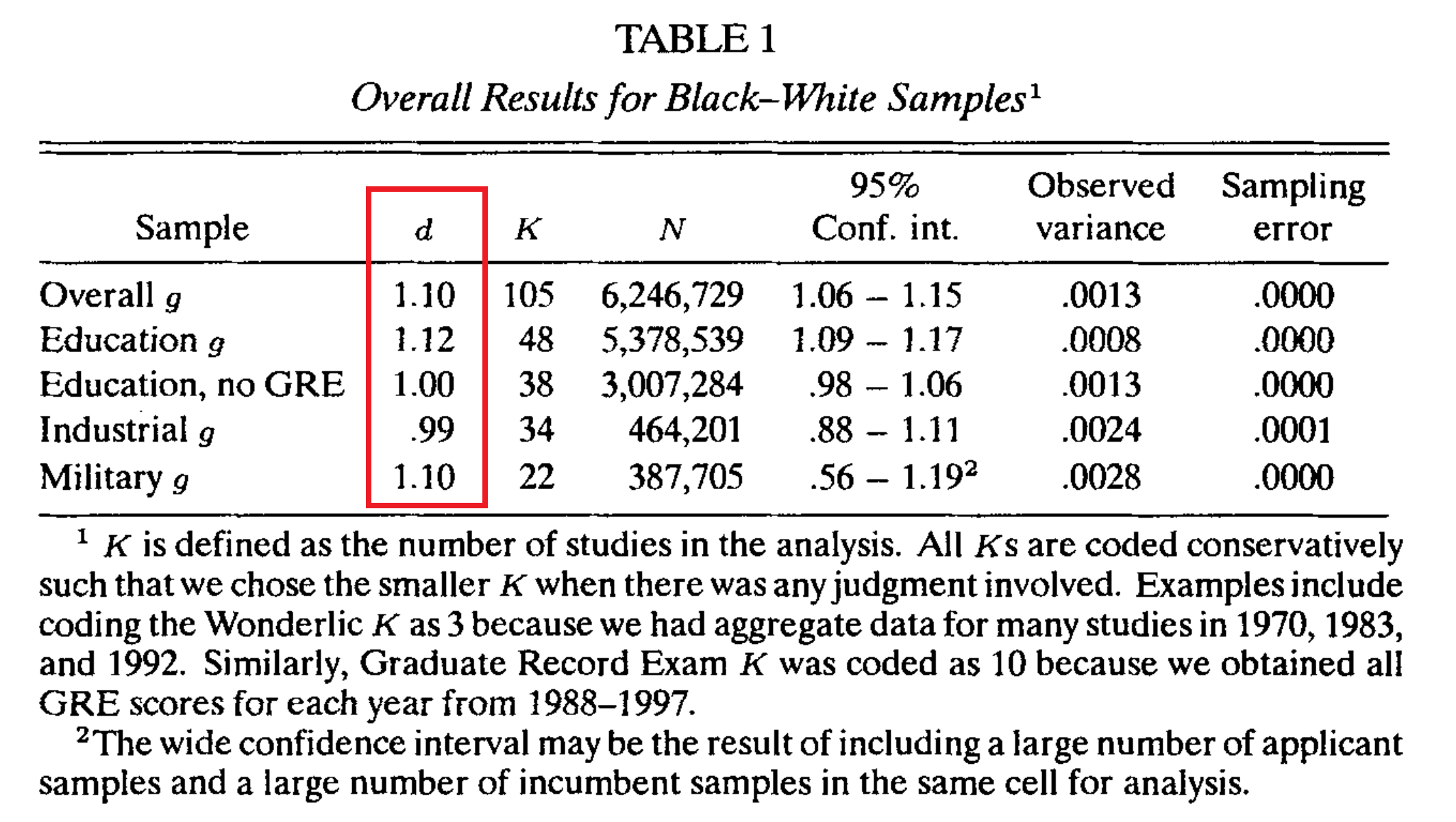
A similar gap was observed in a meta-analysis by Roth et al. (2001) [archived]. As far as I know, this is the most recent meta-analysis reporting the magnitude of racial gaps in cognitive ability. The meta-analysis considered studies on racial disparities in general cognitive ability (g) among adults across educational and employment settings. The black-white gap in g hovered at about 1 standard deviation across different settings. The average gap was 1.1 standard deviations across over 6 million individuals pulled from 105 samples. Table 1 shows the magnitude of the gap in standard deviations (see columns for d) across different testing settings. * [ photo 1 ].
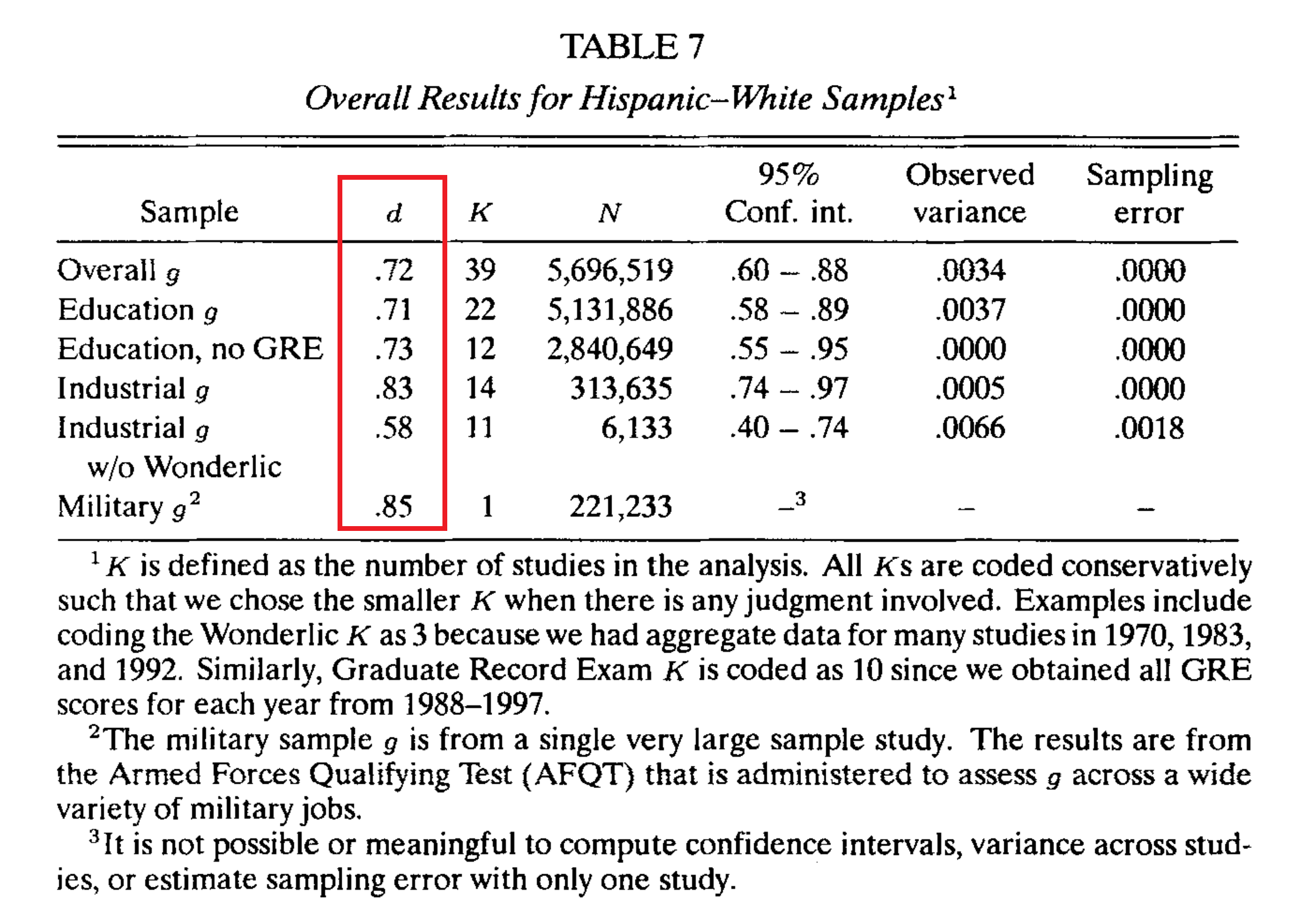
There were also large gaps in cognitive ability between Hispanics and whites, although the magnitude of the gaps were typically smaller than the gaps between blacks and whites. The Hispanic-white gap hovered at around .7 to .8 standard deviation across over 5 million individuals from 39 samples. [ Tabelle 7 photo 2].
.
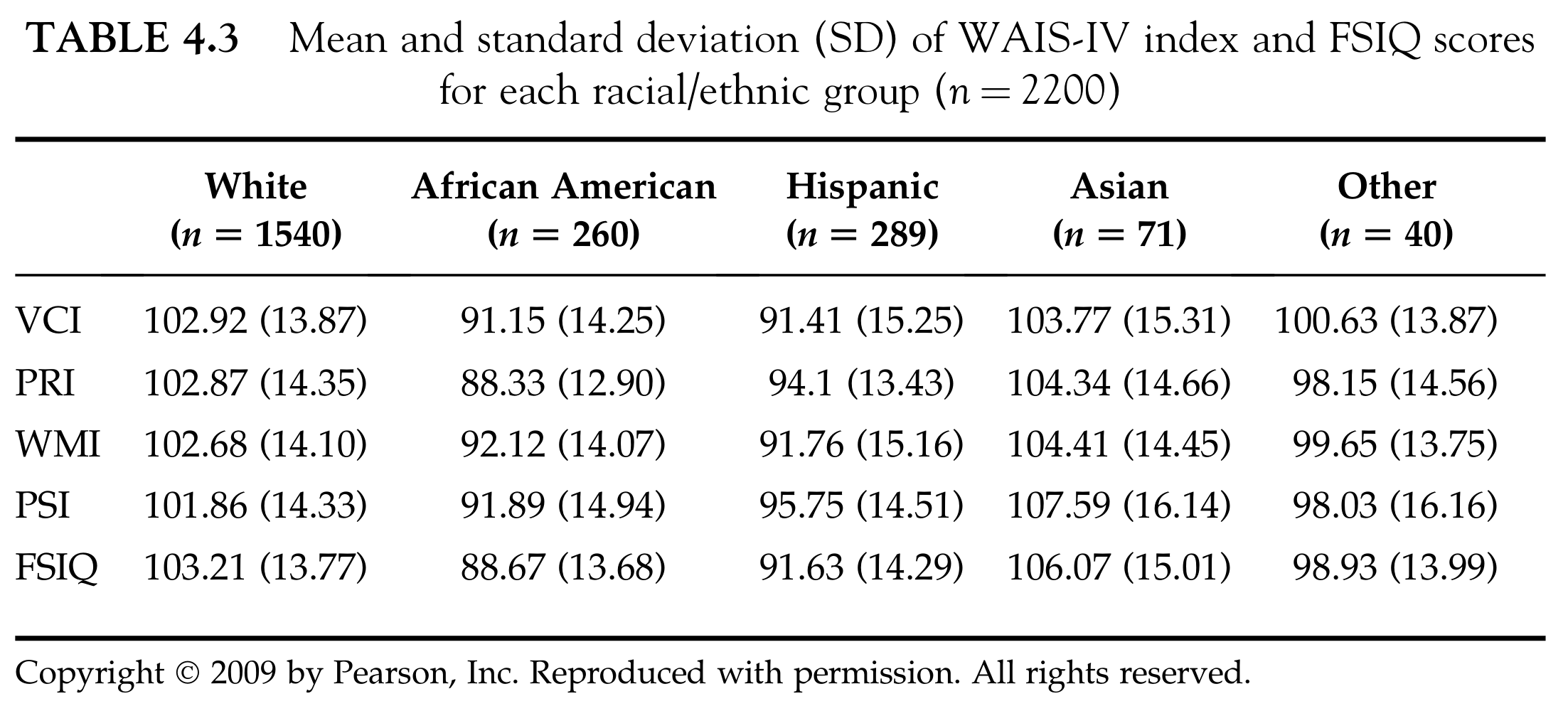
The latest iteration of the Wechsler Adult Intelligence Scale, WAIS-IV, also shows similar racial disparities in cognitive ability. The following table shows the average IQ by race on the standardization sample of the WAIS-IV as reported in Weiss et al. (2010). The standardization sample used 2,200 people in the United States in 2008 between the ages of 16 and 90 years. Scores are normed to have a mean of 100 points and standard deviation of 15 points.
[ Tabelle 4.3 photo 3 ].
.
- For reference, FSIQ = Full-scale IQ which is based on the total combined performance of the VCI, PRI, WMI, and PSI. VCI = Verbal Comprehension Index, PRI = Perceptual Reasoning Index, WMI = Working Memory Index, and PSI = Processing Speed Index.
- The black-white gap is 103.21 – 88.67 = 14.54 points, or about 14.54/15 = 0.97 standard deviations.
- The Hispanic-white gap is 103.21 – 91.63 = 11.58 points, or about 11.58/15 = 0.77standard deviations.
- The Asian-white gap is 106.07 – 103.21= 2.86 points, or about 2.86/15 = 0.19 standard deviations.
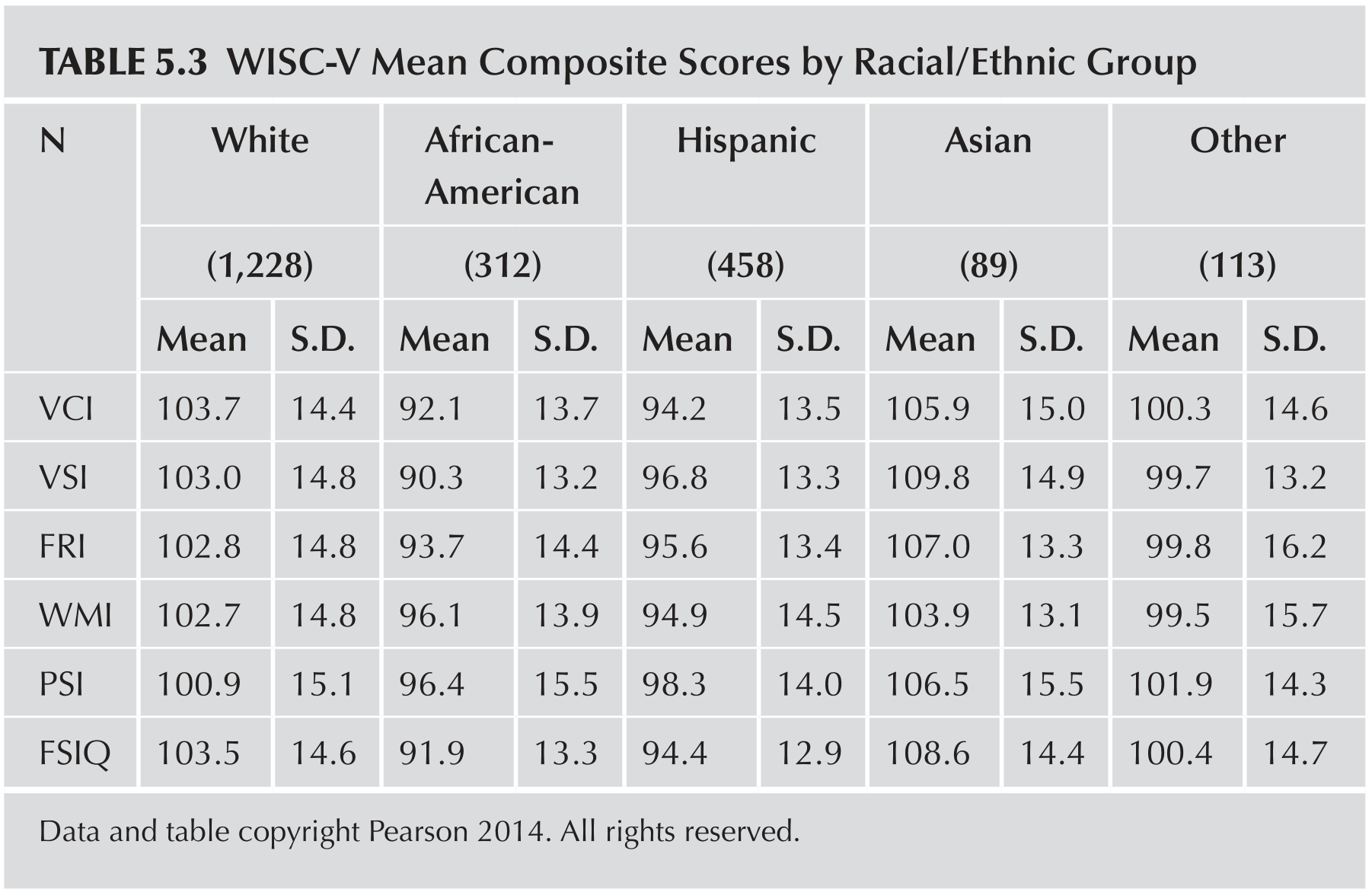
There are also similar gaps reported in the Wechsler Intelligence Scale for Children, although the gaps are typically smaller in magnitude. The following table shows the average IQ by race in the latest iteration of this test, the WISC-V, as reported by Weiss et al. (2015). The standardization sample was based on 2,200 children in the United States in 2014 between the ages of 6 and 16 years. Like the WAIS-IV, scores are normed to have a mean of 100 points and standard deviation of 15 points.
[ Tabelle 5.3 photo 4 ].
Part 2 incoming soon.