Reinhard_Heini
Platinum
- Joined
- Apr 25, 2026
- Posts
- 1,092
- Reputation
- 1,071
Part 2 :/
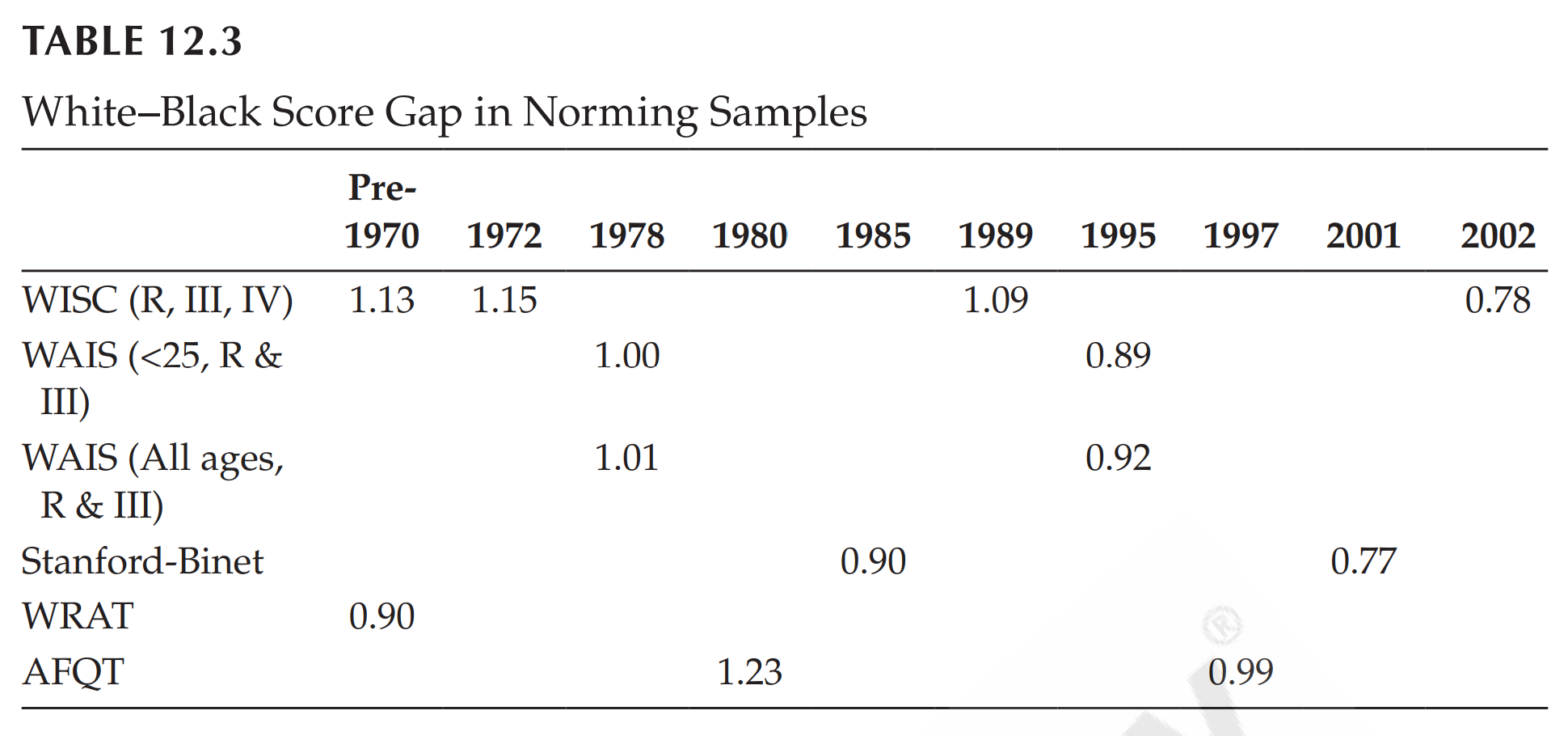
For more context, one should integrate these findings with the previously cited findings on the WAIS-IV and WISC-V. Recall that the WISC-V (2014) showed a black-white gap of about 0.77 standard deviations, which is about the same as the gap of 0.78 standard deviations on the WISC-IV (2002). Also, the WAIS-IV (2008) revealed a gap of about 0.97 standard deviations, which is about the same as previous WAIS tests.
Murray (2006) [archived] also examined black-white gaps in test scores on the standardization samples of different iterations of the Woodcock-Johnson test of cognitive abilities. The following shows the average scores for blacks and whites across three iterations of the WJ tests.

As you can see, there was a large reduction in the gap between WJ1 and WJ2. However, there was no improvement between WJ2 and WJ3. Murray also used this data to calculate the black-white gap by birth year. This analysis more clearly shows substantial reductions until about the 70s.

As Murray states, the gap reduces from about 1.33 to 0.98 standard deviations throughout the 20th century on WJ tests.
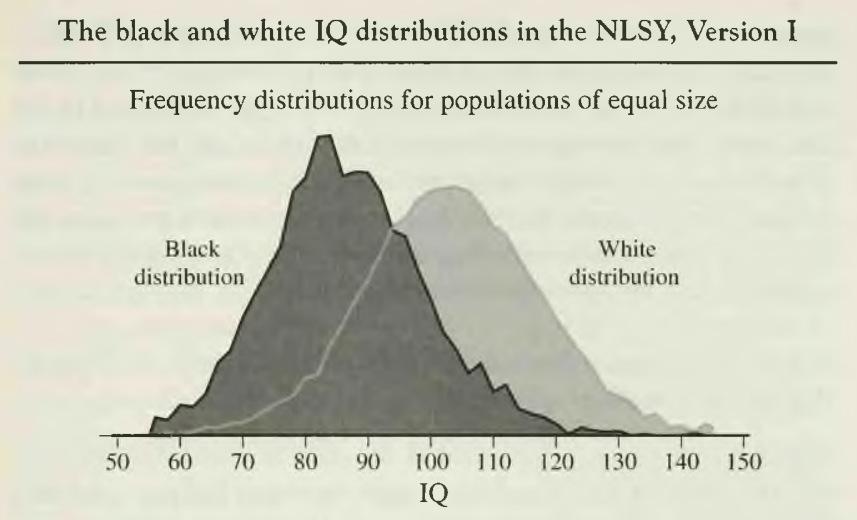
Think of racial differences in IQ the same way we think of sex differences in height. Men are taller than women on average, and there are far more men than women who are relatively tall (say, over 6 feet), yet it is common to find individual women taller than individual men. Likewise, whites are more intelligent than blacks on average, and there are far more whites than blacks who are relatively intelligent (say, over 115 IQ), yet it is common to find some black people smarter than some white people. One additional point worth noting is that the black-white gap in IQ is not as large as the male-female gap in height. In the United States, the mean height for men is about 5 inches greater than the mean height for women, which is equivalent to about 2 standard deviations. By contrast, the black-white gap in cognitive ability tends to hover at around 1 standard deviation. Thus, whereas only about 2 percent of women are taller than the average height for men, about 16 percent of blacks have higher IQs than the average IQ for whites.
For a visual illustration of racial differences in IQ distributions, consider the following distributions of IQ scores of blacks and whites in the United States (this graph was pulled from page 279 of The Bell Curve):
If we scaled the distributions to reflect population sizes, it would appear as follows:

One might think that a gap of 1 standard deviation in IQ is not much. After all, its half as great as the difference in height between men and women. However, if we assume that blacks and whites have a mean IQ of 85 and 100, respectively, then this would have the following profound statistical implications:
Cognitive ability is a strong predictor (oftentimes the best predictor) of outcomes such as academic achievement, job performance, educational attainment, job status, income, wealth, crime, and health. The predictive power of cognitive ability has been succinctly illustrated in the following chart reported by Gottfredson (1998) [archived] (page 28):
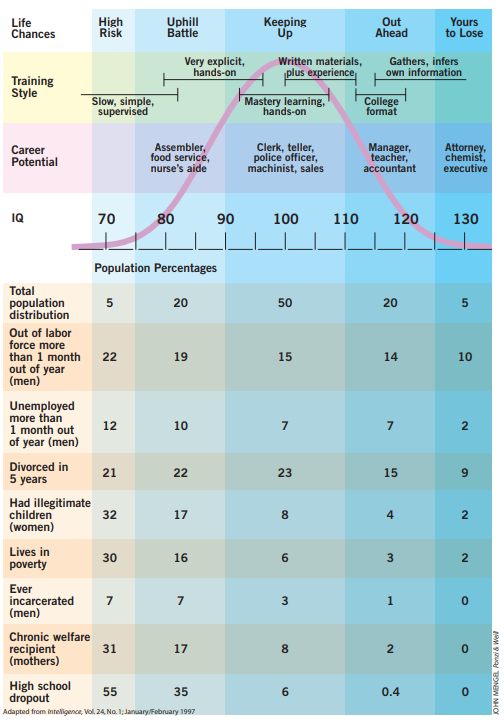
The above chart shows the probability of various social outcomes at different IQ levels. Note that the data here is only reported for young white adults (to avoid conflating the effects of IQ with the effects of race). As you can see, negative social outcomes are far more common for individuals with lower IQ scores. For example, young white adults with IQs between the 5th and 25th percentile are about 6 times as likely to drop out of high school as young white adults with IQs between the 25th and 75th percentile (35% vs 6%).
Gottfredson (2004) [archived] goes into some detail on the impact of racial differences in cognitive ability by considering the life outcomes associated with a variety of different IQ thresholds:
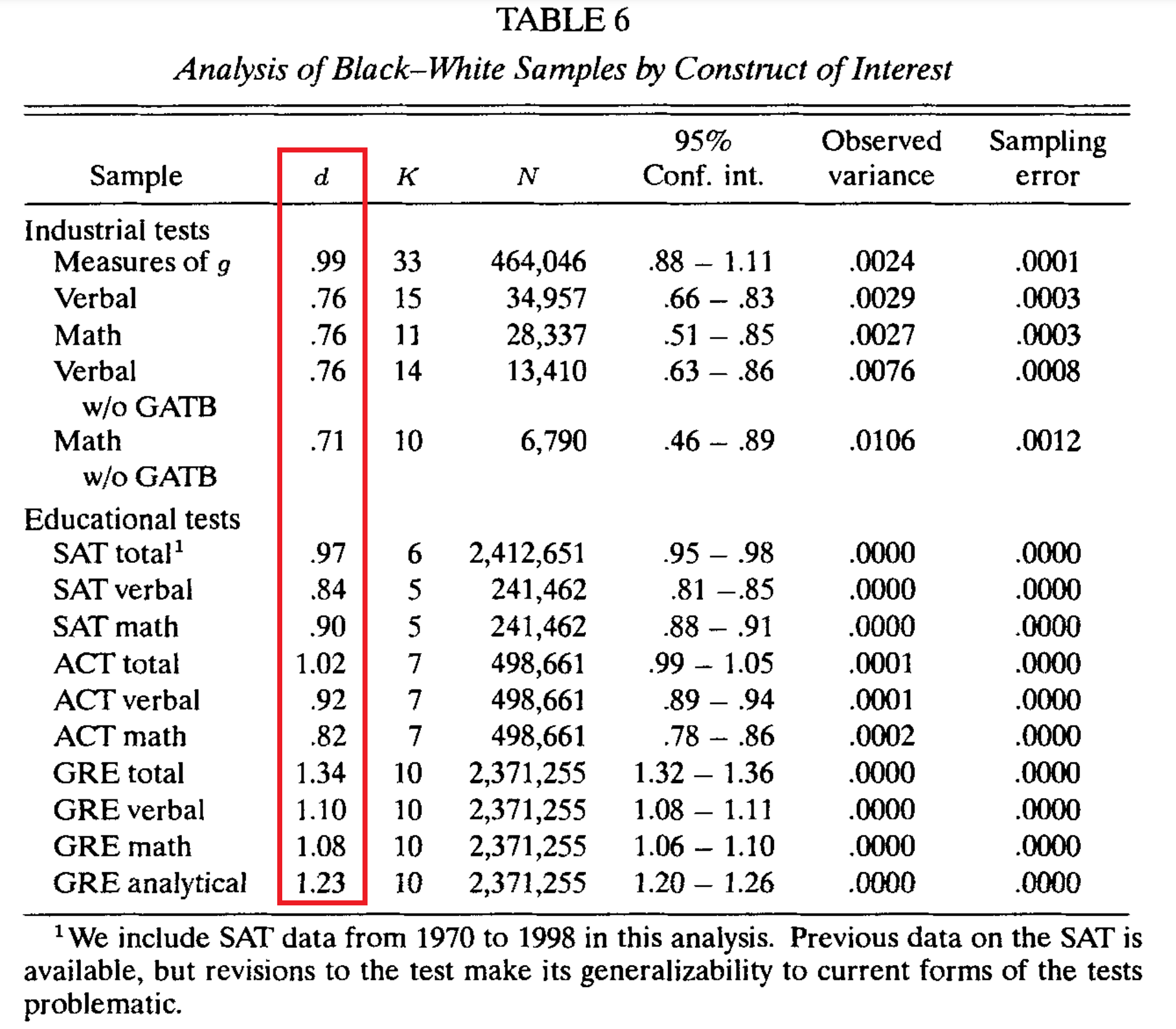
Racial differences in test scores is not limited to formal tests of cognitive ability. Racial gaps are also found on virtually all standardized tests of academic achievement. For example, Sackett and Shen (2010) [archived] also report large gaps on college admissions tests (e.g., SAT, ACT) and school achievement tests. The following table shows average black-white disparities in test scores across a variety of different tests.

In line with the earlier data, the black-white gap seems to hover at around 1 standard deviation. Also in line with earlier data, the Hispanic-white gap (not shown here because the table is too long) hovers at around 0.7 standard deviations.
Similar gaps were reported in Roth et al. (2001)[archived]. These authors show large black-white disparities on a variety of college admissions tests, including graduate admissions (e.g. GRE) tests.
Again, Hispanics also lagged behind whites, although to a lesser extent than did blacks.

While we find racial differences across a wide variety of tests, it’s important to note that racial gaps (particularly black-white gaps) on test scores tend to be greater on more g-loaded tests. This finding has been reported in a meta-analysis by Te Nijenhuis and Van den Hoek (2015) [archived].
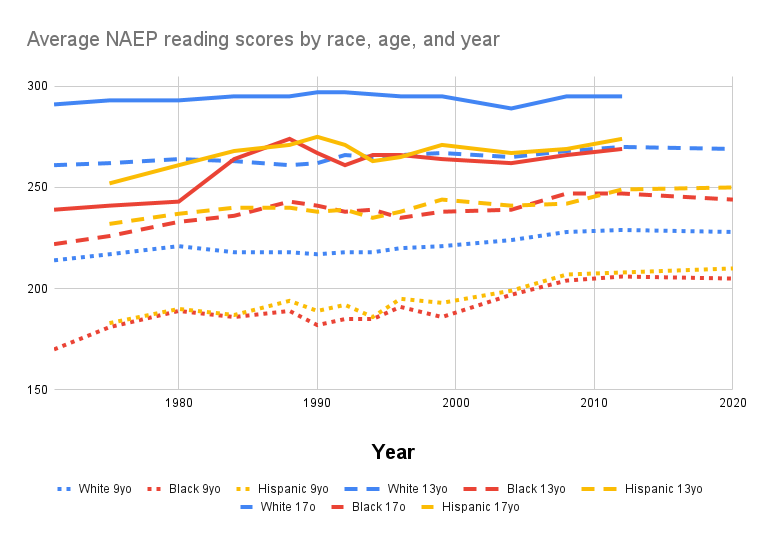
As you can see, racial disparities in test scores have been persistent for decades. There is some sign of narrowing of disparities among 9-year-olds, but the disparities for 13 and 17 year-olds has been mostly stagnant since the late 1980s. Another thing to note is that white 13-year-olds score at about the same level as black and Hispanic 17-year-olds. In fact, the white 13-year-olds have consistently outscored black 17-year-olds since the 1990s.
There are similar findings when examining average mathematics scores. This table shows the average mathematics scale scores by race and age from 1973 to 2020. I converted the data into a line chart in excel to better illustrate the changes over time. Here are the results:
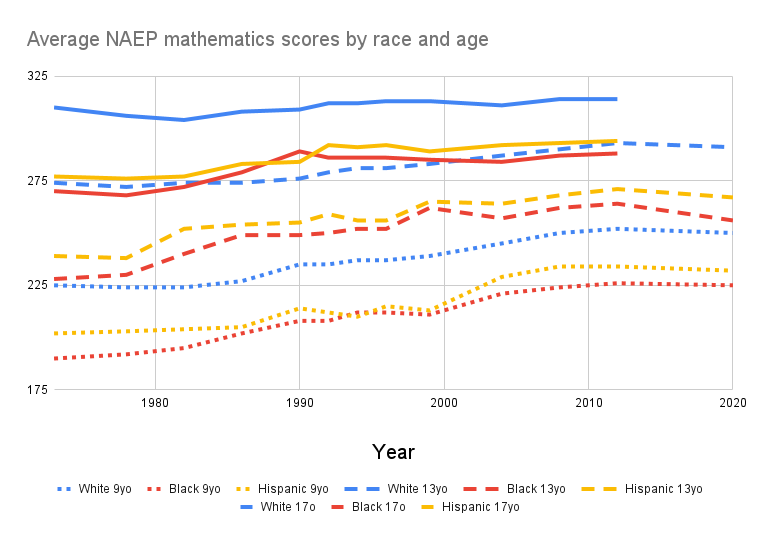
Again, there are similar patterns here as with the reading data. The gaps appear to have been mostly stagnant since the late 1980s. Also, white 13-year-olds have scored at the level of black and Hispanic 17-year-olds fairly consistently since the 1970s (aside from about the mid 80s to the mid 90s). Perhaps more shockingly, white 9-year-olds have begun to match black 13-year-olds in recent years.
- FRI = Fluid Reasoning Index.
- The black-white gap is 103.5 – 91.9 = 11.6 points, or about 11.6/15 = 0.77 standard deviations.
- The Hispanic-white gap is 103.5 – 94.4 = 9.1 points, or about 9.1/15 = 0.61 standard deviations.
- The Asian-white gap is 108.6 – 103.5= 5.1 points, or about 5.1/15 = 0.34 standard deviations.
Gaps across time
When considering IQ tests across time, one finds moderate closing of the black-white gap in the 70s and 80s, but mostly stagnation since then. Consider the following black-white disparities (in standard deviation units) on standardized tests between 1970s and the early 2000s as reported in Sackett and Shen (2010)[archived]:
For more context, one should integrate these findings with the previously cited findings on the WAIS-IV and WISC-V. Recall that the WISC-V (2014) showed a black-white gap of about 0.77 standard deviations, which is about the same as the gap of 0.78 standard deviations on the WISC-IV (2002). Also, the WAIS-IV (2008) revealed a gap of about 0.97 standard deviations, which is about the same as previous WAIS tests.
Murray (2006) [archived] also examined black-white gaps in test scores on the standardization samples of different iterations of the Woodcock-Johnson test of cognitive abilities. The following shows the average scores for blacks and whites across three iterations of the WJ tests.
As you can see, there was a large reduction in the gap between WJ1 and WJ2. However, there was no improvement between WJ2 and WJ3. Murray also used this data to calculate the black-white gap by birth year. This analysis more clearly shows substantial reductions until about the 70s.
As Murray states, the gap reduces from about 1.33 to 0.98 standard deviations throughout the 20th century on WJ tests.
He concludes that gap reductions dissipated in the 1970s:The B–W difference among persons born from 1920 to 1939 was 1.33σ. The difference dropped to 1.08σ for those born from 1940 to 1955. When the line begins in 1958, the difference was extremely large, reaching a high of 1.45σ in 1959. The difference dropped steeply throughout the 1960s, reaching its low in 1972, at 0.83σ. For those born most recently, 1987–1991, the difference was 0.98σ
This analysis has used data from the Woodcock–Johnson standardizations to explore a hypothesis for explaining for the disparate findings in the literature on the B–W difference over time: Narrowing in the B–W difference on highly g-loaded measures did occur during the 20th century, but the difference stopped narrowing for persons born in the 1970s and thereafter.
Comparing distributions
Cognitive ability scores, as measured by IQ tests, are normally distributed for all racial groups. The standard deviation of IQ is similar for all racial and ethnic groups, usually 13 to 15 points as shown in the WAIS data above. Thus, the shape of the distribution (or the “bell curve”) of IQ scores for all racial and ethnic groups are fairly similar. However, the large differences in mean IQ implies that the distribution of IQ scores for certain racial or ethnic groups is shifted above or below that of others. This means that, if group A has a higher mean IQ than group B, then there will be more individuals from group A that exceeds any given IQ threshold than there will be from group B. However, both groups will have some number of individuals exceeding any given IQ threshold (unless one makes the threshold so high that only rare outliers can exceed that amount). Thus, even if group A has a higher mean IQ than group B, for any individual in group A, there will almost always be some individual from group B with a higher IQ.Think of racial differences in IQ the same way we think of sex differences in height. Men are taller than women on average, and there are far more men than women who are relatively tall (say, over 6 feet), yet it is common to find individual women taller than individual men. Likewise, whites are more intelligent than blacks on average, and there are far more whites than blacks who are relatively intelligent (say, over 115 IQ), yet it is common to find some black people smarter than some white people. One additional point worth noting is that the black-white gap in IQ is not as large as the male-female gap in height. In the United States, the mean height for men is about 5 inches greater than the mean height for women, which is equivalent to about 2 standard deviations. By contrast, the black-white gap in cognitive ability tends to hover at around 1 standard deviation. Thus, whereas only about 2 percent of women are taller than the average height for men, about 16 percent of blacks have higher IQs than the average IQ for whites.
For a visual illustration of racial differences in IQ distributions, consider the following distributions of IQ scores of blacks and whites in the United States (this graph was pulled from page 279 of The Bell Curve):
If we scaled the distributions to reflect population sizes, it would appear as follows:
One might think that a gap of 1 standard deviation in IQ is not much. After all, its half as great as the difference in height between men and women. However, if we assume that blacks and whites have a mean IQ of 85 and 100, respectively, then this would have the following profound statistical implications:
- Only about 16% of blacks have an IQ above 100, compared to 50% of whites.
- Only about 2% of blacks have IQs above 115, compared to 16% of whites.
- 65% of blacks have an IQ below 90, compared to 25% of whites.
- 35% of blacks have an IQ below 80, compared to less than 10% of whites (these individuals are below the cutoff point for acceptance into the US armed forces).
- 16% of blacks have an IQ below 70, compared to 3% of whites (this constitutes intellectual disability according to the DSM-5 [archived]).
Cognitive ability is a strong predictor (oftentimes the best predictor) of outcomes such as academic achievement, job performance, educational attainment, job status, income, wealth, crime, and health. The predictive power of cognitive ability has been succinctly illustrated in the following chart reported by Gottfredson (1998) [archived] (page 28):
The above chart shows the probability of various social outcomes at different IQ levels. Note that the data here is only reported for young white adults (to avoid conflating the effects of IQ with the effects of race). As you can see, negative social outcomes are far more common for individuals with lower IQ scores. For example, young white adults with IQs between the 5th and 25th percentile are about 6 times as likely to drop out of high school as young white adults with IQs between the 25th and 75th percentile (35% vs 6%).
Gottfredson (2004) [archived] goes into some detail on the impact of racial differences in cognitive ability by considering the life outcomes associated with a variety of different IQ thresholds:
- An IQ of 75 “signals the ability level below which individuals are not likely to master the elementary school curriculum or function independently in adulthood in modern societies” (page 28). They are likely to be eligible for “financial support provided to mentally and physically disabled adults” by the U.S. government. Such individuals are “difficult to train except for the simplest tasks, so they are fortunate in industrialized nations to get any paying job at all. While only 1 out of 50 Asian-Americans faces such risk, Figure 3 shows that 1 out of 6 black Americans does.”
- An IQ of 85 is another threshold considered because “the U.S. military sets its minimum enlistment standards at about this level” (page 28). The military is often viewed as a last resort by many people, but “this minimum standard rules out almost half of blacks (44%) and a third of Hispanics (34%), but far fewer whites (13%) and Asians (8%).” Individuals with IQs in this range “live at the edge of unemployability in modern nations, and the jobs they do get are typically the least prestigious and lowest paying: for example, janitor, food service worker, hospital orderly, or parts assembler in a factory.”
- An IQ of 105 can be viewed as “the minimum threshold for achieving moderately high levels of success” (page 30). People above this level are “highly competitive for middle-level jobs (clerical, crafts and repair, sales, police and firefighting), and they are good contenders for the lower tiers of managerial and professional work (supervisory, technical, accounting, nursing, teaching).” The percentages of people achieving this threshold of IQ are “53%, 40%, 27%, and 8%, respectively, for Asians, whites, Hispanics, and blacks.”
Other Tests
Racial differences in test scores is not limited to formal tests of cognitive ability. Racial gaps are also found on virtually all standardized tests of academic achievement. For example, Sackett and Shen (2010) [archived] also report large gaps on college admissions tests (e.g., SAT, ACT) and school achievement tests. The following table shows average black-white disparities in test scores across a variety of different tests.
In line with the earlier data, the black-white gap seems to hover at around 1 standard deviation. Also in line with earlier data, the Hispanic-white gap (not shown here because the table is too long) hovers at around 0.7 standard deviations.
Similar gaps were reported in Roth et al. (2001)[archived]. These authors show large black-white disparities on a variety of college admissions tests, including graduate admissions (e.g. GRE) tests.
Again, Hispanics also lagged behind whites, although to a lesser extent than did blacks.
While we find racial differences across a wide variety of tests, it’s important to note that racial gaps (particularly black-white gaps) on test scores tend to be greater on more g-loaded tests. This finding has been reported in a meta-analysis by Te Nijenhuis and Van den Hoek (2015) [archived].
Achievement
The largest assessment of academic achievement from representative samples comes from the National Assessment of Educational Progress (NAEP). The NAEP provides data on results of academic assessments that have been conducted regularly since the early 1970s. Data is published each year for free to the NCES website. Data published in 2021 is available here. This table shows the average reading scale scores by race/ethnicity and age from 1971 to 2020. I converted the data into a line chart in excel to better illustrate the changes over time. Here are the results:
As you can see, racial disparities in test scores have been persistent for decades. There is some sign of narrowing of disparities among 9-year-olds, but the disparities for 13 and 17 year-olds has been mostly stagnant since the late 1980s. Another thing to note is that white 13-year-olds score at about the same level as black and Hispanic 17-year-olds. In fact, the white 13-year-olds have consistently outscored black 17-year-olds since the 1990s.
There are similar findings when examining average mathematics scores. This table shows the average mathematics scale scores by race and age from 1973 to 2020. I converted the data into a line chart in excel to better illustrate the changes over time. Here are the results:
Again, there are similar patterns here as with the reading data. The gaps appear to have been mostly stagnant since the late 1980s. Also, white 13-year-olds have scored at the level of black and Hispanic 17-year-olds fairly consistently since the 1970s (aside from about the mid 80s to the mid 90s). Perhaps more shockingly, white 9-year-olds have begun to match black 13-year-olds in recent years.