The Only Infraorbital Guide You'll EVER Need

THE ONLY INFRAORBITAL GUIDE YOU'LL EVER NEED

——————————————————————————————


This thread has been in the works for a while.

The infraorbital rim, what it actually does, why it's responsible for many eye area problems, and every single option available to fix it. Everything in this guide is sourced from published research, clinical case studies, and real surgical documentation.


Related reading: The Eye Area Manual and The Holy Grail of Facial Aesthetics — How to Simulate Lefort III Results with the Midface Mask Implant


——————————————————————————————


TABLE OF CONTENTS


1. What the Infraorbital Rim Actually Is

2. How To Tell If Yours Is Deficient

3. The Orbital Vector and Why It Matters More Than You Think

4. The Anatomy Explained Properly - Ligaments, Fat Compartments, and Vascular Zones

5. The Three Classes of Infraorbital Hollowing

6. Non-Surgical Options

7. The Right Filler Technique

7B. DIY Undereye Filler

8. Infraorbital Rim Implants With Costs

9. Midface Mask Implant

10. Le Fort Osteotomy


11. Surgeon Tierlist and Recommendations

12. Science Backing and Sources


——————————————————————————————

1. WHAT THE INFRAORBITAL RIM IS

The infraorbital rim is a ledge of bone sitting directly beneath your eye socket. It's the bottom border of the orbit and it's the foundation that everything else sits on. Your fat pads, your lower eyelid, your skin rests here. When this bone projects well, all that tissue is properly supported and your undereye looks smooth, full, and defined. When it's recessed or underdeveloped, the tissue has nothing to rest on. It descends. You get hollows, shadow, and that wrecked permanently tired look no matter how much sleep you're getting. Because it's not sleep causing it. It's bone.

Here is a comparison of Bad vs Good infras

Screenshot 2026 05 14 at 082231
Screenshot 2026 05 14 at 082241


Here's the number that puts it in perspective. On average the infraorbital rim sits about 3mm behind the surface of your cornea. Your brow bone at the top sits about 10mm in front of the cornea. That 13mm gap between upper and lower bony projection is what creates the deep-set look. When your infraorbital rim retrudes further back than average may it be whether from genetics or from the bone loss that happens as you age. Your globe looks relatively more prominent, the lower lid loses its anchor, and the whole undereye area looks sunken
1778726650989

There's a research finding published in Aesthetic Plastic Surgery by Pessa et al. and separately confirmed in a 2025 multilayered periorbital aging analysis in Aesthetic Plastic Surgery journal showing that orbital cavity volume actually expands with age as the bone resorbs. The globe itself gets slightly smaller too. Both changes together create the sunken, enophthalmic look that older men develop hence the hollow orbit and shadowed undereye.

——————————————————————————————

2. HOW TO TELL IF YOURS IS DEFICIENT


Take a side photo or look at your face in true lateral view. Drop an imaginary vertical line straight down from the most forward point of your eyeball, what's called the corneal apex. If the bone and soft tissue under your eye sits clearly behind that line, you have a negative orbital vector. The clinical literature consistently uses this as the primary diagnostic criterion. The further behind that vertical plane your rim sits, the more deficient it is.
1778727218748


The fat herniation test
Look directly upward in a mirror. If any bags or puffiness under your eyes get worse when you look up, that's herniated orbital fat pushing forward. Filler does not fix this. Filler in a herniated eye will make it look worse. That case needs lower blepharoplasty with fat repositioning.
1778727309499


The malar mound test
Press upward gently on your cheekbone just under the eye. If a visible mound or puffiness appears underneath rather than the hollow improving, you have malar mound tendency. Adding filler in this setting makes the mound worse. This is a known complication of undereye filler in the wrong candidate. It's well-documented in the clinical literature and it's almost impossible to fully reverse without hyaluronidase.
1778727908145

——————————————————————————————

3. THE ORBITAL VECTOR — WHY IT MATTERS MORE THAN YOU THINK

Positive orbital vector means your cheekbone and rim complex sits forward of your eyeball. The lower lid is fully supported, the lid-cheek junction is smooth, the eye looks deep-set and defined. Negative vector means your globe is the most forward structure in that zone as it protrudes past your cheek and rim. The lower lid has nothing to anchor it, eyes look slightly bulgy or round, the midface looks flat and withdrawn.
1778728628932

The reason the vector discussion matters so much beyond just aesthetics. Guys spending money on canthoplasty with an uncorrected negative vector are wasting it. The whole mechanism of canthoplasty is lifting the outer corner of the lower lid and changing the tilt of the eye and that depends on having a stable bony ledge underneath the lower lid to hold the result long term. If that ledge is recessed, the lid migrates back down over months regardless of the quality of the surgical work.

There's also a finding worth knowing about that comes from published morphometric research comparing young and older faces. In younger patients the malar eminence, infraorbital rim, and pyriform aperture are all positioned anteriorly and the orbital aperture is relatively small and compact. In older patients all three of those landmarks have retrused posteriorly, the orbital aperture has expanded in area, and the inferior orbital rim has developed a different curvature pattern. The researchers note that implant designs targeting the skeletally deficient areas of older patients literally match the anatomy of what's been lost over time. This is why implants for the infraorbital rim look so natural when properly placed.

——————————————————————————————

4. THE ANATOMY

The clinical outcomes of everything done in this area like filler, fat grafting, implants are directly determined by understanding these structures. So its better to have a good grasp of things.

The orbicularis retaining ligament (ORL) and the tear trough ligament
The orbicularis retaining ligament is a series of fibrous attachments extending from the inferior orbital rim to the overlying skin. It defines the upper border of the sub-orbicularis oculi fat compartment (SOOF). The medial portion of the ORL is specifically called the tear trough ligament. This structure is what creates much of the tear trough deformity. It physically tethers the skin to the bone, creating a groove that descends as the surrounding tissue loses volume and descends with age. When you squint or frown you can often see the tear trough groove deepen temporarily because the muscular contraction tightens this tethering effect.
1778729051874


The fat compartments that matter the most :
Below the orbicularis muscle sits the SOOF (the sub-orbicularis oculi fat). This compartment is bounded superiorly by the ORL and inferiorly by the zygomatic cutaneous ligament. Below and lateral to that is the deep medial cheek fat compartment which is where the structural cheek volume lives. In the superficial plane above the muscle are the superficial fat compartments the medial cheek fat, nasolabial fat, and a thin preseptal fat layer directly over the lower lid. Understanding which plane you're in during injection determines whether the result looks right or wrong. Filler placed in the wrong fat compartment doesn't just look suboptimal and it migrates in a direction determined by the anatomy of that compartment and can end up in a location that makes things look worse months later.

1778729355748


The vascular danger zones and why this area is high risk
The infraorbital region is supplied by several arterial branches. The angular artery is branch of the facial artery that runs medially across the nasojugal groove and is one of the most commonly injured vessels during tear trough injection. The infraorbital artery exits the infraorbital foramen approximately 3cm lateral to the midline just below the orbital rim. The zygomaticofacial artery runs laterally. All of these sit in a vascular territory that communicates with the ophthalmic artery via the orbital septum. This is why vascular occlusion from filler in this area carries vision risk in a way that injections elsewhere on the face generally don't. The connection to the ophthalmic circulation is real and documented. A 2015 review of the world literature on filler-related blindness by Beleznay et al. identified the glabellar region and nasal area as highest risk.
1778729941961

——————————————————————————————

5. THE THREE CLASSES OF INFRAORBITAL HOLLOWING

The groove is confined to the inner corner area. The rest of the rim still has reasonable support. This is the mildest presentation and it responds well to filler correctly placed. A good injector at the right depth can fix this in one session.

1778730948025

The hollow has deepened and extended outward. Visible under the middle of the eye and sometimes toward the outer corner. Early volume loss in the central cheek becomes visible. Filler still works but placement has to cover multiple zones and single-pass medial technique leaves the lateral area still hollow. You need dual-plane treatment across two or three anatomical subzones.
1778731030403

The hollow wraps around the entire rim. The lid-cheek groove is visible from every angle. This isn't just soft tissue loss anymore as the bone itself is genuinely deficient. Filler cannot build structure here because there's no skeletal platform for it to sit on. It just creates a puffy appearance without correcting the vector or the hollow. Class 3 is implant or fat grafting territory.

1778731161242

——————————————————————————————

6. NON-SURGICAL (COPE)


THIS WHOLE SECTION EXCEPT FOR THE DEXA SCAN AND BODY ARE FOR COPERS WHO ARE AGAINST FILLERS AND HARDMAXES SO DNR THIS IF YOU ARENT ONE


Global Costs

USA:
GHK-Cu serum $20 to $60 per bottle. The Ordinary Buffet + Copper Peptides around $25. Prescription tretinoin via telehealth (Curology, AgelessRx) $20 to $40 per month.

UK:
GHK-Cu £18 to £50. Tretinoin via Dermatica or Skin + Me £20 to £30 per month.

Europe:
€20 to €55. Prescription tretinoin through a derm €30 to €60 per month.


The Full Protocol

Step 1:
Cleanse morning and night with a gentle non-stripping cleanser. The periorbital skin is some of the thinnest on the entire body so anything with high-pH foaming agents or sulfates irritates it and makes the area look worse over time.

Step 2 (Morning):
A few drops of GHK-Cu serum on damp skin around the undereye and midface. Use your ring finger as it naturally applies the least pressure then and tap gently rather than rubbing. Don't drag the skin. This matters more than most people think over months and years of cumulative mechanical stress.

Step 3 (Morning):
SPF 50+ over everything including the undereye. Non-negotiable as UV accelerates collagen breakdown in this region faster than almost anywhere else on the face because the skin here is so thin and has so little protective mass. Long-term sun exposure is one of the factors driving the skeletal resorption pattern in this area.

Step 4 (Evening):
Retinol after cleansing. Start at 0.025% three nights per week. Move to every other night in weeks five through eight. Nightly from week nine. Step up concentration to 0.05% then 0.1% over three to four months. Follow with a light moisturizer to buffer irritation around the periorbital zone.

Key rule:
GHK-Cu and retinol in the same session cancel each other out. GHK-Cu in the morning, retinol at night.

raw GHK-Cu powder:
Buy raw GHK-Cu powder from Peptide Sciences or BoS Research for around $10 to $15 per gram. Dissolve 0.5g into 100ml of water-based hyaluronic acid serum base in a dark glass dropper bottle. That's a 0.5% serum for a fraction of what any brand charges. Dissolves cleanly. Store refrigerated, use within 60 days, date the bottle.

Realistic expectations:
Noticeably better skin quality, thicker skin, reduced shadowing after 12 to 16 weeks of consistency. It is mitigation not correction. Class 1 can see real improvement from topicals. Class 2 and 3 need more than this but topicals are worth running alongside whatever else you're doing.

Cost
Free. DEXA scan $50 to $150 in the US, £30 to £80 in UK, €40 to €100 in Europe, $20 to $40 in Turkey and Thailand.

Why it matters and what to do
The periorbital fat pads are highly sensitive to overall body fat percentage. Drop below 10% body fat and those pads thin out dramatically, making the infraorbital hollow look significantly worse. A lot of guys notice their undereye area looks great at 14% and wrecked when they push down to 8% for summer. There's a sweet spot typically somewhere in the 12 to 17% range where facial fat is preserved without sacrificing overall body composition. It's individual based on genetic facial fat distribution. Get a DEXA scan at your leanest and at a moderate body fat, photograph yourself in consistent lighting at both, and compare. That gives you your actual threshold.

1778731810923

Global Costs

USA:
$20 to $40 per month at 10g daily. BulkSupplements cheapest at $20 to $25.
UK:
£18 to £35. Bulk Powders and MyProtein both carry it.
Europe:
€20 to €40. Bulk Powders ships to most EU countries.


The Protocol

Step 1:
Hydrolyzed Type I and III collagen peptide powder specifically. Not gelatin. Not non-hydrolyzed collagen. The label has to say hydrolyzed collagen peptides or you're not getting the absorption the clinical studies are based on.

Step 2:
10g every morning in hot coffee or tea. Tasteless in most formulations. Dissolves completely in hot liquid.

Step 3:
500mg Vitamin C at the same time. Ascorbic acid is a required enzymatic cofactor in the collagen synthesis pathway. Without adequate circulating Vitamin C the production signal from the peptides can't complete properly. Most people skip this and then wonder why their results are mediocre.

Step 4:
Every single day for minimum 90 days before assessing. Collagen remodeling is slow. Most people see real change between weeks 8 and 16. Sporadic use produces nothing.

Step 5:
Photograph the undereye in the same lighting every four weeks. Subjective mirror assessment doesn't work for slow changes. Objective photos tracked over time are the only accurate way to evaluate this.

——————————————————————————————

7. THE RIGHT FILLER TECHNIQUE

The tear trough is not just volume loss. There's a fibrous structure. The tear trough ligament, the medial portion of the orbicularis retaining ligament is the one that physically tethers the skin to the orbital rim bone at the boundary between the thin eyelid skin and the thicker cheek skin. To lift the groove you need product placed below this structure at the supraperiosteal level so it pushes up against the tethering from underneath. Injectors who deposit product above the ligament in the superficial plane get a lump or ridge sitting on top of the groove without lifting it. That's the most common reason tear trough filler results look bad. The cadaveric study from the University of Pennsylvania published in Aesthetic Surgery Journal in 2023 confirmed that injection just above the periosteum produces the most anatomically precise placement along the orbital rim and critically showed that Restylane-L placed this way stays as a distinct mass along the ORL, while Volbella spreads more freely across anatomical planes due to its lower elastic modulus. This finding has direct implications for which product you use at which depth.

HA filler injected at the supraperiosteal level supports the undereye, reduces hollowing, and moves the orbital vector toward positive. Often combined with lower blepharoplasty when someone needs both structural and skin correction at the same time. The area around the infraorbital rim is highly vascular with multiple arterial branches communicating with the ophthalmic circulation

1778732275401


Global Costs — Both Eyes

USA:
$1,000 to $2,500 total. Per syringe $600 to $1,500. ASPS national average around $684 per syringe.
UK:
£500 to £1,500. Harley Street at the top. Regional UK from £350 to £400 per syringe.
Western Europe:
€600 to €1,400. Spain and Eastern Europe more competitive at €350 to €800.
Turkey (Istanbul):
€250 to €450. Same brand-name filler, 60 to 75% cheaper. Highest ROI destination for this specific procedure.
South Korea (Seoul):
$300 to $600 at Gangnam clinics.
Thailand (Bangkok):
$200 to $500. JCI-accredited clinics only.
Mexico:
$300 to $700. Major cities with board-certified injectors.

——————————————————————————————

7B. DIY UNDEREYE FILLER FULL GUIDE

This covers the DIY approach. The undereye is the highest-risk filler site on the face due to the vascular anatomy described in Section 4. Know the emergency protocol before you start. Have hyaluronidase on hand.


You're a reasonable candidate if:
You have Class 1 or mild Class 2 hollowing. A groove with genuine volume loss but nothing puffy or herniated. Lower eyelid skin is taut when you pinch it gently. No loose or baggy eyelid skin. No bags that are worse in the morning. No bleeding disorders, autoimmune conditions, or active skin infection. You haven't had filler dissolved in this area in the past 8 weeks.

Stop here if:
You have puffy bags or visible fat herniation as filler will make this dramatically worse. Thin eyelid skin where veins are clearly visible. Significant laxity under the eye. Strongly negative orbital vector without structural support as filler will just look puffy without fixing the vector. You've had hyaluronidase used in this area in the last 8 weeks.

The filler
Soft, low G-prime HA filler designed for periorbital use. Do not use thick fillers like Voluma, Radiesse, or dense Juvederm in the tear trough as they lump and migrate. The right products are Restylane-L, Juvederm Volbella, Belotero Balance, and Teosyal Redensity 2. Teosyal Redensity 2 is specifically formulated for periorbital use with lower water-attracting properties to reduce post-injection swelling. You need 1ml maximum for both sides as most sessions use 0.3 to 0.5ml total.

Where to source: Medica Depot, HA-Dermal, DoctorMedica, and similar gray market wholesale suppliers sell Restylane and Teosyal without prescription in many jurisdictions. In Turkey you can walk into Istanbul pharmacies and buy Juvederm or Restylane OTC for $40 to $80 per syringe. Never buy from eBay or AliExpress and counterfeit or improperly cold-chain stored filler is a real infection risk. Established suppliers with documented cold-chain shipping only.


Cannulas
27-gauge blunt cannula, 38mm length. The blunt tip pushes vessels aside rather than puncturing them. Brands: Softfil, TSK Steriglide, FlexFill. Available from Medica Depot or iBeautyMachine for $15 to $40 per box of 20. Fresh cannula per session and per eye as you should never reuse.

Entry needle
25-gauge sharp hypodermic needle to create the entry point hole. Available at any pharmacy.

Numbing
EMLA cream (lidocaine 2.5% plus prilocaine 2.5%) under cling film for 30 minutes. LMX4 also works. Do not use ice as primary numbing as it causes vasoconstriction which makes blood aspiration harder to assess.

Hyaluronidase
The enzyme that dissolves HA filler. Available as Hylenex in the US, Hyalase in UK and Europe, or generic hyaluronidase 1500iu vials. t.

Sterility supplies
Nitrile gloves. Alcohol prep pads (70% isopropyl). Chlorhexidine 2% for skin prep. Gauze pads. Sterile drape or fresh clean towel. Sharps container.

Total cost
Filler syringe $40 to $120. Cannula box $15 to $40. EMLA $10 to $25. Hyaluronidase $30 to $80. Supplies $10 to $20. Total $105 to $285 versus $1,000 to $2,500 professionally.

48 hours before:
Stop blood thinners so no aspirin, ibuprofen, fish oil, vitamin E, or alcohol. OTC supplements and lifestyle only and do not stop prescription blood thinners without speaking to your doctor.

Day of — skin prep:
Wash your face. Remove everything like no makeup, no skincare. Chlorhexidine on a gauze pad wiped from center outward over the injection zone. Follow with alcohol prep pad. Let dry completely. Don't touch the cleaned area with bare hands again.

EMLA application:
Thick layer covering the full undereye zone from inner corner to the outer orbital area. Cover with cling film. Leave minimum 30 minutes. Wipe completely off with alcohol prep pad and let dry fully before proceeding.

Workspace setup:
Large well-lit mirror. Daylight or bright white LED pointed at your face. All supplies within reach. Nitrile gloves on. Filler syringe open with hub attached. Cannula on sterile surface. Hyaluronidase immediately accessible and know exactly where it is and how to draw it up before touching anything.

Step 1 — Mark your anatomy
White eyeliner pencil only and not a dark marker. Mark the lowest point of your tear trough groove in good lighting. Mark your entry point: 15 to 20mm directly below the outer edge of your iris (lateral limbus) on the cheek. This location keeps your cannula path away from the infraorbital foramen and the angular artery as you travel medially. Wipe the marks off with an alcohol pad before injecting also never inject through skin with marker on it.
1778735500303


Step 2 — Create entry point
Stretch the skin at the entry point with your non-dominant hand. 25-gauge sharp needle, firm puncture at 45 to 90 degrees. One clean puncture. Entry point on the cheek, not the lower eyelid. Small drop of blood is fine but wipe with alcohol pad.

1778736196786


Step 3 — Insert cannula
27-gauge blunt cannula attached to filler syringe. Stretch entry point skin to keep the hole open. Insert at 30 to 45 degrees then flatten the angle to nearly parallel with the skin surface. Travel supraperiosteally and just above bone. You feel slight resistance through the orbicularis and a give as you enter the sub-orbicularis plane. Cannula scraping against bone means you're at the right depth. Advance slowly toward the inner corner of the eye, below the tear trough groove.
1778743967767


Step 4 — Aspirate first
Before releasing any product, pull the plunger back. Blood in the syringe means you're in a vessel. Withdraw immediately, apply pressure for 2 minutes, don't inject from that entry point again. Move to the other eye and return with a fresh cannula from a slightly different entry location.
1778744280250


Step 5 — Retrograde linear threading
Cannula at its deepest point medially near the inner corner. Begin slowly pressing the plunger while simultaneously withdrawing at a steady even pace toward the entry point. Product deposits as a thin continuous thread as you withdraw. Even pressure, smooth withdrawal with thin column along the rim, not a blob. Volume per pass: 0.1 to 0.2ml max. Start with 0.1ml and assess before adding more.
Screenshot 2026 05 14 at 145210


Step 6 — Lateral fan if needed (Class 2 only)
If hollow extends laterally past mid-pupil, readvance from same entry point angled slightly outward. Second retrograde pass covering the lateral area. Use less here like 0.05 to 0.1ml. Maximum two passes from one entry point.

Step 7 — Assess and massage
Remove cannula. Gentle pressure on entry point for 30 seconds. Sit upright and look in natural light. Any lumps felt then gentle circular massage with clean finger. Check specifically for skin blanching anywhere for white patches that don't resolve in 30 seconds mean possible vascular compression.
Wait 5 minutes and reassess the first side before moving to the other eye.

Step 8 — Other eye
Fresh cannula. New entry point same location on the other side. Match volume exactly to what you used on the first side. Always err toward less so you can add at 2 weeks, you cannot easily remove immediately.

Step 9 — Aftercare
Cold compress (wrapped, not bare ice) for 10 minutes. No makeup for 24 hours. No alcohol, exercise, or heat for 48 hours. Sleep slightly elevated the first night. Don't massage after the first hour. Expect some swelling and possible mild bruising for 2 to 5 days. Final result at 2 weeks around is noticed.

Most DIY attempts go wrong because people use too much. This area needs far less product than anywhere else on the face. Overfilling creates a puffy pillow look that sits there for months and requires hyaluronidase to fix.

Session 1:
0.1ml per side. Total 0.2ml. Test session. You will probably not see a dramatic result. Assess at 2 weeks.

Session 2 (minimum 2 weeks later):
Add up to 0.15ml per side if genuinely needed. Cumulative max after two sessions: 0.25ml per side.

ceiling:
Never exceed 0.3ml per side total across all DIY sessions. If your hollowing needs more than that, the problem is structural.

vascular occlusion:
Signs: skin blanching white that doesn't resolve in 30 seconds, skin going mottled or grey or purple, severe pain out of proportion to the procedure, any change in vision including blurring or darkening. If any of these happen: stop injecting. Inject hyaluronidase immediately into the affected area then reconstitute 1500iu vial with 2ml saline for 750iu/ml, inject 0.2ml (150 units) directly into the blanched zone and surrounding tissue. Apply warm compress then Take 325mg aspirin.

Tyndall effect (blue discoloration):
Filler placed too superficially. Not dangerous but looks bad. Hyaluronidase 15 to 30 units injected directly into the blue zone in small aliquots. Resolves within 24 to 48 hours.

Persistent lump:
Wait 2 weeks as most resolve with swelling. Persistent lump at 2 weeks gets hyaluronidase 15 units per side directly into it. Reassess at 48 hours.

Full dissolution protocol:
Reconstitute 1500iu hyaluronidase with 2ml bacteriostatic saline giving 750iu/ml. Draw up appropriate volume in insulin syringe. Inject small amounts (0.02 to 0.05ml per puncture) directly into the filler deposit across multiple punctures. For full dissolution of undereye filler: 15 to 75 units per side. Results in 24 to 48 hours. Wait minimum 4 weeks before re-injecting as residual hyaluronidase can break down freshly placed filler if you go back too soon.

——————————————————————————————

8. INFRAORBITAL RIM IMPLANTS COSTS

Solid silicone implants placed directly on the infraorbital rim bone. The most direct structural correction available for undereye hollowing and a negative orbital vector as you are physically augmenting the bony architecture, not masking the problem with volume. Unlike filler which is temporary and only addresses soft tissue, implants permanently correct the vector. They're typically combined with lower blepharoplasty for the best full eye area result.


Off-the-shelf implant designs are not inferior to custom implants for most people. The Flowers infraorbital rim implant is a well-established design with a long clinical track record and it's appropriate for the majority of symmetric cases. Custom implants are specifically for patients with significant asymmetry between sides or unusual anatomy that a standard design can't accommodate. The push toward custom-only is partly surgeon preference and partly commercial as custom implants cost significantly more and have higher margin.


Global Costs

USA:
$6,000 to $15,000. Flowers off-the-shelf designs at the lower end. Custom CT-derived implants from Eppley, Taban, Isaacs at $8,000 to $15,000+.
UK:
£5,000 to £9,000. Surgeons with specific experience in this procedure are rare outside London.
Western Europe:
€5,000 to €10,000. Belgium, Netherlands, Germany, Spain have experienced craniofacial surgeons doing this.
Turkey (Istanbul):
$3,000 to $6,000 all-in with hotel and transfers. Verify that the specific surgeon has done infraorbital rim implants specifically — not just cheek or chin work.
South Korea (Seoul):
$4,000 to $8,000. Often combined with canthoplasty and lower bleph as a full eye area package. VAT refund 7 to 8% at airport for foreign patients.
Thailand (Bangkok):
$3,500 to $7,000 at JCI hospitals.
Mexico:
$3,000 to $6,000. Mexico City and Monterrey over Tijuana for this level of work.

——————————————————————————————


9. MIDFACE MASK IMPLANT


Reference thread on this: The Holy Grail of Facial Aesthetics — How to Simulate Lefort III Results with the Midface Mask Implant


The custom midface mask implant covers the entire upper midface skeleton which is from the infraorbital rims down to just above the upper teeth. Think of it as a single unified implant that simultaneously augments all of the following : the infraorbital rims, the malar eminences (cheekbones), the paranasal region (the area around the base of the nose), and the anterior maxilla. That coverage is why it's called a mask. the footprint literally looks like the upper portion of a face mask on 3D imaging.

Screenshot 2026 05 14 at 170714

The effect is described in the surgical literature as Lefort III-like but without the occlusal movement. Meaning it pulls the entire midfacial skeleton forward in one coordinated augmentation, mimicking the aesthetic outcome of a full midface advancement osteotomy without actually cutting and moving bone. The infraorbital rims project forward correcting the negative vector, the cheeks project forward, the paranasal area fills out, the entire midface depth and width changes. For someone with true generalized midface hypoplasia this is the procedure that actually addresses the whole problem rather than chasing individual zones with separate implants.

Because the infraorbital nerve passes through the infraorbital foramen in the middle of this zone, the implant is designed as three pieces: bilateral infraorbital-malar segments and a lower maxillary segment that crosses under the nasal base. Each piece is designed around the nerve pathway to prevent compression. When properly placed there should be no permanent nerve damage, though patients should expect some temporary numbness of the upper lip and side of the nose from nerve stretching during implant seating which recovers fully.

The limitation with doing a cheek implant here and a separate infraorbital rim implant there and a separate pyriform implant somewhere else is that you get disjointed augmentation with visible transitions between the zones. Each implant has edges. Where one implant ends and another begins there's a potential step-off or contour irregularity that shows through the overlying soft tissue. The more implants you stack the more complex the revision situation if anything needs to be adjusted.
1778825712194

The midface mask implant solves this by creating one continuous augmentation surface across all zones simultaneously. The transitions between the infraorbital rim, malar eminence, and paranasal regions are built into the implant design itself and are smooth by design rather than approximated by placement of separate pieces. The clinical result looks more natural and cohesive because it is more natural and it follows the actual anatomy of the midfacial skeleton as a unified structure rather than addressing it as isolated landmarks.

There's also a case documented in the surgical literature specifically for patients who had a Le Fort I osteotomy that moved the lower maxilla but left the upper midface consisting of the infraorbital rims and zygomaticomalar complex untouched and still recessed. This is a known limitation of Le Fort I: it addresses the occlusal level but doesn't move the infraorbital rim. A custom infraorbital-maxillary-malar implant placed after a Le Fort I creates what surgeons describe as a modified Le Fort III effect as both the lower and upper midface are now addressed, combining what surgery did with what the implant adds.

The midface mask implant is appropriate for someone with true generalized midface hypoplasia and not just undereye hollows, not just flat cheeks, but the full midface complex being recessed including the infraorbital rims, malar eminences, and paranasal area. If you look at your profile and everything from your lower eyelid to your upper lip sits behind the plane of your nose tip and forehead, you are probably in this category. If only specific zones are deficient, targeted implants or filler are more appropriate.


The procedure is not appropriate if your occlusion needs to change and if you have a malocclusion that needs orthognathic surgery, that needs to be addressed before or simultaneously with any midface implant work, not replaced by it. The midface mask implant advances the skeletal contour without moving the teeth or changing the bite. If the bite is off, that's a separate problem requiring orthognathic surgery.

Cost
$6,000 to $15,000 depending on surgeon and whether it is standalone or combined with other procedures. For context: a Le Fort II or III osteotomy runs $30,000 to $60,000 and is practically inaccessible for purely aesthetic indications. The midface mask implant achieves a comparable aesthetic effect at 20 to 50% of that cost. This is one of the best cost-to-outcome ratios in all of facial surgery for the right candidate.


Where to find surgeons who specifically do this
Dr. Barry Eppley at Eppley Custom Facial Implants in Indianapolis is the most documented surgeon in the English-language literature for this specific procedure. His case studies are publicly available on exploreplasticsurgery.com and document outcomes across multiple patient types including men with generalized midface hypoplasia. In Europe, craniofacial units in Belgium and the Netherlands have surgeons experienced with comprehensive midface implant design. In South Korea the Gangnam complex surgery market has surgeons comfortable with multi-zone midface implants. As with the infraorbital rim implant, verify specifically that the surgeon has documented experience with full-coverage midface mask implants — not just cheek or malar implants in isolation.

his website : eppleyplasticsurgery.com

——————————————————————————————

10. LE FORT OSTEOTOMY — WHEN AND WHY

The Le Fort osteotomies are the actual skeletal solution for severe midface recession. Le Fort I moves the maxilla at the occlusal level and changes the teeth and lower midface position but critically does not move the infraorbital rims, which is why it often leaves the upper midface still recessed after surgery. Le Fort III moves the entire midface including the orbital rims forward and is the most complete correction available.
1778826863528


Global Costs

USA:
$20,000 to $40,000 for Le Fort I. Modified Le Fort III $30,000 to $60,000+ at major craniofacial centers.
UK:
£12,000 to £25,000 private. NHS may cover with functional indication.
Western Europe:
€10,000 to €25,000. Spain and Eastern Europe more competitive at €10,000 to €15,000.
Turkey (Istanbul):
$6,500 to $12,000 at accredited hospitals.
South Korea (Seoul):
$8,000 to $18,000. Korea performs among the highest annual volume of orthognathic surgery globally.
Thailand (Bangkok):
$9,500 to $15,000 at JCI hospitals.
Mexico:
$8,000 to $15,000. Mexico City university-affiliated maxillofacial departments.


The Le Fort I Limitation and Why Many Patients Need More
Le Fort I advancement moves the lower midface consisting of teeth, lower cheeks, nose but it does not move the infraorbital rims. In patients where the midface deficiency extends all the way up to include the orbital rims, a Le Fort I leaves the upper midface still recessed after surgery. The patient sees improvement in their bite and lower face but still has a negative orbital vector and hollow undereyes. Opting for a LE FORT III is best here.
1778826581514


——————————————————————————————

11. SURGEON TIERLIST

The surgeons listed here are the ones with documented, verifiable track records specifically for this procedure and not general plastic surgeons who have done one or two of these, but specialists who have built a reputation specifically around periorbital and midface skeletal surgery. Tierlists cover surgeons globally, then clinics by country, then countries overall.


Ranked specifically on documented case volume, technical specificity for this procedure, published research contribution, and real patient outcome track record. Not on general reputation as a plastic surgeon.

S TIER — The absolute best, would travel anywhere for these

Dr. Barry Eppley
Location:
Eppley Plastic Surgery, 12188-A North Meridian St Suite 310, Carmel (Indianapolis), Indiana, USA
Website:
eppleyplasticsurgery.com and eppleycustomfacialimplants.com
Approximate cost:
Infraorbital rim implants (combined infraorbital-malar) around $6,500. Midface mask implant $8,000 to $12,000. Custom jaw, cheek, full facial packages vary. Virtual consultation available.
Why S tier:
Eppley is probably the single most documented surgeon in the English-language literature for custom facial implants including infraorbital rim, midface mask, and combined periorbital work. His blog at exploreplasticsurgery.com contains hundreds of case studies with full before/after documentation across every facial zone. He developed the semi-custom infraorbital-malar implant approach and has the deepest public case archive of anyone doing this procedure. He uses titanium micro-screw fixation for long-term positional stability. His pricing is also significantly lower than the Beverly Hills surgeons doing comparable work.
In his own words on infraorbital implants vs fillers:
"In the treatment of infraorbital rim deficiency, the three treatments are synthetic injectable fillers, injected fat and implants. Each has their own advantages and disadvantages. But none of them are perfect nor is one method best for all patients. Each case must be considered separately and the magnitude of the defect considered in the treatment selection." He also notes that fillers should be used as a trial method first to assess whether soft tissue volumization gives the desired effect before committing to implants.
On custom vs off-the-shelf:
"A semi-custom approach allows me to select an infraorbital-malar implant from a variety of custom ones that have been made for other patients. Given the shape of this area of the facial skeleton a semi-custom implant can be a more cost-effective method that fits fairly well." Worth knowing that he actually offers this more affordable semi-custom option for appropriate cases.

Dr. Mehryar (Ray) Taban
Location:
9735 Wilshire Blvd Suite 319, Beverly Hills, CA 90212, USA. Also Santa Barbara.
Website:
tabanmd.com — Phone: (310) 278-1836
Approximate cost:
Infraorbital rim implants $8,000 to $15,000 depending on complexity and whether combined with canthoplasty, blepharoplasty, or orbital decompression. Full periorbital transformation packages can run higher.
Why S tier:
Taban is double board-certified by ASOPRS (American Society of Oculofacial Plastic and Reconstructive Surgery) and the American Board of Ophthalmology, and is also an Assistant Clinical Professor at UCLA. He is the go-to surgeon for complex periorbital work that combines infraorbital rim implants with canthoplasty, lower eyelid retraction repair, and orbital decompression in a single operation. His patient gallery at tabanmd.com contains an extensive archive of before/after cases documenting vector correction and eye shape transformation. He uses the transconjunctival approach with suture fixation rather than screws, preferring to avoid metal hardware near the orbit. His specific expertise in oculoplastic surgery means he understands the lower eyelid mechanics in a way that most plastic surgeons simply don't.
On what he actually does for negative vector patients:
His documented approach for negative vector patients often combines infraorbital rim implant placement with lower eyelid retraction correction and canthoplasty in a single operative session by addressing the bone, the lid position, and the canthal angle simultaneously. This is significantly more ambitious than what most surgeons offer and is appropriate for patients whose eye area problems involve all three components.
Real patient review (documented on RealSelf):
One patient with extensive knowledge of maxillofacial surgery wrote: "When it comes to the periorbital region he IS the best in the world. Through canthoplasty, tear trough implants on the orbital rim, lower lid retraction, orbital decompression, and slight lowering of the upper eyelid, I now have hooded eyes, a sweeping effect, a high lateral canthus position, and a lower lid so high it likely won't descend for decades."

A TIER — Elite surgeons, genuinely excellent, specific strengths noted

Dr. Michael Yaremchuk
Location:
Massachusetts General Hospital, Division of Plastic Surgery, Boston, MA, USA
Website:
dryaremchuk.com
Approximate cost:
$10,000 to $18,000 for infraorbital rim and midface implant work. As a Harvard-affiliated craniofacial surgeon the pricing reflects his academic institution and elite reputation.
Why A tier:
Yaremchuk is the academic foundation of this entire field. He literally wrote the original peer-reviewed paper on infraorbital rim augmentation published in Plastic and Reconstructive Surgery in 2001 which is still cited in almost every academic article on this procedure. He also designed specific implants for this procedure. His clinical background is craniofacial surgery at one of the top hospitals in the world. His research on how the aging facial skeleton changes the orbital vector relationship is the most cited work in this space. The reason he's A rather than S is purely accessibility as academic hospital pricing is steep, his focus is broader than just aesthetic cases, and he's harder to get to.
In his own published research:
"In patients with recessive infraorbital rims, alloplastic augmentation of the infraorbital rims makes the eyes appear less prominent and improves appearance. Augmentation of the infraorbital rim and resuspension of the cheek soft tissues can have a rejuvenating effect in properly selected patients." His 3D reconstructions comparing youthful and aged orbits shows how an infraorbital rim implant placed on the aged skeletal anatomy transforms it back toward the youthful contour are the clearest visual demonstration of what this procedure actually achieves.
Real patient quote:
"I had an under the eye problem and the only solution I thought there was, was cheek implants. Instead with his orbital rim implant he fixed the problem perfectly. In terms of surgical skill and experience, Dr. Yaremchuk is pretty much as good as it gets."

Dr. David Isaacs
Location:
Beverly Hills, CA, USA
Website:
drdavidisaacs.com
Approximate cost:
$10,000 to $15,000 for infraorbital rim implants. Uses 3D Accuscan imaging for custom implant design.
Why A tier:
Dual-fellowship trained oculofacial plastic surgeon in Beverly Hills who specifically markets and documents infraorbital rim implant work. Uses a transconjunctival approach and custom 3D Accuscan imaging to ensure implant fit. Strong documented case gallery. Appropriate for patients who want a Beverly Hills-based alternative to Taban with similar oculoplastic training background. His stated approach on fitting is that the procedure should always be anchored securely while blending naturally with facial contours, and that careful technique avoids overcorrection while preserving the natural lower eyelid to cheek transition.

B TIER — Solid options, less documented but legitimate

Korean Gangnam Oculoplastic Surgeons (as a group)
Location:
Gangnam and Apgujeong districts, Seoul, South Korea
Approximate cost:
$4,000 to $8,000 for infraorbital rim implants. $920 to $1,530 for undereye fat grafting. Often packaged with canthoplasty and lower blepharoplasty.
Why B tier:
Korean surgeons as a group represent excellent value and high volume, particularly for canthoplasty, lower blepharoplasty, and combined eye area transformation packages that include infraorbital rim work. The sheer case volume in Seoul means technique refinement that's genuinely hard to match elsewhere. The reason they're B rather than A as a group is variability as you need to research the specific surgeon rather than just the clinic, the anesthesiologist issue is real (verify presence before booking), and the documented English-language case literature for this specific procedure is less accessible than the US surgeons. The best Korean surgeons doing this work are at the same technical level as S tier but the challenge is identifying them.

Istanbul Craniofacial Surgeons (JCI-accredited hospitals)
Location:
Acibadem, Memorial Hospital Group, Medipol Mega, Liv Hospital, Istanbul, Turkey
Approximate cost:
$3,000 to $6,000 for infraorbital rim implants all-in. $1,450 to $2,900 for fat grafting.
Why B tier:
Turkey has the best cost-to-outcome ratio globally for this procedure when you find the right surgeon. The infrastructure at JCI hospitals is genuinely high quality, ISAPS-certified surgeons in Istanbul are operating at a legitimate international standard, and the all-inclusive packages make the logistics straightforward. The B tier placement reflects the same variability issue as Korea as surgeon-specific due diligence is essential, and the English-language documentation of individual surgeon case archives is harder to evaluate than the US names listed above.

C TIER — Proceed with extreme caution or avoid for this specific procedure

General plastic surgeons without specific infraorbital rim implant experience, regardless of their general reputation. The procedure is technically demanding enough and rare enough that a surgeon who does it once or twice a year and otherwise sticks to rhinoplasties and breast work is not an appropriate choice.

S TIER COUNTRIES for this specific procedure

USA (specifically Indianapolis and Beverly Hills)
Home to the most documented and accessible specialists for infraorbital rim and midface implants globally. Eppley in Indianapolis gives you the most documented case archive and competitive pricing for the US market. Beverly Hills gives you Taban and Isaacs with the deepest oculoplastic expertise. The US is S tier not because it's cheapest as it clearly isn't nigga :feelswhy: but because the surgeon-specific documentation and research output here is the most accessible for doing pre-operative due diligence, and the legal/medical infrastructure for complications and revision is the most robust.

A TIER COUNTRIES

South Korea (Seoul — Gangnam/Apgujeong)
Best in the world for combined eye area transformation packages, fat grafting, and any procedure that combines periorbital structural work with canthoplasty and blepharoplasty. Case volume is unmatched globally. The challenge is verification When you find the right surgeon the outcomes here are comparable to the best in the world at 40 to 60% of US pricing.

Turkey (Istanbul — JCI hospitals)
Best value globally for filler, fat grafting, and implant work when you vet properly. The cost savings versus the US and UK are dramatic. The due diligence process described in Section 12 is non-negotiable though as the variation between top-tier and mid-tier providers in Istanbul is significant.

B TIER COUNTRIES

Western Europe (Belgium, Netherlands, Spain — Barcelona/Madrid)
Strong craniofacial surgery scenes in Belgium and the Netherlands specifically. Spain has experienced surgeons in Barcelona and Madrid who do periorbital and midface implant work. Pricing sits between Turkey and the US. Good option for European patients who don't want to travel to Turkey or Korea.

UK (London specifically)
Strong regulatory framework and high-quality surgeons in London. The issue for this specific procedure is the same as everywhere but surgeons with documented specific experience in infraorbital rim implants are rare. Outside London the landscape thins out considerably. Pricing is high for what you get relative to Istanbul or Seoul. Better for filler and blepharoplasty than for complex implant work.

Thailand (Bangkok — JCI hospitals)
Strong for fat grafting and combined lower eyelid work at JCI hospitals. The specific infraorbital rim implant expertise is thinner here than in Korea or Turkey. Good value for procedures in the less specialized range like filler, fat grafting, blepharoplasty. Bumrungrad in particular has internationally trained surgeons who are genuinely excellent. For implant work specifically, less reliable than Seoul or Istanbul.

C TIER COUNTRIES — Use with heavy caution for this procedure

Mexico (Tijuana specifically), Eastern Europe outside major medical centers, and anywhere where infrastructure for managing complex periorbital complications is not immediately accessible. This isn't about general surgical quality and it's about the specific requirement that if something goes wrong with an infraorbital rim implant near the globe, you need to be in a facility that can manage it immediately. Mexico City and Monterrey are a different story and sit closer to B tier.

The surgeon tierlist above is primarily for implant and surgical procedures. For filler specifically, the calculus is somewhat different because the skill is in injection technique rather than operative surgical training, and the reversibility with hyaluronidase means mistakes are less catastrophic than with surgery.

Best market for filler value:
Istanbul. Same brand-name product, 60 to 75% cheaper, experienced injectors who do high volume. Single best destination for filler purely on cost and quality balance or you could just go DIY.

Best market for technique:
Seoul. The periorbital filler technique refinement in Gangnam clinics, including emerging ultrasound-guided tear trough work, is as advanced as anywhere globally.

What to look for in any injector anywhere:
They use a blunt cannula not a sharp needle in the tear trough. They can describe their entry point, injection plane, and product selection specifically. They have before/after photos of tear trough cases specifically not just general filler work.

——————————————————————————————

12. SCIENCE BACKING AND SOURCES

Everything in this guide is sourced from published research, peer-reviewed clinical literature, or documented surgical case studies. Links below.

Anatomy and Aging
PubMed — Infraorbital Rim Augmentation in Orthognathic Surgery (Le Fort I limitation documentation)
Aesthetic Plastic Surgery — Decoding Periorbital Aging: Multilayered Analysis (2025 — orbital cavity expansion with bone resorption, globe volume decrease)
ScienceDirect — Facial Bone Aging: An Update and Literature Review 2020-2023 (region-specific bone loss affecting orbital rims and maxilla)
Aesthetic Surgery Journal — Infraorbital Hollow Rejuvenation: Contributions of Midface Volumization (ORL anatomy, vascular supply, etiology)


Filler Technique and Anatomy
PMC — Cadaveric Evaluation of Filler Behavior in Tear Trough (University of Pennsylvania, 2023 — Volbella spreads across planes, Restylane-L stays as distinct mass at ORL)
PMC — Anatomical Filler Injection Techniques: Infraorbital Groove and Hollowness
PMC — Tear Trough Filler Using Three-Point Tangent Technique: Lessons from 1452 Applications (2023)
PMC — Bridging the Gap: Alternative Injection Strategy for Medial Infraorbital Region (lateral entry point, ultrasound-guided approach)
MDPI — Anatomical-Based Filler Injection: Infraorbital Groove and Hollowness (2025 — tear trough ligament vs fibrotic connective tissue debate)
PubMed — HA Filler Effectiveness for Periorbital Region


Implants and Surgical Correction
PMC — Improvement of Infraorbital Rim Contour (Medpor vs alternative materials, surgical technique documentation)
Explore Plastic Surgery — Custom Midface Mask Implant Case Study (Eppley — three-piece design, Le Fort III-like effect)
Explore Plastic Surgery — The Midface Mask Implant for Aesthetic Augmentation (full design description and indication criteria)
Explore Plastic Surgery — Custom IMM Implant After Le Fort I Osteotomy (the Le Fort I leaves upper midface behind — implant completes it)
Explore Plastic Surgery — Negative Orbital Vector and Custom Infraorbital Implants: Case Study


Related Reading from org
The Eye Area Manual — comprehensive breakdown of the full eye area

——————————————————————————————


AI was used to fix grammatical errors
 
Last edited:
  • +1
  • Love it
  • Hmm...
Reactions: 0xid, se1ank, combatingNorwooding and 22 others
hymen bookmarked
 
  • Love it
Reactions: kdev
ig
 
  • JFL
Reactions: kdev
mirin, botb worhy
 
  • +1
Reactions: kdev
@Subhuman @teddy101 @BigBallsHisty @Eggshells @Atra
 
  • +1
Reactions: Subhuman, Atra and BigBallsHisty
THE ONLY INFRAORBITAL GUIDE YOU'LL EVER NEED

——————————————————————————————


This thread has been in the works for a while.

The infraorbital rim, what it actually does, why it's responsible for many eye area problems, and every single option available to fix it. Everything in this guide is sourced from published research, clinical case studies, and real surgical documentation.


Related reading: The Eye Area Manual and The Holy Grail of Facial Aesthetics — How to Simulate Lefort III Results with the Midface Mask Implant


——————————————————————————————


TABLE OF CONTENTS


1. What the Infraorbital Rim Actually Is

2. How To Tell If Yours Is Deficient

3. The Orbital Vector and Why It Matters More Than You Think

4. The Anatomy Explained Properly - Ligaments, Fat Compartments, and Vascular Zones

5. The Three Classes of Infraorbital Hollowing

6. Non-Surgical Options

7. The Right Filler Technique

7B. DIY Undereye Filler

8. Infraorbital Rim Implants With Costs

9. Midface Mask Implant

10. Le Fort Osteotomy


11. Surgeon Tierlist and Recommendations

12. Science Backing and Sources


——————————————————————————————

1. WHAT THE INFRAORBITAL RIM IS

The infraorbital rim is a ledge of bone sitting directly beneath your eye socket. It's the bottom border of the orbit and it's the foundation that everything else sits on. Your fat pads, your lower eyelid, your skin rests here. When this bone projects well, all that tissue is properly supported and your undereye looks smooth, full, and defined. When it's recessed or underdeveloped, the tissue has nothing to rest on. It descends. You get hollows, shadow, and that wrecked permanently tired look no matter how much sleep you're getting. Because it's not sleep causing it. It's bone.

Here is a comparison of Bad vs Good infras

View attachment 5057276View attachment 5057277

Here's the number that puts it in perspective. On average the infraorbital rim sits about 3mm behind the surface of your cornea. Your brow bone at the top sits about 10mm in front of the cornea. That 13mm gap between upper and lower bony projection is what creates the deep-set look. When your infraorbital rim retrudes further back than average may it be whether from genetics or from the bone loss that happens as you age. Your globe looks relatively more prominent, the lower lid loses its anchor, and the whole undereye area looks sunken.
View attachment 5057288

There's a research finding published in Aesthetic Plastic Surgery by Pessa et al. and separately confirmed in a 2025 multilayered periorbital aging analysis in Aesthetic Plastic Surgery journal showing that orbital cavity volume actually expands with age as the bone resorbs. The globe itself gets slightly smaller too. Both changes together create the sunken, enophthalmic look that older men develop hence the hollow orbit and shadowed undereye.

——————————————————————————————

2. HOW TO TELL IF YOURS IS DEFICIENT


Take a side photo or look at your face in true lateral view. Drop an imaginary vertical line straight down from the most forward point of your eyeball, what's called the corneal apex. If the bone and soft tissue under your eye sits clearly behind that line, you have a negative orbital vector. The clinical literature consistently uses this as the primary diagnostic criterion. The further behind that vertical plane your rim sits, the more deficient it is.
View attachment 5057307


The fat herniation test
Look directly upward in a mirror. If any bags or puffiness under your eyes get worse when you look up, that's herniated orbital fat pushing forward. Filler does not fix this. Filler in a herniated eye will make it look worse. That case needs lower blepharoplasty with fat repositioning.
View attachment 5057309


The malar mound test
Press upward gently on your cheekbone just under the eye. If a visible mound or puffiness appears underneath rather than the hollow improving, you have malar mound tendency. Adding filler in this setting makes the mound worse. This is a known complication of undereye filler in the wrong candidate. It's well-documented in the clinical literature and it's almost impossible to fully reverse without hyaluronidase.
View attachment 5057331

——————————————————————————————

3. THE ORBITAL VECTOR — WHY IT MATTERS MORE THAN YOU THINK

Positive orbital vector means your cheekbone and rim complex sits forward of your eyeball. The lower lid is fully supported, the lid-cheek junction is smooth, the eye looks deep-set and defined. Negative vector means your globe is the most forward structure in that zone as it protrudes past your cheek and rim. The lower lid has nothing to anchor it, eyes look slightly bulgy or round, the midface looks flat and withdrawn.
View attachment 5057372

The reason the vector discussion matters so much beyond just aesthetics. Guys spending money on canthoplasty with an uncorrected negative vector are wasting it. The whole mechanism of canthoplasty is lifting the outer corner of the lower lid and changing the tilt of the eye and that depends on having a stable bony ledge underneath the lower lid to hold the result long term. If that ledge is recessed, the lid migrates back down over months regardless of the quality of the surgical work.

There's also a finding worth knowing about that comes from published morphometric research comparing young and older faces. In younger patients the malar eminence, infraorbital rim, and pyriform aperture are all positioned anteriorly and the orbital aperture is relatively small and compact. In older patients all three of those landmarks have retrused posteriorly, the orbital aperture has expanded in area, and the inferior orbital rim has developed a different curvature pattern. The researchers note that implant designs targeting the skeletally deficient areas of older patients literally match the anatomy of what's been lost over time. This is why implants for the infraorbital rim look so natural when properly placed.

——————————————————————————————

4. THE ANATOMY

The clinical outcomes of everything done in this area like filler, fat grafting, implants are directly determined by understanding these structures. So its better to have a good grasp of things.

The orbicularis retaining ligament (ORL) and the tear trough ligament
The orbicularis retaining ligament is a series of fibrous attachments extending from the inferior orbital rim to the overlying skin. It defines the upper border of the sub-orbicularis oculi fat compartment (SOOF). The medial portion of the ORL is specifically called the tear trough ligament. This structure is what creates much of the tear trough deformity. It physically tethers the skin to the bone, creating a groove that descends as the surrounding tissue loses volume and descends with age. When you squint or frown you can often see the tear trough groove deepen temporarily because the muscular contraction tightens this tethering effect.
View attachment 5057387


The fat compartments that matter the most :
Below the orbicularis muscle sits the SOOF (the sub-orbicularis oculi fat). This compartment is bounded superiorly by the ORL and inferiorly by the zygomatic cutaneous ligament. Below and lateral to that is the deep medial cheek fat compartment which is where the structural cheek volume lives. In the superficial plane above the muscle are the superficial fat compartments the medial cheek fat, nasolabial fat, and a thin preseptal fat layer directly over the lower lid. Understanding which plane you're in during injection determines whether the result looks right or wrong. Filler placed in the wrong fat compartment doesn't just look suboptimal and it migrates in a direction determined by the anatomy of that compartment and can end up in a location that makes things look worse months later.

View attachment 5057396


The vascular danger zones and why this area is high risk
The infraorbital region is supplied by several arterial branches. The angular artery is branch of the facial artery that runs medially across the nasojugal groove and is one of the most commonly injured vessels during tear trough injection. The infraorbital artery exits the infraorbital foramen approximately 3cm lateral to the midline just below the orbital rim. The zygomaticofacial artery runs laterally. All of these sit in a vascular territory that communicates with the ophthalmic artery via the orbital septum. This is why vascular occlusion from filler in this area carries vision risk in a way that injections elsewhere on the face generally don't. The connection to the ophthalmic circulation is real and documented. A 2015 review of the world literature on filler-related blindness by Beleznay et al. identified the glabellar region and nasal area as highest risk.
View attachment 5057438

——————————————————————————————

5. THE THREE CLASSES OF INFRAORBITAL HOLLOWING

The groove is confined to the inner corner area. The rest of the rim still has reasonable support. This is the mildest presentation and it responds well to filler correctly placed. A good injector at the right depth can fix this in one session.

View attachment 5057501

The hollow has deepened and extended outward. Visible under the middle of the eye and sometimes toward the outer corner. Early volume loss in the central cheek becomes visible. Filler still works but placement has to cover multiple zones and single-pass medial technique leaves the lateral area still hollow. You need dual-plane treatment across two or three anatomical subzones.
View attachment 5057508

The hollow wraps around the entire rim. The lid-cheek groove is visible from every angle. This isn't just soft tissue loss anymore as the bone itself is genuinely deficient. Filler cannot build structure here because there's no skeletal platform for it to sit on. It just creates a puffy appearance without correcting the vector or the hollow. Class 3 is implant or fat grafting territory.

View attachment 5057516

——————————————————————————————

6. NON-SURGICAL (COPE)


THIS WHOLE SECTION EXCEPT FOR THE DEXA SCAN AND BODY ARE FOR COPERS WHO ARE AGAINST FILLERS AND HARDMAXES SO DNR THIS IF YOU ARENT ONE


Global Costs

USA:
GHK-Cu serum $20 to $60 per bottle. The Ordinary Buffet + Copper Peptides around $25. Prescription tretinoin via telehealth (Curology, AgelessRx) $20 to $40 per month.

UK:
GHK-Cu £18 to £50. Tretinoin via Dermatica or Skin + Me £20 to £30 per month.

Europe:
€20 to €55. Prescription tretinoin through a derm €30 to €60 per month.


The Full Protocol

Step 1:
Cleanse morning and night with a gentle non-stripping cleanser. The periorbital skin is some of the thinnest on the entire body so anything with high-pH foaming agents or sulfates irritates it and makes the area look worse over time.

Step 2 (Morning):
A few drops of GHK-Cu serum on damp skin around the undereye and midface. Use your ring finger as it naturally applies the least pressure then and tap gently rather than rubbing. Don't drag the skin. This matters more than most people think over months and years of cumulative mechanical stress.

Step 3 (Morning):
SPF 50+ over everything including the undereye. Non-negotiable as UV accelerates collagen breakdown in this region faster than almost anywhere else on the face because the skin here is so thin and has so little protective mass. Long-term sun exposure is one of the factors driving the skeletal resorption pattern in this area.

Step 4 (Evening):
Retinol after cleansing. Start at 0.025% three nights per week. Move to every other night in weeks five through eight. Nightly from week nine. Step up concentration to 0.05% then 0.1% over three to four months. Follow with a light moisturizer to buffer irritation around the periorbital zone.

Key rule:
GHK-Cu and retinol in the same session cancel each other out. GHK-Cu in the morning, retinol at night.

raw GHK-Cu powder:
Buy raw GHK-Cu powder from Peptide Sciences or BoS Research for around $10 to $15 per gram. Dissolve 0.5g into 100ml of water-based hyaluronic acid serum base in a dark glass dropper bottle. That's a 0.5% serum for a fraction of what any brand charges. Dissolves cleanly. Store refrigerated, use within 60 days, date the bottle.

Realistic expectations:
Noticeably better skin quality, thicker skin, reduced shadowing after 12 to 16 weeks of consistency. It is mitigation not correction. Class 1 can see real improvement from topicals. Class 2 and 3 need more than this but topicals are worth running alongside whatever else you're doing.

Cost
Free. DEXA scan $50 to $150 in the US, £30 to £80 in UK, €40 to €100 in Europe, $20 to $40 in Turkey and Thailand.

Why it matters and what to do
The periorbital fat pads are highly sensitive to overall body fat percentage. Drop below 10% body fat and those pads thin out dramatically, making the infraorbital hollow look significantly worse. A lot of guys notice their undereye area looks great at 14% and wrecked when they push down to 8% for summer. There's a sweet spot typically somewhere in the 12 to 17% range where facial fat is preserved without sacrificing overall body composition. It's individual based on genetic facial fat distribution. Get a DEXA scan at your leanest and at a moderate body fat, photograph yourself in consistent lighting at both, and compare. That gives you your actual threshold.

View attachment 5057563

Global Costs

USA:
$20 to $40 per month at 10g daily. BulkSupplements cheapest at $20 to $25.
UK:
£18 to £35. Bulk Powders and MyProtein both carry it.
Europe:
€20 to €40. Bulk Powders ships to most EU countries.


The Protocol

Step 1:
Hydrolyzed Type I and III collagen peptide powder specifically. Not gelatin. Not non-hydrolyzed collagen. The label has to say hydrolyzed collagen peptides or you're not getting the absorption the clinical studies are based on.

Step 2:
10g every morning in hot coffee or tea. Tasteless in most formulations. Dissolves completely in hot liquid.

Step 3:
500mg Vitamin C at the same time. Ascorbic acid is a required enzymatic cofactor in the collagen synthesis pathway. Without adequate circulating Vitamin C the production signal from the peptides can't complete properly. Most people skip this and then wonder why their results are mediocre.

Step 4:
Every single day for minimum 90 days before assessing. Collagen remodeling is slow. Most people see real change between weeks 8 and 16. Sporadic use produces nothing.

Step 5:
Photograph the undereye in the same lighting every four weeks. Subjective mirror assessment doesn't work for slow changes. Objective photos tracked over time are the only accurate way to evaluate this.

——————————————————————————————

7. THE RIGHT FILLER TECHNIQUE

The tear trough is not just volume loss. There's a fibrous structure. The tear trough ligament, the medial portion of the orbicularis retaining ligament is the one that physically tethers the skin to the orbital rim bone at the boundary between the thin eyelid skin and the thicker cheek skin. To lift the groove you need product placed below this structure at the supraperiosteal level so it pushes up against the tethering from underneath. Injectors who deposit product above the ligament in the superficial plane get a lump or ridge sitting on top of the groove without lifting it. That's the most common reason tear trough filler results look bad. The cadaveric study from the University of Pennsylvania published in Aesthetic Surgery Journal in 2023 confirmed that injection just above the periosteum produces the most anatomically precise placement along the orbital rim and critically showed that Restylane-L placed this way stays as a distinct mass along the ORL, while Volbella spreads more freely across anatomical planes due to its lower elastic modulus. This finding has direct implications for which product you use at which depth.

HA filler injected at the supraperiosteal level supports the undereye, reduces hollowing, and moves the orbital vector toward positive. Often combined with lower blepharoplasty when someone needs both structural and skin correction at the same time. The area around the infraorbital rim is highly vascular with multiple arterial branches communicating with the ophthalmic circulation

View attachment 5057605


Global Costs — Both Eyes

USA:
$1,000 to $2,500 total. Per syringe $600 to $1,500. ASPS national average around $684 per syringe.
UK:
£500 to £1,500. Harley Street at the top. Regional UK from £350 to £400 per syringe.
Western Europe:
€600 to €1,400. Spain and Eastern Europe more competitive at €350 to €800.
Turkey (Istanbul):
€250 to €450. Same brand-name filler, 60 to 75% cheaper. Highest ROI destination for this specific procedure.
South Korea (Seoul):
$300 to $600 at Gangnam clinics.
Thailand (Bangkok):
$200 to $500. JCI-accredited clinics only.
Mexico:
$300 to $700. Major cities with board-certified injectors.

——————————————————————————————

7B. DIY UNDEREYE FILLER FULL GUIDE

This covers the DIY approach. The undereye is the highest-risk filler site on the face due to the vascular anatomy described in Section 4. Know the emergency protocol before you start. Have hyaluronidase on hand.


You're a reasonable candidate if:
You have Class 1 or mild Class 2 hollowing. A groove with genuine volume loss but nothing puffy or herniated. Lower eyelid skin is taut when you pinch it gently. No loose or baggy eyelid skin. No bags that are worse in the morning. No bleeding disorders, autoimmune conditions, or active skin infection. You haven't had filler dissolved in this area in the past 8 weeks.

Stop here if:
You have puffy bags or visible fat herniation as filler will make this dramatically worse. Thin eyelid skin where veins are clearly visible. Significant laxity under the eye. Strongly negative orbital vector without structural support as filler will just look puffy without fixing the vector. You've had hyaluronidase used in this area in the last 8 weeks.

The filler
Soft, low G-prime HA filler designed for periorbital use. Do not use thick fillers like Voluma, Radiesse, or dense Juvederm in the tear trough as they lump and migrate. The right products are Restylane-L, Juvederm Volbella, Belotero Balance, and Teosyal Redensity 2. Teosyal Redensity 2 is specifically formulated for periorbital use with lower water-attracting properties to reduce post-injection swelling. You need 1ml maximum for both sides as most sessions use 0.3 to 0.5ml total.

Where to source: Medica Depot, HA-Dermal, DoctorMedica, and similar gray market wholesale suppliers sell Restylane and Teosyal without prescription in many jurisdictions. In Turkey you can walk into Istanbul pharmacies and buy Juvederm or Restylane OTC for $40 to $80 per syringe. Never buy from eBay or AliExpress and counterfeit or improperly cold-chain stored filler is a real infection risk. Established suppliers with documented cold-chain shipping only.


Cannulas
27-gauge blunt cannula, 38mm length. The blunt tip pushes vessels aside rather than puncturing them. Brands: Softfil, TSK Steriglide, FlexFill. Available from Medica Depot or iBeautyMachine for $15 to $40 per box of 20. Fresh cannula per session and per eye as you should never reuse.

Entry needle
25-gauge sharp hypodermic needle to create the entry point hole. Available at any pharmacy.

Numbing
EMLA cream (lidocaine 2.5% plus prilocaine 2.5%) under cling film for 30 minutes. LMX4 also works. Do not use ice as primary numbing as it causes vasoconstriction which makes blood aspiration harder to assess.

Hyaluronidase
The enzyme that dissolves HA filler. Available as Hylenex in the US, Hyalase in UK and Europe, or generic hyaluronidase 1500iu vials. t.

Sterility supplies
Nitrile gloves. Alcohol prep pads (70% isopropyl). Chlorhexidine 2% for skin prep. Gauze pads. Sterile drape or fresh clean towel. Sharps container.

Total cost
Filler syringe $40 to $120. Cannula box $15 to $40. EMLA $10 to $25. Hyaluronidase $30 to $80. Supplies $10 to $20. Total $105 to $285 versus $1,000 to $2,500 professionally.

48 hours before:
Stop blood thinners so no aspirin, ibuprofen, fish oil, vitamin E, or alcohol. OTC supplements and lifestyle only and do not stop prescription blood thinners without speaking to your doctor.

Day of — skin prep:
Wash your face. Remove everything like no makeup, no skincare. Chlorhexidine on a gauze pad wiped from center outward over the injection zone. Follow with alcohol prep pad. Let dry completely. Don't touch the cleaned area with bare hands again.

EMLA application:
Thick layer covering the full undereye zone from inner corner to the outer orbital area. Cover with cling film. Leave minimum 30 minutes. Wipe completely off with alcohol prep pad and let dry fully before proceeding.

Workspace setup:
Large well-lit mirror. Daylight or bright white LED pointed at your face. All supplies within reach. Nitrile gloves on. Filler syringe open with hub attached. Cannula on sterile surface. Hyaluronidase immediately accessible and know exactly where it is and how to draw it up before touching anything.

Step 1 — Mark your anatomy
White eyeliner pencil only and not a dark marker. Mark the lowest point of your tear trough groove in good lighting. Mark your entry point: 15 to 20mm directly below the outer edge of your iris (lateral limbus) on the cheek. This location keeps your cannula path away from the infraorbital foramen and the angular artery as you travel medially. Wipe the marks off with an alcohol pad before injecting also never inject through skin with marker on it.
View attachment 5057828


Step 2 — Create entry point
Stretch the skin at the entry point with your non-dominant hand. 25-gauge sharp needle, firm puncture at 45 to 90 degrees. One clean puncture. Entry point on the cheek, not the lower eyelid. Small drop of blood is fine but wipe with alcohol pad.

View attachment 5057856


Step 3 — Insert cannula
27-gauge blunt cannula attached to filler syringe. Stretch entry point skin to keep the hole open. Insert at 30 to 45 degrees then flatten the angle to nearly parallel with the skin surface. Travel supraperiosteally and just above bone. You feel slight resistance through the orbicularis and a give as you enter the sub-orbicularis plane. Cannula scraping against bone means you're at the right depth. Advance slowly toward the inner corner of the eye, below the tear trough groove.
View attachment 5058166


Step 4 — Aspirate first
Before releasing any product, pull the plunger back. Blood in the syringe means you're in a vessel. Withdraw immediately, apply pressure for 2 minutes, don't inject from that entry point again. Move to the other eye and return with a fresh cannula from a slightly different entry location.
View attachment 5058179


Step 5 — Retrograde linear threading
Cannula at its deepest point medially near the inner corner. Begin slowly pressing the plunger while simultaneously withdrawing at a steady even pace toward the entry point. Product deposits as a thin continuous thread as you withdraw. Even pressure, smooth withdrawal with thin column along the rim, not a blob. Volume per pass: 0.1 to 0.2ml max. Start with 0.1ml and assess before adding more.
View attachment 5058325


Step 6 — Lateral fan if needed (Class 2 only)
If hollow extends laterally past mid-pupil, readvance from same entry point angled slightly outward. Second retrograde pass covering the lateral area. Use less here like 0.05 to 0.1ml. Maximum two passes from one entry point.

Step 7 — Assess and massage
Remove cannula. Gentle pressure on entry point for 30 seconds. Sit upright and look in natural light. Any lumps felt then gentle circular massage with clean finger. Check specifically for skin blanching anywhere for white patches that don't resolve in 30 seconds mean possible vascular compression.
Wait 5 minutes and reassess the first side before moving to the other eye.

Step 8 — Other eye
Fresh cannula. New entry point same location on the other side. Match volume exactly to what you used on the first side. Always err toward less so you can add at 2 weeks, you cannot easily remove immediately.

Step 9 — Aftercare
Cold compress (wrapped, not bare ice) for 10 minutes. No makeup for 24 hours. No alcohol, exercise, or heat for 48 hours. Sleep slightly elevated the first night. Don't massage after the first hour. Expect some swelling and possible mild bruising for 2 to 5 days. Final result at 2 weeks around is noticed.

Most DIY attempts go wrong because people use too much. This area needs far less product than anywhere else on the face. Overfilling creates a puffy pillow look that sits there for months and requires hyaluronidase to fix.

Session 1:
0.1ml per side. Total 0.2ml. Test session. You will probably not see a dramatic result. Assess at 2 weeks.

Session 2 (minimum 2 weeks later):
Add up to 0.15ml per side if genuinely needed. Cumulative max after two sessions: 0.25ml per side.

ceiling:
Never exceed 0.3ml per side total across all DIY sessions. If your hollowing needs more than that, the problem is structural.

vascular occlusion:
Signs: skin blanching white that doesn't resolve in 30 seconds, skin going mottled or grey or purple, severe pain out of proportion to the procedure, any change in vision including blurring or darkening. If any of these happen: stop injecting. Inject hyaluronidase immediately into the affected area then reconstitute 1500iu vial with 2ml saline for 750iu/ml, inject 0.2ml (150 units) directly into the blanched zone and surrounding tissue. Apply warm compress then Take 325mg aspirin.

Tyndall effect (blue discoloration):
Filler placed too superficially. Not dangerous but looks bad. Hyaluronidase 15 to 30 units injected directly into the blue zone in small aliquots. Resolves within 24 to 48 hours.

Persistent lump:
Wait 2 weeks as most resolve with swelling. Persistent lump at 2 weeks gets hyaluronidase 15 units per side directly into it. Reassess at 48 hours.

Full dissolution protocol:
Reconstitute 1500iu hyaluronidase with 2ml bacteriostatic saline giving 750iu/ml. Draw up appropriate volume in insulin syringe. Inject small amounts (0.02 to 0.05ml per puncture) directly into the filler deposit across multiple punctures. For full dissolution of undereye filler: 15 to 75 units per side. Results in 24 to 48 hours. Wait minimum 4 weeks before re-injecting as residual hyaluronidase can break down freshly placed filler if you go back too soon.

——————————————————————————————

8. INFRAORBITAL RIM IMPLANTS COSTS

Solid silicone implants placed directly on the infraorbital rim bone. The most direct structural correction available for undereye hollowing and a negative orbital vector as you are physically augmenting the bony architecture, not masking the problem with volume. Unlike filler which is temporary and only addresses soft tissue, implants permanently correct the vector. They're typically combined with lower blepharoplasty for the best full eye area result.


Off-the-shelf implant designs are not inferior to custom implants for most people. The Flowers infraorbital rim implant is a well-established design with a long clinical track record and it's appropriate for the majority of symmetric cases. Custom implants are specifically for patients with significant asymmetry between sides or unusual anatomy that a standard design can't accommodate. The push toward custom-only is partly surgeon preference and partly commercial as custom implants cost significantly more and have higher margin.


Global Costs

USA:
$6,000 to $15,000. Flowers off-the-shelf designs at the lower end. Custom CT-derived implants from Eppley, Taban, Isaacs at $8,000 to $15,000+.
UK:
£5,000 to £9,000. Surgeons with specific experience in this procedure are rare outside London.
Western Europe:
€5,000 to €10,000. Belgium, Netherlands, Germany, Spain have experienced craniofacial surgeons doing this.
Turkey (Istanbul):
$3,000 to $6,000 all-in with hotel and transfers. Verify that the specific surgeon has done infraorbital rim implants specifically — not just cheek or chin work.
South Korea (Seoul):
$4,000 to $8,000. Often combined with canthoplasty and lower bleph as a full eye area package. VAT refund 7 to 8% at airport for foreign patients.
Thailand (Bangkok):
$3,500 to $7,000 at JCI hospitals.
Mexico:
$3,000 to $6,000. Mexico City and Monterrey over Tijuana for this level of work.

——————————————————————————————


9. MIDFACE MASK IMPLANT


Reference thread on this: The Holy Grail of Facial Aesthetics — How to Simulate Lefort III Results with the Midface Mask Implant


The custom midface mask implant covers the entire upper midface skeleton which is from the infraorbital rims down to just above the upper teeth. Think of it as a single unified implant that simultaneously augments all of the following : the infraorbital rims, the malar eminences (cheekbones), the paranasal region (the area around the base of the nose), and the anterior maxilla. That coverage is why it's called a mask. the footprint literally looks like the upper portion of a face mask on 3D imaging.

View attachment 5058644

The effect is described in the surgical literature as Lefort III-like but without the occlusal movement. Meaning it pulls the entire midfacial skeleton forward in one coordinated augmentation, mimicking the aesthetic outcome of a full midface advancement osteotomy without actually cutting and moving bone. The infraorbital rims project forward correcting the negative vector, the cheeks project forward, the paranasal area fills out, the entire midface depth and width changes. For someone with true generalized midface hypoplasia this is the procedure that actually addresses the whole problem rather than chasing individual zones with separate implants.

Because the infraorbital nerve passes through the infraorbital foramen in the middle of this zone, the implant is designed as three pieces: bilateral infraorbital-malar segments and a lower maxillary segment that crosses under the nasal base. Each piece is designed around the nerve pathway to prevent compression. When properly placed there should be no permanent nerve damage, though patients should expect some temporary numbness of the upper lip and side of the nose from nerve stretching during implant seating which recovers fully.

The limitation with doing a cheek implant here and a separate infraorbital rim implant there and a separate pyriform implant somewhere else is that you get disjointed augmentation with visible transitions between the zones. Each implant has edges. Where one implant ends and another begins there's a potential step-off or contour irregularity that shows through the overlying soft tissue. The more implants you stack the more complex the revision situation if anything needs to be adjusted.
View attachment 5062790

The midface mask implant solves this by creating one continuous augmentation surface across all zones simultaneously. The transitions between the infraorbital rim, malar eminence, and paranasal regions are built into the implant design itself and are smooth by design rather than approximated by placement of separate pieces. The clinical result looks more natural and cohesive because it is more natural and it follows the actual anatomy of the midfacial skeleton as a unified structure rather than addressing it as isolated landmarks.

There's also a case documented in the surgical literature specifically for patients who had a Le Fort I osteotomy that moved the lower maxilla but left the upper midface consisting of the infraorbital rims and zygomaticomalar complex untouched and still recessed. This is a known limitation of Le Fort I: it addresses the occlusal level but doesn't move the infraorbital rim. A custom infraorbital-maxillary-malar implant placed after a Le Fort I creates what surgeons describe as a modified Le Fort III effect as both the lower and upper midface are now addressed, combining what surgery did with what the implant adds.

The midface mask implant is appropriate for someone with true generalized midface hypoplasia and not just undereye hollows, not just flat cheeks, but the full midface complex being recessed including the infraorbital rims, malar eminences, and paranasal area. If you look at your profile and everything from your lower eyelid to your upper lip sits behind the plane of your nose tip and forehead, you are probably in this category. If only specific zones are deficient, targeted implants or filler are more appropriate.


The procedure is not appropriate if your occlusion needs to change and if you have a malocclusion that needs orthognathic surgery, that needs to be addressed before or simultaneously with any midface implant work, not replaced by it. The midface mask implant advances the skeletal contour without moving the teeth or changing the bite. If the bite is off, that's a separate problem requiring orthognathic surgery.

Cost
$6,000 to $15,000 depending on surgeon and whether it is standalone or combined with other procedures. For context: a Le Fort II or III osteotomy runs $30,000 to $60,000 and is practically inaccessible for purely aesthetic indications. The midface mask implant achieves a comparable aesthetic effect at 20 to 50% of that cost. This is one of the best cost-to-outcome ratios in all of facial surgery for the right candidate.


Where to find surgeons who specifically do this
Dr. Barry Eppley at Eppley Custom Facial Implants in Indianapolis is the most documented surgeon in the English-language literature for this specific procedure. His case studies are publicly available on exploreplasticsurgery.com and document outcomes across multiple patient types including men with generalized midface hypoplasia. In Europe, craniofacial units in Belgium and the Netherlands have surgeons experienced with comprehensive midface implant design. In South Korea the Gangnam complex surgery market has surgeons comfortable with multi-zone midface implants. As with the infraorbital rim implant, verify specifically that the surgeon has documented experience with full-coverage midface mask implants — not just cheek or malar implants in isolation.

his website : eppleyplasticsurgery.com

——————————————————————————————

10. LE FORT OSTEOTOMY — WHEN AND WHY

The Le Fort osteotomies are the actual skeletal solution for severe midface recession. Le Fort I moves the maxilla at the occlusal level and changes the teeth and lower midface position but critically does not move the infraorbital rims, which is why it often leaves the upper midface still recessed after surgery. Le Fort III moves the entire midface including the orbital rims forward and is the most complete correction available.
View attachment 5062824


Global Costs

USA:
$20,000 to $40,000 for Le Fort I. Modified Le Fort III $30,000 to $60,000+ at major craniofacial centers.
UK:
£12,000 to £25,000 private. NHS may cover with functional indication.
Western Europe:
€10,000 to €25,000. Spain and Eastern Europe more competitive at €10,000 to €15,000.
Turkey (Istanbul):
$6,500 to $12,000 at accredited hospitals.
South Korea (Seoul):
$8,000 to $18,000. Korea performs among the highest annual volume of orthognathic surgery globally.
Thailand (Bangkok):
$9,500 to $15,000 at JCI hospitals.
Mexico:
$8,000 to $15,000. Mexico City university-affiliated maxillofacial departments.


The Le Fort I Limitation and Why Many Patients Need More
Le Fort I advancement moves the lower midface consisting of teeth, lower cheeks, nose but it does not move the infraorbital rims. In patients where the midface deficiency extends all the way up to include the orbital rims, a Le Fort I leaves the upper midface still recessed after surgery. The patient sees improvement in their bite and lower face but still has a negative orbital vector and hollow undereyes. Opting for a LE FORT III is best here.
View attachment 5062819


——————————————————————————————

11. SURGEON TIERLIST

The surgeons listed here are the ones with documented, verifiable track records specifically for this procedure and not general plastic surgeons who have done one or two of these, but specialists who have built a reputation specifically around periorbital and midface skeletal surgery. Tierlists cover surgeons globally, then clinics by country, then countries overall.


Ranked specifically on documented case volume, technical specificity for this procedure, published research contribution, and real patient outcome track record. Not on general reputation as a plastic surgeon.

S TIER — The absolute best, would travel anywhere for these

Dr. Barry Eppley
Location:
Eppley Plastic Surgery, 12188-A North Meridian St Suite 310, Carmel (Indianapolis), Indiana, USA
Website:
eppleyplasticsurgery.com and eppleycustomfacialimplants.com
Approximate cost:
Infraorbital rim implants (combined infraorbital-malar) around $6,500. Midface mask implant $8,000 to $12,000. Custom jaw, cheek, full facial packages vary. Virtual consultation available.
Why S tier:
Eppley is probably the single most documented surgeon in the English-language literature for custom facial implants including infraorbital rim, midface mask, and combined periorbital work. His blog at exploreplasticsurgery.com contains hundreds of case studies with full before/after documentation across every facial zone. He developed the semi-custom infraorbital-malar implant approach and has the deepest public case archive of anyone doing this procedure. He uses titanium micro-screw fixation for long-term positional stability. His pricing is also significantly lower than the Beverly Hills surgeons doing comparable work.
In his own words on infraorbital implants vs fillers:
"In the treatment of infraorbital rim deficiency, the three treatments are synthetic injectable fillers, injected fat and implants. Each has their own advantages and disadvantages. But none of them are perfect nor is one method best for all patients. Each case must be considered separately and the magnitude of the defect considered in the treatment selection." He also notes that fillers should be used as a trial method first to assess whether soft tissue volumization gives the desired effect before committing to implants.
On custom vs off-the-shelf:
"A semi-custom approach allows me to select an infraorbital-malar implant from a variety of custom ones that have been made for other patients. Given the shape of this area of the facial skeleton a semi-custom implant can be a more cost-effective method that fits fairly well." Worth knowing that he actually offers this more affordable semi-custom option for appropriate cases.

Dr. Mehryar (Ray) Taban
Location:
9735 Wilshire Blvd Suite 319, Beverly Hills, CA 90212, USA. Also Santa Barbara.
Website:
tabanmd.com — Phone: (310) 278-1836
Approximate cost:
Infraorbital rim implants $8,000 to $15,000 depending on complexity and whether combined with canthoplasty, blepharoplasty, or orbital decompression. Full periorbital transformation packages can run higher.
Why S tier:
Taban is double board-certified by ASOPRS (American Society of Oculofacial Plastic and Reconstructive Surgery) and the American Board of Ophthalmology, and is also an Assistant Clinical Professor at UCLA. He is the go-to surgeon for complex periorbital work that combines infraorbital rim implants with canthoplasty, lower eyelid retraction repair, and orbital decompression in a single operation. His patient gallery at tabanmd.com contains an extensive archive of before/after cases documenting vector correction and eye shape transformation. He uses the transconjunctival approach with suture fixation rather than screws, preferring to avoid metal hardware near the orbit. His specific expertise in oculoplastic surgery means he understands the lower eyelid mechanics in a way that most plastic surgeons simply don't.
On what he actually does for negative vector patients:
His documented approach for negative vector patients often combines infraorbital rim implant placement with lower eyelid retraction correction and canthoplasty in a single operative session by addressing the bone, the lid position, and the canthal angle simultaneously. This is significantly more ambitious than what most surgeons offer and is appropriate for patients whose eye area problems involve all three components.
Real patient review (documented on RealSelf):
One patient with extensive knowledge of maxillofacial surgery wrote: "When it comes to the periorbital region he IS the best in the world. Through canthoplasty, tear trough implants on the orbital rim, lower lid retraction, orbital decompression, and slight lowering of the upper eyelid, I now have hooded eyes, a sweeping effect, a high lateral canthus position, and a lower lid so high it likely won't descend for decades."

A TIER — Elite surgeons, genuinely excellent, specific strengths noted

Dr. Michael Yaremchuk
Location:
Massachusetts General Hospital, Division of Plastic Surgery, Boston, MA, USA
Website:
dryaremchuk.com
Approximate cost:
$10,000 to $18,000 for infraorbital rim and midface implant work. As a Harvard-affiliated craniofacial surgeon the pricing reflects his academic institution and elite reputation.
Why A tier:
Yaremchuk is the academic foundation of this entire field. He literally wrote the original peer-reviewed paper on infraorbital rim augmentation published in Plastic and Reconstructive Surgery in 2001 which is still cited in almost every academic article on this procedure. He also designed specific implants for this procedure. His clinical background is craniofacial surgery at one of the top hospitals in the world. His research on how the aging facial skeleton changes the orbital vector relationship is the most cited work in this space. The reason he's A rather than S is purely accessibility as academic hospital pricing is steep, his focus is broader than just aesthetic cases, and he's harder to get to.
In his own published research:
"In patients with recessive infraorbital rims, alloplastic augmentation of the infraorbital rims makes the eyes appear less prominent and improves appearance. Augmentation of the infraorbital rim and resuspension of the cheek soft tissues can have a rejuvenating effect in properly selected patients." His 3D reconstructions comparing youthful and aged orbits shows how an infraorbital rim implant placed on the aged skeletal anatomy transforms it back toward the youthful contour are the clearest visual demonstration of what this procedure actually achieves.
Real patient quote:
"I had an under the eye problem and the only solution I thought there was, was cheek implants. Instead with his orbital rim implant he fixed the problem perfectly. In terms of surgical skill and experience, Dr. Yaremchuk is pretty much as good as it gets."

Dr. David Isaacs
Location:
Beverly Hills, CA, USA
Website:
drdavidisaacs.com
Approximate cost:
$10,000 to $15,000 for infraorbital rim implants. Uses 3D Accuscan imaging for custom implant design.
Why A tier:
Dual-fellowship trained oculofacial plastic surgeon in Beverly Hills who specifically markets and documents infraorbital rim implant work. Uses a transconjunctival approach and custom 3D Accuscan imaging to ensure implant fit. Strong documented case gallery. Appropriate for patients who want a Beverly Hills-based alternative to Taban with similar oculoplastic training background. His stated approach on fitting is that the procedure should always be anchored securely while blending naturally with facial contours, and that careful technique avoids overcorrection while preserving the natural lower eyelid to cheek transition.

B TIER — Solid options, less documented but legitimate

Korean Gangnam Oculoplastic Surgeons (as a group)
Location:
Gangnam and Apgujeong districts, Seoul, South Korea
Approximate cost:
$4,000 to $8,000 for infraorbital rim implants. $920 to $1,530 for undereye fat grafting. Often packaged with canthoplasty and lower blepharoplasty.
Why B tier:
Korean surgeons as a group represent excellent value and high volume, particularly for canthoplasty, lower blepharoplasty, and combined eye area transformation packages that include infraorbital rim work. The sheer case volume in Seoul means technique refinement that's genuinely hard to match elsewhere. The reason they're B rather than A as a group is variability as you need to research the specific surgeon rather than just the clinic, the anesthesiologist issue is real (verify presence before booking), and the documented English-language case literature for this specific procedure is less accessible than the US surgeons. The best Korean surgeons doing this work are at the same technical level as S tier but the challenge is identifying them.

Istanbul Craniofacial Surgeons (JCI-accredited hospitals)
Location:
Acibadem, Memorial Hospital Group, Medipol Mega, Liv Hospital, Istanbul, Turkey
Approximate cost:
$3,000 to $6,000 for infraorbital rim implants all-in. $1,450 to $2,900 for fat grafting.
Why B tier:
Turkey has the best cost-to-outcome ratio globally for this procedure when you find the right surgeon. The infrastructure at JCI hospitals is genuinely high quality, ISAPS-certified surgeons in Istanbul are operating at a legitimate international standard, and the all-inclusive packages make the logistics straightforward. The B tier placement reflects the same variability issue as Korea as surgeon-specific due diligence is essential, and the English-language documentation of individual surgeon case archives is harder to evaluate than the US names listed above.

C TIER — Proceed with extreme caution or avoid for this specific procedure

General plastic surgeons without specific infraorbital rim implant experience, regardless of their general reputation. The procedure is technically demanding enough and rare enough that a surgeon who does it once or twice a year and otherwise sticks to rhinoplasties and breast work is not an appropriate choice.

S TIER COUNTRIES for this specific procedure

USA (specifically Indianapolis and Beverly Hills)
Home to the most documented and accessible specialists for infraorbital rim and midface implants globally. Eppley in Indianapolis gives you the most documented case archive and competitive pricing for the US market. Beverly Hills gives you Taban and Isaacs with the deepest oculoplastic expertise. The US is S tier not because it's cheapest as it clearly isn't nigga :feelswhy: but because the surgeon-specific documentation and research output here is the most accessible for doing pre-operative due diligence, and the legal/medical infrastructure for complications and revision is the most robust.

A TIER COUNTRIES

South Korea (Seoul — Gangnam/Apgujeong)
Best in the world for combined eye area transformation packages, fat grafting, and any procedure that combines periorbital structural work with canthoplasty and blepharoplasty. Case volume is unmatched globally. The challenge is verification When you find the right surgeon the outcomes here are comparable to the best in the world at 40 to 60% of US pricing.

Turkey (Istanbul — JCI hospitals)
Best value globally for filler, fat grafting, and implant work when you vet properly. The cost savings versus the US and UK are dramatic. The due diligence process described in Section 12 is non-negotiable though as the variation between top-tier and mid-tier providers in Istanbul is significant.

B TIER COUNTRIES

Western Europe (Belgium, Netherlands, Spain — Barcelona/Madrid)
Strong craniofacial surgery scenes in Belgium and the Netherlands specifically. Spain has experienced surgeons in Barcelona and Madrid who do periorbital and midface implant work. Pricing sits between Turkey and the US. Good option for European patients who don't want to travel to Turkey or Korea.

UK (London specifically)
Strong regulatory framework and high-quality surgeons in London. The issue for this specific procedure is the same as everywhere but surgeons with documented specific experience in infraorbital rim implants are rare. Outside London the landscape thins out considerably. Pricing is high for what you get relative to Istanbul or Seoul. Better for filler and blepharoplasty than for complex implant work.

Thailand (Bangkok — JCI hospitals)
Strong for fat grafting and combined lower eyelid work at JCI hospitals. The specific infraorbital rim implant expertise is thinner here than in Korea or Turkey. Good value for procedures in the less specialized range like filler, fat grafting, blepharoplasty. Bumrungrad in particular has internationally trained surgeons who are genuinely excellent. For implant work specifically, less reliable than Seoul or Istanbul.

C TIER COUNTRIES — Use with heavy caution for this procedure

Mexico (Tijuana specifically), Eastern Europe outside major medical centers, and anywhere where infrastructure for managing complex periorbital complications is not immediately accessible. This isn't about general surgical quality and it's about the specific requirement that if something goes wrong with an infraorbital rim implant near the globe, you need to be in a facility that can manage it immediately. Mexico City and Monterrey are a different story and sit closer to B tier.

The surgeon tierlist above is primarily for implant and surgical procedures. For filler specifically, the calculus is somewhat different because the skill is in injection technique rather than operative surgical training, and the reversibility with hyaluronidase means mistakes are less catastrophic than with surgery.

Best market for filler value:
Istanbul. Same brand-name product, 60 to 75% cheaper, experienced injectors who do high volume. Single best destination for filler purely on cost and quality balance or you could just go DIY.

Best market for technique:
Seoul. The periorbital filler technique refinement in Gangnam clinics, including emerging ultrasound-guided tear trough work, is as advanced as anywhere globally.

What to look for in any injector anywhere:
They use a blunt cannula not a sharp needle in the tear trough. They can describe their entry point, injection plane, and product selection specifically. They have before/after photos of tear trough cases specifically not just general filler work.

——————————————————————————————

12. SCIENCE BACKING AND SOURCES

Everything in this guide is sourced from published research, peer-reviewed clinical literature, or documented surgical case studies. Links below.

Anatomy and Aging
PubMed — Infraorbital Rim Augmentation in Orthognathic Surgery (Le Fort I limitation documentation)
Aesthetic Plastic Surgery — Decoding Periorbital Aging: Multilayered Analysis (2025 — orbital cavity expansion with bone resorption, globe volume decrease)
ScienceDirect — Facial Bone Aging: An Update and Literature Review 2020-2023 (region-specific bone loss affecting orbital rims and maxilla)
Aesthetic Surgery Journal — Infraorbital Hollow Rejuvenation: Contributions of Midface Volumization (ORL anatomy, vascular supply, etiology)


Filler Technique and Anatomy
PMC — Cadaveric Evaluation of Filler Behavior in Tear Trough (University of Pennsylvania, 2023 — Volbella spreads across planes, Restylane-L stays as distinct mass at ORL)
PMC — Anatomical Filler Injection Techniques: Infraorbital Groove and Hollowness
PMC — Tear Trough Filler Using Three-Point Tangent Technique: Lessons from 1452 Applications (2023)
PMC — Bridging the Gap: Alternative Injection Strategy for Medial Infraorbital Region (lateral entry point, ultrasound-guided approach)
MDPI — Anatomical-Based Filler Injection: Infraorbital Groove and Hollowness (2025 — tear trough ligament vs fibrotic connective tissue debate)
PubMed — HA Filler Effectiveness for Periorbital Region


Implants and Surgical Correction
PMC — Improvement of Infraorbital Rim Contour (Medpor vs alternative materials, surgical technique documentation)
Explore Plastic Surgery — Custom Midface Mask Implant Case Study (Eppley — three-piece design, Le Fort III-like effect)
Explore Plastic Surgery — The Midface Mask Implant for Aesthetic Augmentation (full design description and indication criteria)
Explore Plastic Surgery — Custom IMM Implant After Le Fort I Osteotomy (the Le Fort I leaves upper midface behind — implant completes it)
Explore Plastic Surgery — Negative Orbital Vector and Custom Infraorbital Implants: Case Study


Related Reading from org
The Eye Area Manual — comprehensive breakdown of the full eye area

——————————————————————————————


AI was used to fix grammatical errors
Very good should be in botb
 
  • +1
  • Love it
Reactions: Atra, kdev, BigBallsHisty and 1 other person
THE ONLY INFRAORBITAL GUIDE YOU'LL EVER NEED

——————————————————————————————


This thread has been in the works for a while.

The infraorbital rim, what it actually does, why it's responsible for many eye area problems, and every single option available to fix it. Everything in this guide is sourced from published research, clinical case studies, and real surgical documentation.


Related reading: The Eye Area Manual and The Holy Grail of Facial Aesthetics — How to Simulate Lefort III Results with the Midface Mask Implant


——————————————————————————————


TABLE OF CONTENTS


1. What the Infraorbital Rim Actually Is

2. How To Tell If Yours Is Deficient

3. The Orbital Vector and Why It Matters More Than You Think

4. The Anatomy Explained Properly - Ligaments, Fat Compartments, and Vascular Zones

5. The Three Classes of Infraorbital Hollowing

6. Non-Surgical Options

7. The Right Filler Technique

7B. DIY Undereye Filler

8. Infraorbital Rim Implants With Costs

9. Midface Mask Implant

10. Le Fort Osteotomy


11. Surgeon Tierlist and Recommendations

12. Science Backing and Sources


——————————————————————————————

1. WHAT THE INFRAORBITAL RIM IS

The infraorbital rim is a ledge of bone sitting directly beneath your eye socket. It's the bottom border of the orbit and it's the foundation that everything else sits on. Your fat pads, your lower eyelid, your skin rests here. When this bone projects well, all that tissue is properly supported and your undereye looks smooth, full, and defined. When it's recessed or underdeveloped, the tissue has nothing to rest on. It descends. You get hollows, shadow, and that wrecked permanently tired look no matter how much sleep you're getting. Because it's not sleep causing it. It's bone.

Here is a comparison of Bad vs Good infras
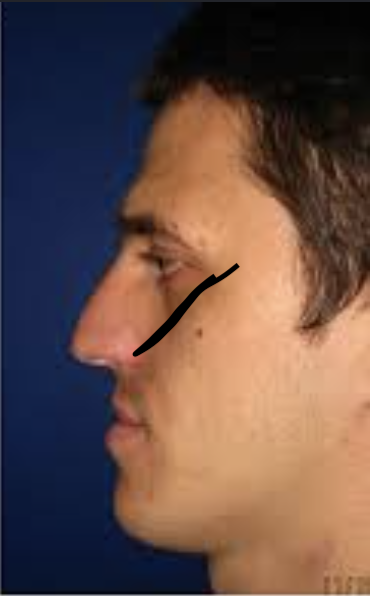
View attachment 5057276View attachment 5057277

Here's the number that puts it in perspective. On average the infraorbital rim sits about 3mm behind the surface of your cornea. Your brow bone at the top sits about 10mm in front of the cornea. That 13mm gap between upper and lower bony projection is what creates the deep-set look. When your infraorbital rim retrudes further back than average may it be whether from genetics or from the bone loss that happens as you age. Your globe looks relatively more prominent, the lower lid loses its anchor, and the whole undereye area looks sunken.
View attachment 5057288

There's a research finding published in Aesthetic Plastic Surgery by Pessa et al. and separately confirmed in a 2025 multilayered periorbital aging analysis in Aesthetic Plastic Surgery journal showing that orbital cavity volume actually expands with age as the bone resorbs. The globe itself gets slightly smaller too. Both changes together create the sunken, enophthalmic look that older men develop hence the hollow orbit and shadowed undereye.

——————————————————————————————

2. HOW TO TELL IF YOURS IS DEFICIENT


Take a side photo or look at your face in true lateral view. Drop an imaginary vertical line straight down from the most forward point of your eyeball, what's called the corneal apex. If the bone and soft tissue under your eye sits clearly behind that line, you have a negative orbital vector. The clinical literature consistently uses this as the primary diagnostic criterion. The further behind that vertical plane your rim sits, the more deficient it is.
View attachment 5057307


The fat herniation test
Look directly upward in a mirror. If any bags or puffiness under your eyes get worse when you look up, that's herniated orbital fat pushing forward. Filler does not fix this. Filler in a herniated eye will make it look worse. That case needs lower blepharoplasty with fat repositioning.
View attachment 5057309


The malar mound test
Press upward gently on your cheekbone just under the eye. If a visible mound or puffiness appears underneath rather than the hollow improving, you have malar mound tendency. Adding filler in this setting makes the mound worse. This is a known complication of undereye filler in the wrong candidate. It's well-documented in the clinical literature and it's almost impossible to fully reverse without hyaluronidase.
View attachment 5057331

——————————————————————————————

3. THE ORBITAL VECTOR — WHY IT MATTERS MORE THAN YOU THINK

Positive orbital vector means your cheekbone and rim complex sits forward of your eyeball. The lower lid is fully supported, the lid-cheek junction is smooth, the eye looks deep-set and defined. Negative vector means your globe is the most forward structure in that zone as it protrudes past your cheek and rim. The lower lid has nothing to anchor it, eyes look slightly bulgy or round, the midface looks flat and withdrawn.
View attachment 5057372

The reason the vector discussion matters so much beyond just aesthetics. Guys spending money on canthoplasty with an uncorrected negative vector are wasting it. The whole mechanism of canthoplasty is lifting the outer corner of the lower lid and changing the tilt of the eye and that depends on having a stable bony ledge underneath the lower lid to hold the result long term. If that ledge is recessed, the lid migrates back down over months regardless of the quality of the surgical work.

There's also a finding worth knowing about that comes from published morphometric research comparing young and older faces. In younger patients the malar eminence, infraorbital rim, and pyriform aperture are all positioned anteriorly and the orbital aperture is relatively small and compact. In older patients all three of those landmarks have retrused posteriorly, the orbital aperture has expanded in area, and the inferior orbital rim has developed a different curvature pattern. The researchers note that implant designs targeting the skeletally deficient areas of older patients literally match the anatomy of what's been lost over time. This is why implants for the infraorbital rim look so natural when properly placed.

——————————————————————————————

4. THE ANATOMY

The clinical outcomes of everything done in this area like filler, fat grafting, implants are directly determined by understanding these structures. So its better to have a good grasp of things.

The orbicularis retaining ligament (ORL) and the tear trough ligament
The orbicularis retaining ligament is a series of fibrous attachments extending from the inferior orbital rim to the overlying skin. It defines the upper border of the sub-orbicularis oculi fat compartment (SOOF). The medial portion of the ORL is specifically called the tear trough ligament. This structure is what creates much of the tear trough deformity. It physically tethers the skin to the bone, creating a groove that descends as the surrounding tissue loses volume and descends with age. When you squint or frown you can often see the tear trough groove deepen temporarily because the muscular contraction tightens this tethering effect.
View attachment 5057387


The fat compartments that matter the most :
Below the orbicularis muscle sits the SOOF (the sub-orbicularis oculi fat). This compartment is bounded superiorly by the ORL and inferiorly by the zygomatic cutaneous ligament. Below and lateral to that is the deep medial cheek fat compartment which is where the structural cheek volume lives. In the superficial plane above the muscle are the superficial fat compartments the medial cheek fat, nasolabial fat, and a thin preseptal fat layer directly over the lower lid. Understanding which plane you're in during injection determines whether the result looks right or wrong. Filler placed in the wrong fat compartment doesn't just look suboptimal and it migrates in a direction determined by the anatomy of that compartment and can end up in a location that makes things look worse months later.

View attachment 5057396


The vascular danger zones and why this area is high risk
The infraorbital region is supplied by several arterial branches. The angular artery is branch of the facial artery that runs medially across the nasojugal groove and is one of the most commonly injured vessels during tear trough injection. The infraorbital artery exits the infraorbital foramen approximately 3cm lateral to the midline just below the orbital rim. The zygomaticofacial artery runs laterally. All of these sit in a vascular territory that communicates with the ophthalmic artery via the orbital septum. This is why vascular occlusion from filler in this area carries vision risk in a way that injections elsewhere on the face generally don't. The connection to the ophthalmic circulation is real and documented. A 2015 review of the world literature on filler-related blindness by Beleznay et al. identified the glabellar region and nasal area as highest risk.
View attachment 5057438

——————————————————————————————

5. THE THREE CLASSES OF INFRAORBITAL HOLLOWING

The groove is confined to the inner corner area. The rest of the rim still has reasonable support. This is the mildest presentation and it responds well to filler correctly placed. A good injector at the right depth can fix this in one session.

View attachment 5057501

The hollow has deepened and extended outward. Visible under the middle of the eye and sometimes toward the outer corner. Early volume loss in the central cheek becomes visible. Filler still works but placement has to cover multiple zones and single-pass medial technique leaves the lateral area still hollow. You need dual-plane treatment across two or three anatomical subzones.
View attachment 5057508

The hollow wraps around the entire rim. The lid-cheek groove is visible from every angle. This isn't just soft tissue loss anymore as the bone itself is genuinely deficient. Filler cannot build structure here because there's no skeletal platform for it to sit on. It just creates a puffy appearance without correcting the vector or the hollow. Class 3 is implant or fat grafting territory.

View attachment 5057516

——————————————————————————————

6. NON-SURGICAL (COPE)


THIS WHOLE SECTION EXCEPT FOR THE DEXA SCAN AND BODY ARE FOR COPERS WHO ARE AGAINST FILLERS AND HARDMAXES SO DNR THIS IF YOU ARENT ONE


Global Costs

USA:
GHK-Cu serum $20 to $60 per bottle. The Ordinary Buffet + Copper Peptides around $25. Prescription tretinoin via telehealth (Curology, AgelessRx) $20 to $40 per month.

UK:
GHK-Cu £18 to £50. Tretinoin via Dermatica or Skin + Me £20 to £30 per month.

Europe:
€20 to €55. Prescription tretinoin through a derm €30 to €60 per month.


The Full Protocol

Step 1:
Cleanse morning and night with a gentle non-stripping cleanser. The periorbital skin is some of the thinnest on the entire body so anything with high-pH foaming agents or sulfates irritates it and makes the area look worse over time.

Step 2 (Morning):
A few drops of GHK-Cu serum on damp skin around the undereye and midface. Use your ring finger as it naturally applies the least pressure then and tap gently rather than rubbing. Don't drag the skin. This matters more than most people think over months and years of cumulative mechanical stress.

Step 3 (Morning):
SPF 50+ over everything including the undereye. Non-negotiable as UV accelerates collagen breakdown in this region faster than almost anywhere else on the face because the skin here is so thin and has so little protective mass. Long-term sun exposure is one of the factors driving the skeletal resorption pattern in this area.

Step 4 (Evening):
Retinol after cleansing. Start at 0.025% three nights per week. Move to every other night in weeks five through eight. Nightly from week nine. Step up concentration to 0.05% then 0.1% over three to four months. Follow with a light moisturizer to buffer irritation around the periorbital zone.

Key rule:
GHK-Cu and retinol in the same session cancel each other out. GHK-Cu in the morning, retinol at night.

raw GHK-Cu powder:
Buy raw GHK-Cu powder from Peptide Sciences or BoS Research for around $10 to $15 per gram. Dissolve 0.5g into 100ml of water-based hyaluronic acid serum base in a dark glass dropper bottle. That's a 0.5% serum for a fraction of what any brand charges. Dissolves cleanly. Store refrigerated, use within 60 days, date the bottle.

Realistic expectations:
Noticeably better skin quality, thicker skin, reduced shadowing after 12 to 16 weeks of consistency. It is mitigation not correction. Class 1 can see real improvement from topicals. Class 2 and 3 need more than this but topicals are worth running alongside whatever else you're doing.

Cost
Free. DEXA scan $50 to $150 in the US, £30 to £80 in UK, €40 to €100 in Europe, $20 to $40 in Turkey and Thailand.

Why it matters and what to do
The periorbital fat pads are highly sensitive to overall body fat percentage. Drop below 10% body fat and those pads thin out dramatically, making the infraorbital hollow look significantly worse. A lot of guys notice their undereye area looks great at 14% and wrecked when they push down to 8% for summer. There's a sweet spot typically somewhere in the 12 to 17% range where facial fat is preserved without sacrificing overall body composition. It's individual based on genetic facial fat distribution. Get a DEXA scan at your leanest and at a moderate body fat, photograph yourself in consistent lighting at both, and compare. That gives you your actual threshold.

View attachment 5057563

Global Costs

USA:
$20 to $40 per month at 10g daily. BulkSupplements cheapest at $20 to $25.
UK:
£18 to £35. Bulk Powders and MyProtein both carry it.
Europe:
€20 to €40. Bulk Powders ships to most EU countries.


The Protocol

Step 1:
Hydrolyzed Type I and III collagen peptide powder specifically. Not gelatin. Not non-hydrolyzed collagen. The label has to say hydrolyzed collagen peptides or you're not getting the absorption the clinical studies are based on.

Step 2:
10g every morning in hot coffee or tea. Tasteless in most formulations. Dissolves completely in hot liquid.

Step 3:
500mg Vitamin C at the same time. Ascorbic acid is a required enzymatic cofactor in the collagen synthesis pathway. Without adequate circulating Vitamin C the production signal from the peptides can't complete properly. Most people skip this and then wonder why their results are mediocre.

Step 4:
Every single day for minimum 90 days before assessing. Collagen remodeling is slow. Most people see real change between weeks 8 and 16. Sporadic use produces nothing.

Step 5:
Photograph the undereye in the same lighting every four weeks. Subjective mirror assessment doesn't work for slow changes. Objective photos tracked over time are the only accurate way to evaluate this.

——————————————————————————————

7. THE RIGHT FILLER TECHNIQUE

The tear trough is not just volume loss. There's a fibrous structure. The tear trough ligament, the medial portion of the orbicularis retaining ligament is the one that physically tethers the skin to the orbital rim bone at the boundary between the thin eyelid skin and the thicker cheek skin. To lift the groove you need product placed below this structure at the supraperiosteal level so it pushes up against the tethering from underneath. Injectors who deposit product above the ligament in the superficial plane get a lump or ridge sitting on top of the groove without lifting it. That's the most common reason tear trough filler results look bad. The cadaveric study from the University of Pennsylvania published in Aesthetic Surgery Journal in 2023 confirmed that injection just above the periosteum produces the most anatomically precise placement along the orbital rim and critically showed that Restylane-L placed this way stays as a distinct mass along the ORL, while Volbella spreads more freely across anatomical planes due to its lower elastic modulus. This finding has direct implications for which product you use at which depth.

HA filler injected at the supraperiosteal level supports the undereye, reduces hollowing, and moves the orbital vector toward positive. Often combined with lower blepharoplasty when someone needs both structural and skin correction at the same time. The area around the infraorbital rim is highly vascular with multiple arterial branches communicating with the ophthalmic circulation

View attachment 5057605


Global Costs — Both Eyes

USA:
$1,000 to $2,500 total. Per syringe $600 to $1,500. ASPS national average around $684 per syringe.
UK:
£500 to £1,500. Harley Street at the top. Regional UK from £350 to £400 per syringe.
Western Europe:
€600 to €1,400. Spain and Eastern Europe more competitive at €350 to €800.
Turkey (Istanbul):
€250 to €450. Same brand-name filler, 60 to 75% cheaper. Highest ROI destination for this specific procedure.
South Korea (Seoul):
$300 to $600 at Gangnam clinics.
Thailand (Bangkok):
$200 to $500. JCI-accredited clinics only.
Mexico:
$300 to $700. Major cities with board-certified injectors.

——————————————————————————————

7B. DIY UNDEREYE FILLER FULL GUIDE

This covers the DIY approach. The undereye is the highest-risk filler site on the face due to the vascular anatomy described in Section 4. Know the emergency protocol before you start. Have hyaluronidase on hand.


You're a reasonable candidate if:
You have Class 1 or mild Class 2 hollowing. A groove with genuine volume loss but nothing puffy or herniated. Lower eyelid skin is taut when you pinch it gently. No loose or baggy eyelid skin. No bags that are worse in the morning. No bleeding disorders, autoimmune conditions, or active skin infection. You haven't had filler dissolved in this area in the past 8 weeks.

Stop here if:
You have puffy bags or visible fat herniation as filler will make this dramatically worse. Thin eyelid skin where veins are clearly visible. Significant laxity under the eye. Strongly negative orbital vector without structural support as filler will just look puffy without fixing the vector. You've had hyaluronidase used in this area in the last 8 weeks.

The filler
Soft, low G-prime HA filler designed for periorbital use. Do not use thick fillers like Voluma, Radiesse, or dense Juvederm in the tear trough as they lump and migrate. The right products are Restylane-L, Juvederm Volbella, Belotero Balance, and Teosyal Redensity 2. Teosyal Redensity 2 is specifically formulated for periorbital use with lower water-attracting properties to reduce post-injection swelling. You need 1ml maximum for both sides as most sessions use 0.3 to 0.5ml total.

Where to source: Medica Depot, HA-Dermal, DoctorMedica, and similar gray market wholesale suppliers sell Restylane and Teosyal without prescription in many jurisdictions. In Turkey you can walk into Istanbul pharmacies and buy Juvederm or Restylane OTC for $40 to $80 per syringe. Never buy from eBay or AliExpress and counterfeit or improperly cold-chain stored filler is a real infection risk. Established suppliers with documented cold-chain shipping only.


Cannulas
27-gauge blunt cannula, 38mm length. The blunt tip pushes vessels aside rather than puncturing them. Brands: Softfil, TSK Steriglide, FlexFill. Available from Medica Depot or iBeautyMachine for $15 to $40 per box of 20. Fresh cannula per session and per eye as you should never reuse.

Entry needle
25-gauge sharp hypodermic needle to create the entry point hole. Available at any pharmacy.

Numbing
EMLA cream (lidocaine 2.5% plus prilocaine 2.5%) under cling film for 30 minutes. LMX4 also works. Do not use ice as primary numbing as it causes vasoconstriction which makes blood aspiration harder to assess.

Hyaluronidase
The enzyme that dissolves HA filler. Available as Hylenex in the US, Hyalase in UK and Europe, or generic hyaluronidase 1500iu vials. t.

Sterility supplies
Nitrile gloves. Alcohol prep pads (70% isopropyl). Chlorhexidine 2% for skin prep. Gauze pads. Sterile drape or fresh clean towel. Sharps container.

Total cost
Filler syringe $40 to $120. Cannula box $15 to $40. EMLA $10 to $25. Hyaluronidase $30 to $80. Supplies $10 to $20. Total $105 to $285 versus $1,000 to $2,500 professionally.

48 hours before:
Stop blood thinners so no aspirin, ibuprofen, fish oil, vitamin E, or alcohol. OTC supplements and lifestyle only and do not stop prescription blood thinners without speaking to your doctor.

Day of — skin prep:
Wash your face. Remove everything like no makeup, no skincare. Chlorhexidine on a gauze pad wiped from center outward over the injection zone. Follow with alcohol prep pad. Let dry completely. Don't touch the cleaned area with bare hands again.

EMLA application:
Thick layer covering the full undereye zone from inner corner to the outer orbital area. Cover with cling film. Leave minimum 30 minutes. Wipe completely off with alcohol prep pad and let dry fully before proceeding.

Workspace setup:
Large well-lit mirror. Daylight or bright white LED pointed at your face. All supplies within reach. Nitrile gloves on. Filler syringe open with hub attached. Cannula on sterile surface. Hyaluronidase immediately accessible and know exactly where it is and how to draw it up before touching anything.

Step 1 — Mark your anatomy
White eyeliner pencil only and not a dark marker. Mark the lowest point of your tear trough groove in good lighting. Mark your entry point: 15 to 20mm directly below the outer edge of your iris (lateral limbus) on the cheek. This location keeps your cannula path away from the infraorbital foramen and the angular artery as you travel medially. Wipe the marks off with an alcohol pad before injecting also never inject through skin with marker on it.
View attachment 5057828


Step 2 — Create entry point
Stretch the skin at the entry point with your non-dominant hand. 25-gauge sharp needle, firm puncture at 45 to 90 degrees. One clean puncture. Entry point on the cheek, not the lower eyelid. Small drop of blood is fine but wipe with alcohol pad.

View attachment 5057856


Step 3 — Insert cannula
27-gauge blunt cannula attached to filler syringe. Stretch entry point skin to keep the hole open. Insert at 30 to 45 degrees then flatten the angle to nearly parallel with the skin surface. Travel supraperiosteally and just above bone. You feel slight resistance through the orbicularis and a give as you enter the sub-orbicularis plane. Cannula scraping against bone means you're at the right depth. Advance slowly toward the inner corner of the eye, below the tear trough groove.
View attachment 5058166


Step 4 — Aspirate first
Before releasing any product, pull the plunger back. Blood in the syringe means you're in a vessel. Withdraw immediately, apply pressure for 2 minutes, don't inject from that entry point again. Move to the other eye and return with a fresh cannula from a slightly different entry location.
View attachment 5058179


Step 5 — Retrograde linear threading
Cannula at its deepest point medially near the inner corner. Begin slowly pressing the plunger while simultaneously withdrawing at a steady even pace toward the entry point. Product deposits as a thin continuous thread as you withdraw. Even pressure, smooth withdrawal with thin column along the rim, not a blob. Volume per pass: 0.1 to 0.2ml max. Start with 0.1ml and assess before adding more.
View attachment 5058325


Step 6 — Lateral fan if needed (Class 2 only)
If hollow extends laterally past mid-pupil, readvance from same entry point angled slightly outward. Second retrograde pass covering the lateral area. Use less here like 0.05 to 0.1ml. Maximum two passes from one entry point.

Step 7 — Assess and massage
Remove cannula. Gentle pressure on entry point for 30 seconds. Sit upright and look in natural light. Any lumps felt then gentle circular massage with clean finger. Check specifically for skin blanching anywhere for white patches that don't resolve in 30 seconds mean possible vascular compression.
Wait 5 minutes and reassess the first side before moving to the other eye.

Step 8 — Other eye
Fresh cannula. New entry point same location on the other side. Match volume exactly to what you used on the first side. Always err toward less so you can add at 2 weeks, you cannot easily remove immediately.

Step 9 — Aftercare
Cold compress (wrapped, not bare ice) for 10 minutes. No makeup for 24 hours. No alcohol, exercise, or heat for 48 hours. Sleep slightly elevated the first night. Don't massage after the first hour. Expect some swelling and possible mild bruising for 2 to 5 days. Final result at 2 weeks around is noticed.

Most DIY attempts go wrong because people use too much. This area needs far less product than anywhere else on the face. Overfilling creates a puffy pillow look that sits there for months and requires hyaluronidase to fix.

Session 1:
0.1ml per side. Total 0.2ml. Test session. You will probably not see a dramatic result. Assess at 2 weeks.

Session 2 (minimum 2 weeks later):
Add up to 0.15ml per side if genuinely needed. Cumulative max after two sessions: 0.25ml per side.

ceiling:
Never exceed 0.3ml per side total across all DIY sessions. If your hollowing needs more than that, the problem is structural.

vascular occlusion:
Signs: skin blanching white that doesn't resolve in 30 seconds, skin going mottled or grey or purple, severe pain out of proportion to the procedure, any change in vision including blurring or darkening. If any of these happen: stop injecting. Inject hyaluronidase immediately into the affected area then reconstitute 1500iu vial with 2ml saline for 750iu/ml, inject 0.2ml (150 units) directly into the blanched zone and surrounding tissue. Apply warm compress then Take 325mg aspirin.

Tyndall effect (blue discoloration):
Filler placed too superficially. Not dangerous but looks bad. Hyaluronidase 15 to 30 units injected directly into the blue zone in small aliquots. Resolves within 24 to 48 hours.

Persistent lump:
Wait 2 weeks as most resolve with swelling. Persistent lump at 2 weeks gets hyaluronidase 15 units per side directly into it. Reassess at 48 hours.

Full dissolution protocol:
Reconstitute 1500iu hyaluronidase with 2ml bacteriostatic saline giving 750iu/ml. Draw up appropriate volume in insulin syringe. Inject small amounts (0.02 to 0.05ml per puncture) directly into the filler deposit across multiple punctures. For full dissolution of undereye filler: 15 to 75 units per side. Results in 24 to 48 hours. Wait minimum 4 weeks before re-injecting as residual hyaluronidase can break down freshly placed filler if you go back too soon.

——————————————————————————————

8. INFRAORBITAL RIM IMPLANTS COSTS

Solid silicone implants placed directly on the infraorbital rim bone. The most direct structural correction available for undereye hollowing and a negative orbital vector as you are physically augmenting the bony architecture, not masking the problem with volume. Unlike filler which is temporary and only addresses soft tissue, implants permanently correct the vector. They're typically combined with lower blepharoplasty for the best full eye area result.


Off-the-shelf implant designs are not inferior to custom implants for most people. The Flowers infraorbital rim implant is a well-established design with a long clinical track record and it's appropriate for the majority of symmetric cases. Custom implants are specifically for patients with significant asymmetry between sides or unusual anatomy that a standard design can't accommodate. The push toward custom-only is partly surgeon preference and partly commercial as custom implants cost significantly more and have higher margin.


Global Costs

USA:
$6,000 to $15,000. Flowers off-the-shelf designs at the lower end. Custom CT-derived implants from Eppley, Taban, Isaacs at $8,000 to $15,000+.
UK:
£5,000 to £9,000. Surgeons with specific experience in this procedure are rare outside London.
Western Europe:
€5,000 to €10,000. Belgium, Netherlands, Germany, Spain have experienced craniofacial surgeons doing this.
Turkey (Istanbul):
$3,000 to $6,000 all-in with hotel and transfers. Verify that the specific surgeon has done infraorbital rim implants specifically — not just cheek or chin work.
South Korea (Seoul):
$4,000 to $8,000. Often combined with canthoplasty and lower bleph as a full eye area package. VAT refund 7 to 8% at airport for foreign patients.
Thailand (Bangkok):
$3,500 to $7,000 at JCI hospitals.
Mexico:
$3,000 to $6,000. Mexico City and Monterrey over Tijuana for this level of work.

——————————————————————————————


9. MIDFACE MASK IMPLANT


Reference thread on this: The Holy Grail of Facial Aesthetics — How to Simulate Lefort III Results with the Midface Mask Implant


The custom midface mask implant covers the entire upper midface skeleton which is from the infraorbital rims down to just above the upper teeth. Think of it as a single unified implant that simultaneously augments all of the following : the infraorbital rims, the malar eminences (cheekbones), the paranasal region (the area around the base of the nose), and the anterior maxilla. That coverage is why it's called a mask. the footprint literally looks like the upper portion of a face mask on 3D imaging.

View attachment 5058644

The effect is described in the surgical literature as Lefort III-like but without the occlusal movement. Meaning it pulls the entire midfacial skeleton forward in one coordinated augmentation, mimicking the aesthetic outcome of a full midface advancement osteotomy without actually cutting and moving bone. The infraorbital rims project forward correcting the negative vector, the cheeks project forward, the paranasal area fills out, the entire midface depth and width changes. For someone with true generalized midface hypoplasia this is the procedure that actually addresses the whole problem rather than chasing individual zones with separate implants.

Because the infraorbital nerve passes through the infraorbital foramen in the middle of this zone, the implant is designed as three pieces: bilateral infraorbital-malar segments and a lower maxillary segment that crosses under the nasal base. Each piece is designed around the nerve pathway to prevent compression. When properly placed there should be no permanent nerve damage, though patients should expect some temporary numbness of the upper lip and side of the nose from nerve stretching during implant seating which recovers fully.

The limitation with doing a cheek implant here and a separate infraorbital rim implant there and a separate pyriform implant somewhere else is that you get disjointed augmentation with visible transitions between the zones. Each implant has edges. Where one implant ends and another begins there's a potential step-off or contour irregularity that shows through the overlying soft tissue. The more implants you stack the more complex the revision situation if anything needs to be adjusted.
View attachment 5062790

The midface mask implant solves this by creating one continuous augmentation surface across all zones simultaneously. The transitions between the infraorbital rim, malar eminence, and paranasal regions are built into the implant design itself and are smooth by design rather than approximated by placement of separate pieces. The clinical result looks more natural and cohesive because it is more natural and it follows the actual anatomy of the midfacial skeleton as a unified structure rather than addressing it as isolated landmarks.

There's also a case documented in the surgical literature specifically for patients who had a Le Fort I osteotomy that moved the lower maxilla but left the upper midface consisting of the infraorbital rims and zygomaticomalar complex untouched and still recessed. This is a known limitation of Le Fort I: it addresses the occlusal level but doesn't move the infraorbital rim. A custom infraorbital-maxillary-malar implant placed after a Le Fort I creates what surgeons describe as a modified Le Fort III effect as both the lower and upper midface are now addressed, combining what surgery did with what the implant adds.

The midface mask implant is appropriate for someone with true generalized midface hypoplasia and not just undereye hollows, not just flat cheeks, but the full midface complex being recessed including the infraorbital rims, malar eminences, and paranasal area. If you look at your profile and everything from your lower eyelid to your upper lip sits behind the plane of your nose tip and forehead, you are probably in this category. If only specific zones are deficient, targeted implants or filler are more appropriate.


The procedure is not appropriate if your occlusion needs to change and if you have a malocclusion that needs orthognathic surgery, that needs to be addressed before or simultaneously with any midface implant work, not replaced by it. The midface mask implant advances the skeletal contour without moving the teeth or changing the bite. If the bite is off, that's a separate problem requiring orthognathic surgery.

Cost
$6,000 to $15,000 depending on surgeon and whether it is standalone or combined with other procedures. For context: a Le Fort II or III osteotomy runs $30,000 to $60,000 and is practically inaccessible for purely aesthetic indications. The midface mask implant achieves a comparable aesthetic effect at 20 to 50% of that cost. This is one of the best cost-to-outcome ratios in all of facial surgery for the right candidate.


Where to find surgeons who specifically do this
Dr. Barry Eppley at Eppley Custom Facial Implants in Indianapolis is the most documented surgeon in the English-language literature for this specific procedure. His case studies are publicly available on exploreplasticsurgery.com and document outcomes across multiple patient types including men with generalized midface hypoplasia. In Europe, craniofacial units in Belgium and the Netherlands have surgeons experienced with comprehensive midface implant design. In South Korea the Gangnam complex surgery market has surgeons comfortable with multi-zone midface implants. As with the infraorbital rim implant, verify specifically that the surgeon has documented experience with full-coverage midface mask implants — not just cheek or malar implants in isolation.

his website : eppleyplasticsurgery.com

——————————————————————————————

10. LE FORT OSTEOTOMY — WHEN AND WHY

The Le Fort osteotomies are the actual skeletal solution for severe midface recession. Le Fort I moves the maxilla at the occlusal level and changes the teeth and lower midface position but critically does not move the infraorbital rims, which is why it often leaves the upper midface still recessed after surgery. Le Fort III moves the entire midface including the orbital rims forward and is the most complete correction available.
View attachment 5062824


Global Costs

USA:
$20,000 to $40,000 for Le Fort I. Modified Le Fort III $30,000 to $60,000+ at major craniofacial centers.
UK:
£12,000 to £25,000 private. NHS may cover with functional indication.
Western Europe:
€10,000 to €25,000. Spain and Eastern Europe more competitive at €10,000 to €15,000.
Turkey (Istanbul):
$6,500 to $12,000 at accredited hospitals.
South Korea (Seoul):
$8,000 to $18,000. Korea performs among the highest annual volume of orthognathic surgery globally.
Thailand (Bangkok):
$9,500 to $15,000 at JCI hospitals.
Mexico:
$8,000 to $15,000. Mexico City university-affiliated maxillofacial departments.


The Le Fort I Limitation and Why Many Patients Need More
Le Fort I advancement moves the lower midface consisting of teeth, lower cheeks, nose but it does not move the infraorbital rims. In patients where the midface deficiency extends all the way up to include the orbital rims, a Le Fort I leaves the upper midface still recessed after surgery. The patient sees improvement in their bite and lower face but still has a negative orbital vector and hollow undereyes. Opting for a LE FORT III is best here.
View attachment 5062819


——————————————————————————————

11. SURGEON TIERLIST

The surgeons listed here are the ones with documented, verifiable track records specifically for this procedure and not general plastic surgeons who have done one or two of these, but specialists who have built a reputation specifically around periorbital and midface skeletal surgery. Tierlists cover surgeons globally, then clinics by country, then countries overall.


Ranked specifically on documented case volume, technical specificity for this procedure, published research contribution, and real patient outcome track record. Not on general reputation as a plastic surgeon.

S TIER — The absolute best, would travel anywhere for these

Dr. Barry Eppley
Location:
Eppley Plastic Surgery, 12188-A North Meridian St Suite 310, Carmel (Indianapolis), Indiana, USA
Website:
eppleyplasticsurgery.com and eppleycustomfacialimplants.com
Approximate cost:
Infraorbital rim implants (combined infraorbital-malar) around $6,500. Midface mask implant $8,000 to $12,000. Custom jaw, cheek, full facial packages vary. Virtual consultation available.
Why S tier:
Eppley is probably the single most documented surgeon in the English-language literature for custom facial implants including infraorbital rim, midface mask, and combined periorbital work. His blog at exploreplasticsurgery.com contains hundreds of case studies with full before/after documentation across every facial zone. He developed the semi-custom infraorbital-malar implant approach and has the deepest public case archive of anyone doing this procedure. He uses titanium micro-screw fixation for long-term positional stability. His pricing is also significantly lower than the Beverly Hills surgeons doing comparable work.
In his own words on infraorbital implants vs fillers:
"In the treatment of infraorbital rim deficiency, the three treatments are synthetic injectable fillers, injected fat and implants. Each has their own advantages and disadvantages. But none of them are perfect nor is one method best for all patients. Each case must be considered separately and the magnitude of the defect considered in the treatment selection." He also notes that fillers should be used as a trial method first to assess whether soft tissue volumization gives the desired effect before committing to implants.
On custom vs off-the-shelf:
"A semi-custom approach allows me to select an infraorbital-malar implant from a variety of custom ones that have been made for other patients. Given the shape of this area of the facial skeleton a semi-custom implant can be a more cost-effective method that fits fairly well." Worth knowing that he actually offers this more affordable semi-custom option for appropriate cases.

Dr. Mehryar (Ray) Taban
Location:
9735 Wilshire Blvd Suite 319, Beverly Hills, CA 90212, USA. Also Santa Barbara.
Website:
tabanmd.com — Phone: (310) 278-1836
Approximate cost:
Infraorbital rim implants $8,000 to $15,000 depending on complexity and whether combined with canthoplasty, blepharoplasty, or orbital decompression. Full periorbital transformation packages can run higher.
Why S tier:
Taban is double board-certified by ASOPRS (American Society of Oculofacial Plastic and Reconstructive Surgery) and the American Board of Ophthalmology, and is also an Assistant Clinical Professor at UCLA. He is the go-to surgeon for complex periorbital work that combines infraorbital rim implants with canthoplasty, lower eyelid retraction repair, and orbital decompression in a single operation. His patient gallery at tabanmd.com contains an extensive archive of before/after cases documenting vector correction and eye shape transformation. He uses the transconjunctival approach with suture fixation rather than screws, preferring to avoid metal hardware near the orbit. His specific expertise in oculoplastic surgery means he understands the lower eyelid mechanics in a way that most plastic surgeons simply don't.
On what he actually does for negative vector patients:
His documented approach for negative vector patients often combines infraorbital rim implant placement with lower eyelid retraction correction and canthoplasty in a single operative session by addressing the bone, the lid position, and the canthal angle simultaneously. This is significantly more ambitious than what most surgeons offer and is appropriate for patients whose eye area problems involve all three components.
Real patient review (documented on RealSelf):
One patient with extensive knowledge of maxillofacial surgery wrote: "When it comes to the periorbital region he IS the best in the world. Through canthoplasty, tear trough implants on the orbital rim, lower lid retraction, orbital decompression, and slight lowering of the upper eyelid, I now have hooded eyes, a sweeping effect, a high lateral canthus position, and a lower lid so high it likely won't descend for decades."

A TIER — Elite surgeons, genuinely excellent, specific strengths noted

Dr. Michael Yaremchuk
Location:
Massachusetts General Hospital, Division of Plastic Surgery, Boston, MA, USA
Website:
dryaremchuk.com
Approximate cost:
$10,000 to $18,000 for infraorbital rim and midface implant work. As a Harvard-affiliated craniofacial surgeon the pricing reflects his academic institution and elite reputation.
Why A tier:
Yaremchuk is the academic foundation of this entire field. He literally wrote the original peer-reviewed paper on infraorbital rim augmentation published in Plastic and Reconstructive Surgery in 2001 which is still cited in almost every academic article on this procedure. He also designed specific implants for this procedure. His clinical background is craniofacial surgery at one of the top hospitals in the world. His research on how the aging facial skeleton changes the orbital vector relationship is the most cited work in this space. The reason he's A rather than S is purely accessibility as academic hospital pricing is steep, his focus is broader than just aesthetic cases, and he's harder to get to.
In his own published research:
"In patients with recessive infraorbital rims, alloplastic augmentation of the infraorbital rims makes the eyes appear less prominent and improves appearance. Augmentation of the infraorbital rim and resuspension of the cheek soft tissues can have a rejuvenating effect in properly selected patients." His 3D reconstructions comparing youthful and aged orbits shows how an infraorbital rim implant placed on the aged skeletal anatomy transforms it back toward the youthful contour are the clearest visual demonstration of what this procedure actually achieves.
Real patient quote:
"I had an under the eye problem and the only solution I thought there was, was cheek implants. Instead with his orbital rim implant he fixed the problem perfectly. In terms of surgical skill and experience, Dr. Yaremchuk is pretty much as good as it gets."

Dr. David Isaacs
Location:
Beverly Hills, CA, USA
Website:
drdavidisaacs.com
Approximate cost:
$10,000 to $15,000 for infraorbital rim implants. Uses 3D Accuscan imaging for custom implant design.
Why A tier:
Dual-fellowship trained oculofacial plastic surgeon in Beverly Hills who specifically markets and documents infraorbital rim implant work. Uses a transconjunctival approach and custom 3D Accuscan imaging to ensure implant fit. Strong documented case gallery. Appropriate for patients who want a Beverly Hills-based alternative to Taban with similar oculoplastic training background. His stated approach on fitting is that the procedure should always be anchored securely while blending naturally with facial contours, and that careful technique avoids overcorrection while preserving the natural lower eyelid to cheek transition.

B TIER — Solid options, less documented but legitimate

Korean Gangnam Oculoplastic Surgeons (as a group)
Location:
Gangnam and Apgujeong districts, Seoul, South Korea
Approximate cost:
$4,000 to $8,000 for infraorbital rim implants. $920 to $1,530 for undereye fat grafting. Often packaged with canthoplasty and lower blepharoplasty.
Why B tier:
Korean surgeons as a group represent excellent value and high volume, particularly for canthoplasty, lower blepharoplasty, and combined eye area transformation packages that include infraorbital rim work. The sheer case volume in Seoul means technique refinement that's genuinely hard to match elsewhere. The reason they're B rather than A as a group is variability as you need to research the specific surgeon rather than just the clinic, the anesthesiologist issue is real (verify presence before booking), and the documented English-language case literature for this specific procedure is less accessible than the US surgeons. The best Korean surgeons doing this work are at the same technical level as S tier but the challenge is identifying them.

Istanbul Craniofacial Surgeons (JCI-accredited hospitals)
Location:
Acibadem, Memorial Hospital Group, Medipol Mega, Liv Hospital, Istanbul, Turkey
Approximate cost:
$3,000 to $6,000 for infraorbital rim implants all-in. $1,450 to $2,900 for fat grafting.
Why B tier:
Turkey has the best cost-to-outcome ratio globally for this procedure when you find the right surgeon. The infrastructure at JCI hospitals is genuinely high quality, ISAPS-certified surgeons in Istanbul are operating at a legitimate international standard, and the all-inclusive packages make the logistics straightforward. The B tier placement reflects the same variability issue as Korea as surgeon-specific due diligence is essential, and the English-language documentation of individual surgeon case archives is harder to evaluate than the US names listed above.

C TIER — Proceed with extreme caution or avoid for this specific procedure

General plastic surgeons without specific infraorbital rim implant experience, regardless of their general reputation. The procedure is technically demanding enough and rare enough that a surgeon who does it once or twice a year and otherwise sticks to rhinoplasties and breast work is not an appropriate choice.

S TIER COUNTRIES for this specific procedure

USA (specifically Indianapolis and Beverly Hills)
Home to the most documented and accessible specialists for infraorbital rim and midface implants globally. Eppley in Indianapolis gives you the most documented case archive and competitive pricing for the US market. Beverly Hills gives you Taban and Isaacs with the deepest oculoplastic expertise. The US is S tier not because it's cheapest as it clearly isn't nigga :feelswhy: but because the surgeon-specific documentation and research output here is the most accessible for doing pre-operative due diligence, and the legal/medical infrastructure for complications and revision is the most robust.

A TIER COUNTRIES

South Korea (Seoul — Gangnam/Apgujeong)
Best in the world for combined eye area transformation packages, fat grafting, and any procedure that combines periorbital structural work with canthoplasty and blepharoplasty. Case volume is unmatched globally. The challenge is verification When you find the right surgeon the outcomes here are comparable to the best in the world at 40 to 60% of US pricing.

Turkey (Istanbul — JCI hospitals)
Best value globally for filler, fat grafting, and implant work when you vet properly. The cost savings versus the US and UK are dramatic. The due diligence process described in Section 12 is non-negotiable though as the variation between top-tier and mid-tier providers in Istanbul is significant.

B TIER COUNTRIES

Western Europe (Belgium, Netherlands, Spain — Barcelona/Madrid)
Strong craniofacial surgery scenes in Belgium and the Netherlands specifically. Spain has experienced surgeons in Barcelona and Madrid who do periorbital and midface implant work. Pricing sits between Turkey and the US. Good option for European patients who don't want to travel to Turkey or Korea.

UK (London specifically)
Strong regulatory framework and high-quality surgeons in London. The issue for this specific procedure is the same as everywhere but surgeons with documented specific experience in infraorbital rim implants are rare. Outside London the landscape thins out considerably. Pricing is high for what you get relative to Istanbul or Seoul. Better for filler and blepharoplasty than for complex implant work.

Thailand (Bangkok — JCI hospitals)
Strong for fat grafting and combined lower eyelid work at JCI hospitals. The specific infraorbital rim implant expertise is thinner here than in Korea or Turkey. Good value for procedures in the less specialized range like filler, fat grafting, blepharoplasty. Bumrungrad in particular has internationally trained surgeons who are genuinely excellent. For implant work specifically, less reliable than Seoul or Istanbul.

C TIER COUNTRIES — Use with heavy caution for this procedure

Mexico (Tijuana specifically), Eastern Europe outside major medical centers, and anywhere where infrastructure for managing complex periorbital complications is not immediately accessible. This isn't about general surgical quality and it's about the specific requirement that if something goes wrong with an infraorbital rim implant near the globe, you need to be in a facility that can manage it immediately. Mexico City and Monterrey are a different story and sit closer to B tier.

The surgeon tierlist above is primarily for implant and surgical procedures. For filler specifically, the calculus is somewhat different because the skill is in injection technique rather than operative surgical training, and the reversibility with hyaluronidase means mistakes are less catastrophic than with surgery.

Best market for filler value:
Istanbul. Same brand-name product, 60 to 75% cheaper, experienced injectors who do high volume. Single best destination for filler purely on cost and quality balance or you could just go DIY.

Best market for technique:
Seoul. The periorbital filler technique refinement in Gangnam clinics, including emerging ultrasound-guided tear trough work, is as advanced as anywhere globally.

What to look for in any injector anywhere:
They use a blunt cannula not a sharp needle in the tear trough. They can describe their entry point, injection plane, and product selection specifically. They have before/after photos of tear trough cases specifically not just general filler work.

——————————————————————————————

12. SCIENCE BACKING AND SOURCES

Everything in this guide is sourced from published research, peer-reviewed clinical literature, or documented surgical case studies. Links below.

Anatomy and Aging
PubMed — Infraorbital Rim Augmentation in Orthognathic Surgery (Le Fort I limitation documentation)
Aesthetic Plastic Surgery — Decoding Periorbital Aging: Multilayered Analysis (2025 — orbital cavity expansion with bone resorption, globe volume decrease)
ScienceDirect — Facial Bone Aging: An Update and Literature Review 2020-2023 (region-specific bone loss affecting orbital rims and maxilla)
Aesthetic Surgery Journal — Infraorbital Hollow Rejuvenation: Contributions of Midface Volumization (ORL anatomy, vascular supply, etiology)


Filler Technique and Anatomy
PMC — Cadaveric Evaluation of Filler Behavior in Tear Trough (University of Pennsylvania, 2023 — Volbella spreads across planes, Restylane-L stays as distinct mass at ORL)
PMC — Anatomical Filler Injection Techniques: Infraorbital Groove and Hollowness
PMC — Tear Trough Filler Using Three-Point Tangent Technique: Lessons from 1452 Applications (2023)
PMC — Bridging the Gap: Alternative Injection Strategy for Medial Infraorbital Region (lateral entry point, ultrasound-guided approach)
MDPI — Anatomical-Based Filler Injection: Infraorbital Groove and Hollowness (2025 — tear trough ligament vs fibrotic connective tissue debate)
PubMed — HA Filler Effectiveness for Periorbital Region


Implants and Surgical Correction
PMC — Improvement of Infraorbital Rim Contour (Medpor vs alternative materials, surgical technique documentation)
Explore Plastic Surgery — Custom Midface Mask Implant Case Study (Eppley — three-piece design, Le Fort III-like effect)
Explore Plastic Surgery — The Midface Mask Implant for Aesthetic Augmentation (full design description and indication criteria)
Explore Plastic Surgery — Custom IMM Implant After Le Fort I Osteotomy (the Le Fort I leaves upper midface behind — implant completes it)
Explore Plastic Surgery — Negative Orbital Vector and Custom Infraorbital Implants: Case Study


Related Reading from org
The Eye Area Manual — comprehensive breakdown of the full eye area

——————————————————————————————


AI was used to fix grammatical errors
Amazing article , mirin the effort

Good thing you mentioned that most of the softmaxxes are cope , since this area can't be done without fillers/Surgery

Good job , Keep posting good guides :Claps:
 
  • +1
  • Love it
Reactions: Disturbed, Atra, Navity and 3 others
@illusion @Navity @Disturbed @Genio @Revan [HIQM]
 
  • +1
  • Love it
Reactions: illusion, Disturbed, Atra and 3 others
  • +1
  • Love it
Reactions: Atra, Navity, mohito and 1 other person
Amazing article , mirin the effort

Good thing you mentioned that most of the softmaxxes are cope , since this area can't be done without fillers/Surgery

Good job , Keep posting good guides :Claps:
thanks bhai :love::love:
 
  • +1
Reactions: Atra and BigBallsHisty
THE ONLY INFRAORBITAL GUIDE YOU'LL EVER NEED

——————————————————————————————


This thread has been in the works for a while.

The infraorbital rim, what it actually does, why it's responsible for many eye area problems, and every single option available to fix it. Everything in this guide is sourced from published research, clinical case studies, and real surgical documentation.


Related reading: The Eye Area Manual and The Holy Grail of Facial Aesthetics — How to Simulate Lefort III Results with the Midface Mask Implant


——————————————————————————————


TABLE OF CONTENTS


1. What the Infraorbital Rim Actually Is

2. How To Tell If Yours Is Deficient

3. The Orbital Vector and Why It Matters More Than You Think

4. The Anatomy Explained Properly - Ligaments, Fat Compartments, and Vascular Zones

5. The Three Classes of Infraorbital Hollowing

6. Non-Surgical Options

7. The Right Filler Technique

7B. DIY Undereye Filler

8. Infraorbital Rim Implants With Costs

9. Midface Mask Implant

10. Le Fort Osteotomy


11. Surgeon Tierlist and Recommendations

12. Science Backing and Sources


——————————————————————————————

1. WHAT THE INFRAORBITAL RIM IS

The infraorbital rim is a ledge of bone sitting directly beneath your eye socket. It's the bottom border of the orbit and it's the foundation that everything else sits on. Your fat pads, your lower eyelid, your skin rests here. When this bone projects well, all that tissue is properly supported and your undereye looks smooth, full, and defined. When it's recessed or underdeveloped, the tissue has nothing to rest on. It descends. You get hollows, shadow, and that wrecked permanently tired look no matter how much sleep you're getting. Because it's not sleep causing it. It's bone.

Here is a comparison of Bad vs Good infras
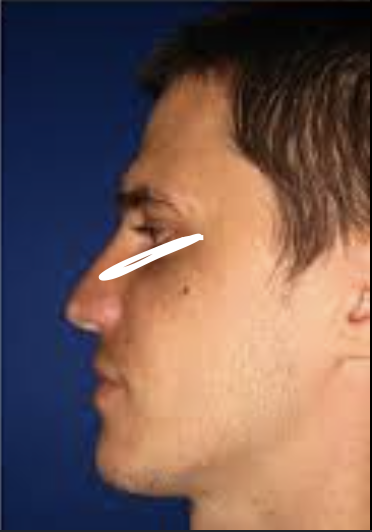
View attachment 5057276View attachment 5057277

Here's the number that puts it in perspective. On average the infraorbital rim sits about 3mm behind the surface of your cornea. Your brow bone at the top sits about 10mm in front of the cornea. That 13mm gap between upper and lower bony projection is what creates the deep-set look. When your infraorbital rim retrudes further back than average may it be whether from genetics or from the bone loss that happens as you age. Your globe looks relatively more prominent, the lower lid loses its anchor, and the whole undereye area looks sunken
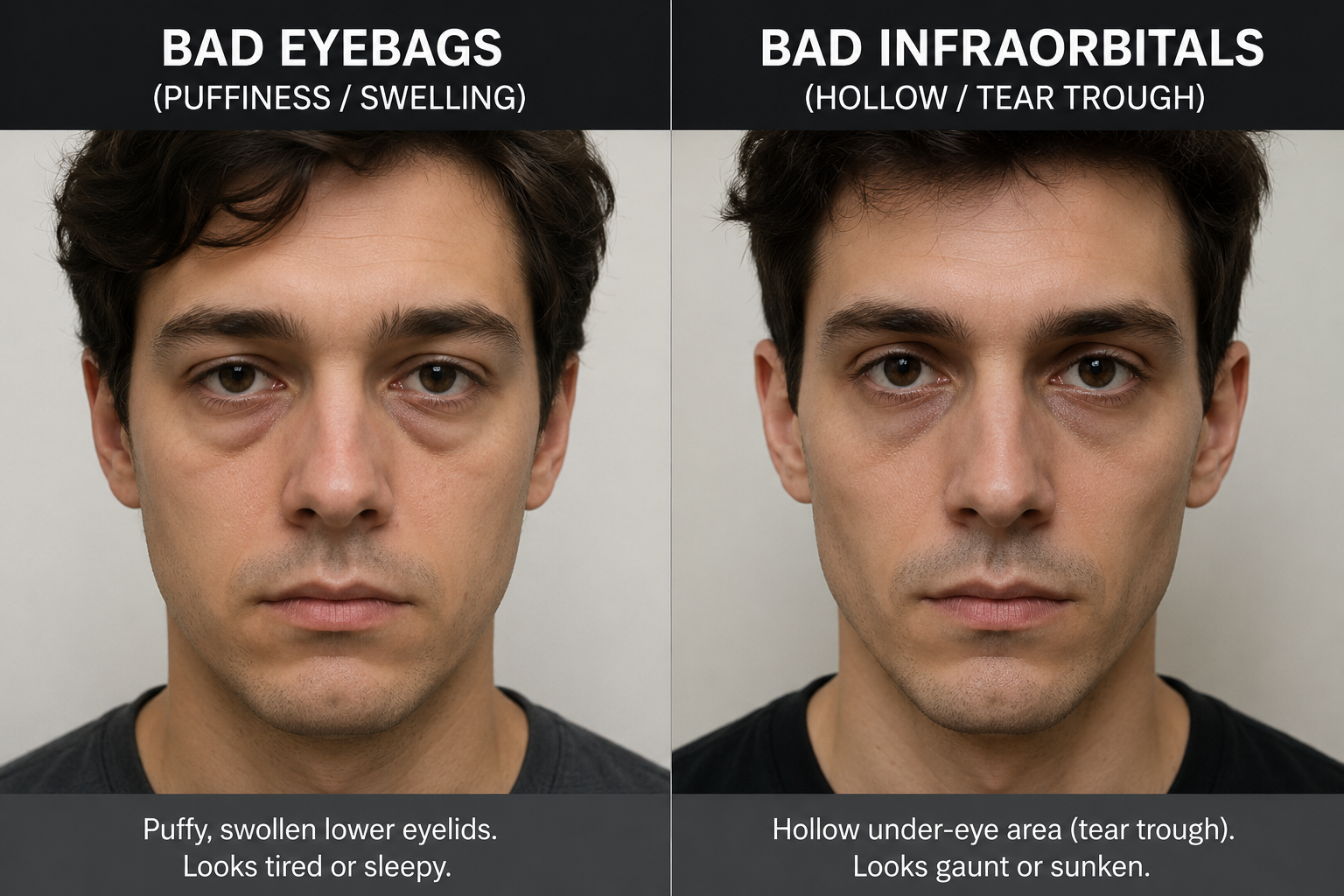
View attachment 5057288

There's a research finding published in Aesthetic Plastic Surgery by Pessa et al. and separately confirmed in a 2025 multilayered periorbital aging analysis in Aesthetic Plastic Surgery journal showing that orbital cavity volume actually expands with age as the bone resorbs. The globe itself gets slightly smaller too. Both changes together create the sunken, enophthalmic look that older men develop hence the hollow orbit and shadowed undereye.

——————————————————————————————

2. HOW TO TELL IF YOURS IS DEFICIENT


Take a side photo or look at your face in true lateral view. Drop an imaginary vertical line straight down from the most forward point of your eyeball, what's called the corneal apex. If the bone and soft tissue under your eye sits clearly behind that line, you have a negative orbital vector. The clinical literature consistently uses this as the primary diagnostic criterion. The further behind that vertical plane your rim sits, the more deficient it is.
View attachment 5057307


The fat herniation test
Look directly upward in a mirror. If any bags or puffiness under your eyes get worse when you look up, that's herniated orbital fat pushing forward. Filler does not fix this. Filler in a herniated eye will make it look worse. That case needs lower blepharoplasty with fat repositioning.
View attachment 5057309


The malar mound test
Press upward gently on your cheekbone just under the eye. If a visible mound or puffiness appears underneath rather than the hollow improving, you have malar mound tendency. Adding filler in this setting makes the mound worse. This is a known complication of undereye filler in the wrong candidate. It's well-documented in the clinical literature and it's almost impossible to fully reverse without hyaluronidase.
View attachment 5057331

——————————————————————————————

3. THE ORBITAL VECTOR — WHY IT MATTERS MORE THAN YOU THINK

Positive orbital vector means your cheekbone and rim complex sits forward of your eyeball. The lower lid is fully supported, the lid-cheek junction is smooth, the eye looks deep-set and defined. Negative vector means your globe is the most forward structure in that zone as it protrudes past your cheek and rim. The lower lid has nothing to anchor it, eyes look slightly bulgy or round, the midface looks flat and withdrawn.
View attachment 5057372

The reason the vector discussion matters so much beyond just aesthetics. Guys spending money on canthoplasty with an uncorrected negative vector are wasting it. The whole mechanism of canthoplasty is lifting the outer corner of the lower lid and changing the tilt of the eye and that depends on having a stable bony ledge underneath the lower lid to hold the result long term. If that ledge is recessed, the lid migrates back down over months regardless of the quality of the surgical work.

There's also a finding worth knowing about that comes from published morphometric research comparing young and older faces. In younger patients the malar eminence, infraorbital rim, and pyriform aperture are all positioned anteriorly and the orbital aperture is relatively small and compact. In older patients all three of those landmarks have retrused posteriorly, the orbital aperture has expanded in area, and the inferior orbital rim has developed a different curvature pattern. The researchers note that implant designs targeting the skeletally deficient areas of older patients literally match the anatomy of what's been lost over time. This is why implants for the infraorbital rim look so natural when properly placed.

——————————————————————————————

4. THE ANATOMY

The clinical outcomes of everything done in this area like filler, fat grafting, implants are directly determined by understanding these structures. So its better to have a good grasp of things.

The orbicularis retaining ligament (ORL) and the tear trough ligament
The orbicularis retaining ligament is a series of fibrous attachments extending from the inferior orbital rim to the overlying skin. It defines the upper border of the sub-orbicularis oculi fat compartment (SOOF). The medial portion of the ORL is specifically called the tear trough ligament. This structure is what creates much of the tear trough deformity. It physically tethers the skin to the bone, creating a groove that descends as the surrounding tissue loses volume and descends with age. When you squint or frown you can often see the tear trough groove deepen temporarily because the muscular contraction tightens this tethering effect.
View attachment 5057387


The fat compartments that matter the most :
Below the orbicularis muscle sits the SOOF (the sub-orbicularis oculi fat). This compartment is bounded superiorly by the ORL and inferiorly by the zygomatic cutaneous ligament. Below and lateral to that is the deep medial cheek fat compartment which is where the structural cheek volume lives. In the superficial plane above the muscle are the superficial fat compartments the medial cheek fat, nasolabial fat, and a thin preseptal fat layer directly over the lower lid. Understanding which plane you're in during injection determines whether the result looks right or wrong. Filler placed in the wrong fat compartment doesn't just look suboptimal and it migrates in a direction determined by the anatomy of that compartment and can end up in a location that makes things look worse months later.

View attachment 5057396


The vascular danger zones and why this area is high risk
The infraorbital region is supplied by several arterial branches. The angular artery is branch of the facial artery that runs medially across the nasojugal groove and is one of the most commonly injured vessels during tear trough injection. The infraorbital artery exits the infraorbital foramen approximately 3cm lateral to the midline just below the orbital rim. The zygomaticofacial artery runs laterally. All of these sit in a vascular territory that communicates with the ophthalmic artery via the orbital septum. This is why vascular occlusion from filler in this area carries vision risk in a way that injections elsewhere on the face generally don't. The connection to the ophthalmic circulation is real and documented. A 2015 review of the world literature on filler-related blindness by Beleznay et al. identified the glabellar region and nasal area as highest risk.
View attachment 5057438

——————————————————————————————

5. THE THREE CLASSES OF INFRAORBITAL HOLLOWING

The groove is confined to the inner corner area. The rest of the rim still has reasonable support. This is the mildest presentation and it responds well to filler correctly placed. A good injector at the right depth can fix this in one session.

View attachment 5057501

The hollow has deepened and extended outward. Visible under the middle of the eye and sometimes toward the outer corner. Early volume loss in the central cheek becomes visible. Filler still works but placement has to cover multiple zones and single-pass medial technique leaves the lateral area still hollow. You need dual-plane treatment across two or three anatomical subzones.
View attachment 5057508

The hollow wraps around the entire rim. The lid-cheek groove is visible from every angle. This isn't just soft tissue loss anymore as the bone itself is genuinely deficient. Filler cannot build structure here because there's no skeletal platform for it to sit on. It just creates a puffy appearance without correcting the vector or the hollow. Class 3 is implant or fat grafting territory.

View attachment 5057516

——————————————————————————————

6. NON-SURGICAL (COPE)


THIS WHOLE SECTION EXCEPT FOR THE DEXA SCAN AND BODY ARE FOR COPERS WHO ARE AGAINST FILLERS AND HARDMAXES SO DNR THIS IF YOU ARENT ONE


Global Costs

USA:
GHK-Cu serum $20 to $60 per bottle. The Ordinary Buffet + Copper Peptides around $25. Prescription tretinoin via telehealth (Curology, AgelessRx) $20 to $40 per month.

UK:
GHK-Cu £18 to £50. Tretinoin via Dermatica or Skin + Me £20 to £30 per month.

Europe:
€20 to €55. Prescription tretinoin through a derm €30 to €60 per month.


The Full Protocol

Step 1:
Cleanse morning and night with a gentle non-stripping cleanser. The periorbital skin is some of the thinnest on the entire body so anything with high-pH foaming agents or sulfates irritates it and makes the area look worse over time.

Step 2 (Morning):
A few drops of GHK-Cu serum on damp skin around the undereye and midface. Use your ring finger as it naturally applies the least pressure then and tap gently rather than rubbing. Don't drag the skin. This matters more than most people think over months and years of cumulative mechanical stress.

Step 3 (Morning):
SPF 50+ over everything including the undereye. Non-negotiable as UV accelerates collagen breakdown in this region faster than almost anywhere else on the face because the skin here is so thin and has so little protective mass. Long-term sun exposure is one of the factors driving the skeletal resorption pattern in this area.

Step 4 (Evening):
Retinol after cleansing. Start at 0.025% three nights per week. Move to every other night in weeks five through eight. Nightly from week nine. Step up concentration to 0.05% then 0.1% over three to four months. Follow with a light moisturizer to buffer irritation around the periorbital zone.

Key rule:
GHK-Cu and retinol in the same session cancel each other out. GHK-Cu in the morning, retinol at night.

raw GHK-Cu powder:
Buy raw GHK-Cu powder from Peptide Sciences or BoS Research for around $10 to $15 per gram. Dissolve 0.5g into 100ml of water-based hyaluronic acid serum base in a dark glass dropper bottle. That's a 0.5% serum for a fraction of what any brand charges. Dissolves cleanly. Store refrigerated, use within 60 days, date the bottle.

Realistic expectations:
Noticeably better skin quality, thicker skin, reduced shadowing after 12 to 16 weeks of consistency. It is mitigation not correction. Class 1 can see real improvement from topicals. Class 2 and 3 need more than this but topicals are worth running alongside whatever else you're doing.

Cost
Free. DEXA scan $50 to $150 in the US, £30 to £80 in UK, €40 to €100 in Europe, $20 to $40 in Turkey and Thailand.

Why it matters and what to do
The periorbital fat pads are highly sensitive to overall body fat percentage. Drop below 10% body fat and those pads thin out dramatically, making the infraorbital hollow look significantly worse. A lot of guys notice their undereye area looks great at 14% and wrecked when they push down to 8% for summer. There's a sweet spot typically somewhere in the 12 to 17% range where facial fat is preserved without sacrificing overall body composition. It's individual based on genetic facial fat distribution. Get a DEXA scan at your leanest and at a moderate body fat, photograph yourself in consistent lighting at both, and compare. That gives you your actual threshold.

View attachment 5057563

Global Costs

USA:
$20 to $40 per month at 10g daily. BulkSupplements cheapest at $20 to $25.
UK:
£18 to £35. Bulk Powders and MyProtein both carry it.
Europe:
€20 to €40. Bulk Powders ships to most EU countries.


The Protocol

Step 1:
Hydrolyzed Type I and III collagen peptide powder specifically. Not gelatin. Not non-hydrolyzed collagen. The label has to say hydrolyzed collagen peptides or you're not getting the absorption the clinical studies are based on.

Step 2:
10g every morning in hot coffee or tea. Tasteless in most formulations. Dissolves completely in hot liquid.

Step 3:
500mg Vitamin C at the same time. Ascorbic acid is a required enzymatic cofactor in the collagen synthesis pathway. Without adequate circulating Vitamin C the production signal from the peptides can't complete properly. Most people skip this and then wonder why their results are mediocre.

Step 4:
Every single day for minimum 90 days before assessing. Collagen remodeling is slow. Most people see real change between weeks 8 and 16. Sporadic use produces nothing.

Step 5:
Photograph the undereye in the same lighting every four weeks. Subjective mirror assessment doesn't work for slow changes. Objective photos tracked over time are the only accurate way to evaluate this.

——————————————————————————————

7. THE RIGHT FILLER TECHNIQUE

The tear trough is not just volume loss. There's a fibrous structure. The tear trough ligament, the medial portion of the orbicularis retaining ligament is the one that physically tethers the skin to the orbital rim bone at the boundary between the thin eyelid skin and the thicker cheek skin. To lift the groove you need product placed below this structure at the supraperiosteal level so it pushes up against the tethering from underneath. Injectors who deposit product above the ligament in the superficial plane get a lump or ridge sitting on top of the groove without lifting it. That's the most common reason tear trough filler results look bad. The cadaveric study from the University of Pennsylvania published in Aesthetic Surgery Journal in 2023 confirmed that injection just above the periosteum produces the most anatomically precise placement along the orbital rim and critically showed that Restylane-L placed this way stays as a distinct mass along the ORL, while Volbella spreads more freely across anatomical planes due to its lower elastic modulus. This finding has direct implications for which product you use at which depth.

HA filler injected at the supraperiosteal level supports the undereye, reduces hollowing, and moves the orbital vector toward positive. Often combined with lower blepharoplasty when someone needs both structural and skin correction at the same time. The area around the infraorbital rim is highly vascular with multiple arterial branches communicating with the ophthalmic circulation

View attachment 5057605


Global Costs — Both Eyes

USA:
$1,000 to $2,500 total. Per syringe $600 to $1,500. ASPS national average around $684 per syringe.
UK:
£500 to £1,500. Harley Street at the top. Regional UK from £350 to £400 per syringe.
Western Europe:
€600 to €1,400. Spain and Eastern Europe more competitive at €350 to €800.
Turkey (Istanbul):
€250 to €450. Same brand-name filler, 60 to 75% cheaper. Highest ROI destination for this specific procedure.
South Korea (Seoul):
$300 to $600 at Gangnam clinics.
Thailand (Bangkok):
$200 to $500. JCI-accredited clinics only.
Mexico:
$300 to $700. Major cities with board-certified injectors.

——————————————————————————————

7B. DIY UNDEREYE FILLER FULL GUIDE

This covers the DIY approach. The undereye is the highest-risk filler site on the face due to the vascular anatomy described in Section 4. Know the emergency protocol before you start. Have hyaluronidase on hand.


You're a reasonable candidate if:
You have Class 1 or mild Class 2 hollowing. A groove with genuine volume loss but nothing puffy or herniated. Lower eyelid skin is taut when you pinch it gently. No loose or baggy eyelid skin. No bags that are worse in the morning. No bleeding disorders, autoimmune conditions, or active skin infection. You haven't had filler dissolved in this area in the past 8 weeks.

Stop here if:
You have puffy bags or visible fat herniation as filler will make this dramatically worse. Thin eyelid skin where veins are clearly visible. Significant laxity under the eye. Strongly negative orbital vector without structural support as filler will just look puffy without fixing the vector. You've had hyaluronidase used in this area in the last 8 weeks.

The filler
Soft, low G-prime HA filler designed for periorbital use. Do not use thick fillers like Voluma, Radiesse, or dense Juvederm in the tear trough as they lump and migrate. The right products are Restylane-L, Juvederm Volbella, Belotero Balance, and Teosyal Redensity 2. Teosyal Redensity 2 is specifically formulated for periorbital use with lower water-attracting properties to reduce post-injection swelling. You need 1ml maximum for both sides as most sessions use 0.3 to 0.5ml total.

Where to source: Medica Depot, HA-Dermal, DoctorMedica, and similar gray market wholesale suppliers sell Restylane and Teosyal without prescription in many jurisdictions. In Turkey you can walk into Istanbul pharmacies and buy Juvederm or Restylane OTC for $40 to $80 per syringe. Never buy from eBay or AliExpress and counterfeit or improperly cold-chain stored filler is a real infection risk. Established suppliers with documented cold-chain shipping only.


Cannulas
27-gauge blunt cannula, 38mm length. The blunt tip pushes vessels aside rather than puncturing them. Brands: Softfil, TSK Steriglide, FlexFill. Available from Medica Depot or iBeautyMachine for $15 to $40 per box of 20. Fresh cannula per session and per eye as you should never reuse.

Entry needle
25-gauge sharp hypodermic needle to create the entry point hole. Available at any pharmacy.

Numbing
EMLA cream (lidocaine 2.5% plus prilocaine 2.5%) under cling film for 30 minutes. LMX4 also works. Do not use ice as primary numbing as it causes vasoconstriction which makes blood aspiration harder to assess.

Hyaluronidase
The enzyme that dissolves HA filler. Available as Hylenex in the US, Hyalase in UK and Europe, or generic hyaluronidase 1500iu vials. t.

Sterility supplies
Nitrile gloves. Alcohol prep pads (70% isopropyl). Chlorhexidine 2% for skin prep. Gauze pads. Sterile drape or fresh clean towel. Sharps container.

Total cost
Filler syringe $40 to $120. Cannula box $15 to $40. EMLA $10 to $25. Hyaluronidase $30 to $80. Supplies $10 to $20. Total $105 to $285 versus $1,000 to $2,500 professionally.

48 hours before:
Stop blood thinners so no aspirin, ibuprofen, fish oil, vitamin E, or alcohol. OTC supplements and lifestyle only and do not stop prescription blood thinners without speaking to your doctor.

Day of — skin prep:
Wash your face. Remove everything like no makeup, no skincare. Chlorhexidine on a gauze pad wiped from center outward over the injection zone. Follow with alcohol prep pad. Let dry completely. Don't touch the cleaned area with bare hands again.

EMLA application:
Thick layer covering the full undereye zone from inner corner to the outer orbital area. Cover with cling film. Leave minimum 30 minutes. Wipe completely off with alcohol prep pad and let dry fully before proceeding.

Workspace setup:
Large well-lit mirror. Daylight or bright white LED pointed at your face. All supplies within reach. Nitrile gloves on. Filler syringe open with hub attached. Cannula on sterile surface. Hyaluronidase immediately accessible and know exactly where it is and how to draw it up before touching anything.

Step 1 — Mark your anatomy
White eyeliner pencil only and not a dark marker. Mark the lowest point of your tear trough groove in good lighting. Mark your entry point: 15 to 20mm directly below the outer edge of your iris (lateral limbus) on the cheek. This location keeps your cannula path away from the infraorbital foramen and the angular artery as you travel medially. Wipe the marks off with an alcohol pad before injecting also never inject through skin with marker on it.
View attachment 5057828


Step 2 — Create entry point
Stretch the skin at the entry point with your non-dominant hand. 25-gauge sharp needle, firm puncture at 45 to 90 degrees. One clean puncture. Entry point on the cheek, not the lower eyelid. Small drop of blood is fine but wipe with alcohol pad.

View attachment 5057856


Step 3 — Insert cannula
27-gauge blunt cannula attached to filler syringe. Stretch entry point skin to keep the hole open. Insert at 30 to 45 degrees then flatten the angle to nearly parallel with the skin surface. Travel supraperiosteally and just above bone. You feel slight resistance through the orbicularis and a give as you enter the sub-orbicularis plane. Cannula scraping against bone means you're at the right depth. Advance slowly toward the inner corner of the eye, below the tear trough groove.
View attachment 5058166


Step 4 — Aspirate first
Before releasing any product, pull the plunger back. Blood in the syringe means you're in a vessel. Withdraw immediately, apply pressure for 2 minutes, don't inject from that entry point again. Move to the other eye and return with a fresh cannula from a slightly different entry location.
View attachment 5058179


Step 5 — Retrograde linear threading
Cannula at its deepest point medially near the inner corner. Begin slowly pressing the plunger while simultaneously withdrawing at a steady even pace toward the entry point. Product deposits as a thin continuous thread as you withdraw. Even pressure, smooth withdrawal with thin column along the rim, not a blob. Volume per pass: 0.1 to 0.2ml max. Start with 0.1ml and assess before adding more.
View attachment 5058325


Step 6 — Lateral fan if needed (Class 2 only)
If hollow extends laterally past mid-pupil, readvance from same entry point angled slightly outward. Second retrograde pass covering the lateral area. Use less here like 0.05 to 0.1ml. Maximum two passes from one entry point.

Step 7 — Assess and massage
Remove cannula. Gentle pressure on entry point for 30 seconds. Sit upright and look in natural light. Any lumps felt then gentle circular massage with clean finger. Check specifically for skin blanching anywhere for white patches that don't resolve in 30 seconds mean possible vascular compression.
Wait 5 minutes and reassess the first side before moving to the other eye.

Step 8 — Other eye
Fresh cannula. New entry point same location on the other side. Match volume exactly to what you used on the first side. Always err toward less so you can add at 2 weeks, you cannot easily remove immediately.

Step 9 — Aftercare
Cold compress (wrapped, not bare ice) for 10 minutes. No makeup for 24 hours. No alcohol, exercise, or heat for 48 hours. Sleep slightly elevated the first night. Don't massage after the first hour. Expect some swelling and possible mild bruising for 2 to 5 days. Final result at 2 weeks around is noticed.

Most DIY attempts go wrong because people use too much. This area needs far less product than anywhere else on the face. Overfilling creates a puffy pillow look that sits there for months and requires hyaluronidase to fix.

Session 1:
0.1ml per side. Total 0.2ml. Test session. You will probably not see a dramatic result. Assess at 2 weeks.

Session 2 (minimum 2 weeks later):
Add up to 0.15ml per side if genuinely needed. Cumulative max after two sessions: 0.25ml per side.

ceiling:
Never exceed 0.3ml per side total across all DIY sessions. If your hollowing needs more than that, the problem is structural.

vascular occlusion:
Signs: skin blanching white that doesn't resolve in 30 seconds, skin going mottled or grey or purple, severe pain out of proportion to the procedure, any change in vision including blurring or darkening. If any of these happen: stop injecting. Inject hyaluronidase immediately into the affected area then reconstitute 1500iu vial with 2ml saline for 750iu/ml, inject 0.2ml (150 units) directly into the blanched zone and surrounding tissue. Apply warm compress then Take 325mg aspirin.

Tyndall effect (blue discoloration):
Filler placed too superficially. Not dangerous but looks bad. Hyaluronidase 15 to 30 units injected directly into the blue zone in small aliquots. Resolves within 24 to 48 hours.

Persistent lump:
Wait 2 weeks as most resolve with swelling. Persistent lump at 2 weeks gets hyaluronidase 15 units per side directly into it. Reassess at 48 hours.

Full dissolution protocol:
Reconstitute 1500iu hyaluronidase with 2ml bacteriostatic saline giving 750iu/ml. Draw up appropriate volume in insulin syringe. Inject small amounts (0.02 to 0.05ml per puncture) directly into the filler deposit across multiple punctures. For full dissolution of undereye filler: 15 to 75 units per side. Results in 24 to 48 hours. Wait minimum 4 weeks before re-injecting as residual hyaluronidase can break down freshly placed filler if you go back too soon.

——————————————————————————————

8. INFRAORBITAL RIM IMPLANTS COSTS

Solid silicone implants placed directly on the infraorbital rim bone. The most direct structural correction available for undereye hollowing and a negative orbital vector as you are physically augmenting the bony architecture, not masking the problem with volume. Unlike filler which is temporary and only addresses soft tissue, implants permanently correct the vector. They're typically combined with lower blepharoplasty for the best full eye area result.


Off-the-shelf implant designs are not inferior to custom implants for most people. The Flowers infraorbital rim implant is a well-established design with a long clinical track record and it's appropriate for the majority of symmetric cases. Custom implants are specifically for patients with significant asymmetry between sides or unusual anatomy that a standard design can't accommodate. The push toward custom-only is partly surgeon preference and partly commercial as custom implants cost significantly more and have higher margin.


Global Costs

USA:
$6,000 to $15,000. Flowers off-the-shelf designs at the lower end. Custom CT-derived implants from Eppley, Taban, Isaacs at $8,000 to $15,000+.
UK:
£5,000 to £9,000. Surgeons with specific experience in this procedure are rare outside London.
Western Europe:
€5,000 to €10,000. Belgium, Netherlands, Germany, Spain have experienced craniofacial surgeons doing this.
Turkey (Istanbul):
$3,000 to $6,000 all-in with hotel and transfers. Verify that the specific surgeon has done infraorbital rim implants specifically — not just cheek or chin work.
South Korea (Seoul):
$4,000 to $8,000. Often combined with canthoplasty and lower bleph as a full eye area package. VAT refund 7 to 8% at airport for foreign patients.
Thailand (Bangkok):
$3,500 to $7,000 at JCI hospitals.
Mexico:
$3,000 to $6,000. Mexico City and Monterrey over Tijuana for this level of work.

——————————————————————————————


9. MIDFACE MASK IMPLANT


Reference thread on this: The Holy Grail of Facial Aesthetics — How to Simulate Lefort III Results with the Midface Mask Implant


The custom midface mask implant covers the entire upper midface skeleton which is from the infraorbital rims down to just above the upper teeth. Think of it as a single unified implant that simultaneously augments all of the following : the infraorbital rims, the malar eminences (cheekbones), the paranasal region (the area around the base of the nose), and the anterior maxilla. That coverage is why it's called a mask. the footprint literally looks like the upper portion of a face mask on 3D imaging.

View attachment 5058644

The effect is described in the surgical literature as Lefort III-like but without the occlusal movement. Meaning it pulls the entire midfacial skeleton forward in one coordinated augmentation, mimicking the aesthetic outcome of a full midface advancement osteotomy without actually cutting and moving bone. The infraorbital rims project forward correcting the negative vector, the cheeks project forward, the paranasal area fills out, the entire midface depth and width changes. For someone with true generalized midface hypoplasia this is the procedure that actually addresses the whole problem rather than chasing individual zones with separate implants.

Because the infraorbital nerve passes through the infraorbital foramen in the middle of this zone, the implant is designed as three pieces: bilateral infraorbital-malar segments and a lower maxillary segment that crosses under the nasal base. Each piece is designed around the nerve pathway to prevent compression. When properly placed there should be no permanent nerve damage, though patients should expect some temporary numbness of the upper lip and side of the nose from nerve stretching during implant seating which recovers fully.

The limitation with doing a cheek implant here and a separate infraorbital rim implant there and a separate pyriform implant somewhere else is that you get disjointed augmentation with visible transitions between the zones. Each implant has edges. Where one implant ends and another begins there's a potential step-off or contour irregularity that shows through the overlying soft tissue. The more implants you stack the more complex the revision situation if anything needs to be adjusted.
View attachment 5062790

The midface mask implant solves this by creating one continuous augmentation surface across all zones simultaneously. The transitions between the infraorbital rim, malar eminence, and paranasal regions are built into the implant design itself and are smooth by design rather than approximated by placement of separate pieces. The clinical result looks more natural and cohesive because it is more natural and it follows the actual anatomy of the midfacial skeleton as a unified structure rather than addressing it as isolated landmarks.

There's also a case documented in the surgical literature specifically for patients who had a Le Fort I osteotomy that moved the lower maxilla but left the upper midface consisting of the infraorbital rims and zygomaticomalar complex untouched and still recessed. This is a known limitation of Le Fort I: it addresses the occlusal level but doesn't move the infraorbital rim. A custom infraorbital-maxillary-malar implant placed after a Le Fort I creates what surgeons describe as a modified Le Fort III effect as both the lower and upper midface are now addressed, combining what surgery did with what the implant adds.

The midface mask implant is appropriate for someone with true generalized midface hypoplasia and not just undereye hollows, not just flat cheeks, but the full midface complex being recessed including the infraorbital rims, malar eminences, and paranasal area. If you look at your profile and everything from your lower eyelid to your upper lip sits behind the plane of your nose tip and forehead, you are probably in this category. If only specific zones are deficient, targeted implants or filler are more appropriate.


The procedure is not appropriate if your occlusion needs to change and if you have a malocclusion that needs orthognathic surgery, that needs to be addressed before or simultaneously with any midface implant work, not replaced by it. The midface mask implant advances the skeletal contour without moving the teeth or changing the bite. If the bite is off, that's a separate problem requiring orthognathic surgery.

Cost
$6,000 to $15,000 depending on surgeon and whether it is standalone or combined with other procedures. For context: a Le Fort II or III osteotomy runs $30,000 to $60,000 and is practically inaccessible for purely aesthetic indications. The midface mask implant achieves a comparable aesthetic effect at 20 to 50% of that cost. This is one of the best cost-to-outcome ratios in all of facial surgery for the right candidate.


Where to find surgeons who specifically do this
Dr. Barry Eppley at Eppley Custom Facial Implants in Indianapolis is the most documented surgeon in the English-language literature for this specific procedure. His case studies are publicly available on exploreplasticsurgery.com and document outcomes across multiple patient types including men with generalized midface hypoplasia. In Europe, craniofacial units in Belgium and the Netherlands have surgeons experienced with comprehensive midface implant design. In South Korea the Gangnam complex surgery market has surgeons comfortable with multi-zone midface implants. As with the infraorbital rim implant, verify specifically that the surgeon has documented experience with full-coverage midface mask implants — not just cheek or malar implants in isolation.

his website : eppleyplasticsurgery.com

——————————————————————————————

10. LE FORT OSTEOTOMY — WHEN AND WHY

The Le Fort osteotomies are the actual skeletal solution for severe midface recession. Le Fort I moves the maxilla at the occlusal level and changes the teeth and lower midface position but critically does not move the infraorbital rims, which is why it often leaves the upper midface still recessed after surgery. Le Fort III moves the entire midface including the orbital rims forward and is the most complete correction available.
View attachment 5062824


Global Costs

USA:
$20,000 to $40,000 for Le Fort I. Modified Le Fort III $30,000 to $60,000+ at major craniofacial centers.
UK:
£12,000 to £25,000 private. NHS may cover with functional indication.
Western Europe:
€10,000 to €25,000. Spain and Eastern Europe more competitive at €10,000 to €15,000.
Turkey (Istanbul):
$6,500 to $12,000 at accredited hospitals.
South Korea (Seoul):
$8,000 to $18,000. Korea performs among the highest annual volume of orthognathic surgery globally.
Thailand (Bangkok):
$9,500 to $15,000 at JCI hospitals.
Mexico:
$8,000 to $15,000. Mexico City university-affiliated maxillofacial departments.


The Le Fort I Limitation and Why Many Patients Need More
Le Fort I advancement moves the lower midface consisting of teeth, lower cheeks, nose but it does not move the infraorbital rims. In patients where the midface deficiency extends all the way up to include the orbital rims, a Le Fort I leaves the upper midface still recessed after surgery. The patient sees improvement in their bite and lower face but still has a negative orbital vector and hollow undereyes. Opting for a LE FORT III is best here.
View attachment 5062819


——————————————————————————————

11. SURGEON TIERLIST

The surgeons listed here are the ones with documented, verifiable track records specifically for this procedure and not general plastic surgeons who have done one or two of these, but specialists who have built a reputation specifically around periorbital and midface skeletal surgery. Tierlists cover surgeons globally, then clinics by country, then countries overall.


Ranked specifically on documented case volume, technical specificity for this procedure, published research contribution, and real patient outcome track record. Not on general reputation as a plastic surgeon.

S TIER — The absolute best, would travel anywhere for these

Dr. Barry Eppley
Location:
Eppley Plastic Surgery, 12188-A North Meridian St Suite 310, Carmel (Indianapolis), Indiana, USA
Website:
eppleyplasticsurgery.com and eppleycustomfacialimplants.com
Approximate cost:
Infraorbital rim implants (combined infraorbital-malar) around $6,500. Midface mask implant $8,000 to $12,000. Custom jaw, cheek, full facial packages vary. Virtual consultation available.
Why S tier:
Eppley is probably the single most documented surgeon in the English-language literature for custom facial implants including infraorbital rim, midface mask, and combined periorbital work. His blog at exploreplasticsurgery.com contains hundreds of case studies with full before/after documentation across every facial zone. He developed the semi-custom infraorbital-malar implant approach and has the deepest public case archive of anyone doing this procedure. He uses titanium micro-screw fixation for long-term positional stability. His pricing is also significantly lower than the Beverly Hills surgeons doing comparable work.
In his own words on infraorbital implants vs fillers:
"In the treatment of infraorbital rim deficiency, the three treatments are synthetic injectable fillers, injected fat and implants. Each has their own advantages and disadvantages. But none of them are perfect nor is one method best for all patients. Each case must be considered separately and the magnitude of the defect considered in the treatment selection." He also notes that fillers should be used as a trial method first to assess whether soft tissue volumization gives the desired effect before committing to implants.
On custom vs off-the-shelf:
"A semi-custom approach allows me to select an infraorbital-malar implant from a variety of custom ones that have been made for other patients. Given the shape of this area of the facial skeleton a semi-custom implant can be a more cost-effective method that fits fairly well." Worth knowing that he actually offers this more affordable semi-custom option for appropriate cases.

Dr. Mehryar (Ray) Taban
Location:
9735 Wilshire Blvd Suite 319, Beverly Hills, CA 90212, USA. Also Santa Barbara.
Website:
tabanmd.com — Phone: (310) 278-1836
Approximate cost:
Infraorbital rim implants $8,000 to $15,000 depending on complexity and whether combined with canthoplasty, blepharoplasty, or orbital decompression. Full periorbital transformation packages can run higher.
Why S tier:
Taban is double board-certified by ASOPRS (American Society of Oculofacial Plastic and Reconstructive Surgery) and the American Board of Ophthalmology, and is also an Assistant Clinical Professor at UCLA. He is the go-to surgeon for complex periorbital work that combines infraorbital rim implants with canthoplasty, lower eyelid retraction repair, and orbital decompression in a single operation. His patient gallery at tabanmd.com contains an extensive archive of before/after cases documenting vector correction and eye shape transformation. He uses the transconjunctival approach with suture fixation rather than screws, preferring to avoid metal hardware near the orbit. His specific expertise in oculoplastic surgery means he understands the lower eyelid mechanics in a way that most plastic surgeons simply don't.
On what he actually does for negative vector patients:
His documented approach for negative vector patients often combines infraorbital rim implant placement with lower eyelid retraction correction and canthoplasty in a single operative session by addressing the bone, the lid position, and the canthal angle simultaneously. This is significantly more ambitious than what most surgeons offer and is appropriate for patients whose eye area problems involve all three components.
Real patient review (documented on RealSelf):
One patient with extensive knowledge of maxillofacial surgery wrote: "When it comes to the periorbital region he IS the best in the world. Through canthoplasty, tear trough implants on the orbital rim, lower lid retraction, orbital decompression, and slight lowering of the upper eyelid, I now have hooded eyes, a sweeping effect, a high lateral canthus position, and a lower lid so high it likely won't descend for decades."

A TIER — Elite surgeons, genuinely excellent, specific strengths noted

Dr. Michael Yaremchuk
Location:
Massachusetts General Hospital, Division of Plastic Surgery, Boston, MA, USA
Website:
dryaremchuk.com
Approximate cost:
$10,000 to $18,000 for infraorbital rim and midface implant work. As a Harvard-affiliated craniofacial surgeon the pricing reflects his academic institution and elite reputation.
Why A tier:
Yaremchuk is the academic foundation of this entire field. He literally wrote the original peer-reviewed paper on infraorbital rim augmentation published in Plastic and Reconstructive Surgery in 2001 which is still cited in almost every academic article on this procedure. He also designed specific implants for this procedure. His clinical background is craniofacial surgery at one of the top hospitals in the world. His research on how the aging facial skeleton changes the orbital vector relationship is the most cited work in this space. The reason he's A rather than S is purely accessibility as academic hospital pricing is steep, his focus is broader than just aesthetic cases, and he's harder to get to.
In his own published research:
"In patients with recessive infraorbital rims, alloplastic augmentation of the infraorbital rims makes the eyes appear less prominent and improves appearance. Augmentation of the infraorbital rim and resuspension of the cheek soft tissues can have a rejuvenating effect in properly selected patients." His 3D reconstructions comparing youthful and aged orbits shows how an infraorbital rim implant placed on the aged skeletal anatomy transforms it back toward the youthful contour are the clearest visual demonstration of what this procedure actually achieves.
Real patient quote:
"I had an under the eye problem and the only solution I thought there was, was cheek implants. Instead with his orbital rim implant he fixed the problem perfectly. In terms of surgical skill and experience, Dr. Yaremchuk is pretty much as good as it gets."

Dr. David Isaacs
Location:
Beverly Hills, CA, USA
Website:
drdavidisaacs.com
Approximate cost:
$10,000 to $15,000 for infraorbital rim implants. Uses 3D Accuscan imaging for custom implant design.
Why A tier:
Dual-fellowship trained oculofacial plastic surgeon in Beverly Hills who specifically markets and documents infraorbital rim implant work. Uses a transconjunctival approach and custom 3D Accuscan imaging to ensure implant fit. Strong documented case gallery. Appropriate for patients who want a Beverly Hills-based alternative to Taban with similar oculoplastic training background. His stated approach on fitting is that the procedure should always be anchored securely while blending naturally with facial contours, and that careful technique avoids overcorrection while preserving the natural lower eyelid to cheek transition.

B TIER — Solid options, less documented but legitimate

Korean Gangnam Oculoplastic Surgeons (as a group)
Location:
Gangnam and Apgujeong districts, Seoul, South Korea
Approximate cost:
$4,000 to $8,000 for infraorbital rim implants. $920 to $1,530 for undereye fat grafting. Often packaged with canthoplasty and lower blepharoplasty.
Why B tier:
Korean surgeons as a group represent excellent value and high volume, particularly for canthoplasty, lower blepharoplasty, and combined eye area transformation packages that include infraorbital rim work. The sheer case volume in Seoul means technique refinement that's genuinely hard to match elsewhere. The reason they're B rather than A as a group is variability as you need to research the specific surgeon rather than just the clinic, the anesthesiologist issue is real (verify presence before booking), and the documented English-language case literature for this specific procedure is less accessible than the US surgeons. The best Korean surgeons doing this work are at the same technical level as S tier but the challenge is identifying them.

Istanbul Craniofacial Surgeons (JCI-accredited hospitals)
Location:
Acibadem, Memorial Hospital Group, Medipol Mega, Liv Hospital, Istanbul, Turkey
Approximate cost:
$3,000 to $6,000 for infraorbital rim implants all-in. $1,450 to $2,900 for fat grafting.
Why B tier:
Turkey has the best cost-to-outcome ratio globally for this procedure when you find the right surgeon. The infrastructure at JCI hospitals is genuinely high quality, ISAPS-certified surgeons in Istanbul are operating at a legitimate international standard, and the all-inclusive packages make the logistics straightforward. The B tier placement reflects the same variability issue as Korea as surgeon-specific due diligence is essential, and the English-language documentation of individual surgeon case archives is harder to evaluate than the US names listed above.

C TIER — Proceed with extreme caution or avoid for this specific procedure

General plastic surgeons without specific infraorbital rim implant experience, regardless of their general reputation. The procedure is technically demanding enough and rare enough that a surgeon who does it once or twice a year and otherwise sticks to rhinoplasties and breast work is not an appropriate choice.

S TIER COUNTRIES for this specific procedure

USA (specifically Indianapolis and Beverly Hills)
Home to the most documented and accessible specialists for infraorbital rim and midface implants globally. Eppley in Indianapolis gives you the most documented case archive and competitive pricing for the US market. Beverly Hills gives you Taban and Isaacs with the deepest oculoplastic expertise. The US is S tier not because it's cheapest as it clearly isn't nigga :feelswhy: but because the surgeon-specific documentation and research output here is the most accessible for doing pre-operative due diligence, and the legal/medical infrastructure for complications and revision is the most robust.

A TIER COUNTRIES

South Korea (Seoul — Gangnam/Apgujeong)
Best in the world for combined eye area transformation packages, fat grafting, and any procedure that combines periorbital structural work with canthoplasty and blepharoplasty. Case volume is unmatched globally. The challenge is verification When you find the right surgeon the outcomes here are comparable to the best in the world at 40 to 60% of US pricing.

Turkey (Istanbul — JCI hospitals)
Best value globally for filler, fat grafting, and implant work when you vet properly. The cost savings versus the US and UK are dramatic. The due diligence process described in Section 12 is non-negotiable though as the variation between top-tier and mid-tier providers in Istanbul is significant.

B TIER COUNTRIES

Western Europe (Belgium, Netherlands, Spain — Barcelona/Madrid)
Strong craniofacial surgery scenes in Belgium and the Netherlands specifically. Spain has experienced surgeons in Barcelona and Madrid who do periorbital and midface implant work. Pricing sits between Turkey and the US. Good option for European patients who don't want to travel to Turkey or Korea.

UK (London specifically)
Strong regulatory framework and high-quality surgeons in London. The issue for this specific procedure is the same as everywhere but surgeons with documented specific experience in infraorbital rim implants are rare. Outside London the landscape thins out considerably. Pricing is high for what you get relative to Istanbul or Seoul. Better for filler and blepharoplasty than for complex implant work.

Thailand (Bangkok — JCI hospitals)
Strong for fat grafting and combined lower eyelid work at JCI hospitals. The specific infraorbital rim implant expertise is thinner here than in Korea or Turkey. Good value for procedures in the less specialized range like filler, fat grafting, blepharoplasty. Bumrungrad in particular has internationally trained surgeons who are genuinely excellent. For implant work specifically, less reliable than Seoul or Istanbul.

C TIER COUNTRIES — Use with heavy caution for this procedure

Mexico (Tijuana specifically), Eastern Europe outside major medical centers, and anywhere where infrastructure for managing complex periorbital complications is not immediately accessible. This isn't about general surgical quality and it's about the specific requirement that if something goes wrong with an infraorbital rim implant near the globe, you need to be in a facility that can manage it immediately. Mexico City and Monterrey are a different story and sit closer to B tier.

The surgeon tierlist above is primarily for implant and surgical procedures. For filler specifically, the calculus is somewhat different because the skill is in injection technique rather than operative surgical training, and the reversibility with hyaluronidase means mistakes are less catastrophic than with surgery.

Best market for filler value:
Istanbul. Same brand-name product, 60 to 75% cheaper, experienced injectors who do high volume. Single best destination for filler purely on cost and quality balance or you could just go DIY.

Best market for technique:
Seoul. The periorbital filler technique refinement in Gangnam clinics, including emerging ultrasound-guided tear trough work, is as advanced as anywhere globally.

What to look for in any injector anywhere:
They use a blunt cannula not a sharp needle in the tear trough. They can describe their entry point, injection plane, and product selection specifically. They have before/after photos of tear trough cases specifically not just general filler work.

——————————————————————————————

12. SCIENCE BACKING AND SOURCES

Everything in this guide is sourced from published research, peer-reviewed clinical literature, or documented surgical case studies. Links below.

Anatomy and Aging
PubMed — Infraorbital Rim Augmentation in Orthognathic Surgery (Le Fort I limitation documentation)
Aesthetic Plastic Surgery — Decoding Periorbital Aging: Multilayered Analysis (2025 — orbital cavity expansion with bone resorption, globe volume decrease)
ScienceDirect — Facial Bone Aging: An Update and Literature Review 2020-2023 (region-specific bone loss affecting orbital rims and maxilla)
Aesthetic Surgery Journal — Infraorbital Hollow Rejuvenation: Contributions of Midface Volumization (ORL anatomy, vascular supply, etiology)


Filler Technique and Anatomy
PMC — Cadaveric Evaluation of Filler Behavior in Tear Trough (University of Pennsylvania, 2023 — Volbella spreads across planes, Restylane-L stays as distinct mass at ORL)
PMC — Anatomical Filler Injection Techniques: Infraorbital Groove and Hollowness
PMC — Tear Trough Filler Using Three-Point Tangent Technique: Lessons from 1452 Applications (2023)
PMC — Bridging the Gap: Alternative Injection Strategy for Medial Infraorbital Region (lateral entry point, ultrasound-guided approach)
MDPI — Anatomical-Based Filler Injection: Infraorbital Groove and Hollowness (2025 — tear trough ligament vs fibrotic connective tissue debate)
PubMed — HA Filler Effectiveness for Periorbital Region


Implants and Surgical Correction
PMC — Improvement of Infraorbital Rim Contour (Medpor vs alternative materials, surgical technique documentation)
Explore Plastic Surgery — Custom Midface Mask Implant Case Study (Eppley — three-piece design, Le Fort III-like effect)
Explore Plastic Surgery — The Midface Mask Implant for Aesthetic Augmentation (full design description and indication criteria)
Explore Plastic Surgery — Custom IMM Implant After Le Fort I Osteotomy (the Le Fort I leaves upper midface behind — implant completes it)
Explore Plastic Surgery — Negative Orbital Vector and Custom Infraorbital Implants: Case Study


Related Reading from org
The Eye Area Manual — comprehensive breakdown of the full eye area

——————————————————————————————


AI was used to fix grammatical errors
Will be reading when free:feelshah:
 
  • Love it
  • +1
Reactions: Atra and kdev
Will read later g!
 
  • Love it
  • +1
Reactions: mohito, BigBallsHisty and kdev
@Sadist @slycooperr @Sircharlesbarkley @neurodivergent
 
  • +1
Reactions: Atra, BigBallsHisty and Sadist
THE ONLY INFRAORBITAL GUIDE YOU'LL EVER NEED

——————————————————————————————


This thread has been in the works for a while.

The infraorbital rim, what it actually does, why it's responsible for many eye area problems, and every single option available to fix it. Everything in this guide is sourced from published research, clinical case studies, and real surgical documentation.


Related reading: The Eye Area Manual and The Holy Grail of Facial Aesthetics — How to Simulate Lefort III Results with the Midface Mask Implant


——————————————————————————————


TABLE OF CONTENTS


1. What the Infraorbital Rim Actually Is

2. How To Tell If Yours Is Deficient

3. The Orbital Vector and Why It Matters More Than You Think

4. The Anatomy Explained Properly - Ligaments, Fat Compartments, and Vascular Zones

5. The Three Classes of Infraorbital Hollowing

6. Non-Surgical Options

7. The Right Filler Technique

7B. DIY Undereye Filler

8. Infraorbital Rim Implants With Costs

9. Midface Mask Implant

10. Le Fort Osteotomy


11. Surgeon Tierlist and Recommendations

12. Science Backing and Sources


——————————————————————————————

1. WHAT THE INFRAORBITAL RIM IS

The infraorbital rim is a ledge of bone sitting directly beneath your eye socket. It's the bottom border of the orbit and it's the foundation that everything else sits on. Your fat pads, your lower eyelid, your skin rests here. When this bone projects well, all that tissue is properly supported and your undereye looks smooth, full, and defined. When it's recessed or underdeveloped, the tissue has nothing to rest on. It descends. You get hollows, shadow, and that wrecked permanently tired look no matter how much sleep you're getting. Because it's not sleep causing it. It's bone.

Here is a comparison of Bad vs Good infras

View attachment 5057276View attachment 5057277

Here's the number that puts it in perspective. On average the infraorbital rim sits about 3mm behind the surface of your cornea. Your brow bone at the top sits about 10mm in front of the cornea. That 13mm gap between upper and lower bony projection is what creates the deep-set look. When your infraorbital rim retrudes further back than average may it be whether from genetics or from the bone loss that happens as you age. Your globe looks relatively more prominent, the lower lid loses its anchor, and the whole undereye area looks sunken
View attachment 5057288

There's a research finding published in Aesthetic Plastic Surgery by Pessa et al. and separately confirmed in a 2025 multilayered periorbital aging analysis in Aesthetic Plastic Surgery journal showing that orbital cavity volume actually expands with age as the bone resorbs. The globe itself gets slightly smaller too. Both changes together create the sunken, enophthalmic look that older men develop hence the hollow orbit and shadowed undereye.

——————————————————————————————

2. HOW TO TELL IF YOURS IS DEFICIENT


Take a side photo or look at your face in true lateral view. Drop an imaginary vertical line straight down from the most forward point of your eyeball, what's called the corneal apex. If the bone and soft tissue under your eye sits clearly behind that line, you have a negative orbital vector. The clinical literature consistently uses this as the primary diagnostic criterion. The further behind that vertical plane your rim sits, the more deficient it is.
View attachment 5057307


The fat herniation test
Look directly upward in a mirror. If any bags or puffiness under your eyes get worse when you look up, that's herniated orbital fat pushing forward. Filler does not fix this. Filler in a herniated eye will make it look worse. That case needs lower blepharoplasty with fat repositioning.
View attachment 5057309


The malar mound test
Press upward gently on your cheekbone just under the eye. If a visible mound or puffiness appears underneath rather than the hollow improving, you have malar mound tendency. Adding filler in this setting makes the mound worse. This is a known complication of undereye filler in the wrong candidate. It's well-documented in the clinical literature and it's almost impossible to fully reverse without hyaluronidase.
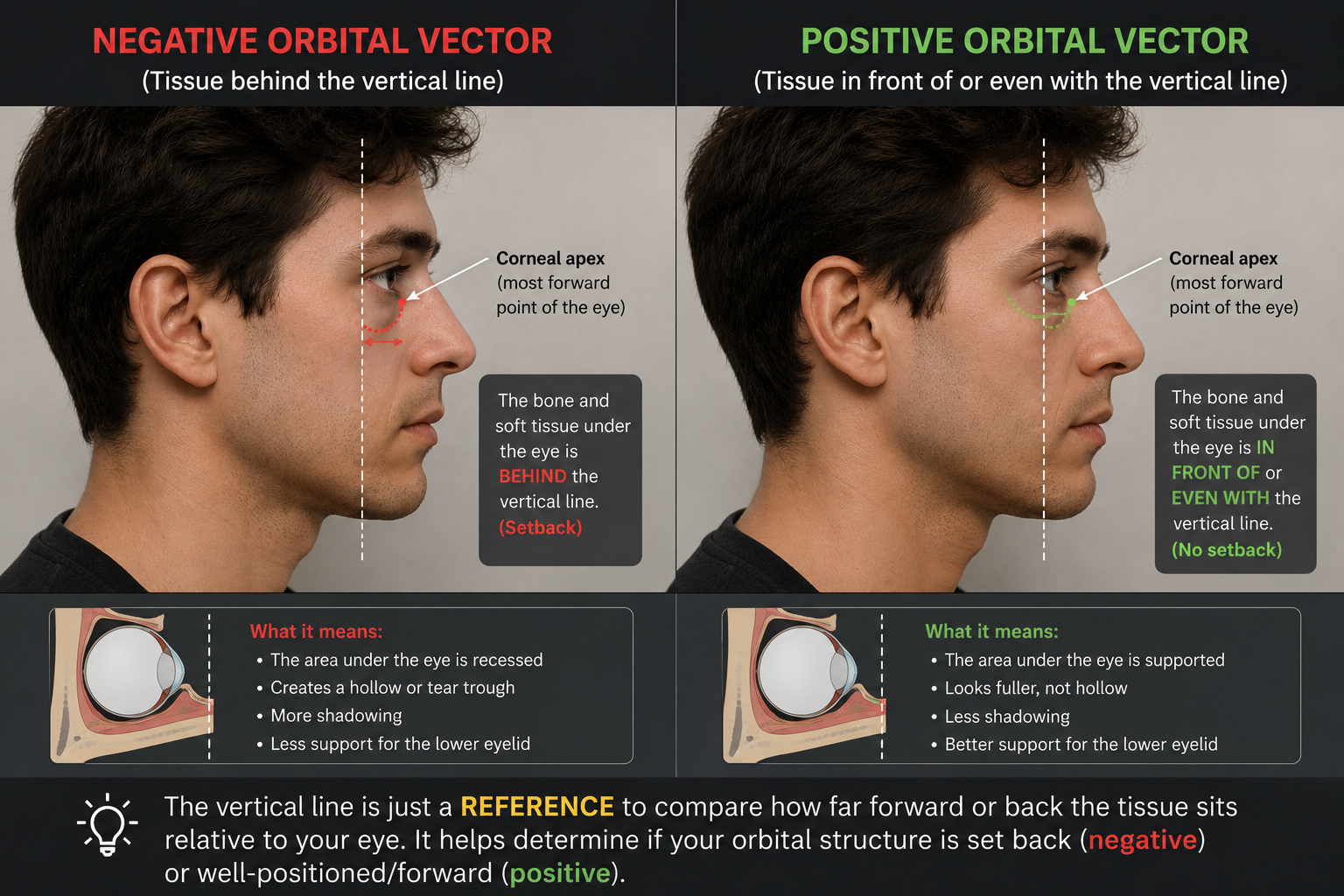
View attachment 5057331

——————————————————————————————

3. THE ORBITAL VECTOR — WHY IT MATTERS MORE THAN YOU THINK

Positive orbital vector means your cheekbone and rim complex sits forward of your eyeball. The lower lid is fully supported, the lid-cheek junction is smooth, the eye looks deep-set and defined. Negative vector means your globe is the most forward structure in that zone as it protrudes past your cheek and rim. The lower lid has nothing to anchor it, eyes look slightly bulgy or round, the midface looks flat and withdrawn.
View attachment 5057372

The reason the vector discussion matters so much beyond just aesthetics. Guys spending money on canthoplasty with an uncorrected negative vector are wasting it. The whole mechanism of canthoplasty is lifting the outer corner of the lower lid and changing the tilt of the eye and that depends on having a stable bony ledge underneath the lower lid to hold the result long term. If that ledge is recessed, the lid migrates back down over months regardless of the quality of the surgical work.

There's also a finding worth knowing about that comes from published morphometric research comparing young and older faces. In younger patients the malar eminence, infraorbital rim, and pyriform aperture are all positioned anteriorly and the orbital aperture is relatively small and compact. In older patients all three of those landmarks have retrused posteriorly, the orbital aperture has expanded in area, and the inferior orbital rim has developed a different curvature pattern. The researchers note that implant designs targeting the skeletally deficient areas of older patients literally match the anatomy of what's been lost over time. This is why implants for the infraorbital rim look so natural when properly placed.

——————————————————————————————

4. THE ANATOMY

The clinical outcomes of everything done in this area like filler, fat grafting, implants are directly determined by understanding these structures. So its better to have a good grasp of things.

The orbicularis retaining ligament (ORL) and the tear trough ligament
The orbicularis retaining ligament is a series of fibrous attachments extending from the inferior orbital rim to the overlying skin. It defines the upper border of the sub-orbicularis oculi fat compartment (SOOF). The medial portion of the ORL is specifically called the tear trough ligament. This structure is what creates much of the tear trough deformity. It physically tethers the skin to the bone, creating a groove that descends as the surrounding tissue loses volume and descends with age. When you squint or frown you can often see the tear trough groove deepen temporarily because the muscular contraction tightens this tethering effect.
View attachment 5057387


The fat compartments that matter the most :
Below the orbicularis muscle sits the SOOF (the sub-orbicularis oculi fat). This compartment is bounded superiorly by the ORL and inferiorly by the zygomatic cutaneous ligament. Below and lateral to that is the deep medial cheek fat compartment which is where the structural cheek volume lives. In the superficial plane above the muscle are the superficial fat compartments the medial cheek fat, nasolabial fat, and a thin preseptal fat layer directly over the lower lid. Understanding which plane you're in during injection determines whether the result looks right or wrong. Filler placed in the wrong fat compartment doesn't just look suboptimal and it migrates in a direction determined by the anatomy of that compartment and can end up in a location that makes things look worse months later.

View attachment 5057396


The vascular danger zones and why this area is high risk
The infraorbital region is supplied by several arterial branches. The angular artery is branch of the facial artery that runs medially across the nasojugal groove and is one of the most commonly injured vessels during tear trough injection. The infraorbital artery exits the infraorbital foramen approximately 3cm lateral to the midline just below the orbital rim. The zygomaticofacial artery runs laterally. All of these sit in a vascular territory that communicates with the ophthalmic artery via the orbital septum. This is why vascular occlusion from filler in this area carries vision risk in a way that injections elsewhere on the face generally don't. The connection to the ophthalmic circulation is real and documented. A 2015 review of the world literature on filler-related blindness by Beleznay et al. identified the glabellar region and nasal area as highest risk.
View attachment 5057438

——————————————————————————————

5. THE THREE CLASSES OF INFRAORBITAL HOLLOWING

The groove is confined to the inner corner area. The rest of the rim still has reasonable support. This is the mildest presentation and it responds well to filler correctly placed. A good injector at the right depth can fix this in one session.

View attachment 5057501

The hollow has deepened and extended outward. Visible under the middle of the eye and sometimes toward the outer corner. Early volume loss in the central cheek becomes visible. Filler still works but placement has to cover multiple zones and single-pass medial technique leaves the lateral area still hollow. You need dual-plane treatment across two or three anatomical subzones.
View attachment 5057508

The hollow wraps around the entire rim. The lid-cheek groove is visible from every angle. This isn't just soft tissue loss anymore as the bone itself is genuinely deficient. Filler cannot build structure here because there's no skeletal platform for it to sit on. It just creates a puffy appearance without correcting the vector or the hollow. Class 3 is implant or fat grafting territory.

View attachment 5057516

——————————————————————————————

6. NON-SURGICAL (COPE)


THIS WHOLE SECTION EXCEPT FOR THE DEXA SCAN AND BODY ARE FOR COPERS WHO ARE AGAINST FILLERS AND HARDMAXES SO DNR THIS IF YOU ARENT ONE


Global Costs

USA:
GHK-Cu serum $20 to $60 per bottle. The Ordinary Buffet + Copper Peptides around $25. Prescription tretinoin via telehealth (Curology, AgelessRx) $20 to $40 per month.

UK:
GHK-Cu £18 to £50. Tretinoin via Dermatica or Skin + Me £20 to £30 per month.

Europe:
€20 to €55. Prescription tretinoin through a derm €30 to €60 per month.


The Full Protocol

Step 1:
Cleanse morning and night with a gentle non-stripping cleanser. The periorbital skin is some of the thinnest on the entire body so anything with high-pH foaming agents or sulfates irritates it and makes the area look worse over time.

Step 2 (Morning):
A few drops of GHK-Cu serum on damp skin around the undereye and midface. Use your ring finger as it naturally applies the least pressure then and tap gently rather than rubbing. Don't drag the skin. This matters more than most people think over months and years of cumulative mechanical stress.

Step 3 (Morning):
SPF 50+ over everything including the undereye. Non-negotiable as UV accelerates collagen breakdown in this region faster than almost anywhere else on the face because the skin here is so thin and has so little protective mass. Long-term sun exposure is one of the factors driving the skeletal resorption pattern in this area.

Step 4 (Evening):
Retinol after cleansing. Start at 0.025% three nights per week. Move to every other night in weeks five through eight. Nightly from week nine. Step up concentration to 0.05% then 0.1% over three to four months. Follow with a light moisturizer to buffer irritation around the periorbital zone.

Key rule:
GHK-Cu and retinol in the same session cancel each other out. GHK-Cu in the morning, retinol at night.

raw GHK-Cu powder:
Buy raw GHK-Cu powder from Peptide Sciences or BoS Research for around $10 to $15 per gram. Dissolve 0.5g into 100ml of water-based hyaluronic acid serum base in a dark glass dropper bottle. That's a 0.5% serum for a fraction of what any brand charges. Dissolves cleanly. Store refrigerated, use within 60 days, date the bottle.

Realistic expectations:
Noticeably better skin quality, thicker skin, reduced shadowing after 12 to 16 weeks of consistency. It is mitigation not correction. Class 1 can see real improvement from topicals. Class 2 and 3 need more than this but topicals are worth running alongside whatever else you're doing.

Cost
Free. DEXA scan $50 to $150 in the US, £30 to £80 in UK, €40 to €100 in Europe, $20 to $40 in Turkey and Thailand.

Why it matters and what to do
The periorbital fat pads are highly sensitive to overall body fat percentage. Drop below 10% body fat and those pads thin out dramatically, making the infraorbital hollow look significantly worse. A lot of guys notice their undereye area looks great at 14% and wrecked when they push down to 8% for summer. There's a sweet spot typically somewhere in the 12 to 17% range where facial fat is preserved without sacrificing overall body composition. It's individual based on genetic facial fat distribution. Get a DEXA scan at your leanest and at a moderate body fat, photograph yourself in consistent lighting at both, and compare. That gives you your actual threshold.

View attachment 5057563

Global Costs

USA:
$20 to $40 per month at 10g daily. BulkSupplements cheapest at $20 to $25.
UK:
£18 to £35. Bulk Powders and MyProtein both carry it.
Europe:
€20 to €40. Bulk Powders ships to most EU countries.


The Protocol

Step 1:
Hydrolyzed Type I and III collagen peptide powder specifically. Not gelatin. Not non-hydrolyzed collagen. The label has to say hydrolyzed collagen peptides or you're not getting the absorption the clinical studies are based on.

Step 2:
10g every morning in hot coffee or tea. Tasteless in most formulations. Dissolves completely in hot liquid.

Step 3:
500mg Vitamin C at the same time. Ascorbic acid is a required enzymatic cofactor in the collagen synthesis pathway. Without adequate circulating Vitamin C the production signal from the peptides can't complete properly. Most people skip this and then wonder why their results are mediocre.

Step 4:
Every single day for minimum 90 days before assessing. Collagen remodeling is slow. Most people see real change between weeks 8 and 16. Sporadic use produces nothing.

Step 5:
Photograph the undereye in the same lighting every four weeks. Subjective mirror assessment doesn't work for slow changes. Objective photos tracked over time are the only accurate way to evaluate this.

——————————————————————————————

7. THE RIGHT FILLER TECHNIQUE

The tear trough is not just volume loss. There's a fibrous structure. The tear trough ligament, the medial portion of the orbicularis retaining ligament is the one that physically tethers the skin to the orbital rim bone at the boundary between the thin eyelid skin and the thicker cheek skin. To lift the groove you need product placed below this structure at the supraperiosteal level so it pushes up against the tethering from underneath. Injectors who deposit product above the ligament in the superficial plane get a lump or ridge sitting on top of the groove without lifting it. That's the most common reason tear trough filler results look bad. The cadaveric study from the University of Pennsylvania published in Aesthetic Surgery Journal in 2023 confirmed that injection just above the periosteum produces the most anatomically precise placement along the orbital rim and critically showed that Restylane-L placed this way stays as a distinct mass along the ORL, while Volbella spreads more freely across anatomical planes due to its lower elastic modulus. This finding has direct implications for which product you use at which depth.

HA filler injected at the supraperiosteal level supports the undereye, reduces hollowing, and moves the orbital vector toward positive. Often combined with lower blepharoplasty when someone needs both structural and skin correction at the same time. The area around the infraorbital rim is highly vascular with multiple arterial branches communicating with the ophthalmic circulation

View attachment 5057605


Global Costs — Both Eyes

USA:
$1,000 to $2,500 total. Per syringe $600 to $1,500. ASPS national average around $684 per syringe.
UK:
£500 to £1,500. Harley Street at the top. Regional UK from £350 to £400 per syringe.
Western Europe:
€600 to €1,400. Spain and Eastern Europe more competitive at €350 to €800.
Turkey (Istanbul):
€250 to €450. Same brand-name filler, 60 to 75% cheaper. Highest ROI destination for this specific procedure.
South Korea (Seoul):
$300 to $600 at Gangnam clinics.
Thailand (Bangkok):
$200 to $500. JCI-accredited clinics only.
Mexico:
$300 to $700. Major cities with board-certified injectors.

——————————————————————————————

7B. DIY UNDEREYE FILLER FULL GUIDE

This covers the DIY approach. The undereye is the highest-risk filler site on the face due to the vascular anatomy described in Section 4. Know the emergency protocol before you start. Have hyaluronidase on hand.


You're a reasonable candidate if:
You have Class 1 or mild Class 2 hollowing. A groove with genuine volume loss but nothing puffy or herniated. Lower eyelid skin is taut when you pinch it gently. No loose or baggy eyelid skin. No bags that are worse in the morning. No bleeding disorders, autoimmune conditions, or active skin infection. You haven't had filler dissolved in this area in the past 8 weeks.

Stop here if:
You have puffy bags or visible fat herniation as filler will make this dramatically worse. Thin eyelid skin where veins are clearly visible. Significant laxity under the eye. Strongly negative orbital vector without structural support as filler will just look puffy without fixing the vector. You've had hyaluronidase used in this area in the last 8 weeks.

The filler
Soft, low G-prime HA filler designed for periorbital use. Do not use thick fillers like Voluma, Radiesse, or dense Juvederm in the tear trough as they lump and migrate. The right products are Restylane-L, Juvederm Volbella, Belotero Balance, and Teosyal Redensity 2. Teosyal Redensity 2 is specifically formulated for periorbital use with lower water-attracting properties to reduce post-injection swelling. You need 1ml maximum for both sides as most sessions use 0.3 to 0.5ml total.

Where to source: Medica Depot, HA-Dermal, DoctorMedica, and similar gray market wholesale suppliers sell Restylane and Teosyal without prescription in many jurisdictions. In Turkey you can walk into Istanbul pharmacies and buy Juvederm or Restylane OTC for $40 to $80 per syringe. Never buy from eBay or AliExpress and counterfeit or improperly cold-chain stored filler is a real infection risk. Established suppliers with documented cold-chain shipping only.


Cannulas
27-gauge blunt cannula, 38mm length. The blunt tip pushes vessels aside rather than puncturing them. Brands: Softfil, TSK Steriglide, FlexFill. Available from Medica Depot or iBeautyMachine for $15 to $40 per box of 20. Fresh cannula per session and per eye as you should never reuse.

Entry needle
25-gauge sharp hypodermic needle to create the entry point hole. Available at any pharmacy.

Numbing
EMLA cream (lidocaine 2.5% plus prilocaine 2.5%) under cling film for 30 minutes. LMX4 also works. Do not use ice as primary numbing as it causes vasoconstriction which makes blood aspiration harder to assess.

Hyaluronidase
The enzyme that dissolves HA filler. Available as Hylenex in the US, Hyalase in UK and Europe, or generic hyaluronidase 1500iu vials. t.

Sterility supplies
Nitrile gloves. Alcohol prep pads (70% isopropyl). Chlorhexidine 2% for skin prep. Gauze pads. Sterile drape or fresh clean towel. Sharps container.

Total cost
Filler syringe $40 to $120. Cannula box $15 to $40. EMLA $10 to $25. Hyaluronidase $30 to $80. Supplies $10 to $20. Total $105 to $285 versus $1,000 to $2,500 professionally.

48 hours before:
Stop blood thinners so no aspirin, ibuprofen, fish oil, vitamin E, or alcohol. OTC supplements and lifestyle only and do not stop prescription blood thinners without speaking to your doctor.

Day of — skin prep:
Wash your face. Remove everything like no makeup, no skincare. Chlorhexidine on a gauze pad wiped from center outward over the injection zone. Follow with alcohol prep pad. Let dry completely. Don't touch the cleaned area with bare hands again.

EMLA application:
Thick layer covering the full undereye zone from inner corner to the outer orbital area. Cover with cling film. Leave minimum 30 minutes. Wipe completely off with alcohol prep pad and let dry fully before proceeding.

Workspace setup:
Large well-lit mirror. Daylight or bright white LED pointed at your face. All supplies within reach. Nitrile gloves on. Filler syringe open with hub attached. Cannula on sterile surface. Hyaluronidase immediately accessible and know exactly where it is and how to draw it up before touching anything.

Step 1 — Mark your anatomy
White eyeliner pencil only and not a dark marker. Mark the lowest point of your tear trough groove in good lighting. Mark your entry point: 15 to 20mm directly below the outer edge of your iris (lateral limbus) on the cheek. This location keeps your cannula path away from the infraorbital foramen and the angular artery as you travel medially. Wipe the marks off with an alcohol pad before injecting also never inject through skin with marker on it.
View attachment 5057828


Step 2 — Create entry point
Stretch the skin at the entry point with your non-dominant hand. 25-gauge sharp needle, firm puncture at 45 to 90 degrees. One clean puncture. Entry point on the cheek, not the lower eyelid. Small drop of blood is fine but wipe with alcohol pad.

View attachment 5057856


Step 3 — Insert cannula
27-gauge blunt cannula attached to filler syringe. Stretch entry point skin to keep the hole open. Insert at 30 to 45 degrees then flatten the angle to nearly parallel with the skin surface. Travel supraperiosteally and just above bone. You feel slight resistance through the orbicularis and a give as you enter the sub-orbicularis plane. Cannula scraping against bone means you're at the right depth. Advance slowly toward the inner corner of the eye, below the tear trough groove.
View attachment 5058166


Step 4 — Aspirate first
Before releasing any product, pull the plunger back. Blood in the syringe means you're in a vessel. Withdraw immediately, apply pressure for 2 minutes, don't inject from that entry point again. Move to the other eye and return with a fresh cannula from a slightly different entry location.
View attachment 5058179


Step 5 — Retrograde linear threading
Cannula at its deepest point medially near the inner corner. Begin slowly pressing the plunger while simultaneously withdrawing at a steady even pace toward the entry point. Product deposits as a thin continuous thread as you withdraw. Even pressure, smooth withdrawal with thin column along the rim, not a blob. Volume per pass: 0.1 to 0.2ml max. Start with 0.1ml and assess before adding more.
View attachment 5058325


Step 6 — Lateral fan if needed (Class 2 only)
If hollow extends laterally past mid-pupil, readvance from same entry point angled slightly outward. Second retrograde pass covering the lateral area. Use less here like 0.05 to 0.1ml. Maximum two passes from one entry point.

Step 7 — Assess and massage
Remove cannula. Gentle pressure on entry point for 30 seconds. Sit upright and look in natural light. Any lumps felt then gentle circular massage with clean finger. Check specifically for skin blanching anywhere for white patches that don't resolve in 30 seconds mean possible vascular compression.
Wait 5 minutes and reassess the first side before moving to the other eye.

Step 8 — Other eye
Fresh cannula. New entry point same location on the other side. Match volume exactly to what you used on the first side. Always err toward less so you can add at 2 weeks, you cannot easily remove immediately.

Step 9 — Aftercare
Cold compress (wrapped, not bare ice) for 10 minutes. No makeup for 24 hours. No alcohol, exercise, or heat for 48 hours. Sleep slightly elevated the first night. Don't massage after the first hour. Expect some swelling and possible mild bruising for 2 to 5 days. Final result at 2 weeks around is noticed.

Most DIY attempts go wrong because people use too much. This area needs far less product than anywhere else on the face. Overfilling creates a puffy pillow look that sits there for months and requires hyaluronidase to fix.

Session 1:
0.1ml per side. Total 0.2ml. Test session. You will probably not see a dramatic result. Assess at 2 weeks.

Session 2 (minimum 2 weeks later):
Add up to 0.15ml per side if genuinely needed. Cumulative max after two sessions: 0.25ml per side.

ceiling:
Never exceed 0.3ml per side total across all DIY sessions. If your hollowing needs more than that, the problem is structural.

vascular occlusion:
Signs: skin blanching white that doesn't resolve in 30 seconds, skin going mottled or grey or purple, severe pain out of proportion to the procedure, any change in vision including blurring or darkening. If any of these happen: stop injecting. Inject hyaluronidase immediately into the affected area then reconstitute 1500iu vial with 2ml saline for 750iu/ml, inject 0.2ml (150 units) directly into the blanched zone and surrounding tissue. Apply warm compress then Take 325mg aspirin.

Tyndall effect (blue discoloration):
Filler placed too superficially. Not dangerous but looks bad. Hyaluronidase 15 to 30 units injected directly into the blue zone in small aliquots. Resolves within 24 to 48 hours.

Persistent lump:
Wait 2 weeks as most resolve with swelling. Persistent lump at 2 weeks gets hyaluronidase 15 units per side directly into it. Reassess at 48 hours.

Full dissolution protocol:
Reconstitute 1500iu hyaluronidase with 2ml bacteriostatic saline giving 750iu/ml. Draw up appropriate volume in insulin syringe. Inject small amounts (0.02 to 0.05ml per puncture) directly into the filler deposit across multiple punctures. For full dissolution of undereye filler: 15 to 75 units per side. Results in 24 to 48 hours. Wait minimum 4 weeks before re-injecting as residual hyaluronidase can break down freshly placed filler if you go back too soon.

——————————————————————————————

8. INFRAORBITAL RIM IMPLANTS COSTS

Solid silicone implants placed directly on the infraorbital rim bone. The most direct structural correction available for undereye hollowing and a negative orbital vector as you are physically augmenting the bony architecture, not masking the problem with volume. Unlike filler which is temporary and only addresses soft tissue, implants permanently correct the vector. They're typically combined with lower blepharoplasty for the best full eye area result.


Off-the-shelf implant designs are not inferior to custom implants for most people. The Flowers infraorbital rim implant is a well-established design with a long clinical track record and it's appropriate for the majority of symmetric cases. Custom implants are specifically for patients with significant asymmetry between sides or unusual anatomy that a standard design can't accommodate. The push toward custom-only is partly surgeon preference and partly commercial as custom implants cost significantly more and have higher margin.


Global Costs

USA:
$6,000 to $15,000. Flowers off-the-shelf designs at the lower end. Custom CT-derived implants from Eppley, Taban, Isaacs at $8,000 to $15,000+.
UK:
£5,000 to £9,000. Surgeons with specific experience in this procedure are rare outside London.
Western Europe:
€5,000 to €10,000. Belgium, Netherlands, Germany, Spain have experienced craniofacial surgeons doing this.
Turkey (Istanbul):
$3,000 to $6,000 all-in with hotel and transfers. Verify that the specific surgeon has done infraorbital rim implants specifically — not just cheek or chin work.
South Korea (Seoul):
$4,000 to $8,000. Often combined with canthoplasty and lower bleph as a full eye area package. VAT refund 7 to 8% at airport for foreign patients.
Thailand (Bangkok):
$3,500 to $7,000 at JCI hospitals.
Mexico:
$3,000 to $6,000. Mexico City and Monterrey over Tijuana for this level of work.

——————————————————————————————


9. MIDFACE MASK IMPLANT


Reference thread on this: The Holy Grail of Facial Aesthetics — How to Simulate Lefort III Results with the Midface Mask Implant


The custom midface mask implant covers the entire upper midface skeleton which is from the infraorbital rims down to just above the upper teeth. Think of it as a single unified implant that simultaneously augments all of the following : the infraorbital rims, the malar eminences (cheekbones), the paranasal region (the area around the base of the nose), and the anterior maxilla. That coverage is why it's called a mask. the footprint literally looks like the upper portion of a face mask on 3D imaging.

View attachment 5058644

The effect is described in the surgical literature as Lefort III-like but without the occlusal movement. Meaning it pulls the entire midfacial skeleton forward in one coordinated augmentation, mimicking the aesthetic outcome of a full midface advancement osteotomy without actually cutting and moving bone. The infraorbital rims project forward correcting the negative vector, the cheeks project forward, the paranasal area fills out, the entire midface depth and width changes. For someone with true generalized midface hypoplasia this is the procedure that actually addresses the whole problem rather than chasing individual zones with separate implants.

Because the infraorbital nerve passes through the infraorbital foramen in the middle of this zone, the implant is designed as three pieces: bilateral infraorbital-malar segments and a lower maxillary segment that crosses under the nasal base. Each piece is designed around the nerve pathway to prevent compression. When properly placed there should be no permanent nerve damage, though patients should expect some temporary numbness of the upper lip and side of the nose from nerve stretching during implant seating which recovers fully.

The limitation with doing a cheek implant here and a separate infraorbital rim implant there and a separate pyriform implant somewhere else is that you get disjointed augmentation with visible transitions between the zones. Each implant has edges. Where one implant ends and another begins there's a potential step-off or contour irregularity that shows through the overlying soft tissue. The more implants you stack the more complex the revision situation if anything needs to be adjusted.
View attachment 5062790

The midface mask implant solves this by creating one continuous augmentation surface across all zones simultaneously. The transitions between the infraorbital rim, malar eminence, and paranasal regions are built into the implant design itself and are smooth by design rather than approximated by placement of separate pieces. The clinical result looks more natural and cohesive because it is more natural and it follows the actual anatomy of the midfacial skeleton as a unified structure rather than addressing it as isolated landmarks.

There's also a case documented in the surgical literature specifically for patients who had a Le Fort I osteotomy that moved the lower maxilla but left the upper midface consisting of the infraorbital rims and zygomaticomalar complex untouched and still recessed. This is a known limitation of Le Fort I: it addresses the occlusal level but doesn't move the infraorbital rim. A custom infraorbital-maxillary-malar implant placed after a Le Fort I creates what surgeons describe as a modified Le Fort III effect as both the lower and upper midface are now addressed, combining what surgery did with what the implant adds.

The midface mask implant is appropriate for someone with true generalized midface hypoplasia and not just undereye hollows, not just flat cheeks, but the full midface complex being recessed including the infraorbital rims, malar eminences, and paranasal area. If you look at your profile and everything from your lower eyelid to your upper lip sits behind the plane of your nose tip and forehead, you are probably in this category. If only specific zones are deficient, targeted implants or filler are more appropriate.


The procedure is not appropriate if your occlusion needs to change and if you have a malocclusion that needs orthognathic surgery, that needs to be addressed before or simultaneously with any midface implant work, not replaced by it. The midface mask implant advances the skeletal contour without moving the teeth or changing the bite. If the bite is off, that's a separate problem requiring orthognathic surgery.

Cost
$6,000 to $15,000 depending on surgeon and whether it is standalone or combined with other procedures. For context: a Le Fort II or III osteotomy runs $30,000 to $60,000 and is practically inaccessible for purely aesthetic indications. The midface mask implant achieves a comparable aesthetic effect at 20 to 50% of that cost. This is one of the best cost-to-outcome ratios in all of facial surgery for the right candidate.


Where to find surgeons who specifically do this
Dr. Barry Eppley at Eppley Custom Facial Implants in Indianapolis is the most documented surgeon in the English-language literature for this specific procedure. His case studies are publicly available on exploreplasticsurgery.com and document outcomes across multiple patient types including men with generalized midface hypoplasia. In Europe, craniofacial units in Belgium and the Netherlands have surgeons experienced with comprehensive midface implant design. In South Korea the Gangnam complex surgery market has surgeons comfortable with multi-zone midface implants. As with the infraorbital rim implant, verify specifically that the surgeon has documented experience with full-coverage midface mask implants — not just cheek or malar implants in isolation.

his website : eppleyplasticsurgery.com

——————————————————————————————

10. LE FORT OSTEOTOMY — WHEN AND WHY

The Le Fort osteotomies are the actual skeletal solution for severe midface recession. Le Fort I moves the maxilla at the occlusal level and changes the teeth and lower midface position but critically does not move the infraorbital rims, which is why it often leaves the upper midface still recessed after surgery. Le Fort III moves the entire midface including the orbital rims forward and is the most complete correction available.
View attachment 5062824


Global Costs

USA:
$20,000 to $40,000 for Le Fort I. Modified Le Fort III $30,000 to $60,000+ at major craniofacial centers.
UK:
£12,000 to £25,000 private. NHS may cover with functional indication.
Western Europe:
€10,000 to €25,000. Spain and Eastern Europe more competitive at €10,000 to €15,000.
Turkey (Istanbul):
$6,500 to $12,000 at accredited hospitals.
South Korea (Seoul):
$8,000 to $18,000. Korea performs among the highest annual volume of orthognathic surgery globally.
Thailand (Bangkok):
$9,500 to $15,000 at JCI hospitals.
Mexico:
$8,000 to $15,000. Mexico City university-affiliated maxillofacial departments.


The Le Fort I Limitation and Why Many Patients Need More
Le Fort I advancement moves the lower midface consisting of teeth, lower cheeks, nose but it does not move the infraorbital rims. In patients where the midface deficiency extends all the way up to include the orbital rims, a Le Fort I leaves the upper midface still recessed after surgery. The patient sees improvement in their bite and lower face but still has a negative orbital vector and hollow undereyes. Opting for a LE FORT III is best here.
View attachment 5062819


——————————————————————————————

11. SURGEON TIERLIST

The surgeons listed here are the ones with documented, verifiable track records specifically for this procedure and not general plastic surgeons who have done one or two of these, but specialists who have built a reputation specifically around periorbital and midface skeletal surgery. Tierlists cover surgeons globally, then clinics by country, then countries overall.


Ranked specifically on documented case volume, technical specificity for this procedure, published research contribution, and real patient outcome track record. Not on general reputation as a plastic surgeon.

S TIER — The absolute best, would travel anywhere for these

Dr. Barry Eppley
Location:
Eppley Plastic Surgery, 12188-A North Meridian St Suite 310, Carmel (Indianapolis), Indiana, USA
Website:
eppleyplasticsurgery.com and eppleycustomfacialimplants.com
Approximate cost:
Infraorbital rim implants (combined infraorbital-malar) around $6,500. Midface mask implant $8,000 to $12,000. Custom jaw, cheek, full facial packages vary. Virtual consultation available.
Why S tier:
Eppley is probably the single most documented surgeon in the English-language literature for custom facial implants including infraorbital rim, midface mask, and combined periorbital work. His blog at exploreplasticsurgery.com contains hundreds of case studies with full before/after documentation across every facial zone. He developed the semi-custom infraorbital-malar implant approach and has the deepest public case archive of anyone doing this procedure. He uses titanium micro-screw fixation for long-term positional stability. His pricing is also significantly lower than the Beverly Hills surgeons doing comparable work.
In his own words on infraorbital implants vs fillers:
"In the treatment of infraorbital rim deficiency, the three treatments are synthetic injectable fillers, injected fat and implants. Each has their own advantages and disadvantages. But none of them are perfect nor is one method best for all patients. Each case must be considered separately and the magnitude of the defect considered in the treatment selection." He also notes that fillers should be used as a trial method first to assess whether soft tissue volumization gives the desired effect before committing to implants.
On custom vs off-the-shelf:
"A semi-custom approach allows me to select an infraorbital-malar implant from a variety of custom ones that have been made for other patients. Given the shape of this area of the facial skeleton a semi-custom implant can be a more cost-effective method that fits fairly well." Worth knowing that he actually offers this more affordable semi-custom option for appropriate cases.

Dr. Mehryar (Ray) Taban
Location:
9735 Wilshire Blvd Suite 319, Beverly Hills, CA 90212, USA. Also Santa Barbara.
Website:
tabanmd.com — Phone: (310) 278-1836
Approximate cost:
Infraorbital rim implants $8,000 to $15,000 depending on complexity and whether combined with canthoplasty, blepharoplasty, or orbital decompression. Full periorbital transformation packages can run higher.
Why S tier:
Taban is double board-certified by ASOPRS (American Society of Oculofacial Plastic and Reconstructive Surgery) and the American Board of Ophthalmology, and is also an Assistant Clinical Professor at UCLA. He is the go-to surgeon for complex periorbital work that combines infraorbital rim implants with canthoplasty, lower eyelid retraction repair, and orbital decompression in a single operation. His patient gallery at tabanmd.com contains an extensive archive of before/after cases documenting vector correction and eye shape transformation. He uses the transconjunctival approach with suture fixation rather than screws, preferring to avoid metal hardware near the orbit. His specific expertise in oculoplastic surgery means he understands the lower eyelid mechanics in a way that most plastic surgeons simply don't.
On what he actually does for negative vector patients:
His documented approach for negative vector patients often combines infraorbital rim implant placement with lower eyelid retraction correction and canthoplasty in a single operative session by addressing the bone, the lid position, and the canthal angle simultaneously. This is significantly more ambitious than what most surgeons offer and is appropriate for patients whose eye area problems involve all three components.
Real patient review (documented on RealSelf):
One patient with extensive knowledge of maxillofacial surgery wrote: "When it comes to the periorbital region he IS the best in the world. Through canthoplasty, tear trough implants on the orbital rim, lower lid retraction, orbital decompression, and slight lowering of the upper eyelid, I now have hooded eyes, a sweeping effect, a high lateral canthus position, and a lower lid so high it likely won't descend for decades."

A TIER — Elite surgeons, genuinely excellent, specific strengths noted

Dr. Michael Yaremchuk
Location:
Massachusetts General Hospital, Division of Plastic Surgery, Boston, MA, USA
Website:
dryaremchuk.com
Approximate cost:
$10,000 to $18,000 for infraorbital rim and midface implant work. As a Harvard-affiliated craniofacial surgeon the pricing reflects his academic institution and elite reputation.
Why A tier:
Yaremchuk is the academic foundation of this entire field. He literally wrote the original peer-reviewed paper on infraorbital rim augmentation published in Plastic and Reconstructive Surgery in 2001 which is still cited in almost every academic article on this procedure. He also designed specific implants for this procedure. His clinical background is craniofacial surgery at one of the top hospitals in the world. His research on how the aging facial skeleton changes the orbital vector relationship is the most cited work in this space. The reason he's A rather than S is purely accessibility as academic hospital pricing is steep, his focus is broader than just aesthetic cases, and he's harder to get to.
In his own published research:
"In patients with recessive infraorbital rims, alloplastic augmentation of the infraorbital rims makes the eyes appear less prominent and improves appearance. Augmentation of the infraorbital rim and resuspension of the cheek soft tissues can have a rejuvenating effect in properly selected patients." His 3D reconstructions comparing youthful and aged orbits shows how an infraorbital rim implant placed on the aged skeletal anatomy transforms it back toward the youthful contour are the clearest visual demonstration of what this procedure actually achieves.
Real patient quote:
"I had an under the eye problem and the only solution I thought there was, was cheek implants. Instead with his orbital rim implant he fixed the problem perfectly. In terms of surgical skill and experience, Dr. Yaremchuk is pretty much as good as it gets."

Dr. David Isaacs
Location:
Beverly Hills, CA, USA
Website:
drdavidisaacs.com
Approximate cost:
$10,000 to $15,000 for infraorbital rim implants. Uses 3D Accuscan imaging for custom implant design.
Why A tier:
Dual-fellowship trained oculofacial plastic surgeon in Beverly Hills who specifically markets and documents infraorbital rim implant work. Uses a transconjunctival approach and custom 3D Accuscan imaging to ensure implant fit. Strong documented case gallery. Appropriate for patients who want a Beverly Hills-based alternative to Taban with similar oculoplastic training background. His stated approach on fitting is that the procedure should always be anchored securely while blending naturally with facial contours, and that careful technique avoids overcorrection while preserving the natural lower eyelid to cheek transition.

B TIER — Solid options, less documented but legitimate

Korean Gangnam Oculoplastic Surgeons (as a group)
Location:
Gangnam and Apgujeong districts, Seoul, South Korea
Approximate cost:
$4,000 to $8,000 for infraorbital rim implants. $920 to $1,530 for undereye fat grafting. Often packaged with canthoplasty and lower blepharoplasty.
Why B tier:
Korean surgeons as a group represent excellent value and high volume, particularly for canthoplasty, lower blepharoplasty, and combined eye area transformation packages that include infraorbital rim work. The sheer case volume in Seoul means technique refinement that's genuinely hard to match elsewhere. The reason they're B rather than A as a group is variability as you need to research the specific surgeon rather than just the clinic, the anesthesiologist issue is real (verify presence before booking), and the documented English-language case literature for this specific procedure is less accessible than the US surgeons. The best Korean surgeons doing this work are at the same technical level as S tier but the challenge is identifying them.

Istanbul Craniofacial Surgeons (JCI-accredited hospitals)
Location:
Acibadem, Memorial Hospital Group, Medipol Mega, Liv Hospital, Istanbul, Turkey
Approximate cost:
$3,000 to $6,000 for infraorbital rim implants all-in. $1,450 to $2,900 for fat grafting.
Why B tier:
Turkey has the best cost-to-outcome ratio globally for this procedure when you find the right surgeon. The infrastructure at JCI hospitals is genuinely high quality, ISAPS-certified surgeons in Istanbul are operating at a legitimate international standard, and the all-inclusive packages make the logistics straightforward. The B tier placement reflects the same variability issue as Korea as surgeon-specific due diligence is essential, and the English-language documentation of individual surgeon case archives is harder to evaluate than the US names listed above.

C TIER — Proceed with extreme caution or avoid for this specific procedure

General plastic surgeons without specific infraorbital rim implant experience, regardless of their general reputation. The procedure is technically demanding enough and rare enough that a surgeon who does it once or twice a year and otherwise sticks to rhinoplasties and breast work is not an appropriate choice.

S TIER COUNTRIES for this specific procedure

USA (specifically Indianapolis and Beverly Hills)
Home to the most documented and accessible specialists for infraorbital rim and midface implants globally. Eppley in Indianapolis gives you the most documented case archive and competitive pricing for the US market. Beverly Hills gives you Taban and Isaacs with the deepest oculoplastic expertise. The US is S tier not because it's cheapest as it clearly isn't nigga :feelswhy: but because the surgeon-specific documentation and research output here is the most accessible for doing pre-operative due diligence, and the legal/medical infrastructure for complications and revision is the most robust.

A TIER COUNTRIES

South Korea (Seoul — Gangnam/Apgujeong)
Best in the world for combined eye area transformation packages, fat grafting, and any procedure that combines periorbital structural work with canthoplasty and blepharoplasty. Case volume is unmatched globally. The challenge is verification When you find the right surgeon the outcomes here are comparable to the best in the world at 40 to 60% of US pricing.

Turkey (Istanbul — JCI hospitals)
Best value globally for filler, fat grafting, and implant work when you vet properly. The cost savings versus the US and UK are dramatic. The due diligence process described in Section 12 is non-negotiable though as the variation between top-tier and mid-tier providers in Istanbul is significant.

B TIER COUNTRIES

Western Europe (Belgium, Netherlands, Spain — Barcelona/Madrid)
Strong craniofacial surgery scenes in Belgium and the Netherlands specifically. Spain has experienced surgeons in Barcelona and Madrid who do periorbital and midface implant work. Pricing sits between Turkey and the US. Good option for European patients who don't want to travel to Turkey or Korea.

UK (London specifically)
Strong regulatory framework and high-quality surgeons in London. The issue for this specific procedure is the same as everywhere but surgeons with documented specific experience in infraorbital rim implants are rare. Outside London the landscape thins out considerably. Pricing is high for what you get relative to Istanbul or Seoul. Better for filler and blepharoplasty than for complex implant work.

Thailand (Bangkok — JCI hospitals)
Strong for fat grafting and combined lower eyelid work at JCI hospitals. The specific infraorbital rim implant expertise is thinner here than in Korea or Turkey. Good value for procedures in the less specialized range like filler, fat grafting, blepharoplasty. Bumrungrad in particular has internationally trained surgeons who are genuinely excellent. For implant work specifically, less reliable than Seoul or Istanbul.

C TIER COUNTRIES — Use with heavy caution for this procedure

Mexico (Tijuana specifically), Eastern Europe outside major medical centers, and anywhere where infrastructure for managing complex periorbital complications is not immediately accessible. This isn't about general surgical quality and it's about the specific requirement that if something goes wrong with an infraorbital rim implant near the globe, you need to be in a facility that can manage it immediately. Mexico City and Monterrey are a different story and sit closer to B tier.

The surgeon tierlist above is primarily for implant and surgical procedures. For filler specifically, the calculus is somewhat different because the skill is in injection technique rather than operative surgical training, and the reversibility with hyaluronidase means mistakes are less catastrophic than with surgery.

Best market for filler value:
Istanbul. Same brand-name product, 60 to 75% cheaper, experienced injectors who do high volume. Single best destination for filler purely on cost and quality balance or you could just go DIY.

Best market for technique:
Seoul. The periorbital filler technique refinement in Gangnam clinics, including emerging ultrasound-guided tear trough work, is as advanced as anywhere globally.

What to look for in any injector anywhere:
They use a blunt cannula not a sharp needle in the tear trough. They can describe their entry point, injection plane, and product selection specifically. They have before/after photos of tear trough cases specifically not just general filler work.

——————————————————————————————

12. SCIENCE BACKING AND SOURCES

Everything in this guide is sourced from published research, peer-reviewed clinical literature, or documented surgical case studies. Links below.

Anatomy and Aging
PubMed — Infraorbital Rim Augmentation in Orthognathic Surgery (Le Fort I limitation documentation)
Aesthetic Plastic Surgery — Decoding Periorbital Aging: Multilayered Analysis (2025 — orbital cavity expansion with bone resorption, globe volume decrease)
ScienceDirect — Facial Bone Aging: An Update and Literature Review 2020-2023 (region-specific bone loss affecting orbital rims and maxilla)
Aesthetic Surgery Journal — Infraorbital Hollow Rejuvenation: Contributions of Midface Volumization (ORL anatomy, vascular supply, etiology)


Filler Technique and Anatomy
PMC — Cadaveric Evaluation of Filler Behavior in Tear Trough (University of Pennsylvania, 2023 — Volbella spreads across planes, Restylane-L stays as distinct mass at ORL)
PMC — Anatomical Filler Injection Techniques: Infraorbital Groove and Hollowness
PMC — Tear Trough Filler Using Three-Point Tangent Technique: Lessons from 1452 Applications (2023)
PMC — Bridging the Gap: Alternative Injection Strategy for Medial Infraorbital Region (lateral entry point, ultrasound-guided approach)
MDPI — Anatomical-Based Filler Injection: Infraorbital Groove and Hollowness (2025 — tear trough ligament vs fibrotic connective tissue debate)
PubMed — HA Filler Effectiveness for Periorbital Region


Implants and Surgical Correction
PMC — Improvement of Infraorbital Rim Contour (Medpor vs alternative materials, surgical technique documentation)
Explore Plastic Surgery — Custom Midface Mask Implant Case Study (Eppley — three-piece design, Le Fort III-like effect)
Explore Plastic Surgery — The Midface Mask Implant for Aesthetic Augmentation (full design description and indication criteria)
Explore Plastic Surgery — Custom IMM Implant After Le Fort I Osteotomy (the Le Fort I leaves upper midface behind — implant completes it)
Explore Plastic Surgery — Negative Orbital Vector and Custom Infraorbital Implants: Case Study


Related Reading from org
The Eye Area Manual — comprehensive breakdown of the full eye area

——————————————————————————————


AI was used to fix grammatical errors
That's a good job, my friend. How long did it take you to finish it?:(ditto):
 
  • Love it
  • +1
Reactions: kdev and Navity
THE ONLY INFRAORBITAL GUIDE YOU'LL EVER NEED

——————————————————————————————


This thread has been in the works for a while.

The infraorbital rim, what it actually does, why it's responsible for many eye area problems, and every single option available to fix it. Everything in this guide is sourced from published research, clinical case studies, and real surgical documentation.


Related reading: The Eye Area Manual and The Holy Grail of Facial Aesthetics — How to Simulate Lefort III Results with the Midface Mask Implant


——————————————————————————————


TABLE OF CONTENTS


1. What the Infraorbital Rim Actually Is

2. How To Tell If Yours Is Deficient

3. The Orbital Vector and Why It Matters More Than You Think

4. The Anatomy Explained Properly - Ligaments, Fat Compartments, and Vascular Zones

5. The Three Classes of Infraorbital Hollowing

6. Non-Surgical Options

7. The Right Filler Technique

7B. DIY Undereye Filler

8. Infraorbital Rim Implants With Costs

9. Midface Mask Implant

10. Le Fort Osteotomy


11. Surgeon Tierlist and Recommendations

12. Science Backing and Sources


——————————————————————————————

1. WHAT THE INFRAORBITAL RIM IS

The infraorbital rim is a ledge of bone sitting directly beneath your eye socket. It's the bottom border of the orbit and it's the foundation that everything else sits on. Your fat pads, your lower eyelid, your skin rests here. When this bone projects well, all that tissue is properly supported and your undereye looks smooth, full, and defined. When it's recessed or underdeveloped, the tissue has nothing to rest on. It descends. You get hollows, shadow, and that wrecked permanently tired look no matter how much sleep you're getting. Because it's not sleep causing it. It's bone.

Here is a comparison of Bad vs Good infras

View attachment 5057276View attachment 5057277

Here's the number that puts it in perspective. On average the infraorbital rim sits about 3mm behind the surface of your cornea. Your brow bone at the top sits about 10mm in front of the cornea. That 13mm gap between upper and lower bony projection is what creates the deep-set look. When your infraorbital rim retrudes further back than average may it be whether from genetics or from the bone loss that happens as you age. Your globe looks relatively more prominent, the lower lid loses its anchor, and the whole undereye area looks sunken
View attachment 5057288

There's a research finding published in Aesthetic Plastic Surgery by Pessa et al. and separately confirmed in a 2025 multilayered periorbital aging analysis in Aesthetic Plastic Surgery journal showing that orbital cavity volume actually expands with age as the bone resorbs. The globe itself gets slightly smaller too. Both changes together create the sunken, enophthalmic look that older men develop hence the hollow orbit and shadowed undereye.

——————————————————————————————

2. HOW TO TELL IF YOURS IS DEFICIENT


Take a side photo or look at your face in true lateral view. Drop an imaginary vertical line straight down from the most forward point of your eyeball, what's called the corneal apex. If the bone and soft tissue under your eye sits clearly behind that line, you have a negative orbital vector. The clinical literature consistently uses this as the primary diagnostic criterion. The further behind that vertical plane your rim sits, the more deficient it is.
View attachment 5057307


The fat herniation test
Look directly upward in a mirror. If any bags or puffiness under your eyes get worse when you look up, that's herniated orbital fat pushing forward. Filler does not fix this. Filler in a herniated eye will make it look worse. That case needs lower blepharoplasty with fat repositioning.
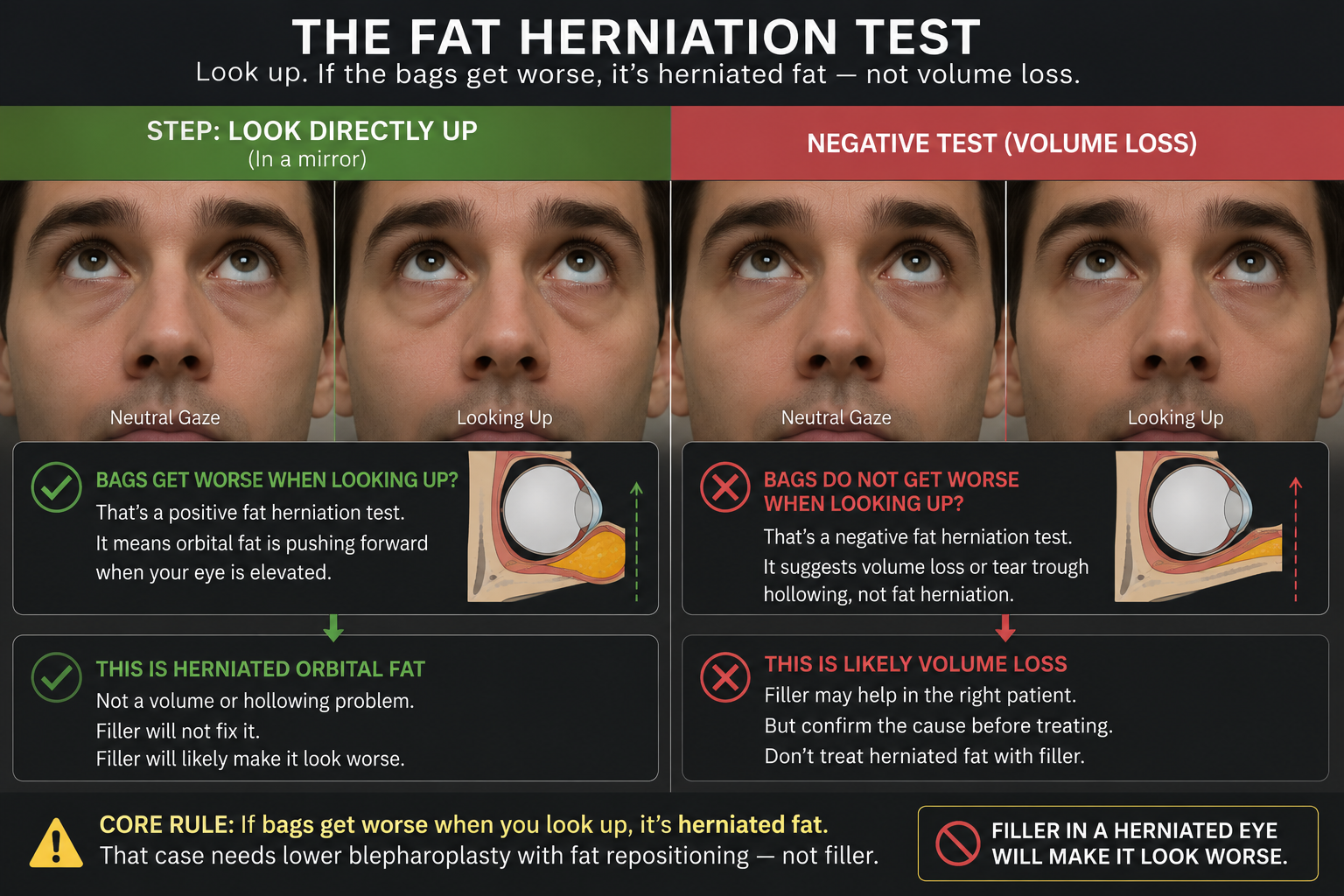
View attachment 5057309


The malar mound test
Press upward gently on your cheekbone just under the eye. If a visible mound or puffiness appears underneath rather than the hollow improving, you have malar mound tendency. Adding filler in this setting makes the mound worse. This is a known complication of undereye filler in the wrong candidate. It's well-documented in the clinical literature and it's almost impossible to fully reverse without hyaluronidase.
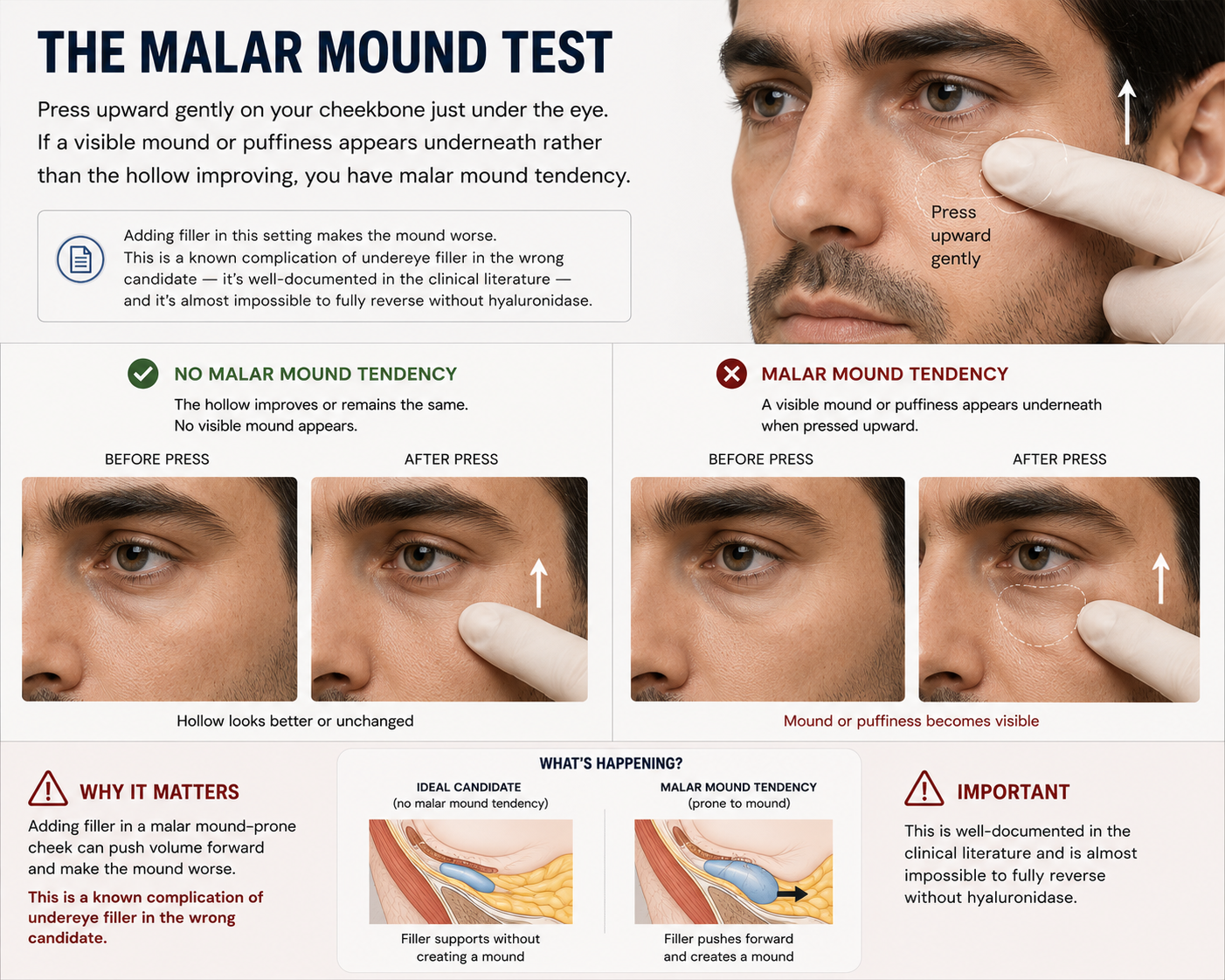
View attachment 5057331

——————————————————————————————

3. THE ORBITAL VECTOR — WHY IT MATTERS MORE THAN YOU THINK

Positive orbital vector means your cheekbone and rim complex sits forward of your eyeball. The lower lid is fully supported, the lid-cheek junction is smooth, the eye looks deep-set and defined. Negative vector means your globe is the most forward structure in that zone as it protrudes past your cheek and rim. The lower lid has nothing to anchor it, eyes look slightly bulgy or round, the midface looks flat and withdrawn.
View attachment 5057372

The reason the vector discussion matters so much beyond just aesthetics. Guys spending money on canthoplasty with an uncorrected negative vector are wasting it. The whole mechanism of canthoplasty is lifting the outer corner of the lower lid and changing the tilt of the eye and that depends on having a stable bony ledge underneath the lower lid to hold the result long term. If that ledge is recessed, the lid migrates back down over months regardless of the quality of the surgical work.

There's also a finding worth knowing about that comes from published morphometric research comparing young and older faces. In younger patients the malar eminence, infraorbital rim, and pyriform aperture are all positioned anteriorly and the orbital aperture is relatively small and compact. In older patients all three of those landmarks have retrused posteriorly, the orbital aperture has expanded in area, and the inferior orbital rim has developed a different curvature pattern. The researchers note that implant designs targeting the skeletally deficient areas of older patients literally match the anatomy of what's been lost over time. This is why implants for the infraorbital rim look so natural when properly placed.
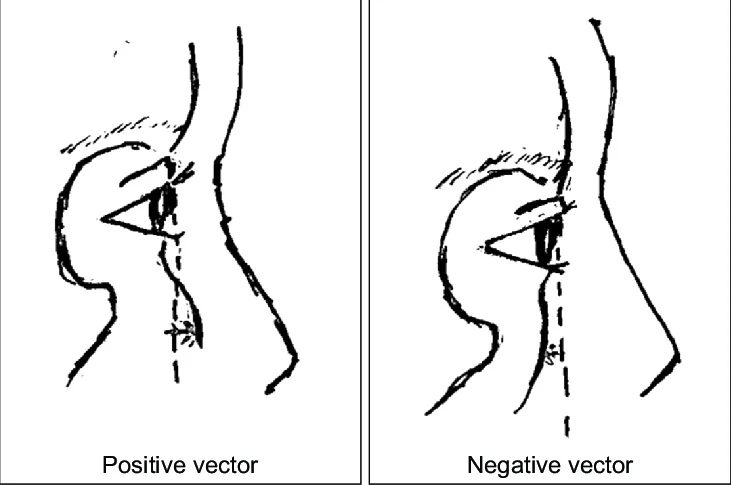
——————————————————————————————

4. THE ANATOMY

The clinical outcomes of everything done in this area like filler, fat grafting, implants are directly determined by understanding these structures. So its better to have a good grasp of things.

The orbicularis retaining ligament (ORL) and the tear trough ligament
The orbicularis retaining ligament is a series of fibrous attachments extending from the inferior orbital rim to the overlying skin. It defines the upper border of the sub-orbicularis oculi fat compartment (SOOF). The medial portion of the ORL is specifically called the tear trough ligament. This structure is what creates much of the tear trough deformity. It physically tethers the skin to the bone, creating a groove that descends as the surrounding tissue loses volume and descends with age. When you squint or frown you can often see the tear trough groove deepen temporarily because the muscular contraction tightens this tethering effect.
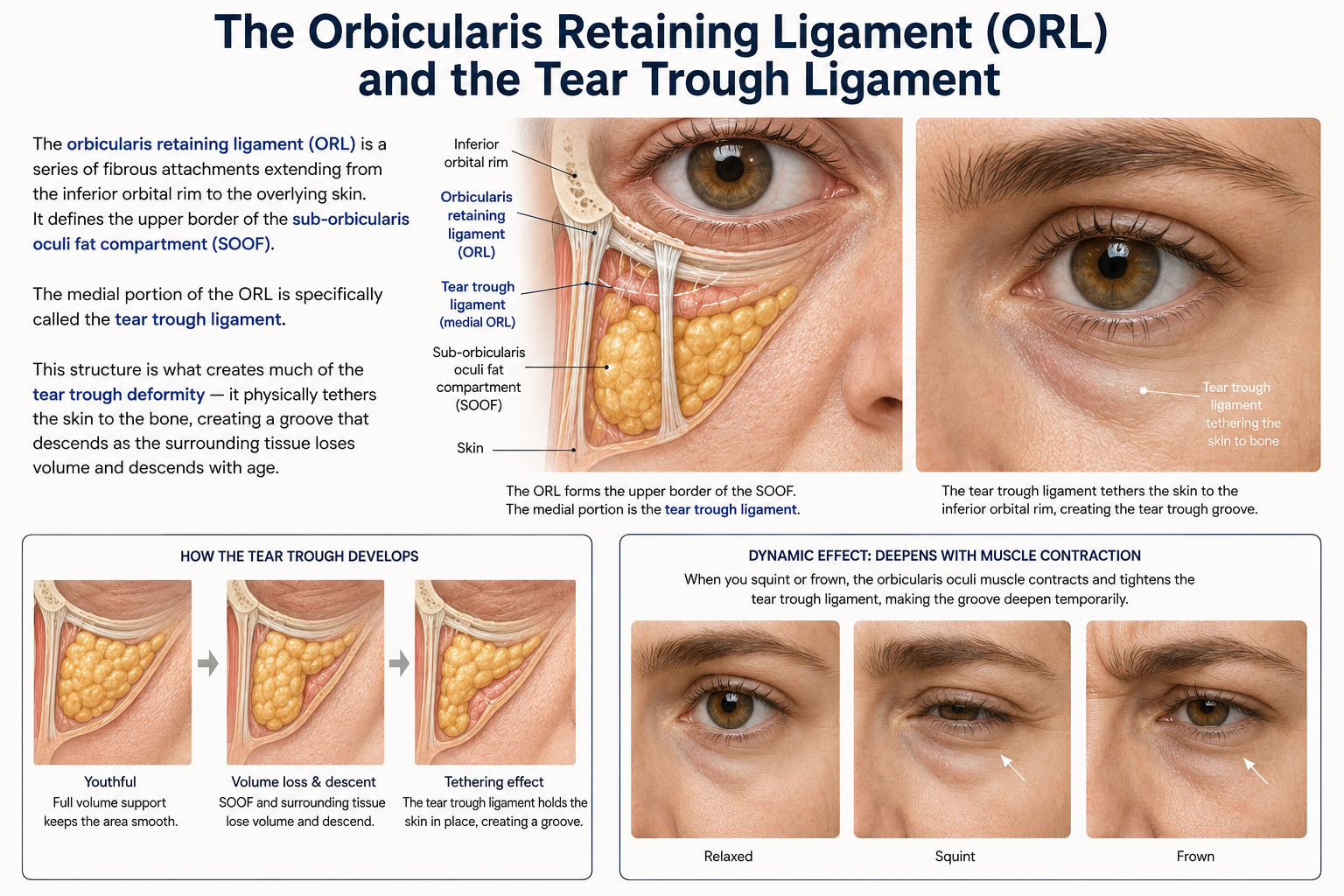
View attachment 5057387


The fat compartments that matter the most :
Below the orbicularis muscle sits the SOOF (the sub-orbicularis oculi fat). This compartment is bounded superiorly by the ORL and inferiorly by the zygomatic cutaneous ligament. Below and lateral to that is the deep medial cheek fat compartment which is where the structural cheek volume lives. In the superficial plane above the muscle are the superficial fat compartments the medial cheek fat, nasolabial fat, and a thin preseptal fat layer directly over the lower lid. Understanding which plane you're in during injection determines whether the result looks right or wrong. Filler placed in the wrong fat compartment doesn't just look suboptimal and it migrates in a direction determined by the anatomy of that compartment and can end up in a location that makes things look worse months later.
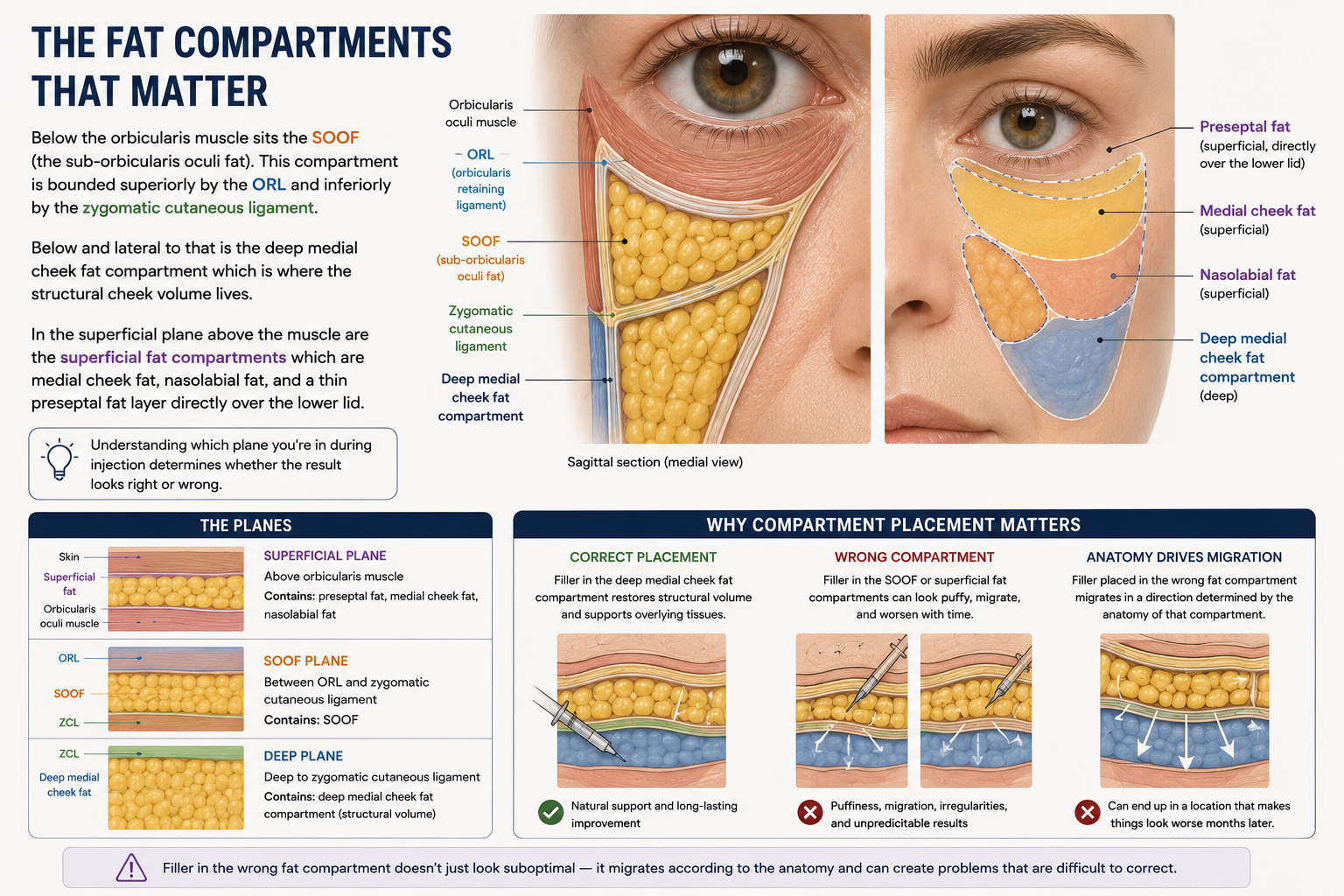
View attachment 5057396


The vascular danger zones and why this area is high risk
The infraorbital region is supplied by several arterial branches. The angular artery is branch of the facial artery that runs medially across the nasojugal groove and is one of the most commonly injured vessels during tear trough injection. The infraorbital artery exits the infraorbital foramen approximately 3cm lateral to the midline just below the orbital rim. The zygomaticofacial artery runs laterally. All of these sit in a vascular territory that communicates with the ophthalmic artery via the orbital septum. This is why vascular occlusion from filler in this area carries vision risk in a way that injections elsewhere on the face generally don't. The connection to the ophthalmic circulation is real and documented. A 2015 review of the world literature on filler-related blindness by Beleznay et al. identified the glabellar region and nasal area as highest risk.
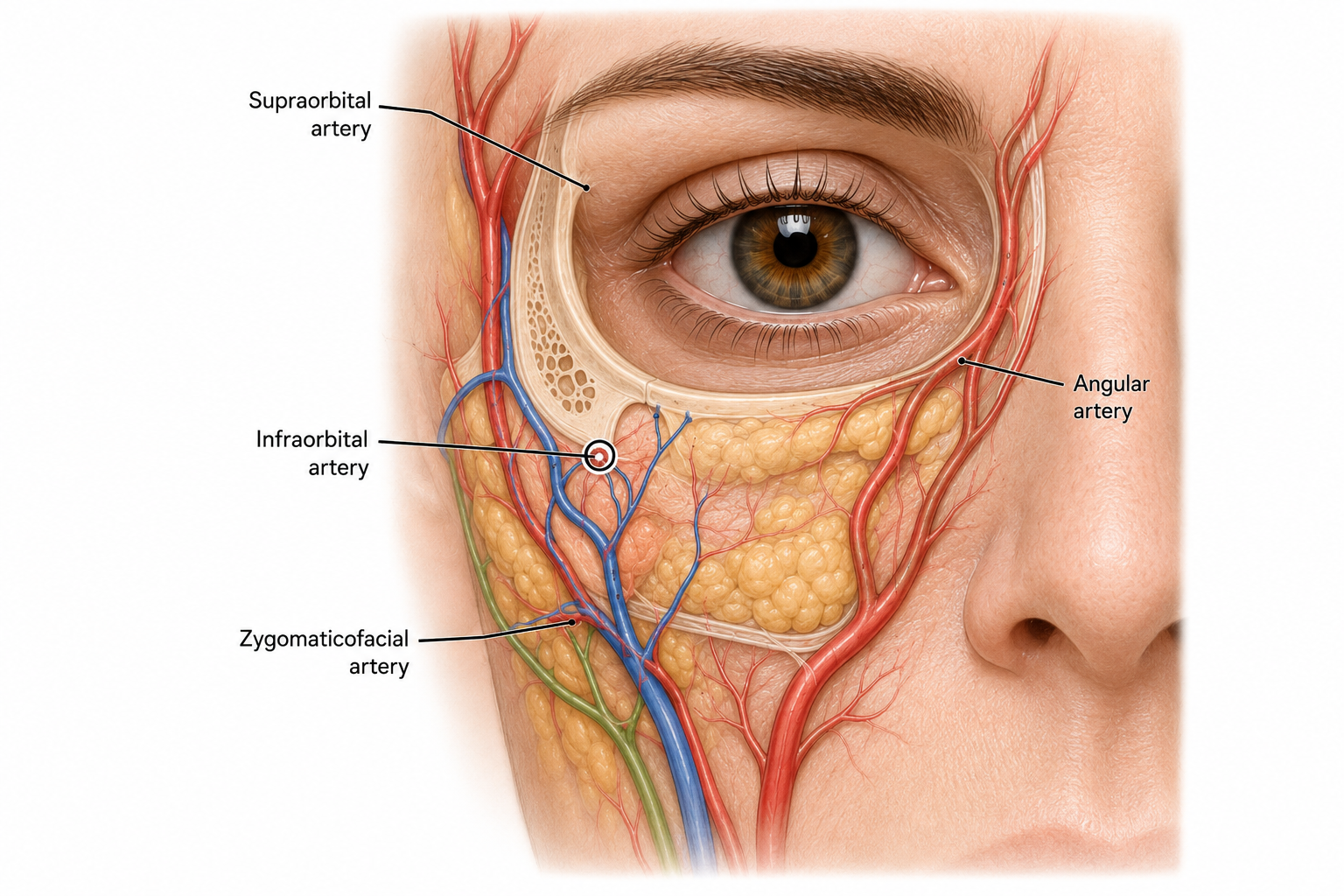
View attachment 5057438

——————————————————————————————

5. THE THREE CLASSES OF INFRAORBITAL HOLLOWING

The groove is confined to the inner corner area. The rest of the rim still has reasonable support. This is the mildest presentation and it responds well to filler correctly placed. A good injector at the right depth can fix this in one session.
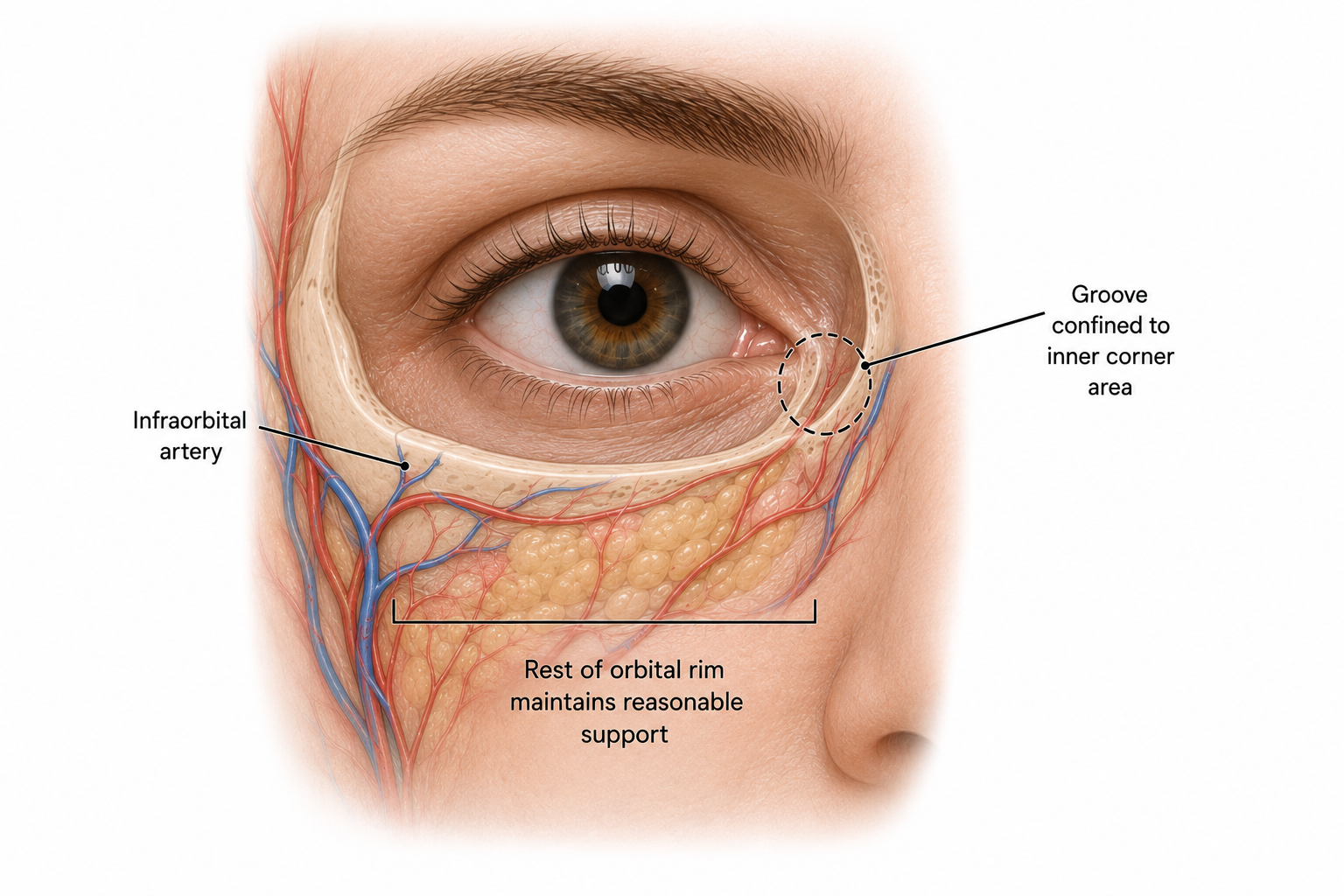
View attachment 5057501

The hollow has deepened and extended outward. Visible under the middle of the eye and sometimes toward the outer corner. Early volume loss in the central cheek becomes visible. Filler still works but placement has to cover multiple zones and single-pass medial technique leaves the lateral area still hollow. You need dual-plane treatment across two or three anatomical subzones.
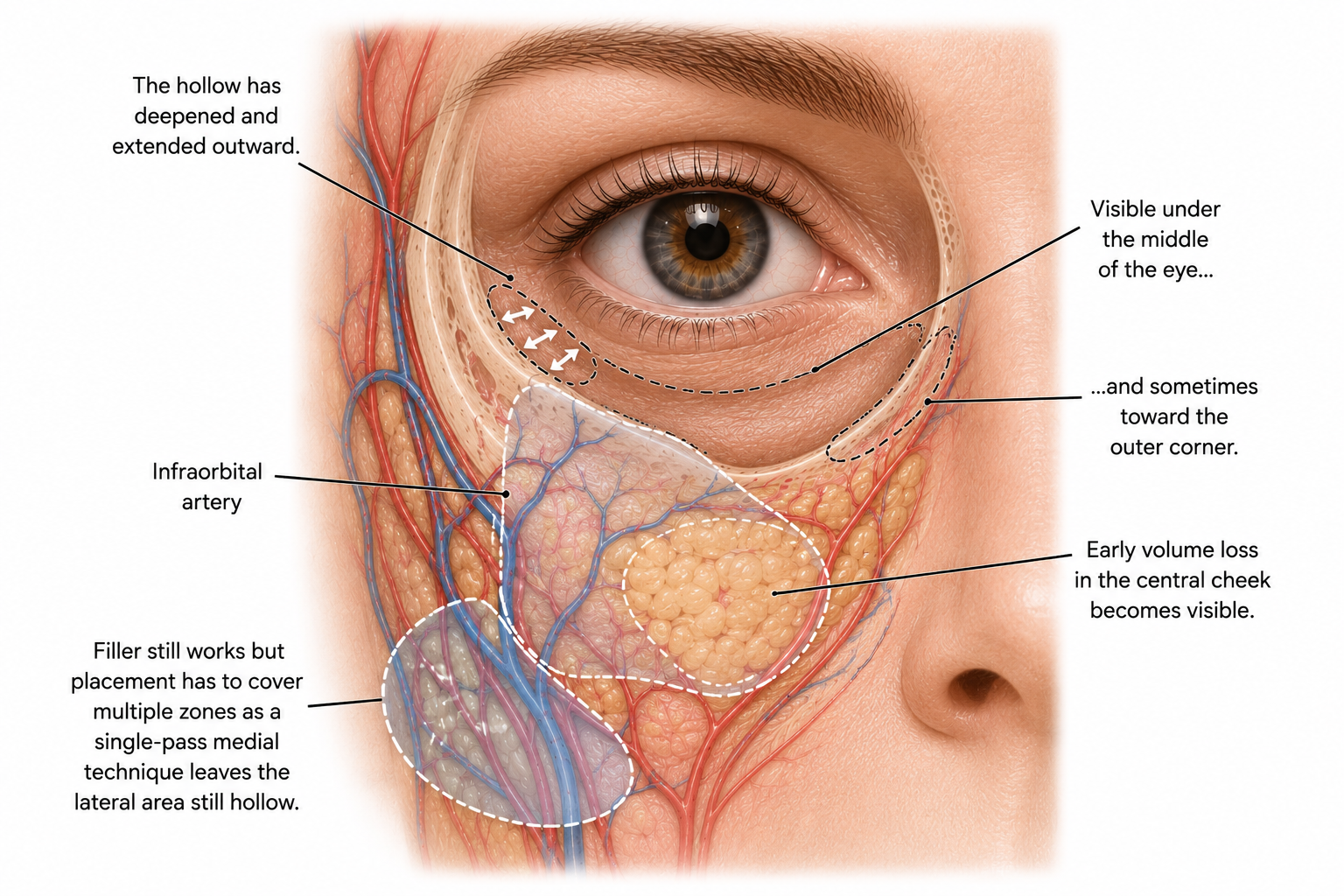
View attachment 5057508

The hollow wraps around the entire rim. The lid-cheek groove is visible from every angle. This isn't just soft tissue loss anymore as the bone itself is genuinely deficient. Filler cannot build structure here because there's no skeletal platform for it to sit on. It just creates a puffy appearance without correcting the vector or the hollow. Class 3 is implant or fat grafting territory.
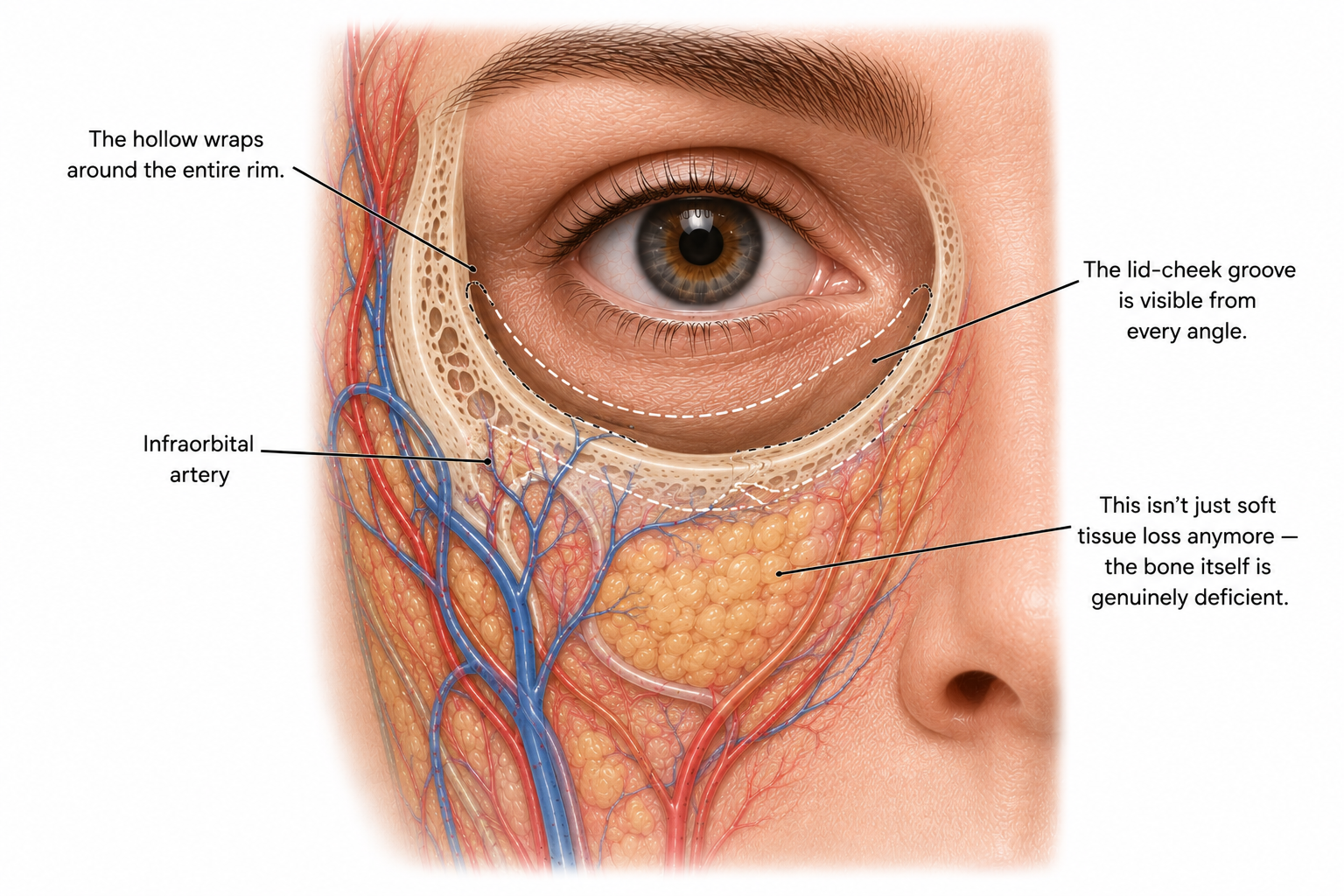
View attachment 5057516

——————————————————————————————

6. NON-SURGICAL (COPE)


THIS WHOLE SECTION EXCEPT FOR THE DEXA SCAN AND BODY ARE FOR COPERS WHO ARE AGAINST FILLERS AND HARDMAXES SO DNR THIS IF YOU ARENT ONE


Global Costs

USA:
GHK-Cu serum $20 to $60 per bottle. The Ordinary Buffet + Copper Peptides around $25. Prescription tretinoin via telehealth (Curology, AgelessRx) $20 to $40 per month.

UK:
GHK-Cu £18 to £50. Tretinoin via Dermatica or Skin + Me £20 to £30 per month.

Europe:
€20 to €55. Prescription tretinoin through a derm €30 to €60 per month.


The Full Protocol

Step 1:
Cleanse morning and night with a gentle non-stripping cleanser. The periorbital skin is some of the thinnest on the entire body so anything with high-pH foaming agents or sulfates irritates it and makes the area look worse over time.

Step 2 (Morning):
A few drops of GHK-Cu serum on damp skin around the undereye and midface. Use your ring finger as it naturally applies the least pressure then and tap gently rather than rubbing. Don't drag the skin. This matters more than most people think over months and years of cumulative mechanical stress.

Step 3 (Morning):
SPF 50+ over everything including the undereye. Non-negotiable as UV accelerates collagen breakdown in this region faster than almost anywhere else on the face because the skin here is so thin and has so little protective mass. Long-term sun exposure is one of the factors driving the skeletal resorption pattern in this area.

Step 4 (Evening):
Retinol after cleansing. Start at 0.025% three nights per week. Move to every other night in weeks five through eight. Nightly from week nine. Step up concentration to 0.05% then 0.1% over three to four months. Follow with a light moisturizer to buffer irritation around the periorbital zone.

Key rule:
GHK-Cu and retinol in the same session cancel each other out. GHK-Cu in the morning, retinol at night.

raw GHK-Cu powder:
Buy raw GHK-Cu powder from Peptide Sciences or BoS Research for around $10 to $15 per gram. Dissolve 0.5g into 100ml of water-based hyaluronic acid serum base in a dark glass dropper bottle. That's a 0.5% serum for a fraction of what any brand charges. Dissolves cleanly. Store refrigerated, use within 60 days, date the bottle.

Realistic expectations:
Noticeably better skin quality, thicker skin, reduced shadowing after 12 to 16 weeks of consistency. It is mitigation not correction. Class 1 can see real improvement from topicals. Class 2 and 3 need more than this but topicals are worth running alongside whatever else you're doing.

Cost
Free. DEXA scan $50 to $150 in the US, £30 to £80 in UK, €40 to €100 in Europe, $20 to $40 in Turkey and Thailand.

Why it matters and what to do
The periorbital fat pads are highly sensitive to overall body fat percentage. Drop below 10% body fat and those pads thin out dramatically, making the infraorbital hollow look significantly worse. A lot of guys notice their undereye area looks great at 14% and wrecked when they push down to 8% for summer. There's a sweet spot typically somewhere in the 12 to 17% range where facial fat is preserved without sacrificing overall body composition. It's individual based on genetic facial fat distribution. Get a DEXA scan at your leanest and at a moderate body fat, photograph yourself in consistent lighting at both, and compare. That gives you your actual threshold.
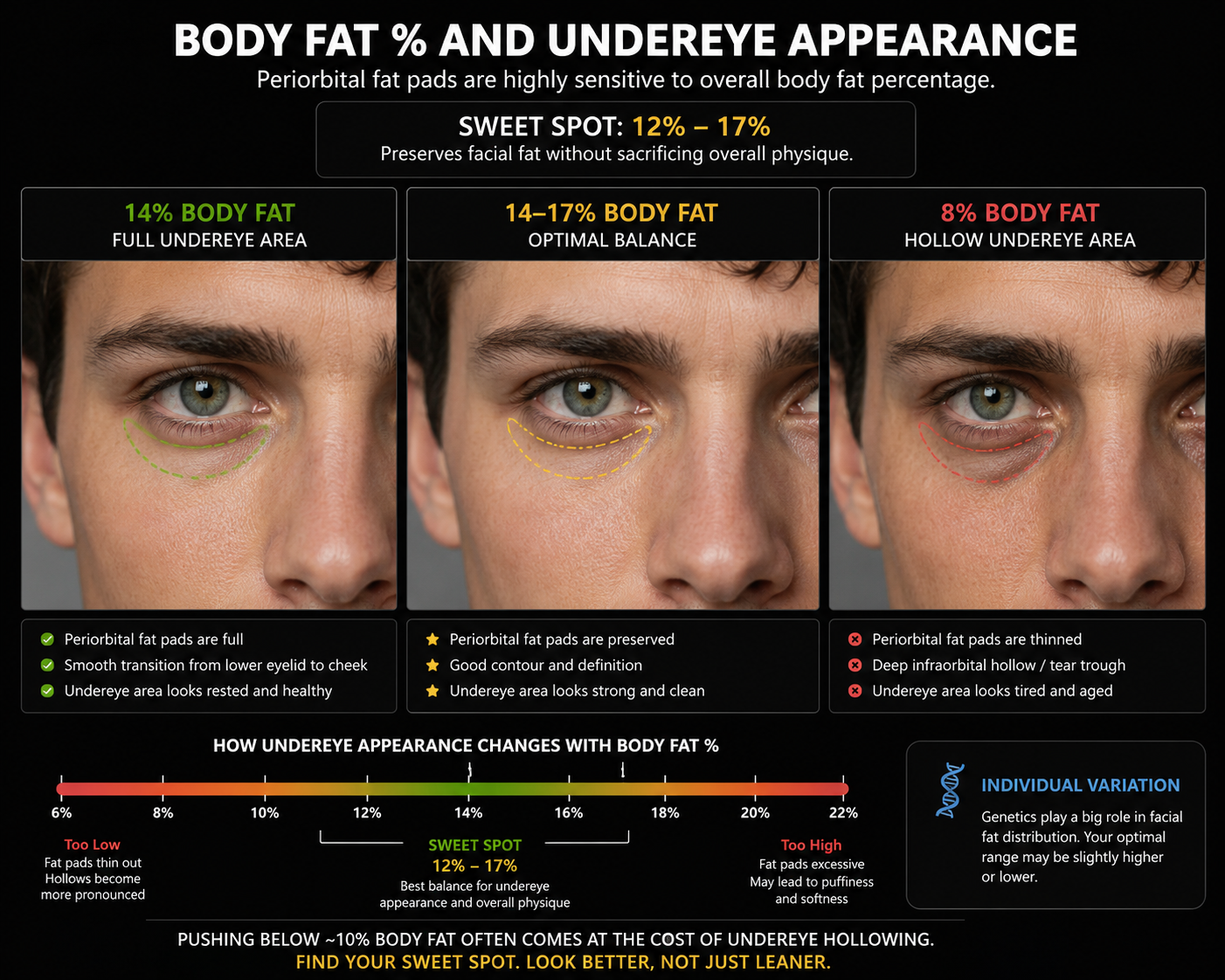
View attachment 5057563

Global Costs

USA:
$20 to $40 per month at 10g daily. BulkSupplements cheapest at $20 to $25.
UK:
£18 to £35. Bulk Powders and MyProtein both carry it.
Europe:
€20 to €40. Bulk Powders ships to most EU countries.


The Protocol

Step 1:
Hydrolyzed Type I and III collagen peptide powder specifically. Not gelatin. Not non-hydrolyzed collagen. The label has to say hydrolyzed collagen peptides or you're not getting the absorption the clinical studies are based on.

Step 2:
10g every morning in hot coffee or tea. Tasteless in most formulations. Dissolves completely in hot liquid.

Step 3:
500mg Vitamin C at the same time. Ascorbic acid is a required enzymatic cofactor in the collagen synthesis pathway. Without adequate circulating Vitamin C the production signal from the peptides can't complete properly. Most people skip this and then wonder why their results are mediocre.

Step 4:
Every single day for minimum 90 days before assessing. Collagen remodeling is slow. Most people see real change between weeks 8 and 16. Sporadic use produces nothing.

Step 5:
Photograph the undereye in the same lighting every four weeks. Subjective mirror assessment doesn't work for slow changes. Objective photos tracked over time are the only accurate way to evaluate this.

——————————————————————————————

7. THE RIGHT FILLER TECHNIQUE

The tear trough is not just volume loss. There's a fibrous structure. The tear trough ligament, the medial portion of the orbicularis retaining ligament is the one that physically tethers the skin to the orbital rim bone at the boundary between the thin eyelid skin and the thicker cheek skin. To lift the groove you need product placed below this structure at the supraperiosteal level so it pushes up against the tethering from underneath. Injectors who deposit product above the ligament in the superficial plane get a lump or ridge sitting on top of the groove without lifting it. That's the most common reason tear trough filler results look bad. The cadaveric study from the University of Pennsylvania published in Aesthetic Surgery Journal in 2023 confirmed that injection just above the periosteum produces the most anatomically precise placement along the orbital rim and critically showed that Restylane-L placed this way stays as a distinct mass along the ORL, while Volbella spreads more freely across anatomical planes due to its lower elastic modulus. This finding has direct implications for which product you use at which depth.

HA filler injected at the supraperiosteal level supports the undereye, reduces hollowing, and moves the orbital vector toward positive. Often combined with lower blepharoplasty when someone needs both structural and skin correction at the same time. The area around the infraorbital rim is highly vascular with multiple arterial branches communicating with the ophthalmic circulation

View attachment 5057605


Global Costs — Both Eyes

USA:
$1,000 to $2,500 total. Per syringe $600 to $1,500. ASPS national average around $684 per syringe.
UK:
£500 to £1,500. Harley Street at the top. Regional UK from £350 to £400 per syringe.
Western Europe:
€600 to €1,400. Spain and Eastern Europe more competitive at €350 to €800.
Turkey (Istanbul):
€250 to €450. Same brand-name filler, 60 to 75% cheaper. Highest ROI destination for this specific procedure.
South Korea (Seoul):
$300 to $600 at Gangnam clinics.
Thailand (Bangkok):
$200 to $500. JCI-accredited clinics only.
Mexico:
$300 to $700. Major cities with board-certified injectors.
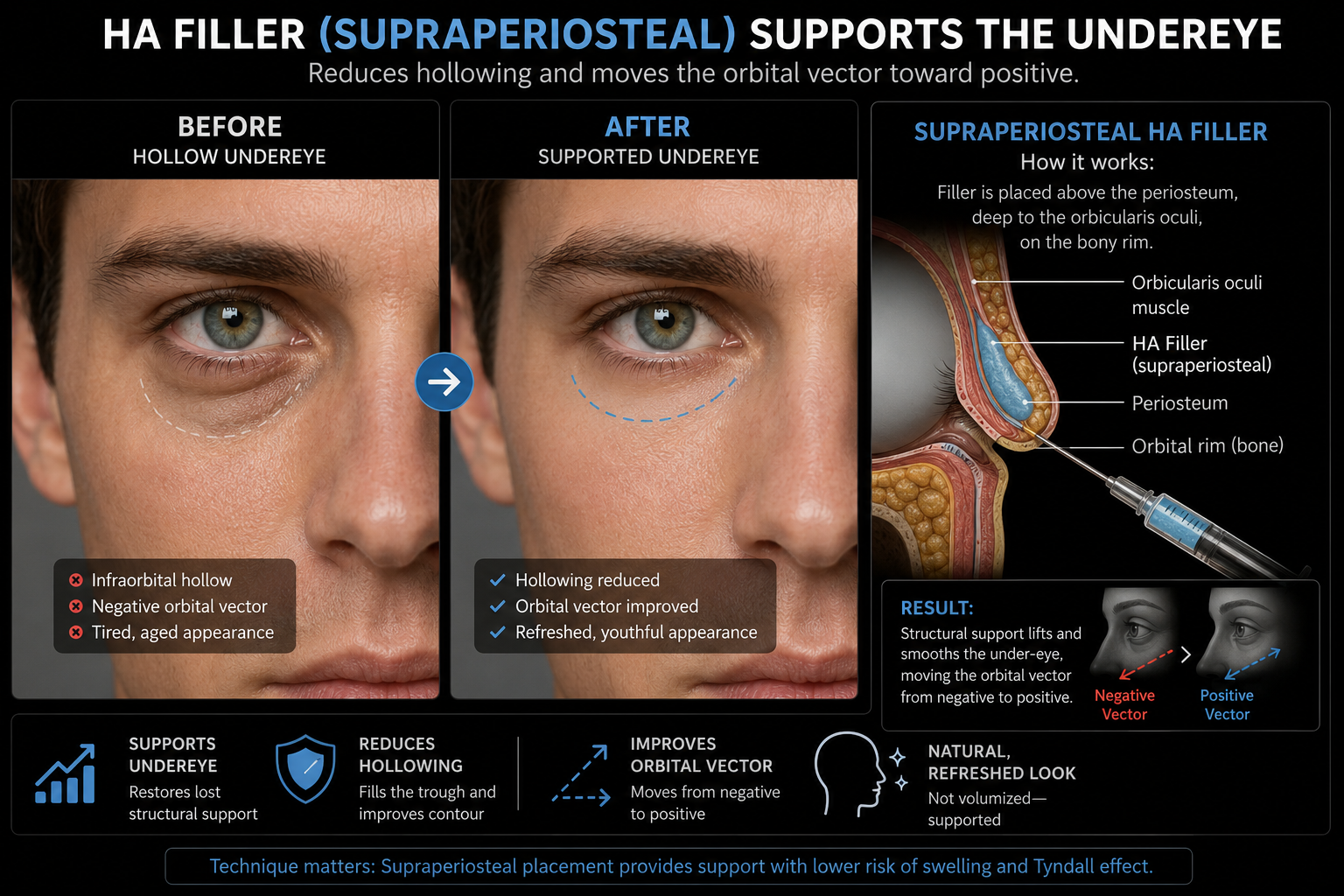
——————————————————————————————

7B. DIY UNDEREYE FILLER FULL GUIDE

This covers the DIY approach. The undereye is the highest-risk filler site on the face due to the vascular anatomy described in Section 4. Know the emergency protocol before you start. Have hyaluronidase on hand.


You're a reasonable candidate if:
You have Class 1 or mild Class 2 hollowing. A groove with genuine volume loss but nothing puffy or herniated. Lower eyelid skin is taut when you pinch it gently. No loose or baggy eyelid skin. No bags that are worse in the morning. No bleeding disorders, autoimmune conditions, or active skin infection. You haven't had filler dissolved in this area in the past 8 weeks.

Stop here if:
You have puffy bags or visible fat herniation as filler will make this dramatically worse. Thin eyelid skin where veins are clearly visible. Significant laxity under the eye. Strongly negative orbital vector without structural support as filler will just look puffy without fixing the vector. You've had hyaluronidase used in this area in the last 8 weeks.

The filler
Soft, low G-prime HA filler designed for periorbital use. Do not use thick fillers like Voluma, Radiesse, or dense Juvederm in the tear trough as they lump and migrate. The right products are Restylane-L, Juvederm Volbella, Belotero Balance, and Teosyal Redensity 2. Teosyal Redensity 2 is specifically formulated for periorbital use with lower water-attracting properties to reduce post-injection swelling. You need 1ml maximum for both sides as most sessions use 0.3 to 0.5ml total.

Where to source: Medica Depot, HA-Dermal, DoctorMedica, and similar gray market wholesale suppliers sell Restylane and Teosyal without prescription in many jurisdictions. In Turkey you can walk into Istanbul pharmacies and buy Juvederm or Restylane OTC for $40 to $80 per syringe. Never buy from eBay or AliExpress and counterfeit or improperly cold-chain stored filler is a real infection risk. Established suppliers with documented cold-chain shipping only.


Cannulas
27-gauge blunt cannula, 38mm length. The blunt tip pushes vessels aside rather than puncturing them. Brands: Softfil, TSK Steriglide, FlexFill. Available from Medica Depot or iBeautyMachine for $15 to $40 per box of 20. Fresh cannula per session and per eye as you should never reuse.

Entry needle
25-gauge sharp hypodermic needle to create the entry point hole. Available at any pharmacy.

Numbing
EMLA cream (lidocaine 2.5% plus prilocaine 2.5%) under cling film for 30 minutes. LMX4 also works. Do not use ice as primary numbing as it causes vasoconstriction which makes blood aspiration harder to assess.

Hyaluronidase
The enzyme that dissolves HA filler. Available as Hylenex in the US, Hyalase in UK and Europe, or generic hyaluronidase 1500iu vials. t.

Sterility supplies
Nitrile gloves. Alcohol prep pads (70% isopropyl). Chlorhexidine 2% for skin prep. Gauze pads. Sterile drape or fresh clean towel. Sharps container.

Total cost
Filler syringe $40 to $120. Cannula box $15 to $40. EMLA $10 to $25. Hyaluronidase $30 to $80. Supplies $10 to $20. Total $105 to $285 versus $1,000 to $2,500 professionally.

48 hours before:
Stop blood thinners so no aspirin, ibuprofen, fish oil, vitamin E, or alcohol. OTC supplements and lifestyle only and do not stop prescription blood thinners without speaking to your doctor.

Day of — skin prep:
Wash your face. Remove everything like no makeup, no skincare. Chlorhexidine on a gauze pad wiped from center outward over the injection zone. Follow with alcohol prep pad. Let dry completely. Don't touch the cleaned area with bare hands again.

EMLA application:
Thick layer covering the full undereye zone from inner corner to the outer orbital area. Cover with cling film. Leave minimum 30 minutes. Wipe completely off with alcohol prep pad and let dry fully before proceeding.

Workspace setup:
Large well-lit mirror. Daylight or bright white LED pointed at your face. All supplies within reach. Nitrile gloves on. Filler syringe open with hub attached. Cannula on sterile surface. Hyaluronidase immediately accessible and know exactly where it is and how to draw it up before touching anything.

Step 1 — Mark your anatomy
White eyeliner pencil only and not a dark marker. Mark the lowest point of your tear trough groove in good lighting. Mark your entry point: 15 to 20mm directly below the outer edge of your iris (lateral limbus) on the cheek. This location keeps your cannula path away from the infraorbital foramen and the angular artery as you travel medially. Wipe the marks off with an alcohol pad before injecting also never inject through skin with marker on it.
View attachment 5057828


Step 2 — Create entry point
Stretch the skin at the entry point with your non-dominant hand. 25-gauge sharp needle, firm puncture at 45 to 90 degrees. One clean puncture. Entry point on the cheek, not the lower eyelid. Small drop of blood is fine but wipe with alcohol pad.

View attachment 5057856


Step 3 — Insert cannula
27-gauge blunt cannula attached to filler syringe. Stretch entry point skin to keep the hole open. Insert at 30 to 45 degrees then flatten the angle to nearly parallel with the skin surface. Travel supraperiosteally and just above bone. You feel slight resistance through the orbicularis and a give as you enter the sub-orbicularis plane. Cannula scraping against bone means you're at the right depth. Advance slowly toward the inner corner of the eye, below the tear trough groove.
View attachment 5058166


Step 4 — Aspirate first
Before releasing any product, pull the plunger back. Blood in the syringe means you're in a vessel. Withdraw immediately, apply pressure for 2 minutes, don't inject from that entry point again. Move to the other eye and return with a fresh cannula from a slightly different entry location.
View attachment 5058179


Step 5 — Retrograde linear threading
Cannula at its deepest point medially near the inner corner. Begin slowly pressing the plunger while simultaneously withdrawing at a steady even pace toward the entry point. Product deposits as a thin continuous thread as you withdraw. Even pressure, smooth withdrawal with thin column along the rim, not a blob. Volume per pass: 0.1 to 0.2ml max. Start with 0.1ml and assess before adding more.
View attachment 5058325


Step 6 — Lateral fan if needed (Class 2 only)
If hollow extends laterally past mid-pupil, readvance from same entry point angled slightly outward. Second retrograde pass covering the lateral area. Use less here like 0.05 to 0.1ml. Maximum two passes from one entry point.

Step 7 — Assess and massage
Remove cannula. Gentle pressure on entry point for 30 seconds. Sit upright and look in natural light. Any lumps felt then gentle circular massage with clean finger. Check specifically for skin blanching anywhere for white patches that don't resolve in 30 seconds mean possible vascular compression.
Wait 5 minutes and reassess the first side before moving to the other eye.

Step 8 — Other eye
Fresh cannula. New entry point same location on the other side. Match volume exactly to what you used on the first side. Always err toward less so you can add at 2 weeks, you cannot easily remove immediately.

Step 9 — Aftercare
Cold compress (wrapped, not bare ice) for 10 minutes. No makeup for 24 hours. No alcohol, exercise, or heat for 48 hours. Sleep slightly elevated the first night. Don't massage after the first hour. Expect some swelling and possible mild bruising for 2 to 5 days. Final result at 2 weeks around is noticed.

Most DIY attempts go wrong because people use too much. This area needs far less product than anywhere else on the face. Overfilling creates a puffy pillow look that sits there for months and requires hyaluronidase to fix.

Session 1:
0.1ml per side. Total 0.2ml. Test session. You will probably not see a dramatic result. Assess at 2 weeks.

Session 2 (minimum 2 weeks later):
Add up to 0.15ml per side if genuinely needed. Cumulative max after two sessions: 0.25ml per side.

ceiling:
Never exceed 0.3ml per side total across all DIY sessions. If your hollowing needs more than that, the problem is structural.

vascular occlusion:
Signs: skin blanching white that doesn't resolve in 30 seconds, skin going mottled or grey or purple, severe pain out of proportion to the procedure, any change in vision including blurring or darkening. If any of these happen: stop injecting. Inject hyaluronidase immediately into the affected area then reconstitute 1500iu vial with 2ml saline for 750iu/ml, inject 0.2ml (150 units) directly into the blanched zone and surrounding tissue. Apply warm compress then Take 325mg aspirin.

Tyndall effect (blue discoloration):
Filler placed too superficially. Not dangerous but looks bad. Hyaluronidase 15 to 30 units injected directly into the blue zone in small aliquots. Resolves within 24 to 48 hours.

Persistent lump:
Wait 2 weeks as most resolve with swelling. Persistent lump at 2 weeks gets hyaluronidase 15 units per side directly into it. Reassess at 48 hours.

Full dissolution protocol:
Reconstitute 1500iu hyaluronidase with 2ml bacteriostatic saline giving 750iu/ml. Draw up appropriate volume in insulin syringe. Inject small amounts (0.02 to 0.05ml per puncture) directly into the filler deposit across multiple punctures. For full dissolution of undereye filler: 15 to 75 units per side. Results in 24 to 48 hours. Wait minimum 4 weeks before re-injecting as residual hyaluronidase can break down freshly placed filler if you go back too soon.

——————————————————————————————

8. INFRAORBITAL RIM IMPLANTS COSTS

Solid silicone implants placed directly on the infraorbital rim bone. The most direct structural correction available for undereye hollowing and a negative orbital vector as you are physically augmenting the bony architecture, not masking the problem with volume. Unlike filler which is temporary and only addresses soft tissue, implants permanently correct the vector. They're typically combined with lower blepharoplasty for the best full eye area result.


Off-the-shelf implant designs are not inferior to custom implants for most people. The Flowers infraorbital rim implant is a well-established design with a long clinical track record and it's appropriate for the majority of symmetric cases. Custom implants are specifically for patients with significant asymmetry between sides or unusual anatomy that a standard design can't accommodate. The push toward custom-only is partly surgeon preference and partly commercial as custom implants cost significantly more and have higher margin.


Global Costs

USA:
$6,000 to $15,000. Flowers off-the-shelf designs at the lower end. Custom CT-derived implants from Eppley, Taban, Isaacs at $8,000 to $15,000+.
UK:
£5,000 to £9,000. Surgeons with specific experience in this procedure are rare outside London.
Western Europe:
€5,000 to €10,000. Belgium, Netherlands, Germany, Spain have experienced craniofacial surgeons doing this.
Turkey (Istanbul):
$3,000 to $6,000 all-in with hotel and transfers. Verify that the specific surgeon has done infraorbital rim implants specifically — not just cheek or chin work.
South Korea (Seoul):
$4,000 to $8,000. Often combined with canthoplasty and lower bleph as a full eye area package. VAT refund 7 to 8% at airport for foreign patients.
Thailand (Bangkok):
$3,500 to $7,000 at JCI hospitals.
Mexico:
$3,000 to $6,000. Mexico City and Monterrey over Tijuana for this level of work.

——————————————————————————————


9. MIDFACE MASK IMPLANT


Reference thread on this: The Holy Grail of Facial Aesthetics — How to Simulate Lefort III Results with the Midface Mask Implant


The custom midface mask implant covers the entire upper midface skeleton which is from the infraorbital rims down to just above the upper teeth. Think of it as a single unified implant that simultaneously augments all of the following : the infraorbital rims, the malar eminences (cheekbones), the paranasal region (the area around the base of the nose), and the anterior maxilla. That coverage is why it's called a mask. the footprint literally looks like the upper portion of a face mask on 3D imaging.

View attachment 5058644

The effect is described in the surgical literature as Lefort III-like but without the occlusal movement. Meaning it pulls the entire midfacial skeleton forward in one coordinated augmentation, mimicking the aesthetic outcome of a full midface advancement osteotomy without actually cutting and moving bone. The infraorbital rims project forward correcting the negative vector, the cheeks project forward, the paranasal area fills out, the entire midface depth and width changes. For someone with true generalized midface hypoplasia this is the procedure that actually addresses the whole problem rather than chasing individual zones with separate implants.

Because the infraorbital nerve passes through the infraorbital foramen in the middle of this zone, the implant is designed as three pieces: bilateral infraorbital-malar segments and a lower maxillary segment that crosses under the nasal base. Each piece is designed around the nerve pathway to prevent compression. When properly placed there should be no permanent nerve damage, though patients should expect some temporary numbness of the upper lip and side of the nose from nerve stretching during implant seating which recovers fully.

The limitation with doing a cheek implant here and a separate infraorbital rim implant there and a separate pyriform implant somewhere else is that you get disjointed augmentation with visible transitions between the zones. Each implant has edges. Where one implant ends and another begins there's a potential step-off or contour irregularity that shows through the overlying soft tissue. The more implants you stack the more complex the revision situation if anything needs to be adjusted.
View attachment 5062790

The midface mask implant solves this by creating one continuous augmentation surface across all zones simultaneously. The transitions between the infraorbital rim, malar eminence, and paranasal regions are built into the implant design itself and are smooth by design rather than approximated by placement of separate pieces. The clinical result looks more natural and cohesive because it is more natural and it follows the actual anatomy of the midfacial skeleton as a unified structure rather than addressing it as isolated landmarks.

There's also a case documented in the surgical literature specifically for patients who had a Le Fort I osteotomy that moved the lower maxilla but left the upper midface consisting of the infraorbital rims and zygomaticomalar complex untouched and still recessed. This is a known limitation of Le Fort I: it addresses the occlusal level but doesn't move the infraorbital rim. A custom infraorbital-maxillary-malar implant placed after a Le Fort I creates what surgeons describe as a modified Le Fort III effect as both the lower and upper midface are now addressed, combining what surgery did with what the implant adds.

The midface mask implant is appropriate for someone with true generalized midface hypoplasia and not just undereye hollows, not just flat cheeks, but the full midface complex being recessed including the infraorbital rims, malar eminences, and paranasal area. If you look at your profile and everything from your lower eyelid to your upper lip sits behind the plane of your nose tip and forehead, you are probably in this category. If only specific zones are deficient, targeted implants or filler are more appropriate.


The procedure is not appropriate if your occlusion needs to change and if you have a malocclusion that needs orthognathic surgery, that needs to be addressed before or simultaneously with any midface implant work, not replaced by it. The midface mask implant advances the skeletal contour without moving the teeth or changing the bite. If the bite is off, that's a separate problem requiring orthognathic surgery.

Cost
$6,000 to $15,000 depending on surgeon and whether it is standalone or combined with other procedures. For context: a Le Fort II or III osteotomy runs $30,000 to $60,000 and is practically inaccessible for purely aesthetic indications. The midface mask implant achieves a comparable aesthetic effect at 20 to 50% of that cost. This is one of the best cost-to-outcome ratios in all of facial surgery for the right candidate.


Where to find surgeons who specifically do this
Dr. Barry Eppley at Eppley Custom Facial Implants in Indianapolis is the most documented surgeon in the English-language literature for this specific procedure. His case studies are publicly available on exploreplasticsurgery.com and document outcomes across multiple patient types including men with generalized midface hypoplasia. In Europe, craniofacial units in Belgium and the Netherlands have surgeons experienced with comprehensive midface implant design. In South Korea the Gangnam complex surgery market has surgeons comfortable with multi-zone midface implants. As with the infraorbital rim implant, verify specifically that the surgeon has documented experience with full-coverage midface mask implants — not just cheek or malar implants in isolation.

his website : eppleyplasticsurgery.com

——————————————————————————————

10. LE FORT OSTEOTOMY — WHEN AND WHY

The Le Fort osteotomies are the actual skeletal solution for severe midface recession. Le Fort I moves the maxilla at the occlusal level and changes the teeth and lower midface position but critically does not move the infraorbital rims, which is why it often leaves the upper midface still recessed after surgery. Le Fort III moves the entire midface including the orbital rims forward and is the most complete correction available.
View attachment 5062824


Global Costs

USA:
$20,000 to $40,000 for Le Fort I. Modified Le Fort III $30,000 to $60,000+ at major craniofacial centers.
UK:
£12,000 to £25,000 private. NHS may cover with functional indication.
Western Europe:
€10,000 to €25,000. Spain and Eastern Europe more competitive at €10,000 to €15,000.
Turkey (Istanbul):
$6,500 to $12,000 at accredited hospitals.
South Korea (Seoul):
$8,000 to $18,000. Korea performs among the highest annual volume of orthognathic surgery globally.
Thailand (Bangkok):
$9,500 to $15,000 at JCI hospitals.
Mexico:
$8,000 to $15,000. Mexico City university-affiliated maxillofacial departments.


The Le Fort I Limitation and Why Many Patients Need More
Le Fort I advancement moves the lower midface consisting of teeth, lower cheeks, nose but it does not move the infraorbital rims. In patients where the midface deficiency extends all the way up to include the orbital rims, a Le Fort I leaves the upper midface still recessed after surgery. The patient sees improvement in their bite and lower face but still has a negative orbital vector and hollow undereyes. Opting for a LE FORT III is best here.
View attachment 5062819


——————————————————————————————

11. SURGEON TIERLIST

The surgeons listed here are the ones with documented, verifiable track records specifically for this procedure and not general plastic surgeons who have done one or two of these, but specialists who have built a reputation specifically around periorbital and midface skeletal surgery. Tierlists cover surgeons globally, then clinics by country, then countries overall.


Ranked specifically on documented case volume, technical specificity for this procedure, published research contribution, and real patient outcome track record. Not on general reputation as a plastic surgeon.

S TIER — The absolute best, would travel anywhere for these

Dr. Barry Eppley
Location:
Eppley Plastic Surgery, 12188-A North Meridian St Suite 310, Carmel (Indianapolis), Indiana, USA
Website:
eppleyplasticsurgery.com and eppleycustomfacialimplants.com
Approximate cost:
Infraorbital rim implants (combined infraorbital-malar) around $6,500. Midface mask implant $8,000 to $12,000. Custom jaw, cheek, full facial packages vary. Virtual consultation available.
Why S tier:
Eppley is probably the single most documented surgeon in the English-language literature for custom facial implants including infraorbital rim, midface mask, and combined periorbital work. His blog at exploreplasticsurgery.com contains hundreds of case studies with full before/after documentation across every facial zone. He developed the semi-custom infraorbital-malar implant approach and has the deepest public case archive of anyone doing this procedure. He uses titanium micro-screw fixation for long-term positional stability. His pricing is also significantly lower than the Beverly Hills surgeons doing comparable work.
In his own words on infraorbital implants vs fillers:
"In the treatment of infraorbital rim deficiency, the three treatments are synthetic injectable fillers, injected fat and implants. Each has their own advantages and disadvantages. But none of them are perfect nor is one method best for all patients. Each case must be considered separately and the magnitude of the defect considered in the treatment selection." He also notes that fillers should be used as a trial method first to assess whether soft tissue volumization gives the desired effect before committing to implants.
On custom vs off-the-shelf:
"A semi-custom approach allows me to select an infraorbital-malar implant from a variety of custom ones that have been made for other patients. Given the shape of this area of the facial skeleton a semi-custom implant can be a more cost-effective method that fits fairly well." Worth knowing that he actually offers this more affordable semi-custom option for appropriate cases.

Dr. Mehryar (Ray) Taban
Location:
9735 Wilshire Blvd Suite 319, Beverly Hills, CA 90212, USA. Also Santa Barbara.
Website:
tabanmd.com — Phone: (310) 278-1836
Approximate cost:
Infraorbital rim implants $8,000 to $15,000 depending on complexity and whether combined with canthoplasty, blepharoplasty, or orbital decompression. Full periorbital transformation packages can run higher.
Why S tier:
Taban is double board-certified by ASOPRS (American Society of Oculofacial Plastic and Reconstructive Surgery) and the American Board of Ophthalmology, and is also an Assistant Clinical Professor at UCLA. He is the go-to surgeon for complex periorbital work that combines infraorbital rim implants with canthoplasty, lower eyelid retraction repair, and orbital decompression in a single operation. His patient gallery at tabanmd.com contains an extensive archive of before/after cases documenting vector correction and eye shape transformation. He uses the transconjunctival approach with suture fixation rather than screws, preferring to avoid metal hardware near the orbit. His specific expertise in oculoplastic surgery means he understands the lower eyelid mechanics in a way that most plastic surgeons simply don't.
On what he actually does for negative vector patients:
His documented approach for negative vector patients often combines infraorbital rim implant placement with lower eyelid retraction correction and canthoplasty in a single operative session by addressing the bone, the lid position, and the canthal angle simultaneously. This is significantly more ambitious than what most surgeons offer and is appropriate for patients whose eye area problems involve all three components.
Real patient review (documented on RealSelf):
One patient with extensive knowledge of maxillofacial surgery wrote: "When it comes to the periorbital region he IS the best in the world. Through canthoplasty, tear trough implants on the orbital rim, lower lid retraction, orbital decompression, and slight lowering of the upper eyelid, I now have hooded eyes, a sweeping effect, a high lateral canthus position, and a lower lid so high it likely won't descend for decades."

A TIER — Elite surgeons, genuinely excellent, specific strengths noted

Dr. Michael Yaremchuk
Location:
Massachusetts General Hospital, Division of Plastic Surgery, Boston, MA, USA
Website:
dryaremchuk.com
Approximate cost:
$10,000 to $18,000 for infraorbital rim and midface implant work. As a Harvard-affiliated craniofacial surgeon the pricing reflects his academic institution and elite reputation.
Why A tier:
Yaremchuk is the academic foundation of this entire field. He literally wrote the original peer-reviewed paper on infraorbital rim augmentation published in Plastic and Reconstructive Surgery in 2001 which is still cited in almost every academic article on this procedure. He also designed specific implants for this procedure. His clinical background is craniofacial surgery at one of the top hospitals in the world. His research on how the aging facial skeleton changes the orbital vector relationship is the most cited work in this space. The reason he's A rather than S is purely accessibility as academic hospital pricing is steep, his focus is broader than just aesthetic cases, and he's harder to get to.
In his own published research:
"In patients with recessive infraorbital rims, alloplastic augmentation of the infraorbital rims makes the eyes appear less prominent and improves appearance. Augmentation of the infraorbital rim and resuspension of the cheek soft tissues can have a rejuvenating effect in properly selected patients." His 3D reconstructions comparing youthful and aged orbits shows how an infraorbital rim implant placed on the aged skeletal anatomy transforms it back toward the youthful contour are the clearest visual demonstration of what this procedure actually achieves.
Real patient quote:
"I had an under the eye problem and the only solution I thought there was, was cheek implants. Instead with his orbital rim implant he fixed the problem perfectly. In terms of surgical skill and experience, Dr. Yaremchuk is pretty much as good as it gets."

Dr. David Isaacs
Location:
Beverly Hills, CA, USA
Website:
drdavidisaacs.com
Approximate cost:
$10,000 to $15,000 for infraorbital rim implants. Uses 3D Accuscan imaging for custom implant design.
Why A tier:
Dual-fellowship trained oculofacial plastic surgeon in Beverly Hills who specifically markets and documents infraorbital rim implant work. Uses a transconjunctival approach and custom 3D Accuscan imaging to ensure implant fit. Strong documented case gallery. Appropriate for patients who want a Beverly Hills-based alternative to Taban with similar oculoplastic training background. His stated approach on fitting is that the procedure should always be anchored securely while blending naturally with facial contours, and that careful technique avoids overcorrection while preserving the natural lower eyelid to cheek transition.

B TIER — Solid options, less documented but legitimate

Korean Gangnam Oculoplastic Surgeons (as a group)
Location:
Gangnam and Apgujeong districts, Seoul, South Korea
Approximate cost:
$4,000 to $8,000 for infraorbital rim implants. $920 to $1,530 for undereye fat grafting. Often packaged with canthoplasty and lower blepharoplasty.
Why B tier:
Korean surgeons as a group represent excellent value and high volume, particularly for canthoplasty, lower blepharoplasty, and combined eye area transformation packages that include infraorbital rim work. The sheer case volume in Seoul means technique refinement that's genuinely hard to match elsewhere. The reason they're B rather than A as a group is variability as you need to research the specific surgeon rather than just the clinic, the anesthesiologist issue is real (verify presence before booking), and the documented English-language case literature for this specific procedure is less accessible than the US surgeons. The best Korean surgeons doing this work are at the same technical level as S tier but the challenge is identifying them.

Istanbul Craniofacial Surgeons (JCI-accredited hospitals)
Location:
Acibadem, Memorial Hospital Group, Medipol Mega, Liv Hospital, Istanbul, Turkey
Approximate cost:
$3,000 to $6,000 for infraorbital rim implants all-in. $1,450 to $2,900 for fat grafting.
Why B tier:
Turkey has the best cost-to-outcome ratio globally for this procedure when you find the right surgeon. The infrastructure at JCI hospitals is genuinely high quality, ISAPS-certified surgeons in Istanbul are operating at a legitimate international standard, and the all-inclusive packages make the logistics straightforward. The B tier placement reflects the same variability issue as Korea as surgeon-specific due diligence is essential, and the English-language documentation of individual surgeon case archives is harder to evaluate than the US names listed above.

C TIER — Proceed with extreme caution or avoid for this specific procedure

General plastic surgeons without specific infraorbital rim implant experience, regardless of their general reputation. The procedure is technically demanding enough and rare enough that a surgeon who does it once or twice a year and otherwise sticks to rhinoplasties and breast work is not an appropriate choice.

S TIER COUNTRIES for this specific procedure

USA (specifically Indianapolis and Beverly Hills)
Home to the most documented and accessible specialists for infraorbital rim and midface implants globally. Eppley in Indianapolis gives you the most documented case archive and competitive pricing for the US market. Beverly Hills gives you Taban and Isaacs with the deepest oculoplastic expertise. The US is S tier not because it's cheapest as it clearly isn't nigga :feelswhy: but because the surgeon-specific documentation and research output here is the most accessible for doing pre-operative due diligence, and the legal/medical infrastructure for complications and revision is the most robust.

A TIER COUNTRIES

South Korea (Seoul — Gangnam/Apgujeong)
Best in the world for combined eye area transformation packages, fat grafting, and any procedure that combines periorbital structural work with canthoplasty and blepharoplasty. Case volume is unmatched globally. The challenge is verification When you find the right surgeon the outcomes here are comparable to the best in the world at 40 to 60% of US pricing.

Turkey (Istanbul — JCI hospitals)
Best value globally for filler, fat grafting, and implant work when you vet properly. The cost savings versus the US and UK are dramatic. The due diligence process described in Section 12 is non-negotiable though as the variation between top-tier and mid-tier providers in Istanbul is significant.

B TIER COUNTRIES

Western Europe (Belgium, Netherlands, Spain — Barcelona/Madrid)
Strong craniofacial surgery scenes in Belgium and the Netherlands specifically. Spain has experienced surgeons in Barcelona and Madrid who do periorbital and midface implant work. Pricing sits between Turkey and the US. Good option for European patients who don't want to travel to Turkey or Korea.

UK (London specifically)
Strong regulatory framework and high-quality surgeons in London. The issue for this specific procedure is the same as everywhere but surgeons with documented specific experience in infraorbital rim implants are rare. Outside London the landscape thins out considerably. Pricing is high for what you get relative to Istanbul or Seoul. Better for filler and blepharoplasty than for complex implant work.

Thailand (Bangkok — JCI hospitals)
Strong for fat grafting and combined lower eyelid work at JCI hospitals. The specific infraorbital rim implant expertise is thinner here than in Korea or Turkey. Good value for procedures in the less specialized range like filler, fat grafting, blepharoplasty. Bumrungrad in particular has internationally trained surgeons who are genuinely excellent. For implant work specifically, less reliable than Seoul or Istanbul.

C TIER COUNTRIES — Use with heavy caution for this procedure

Mexico (Tijuana specifically), Eastern Europe outside major medical centers, and anywhere where infrastructure for managing complex periorbital complications is not immediately accessible. This isn't about general surgical quality and it's about the specific requirement that if something goes wrong with an infraorbital rim implant near the globe, you need to be in a facility that can manage it immediately. Mexico City and Monterrey are a different story and sit closer to B tier.

The surgeon tierlist above is primarily for implant and surgical procedures. For filler specifically, the calculus is somewhat different because the skill is in injection technique rather than operative surgical training, and the reversibility with hyaluronidase means mistakes are less catastrophic than with surgery.

Best market for filler value:
Istanbul. Same brand-name product, 60 to 75% cheaper, experienced injectors who do high volume. Single best destination for filler purely on cost and quality balance or you could just go DIY.

Best market for technique:
Seoul. The periorbital filler technique refinement in Gangnam clinics, including emerging ultrasound-guided tear trough work, is as advanced as anywhere globally.

What to look for in any injector anywhere:
They use a blunt cannula not a sharp needle in the tear trough. They can describe their entry point, injection plane, and product selection specifically. They have before/after photos of tear trough cases specifically not just general filler work.

——————————————————————————————

12. SCIENCE BACKING AND SOURCES

Everything in this guide is sourced from published research, peer-reviewed clinical literature, or documented surgical case studies. Links below.

Anatomy and Aging
PubMed — Infraorbital Rim Augmentation in Orthognathic Surgery (Le Fort I limitation documentation)
Aesthetic Plastic Surgery — Decoding Periorbital Aging: Multilayered Analysis (2025 — orbital cavity expansion with bone resorption, globe volume decrease)
ScienceDirect — Facial Bone Aging: An Update and Literature Review 2020-2023 (region-specific bone loss affecting orbital rims and maxilla)
Aesthetic Surgery Journal — Infraorbital Hollow Rejuvenation: Contributions of Midface Volumization (ORL anatomy, vascular supply, etiology)


Filler Technique and Anatomy
PMC — Cadaveric Evaluation of Filler Behavior in Tear Trough (University of Pennsylvania, 2023 — Volbella spreads across planes, Restylane-L stays as distinct mass at ORL)
PMC — Anatomical Filler Injection Techniques: Infraorbital Groove and Hollowness
PMC — Tear Trough Filler Using Three-Point Tangent Technique: Lessons from 1452 Applications (2023)
PMC — Bridging the Gap: Alternative Injection Strategy for Medial Infraorbital Region (lateral entry point, ultrasound-guided approach)
MDPI — Anatomical-Based Filler Injection: Infraorbital Groove and Hollowness (2025 — tear trough ligament vs fibrotic connective tissue debate)
PubMed — HA Filler Effectiveness for Periorbital Region


Implants and Surgical Correction
PMC — Improvement of Infraorbital Rim Contour (Medpor vs alternative materials, surgical technique documentation)
Explore Plastic Surgery — Custom Midface Mask Implant Case Study (Eppley — three-piece design, Le Fort III-like effect)
Explore Plastic Surgery — The Midface Mask Implant for Aesthetic Augmentation (full design description and indication criteria)
Explore Plastic Surgery — Custom IMM Implant After Le Fort I Osteotomy (the Le Fort I leaves upper midface behind — implant completes it)
Explore Plastic Surgery — Negative Orbital Vector and Custom Infraorbital Implants: Case Study


Related Reading from org
The Eye Area Manual — comprehensive breakdown of the full eye area

——————————————————————————————


AI was used to fix grammatical errors
INB4 sticky, this nigga def getting contributer bvadge one day.
 
  • +1
  • Love it
Reactions: se1ank, BigBallsHisty, kdev and 1 other person
I agree with your arguments for why the infraorbital rim is important. All the solutions you give fail to actually adress the problem though. All the solutions you give do not adress the cause of the recession. Implants and fillers are obviously the worst when it comes to that, since it's literally putting a patch on things. With surgery you at least restore some of the missing function but lefort 1 which is the only actual safe procedure, like you said does not effect the eyes that much.
 
  • +1
Reactions: zizslep
THE ONLY INFRAORBITAL GUIDE YOU'LL EVER NEED

——————————————————————————————


This thread has been in the works for a while.

The infraorbital rim, what it actually does, why it's responsible for many eye area problems, and every single option available to fix it. Everything in this guide is sourced from published research, clinical case studies, and real surgical documentation.


Related reading: The Eye Area Manual and The Holy Grail of Facial Aesthetics — How to Simulate Lefort III Results with the Midface Mask Implant


——————————————————————————————


TABLE OF CONTENTS


1. What the Infraorbital Rim Actually Is

2. How To Tell If Yours Is Deficient

3. The Orbital Vector and Why It Matters More Than You Think

4. The Anatomy Explained Properly - Ligaments, Fat Compartments, and Vascular Zones

5. The Three Classes of Infraorbital Hollowing

6. Non-Surgical Options

7. The Right Filler Technique

7B. DIY Undereye Filler

8. Infraorbital Rim Implants With Costs

9. Midface Mask Implant

10. Le Fort Osteotomy


11. Surgeon Tierlist and Recommendations

12. Science Backing and Sources


——————————————————————————————

1. WHAT THE INFRAORBITAL RIM IS

The infraorbital rim is a ledge of bone sitting directly beneath your eye socket. It's the bottom border of the orbit and it's the foundation that everything else sits on. Your fat pads, your lower eyelid, your skin rests here. When this bone projects well, all that tissue is properly supported and your undereye looks smooth, full, and defined. When it's recessed or underdeveloped, the tissue has nothing to rest on. It descends. You get hollows, shadow, and that wrecked permanently tired look no matter how much sleep you're getting. Because it's not sleep causing it. It's bone.

Here is a comparison of Bad vs Good infras

View attachment 5057276View attachment 5057277

Here's the number that puts it in perspective. On average the infraorbital rim sits about 3mm behind the surface of your cornea. Your brow bone at the top sits about 10mm in front of the cornea. That 13mm gap between upper and lower bony projection is what creates the deep-set look. When your infraorbital rim retrudes further back than average may it be whether from genetics or from the bone loss that happens as you age. Your globe looks relatively more prominent, the lower lid loses its anchor, and the whole undereye area looks sunken
View attachment 5057288

There's a research finding published in Aesthetic Plastic Surgery by Pessa et al. and separately confirmed in a 2025 multilayered periorbital aging analysis in Aesthetic Plastic Surgery journal showing that orbital cavity volume actually expands with age as the bone resorbs. The globe itself gets slightly smaller too. Both changes together create the sunken, enophthalmic look that older men develop hence the hollow orbit and shadowed undereye.

——————————————————————————————

2. HOW TO TELL IF YOURS IS DEFICIENT


Take a side photo or look at your face in true lateral view. Drop an imaginary vertical line straight down from the most forward point of your eyeball, what's called the corneal apex. If the bone and soft tissue under your eye sits clearly behind that line, you have a negative orbital vector. The clinical literature consistently uses this as the primary diagnostic criterion. The further behind that vertical plane your rim sits, the more deficient it is.
View attachment 5057307


The fat herniation test
Look directly upward in a mirror. If any bags or puffiness under your eyes get worse when you look up, that's herniated orbital fat pushing forward. Filler does not fix this. Filler in a herniated eye will make it look worse. That case needs lower blepharoplasty with fat repositioning.
View attachment 5057309


The malar mound test
Press upward gently on your cheekbone just under the eye. If a visible mound or puffiness appears underneath rather than the hollow improving, you have malar mound tendency. Adding filler in this setting makes the mound worse. This is a known complication of undereye filler in the wrong candidate. It's well-documented in the clinical literature and it's almost impossible to fully reverse without hyaluronidase.
View attachment 5057331

——————————————————————————————

3. THE ORBITAL VECTOR — WHY IT MATTERS MORE THAN YOU THINK

Positive orbital vector means your cheekbone and rim complex sits forward of your eyeball. The lower lid is fully supported, the lid-cheek junction is smooth, the eye looks deep-set and defined. Negative vector means your globe is the most forward structure in that zone as it protrudes past your cheek and rim. The lower lid has nothing to anchor it, eyes look slightly bulgy or round, the midface looks flat and withdrawn.
View attachment 5057372

The reason the vector discussion matters so much beyond just aesthetics. Guys spending money on canthoplasty with an uncorrected negative vector are wasting it. The whole mechanism of canthoplasty is lifting the outer corner of the lower lid and changing the tilt of the eye and that depends on having a stable bony ledge underneath the lower lid to hold the result long term. If that ledge is recessed, the lid migrates back down over months regardless of the quality of the surgical work.

There's also a finding worth knowing about that comes from published morphometric research comparing young and older faces. In younger patients the malar eminence, infraorbital rim, and pyriform aperture are all positioned anteriorly and the orbital aperture is relatively small and compact. In older patients all three of those landmarks have retrused posteriorly, the orbital aperture has expanded in area, and the inferior orbital rim has developed a different curvature pattern. The researchers note that implant designs targeting the skeletally deficient areas of older patients literally match the anatomy of what's been lost over time. This is why implants for the infraorbital rim look so natural when properly placed.

——————————————————————————————

4. THE ANATOMY

The clinical outcomes of everything done in this area like filler, fat grafting, implants are directly determined by understanding these structures. So its better to have a good grasp of things.

The orbicularis retaining ligament (ORL) and the tear trough ligament
The orbicularis retaining ligament is a series of fibrous attachments extending from the inferior orbital rim to the overlying skin. It defines the upper border of the sub-orbicularis oculi fat compartment (SOOF). The medial portion of the ORL is specifically called the tear trough ligament. This structure is what creates much of the tear trough deformity. It physically tethers the skin to the bone, creating a groove that descends as the surrounding tissue loses volume and descends with age. When you squint or frown you can often see the tear trough groove deepen temporarily because the muscular contraction tightens this tethering effect.
View attachment 5057387


The fat compartments that matter the most :
Below the orbicularis muscle sits the SOOF (the sub-orbicularis oculi fat). This compartment is bounded superiorly by the ORL and inferiorly by the zygomatic cutaneous ligament. Below and lateral to that is the deep medial cheek fat compartment which is where the structural cheek volume lives. In the superficial plane above the muscle are the superficial fat compartments the medial cheek fat, nasolabial fat, and a thin preseptal fat layer directly over the lower lid. Understanding which plane you're in during injection determines whether the result looks right or wrong. Filler placed in the wrong fat compartment doesn't just look suboptimal and it migrates in a direction determined by the anatomy of that compartment and can end up in a location that makes things look worse months later.

View attachment 5057396


The vascular danger zones and why this area is high risk
The infraorbital region is supplied by several arterial branches. The angular artery is branch of the facial artery that runs medially across the nasojugal groove and is one of the most commonly injured vessels during tear trough injection. The infraorbital artery exits the infraorbital foramen approximately 3cm lateral to the midline just below the orbital rim. The zygomaticofacial artery runs laterally. All of these sit in a vascular territory that communicates with the ophthalmic artery via the orbital septum. This is why vascular occlusion from filler in this area carries vision risk in a way that injections elsewhere on the face generally don't. The connection to the ophthalmic circulation is real and documented. A 2015 review of the world literature on filler-related blindness by Beleznay et al. identified the glabellar region and nasal area as highest risk.
View attachment 5057438

——————————————————————————————

5. THE THREE CLASSES OF INFRAORBITAL HOLLOWING

The groove is confined to the inner corner area. The rest of the rim still has reasonable support. This is the mildest presentation and it responds well to filler correctly placed. A good injector at the right depth can fix this in one session.

View attachment 5057501

The hollow has deepened and extended outward. Visible under the middle of the eye and sometimes toward the outer corner. Early volume loss in the central cheek becomes visible. Filler still works but placement has to cover multiple zones and single-pass medial technique leaves the lateral area still hollow. You need dual-plane treatment across two or three anatomical subzones.
View attachment 5057508

The hollow wraps around the entire rim. The lid-cheek groove is visible from every angle. This isn't just soft tissue loss anymore as the bone itself is genuinely deficient. Filler cannot build structure here because there's no skeletal platform for it to sit on. It just creates a puffy appearance without correcting the vector or the hollow. Class 3 is implant or fat grafting territory.

View attachment 5057516

——————————————————————————————

6. NON-SURGICAL (COPE)


THIS WHOLE SECTION EXCEPT FOR THE DEXA SCAN AND BODY ARE FOR COPERS WHO ARE AGAINST FILLERS AND HARDMAXES SO DNR THIS IF YOU ARENT ONE


Global Costs

USA:
GHK-Cu serum $20 to $60 per bottle. The Ordinary Buffet + Copper Peptides around $25. Prescription tretinoin via telehealth (Curology, AgelessRx) $20 to $40 per month.

UK:
GHK-Cu £18 to £50. Tretinoin via Dermatica or Skin + Me £20 to £30 per month.

Europe:
€20 to €55. Prescription tretinoin through a derm €30 to €60 per month.


The Full Protocol

Step 1:
Cleanse morning and night with a gentle non-stripping cleanser. The periorbital skin is some of the thinnest on the entire body so anything with high-pH foaming agents or sulfates irritates it and makes the area look worse over time.

Step 2 (Morning):
A few drops of GHK-Cu serum on damp skin around the undereye and midface. Use your ring finger as it naturally applies the least pressure then and tap gently rather than rubbing. Don't drag the skin. This matters more than most people think over months and years of cumulative mechanical stress.

Step 3 (Morning):
SPF 50+ over everything including the undereye. Non-negotiable as UV accelerates collagen breakdown in this region faster than almost anywhere else on the face because the skin here is so thin and has so little protective mass. Long-term sun exposure is one of the factors driving the skeletal resorption pattern in this area.

Step 4 (Evening):
Retinol after cleansing. Start at 0.025% three nights per week. Move to every other night in weeks five through eight. Nightly from week nine. Step up concentration to 0.05% then 0.1% over three to four months. Follow with a light moisturizer to buffer irritation around the periorbital zone.

Key rule:
GHK-Cu and retinol in the same session cancel each other out. GHK-Cu in the morning, retinol at night.

raw GHK-Cu powder:
Buy raw GHK-Cu powder from Peptide Sciences or BoS Research for around $10 to $15 per gram. Dissolve 0.5g into 100ml of water-based hyaluronic acid serum base in a dark glass dropper bottle. That's a 0.5% serum for a fraction of what any brand charges. Dissolves cleanly. Store refrigerated, use within 60 days, date the bottle.

Realistic expectations:
Noticeably better skin quality, thicker skin, reduced shadowing after 12 to 16 weeks of consistency. It is mitigation not correction. Class 1 can see real improvement from topicals. Class 2 and 3 need more than this but topicals are worth running alongside whatever else you're doing.

Cost
Free. DEXA scan $50 to $150 in the US, £30 to £80 in UK, €40 to €100 in Europe, $20 to $40 in Turkey and Thailand.

Why it matters and what to do
The periorbital fat pads are highly sensitive to overall body fat percentage. Drop below 10% body fat and those pads thin out dramatically, making the infraorbital hollow look significantly worse. A lot of guys notice their undereye area looks great at 14% and wrecked when they push down to 8% for summer. There's a sweet spot typically somewhere in the 12 to 17% range where facial fat is preserved without sacrificing overall body composition. It's individual based on genetic facial fat distribution. Get a DEXA scan at your leanest and at a moderate body fat, photograph yourself in consistent lighting at both, and compare. That gives you your actual threshold.

View attachment 5057563

Global Costs

USA:
$20 to $40 per month at 10g daily. BulkSupplements cheapest at $20 to $25.
UK:
£18 to £35. Bulk Powders and MyProtein both carry it.
Europe:
€20 to €40. Bulk Powders ships to most EU countries.


The Protocol

Step 1:
Hydrolyzed Type I and III collagen peptide powder specifically. Not gelatin. Not non-hydrolyzed collagen. The label has to say hydrolyzed collagen peptides or you're not getting the absorption the clinical studies are based on.

Step 2:
10g every morning in hot coffee or tea. Tasteless in most formulations. Dissolves completely in hot liquid.

Step 3:
500mg Vitamin C at the same time. Ascorbic acid is a required enzymatic cofactor in the collagen synthesis pathway. Without adequate circulating Vitamin C the production signal from the peptides can't complete properly. Most people skip this and then wonder why their results are mediocre.

Step 4:
Every single day for minimum 90 days before assessing. Collagen remodeling is slow. Most people see real change between weeks 8 and 16. Sporadic use produces nothing.

Step 5:
Photograph the undereye in the same lighting every four weeks. Subjective mirror assessment doesn't work for slow changes. Objective photos tracked over time are the only accurate way to evaluate this.

——————————————————————————————

7. THE RIGHT FILLER TECHNIQUE

The tear trough is not just volume loss. There's a fibrous structure. The tear trough ligament, the medial portion of the orbicularis retaining ligament is the one that physically tethers the skin to the orbital rim bone at the boundary between the thin eyelid skin and the thicker cheek skin. To lift the groove you need product placed below this structure at the supraperiosteal level so it pushes up against the tethering from underneath. Injectors who deposit product above the ligament in the superficial plane get a lump or ridge sitting on top of the groove without lifting it. That's the most common reason tear trough filler results look bad. The cadaveric study from the University of Pennsylvania published in Aesthetic Surgery Journal in 2023 confirmed that injection just above the periosteum produces the most anatomically precise placement along the orbital rim and critically showed that Restylane-L placed this way stays as a distinct mass along the ORL, while Volbella spreads more freely across anatomical planes due to its lower elastic modulus. This finding has direct implications for which product you use at which depth.

HA filler injected at the supraperiosteal level supports the undereye, reduces hollowing, and moves the orbital vector toward positive. Often combined with lower blepharoplasty when someone needs both structural and skin correction at the same time. The area around the infraorbital rim is highly vascular with multiple arterial branches communicating with the ophthalmic circulation

View attachment 5057605


Global Costs — Both Eyes

USA:
$1,000 to $2,500 total. Per syringe $600 to $1,500. ASPS national average around $684 per syringe.
UK:
£500 to £1,500. Harley Street at the top. Regional UK from £350 to £400 per syringe.
Western Europe:
€600 to €1,400. Spain and Eastern Europe more competitive at €350 to €800.
Turkey (Istanbul):
€250 to €450. Same brand-name filler, 60 to 75% cheaper. Highest ROI destination for this specific procedure.
South Korea (Seoul):
$300 to $600 at Gangnam clinics.
Thailand (Bangkok):
$200 to $500. JCI-accredited clinics only.
Mexico:
$300 to $700. Major cities with board-certified injectors.

——————————————————————————————

7B. DIY UNDEREYE FILLER FULL GUIDE

This covers the DIY approach. The undereye is the highest-risk filler site on the face due to the vascular anatomy described in Section 4. Know the emergency protocol before you start. Have hyaluronidase on hand.


You're a reasonable candidate if:
You have Class 1 or mild Class 2 hollowing. A groove with genuine volume loss but nothing puffy or herniated. Lower eyelid skin is taut when you pinch it gently. No loose or baggy eyelid skin. No bags that are worse in the morning. No bleeding disorders, autoimmune conditions, or active skin infection. You haven't had filler dissolved in this area in the past 8 weeks.

Stop here if:
You have puffy bags or visible fat herniation as filler will make this dramatically worse. Thin eyelid skin where veins are clearly visible. Significant laxity under the eye. Strongly negative orbital vector without structural support as filler will just look puffy without fixing the vector. You've had hyaluronidase used in this area in the last 8 weeks.

The filler
Soft, low G-prime HA filler designed for periorbital use. Do not use thick fillers like Voluma, Radiesse, or dense Juvederm in the tear trough as they lump and migrate. The right products are Restylane-L, Juvederm Volbella, Belotero Balance, and Teosyal Redensity 2. Teosyal Redensity 2 is specifically formulated for periorbital use with lower water-attracting properties to reduce post-injection swelling. You need 1ml maximum for both sides as most sessions use 0.3 to 0.5ml total.

Where to source: Medica Depot, HA-Dermal, DoctorMedica, and similar gray market wholesale suppliers sell Restylane and Teosyal without prescription in many jurisdictions. In Turkey you can walk into Istanbul pharmacies and buy Juvederm or Restylane OTC for $40 to $80 per syringe. Never buy from eBay or AliExpress and counterfeit or improperly cold-chain stored filler is a real infection risk. Established suppliers with documented cold-chain shipping only.


Cannulas
27-gauge blunt cannula, 38mm length. The blunt tip pushes vessels aside rather than puncturing them. Brands: Softfil, TSK Steriglide, FlexFill. Available from Medica Depot or iBeautyMachine for $15 to $40 per box of 20. Fresh cannula per session and per eye as you should never reuse.

Entry needle
25-gauge sharp hypodermic needle to create the entry point hole. Available at any pharmacy.

Numbing
EMLA cream (lidocaine 2.5% plus prilocaine 2.5%) under cling film for 30 minutes. LMX4 also works. Do not use ice as primary numbing as it causes vasoconstriction which makes blood aspiration harder to assess.

Hyaluronidase
The enzyme that dissolves HA filler. Available as Hylenex in the US, Hyalase in UK and Europe, or generic hyaluronidase 1500iu vials. t.

Sterility supplies
Nitrile gloves. Alcohol prep pads (70% isopropyl). Chlorhexidine 2% for skin prep. Gauze pads. Sterile drape or fresh clean towel. Sharps container.

Total cost
Filler syringe $40 to $120. Cannula box $15 to $40. EMLA $10 to $25. Hyaluronidase $30 to $80. Supplies $10 to $20. Total $105 to $285 versus $1,000 to $2,500 professionally.

48 hours before:
Stop blood thinners so no aspirin, ibuprofen, fish oil, vitamin E, or alcohol. OTC supplements and lifestyle only and do not stop prescription blood thinners without speaking to your doctor.

Day of — skin prep:
Wash your face. Remove everything like no makeup, no skincare. Chlorhexidine on a gauze pad wiped from center outward over the injection zone. Follow with alcohol prep pad. Let dry completely. Don't touch the cleaned area with bare hands again.

EMLA application:
Thick layer covering the full undereye zone from inner corner to the outer orbital area. Cover with cling film. Leave minimum 30 minutes. Wipe completely off with alcohol prep pad and let dry fully before proceeding.

Workspace setup:
Large well-lit mirror. Daylight or bright white LED pointed at your face. All supplies within reach. Nitrile gloves on. Filler syringe open with hub attached. Cannula on sterile surface. Hyaluronidase immediately accessible and know exactly where it is and how to draw it up before touching anything.

Step 1 — Mark your anatomy
White eyeliner pencil only and not a dark marker. Mark the lowest point of your tear trough groove in good lighting. Mark your entry point: 15 to 20mm directly below the outer edge of your iris (lateral limbus) on the cheek. This location keeps your cannula path away from the infraorbital foramen and the angular artery as you travel medially. Wipe the marks off with an alcohol pad before injecting also never inject through skin with marker on it.
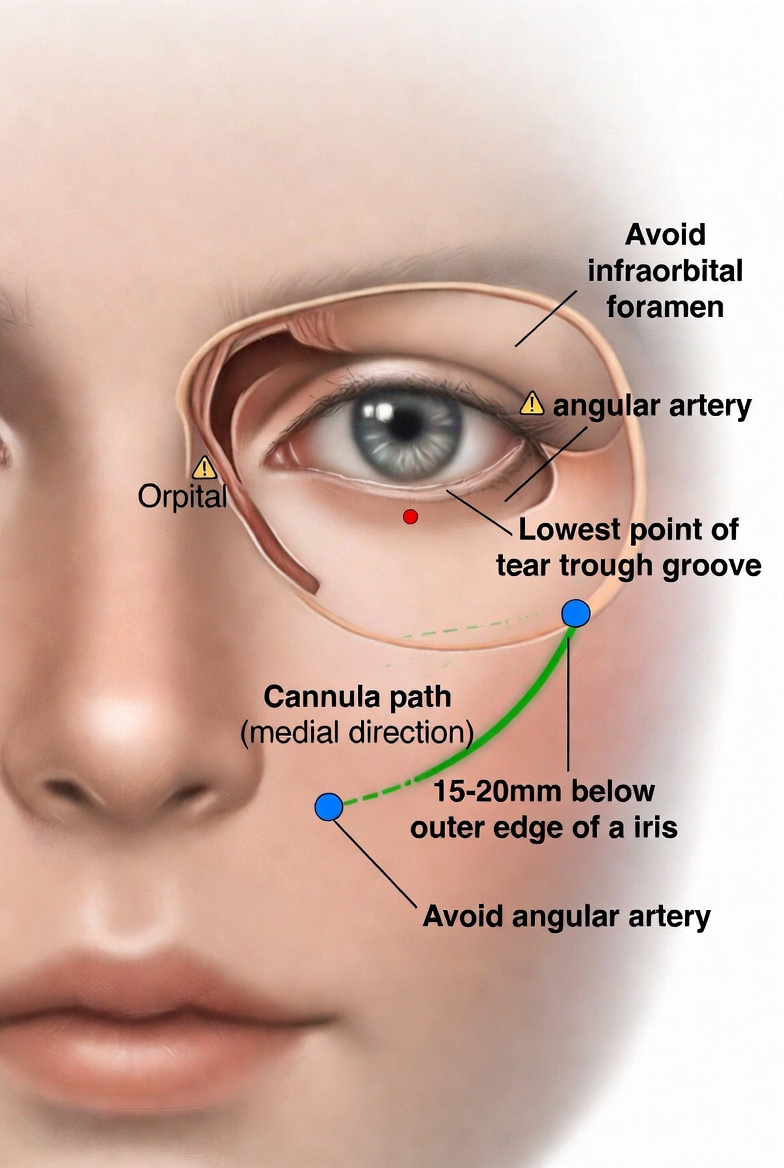
View attachment 5057828


Step 2 — Create entry point
Stretch the skin at the entry point with your non-dominant hand. 25-gauge sharp needle, firm puncture at 45 to 90 degrees. One clean puncture. Entry point on the cheek, not the lower eyelid. Small drop of blood is fine but wipe with alcohol pad.
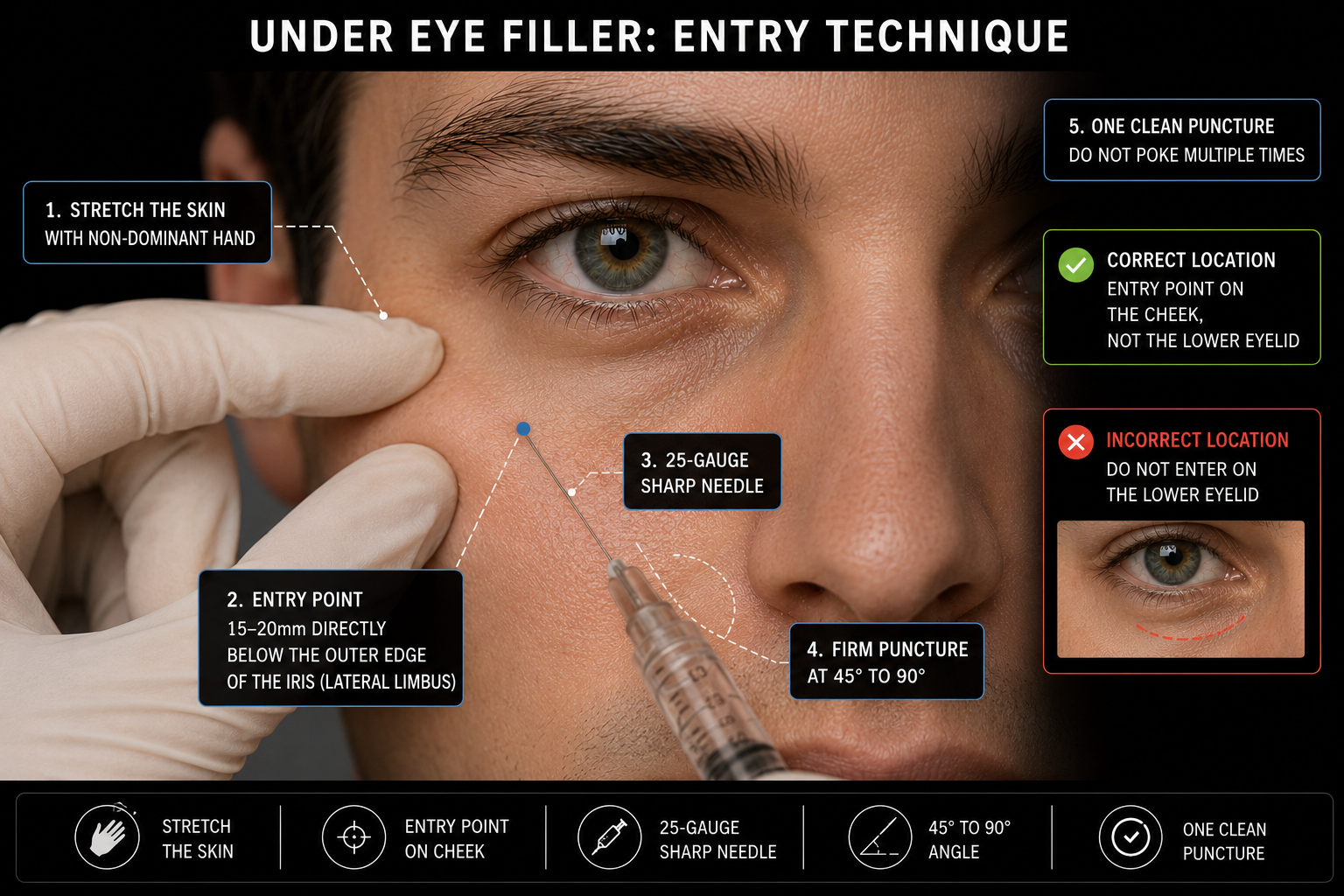
View attachment 5057856


Step 3 — Insert cannula
27-gauge blunt cannula attached to filler syringe. Stretch entry point skin to keep the hole open. Insert at 30 to 45 degrees then flatten the angle to nearly parallel with the skin surface. Travel supraperiosteally and just above bone. You feel slight resistance through the orbicularis and a give as you enter the sub-orbicularis plane. Cannula scraping against bone means you're at the right depth. Advance slowly toward the inner corner of the eye, below the tear trough groove.
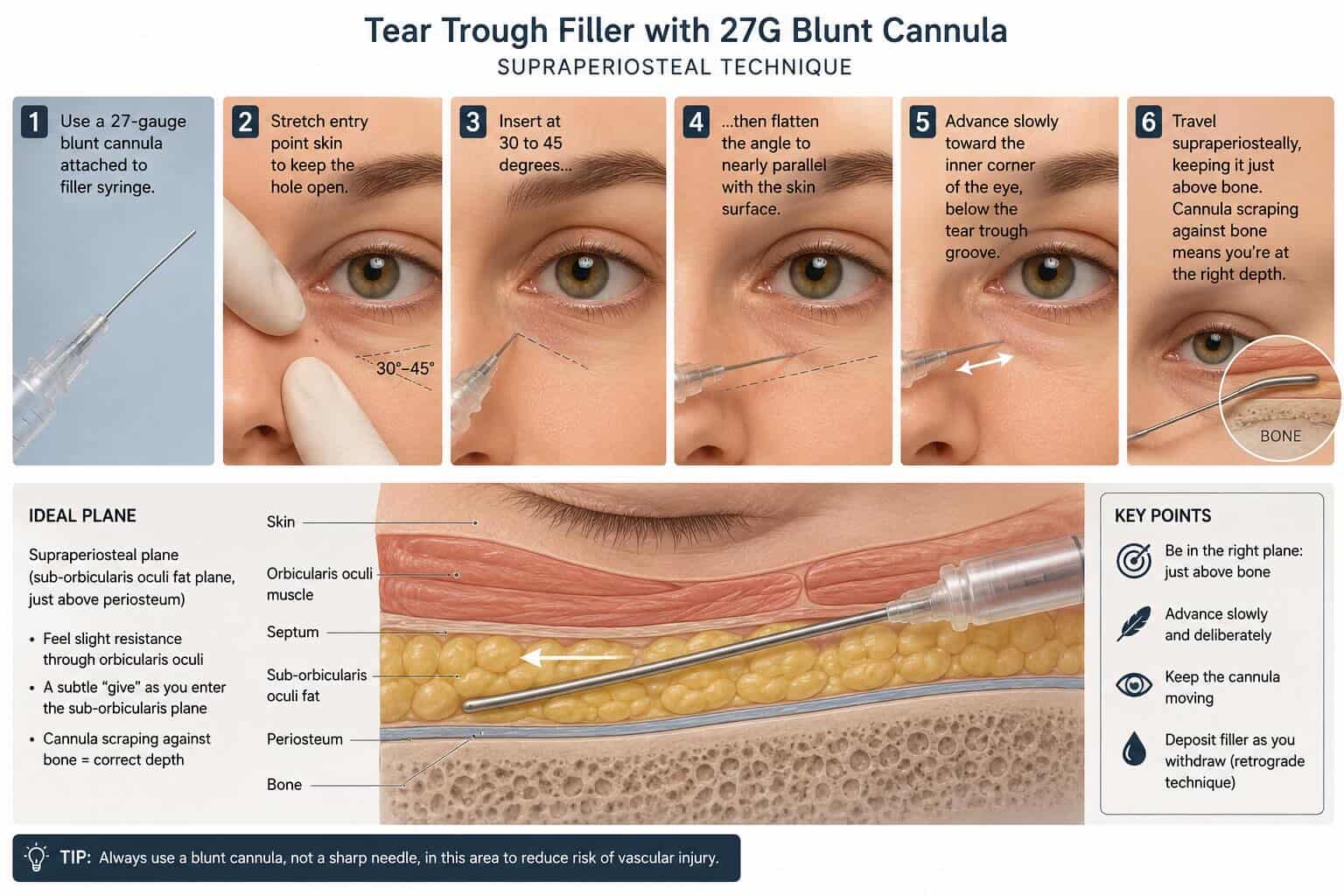
View attachment 5058166


Step 4 — Aspirate first
Before releasing any product, pull the plunger back. Blood in the syringe means you're in a vessel. Withdraw immediately, apply pressure for 2 minutes, don't inject from that entry point again. Move to the other eye and return with a fresh cannula from a slightly different entry location.
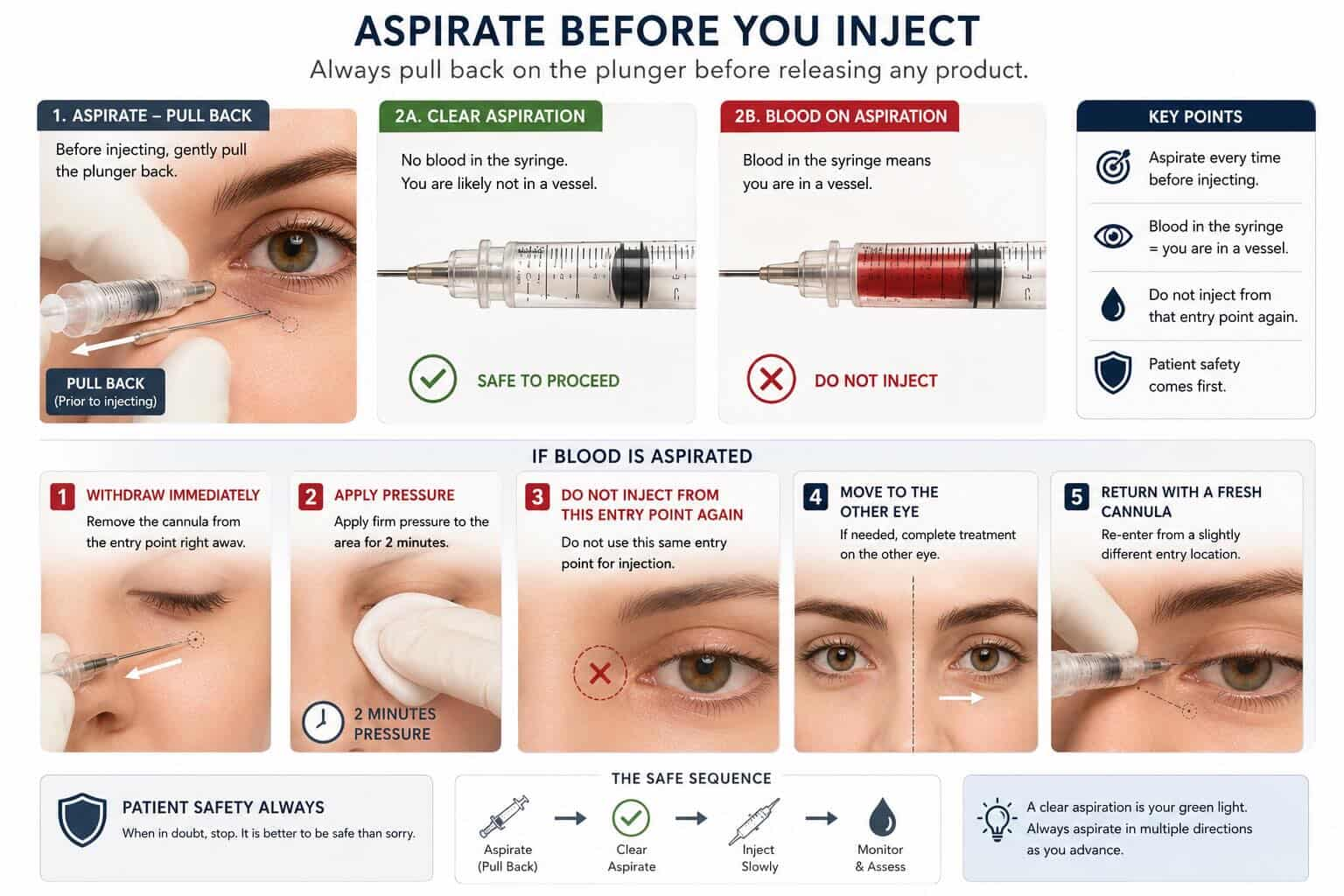
View attachment 5058179


Step 5 — Retrograde linear threading
Cannula at its deepest point medially near the inner corner. Begin slowly pressing the plunger while simultaneously withdrawing at a steady even pace toward the entry point. Product deposits as a thin continuous thread as you withdraw. Even pressure, smooth withdrawal with thin column along the rim, not a blob. Volume per pass: 0.1 to 0.2ml max. Start with 0.1ml and assess before adding more.
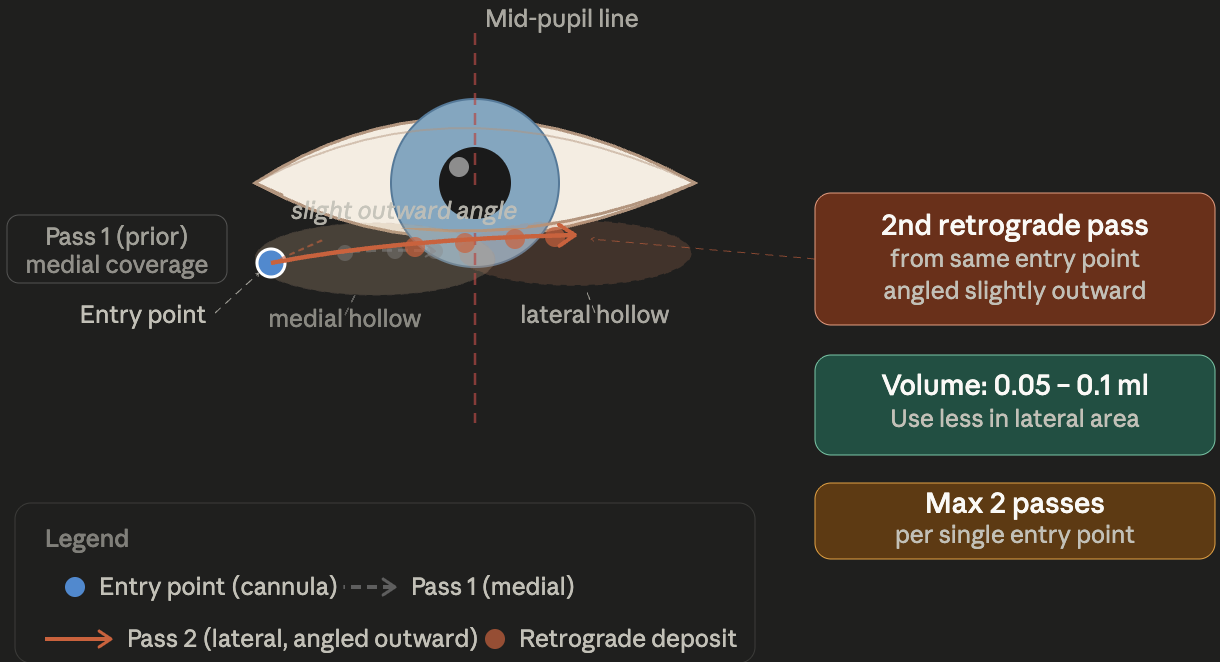
View attachment 5058325


Step 6 — Lateral fan if needed (Class 2 only)
If hollow extends laterally past mid-pupil, readvance from same entry point angled slightly outward. Second retrograde pass covering the lateral area. Use less here like 0.05 to 0.1ml. Maximum two passes from one entry point.

Step 7 — Assess and massage
Remove cannula. Gentle pressure on entry point for 30 seconds. Sit upright and look in natural light. Any lumps felt then gentle circular massage with clean finger. Check specifically for skin blanching anywhere for white patches that don't resolve in 30 seconds mean possible vascular compression.
Wait 5 minutes and reassess the first side before moving to the other eye.

Step 8 — Other eye
Fresh cannula. New entry point same location on the other side. Match volume exactly to what you used on the first side. Always err toward less so you can add at 2 weeks, you cannot easily remove immediately.

Step 9 — Aftercare
Cold compress (wrapped, not bare ice) for 10 minutes. No makeup for 24 hours. No alcohol, exercise, or heat for 48 hours. Sleep slightly elevated the first night. Don't massage after the first hour. Expect some swelling and possible mild bruising for 2 to 5 days. Final result at 2 weeks around is noticed.

Most DIY attempts go wrong because people use too much. This area needs far less product than anywhere else on the face. Overfilling creates a puffy pillow look that sits there for months and requires hyaluronidase to fix.

Session 1:
0.1ml per side. Total 0.2ml. Test session. You will probably not see a dramatic result. Assess at 2 weeks.

Session 2 (minimum 2 weeks later):
Add up to 0.15ml per side if genuinely needed. Cumulative max after two sessions: 0.25ml per side.

ceiling:
Never exceed 0.3ml per side total across all DIY sessions. If your hollowing needs more than that, the problem is structural.

vascular occlusion:
Signs: skin blanching white that doesn't resolve in 30 seconds, skin going mottled or grey or purple, severe pain out of proportion to the procedure, any change in vision including blurring or darkening. If any of these happen: stop injecting. Inject hyaluronidase immediately into the affected area then reconstitute 1500iu vial with 2ml saline for 750iu/ml, inject 0.2ml (150 units) directly into the blanched zone and surrounding tissue. Apply warm compress then Take 325mg aspirin.

Tyndall effect (blue discoloration):
Filler placed too superficially. Not dangerous but looks bad. Hyaluronidase 15 to 30 units injected directly into the blue zone in small aliquots. Resolves within 24 to 48 hours.

Persistent lump:
Wait 2 weeks as most resolve with swelling. Persistent lump at 2 weeks gets hyaluronidase 15 units per side directly into it. Reassess at 48 hours.

Full dissolution protocol:
Reconstitute 1500iu hyaluronidase with 2ml bacteriostatic saline giving 750iu/ml. Draw up appropriate volume in insulin syringe. Inject small amounts (0.02 to 0.05ml per puncture) directly into the filler deposit across multiple punctures. For full dissolution of undereye filler: 15 to 75 units per side. Results in 24 to 48 hours. Wait minimum 4 weeks before re-injecting as residual hyaluronidase can break down freshly placed filler if you go back too soon.

——————————————————————————————

8. INFRAORBITAL RIM IMPLANTS COSTS

Solid silicone implants placed directly on the infraorbital rim bone. The most direct structural correction available for undereye hollowing and a negative orbital vector as you are physically augmenting the bony architecture, not masking the problem with volume. Unlike filler which is temporary and only addresses soft tissue, implants permanently correct the vector. They're typically combined with lower blepharoplasty for the best full eye area result.


Off-the-shelf implant designs are not inferior to custom implants for most people. The Flowers infraorbital rim implant is a well-established design with a long clinical track record and it's appropriate for the majority of symmetric cases. Custom implants are specifically for patients with significant asymmetry between sides or unusual anatomy that a standard design can't accommodate. The push toward custom-only is partly surgeon preference and partly commercial as custom implants cost significantly more and have higher margin.


Global Costs

USA:
$6,000 to $15,000. Flowers off-the-shelf designs at the lower end. Custom CT-derived implants from Eppley, Taban, Isaacs at $8,000 to $15,000+.
UK:
£5,000 to £9,000. Surgeons with specific experience in this procedure are rare outside London.
Western Europe:
€5,000 to €10,000. Belgium, Netherlands, Germany, Spain have experienced craniofacial surgeons doing this.
Turkey (Istanbul):
$3,000 to $6,000 all-in with hotel and transfers. Verify that the specific surgeon has done infraorbital rim implants specifically — not just cheek or chin work.
South Korea (Seoul):
$4,000 to $8,000. Often combined with canthoplasty and lower bleph as a full eye area package. VAT refund 7 to 8% at airport for foreign patients.
Thailand (Bangkok):
$3,500 to $7,000 at JCI hospitals.
Mexico:
$3,000 to $6,000. Mexico City and Monterrey over Tijuana for this level of work.

——————————————————————————————


9. MIDFACE MASK IMPLANT


Reference thread on this: The Holy Grail of Facial Aesthetics — How to Simulate Lefort III Results with the Midface Mask Implant


The custom midface mask implant covers the entire upper midface skeleton which is from the infraorbital rims down to just above the upper teeth. Think of it as a single unified implant that simultaneously augments all of the following : the infraorbital rims, the malar eminences (cheekbones), the paranasal region (the area around the base of the nose), and the anterior maxilla. That coverage is why it's called a mask. the footprint literally looks like the upper portion of a face mask on 3D imaging.

View attachment 5058644

The effect is described in the surgical literature as Lefort III-like but without the occlusal movement. Meaning it pulls the entire midfacial skeleton forward in one coordinated augmentation, mimicking the aesthetic outcome of a full midface advancement osteotomy without actually cutting and moving bone. The infraorbital rims project forward correcting the negative vector, the cheeks project forward, the paranasal area fills out, the entire midface depth and width changes. For someone with true generalized midface hypoplasia this is the procedure that actually addresses the whole problem rather than chasing individual zones with separate implants.

Because the infraorbital nerve passes through the infraorbital foramen in the middle of this zone, the implant is designed as three pieces: bilateral infraorbital-malar segments and a lower maxillary segment that crosses under the nasal base. Each piece is designed around the nerve pathway to prevent compression. When properly placed there should be no permanent nerve damage, though patients should expect some temporary numbness of the upper lip and side of the nose from nerve stretching during implant seating which recovers fully.
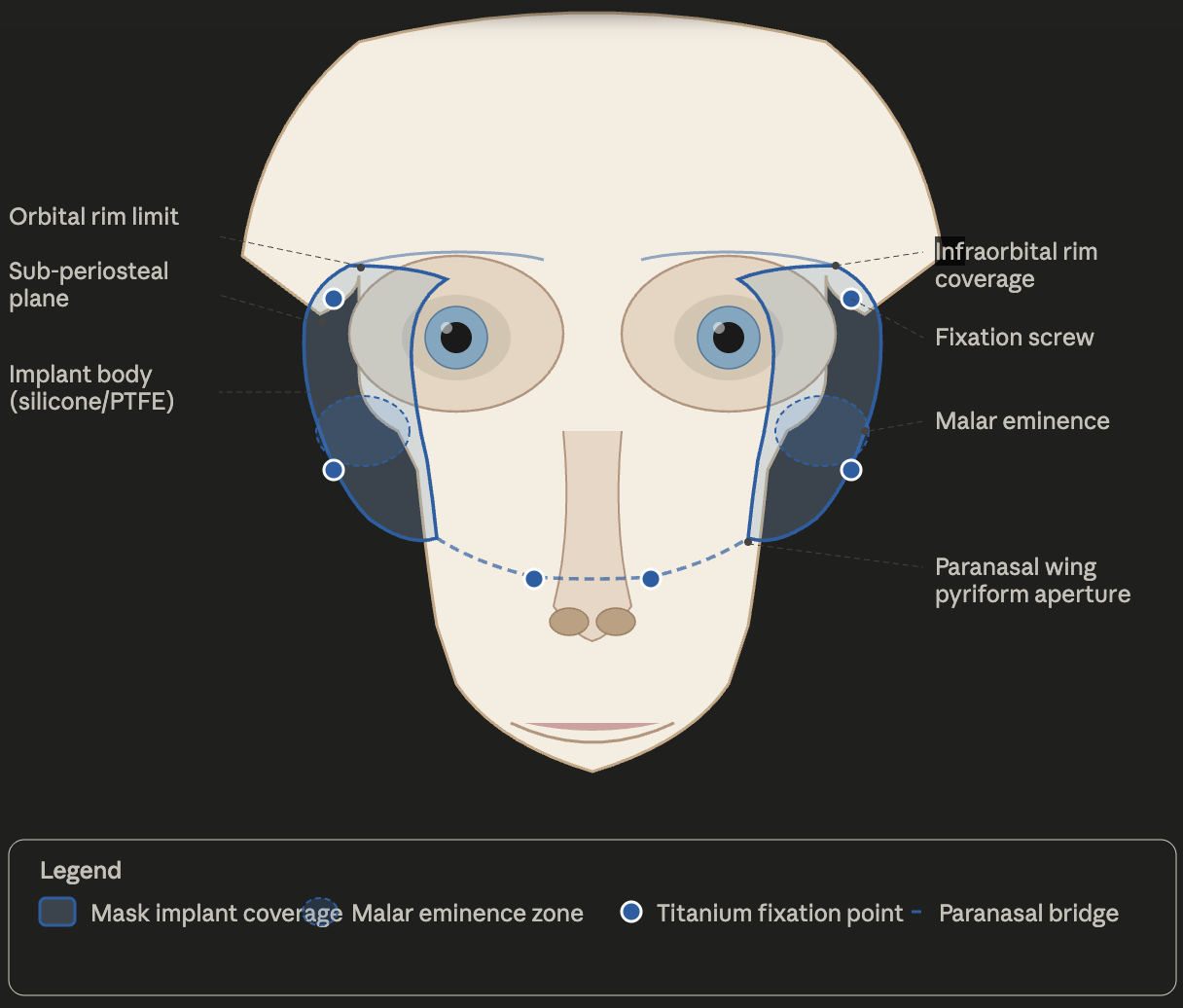
The limitation with doing a cheek implant here and a separate infraorbital rim implant there and a separate pyriform implant somewhere else is that you get disjointed augmentation with visible transitions between the zones. Each implant has edges. Where one implant ends and another begins there's a potential step-off or contour irregularity that shows through the overlying soft tissue. The more implants you stack the more complex the revision situation if anything needs to be adjusted.
View attachment 5062790

The midface mask implant solves this by creating one continuous augmentation surface across all zones simultaneously. The transitions between the infraorbital rim, malar eminence, and paranasal regions are built into the implant design itself and are smooth by design rather than approximated by placement of separate pieces. The clinical result looks more natural and cohesive because it is more natural and it follows the actual anatomy of the midfacial skeleton as a unified structure rather than addressing it as isolated landmarks.

There's also a case documented in the surgical literature specifically for patients who had a Le Fort I osteotomy that moved the lower maxilla but left the upper midface consisting of the infraorbital rims and zygomaticomalar complex untouched and still recessed. This is a known limitation of Le Fort I: it addresses the occlusal level but doesn't move the infraorbital rim. A custom infraorbital-maxillary-malar implant placed after a Le Fort I creates what surgeons describe as a modified Le Fort III effect as both the lower and upper midface are now addressed, combining what surgery did with what the implant adds.
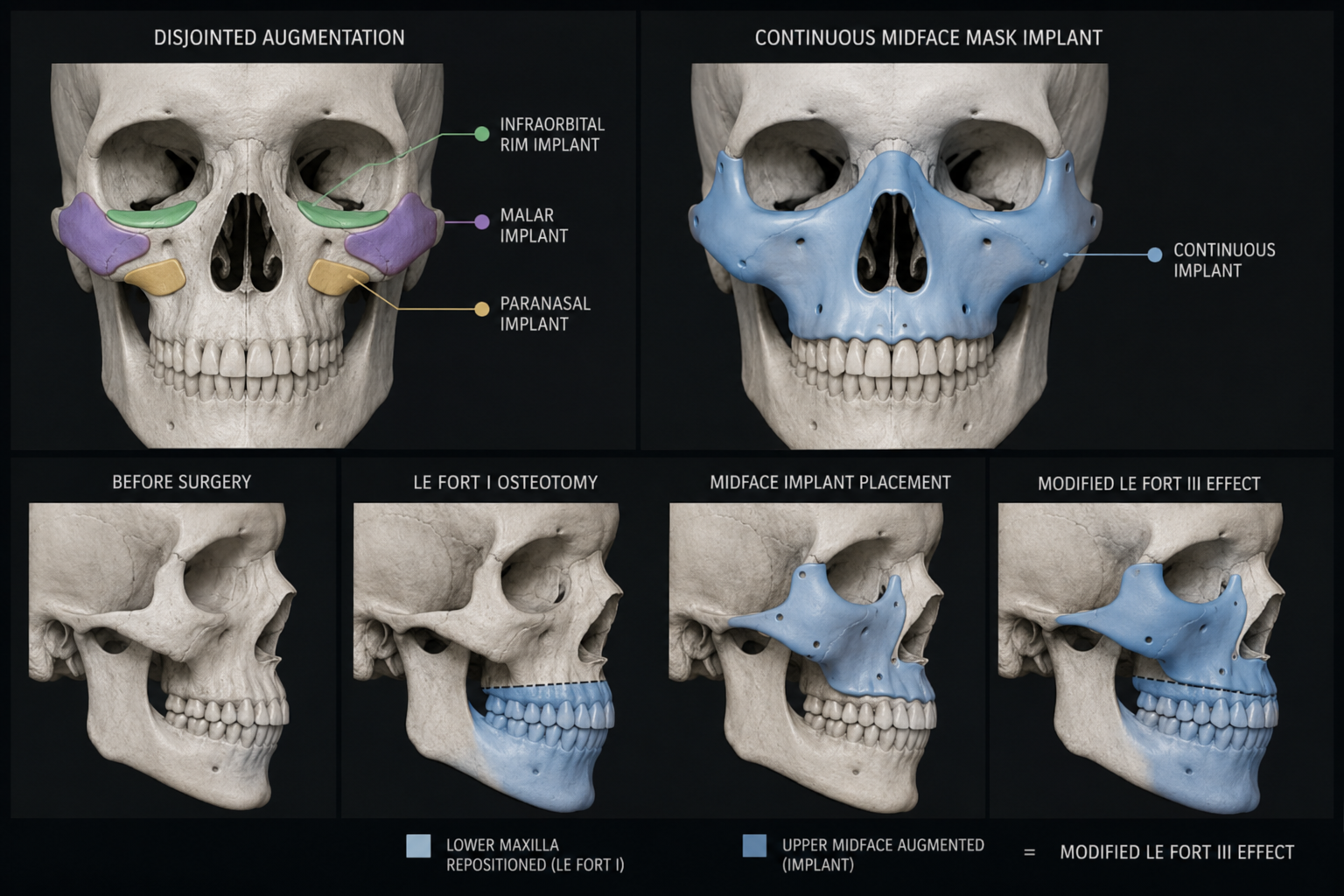
The midface mask implant is appropriate for someone with true generalized midface hypoplasia and not just undereye hollows, not just flat cheeks, but the full midface complex being recessed including the infraorbital rims, malar eminences, and paranasal area. If you look at your profile and everything from your lower eyelid to your upper lip sits behind the plane of your nose tip and forehead, you are probably in this category. If only specific zones are deficient, targeted implants or filler are more appropriate.


The procedure is not appropriate if your occlusion needs to change and if you have a malocclusion that needs orthognathic surgery, that needs to be addressed before or simultaneously with any midface implant work, not replaced by it. The midface mask implant advances the skeletal contour without moving the teeth or changing the bite. If the bite is off, that's a separate problem requiring orthognathic surgery.

Cost
$6,000 to $15,000 depending on surgeon and whether it is standalone or combined with other procedures. For context: a Le Fort II or III osteotomy runs $30,000 to $60,000 and is practically inaccessible for purely aesthetic indications. The midface mask implant achieves a comparable aesthetic effect at 20 to 50% of that cost. This is one of the best cost-to-outcome ratios in all of facial surgery for the right candidate.


Where to find surgeons who specifically do this
Dr. Barry Eppley at Eppley Custom Facial Implants in Indianapolis is the most documented surgeon in the English-language literature for this specific procedure. His case studies are publicly available on exploreplasticsurgery.com and document outcomes across multiple patient types including men with generalized midface hypoplasia. In Europe, craniofacial units in Belgium and the Netherlands have surgeons experienced with comprehensive midface implant design. In South Korea the Gangnam complex surgery market has surgeons comfortable with multi-zone midface implants. As with the infraorbital rim implant, verify specifically that the surgeon has documented experience with full-coverage midface mask implants — not just cheek or malar implants in isolation.

his website : eppleyplasticsurgery.com

——————————————————————————————

10. LE FORT OSTEOTOMY — WHEN AND WHY

The Le Fort osteotomies are the actual skeletal solution for severe midface recession. Le Fort I moves the maxilla at the occlusal level and changes the teeth and lower midface position but critically does not move the infraorbital rims, which is why it often leaves the upper midface still recessed after surgery. Le Fort III moves the entire midface including the orbital rims forward and is the most complete correction available.
View attachment 5062824


Global Costs

USA:
$20,000 to $40,000 for Le Fort I. Modified Le Fort III $30,000 to $60,000+ at major craniofacial centers.
UK:
£12,000 to £25,000 private. NHS may cover with functional indication.
Western Europe:
€10,000 to €25,000. Spain and Eastern Europe more competitive at €10,000 to €15,000.
Turkey (Istanbul):
$6,500 to $12,000 at accredited hospitals.
South Korea (Seoul):
$8,000 to $18,000. Korea performs among the highest annual volume of orthognathic surgery globally.
Thailand (Bangkok):
$9,500 to $15,000 at JCI hospitals.
Mexico:
$8,000 to $15,000. Mexico City university-affiliated maxillofacial departments.


The Le Fort I Limitation and Why Many Patients Need More
Le Fort I advancement moves the lower midface consisting of teeth, lower cheeks, nose but it does not move the infraorbital rims. In patients where the midface deficiency extends all the way up to include the orbital rims, a Le Fort I leaves the upper midface still recessed after surgery. The patient sees improvement in their bite and lower face but still has a negative orbital vector and hollow undereyes. Opting for a LE FORT III is best here.
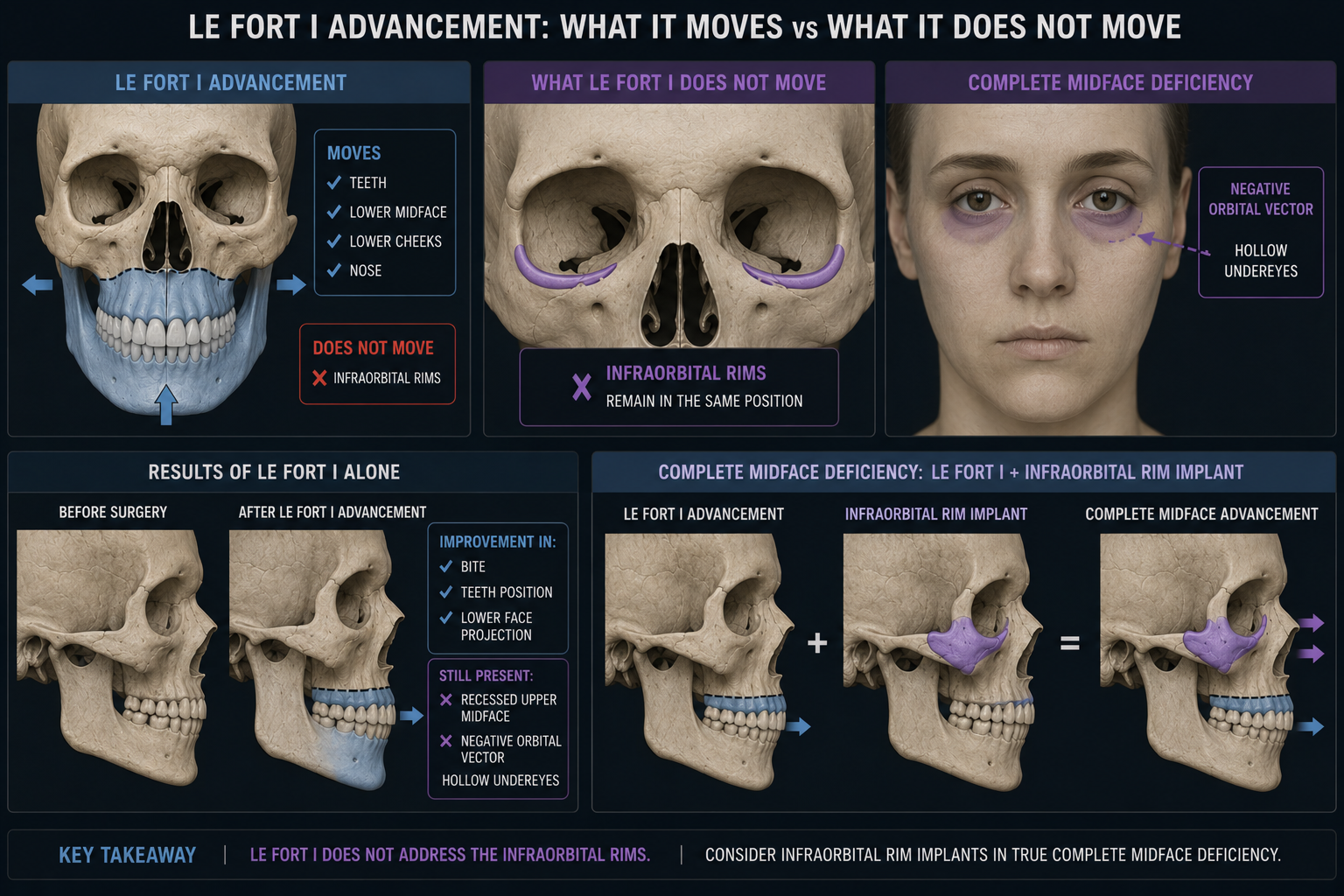
View attachment 5062819


——————————————————————————————

11. SURGEON TIERLIST

The surgeons listed here are the ones with documented, verifiable track records specifically for this procedure and not general plastic surgeons who have done one or two of these, but specialists who have built a reputation specifically around periorbital and midface skeletal surgery. Tierlists cover surgeons globally, then clinics by country, then countries overall.


Ranked specifically on documented case volume, technical specificity for this procedure, published research contribution, and real patient outcome track record. Not on general reputation as a plastic surgeon.

S TIER — The absolute best, would travel anywhere for these

Dr. Barry Eppley
Location:
Eppley Plastic Surgery, 12188-A North Meridian St Suite 310, Carmel (Indianapolis), Indiana, USA
Website:
eppleyplasticsurgery.com and eppleycustomfacialimplants.com
Approximate cost:
Infraorbital rim implants (combined infraorbital-malar) around $6,500. Midface mask implant $8,000 to $12,000. Custom jaw, cheek, full facial packages vary. Virtual consultation available.
Why S tier:
Eppley is probably the single most documented surgeon in the English-language literature for custom facial implants including infraorbital rim, midface mask, and combined periorbital work. His blog at exploreplasticsurgery.com contains hundreds of case studies with full before/after documentation across every facial zone. He developed the semi-custom infraorbital-malar implant approach and has the deepest public case archive of anyone doing this procedure. He uses titanium micro-screw fixation for long-term positional stability. His pricing is also significantly lower than the Beverly Hills surgeons doing comparable work.
In his own words on infraorbital implants vs fillers:
"In the treatment of infraorbital rim deficiency, the three treatments are synthetic injectable fillers, injected fat and implants. Each has their own advantages and disadvantages. But none of them are perfect nor is one method best for all patients. Each case must be considered separately and the magnitude of the defect considered in the treatment selection." He also notes that fillers should be used as a trial method first to assess whether soft tissue volumization gives the desired effect before committing to implants.
On custom vs off-the-shelf:
"A semi-custom approach allows me to select an infraorbital-malar implant from a variety of custom ones that have been made for other patients. Given the shape of this area of the facial skeleton a semi-custom implant can be a more cost-effective method that fits fairly well." Worth knowing that he actually offers this more affordable semi-custom option for appropriate cases.

Dr. Mehryar (Ray) Taban
Location:
9735 Wilshire Blvd Suite 319, Beverly Hills, CA 90212, USA. Also Santa Barbara.
Website:
tabanmd.com — Phone: (310) 278-1836
Approximate cost:
Infraorbital rim implants $8,000 to $15,000 depending on complexity and whether combined with canthoplasty, blepharoplasty, or orbital decompression. Full periorbital transformation packages can run higher.
Why S tier:
Taban is double board-certified by ASOPRS (American Society of Oculofacial Plastic and Reconstructive Surgery) and the American Board of Ophthalmology, and is also an Assistant Clinical Professor at UCLA. He is the go-to surgeon for complex periorbital work that combines infraorbital rim implants with canthoplasty, lower eyelid retraction repair, and orbital decompression in a single operation. His patient gallery at tabanmd.com contains an extensive archive of before/after cases documenting vector correction and eye shape transformation. He uses the transconjunctival approach with suture fixation rather than screws, preferring to avoid metal hardware near the orbit. His specific expertise in oculoplastic surgery means he understands the lower eyelid mechanics in a way that most plastic surgeons simply don't.
On what he actually does for negative vector patients:
His documented approach for negative vector patients often combines infraorbital rim implant placement with lower eyelid retraction correction and canthoplasty in a single operative session by addressing the bone, the lid position, and the canthal angle simultaneously. This is significantly more ambitious than what most surgeons offer and is appropriate for patients whose eye area problems involve all three components.
Real patient review (documented on RealSelf):
One patient with extensive knowledge of maxillofacial surgery wrote: "When it comes to the periorbital region he IS the best in the world. Through canthoplasty, tear trough implants on the orbital rim, lower lid retraction, orbital decompression, and slight lowering of the upper eyelid, I now have hooded eyes, a sweeping effect, a high lateral canthus position, and a lower lid so high it likely won't descend for decades."

A TIER — Elite surgeons, genuinely excellent, specific strengths noted

Dr. Michael Yaremchuk
Location:
Massachusetts General Hospital, Division of Plastic Surgery, Boston, MA, USA
Website:
dryaremchuk.com
Approximate cost:
$10,000 to $18,000 for infraorbital rim and midface implant work. As a Harvard-affiliated craniofacial surgeon the pricing reflects his academic institution and elite reputation.
Why A tier:
Yaremchuk is the academic foundation of this entire field. He literally wrote the original peer-reviewed paper on infraorbital rim augmentation published in Plastic and Reconstructive Surgery in 2001 which is still cited in almost every academic article on this procedure. He also designed specific implants for this procedure. His clinical background is craniofacial surgery at one of the top hospitals in the world. His research on how the aging facial skeleton changes the orbital vector relationship is the most cited work in this space. The reason he's A rather than S is purely accessibility as academic hospital pricing is steep, his focus is broader than just aesthetic cases, and he's harder to get to.
In his own published research:
"In patients with recessive infraorbital rims, alloplastic augmentation of the infraorbital rims makes the eyes appear less prominent and improves appearance. Augmentation of the infraorbital rim and resuspension of the cheek soft tissues can have a rejuvenating effect in properly selected patients." His 3D reconstructions comparing youthful and aged orbits shows how an infraorbital rim implant placed on the aged skeletal anatomy transforms it back toward the youthful contour are the clearest visual demonstration of what this procedure actually achieves.
Real patient quote:
"I had an under the eye problem and the only solution I thought there was, was cheek implants. Instead with his orbital rim implant he fixed the problem perfectly. In terms of surgical skill and experience, Dr. Yaremchuk is pretty much as good as it gets."

Dr. David Isaacs
Location:
Beverly Hills, CA, USA
Website:
drdavidisaacs.com
Approximate cost:
$10,000 to $15,000 for infraorbital rim implants. Uses 3D Accuscan imaging for custom implant design.
Why A tier:
Dual-fellowship trained oculofacial plastic surgeon in Beverly Hills who specifically markets and documents infraorbital rim implant work. Uses a transconjunctival approach and custom 3D Accuscan imaging to ensure implant fit. Strong documented case gallery. Appropriate for patients who want a Beverly Hills-based alternative to Taban with similar oculoplastic training background. His stated approach on fitting is that the procedure should always be anchored securely while blending naturally with facial contours, and that careful technique avoids overcorrection while preserving the natural lower eyelid to cheek transition.

B TIER — Solid options, less documented but legitimate

Korean Gangnam Oculoplastic Surgeons (as a group)
Location:
Gangnam and Apgujeong districts, Seoul, South Korea
Approximate cost:
$4,000 to $8,000 for infraorbital rim implants. $920 to $1,530 for undereye fat grafting. Often packaged with canthoplasty and lower blepharoplasty.
Why B tier:
Korean surgeons as a group represent excellent value and high volume, particularly for canthoplasty, lower blepharoplasty, and combined eye area transformation packages that include infraorbital rim work. The sheer case volume in Seoul means technique refinement that's genuinely hard to match elsewhere. The reason they're B rather than A as a group is variability as you need to research the specific surgeon rather than just the clinic, the anesthesiologist issue is real (verify presence before booking), and the documented English-language case literature for this specific procedure is less accessible than the US surgeons. The best Korean surgeons doing this work are at the same technical level as S tier but the challenge is identifying them.

Istanbul Craniofacial Surgeons (JCI-accredited hospitals)
Location:
Acibadem, Memorial Hospital Group, Medipol Mega, Liv Hospital, Istanbul, Turkey
Approximate cost:
$3,000 to $6,000 for infraorbital rim implants all-in. $1,450 to $2,900 for fat grafting.
Why B tier:
Turkey has the best cost-to-outcome ratio globally for this procedure when you find the right surgeon. The infrastructure at JCI hospitals is genuinely high quality, ISAPS-certified surgeons in Istanbul are operating at a legitimate international standard, and the all-inclusive packages make the logistics straightforward. The B tier placement reflects the same variability issue as Korea as surgeon-specific due diligence is essential, and the English-language documentation of individual surgeon case archives is harder to evaluate than the US names listed above.

C TIER — Proceed with extreme caution or avoid for this specific procedure

General plastic surgeons without specific infraorbital rim implant experience, regardless of their general reputation. The procedure is technically demanding enough and rare enough that a surgeon who does it once or twice a year and otherwise sticks to rhinoplasties and breast work is not an appropriate choice.

S TIER COUNTRIES for this specific procedure

USA (specifically Indianapolis and Beverly Hills)
Home to the most documented and accessible specialists for infraorbital rim and midface implants globally. Eppley in Indianapolis gives you the most documented case archive and competitive pricing for the US market. Beverly Hills gives you Taban and Isaacs with the deepest oculoplastic expertise. The US is S tier not because it's cheapest as it clearly isn't nigga :feelswhy: but because the surgeon-specific documentation and research output here is the most accessible for doing pre-operative due diligence, and the legal/medical infrastructure for complications and revision is the most robust.

A TIER COUNTRIES

South Korea (Seoul — Gangnam/Apgujeong)
Best in the world for combined eye area transformation packages, fat grafting, and any procedure that combines periorbital structural work with canthoplasty and blepharoplasty. Case volume is unmatched globally. The challenge is verification When you find the right surgeon the outcomes here are comparable to the best in the world at 40 to 60% of US pricing.

Turkey (Istanbul — JCI hospitals)
Best value globally for filler, fat grafting, and implant work when you vet properly. The cost savings versus the US and UK are dramatic. The due diligence process described in Section 12 is non-negotiable though as the variation between top-tier and mid-tier providers in Istanbul is significant.

B TIER COUNTRIES

Western Europe (Belgium, Netherlands, Spain — Barcelona/Madrid)
Strong craniofacial surgery scenes in Belgium and the Netherlands specifically. Spain has experienced surgeons in Barcelona and Madrid who do periorbital and midface implant work. Pricing sits between Turkey and the US. Good option for European patients who don't want to travel to Turkey or Korea.

UK (London specifically)
Strong regulatory framework and high-quality surgeons in London. The issue for this specific procedure is the same as everywhere but surgeons with documented specific experience in infraorbital rim implants are rare. Outside London the landscape thins out considerably. Pricing is high for what you get relative to Istanbul or Seoul. Better for filler and blepharoplasty than for complex implant work.

Thailand (Bangkok — JCI hospitals)
Strong for fat grafting and combined lower eyelid work at JCI hospitals. The specific infraorbital rim implant expertise is thinner here than in Korea or Turkey. Good value for procedures in the less specialized range like filler, fat grafting, blepharoplasty. Bumrungrad in particular has internationally trained surgeons who are genuinely excellent. For implant work specifically, less reliable than Seoul or Istanbul.

C TIER COUNTRIES — Use with heavy caution for this procedure

Mexico (Tijuana specifically), Eastern Europe outside major medical centers, and anywhere where infrastructure for managing complex periorbital complications is not immediately accessible. This isn't about general surgical quality and it's about the specific requirement that if something goes wrong with an infraorbital rim implant near the globe, you need to be in a facility that can manage it immediately. Mexico City and Monterrey are a different story and sit closer to B tier.

The surgeon tierlist above is primarily for implant and surgical procedures. For filler specifically, the calculus is somewhat different because the skill is in injection technique rather than operative surgical training, and the reversibility with hyaluronidase means mistakes are less catastrophic than with surgery.

Best market for filler value:
Istanbul. Same brand-name product, 60 to 75% cheaper, experienced injectors who do high volume. Single best destination for filler purely on cost and quality balance or you could just go DIY.

Best market for technique:
Seoul. The periorbital filler technique refinement in Gangnam clinics, including emerging ultrasound-guided tear trough work, is as advanced as anywhere globally.

What to look for in any injector anywhere:
They use a blunt cannula not a sharp needle in the tear trough. They can describe their entry point, injection plane, and product selection specifically. They have before/after photos of tear trough cases specifically not just general filler work.

——————————————————————————————

12. SCIENCE BACKING AND SOURCES

Everything in this guide is sourced from published research, peer-reviewed clinical literature, or documented surgical case studies. Links below.

Anatomy and Aging
PubMed — Infraorbital Rim Augmentation in Orthognathic Surgery (Le Fort I limitation documentation)
Aesthetic Plastic Surgery — Decoding Periorbital Aging: Multilayered Analysis (2025 — orbital cavity expansion with bone resorption, globe volume decrease)
ScienceDirect — Facial Bone Aging: An Update and Literature Review 2020-2023 (region-specific bone loss affecting orbital rims and maxilla)
Aesthetic Surgery Journal — Infraorbital Hollow Rejuvenation: Contributions of Midface Volumization (ORL anatomy, vascular supply, etiology)


Filler Technique and Anatomy
PMC — Cadaveric Evaluation of Filler Behavior in Tear Trough (University of Pennsylvania, 2023 — Volbella spreads across planes, Restylane-L stays as distinct mass at ORL)
PMC — Anatomical Filler Injection Techniques: Infraorbital Groove and Hollowness
PMC — Tear Trough Filler Using Three-Point Tangent Technique: Lessons from 1452 Applications (2023)
PMC — Bridging the Gap: Alternative Injection Strategy for Medial Infraorbital Region (lateral entry point, ultrasound-guided approach)
MDPI — Anatomical-Based Filler Injection: Infraorbital Groove and Hollowness (2025 — tear trough ligament vs fibrotic connective tissue debate)
PubMed — HA Filler Effectiveness for Periorbital Region


Implants and Surgical Correction
PMC — Improvement of Infraorbital Rim Contour (Medpor vs alternative materials, surgical technique documentation)
Explore Plastic Surgery — Custom Midface Mask Implant Case Study (Eppley — three-piece design, Le Fort III-like effect)
Explore Plastic Surgery — The Midface Mask Implant for Aesthetic Augmentation (full design description and indication criteria)
Explore Plastic Surgery — Custom IMM Implant After Le Fort I Osteotomy (the Le Fort I leaves upper midface behind — implant completes it)
Explore Plastic Surgery — Negative Orbital Vector and Custom Infraorbital Implants: Case Study


Related Reading from org
The Eye Area Manual — comprehensive breakdown of the full eye area

——————————————————————————————


AI was used to fix grammatical errors
Over for softmaxxers like me :kys:
 
  • +1
  • Hmm...
Reactions: BigBallsHisty and kdev
That's a good job, my friend. How long did it take you to finish it?:(ditto):
ive been working on this for 2 weeks or so giving 2hrs+ daily on research and writing simultaneously
 
  • +1
Reactions: Atra, BigBallsHisty, zizslep and 1 other person
i love you bhaijaan

mirin the effort
 
  • Love it
Reactions: kdev
@Hernan yo check it out bhaisan :lul:
 
  • +1
Reactions: BigBallsHisty and Hernan
THE ONLY INFRAORBITAL GUIDE YOU'LL EVER NEED

——————————————————————————————


This thread has been in the works for a while.

The infraorbital rim, what it actually does, why it's responsible for many eye area problems, and every single option available to fix it. Everything in this guide is sourced from published research, clinical case studies, and real surgical documentation.


Related reading: The Eye Area Manual and The Holy Grail of Facial Aesthetics — How to Simulate Lefort III Results with the Midface Mask Implant


——————————————————————————————


TABLE OF CONTENTS


1. What the Infraorbital Rim Actually Is

2. How To Tell If Yours Is Deficient

3. The Orbital Vector and Why It Matters More Than You Think

4. The Anatomy Explained Properly - Ligaments, Fat Compartments, and Vascular Zones

5. The Three Classes of Infraorbital Hollowing

6. Non-Surgical Options

7. The Right Filler Technique

7B. DIY Undereye Filler

8. Infraorbital Rim Implants With Costs

9. Midface Mask Implant

10. Le Fort Osteotomy


11. Surgeon Tierlist and Recommendations

12. Science Backing and Sources


——————————————————————————————

1. WHAT THE INFRAORBITAL RIM IS

The infraorbital rim is a ledge of bone sitting directly beneath your eye socket. It's the bottom border of the orbit and it's the foundation that everything else sits on. Your fat pads, your lower eyelid, your skin rests here. When this bone projects well, all that tissue is properly supported and your undereye looks smooth, full, and defined. When it's recessed or underdeveloped, the tissue has nothing to rest on. It descends. You get hollows, shadow, and that wrecked permanently tired look no matter how much sleep you're getting. Because it's not sleep causing it. It's bone.

Here is a comparison of Bad vs Good infras

View attachment 5057276View attachment 5057277

Here's the number that puts it in perspective. On average the infraorbital rim sits about 3mm behind the surface of your cornea. Your brow bone at the top sits about 10mm in front of the cornea. That 13mm gap between upper and lower bony projection is what creates the deep-set look. When your infraorbital rim retrudes further back than average may it be whether from genetics or from the bone loss that happens as you age. Your globe looks relatively more prominent, the lower lid loses its anchor, and the whole undereye area looks sunken
View attachment 5057288

There's a research finding published in Aesthetic Plastic Surgery by Pessa et al. and separately confirmed in a 2025 multilayered periorbital aging analysis in Aesthetic Plastic Surgery journal showing that orbital cavity volume actually expands with age as the bone resorbs. The globe itself gets slightly smaller too. Both changes together create the sunken, enophthalmic look that older men develop hence the hollow orbit and shadowed undereye.

——————————————————————————————

2. HOW TO TELL IF YOURS IS DEFICIENT


Take a side photo or look at your face in true lateral view. Drop an imaginary vertical line straight down from the most forward point of your eyeball, what's called the corneal apex. If the bone and soft tissue under your eye sits clearly behind that line, you have a negative orbital vector. The clinical literature consistently uses this as the primary diagnostic criterion. The further behind that vertical plane your rim sits, the more deficient it is.
View attachment 5057307


The fat herniation test
Look directly upward in a mirror. If any bags or puffiness under your eyes get worse when you look up, that's herniated orbital fat pushing forward. Filler does not fix this. Filler in a herniated eye will make it look worse. That case needs lower blepharoplasty with fat repositioning.
View attachment 5057309


The malar mound test
Press upward gently on your cheekbone just under the eye. If a visible mound or puffiness appears underneath rather than the hollow improving, you have malar mound tendency. Adding filler in this setting makes the mound worse. This is a known complication of undereye filler in the wrong candidate. It's well-documented in the clinical literature and it's almost impossible to fully reverse without hyaluronidase.
View attachment 5057331

——————————————————————————————

3. THE ORBITAL VECTOR — WHY IT MATTERS MORE THAN YOU THINK

Positive orbital vector means your cheekbone and rim complex sits forward of your eyeball. The lower lid is fully supported, the lid-cheek junction is smooth, the eye looks deep-set and defined. Negative vector means your globe is the most forward structure in that zone as it protrudes past your cheek and rim. The lower lid has nothing to anchor it, eyes look slightly bulgy or round, the midface looks flat and withdrawn.
View attachment 5057372

The reason the vector discussion matters so much beyond just aesthetics. Guys spending money on canthoplasty with an uncorrected negative vector are wasting it. The whole mechanism of canthoplasty is lifting the outer corner of the lower lid and changing the tilt of the eye and that depends on having a stable bony ledge underneath the lower lid to hold the result long term. If that ledge is recessed, the lid migrates back down over months regardless of the quality of the surgical work.

There's also a finding worth knowing about that comes from published morphometric research comparing young and older faces. In younger patients the malar eminence, infraorbital rim, and pyriform aperture are all positioned anteriorly and the orbital aperture is relatively small and compact. In older patients all three of those landmarks have retrused posteriorly, the orbital aperture has expanded in area, and the inferior orbital rim has developed a different curvature pattern. The researchers note that implant designs targeting the skeletally deficient areas of older patients literally match the anatomy of what's been lost over time. This is why implants for the infraorbital rim look so natural when properly placed.

——————————————————————————————

4. THE ANATOMY

The clinical outcomes of everything done in this area like filler, fat grafting, implants are directly determined by understanding these structures. So its better to have a good grasp of things.

The orbicularis retaining ligament (ORL) and the tear trough ligament
The orbicularis retaining ligament is a series of fibrous attachments extending from the inferior orbital rim to the overlying skin. It defines the upper border of the sub-orbicularis oculi fat compartment (SOOF). The medial portion of the ORL is specifically called the tear trough ligament. This structure is what creates much of the tear trough deformity. It physically tethers the skin to the bone, creating a groove that descends as the surrounding tissue loses volume and descends with age. When you squint or frown you can often see the tear trough groove deepen temporarily because the muscular contraction tightens this tethering effect.
View attachment 5057387


The fat compartments that matter the most :
Below the orbicularis muscle sits the SOOF (the sub-orbicularis oculi fat). This compartment is bounded superiorly by the ORL and inferiorly by the zygomatic cutaneous ligament. Below and lateral to that is the deep medial cheek fat compartment which is where the structural cheek volume lives. In the superficial plane above the muscle are the superficial fat compartments the medial cheek fat, nasolabial fat, and a thin preseptal fat layer directly over the lower lid. Understanding which plane you're in during injection determines whether the result looks right or wrong. Filler placed in the wrong fat compartment doesn't just look suboptimal and it migrates in a direction determined by the anatomy of that compartment and can end up in a location that makes things look worse months later.

View attachment 5057396


The vascular danger zones and why this area is high risk
The infraorbital region is supplied by several arterial branches. The angular artery is branch of the facial artery that runs medially across the nasojugal groove and is one of the most commonly injured vessels during tear trough injection. The infraorbital artery exits the infraorbital foramen approximately 3cm lateral to the midline just below the orbital rim. The zygomaticofacial artery runs laterally. All of these sit in a vascular territory that communicates with the ophthalmic artery via the orbital septum. This is why vascular occlusion from filler in this area carries vision risk in a way that injections elsewhere on the face generally don't. The connection to the ophthalmic circulation is real and documented. A 2015 review of the world literature on filler-related blindness by Beleznay et al. identified the glabellar region and nasal area as highest risk.
View attachment 5057438

——————————————————————————————

5. THE THREE CLASSES OF INFRAORBITAL HOLLOWING

The groove is confined to the inner corner area. The rest of the rim still has reasonable support. This is the mildest presentation and it responds well to filler correctly placed. A good injector at the right depth can fix this in one session.

View attachment 5057501

The hollow has deepened and extended outward. Visible under the middle of the eye and sometimes toward the outer corner. Early volume loss in the central cheek becomes visible. Filler still works but placement has to cover multiple zones and single-pass medial technique leaves the lateral area still hollow. You need dual-plane treatment across two or three anatomical subzones.
View attachment 5057508

The hollow wraps around the entire rim. The lid-cheek groove is visible from every angle. This isn't just soft tissue loss anymore as the bone itself is genuinely deficient. Filler cannot build structure here because there's no skeletal platform for it to sit on. It just creates a puffy appearance without correcting the vector or the hollow. Class 3 is implant or fat grafting territory.

View attachment 5057516

——————————————————————————————

6. NON-SURGICAL (COPE)


THIS WHOLE SECTION EXCEPT FOR THE DEXA SCAN AND BODY ARE FOR COPERS WHO ARE AGAINST FILLERS AND HARDMAXES SO DNR THIS IF YOU ARENT ONE


Global Costs

USA:
GHK-Cu serum $20 to $60 per bottle. The Ordinary Buffet + Copper Peptides around $25. Prescription tretinoin via telehealth (Curology, AgelessRx) $20 to $40 per month.

UK:
GHK-Cu £18 to £50. Tretinoin via Dermatica or Skin + Me £20 to £30 per month.

Europe:
€20 to €55. Prescription tretinoin through a derm €30 to €60 per month.


The Full Protocol

Step 1:
Cleanse morning and night with a gentle non-stripping cleanser. The periorbital skin is some of the thinnest on the entire body so anything with high-pH foaming agents or sulfates irritates it and makes the area look worse over time.

Step 2 (Morning):
A few drops of GHK-Cu serum on damp skin around the undereye and midface. Use your ring finger as it naturally applies the least pressure then and tap gently rather than rubbing. Don't drag the skin. This matters more than most people think over months and years of cumulative mechanical stress.

Step 3 (Morning):
SPF 50+ over everything including the undereye. Non-negotiable as UV accelerates collagen breakdown in this region faster than almost anywhere else on the face because the skin here is so thin and has so little protective mass. Long-term sun exposure is one of the factors driving the skeletal resorption pattern in this area.

Step 4 (Evening):
Retinol after cleansing. Start at 0.025% three nights per week. Move to every other night in weeks five through eight. Nightly from week nine. Step up concentration to 0.05% then 0.1% over three to four months. Follow with a light moisturizer to buffer irritation around the periorbital zone.

Key rule:
GHK-Cu and retinol in the same session cancel each other out. GHK-Cu in the morning, retinol at night.

raw GHK-Cu powder:
Buy raw GHK-Cu powder from Peptide Sciences or BoS Research for around $10 to $15 per gram. Dissolve 0.5g into 100ml of water-based hyaluronic acid serum base in a dark glass dropper bottle. That's a 0.5% serum for a fraction of what any brand charges. Dissolves cleanly. Store refrigerated, use within 60 days, date the bottle.

Realistic expectations:
Noticeably better skin quality, thicker skin, reduced shadowing after 12 to 16 weeks of consistency. It is mitigation not correction. Class 1 can see real improvement from topicals. Class 2 and 3 need more than this but topicals are worth running alongside whatever else you're doing.

Cost
Free. DEXA scan $50 to $150 in the US, £30 to £80 in UK, €40 to €100 in Europe, $20 to $40 in Turkey and Thailand.

Why it matters and what to do
The periorbital fat pads are highly sensitive to overall body fat percentage. Drop below 10% body fat and those pads thin out dramatically, making the infraorbital hollow look significantly worse. A lot of guys notice their undereye area looks great at 14% and wrecked when they push down to 8% for summer. There's a sweet spot typically somewhere in the 12 to 17% range where facial fat is preserved without sacrificing overall body composition. It's individual based on genetic facial fat distribution. Get a DEXA scan at your leanest and at a moderate body fat, photograph yourself in consistent lighting at both, and compare. That gives you your actual threshold.

View attachment 5057563

Global Costs

USA:
$20 to $40 per month at 10g daily. BulkSupplements cheapest at $20 to $25.
UK:
£18 to £35. Bulk Powders and MyProtein both carry it.
Europe:
€20 to €40. Bulk Powders ships to most EU countries.


The Protocol

Step 1:
Hydrolyzed Type I and III collagen peptide powder specifically. Not gelatin. Not non-hydrolyzed collagen. The label has to say hydrolyzed collagen peptides or you're not getting the absorption the clinical studies are based on.

Step 2:
10g every morning in hot coffee or tea. Tasteless in most formulations. Dissolves completely in hot liquid.

Step 3:
500mg Vitamin C at the same time. Ascorbic acid is a required enzymatic cofactor in the collagen synthesis pathway. Without adequate circulating Vitamin C the production signal from the peptides can't complete properly. Most people skip this and then wonder why their results are mediocre.

Step 4:
Every single day for minimum 90 days before assessing. Collagen remodeling is slow. Most people see real change between weeks 8 and 16. Sporadic use produces nothing.

Step 5:
Photograph the undereye in the same lighting every four weeks. Subjective mirror assessment doesn't work for slow changes. Objective photos tracked over time are the only accurate way to evaluate this.

——————————————————————————————

7. THE RIGHT FILLER TECHNIQUE

The tear trough is not just volume loss. There's a fibrous structure. The tear trough ligament, the medial portion of the orbicularis retaining ligament is the one that physically tethers the skin to the orbital rim bone at the boundary between the thin eyelid skin and the thicker cheek skin. To lift the groove you need product placed below this structure at the supraperiosteal level so it pushes up against the tethering from underneath. Injectors who deposit product above the ligament in the superficial plane get a lump or ridge sitting on top of the groove without lifting it. That's the most common reason tear trough filler results look bad. The cadaveric study from the University of Pennsylvania published in Aesthetic Surgery Journal in 2023 confirmed that injection just above the periosteum produces the most anatomically precise placement along the orbital rim and critically showed that Restylane-L placed this way stays as a distinct mass along the ORL, while Volbella spreads more freely across anatomical planes due to its lower elastic modulus. This finding has direct implications for which product you use at which depth.

HA filler injected at the supraperiosteal level supports the undereye, reduces hollowing, and moves the orbital vector toward positive. Often combined with lower blepharoplasty when someone needs both structural and skin correction at the same time. The area around the infraorbital rim is highly vascular with multiple arterial branches communicating with the ophthalmic circulation

View attachment 5057605


Global Costs — Both Eyes

USA:
$1,000 to $2,500 total. Per syringe $600 to $1,500. ASPS national average around $684 per syringe.
UK:
£500 to £1,500. Harley Street at the top. Regional UK from £350 to £400 per syringe.
Western Europe:
€600 to €1,400. Spain and Eastern Europe more competitive at €350 to €800.
Turkey (Istanbul):
€250 to €450. Same brand-name filler, 60 to 75% cheaper. Highest ROI destination for this specific procedure.
South Korea (Seoul):
$300 to $600 at Gangnam clinics.
Thailand (Bangkok):
$200 to $500. JCI-accredited clinics only.
Mexico:
$300 to $700. Major cities with board-certified injectors.

——————————————————————————————

7B. DIY UNDEREYE FILLER FULL GUIDE

This covers the DIY approach. The undereye is the highest-risk filler site on the face due to the vascular anatomy described in Section 4. Know the emergency protocol before you start. Have hyaluronidase on hand.


You're a reasonable candidate if:
You have Class 1 or mild Class 2 hollowing. A groove with genuine volume loss but nothing puffy or herniated. Lower eyelid skin is taut when you pinch it gently. No loose or baggy eyelid skin. No bags that are worse in the morning. No bleeding disorders, autoimmune conditions, or active skin infection. You haven't had filler dissolved in this area in the past 8 weeks.

Stop here if:
You have puffy bags or visible fat herniation as filler will make this dramatically worse. Thin eyelid skin where veins are clearly visible. Significant laxity under the eye. Strongly negative orbital vector without structural support as filler will just look puffy without fixing the vector. You've had hyaluronidase used in this area in the last 8 weeks.

The filler
Soft, low G-prime HA filler designed for periorbital use. Do not use thick fillers like Voluma, Radiesse, or dense Juvederm in the tear trough as they lump and migrate. The right products are Restylane-L, Juvederm Volbella, Belotero Balance, and Teosyal Redensity 2. Teosyal Redensity 2 is specifically formulated for periorbital use with lower water-attracting properties to reduce post-injection swelling. You need 1ml maximum for both sides as most sessions use 0.3 to 0.5ml total.

Where to source: Medica Depot, HA-Dermal, DoctorMedica, and similar gray market wholesale suppliers sell Restylane and Teosyal without prescription in many jurisdictions. In Turkey you can walk into Istanbul pharmacies and buy Juvederm or Restylane OTC for $40 to $80 per syringe. Never buy from eBay or AliExpress and counterfeit or improperly cold-chain stored filler is a real infection risk. Established suppliers with documented cold-chain shipping only.


Cannulas
27-gauge blunt cannula, 38mm length. The blunt tip pushes vessels aside rather than puncturing them. Brands: Softfil, TSK Steriglide, FlexFill. Available from Medica Depot or iBeautyMachine for $15 to $40 per box of 20. Fresh cannula per session and per eye as you should never reuse.

Entry needle
25-gauge sharp hypodermic needle to create the entry point hole. Available at any pharmacy.

Numbing
EMLA cream (lidocaine 2.5% plus prilocaine 2.5%) under cling film for 30 minutes. LMX4 also works. Do not use ice as primary numbing as it causes vasoconstriction which makes blood aspiration harder to assess.

Hyaluronidase
The enzyme that dissolves HA filler. Available as Hylenex in the US, Hyalase in UK and Europe, or generic hyaluronidase 1500iu vials. t.

Sterility supplies
Nitrile gloves. Alcohol prep pads (70% isopropyl). Chlorhexidine 2% for skin prep. Gauze pads. Sterile drape or fresh clean towel. Sharps container.

Total cost
Filler syringe $40 to $120. Cannula box $15 to $40. EMLA $10 to $25. Hyaluronidase $30 to $80. Supplies $10 to $20. Total $105 to $285 versus $1,000 to $2,500 professionally.

48 hours before:
Stop blood thinners so no aspirin, ibuprofen, fish oil, vitamin E, or alcohol. OTC supplements and lifestyle only and do not stop prescription blood thinners without speaking to your doctor.

Day of — skin prep:
Wash your face. Remove everything like no makeup, no skincare. Chlorhexidine on a gauze pad wiped from center outward over the injection zone. Follow with alcohol prep pad. Let dry completely. Don't touch the cleaned area with bare hands again.

EMLA application:
Thick layer covering the full undereye zone from inner corner to the outer orbital area. Cover with cling film. Leave minimum 30 minutes. Wipe completely off with alcohol prep pad and let dry fully before proceeding.

Workspace setup:
Large well-lit mirror. Daylight or bright white LED pointed at your face. All supplies within reach. Nitrile gloves on. Filler syringe open with hub attached. Cannula on sterile surface. Hyaluronidase immediately accessible and know exactly where it is and how to draw it up before touching anything.

Step 1 — Mark your anatomy
White eyeliner pencil only and not a dark marker. Mark the lowest point of your tear trough groove in good lighting. Mark your entry point: 15 to 20mm directly below the outer edge of your iris (lateral limbus) on the cheek. This location keeps your cannula path away from the infraorbital foramen and the angular artery as you travel medially. Wipe the marks off with an alcohol pad before injecting also never inject through skin with marker on it.
View attachment 5057828


Step 2 — Create entry point
Stretch the skin at the entry point with your non-dominant hand. 25-gauge sharp needle, firm puncture at 45 to 90 degrees. One clean puncture. Entry point on the cheek, not the lower eyelid. Small drop of blood is fine but wipe with alcohol pad.

View attachment 5057856


Step 3 — Insert cannula
27-gauge blunt cannula attached to filler syringe. Stretch entry point skin to keep the hole open. Insert at 30 to 45 degrees then flatten the angle to nearly parallel with the skin surface. Travel supraperiosteally and just above bone. You feel slight resistance through the orbicularis and a give as you enter the sub-orbicularis plane. Cannula scraping against bone means you're at the right depth. Advance slowly toward the inner corner of the eye, below the tear trough groove.
View attachment 5058166


Step 4 — Aspirate first
Before releasing any product, pull the plunger back. Blood in the syringe means you're in a vessel. Withdraw immediately, apply pressure for 2 minutes, don't inject from that entry point again. Move to the other eye and return with a fresh cannula from a slightly different entry location.
View attachment 5058179


Step 5 — Retrograde linear threading
Cannula at its deepest point medially near the inner corner. Begin slowly pressing the plunger while simultaneously withdrawing at a steady even pace toward the entry point. Product deposits as a thin continuous thread as you withdraw. Even pressure, smooth withdrawal with thin column along the rim, not a blob. Volume per pass: 0.1 to 0.2ml max. Start with 0.1ml and assess before adding more.
View attachment 5058325


Step 6 — Lateral fan if needed (Class 2 only)
If hollow extends laterally past mid-pupil, readvance from same entry point angled slightly outward. Second retrograde pass covering the lateral area. Use less here like 0.05 to 0.1ml. Maximum two passes from one entry point.

Step 7 — Assess and massage
Remove cannula. Gentle pressure on entry point for 30 seconds. Sit upright and look in natural light. Any lumps felt then gentle circular massage with clean finger. Check specifically for skin blanching anywhere for white patches that don't resolve in 30 seconds mean possible vascular compression.
Wait 5 minutes and reassess the first side before moving to the other eye.

Step 8 — Other eye
Fresh cannula. New entry point same location on the other side. Match volume exactly to what you used on the first side. Always err toward less so you can add at 2 weeks, you cannot easily remove immediately.

Step 9 — Aftercare
Cold compress (wrapped, not bare ice) for 10 minutes. No makeup for 24 hours. No alcohol, exercise, or heat for 48 hours. Sleep slightly elevated the first night. Don't massage after the first hour. Expect some swelling and possible mild bruising for 2 to 5 days. Final result at 2 weeks around is noticed.

Most DIY attempts go wrong because people use too much. This area needs far less product than anywhere else on the face. Overfilling creates a puffy pillow look that sits there for months and requires hyaluronidase to fix.

Session 1:
0.1ml per side. Total 0.2ml. Test session. You will probably not see a dramatic result. Assess at 2 weeks.

Session 2 (minimum 2 weeks later):
Add up to 0.15ml per side if genuinely needed. Cumulative max after two sessions: 0.25ml per side.

ceiling:
Never exceed 0.3ml per side total across all DIY sessions. If your hollowing needs more than that, the problem is structural.

vascular occlusion:
Signs: skin blanching white that doesn't resolve in 30 seconds, skin going mottled or grey or purple, severe pain out of proportion to the procedure, any change in vision including blurring or darkening. If any of these happen: stop injecting. Inject hyaluronidase immediately into the affected area then reconstitute 1500iu vial with 2ml saline for 750iu/ml, inject 0.2ml (150 units) directly into the blanched zone and surrounding tissue. Apply warm compress then Take 325mg aspirin.

Tyndall effect (blue discoloration):
Filler placed too superficially. Not dangerous but looks bad. Hyaluronidase 15 to 30 units injected directly into the blue zone in small aliquots. Resolves within 24 to 48 hours.

Persistent lump:
Wait 2 weeks as most resolve with swelling. Persistent lump at 2 weeks gets hyaluronidase 15 units per side directly into it. Reassess at 48 hours.

Full dissolution protocol:
Reconstitute 1500iu hyaluronidase with 2ml bacteriostatic saline giving 750iu/ml. Draw up appropriate volume in insulin syringe. Inject small amounts (0.02 to 0.05ml per puncture) directly into the filler deposit across multiple punctures. For full dissolution of undereye filler: 15 to 75 units per side. Results in 24 to 48 hours. Wait minimum 4 weeks before re-injecting as residual hyaluronidase can break down freshly placed filler if you go back too soon.

——————————————————————————————

8. INFRAORBITAL RIM IMPLANTS COSTS

Solid silicone implants placed directly on the infraorbital rim bone. The most direct structural correction available for undereye hollowing and a negative orbital vector as you are physically augmenting the bony architecture, not masking the problem with volume. Unlike filler which is temporary and only addresses soft tissue, implants permanently correct the vector. They're typically combined with lower blepharoplasty for the best full eye area result.


Off-the-shelf implant designs are not inferior to custom implants for most people. The Flowers infraorbital rim implant is a well-established design with a long clinical track record and it's appropriate for the majority of symmetric cases. Custom implants are specifically for patients with significant asymmetry between sides or unusual anatomy that a standard design can't accommodate. The push toward custom-only is partly surgeon preference and partly commercial as custom implants cost significantly more and have higher margin.


Global Costs

USA:
$6,000 to $15,000. Flowers off-the-shelf designs at the lower end. Custom CT-derived implants from Eppley, Taban, Isaacs at $8,000 to $15,000+.
UK:
£5,000 to £9,000. Surgeons with specific experience in this procedure are rare outside London.
Western Europe:
€5,000 to €10,000. Belgium, Netherlands, Germany, Spain have experienced craniofacial surgeons doing this.
Turkey (Istanbul):
$3,000 to $6,000 all-in with hotel and transfers. Verify that the specific surgeon has done infraorbital rim implants specifically — not just cheek or chin work.
South Korea (Seoul):
$4,000 to $8,000. Often combined with canthoplasty and lower bleph as a full eye area package. VAT refund 7 to 8% at airport for foreign patients.
Thailand (Bangkok):
$3,500 to $7,000 at JCI hospitals.
Mexico:
$3,000 to $6,000. Mexico City and Monterrey over Tijuana for this level of work.

——————————————————————————————


9. MIDFACE MASK IMPLANT


Reference thread on this: The Holy Grail of Facial Aesthetics — How to Simulate Lefort III Results with the Midface Mask Implant


The custom midface mask implant covers the entire upper midface skeleton which is from the infraorbital rims down to just above the upper teeth. Think of it as a single unified implant that simultaneously augments all of the following : the infraorbital rims, the malar eminences (cheekbones), the paranasal region (the area around the base of the nose), and the anterior maxilla. That coverage is why it's called a mask. the footprint literally looks like the upper portion of a face mask on 3D imaging.

View attachment 5058644

The effect is described in the surgical literature as Lefort III-like but without the occlusal movement. Meaning it pulls the entire midfacial skeleton forward in one coordinated augmentation, mimicking the aesthetic outcome of a full midface advancement osteotomy without actually cutting and moving bone. The infraorbital rims project forward correcting the negative vector, the cheeks project forward, the paranasal area fills out, the entire midface depth and width changes. For someone with true generalized midface hypoplasia this is the procedure that actually addresses the whole problem rather than chasing individual zones with separate implants.

Because the infraorbital nerve passes through the infraorbital foramen in the middle of this zone, the implant is designed as three pieces: bilateral infraorbital-malar segments and a lower maxillary segment that crosses under the nasal base. Each piece is designed around the nerve pathway to prevent compression. When properly placed there should be no permanent nerve damage, though patients should expect some temporary numbness of the upper lip and side of the nose from nerve stretching during implant seating which recovers fully.

The limitation with doing a cheek implant here and a separate infraorbital rim implant there and a separate pyriform implant somewhere else is that you get disjointed augmentation with visible transitions between the zones. Each implant has edges. Where one implant ends and another begins there's a potential step-off or contour irregularity that shows through the overlying soft tissue. The more implants you stack the more complex the revision situation if anything needs to be adjusted.
View attachment 5062790

The midface mask implant solves this by creating one continuous augmentation surface across all zones simultaneously. The transitions between the infraorbital rim, malar eminence, and paranasal regions are built into the implant design itself and are smooth by design rather than approximated by placement of separate pieces. The clinical result looks more natural and cohesive because it is more natural and it follows the actual anatomy of the midfacial skeleton as a unified structure rather than addressing it as isolated landmarks.

There's also a case documented in the surgical literature specifically for patients who had a Le Fort I osteotomy that moved the lower maxilla but left the upper midface consisting of the infraorbital rims and zygomaticomalar complex untouched and still recessed. This is a known limitation of Le Fort I: it addresses the occlusal level but doesn't move the infraorbital rim. A custom infraorbital-maxillary-malar implant placed after a Le Fort I creates what surgeons describe as a modified Le Fort III effect as both the lower and upper midface are now addressed, combining what surgery did with what the implant adds.

The midface mask implant is appropriate for someone with true generalized midface hypoplasia and not just undereye hollows, not just flat cheeks, but the full midface complex being recessed including the infraorbital rims, malar eminences, and paranasal area. If you look at your profile and everything from your lower eyelid to your upper lip sits behind the plane of your nose tip and forehead, you are probably in this category. If only specific zones are deficient, targeted implants or filler are more appropriate.


The procedure is not appropriate if your occlusion needs to change and if you have a malocclusion that needs orthognathic surgery, that needs to be addressed before or simultaneously with any midface implant work, not replaced by it. The midface mask implant advances the skeletal contour without moving the teeth or changing the bite. If the bite is off, that's a separate problem requiring orthognathic surgery.

Cost
$6,000 to $15,000 depending on surgeon and whether it is standalone or combined with other procedures. For context: a Le Fort II or III osteotomy runs $30,000 to $60,000 and is practically inaccessible for purely aesthetic indications. The midface mask implant achieves a comparable aesthetic effect at 20 to 50% of that cost. This is one of the best cost-to-outcome ratios in all of facial surgery for the right candidate.


Where to find surgeons who specifically do this
Dr. Barry Eppley at Eppley Custom Facial Implants in Indianapolis is the most documented surgeon in the English-language literature for this specific procedure. His case studies are publicly available on exploreplasticsurgery.com and document outcomes across multiple patient types including men with generalized midface hypoplasia. In Europe, craniofacial units in Belgium and the Netherlands have surgeons experienced with comprehensive midface implant design. In South Korea the Gangnam complex surgery market has surgeons comfortable with multi-zone midface implants. As with the infraorbital rim implant, verify specifically that the surgeon has documented experience with full-coverage midface mask implants — not just cheek or malar implants in isolation.

his website : eppleyplasticsurgery.com

——————————————————————————————

10. LE FORT OSTEOTOMY — WHEN AND WHY

The Le Fort osteotomies are the actual skeletal solution for severe midface recession. Le Fort I moves the maxilla at the occlusal level and changes the teeth and lower midface position but critically does not move the infraorbital rims, which is why it often leaves the upper midface still recessed after surgery. Le Fort III moves the entire midface including the orbital rims forward and is the most complete correction available.
View attachment 5062824


Global Costs

USA:
$20,000 to $40,000 for Le Fort I. Modified Le Fort III $30,000 to $60,000+ at major craniofacial centers.
UK:
£12,000 to £25,000 private. NHS may cover with functional indication.
Western Europe:
€10,000 to €25,000. Spain and Eastern Europe more competitive at €10,000 to €15,000.
Turkey (Istanbul):
$6,500 to $12,000 at accredited hospitals.
South Korea (Seoul):
$8,000 to $18,000. Korea performs among the highest annual volume of orthognathic surgery globally.
Thailand (Bangkok):
$9,500 to $15,000 at JCI hospitals.
Mexico:
$8,000 to $15,000. Mexico City university-affiliated maxillofacial departments.


The Le Fort I Limitation and Why Many Patients Need More
Le Fort I advancement moves the lower midface consisting of teeth, lower cheeks, nose but it does not move the infraorbital rims. In patients where the midface deficiency extends all the way up to include the orbital rims, a Le Fort I leaves the upper midface still recessed after surgery. The patient sees improvement in their bite and lower face but still has a negative orbital vector and hollow undereyes. Opting for a LE FORT III is best here.
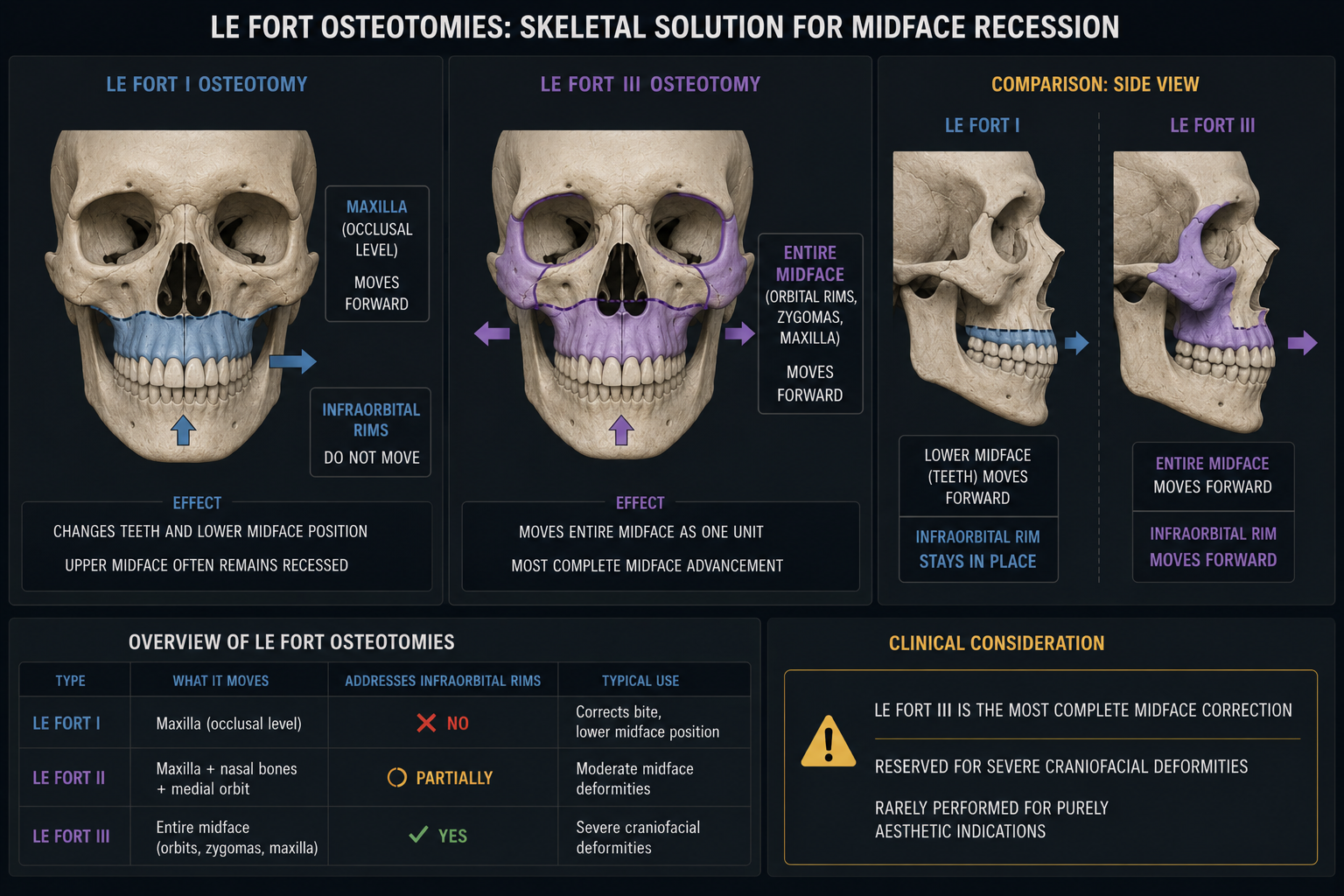
View attachment 5062819


——————————————————————————————

11. SURGEON TIERLIST

The surgeons listed here are the ones with documented, verifiable track records specifically for this procedure and not general plastic surgeons who have done one or two of these, but specialists who have built a reputation specifically around periorbital and midface skeletal surgery. Tierlists cover surgeons globally, then clinics by country, then countries overall.


Ranked specifically on documented case volume, technical specificity for this procedure, published research contribution, and real patient outcome track record. Not on general reputation as a plastic surgeon.

S TIER — The absolute best, would travel anywhere for these

Dr. Barry Eppley
Location:
Eppley Plastic Surgery, 12188-A North Meridian St Suite 310, Carmel (Indianapolis), Indiana, USA
Website:
eppleyplasticsurgery.com and eppleycustomfacialimplants.com
Approximate cost:
Infraorbital rim implants (combined infraorbital-malar) around $6,500. Midface mask implant $8,000 to $12,000. Custom jaw, cheek, full facial packages vary. Virtual consultation available.
Why S tier:
Eppley is probably the single most documented surgeon in the English-language literature for custom facial implants including infraorbital rim, midface mask, and combined periorbital work. His blog at exploreplasticsurgery.com contains hundreds of case studies with full before/after documentation across every facial zone. He developed the semi-custom infraorbital-malar implant approach and has the deepest public case archive of anyone doing this procedure. He uses titanium micro-screw fixation for long-term positional stability. His pricing is also significantly lower than the Beverly Hills surgeons doing comparable work.
In his own words on infraorbital implants vs fillers:
"In the treatment of infraorbital rim deficiency, the three treatments are synthetic injectable fillers, injected fat and implants. Each has their own advantages and disadvantages. But none of them are perfect nor is one method best for all patients. Each case must be considered separately and the magnitude of the defect considered in the treatment selection." He also notes that fillers should be used as a trial method first to assess whether soft tissue volumization gives the desired effect before committing to implants.
On custom vs off-the-shelf:
"A semi-custom approach allows me to select an infraorbital-malar implant from a variety of custom ones that have been made for other patients. Given the shape of this area of the facial skeleton a semi-custom implant can be a more cost-effective method that fits fairly well." Worth knowing that he actually offers this more affordable semi-custom option for appropriate cases.

Dr. Mehryar (Ray) Taban
Location:
9735 Wilshire Blvd Suite 319, Beverly Hills, CA 90212, USA. Also Santa Barbara.
Website:
tabanmd.com — Phone: (310) 278-1836
Approximate cost:
Infraorbital rim implants $8,000 to $15,000 depending on complexity and whether combined with canthoplasty, blepharoplasty, or orbital decompression. Full periorbital transformation packages can run higher.
Why S tier:
Taban is double board-certified by ASOPRS (American Society of Oculofacial Plastic and Reconstructive Surgery) and the American Board of Ophthalmology, and is also an Assistant Clinical Professor at UCLA. He is the go-to surgeon for complex periorbital work that combines infraorbital rim implants with canthoplasty, lower eyelid retraction repair, and orbital decompression in a single operation. His patient gallery at tabanmd.com contains an extensive archive of before/after cases documenting vector correction and eye shape transformation. He uses the transconjunctival approach with suture fixation rather than screws, preferring to avoid metal hardware near the orbit. His specific expertise in oculoplastic surgery means he understands the lower eyelid mechanics in a way that most plastic surgeons simply don't.
On what he actually does for negative vector patients:
His documented approach for negative vector patients often combines infraorbital rim implant placement with lower eyelid retraction correction and canthoplasty in a single operative session by addressing the bone, the lid position, and the canthal angle simultaneously. This is significantly more ambitious than what most surgeons offer and is appropriate for patients whose eye area problems involve all three components.
Real patient review (documented on RealSelf):
One patient with extensive knowledge of maxillofacial surgery wrote: "When it comes to the periorbital region he IS the best in the world. Through canthoplasty, tear trough implants on the orbital rim, lower lid retraction, orbital decompression, and slight lowering of the upper eyelid, I now have hooded eyes, a sweeping effect, a high lateral canthus position, and a lower lid so high it likely won't descend for decades."

A TIER — Elite surgeons, genuinely excellent, specific strengths noted

Dr. Michael Yaremchuk
Location:
Massachusetts General Hospital, Division of Plastic Surgery, Boston, MA, USA
Website:
dryaremchuk.com
Approximate cost:
$10,000 to $18,000 for infraorbital rim and midface implant work. As a Harvard-affiliated craniofacial surgeon the pricing reflects his academic institution and elite reputation.
Why A tier:
Yaremchuk is the academic foundation of this entire field. He literally wrote the original peer-reviewed paper on infraorbital rim augmentation published in Plastic and Reconstructive Surgery in 2001 which is still cited in almost every academic article on this procedure. He also designed specific implants for this procedure. His clinical background is craniofacial surgery at one of the top hospitals in the world. His research on how the aging facial skeleton changes the orbital vector relationship is the most cited work in this space. The reason he's A rather than S is purely accessibility as academic hospital pricing is steep, his focus is broader than just aesthetic cases, and he's harder to get to.
In his own published research:
"In patients with recessive infraorbital rims, alloplastic augmentation of the infraorbital rims makes the eyes appear less prominent and improves appearance. Augmentation of the infraorbital rim and resuspension of the cheek soft tissues can have a rejuvenating effect in properly selected patients." His 3D reconstructions comparing youthful and aged orbits shows how an infraorbital rim implant placed on the aged skeletal anatomy transforms it back toward the youthful contour are the clearest visual demonstration of what this procedure actually achieves.
Real patient quote:
"I had an under the eye problem and the only solution I thought there was, was cheek implants. Instead with his orbital rim implant he fixed the problem perfectly. In terms of surgical skill and experience, Dr. Yaremchuk is pretty much as good as it gets."

Dr. David Isaacs
Location:
Beverly Hills, CA, USA
Website:
drdavidisaacs.com
Approximate cost:
$10,000 to $15,000 for infraorbital rim implants. Uses 3D Accuscan imaging for custom implant design.
Why A tier:
Dual-fellowship trained oculofacial plastic surgeon in Beverly Hills who specifically markets and documents infraorbital rim implant work. Uses a transconjunctival approach and custom 3D Accuscan imaging to ensure implant fit. Strong documented case gallery. Appropriate for patients who want a Beverly Hills-based alternative to Taban with similar oculoplastic training background. His stated approach on fitting is that the procedure should always be anchored securely while blending naturally with facial contours, and that careful technique avoids overcorrection while preserving the natural lower eyelid to cheek transition.

B TIER — Solid options, less documented but legitimate

Korean Gangnam Oculoplastic Surgeons (as a group)
Location:
Gangnam and Apgujeong districts, Seoul, South Korea
Approximate cost:
$4,000 to $8,000 for infraorbital rim implants. $920 to $1,530 for undereye fat grafting. Often packaged with canthoplasty and lower blepharoplasty.
Why B tier:
Korean surgeons as a group represent excellent value and high volume, particularly for canthoplasty, lower blepharoplasty, and combined eye area transformation packages that include infraorbital rim work. The sheer case volume in Seoul means technique refinement that's genuinely hard to match elsewhere. The reason they're B rather than A as a group is variability as you need to research the specific surgeon rather than just the clinic, the anesthesiologist issue is real (verify presence before booking), and the documented English-language case literature for this specific procedure is less accessible than the US surgeons. The best Korean surgeons doing this work are at the same technical level as S tier but the challenge is identifying them.

Istanbul Craniofacial Surgeons (JCI-accredited hospitals)
Location:
Acibadem, Memorial Hospital Group, Medipol Mega, Liv Hospital, Istanbul, Turkey
Approximate cost:
$3,000 to $6,000 for infraorbital rim implants all-in. $1,450 to $2,900 for fat grafting.
Why B tier:
Turkey has the best cost-to-outcome ratio globally for this procedure when you find the right surgeon. The infrastructure at JCI hospitals is genuinely high quality, ISAPS-certified surgeons in Istanbul are operating at a legitimate international standard, and the all-inclusive packages make the logistics straightforward. The B tier placement reflects the same variability issue as Korea as surgeon-specific due diligence is essential, and the English-language documentation of individual surgeon case archives is harder to evaluate than the US names listed above.

C TIER — Proceed with extreme caution or avoid for this specific procedure

General plastic surgeons without specific infraorbital rim implant experience, regardless of their general reputation. The procedure is technically demanding enough and rare enough that a surgeon who does it once or twice a year and otherwise sticks to rhinoplasties and breast work is not an appropriate choice.

S TIER COUNTRIES for this specific procedure

USA (specifically Indianapolis and Beverly Hills)
Home to the most documented and accessible specialists for infraorbital rim and midface implants globally. Eppley in Indianapolis gives you the most documented case archive and competitive pricing for the US market. Beverly Hills gives you Taban and Isaacs with the deepest oculoplastic expertise. The US is S tier not because it's cheapest as it clearly isn't nigga :feelswhy: but because the surgeon-specific documentation and research output here is the most accessible for doing pre-operative due diligence, and the legal/medical infrastructure for complications and revision is the most robust.

A TIER COUNTRIES

South Korea (Seoul — Gangnam/Apgujeong)
Best in the world for combined eye area transformation packages, fat grafting, and any procedure that combines periorbital structural work with canthoplasty and blepharoplasty. Case volume is unmatched globally. The challenge is verification When you find the right surgeon the outcomes here are comparable to the best in the world at 40 to 60% of US pricing.

Turkey (Istanbul — JCI hospitals)
Best value globally for filler, fat grafting, and implant work when you vet properly. The cost savings versus the US and UK are dramatic. The due diligence process described in Section 12 is non-negotiable though as the variation between top-tier and mid-tier providers in Istanbul is significant.

B TIER COUNTRIES

Western Europe (Belgium, Netherlands, Spain — Barcelona/Madrid)
Strong craniofacial surgery scenes in Belgium and the Netherlands specifically. Spain has experienced surgeons in Barcelona and Madrid who do periorbital and midface implant work. Pricing sits between Turkey and the US. Good option for European patients who don't want to travel to Turkey or Korea.

UK (London specifically)
Strong regulatory framework and high-quality surgeons in London. The issue for this specific procedure is the same as everywhere but surgeons with documented specific experience in infraorbital rim implants are rare. Outside London the landscape thins out considerably. Pricing is high for what you get relative to Istanbul or Seoul. Better for filler and blepharoplasty than for complex implant work.

Thailand (Bangkok — JCI hospitals)
Strong for fat grafting and combined lower eyelid work at JCI hospitals. The specific infraorbital rim implant expertise is thinner here than in Korea or Turkey. Good value for procedures in the less specialized range like filler, fat grafting, blepharoplasty. Bumrungrad in particular has internationally trained surgeons who are genuinely excellent. For implant work specifically, less reliable than Seoul or Istanbul.

C TIER COUNTRIES — Use with heavy caution for this procedure

Mexico (Tijuana specifically), Eastern Europe outside major medical centers, and anywhere where infrastructure for managing complex periorbital complications is not immediately accessible. This isn't about general surgical quality and it's about the specific requirement that if something goes wrong with an infraorbital rim implant near the globe, you need to be in a facility that can manage it immediately. Mexico City and Monterrey are a different story and sit closer to B tier.

The surgeon tierlist above is primarily for implant and surgical procedures. For filler specifically, the calculus is somewhat different because the skill is in injection technique rather than operative surgical training, and the reversibility with hyaluronidase means mistakes are less catastrophic than with surgery.

Best market for filler value:
Istanbul. Same brand-name product, 60 to 75% cheaper, experienced injectors who do high volume. Single best destination for filler purely on cost and quality balance or you could just go DIY.

Best market for technique:
Seoul. The periorbital filler technique refinement in Gangnam clinics, including emerging ultrasound-guided tear trough work, is as advanced as anywhere globally.

What to look for in any injector anywhere:
They use a blunt cannula not a sharp needle in the tear trough. They can describe their entry point, injection plane, and product selection specifically. They have before/after photos of tear trough cases specifically not just general filler work.

——————————————————————————————

12. SCIENCE BACKING AND SOURCES

Everything in this guide is sourced from published research, peer-reviewed clinical literature, or documented surgical case studies. Links below.

Anatomy and Aging
PubMed — Infraorbital Rim Augmentation in Orthognathic Surgery (Le Fort I limitation documentation)
Aesthetic Plastic Surgery — Decoding Periorbital Aging: Multilayered Analysis (2025 — orbital cavity expansion with bone resorption, globe volume decrease)
ScienceDirect — Facial Bone Aging: An Update and Literature Review 2020-2023 (region-specific bone loss affecting orbital rims and maxilla)
Aesthetic Surgery Journal — Infraorbital Hollow Rejuvenation: Contributions of Midface Volumization (ORL anatomy, vascular supply, etiology)


Filler Technique and Anatomy
PMC — Cadaveric Evaluation of Filler Behavior in Tear Trough (University of Pennsylvania, 2023 — Volbella spreads across planes, Restylane-L stays as distinct mass at ORL)
PMC — Anatomical Filler Injection Techniques: Infraorbital Groove and Hollowness
PMC — Tear Trough Filler Using Three-Point Tangent Technique: Lessons from 1452 Applications (2023)
PMC — Bridging the Gap: Alternative Injection Strategy for Medial Infraorbital Region (lateral entry point, ultrasound-guided approach)
MDPI — Anatomical-Based Filler Injection: Infraorbital Groove and Hollowness (2025 — tear trough ligament vs fibrotic connective tissue debate)
PubMed — HA Filler Effectiveness for Periorbital Region


Implants and Surgical Correction
PMC — Improvement of Infraorbital Rim Contour (Medpor vs alternative materials, surgical technique documentation)
Explore Plastic Surgery — Custom Midface Mask Implant Case Study (Eppley — three-piece design, Le Fort III-like effect)
Explore Plastic Surgery — The Midface Mask Implant for Aesthetic Augmentation (full design description and indication criteria)
Explore Plastic Surgery — Custom IMM Implant After Le Fort I Osteotomy (the Le Fort I leaves upper midface behind — implant completes it)
Explore Plastic Surgery — Negative Orbital Vector and Custom Infraorbital Implants: Case Study


Related Reading from org
The Eye Area Manual — comprehensive breakdown of the full eye area

——————————————————————————————


AI was used to fix grammatical errors
Nice thread, Fat grafts seem to be the best for the majority I'd say.
 
  • +1
Reactions: Atra, Navity, BigBallsHisty and 2 others
THE ONLY INFRAORBITAL GUIDE YOU'LL EVER NEED

——————————————————————————————


This thread has been in the works for a while.

The infraorbital rim, what it actually does, why it's responsible for many eye area problems, and every single option available to fix it. Everything in this guide is sourced from published research, clinical case studies, and real surgical documentation.


Related reading: The Eye Area Manual and The Holy Grail of Facial Aesthetics — How to Simulate Lefort III Results with the Midface Mask Implant


——————————————————————————————


TABLE OF CONTENTS


1. What the Infraorbital Rim Actually Is

2. How To Tell If Yours Is Deficient

3. The Orbital Vector and Why It Matters More Than You Think

4. The Anatomy Explained Properly - Ligaments, Fat Compartments, and Vascular Zones

5. The Three Classes of Infraorbital Hollowing

6. Non-Surgical Options

7. The Right Filler Technique

7B. DIY Undereye Filler

8. Infraorbital Rim Implants With Costs

9. Midface Mask Implant

10. Le Fort Osteotomy


11. Surgeon Tierlist and Recommendations

12. Science Backing and Sources


——————————————————————————————

1. WHAT THE INFRAORBITAL RIM IS

The infraorbital rim is a ledge of bone sitting directly beneath your eye socket. It's the bottom border of the orbit and it's the foundation that everything else sits on. Your fat pads, your lower eyelid, your skin rests here. When this bone projects well, all that tissue is properly supported and your undereye looks smooth, full, and defined. When it's recessed or underdeveloped, the tissue has nothing to rest on. It descends. You get hollows, shadow, and that wrecked permanently tired look no matter how much sleep you're getting. Because it's not sleep causing it. It's bone.

Here is a comparison of Bad vs Good infras

View attachment 5057276View attachment 5057277

Here's the number that puts it in perspective. On average the infraorbital rim sits about 3mm behind the surface of your cornea. Your brow bone at the top sits about 10mm in front of the cornea. That 13mm gap between upper and lower bony projection is what creates the deep-set look. When your infraorbital rim retrudes further back than average may it be whether from genetics or from the bone loss that happens as you age. Your globe looks relatively more prominent, the lower lid loses its anchor, and the whole undereye area looks sunken
View attachment 5057288

There's a research finding published in Aesthetic Plastic Surgery by Pessa et al. and separately confirmed in a 2025 multilayered periorbital aging analysis in Aesthetic Plastic Surgery journal showing that orbital cavity volume actually expands with age as the bone resorbs. The globe itself gets slightly smaller too. Both changes together create the sunken, enophthalmic look that older men develop hence the hollow orbit and shadowed undereye.

——————————————————————————————

2. HOW TO TELL IF YOURS IS DEFICIENT


Take a side photo or look at your face in true lateral view. Drop an imaginary vertical line straight down from the most forward point of your eyeball, what's called the corneal apex. If the bone and soft tissue under your eye sits clearly behind that line, you have a negative orbital vector. The clinical literature consistently uses this as the primary diagnostic criterion. The further behind that vertical plane your rim sits, the more deficient it is.
View attachment 5057307


The fat herniation test
Look directly upward in a mirror. If any bags or puffiness under your eyes get worse when you look up, that's herniated orbital fat pushing forward. Filler does not fix this. Filler in a herniated eye will make it look worse. That case needs lower blepharoplasty with fat repositioning.
View attachment 5057309


The malar mound test
Press upward gently on your cheekbone just under the eye. If a visible mound or puffiness appears underneath rather than the hollow improving, you have malar mound tendency. Adding filler in this setting makes the mound worse. This is a known complication of undereye filler in the wrong candidate. It's well-documented in the clinical literature and it's almost impossible to fully reverse without hyaluronidase.
View attachment 5057331

——————————————————————————————

3. THE ORBITAL VECTOR — WHY IT MATTERS MORE THAN YOU THINK

Positive orbital vector means your cheekbone and rim complex sits forward of your eyeball. The lower lid is fully supported, the lid-cheek junction is smooth, the eye looks deep-set and defined. Negative vector means your globe is the most forward structure in that zone as it protrudes past your cheek and rim. The lower lid has nothing to anchor it, eyes look slightly bulgy or round, the midface looks flat and withdrawn.
View attachment 5057372

The reason the vector discussion matters so much beyond just aesthetics. Guys spending money on canthoplasty with an uncorrected negative vector are wasting it. The whole mechanism of canthoplasty is lifting the outer corner of the lower lid and changing the tilt of the eye and that depends on having a stable bony ledge underneath the lower lid to hold the result long term. If that ledge is recessed, the lid migrates back down over months regardless of the quality of the surgical work.

There's also a finding worth knowing about that comes from published morphometric research comparing young and older faces. In younger patients the malar eminence, infraorbital rim, and pyriform aperture are all positioned anteriorly and the orbital aperture is relatively small and compact. In older patients all three of those landmarks have retrused posteriorly, the orbital aperture has expanded in area, and the inferior orbital rim has developed a different curvature pattern. The researchers note that implant designs targeting the skeletally deficient areas of older patients literally match the anatomy of what's been lost over time. This is why implants for the infraorbital rim look so natural when properly placed.

——————————————————————————————

4. THE ANATOMY

The clinical outcomes of everything done in this area like filler, fat grafting, implants are directly determined by understanding these structures. So its better to have a good grasp of things.

The orbicularis retaining ligament (ORL) and the tear trough ligament
The orbicularis retaining ligament is a series of fibrous attachments extending from the inferior orbital rim to the overlying skin. It defines the upper border of the sub-orbicularis oculi fat compartment (SOOF). The medial portion of the ORL is specifically called the tear trough ligament. This structure is what creates much of the tear trough deformity. It physically tethers the skin to the bone, creating a groove that descends as the surrounding tissue loses volume and descends with age. When you squint or frown you can often see the tear trough groove deepen temporarily because the muscular contraction tightens this tethering effect.
View attachment 5057387


The fat compartments that matter the most :
Below the orbicularis muscle sits the SOOF (the sub-orbicularis oculi fat). This compartment is bounded superiorly by the ORL and inferiorly by the zygomatic cutaneous ligament. Below and lateral to that is the deep medial cheek fat compartment which is where the structural cheek volume lives. In the superficial plane above the muscle are the superficial fat compartments the medial cheek fat, nasolabial fat, and a thin preseptal fat layer directly over the lower lid. Understanding which plane you're in during injection determines whether the result looks right or wrong. Filler placed in the wrong fat compartment doesn't just look suboptimal and it migrates in a direction determined by the anatomy of that compartment and can end up in a location that makes things look worse months later.

View attachment 5057396


The vascular danger zones and why this area is high risk
The infraorbital region is supplied by several arterial branches. The angular artery is branch of the facial artery that runs medially across the nasojugal groove and is one of the most commonly injured vessels during tear trough injection. The infraorbital artery exits the infraorbital foramen approximately 3cm lateral to the midline just below the orbital rim. The zygomaticofacial artery runs laterally. All of these sit in a vascular territory that communicates with the ophthalmic artery via the orbital septum. This is why vascular occlusion from filler in this area carries vision risk in a way that injections elsewhere on the face generally don't. The connection to the ophthalmic circulation is real and documented. A 2015 review of the world literature on filler-related blindness by Beleznay et al. identified the glabellar region and nasal area as highest risk.
View attachment 5057438

——————————————————————————————

5. THE THREE CLASSES OF INFRAORBITAL HOLLOWING

The groove is confined to the inner corner area. The rest of the rim still has reasonable support. This is the mildest presentation and it responds well to filler correctly placed. A good injector at the right depth can fix this in one session.

View attachment 5057501

The hollow has deepened and extended outward. Visible under the middle of the eye and sometimes toward the outer corner. Early volume loss in the central cheek becomes visible. Filler still works but placement has to cover multiple zones and single-pass medial technique leaves the lateral area still hollow. You need dual-plane treatment across two or three anatomical subzones.
View attachment 5057508

The hollow wraps around the entire rim. The lid-cheek groove is visible from every angle. This isn't just soft tissue loss anymore as the bone itself is genuinely deficient. Filler cannot build structure here because there's no skeletal platform for it to sit on. It just creates a puffy appearance without correcting the vector or the hollow. Class 3 is implant or fat grafting territory.

View attachment 5057516

——————————————————————————————

6. NON-SURGICAL (COPE)


THIS WHOLE SECTION EXCEPT FOR THE DEXA SCAN AND BODY ARE FOR COPERS WHO ARE AGAINST FILLERS AND HARDMAXES SO DNR THIS IF YOU ARENT ONE


Global Costs

USA:
GHK-Cu serum $20 to $60 per bottle. The Ordinary Buffet + Copper Peptides around $25. Prescription tretinoin via telehealth (Curology, AgelessRx) $20 to $40 per month.

UK:
GHK-Cu £18 to £50. Tretinoin via Dermatica or Skin + Me £20 to £30 per month.

Europe:
€20 to €55. Prescription tretinoin through a derm €30 to €60 per month.


The Full Protocol

Step 1:
Cleanse morning and night with a gentle non-stripping cleanser. The periorbital skin is some of the thinnest on the entire body so anything with high-pH foaming agents or sulfates irritates it and makes the area look worse over time.

Step 2 (Morning):
A few drops of GHK-Cu serum on damp skin around the undereye and midface. Use your ring finger as it naturally applies the least pressure then and tap gently rather than rubbing. Don't drag the skin. This matters more than most people think over months and years of cumulative mechanical stress.

Step 3 (Morning):
SPF 50+ over everything including the undereye. Non-negotiable as UV accelerates collagen breakdown in this region faster than almost anywhere else on the face because the skin here is so thin and has so little protective mass. Long-term sun exposure is one of the factors driving the skeletal resorption pattern in this area.

Step 4 (Evening):
Retinol after cleansing. Start at 0.025% three nights per week. Move to every other night in weeks five through eight. Nightly from week nine. Step up concentration to 0.05% then 0.1% over three to four months. Follow with a light moisturizer to buffer irritation around the periorbital zone.

Key rule:
GHK-Cu and retinol in the same session cancel each other out. GHK-Cu in the morning, retinol at night.

raw GHK-Cu powder:
Buy raw GHK-Cu powder from Peptide Sciences or BoS Research for around $10 to $15 per gram. Dissolve 0.5g into 100ml of water-based hyaluronic acid serum base in a dark glass dropper bottle. That's a 0.5% serum for a fraction of what any brand charges. Dissolves cleanly. Store refrigerated, use within 60 days, date the bottle.

Realistic expectations:
Noticeably better skin quality, thicker skin, reduced shadowing after 12 to 16 weeks of consistency. It is mitigation not correction. Class 1 can see real improvement from topicals. Class 2 and 3 need more than this but topicals are worth running alongside whatever else you're doing.

Cost
Free. DEXA scan $50 to $150 in the US, £30 to £80 in UK, €40 to €100 in Europe, $20 to $40 in Turkey and Thailand.

Why it matters and what to do
The periorbital fat pads are highly sensitive to overall body fat percentage. Drop below 10% body fat and those pads thin out dramatically, making the infraorbital hollow look significantly worse. A lot of guys notice their undereye area looks great at 14% and wrecked when they push down to 8% for summer. There's a sweet spot typically somewhere in the 12 to 17% range where facial fat is preserved without sacrificing overall body composition. It's individual based on genetic facial fat distribution. Get a DEXA scan at your leanest and at a moderate body fat, photograph yourself in consistent lighting at both, and compare. That gives you your actual threshold.

View attachment 5057563

Global Costs

USA:
$20 to $40 per month at 10g daily. BulkSupplements cheapest at $20 to $25.
UK:
£18 to £35. Bulk Powders and MyProtein both carry it.
Europe:
€20 to €40. Bulk Powders ships to most EU countries.


The Protocol

Step 1:
Hydrolyzed Type I and III collagen peptide powder specifically. Not gelatin. Not non-hydrolyzed collagen. The label has to say hydrolyzed collagen peptides or you're not getting the absorption the clinical studies are based on.

Step 2:
10g every morning in hot coffee or tea. Tasteless in most formulations. Dissolves completely in hot liquid.

Step 3:
500mg Vitamin C at the same time. Ascorbic acid is a required enzymatic cofactor in the collagen synthesis pathway. Without adequate circulating Vitamin C the production signal from the peptides can't complete properly. Most people skip this and then wonder why their results are mediocre.

Step 4:
Every single day for minimum 90 days before assessing. Collagen remodeling is slow. Most people see real change between weeks 8 and 16. Sporadic use produces nothing.

Step 5:
Photograph the undereye in the same lighting every four weeks. Subjective mirror assessment doesn't work for slow changes. Objective photos tracked over time are the only accurate way to evaluate this.

——————————————————————————————

7. THE RIGHT FILLER TECHNIQUE

The tear trough is not just volume loss. There's a fibrous structure. The tear trough ligament, the medial portion of the orbicularis retaining ligament is the one that physically tethers the skin to the orbital rim bone at the boundary between the thin eyelid skin and the thicker cheek skin. To lift the groove you need product placed below this structure at the supraperiosteal level so it pushes up against the tethering from underneath. Injectors who deposit product above the ligament in the superficial plane get a lump or ridge sitting on top of the groove without lifting it. That's the most common reason tear trough filler results look bad. The cadaveric study from the University of Pennsylvania published in Aesthetic Surgery Journal in 2023 confirmed that injection just above the periosteum produces the most anatomically precise placement along the orbital rim and critically showed that Restylane-L placed this way stays as a distinct mass along the ORL, while Volbella spreads more freely across anatomical planes due to its lower elastic modulus. This finding has direct implications for which product you use at which depth.

HA filler injected at the supraperiosteal level supports the undereye, reduces hollowing, and moves the orbital vector toward positive. Often combined with lower blepharoplasty when someone needs both structural and skin correction at the same time. The area around the infraorbital rim is highly vascular with multiple arterial branches communicating with the ophthalmic circulation

View attachment 5057605


Global Costs — Both Eyes

USA:
$1,000 to $2,500 total. Per syringe $600 to $1,500. ASPS national average around $684 per syringe.
UK:
£500 to £1,500. Harley Street at the top. Regional UK from £350 to £400 per syringe.
Western Europe:
€600 to €1,400. Spain and Eastern Europe more competitive at €350 to €800.
Turkey (Istanbul):
€250 to €450. Same brand-name filler, 60 to 75% cheaper. Highest ROI destination for this specific procedure.
South Korea (Seoul):
$300 to $600 at Gangnam clinics.
Thailand (Bangkok):
$200 to $500. JCI-accredited clinics only.
Mexico:
$300 to $700. Major cities with board-certified injectors.

——————————————————————————————

7B. DIY UNDEREYE FILLER FULL GUIDE

This covers the DIY approach. The undereye is the highest-risk filler site on the face due to the vascular anatomy described in Section 4. Know the emergency protocol before you start. Have hyaluronidase on hand.


You're a reasonable candidate if:
You have Class 1 or mild Class 2 hollowing. A groove with genuine volume loss but nothing puffy or herniated. Lower eyelid skin is taut when you pinch it gently. No loose or baggy eyelid skin. No bags that are worse in the morning. No bleeding disorders, autoimmune conditions, or active skin infection. You haven't had filler dissolved in this area in the past 8 weeks.

Stop here if:
You have puffy bags or visible fat herniation as filler will make this dramatically worse. Thin eyelid skin where veins are clearly visible. Significant laxity under the eye. Strongly negative orbital vector without structural support as filler will just look puffy without fixing the vector. You've had hyaluronidase used in this area in the last 8 weeks.

The filler
Soft, low G-prime HA filler designed for periorbital use. Do not use thick fillers like Voluma, Radiesse, or dense Juvederm in the tear trough as they lump and migrate. The right products are Restylane-L, Juvederm Volbella, Belotero Balance, and Teosyal Redensity 2. Teosyal Redensity 2 is specifically formulated for periorbital use with lower water-attracting properties to reduce post-injection swelling. You need 1ml maximum for both sides as most sessions use 0.3 to 0.5ml total.

Where to source: Medica Depot, HA-Dermal, DoctorMedica, and similar gray market wholesale suppliers sell Restylane and Teosyal without prescription in many jurisdictions. In Turkey you can walk into Istanbul pharmacies and buy Juvederm or Restylane OTC for $40 to $80 per syringe. Never buy from eBay or AliExpress and counterfeit or improperly cold-chain stored filler is a real infection risk. Established suppliers with documented cold-chain shipping only.


Cannulas
27-gauge blunt cannula, 38mm length. The blunt tip pushes vessels aside rather than puncturing them. Brands: Softfil, TSK Steriglide, FlexFill. Available from Medica Depot or iBeautyMachine for $15 to $40 per box of 20. Fresh cannula per session and per eye as you should never reuse.

Entry needle
25-gauge sharp hypodermic needle to create the entry point hole. Available at any pharmacy.

Numbing
EMLA cream (lidocaine 2.5% plus prilocaine 2.5%) under cling film for 30 minutes. LMX4 also works. Do not use ice as primary numbing as it causes vasoconstriction which makes blood aspiration harder to assess.

Hyaluronidase
The enzyme that dissolves HA filler. Available as Hylenex in the US, Hyalase in UK and Europe, or generic hyaluronidase 1500iu vials. t.

Sterility supplies
Nitrile gloves. Alcohol prep pads (70% isopropyl). Chlorhexidine 2% for skin prep. Gauze pads. Sterile drape or fresh clean towel. Sharps container.

Total cost
Filler syringe $40 to $120. Cannula box $15 to $40. EMLA $10 to $25. Hyaluronidase $30 to $80. Supplies $10 to $20. Total $105 to $285 versus $1,000 to $2,500 professionally.

48 hours before:
Stop blood thinners so no aspirin, ibuprofen, fish oil, vitamin E, or alcohol. OTC supplements and lifestyle only and do not stop prescription blood thinners without speaking to your doctor.

Day of — skin prep:
Wash your face. Remove everything like no makeup, no skincare. Chlorhexidine on a gauze pad wiped from center outward over the injection zone. Follow with alcohol prep pad. Let dry completely. Don't touch the cleaned area with bare hands again.

EMLA application:
Thick layer covering the full undereye zone from inner corner to the outer orbital area. Cover with cling film. Leave minimum 30 minutes. Wipe completely off with alcohol prep pad and let dry fully before proceeding.

Workspace setup:
Large well-lit mirror. Daylight or bright white LED pointed at your face. All supplies within reach. Nitrile gloves on. Filler syringe open with hub attached. Cannula on sterile surface. Hyaluronidase immediately accessible and know exactly where it is and how to draw it up before touching anything.

Step 1 — Mark your anatomy
White eyeliner pencil only and not a dark marker. Mark the lowest point of your tear trough groove in good lighting. Mark your entry point: 15 to 20mm directly below the outer edge of your iris (lateral limbus) on the cheek. This location keeps your cannula path away from the infraorbital foramen and the angular artery as you travel medially. Wipe the marks off with an alcohol pad before injecting also never inject through skin with marker on it.
View attachment 5057828


Step 2 — Create entry point
Stretch the skin at the entry point with your non-dominant hand. 25-gauge sharp needle, firm puncture at 45 to 90 degrees. One clean puncture. Entry point on the cheek, not the lower eyelid. Small drop of blood is fine but wipe with alcohol pad.

View attachment 5057856


Step 3 — Insert cannula
27-gauge blunt cannula attached to filler syringe. Stretch entry point skin to keep the hole open. Insert at 30 to 45 degrees then flatten the angle to nearly parallel with the skin surface. Travel supraperiosteally and just above bone. You feel slight resistance through the orbicularis and a give as you enter the sub-orbicularis plane. Cannula scraping against bone means you're at the right depth. Advance slowly toward the inner corner of the eye, below the tear trough groove.
View attachment 5058166


Step 4 — Aspirate first
Before releasing any product, pull the plunger back. Blood in the syringe means you're in a vessel. Withdraw immediately, apply pressure for 2 minutes, don't inject from that entry point again. Move to the other eye and return with a fresh cannula from a slightly different entry location.
View attachment 5058179


Step 5 — Retrograde linear threading
Cannula at its deepest point medially near the inner corner. Begin slowly pressing the plunger while simultaneously withdrawing at a steady even pace toward the entry point. Product deposits as a thin continuous thread as you withdraw. Even pressure, smooth withdrawal with thin column along the rim, not a blob. Volume per pass: 0.1 to 0.2ml max. Start with 0.1ml and assess before adding more.
View attachment 5058325


Step 6 — Lateral fan if needed (Class 2 only)
If hollow extends laterally past mid-pupil, readvance from same entry point angled slightly outward. Second retrograde pass covering the lateral area. Use less here like 0.05 to 0.1ml. Maximum two passes from one entry point.

Step 7 — Assess and massage
Remove cannula. Gentle pressure on entry point for 30 seconds. Sit upright and look in natural light. Any lumps felt then gentle circular massage with clean finger. Check specifically for skin blanching anywhere for white patches that don't resolve in 30 seconds mean possible vascular compression.
Wait 5 minutes and reassess the first side before moving to the other eye.

Step 8 — Other eye
Fresh cannula. New entry point same location on the other side. Match volume exactly to what you used on the first side. Always err toward less so you can add at 2 weeks, you cannot easily remove immediately.

Step 9 — Aftercare
Cold compress (wrapped, not bare ice) for 10 minutes. No makeup for 24 hours. No alcohol, exercise, or heat for 48 hours. Sleep slightly elevated the first night. Don't massage after the first hour. Expect some swelling and possible mild bruising for 2 to 5 days. Final result at 2 weeks around is noticed.

Most DIY attempts go wrong because people use too much. This area needs far less product than anywhere else on the face. Overfilling creates a puffy pillow look that sits there for months and requires hyaluronidase to fix.

Session 1:
0.1ml per side. Total 0.2ml. Test session. You will probably not see a dramatic result. Assess at 2 weeks.

Session 2 (minimum 2 weeks later):
Add up to 0.15ml per side if genuinely needed. Cumulative max after two sessions: 0.25ml per side.

ceiling:
Never exceed 0.3ml per side total across all DIY sessions. If your hollowing needs more than that, the problem is structural.

vascular occlusion:
Signs: skin blanching white that doesn't resolve in 30 seconds, skin going mottled or grey or purple, severe pain out of proportion to the procedure, any change in vision including blurring or darkening. If any of these happen: stop injecting. Inject hyaluronidase immediately into the affected area then reconstitute 1500iu vial with 2ml saline for 750iu/ml, inject 0.2ml (150 units) directly into the blanched zone and surrounding tissue. Apply warm compress then Take 325mg aspirin.

Tyndall effect (blue discoloration):
Filler placed too superficially. Not dangerous but looks bad. Hyaluronidase 15 to 30 units injected directly into the blue zone in small aliquots. Resolves within 24 to 48 hours.

Persistent lump:
Wait 2 weeks as most resolve with swelling. Persistent lump at 2 weeks gets hyaluronidase 15 units per side directly into it. Reassess at 48 hours.

Full dissolution protocol:
Reconstitute 1500iu hyaluronidase with 2ml bacteriostatic saline giving 750iu/ml. Draw up appropriate volume in insulin syringe. Inject small amounts (0.02 to 0.05ml per puncture) directly into the filler deposit across multiple punctures. For full dissolution of undereye filler: 15 to 75 units per side. Results in 24 to 48 hours. Wait minimum 4 weeks before re-injecting as residual hyaluronidase can break down freshly placed filler if you go back too soon.

——————————————————————————————

8. INFRAORBITAL RIM IMPLANTS COSTS

Solid silicone implants placed directly on the infraorbital rim bone. The most direct structural correction available for undereye hollowing and a negative orbital vector as you are physically augmenting the bony architecture, not masking the problem with volume. Unlike filler which is temporary and only addresses soft tissue, implants permanently correct the vector. They're typically combined with lower blepharoplasty for the best full eye area result.


Off-the-shelf implant designs are not inferior to custom implants for most people. The Flowers infraorbital rim implant is a well-established design with a long clinical track record and it's appropriate for the majority of symmetric cases. Custom implants are specifically for patients with significant asymmetry between sides or unusual anatomy that a standard design can't accommodate. The push toward custom-only is partly surgeon preference and partly commercial as custom implants cost significantly more and have higher margin.


Global Costs

USA:
$6,000 to $15,000. Flowers off-the-shelf designs at the lower end. Custom CT-derived implants from Eppley, Taban, Isaacs at $8,000 to $15,000+.
UK:
£5,000 to £9,000. Surgeons with specific experience in this procedure are rare outside London.
Western Europe:
€5,000 to €10,000. Belgium, Netherlands, Germany, Spain have experienced craniofacial surgeons doing this.
Turkey (Istanbul):
$3,000 to $6,000 all-in with hotel and transfers. Verify that the specific surgeon has done infraorbital rim implants specifically — not just cheek or chin work.
South Korea (Seoul):
$4,000 to $8,000. Often combined with canthoplasty and lower bleph as a full eye area package. VAT refund 7 to 8% at airport for foreign patients.
Thailand (Bangkok):
$3,500 to $7,000 at JCI hospitals.
Mexico:
$3,000 to $6,000. Mexico City and Monterrey over Tijuana for this level of work.

——————————————————————————————


9. MIDFACE MASK IMPLANT


Reference thread on this: The Holy Grail of Facial Aesthetics — How to Simulate Lefort III Results with the Midface Mask Implant


The custom midface mask implant covers the entire upper midface skeleton which is from the infraorbital rims down to just above the upper teeth. Think of it as a single unified implant that simultaneously augments all of the following : the infraorbital rims, the malar eminences (cheekbones), the paranasal region (the area around the base of the nose), and the anterior maxilla. That coverage is why it's called a mask. the footprint literally looks like the upper portion of a face mask on 3D imaging.

View attachment 5058644

The effect is described in the surgical literature as Lefort III-like but without the occlusal movement. Meaning it pulls the entire midfacial skeleton forward in one coordinated augmentation, mimicking the aesthetic outcome of a full midface advancement osteotomy without actually cutting and moving bone. The infraorbital rims project forward correcting the negative vector, the cheeks project forward, the paranasal area fills out, the entire midface depth and width changes. For someone with true generalized midface hypoplasia this is the procedure that actually addresses the whole problem rather than chasing individual zones with separate implants.

Because the infraorbital nerve passes through the infraorbital foramen in the middle of this zone, the implant is designed as three pieces: bilateral infraorbital-malar segments and a lower maxillary segment that crosses under the nasal base. Each piece is designed around the nerve pathway to prevent compression. When properly placed there should be no permanent nerve damage, though patients should expect some temporary numbness of the upper lip and side of the nose from nerve stretching during implant seating which recovers fully.

The limitation with doing a cheek implant here and a separate infraorbital rim implant there and a separate pyriform implant somewhere else is that you get disjointed augmentation with visible transitions between the zones. Each implant has edges. Where one implant ends and another begins there's a potential step-off or contour irregularity that shows through the overlying soft tissue. The more implants you stack the more complex the revision situation if anything needs to be adjusted.
View attachment 5062790

The midface mask implant solves this by creating one continuous augmentation surface across all zones simultaneously. The transitions between the infraorbital rim, malar eminence, and paranasal regions are built into the implant design itself and are smooth by design rather than approximated by placement of separate pieces. The clinical result looks more natural and cohesive because it is more natural and it follows the actual anatomy of the midfacial skeleton as a unified structure rather than addressing it as isolated landmarks.

There's also a case documented in the surgical literature specifically for patients who had a Le Fort I osteotomy that moved the lower maxilla but left the upper midface consisting of the infraorbital rims and zygomaticomalar complex untouched and still recessed. This is a known limitation of Le Fort I: it addresses the occlusal level but doesn't move the infraorbital rim. A custom infraorbital-maxillary-malar implant placed after a Le Fort I creates what surgeons describe as a modified Le Fort III effect as both the lower and upper midface are now addressed, combining what surgery did with what the implant adds.

The midface mask implant is appropriate for someone with true generalized midface hypoplasia and not just undereye hollows, not just flat cheeks, but the full midface complex being recessed including the infraorbital rims, malar eminences, and paranasal area. If you look at your profile and everything from your lower eyelid to your upper lip sits behind the plane of your nose tip and forehead, you are probably in this category. If only specific zones are deficient, targeted implants or filler are more appropriate.


The procedure is not appropriate if your occlusion needs to change and if you have a malocclusion that needs orthognathic surgery, that needs to be addressed before or simultaneously with any midface implant work, not replaced by it. The midface mask implant advances the skeletal contour without moving the teeth or changing the bite. If the bite is off, that's a separate problem requiring orthognathic surgery.

Cost
$6,000 to $15,000 depending on surgeon and whether it is standalone or combined with other procedures. For context: a Le Fort II or III osteotomy runs $30,000 to $60,000 and is practically inaccessible for purely aesthetic indications. The midface mask implant achieves a comparable aesthetic effect at 20 to 50% of that cost. This is one of the best cost-to-outcome ratios in all of facial surgery for the right candidate.


Where to find surgeons who specifically do this
Dr. Barry Eppley at Eppley Custom Facial Implants in Indianapolis is the most documented surgeon in the English-language literature for this specific procedure. His case studies are publicly available on exploreplasticsurgery.com and document outcomes across multiple patient types including men with generalized midface hypoplasia. In Europe, craniofacial units in Belgium and the Netherlands have surgeons experienced with comprehensive midface implant design. In South Korea the Gangnam complex surgery market has surgeons comfortable with multi-zone midface implants. As with the infraorbital rim implant, verify specifically that the surgeon has documented experience with full-coverage midface mask implants — not just cheek or malar implants in isolation.

his website : eppleyplasticsurgery.com

——————————————————————————————

10. LE FORT OSTEOTOMY — WHEN AND WHY

The Le Fort osteotomies are the actual skeletal solution for severe midface recession. Le Fort I moves the maxilla at the occlusal level and changes the teeth and lower midface position but critically does not move the infraorbital rims, which is why it often leaves the upper midface still recessed after surgery. Le Fort III moves the entire midface including the orbital rims forward and is the most complete correction available.
View attachment 5062824


Global Costs

USA:
$20,000 to $40,000 for Le Fort I. Modified Le Fort III $30,000 to $60,000+ at major craniofacial centers.
UK:
£12,000 to £25,000 private. NHS may cover with functional indication.
Western Europe:
€10,000 to €25,000. Spain and Eastern Europe more competitive at €10,000 to €15,000.
Turkey (Istanbul):
$6,500 to $12,000 at accredited hospitals.
South Korea (Seoul):
$8,000 to $18,000. Korea performs among the highest annual volume of orthognathic surgery globally.
Thailand (Bangkok):
$9,500 to $15,000 at JCI hospitals.
Mexico:
$8,000 to $15,000. Mexico City university-affiliated maxillofacial departments.


The Le Fort I Limitation and Why Many Patients Need More
Le Fort I advancement moves the lower midface consisting of teeth, lower cheeks, nose but it does not move the infraorbital rims. In patients where the midface deficiency extends all the way up to include the orbital rims, a Le Fort I leaves the upper midface still recessed after surgery. The patient sees improvement in their bite and lower face but still has a negative orbital vector and hollow undereyes. Opting for a LE FORT III is best here.
View attachment 5062819


——————————————————————————————

11. SURGEON TIERLIST

The surgeons listed here are the ones with documented, verifiable track records specifically for this procedure and not general plastic surgeons who have done one or two of these, but specialists who have built a reputation specifically around periorbital and midface skeletal surgery. Tierlists cover surgeons globally, then clinics by country, then countries overall.


Ranked specifically on documented case volume, technical specificity for this procedure, published research contribution, and real patient outcome track record. Not on general reputation as a plastic surgeon.

S TIER — The absolute best, would travel anywhere for these

Dr. Barry Eppley
Location:
Eppley Plastic Surgery, 12188-A North Meridian St Suite 310, Carmel (Indianapolis), Indiana, USA
Website:
eppleyplasticsurgery.com and eppleycustomfacialimplants.com
Approximate cost:
Infraorbital rim implants (combined infraorbital-malar) around $6,500. Midface mask implant $8,000 to $12,000. Custom jaw, cheek, full facial packages vary. Virtual consultation available.
Why S tier:
Eppley is probably the single most documented surgeon in the English-language literature for custom facial implants including infraorbital rim, midface mask, and combined periorbital work. His blog at exploreplasticsurgery.com contains hundreds of case studies with full before/after documentation across every facial zone. He developed the semi-custom infraorbital-malar implant approach and has the deepest public case archive of anyone doing this procedure. He uses titanium micro-screw fixation for long-term positional stability. His pricing is also significantly lower than the Beverly Hills surgeons doing comparable work.
In his own words on infraorbital implants vs fillers:
"In the treatment of infraorbital rim deficiency, the three treatments are synthetic injectable fillers, injected fat and implants. Each has their own advantages and disadvantages. But none of them are perfect nor is one method best for all patients. Each case must be considered separately and the magnitude of the defect considered in the treatment selection." He also notes that fillers should be used as a trial method first to assess whether soft tissue volumization gives the desired effect before committing to implants.
On custom vs off-the-shelf:
"A semi-custom approach allows me to select an infraorbital-malar implant from a variety of custom ones that have been made for other patients. Given the shape of this area of the facial skeleton a semi-custom implant can be a more cost-effective method that fits fairly well." Worth knowing that he actually offers this more affordable semi-custom option for appropriate cases.

Dr. Mehryar (Ray) Taban
Location:
9735 Wilshire Blvd Suite 319, Beverly Hills, CA 90212, USA. Also Santa Barbara.
Website:
tabanmd.com — Phone: (310) 278-1836
Approximate cost:
Infraorbital rim implants $8,000 to $15,000 depending on complexity and whether combined with canthoplasty, blepharoplasty, or orbital decompression. Full periorbital transformation packages can run higher.
Why S tier:
Taban is double board-certified by ASOPRS (American Society of Oculofacial Plastic and Reconstructive Surgery) and the American Board of Ophthalmology, and is also an Assistant Clinical Professor at UCLA. He is the go-to surgeon for complex periorbital work that combines infraorbital rim implants with canthoplasty, lower eyelid retraction repair, and orbital decompression in a single operation. His patient gallery at tabanmd.com contains an extensive archive of before/after cases documenting vector correction and eye shape transformation. He uses the transconjunctival approach with suture fixation rather than screws, preferring to avoid metal hardware near the orbit. His specific expertise in oculoplastic surgery means he understands the lower eyelid mechanics in a way that most plastic surgeons simply don't.
On what he actually does for negative vector patients:
His documented approach for negative vector patients often combines infraorbital rim implant placement with lower eyelid retraction correction and canthoplasty in a single operative session by addressing the bone, the lid position, and the canthal angle simultaneously. This is significantly more ambitious than what most surgeons offer and is appropriate for patients whose eye area problems involve all three components.
Real patient review (documented on RealSelf):
One patient with extensive knowledge of maxillofacial surgery wrote: "When it comes to the periorbital region he IS the best in the world. Through canthoplasty, tear trough implants on the orbital rim, lower lid retraction, orbital decompression, and slight lowering of the upper eyelid, I now have hooded eyes, a sweeping effect, a high lateral canthus position, and a lower lid so high it likely won't descend for decades."

A TIER — Elite surgeons, genuinely excellent, specific strengths noted

Dr. Michael Yaremchuk
Location:
Massachusetts General Hospital, Division of Plastic Surgery, Boston, MA, USA
Website:
dryaremchuk.com
Approximate cost:
$10,000 to $18,000 for infraorbital rim and midface implant work. As a Harvard-affiliated craniofacial surgeon the pricing reflects his academic institution and elite reputation.
Why A tier:
Yaremchuk is the academic foundation of this entire field. He literally wrote the original peer-reviewed paper on infraorbital rim augmentation published in Plastic and Reconstructive Surgery in 2001 which is still cited in almost every academic article on this procedure. He also designed specific implants for this procedure. His clinical background is craniofacial surgery at one of the top hospitals in the world. His research on how the aging facial skeleton changes the orbital vector relationship is the most cited work in this space. The reason he's A rather than S is purely accessibility as academic hospital pricing is steep, his focus is broader than just aesthetic cases, and he's harder to get to.
In his own published research:
"In patients with recessive infraorbital rims, alloplastic augmentation of the infraorbital rims makes the eyes appear less prominent and improves appearance. Augmentation of the infraorbital rim and resuspension of the cheek soft tissues can have a rejuvenating effect in properly selected patients." His 3D reconstructions comparing youthful and aged orbits shows how an infraorbital rim implant placed on the aged skeletal anatomy transforms it back toward the youthful contour are the clearest visual demonstration of what this procedure actually achieves.
Real patient quote:
"I had an under the eye problem and the only solution I thought there was, was cheek implants. Instead with his orbital rim implant he fixed the problem perfectly. In terms of surgical skill and experience, Dr. Yaremchuk is pretty much as good as it gets."

Dr. David Isaacs
Location:
Beverly Hills, CA, USA
Website:
drdavidisaacs.com
Approximate cost:
$10,000 to $15,000 for infraorbital rim implants. Uses 3D Accuscan imaging for custom implant design.
Why A tier:
Dual-fellowship trained oculofacial plastic surgeon in Beverly Hills who specifically markets and documents infraorbital rim implant work. Uses a transconjunctival approach and custom 3D Accuscan imaging to ensure implant fit. Strong documented case gallery. Appropriate for patients who want a Beverly Hills-based alternative to Taban with similar oculoplastic training background. His stated approach on fitting is that the procedure should always be anchored securely while blending naturally with facial contours, and that careful technique avoids overcorrection while preserving the natural lower eyelid to cheek transition.

B TIER — Solid options, less documented but legitimate

Korean Gangnam Oculoplastic Surgeons (as a group)
Location:
Gangnam and Apgujeong districts, Seoul, South Korea
Approximate cost:
$4,000 to $8,000 for infraorbital rim implants. $920 to $1,530 for undereye fat grafting. Often packaged with canthoplasty and lower blepharoplasty.
Why B tier:
Korean surgeons as a group represent excellent value and high volume, particularly for canthoplasty, lower blepharoplasty, and combined eye area transformation packages that include infraorbital rim work. The sheer case volume in Seoul means technique refinement that's genuinely hard to match elsewhere. The reason they're B rather than A as a group is variability as you need to research the specific surgeon rather than just the clinic, the anesthesiologist issue is real (verify presence before booking), and the documented English-language case literature for this specific procedure is less accessible than the US surgeons. The best Korean surgeons doing this work are at the same technical level as S tier but the challenge is identifying them.

Istanbul Craniofacial Surgeons (JCI-accredited hospitals)
Location:
Acibadem, Memorial Hospital Group, Medipol Mega, Liv Hospital, Istanbul, Turkey
Approximate cost:
$3,000 to $6,000 for infraorbital rim implants all-in. $1,450 to $2,900 for fat grafting.
Why B tier:
Turkey has the best cost-to-outcome ratio globally for this procedure when you find the right surgeon. The infrastructure at JCI hospitals is genuinely high quality, ISAPS-certified surgeons in Istanbul are operating at a legitimate international standard, and the all-inclusive packages make the logistics straightforward. The B tier placement reflects the same variability issue as Korea as surgeon-specific due diligence is essential, and the English-language documentation of individual surgeon case archives is harder to evaluate than the US names listed above.

C TIER — Proceed with extreme caution or avoid for this specific procedure

General plastic surgeons without specific infraorbital rim implant experience, regardless of their general reputation. The procedure is technically demanding enough and rare enough that a surgeon who does it once or twice a year and otherwise sticks to rhinoplasties and breast work is not an appropriate choice.

S TIER COUNTRIES for this specific procedure

USA (specifically Indianapolis and Beverly Hills)
Home to the most documented and accessible specialists for infraorbital rim and midface implants globally. Eppley in Indianapolis gives you the most documented case archive and competitive pricing for the US market. Beverly Hills gives you Taban and Isaacs with the deepest oculoplastic expertise. The US is S tier not because it's cheapest as it clearly isn't nigga :feelswhy: but because the surgeon-specific documentation and research output here is the most accessible for doing pre-operative due diligence, and the legal/medical infrastructure for complications and revision is the most robust.

A TIER COUNTRIES

South Korea (Seoul — Gangnam/Apgujeong)
Best in the world for combined eye area transformation packages, fat grafting, and any procedure that combines periorbital structural work with canthoplasty and blepharoplasty. Case volume is unmatched globally. The challenge is verification When you find the right surgeon the outcomes here are comparable to the best in the world at 40 to 60% of US pricing.

Turkey (Istanbul — JCI hospitals)
Best value globally for filler, fat grafting, and implant work when you vet properly. The cost savings versus the US and UK are dramatic. The due diligence process described in Section 12 is non-negotiable though as the variation between top-tier and mid-tier providers in Istanbul is significant.

B TIER COUNTRIES

Western Europe (Belgium, Netherlands, Spain — Barcelona/Madrid)
Strong craniofacial surgery scenes in Belgium and the Netherlands specifically. Spain has experienced surgeons in Barcelona and Madrid who do periorbital and midface implant work. Pricing sits between Turkey and the US. Good option for European patients who don't want to travel to Turkey or Korea.

UK (London specifically)
Strong regulatory framework and high-quality surgeons in London. The issue for this specific procedure is the same as everywhere but surgeons with documented specific experience in infraorbital rim implants are rare. Outside London the landscape thins out considerably. Pricing is high for what you get relative to Istanbul or Seoul. Better for filler and blepharoplasty than for complex implant work.

Thailand (Bangkok — JCI hospitals)
Strong for fat grafting and combined lower eyelid work at JCI hospitals. The specific infraorbital rim implant expertise is thinner here than in Korea or Turkey. Good value for procedures in the less specialized range like filler, fat grafting, blepharoplasty. Bumrungrad in particular has internationally trained surgeons who are genuinely excellent. For implant work specifically, less reliable than Seoul or Istanbul.

C TIER COUNTRIES — Use with heavy caution for this procedure

Mexico (Tijuana specifically), Eastern Europe outside major medical centers, and anywhere where infrastructure for managing complex periorbital complications is not immediately accessible. This isn't about general surgical quality and it's about the specific requirement that if something goes wrong with an infraorbital rim implant near the globe, you need to be in a facility that can manage it immediately. Mexico City and Monterrey are a different story and sit closer to B tier.

The surgeon tierlist above is primarily for implant and surgical procedures. For filler specifically, the calculus is somewhat different because the skill is in injection technique rather than operative surgical training, and the reversibility with hyaluronidase means mistakes are less catastrophic than with surgery.

Best market for filler value:
Istanbul. Same brand-name product, 60 to 75% cheaper, experienced injectors who do high volume. Single best destination for filler purely on cost and quality balance or you could just go DIY.

Best market for technique:
Seoul. The periorbital filler technique refinement in Gangnam clinics, including emerging ultrasound-guided tear trough work, is as advanced as anywhere globally.

What to look for in any injector anywhere:
They use a blunt cannula not a sharp needle in the tear trough. They can describe their entry point, injection plane, and product selection specifically. They have before/after photos of tear trough cases specifically not just general filler work.

——————————————————————————————

12. SCIENCE BACKING AND SOURCES

Everything in this guide is sourced from published research, peer-reviewed clinical literature, or documented surgical case studies. Links below.

Anatomy and Aging
PubMed — Infraorbital Rim Augmentation in Orthognathic Surgery (Le Fort I limitation documentation)
Aesthetic Plastic Surgery — Decoding Periorbital Aging: Multilayered Analysis (2025 — orbital cavity expansion with bone resorption, globe volume decrease)
ScienceDirect — Facial Bone Aging: An Update and Literature Review 2020-2023 (region-specific bone loss affecting orbital rims and maxilla)
Aesthetic Surgery Journal — Infraorbital Hollow Rejuvenation: Contributions of Midface Volumization (ORL anatomy, vascular supply, etiology)


Filler Technique and Anatomy
PMC — Cadaveric Evaluation of Filler Behavior in Tear Trough (University of Pennsylvania, 2023 — Volbella spreads across planes, Restylane-L stays as distinct mass at ORL)
PMC — Anatomical Filler Injection Techniques: Infraorbital Groove and Hollowness
PMC — Tear Trough Filler Using Three-Point Tangent Technique: Lessons from 1452 Applications (2023)
PMC — Bridging the Gap: Alternative Injection Strategy for Medial Infraorbital Region (lateral entry point, ultrasound-guided approach)
MDPI — Anatomical-Based Filler Injection: Infraorbital Groove and Hollowness (2025 — tear trough ligament vs fibrotic connective tissue debate)
PubMed — HA Filler Effectiveness for Periorbital Region


Implants and Surgical Correction
PMC — Improvement of Infraorbital Rim Contour (Medpor vs alternative materials, surgical technique documentation)
Explore Plastic Surgery — Custom Midface Mask Implant Case Study (Eppley — three-piece design, Le Fort III-like effect)
Explore Plastic Surgery — The Midface Mask Implant for Aesthetic Augmentation (full design description and indication criteria)
Explore Plastic Surgery — Custom IMM Implant After Le Fort I Osteotomy (the Le Fort I leaves upper midface behind — implant completes it)
Explore Plastic Surgery — Negative Orbital Vector and Custom Infraorbital Implants: Case Study


Related Reading from org
The Eye Area Manual — comprehensive breakdown of the full eye area

——————————————————————————————


AI was used to fix grammatical errors
good thread, bookmarked !
 
  • +1
Reactions: kdev
I agree with your arguments for why the infraorbital rim is important. All the solutions you give fail to actually adress the problem though. All the solutions you give do not adress the cause of the recession. Implants and fillers are obviously the worst when it comes to that, since it's literally putting a patch on things. With surgery you at least restore some of the missing function but lefort 1 which is the only actual safe procedure, like you said does not effect the eyes that much.
structural and skeletal causes which are genetics then we have aging then we have environmental factors are the primary causes of infraorbital recession which though not directly are still mentioned in the thread
 
  • +1
Reactions: Atra and BigBallsHisty
Nice thread, Fat grafts seem to be the best for the majority I'd say.
fat grafting deffo is the best but even the greyest of greys know how it works so i didnt find the importance of mentioning it jfl
 
  • +1
Reactions: BigBallsHisty, Atra and Menas
structural and skeletal causes which are genetics then we have aging then we have environmental factors are the primary causes of infraorbital recession which though not directly are still mentioned in the thread
Yes but none of the solution you give adress any of that. You mentioned them but did not try to find a solution that would adress them
 
THANK YOU @Hernan :love:
 
  • +1
  • Love it
Reactions: BigBallsHisty, Hernan, Atra and 1 other person
Yes but none of the solution you give adress any of that. You mentioned them but did not try to find a solution that would adress them
Am i not understanding ur question because im pretty sure i have mentioned all that is needed
 
  • +1
Reactions: BigBallsHisty and Atra
ChatGPT + Useless information. Welcome to sticky bs.
 
good thread
will read later
 
  • +1
  • Love it
Reactions: BigBallsHisty and kdev
Am i not understanding ur question because im pretty sure i have mentioned all that is needed
The solutions you give are not adressing the cause. They do not fix anything. Implants or fillers are literally patches, because they do not restore any of the missing function which like you said is due to habits, genetics and environment. The only procedure you suggest that does that is lefort, but like you explained in the thread it doesn't effect the eye area significantly.
 
  • +1
Reactions: kdev
bump
 
  • +1
Reactions: BigBallsHisty and Atra
The solutions you give are not adressing the cause. They do not fix anything. Implants or fillers are literally patches, because they do not restore any of the missing function which like you said is due to habits, genetics and environment. The only procedure you suggest that does that is lefort, but like you explained in the thread it doesn't effect the eye area significantly.
recession in an area like infras is purely genetics there is no run away from it other than staying as healthy as you can
 
  • +1
Reactions: BigBallsHisty, Subhuman and Atra
@Blobmob
 
  • +1
Reactions: BigBallsHisty, Subhuman and Atra
recession in an area like infras is purely genetics there is no run away from it other than staying as healthy as you can
I heavily disagree with that. I think genetics definitely plays a role in how good your infras look but you will never be born with recessed features unless in the presence of rare deformities.
 

Similar threads

AmazighMaxxer
Replies
13
Views
93
Navity
Navity
Yeti
Replies
6
Views
125
Yeti
Yeti
Lonely
Replies
16
Views
143
Lonely
Lonely
J
Replies
2
Views
54
J99
J

Users who are viewing this thread

  • randomnigga
  • Zoetic
  • skippio
  • Avskinov
  • Kyriae
  • Thomas_psl
  • 0xid
  • Hostlyy_
  • Peco
  • illusion
  • GeneticDeadEnd
  • Tomcreatinemax
  • Chud09
  • Gxbriel24
  • xandylooksmaxs
  • vanitas.txt
  • ProutSigma42
  • anthrocellogy
  • kdev
  • blh66
  • sam9pt
  • imNotanoob13
  • Bp_Saved_Me
  • rickk
  • se1ank
  • lovealittlemore
  • PolishMaxxing
  • Kaires
  • eue
  • Foreverbrad
  • johnleft
  • justjutting
Back
Top