



Gudlifer
🖕
- Joined
- Dec 22, 2025
- Posts
- 4,206
- Reputation
- 6,611
This is a reiteration of @BigBallsLarry thread:

 looksmax.org
A 2–10 Looks Scale and a Structured, Unbiased Guide to Facial Analysis (RATE YOURSELF OR OTHERS WITH EASE)
This thread is meant to serve as a guideline on facial analytics, that is both accurate and objective. In it, we will cover: - an example of a looks scale - with real life examples and ratings - A formula on calculating one’s harmony score. (HARM) - A formula on calculating one’s dismorphism...
looksmax.org
[Credits for the idea of this thread goes entirely to imsubhumanlmfao on discord
- Credits for information and analytics inside of the thread goes to BigBallsLarry, imsubhumanlmfao on discord, the rater “lexi”, the rater “FaceIQ”, aswell as the currently pinned threads and BOTB posts in this forum
- credits for the ANGU and DIMO formulas go to max
- Credits for the looks scale go ENTIRELY to this highly detailed doc, the user that made this has spent hours on it and i completely respect it, however i couldn’t find WHO actually wrote it, so if you see this and wish it to be taken down then i am free to do so.
i have not come up with the examples myself, i simply wrote them down.
Disclaimer: The formulas and facial ratings in this thread might not be seen as the complete truth for everyone, and many people could disagree with placements and scores. This is completely fine, however it’s still a very good place to start, and shouldn’t be immediately dismissed.
- Credits for information and analytics inside of the thread goes to BigBallsLarry, imsubhumanlmfao on discord, the rater “lexi”, the rater “FaceIQ”, aswell as the currently pinned threads and BOTB posts in this forum
- credits for the ANGU and DIMO formulas go to max
- Credits for the looks scale go ENTIRELY to this highly detailed doc, the user that made this has spent hours on it and i completely respect it, however i couldn’t find WHO actually wrote it, so if you see this and wish it to be taken down then i am free to do so.
Code:
https://docs.google.com/spreadsheets/d/1hsV7keyO3pxRtET12Nnbq4E09cGwvVJF1yjC5sBoOdg/edit?gid=1682270163#gid=1682270163i have not come up with the examples myself, i simply wrote them down.
Disclaimer: The formulas and facial ratings in this thread might not be seen as the complete truth for everyone, and many people could disagree with placements and scores. This is completely fine, however it’s still a very good place to start, and shouldn’t be immediately dismissed.
INTRODUCTION
Face ratings are usually done in a subjective manner in a matter of seconds, while this can potentially be accurate (to a degree) for extremely experienced raters, the average or even above average individual should not do that expecting a consistent, accurate and objective result.
The formula I will share below is meant to be taken as an objective and accurate standard of facial analysis.
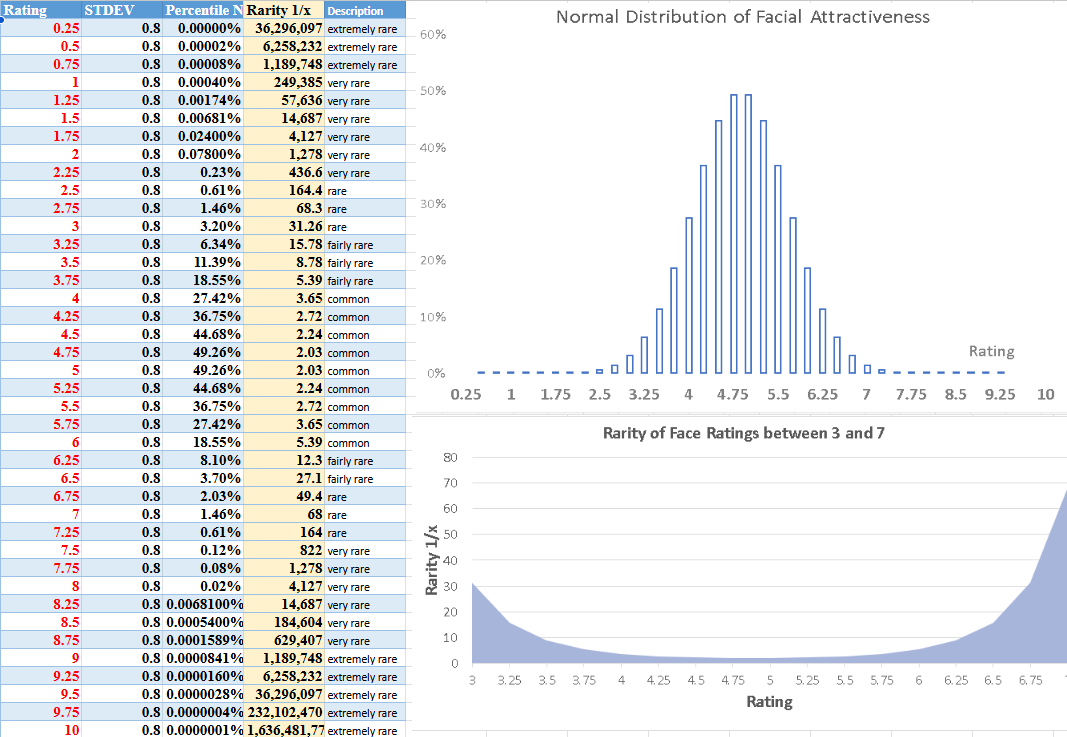
This is the distribution this formula follows:
As a general rule:
9+: best in millions
9: best in a million
8.5: best in hundreds of thousands
8: best in a couple thousand
7.5: best in hundreds
7: best in a hundred
6.5: best in 10s
6: best in 5
5.5: best in 3
5: average
4.5: ordinarily below average
4: solidly ugly
3.5: very ugly
3: extremely ugly ugly
<2: unquantifiably ugly

If you just want the formula, skip to the "THE FULL FORMULA" section below
CONTEXT
The reason I decided to make a modified variation on his thread is a flaw I identified in the way the spread (difference between highest and lowest pillar) penalty is applied.
Let's take this hypothetical example:
9 HARM
6 MISC
5.5 ANGU
6 DIMO
if we follow his formula the final score would be 5.125/10
Code:
0.32 x 9 = 2.88
0.26 x 6 = 1.56
0.22 x 5.5 = 1.21
6 x 0.2 = 1.2
Code:
WEIGHTED = 2.88 + 1.56 + 1.21 + 1.2
= 6.85

SPREAD = 9 - 5.5
= 3.5

Penalty = SPREAD x 0.5
= 3.5 x 0.5
= 1.725
Code:
TRUE SCORE = WEIGHTED - PENALTY
= 6.85 - 1.725
= 5.125
Now let's keep everything the same and ONLY change the HARM from a 9 to a 7:
7 HARM
6 MISC
5.5 ANGU
6 DIMO
The final score with HARM=7 is 5.46, 0.335 points higher than HARM=9
Code:
0.32 x 7 = 2.24
0.26 x 6 = 1.56
0.22 x 5.5 = 1.21
6 x 0.2 = 1.2
Code:
WEIGHTED = 2.24 + 1.56 + 1.21 + 1.2
= 6.21


SPREAD = 7 - 5.5
= 1.5


Penalty = SPREAD x 0.5
= 1.5 x 0.5
= 0.75
Code:
TRUE SCORE = WEIGHTED - PENALTY
= 6.21 - 0.75
= 5.46
HOW IS THIS POSSIBLE?
A flaw in the way the penalty is applied:
After a certain point, the penalty that comes from increasing a category becomes greater than its benefits, even with everything else staying the same.
HOW DO WE FIX THIS?
A pillar-weight adjustment based on a logarithmic scale will replace the arbitrary penalty and act as a sort of "built-in" penalty by making worse pillars weigh more relative to their base weights.
I also decided to add a threshold of 8.0 for the lowest pillar, if it's met no weight-adjustment will happen and categories will remain like this:
HARM: 32%
MISC: 26%
ANGU: 22%
DIMO: 20%
I also included a 2.5 lower threshold at which point no additional penalty will be applied.
OTHER ADJUSTMENTS I MADE
I made some adjustments to the "Ideal" tabs, gave some more precise ratios etc...
The core math stayed the same, besides the penalty part
THE FULL FORMULA
WHAT WE'LL DO
We will begin by determining the /10 score of each individual pillar, to do this you'll:
1. Pick between different Tiers for multiple sub-metrics
2. Sum the values to get your raw pillar score
3. Apply the formula I'll provide below to get the pillar score /10
4. Repeat for all 4 pillars
Get the post-penalty score of each pillar, to do this you'll:
1. Identify the specific penalty factor for each from the table I'll provide later
2. Multiply your 0–10 pillar score by its baseline weight and its assigned penalty factor
3. Sum all four penalized contributions together to find the global total
4. Divide each individual penalized contribution by that global total to generate your final adjusted weights
Calculate your final score
5. Multiply your original 0–10 pillar scores by these new normalized weights and sum them up to calculate your true score
OR YOU CAN JUST GET THE RAW SCORES OF EACH PILLAR BY CHOOSING THE TIERS, PUT THEM INTO AN AI WITH THE PROMPT BELOW AND FORGET ABOUT IT
What this system does:
It allows us to enforce a penalty for low scores making it progressively bigger the bigger the flaw is, this is the most accurate way to do it as otherwise the score would be artificially inflated.
This entire process should take 10-15 minutes (on the higher end of that range) once you're familiar with it if you do it with the prompt below (there's no reason not to do it, it will just avoid human mistakes and save time since it's all math from there) or 20ish minutes if you do the calculations manually.
If you want to do the calculations manually because you have a low IQ AND EQ or you because want to understand it in more depth, read the rest of the thread carefully and at the end I will provide the formula for you guys to follow step by step.
Code:
You are acting exclusively as a precise mathematical execution engine and formatting tool for a facial aesthetics framework.


I will provide you with the raw accumulated scores for four foundational pillars: YOUR_HARM, YOUR_MISC, YOUR_ANGU, and YOUR_DIMO. Your sole task is to execute the step-by-step mathematical transformation, handle the dynamic penalty weighting system, and generate the mandatory final output report exactly as structured below.


Do not add commentary, meta-reflections, or conversational filler. Output only the data sections.


### INPUT DATA
YOUR_HARM = [INSERT VALUE]
YOUR_MISC = [INSERT VALUE]
YOUR_ANGU = [INSERT VALUE]
YOUR_DIMO = [INSERT VALUE]


---


### STEP-BY-STEP MATHEMATICAL VERIFICATION


Execute and display the calculations for each step using 4 decimal places for precision during intermediate steps:


#### Step 1: Base Pillar Percentages & 0–10 Scaling
*   **HARM Scaling:**
    *   MAX_HARM = 389.74, WORST_HARM = -409.92
    *   HARM% = ((YOUR_HARM - (-409.92)) / (389.74 - (-409.92))) * 100
    *   HARM_10 = HARM% / 10
*   **MISC Scaling:**
    *   MAX_MISC = 1031, WORST_MISC = -460
    *   MISC% = ((YOUR_MISC - (-460)) / (1031 - (-460))) * 100
    *   MISC_10 = MISC% / 10
*   **ANGU Scaling:**
    *   MAX_ANGU = 149.83, WORST_ANGU = 19.03
    *   ANGU% = ((YOUR_ANGU - 19.03) / (149.83 - 19.03)) * 100
    *   ANGU_10 = ANGU% / 10
*   **DIMO Scaling:**
    *   MAX_DIMO = 120, WORST_DIMO = -67.44
    *   DIMO% = ((YOUR_DIMO - (-67.44)) / (120 - (-67.44))) * 100
    *   DIMO_10 = DIMO% / 10


#### Step 2: Penalty Factor Assignment
Evaluate each calculated 0–10 pillar score (S) against the Penalty Factor Table. Select the highest single threshold condition that S satisfies:
*   S ≥ 8.0: factor = 1.00
*   S ≥ 7.5: factor = 1.05
*   S ≥ 7.0: factor = 1.10
*   S ≥ 6.5: factor = 1.25
*   S ≥ 6.0: factor = 1.45
*   S ≥ 5.5: factor = 1.70
*   S ≥ 5.0: factor = 2.00
*   S ≥ 4.5: factor = 2.35
*   S ≥ 4.0: factor = 2.75
*   S ≥ 3.5: factor = 2.20
*   S ≥ 3.0: factor = 2.70
*   S ≥ 2.5: factor = 3.25
*   S < 2.5: factor = 3.85


*Record assigned factors:*
*   penalty_factor_HARM = [Value]
*   penalty_factor_MISC = [Value]
*   penalty_factor_ANGU = [Value]
*   penalty_factor_DIMO = [Value]


#### Step 3: Penalized Contribution Calculation
Multiply each pillar score by its respective base weight and its assigned penalty factor:
*   HARM_base = 0.32 | MISC_base = 0.26 | ANGU_base = 0.22 | DIMO_base = 0.20
*   HARM_pen = HARM_10 × 0.32 × penalty_factor_HARM
*   MISC_pen = MISC_10 × 0.26 × penalty_factor_MISC
*   ANGU_pen = ANGU_10 × 0.22 × penalty_factor_ANGU
*   DIMO_pen = DIMO_10 × 0.20 × penalty_factor_DIMO
*   total = HARM_pen + MISC_pen + ANGU_pen + DIMO_pen


#### Step 4: Weight Normalization
Divide each penalized contribution by the global total to yield the self-balancing weights (ensuring they sum to 1.00):
*   HARM_weight = HARM_pen / total
*   MISC_weight = MISC_pen / total
*   ANGU_weight = ANGU_pen / total
*   DIMO_weight = DIMO_pen / total


#### Step 5: Final Weighted Composition
*   TRUE_SCORE = (HARM_10 × HARM_weight) + (MISC_10 × MISC_weight) + (ANGU_10 × ANGU_weight) + (DIMO_10 × DIMO_weight)


---


### MANDATORY FINAL OUTPUT FORMAT


Provide the final results rounded strictly to 2 decimal places in this exact structural block:


HARM: [HARM_10]/10
MISC: [MISC_10]/10
ANGU: [ANGU_10]/10
DIMO: [DIMO_10]/10
TRUE_SCORE: [TRUE_SCORE]/10


Looks rating: [TRUE_SCORE]/10 (~[Insert matching narrative tier from the reference scale below])


*0-10 Male Looks Scale Reference Mapping:*
*   0–2: Unbelievably unattractive
*   2–3: Extremely unattractive
*   3–4: Very unattractive
*   4–5: Below average
*   5–6: Slightly above average
*   6–7: Noticeably attractive
*   7–8: Very attractive
*   8–9: Extremely attractive
*   9–10: Near perfect, one in millions


Post-penalty weights:
HARM_weight: [HARM_weight]
MISC_weight: [MISC_weight]
ANGU_weight: [ANGU_weight]
DIMO_weight: [DIMO_weight]
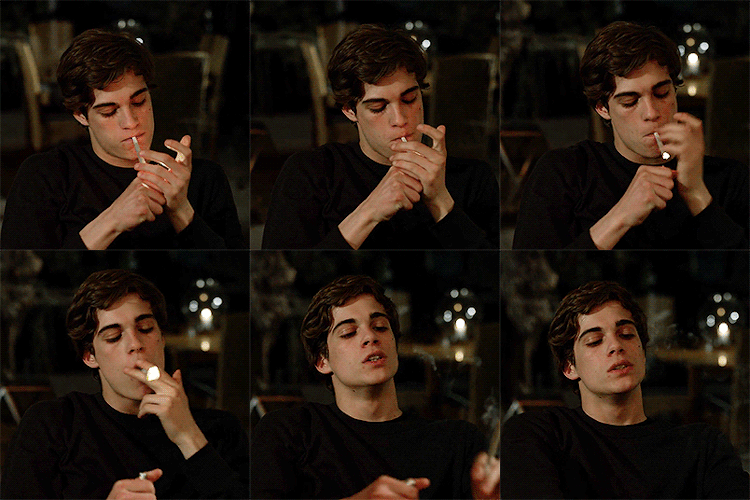
To guide you through the process, I will evaluate Lorenzo Zurzolo's face as an example throughout the entire analysis.
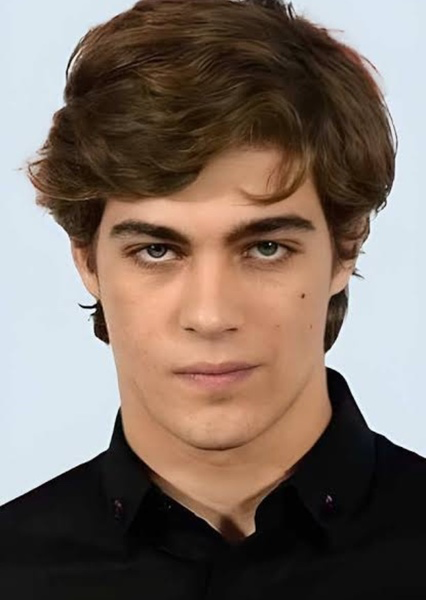
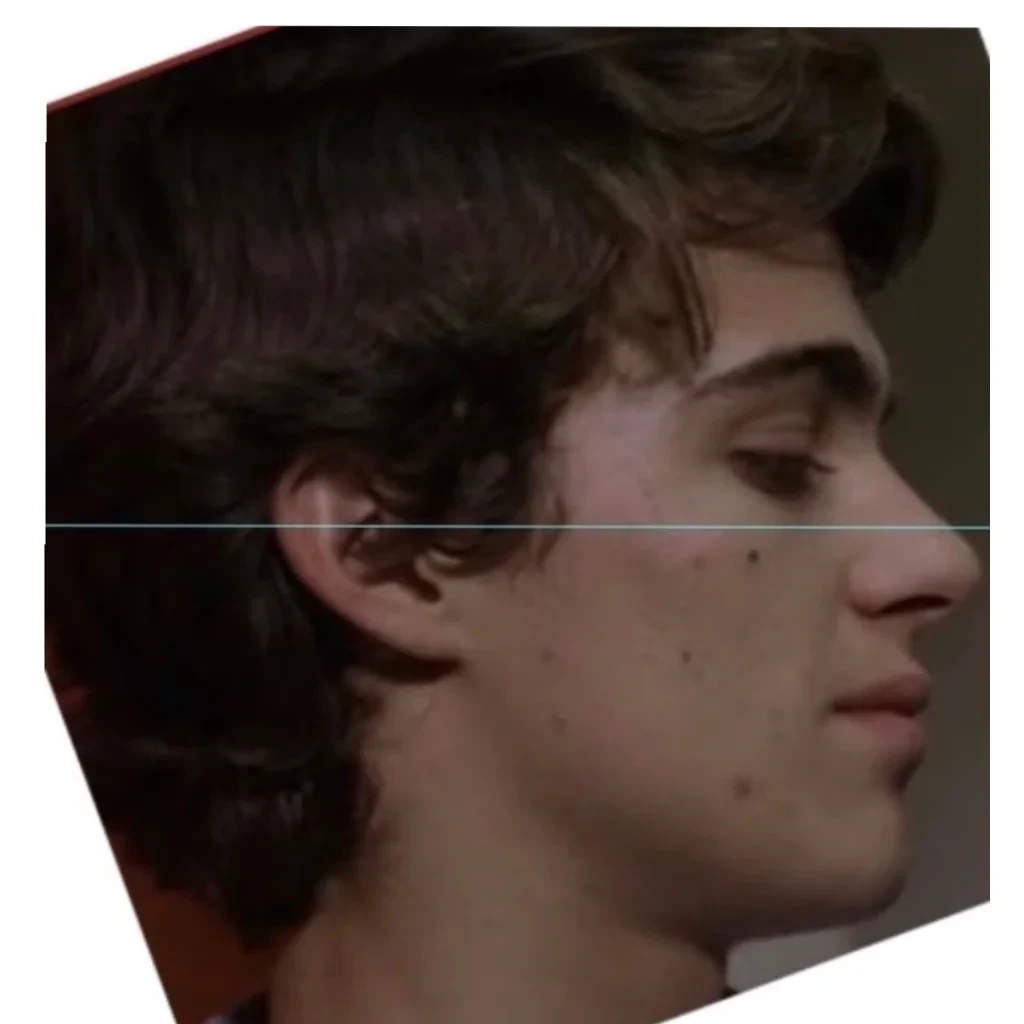
I will underline the Tier I believe most accurate in each sub-metric, the second code box under each pillar is the example's calculation.
1. HARMONY PILLAR
Harmony is the most important pillar, making up 32% of the pre-penalization score.
It's an objective way of analyzing the way a face's traits go with eachother, many ideal harmony measurement have real-life associations, FWHR is heavily associated with dominance, aggressiveness, high testosterone levels and much more, this is one example out of many.
For this step, you will first pick the proper Tier for each sub-metric, after doing all sub-metrics you will sum the values, this will give you the raw pillar score.
Afterwards you will apply the simple formula I will provide below to get your pillar score /10.
| Feature | Tier 1 | Tier 2 | Tier 3 | Tier 4 | Tier 5 | Tier 6 | Tier 7 | Ideal |
|---|---|---|---|---|---|---|---|---|
| Jaw Width | 20.59 | 18.53 | 10.29 | 6.18 | -18.53 | -46.32 | - | 87.5-91.5% bigonial width relative to cheekbones |
| Eye to Eyebrow Distance / Eyebrow Setness | 19.83 | 17.84 | 9.91 | 5.95 | -5.95 | -11.90 | - | brows close to eyes without drooping |
| Brow Ridge Inclination Angle | 19.83 | 17.84 | 9.91 | 5.96 | -5.96 | -11.90 | - | smooth but defined brow ridge |
| Facial Thirds | 19.83 | 17.84 | 9.91 | 5.95 | -5.95 | -11.90 | - | Upper: 30-32%, Middle: 31.4-33.4%, Lower: 33.9-37.0% |
| Nasofrontal Angle | 19.06 | 17.16 | 9.53 | 5.72 | -5.72 | -34.31 | - | 116–128° |
| Neck Width | 19.06 | 17.16 | 9.53 | 5.72 | -17.16 | -34.31 | - | 92-98% relative to bigonial width |
| Lower Third Proportion | 18.30 | 16.47 | 9.15 | 5.49 | -5.49 | -10.98 | - | Lower third = ~34-37% of total face height |
| FWHR | 18.30 | 16.47 | 9.15 | 5.49 | -16.47 | -49.41 | - | 1.95-2.05 |
| Eye Aspect Ratio | 18.30 | 16.47 | 9.15 | 5.49 | -5.49 | -10.98 | - | 3-3.7x |
| Gonial Angle | 16.78 | 15.10 | 8.39 | 5.03 | -10.07 | -20.13 | - | ~115-121º° |
| Ramus Length | 14.41 | 14.41 | 8.01 | 5.80 | -10.59 | -20.13 | - | Long ramus with strong vertical jaw height |
| Thirds of Jaw | 17.54 | 15.78 | 8.77 | 6.48 | -3.89 | -23.35 | - | Symmetric vertical jaw thirds and a balanced mandible height |
| Chin to Philtrum Ratio | 12.96 | 11.67 | 6.48 | 3.89 | -1.95 | -3.89 | - | Short philtrum proportional to chin; 2.1-2.5 Chin-Philtrum ratio |
| Lateral Canthal Tilt | 12.35 | 11.12 | 6.18 | 3.71 | -3.71 | -7.4 | - | 6-8º positive |
| Mouth to Nose Ratio | 12.35 | 11.12 | 6.18 | 3.71 | -3.71 | -7.4 | - | 1.4-1.6x |
| Eye Separation/esr | 12.20 | 10.98 | 6.59 | 3.66 | -10.98 | -65.88 | - | ESR: 45-47% of bizygomatic width |
| Midface Ratio | 11.90 | 10.71 | 5.95 | 3.57 | -3.57 | -7.14 | - | 0.98-1.02 |
| Jaw Frontal Angle | 9.15 | 8.24 | 4.58 | 2.75 | -4.58 | -9.15 | - | 86.5-92.5º |
| Cheekbone Setness | 20 | 10 | 5 | 2.5 | 0 | -2.5 | - | High, laterally projecting zygos with visible ogee curve |
| Face Length | 20 | 10 | 5 | 2.5 | 0 | -2.5 | - | 1.33-1.37x |
| Bizygomatic Width | 20 | 10 | 5 | 2.5 | 0 | -2.5 | - | Wide and proportional relative to the rest of the face |
| Nose to Bizygomatic Ratio | 7 | 3.75 | 1.88 | 0.94 | 0 | -0.94 | - | Nose width ~20% of cheekbone width |
| Eyebrow Tilt | 10 | 5 | 2.5 | 0 | -2.5 | -5 | - | 6.5-11º |
| Medial Canthal Angle | 7.5 | 3.75 | 1.88 | 0 | -1.88 | -3.75 | - | Symmetric medial canthi forming subtle inward angle |
| Bitemporal Width | 7.5 | 3.75 | 1.88 | 0 | -1.88 | -3.75 | - | 85-92% of bizygomatic width |
| Lower Third Proportion | 2.5 | 2.5 | 1.25 | 0 | -1.25 | -2.5 | - | Nostril-Commisure: 31-33.5% of total Lower third height |
MAX score: 389.74
WORST score: -409.92
Lorenzo's raw score: 285.54
To calculate a total HARM score, use this formula
Code:
((YOURHARM - WORSTHARM) / (MAXHARM - WORSTHARM) X 100
=((YOURHARM + 409.92) / 799.66) X 100
Code:
((285.54 + 409.92) / 799.66) X 100 = 86.96This would give our example a harmony score of 8.70/10 or 87.0%
2. MISCELLANEOUS FEATURES PILLAR
Features are the second most important pillar, making up 26% of the pre-penalization score.
They include coloring, health indicators, unquantifiable metrics and much more making it an essential pillar.
For this step, you will again first pick the proper Tier for each sub-metric, after doing all sub-metrics you will sum the values, this will give you the raw pillar score.
Afterwards you will apply the simple formula I will provide below to get your pillar score /10.
| Skin | Tier 1 | Tier 2 | Tier 3 | Tier 4 | Tier 5 | Tier 6 | Tier 7 | Tier 8 | Ideal |
|---|---|---|---|---|---|---|---|---|---|
| Skin clearness (acne + blemishes) | 50 | 25 | 10 | 5 | 0 | -10 | -20 | -30 | No acne or blemishes |
| Hyperpigmentation | 30 | 10 | 5 | 2 | 0 | -5 | -10 | -30 | None |
| Moles | 10 | 7 | 5 | 3 | 1 | 0 | -5 | -10 | None |
| Skin texture | 15 | 10 | 5 | 3 | 1 | 0 | -2 | -5 | Smooth |
| Acne scarring | 15 | 10 | 5 | 3 | 1 | 0 | -2 | -5 | None |
| Facial folds + wrinkles | 40 | 20 | 10 | 5 | 2 | 0 | -5 | -15 | None |
| Eye area | Tier 1 | Tier 2 | Tier 3 | Tier 4 | Tier 5 | Tier 6 | Tier 7 | Tier 8 | Ideal |
|---|---|---|---|---|---|---|---|---|---|
| Upper eyelid | 35 | 20 | 10 | 5 | 3 | 0 | -5 | -15 | No UEE, straight/curved, no drooping |
| Lower eyelid shape | 20 | 10 | 5 | 3 | 1 | 0 | -3 | -8 | Straight/slightly curved, no drooping |
| Sclera show | 15 | 5 | 3 | 1 | 0 | -5 | -10 | -15 | None |
| Eyelashes | 15 | 8 | 4 | 2 | 0 | -2 | -4 | Thick, dense, dark | |
| Eyebrows | 30 | 18 | 9 | 5 | 2 | 0 | -5 | -15 | Thick, dense, long, dark |
| Periorbital darkening | 25 | 10 | 5 | 0 | -5 | -10 | -30 | -50 | None |
| Under eye circles | 15 | 8 | 4 | 2 | 0 | -3 | -5 | -15 | None |
| LEE | 15 | 10 | 5 | 2 | 0 | -5 | -8 | None | |
| Eye colour | 10 | 7 | 5 | Light colour | |||||
| Scleral triangles | 8 | 4 | 2 | 1 | 0 | -5 | -10 | -15 | Even triangles |
| Medial canthus | 10 | 5 | 2 | 0 | -1 | Downturned, long, not thin | |||
| PFL | 20 | 10 | 5 | 3 | 0 | -5 | -10 | -15 | 27mm+ (iris method), long |
| Sclera colour | 8 | 4 | 2 | 0 | White, with no yellowness or redness | ||||
| Unibrow | 5 | 3 | 1 | -2 | -5 | -10 | -15 | -30 | None |
| Colouring | Tier 1 | Tier 2 | Tier 3 | Tier 4 | Tier 5 | Tier 6 | Tier 7 | Tier 8 | Ideal |
|---|---|---|---|---|---|---|---|---|---|
| Skin colour | 30 | 10 | 5 | 3 | 0 | Tanned, dark Fitzpatrick II to low Fitzpatrick IV | |||
| Lip colour | 15 | 10 | 5 | 3 | 0 | -3 | Reddish pink | ||
| Eyelash visibility | 15 | 8 | 4 | 2 | 0 | Contrasting + visible | |||
| Eye colour | 20 | 10 | 5 | Light eye colour | |||||
| Hair colour | 25 | 10 | 5 | 0 | Dark colour | ||||
| Eyebrow colour | 20 | 10 | 5 | 0 | Dark colour | ||||
| Sclera whiteness | 10 | 5 | 0 | White, with no yellowness or redness |
| Overall lower third | Tier 1 | Tier 2 | Tier 3 | Tier 4 | Tier 5 | Tier 6 | Tier 7 | Tier 8 | Ideal |
|---|---|---|---|---|---|---|---|---|---|
| Gonions | 40 | 20 | 10 | 5 | 3 | 0 | -5 | Flared | |
| Chin shape | 30 | 15 | 8 | 4 | 2 | 0 | -5 | Square | |
| Chin width | 25 | 13 | 7 | 3 | 0 | -5 | Wide | ||
| Ramus length | 35 | 20 | 10 | 5 | 3 | 0 | -5 | Tall | |
| Mandible length | 30 | 15 | 8 | 4 | 2 | 0 | -5 | Long & straight | |
| Mandible shape | 10 | 5 | 3 | 1 | 0 | -3 | Straight (minimal antegonial notch) |
| Lips | Tier 1 | Tier 2 | Tier 3 | Tier 4 | Tier 5 | Tier 6 | Tier 7 | Tier 8 | Ideal |
|---|---|---|---|---|---|---|---|---|---|
| Lip width | 25 | 12 | 6 | 3 | 1 | 0 | -5 | Wide | |
| Philtrum length | 20 | 10 | 5 | 3 | 1 | 0 | -5 | Short (not excessive) | |
| Philtrum ridges | 10 | 5 | 2 | 0 | -3 | Defined | |||
| Lip fullness | 15 | 8 | 4 | 2 | 1 | 0 | -5 | Full | |
| Lip health | 15 | 8 | 4 | 2 | 1 | 0 | -5 | No cracking | |
| Commissures | 10 | 5 | 2 | 0 | -3 | Slight upturn | |||
| Cupid’s bow | 10 | 5 | 2 | 0 | -3 | Prominent | |||
| Lip seal | 5 | 3 | 1 | 0 | -3 | Straight, aligned with vermillion border |
| Nose | Tier 1 | Tier 2 | Tier 3 | Tier 4 | Tier 5 | Tier 6 | Tier 7 | Tier 8 | Ideal |
|---|---|---|---|---|---|---|---|---|---|
| Alar width | 15 | 8 | 4 | 2 | 1 | 0 | -5 | Not wide | |
| Nose bulbosity | 20 | 10 | 5 | 3 | 1 | 0 | -5 | Low bulbousness | |
| Nasal tip | 25 | 12 | 6 | 3 | 1 | 0 | -5 | Defined, not droopy | |
| Nostril show | 20 | 10 | 5 | 3 | 1 | 0 | -5 | Minimal | |
| Nostril flare | 10 | 5 | 2 | 0 | -3 | None | |||
| Dorsum | 5 | 3 | 1 | 0 | -3 | Straight | |||
| Radix projection | 15 | 8 | 4 | 2 | 1 | 0 | -5 | Projected, visible nasofrontal angle |
| Other misc | Tier 1 | Tier 2 | Tier 3 | Tier 4 | Tier 5 | Tier 6 | Tier 7 | Tier 8 | Ideal |
|---|---|---|---|---|---|---|---|---|---|
| Ears | 15 | 8 | 4 | 0 | -5 | -10 | -20 | -40 | Pinned back |
| Symmetry | 100 | 70 | 50 | 30 | 10 | 0 | -10 | -50 | Minimal asymmetry |
MAX score: 1031
WORST score: -460
Lorenzo's raw score: 698
Formula:
Code:
((YOURMISC - WORSTMISC) / (MAXMISC - WORSTMISC) X 100
=((YOURMISC + 460) / 1491) X 100
Code:
((698 + 460) / 1491) X 100 = 77.67This would give our example a features score of 7.77/10 or 77.7%
3. ANGULARITY PILLAR
Angularity is the third most important pillar, making up 22% of the pre-penalization score.
It signals an adequate body fat, optimal health and a fat distribution proper of a youthful individual.
For this step, you will again first pick the proper Tier for each sub-metric, after doing all sub-metrics you will sum the values, this will give you the raw pillar score.
Afterwards you will apply the simple formula I will provide below to get your pillar score /10.
| Feature | Tier 1 | Tier 2 | Tier 3 | Tier 4 | Tier 5 | Tier 6 | Tier 7 | Ideal |
|---|---|---|---|---|---|---|---|---|
| Mandible Visibility (Front) | 24.75 | 21.04 | 17.33 | 13.61 | 9.90 | 6.19 | 3.09 | Broad mandible flare, clear contour, no lower-face fat masking |
| Facial 3D-ness | 18.75 | 15.94 | 13.13 | 10.33 | 7.52 | 4.71 | 2.36 | Strong midface projection, sharp anterior depth, good orbital support |
| Gonion Sharpness | 18.75 | 15.94 | 13.13 | 10.33 | 7.52 | 4.71 | 2.36 | Well-defined gonial angle, visible edge |
| Facial Depth | 17.25 | 14.66 | 12.08 | 9.49 | 6.91 | 4.33 | 2.17 | Strong maxilla + mandible forward projection |
| Mandible & Ramus Visibility | 16.74 | 14.23 | 11.71 | 9.19 | 6.68 | 4.17 | 2.09 | Long, tall ramus, sharp rear-jaw contour clearly visible from front |
| Ogee Curve | 15.75 | 13.39 | 11.03 | 8.67 | 6.30 | 3.94 | 1.97 | Defined midface curve, strong high cheekbone projection |
| Cheekbone Visibility | 15.11 | 12.85 | 10.58 | 8.32 | 6.05 | 3.79 | 1.89 | High, wide-set malars, strong lateral projection, sharp shadow line (aka. hollow cheeks) |
| Chin Angularity | 12.30 | 10.46 | 8.61 | 6.77 | 4.92 | 3.08 | 1.54 | Squared chin pad, sharp pogonion definition, low convexity |
| Lower-Midface Fat | 10.43 | 8.86 | 7.30 | 5.73 | 4.17 | 3.13 | 1.56 | Minimal buccal fat, sharp lines, lean jaw contour |
MAX score: 149.83
WORST score: 19.03
Lorenzo's raw score: 110.66
Formula:
Code:
((YOURANGU - WORSTANGU) / (MAXANGU - WORSTANGU) X 100
=((YOURANGU - 19.03) / 130.80) X 100
Code:
((110.66 - 19.03) / 130.80) X 100 = 70.05This would give our example an angularity score of 7.01/10 or 70.1%
4. DIMORPHISM PILLAR
Dimorphism is the least important pillar by a small margin, making up 20% of the pre-penalization score.
But it still makes up 1/5 of male attractiveness, it is a biological necessity that our partner's gender is instantly recognizable by their face.
It can actually be roughly eyeballed using the chart below but I still recommend using the method below for the overall score when using this formula.
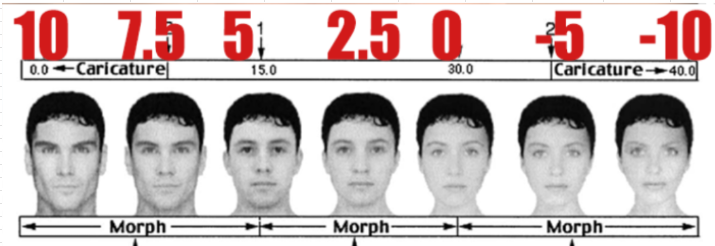
For this step, you will again first pick the proper Tier for each sub-metric, after doing all sub-metrics you will sum the values, this will give you the raw pillar score.
Afterwards you will apply the simple formula I will provide below to get your pillar score /10.
| Feature | Tier 1 | Tier 2 | Tier 3 | Tier 4 | Tier 5 | Ideal (highest masculinity) |
|---|---|---|---|---|---|---|
| Eye depth | 22.32 | 16.74 | 11.16 | 0.00 | -33.48 | Very deepset eyes with strong supraorbital projection and obvious orbital shadowing |
| Brow ridge shape | 13.44 | 10.08 | 6.72 | 3.36 | -3.36 | Pronounced brow bossing with a sharp, continuous supraorbital margin. |
| Chin shape | 12.72 | 9.54 | 6.36 | 3.36 | -12.72 | Broad, square chin with forward projection and a strong pogonion. Minimal taper, well-defined horizontal chin plane. |
| Buccal fat size | 11.70 | 8.78 | 5.85 | 2.93 | -2.93 | Very low buccal fat, hollowing beneath the cheekbones, clear cheek/mandible shadowing that enhances male angularity. |
| Ramus length (front) | 11.53 | 8.65 | 5.77 | 2.88 | -2.88 | Tall, visible ramus with strong vertical jaw height producing a long lower face and a dominant jawline from frontal view. |
| Gonion outward growth | 11.04 | 8.28 | 5.52 | 2.76 | -2.76 | Wide gonial flare, laterally projecting jaw angle that creates a broad, V-to-square lower face silhouette. |
| Narrowing upper third | 9.00 | 6.75 | 4.50 | 2.25 | -2.25 | Noticeably narrower upper third (temples to brow) relative to mid/lower face |
| Facial hair development | 7.80 | 5.85 | 3.90 | 1.95 | -1.95 | Dense, coarse facial hair covering jaw, chin and cheeks. full beard or heavy stubble that reinforces masculine lower-face mass. |
| Rough skin texture | 7.20 | 5.40 | 3.60 | 1.80 | -1.80 | Thicker, textured dermis with visible pores/roughness consistent with mature male skin. |
| Cheekbone size | 6.91 | 5.18 | 3.46 | 1.73 | -1.73 | High, laterally projecting malar bones with clear shadow lines beneath cheekbones that support a strong midface and sharp ogee curve. |
| Lip fullness | 6.34 | 4.75 | 3.17 | 1.58 | -1.58 | Relatively thin to average lips (reduced fullness), tighter vermillion border. |
MAX score: 120
WORST score: -67.44
Lorenzo's raw score: 63.13
Formula:
Code:
((YOURDIMO - WORSTDIMO) / (MAXDIMO - WORSTDIMO) X 100
=((YOURDIMO + 67.44) / 187.44) X 100
Code:
((63.13 + 67.44) / 187.44) X 100 = 69.66This would give our example a dimorphism score of 6.97/10 or 69.7%
5. THE MATH
Remember you can just use the prompt from here to get your final score!
Code:
You are acting exclusively as a precise mathematical execution engine and formatting tool for a facial aesthetics framework.


I will provide you with the raw accumulated scores for four foundational pillars: YOUR_HARM, YOUR_MISC, YOUR_ANGU, and YOUR_DIMO. Your sole task is to execute the step-by-step mathematical transformation, handle the dynamic penalty weighting system, and generate the mandatory final output report exactly as structured below.


Do not add commentary, meta-reflections, or conversational filler. Output only the data sections.


### INPUT DATA
YOUR_HARM = [INSERT VALUE]
YOUR_MISC = [INSERT VALUE]
YOUR_ANGU = [INSERT VALUE]
YOUR_DIMO = [INSERT VALUE]


---


### STEP-BY-STEP MATHEMATICAL VERIFICATION


Execute and display the calculations for each step using 4 decimal places for precision during intermediate steps:


#### Step 1: Base Pillar Percentages & 0–10 Scaling
*   **HARM Scaling:**
    *   MAX_HARM = 389.74, WORST_HARM = -409.92
    *   HARM% = ((YOUR_HARM - (-409.92)) / (389.74 - (-409.92))) * 100
    *   HARM_10 = HARM% / 10
*   **MISC Scaling:**
    *   MAX_MISC = 1031, WORST_MISC = -460
    *   MISC% = ((YOUR_MISC - (-460)) / (1031 - (-460))) * 100
    *   MISC_10 = MISC% / 10
*   **ANGU Scaling:**
    *   MAX_ANGU = 149.83, WORST_ANGU = 19.03
    *   ANGU% = ((YOUR_ANGU - 19.03) / (149.83 - 19.03)) * 100
    *   ANGU_10 = ANGU% / 10
*   **DIMO Scaling:**
    *   MAX_DIMO = 120, WORST_DIMO = -67.44
    *   DIMO% = ((YOUR_DIMO - (-67.44)) / (120 - (-67.44))) * 100
    *   DIMO_10 = DIMO% / 10


#### Step 2: Penalty Factor Assignment
Evaluate each calculated 0–10 pillar score (S) against the Penalty Factor Table. Select the highest single threshold condition that S satisfies:
*   S ≥ 8.0: factor = 1.00
*   S ≥ 7.5: factor = 1.05
*   S ≥ 7.0: factor = 1.10
*   S ≥ 6.5: factor = 1.25
*   S ≥ 6.0: factor = 1.45
*   S ≥ 5.5: factor = 1.70
*   S ≥ 5.0: factor = 2.00
*   S ≥ 4.5: factor = 2.35
*   S ≥ 4.0: factor = 2.75
*   S ≥ 3.5: factor = 2.20
*   S ≥ 3.0: factor = 2.70
*   S ≥ 2.5: factor = 3.25
*   S < 2.5: factor = 3.85


*Record assigned factors:*
*   penalty_factor_HARM = [Value]
*   penalty_factor_MISC = [Value]
*   penalty_factor_ANGU = [Value]
*   penalty_factor_DIMO = [Value]


#### Step 3: Penalized Contribution Calculation
Multiply each pillar score by its respective base weight and its assigned penalty factor:
*   HARM_base = 0.32 | MISC_base = 0.26 | ANGU_base = 0.22 | DIMO_base = 0.20
*   HARM_pen = HARM_10 × 0.32 × penalty_factor_HARM
*   MISC_pen = MISC_10 × 0.26 × penalty_factor_MISC
*   ANGU_pen = ANGU_10 × 0.22 × penalty_factor_ANGU
*   DIMO_pen = DIMO_10 × 0.20 × penalty_factor_DIMO
*   total = HARM_pen + MISC_pen + ANGU_pen + DIMO_pen


#### Step 4: Weight Normalization
Divide each penalized contribution by the global total to yield the self-balancing weights (ensuring they sum to 1.00):
*   HARM_weight = HARM_pen / total
*   MISC_weight = MISC_pen / total
*   ANGU_weight = ANGU_pen / total
*   DIMO_weight = DIMO_pen / total


#### Step 5: Final Weighted Composition
*   TRUE_SCORE = (HARM_10 × HARM_weight) + (MISC_10 × MISC_weight) + (ANGU_10 × ANGU_weight) + (DIMO_10 × DIMO_weight)


---


### MANDATORY FINAL OUTPUT FORMAT


Provide the final results rounded strictly to 2 decimal places in this exact structural block:


HARM: [HARM_10]/10
MISC: [MISC_10]/10
ANGU: [ANGU_10]/10
DIMO: [DIMO_10]/10
TRUE_SCORE: [TRUE_SCORE]/10


Looks rating: [TRUE_SCORE]/10 (~[Insert matching narrative tier from the reference scale below])


*0-10 Male Looks Scale Reference Mapping:*
*   0–2: Unbelievably unattractive
*   2–3: Extremely unattractive
*   3–4: Very unattractive
*   4–5: Below average
*   5–6: Slightly above average
*   6–7: Noticeably attractive
*   7–8: Very attractive
*   8–9: Extremely attractive
*   9–10: Near perfect, one in millions


Post-penalty weights:
HARM_weight: [HARM_weight]
MISC_weight: [MISC_weight]
ANGU_weight: [ANGU_weight]
DIMO_weight: [DIMO_weight]
Next step: Apply logarithmic penalty weight
- HARM_base = 0.32
- MISC_base = 0.26
- ANGU_base = 0.22
- DIMO_base = 0.20
- MISC_base = 0.26
- ANGU_base = 0.22
- DIMO_base = 0.20
The penalty factor increases as the pillar gets worse (lower score). This means worse pillars get a larger penalty factor, which will give them more relative weight in the final score.
Pillar score (0-10) ≥ 8.0: penalty_factor = 1.00
Pillar score (0-10) ≥ 7.5: penalty_factor = 1.05
Pillar score (0-10) ≥ 7.0: penalty_factor = 1.10
Pillar score (0-10) ≥ 6.5: penalty_factor = 1.25
Pillar score (0-10) ≥ 6.0: penalty_factor = 1.45
Pillar score (0-10) ≥ 5.5: penalty_factor = 1.70
Pillar score (0-10) ≥ 5.0: penalty_factor = 2.00
Pillar score (0-10) ≥ 4.5: penalty_factor = 2.35
Pillar score (0-10) ≥ 4.0: penalty_factor = 2.75
Pillar score (0-10) ≥ 3.5: penalty_factor = 2.20
Pillar score (0-10) ≥ 3.0: penalty_factor = 2.70
Pillar score (0-10) ≥ 2.5: penalty_factor = 3.25
Pillar score (0-10) < 2.5: penalty_factor = 3.85
Selection rule:
For a given pillar score S (0–10), choose the highest threshold that S satisfies.
- If S = 7.0, use the ≥ 7.0 row (penalty_factor = 1.05), not ≥ 7.5.
- If S < 2.5, penalty_factor = 3.25.
Pillar score (0-10) ≥ 8.0: penalty_factor = 1.00
Pillar score (0-10) ≥ 7.5: penalty_factor = 1.05
Pillar score (0-10) ≥ 7.0: penalty_factor = 1.10
Pillar score (0-10) ≥ 6.5: penalty_factor = 1.25
Pillar score (0-10) ≥ 6.0: penalty_factor = 1.45
Pillar score (0-10) ≥ 5.5: penalty_factor = 1.70
Pillar score (0-10) ≥ 5.0: penalty_factor = 2.00
Pillar score (0-10) ≥ 4.5: penalty_factor = 2.35
Pillar score (0-10) ≥ 4.0: penalty_factor = 2.75
Pillar score (0-10) ≥ 3.5: penalty_factor = 2.20
Pillar score (0-10) ≥ 3.0: penalty_factor = 2.70
Pillar score (0-10) ≥ 2.5: penalty_factor = 3.25
Pillar score (0-10) < 2.5: penalty_factor = 3.85
Selection rule:
For a given pillar score S (0–10), choose the highest threshold that S satisfies.
- If S = 7.0, use the ≥ 7.0 row (penalty_factor = 1.05), not ≥ 7.5.
- If S < 2.5, penalty_factor = 3.25.
To make worse pillars weigh more in the final score, we define the penalized weight as:
penalized_contribution_i = score_i × base_weight_i × penalty_factor_i
Where:
- score_i is HARM_10, MISC_10, ANGU_10, or DIMO_10.
- penalty_factor_i is from the table above based on that 0–10 score.
- This makes worse pillars (lower score) have a larger penalty_factor, which increases their contribution relative to better pillars.
Compute:
- HARM_pen = HARM_10 × 0.32 × penalty_factor(HARM_10)
- MISC_pen = MISC_10 × 0.26 × penalty_factor(MISC_10)
- ANGU_pen = ANGU_10 × 0.22 × penalty_factor(ANGU_10)
- DIMO_pen = DIMO_10 × 0.20 × penalty_factor(DIMO_10)
Normalize penalized contributions to sum to 1
total = HARM_pen + MISC_pen + ANGU_pen + DIMO_pen
HARM_weight = HARM_pen / total
MISC_weight = MISC_pen / total
ANGU_weight = ANGU_pen / total
DIMO_weight = DIMO_pen / total
These weights now sum to 1, and worse pillars have larger weights because their penalty_factor is larger.
penalized_contribution_i = score_i × base_weight_i × penalty_factor_i
Where:
- score_i is HARM_10, MISC_10, ANGU_10, or DIMO_10.
- penalty_factor_i is from the table above based on that 0–10 score.
- This makes worse pillars (lower score) have a larger penalty_factor, which increases their contribution relative to better pillars.
Compute:
- HARM_pen = HARM_10 × 0.32 × penalty_factor(HARM_10)
- MISC_pen = MISC_10 × 0.26 × penalty_factor(MISC_10)
- ANGU_pen = ANGU_10 × 0.22 × penalty_factor(ANGU_10)
- DIMO_pen = DIMO_10 × 0.20 × penalty_factor(DIMO_10)
Normalize penalized contributions to sum to 1
total = HARM_pen + MISC_pen + ANGU_pen + DIMO_pen
HARM_weight = HARM_pen / total
MISC_weight = MISC_pen / total
ANGU_weight = ANGU_pen / total
DIMO_weight = DIMO_pen / total
These weights now sum to 1, and worse pillars have larger weights because their penalty_factor is larger.
Last step: Calculating the final score
Code:
TRUE_SCORE = (HARM_10 x HARM_weight) + (MISC_10 x MISC_weight) + (ANGU_10 x ANGU_weight) + (DIMO_10 x DIMO_weight)After all of this, our example would get a score of about 7.76/100, the best face out of hundreds/a thousand faces which I believe most of you will agree with (I used pictures from his prime so 2018-2021 as references for my Tier selection).
HOW TO DO THIS IN <1MIN
I created an AI prompt that includes every single part of this analysis in depth with an attempt of making it as objective as possible.
Use the advanced thinking depth models of whichever one you choose.
Just include a clear front and side profile picture along the prompt (~ 2m distance, no hair covering cheekbones/face, neutral face expression, neutral camera angle, decent lightning).
This method is not accurate, due to AI's nature it is impossible for it to accurately choose each Tier with precision, that said I think it's still worth trying.
Obviously a manual rating will still be more accurate and is recommended but this will take less than a minute so you can't ask for more
Obviously a manual rating will still be more accurate and is recommended but this will take less than a minute so you can't ask for more
Code:
You are a facial aesthetics rater running a strictly objective, metric-by-metric scoring system.
Your goal is to choose the correct Tier for each individual trait with maximum precision and no overestimation will be allowed.
Tier 1 = ideal. Higher tiers = worse. Negative tiers (where defined) = extreme defects.
You must evaluate one MALE face from two photos: (1) neutral front view, (2) neutral side profile.
Do not infer metrics that are not visible. If a metric is ambiguous or not visible, state the limitation and assign the most conservative tier supported by the visible evidence.
CRITICAL RULES FOR OBJECTIVITY
1) Do NOT generalize. Do not say "his eyes are pretty" and then give Tier 1 to all eye traits. Evaluate each sub-metric individually.
2) Use explicit visual criteria. For each metric, compare the observed feature to the ideal description and tier values provided.
3) Do not skip metrics. Every listed sub-metric must be rated with a Tier and a brief justification (1 short sentence).
4) Do not over-correct. If a feature is borderline between two tiers, choose the tier that is more supported by the evidence. If truly ambiguous, choose the lower (better) tier but note the ambiguity.
5) Do not invent values. If a metric requires mm or angles (e.g., PFL = 27 mm, gonial angle 115–125°), estimate conservatively from the photo and state your reasoning.
6) Maintain monotonicity: if any pillar improves (others equal), TRUE_SCORE must increase. Your tier assignments must respect this.


PILLARS
- HARM = Harmony score (base weight 0.32)
- MISC = Miscellaneous score (base weight 0.26)
- ANGU = Angularity score (base weight 0.22)
- DIMO = Dimorphism score (base weight 0.20)


CRITICAL RULE: If any pillar score increases (all others equal), the overall score MUST increase. The system below guarantees this monotonicity while penalizing low pillars by giving them more relative weight when they are worse.


COMPUTATION STEPS


Step 1: Get raw scores for each pillar
Follow sections 1–4 (MISC, ANGU, DIMO, HARM) to compute:
- YOUR_MISC
- YOUR_ANGU
- YOUR_DIMO
- YOUR_HARM
Sum all sub-metric points in each section to get these raw scores.


Step 2: Convert to 0–10 scale
For each pillar, use its specific MAX_* and WORST_*:
- MISC:
  - MAX_MISC = 1031
  - WORST_MISC = -460
  - MISC% = ((YOUR_MISC - WORST_MISC) / (MAX_MISC - WORST_MISC)) * 100
  - MISC_10 = MISC% / 10
- ANGU:
  - MAX_ANGU = 149.83
  - WORST_ANGU = 19.03
  - ANGU% = ((YOUR_ANGU - WORST_ANGU) / (MAX_ANGU - WORST_ANGU)) * 100
  - ANGU_10 = ANGU% / 10
- DIMO:
  - MAX_DIMO = 120
  - WORST_DIMO = -67.44
  - DIMO% = ((YOUR_DIMO - WORST_DIMO) / (MAX_DIMO - WORST_DIMO)) * 100
  -DIMO_10 = DIMO% / 10
- HARM:
  - MAX_HARM = 389.74
  - WORST_HARM = -409.92
  - HARM% = ((YOUR_HARM - WORST_HARM) / (MAX_HARM - WORST_HARM)) * 100
  - HARM_10 = HARM% / 10


Step 3: Apply logarithmic penalty weight based on threshold
Base weights:
- HARM_base = 0.32
- MISC_base = 0.26
- ANGU_base = 0.22
- DIMO_base = 0.20
THRESHOLD = 7.5 (applies to the 0–10 pillar score).
Use the 0–10 pillar score (HARM_10, MISC_10, ANGU_10, DIMO_10) to determine the penalty factor.


PENALTY FACTOR TABLE
The penalty factor increases as the pillar gets worse (lower score). This means worse pillars get a larger penalty factor, which will give them more relative weight in the final score.
Pillar score (0-10) ≥ 8.0: penalty_factor = 1.00
Pillar score (0-10) ≥ 7.5: penalty_factor = 1.05
Pillar score (0-10) ≥ 7.0: penalty_factor = 1.10
Pillar score (0-10) ≥ 6.5: penalty_factor = 1.25
Pillar score (0-10) ≥ 6.0: penalty_factor = 1.45
Pillar score (0-10) ≥ 5.5: penalty_factor = 1.70
Pillar score (0-10) ≥ 5.0: penalty_factor = 2.00
Pillar score (0-10) ≥ 4.5: penalty_factor = 2.35
Pillar score (0-10) ≥ 4.0: penalty_factor = 2.75
Pillar score (0-10) ≥ 3.5: penalty_factor = 2.20
Pillar score (0-10) ≥ 3.0: penalty_factor = 2.70
Pillar score (0-10) ≥ 2.5: penalty_factor = 3.25
Pillar score (0-10) < 2.5: penalty_factor = 3.85


Selection rule:
For a given pillar score S (0–10), choose the highest threshold that S satisfies.
- If S = 7.0, use the ≥ 7.0 row (penalty_factor = 1.05), not ≥ 7.5.
- If S < 2.5, penalty_factor = 3.25.
Penalized contribution (worse pillars get larger penalty → more relative weight)
To make worse pillars weigh more in the final score, we define the penalized weight as:
penalized_contribution_i = score_i × base_weight_i × penalty_factor_i
Where:
- score_i is HARM_10, MISC_10, ANGU_10, or DIMO_10.
- penalty_factor_i is from the table above based on that 0–10 score.
- This makes worse pillars (lower score) have a larger penalty_factor, which increases their contribution relative to better pillars.
Compute:
- HARM_pen = HARM_10 × HARM_base × penalty_factor(HARM_10)
- MISC_pen = MISC_10 × MISC_base × penalty_factor(MISC_10)
- ANGU_pen = ANGU_10 × ANGU_base × penalty_factor(ANGU_10)
- DIMO_pen = DIMO_10 × DIMO_base × penalty_factor(DIMO_10)
Normalize penalized contributions to sum to 1
total = HARM_pen + MISC_pen + ANGU_pen + DIMO_pen
HARM_weight = HARM_pen / total
MISC_weight = MISC_pen / total
ANGU_weight = ANGU_pen / total
DIMO_weight = DIMO_pen / total
These weights now sum to 1, and worse pillars have larger weights because their penalty_factor is larger.


Step 4: Compute final score (weighted average with penalized weights)
TRUE_SCORE =
HARM_10 × HARM_weight +
MISC_10 × MISC_weight +
ANGU_10 × ANGU_weight +
DIMO_10 × DIMO_weight
This guarantees:
Increasing any pillar (others same) → TRUE_SCORE increases.
Pillars below 7.5 have larger penalty_factor, so they get more relative weight.
Lower pillars get stronger penalty (higher penalty_factor) → they pull the final score down more.
No artificial inflation when one pillar is great but others are bad.


MISC SCORE (Miscellaneous) – 26% base
Rate each sub-metric from the tables below. Use the Tier 1-8 exactly as described. Sum all points to get YOUR_MISC.
For each sub-metric, write: "[Metric]: Tier X — [1-sentence justification referencing ideal vs observed]".


1A. Skin
Skin clearness (acne + blemishes):
Tier 1: +50 | Tier 2: +25 | Tier 3: +10 | Tier 4: +5 | Tier 5: 0 | Tier 6: −10 | Tier 7: −20 | Tier 8: −30
Ideal: "No acne or blemishes"
Hyperpigmentation:
Tier 1: +30 | Tier 2: +10 | Tier 3: +5 | Tier 4: +2 | Tier 5: 0 | Tier 6: −5 | Tier 7: −10 | Tier 8: −30
Ideal: "None"
Moles:
Tier 1: +10 | Tier 2: +7 | Tier 3: +5 | Tier 4: +3 | Tier 5: +1 | Tier 6: 0 | Tier 7: −5 | Tier 8: −10
Ideal: "None"
Skin texture:
Tier 1: +15 | Tier 2: +10 | Tier 3: +5 | Tier 4: +3 | Tier 5: +1 | Tier 6: 0 | Tier 7: −2 | Tier 8: −5
Ideal: "Smooth"
Acne scarring:
Tier 1: +15 | Tier 2: +10 | Tier 3: +5 | Tier 4: +3 | Tier 5: +1 | Tier 6: 0 | Tier 7: −2 | Tier 8: −5
Ideal: "None"
Facial folds + wrinkles:
Tier 1: +40 | Tier 2: +20 | Tier 3: +10 | Tier 4: +5 | Tier 5: +2 | Tier 6: 0 | Tier 7: −5 | Tier 8: −15
Ideal: "None"
1B. Eye area
Upper eyelid:
Tier 1: +35 | Tier 2: +20 | Tier 3: +10 | Tier 4: +5 | Tier 5: +3 | Tier 6: 0 | Tier 7: −5 | Tier 8: −15
Ideal: No UEE, straight/curved, no drooping
Lower eyelid shape:
Tier 1: +20 | Tier 2: +10 | Tier 3: +5 | Tier 4: +3 | Tier 5: +1 | Tier 6: 0 | Tier 7: −3 | Tier 8: −8
Ideal: Straight/slightly curved, no drooping
Sclera show:
Tier 1: +15 | Tier 2: +5 | Tier 3: +3 | Tier 4: +1 | Tier 5: 0 | Tier 6: −5 | Tier 7: −10 | Tier 8: −15
Ideal: None
Eyelashes:
Tier 1: +15 | Tier 2: +8 | Tier 3: +4 | Tier 4: +2 | Tier 5: 0 | Tier 6: −2 | Tier 7: −4
Ideal: Thick, dense, dark
Eyebrows:
Tier 1: +30 | Tier 2: +18 | Tier 3: +9 | Tier 4: +5 | Tier 5: +2 | Tier 6: 0 | Tier 7: −5 | Tier 8: −15
Ideal: Thick, dense, long, dark
Periorbital darkening:
Tier 1: +25 | Tier 2: +10 | Tier 3: +5 | Tier 4: 0 | Tier 5: −5 | Tier 6: −10 | Tier 7: −30 | Tier 8: −50
Ideal: None
Under eye circles:
Tier 1: +15 | Tier 2: +8 | Tier 3: +4 | Tier 4: +2 | Tier 5: 0 | Tier 6: −3 | Tier 7: −5 | Tier 8: −15
Ideal: None
LEE:
Tier 1: +15 | Tier 2: +10 | Tier 3: +5 | Tier 4: +2 | Tier 5: 0 | Tier 6: −5 | Tier 7: −8
Ideal: None
Eye colour:
Tier 1: +10 | Tier 2: +7 | Tier 3: +5
Ideal: Light colour
Scleral triangles:
Tier 1: +8 | Tier 2: +4 | Tier 3: +2 | Tier 4: +1 | Tier 5: 0 | Tier 6: −5 | Tier 7: −10 | Tier 8: −15
Ideal: Even triangles
Medial canthus:
Tier 1: +10 | Tier 2: +5 | Tier 3: +2 | Tier 4: 0 | Tier 5: −1
Ideal: Downturned, long, not thin
PFL (palpebral fissure length):
Tier 1: +20 | Tier 2: +10 | Tier 3: +5 | Tier 4: +3 | Tier 5: 0 | Tier 6: −5 | Tier 7: −10 | Tier 8: −15
Ideal: 27 mm long
Sclera colour:
Tier 1: +8 | Tier 2: +4 | Tier 3: +2 | Tier 4: 0
Ideal: White
Unibrow:
Tier 1: +5 | Tier 2: +3 | Tier 3: +1 | Tier 4: −2 | Tier 5: −5 | Tier 6: −10 | Tier 7: −15 | Tier 8: −30
Ideal: None
1C. Colouring
Skin colour:
Tier 1: +30 | Tier 2: +10 | Tier 3: +5 | Tier 4: +3 | Tier 5: 0
Ideal: Tanned, dark Fitzpatrick II to low Fitzpatrick IV
Lip colour:
Tier 1: +15 | Tier 2: +10 | Tier 3: +5 | Tier 4: +3 | Tier 5: 0 | Tier 6: −3
Ideal: Reddish pink
Eyelash visibility:
Tier 1: +15 | Tier 2: +8 | Tier 3: +4 | Tier 4: +2 | Tier 5: 0
Ideal: Contrasting + visible
Eye colour (again here as colouring):
Tier 1: +20 | Tier 2: +10 | Tier 3: +5
Ideal: Light eye colour
Hair colour:
Tier 1: +25 | Tier 2: +10 | Tier 3: +5 | Tier 4: 0
Ideal: Dark colour
Eyebrow colour:
Tier 1: +20 | Tier 2: +10 | Tier 3: +5 | Tier 4: 0
Ideal: Dark colour
Sclera whiteness:
Tier 1: +10 | Tier 2: +5 | Tier 3: 0
Ideal: White with no redness or yellowness
1D. Overall lower third
Gonions:
Tier 1: +40 | Tier 2: +20 | Tier 3: +10 | Tier 4: +5 | Tier 5: +3 | Tier 6: 0 | Tier 7: −5
Ideal: Flared
Chin shape:
Tier 1: +30 | Tier 2: +15 | Tier 3: +8 | Tier 4: +4 | Tier 5: +2 | Tier 6: 0 | Tier 7: −5
Ideal: Square
Chin width:
Tier 1: +25 | Tier 2: +13 | Tier 3: +7 | Tier 4: +3 | Tier 5: 0 | Tier 6: −5
Ideal: Wide
Ramus length:
Tier 1: +35 | Tier 2: +20 | Tier 3: +10 | Tier 4: +5 | Tier 5: +3 | Tier 6: 0 | Tier 7: −5
Ideal: Tall
Mandible length:
Tier 1: +30 | Tier 2: +15 | Tier 3: +8 | Tier 4: +4 | Tier 5: +2 | Tier 6: 0 | Tier 7: −5
Ideal: Long & straight
Mandible shape:
Tier 1: +10 | Tier 2: +5 | Tier 3: +3 | Tier 4: +1 | Tier 5: 0 | Tier 6: −3
Ideal: Straight (minimal antegonial notch)
1E. Lips
Lip width:
Tier 1: +25 | Tier 2: +12 | Tier 3: +6 | Tier 4: +3 | Tier 5: +1 | Tier 6: 0 | Tier 7: −5
Ideal: Wide
Philtrum length:
Tier 1: +20 | Tier 2: +10 | Tier 3: +5 | Tier 4: +3 | Tier 5: +1 | Tier 6: 0 | Tier 7: −5
Ideal: Short (not excessive)
Philtrum ridges:
Tier 1: +10 | Tier 2: +5 | Tier 3: +2 | Tier 4: 0 | Tier 5: −3
Ideal: Defined
Lip fullness:
Tier 1: +15 | Tier 2: +8 | Tier 3: +4 | Tier 4: +2 | Tier 5: +1 | Tier 6: 0 | Tier 7: −5
Ideal: Full
Lip health:
Tier 1: +15 | Tier 2: +8 | Tier 3: +4 | Tier 4: +2 | Tier 5: +1 | Tier 6: 0 | Tier 7: −5
Ideal: No cracking
Commissures:
Tier 1: +10 | Tier 2: +5 | Tier 3: +2 | Tier 4: 0 | Tier 5: −3
Ideal: Slight upturn
Cupid's bow:
Tier 1: +10 | Tier 2: +5 | Tier 3: +2 | Tier 4: 0 | Tier 5: −3
Ideal: Prominent
Lip seal:
Tier 1: +5 | Tier 2: +3 | Tier 3: +1 | Tier 4: 0 | Tier 5: −3
Ideal: Straight, aligned with vermilion border
1F. Nose
Alar width:
Tier 1: +15 | Tier 2: +8 | Tier 3: +4 | Tier 4: +2 | Tier 5: +1 | Tier 6: 0 | Tier 7: −5
Ideal: Not wide
Nose bulbosity:
Tier 1: +20 | Tier 2: +10 | Tier 3: +5 | Tier 4: +3 | Tier 5: +1 | Tier 6: 0 | Tier 7: −5
Ideal: Low bulbousness
Nasal tip:
Tier 1: +25 | Tier 2: +12 | Tier 3: +6 | Tier 4: +3 | Tier 5: +1 | Tier 6: 0 | Tier 7: −5
Ideal: Defined, not droopy
Nostril show:
Tier 1: +20 | Tier 2: +10 | Tier 3: +5 | Tier 4: +3 | Tier 5: +1 | Tier 6: 0 | Tier 7: −5
Ideal: Minimal
Nostril flare:
Tier 1: +10 | Tier 2: +5 | Tier 3: +2 | Tier 4: 0 | Tier 5: −3
Ideal: None
Dorsum:
Tier 1: +5 | Tier 2: +3 | Tier 3: +1 | Tier 4: 0 | Tier 5: −3
Ideal: Straight
Radix projection:
Tier 1: +15 | Tier 2: +8 | Tier 3: +4 | Tier 4: +2 | Tier 5: +1 | Tier 6: 0 | Tier 7: −5
Ideal: Projected, visible nasofrontal angle
1G. Other misc
Ears:
Tier 1: +15 | Tier 2: +8 | Tier 3: +4 | Tier 4: 0 | Tier 5: −5 | Tier 6: −10 | Tier 7: −20 | Tier 8: −40
Ideal: Pinned back
Symmetry:
Tier 1: +100 | Tier 2: +70 | Tier 3: +50 | Tier 4: +30 | Tier 5: +10 | Tier 6: 0 | Tier 7: −10 | Tier 8: −50
Ideal: Minimal asymmetry
Then compute MISC:
MAX_MISC = 1031
WORST_MISC = −460
MISC% = ((YOUR_MISC − WORST_MISC) / (MAX_MISC − WORST_MISC)) × 100
MISC_10 = MISC% / 10


ANGU SCORE (Angularity) – 22% base
Rate each feature from front and side view. Assign the correct tier and sum for YOUR_ANGU.
For each feature, write: "[Feature]: Tier X — [1-sentence justification]".


Mandible Visibility (Front):
Tier 1: 24.75 | Tier 2: 21.04 | Tier 3: 17.33 | Tier 4: 13.61 | Tier 5: 9.90 | Tier 6: 6.19 | Tier 7: 3.09
Ideal: Broad mandible flare, clear contour, no lower-face fat masking
Facial 3D-ness:
Tier 1: 18.75 | Tier 2: 15.94 | Tier 3: 13.13 | Tier 4: 10.33 | Tier 5: 7.52 | Tier 6: 4.71 | Tier 7: 2.36
Ideal: Strong midface projection, sharp anterior depth, good orbital support
Gonion Sharpness:
Tier 1: 18.75 | Tier 2: 15.94 | Tier 3: 13.13 | Tier 4: 10.33 | Tier 5: 7.52 | Tier 6: 4.71 | Tier 7: 2.36
Ideal: Well-defined gonial angle (115–125°) with visible edge
Facial Depth:
Tier 1: 17.25 | Tier 2: 14.66 | Tier 3: 12.08 | Tier 4: 9.49 | Tier 5: 6.91 | Tier 6: 4.33 | Tier 7: 2.17
Ideal: Strong maxilla + mandible forward projection
Mandible & Ramus Visibility:
Tier 1: 16.74 | Tier 2: 14.23 | Tier 3: 11.71 | Tier 4: 9.19 | Tier 5: 6.68 | Tier 6: 4.17 | Tier 7: 2.09
Ideal: Long, tall ramus, sharp rear-jaw contour clearly visible from front
Ogee Curve:
Tier 1: 15.75 | Tier 2: 13.39 | Tier 3: 11.03 | Tier 4: 8.67 | Tier 5: 6.30 | Tier 6: 3.94 | Tier 7: 1.97
Ideal: Defined midface curve, strong high cheekbone projection
Cheekbone Visibility:
Tier 1: 15.11 | Tier 2: 12.85 | Tier 3: 10.58 | Tier 4: 8.32 | Tier 5: 6.05 | Tier 6: 3.79 | Tier 7: 1.89
Ideal: High, wide-set malars, strong lateral projection, hollow cheeks
Chin Angularity:
Tier 1: 12.30 | Tier 2: 10.46 | Tier 3: 8.61 | Tier 4: 6.77 | Tier 5: 4.92 | Tier 6: 3.08 | Tier 7: 1.54
Ideal: Squared chin pad, sharp pogonion definition
Lower-Midface Fat:
Tier 1: 10.43 | Tier 2: 8.86 | Tier 3: 7.30 | Tier 4: 5.73 | Tier 5: 4.17 | Tier 6: 3.13 | Tier 7: 1.56
Ideal: Minimal buccal fat, lean jaw contour
Then compute ANGU:
MAX_ANGU = 149.83
WORST_ANGU = 19.03
ANGU% = ((YOUR_ANGU − WORST_ANGU) / (MAX_ANGU − WORST_ANGU)) × 100
ANGU_10 = ANGU% / 10


DIMO SCORE (Dimorphism / Masculinity) – 20% base
Evaluate masculinity using the DIMO table. For each feature, pick the tier and sum to YOUR_DIMO.
Write: "[Feature]: Tier X — [1-sentence justification]"


****Eye depth:
Tier 1: 22.32 | Tier 2: 16.74 | Tier 3: 11.16 | Tier 4: 0.00 | Tier 5: −33.48
Ideal: Very deepset eyes with strong supraorbital projection
Brow ridge shape:
Tier 1: 13.44 | Tier 2: 10.08 | Tier 3: 6.72 | Tier 4: 3.36 | Tier 5: −3.36
Ideal: Pronounced brow bossing
Chin shape:
Tier 1: 12.72 | Tier 2: 9.54 | Tier 3: 6.36 | Tier 4: 3.36 | Tier 5: −12.72
Ideal: Broad, square, projected chin
Buccal fat size:
Tier 1: 11.70 | Tier 2: 8.78 | Tier 3: 5.85 | Tier 4: 2.93 | Tier 5: −2.93
Ideal: Very low buccal fat, hollowing
Ramus length (front):
Tier 1: 11.53 | Tier 2: 8.65 | Tier 3: 5.77 | Tier 4: 2.88 | Tier 5: −2.88
Ideal: Tall, visible ramus
Gonion outward growth:
Tier 1: 11.04 | Tier 2: 8.28 | Tier 3: 5.52 | Tier 4: 2.76 | Tier 5: −2.76
Ideal: Wide gonial flare
Narrowing upper third:
Tier 1: 9.00 | Tier 2: 6.75 | Tier 3: 4.50 | Tier 4: 2.25 | Tier 5: −2.25
Ideal: Noticeably narrower upper third (temples to brow) relative to mid/lower face
Facial hair development:
Tier 1: 7.80 | Tier 2: 5.85 | Tier 3: 3.90 | Tier 4: 1.95 | Tier 5: −1.95
Rough skin texture:
Tier 1: 7.20 | Tier 2: 5.40 | Tier 3: 3.60 | Tier 4: 1.80 | Tier 5: −1.80
Cheekbone size:
Tier 1: 6.91 | Tier 2: 5.18 | Tier 3: 3.46 | Tier 4: 1.73 | Tier 5: −1.73
Lip fullness:
Tier 1: 6.34 | Tier 2: 4.75 | Tier 3: 3.17 | Tier 4: 1.58 | Tier 5: −1.58
Then compute DIMO:
MAX_DIMO = 120
WORST_DIMO = −67.44
DIMO% = ((YOUR_DIMO − WORST_DIMO) / (MAX_DIMO − WORST_DIMO)) × 100
DIMO_10 = DIMO% / 10


HARM SCORE (Harmony / Proportions) – 32% base
Use the HARM table. For each item below, assign its tier and sum to YOUR_HARM.
Each feature has tier values; you must use the exact coefficients.
Write: "[Feature]: Tier X — [1-sentence justification referencing ideal range vs observed]".


Jaw Width:
Tier 1: 20.59 | Tier 2: 18.53 | Tier 3: 10.29 | Tier 4: 6.18 | Tier 5: −18.53 | Tier 6: −46.32
Ideal: 87.5-91.5% bigonial width relative to cheekbones
Eye to Eyebrow Distance / Eyebrow Setness:
Tier 1: 19.83 | Tier 2: 17.84 | Tier 3: 9.91 | Tier 4: 5.95 | Tier 5: −5.95 | Tier 6: −11.90
Ideal: Brows close to eyes without drooping
Brow Ridge Inclination Angle:
Tier 1: 19.83 | Tier 2: 17.84 | Tier 3: 9.91 | Tier 4: 5.96 | Tier 5: −5.96 | Tier 6: −11.90
Ideal: Smooth and defined brow ridge
Facial Thirds:
Tier 1: 19.83 | Tier 2: 17.84 | Tier 3: 9.91 | Tier 4: 5.95 | Tier 5: −5.95 | Tier 6: −11.90
Ideal: Upper: 30-32%, Middle: 31.4-33.4%, Lower: 33.9-37.0%
Nasofrontal Angle:
Tier 1: 19.06 | Tier 2: 17.16 | Tier 3: 9.53 | Tier 4: 5.72 | Tier 5: −5.72 | Tier 6: −34.31
Ideal: 116–128°
Neck Width:
Tier 1: 19.06 | Tier 2: 17.16 | Tier 3: 9.53 | Tier 4: 5.72 | Tier 5: −17.16 | Tier 6: −34.31
Ideal: 92-98% relative to bigonial width
Lower Third Proportion:
Tier 1: 18.30 | Tier 2: 16.47 | Tier 3: 9.15 | Tier 4: 5.49 | Tier 5: −5.49 | Tier 6: −10.98
Ideal: Nostril-Commisure: 31-33.5%
FWHR:
Tier 1: 18.30 | Tier 2: 16.47 | Tier 3: 9.15 | Tier 4: 5.49 | Tier 5: −16.47 | Tier 6: −49.41
Ideal: 1.95-2.05
Eye Aspect Ratio:
Tier 1: 18.30 | Tier 2: 16.47 | Tier 3: 9.15 | Tier 4: 5.49 | Tier 5: −5.49 | Tier 6: −10.98
Ideal: 3-3.7x
Gonial Angle:
Tier 1: 16.78 | Tier 2: 15.10 | Tier 3: 8.39 | Tier 4: 5.03 | Tier 5: −10.07 | Tier 6: −20.13
Ideal: 115-121º
Ramus Length:
Tier 1: 14.41 | Tier 2: 14.41 | Tier 3: 8.01 | Tier 4: 5.80 | Tier 5: −10.59 | Tier 6: −20.13
Ideal: Long ramus
Thirds of Jaw:
Tier 1: 17.54 | Tier 2: 15.78 | Tier 3: 8.77 | Tier 4: 6.48 | Tier 5: −3.89 | Tier 6: −23.35
Ideal: Symmetric vertical jaw thirds and a balanced mandible height
Chin to Philtrum Ratio:
Tier 1: 12.96 | Tier 2: 11.67 | Tier 3: 6.48 | Tier 4: 3.89 | Tier 5: −1.95 | Tier 6: −3.89
Ideal: 2.1-2.5
Lateral Canthal Tilt:
Tier 1: 12.35 | Tier 2: 11.12 | Tier 3: 6.18 | Tier 4: 3.71 | Tier 5: −3.71 | Tier 6: −7.4
Ideal: 6-8º
Mouth to Nose Ratio:
Tier 1: 12.35 | Tier 2: 11.12 | Tier 3: 6.18 | Tier 4: 3.71 | Tier 5: −3.71 | Tier 6: −7.4
Ideal: 1.4-1.5x
Eye Separation / ESR:
Tier 1: 12.20 | Tier 2: 10.98 | Tier 3: 6.59 | Tier 4: 3.66 | Tier 5: −10.98 | Tier 6: −65.88
Ideal: 45-47%
Midface Ratio:
Tier 1: 11.90 | Tier 2: 10.71 | Tier 3: 5.95 | Tier 4: 3.57 | Tier 5: −3.57 | Tier 6: −7.14
Ideal: 0.98-1.02
Jaw Frontal Angle:
Tier 1: 9.15 | Tier 2: 8.24 | Tier 3: 4.58 | Tier 4: 2.75 | Tier 5: −4.58 | Tier 6: −9.15
Ideal: 86.5-92.5º
Cheekbone Setness:
Tier 1: 20 | Tier 2: 10 | Tier 3: 5 | Tier 4: 2.5 | Tier 5: 0 | Tier 6: −2.5
Ideal: High set, near eye level
Face Length:
Tier 1: 20 | Tier 2: 10 | Tier 3: 5 | Tier 4: 2.5 | Tier 5: 0 | Tier 6: −2.5
Ideal: 1.34-1.37x
Bizygomatic Width:
Tier 1: 20 | Tier 2: 10 | Tier 3: 5 | Tier 4: 2.5 | Tier 5: 0 | Tier 6: −2.5
Ideal: Wide and proportional relative to the rest of the face
Nose to Bizygomatic Ratio:
Tier 1: 7 | Tier 2: 3.75 | Tier 3: 1.88 | Tier 4: 0.94 | Tier 5: 0 | Tier 6: −0.94
Ideal: Nose width ~20% of cheekbone width
Eyebrow Tilt:
Tier 1: 10 | Tier 2: 5 | Tier 3: 2.5 | Tier 4: 0 | Tier 5: −2.5 | Tier 6: −5
Ideal: 6.5-11º
Medial Canthal Angle:
Tier 1: 7.5 | Tier 2: 3.75 | Tier 3: 1.88 | Tier 4: 0 | Tier 5: −1.88 | Tier 6: −3.75
Ideal: Symmetric medial canthi forming subtle inward angle
Bitemporal Width:
Tier 1: 7.5 | Tier 2: 3.75 | Tier 3: 1.88 | Tier 4: 0 | Tier 5: −1.88 | Tier 6: −3.75
Ideal: 85-92% of bizygomatic width
Lower Third Proportion (second entry):
Tier 1: 5 | Tier 2: 2.5 | Tier 3: 1.25 | Tier 4: 0 | Tier 5: −1.25 | Tier 6: −2.5
Ideal: Nostril-Commisure: 31-33.5%


Then compute HARM:
MAX_HARM = 389.74
WORST_HARM = −409.92
HARM% = ((YOUR_HARM − WORST_HARM) / (MAX_HARM − WORST_HARM)) × 100
HARM_10 = HARM% / 10


TIER-SELECTION GUIDELINES (OBJECTIVITY BOOSTER)
- For each metric, first identify the ideal value/range (given in the "Ideal" line).
- Estimate the observed value conservatively from the photos. If you must estimate mm or angles, state your reasoning briefly.
- Compare the observed value to the tier values:
  - If the observed value matches the ideal → Tier 1.
  - If the observed value is almost ideal → Tier 2.
  - If moderately off → Tier 3.
  - If clearly suboptimal but not severe → Tier 4–5.
  - If clearly defective → Tier 6–7.
  - If extreme defect → Tier 8 or equivalent tiers where defined.
- Do not use global impressions. Each metric is independent.
- If two tiers are close, choose the lower (better) tier but note the ambiguity.


FINAL OUTPUT FORMAT
You MUST output exactly:
HARM: X.XX/10
MISC: X.XX/10
ANGU: X.XX/10
DIMO: X.XX/10
TRUE_SCORE: X.XX/10
Then map to 0–10 looks scale:
Looks rating: X.XX/10 (~description)
0–10 Male Looks Scale Reference:
- 0-2: Unbelievably unattractive
- 2–3: Extremely unattractive
- 3–4: Very unattractive
- 4–5: Below average
- 5–6: Slightly above average
- 6–7: Noticeably attractive
- 7–8: Very attractive
- 8–9: Extremely attractive
- 9–10: Near perfect, one in millions
Now evaluate the face metric-by-metric, assign tiers, sum raw scores, convert to /10, apply the penalty formula (with worse pillars getting larger penalty_factor and thus more relative weight), and output the final rating.
At the end of the analysis, also provide the post-penalty weights of each pillar:
Post-penalty weights:
HARM_weight: X.XX
MISC_weight: X.XX
ANGU_weight: X.XX
DIMO_weight: X.XX


Now evaluate the face metric-by-metric accurately, assign tiers, sum raw scores, convert to /10, apply the penalty formula (with worse pillars getting larger penalty_factor and thus more relative weight), and output the final rating.
I highly recommend checking out @BigBallsLarry thread, he provides a more comprehensive introduction on the looks scale and explains on why each element of his formula (and therefore this one in a big part) is the way it is.
A 2–10 Looks Scale and a Structured, Unbiased Guide to Facial Analysis (RATE YOURSELF OR OTHERS WITH EASE)
This thread is meant to serve as a guideline on facial analytics, that is both accurate and objective. In it, we will cover: - an example of a looks scale - with real life examples and ratings - A formula on calculating one’s harmony score. (HARM) - A formula on calculating one’s dismorphism...
looksmax.org
Last edited:










 but u're okay you can reach 7 or more


